Neutron Diffraction
Surendra singh
M.sc-II(Applied physics)
Outline
About the neutron
Magnetic Scattering
Neutron diffraction
Magnetic properties of neutron
Advantages and Disadvantages
Why neutron scattering is important
Application of Neutron diffraction
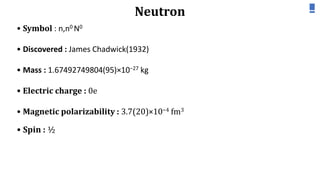
Neutron
• Symbol : n,n0 N0
• Discovered : James Chadwick(1932)
• Mass : 1.67492749804(95)×10−27 kg
• Electric charge : 0e
• Magnetic polarizability : 3.7(20)×10−4 fm3
• Spin : ½
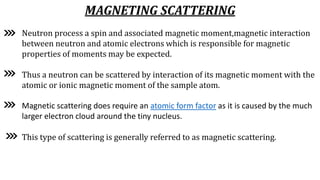
MAGNETING SCATTERING
Neutron process a spin and associated magnetic moment,magnetic interaction
between neutron and atomic electrons which is responsible for magnetic
properties of moments may be expected.
Thus a neutron can be scattered by interaction of its magnetic moment with the
atomic or ionic magnetic moment of the sample atom.
Magnetic scattering does require an atomic form factor as it is caused by the much
larger electron cloud around the tiny nucleus.
This type of scattering is generally referred to as magnetic scattering.
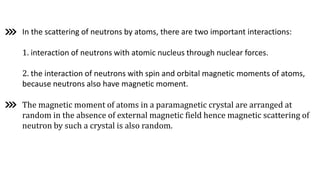
In the scattering of neutrons by atoms, there are two important interactions:
1. interaction of neutrons with atomic nucleus through nuclear forces.
2. the interaction of neutrons with spin and orbital magnetic moments of atoms,
because neutrons also have magnetic moment.
The magnetic moment of atoms in a paramagnetic crystal are arranged at
random in the absence of external magnetic field hence magnetic scattering of
neutron by such a crystal is also random.
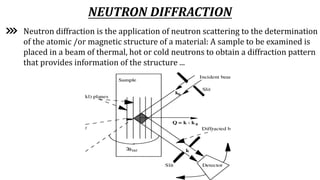
NEUTRON DIFFRACTION
Neutron diffraction is the application of neutron scattering to the determination
of the atomic /or magnetic structure of a material: A sample to be examined is
placed in a beam of thermal, hot or cold neutrons to obtain a diffraction pattern
that provides information of the structure ...
The technique is similar to X-ray diffraction but due to their different scattering
properties, neutrons and X-rays provide complementary information: X-Rays are
suited for superficial analysis, strong x-rays from synchrotron radiation are suited
for shallow depths or thin specimens, while neutrons having high penetration
depth are suited for bulk samples.
Neutrons and X-rays interact with matter differently. X-rays interact primarily with
the electron cloud surrounding each atom. The contribution to the diffracted x-ray
intensity is therefore larger for atoms with larger atomic number (Z). On the other
hand, neutrons interact directly with the nucleus of the atom.
MAGNETIC PROPERTIES OF NEUTRON
The spin of an electron is approximately 1000 times larger than the magnetic
moment of a neutron.
The magnetic moment of the neutron is sufficiently large to give rise to an
interaction with unpaired electrons in magnetic atoms.
In compound containing elements of the first transition series in the periodic table
(Iron, Cobalt and Nickel) the 3d shell contains unpaired electrons.
The magnetic field created by these unpaired electrons in the sample interact with
the neutron magnetic moment to give magnetic scattering.
WHY NEUTRON SCATTERING IS IMPORTANT?
Neutrons have No Charge!
• Highly penetrating
• Nondestructive
• Can be used in extremes
Neutrons have a Magnetic Moment!
• Magnetic structure
• Fluctuations
• Magnetic materials
Neutrons have Spin!
• Polarized beams
• Atomic orientation
Neutrons probe Nuclei!
• Light atom sensitive
• Sensitive to isotopic substitution
TYPES OF NEUTRON
ELASTIC SCATTERING
• No energy transfer to/from sample
• Crystal structure
• Atomic correlation in liquid /glass
INELASTIC SCATTERING
• Energy transfer to/from sample
• Measurement of lattice vibration
(phonons)
• Atomic diffusion
• Molecular modes.
ADVANTAGES
• Mass:
Momentum transfer around interatomic distance
• Zero charge:
highly penetrating: measure bulk properties, can benefit from large samples,
extreme sample environment (high/low temperature, magnetic field, pressure...)
• Spin:
polarization is possible
• Magnetic dipole moment:
Neutrons interact with unpaired electrons.
Magnetic structure and spin excitations can be studied.
DISADVANTAGES
• Low brilliance of sources:
low intensity or resolution, large samples, statistical noise.
• Penetrating:
background hard to control, need large samples
• Some elements (B, Cd, Gd,..) strongly absorb
• Neutral:
hard to manipulate, accelerate, detect, etc
APPLICATION OF NEUTRON DIFFRACTION
• Used for determination of structure
• Locating Light atoms
• Heavy atoms that absorb x-ray strongly
• Similar atomic no /Isotopes
• Magnetic properties
• Single crystal studies analysis
Neutron diffraction

Neutron diffraction

  • 1.
  • 2.
    Outline About the neutron MagneticScattering Neutron diffraction Magnetic properties of neutron Advantages and Disadvantages Why neutron scattering is important Application of Neutron diffraction
  • 3.
    Neutron • Symbol :n,n0 N0 • Discovered : James Chadwick(1932) • Mass : 1.67492749804(95)×10−27 kg • Electric charge : 0e • Magnetic polarizability : 3.7(20)×10−4 fm3 • Spin : ½
  • 4.
    MAGNETING SCATTERING Neutron processa spin and associated magnetic moment,magnetic interaction between neutron and atomic electrons which is responsible for magnetic properties of moments may be expected. Thus a neutron can be scattered by interaction of its magnetic moment with the atomic or ionic magnetic moment of the sample atom. Magnetic scattering does require an atomic form factor as it is caused by the much larger electron cloud around the tiny nucleus. This type of scattering is generally referred to as magnetic scattering.
  • 5.
    In the scatteringof neutrons by atoms, there are two important interactions: 1. interaction of neutrons with atomic nucleus through nuclear forces. 2. the interaction of neutrons with spin and orbital magnetic moments of atoms, because neutrons also have magnetic moment. The magnetic moment of atoms in a paramagnetic crystal are arranged at random in the absence of external magnetic field hence magnetic scattering of neutron by such a crystal is also random.
  • 6.
    NEUTRON DIFFRACTION Neutron diffractionis the application of neutron scattering to the determination of the atomic /or magnetic structure of a material: A sample to be examined is placed in a beam of thermal, hot or cold neutrons to obtain a diffraction pattern that provides information of the structure ...
  • 7.
    The technique issimilar to X-ray diffraction but due to their different scattering properties, neutrons and X-rays provide complementary information: X-Rays are suited for superficial analysis, strong x-rays from synchrotron radiation are suited for shallow depths or thin specimens, while neutrons having high penetration depth are suited for bulk samples. Neutrons and X-rays interact with matter differently. X-rays interact primarily with the electron cloud surrounding each atom. The contribution to the diffracted x-ray intensity is therefore larger for atoms with larger atomic number (Z). On the other hand, neutrons interact directly with the nucleus of the atom.
  • 8.
    MAGNETIC PROPERTIES OFNEUTRON The spin of an electron is approximately 1000 times larger than the magnetic moment of a neutron. The magnetic moment of the neutron is sufficiently large to give rise to an interaction with unpaired electrons in magnetic atoms. In compound containing elements of the first transition series in the periodic table (Iron, Cobalt and Nickel) the 3d shell contains unpaired electrons. The magnetic field created by these unpaired electrons in the sample interact with the neutron magnetic moment to give magnetic scattering.
  • 9.
    WHY NEUTRON SCATTERINGIS IMPORTANT? Neutrons have No Charge! • Highly penetrating • Nondestructive • Can be used in extremes Neutrons have a Magnetic Moment! • Magnetic structure • Fluctuations • Magnetic materials Neutrons have Spin! • Polarized beams • Atomic orientation Neutrons probe Nuclei! • Light atom sensitive • Sensitive to isotopic substitution
  • 10.
    TYPES OF NEUTRON ELASTICSCATTERING • No energy transfer to/from sample • Crystal structure • Atomic correlation in liquid /glass INELASTIC SCATTERING • Energy transfer to/from sample • Measurement of lattice vibration (phonons) • Atomic diffusion • Molecular modes.
  • 11.
    ADVANTAGES • Mass: Momentum transferaround interatomic distance • Zero charge: highly penetrating: measure bulk properties, can benefit from large samples, extreme sample environment (high/low temperature, magnetic field, pressure...) • Spin: polarization is possible • Magnetic dipole moment: Neutrons interact with unpaired electrons. Magnetic structure and spin excitations can be studied.
  • 12.
    DISADVANTAGES • Low brillianceof sources: low intensity or resolution, large samples, statistical noise. • Penetrating: background hard to control, need large samples • Some elements (B, Cd, Gd,..) strongly absorb • Neutral: hard to manipulate, accelerate, detect, etc
  • 13.
    APPLICATION OF NEUTRONDIFFRACTION • Used for determination of structure • Locating Light atoms • Heavy atoms that absorb x-ray strongly • Similar atomic no /Isotopes • Magnetic properties • Single crystal studies analysis