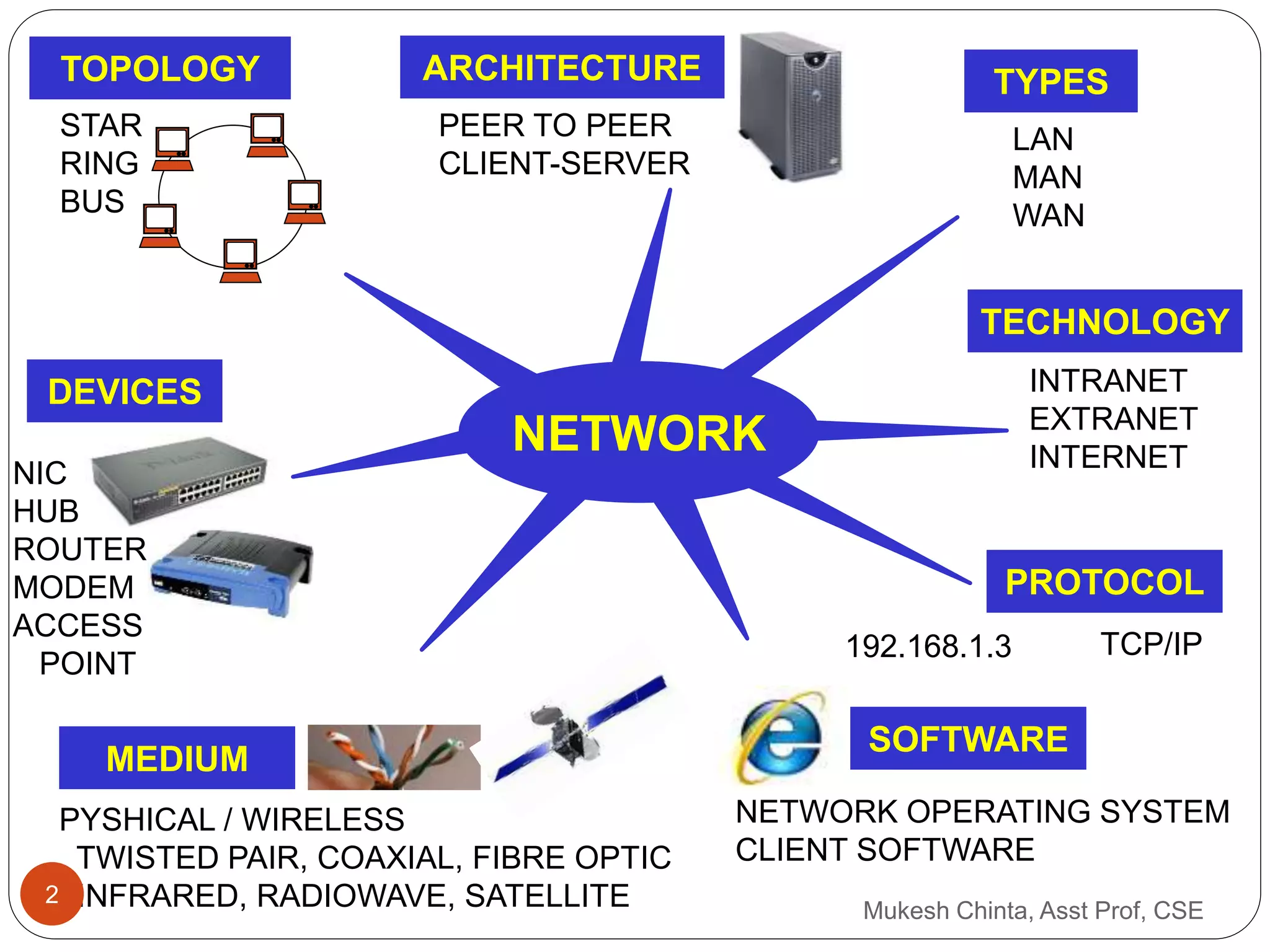
TOPOLOGY
NETWORK
STAR
RING
BUS
PEER TO PEER
CLIENT-SERVER
PYSHICAL / WIRELESS
TWISTED PAIR, COAXIAL, FIBRE OPTIC
INFRARED, RADIOWAVE, SATELLITE
NIC
HUB
ROUTER
MODEM
ACCESS
POINT
LAN
MAN
WAN
INTRANET
EXTRANET
INTERNET
TCP/IP
NETWORK OPERATING SYSTEM
CLIENT SOFTWARE
ARCHITECTURE TYPES
TECHNOLOGY
PROTOCOL
SOFTWARE
MEDIUM
DEVICES
192.168.1.3
Mukesh Chinta, Asst Prof, CSE
2
Classification of Networks
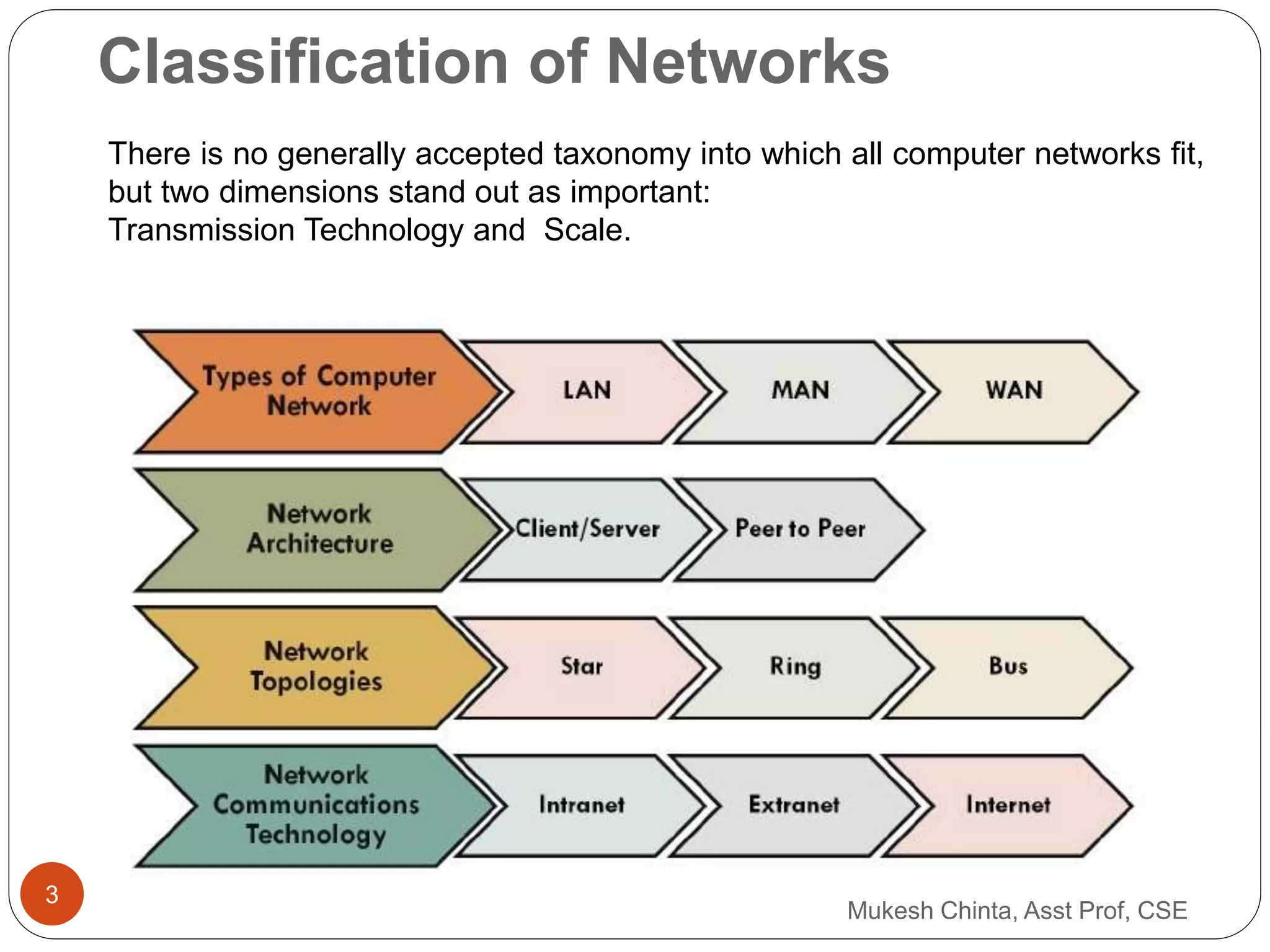
There is no generally accepted taxonomy into which all computer networks fit,
but two dimensions stand out as important:
Transmission Technology and Scale.
Mukesh Chinta, Asst Prof, CSE
3
4
Based on Transmission Technology
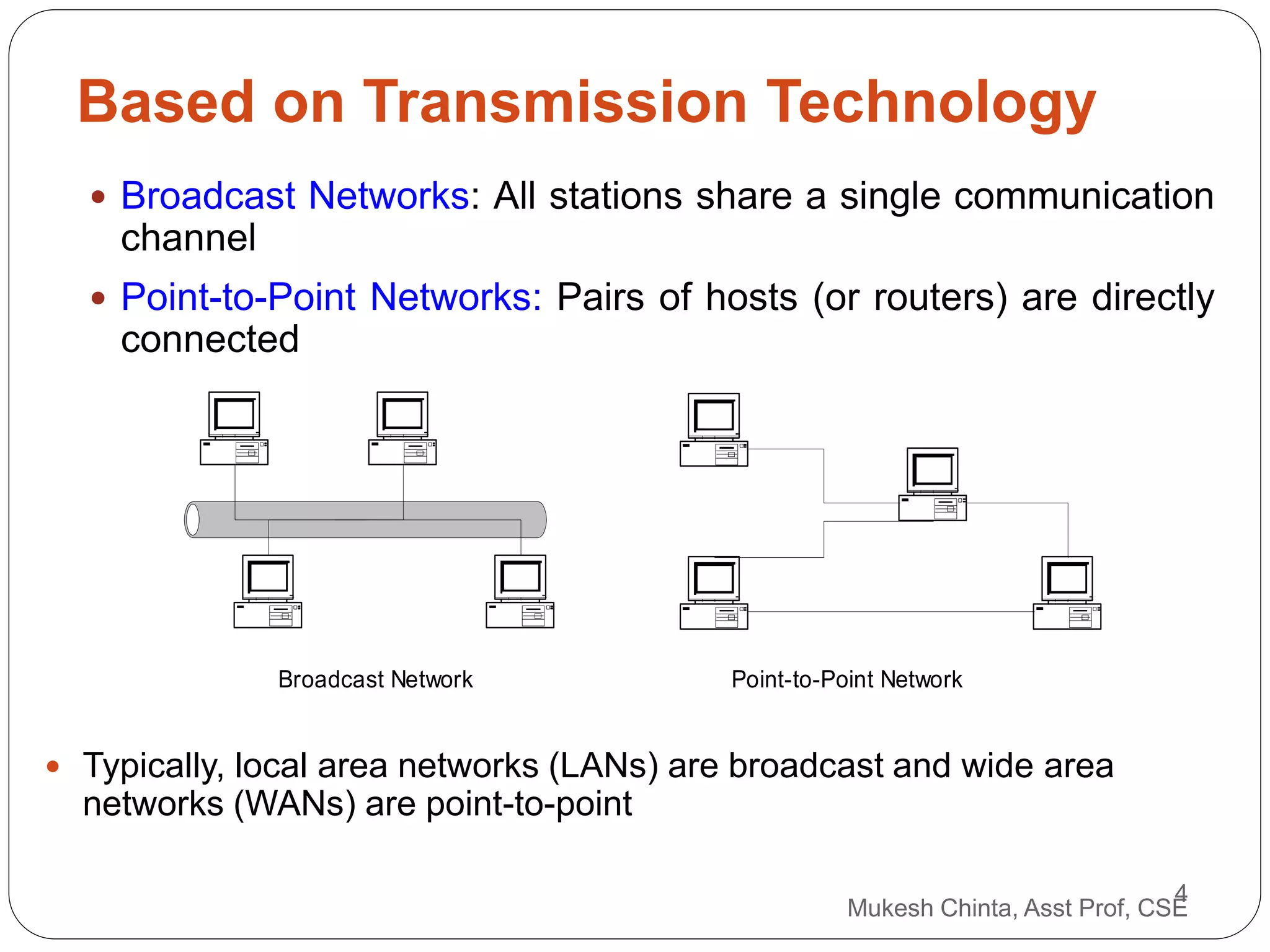
 Broadcast Networks: All stations share a single communication
channel
 Point-to-Point Networks: Pairs of hosts (or routers) are directly
connected
 Typically, local area networks (LANs) are broadcast and wide area
networks (WANs) are point-to-point
Broadcast Network Point-to-Point Network
Mukesh Chinta, Asst Prof, CSE
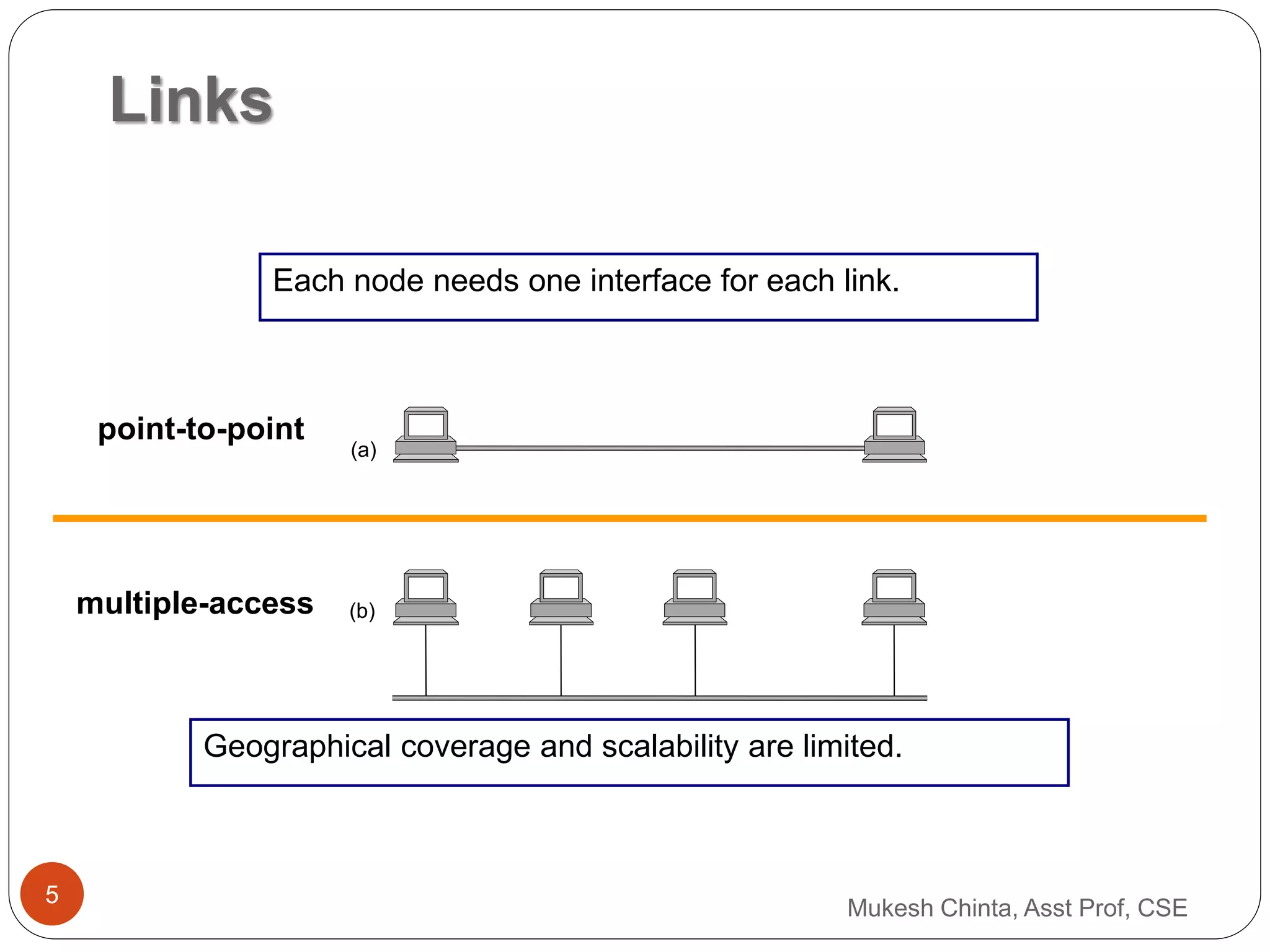
Links
(a)
(b)
point-to-point
multiple-access
Geographical coverage and scalability are limited.
Each node needs one interface for each link.
Mukesh Chinta, Asst Prof, CSE
5
Broadcast Networks
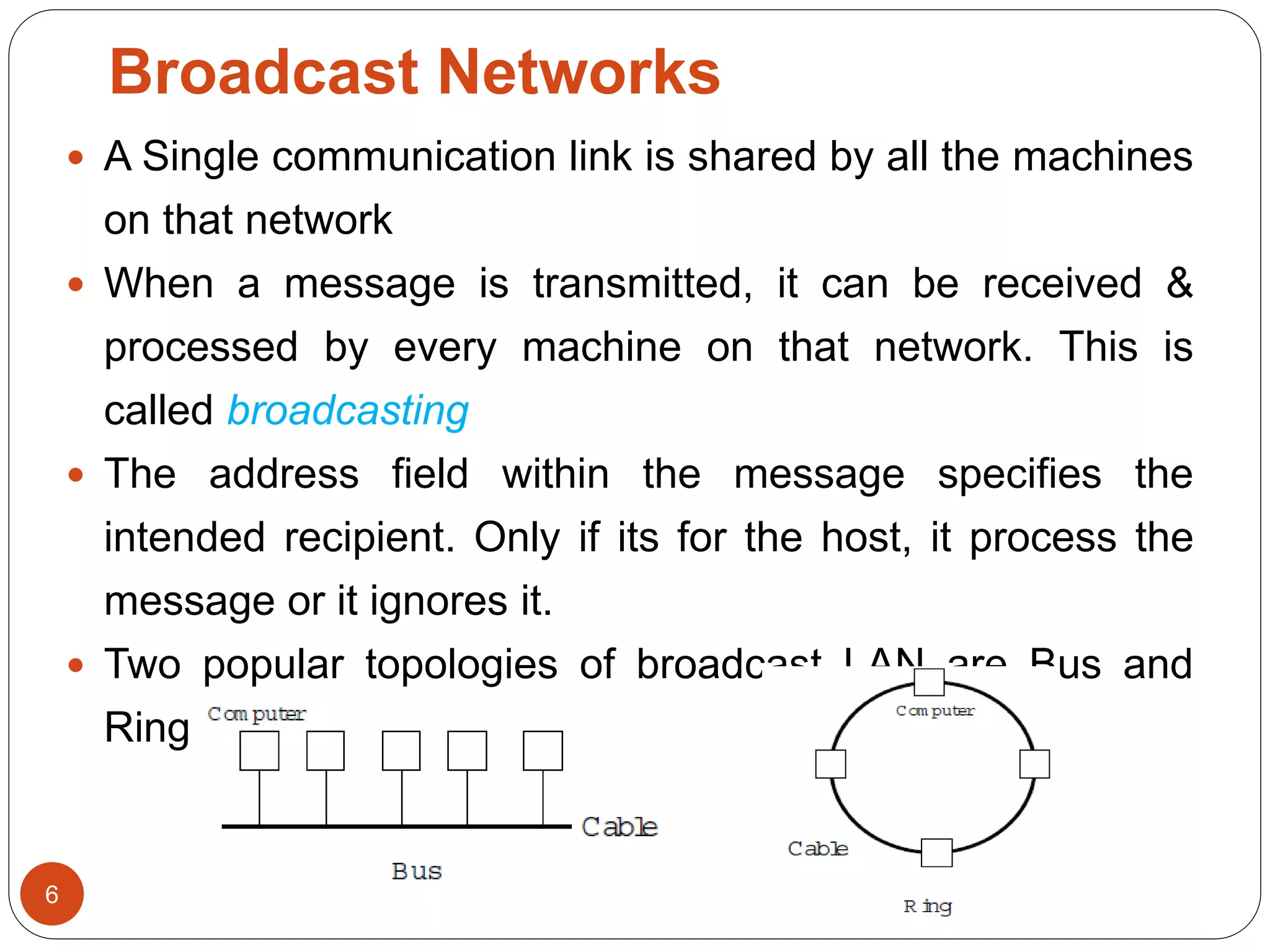
 A Single communication link is shared by all the machines
on that network
 When a message is transmitted, it can be received &
processed by every machine on that network. This is
called broadcasting
 The address field within the message specifies the
intended recipient. Only if its for the host, it process the
message or it ignores it.
 Two popular topologies of broadcast LAN are Bus and
Ring
6
A variant of broadcasting called multicasting in which
transmission is done to a subset of machines.
Advantages
 Network is easy to build- Only one cable is needed
 Cost of construction is cheaper when compared to other
networks
Disadvantages
 Not very scalable and flexible
 An Arbitration mechanism is needed to resolve conflicts
Broadcast Networks
Mukesh Chinta, Asst Prof,
CSE
7
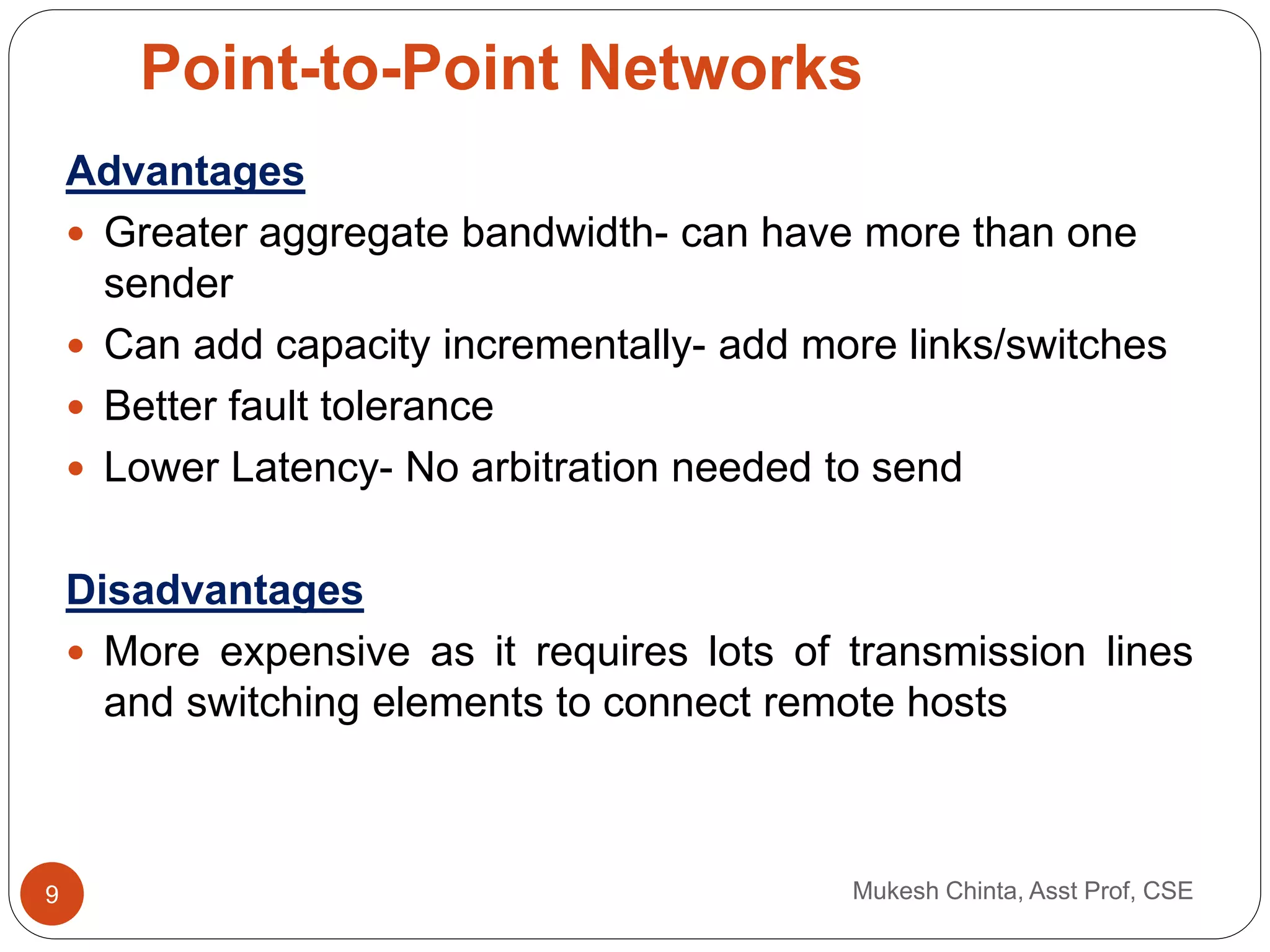
Point-to-Point Networks
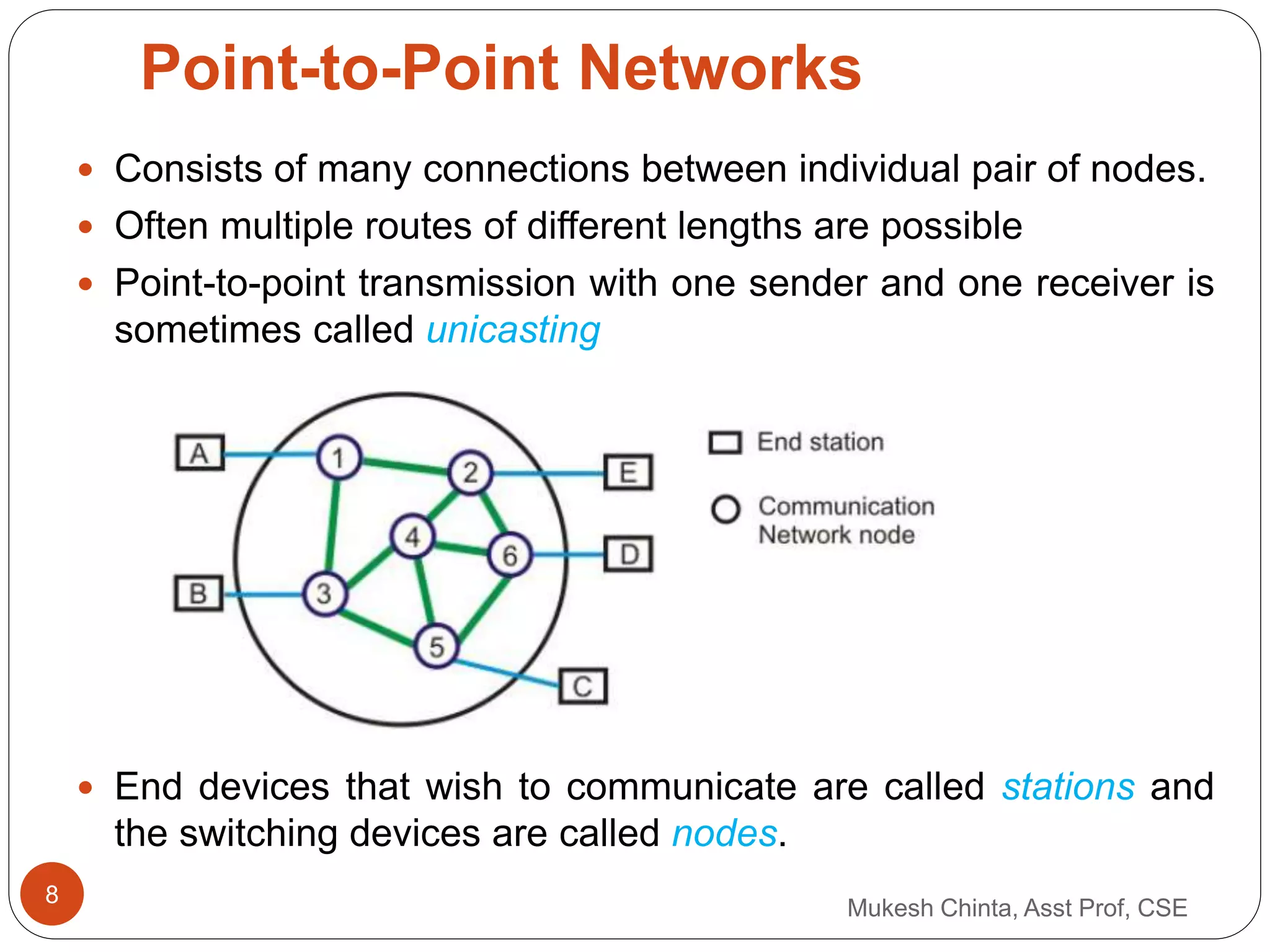
 Consists of many connections between individual pair of nodes.
 Often multiple routes of different lengths are possible
 Point-to-point transmission with one sender and one receiver is
sometimes called unicasting
 End devices that wish to communicate are called stations and
the switching devices are called nodes.
Mukesh Chinta, Asst Prof, CSE
8
Advantages
 Greater aggregate bandwidth- can have more than one
sender
 Can add capacity incrementally- add more links/switches
 Better fault tolerance
 Lower Latency- No arbitration needed to send
Disadvantages
 More expensive as it requires lots of transmission lines
and switching elements to connect remote hosts
Point-to-Point Networks
Mukesh Chinta, Asst Prof, CSE9
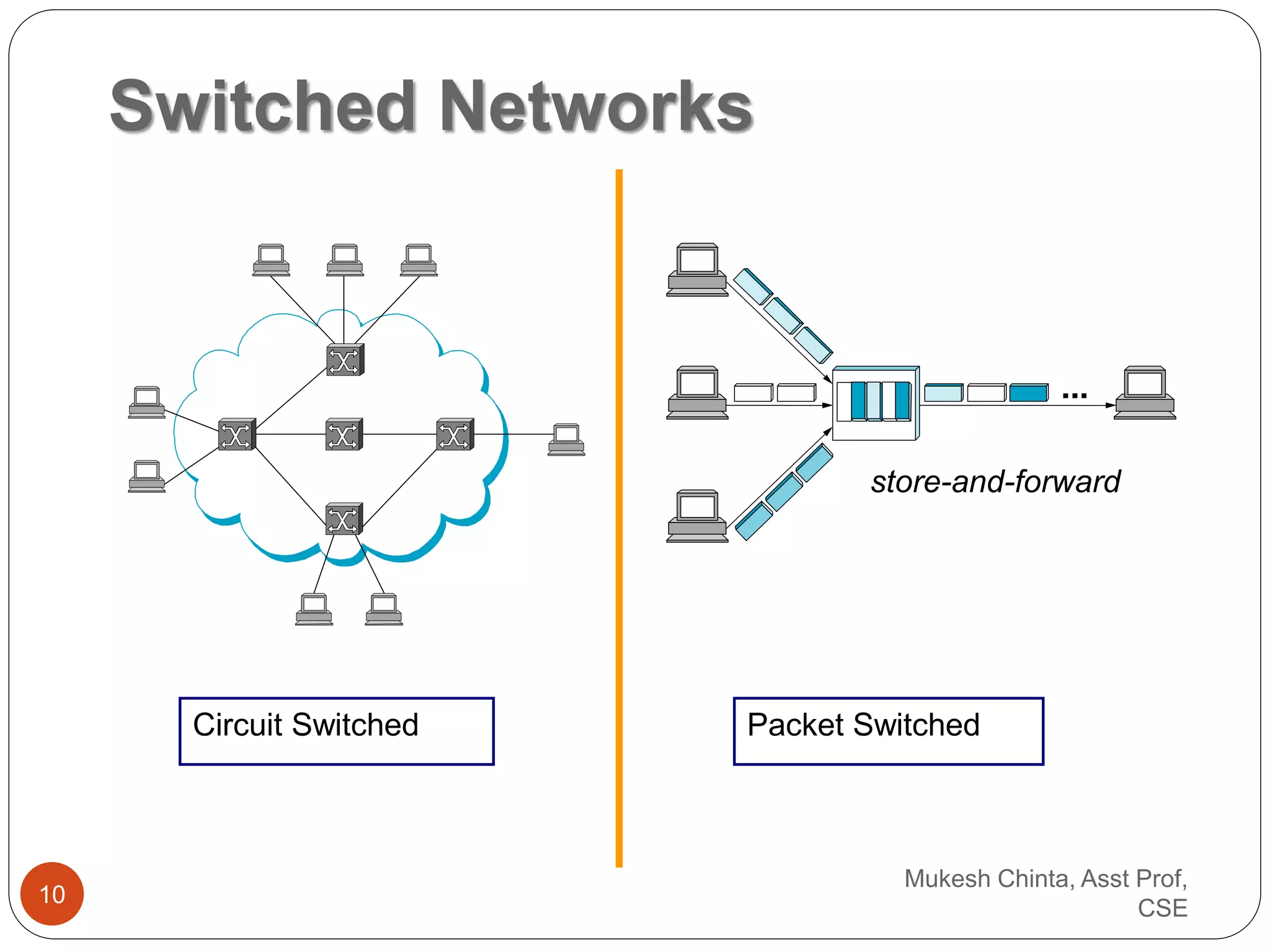
Switched Networks
Circuit Switched
■ ■ ■
Packet Switched
store-and-forward
Mukesh Chinta, Asst Prof,
CSE
10
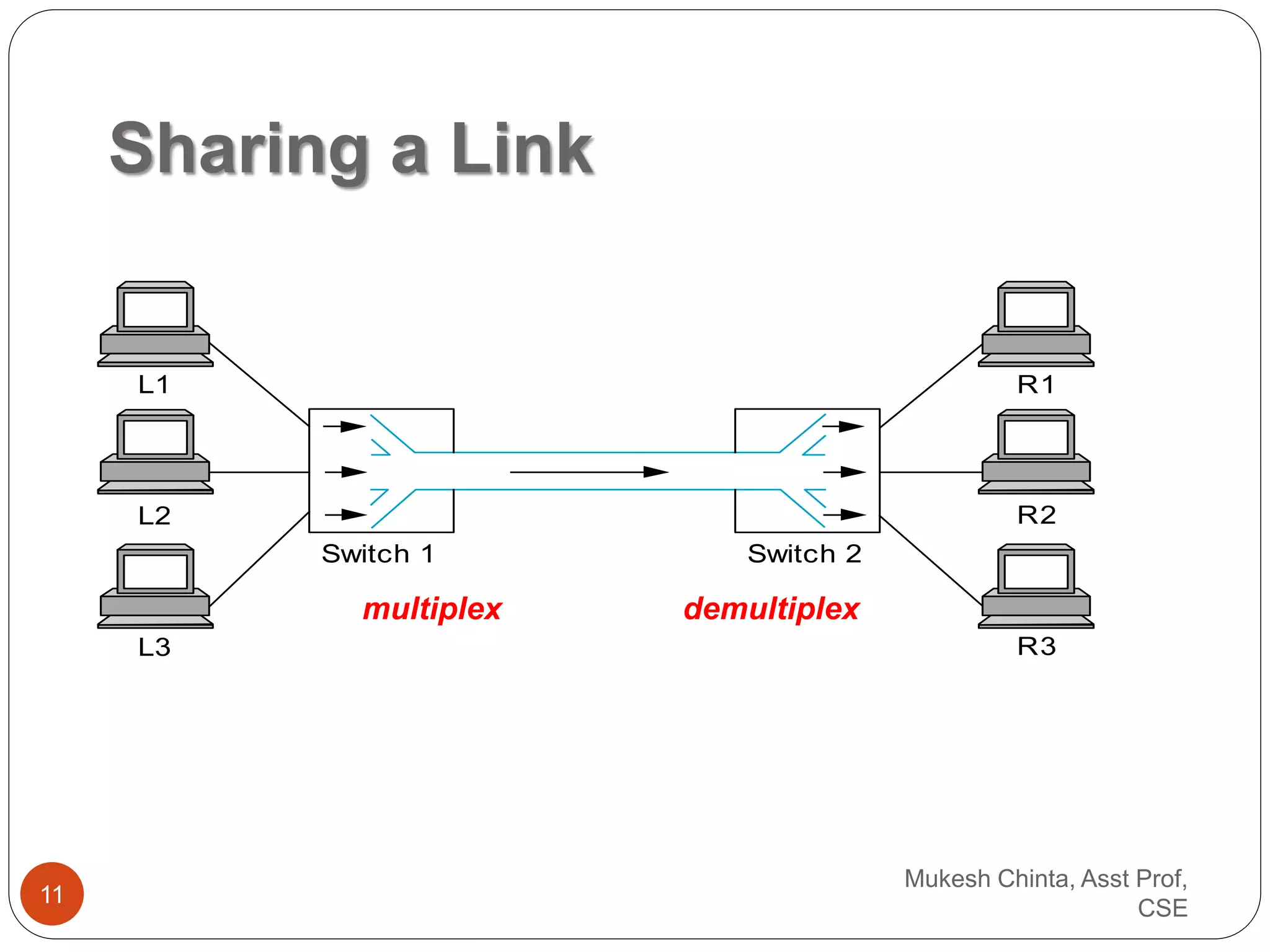
Sharing a Link
L2
L3
R2
R3
L1 R1
Switch 1 Switch 2
multiplex demultiplex
Mukesh Chinta, Asst Prof,
CSE
11
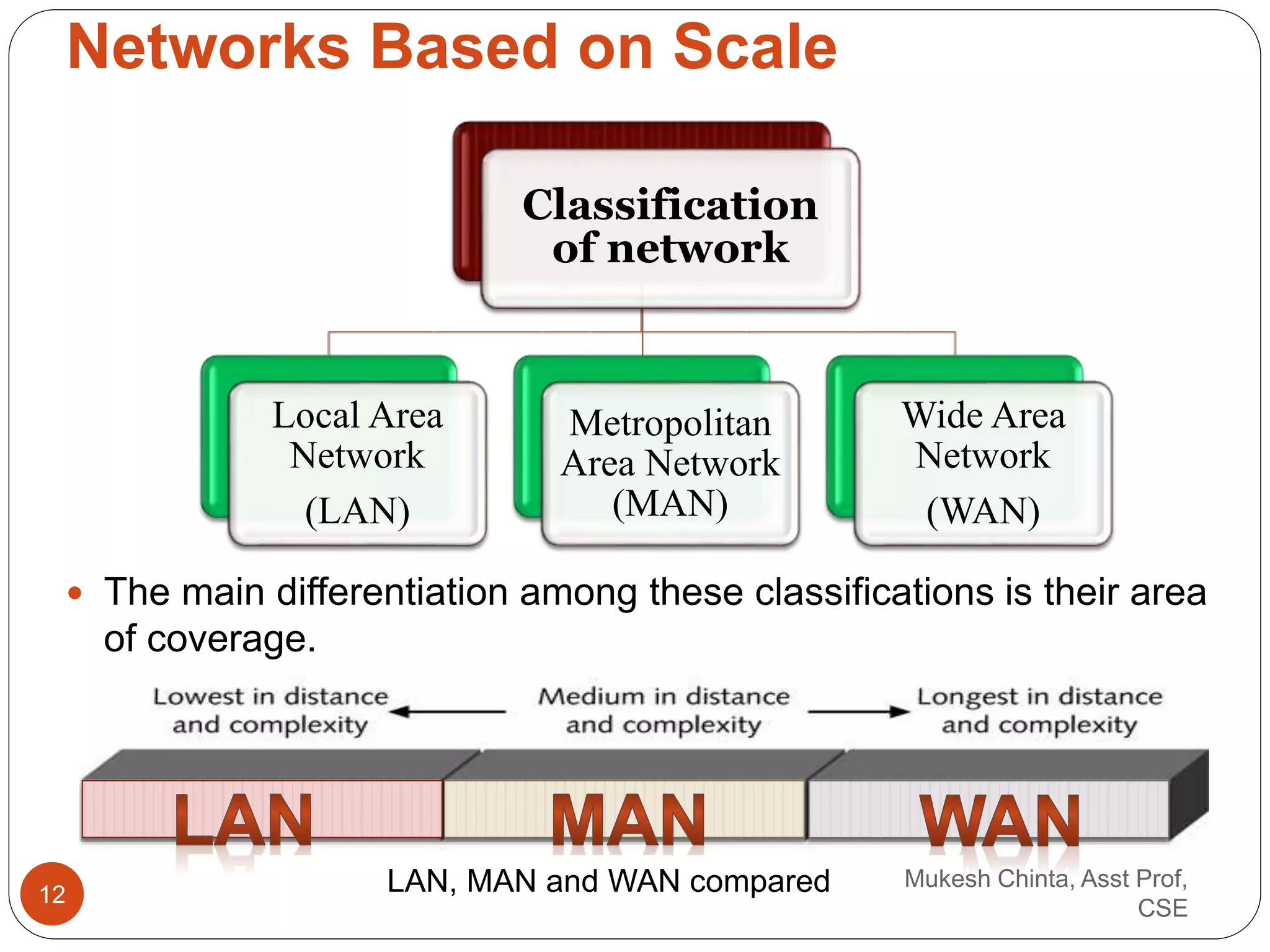
Networks Based on Scale
Classification
of network
Local Area
Network
(LAN)
Metropolitan
Area Network
(MAN)
Wide Area
Network
(WAN)
 The main differentiation among these classifications is their area
of coverage.
LAN, MAN and WAN compared Mukesh Chinta, Asst Prof,
CSE
12
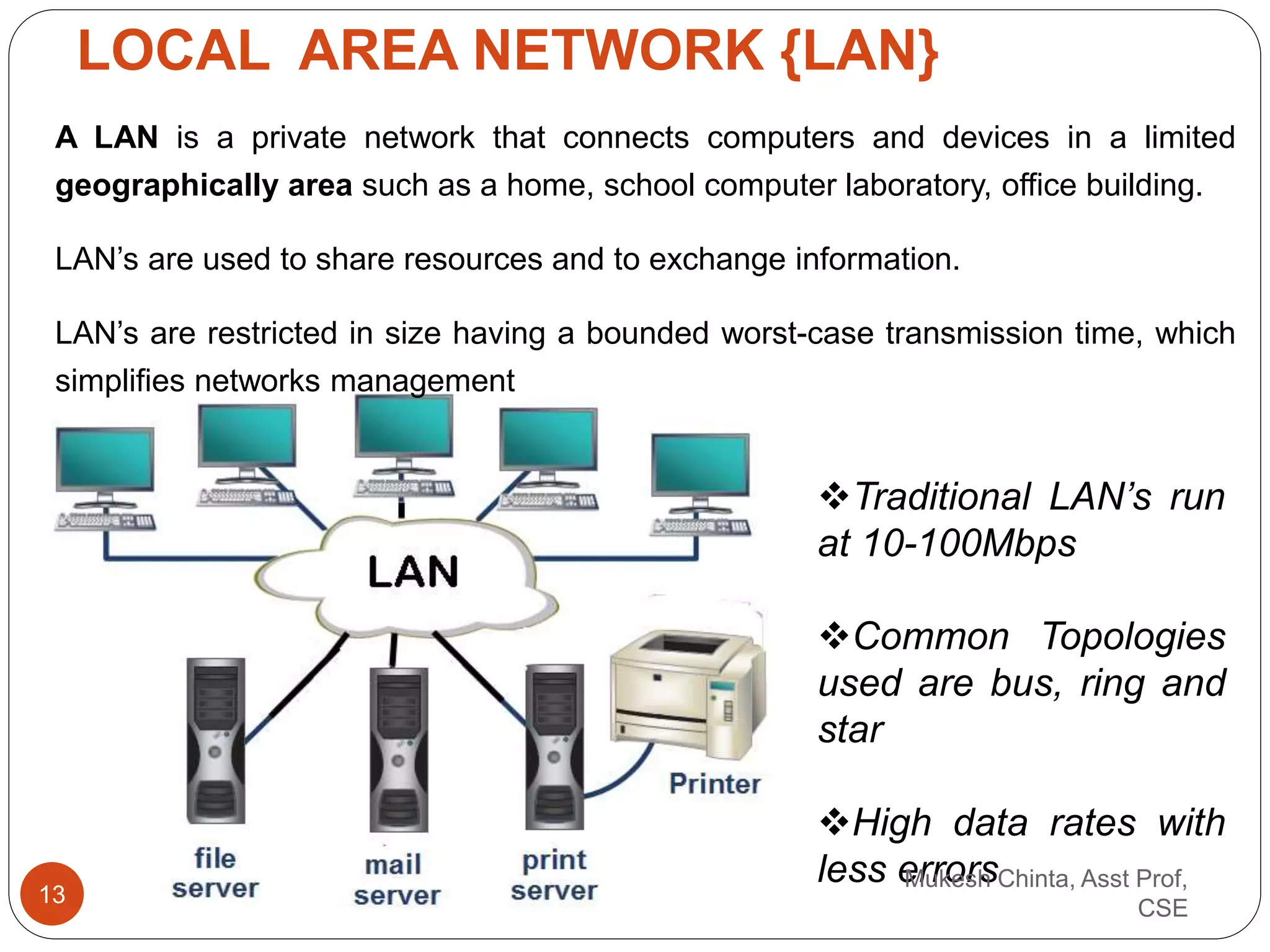
LOCAL AREA NETWORK {LAN}
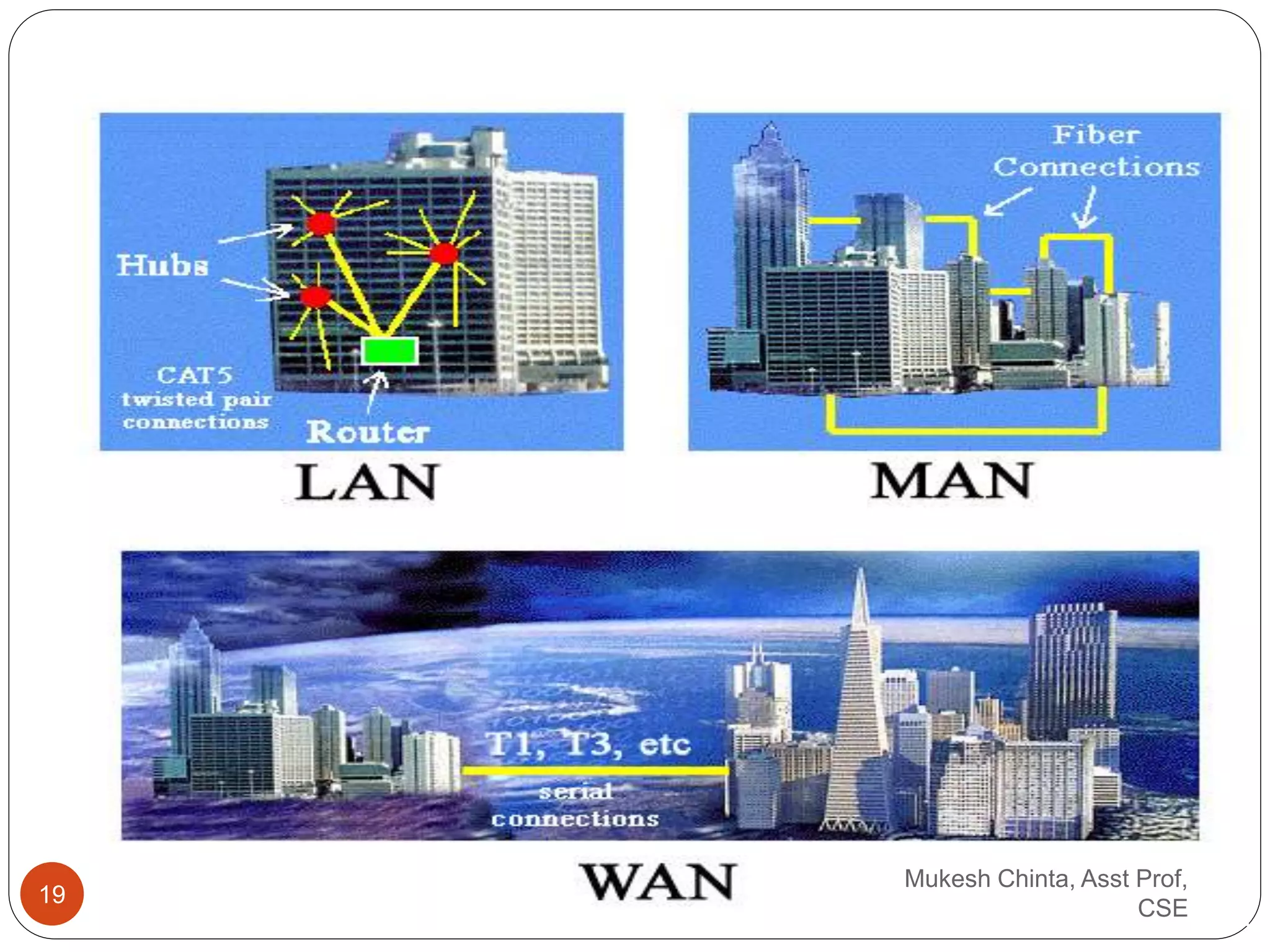
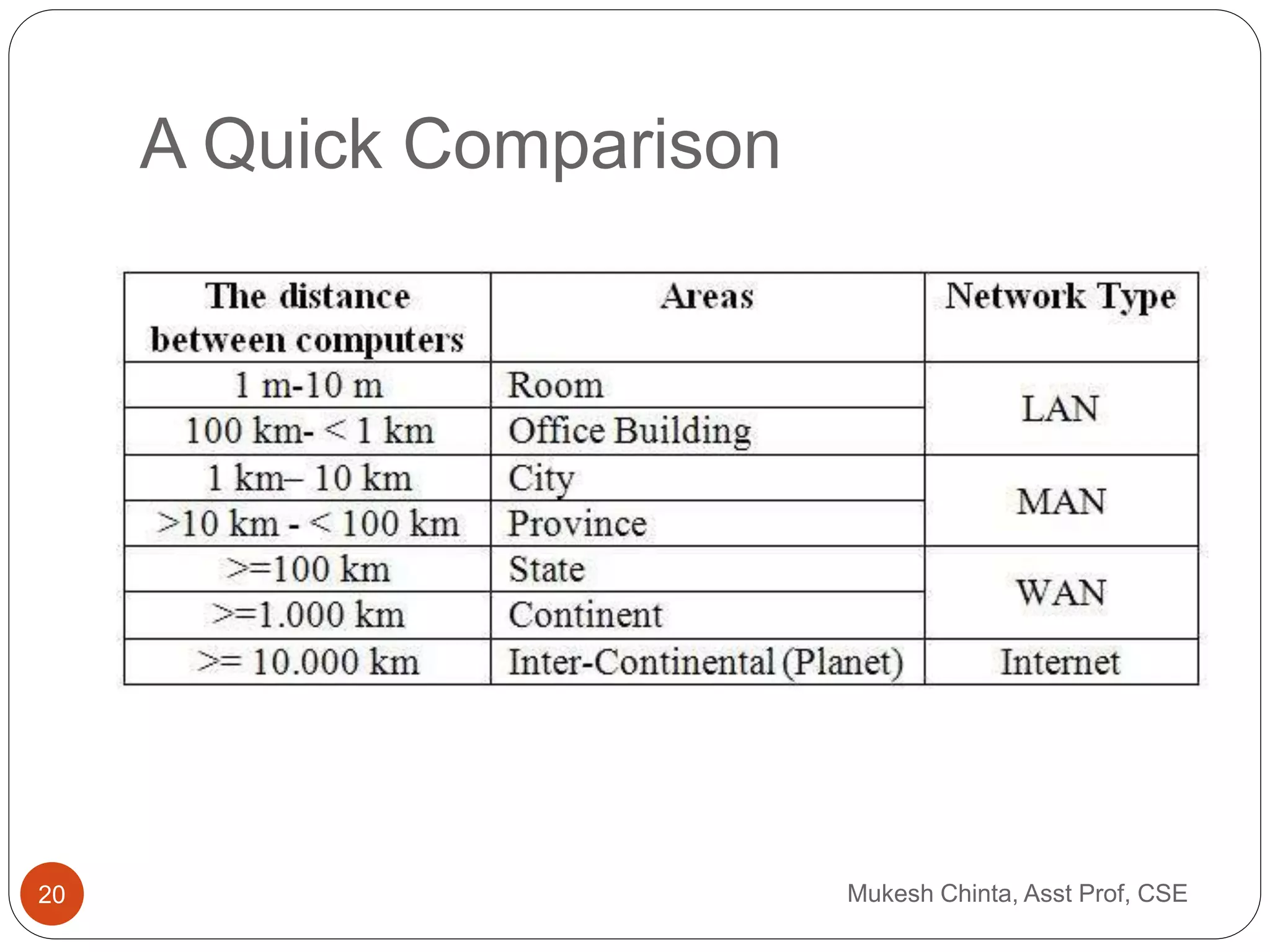
A LAN is a private network that connects computers and devices in a limited
geographically area such as a home, school computer laboratory, office building.
LAN’s are used to share resources and to exchange information.
LAN’s are restricted in size having a bounded worst-case transmission time, which
simplifies networks management
Traditional LAN’s run
at 10-100Mbps
Common Topologies
used are bus, ring and
star
High data rates with
less errorsMukesh Chinta, Asst Prof,
CSE
13
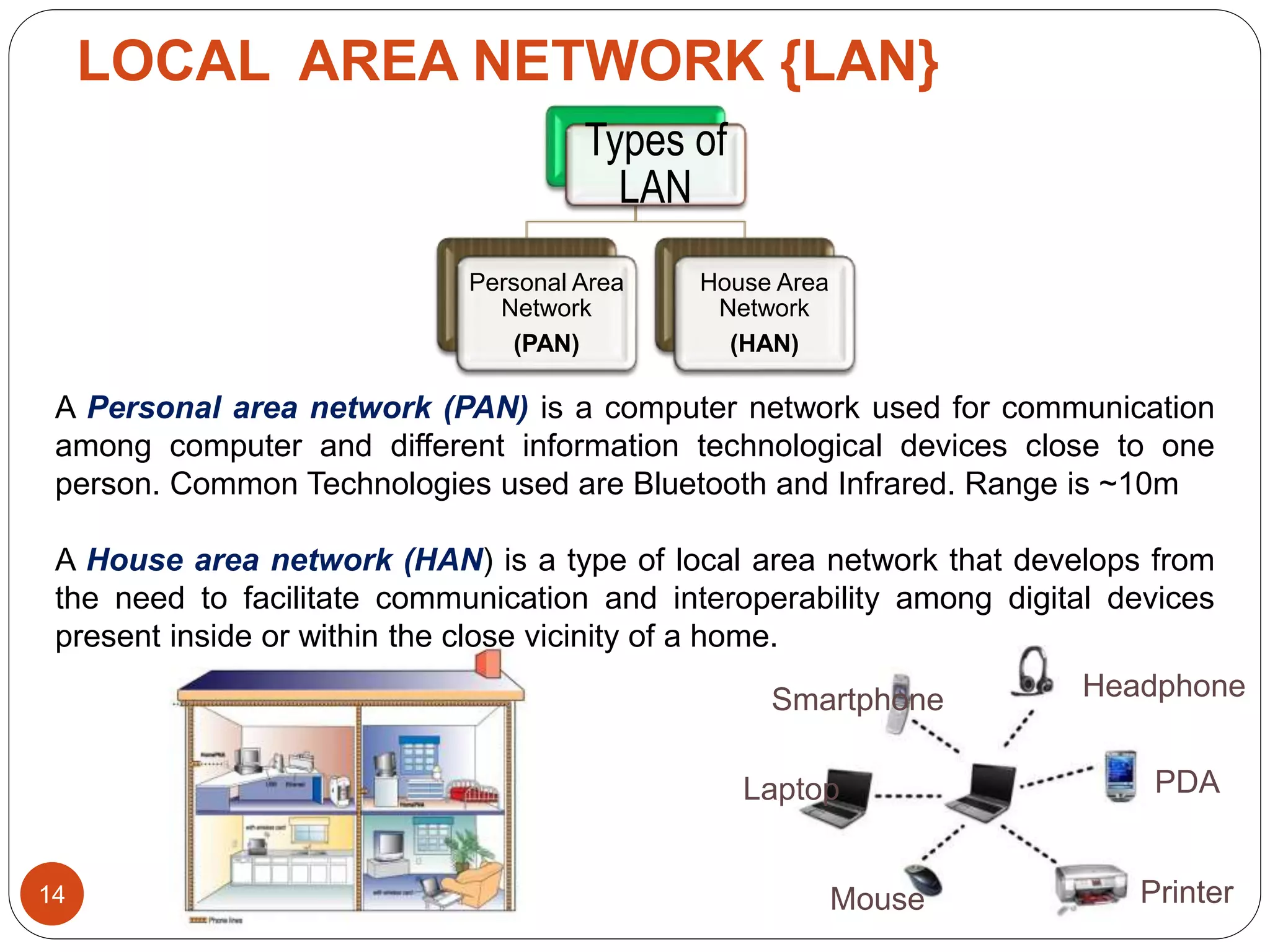
Headphone
PDA
PrinterMouse
Laptop
Smartphone
LOCAL AREA NETWORK {LAN}
Types of
LAN
Personal Area
Network
(PAN)
House Area
Network
(HAN)
A Personal area network (PAN) is a computer network used for communication
among computer and different information technological devices close to one
person. Common Technologies used are Bluetooth and Infrared. Range is ~10m
A House area network (HAN) is a type of local area network that develops from
the need to facilitate communication and interoperability among digital devices
present inside or within the close vicinity of a home.
14
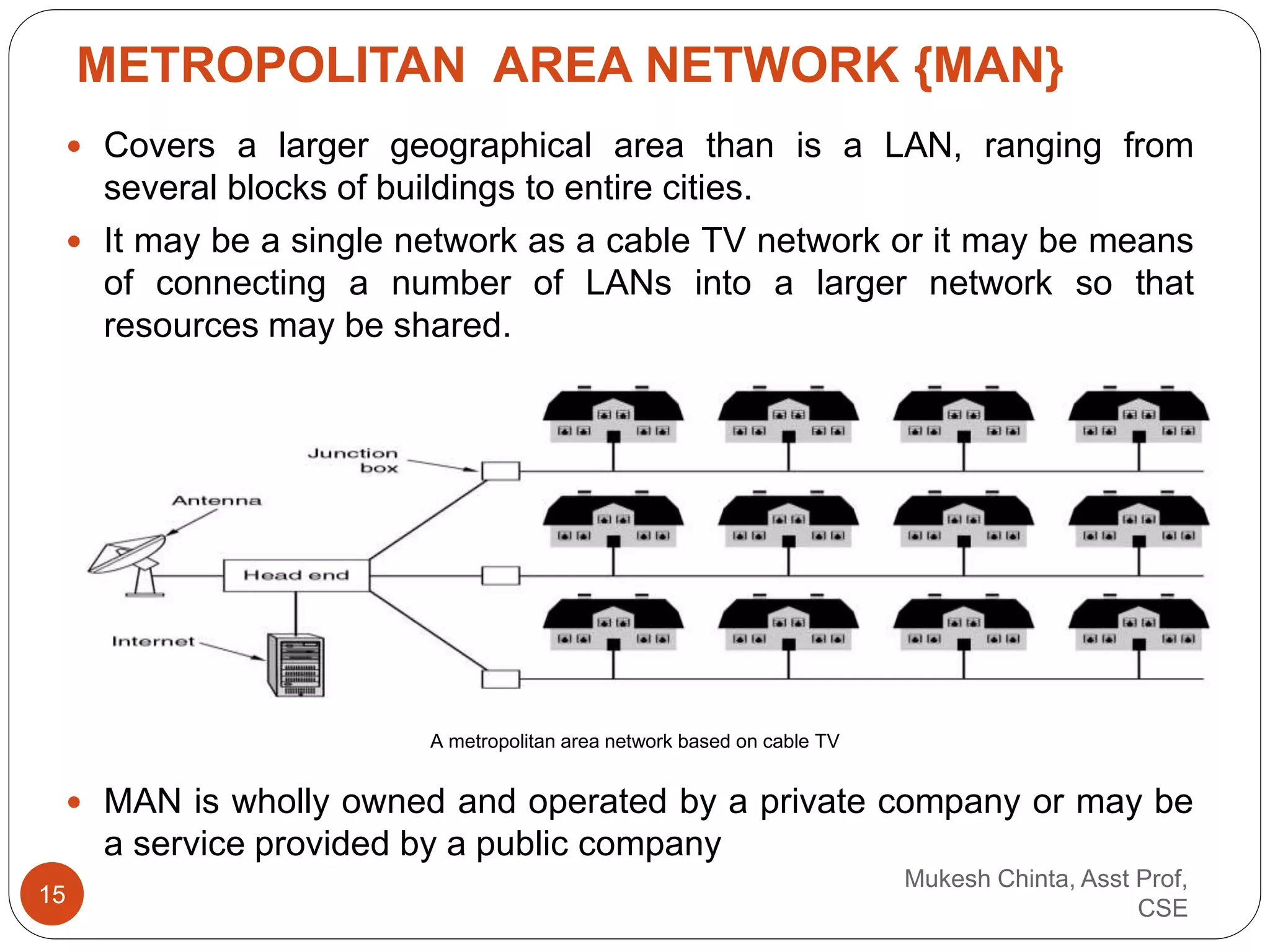
 Covers a larger geographical area than is a LAN, ranging from
several blocks of buildings to entire cities.
 It may be a single network as a cable TV network or it may be means
of connecting a number of LANs into a larger network so that
resources may be shared.
 MAN is wholly owned and operated by a private company or may be
a service provided by a public company
A metropolitan area network based on cable TV
METROPOLITAN AREA NETWORK {MAN}
Mukesh Chinta, Asst Prof,
CSE
15
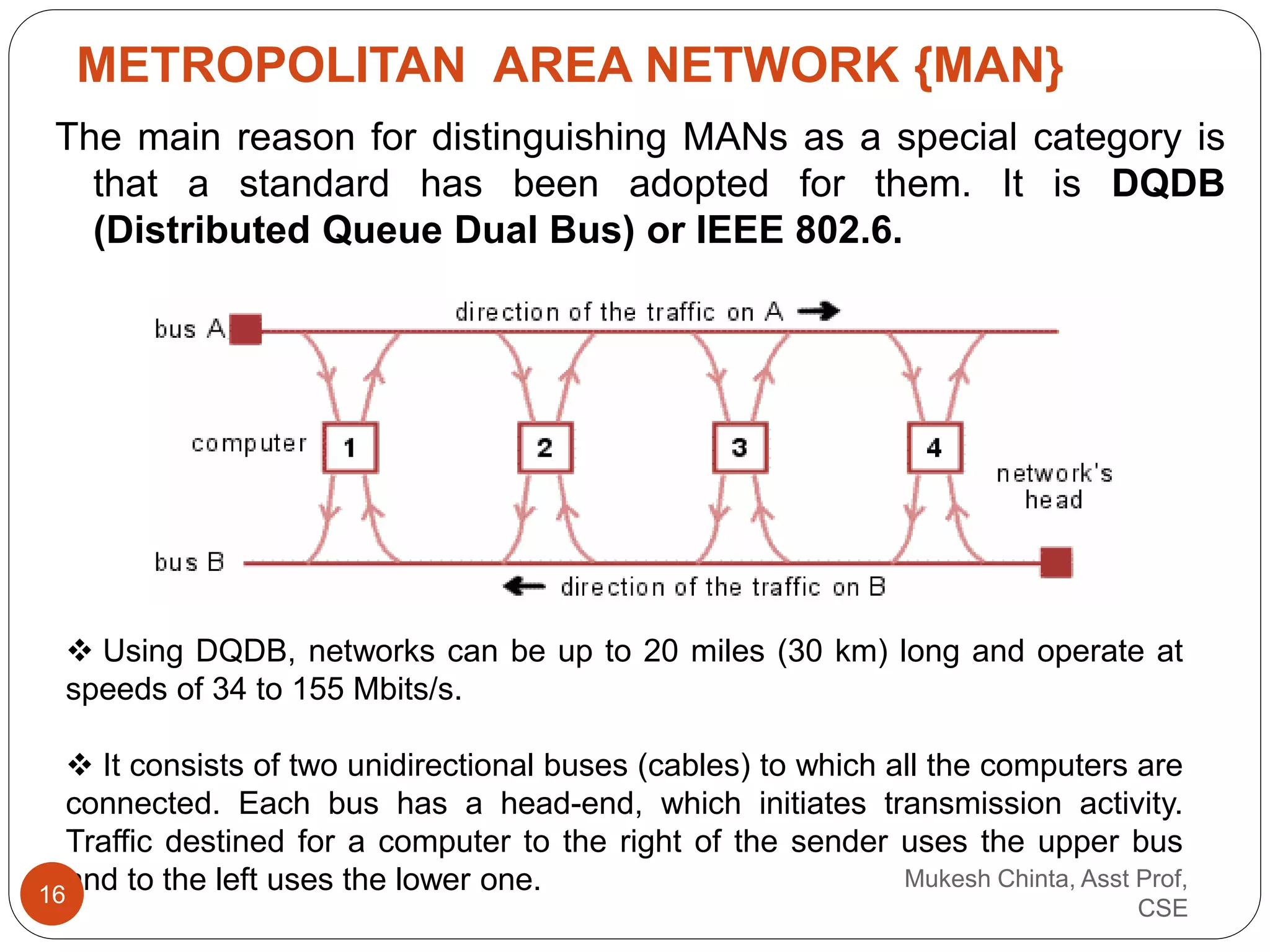
The main reason for distinguishing MANs as a special category is
that a standard has been adopted for them. It is DQDB
(Distributed Queue Dual Bus) or IEEE 802.6.
METROPOLITAN AREA NETWORK {MAN}
 Using DQDB, networks can be up to 20 miles (30 km) long and operate at
speeds of 34 to 155 Mbits/s.
 It consists of two unidirectional buses (cables) to which all the computers are
connected. Each bus has a head-end, which initiates transmission activity.
Traffic destined for a computer to the right of the sender uses the upper bus
and to the left uses the lower one. Mukesh Chinta, Asst Prof,
CSE
16
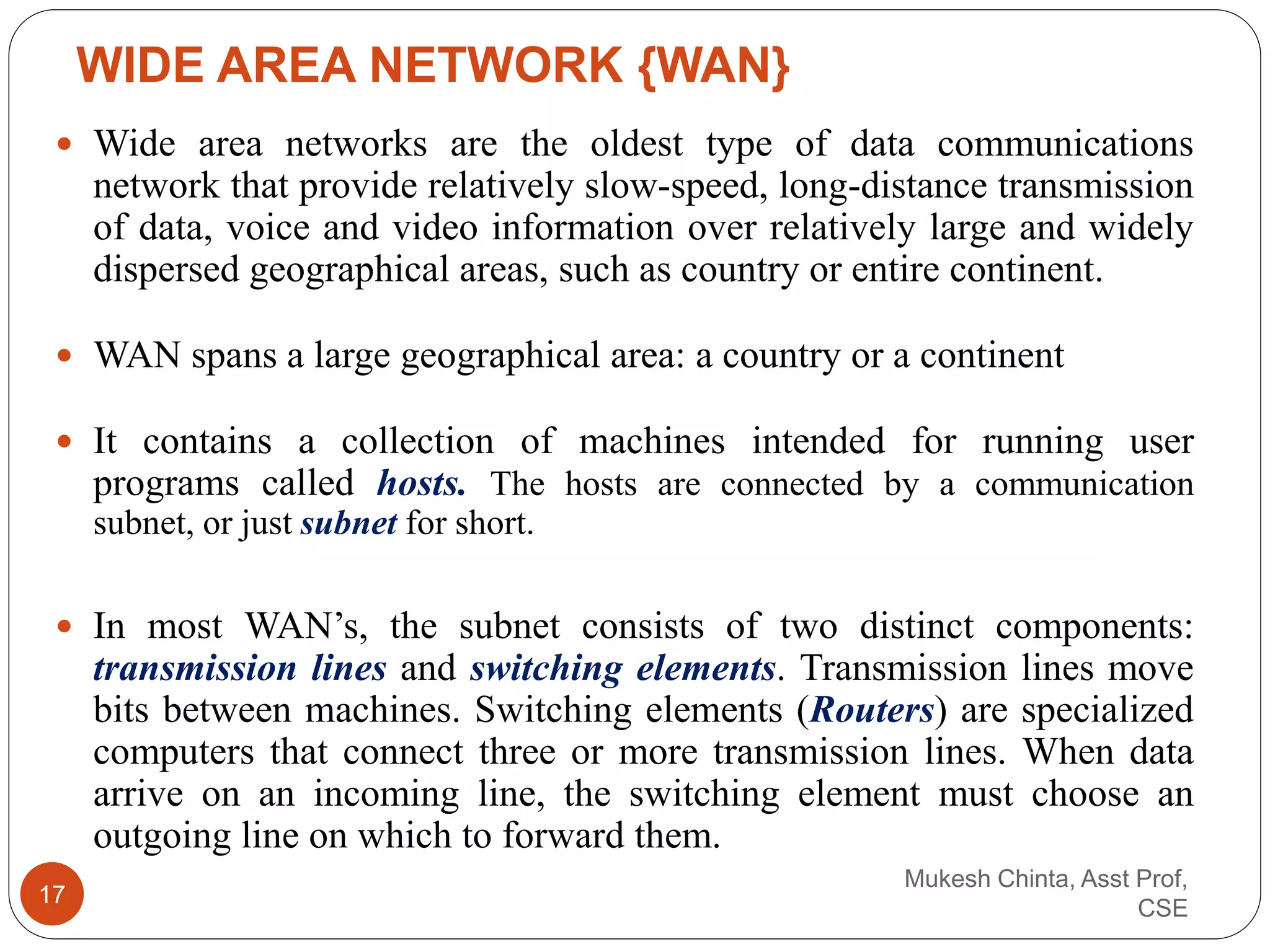
 Wide area networks are the oldest type of data communications
network that provide relatively slow-speed, long-distance transmission
of data, voice and video information over relatively large and widely
dispersed geographical areas, such as country or entire continent.
 WAN spans a large geographical area: a country or a continent
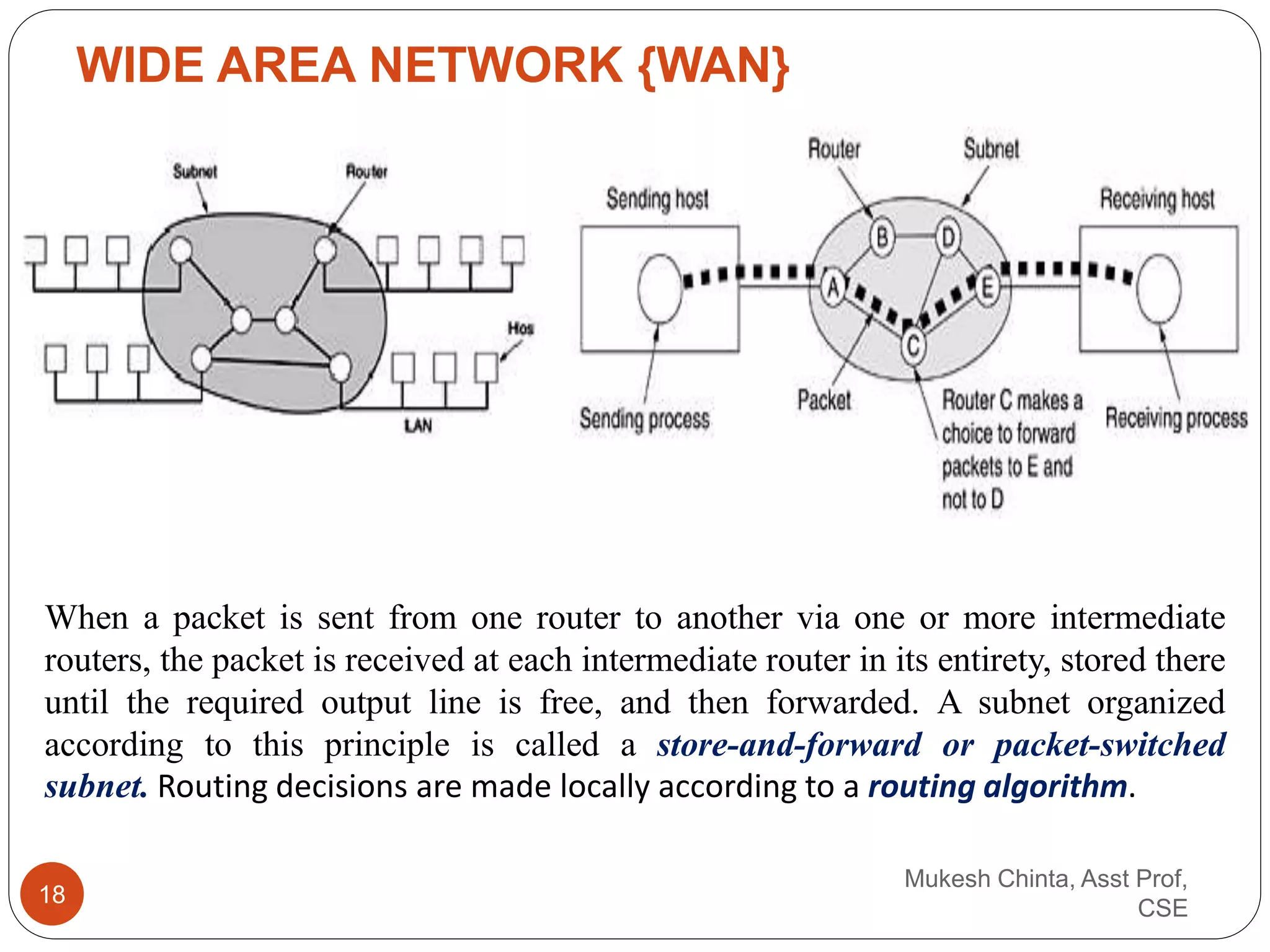
 It contains a collection of machines intended for running user
programs called hosts. The hosts are connected by a communication
subnet, or just subnet for short.
 In most WAN’s, the subnet consists of two distinct components:
transmission lines and switching elements. Transmission lines move
bits between machines. Switching elements (Routers) are specialized
computers that connect three or more transmission lines. When data
arrive on an incoming line, the switching element must choose an
outgoing line on which to forward them.
WIDE AREA NETWORK {WAN}
Mukesh Chinta, Asst Prof,
CSE
17
WIDE AREA NETWORK {WAN}
When a packet is sent from one router to another via one or more intermediate
routers, the packet is received at each intermediate router in its entirety, stored there
until the required output line is free, and then forwarded. A subnet organized
according to this principle is called a store-and-forward or packet-switched
subnet. Routing decisions are made locally according to a routing algorithm.
Mukesh Chinta, Asst Prof,
CSE
18
Mukesh Chinta, Asst Prof,
CSE
19
A Quick Comparison
Mukesh Chinta, Asst Prof, CSE20
Internetwork {Internet}
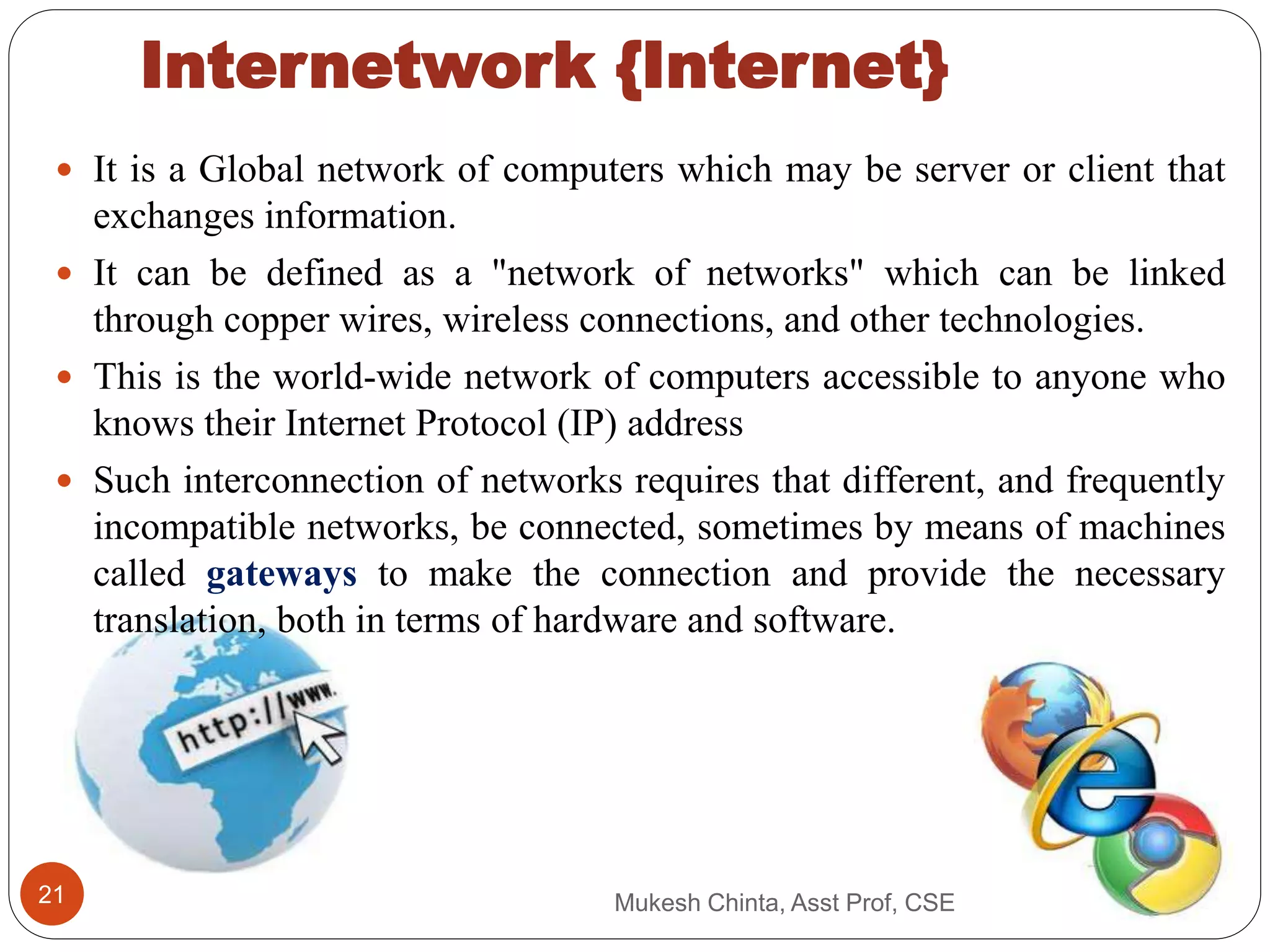
 It is a Global network of computers which may be server or client that
exchanges information.
 It can be defined as a "network of networks" which can be linked
through copper wires, wireless connections, and other technologies.
 This is the world-wide network of computers accessible to anyone who
knows their Internet Protocol (IP) address
 Such interconnection of networks requires that different, and frequently
incompatible networks, be connected, sometimes by means of machines
called gateways to make the connection and provide the necessary
translation, both in terms of hardware and software.
Mukesh Chinta, Asst Prof, CSE21
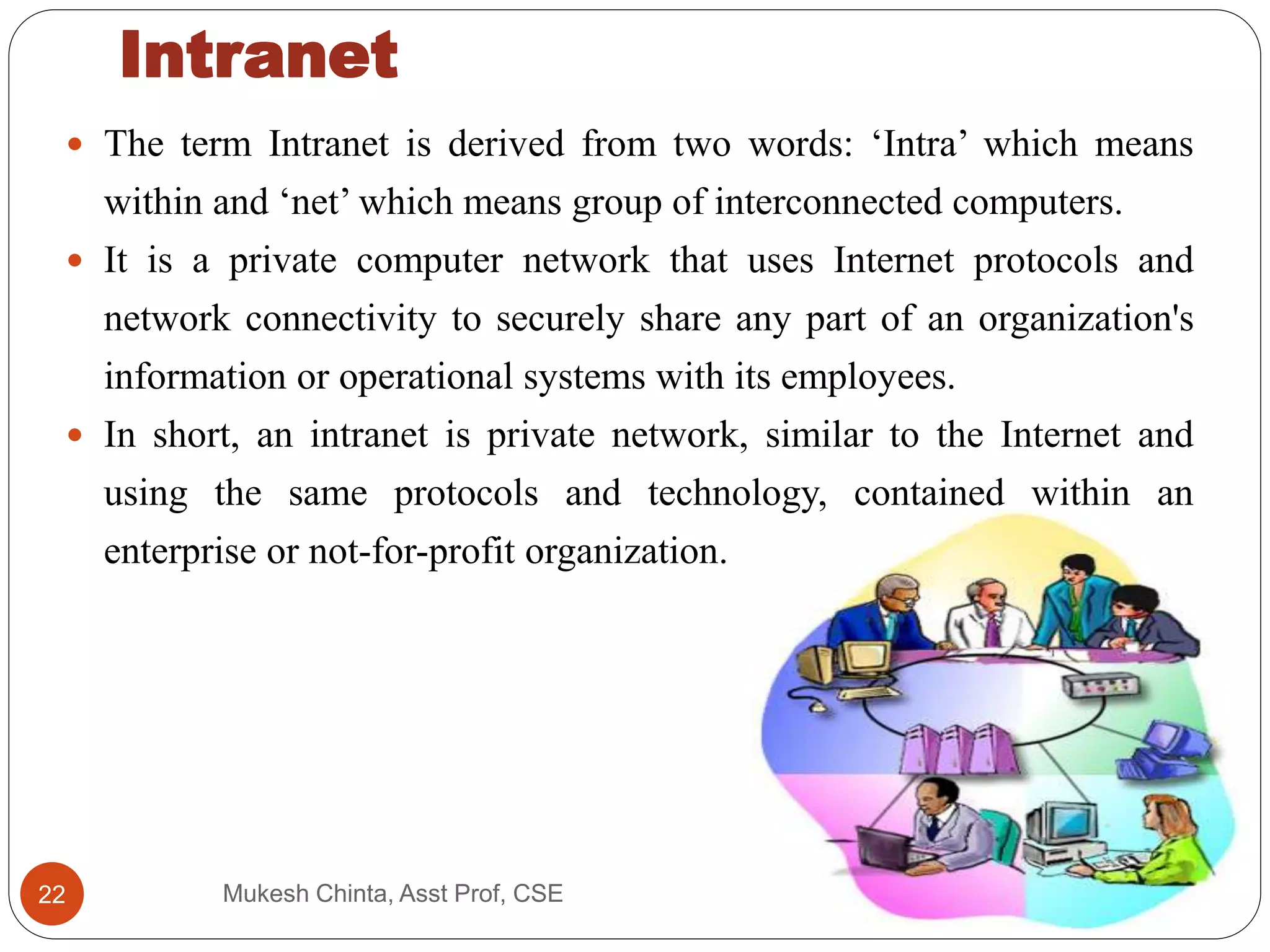
 The term Intranet is derived from two words: ‘Intra’ which means
within and ‘net’ which means group of interconnected computers.
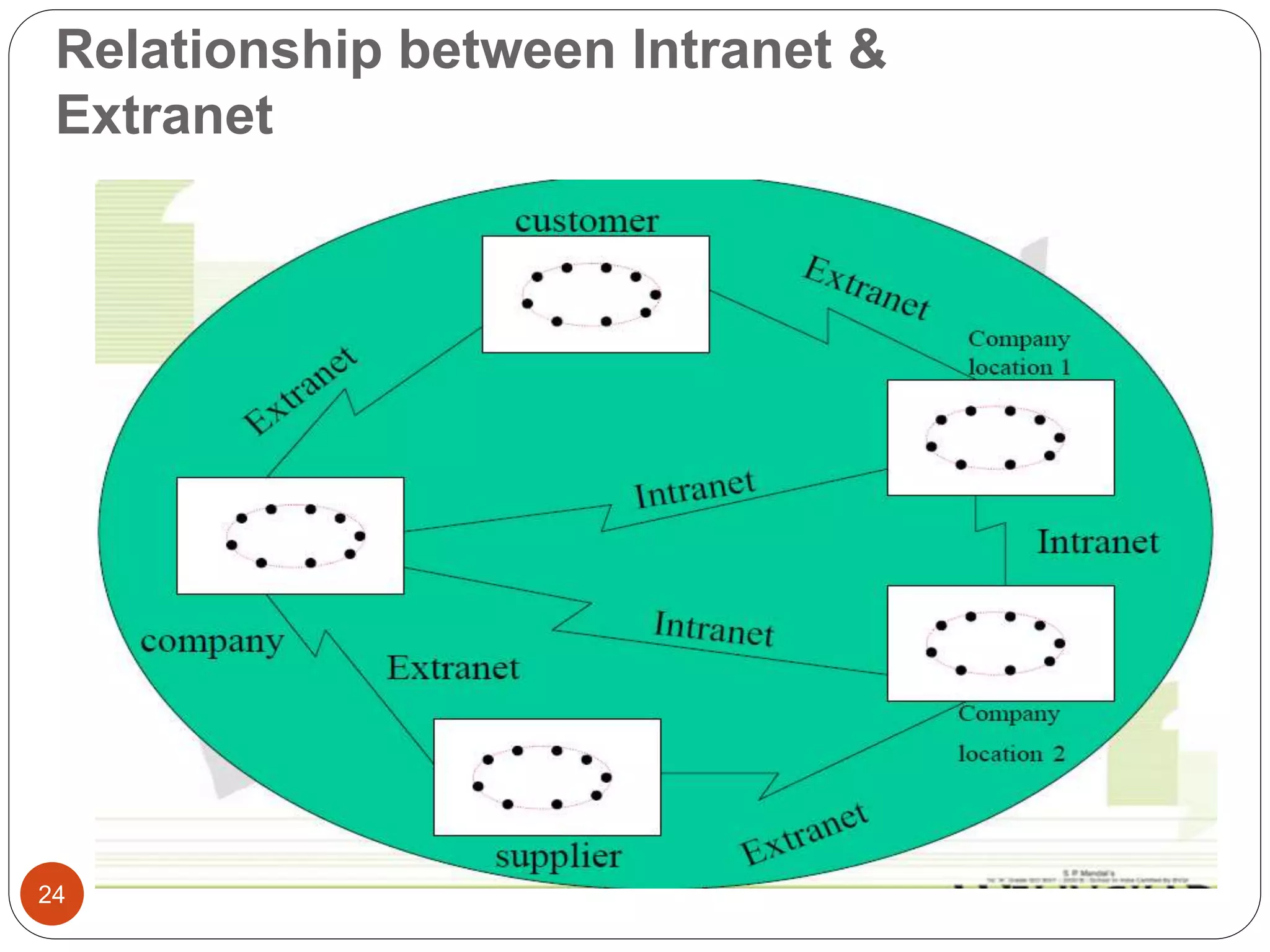
 It is a private computer network that uses Internet protocols and
network connectivity to securely share any part of an organization's
information or operational systems with its employees.
 In short, an intranet is private network, similar to the Internet and
using the same protocols and technology, contained within an
enterprise or not-for-profit organization.
Intranet
Mukesh Chinta, Asst Prof, CSE22
Extranet
 is an intranet for outside authorized users using same internet technologies.
The outside users are trusted partners of the organization who have access to
information of their interest & concern.
 extends the intranet concept to provide a network that connects a company’s
network to the networks of its business partners, selected customers, or
suppliers.
Mukesh Chinta, Asst Prof, CSE
23
Relationship between Intranet &
Extranet
24
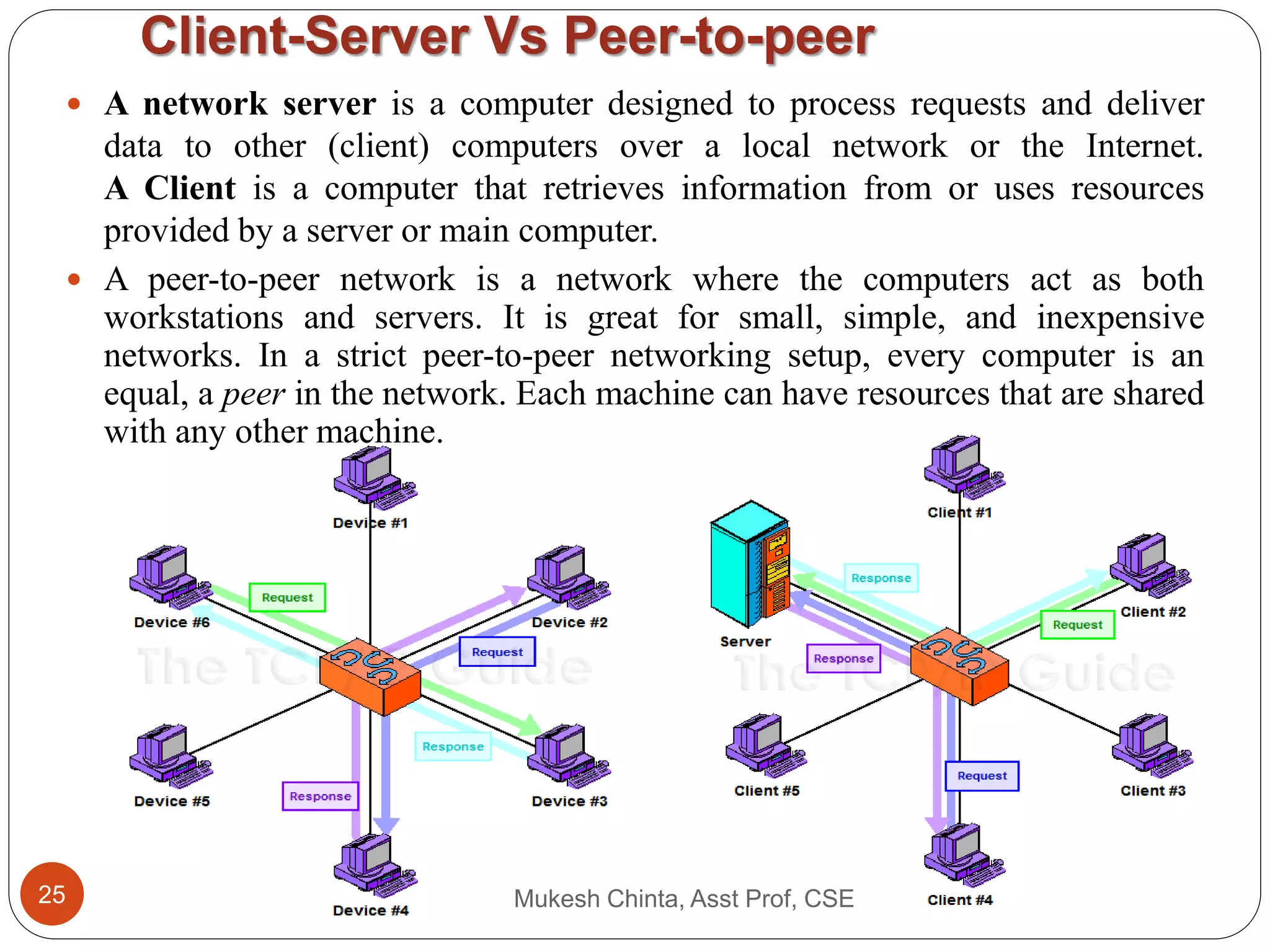
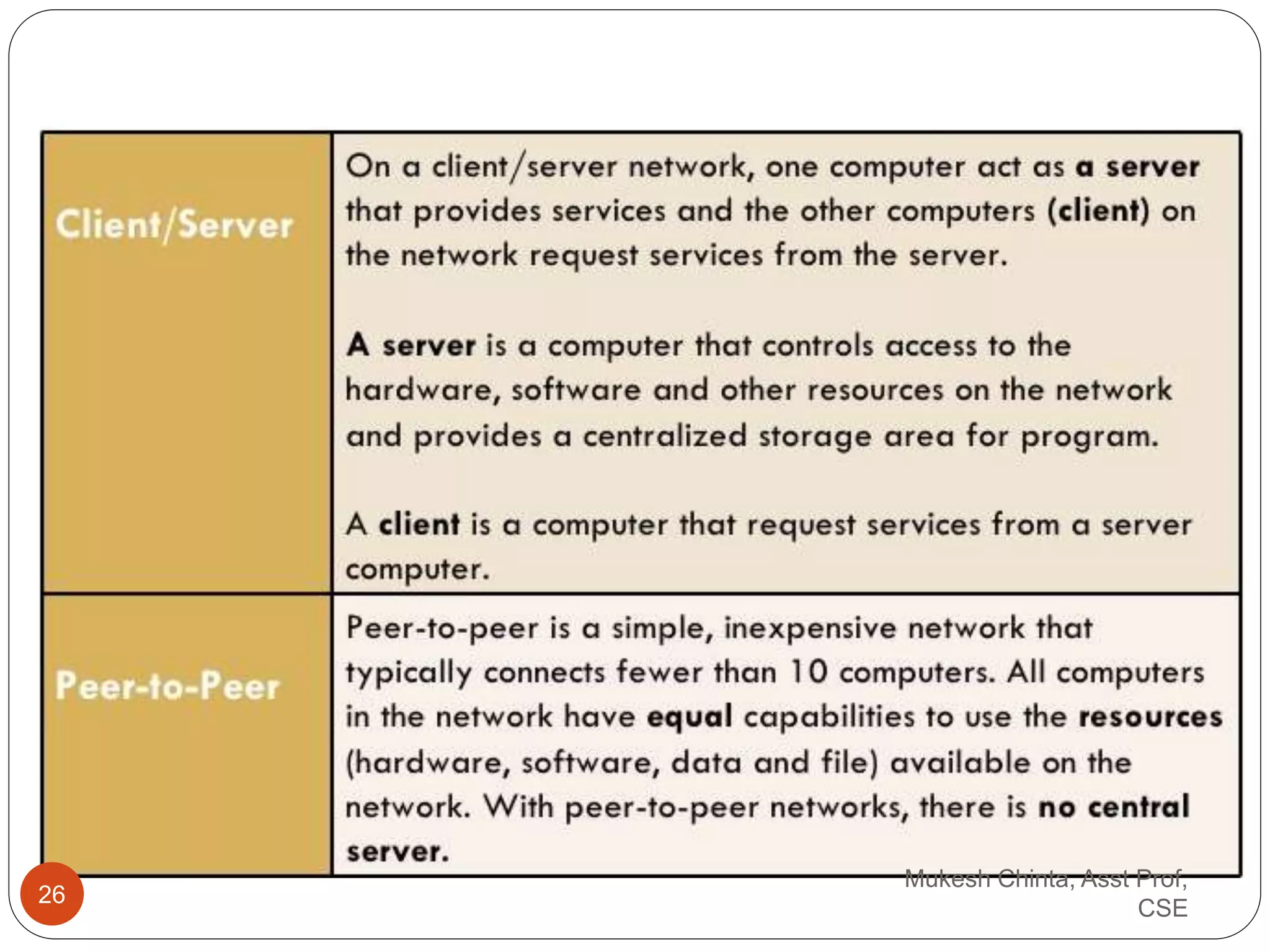
Client-Server Vs Peer-to-peer
 A network server is a computer designed to process requests and deliver
data to other (client) computers over a local network or the Internet.
A Client is a computer that retrieves information from or uses resources
provided by a server or main computer.
 A peer-to-peer network is a network where the computers act as both
workstations and servers. It is great for small, simple, and inexpensive
networks. In a strict peer-to-peer networking setup, every computer is an
equal, a peer in the network. Each machine can have resources that are shared
with any other machine.
Mukesh Chinta, Asst Prof, CSE25
Mukesh Chinta, Asst Prof,
CSE
26
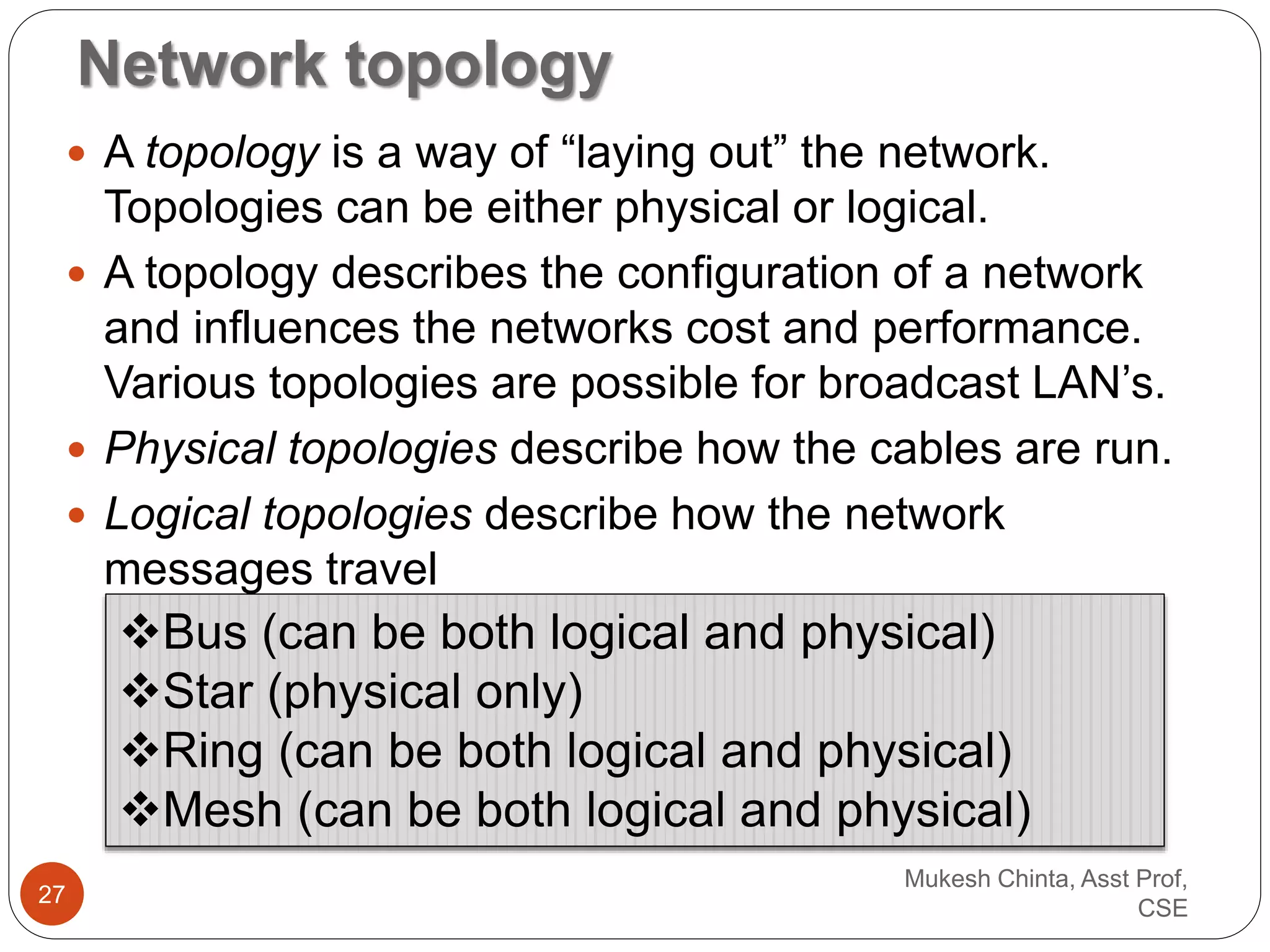
Network topology
 A topology is a way of “laying out” the network.
Topologies can be either physical or logical.
 A topology describes the configuration of a network
and influences the networks cost and performance.
Various topologies are possible for broadcast LAN’s.
 Physical topologies describe how the cables are run.
 Logical topologies describe how the network
messages travel
Bus (can be both logical and physical)
Star (physical only)
Ring (can be both logical and physical)
Mesh (can be both logical and physical)
Mukesh Chinta, Asst Prof,
CSE
27
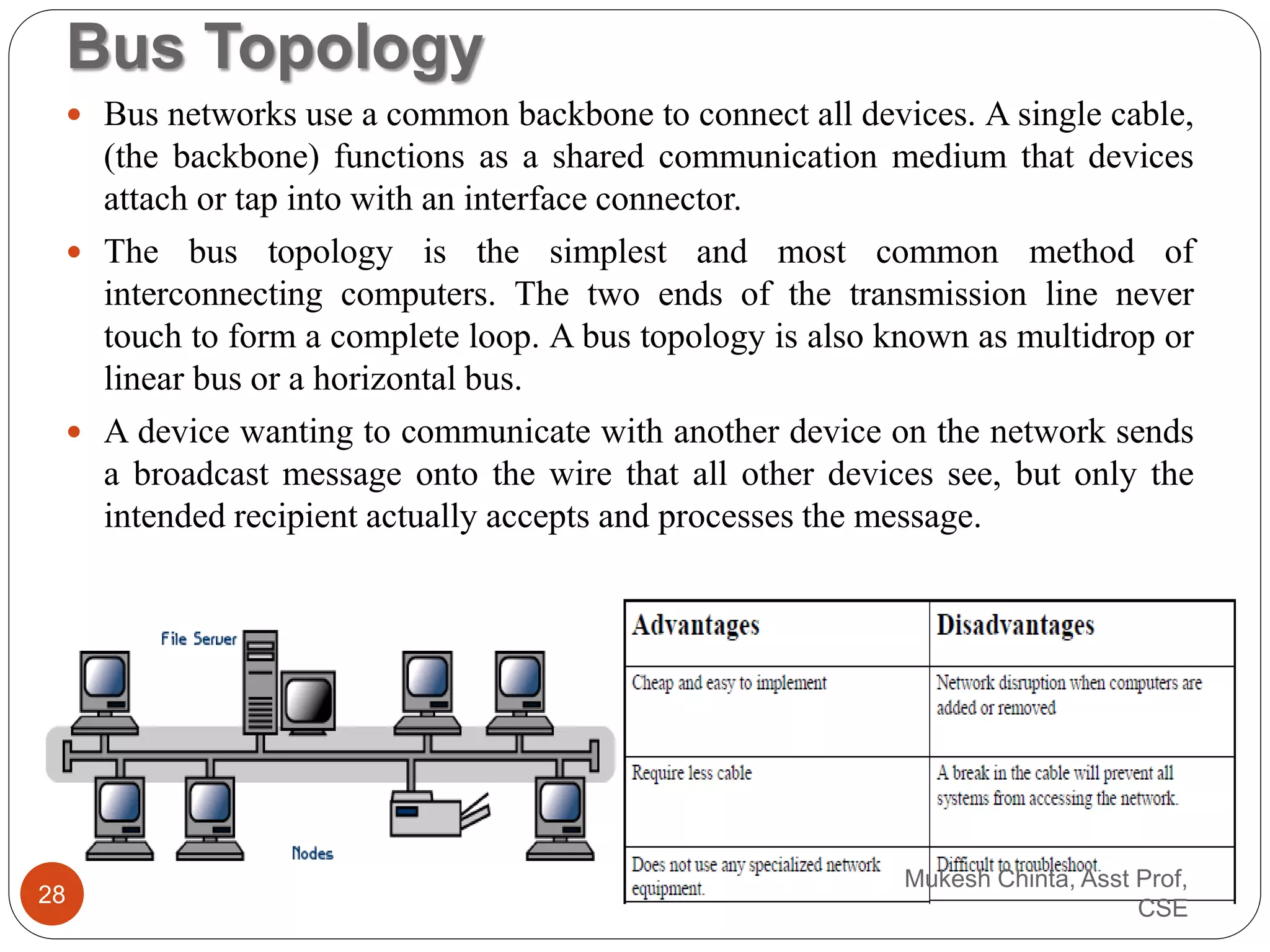
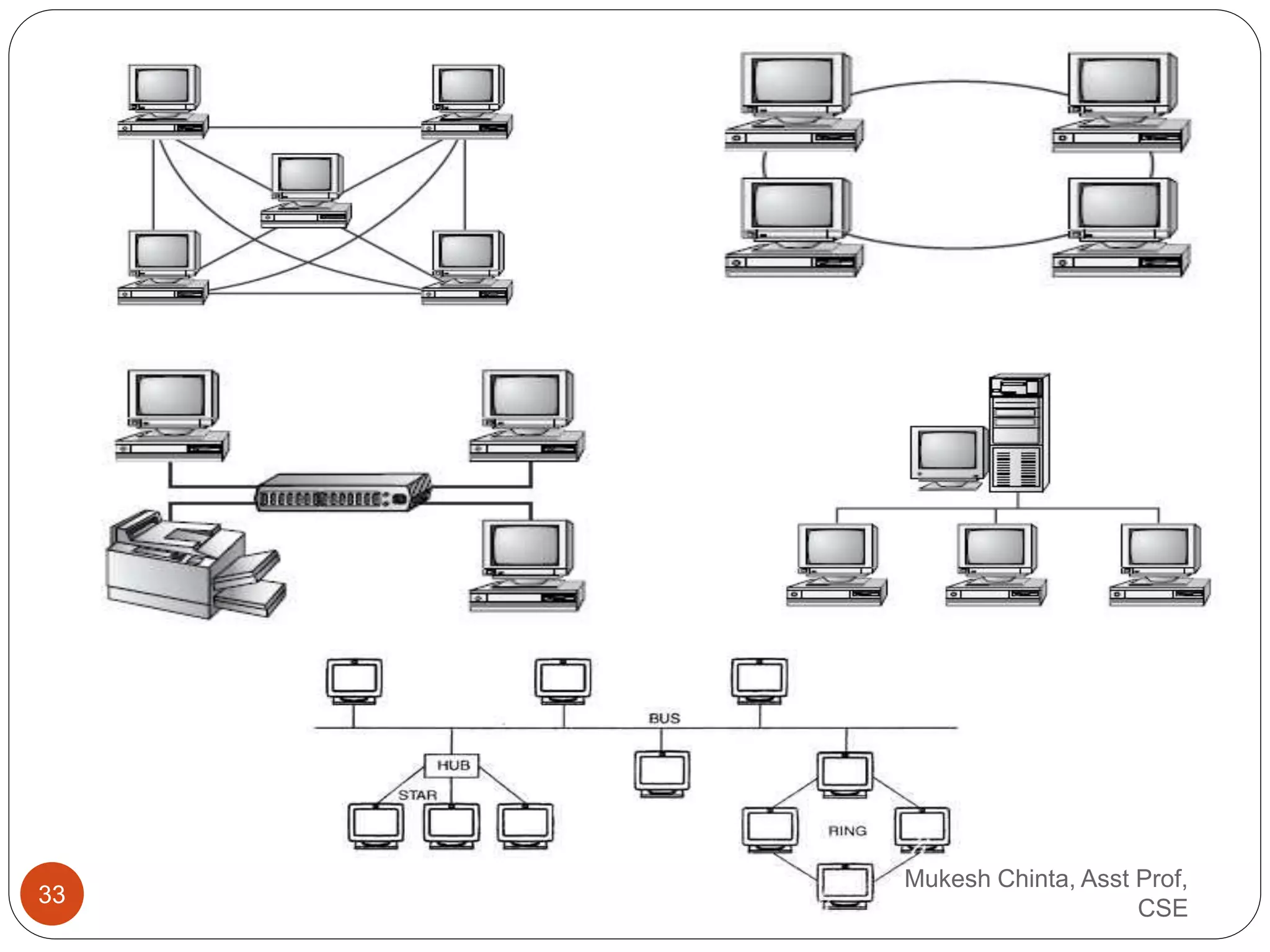
Bus Topology
 Bus networks use a common backbone to connect all devices. A single cable,
(the backbone) functions as a shared communication medium that devices
attach or tap into with an interface connector.
 The bus topology is the simplest and most common method of
interconnecting computers. The two ends of the transmission line never
touch to form a complete loop. A bus topology is also known as multidrop or
linear bus or a horizontal bus.
 A device wanting to communicate with another device on the network sends
a broadcast message onto the wire that all other devices see, but only the
intended recipient actually accepts and processes the message.
Mukesh Chinta, Asst Prof,
CSE
28
Ring Topology
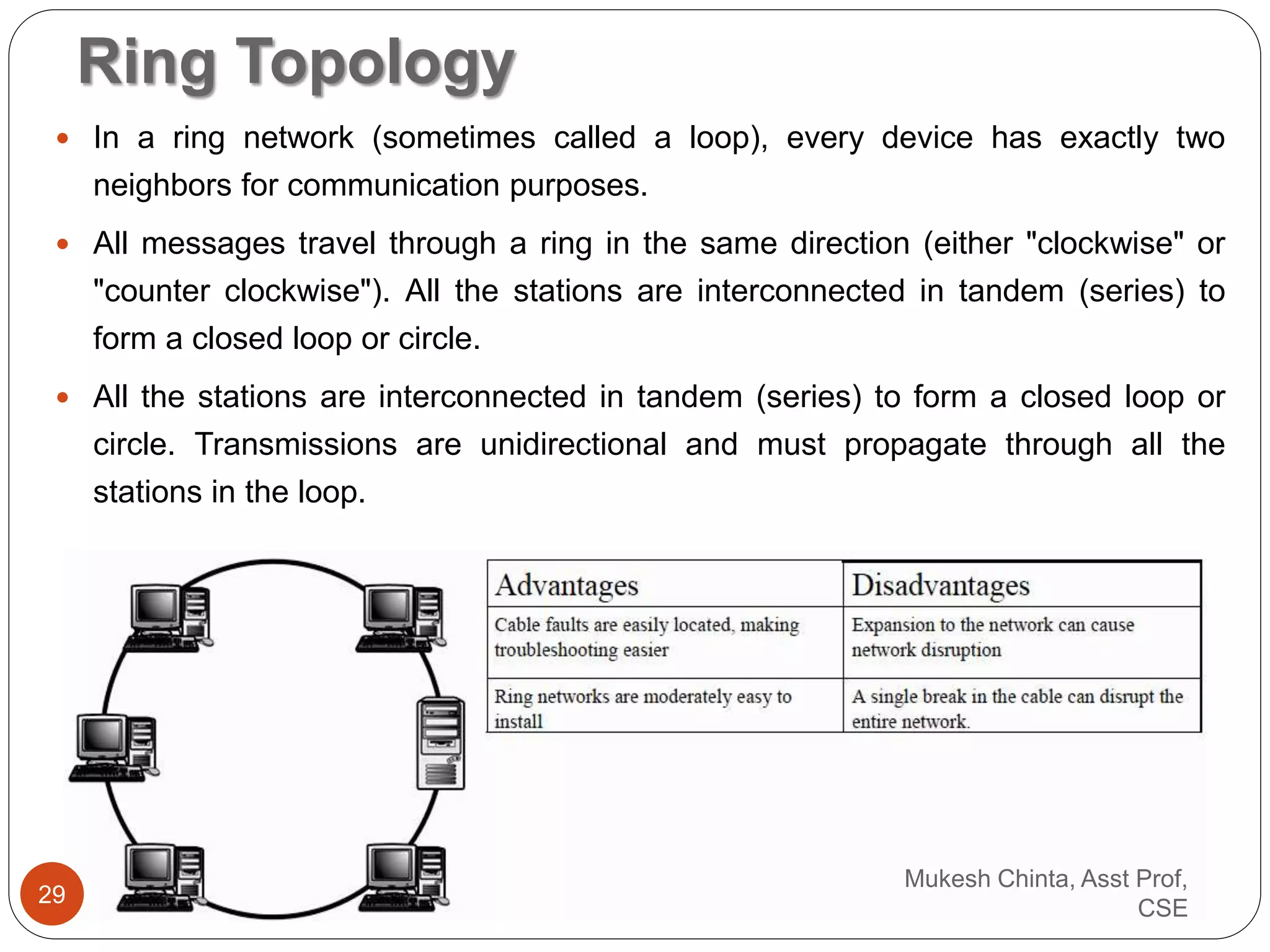
 In a ring network (sometimes called a loop), every device has exactly two
neighbors for communication purposes.
 All messages travel through a ring in the same direction (either "clockwise" or
"counter clockwise"). All the stations are interconnected in tandem (series) to
form a closed loop or circle.
 All the stations are interconnected in tandem (series) to form a closed loop or
circle. Transmissions are unidirectional and must propagate through all the
stations in the loop.
Mukesh Chinta, Asst Prof,
CSE
29
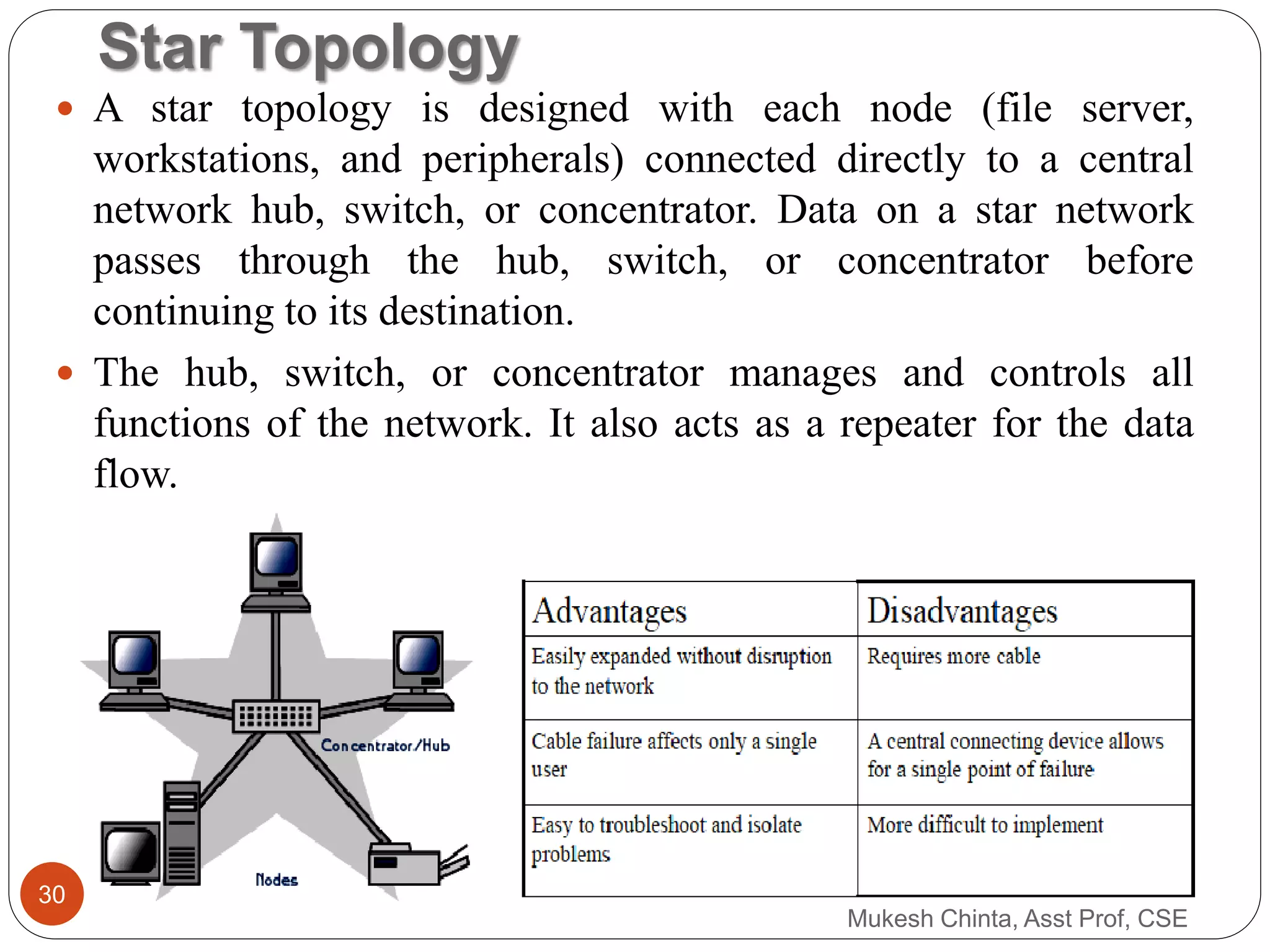
 A star topology is designed with each node (file server,
workstations, and peripherals) connected directly to a central
network hub, switch, or concentrator. Data on a star network
passes through the hub, switch, or concentrator before
continuing to its destination.
 The hub, switch, or concentrator manages and controls all
functions of the network. It also acts as a repeater for the data
flow.
Star Topology
Mukesh Chinta, Asst Prof, CSE
30
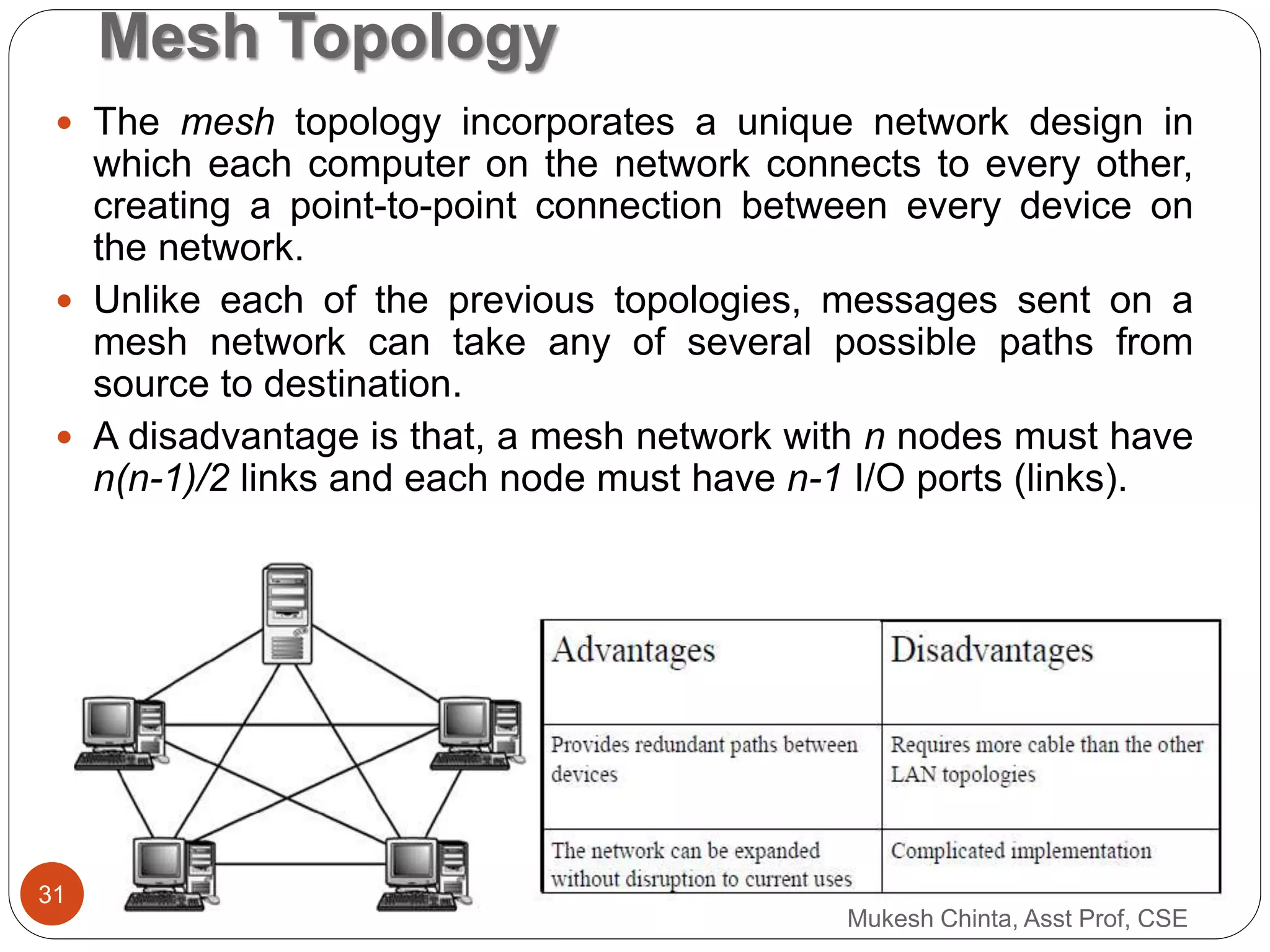
 The mesh topology incorporates a unique network design in
which each computer on the network connects to every other,
creating a point-to-point connection between every device on
the network.
 Unlike each of the previous topologies, messages sent on a
mesh network can take any of several possible paths from
source to destination.
 A disadvantage is that, a mesh network with n nodes must have
n(n-1)/2 links and each node must have n-1 I/O ports (links).
Mesh Topology
Mukesh Chinta, Asst Prof, CSE
31
Hybrid Topology
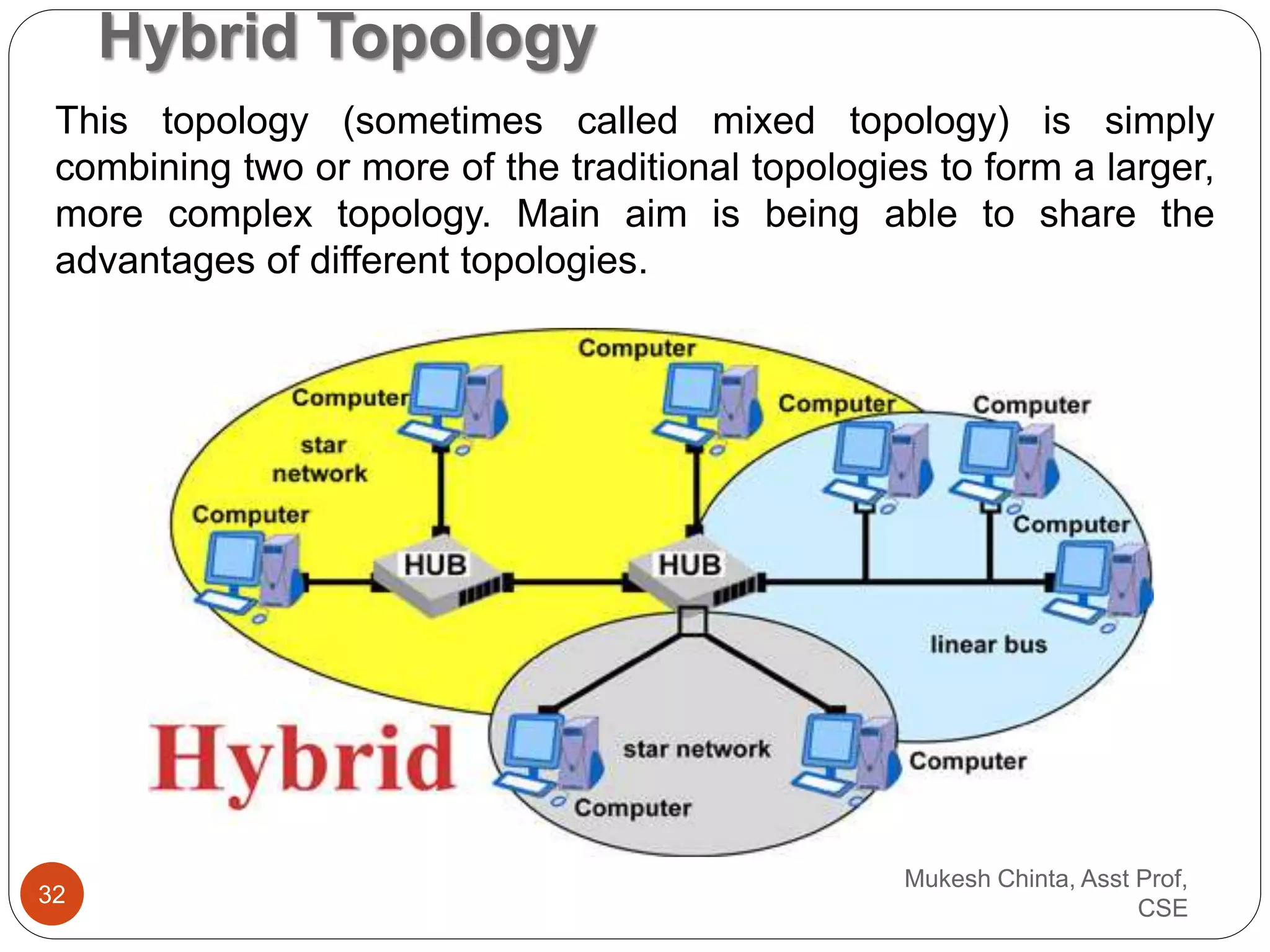
This topology (sometimes called mixed topology) is simply
combining two or more of the traditional topologies to form a larger,
more complex topology. Main aim is being able to share the
advantages of different topologies.
Mukesh Chinta, Asst Prof,
CSE
32
Mukesh Chinta, Asst Prof,
CSE
33

Networks classification

  • 2.
    TOPOLOGY NETWORK STAR RING BUS PEER TO PEER CLIENT-SERVER PYSHICAL/ WIRELESS TWISTED PAIR, COAXIAL, FIBRE OPTIC INFRARED, RADIOWAVE, SATELLITE NIC HUB ROUTER MODEM ACCESS POINT LAN MAN WAN INTRANET EXTRANET INTERNET TCP/IP NETWORK OPERATING SYSTEM CLIENT SOFTWARE ARCHITECTURE TYPES TECHNOLOGY PROTOCOL SOFTWARE MEDIUM DEVICES 192.168.1.3 Mukesh Chinta, Asst Prof, CSE 2
  • 3.
    Classification of Networks Thereis no generally accepted taxonomy into which all computer networks fit, but two dimensions stand out as important: Transmission Technology and Scale. Mukesh Chinta, Asst Prof, CSE 3
  • 4.
    4 Based on TransmissionTechnology  Broadcast Networks: All stations share a single communication channel  Point-to-Point Networks: Pairs of hosts (or routers) are directly connected  Typically, local area networks (LANs) are broadcast and wide area networks (WANs) are point-to-point Broadcast Network Point-to-Point Network Mukesh Chinta, Asst Prof, CSE
  • 5.
    Links (a) (b) point-to-point multiple-access Geographical coverage andscalability are limited. Each node needs one interface for each link. Mukesh Chinta, Asst Prof, CSE 5
  • 6.
    Broadcast Networks  ASingle communication link is shared by all the machines on that network  When a message is transmitted, it can be received & processed by every machine on that network. This is called broadcasting  The address field within the message specifies the intended recipient. Only if its for the host, it process the message or it ignores it.  Two popular topologies of broadcast LAN are Bus and Ring 6
  • 7.
    A variant ofbroadcasting called multicasting in which transmission is done to a subset of machines. Advantages  Network is easy to build- Only one cable is needed  Cost of construction is cheaper when compared to other networks Disadvantages  Not very scalable and flexible  An Arbitration mechanism is needed to resolve conflicts Broadcast Networks Mukesh Chinta, Asst Prof, CSE 7
  • 8.
    Point-to-Point Networks  Consistsof many connections between individual pair of nodes.  Often multiple routes of different lengths are possible  Point-to-point transmission with one sender and one receiver is sometimes called unicasting  End devices that wish to communicate are called stations and the switching devices are called nodes. Mukesh Chinta, Asst Prof, CSE 8
  • 9.
    Advantages  Greater aggregatebandwidth- can have more than one sender  Can add capacity incrementally- add more links/switches  Better fault tolerance  Lower Latency- No arbitration needed to send Disadvantages  More expensive as it requires lots of transmission lines and switching elements to connect remote hosts Point-to-Point Networks Mukesh Chinta, Asst Prof, CSE9
  • 10.
    Switched Networks Circuit Switched ■■ ■ Packet Switched store-and-forward Mukesh Chinta, Asst Prof, CSE 10
  • 11.
    Sharing a Link L2 L3 R2 R3 L1R1 Switch 1 Switch 2 multiplex demultiplex Mukesh Chinta, Asst Prof, CSE 11
  • 12.
    Networks Based onScale Classification of network Local Area Network (LAN) Metropolitan Area Network (MAN) Wide Area Network (WAN)  The main differentiation among these classifications is their area of coverage. LAN, MAN and WAN compared Mukesh Chinta, Asst Prof, CSE 12
  • 13.
    LOCAL AREA NETWORK{LAN} A LAN is a private network that connects computers and devices in a limited geographically area such as a home, school computer laboratory, office building. LAN’s are used to share resources and to exchange information. LAN’s are restricted in size having a bounded worst-case transmission time, which simplifies networks management Traditional LAN’s run at 10-100Mbps Common Topologies used are bus, ring and star High data rates with less errorsMukesh Chinta, Asst Prof, CSE 13
  • 14.
    Headphone PDA PrinterMouse Laptop Smartphone LOCAL AREA NETWORK{LAN} Types of LAN Personal Area Network (PAN) House Area Network (HAN) A Personal area network (PAN) is a computer network used for communication among computer and different information technological devices close to one person. Common Technologies used are Bluetooth and Infrared. Range is ~10m A House area network (HAN) is a type of local area network that develops from the need to facilitate communication and interoperability among digital devices present inside or within the close vicinity of a home. 14
  • 15.
     Covers alarger geographical area than is a LAN, ranging from several blocks of buildings to entire cities.  It may be a single network as a cable TV network or it may be means of connecting a number of LANs into a larger network so that resources may be shared.  MAN is wholly owned and operated by a private company or may be a service provided by a public company A metropolitan area network based on cable TV METROPOLITAN AREA NETWORK {MAN} Mukesh Chinta, Asst Prof, CSE 15
  • 16.
    The main reasonfor distinguishing MANs as a special category is that a standard has been adopted for them. It is DQDB (Distributed Queue Dual Bus) or IEEE 802.6. METROPOLITAN AREA NETWORK {MAN}  Using DQDB, networks can be up to 20 miles (30 km) long and operate at speeds of 34 to 155 Mbits/s.  It consists of two unidirectional buses (cables) to which all the computers are connected. Each bus has a head-end, which initiates transmission activity. Traffic destined for a computer to the right of the sender uses the upper bus and to the left uses the lower one. Mukesh Chinta, Asst Prof, CSE 16
  • 17.
     Wide areanetworks are the oldest type of data communications network that provide relatively slow-speed, long-distance transmission of data, voice and video information over relatively large and widely dispersed geographical areas, such as country or entire continent.  WAN spans a large geographical area: a country or a continent  It contains a collection of machines intended for running user programs called hosts. The hosts are connected by a communication subnet, or just subnet for short.  In most WAN’s, the subnet consists of two distinct components: transmission lines and switching elements. Transmission lines move bits between machines. Switching elements (Routers) are specialized computers that connect three or more transmission lines. When data arrive on an incoming line, the switching element must choose an outgoing line on which to forward them. WIDE AREA NETWORK {WAN} Mukesh Chinta, Asst Prof, CSE 17
  • 18.
    WIDE AREA NETWORK{WAN} When a packet is sent from one router to another via one or more intermediate routers, the packet is received at each intermediate router in its entirety, stored there until the required output line is free, and then forwarded. A subnet organized according to this principle is called a store-and-forward or packet-switched subnet. Routing decisions are made locally according to a routing algorithm. Mukesh Chinta, Asst Prof, CSE 18
  • 19.
    Mukesh Chinta, AsstProf, CSE 19
  • 20.
    A Quick Comparison MukeshChinta, Asst Prof, CSE20
  • 21.
    Internetwork {Internet}  Itis a Global network of computers which may be server or client that exchanges information.  It can be defined as a "network of networks" which can be linked through copper wires, wireless connections, and other technologies.  This is the world-wide network of computers accessible to anyone who knows their Internet Protocol (IP) address  Such interconnection of networks requires that different, and frequently incompatible networks, be connected, sometimes by means of machines called gateways to make the connection and provide the necessary translation, both in terms of hardware and software. Mukesh Chinta, Asst Prof, CSE21
  • 22.
     The termIntranet is derived from two words: ‘Intra’ which means within and ‘net’ which means group of interconnected computers.  It is a private computer network that uses Internet protocols and network connectivity to securely share any part of an organization's information or operational systems with its employees.  In short, an intranet is private network, similar to the Internet and using the same protocols and technology, contained within an enterprise or not-for-profit organization. Intranet Mukesh Chinta, Asst Prof, CSE22
  • 23.
    Extranet  is anintranet for outside authorized users using same internet technologies. The outside users are trusted partners of the organization who have access to information of their interest & concern.  extends the intranet concept to provide a network that connects a company’s network to the networks of its business partners, selected customers, or suppliers. Mukesh Chinta, Asst Prof, CSE 23
  • 24.
  • 25.
    Client-Server Vs Peer-to-peer A network server is a computer designed to process requests and deliver data to other (client) computers over a local network or the Internet. A Client is a computer that retrieves information from or uses resources provided by a server or main computer.  A peer-to-peer network is a network where the computers act as both workstations and servers. It is great for small, simple, and inexpensive networks. In a strict peer-to-peer networking setup, every computer is an equal, a peer in the network. Each machine can have resources that are shared with any other machine. Mukesh Chinta, Asst Prof, CSE25
  • 26.
    Mukesh Chinta, AsstProf, CSE 26
  • 27.
    Network topology  Atopology is a way of “laying out” the network. Topologies can be either physical or logical.  A topology describes the configuration of a network and influences the networks cost and performance. Various topologies are possible for broadcast LAN’s.  Physical topologies describe how the cables are run.  Logical topologies describe how the network messages travel Bus (can be both logical and physical) Star (physical only) Ring (can be both logical and physical) Mesh (can be both logical and physical) Mukesh Chinta, Asst Prof, CSE 27
  • 28.
    Bus Topology  Busnetworks use a common backbone to connect all devices. A single cable, (the backbone) functions as a shared communication medium that devices attach or tap into with an interface connector.  The bus topology is the simplest and most common method of interconnecting computers. The two ends of the transmission line never touch to form a complete loop. A bus topology is also known as multidrop or linear bus or a horizontal bus.  A device wanting to communicate with another device on the network sends a broadcast message onto the wire that all other devices see, but only the intended recipient actually accepts and processes the message. Mukesh Chinta, Asst Prof, CSE 28
  • 29.
    Ring Topology  Ina ring network (sometimes called a loop), every device has exactly two neighbors for communication purposes.  All messages travel through a ring in the same direction (either "clockwise" or "counter clockwise"). All the stations are interconnected in tandem (series) to form a closed loop or circle.  All the stations are interconnected in tandem (series) to form a closed loop or circle. Transmissions are unidirectional and must propagate through all the stations in the loop. Mukesh Chinta, Asst Prof, CSE 29
  • 30.
     A startopology is designed with each node (file server, workstations, and peripherals) connected directly to a central network hub, switch, or concentrator. Data on a star network passes through the hub, switch, or concentrator before continuing to its destination.  The hub, switch, or concentrator manages and controls all functions of the network. It also acts as a repeater for the data flow. Star Topology Mukesh Chinta, Asst Prof, CSE 30
  • 31.
     The meshtopology incorporates a unique network design in which each computer on the network connects to every other, creating a point-to-point connection between every device on the network.  Unlike each of the previous topologies, messages sent on a mesh network can take any of several possible paths from source to destination.  A disadvantage is that, a mesh network with n nodes must have n(n-1)/2 links and each node must have n-1 I/O ports (links). Mesh Topology Mukesh Chinta, Asst Prof, CSE 31
  • 32.
    Hybrid Topology This topology(sometimes called mixed topology) is simply combining two or more of the traditional topologies to form a larger, more complex topology. Main aim is being able to share the advantages of different topologies. Mukesh Chinta, Asst Prof, CSE 32
  • 33.
    Mukesh Chinta, AsstProf, CSE 33