 Computer Networks
 Communication Model
 Transmission Modes
 Communication Types
 Classification Of Computer Networks
 By Scale
 By Structure
 By Topology
 Network Media
 Internetworking
 A computer network is a group of interconnected computers.
 It allows computers to communicate with each other and to
share resources and information.
 First Network : The Advanced Research Projects Agency
(ARPA) funded the design of the "Advanced Research
Projects Agency Network" (ARPANET) for the United States
Department of Defense
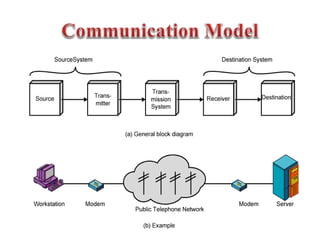
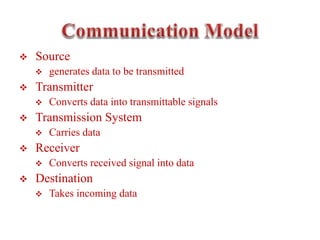
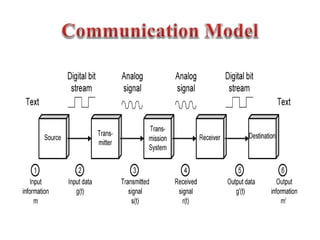
 Source
 generates data to be transmitted
 Transmitter
 Converts data into transmittable signals
 Transmission System
 Carries data
 Receiver
 Converts received signal into data
 Destination
 Takes incoming data
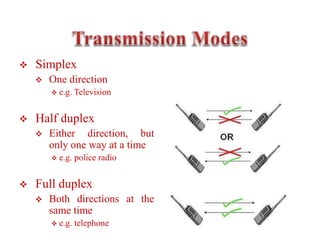
 Simplex
 One direction
 e.g. Television
 Half duplex
 Either direction, but
only one way at a time
 e.g. police radio
 Full duplex
 Both directions at the
same time
 e.g. telephone
 Unicasting (one-to-one)
 Multicasting (one-to-many)
 Broadcasting (one-to-all)
 By Size or Scale
 LAN
 WAN
 MAN
 CAN
 PAN
 Contains printers, servers and computers
 Systems are close to each other
 Contained in one office or building
 Organizations often have several LANS
 Two or more LANs connected
 Over a large geographic area
 Typically use public or leased lines
 Phone lines
 Satellite
 The Internet is a WAN
 Large network that connects different
organizations
 Shares regional resources
 A network provider sells time
 A LAN in one large geographic area
 Resources related to the same organization
 Each department shares the LAN
 Very small scale network
 Range is less than 2 meters
 Cell phones, PDAs, MP3 players
 By Structure / Functional Relationship
 Client / Server
 Peer to Peer (P2PN)
 Nodes and servers share data roles
 Nodes are called clients
 Servers are used to control access
 Database software
 Access to data controlled by server
 Server is the most important computer
 All nodes are equal
 Nodes access resources on other nodes
 Each node controls its own resources
 Most modern OS allow P2PN
 Distributed computing is a form
 Kazaa
 By Topology / Physical Connectivity
 BUS
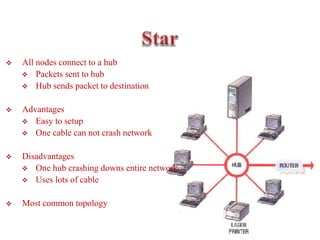
 STAR
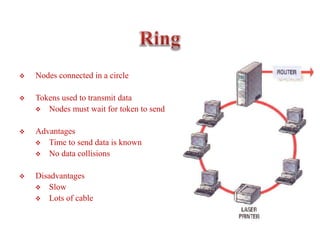
 RING
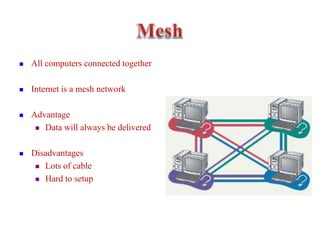
 MESH
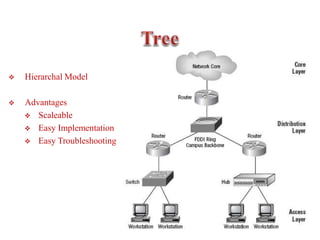
 TREE
 Logical layout of wires and equipment
 Choice affects
Network performance
Network size
Network collision detection
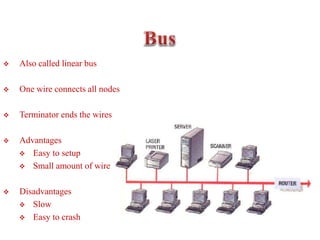
 Also called linear bus
 One wire connects all nodes
 Terminator ends the wires
 Advantages
 Easy to setup
 Small amount of wire
 Disadvantages
 Slow
 Easy to crash
 All nodes connect to a hub
 Packets sent to hub
 Hub sends packet to destination
 Advantages
 Easy to setup
 One cable can not crash network
 Disadvantages
 One hub crashing downs entire network
 Uses lots of cable
 Most common topology
 Nodes connected in a circle
 Tokens used to transmit data
 Nodes must wait for token to send
 Advantages
 Time to send data is known
 No data collisions
 Disadvantages
 Slow
 Lots of cable
 All computers connected together
 Internet is a mesh network
 Advantage
 Data will always be delivered
 Disadvantages
 Lots of cable
 Hard to setup
 Hierarchal Model
 Advantages
 Scaleable
 Easy Implementation
 Easy Troubleshooting
 Links that connect nodes
 Choice impacts
 Speed
 Security
 Size
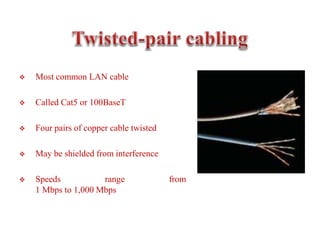
 Most common LAN cable
 Called Cat5 or 100BaseT
 Four pairs of copper cable twisted
 May be shielded from interference
 Speeds range from
1 Mbps to 1,000 Mbps
 Similar to cable TV wire
 One wire runs through cable
 Shielded from interference
 Speeds up to 10 Mbps
 Nearly obsolete
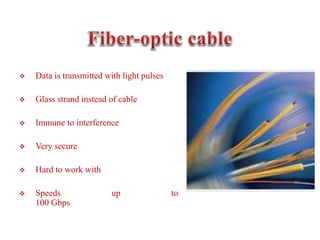
 Data is transmitted with light pulses
 Glass strand instead of cable
 Immune to interference
 Very secure
 Hard to work with
 Speeds up to
100 Gbps
 Data transmitted through the air
 LANs use radio waves
 WANs use microwave signals
 Easy to setup
 Difficult to secure
 An internetwork is the connection of two or
more distinct computer networks or network
segments via a common routing technology.
 Any interconnection among or between public,
private, commercial, industrial, or governmental
networks may also be defined as an
internetwork.
 An extranet is a network or internetwork that is
limited in scope to a single organization or entity
but which also has limited connections to the
networks of one or more other usually, but not
necessarily, trusted organizations or entities
 by definition, an extranet cannot consist of a
single LAN; it must have at least one connection
with an external network.
 An intranet is a set of networks, using the Internet
Protocol and IP-based tools such as web browsers
and file transfer applications, that is under the
control of a single administrative entity.
 Most commonly, an intranet is the internal
network of an organization
 The Internet consists of a worldwide interconnection of
governmental, academic, public, and private networks
based upon the networking technologies of the Internet
Protocol Suite.
 It is the successor of the Advanced Research Projects
Agency Network (ARPANET) developed by DARPA of
the U.S. Department of Defense.
 The Internet is also the communications backbone
underlying the World Wide Web (WWW).
 Federal Networking Council definition of
Internet highlights three important concepts
that are basis for understanding the Internet:
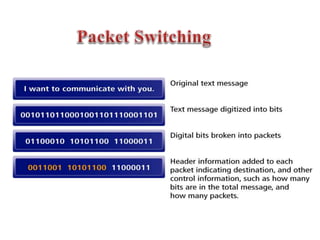
 Packet switching
 TCP/IP communications protocol
 Client/server computing
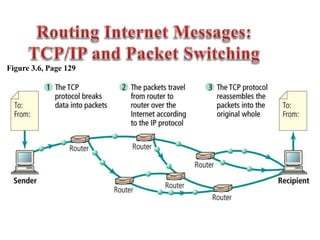
 A method of slicing digital messages into packets,
sending the packets along different communication paths
as they become available, and then reassembling the
packets once they arrive at their destination
 Uses routers: special purpose computers that interconnect
the computer networks that make up the Internet and
route packets to their ultimate destination
 Routers use computer programs called routing algorithms
to ensure packets take the best available path toward their
destination
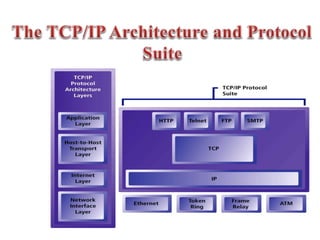
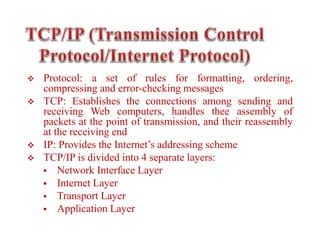
 Protocol: a set of rules for formatting, ordering,
compressing and error-checking messages
 TCP: Establishes the connections among sending and
receiving Web computers, handles thee assembly of
packets at the point of transmission, and their reassembly
at the receiving end
 IP: Provides the Internet’s addressing scheme
 TCP/IP is divided into 4 separate layers:
 Network Interface Layer
 Internet Layer
 Transport Layer
 Application Layer
 Internet address (also called IP address): a 32-
bit number expressed as a series of four
separate numbers marked off by periods, such
as 201.61.186.227
 IPv4 the current version of IP. Can handle up
to 4 billion addresses
 IPv6 (next generation of IP) will use 128-bit
addresses and be able to handle up 1
quadrillion addresses
Figure 3.6, Page 129
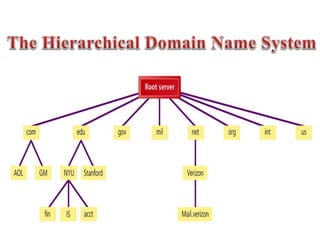
 Domain name: IP address expressed in natural
language
 Domain name system (DNS): allows numeric
IP addresses to be expressed in natural
language
 Example: cnet.com = 216.200.247.134
 Uniform resource locator (URL): addresses
used by Web browsers to identify location of
content on the Web
 Circuit switching was the switching technique
used in communication networks because it is
simple enough to carry analog signals.
 Eg. Phone system
14-Jun-14 ITM 3232.1 E Business 45
 Circuit switching provides traffic isolation
and traffic engineering, but at the expense of
using bandwidth inefficiently and signaling
overhead. It is often said that these two
drawbacks make circuits
witching highly inflexible, especially in a
highly dynamic environment such as the
Internet..
14-Jun-14 ITM 3232.1 E Business 46
 Packet switching is the basis for the
InternetProtocol (IP) In packet switching,
information flows are broken into variable-size
packets (or fixed-size cells as in the case of
ATM).These packets are sent, one by one, to the
nearest router, which will look up the destination
address, and then forward them to the
corresponding next hop. This process is repeated
until the packet reaches its destination. The
routing of the information is thus done locally,
hop-by-hop. Routing decisions are independent
of other decisions in the past and in other routers;
14-Jun-14 ITM 3232.1 E Business 47
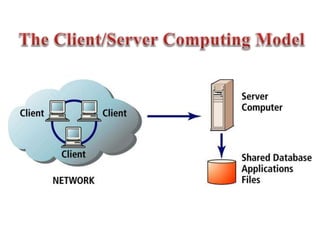
 Model of computing in which very
powerful personal computers (clients) are
connected in a network with one or more
server computers that perform common
functions for the clients, such as storing
files, software applications, etc.
 Peer-to-peer computing an outgrowth of client/server
computing model
 Allows client computers to share resources without
intervention of a central server
 Most often used for sharing music and other file over the
Internet, in violation of copyright laws
 However, some new legitimate uses such as Groove
Workspace, a P2P platform developed by Groove
Networks
 A network interface card (NIC) is a circuit board
or card that is installed in a computer so that it
can be connected to a network.
 A network interface card provides the computer
with a dedicated, full-time connection to a
network. Personal computers and workstations
on a local area network (LAN) typically contain
a network interface card specifically designed for
the LAN transmission technology
14-Jun-14 ITM 3232.1 E Business 51
 Definition: Traditional modems used on
dialup networks convert data between the
analog form used on telephone lines and the
digital form used on computers. Standard dial-
up network modems transmit data at a
maximum rate of 56,000 bits per second (56
Kbps). However, inherent limitations of the
public telephone network limit modem data
rates to 33.6 Kbps or lower in practice.
14-Jun-14 ITM 3232.1 E Business 52
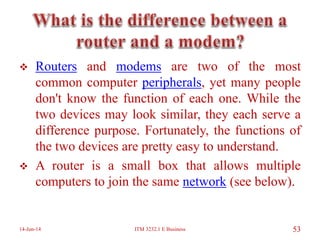
 Routers and modems are two of the most
common computer peripherals, yet many people
don't know the function of each one. While the
two devices may look similar, they each serve a
difference purpose. Fortunately, the functions of
the two devices are pretty easy to understand.
 A router is a small box that allows multiple
computers to join the same network (see below).
14-Jun-14 ITM 3232.1 E Business 53
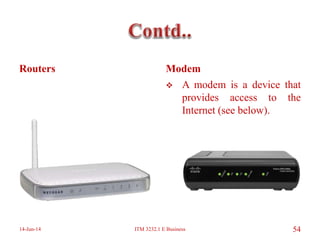
Routers Modem
 A modem is a device that
provides access to the
Internet (see below).
14-Jun-14 ITM 3232.1 E Business 54
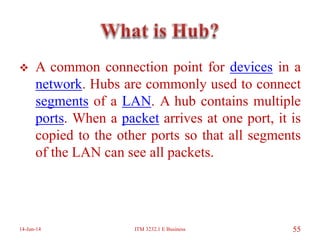
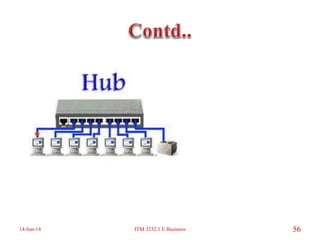
 A common connection point for devices in a
network. Hubs are commonly used to connect
segments of a LAN. A hub contains multiple
ports. When a packet arrives at one port, it is
copied to the other ports so that all segments
of the LAN can see all packets.
14-Jun-14 ITM 3232.1 E Business 55
14-Jun-14 ITM 3232.1 E Business 56
 In networks, a device that filters and forwards
packets between LAN segments. Switches
operate at the data link layer (layer 2) and
sometimes the network layer (layer 3) of the
OSI Reference Model and therefore support
any packet protocol. LANs that use switches
to join segments are called switched LANs or,
in the case of Ethernet networks, switched
Ethernet LANs.
14-Jun-14 ITM 3232.1 E Business 57
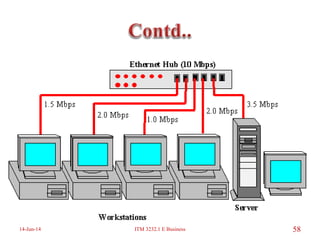
14-Jun-14 ITM 3232.1 E Business 58
 A device that forwards data packets along
networks. A router is connected to at least two
networks, commonly two LANs or WANs or a
LAN and its ISP.s network. Routers are located
at gateways, the places where two or more
networks connect. Routers use headers and
forwarding tables to determine the best path for
forwarding the packets, and they use protocols
such as ICMP to communicate with each other
and configure the best route between any two
hosts.
14-Jun-14 ITM 3232.1 E Business 59
 Definition: A network gateway is an
internetworking system capable of joining
together two networks that use different base
protocols. A network gateway can be
implemented completely in software,
completely in hardware, or as a combination
of both.
14-Jun-14 ITM 3232.1 E Business 60
 A device that connects two local-area
networks (LANs), or two segments of the
same LAN that use the same protocol, such as
Ethernet or Token-Ring.
14-Jun-14 ITM 3232.1 E Business 61
14-Jun-14 ITM 3232.1 E Business 62

E business 2014 l06

  • 4.
     Computer Networks Communication Model  Transmission Modes  Communication Types  Classification Of Computer Networks  By Scale  By Structure  By Topology  Network Media  Internetworking
  • 5.
     A computernetwork is a group of interconnected computers.  It allows computers to communicate with each other and to share resources and information.  First Network : The Advanced Research Projects Agency (ARPA) funded the design of the "Advanced Research Projects Agency Network" (ARPANET) for the United States Department of Defense
  • 7.
     Source  generatesdata to be transmitted  Transmitter  Converts data into transmittable signals  Transmission System  Carries data  Receiver  Converts received signal into data  Destination  Takes incoming data
  • 9.
     Simplex  Onedirection  e.g. Television  Half duplex  Either direction, but only one way at a time  e.g. police radio  Full duplex  Both directions at the same time  e.g. telephone
  • 10.
     Unicasting (one-to-one) Multicasting (one-to-many)  Broadcasting (one-to-all)
  • 11.
     By Sizeor Scale  LAN  WAN  MAN  CAN  PAN
  • 12.
     Contains printers,servers and computers  Systems are close to each other  Contained in one office or building  Organizations often have several LANS
  • 13.
     Two ormore LANs connected  Over a large geographic area  Typically use public or leased lines  Phone lines  Satellite  The Internet is a WAN
  • 14.
     Large networkthat connects different organizations  Shares regional resources  A network provider sells time
  • 15.
     A LANin one large geographic area  Resources related to the same organization  Each department shares the LAN
  • 16.
     Very smallscale network  Range is less than 2 meters  Cell phones, PDAs, MP3 players
  • 17.
     By Structure/ Functional Relationship  Client / Server  Peer to Peer (P2PN)
  • 18.
     Nodes andservers share data roles  Nodes are called clients  Servers are used to control access  Database software  Access to data controlled by server  Server is the most important computer
  • 19.
     All nodesare equal  Nodes access resources on other nodes  Each node controls its own resources  Most modern OS allow P2PN  Distributed computing is a form  Kazaa
  • 20.
     By Topology/ Physical Connectivity  BUS  STAR  RING  MESH  TREE
  • 21.
     Logical layoutof wires and equipment  Choice affects Network performance Network size Network collision detection
  • 22.
     Also calledlinear bus  One wire connects all nodes  Terminator ends the wires  Advantages  Easy to setup  Small amount of wire  Disadvantages  Slow  Easy to crash
  • 23.
     All nodesconnect to a hub  Packets sent to hub  Hub sends packet to destination  Advantages  Easy to setup  One cable can not crash network  Disadvantages  One hub crashing downs entire network  Uses lots of cable  Most common topology
  • 24.
     Nodes connectedin a circle  Tokens used to transmit data  Nodes must wait for token to send  Advantages  Time to send data is known  No data collisions  Disadvantages  Slow  Lots of cable
  • 25.
     All computersconnected together  Internet is a mesh network  Advantage  Data will always be delivered  Disadvantages  Lots of cable  Hard to setup
  • 26.
     Hierarchal Model Advantages  Scaleable  Easy Implementation  Easy Troubleshooting
  • 27.
     Links thatconnect nodes  Choice impacts  Speed  Security  Size
  • 28.
     Most commonLAN cable  Called Cat5 or 100BaseT  Four pairs of copper cable twisted  May be shielded from interference  Speeds range from 1 Mbps to 1,000 Mbps
  • 29.
     Similar tocable TV wire  One wire runs through cable  Shielded from interference  Speeds up to 10 Mbps  Nearly obsolete
  • 30.
     Data istransmitted with light pulses  Glass strand instead of cable  Immune to interference  Very secure  Hard to work with  Speeds up to 100 Gbps
  • 31.
     Data transmittedthrough the air  LANs use radio waves  WANs use microwave signals  Easy to setup  Difficult to secure
  • 32.
     An internetworkis the connection of two or more distinct computer networks or network segments via a common routing technology.  Any interconnection among or between public, private, commercial, industrial, or governmental networks may also be defined as an internetwork.
  • 33.
     An extranetis a network or internetwork that is limited in scope to a single organization or entity but which also has limited connections to the networks of one or more other usually, but not necessarily, trusted organizations or entities  by definition, an extranet cannot consist of a single LAN; it must have at least one connection with an external network.
  • 34.
     An intranetis a set of networks, using the Internet Protocol and IP-based tools such as web browsers and file transfer applications, that is under the control of a single administrative entity.  Most commonly, an intranet is the internal network of an organization
  • 35.
     The Internetconsists of a worldwide interconnection of governmental, academic, public, and private networks based upon the networking technologies of the Internet Protocol Suite.  It is the successor of the Advanced Research Projects Agency Network (ARPANET) developed by DARPA of the U.S. Department of Defense.  The Internet is also the communications backbone underlying the World Wide Web (WWW).
  • 36.
     Federal NetworkingCouncil definition of Internet highlights three important concepts that are basis for understanding the Internet:  Packet switching  TCP/IP communications protocol  Client/server computing
  • 37.
     A methodof slicing digital messages into packets, sending the packets along different communication paths as they become available, and then reassembling the packets once they arrive at their destination  Uses routers: special purpose computers that interconnect the computer networks that make up the Internet and route packets to their ultimate destination  Routers use computer programs called routing algorithms to ensure packets take the best available path toward their destination
  • 39.
     Protocol: aset of rules for formatting, ordering, compressing and error-checking messages  TCP: Establishes the connections among sending and receiving Web computers, handles thee assembly of packets at the point of transmission, and their reassembly at the receiving end  IP: Provides the Internet’s addressing scheme  TCP/IP is divided into 4 separate layers:  Network Interface Layer  Internet Layer  Transport Layer  Application Layer
  • 41.
     Internet address(also called IP address): a 32- bit number expressed as a series of four separate numbers marked off by periods, such as 201.61.186.227  IPv4 the current version of IP. Can handle up to 4 billion addresses  IPv6 (next generation of IP) will use 128-bit addresses and be able to handle up 1 quadrillion addresses
  • 42.
  • 43.
     Domain name:IP address expressed in natural language  Domain name system (DNS): allows numeric IP addresses to be expressed in natural language  Example: cnet.com = 216.200.247.134  Uniform resource locator (URL): addresses used by Web browsers to identify location of content on the Web
  • 45.
     Circuit switchingwas the switching technique used in communication networks because it is simple enough to carry analog signals.  Eg. Phone system 14-Jun-14 ITM 3232.1 E Business 45
  • 46.
     Circuit switchingprovides traffic isolation and traffic engineering, but at the expense of using bandwidth inefficiently and signaling overhead. It is often said that these two drawbacks make circuits witching highly inflexible, especially in a highly dynamic environment such as the Internet.. 14-Jun-14 ITM 3232.1 E Business 46
  • 47.
     Packet switchingis the basis for the InternetProtocol (IP) In packet switching, information flows are broken into variable-size packets (or fixed-size cells as in the case of ATM).These packets are sent, one by one, to the nearest router, which will look up the destination address, and then forward them to the corresponding next hop. This process is repeated until the packet reaches its destination. The routing of the information is thus done locally, hop-by-hop. Routing decisions are independent of other decisions in the past and in other routers; 14-Jun-14 ITM 3232.1 E Business 47
  • 48.
     Model ofcomputing in which very powerful personal computers (clients) are connected in a network with one or more server computers that perform common functions for the clients, such as storing files, software applications, etc.
  • 50.
     Peer-to-peer computingan outgrowth of client/server computing model  Allows client computers to share resources without intervention of a central server  Most often used for sharing music and other file over the Internet, in violation of copyright laws  However, some new legitimate uses such as Groove Workspace, a P2P platform developed by Groove Networks
  • 51.
     A networkinterface card (NIC) is a circuit board or card that is installed in a computer so that it can be connected to a network.  A network interface card provides the computer with a dedicated, full-time connection to a network. Personal computers and workstations on a local area network (LAN) typically contain a network interface card specifically designed for the LAN transmission technology 14-Jun-14 ITM 3232.1 E Business 51
  • 52.
     Definition: Traditionalmodems used on dialup networks convert data between the analog form used on telephone lines and the digital form used on computers. Standard dial- up network modems transmit data at a maximum rate of 56,000 bits per second (56 Kbps). However, inherent limitations of the public telephone network limit modem data rates to 33.6 Kbps or lower in practice. 14-Jun-14 ITM 3232.1 E Business 52
  • 53.
     Routers andmodems are two of the most common computer peripherals, yet many people don't know the function of each one. While the two devices may look similar, they each serve a difference purpose. Fortunately, the functions of the two devices are pretty easy to understand.  A router is a small box that allows multiple computers to join the same network (see below). 14-Jun-14 ITM 3232.1 E Business 53
  • 54.
    Routers Modem  Amodem is a device that provides access to the Internet (see below). 14-Jun-14 ITM 3232.1 E Business 54
  • 55.
     A commonconnection point for devices in a network. Hubs are commonly used to connect segments of a LAN. A hub contains multiple ports. When a packet arrives at one port, it is copied to the other ports so that all segments of the LAN can see all packets. 14-Jun-14 ITM 3232.1 E Business 55
  • 56.
    14-Jun-14 ITM 3232.1E Business 56
  • 57.
     In networks,a device that filters and forwards packets between LAN segments. Switches operate at the data link layer (layer 2) and sometimes the network layer (layer 3) of the OSI Reference Model and therefore support any packet protocol. LANs that use switches to join segments are called switched LANs or, in the case of Ethernet networks, switched Ethernet LANs. 14-Jun-14 ITM 3232.1 E Business 57
  • 58.
    14-Jun-14 ITM 3232.1E Business 58
  • 59.
     A devicethat forwards data packets along networks. A router is connected to at least two networks, commonly two LANs or WANs or a LAN and its ISP.s network. Routers are located at gateways, the places where two or more networks connect. Routers use headers and forwarding tables to determine the best path for forwarding the packets, and they use protocols such as ICMP to communicate with each other and configure the best route between any two hosts. 14-Jun-14 ITM 3232.1 E Business 59
  • 60.
     Definition: Anetwork gateway is an internetworking system capable of joining together two networks that use different base protocols. A network gateway can be implemented completely in software, completely in hardware, or as a combination of both. 14-Jun-14 ITM 3232.1 E Business 60
  • 61.
     A devicethat connects two local-area networks (LANs), or two segments of the same LAN that use the same protocol, such as Ethernet or Token-Ring. 14-Jun-14 ITM 3232.1 E Business 61
  • 62.
    14-Jun-14 ITM 3232.1E Business 62