DATA COMMUNICATION&
NETWORKS
DataCommunication
Exchange of data between two or more
devices using some transmission
medium.
Another explanation could be:
Electronic transmission of information
that has been encoded digitally (as for
storage and processing by computers)
Components of Data
Communication System
Message (text,image, numbers, audio, video)
Sender(computer, workstation, telephone,
camera etc.)
Receiver
Transmission Medium(twisted-pair,optical
fiber, coaxial cable, radiowaves)
Protocol(set of rules that govern data
communication)
Characteristics of Data
Comm.
 Delivery
 Accuracy
 Timeliness
Mode of Data
Communications
Simplex (unidirectional)
Half-Duplex (bidirectional)
Full-Duplex(bidirectional)
Applications ofNetworks
 Resource Sharing
 Hardware (Computing Resources, Disks, Printers,etc.)
 Software (Application Software)
 Information Sharing
 Easyaccessibility fromanywhere (Files, Databases, etc.)
 Search Capability (WWW)
 Communication
 Email
 Message Broadcasting
Network Criteria
Performance:
Transmit Time, ResponseTime,
Throughput
Reliability:
Frequency of failure, Time to recover
Security:
Unauthorized Access, Protecting Data
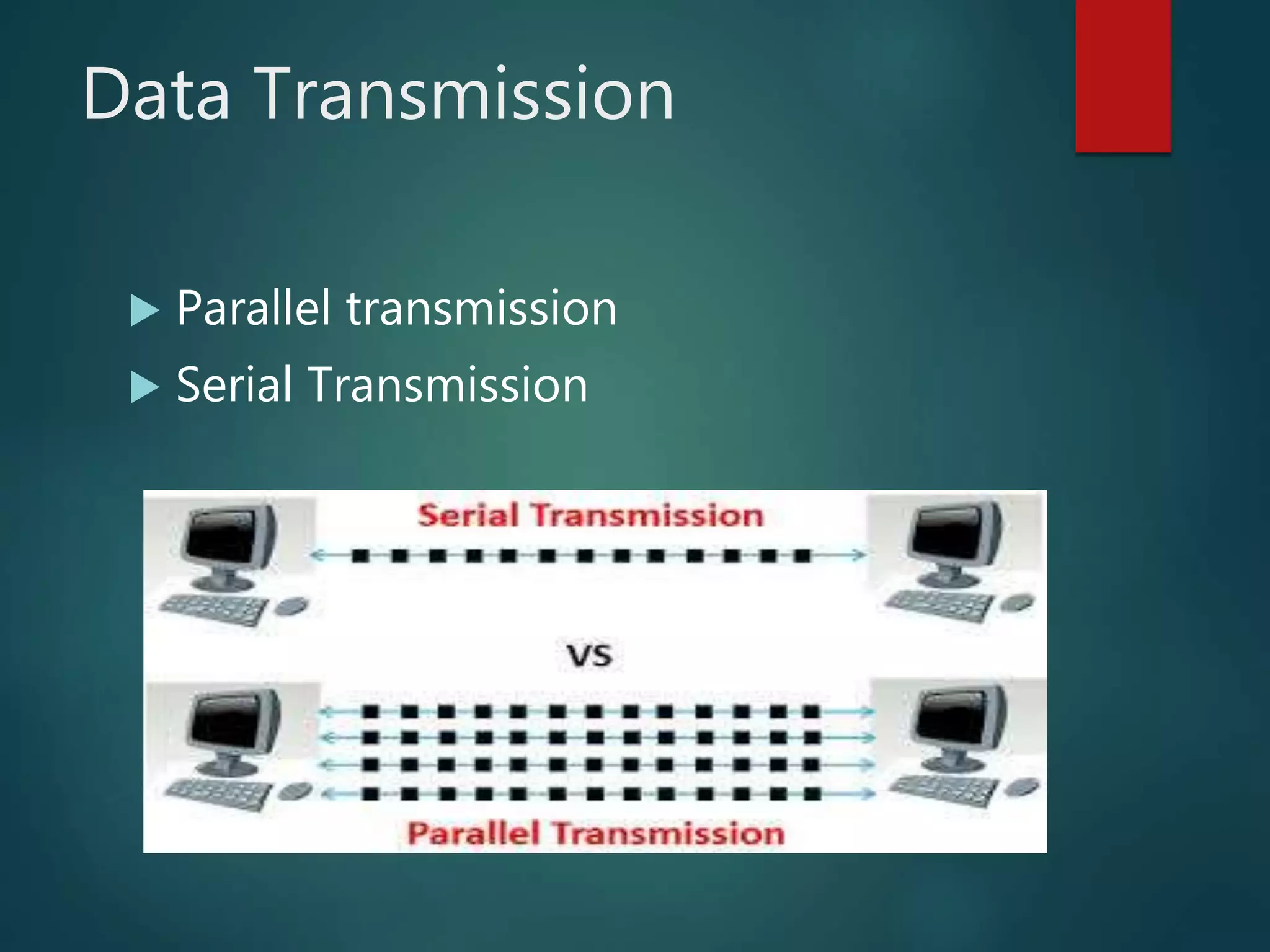
Data Transmission
 Parallel transmission
 Serial Transmission
PhysicalTopology
It refers to the way how the network is
laid out physically.
Geometric representation of the
relationship of all the links and linking
devices
Advantage and
Disadvantages
 Increased speed, Reduced cost, Improved security,
centralized software management, Electronic mail
 High cost of installation, requires time for
administration, failure of server, cable faults
Types of PhysicalTopologies
Mesh Topology
Star Topology
BusTopology
Ring Topology
Tree topology
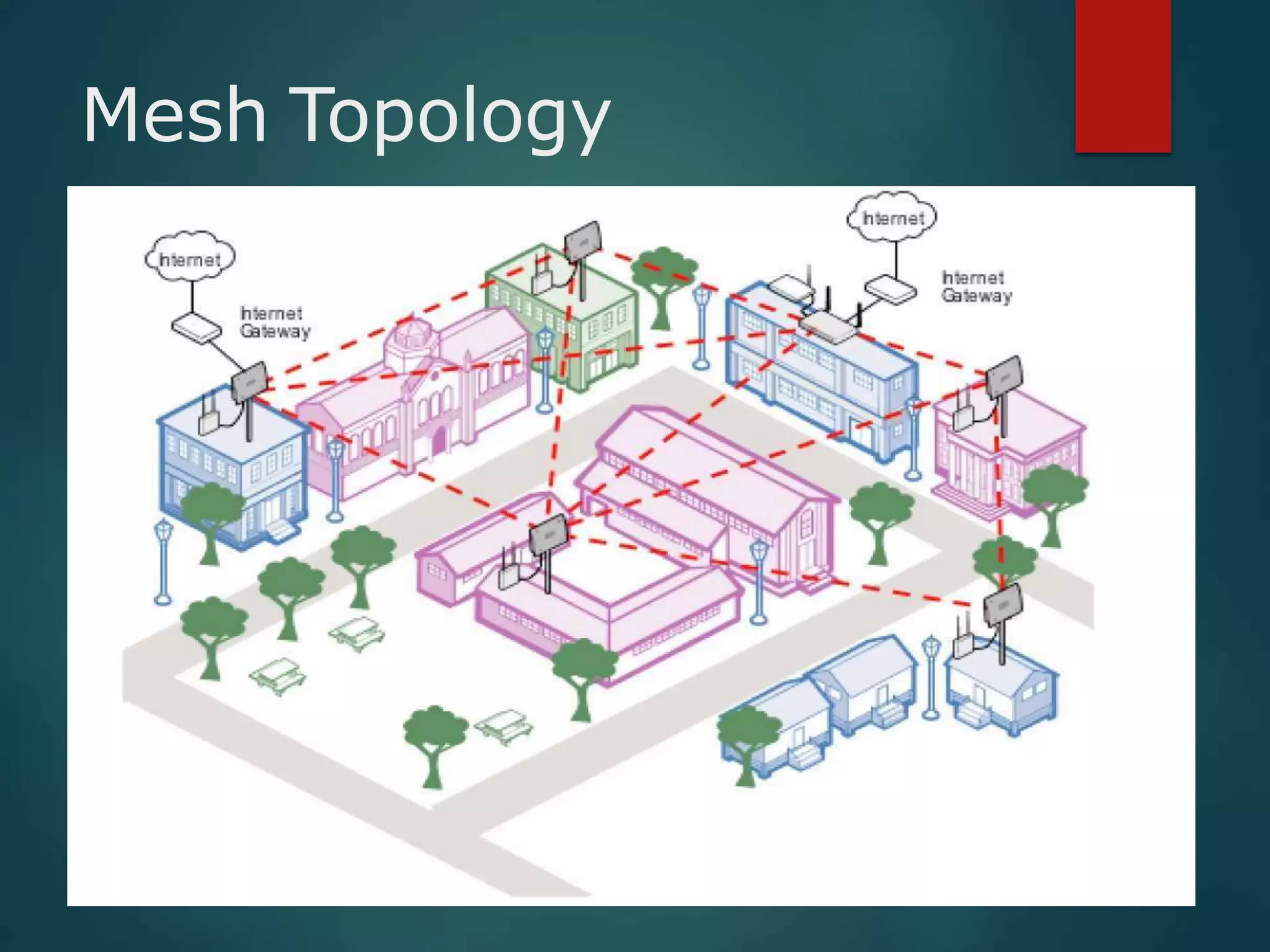
Mesh topology
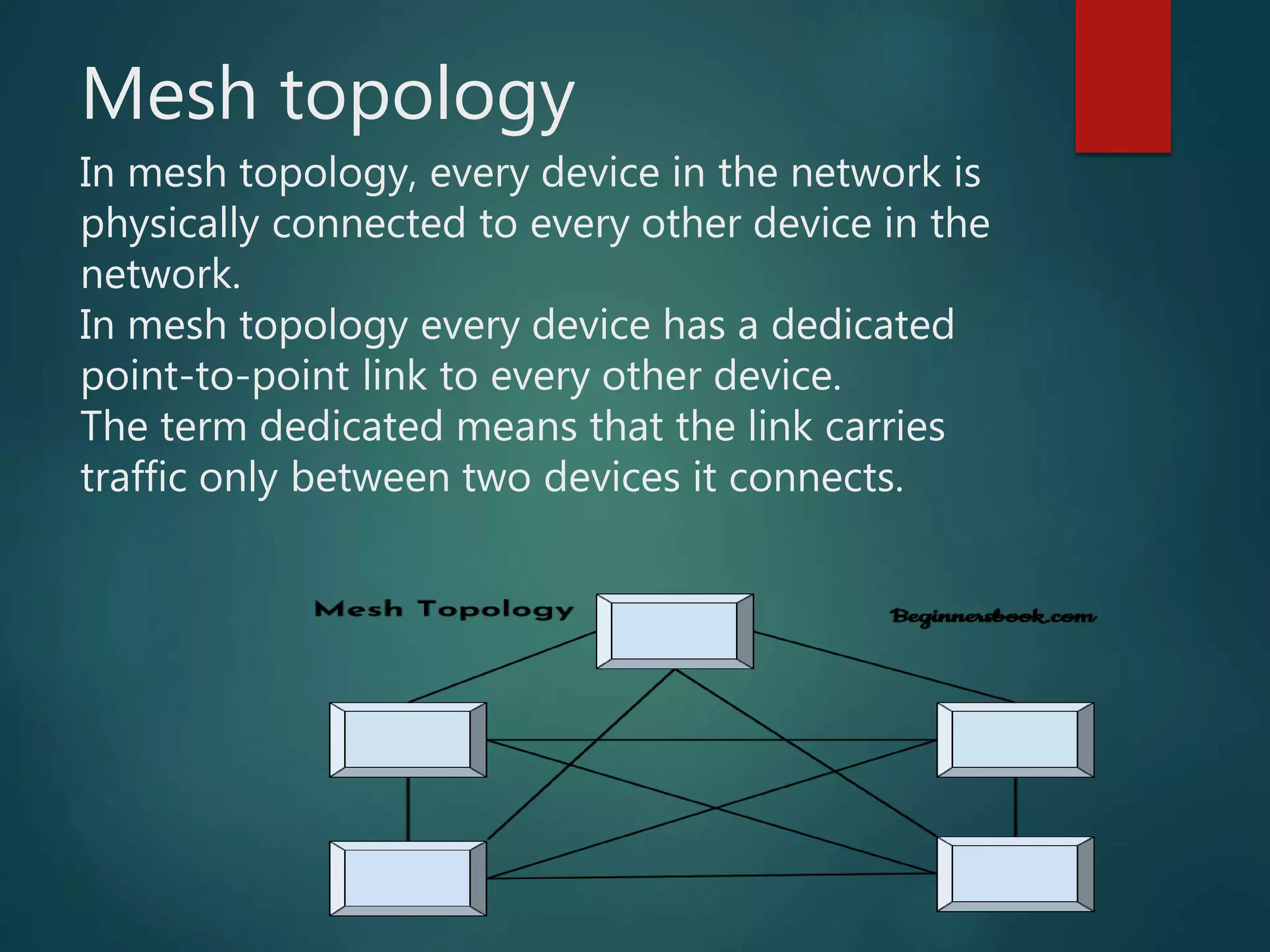
In mesh topology, every device in the network is
physically connected to every other device in the
network.
In mesh topology every device has a dedicated
point-to-point link to every other device.
The term dedicated means that the link carries
traffic only between two devices it connects.
Mesh Topology
Advantages
The use of dedicated links guarantees that each
connection can carry its own data load.
Failure of single computer does not bring down
the entire network
Security and privacy over the dedicated link
Easy diagnosis
Disadvantages
Installation and configuration is difficult
Cabling cost is more
The hardware required to connect each link
Star topology
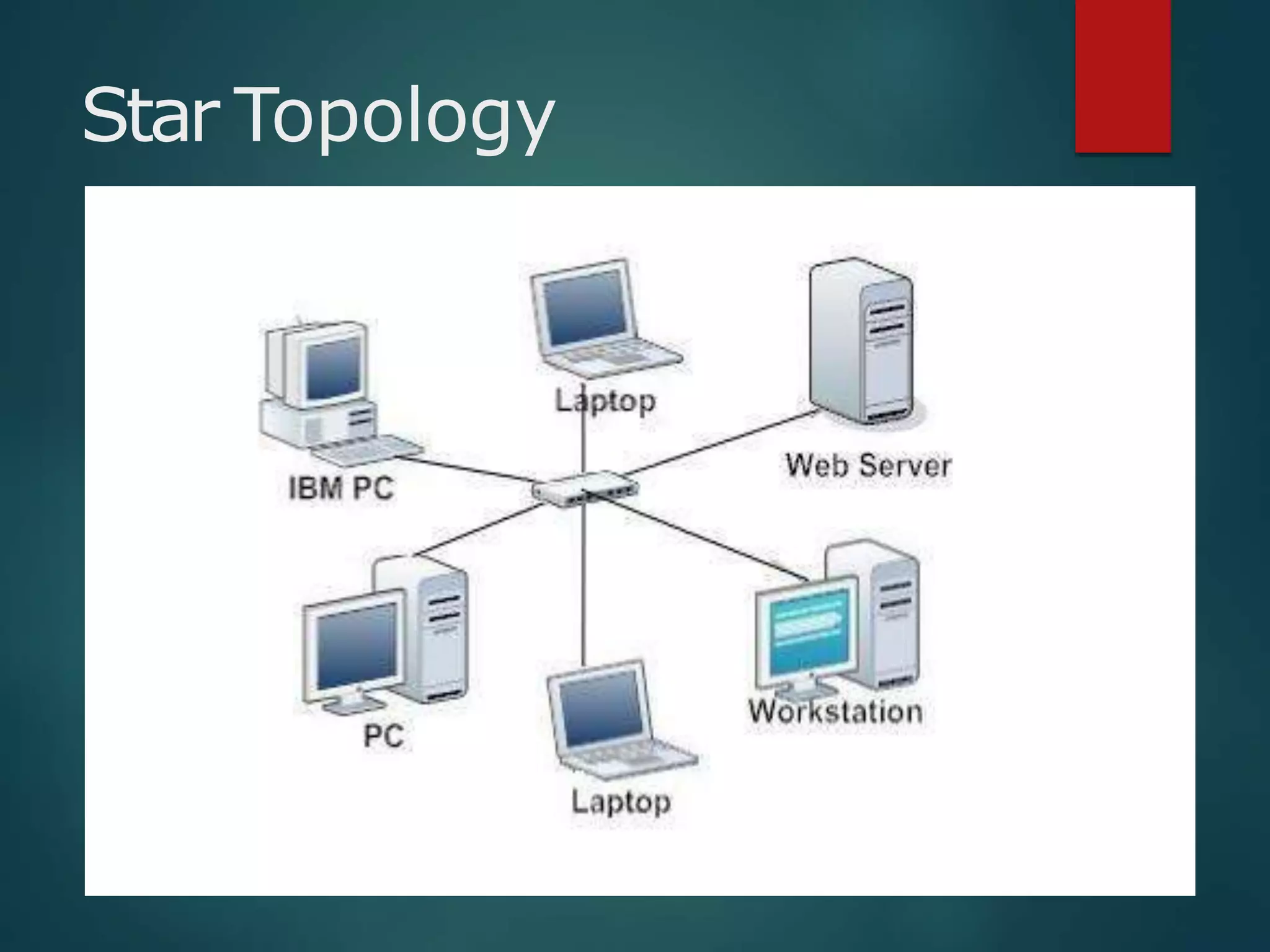
All the cables connects from the computer to the
central location called HUB.
Broadcast star network
Resends message to all the connected computers
Switched star network
Sends data to a destination computer
Working of star topology
The sending computers send
the data to hub. The hub
sends data to the receiving
computer. Each computer in
star network communicates
with a central hub.
Star Topology
Advantages
Easy to install and wire.
No disruptions to the network when connecting or
removing devices.
Easy to detect faults and to remove parts.
Single computer failure does not broke down the whole
network.
Disadvantages
If the central hub fails , the whole network fails to
operate.
The cabling cost is more.
It require a large length of cable to connect
computers.
Bus Topology:
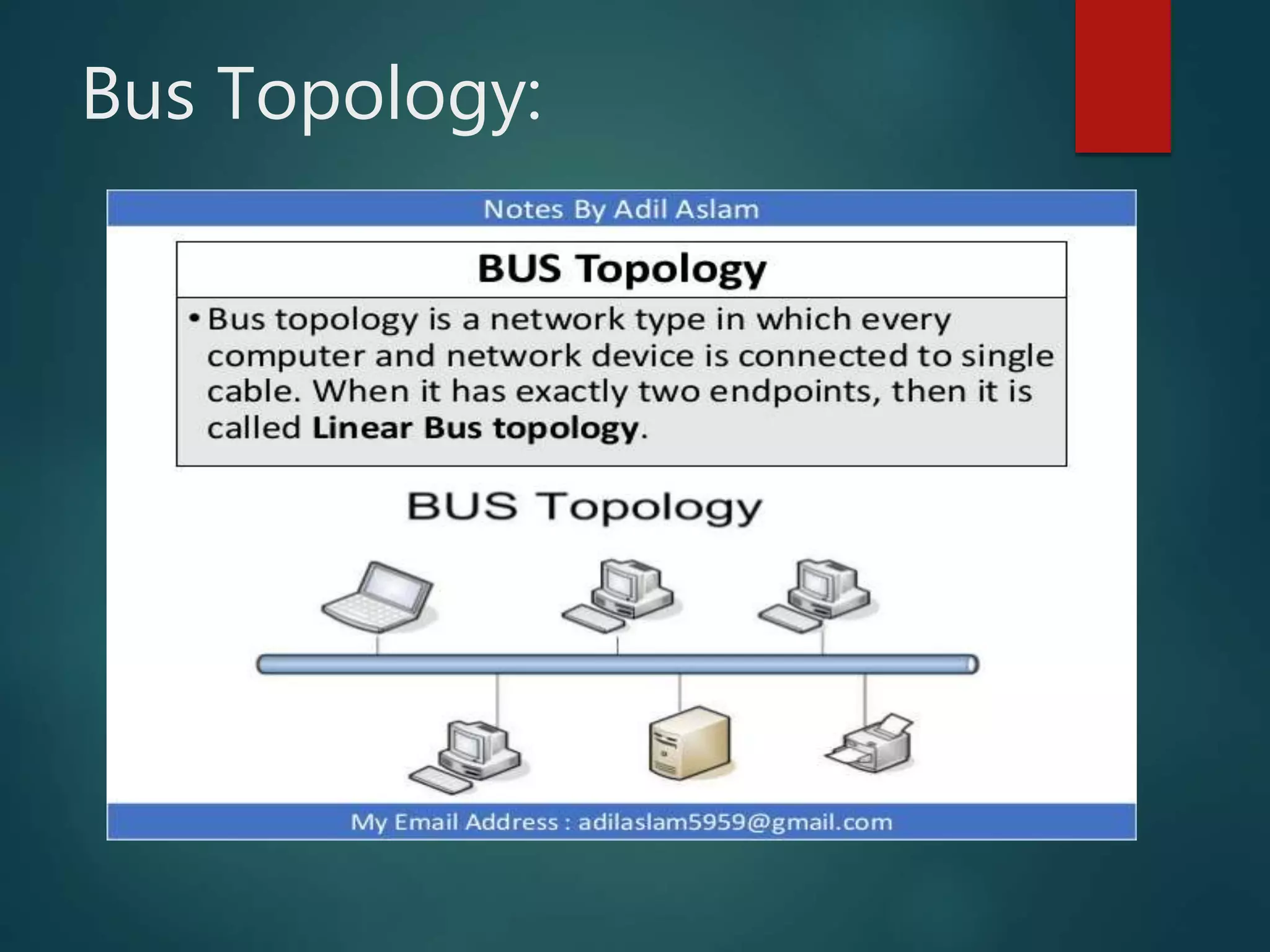
A bus topology is
a topology for a Local
Area Network (LAN) in which
all the nodes are connected to
a single cable. The cable to
which the nodes connect is
called a "backbone".
Bus Topology
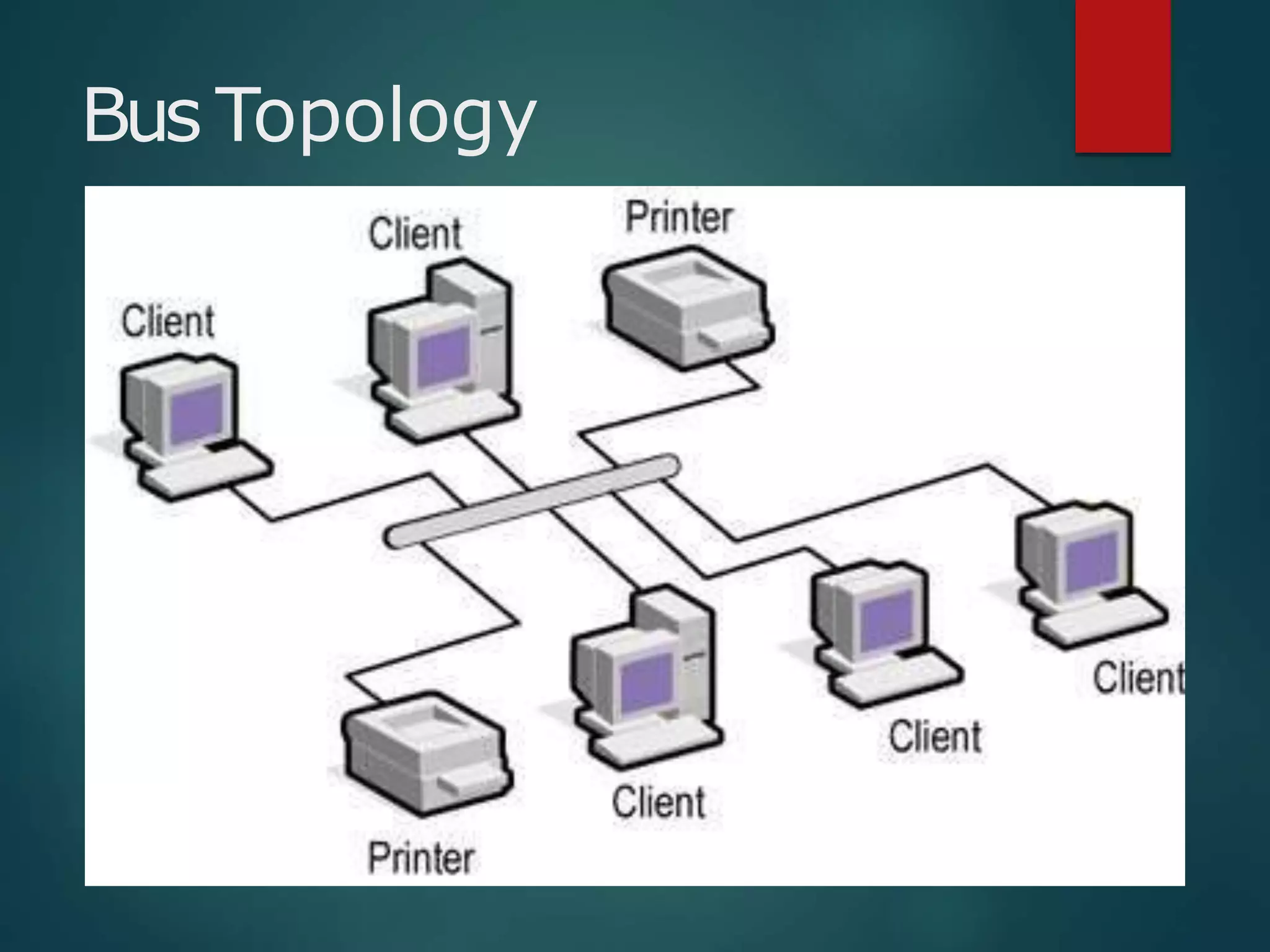
Signal travels along the backbone
Nodes are connected to the bus cable by
drop lines and taps.
Drop line is a connection running between
the device and the main cable
In this topology, at any instant, only one
computer acts as master and it is allowed to
transmit(broadcast). Other devices are
supposed to listen
Bus Topology:
Bus Topology
Advantages
It is simple and easy to use.
It require a small length of cable to connect
computers.
It is less expensive.
It is easy to extend a bus.
Disadvantages
It is difficult to troubleshoot.
It only supports small number of computers.
The network slow down if the numbers of
computers is increases.
Bus topology is not great for large networks.
Terminators are required for both ends of the main
cable.
Ring Topology
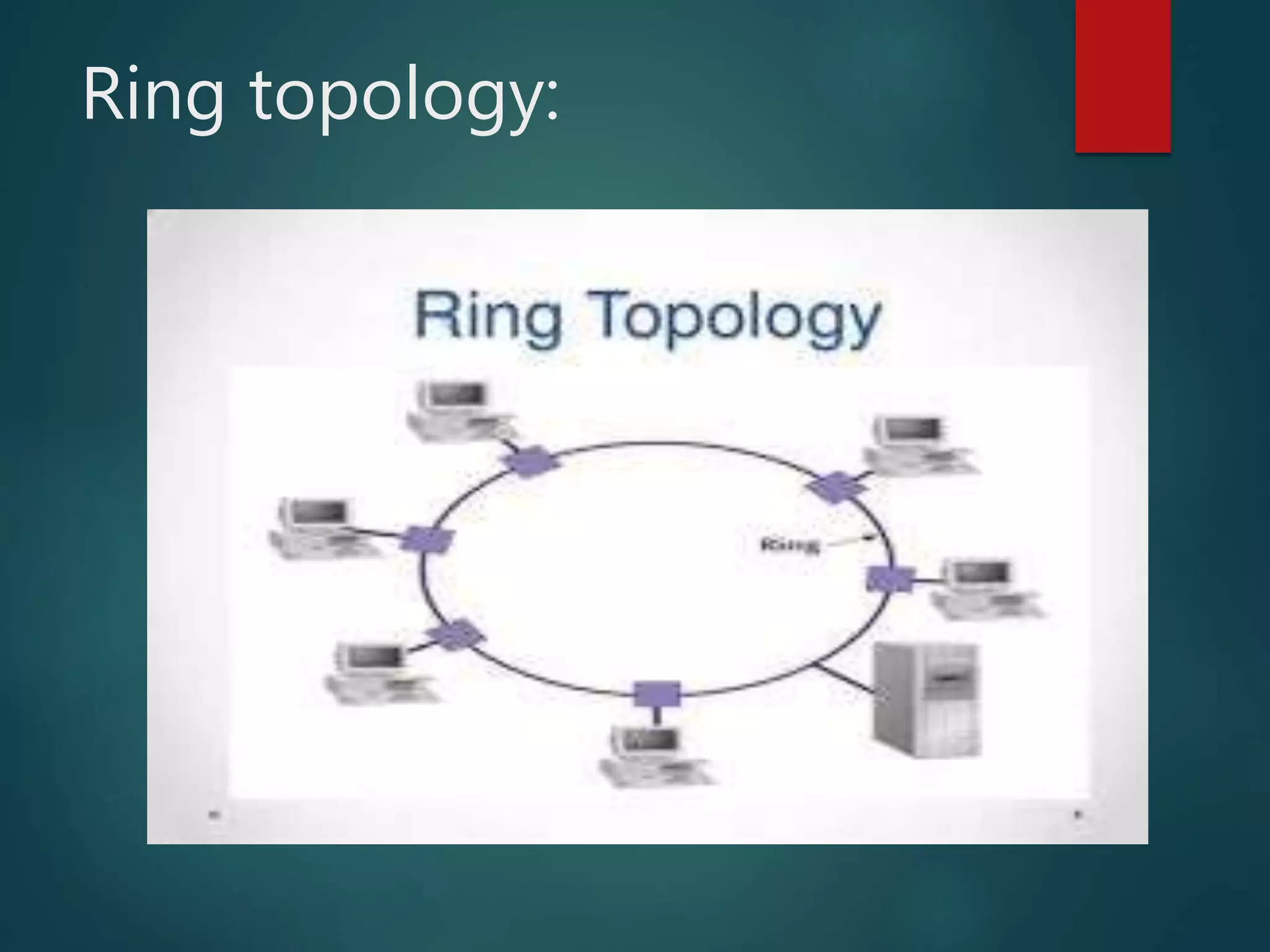
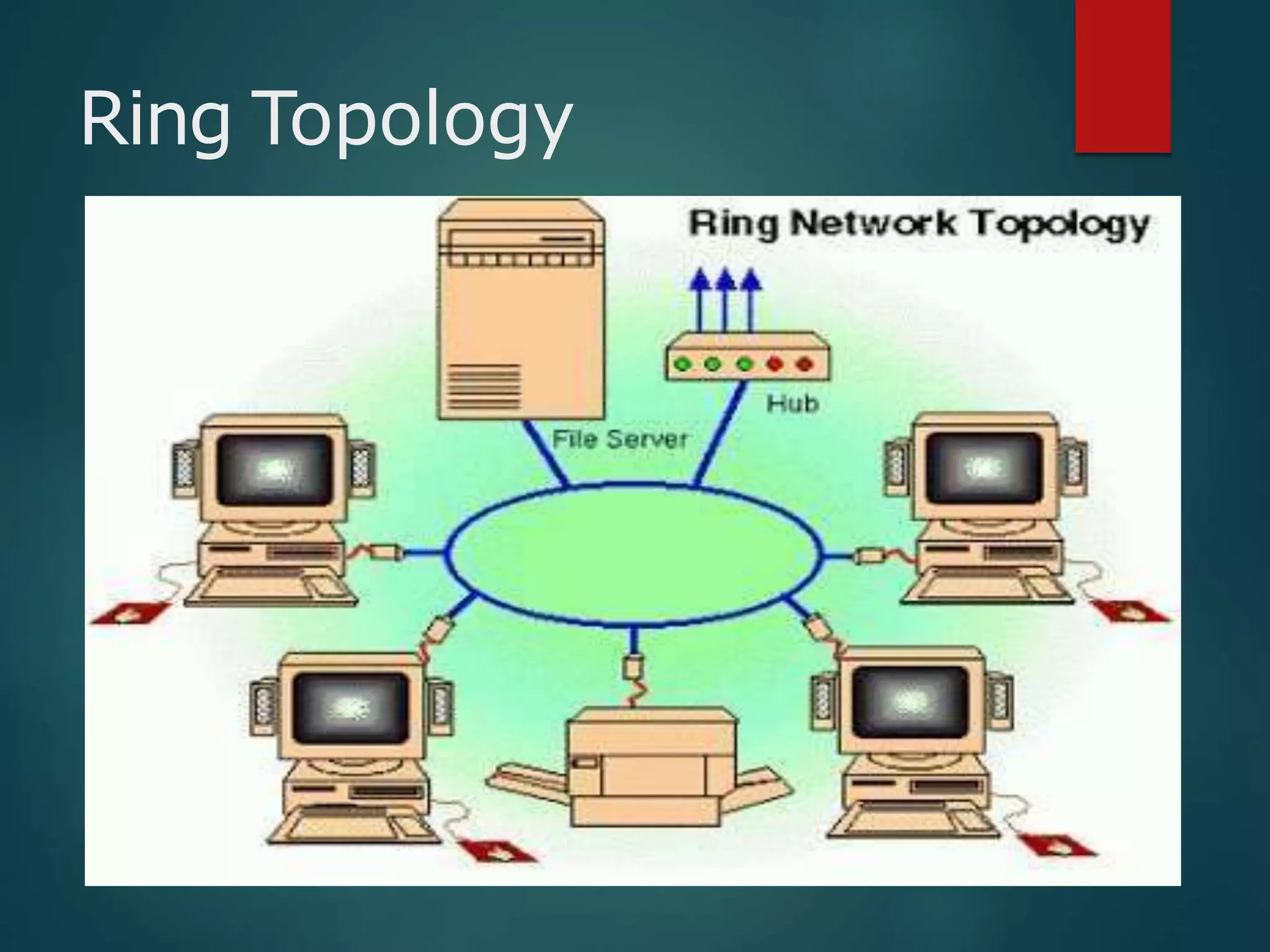
In ring topology, each computer is connected to
the next computer with the last one connected to
the first. Thus, a ring of computers is formed.
In ring topology each node connects exactly two
other nodes
Signal is passed along the ring in one direction,
from device to device until , until it reaches the
destination.
Each device is attached or incorporates or
repeater.
Working of ring topology:
 Every computer connected to next computer
in a ring.
Each computer receives message from the
previous computer and transmits it to the next
computer. The message
Flows in one direction. The message is passed
around the ring
Until it reaches the correct destination
computer.
Ring topology:
Ring Topology
Ring Topology
Advantages
1 It is relatively less expensive than a star topology network.
2. In a Ring topology, every computer has an equal access to
the network.
3. Performs better than a bus topology under heavy network
load
4. Ring is relatively easy to install and reconfigure
Disadvantages
1 Failure of one computer in the ring can affect the whole
network.
2. It is difficult to find faults in a ring network topology.
3. Adding or removing computers will also affect the whole
network since every computer is connected with previous
and next computer.
Categories of Networks
Network Category depends on its size
Primary categories are:
PAN: within a room
LAN: Covers area < 2miles
WAN: Can be worldwide
MAN: Between LAN & WAN, span 30-100 miles
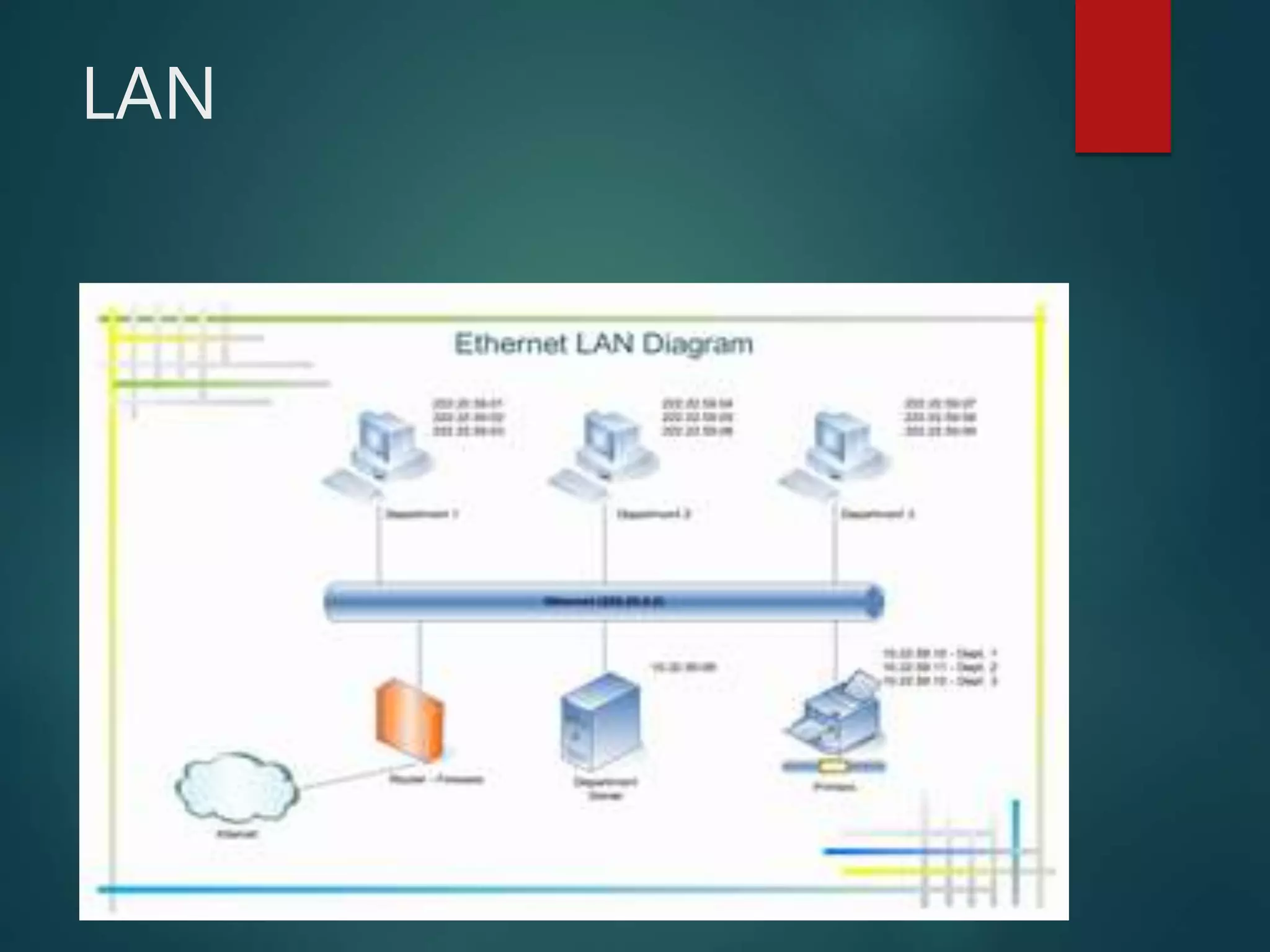
Local Area Network (LAN)
 Privately owned
 Links devices in the same office,
building, or campus
 Simple LAN: 2 PCs & 1 printer in home
or office
 Size is limited to a few kilometers
 Allow resources to be shared
(hardware, software, or data)
Local Area Network (LAN)
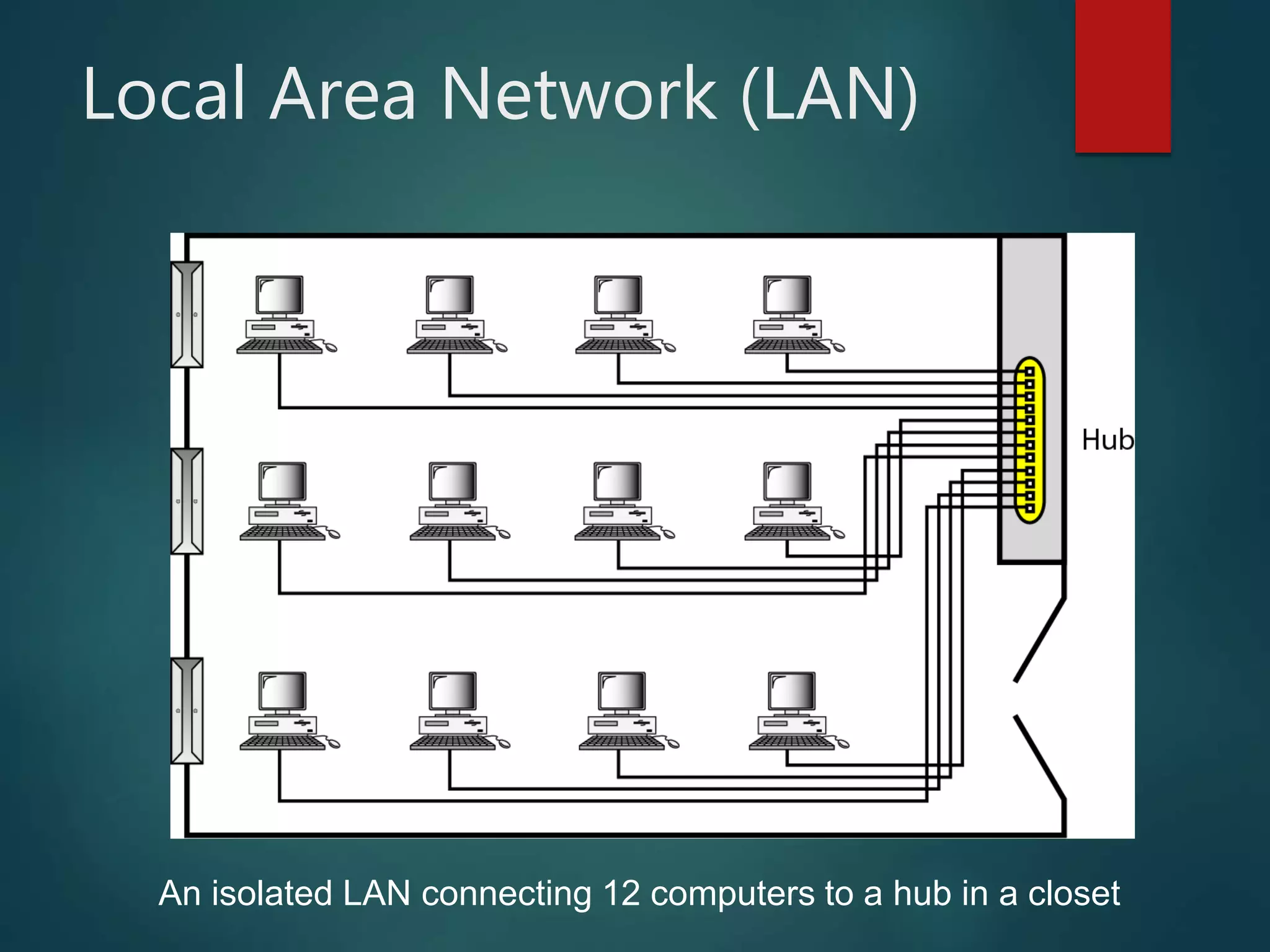
An isolated LAN connecting 12 computers to a hub in a closet
Local Area Network (LAN)
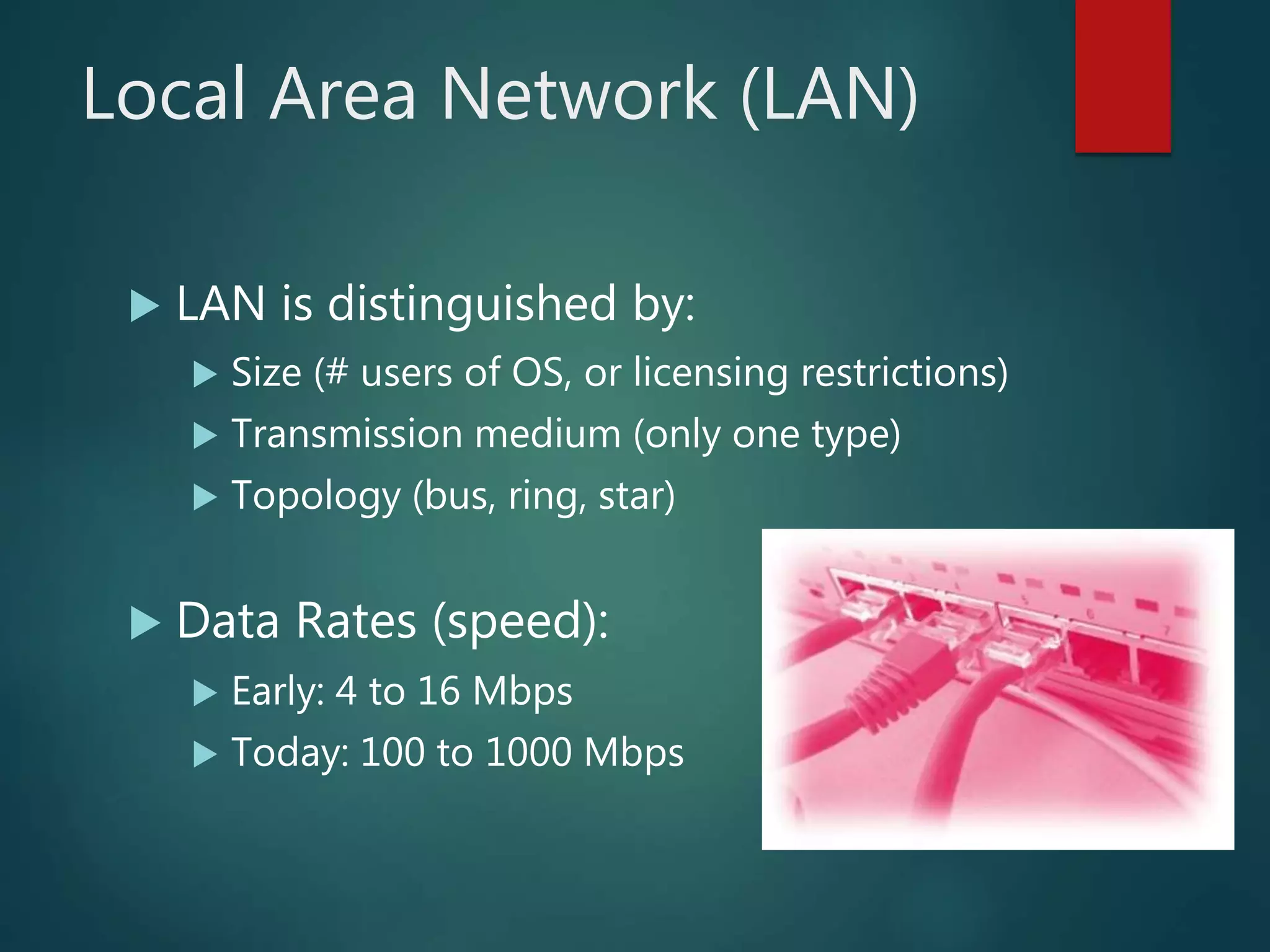
 LAN is distinguished by:
 Size (# users of OS, or licensing restrictions)
 Transmission medium (only one type)
 Topology (bus, ring, star)
 Data Rates (speed):
 Early: 4 to 16 Mbps
 Today: 100 to 1000 Mbps
LAN
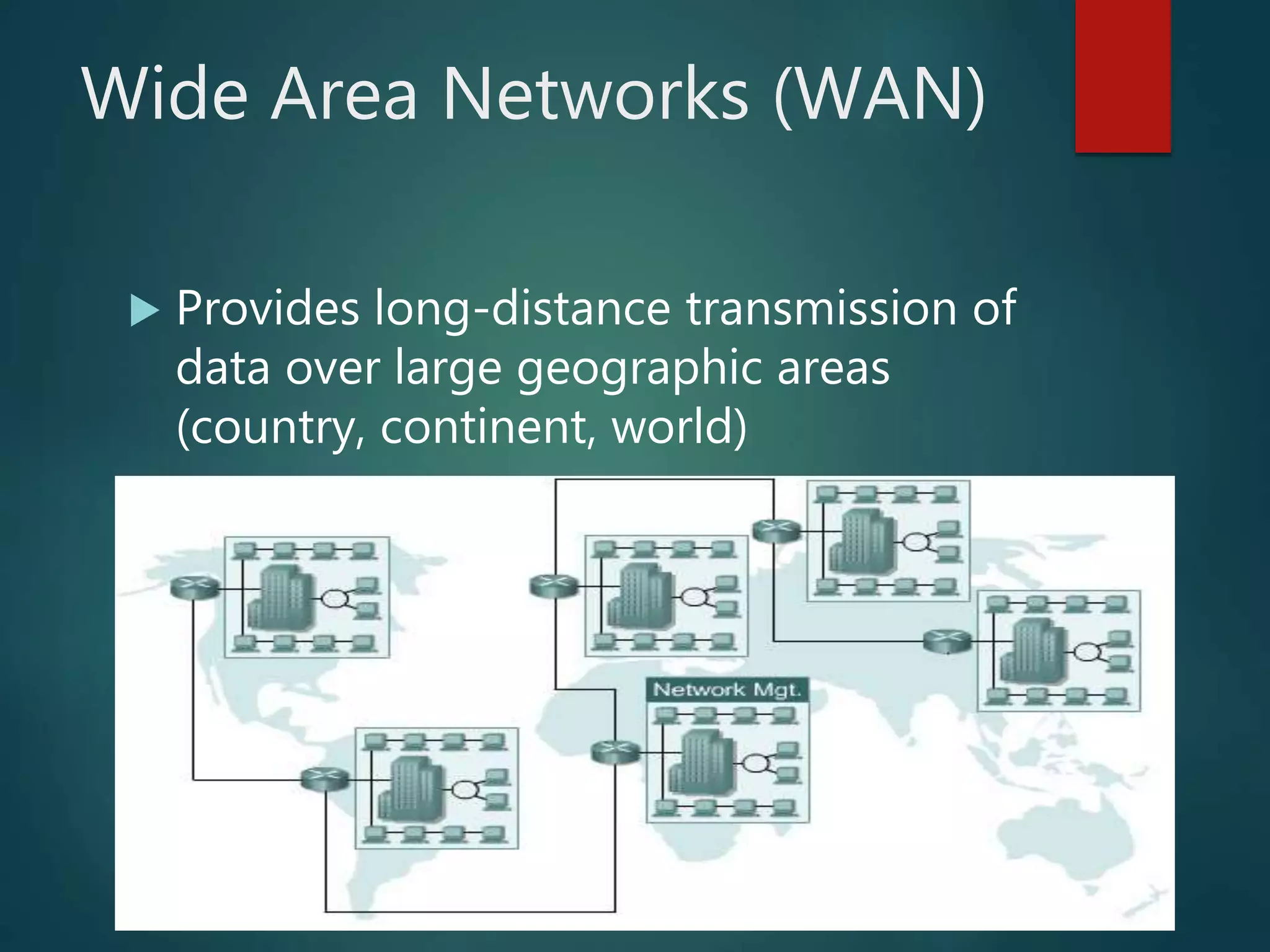
Wide Area Networks (WAN)
 Provides long-distance transmission of
data over large geographic areas
(country, continent, world)
Wide Area Networks (WAN)
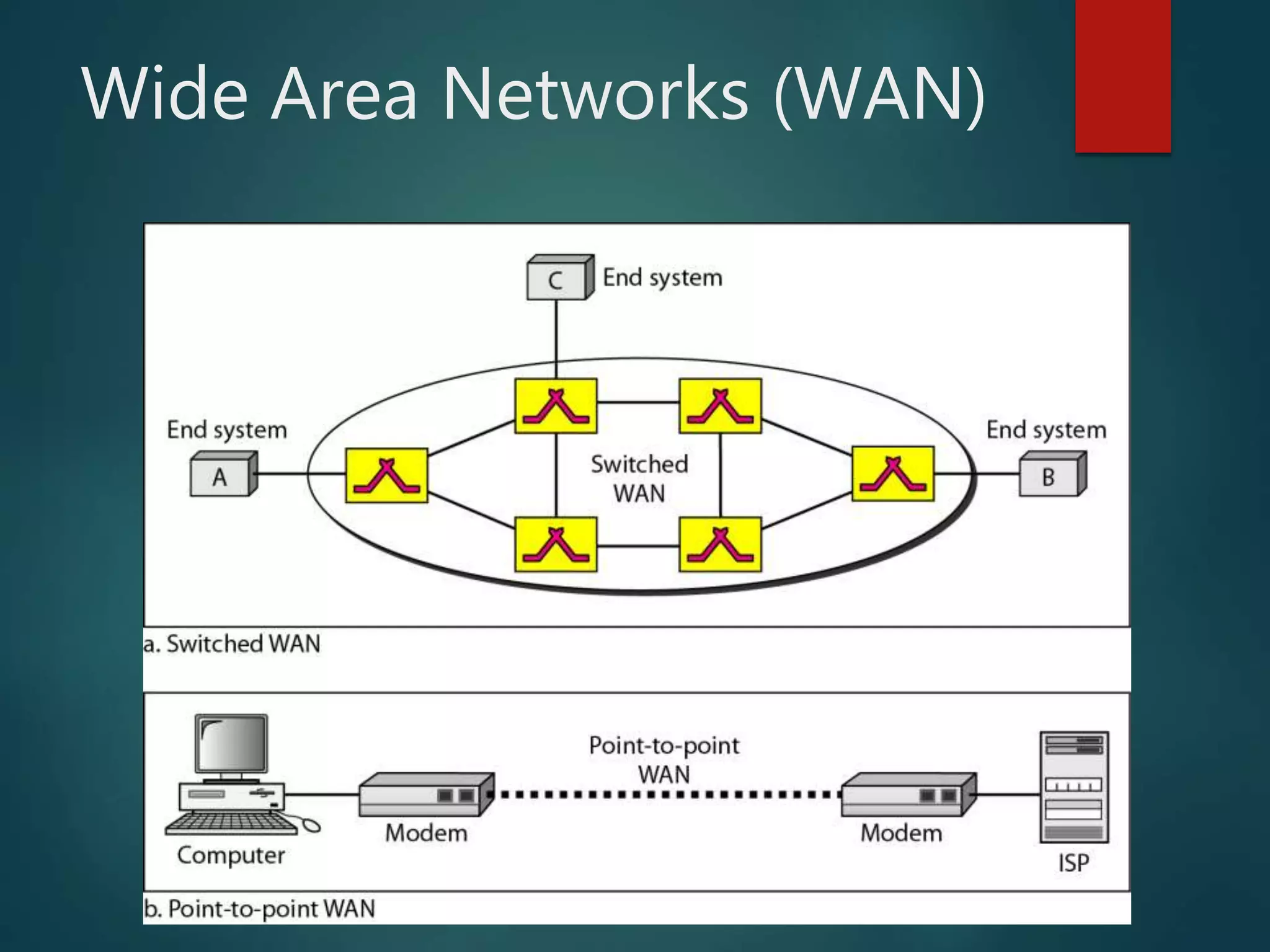
 Switched WAN
 Backbone of the Internet
 Dialup line point-to-point WAN
 Leased line from a telephone company
Wide Area Networks (WAN)
WAN
Metropolitan Area Networks
(MAN)
 Size between LAN and WAN
 Inside a town or a city
 Example: the part of the telephone
company network that can provide a
high-speed DSL to the customer or
cable TV network
MetropolitanArea
Network(MAN)
Designed to extend over the entire city.
It may be asingle network asacable TV
network OR
It may be means of connecting anumber of
LANs into alargernetwork
The main reason fordistinguishing MANs asa
special category is that astandard has been
adopted for them. It is DQDB(Distributed
Queue Dual Bus) or IEEE802.6.
Network coverage
 Local Area Networks:
 Used for small networks (school, home, office)
 Examples and configurations:
 Wireless LAN or Switched LAN
 ATM LAN, Frame Ethernet LAN
 Peer-2-PEER: connecting several computers together (<10)
 Client/Server: The serves shares its resources between different
clients
 Metropolitan Area Network
 Backbone network connecting all LANs
 Can cover a city or the entire country
 Wide Area Network
 Typically between cities and countries
 Technology:
 Circuit Switch, Packet Switch, Frame Relay, ATM
 Examples:
 Internet P2P: Networks with the same network software can be
connected together (Napster)

Data Communication and Networks

  • 1.
  • 2.
    DataCommunication Exchange of databetween two or more devices using some transmission medium. Another explanation could be: Electronic transmission of information that has been encoded digitally (as for storage and processing by computers)
  • 3.
    Components of Data CommunicationSystem Message (text,image, numbers, audio, video) Sender(computer, workstation, telephone, camera etc.) Receiver Transmission Medium(twisted-pair,optical fiber, coaxial cable, radiowaves) Protocol(set of rules that govern data communication)
  • 4.
    Characteristics of Data Comm. Delivery  Accuracy  Timeliness
  • 5.
    Mode of Data Communications Simplex(unidirectional) Half-Duplex (bidirectional) Full-Duplex(bidirectional)
  • 6.
    Applications ofNetworks  ResourceSharing  Hardware (Computing Resources, Disks, Printers,etc.)  Software (Application Software)  Information Sharing  Easyaccessibility fromanywhere (Files, Databases, etc.)  Search Capability (WWW)  Communication  Email  Message Broadcasting
  • 7.
    Network Criteria Performance: Transmit Time,ResponseTime, Throughput Reliability: Frequency of failure, Time to recover Security: Unauthorized Access, Protecting Data
  • 8.
    Data Transmission  Paralleltransmission  Serial Transmission
  • 9.
    PhysicalTopology It refers tothe way how the network is laid out physically. Geometric representation of the relationship of all the links and linking devices
  • 10.
    Advantage and Disadvantages  Increasedspeed, Reduced cost, Improved security, centralized software management, Electronic mail  High cost of installation, requires time for administration, failure of server, cable faults
  • 11.
    Types of PhysicalTopologies MeshTopology Star Topology BusTopology Ring Topology Tree topology
  • 12.
    Mesh topology In meshtopology, every device in the network is physically connected to every other device in the network. In mesh topology every device has a dedicated point-to-point link to every other device. The term dedicated means that the link carries traffic only between two devices it connects.
  • 13.
  • 14.
    Advantages The use ofdedicated links guarantees that each connection can carry its own data load. Failure of single computer does not bring down the entire network Security and privacy over the dedicated link Easy diagnosis Disadvantages Installation and configuration is difficult Cabling cost is more The hardware required to connect each link
  • 15.
    Star topology All thecables connects from the computer to the central location called HUB. Broadcast star network Resends message to all the connected computers Switched star network Sends data to a destination computer
  • 16.
    Working of startopology The sending computers send the data to hub. The hub sends data to the receiving computer. Each computer in star network communicates with a central hub.
  • 17.
  • 18.
    Advantages Easy to installand wire. No disruptions to the network when connecting or removing devices. Easy to detect faults and to remove parts. Single computer failure does not broke down the whole network. Disadvantages If the central hub fails , the whole network fails to operate. The cabling cost is more. It require a large length of cable to connect computers.
  • 19.
    Bus Topology: A bustopology is a topology for a Local Area Network (LAN) in which all the nodes are connected to a single cable. The cable to which the nodes connect is called a "backbone".
  • 20.
    Bus Topology Signal travelsalong the backbone Nodes are connected to the bus cable by drop lines and taps. Drop line is a connection running between the device and the main cable In this topology, at any instant, only one computer acts as master and it is allowed to transmit(broadcast). Other devices are supposed to listen
  • 21.
  • 22.
  • 23.
    Advantages It is simpleand easy to use. It require a small length of cable to connect computers. It is less expensive. It is easy to extend a bus. Disadvantages It is difficult to troubleshoot. It only supports small number of computers. The network slow down if the numbers of computers is increases. Bus topology is not great for large networks. Terminators are required for both ends of the main cable.
  • 24.
    Ring Topology In ringtopology, each computer is connected to the next computer with the last one connected to the first. Thus, a ring of computers is formed. In ring topology each node connects exactly two other nodes Signal is passed along the ring in one direction, from device to device until , until it reaches the destination. Each device is attached or incorporates or repeater.
  • 25.
    Working of ringtopology:  Every computer connected to next computer in a ring. Each computer receives message from the previous computer and transmits it to the next computer. The message Flows in one direction. The message is passed around the ring Until it reaches the correct destination computer.
  • 26.
  • 27.
  • 28.
    Ring Topology Advantages 1 Itis relatively less expensive than a star topology network. 2. In a Ring topology, every computer has an equal access to the network. 3. Performs better than a bus topology under heavy network load 4. Ring is relatively easy to install and reconfigure Disadvantages 1 Failure of one computer in the ring can affect the whole network. 2. It is difficult to find faults in a ring network topology. 3. Adding or removing computers will also affect the whole network since every computer is connected with previous and next computer.
  • 29.
    Categories of Networks NetworkCategory depends on its size Primary categories are: PAN: within a room LAN: Covers area < 2miles WAN: Can be worldwide MAN: Between LAN & WAN, span 30-100 miles
  • 30.
    Local Area Network(LAN)  Privately owned  Links devices in the same office, building, or campus  Simple LAN: 2 PCs & 1 printer in home or office  Size is limited to a few kilometers  Allow resources to be shared (hardware, software, or data)
  • 31.
    Local Area Network(LAN) An isolated LAN connecting 12 computers to a hub in a closet
  • 32.
    Local Area Network(LAN)  LAN is distinguished by:  Size (# users of OS, or licensing restrictions)  Transmission medium (only one type)  Topology (bus, ring, star)  Data Rates (speed):  Early: 4 to 16 Mbps  Today: 100 to 1000 Mbps
  • 33.
  • 34.
    Wide Area Networks(WAN)  Provides long-distance transmission of data over large geographic areas (country, continent, world)
  • 35.
    Wide Area Networks(WAN)  Switched WAN  Backbone of the Internet  Dialup line point-to-point WAN  Leased line from a telephone company
  • 36.
  • 37.
  • 38.
    Metropolitan Area Networks (MAN) Size between LAN and WAN  Inside a town or a city  Example: the part of the telephone company network that can provide a high-speed DSL to the customer or cable TV network
  • 39.
    MetropolitanArea Network(MAN) Designed to extendover the entire city. It may be asingle network asacable TV network OR It may be means of connecting anumber of LANs into alargernetwork The main reason fordistinguishing MANs asa special category is that astandard has been adopted for them. It is DQDB(Distributed Queue Dual Bus) or IEEE802.6.
  • 40.
    Network coverage  LocalArea Networks:  Used for small networks (school, home, office)  Examples and configurations:  Wireless LAN or Switched LAN  ATM LAN, Frame Ethernet LAN  Peer-2-PEER: connecting several computers together (<10)  Client/Server: The serves shares its resources between different clients  Metropolitan Area Network  Backbone network connecting all LANs  Can cover a city or the entire country  Wide Area Network  Typically between cities and countries  Technology:  Circuit Switch, Packet Switch, Frame Relay, ATM  Examples:  Internet P2P: Networks with the same network software can be connected together (Napster)