3.1.2 Classification of network

       What Is a Network?

         A network is a collection of
      computers and devices connected
    together via communications devices
          and transmission media
3.1.2 Classification of network


  Advantages of using a network include:
  • facilitating communications
  • sharing hardware
  • sharing data and information
  • sharing software
  • transferring funds.
3.1.2 Classification of network


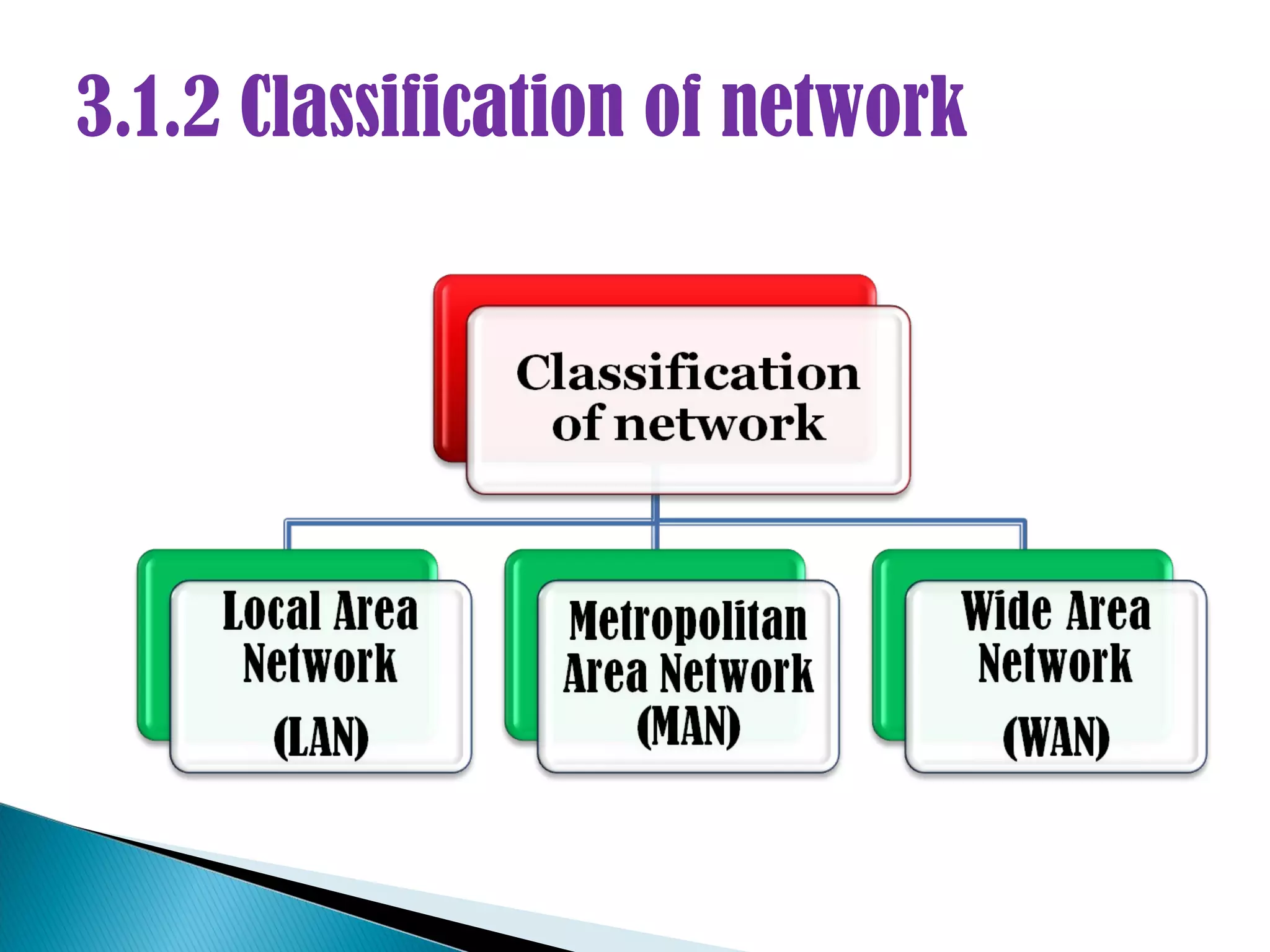
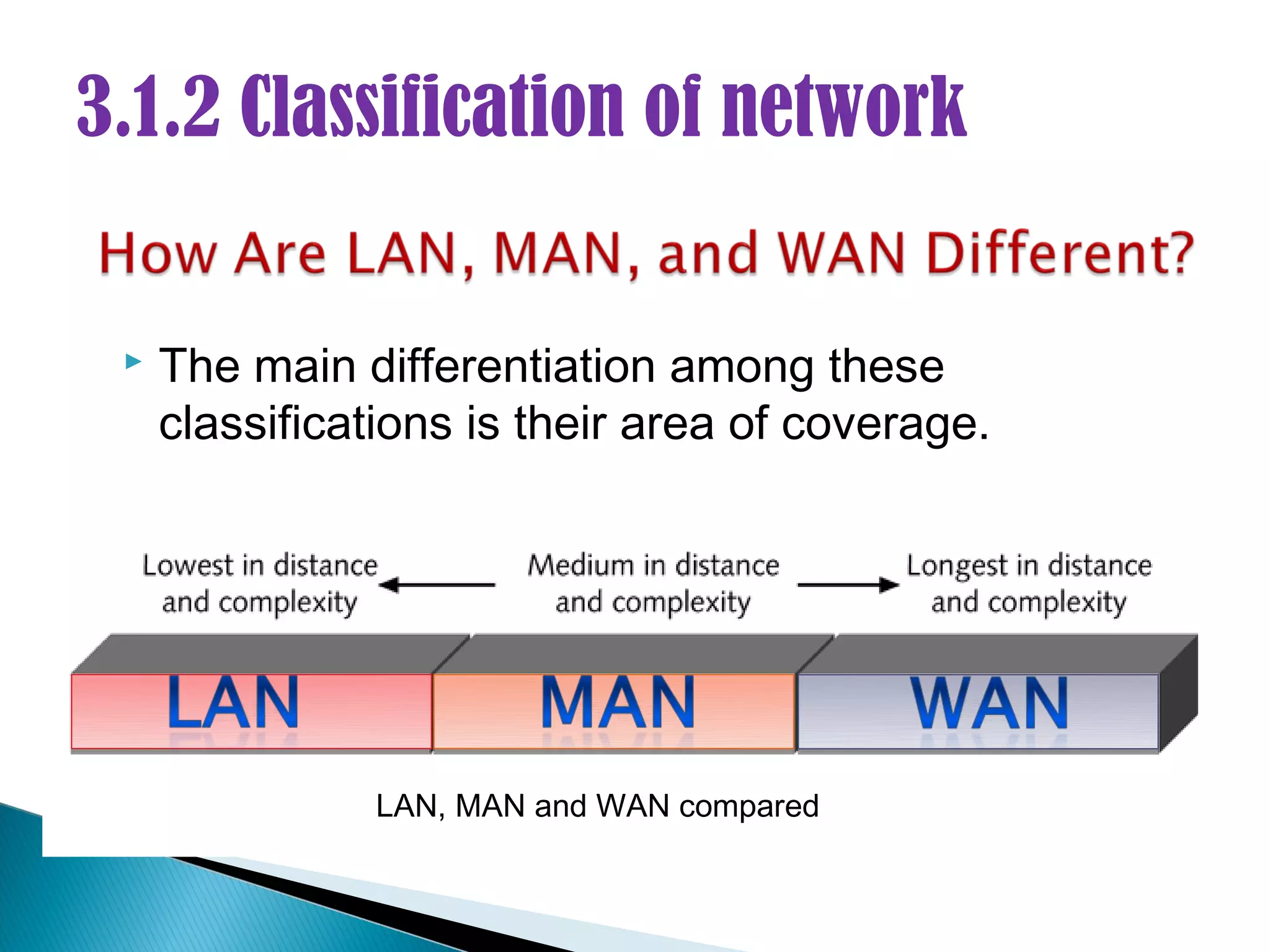
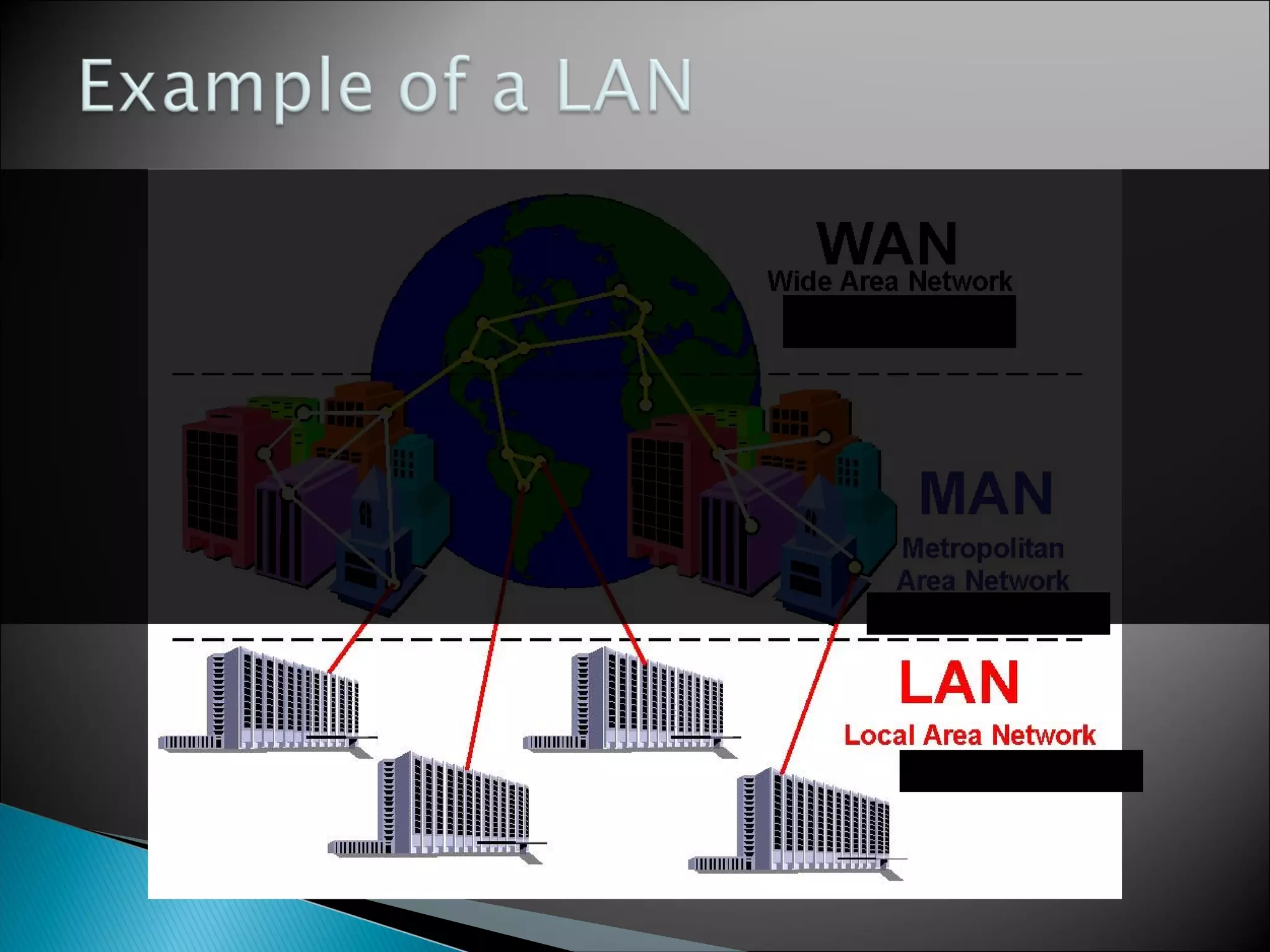
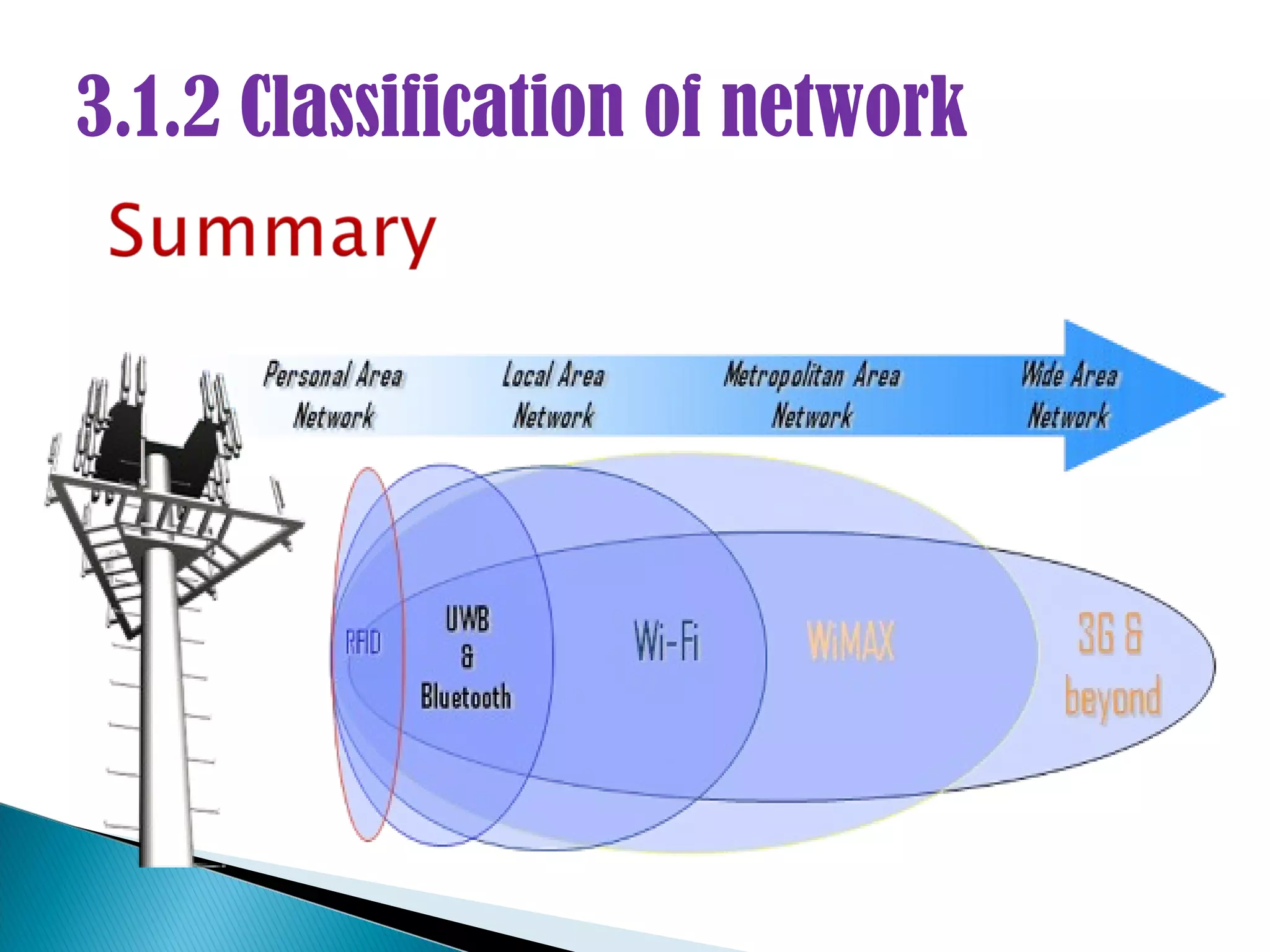
    The main differentiation among these
     classifications is their area of coverage.


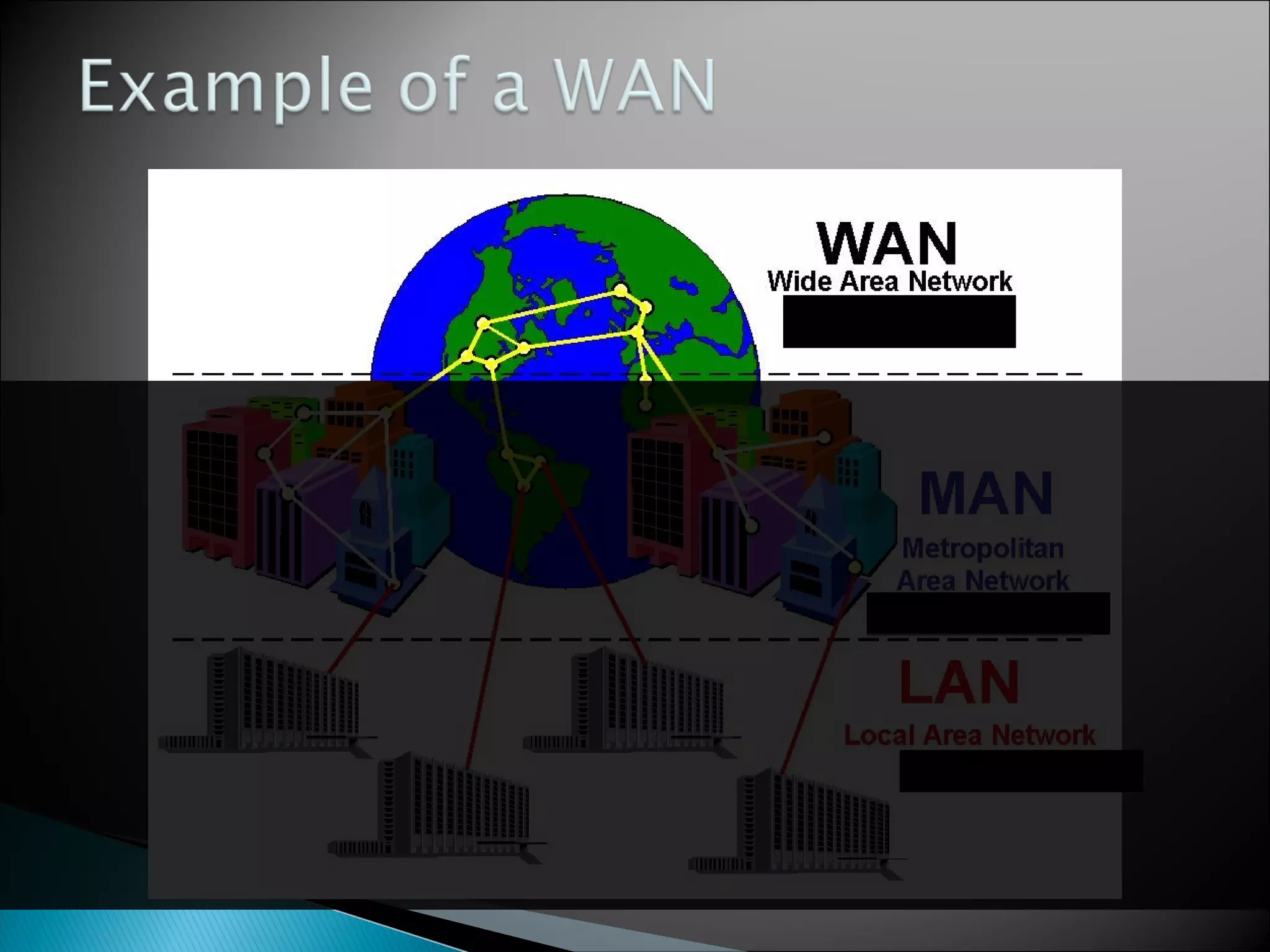
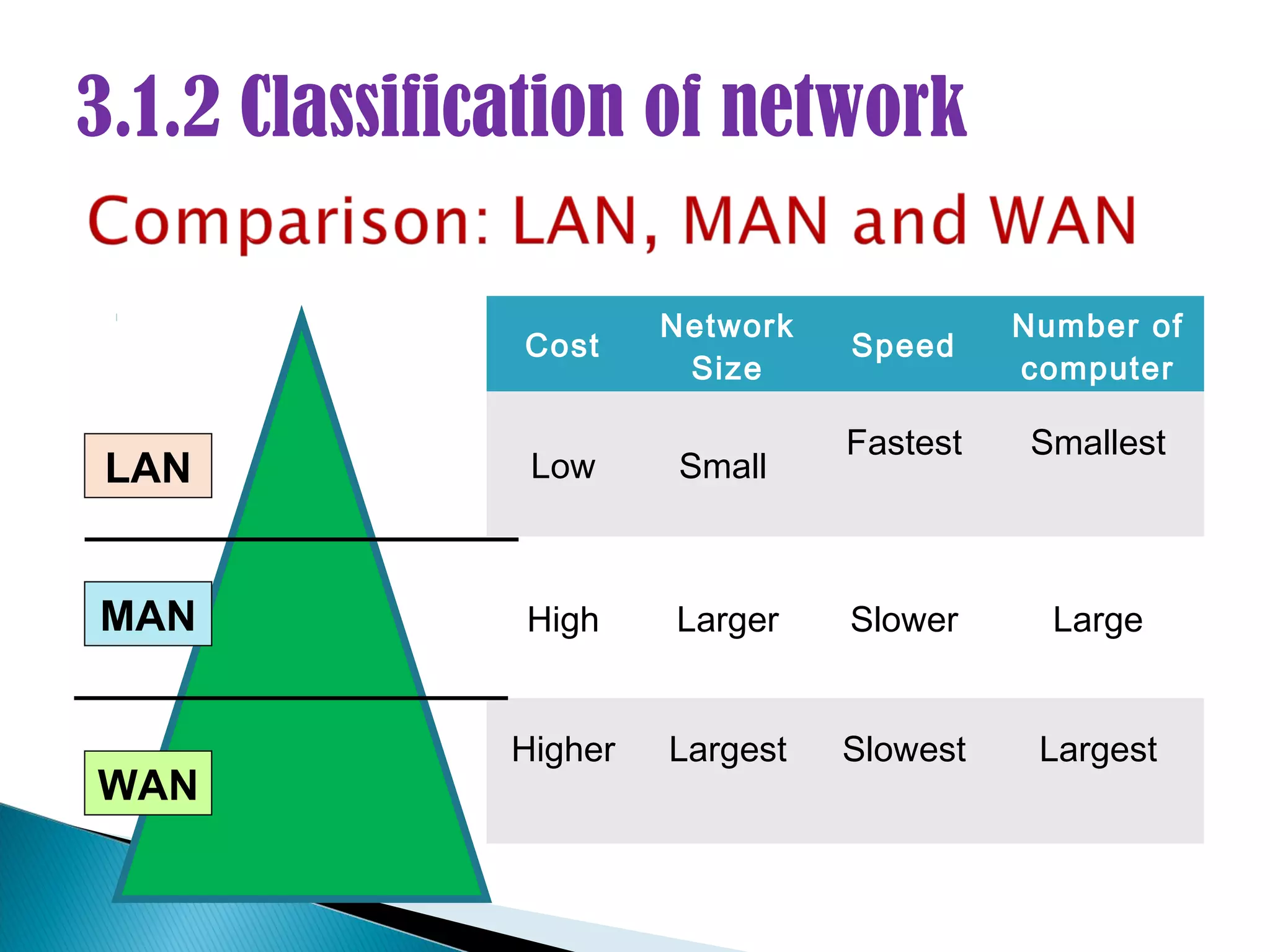
               LAN, MAN and WAN compared
3.1.2 Classification of network
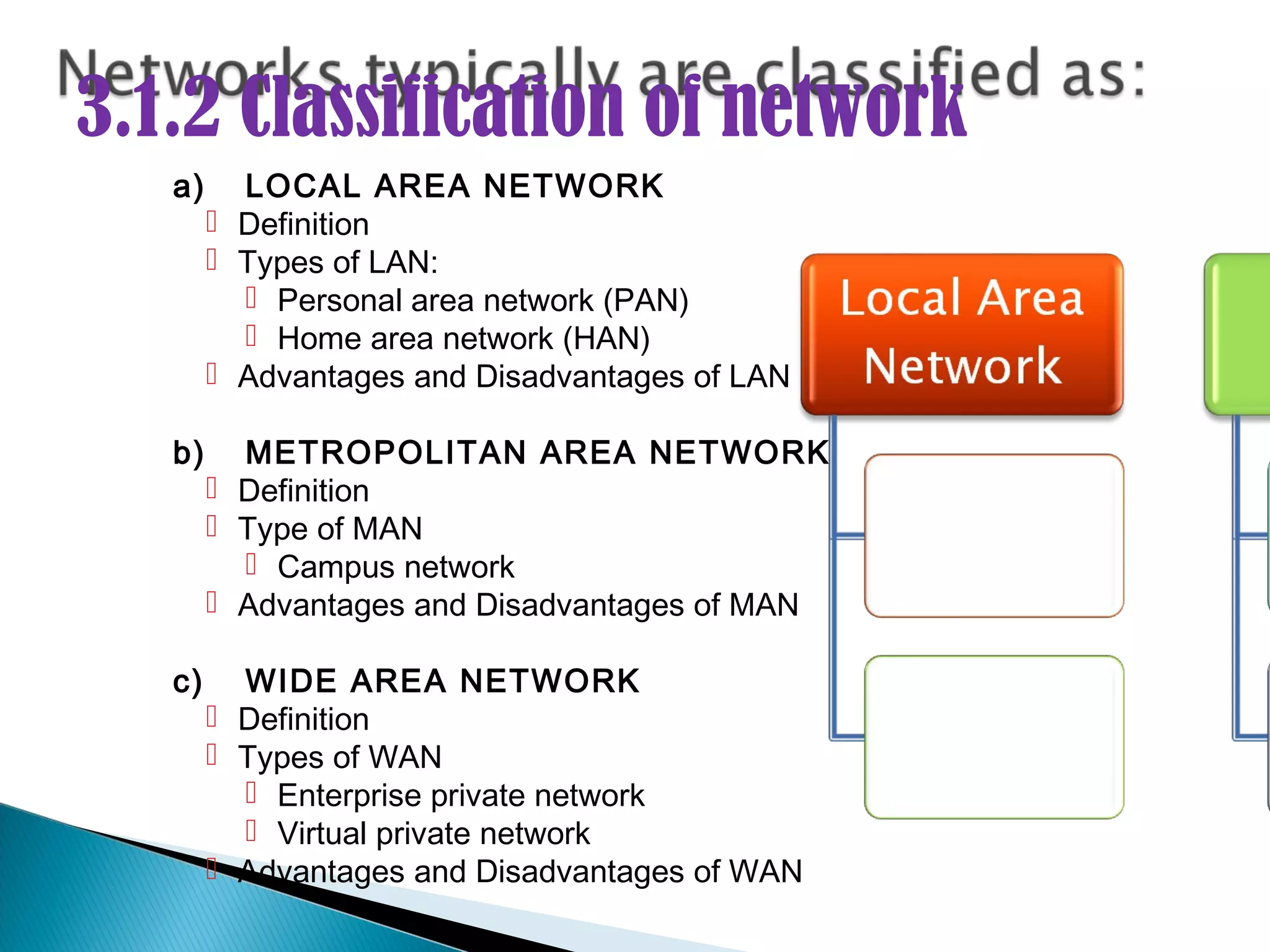
   a)     LOCAL AREA NETWORK
         Definition
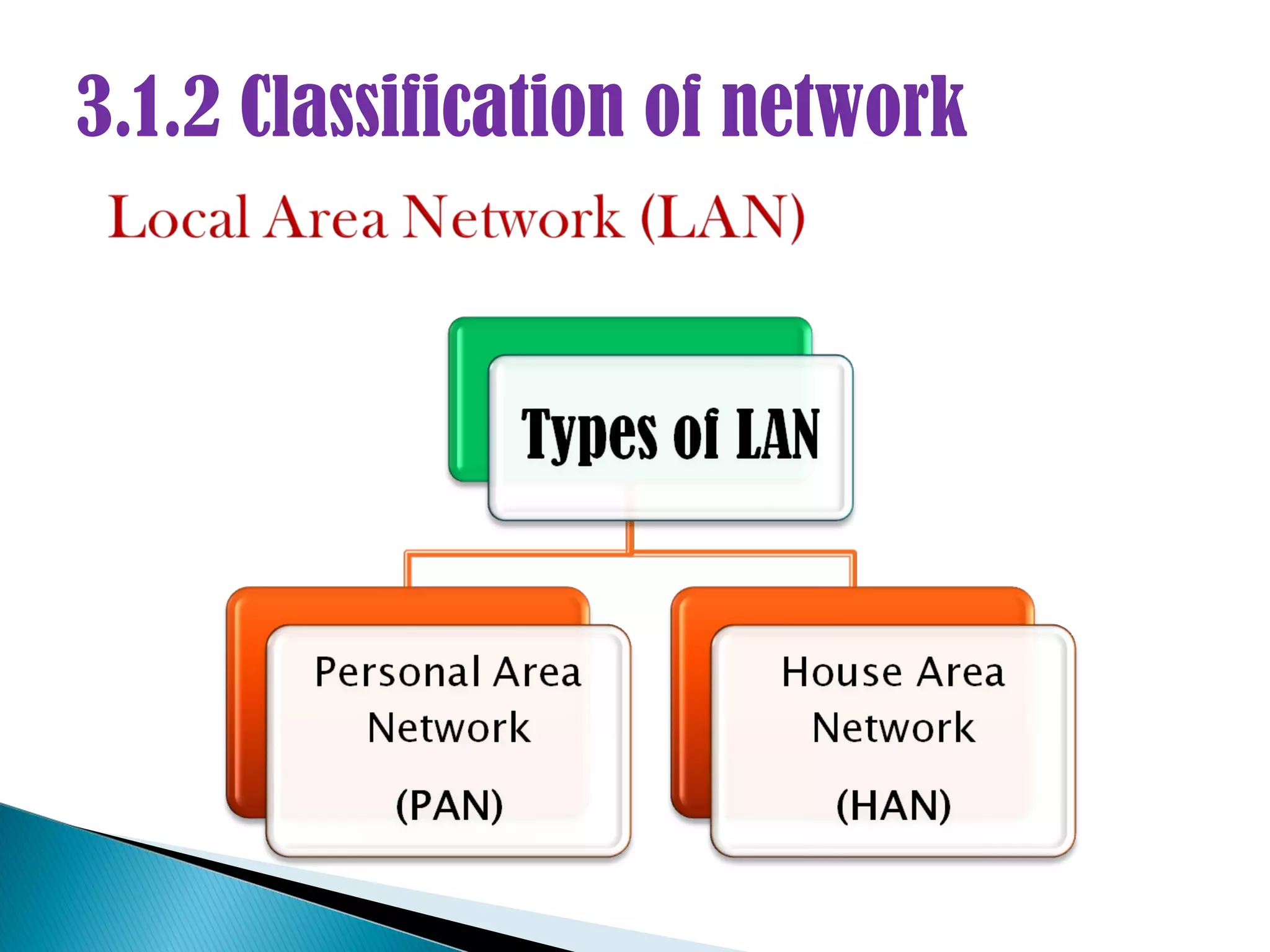
         Types of LAN:
           Personal area network (PAN)
           Home area network (HAN)
         Advantages and Disadvantages of LAN

   b)     METROPOLITAN AREA NETWORK
         Definition
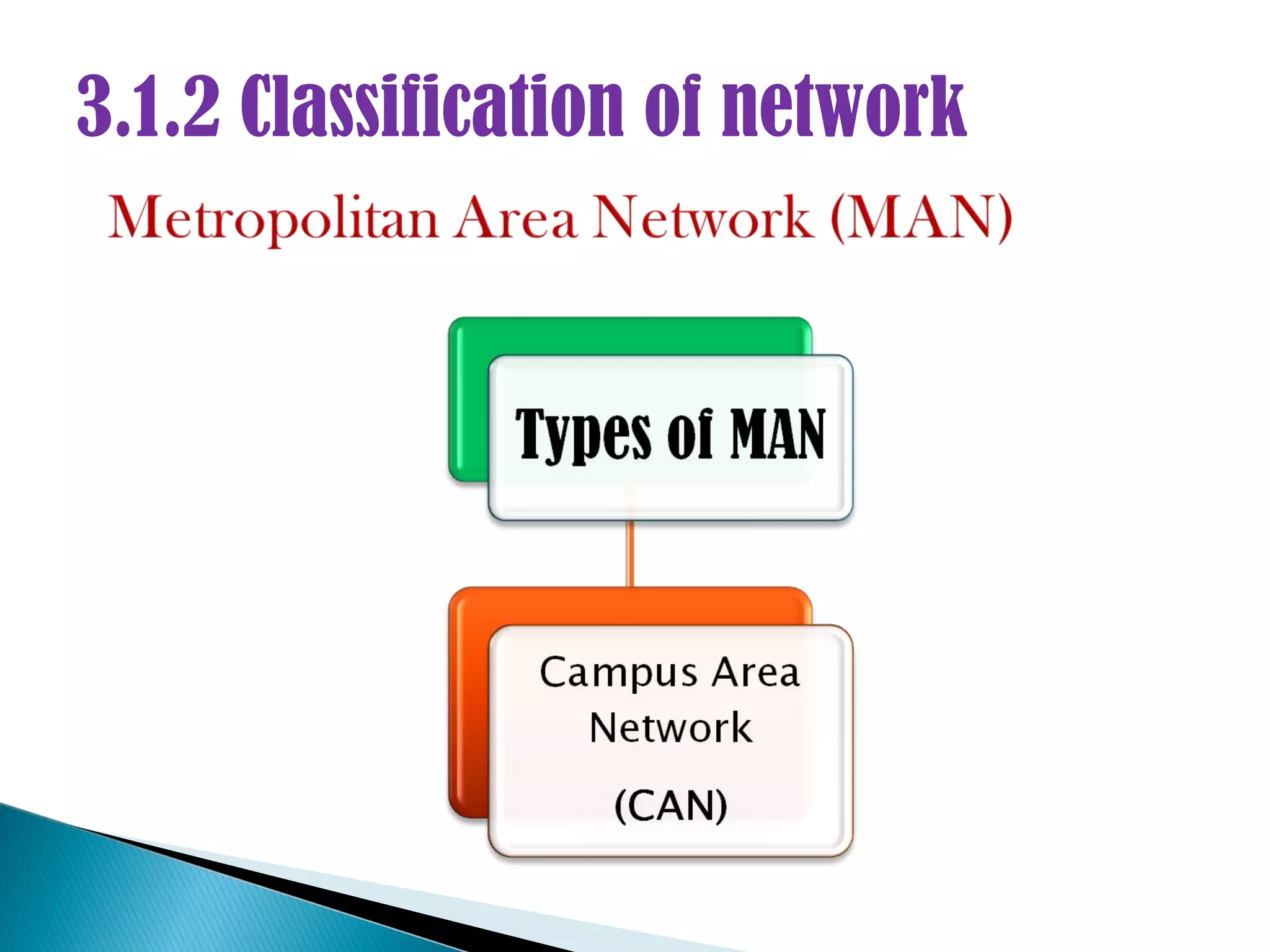
         Type of MAN
           Campus network
         Advantages and Disadvantages of MAN

   c)     WIDE AREA NETWORK
         Definition
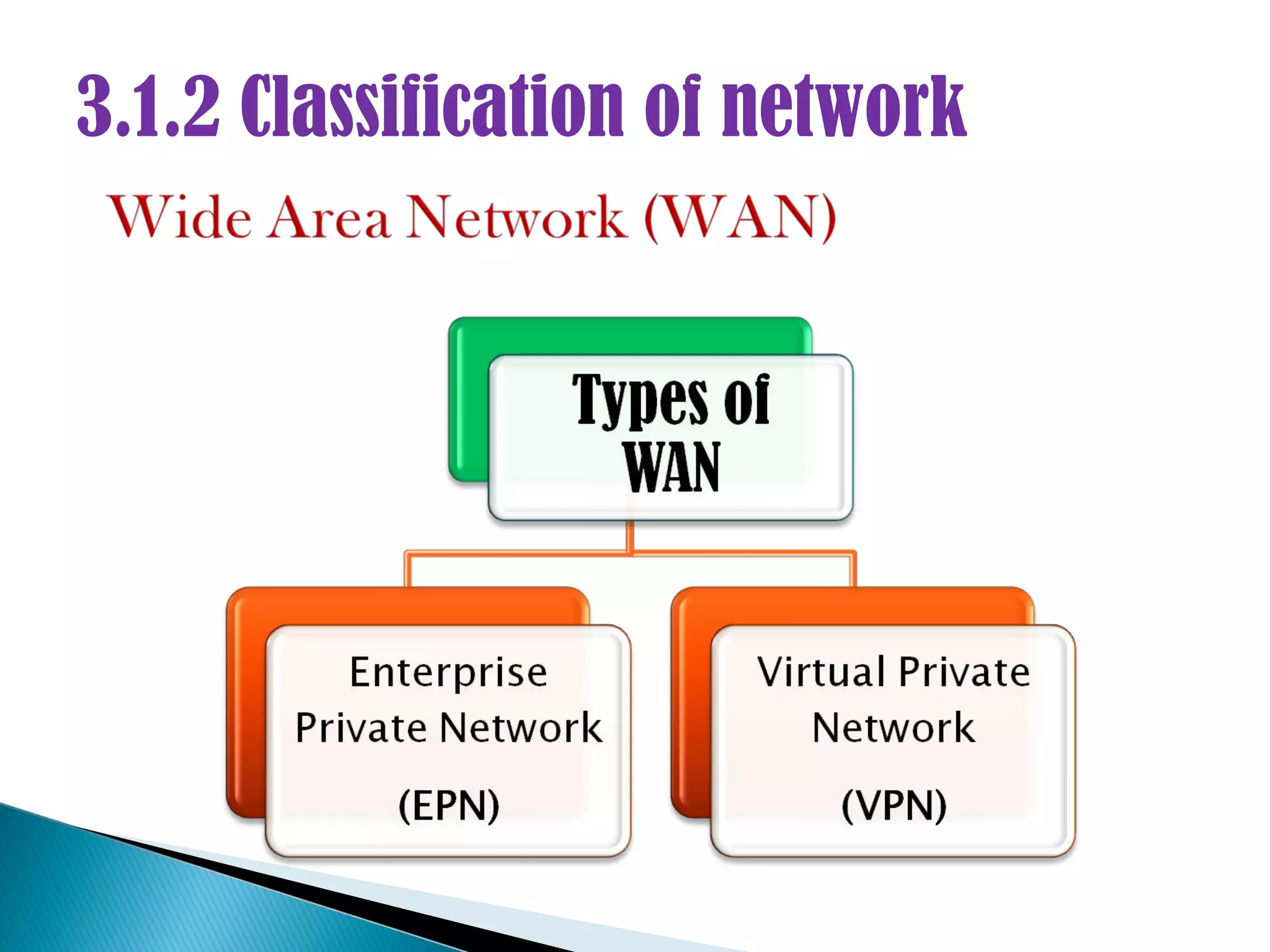
         Types of WAN
           Enterprise private network
           Virtual private network
         Advantages and Disadvantages of WAN
3.1.2 Classification of network


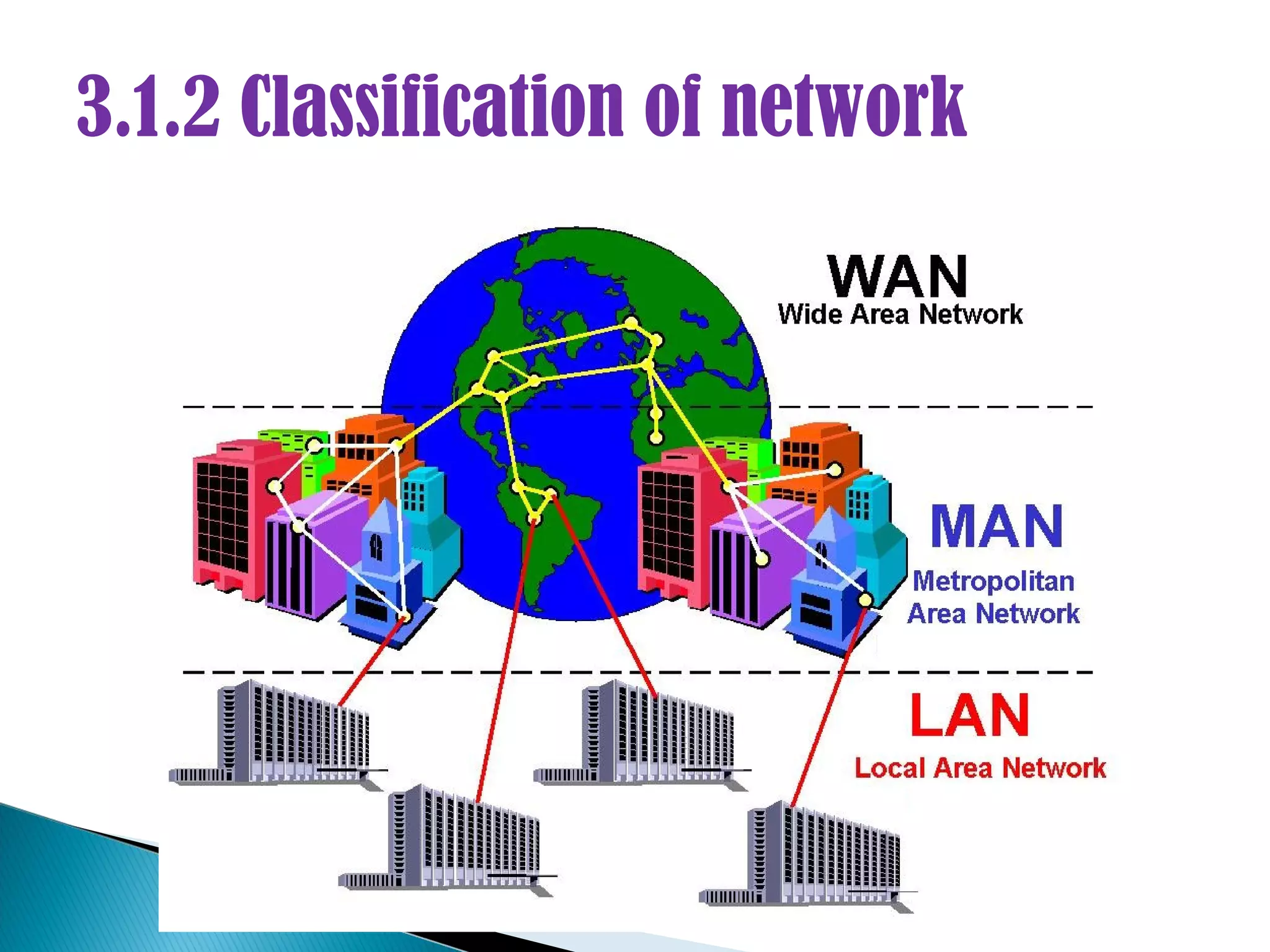
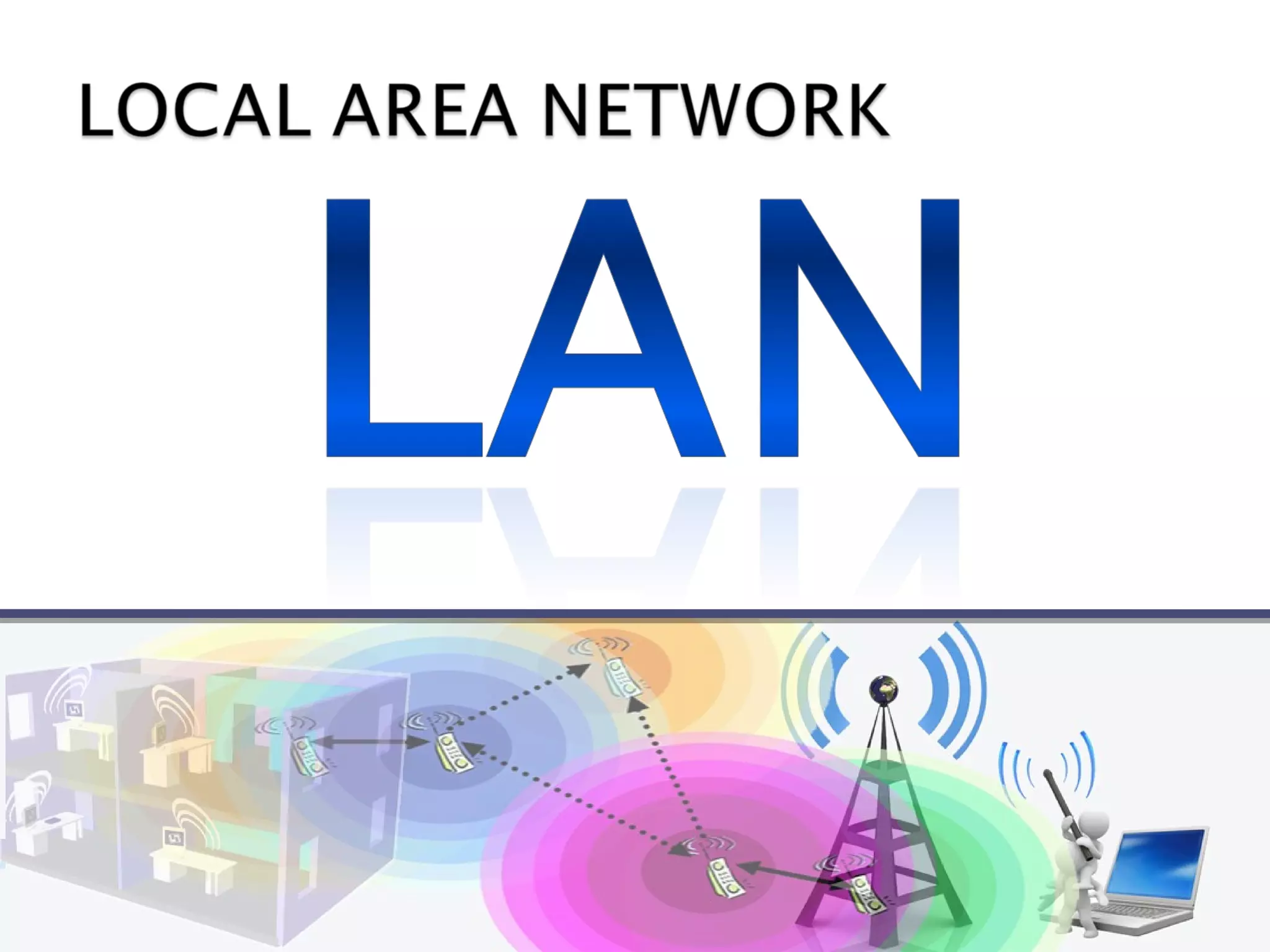
   A local area network (LAN) is a network that
    connects computers and devices in a limited
    geographical area.

   Example such as a home, school computer
    laboratory, office building or closely positioned
    group of buildings.
3.1.2 Classification of network

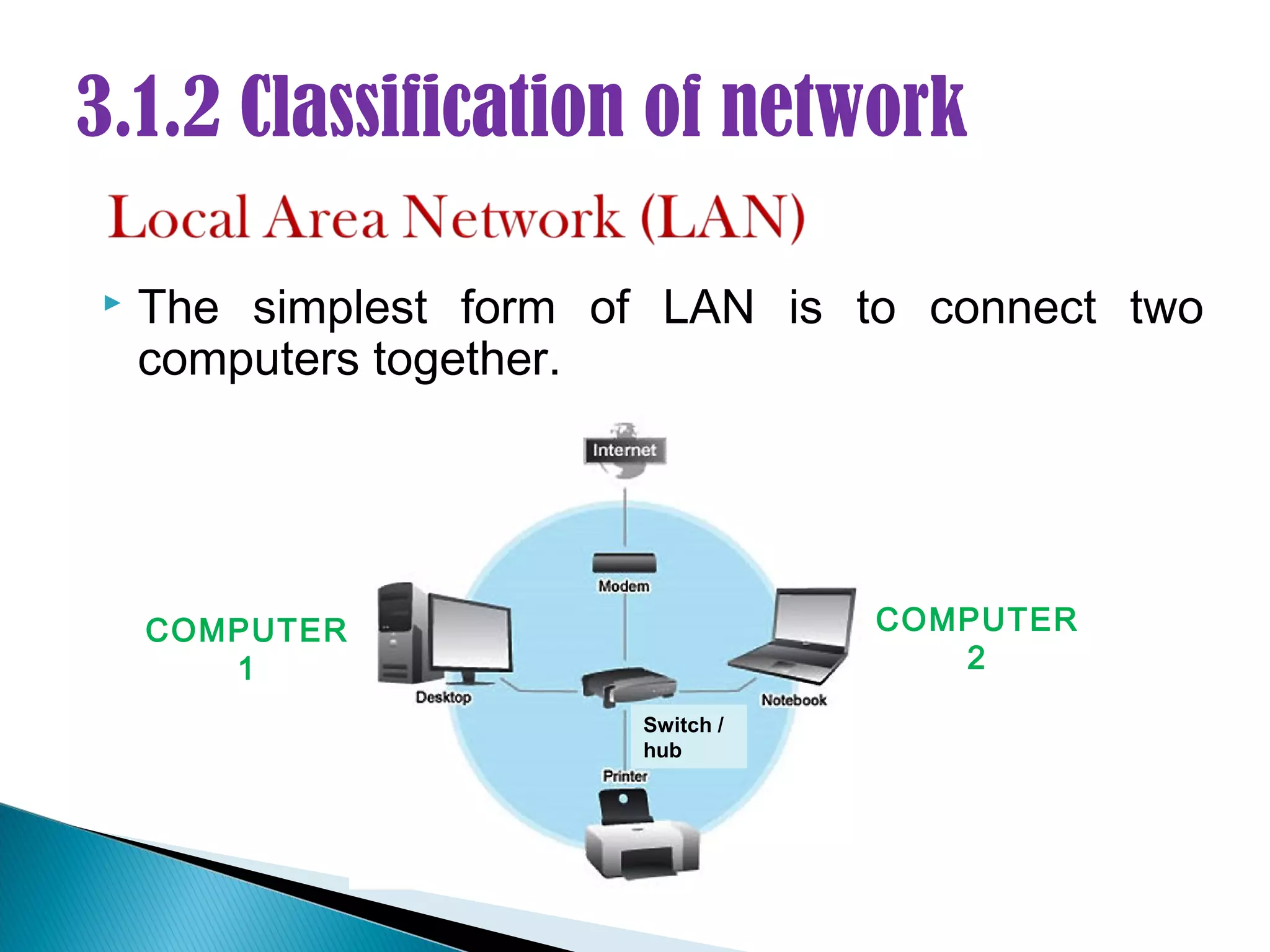
   The simplest form of LAN is to connect two
    computers together.


    COMPUTER                      COMPUTER
       1                             2

                       Switch /
                       hub
3.1.2 Classification of network

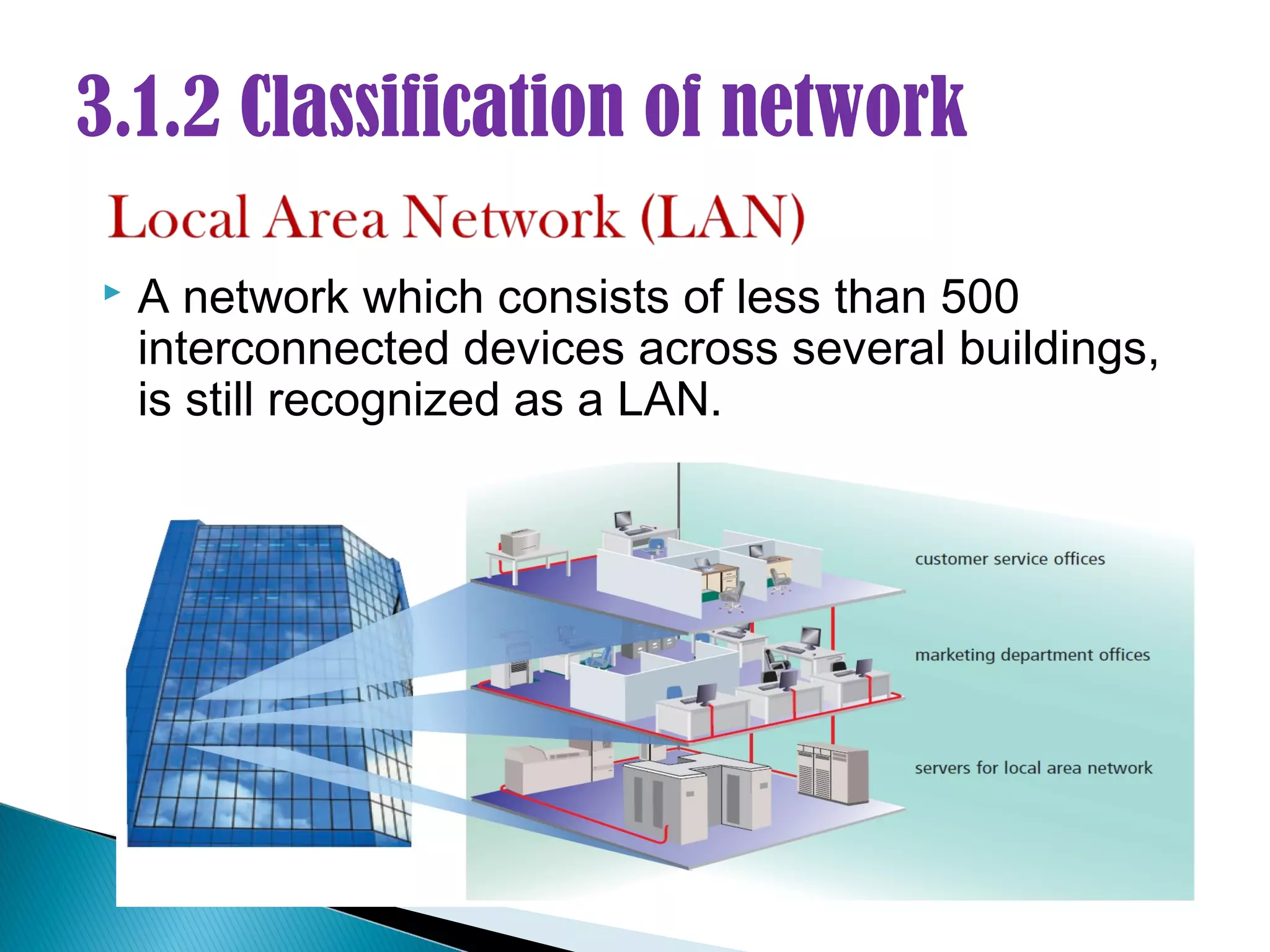
   A network which consists of less than 500
    interconnected devices across several buildings,
    is still recognized as a LAN.
3.1.2 Classification of network

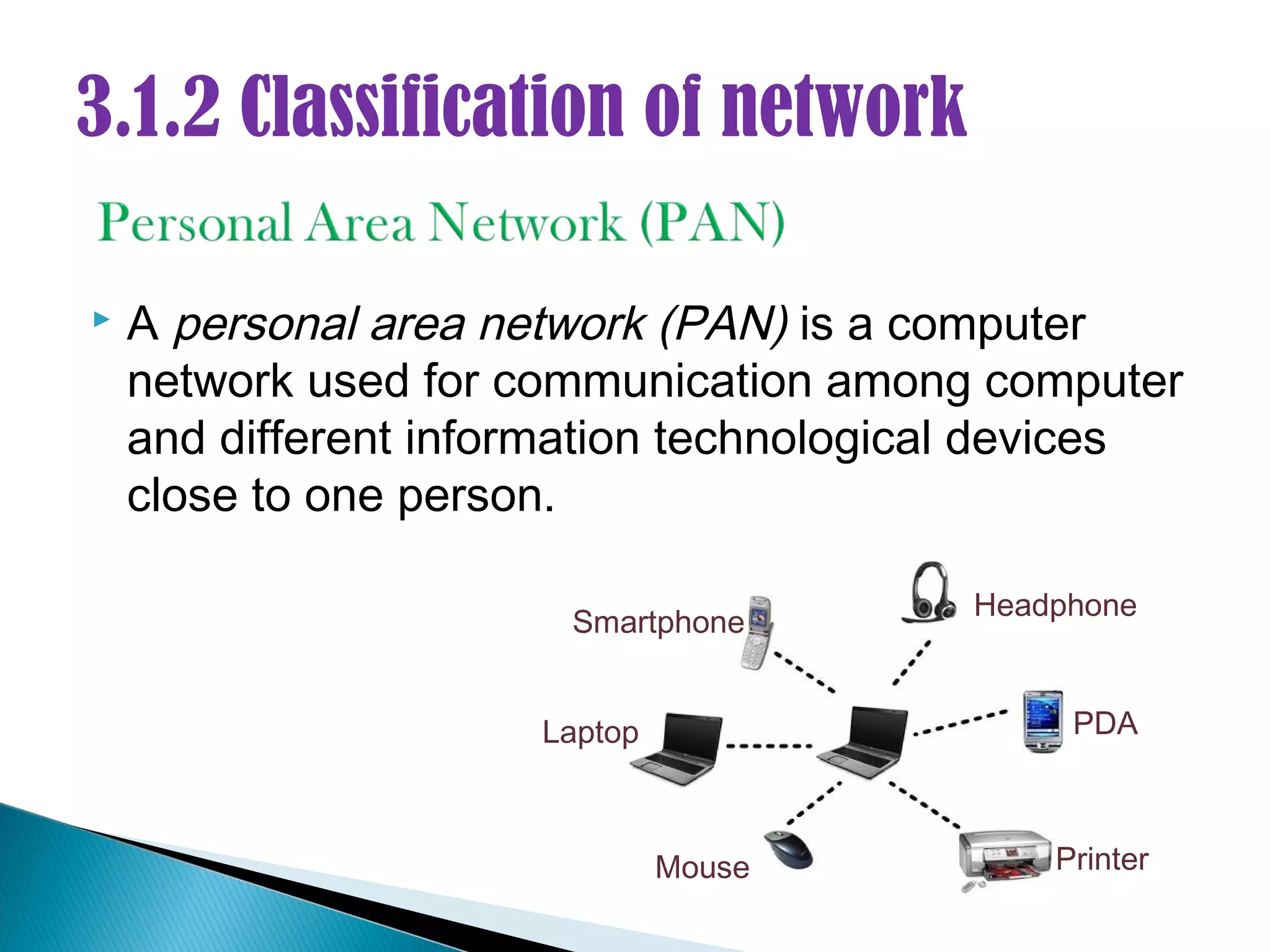
   A personal area network (PAN) is a computer
    network used for communication among computer
    and different information technological devices
    close to one person.

                                         Headphone
                       Smartphone


                      Laptop                  PDA


                               Mouse         Printer
3.1.2 Classification of network

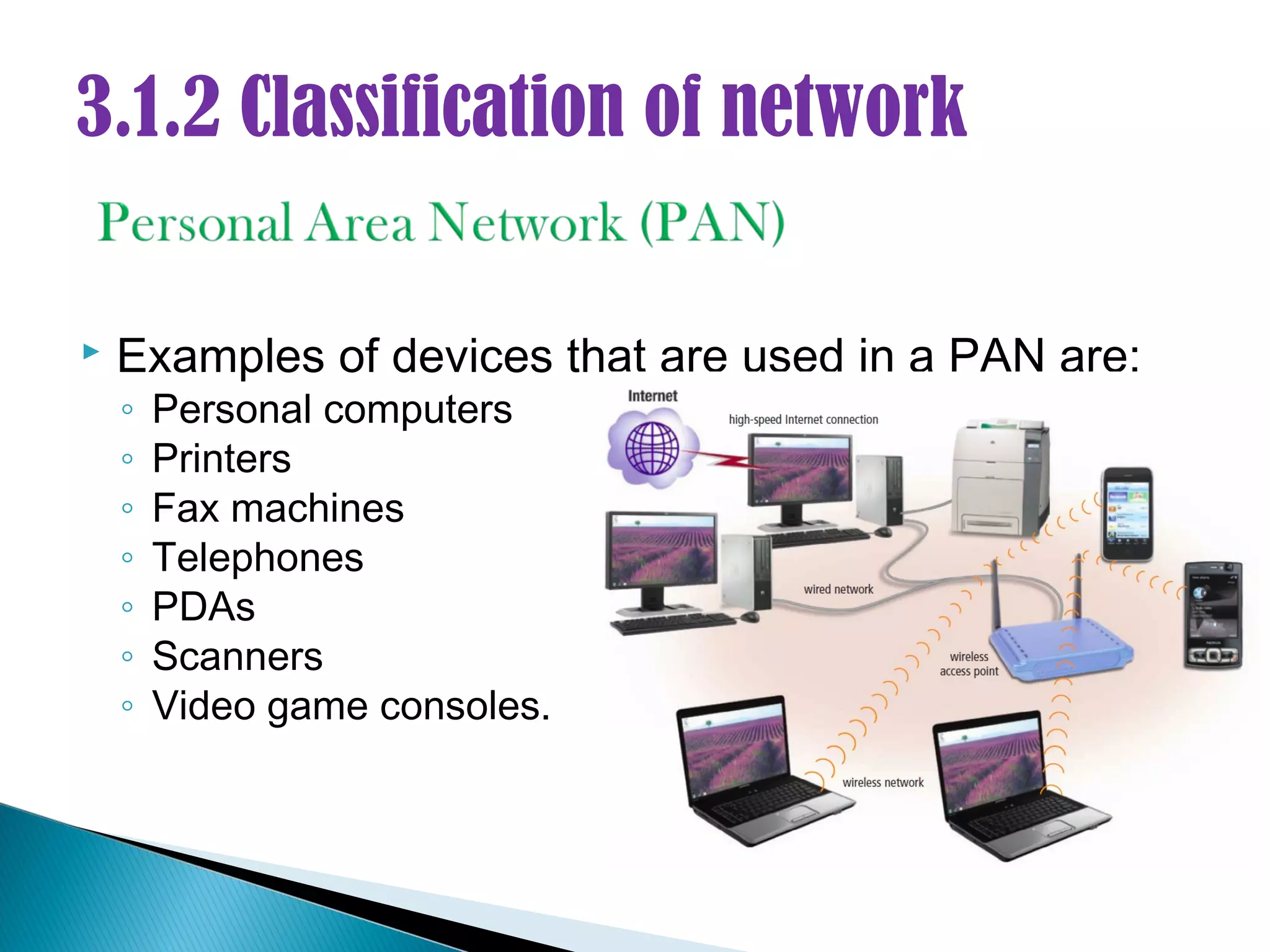
   Examples of devices that are used in a PAN are:
    ◦   Personal computers
    ◦   Printers
    ◦   Fax machines
    ◦   Telephones
    ◦   PDAs
    ◦   Scanners
    ◦   Video game consoles.
3.1.2 Classification of network

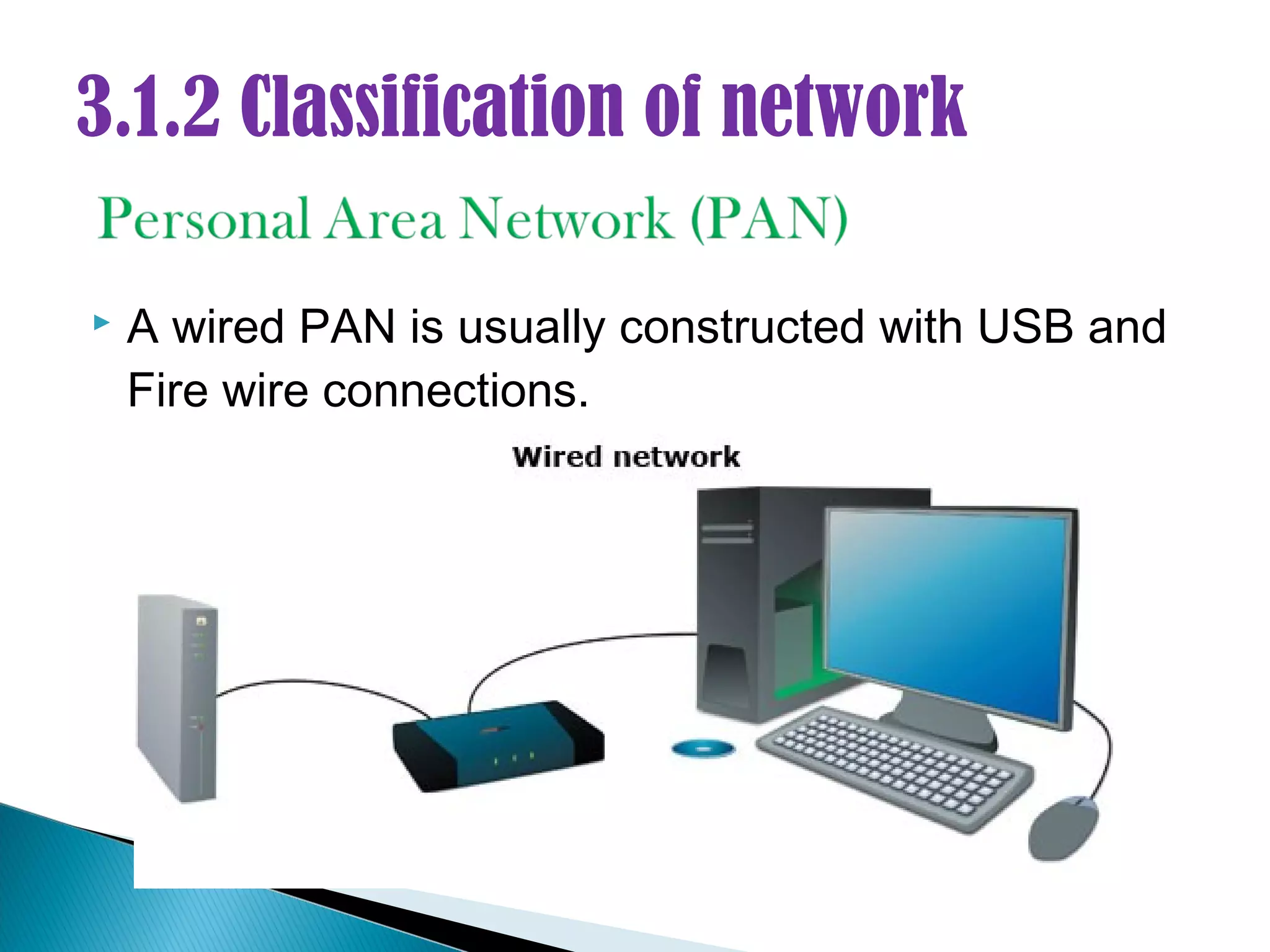
   A wired PAN is usually constructed with USB and
    Fire wire connections.
3.1.2 Classification of network

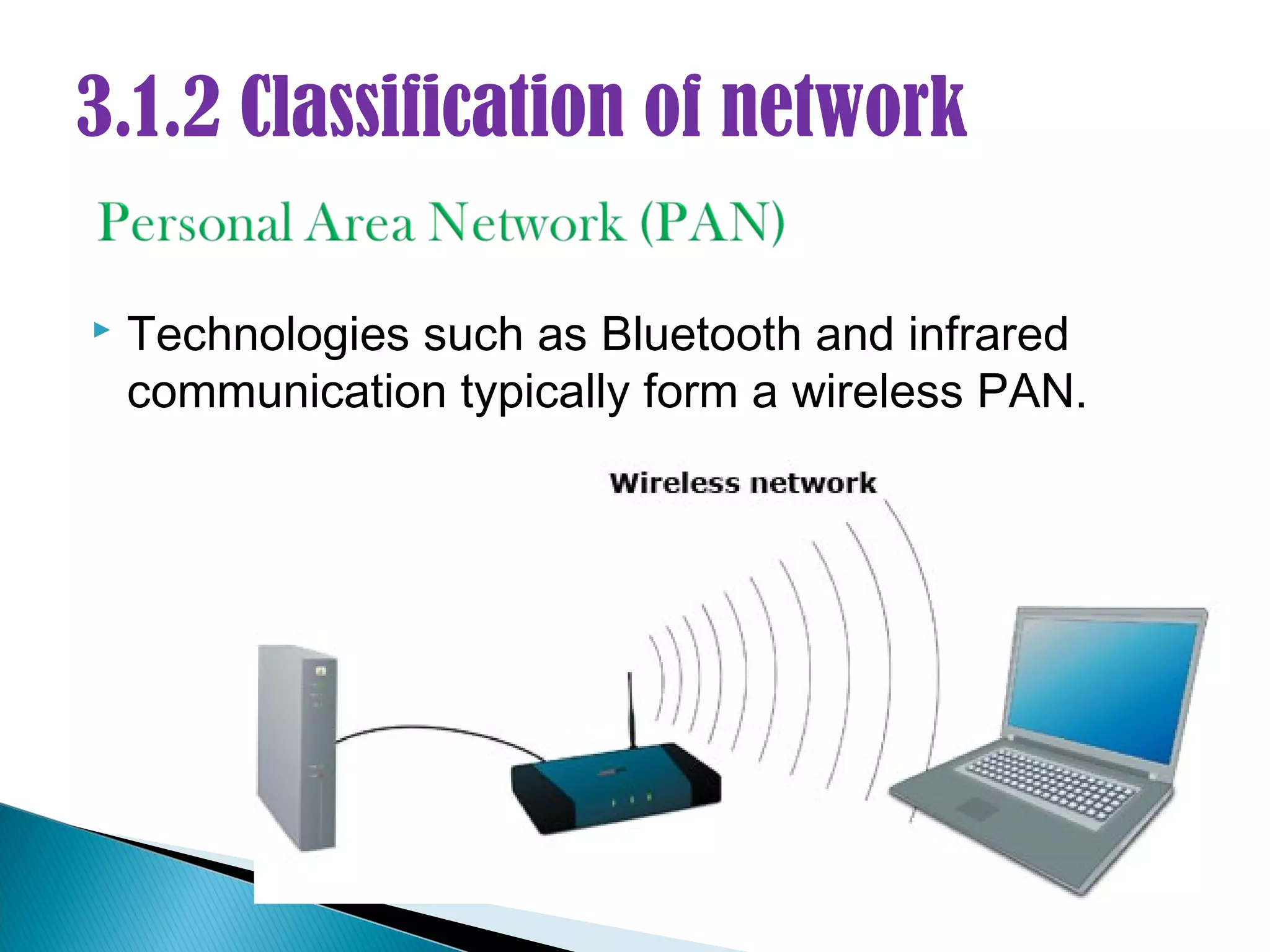
   Technologies such as Bluetooth and infrared
    communication typically form a wireless PAN.
3.1.2 Classification of network

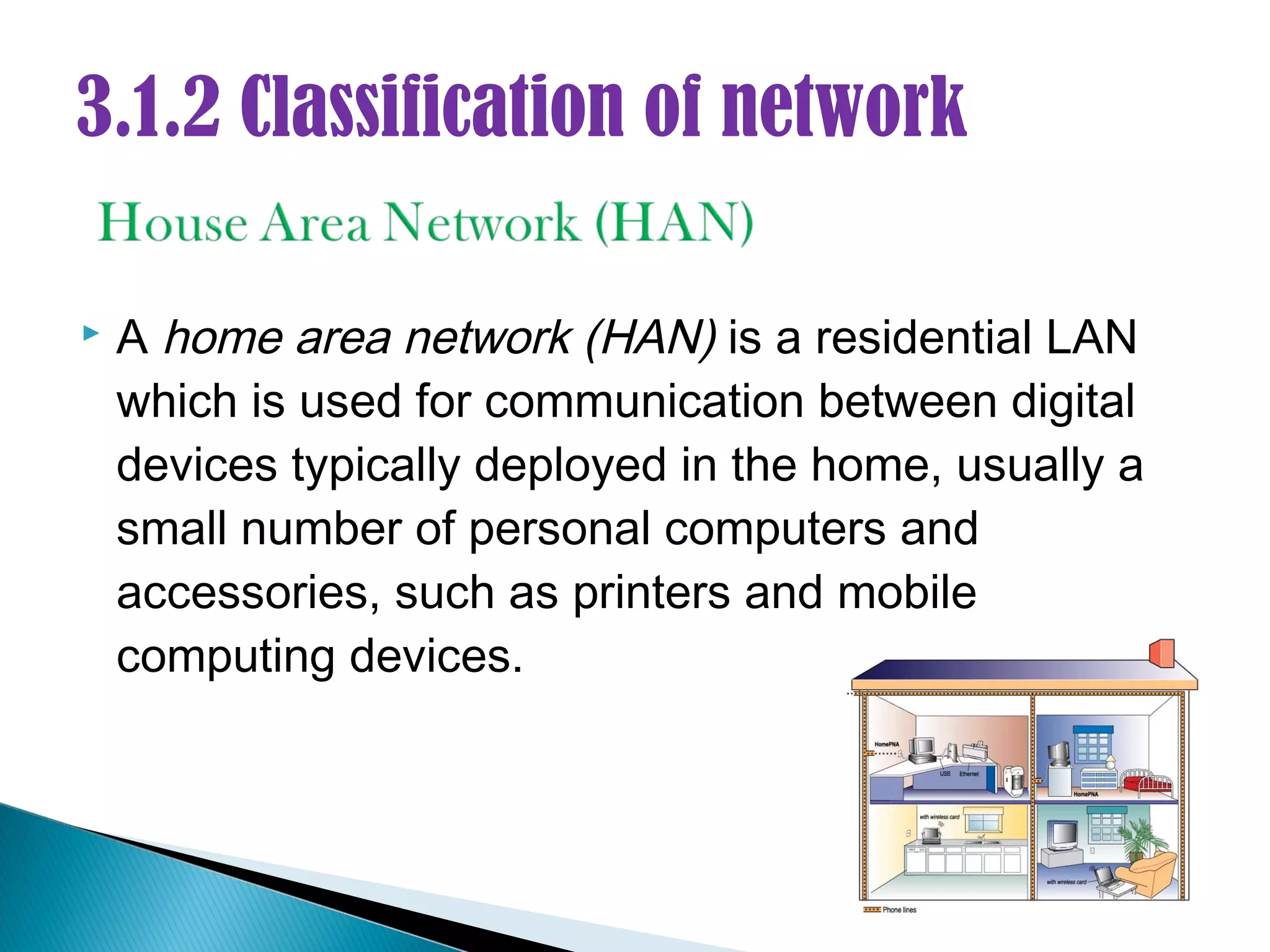
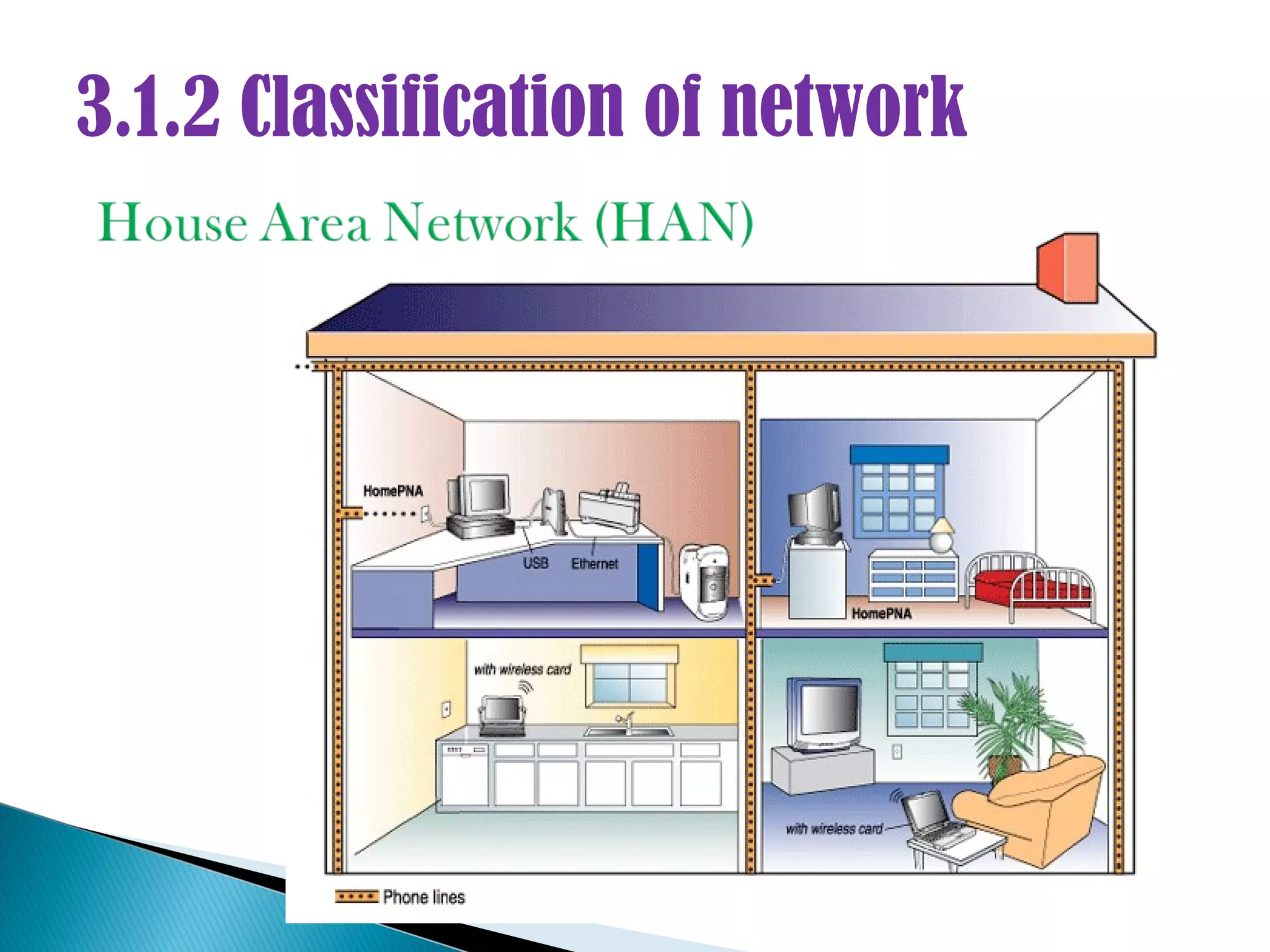
   A home area network (HAN) is a residential LAN
    which is used for communication between digital
    devices typically deployed in the home, usually a
    small number of personal computers and
    accessories, such as printers and mobile
    computing devices.
3.1.2 Classification of network


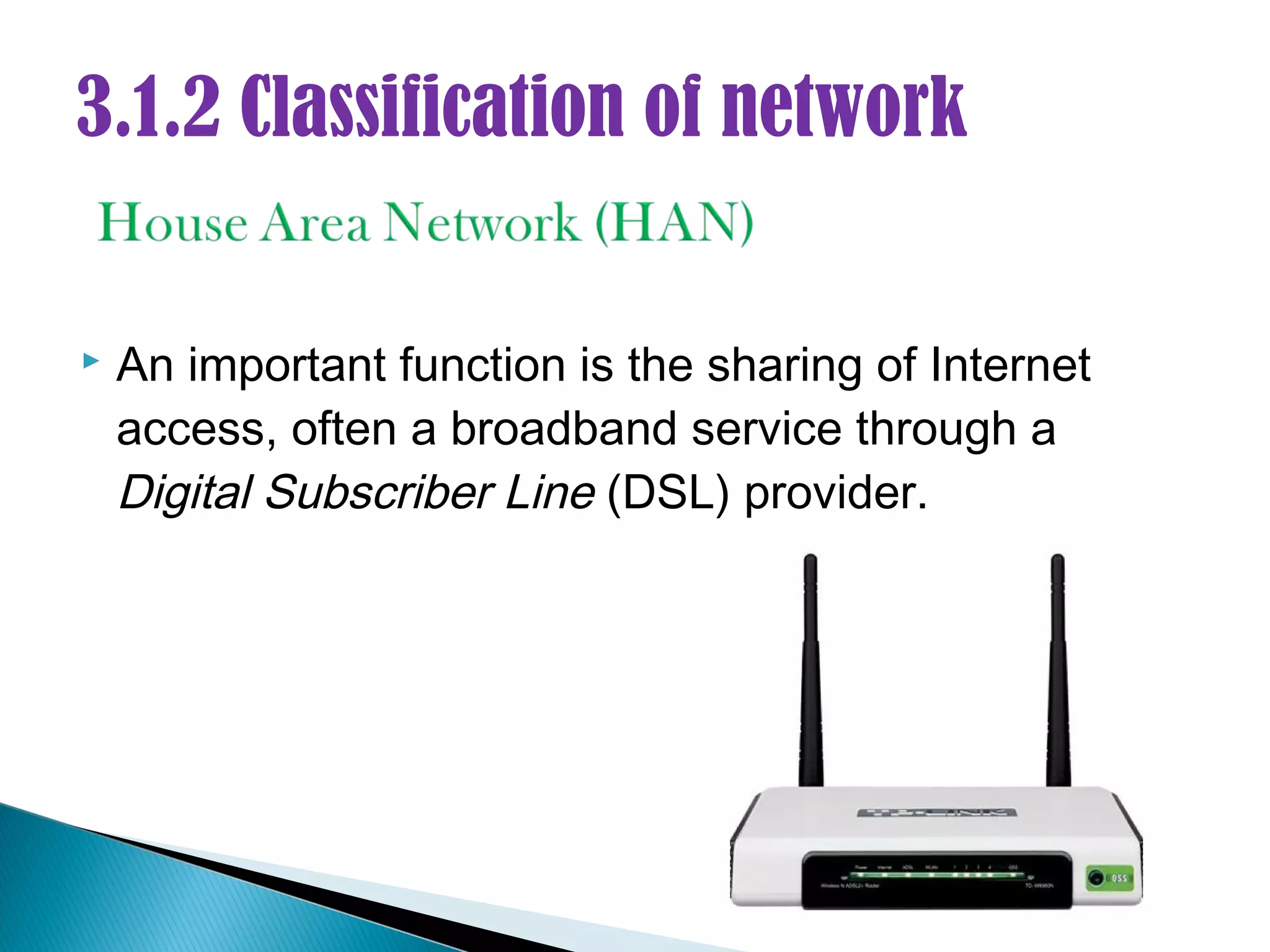
   An important function is the sharing of Internet
    access, often a broadband service through a
    Digital Subscriber Line (DSL) provider.
3.1.2 Classification of network


 • Easy to share devices
   (printers, scanners, external drives)
 • Easy to share data
   (homework, pictures)
 • Cost of LAN Setup is low.
3.1.2 Classification of network


 • Power - a good LAN is required to be on all
   the times.
 • Security - each computer and device
   become another point of entry for
   undesirables.
 • if all computers running at once, can reduce
   speed for each.
 • Area covered is limited
3.1.2 Classification of network


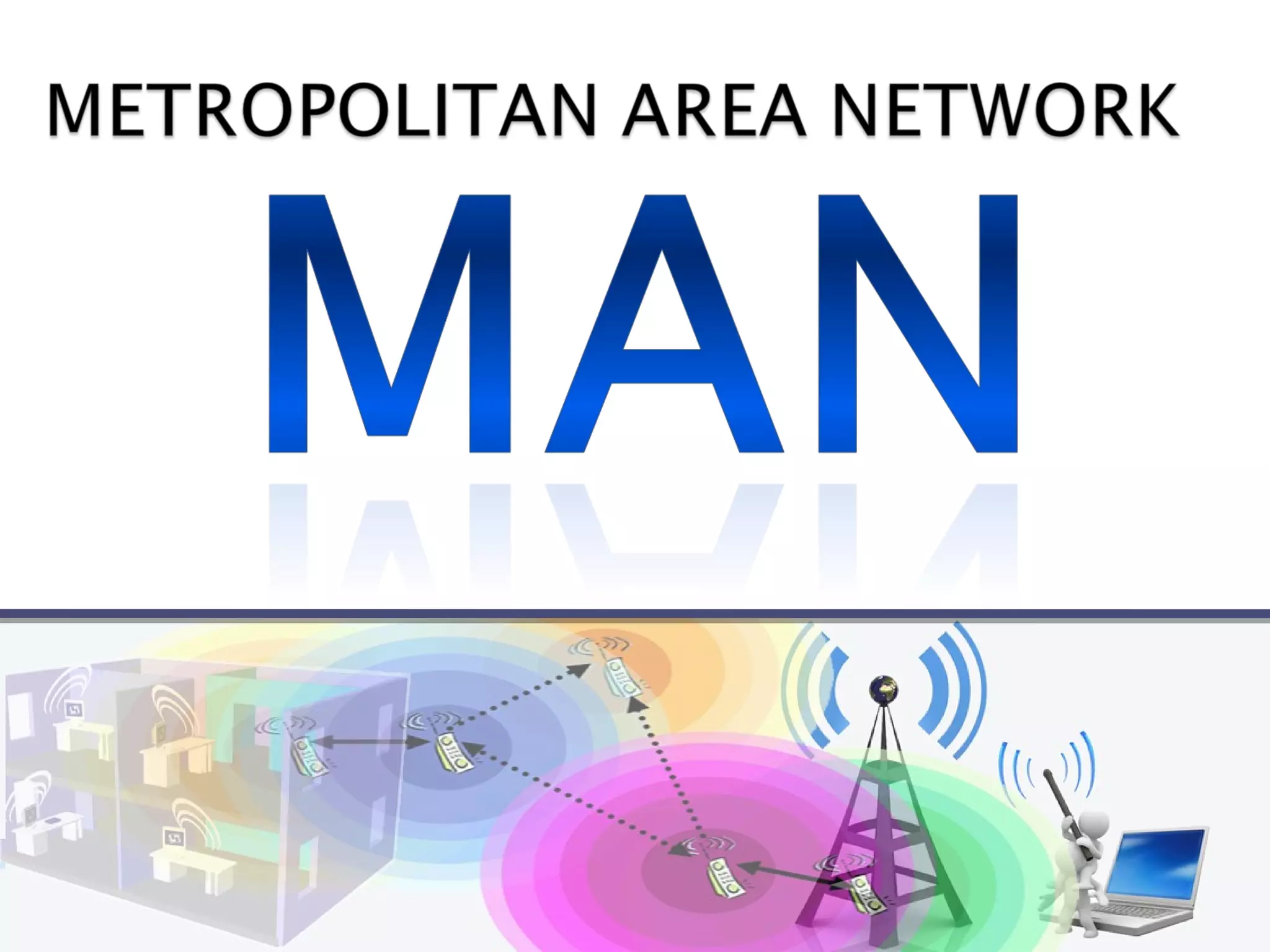
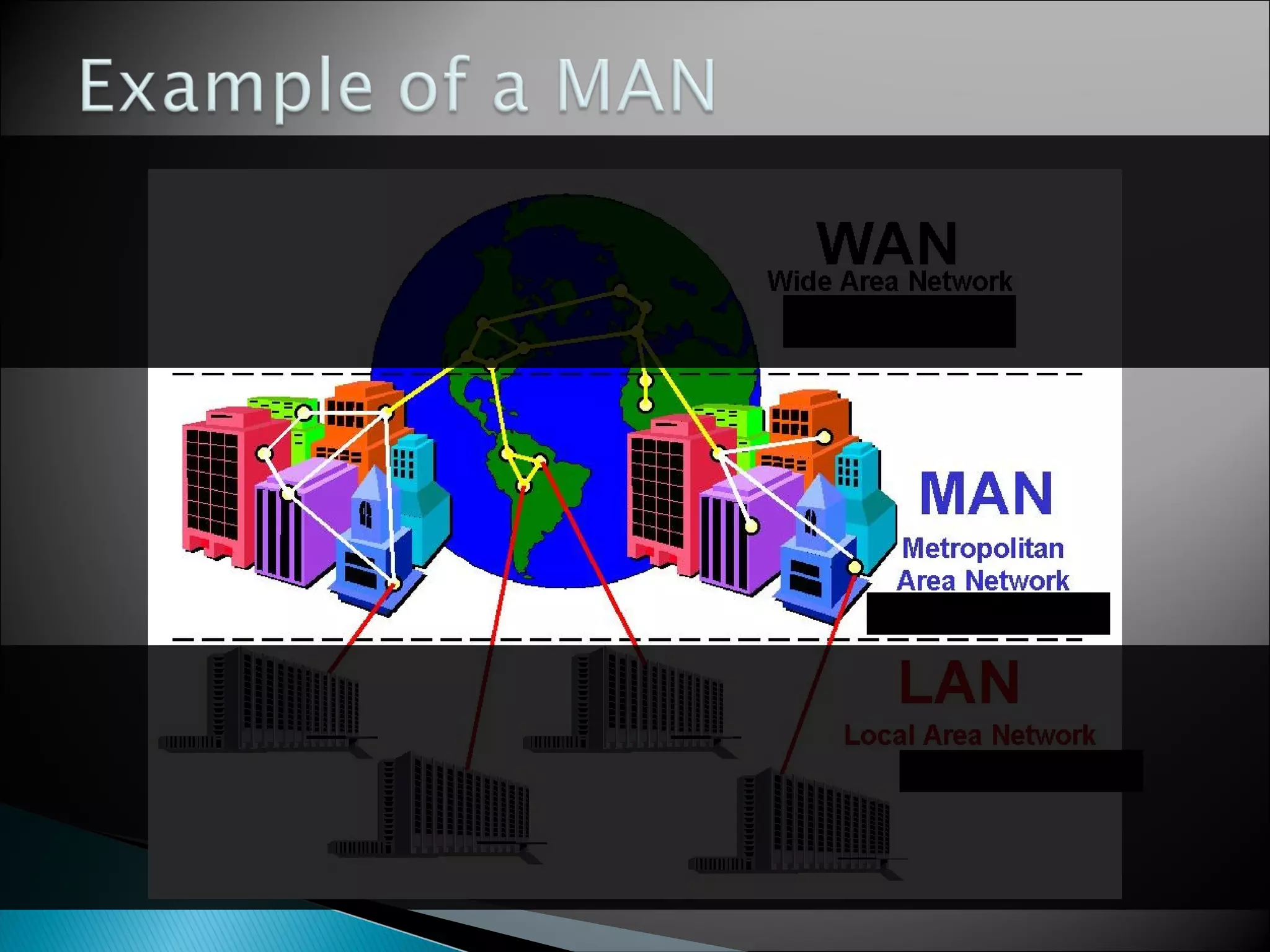
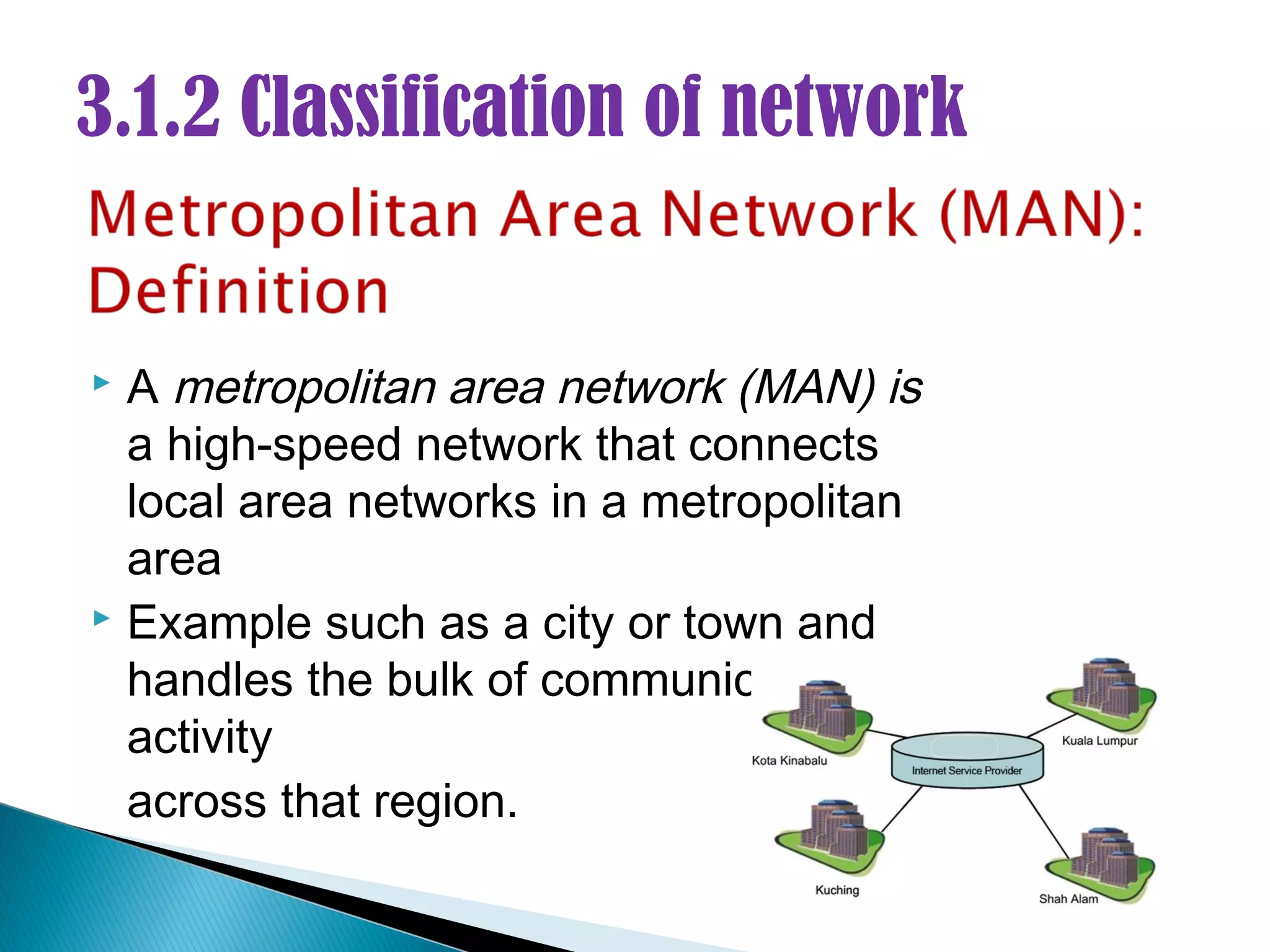
 A metropolitan area network (MAN) is
  a high-speed network that connects
  local area networks in a metropolitan
  area
 Example such as a city or town and

  handles the bulk of communications
  activity
  across that region.
3.1.2 Classification of network

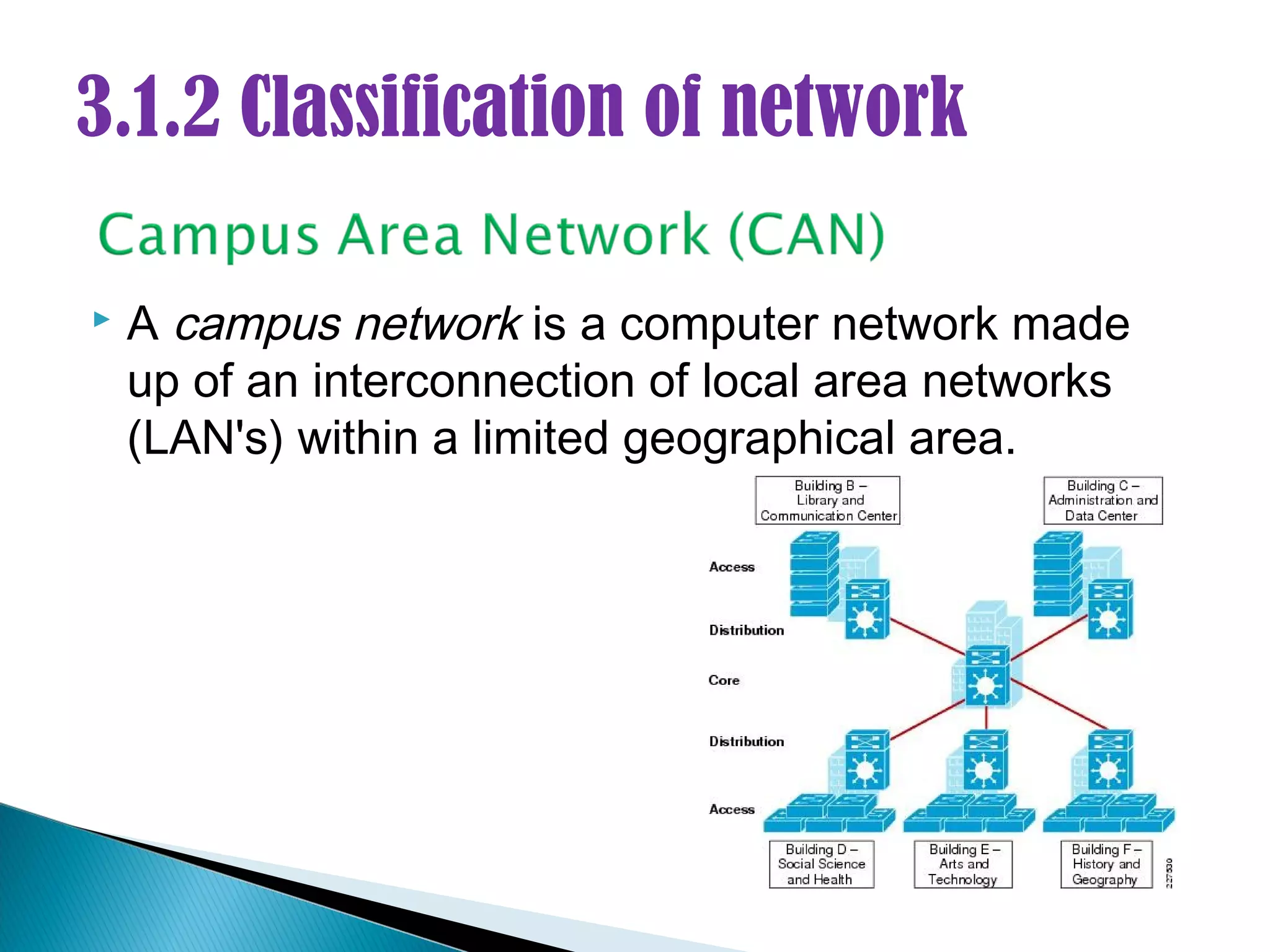
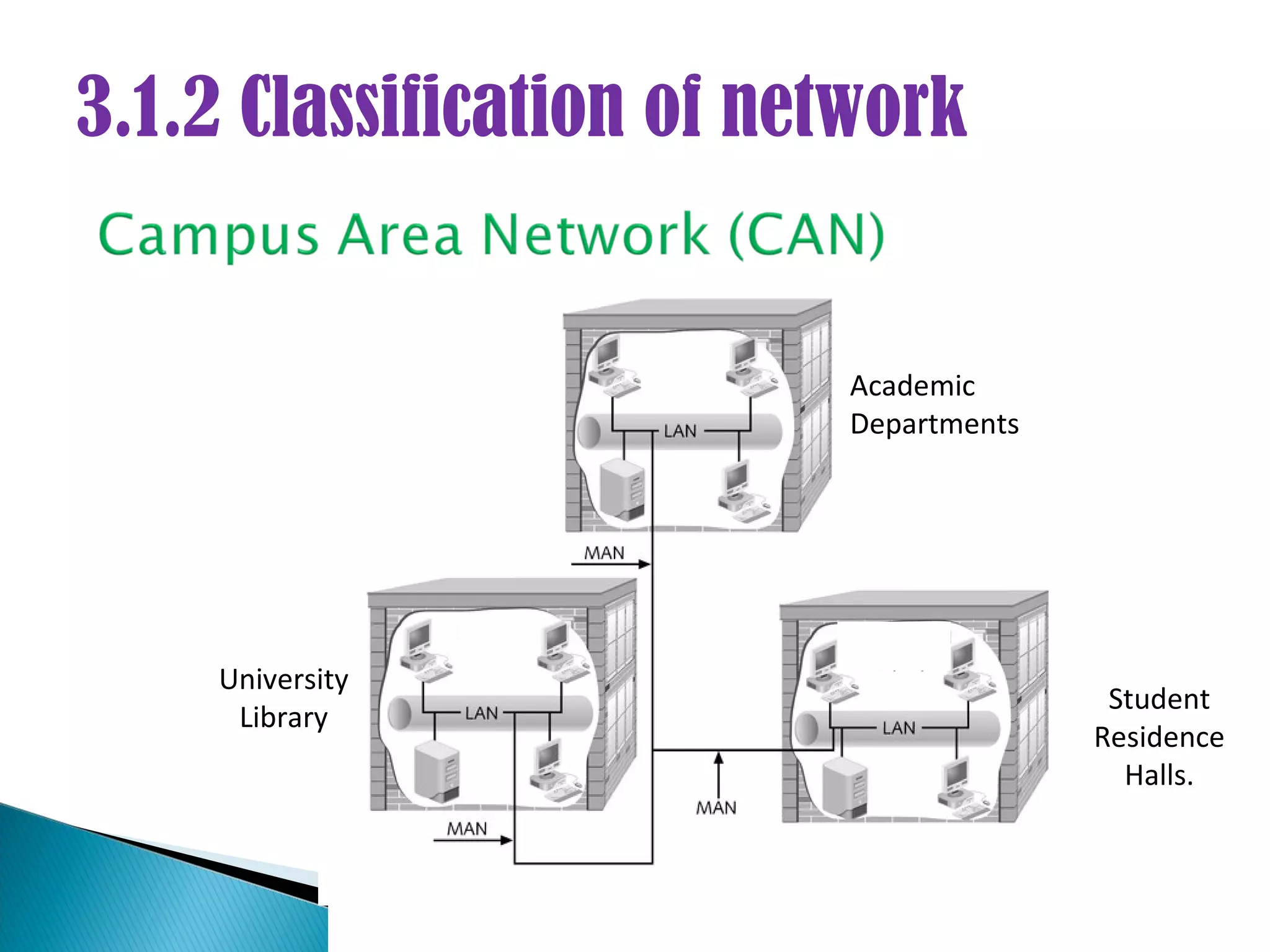
   A campus network is a computer network made
    up of an interconnection of local area networks
    (LAN's) within a limited geographical area.
3.1.2 Classification of network

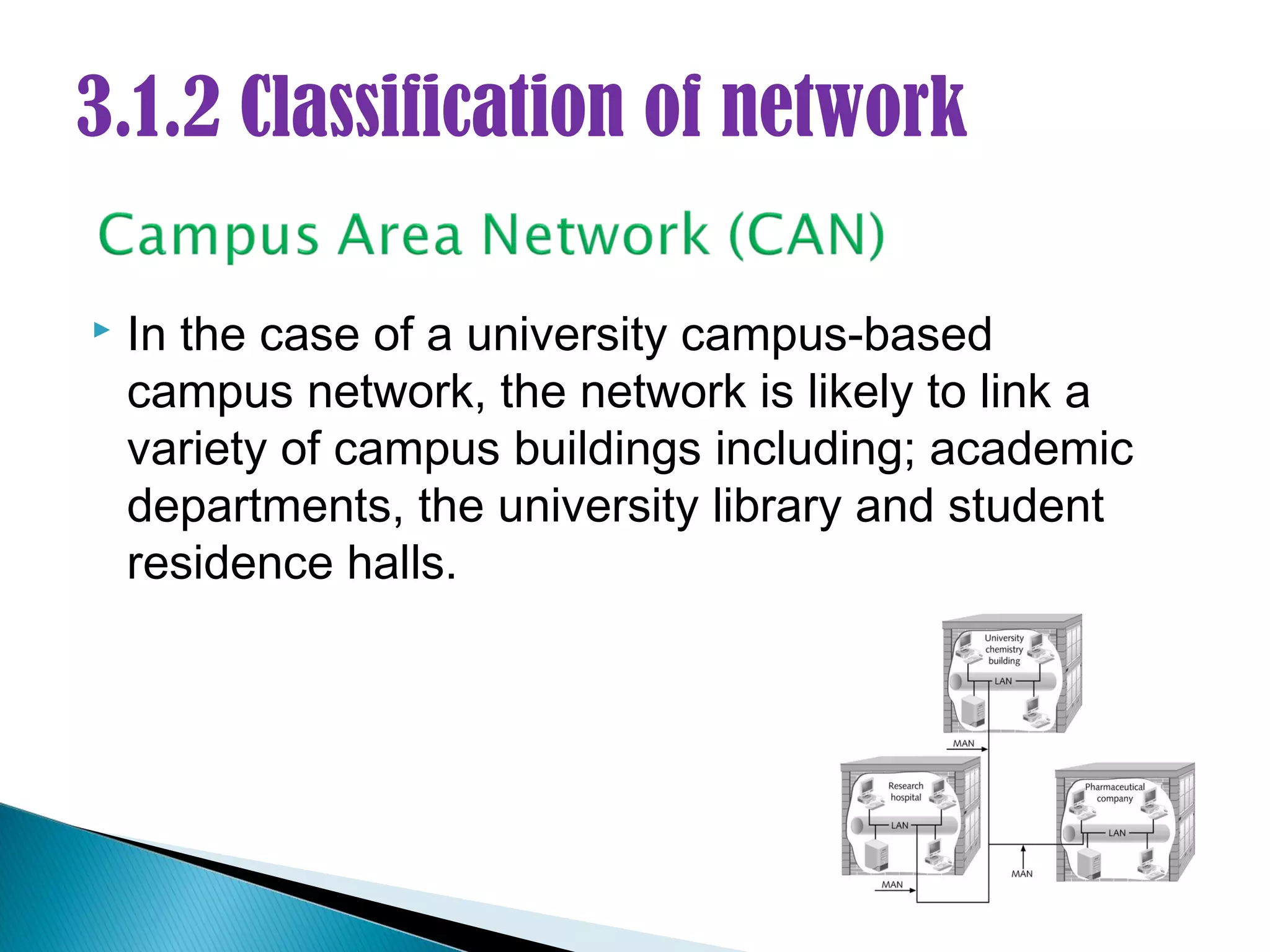
   In the case of a university campus-based
    campus network, the network is likely to link a
    variety of campus buildings including; academic
    departments, the university library and student
    residence halls.
3.1.2 Classification of network


                          Academic
                          Departments


    University
                                         Student
     Library
                                        Residence
                                          Halls.
3.1.2 Classification of network


 • Efficiency and shared access.

 • All the computer-owning residents of the
   area have equal ability to go on line.
3.1.2 Classification of network


  • It can be costly
    (hardware, software, support, etc.)
  • Security problems
  • As the network consists of many computers
    over the span of a city, the connection can
    lag or
    become quite slow.
3.1.2 Classification of network


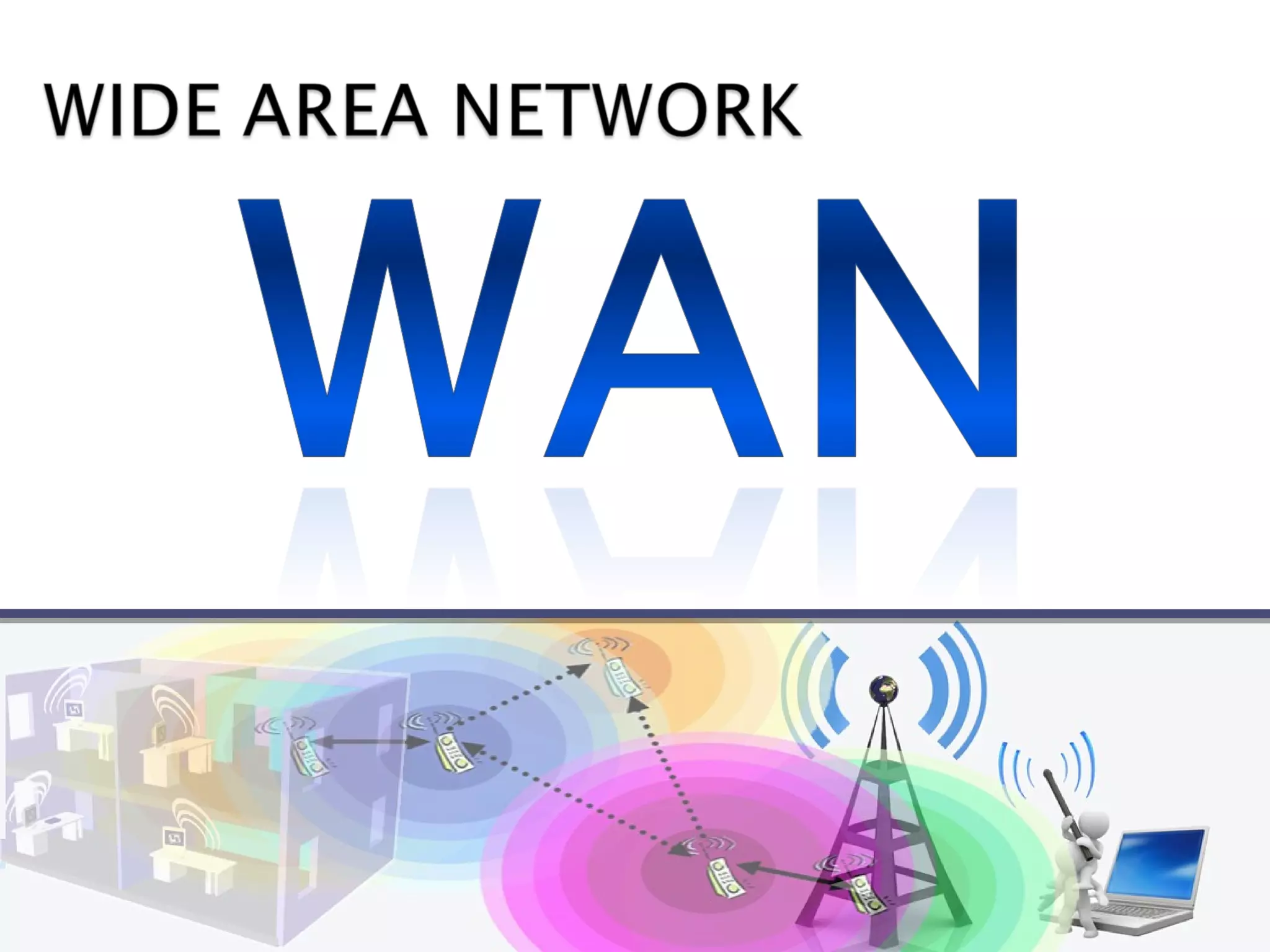
   A wide area network (WAN) is a network that
    covers a large geographic area (such as a city,
    country, or the world) using a communications
    channel that combines many types of media such
    as telephone lines, cables, and radio waves.
3.1.2 Classification of network


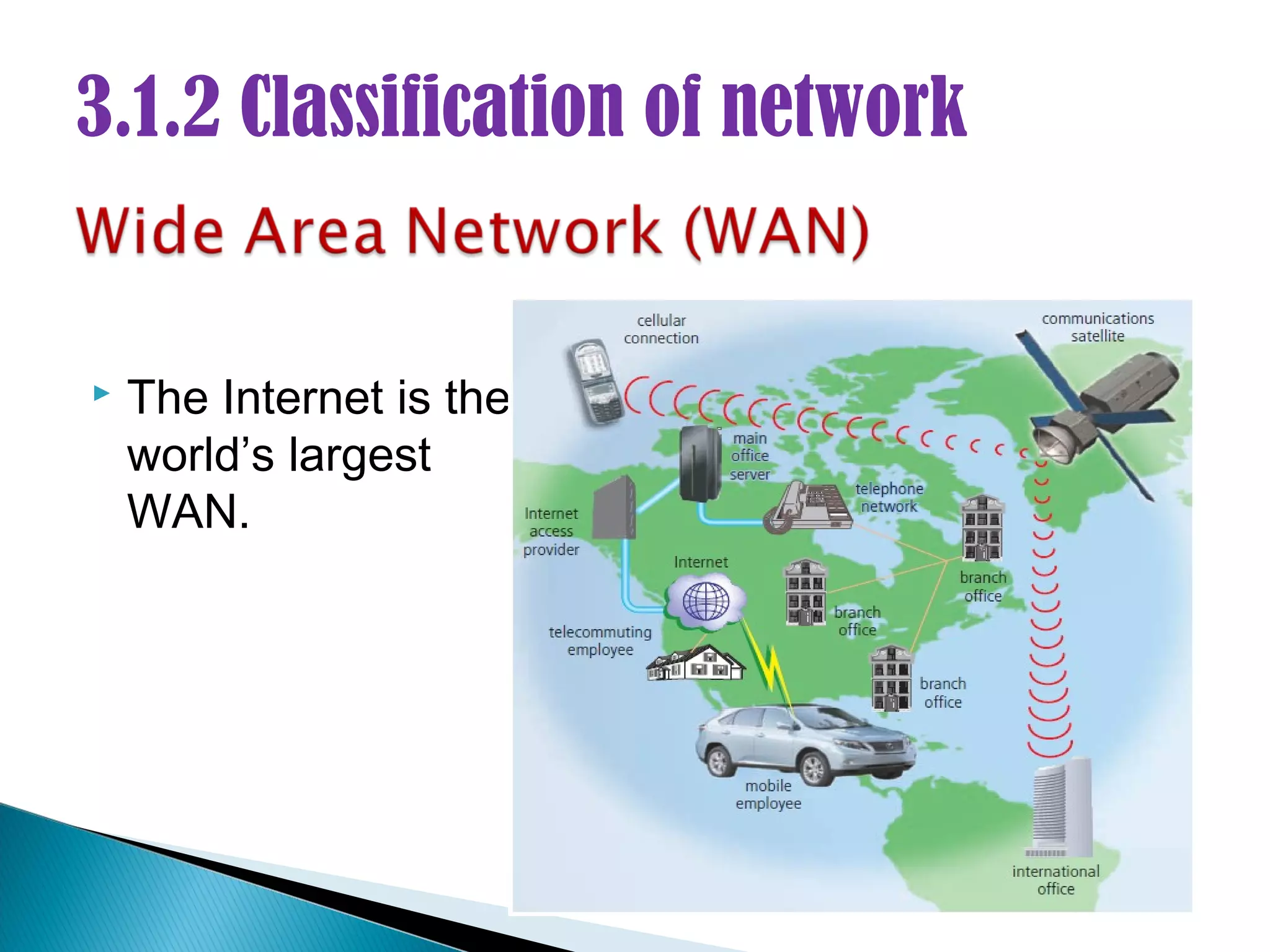
   The Internet is the
    world’s largest
    WAN.
3.1.2 Classification of network

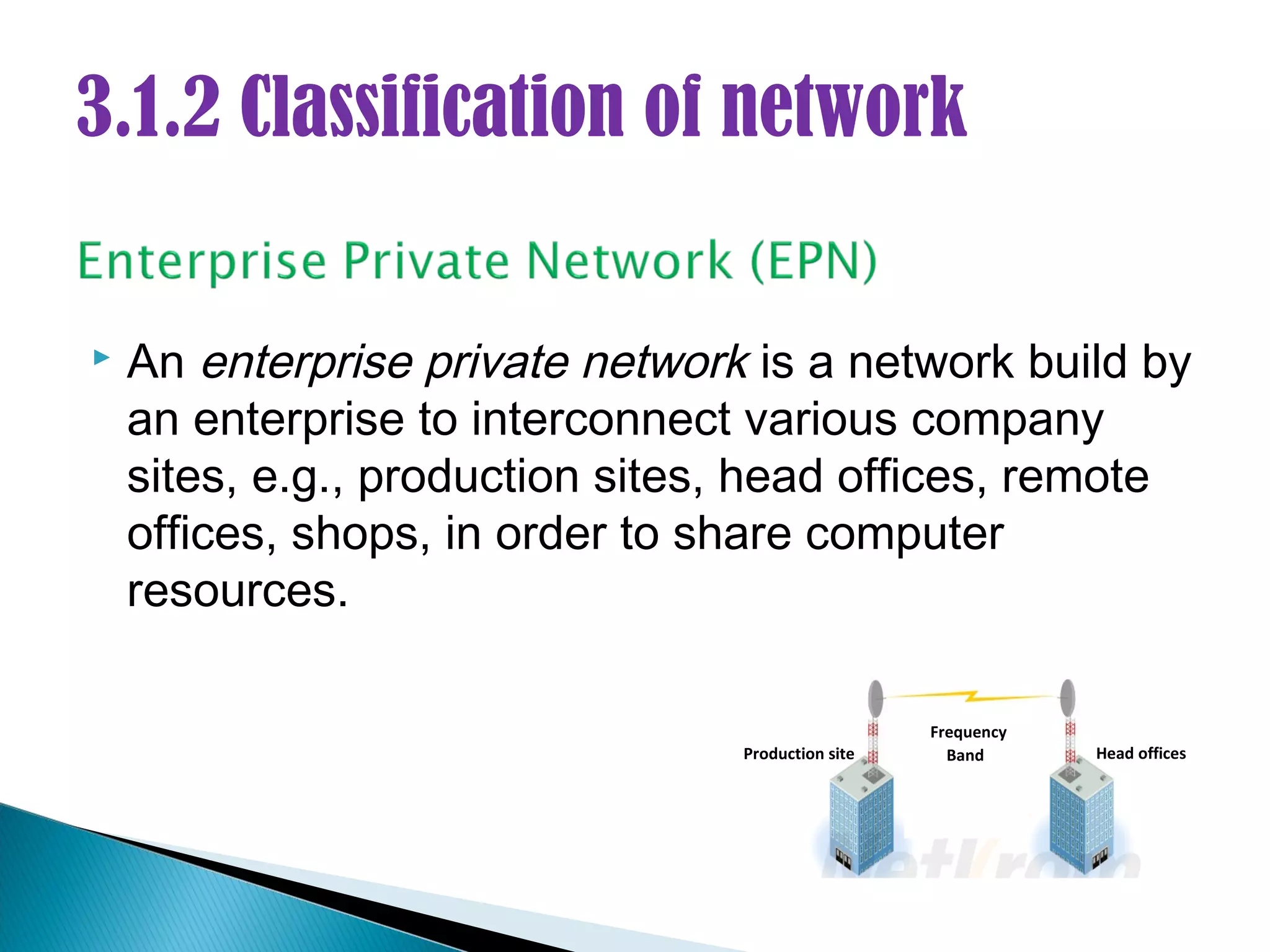
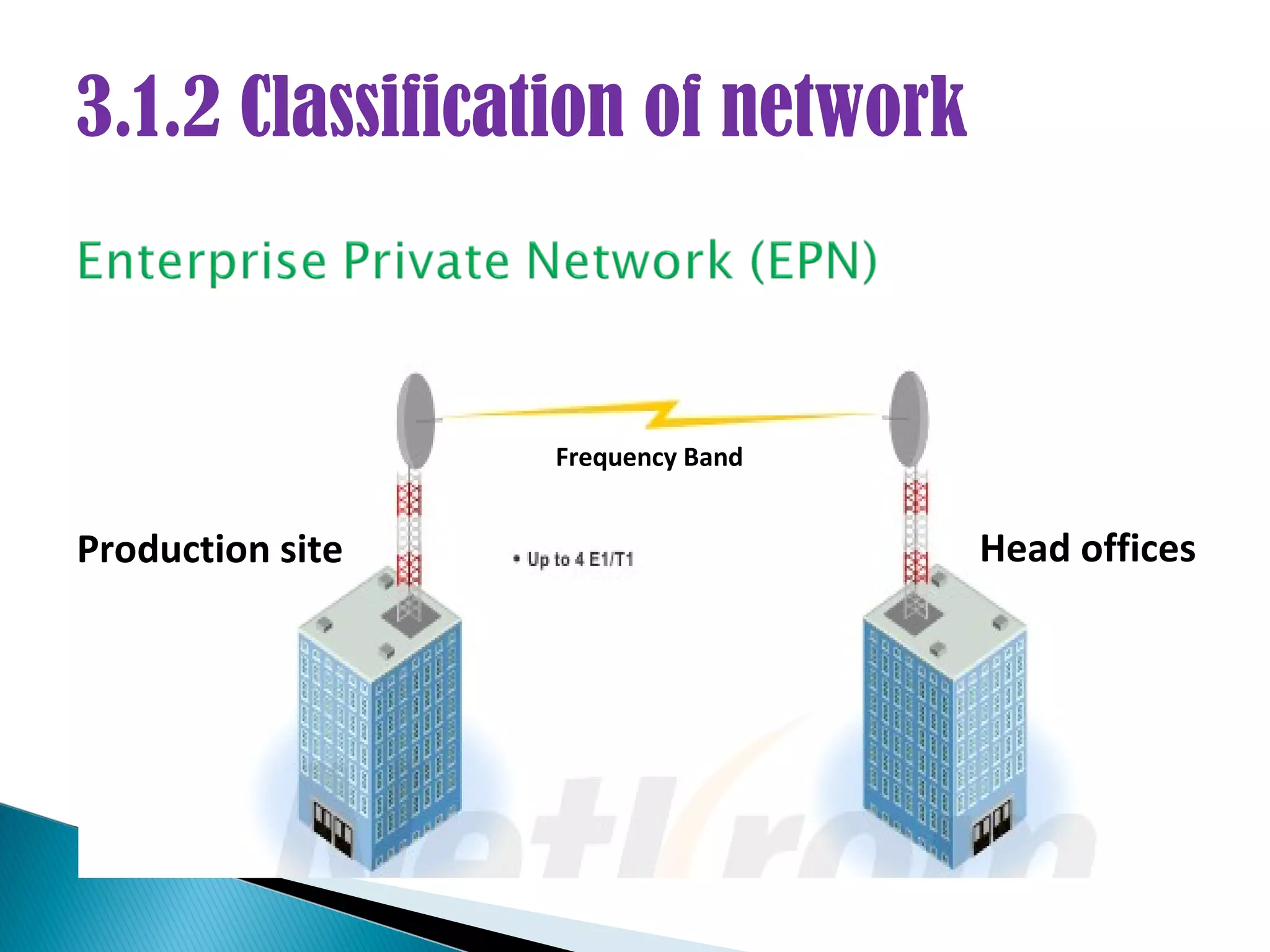
   An enterprise private network is a network build by
    an enterprise to interconnect various company
    sites, e.g., production sites, head offices, remote
    offices, shops, in order to share computer
    resources.

                                                   Frequency
                                 Production site     Band      Head offices
3.1.2 Classification of network


                  Frequency Band


Production site                    Head offices
3.1.2 Classification of network


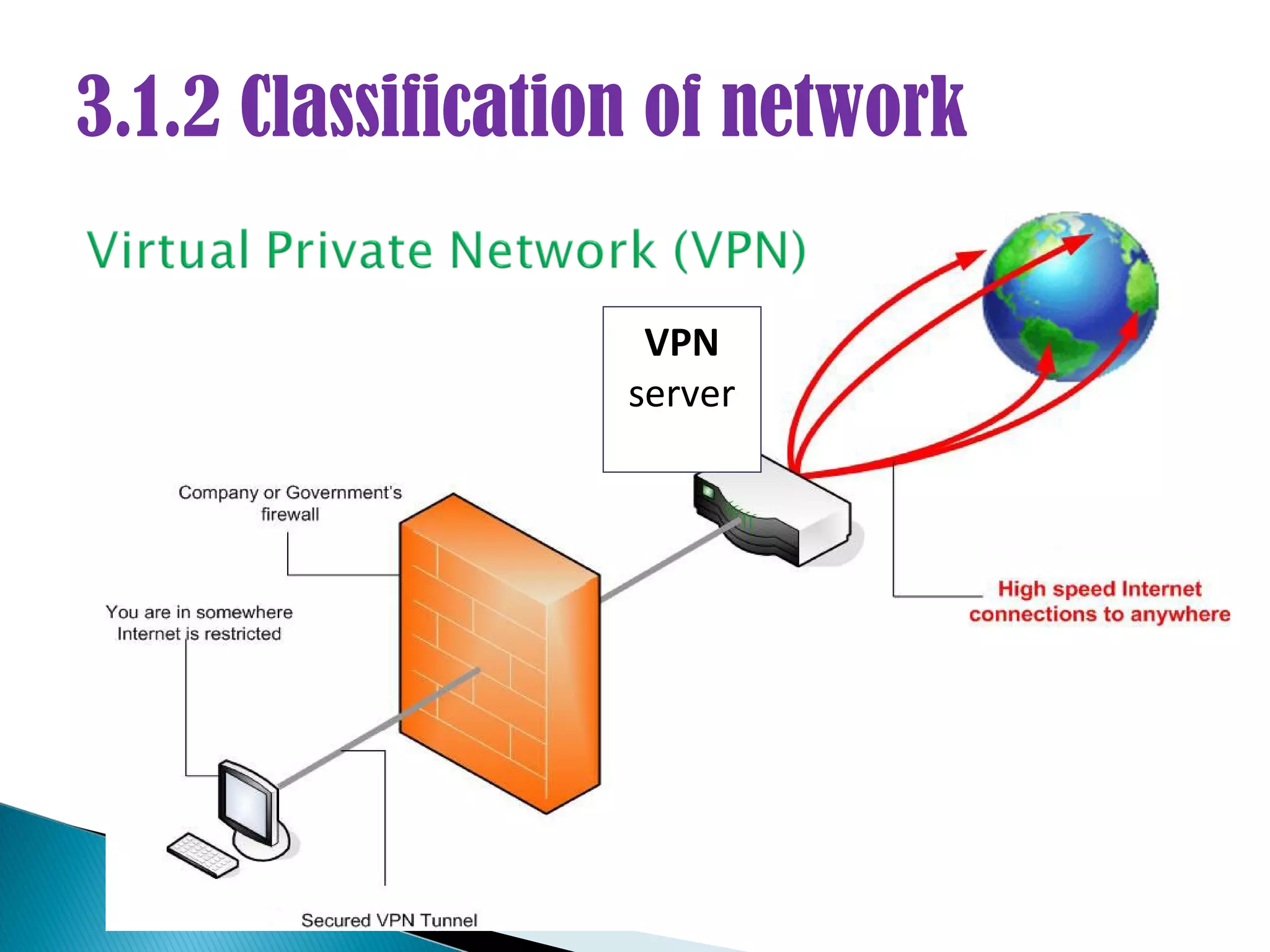
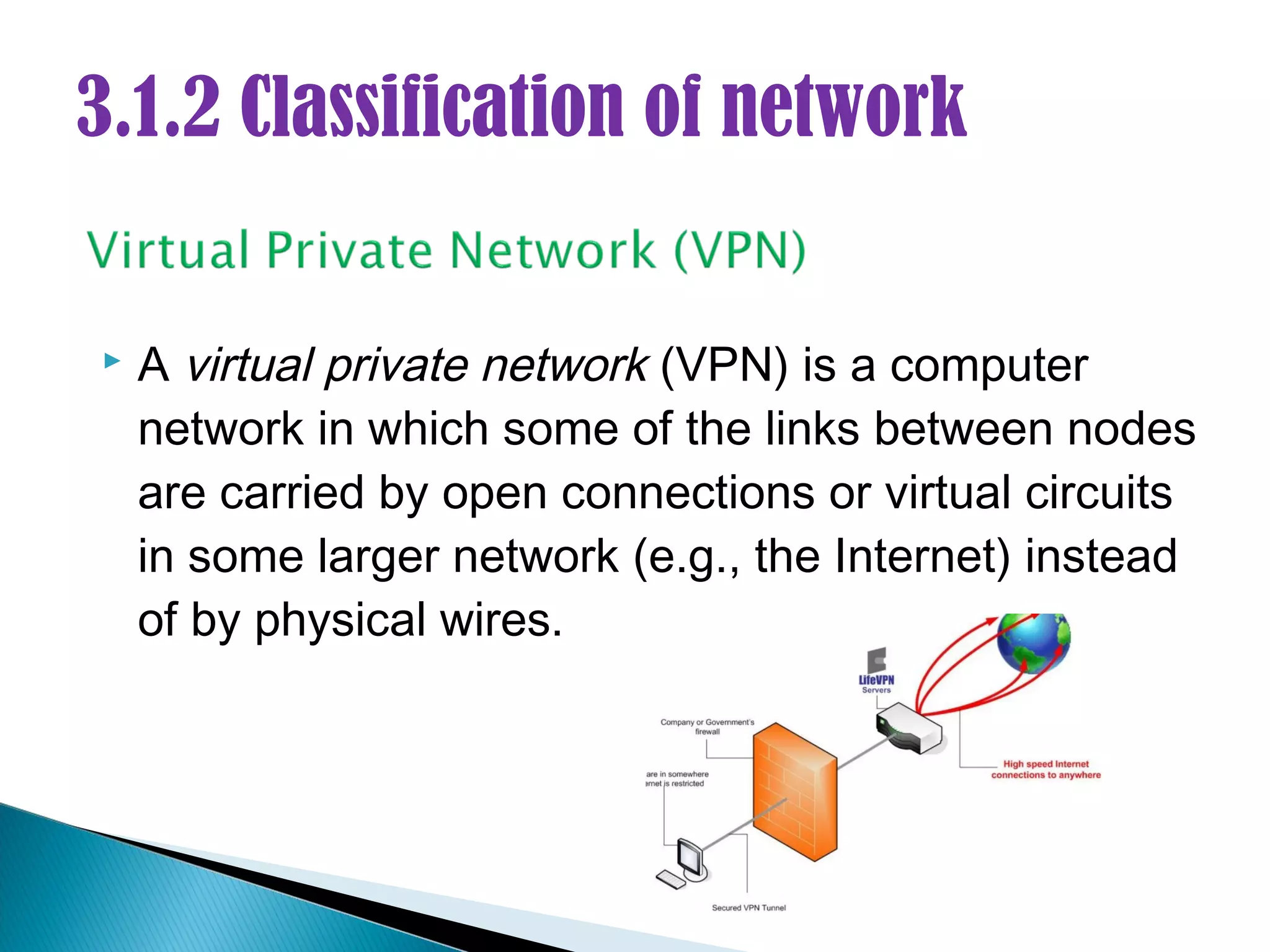
   A virtual private network (VPN) is a computer
    network in which some of the links between nodes
    are carried by open connections or virtual circuits
    in some larger network (e.g., the Internet) instead
    of by physical wires.
3.1.2 Classification of network

                    VPN
                   server
3.1.2 Classification of network


 • Increased efficiency
 • Ease of communication
 • Lowered costs.
3.1.2 Classification of network


  • Security problems
  • Training costs
  • Maintenance problems. Large
    enterprises will dedicate personnel to
    maintaining their WAN.
3.1.2 Classification of network

                        Network             Number of
               Cost               Speed
                         Size               computer

                                  Fastest   Smallest
 LAN            Low     Small


MAN            High     Larger    Slower      Large


               Higher   Largest   Slowest    Largest
WAN
3.1.2 Classification of network
 What is a network?
 What are three advantages of using a network?
 Give two types of LAN configuration.
 Give two types of WAN configuration.
 List down two of WAN disadvantages.
 Give two types of network communication
  standard in wired category.
 Give three types of network communication
  standard in wireless category.

3.1.2 classification of network

  • 2.
    3.1.2 Classification ofnetwork What Is a Network? A network is a collection of computers and devices connected together via communications devices and transmission media
  • 3.
    3.1.2 Classification ofnetwork Advantages of using a network include: • facilitating communications • sharing hardware • sharing data and information • sharing software • transferring funds.
  • 4.
  • 5.
    3.1.2 Classification ofnetwork  The main differentiation among these classifications is their area of coverage. LAN, MAN and WAN compared
  • 6.
  • 7.
    3.1.2 Classification ofnetwork a) LOCAL AREA NETWORK  Definition  Types of LAN:  Personal area network (PAN)  Home area network (HAN)  Advantages and Disadvantages of LAN b) METROPOLITAN AREA NETWORK  Definition  Type of MAN  Campus network  Advantages and Disadvantages of MAN c) WIDE AREA NETWORK  Definition  Types of WAN  Enterprise private network  Virtual private network  Advantages and Disadvantages of WAN
  • 10.
    3.1.2 Classification ofnetwork  A local area network (LAN) is a network that connects computers and devices in a limited geographical area.  Example such as a home, school computer laboratory, office building or closely positioned group of buildings.
  • 11.
    3.1.2 Classification ofnetwork  The simplest form of LAN is to connect two computers together. COMPUTER COMPUTER 1 2 Switch / hub
  • 12.
    3.1.2 Classification ofnetwork  A network which consists of less than 500 interconnected devices across several buildings, is still recognized as a LAN.
  • 13.
  • 14.
    3.1.2 Classification ofnetwork  A personal area network (PAN) is a computer network used for communication among computer and different information technological devices close to one person. Headphone Smartphone Laptop PDA Mouse Printer
  • 15.
    3.1.2 Classification ofnetwork  Examples of devices that are used in a PAN are: ◦ Personal computers ◦ Printers ◦ Fax machines ◦ Telephones ◦ PDAs ◦ Scanners ◦ Video game consoles.
  • 16.
    3.1.2 Classification ofnetwork  A wired PAN is usually constructed with USB and Fire wire connections.
  • 17.
    3.1.2 Classification ofnetwork  Technologies such as Bluetooth and infrared communication typically form a wireless PAN.
  • 18.
    3.1.2 Classification ofnetwork  A home area network (HAN) is a residential LAN which is used for communication between digital devices typically deployed in the home, usually a small number of personal computers and accessories, such as printers and mobile computing devices.
  • 19.
  • 20.
    3.1.2 Classification ofnetwork  An important function is the sharing of Internet access, often a broadband service through a Digital Subscriber Line (DSL) provider.
  • 21.
    3.1.2 Classification ofnetwork • Easy to share devices (printers, scanners, external drives) • Easy to share data (homework, pictures) • Cost of LAN Setup is low.
  • 22.
    3.1.2 Classification ofnetwork • Power - a good LAN is required to be on all the times. • Security - each computer and device become another point of entry for undesirables. • if all computers running at once, can reduce speed for each. • Area covered is limited
  • 25.
    3.1.2 Classification ofnetwork  A metropolitan area network (MAN) is a high-speed network that connects local area networks in a metropolitan area  Example such as a city or town and handles the bulk of communications activity across that region.
  • 26.
  • 27.
    3.1.2 Classification ofnetwork  A campus network is a computer network made up of an interconnection of local area networks (LAN's) within a limited geographical area.
  • 28.
    3.1.2 Classification ofnetwork  In the case of a university campus-based campus network, the network is likely to link a variety of campus buildings including; academic departments, the university library and student residence halls.
  • 29.
    3.1.2 Classification ofnetwork Academic Departments University Student Library Residence Halls.
  • 30.
    3.1.2 Classification ofnetwork • Efficiency and shared access. • All the computer-owning residents of the area have equal ability to go on line.
  • 31.
    3.1.2 Classification ofnetwork • It can be costly (hardware, software, support, etc.) • Security problems • As the network consists of many computers over the span of a city, the connection can lag or become quite slow.
  • 33.
    3.1.2 Classification ofnetwork  A wide area network (WAN) is a network that covers a large geographic area (such as a city, country, or the world) using a communications channel that combines many types of media such as telephone lines, cables, and radio waves.
  • 35.
    3.1.2 Classification ofnetwork  The Internet is the world’s largest WAN.
  • 36.
  • 37.
    3.1.2 Classification ofnetwork  An enterprise private network is a network build by an enterprise to interconnect various company sites, e.g., production sites, head offices, remote offices, shops, in order to share computer resources. Frequency Production site Band Head offices
  • 38.
    3.1.2 Classification ofnetwork Frequency Band Production site Head offices
  • 39.
    3.1.2 Classification ofnetwork  A virtual private network (VPN) is a computer network in which some of the links between nodes are carried by open connections or virtual circuits in some larger network (e.g., the Internet) instead of by physical wires.
  • 40.
    3.1.2 Classification ofnetwork VPN server
  • 41.
    3.1.2 Classification ofnetwork • Increased efficiency • Ease of communication • Lowered costs.
  • 42.
    3.1.2 Classification ofnetwork • Security problems • Training costs • Maintenance problems. Large enterprises will dedicate personnel to maintaining their WAN.
  • 43.
    3.1.2 Classification ofnetwork Network Number of Cost Speed Size computer Fastest Smallest LAN Low Small MAN High Larger Slower Large Higher Largest Slowest Largest WAN
  • 44.
  • 45.
     What isa network?  What are three advantages of using a network?  Give two types of LAN configuration.  Give two types of WAN configuration.  List down two of WAN disadvantages.  Give two types of network communication standard in wired category.  Give three types of network communication standard in wireless category.

Editor's Notes

  • #34 Advantages Of WAN -Messages can be sent very quickly to anyone else on the network. These messages can have pictures, sounds, or data included with them (called attachments). -Expensive things (such as printers or phone lines to the internet) can be shared by all the computers on the network without having to buy a different peripheral for each computer. -Everyone on the network can use the same data. This avoids problems where some users may have older information than others. -Share information/files over a larger area Disadvantages Of WAN -Setting up a network can be an expensive and complicated experience. The bigger the network the more expensive it is. -Security is a real issue when many different people have the ability to use information from other computers. Protection against hackers and viruses adds more complexity and expense. -Once set up, maintaining a network is a full-time job which requires network supervisors and technicians to be employed. -Information may not meet local needs or interests -Vulnerable to hackers or other outside threats
  • #36 Advantages Of WAN -Messages can be sent very quickly to anyone else on the network. These messages can have pictures, sounds, or data included with them (called attachments). -Expensive things (such as printers or phone lines to the internet) can be shared by all the computers on the network without having to buy a different peripheral for each computer. -Everyone on the network can use the same data. This avoids problems where some users may have older information than others. -Share information/files over a larger area Disadvantages Of WAN -Setting up a network can be an expensive and complicated experience. The bigger the network the more expensive it is. -Security is a real issue when many different people have the ability to use information from other computers. Protection against hackers and viruses adds more complexity and expense. -Once set up, maintaining a network is a full-time job which requires network supervisors and technicians to be employed. -Information may not meet local needs or interests -Vulnerable to hackers or other outside threats
  • #42 Advantages Of WAN -Messages can be sent very quickly to anyone else on the network. These messages can have pictures, sounds, or data included with them (called attachments). -Expensive things (such as printers or phone lines to the internet) can be shared by all the computers on the network without having to buy a different peripheral for each computer. -Everyone on the network can use the same data. This avoids problems where some users may have older information than others. -Share information/files over a larger area Disadvantages Of WAN -Setting up a network can be an expensive and complicated experience. The bigger the network the more expensive it is. -Security is a real issue when many different people have the ability to use information from other computers. Protection against hackers and viruses adds more complexity and expense. -Once set up, maintaining a network is a full-time job which requires network supervisors and technicians to be employed. -Information may not meet local needs or interests -Vulnerable to hackers or other outside threats
  • #43 Advantages Of WAN -Messages can be sent very quickly to anyone else on the network. These messages can have pictures, sounds, or data included with them (called attachments). -Expensive things (such as printers or phone lines to the internet) can be shared by all the computers on the network without having to buy a different peripheral for each computer. -Everyone on the network can use the same data. This avoids problems where some users may have older information than others. -Share information/files over a larger area Disadvantages Of WAN -Setting up a network can be an expensive and complicated experience. The bigger the network the more expensive it is. -Security is a real issue when many different people have the ability to use information from other computers. Protection against hackers and viruses adds more complexity and expense. -Once set up, maintaining a network is a full-time job which requires network supervisors and technicians to be employed. -Information may not meet local needs or interests -Vulnerable to hackers or other outside threats