Polycystic
Kidney disease
Lecture 52
Cystic Diseases
of the Kidney
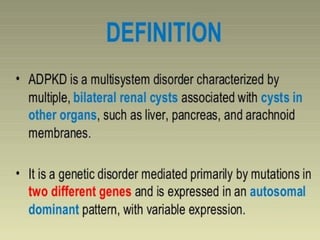
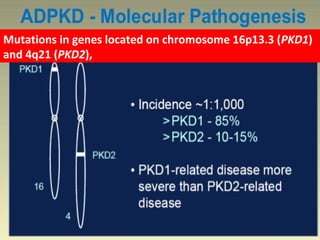
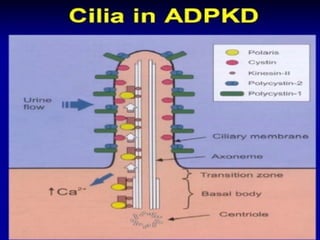
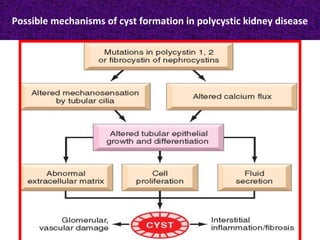
Mutations in genes located on chromosome 16p13.3 (PKD1)
and 4q21 (PKD2),
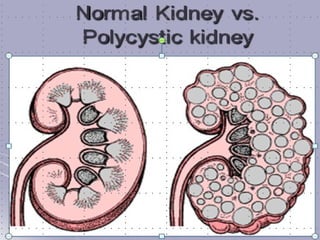
Possible mechanisms of cyst formation in polycystic kidney disease
Gross Morphology
The kidneys are usually bilaterally
ENLARGEDand may achieve
enormous sizes; weights as high as 4 kg
for each kidney have been reported.
Morphology
• The external surface appears to be composed
solely of a mass of cysts, up to 3 to 4
cm in diameter, with no intervening
parenchyma. However, microscopic
examination reveals functioning nephrons
dispersed between the cysts.
Morphology
• The cysts may be filled with
•a clear, serous fluidor,
• more usually, with
turbid, red to
brown,
• sometimes hemorrhagic fluid.
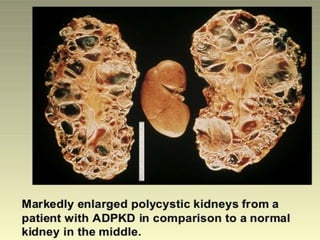
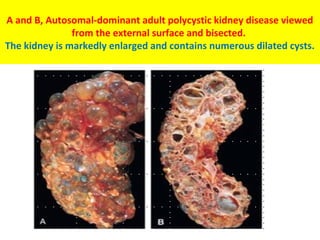
A and B, Autosomal-dominant adult polycystic kidney disease viewed
from the external surface and bisected.
The kidney is markedly enlarged and contains numerous dilated cysts.
Clinical Features
Many of these patients remain
asymptomatic until renal
insufficiency announces the
presence of the disease.
Clinical Features
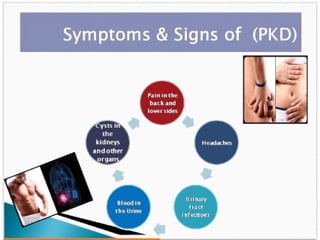
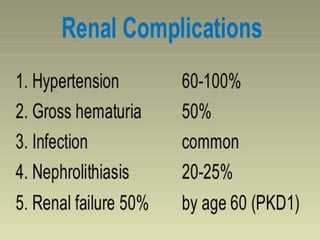
• Hemorrhage or progressive dilation of cysts
may produce PAIN.
• Excretion of blood clots causes RENAL COLIC.
The enlarged kidneys, usually apparent on
abdominal palpation, may induce a dragging
sensation.
Clinical Features
The disease occasionally begins with the
insidious onset of hematuria, followed by
other features of progressive chronic kidney
disease, such as proteinuria (rarely more
than 2 gm/day), polyuria, and hypertension.
Clinical features
• Patients with PKD2 mutations
tend to have an older age at
onset and later development
of renal failure.
Clinical Features
• Both genetic and environmental factors
influence disease severity.
• Progression is accelerated in blacks
(largely correlated with sickle-cell trait), in
males, and in the presence of
hypertension.
Clinical Features
• Intracranial berry aneurysms, presumably
from altered expression of polycystin in
vascular smooth muscle, arise in the circle of
Willis, and subarachnoid hemorrhages from
these account for death in about 4% to 10%
of individuals.
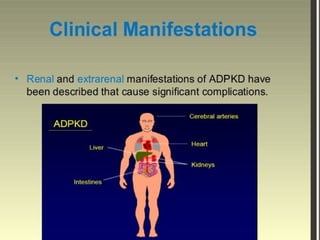
Extrarenal Manifestations
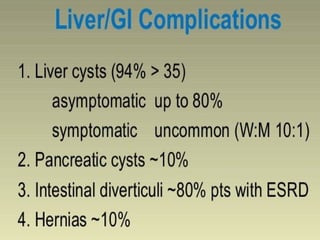
• About 40% have one to several cysts in the
liver (polycystic liver disease) that are usually
asymptomatic.
• The cysts are derived from biliary epithelium.
Cysts occur much less frequently in the
spleen, pancreas, and lungs.
Extrarenal Manifestations
• Mitral valve prolapse and other cardiac
valvular anomalies occur in 20% to 25% of
patients, but most are asymptomatic.
• The clinical diagnosis is made by radiologic
imaging techniques.
Clinical Features
• This form of chronic renal failure is
remarkable in that patients may
survive for many years with
azotemia slowly progressing to
uremia.
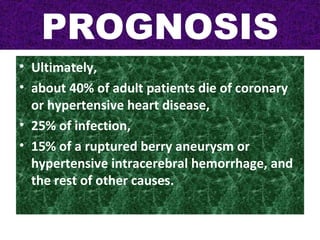
PROGNOSIS
• Ultimately,
• about 40% of adult patients die of coronary
or hypertensive heart disease,
• 25% of infection,
• 15% of a ruptured berry aneurysm or
hypertensive intracerebral hemorrhage, and
the rest of other causes.
Polycystic kidney disease for students

Polycystic kidney disease for students

  • 1.
  • 7.
    Mutations in geneslocated on chromosome 16p13.3 (PKD1) and 4q21 (PKD2),
  • 11.
    Possible mechanisms ofcyst formation in polycystic kidney disease
  • 12.
    Gross Morphology The kidneysare usually bilaterally ENLARGEDand may achieve enormous sizes; weights as high as 4 kg for each kidney have been reported.
  • 13.
    Morphology • The externalsurface appears to be composed solely of a mass of cysts, up to 3 to 4 cm in diameter, with no intervening parenchyma. However, microscopic examination reveals functioning nephrons dispersed between the cysts.
  • 14.
    Morphology • The cystsmay be filled with •a clear, serous fluidor, • more usually, with turbid, red to brown, • sometimes hemorrhagic fluid.
  • 15.
    A and B,Autosomal-dominant adult polycystic kidney disease viewed from the external surface and bisected. The kidney is markedly enlarged and contains numerous dilated cysts.
  • 16.
    Clinical Features Many ofthese patients remain asymptomatic until renal insufficiency announces the presence of the disease.
  • 17.
    Clinical Features • Hemorrhageor progressive dilation of cysts may produce PAIN. • Excretion of blood clots causes RENAL COLIC. The enlarged kidneys, usually apparent on abdominal palpation, may induce a dragging sensation.
  • 18.
    Clinical Features The diseaseoccasionally begins with the insidious onset of hematuria, followed by other features of progressive chronic kidney disease, such as proteinuria (rarely more than 2 gm/day), polyuria, and hypertension.
  • 19.
    Clinical features • Patientswith PKD2 mutations tend to have an older age at onset and later development of renal failure.
  • 20.
    Clinical Features • Bothgenetic and environmental factors influence disease severity. • Progression is accelerated in blacks (largely correlated with sickle-cell trait), in males, and in the presence of hypertension.
  • 21.
    Clinical Features • Intracranialberry aneurysms, presumably from altered expression of polycystin in vascular smooth muscle, arise in the circle of Willis, and subarachnoid hemorrhages from these account for death in about 4% to 10% of individuals.
  • 22.
    Extrarenal Manifestations • About40% have one to several cysts in the liver (polycystic liver disease) that are usually asymptomatic. • The cysts are derived from biliary epithelium. Cysts occur much less frequently in the spleen, pancreas, and lungs.
  • 23.
    Extrarenal Manifestations • Mitralvalve prolapse and other cardiac valvular anomalies occur in 20% to 25% of patients, but most are asymptomatic. • The clinical diagnosis is made by radiologic imaging techniques.
  • 24.
    Clinical Features • Thisform of chronic renal failure is remarkable in that patients may survive for many years with azotemia slowly progressing to uremia.
  • 29.
    PROGNOSIS • Ultimately, • about40% of adult patients die of coronary or hypertensive heart disease, • 25% of infection, • 15% of a ruptured berry aneurysm or hypertensive intracerebral hemorrhage, and the rest of other causes.