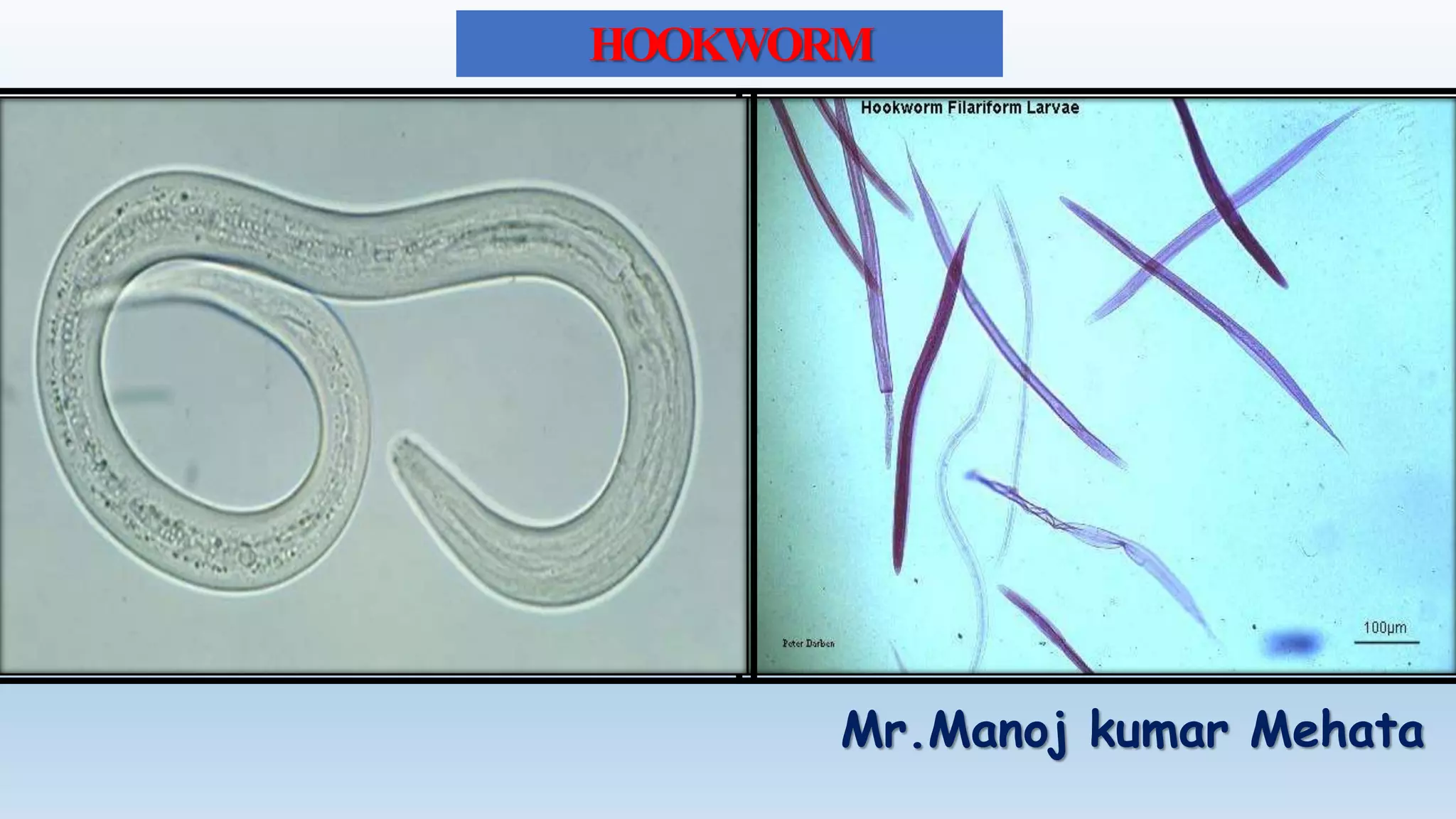
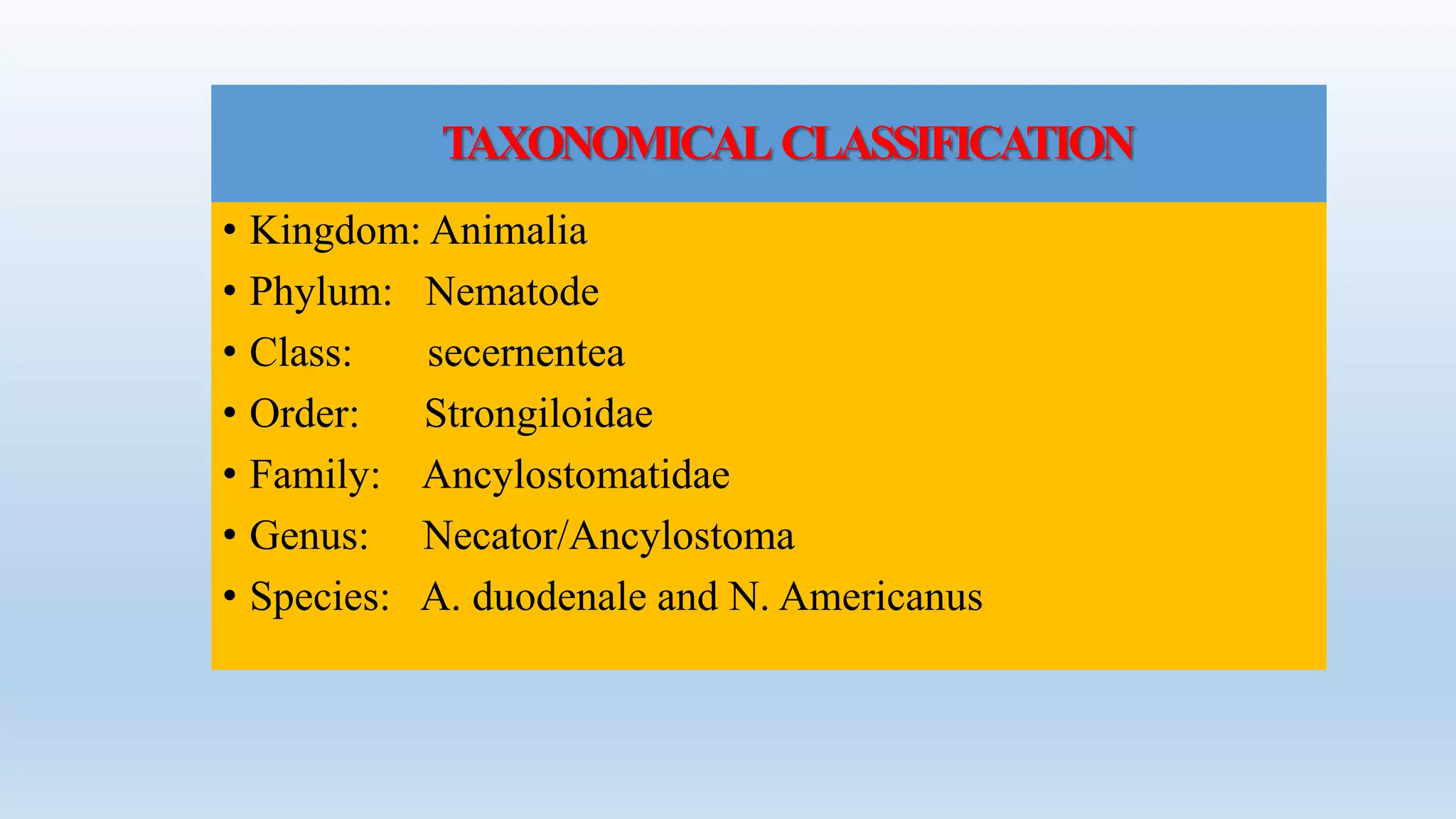
HOOKWORM
Mr. sUbhASH L. KARN
Dept. of microbiology
u.c.m.s.
Mr.Manoj kumar Mehata
TAXONOMICAL CLASSIFICATION
• Kingdom: Animalia
• Phylum: Nematode
• Class: secernentea
• Order: Strongiloidae
• Family: Ancylostomatidae
• Genus: Necator/Ancylostoma
• Species: A. duodenale and N. Americanus
EPIDEMIOLOGY
 It is estimated that it affects 900 million people in the world.Hookworm disease is
commonly throughout the tropics and subtropics region of the world.
 Do not live long in clay, dry, hard packed soils, or where temperatures are freezing, or are
higher than 45C
 Live long between 25 C and 35 C and a shady, sandy, or loamy soil for their larval
development.
 The persistence of these worms favors Moist, shady, sandy, or loamy soil
 Larvae can survive for up to 6 weeks
 Spread of the parasite in population that does not wear shoes.
INTRODUCTION
Hookworm is the second most common human helminthic infection after ascariasis
 Two species of hookworms are human parasites
First species Ancylostoma duodenale: (Greek ankylos-hooked;stoma-mouth) was
described by Dubini in 1843 in Italy and Life cycle described by Looss 1898 in Egypt
–It is predominant in S. Europe, N. Africa, western Asia, northern China, Japan and the
west coast of America
The second species Necator americanus was identified by Stiles in 1902 in specimens
USA. The name literally means the‘American murderer’ (Latin necator—murderer)
- It is predominant in sub-Saharan Africa, south Asia and the Pacific area and
endemic in warm, moist tropical areas where people defecate in the soil.
Common name: Old world hookworm
Habitat: Small intestine
Definitive host: Human
Route of infection: Filariform larvae penetrate the skin of human
Infective stage: Third stage larvae ( filariform)
Diagnostic stage: Eggs in Stool
Disease: Hookworm infection, Ancylostomiasis
Life span:
one year : A duodenale
Three- five year: N. americanus
INTRODUCTION
MORPHOLOGY
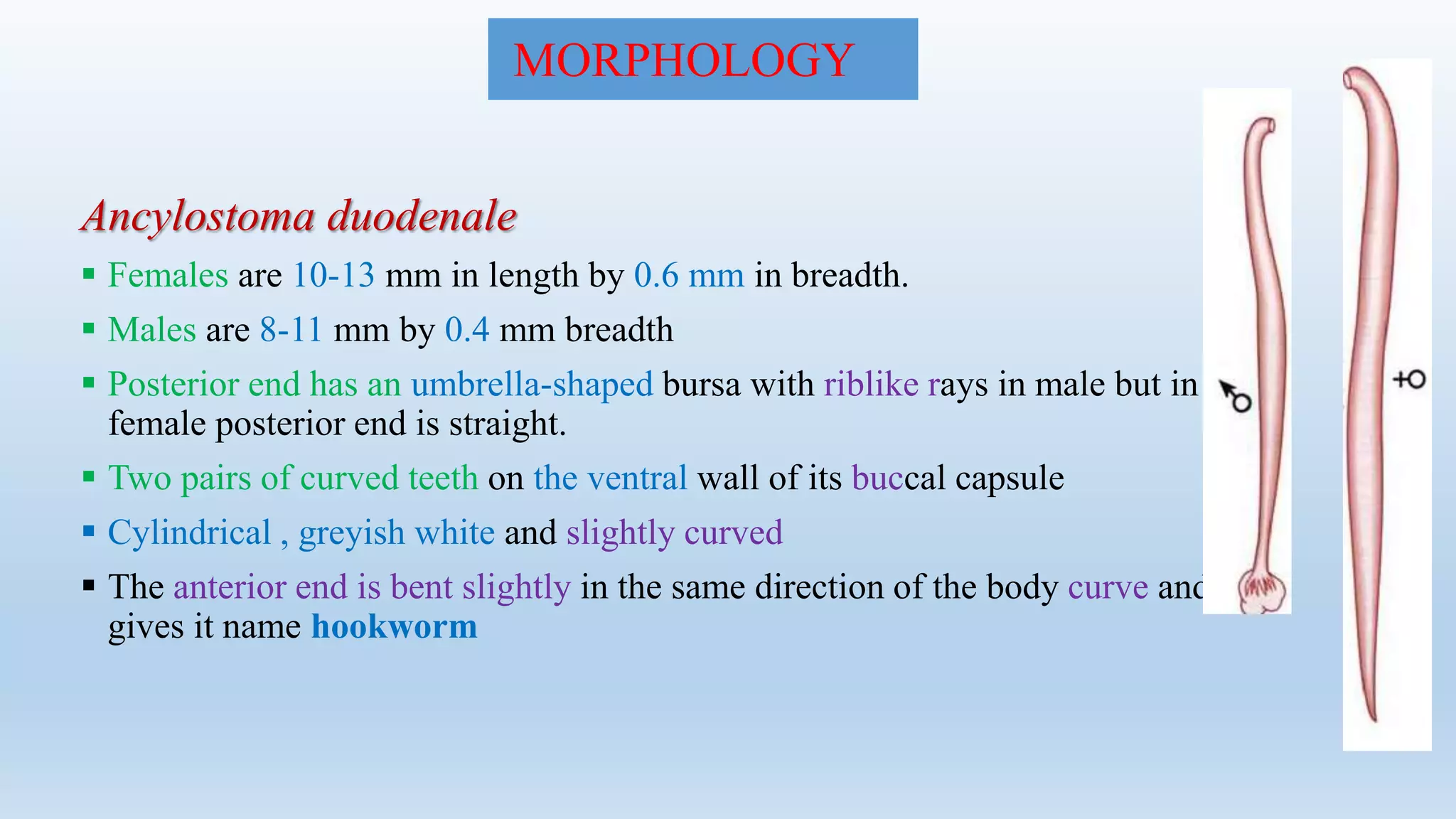
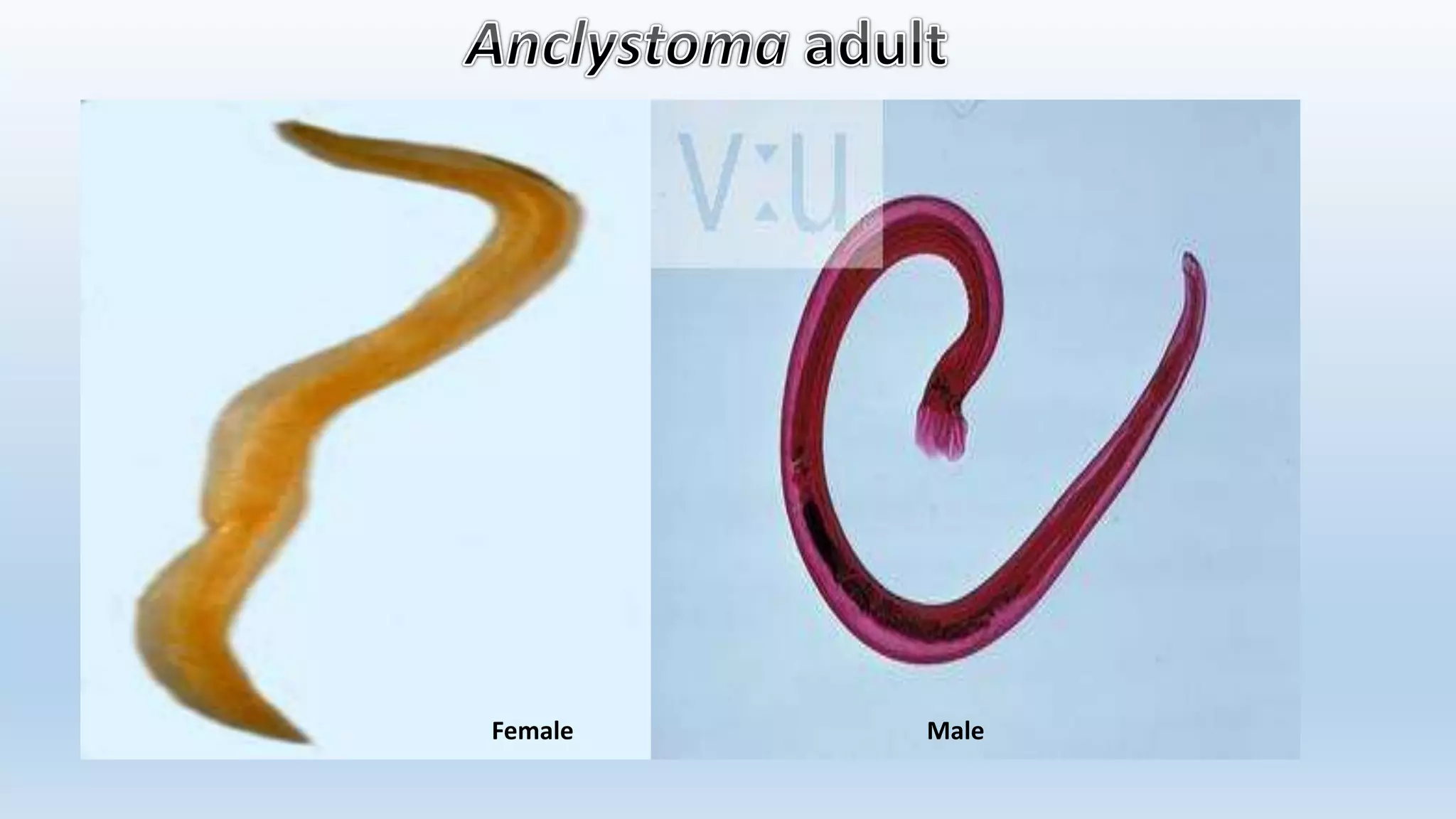
Ancylostoma duodenale
 Females are 10-13 mm in length by 0.6 mm in breadth.
 Males are 8-11 mm by 0.4 mm breadth
 Posterior end has an umbrella-shaped bursa with riblike rays in male but in
female posterior end is straight.
 Two pairs of curved teeth on the ventral wall of its buccal capsule
 Cylindrical , greyish white and slightly curved
 The anterior end is bent slightly in the same direction of the body curve and
gives it name hookworm
MaleFemale
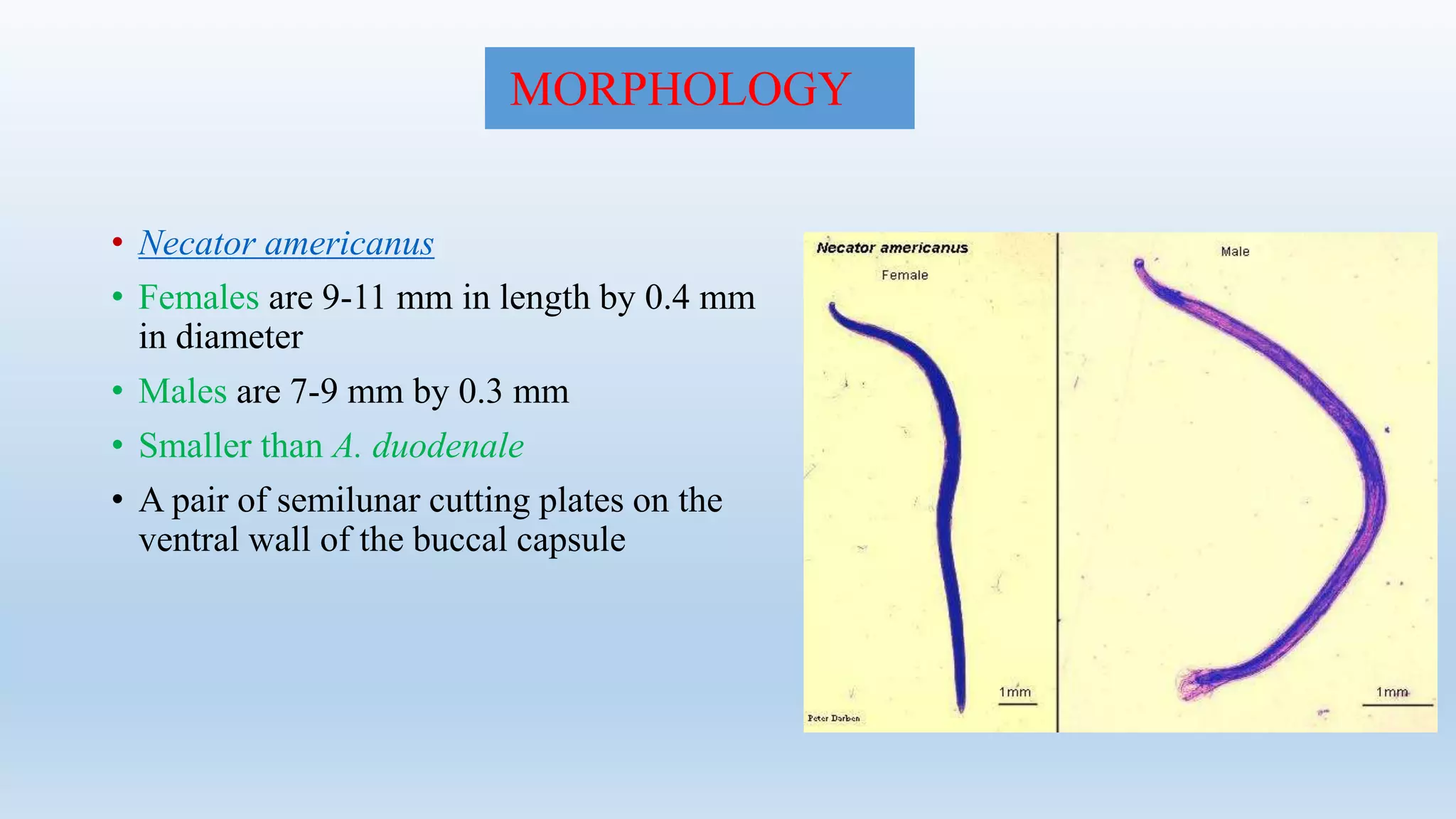
• Necator americanus
• Females are 9-11 mm in length by 0.4 mm
in diameter
• Males are 7-9 mm by 0.3 mm
• Smaller than A. duodenale
• A pair of semilunar cutting plates on the
ventral wall of the buccal capsule
MORPHOLOGY
MORPHOLOGY OF EGG
 Indistinguishable bewween A. Duodenale and Nector amircana
 Shape : oval with Clear space between segmented ovum & egg shell
 Size: 60 x 40 μm
 Shell: thin egg shell
 Color: colorless and transparent
 Contain : 4-8 blastomeres
 Nacl: Float on soln of Nacl
 Bile stained: Not bile stained
 Egg pass : Immature eggs pass in feces
20,000 eggs ⁄ day
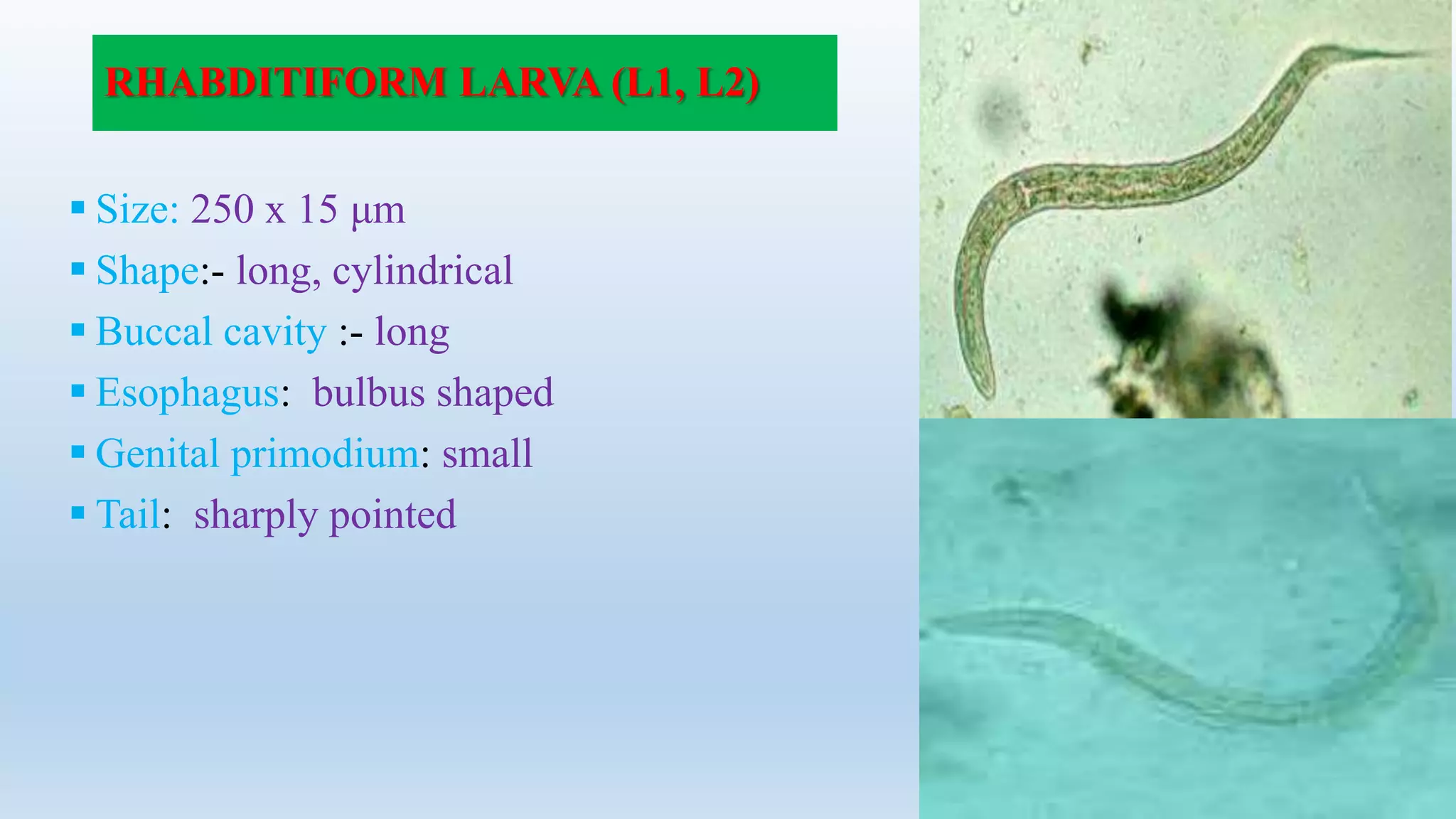
RHABDITIFORM LARVA (L1, L2)
 Size: 250 x 15 μm
 Shape:- long, cylindrical
 Buccal cavity :- long
 Esophagus: bulbus shaped
 Genital primodium: small
 Tail: sharply pointed
FILARIFORM LARVA ( L3)
• Infective stage larva filariform larva
• size : 600-700 x 20-25 μm.
• Shape: long and slender
• Stage: Non-feeding
• Esophagus: elongates
• Tail: - sharply pointed tail
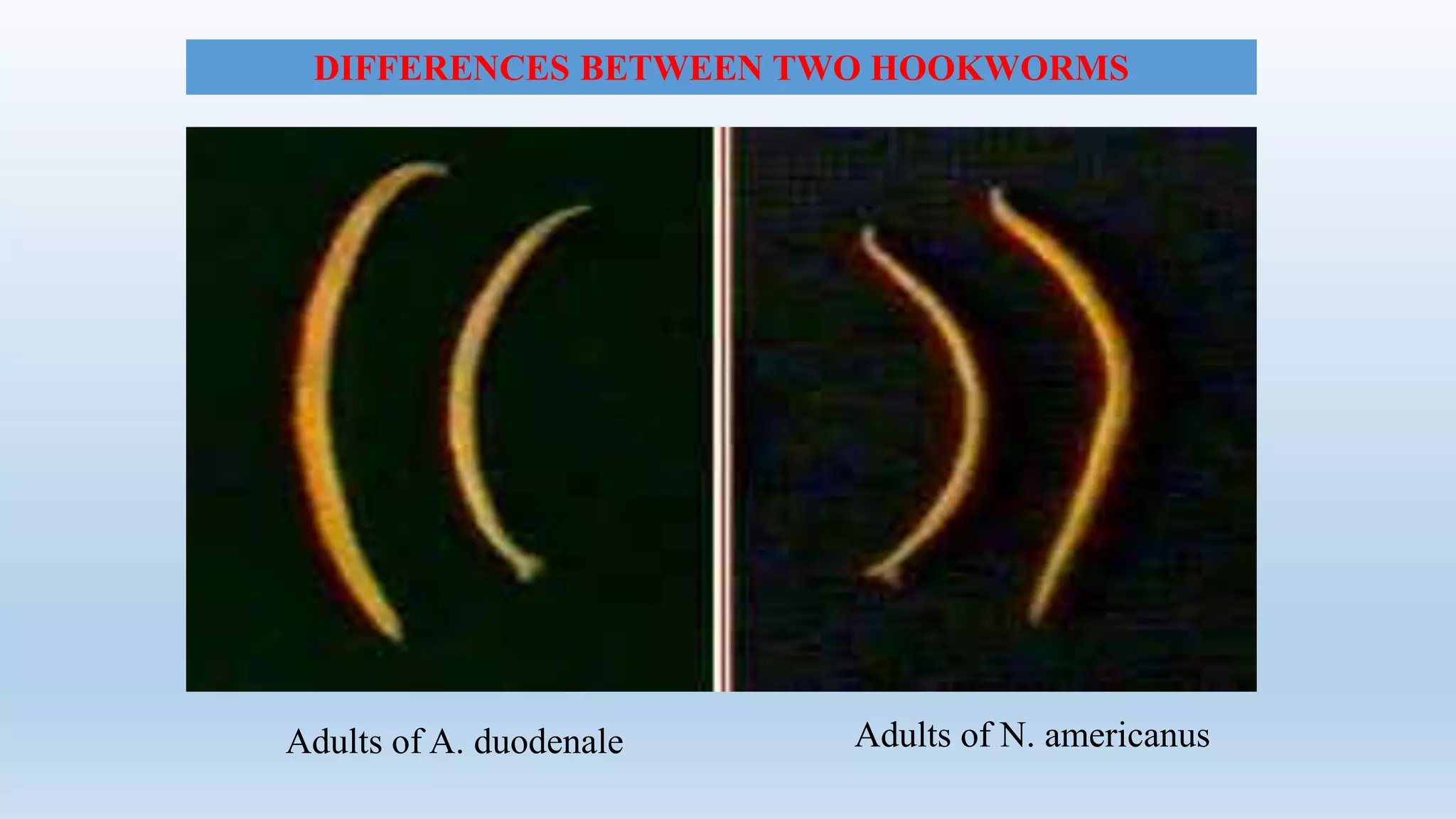
DIFFERENENCE BETWEEN A.DUODENALE AND N. AMERICANA
A. duodenale N. americanus
Size larger smaller
Shape single curve, looks like C double curves, looks like S
Mouth 2 pairs of ventral teeth 1peir of ventral cutting plates
CopulatoryBursa circle in shape (a top view oval in shape(a top view
Copulatory 1pair with separate spicule endings 1pair of which unite to form
a terminal hooklet
caudal spine present No
vulva position post-equatorial pre-equatoria
Adults of A. duodenale Adults of N. americanus
DIFFERENCES BETWEEN TWO HOOKWORMS
MODE OF TRANSMISSION
 Penetration of skin
 Ingestion of filariform larvae
 Breast milk from mother to infants
 Transplacental transmission
 Most common Sites of skin penetration are:
-Thin skin between toes
-Dorsum of the feet
- Inner side of the soles
- Gardeners & miners – skin of hands
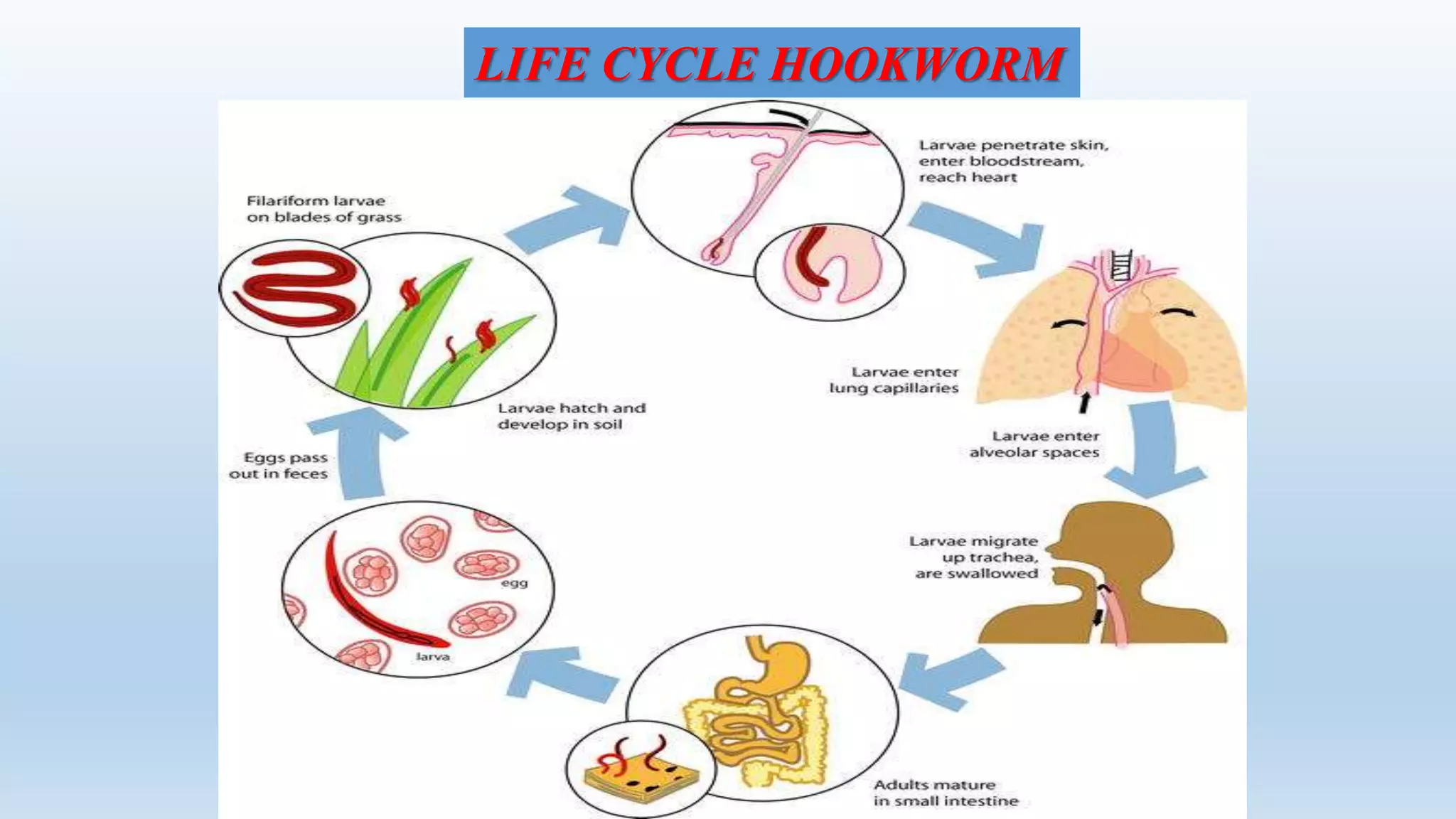
 Adult worms live in the small intestine and
female lay 5-10000 eggs a day over 5 years
 Eggs are passed with the feces
 Larvae develop outside the body and molt
twice
 The filariform or L3 larvae move to the
surface in search for a host
 If they come into contact with the host they
penetrate the skin, enter blood vessels and
leave the circulatory system into the alveoli
 The larvae move up the trachea into the
esophagus, are swallowed and finally reach
the intestine, where they molt twice more
before they reach maturity
LIFE CYCLE
parasite lab
by l.wafa menawi
LIFE CYCLE HOOKWORM
SIGN AND SYMPTOMS
 Skin Infection:
- “Ground itch," a pruritic papule or vesicle, can occur at the site of
entry of the larvae into the skin after 1-2 wks in primary infection
-stinging, burning, itching, pruritus, papulovesicular rash - can last
up to 2 wks
 Lung Infection
• Pneumonia, Dry cough, wheezing rare and mild.
 Ingestion
• Throat soreness, hoarseness, nausea, vomiting
 GI Infection:
• Bloody stool from former attachment sites, abdominal pain,abdominal
discomfort ,anemia etc
SIGN AND SYMPTOMS
 Extreme pallor
 Anemia, iron deficiency,Eosinophilia
 Hypoproteinemia, edema. Inflammation
 Mental, physical, growth retardation.
 Immunocompromised.
 Failure to thrive, extreme fatigue
 IQ loss
 Complication in malaria and HIV patients
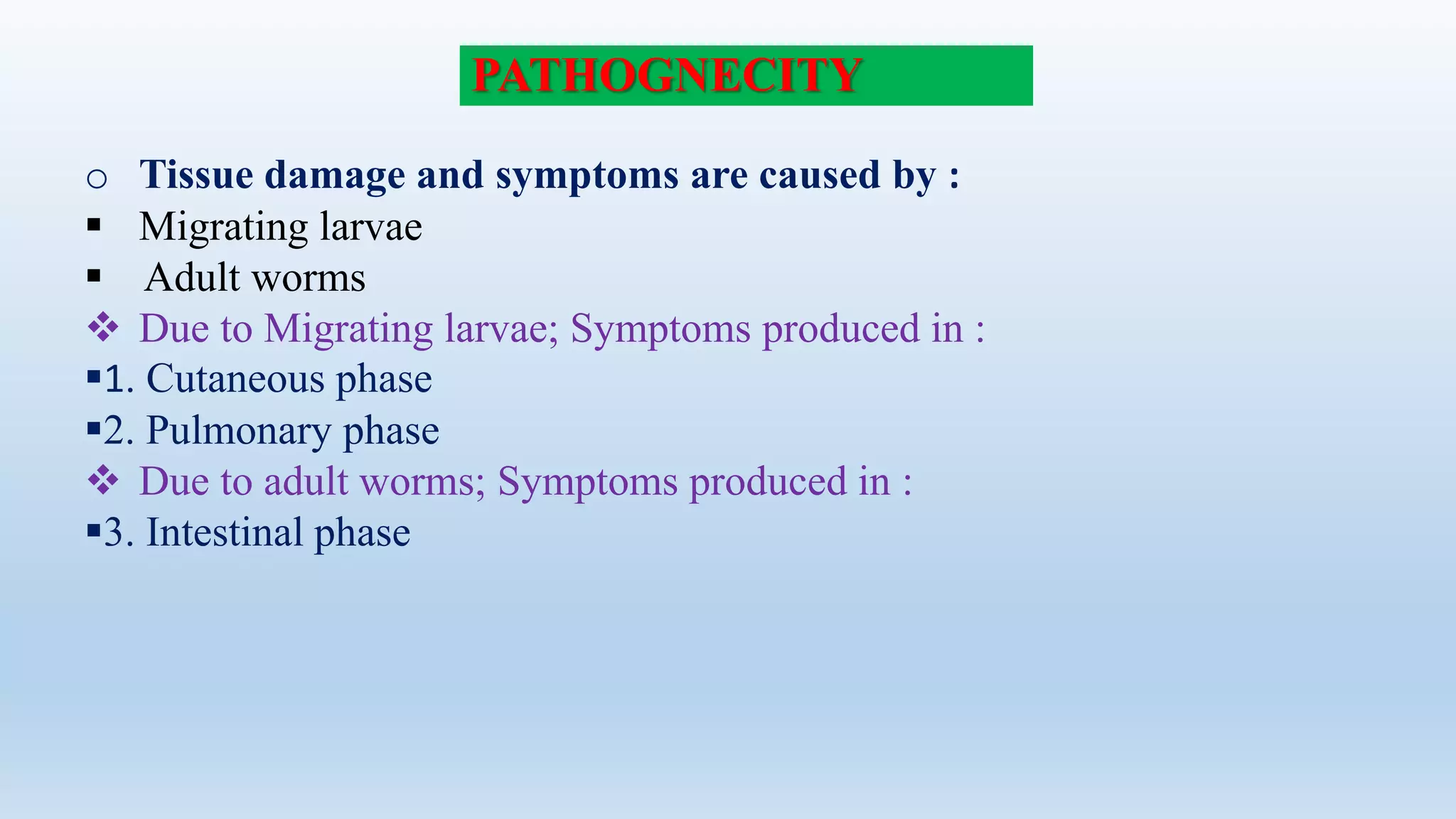
PATHOGNECITY
o Tissue damage and symptoms are caused by :
 Migrating larvae
 Adult worms
 Due to Migrating larvae; Symptoms produced in :
1. Cutaneous phase
2. Pulmonary phase
 Due to adult worms; Symptoms produced in :
3. Intestinal phase
1.CUTANEOUS PHASE
Creeping eruption
A.PATHOLOGY CAUSED BY LARVA STAGE
Lesions in the skin:
-occurs due to filariform larva.
-Larva penetrates the skin - maculopapules -
erythema - heavy itching : ground itch/dew itch,
dermatitis,water sore etc. -occurs at the site of entry
-more common in necator,
-lasts for 2 to 4 weeks
 Creeping eruption:
-Reddish, itchy papule along the path traversed
by filariform larvae larva migrans
Dermatitis
2.PULMONARY PHASE
A.PATHOLOGY CAUSED BY LARVA STAGE
• Lesions in the lungs
 – Bronchitis & bronchopneumonia: In sensitive patient, larva
carried in the circulation, may cause:Bronchitis / Pneumonitis
• Pneumonatitis: allergic reaction
Loeffier's syndrome: cough, asthma, low fever, biood-tinged sputum
or hemoptysis, chest-pain, inflammation shadows in lungs under X-
ray. These manifestations go on about 2 weeks.
3. INTESTINAL PHASE
Hooked to the intestinal mucosal wall :
--abdominal pain, nausea, diarrhea,
Gastrointestinal bleeding ,epigastric pain,
during early phase of infection
 Absorbing 0.2-0.03 ml of blood/day/worm :
-progressive anemia, hypochromic,
microcytic type of Fe deficiency anemia–
due to chronic blood loss
 Heavy anemia (Hb may reach 2 gr %)
-Dyspnea, physical weakness, headache
Rapid pulse beat, cardiac weakness
Children : physical growth retardation,
mental
B,PATHOLOGY CAUSED BY ADULT WORM :
CLINICALDIAGNOSIS
 Atrophic glossitis found with hypo chromic microcytic anemia,
caused by heavy infection of hookworm
 TPatient with atrophic glossitis also show fingernail deformity
(koilonichia)
 Fingernail becomes thin and concave with elevated ridge
 ongue surface become smooth and lacking of papillae
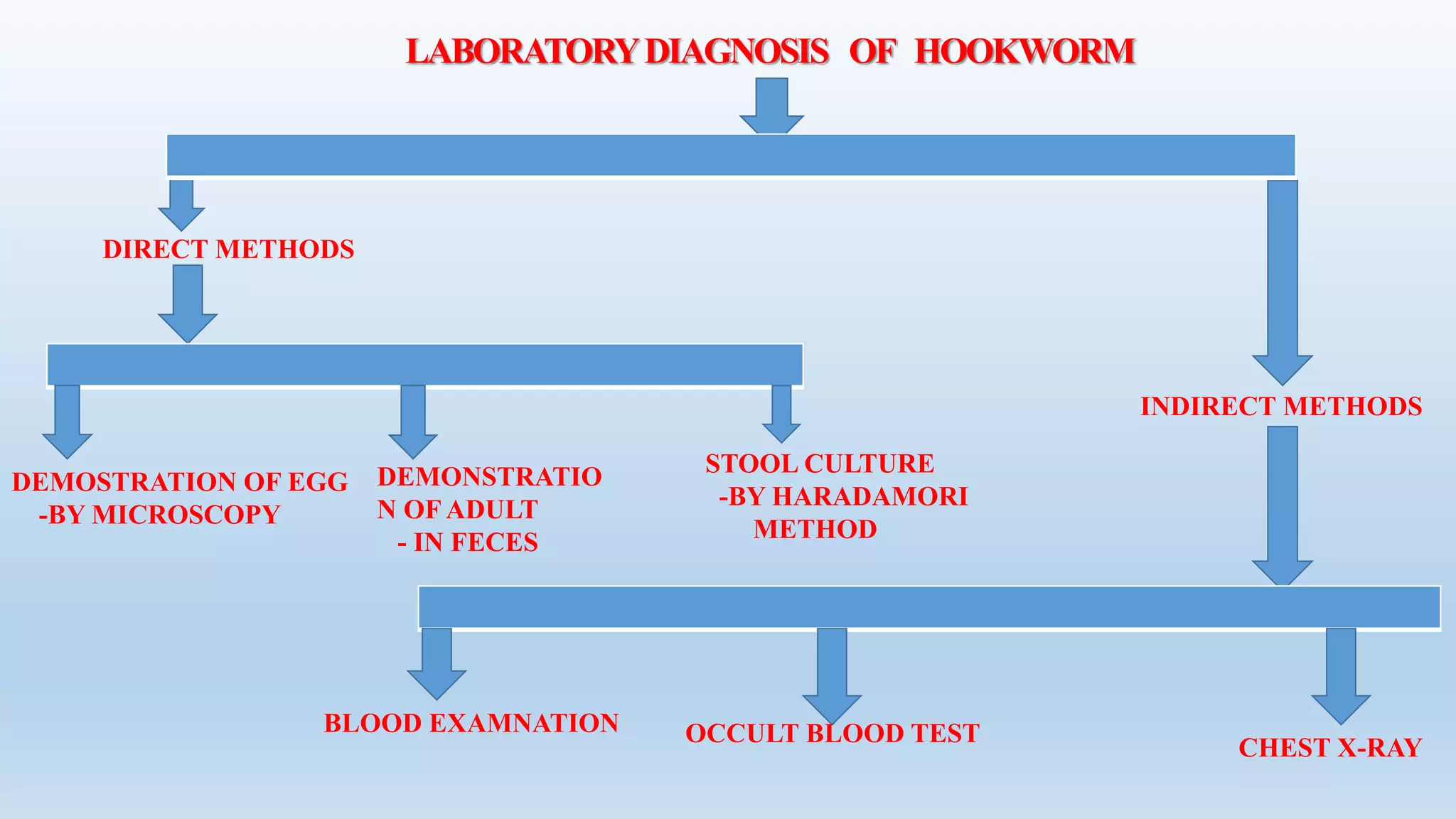
DEMOSTRATION OF EGG
-BY MICROSCOPY
DEMONSTRATIO
N OF ADULT
- IN FECES
STOOL CULTURE
-BY HARADAMORI
METHOD
BLOOD EXAMNATION OCCULT BLOOD TEST
CHEST X-RAY
INDIRECT METHODS
DIRECT METHODS
LABORATORYDIAGNOSIS OF HOOKWORM
 STOOL EXAMINATION BY MICROSCOPY: Non bile stained egg, segmented
DIRECT METHODS
DEMONSTRATION OF ADULT:- IN FECES
Adult worm.of A. duodenale
STOOL CULTURE
 Blood examination:
-low erythrocyte counte
-low haemoglobin level.
-Increased no.of eosinophil count.
Comment on Blood picture:.
-Microcytic hypochromic Normochromic
cause Iron deficiency anaemia – due to
chronic blood loss:
-A single adult hookworm sucks 0.2ml of blood/ day
Imaging methods
BY CHEST X-RAY
-Adult form of Ancyclostoma duodanale
seen in case of heavy infection in lungs.
And respiratory tract
LABORATORY DIAGNOSIS
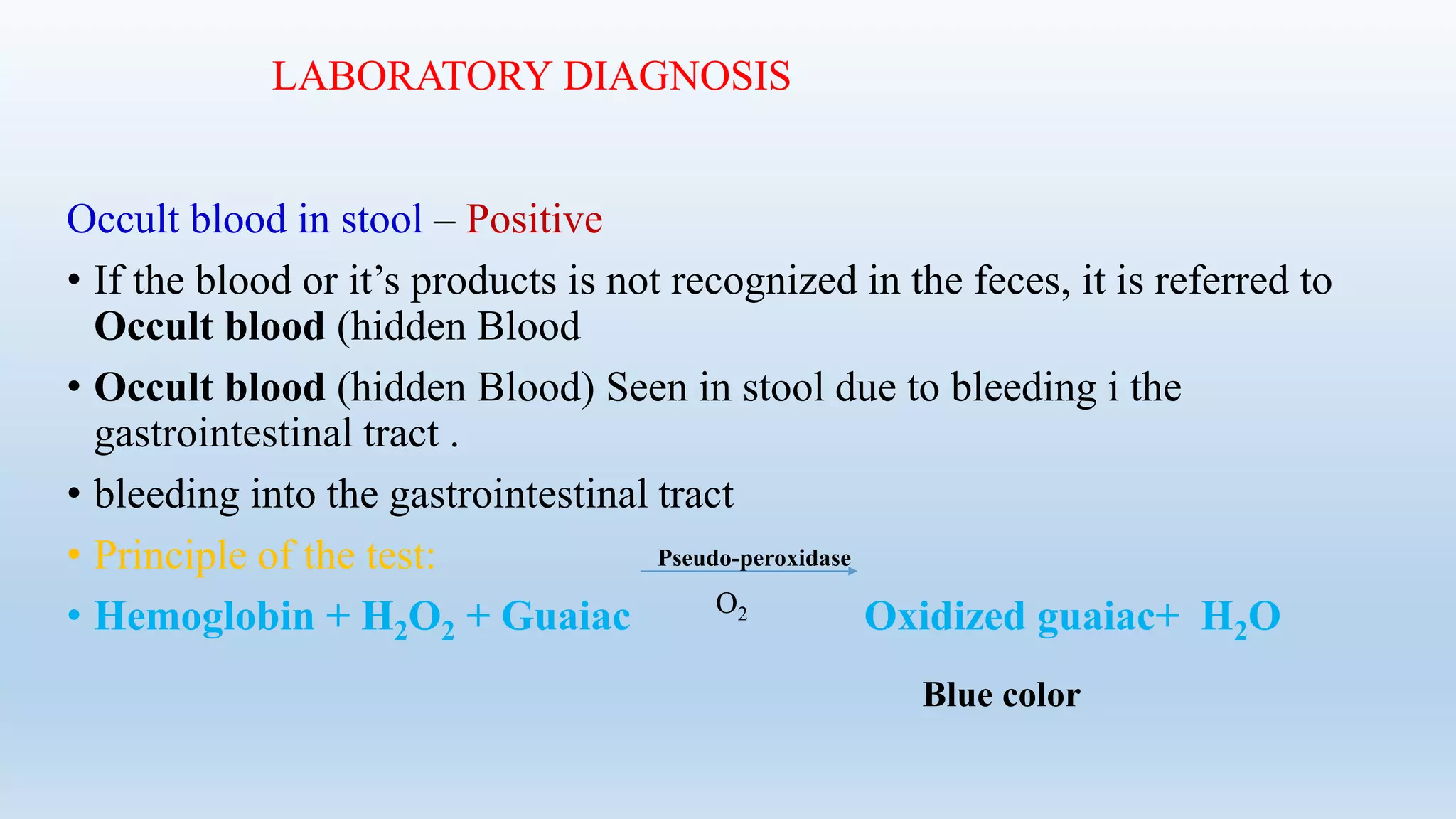
Occult blood in stool – Positive
• If the blood or it’s products is not recognized in the feces, it is referred to
Occult blood (hidden Blood
• Occult blood (hidden Blood) Seen in stool due to bleeding i the
gastrointestinal tract .
• bleeding into the gastrointestinal tract
• Principle of the test:
• Hemoglobin + H2O2 + Guaiac Oxidized guaiac+ H2O
Pseudo-peroxidase
O2
Blue color
Proper sanitation measures & sewage disposal
Personal hygiene
Personal protection – wearing boots & gloves
Simultaneous treatment of carriers & diseased
with wholesale treatment of community
PREVENTION&CONTROL
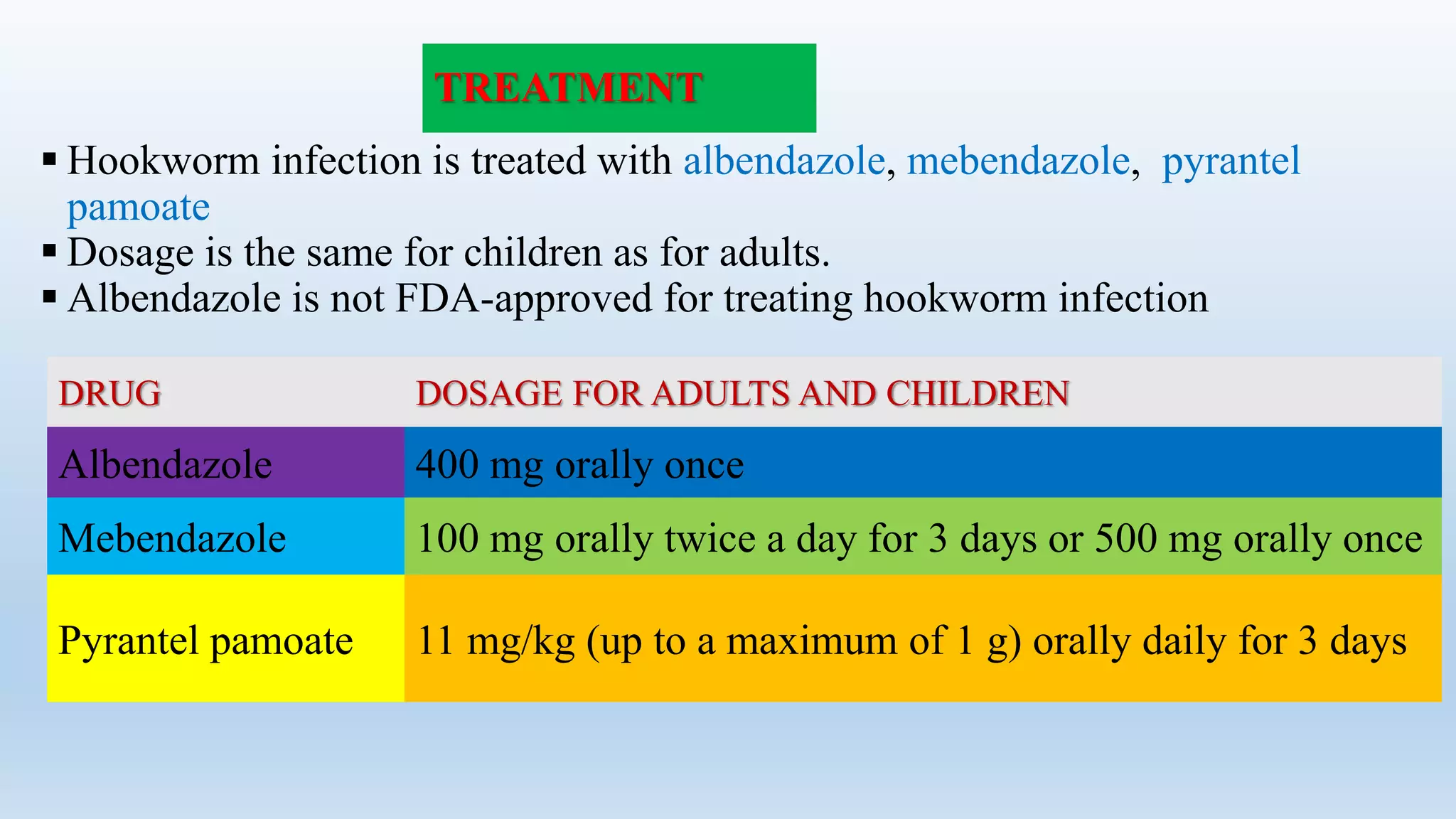
TREATMENT
 Hookworm infection is treated with albendazole, mebendazole, pyrantel
pamoate
 Dosage is the same for children as for adults.
 Albendazole is not FDA-approved for treating hookworm infection
DRUG DOSAGE FOR ADULTS AND CHILDREN
Albendazole 400 mg orally once
Mebendazole 100 mg orally twice a day for 3 days or 500 mg orally once
Pyrantel pamoate 11 mg/kg (up to a maximum of 1 g) orally daily for 3 days
Hookworms by manoj

Hookworms by manoj

  • 1.
    HOOKWORM Mr. sUbhASH L.KARN Dept. of microbiology u.c.m.s. Mr.Manoj kumar Mehata
  • 2.
    TAXONOMICAL CLASSIFICATION • Kingdom:Animalia • Phylum: Nematode • Class: secernentea • Order: Strongiloidae • Family: Ancylostomatidae • Genus: Necator/Ancylostoma • Species: A. duodenale and N. Americanus
  • 3.
    EPIDEMIOLOGY  It isestimated that it affects 900 million people in the world.Hookworm disease is commonly throughout the tropics and subtropics region of the world.  Do not live long in clay, dry, hard packed soils, or where temperatures are freezing, or are higher than 45C  Live long between 25 C and 35 C and a shady, sandy, or loamy soil for their larval development.  The persistence of these worms favors Moist, shady, sandy, or loamy soil  Larvae can survive for up to 6 weeks  Spread of the parasite in population that does not wear shoes.
  • 4.
    INTRODUCTION Hookworm is thesecond most common human helminthic infection after ascariasis  Two species of hookworms are human parasites First species Ancylostoma duodenale: (Greek ankylos-hooked;stoma-mouth) was described by Dubini in 1843 in Italy and Life cycle described by Looss 1898 in Egypt –It is predominant in S. Europe, N. Africa, western Asia, northern China, Japan and the west coast of America The second species Necator americanus was identified by Stiles in 1902 in specimens USA. The name literally means the‘American murderer’ (Latin necator—murderer) - It is predominant in sub-Saharan Africa, south Asia and the Pacific area and endemic in warm, moist tropical areas where people defecate in the soil.
  • 5.
    Common name: Oldworld hookworm Habitat: Small intestine Definitive host: Human Route of infection: Filariform larvae penetrate the skin of human Infective stage: Third stage larvae ( filariform) Diagnostic stage: Eggs in Stool Disease: Hookworm infection, Ancylostomiasis Life span: one year : A duodenale Three- five year: N. americanus INTRODUCTION
  • 6.
    MORPHOLOGY Ancylostoma duodenale  Femalesare 10-13 mm in length by 0.6 mm in breadth.  Males are 8-11 mm by 0.4 mm breadth  Posterior end has an umbrella-shaped bursa with riblike rays in male but in female posterior end is straight.  Two pairs of curved teeth on the ventral wall of its buccal capsule  Cylindrical , greyish white and slightly curved  The anterior end is bent slightly in the same direction of the body curve and gives it name hookworm
  • 7.
  • 8.
    • Necator americanus •Females are 9-11 mm in length by 0.4 mm in diameter • Males are 7-9 mm by 0.3 mm • Smaller than A. duodenale • A pair of semilunar cutting plates on the ventral wall of the buccal capsule MORPHOLOGY
  • 9.
    MORPHOLOGY OF EGG Indistinguishable bewween A. Duodenale and Nector amircana  Shape : oval with Clear space between segmented ovum & egg shell  Size: 60 x 40 μm  Shell: thin egg shell  Color: colorless and transparent  Contain : 4-8 blastomeres  Nacl: Float on soln of Nacl  Bile stained: Not bile stained  Egg pass : Immature eggs pass in feces 20,000 eggs ⁄ day
  • 10.
    RHABDITIFORM LARVA (L1,L2)  Size: 250 x 15 μm  Shape:- long, cylindrical  Buccal cavity :- long  Esophagus: bulbus shaped  Genital primodium: small  Tail: sharply pointed
  • 11.
    FILARIFORM LARVA (L3) • Infective stage larva filariform larva • size : 600-700 x 20-25 μm. • Shape: long and slender • Stage: Non-feeding • Esophagus: elongates • Tail: - sharply pointed tail
  • 12.
    DIFFERENENCE BETWEEN A.DUODENALEAND N. AMERICANA A. duodenale N. americanus Size larger smaller Shape single curve, looks like C double curves, looks like S Mouth 2 pairs of ventral teeth 1peir of ventral cutting plates CopulatoryBursa circle in shape (a top view oval in shape(a top view Copulatory 1pair with separate spicule endings 1pair of which unite to form a terminal hooklet caudal spine present No vulva position post-equatorial pre-equatoria
  • 13.
    Adults of A.duodenale Adults of N. americanus DIFFERENCES BETWEEN TWO HOOKWORMS
  • 14.
    MODE OF TRANSMISSION Penetration of skin  Ingestion of filariform larvae  Breast milk from mother to infants  Transplacental transmission  Most common Sites of skin penetration are: -Thin skin between toes -Dorsum of the feet - Inner side of the soles - Gardeners & miners – skin of hands
  • 15.
     Adult wormslive in the small intestine and female lay 5-10000 eggs a day over 5 years  Eggs are passed with the feces  Larvae develop outside the body and molt twice  The filariform or L3 larvae move to the surface in search for a host  If they come into contact with the host they penetrate the skin, enter blood vessels and leave the circulatory system into the alveoli  The larvae move up the trachea into the esophagus, are swallowed and finally reach the intestine, where they molt twice more before they reach maturity LIFE CYCLE
  • 16.
  • 17.
  • 18.
    SIGN AND SYMPTOMS Skin Infection: - “Ground itch," a pruritic papule or vesicle, can occur at the site of entry of the larvae into the skin after 1-2 wks in primary infection -stinging, burning, itching, pruritus, papulovesicular rash - can last up to 2 wks  Lung Infection • Pneumonia, Dry cough, wheezing rare and mild.  Ingestion • Throat soreness, hoarseness, nausea, vomiting  GI Infection: • Bloody stool from former attachment sites, abdominal pain,abdominal discomfort ,anemia etc
  • 19.
    SIGN AND SYMPTOMS Extreme pallor  Anemia, iron deficiency,Eosinophilia  Hypoproteinemia, edema. Inflammation  Mental, physical, growth retardation.  Immunocompromised.  Failure to thrive, extreme fatigue  IQ loss  Complication in malaria and HIV patients
  • 20.
    PATHOGNECITY o Tissue damageand symptoms are caused by :  Migrating larvae  Adult worms  Due to Migrating larvae; Symptoms produced in : 1. Cutaneous phase 2. Pulmonary phase  Due to adult worms; Symptoms produced in : 3. Intestinal phase
  • 21.
    1.CUTANEOUS PHASE Creeping eruption A.PATHOLOGYCAUSED BY LARVA STAGE Lesions in the skin: -occurs due to filariform larva. -Larva penetrates the skin - maculopapules - erythema - heavy itching : ground itch/dew itch, dermatitis,water sore etc. -occurs at the site of entry -more common in necator, -lasts for 2 to 4 weeks  Creeping eruption: -Reddish, itchy papule along the path traversed by filariform larvae larva migrans Dermatitis
  • 22.
    2.PULMONARY PHASE A.PATHOLOGY CAUSEDBY LARVA STAGE • Lesions in the lungs  – Bronchitis & bronchopneumonia: In sensitive patient, larva carried in the circulation, may cause:Bronchitis / Pneumonitis • Pneumonatitis: allergic reaction Loeffier's syndrome: cough, asthma, low fever, biood-tinged sputum or hemoptysis, chest-pain, inflammation shadows in lungs under X- ray. These manifestations go on about 2 weeks.
  • 23.
    3. INTESTINAL PHASE Hookedto the intestinal mucosal wall : --abdominal pain, nausea, diarrhea, Gastrointestinal bleeding ,epigastric pain, during early phase of infection  Absorbing 0.2-0.03 ml of blood/day/worm : -progressive anemia, hypochromic, microcytic type of Fe deficiency anemia– due to chronic blood loss  Heavy anemia (Hb may reach 2 gr %) -Dyspnea, physical weakness, headache Rapid pulse beat, cardiac weakness Children : physical growth retardation, mental B,PATHOLOGY CAUSED BY ADULT WORM :
  • 24.
    CLINICALDIAGNOSIS  Atrophic glossitisfound with hypo chromic microcytic anemia, caused by heavy infection of hookworm  TPatient with atrophic glossitis also show fingernail deformity (koilonichia)  Fingernail becomes thin and concave with elevated ridge  ongue surface become smooth and lacking of papillae
  • 25.
    DEMOSTRATION OF EGG -BYMICROSCOPY DEMONSTRATIO N OF ADULT - IN FECES STOOL CULTURE -BY HARADAMORI METHOD BLOOD EXAMNATION OCCULT BLOOD TEST CHEST X-RAY INDIRECT METHODS DIRECT METHODS LABORATORYDIAGNOSIS OF HOOKWORM
  • 26.
     STOOL EXAMINATIONBY MICROSCOPY: Non bile stained egg, segmented DIRECT METHODS
  • 27.
    DEMONSTRATION OF ADULT:-IN FECES Adult worm.of A. duodenale
  • 28.
  • 29.
     Blood examination: -lowerythrocyte counte -low haemoglobin level. -Increased no.of eosinophil count. Comment on Blood picture:. -Microcytic hypochromic Normochromic cause Iron deficiency anaemia – due to chronic blood loss: -A single adult hookworm sucks 0.2ml of blood/ day
  • 30.
    Imaging methods BY CHESTX-RAY -Adult form of Ancyclostoma duodanale seen in case of heavy infection in lungs. And respiratory tract
  • 31.
    LABORATORY DIAGNOSIS Occult bloodin stool – Positive • If the blood or it’s products is not recognized in the feces, it is referred to Occult blood (hidden Blood • Occult blood (hidden Blood) Seen in stool due to bleeding i the gastrointestinal tract . • bleeding into the gastrointestinal tract • Principle of the test: • Hemoglobin + H2O2 + Guaiac Oxidized guaiac+ H2O Pseudo-peroxidase O2 Blue color
  • 32.
    Proper sanitation measures& sewage disposal Personal hygiene Personal protection – wearing boots & gloves Simultaneous treatment of carriers & diseased with wholesale treatment of community PREVENTION&CONTROL
  • 33.
    TREATMENT  Hookworm infectionis treated with albendazole, mebendazole, pyrantel pamoate  Dosage is the same for children as for adults.  Albendazole is not FDA-approved for treating hookworm infection DRUG DOSAGE FOR ADULTS AND CHILDREN Albendazole 400 mg orally once Mebendazole 100 mg orally twice a day for 3 days or 500 mg orally once Pyrantel pamoate 11 mg/kg (up to a maximum of 1 g) orally daily for 3 days