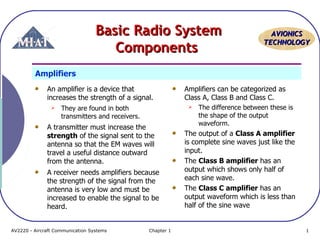
Basic Radio System
Components

AVIONICS
TECHNOLOGY

Amplifiers
An amplifier is a device that
increases the strength of a signal.


They are found in both
transmitters and receivers.



A transmitter must increase the
strength of the signal sent to the
antenna so that the EM waves will
travel a useful distance outward
from the antenna.
A receiver needs amplifiers because
the strength of the signal from the
antenna is very low and must be
increased to enable the signal to be
heard.
AV2220 - Aircraft Communication Systems

Amplifiers can be categorized as
Class A, Class B and Class C.

Chapter 1

The difference between these is
the shape of the output
waveform.

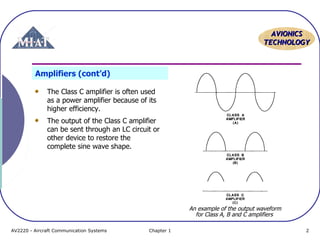
The output of a Class A amplifier
is complete sine waves just like the
input.
The Class B amplifier has an
output which shows only half of
each sine wave.
The Class C amplifier has an
output waveform which is less than
half of the sine wave

1
AVIONICS
TECHNOLOGY

Amplifiers (cont’d)
The Class C amplifier is often used
as a power amplifier because of its
higher efficiency.
The output of the Class C amplifier
can be sent through an LC circuit or
other device to restore the
complete sine wave shape.

An example of the output waveform
for Class A, B and C amplifiers
AV2220 - Aircraft Communication Systems

Chapter 1

2
AVIONICS
TECHNOLOGY

Oscillators
An oscillator is a device that
produces the frequencies needed by
both receivers and transmitters.
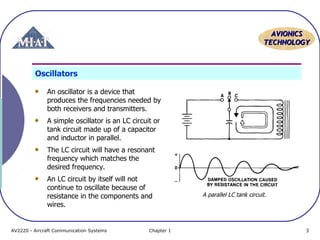
A simple oscillator is an LC circuit or
tank circuit made up of a capacitor
and inductor in parallel.
The LC circuit will have a resonant
frequency which matches the
desired frequency.
An LC circuit by itself will not
continue to oscillate because of
resistance in the components and
wires.

AV2220 - Aircraft Communication Systems

Chapter 1

A parallel LC tank circuit.

3
AVIONICS
TECHNOLOGY

Oscillators (cont’d)
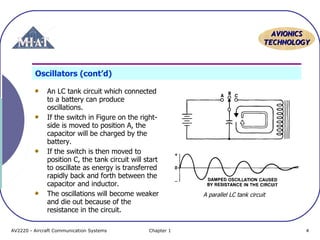
An LC tank circuit which connected
to a battery can produce
oscillations.
If the switch in Figure on the rightside is moved to position A, the
capacitor will be charged by the
battery.
If the switch is then moved to
position C, the tank circuit will start
to oscillate as energy is transferred
rapidly back and forth between the
capacitor and inductor.
The oscillations will become weaker
and die out because of the
resistance in the circuit.
AV2220 - Aircraft Communication Systems

Chapter 1

A parallel LC tank circuit

4
AVIONICS
TECHNOLOGY

Oscillators (cont’d)
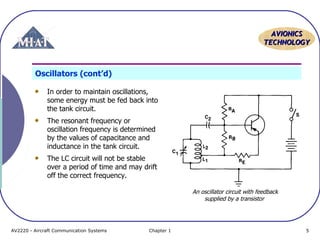
In order to maintain oscillations,
some energy must be fed back into
the tank circuit.
The resonant frequency or
oscillation frequency is determined
by the values of capacitance and
inductance in the tank circuit.
The LC circuit will not be stable
over a period of time and may drift
off the correct frequency.
An oscillator circuit with feedback
supplied by a transistor

AV2220 - Aircraft Communication Systems

Chapter 1

5
AVIONICS
TECHNOLOGY

Oscillators (cont’d)
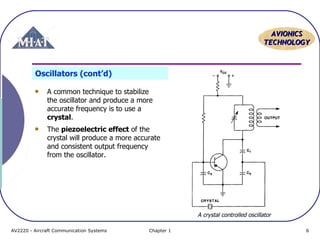
A common technique to stabilize
the oscillator and produce a more
accurate frequency is to use a
crystal.
The piezoelectric effect of the
crystal will produce a more accurate
and consistent output frequency
from the oscillator.

A crystal controlled oscillator
AV2220 - Aircraft Communication Systems

Chapter 1

6
AVIONICS
TECHNOLOGY

Modulators and Demodulators
In the radio transmitter, a device is
needed which will combine the AF
signal with the RF carrier wave
signal before it is sent to the
antenna.
This is the function of a modulator,
it combines the AF and RF signals
so that information can be
transmitted.
The output of the modulator is
called modulated RF.
The signal produced by the antenna
in a receiver will be modulated RF.

AV2220 - Aircraft Communication Systems

Chapter 1

In order to hear the voice as an
output of the receiver, the AF
component must be separated out.
The demodulator removes the RF
component of the modulated RF
signal and produces an AF output.
When the AF and RF signals are
combined in the modulator, they
must have the proper relative
strengths for maximum efficiency.
The amount of modulation is called
the modulation rate.

7
AVIONICS
TECHNOLOGY

Modulators and Demodulators
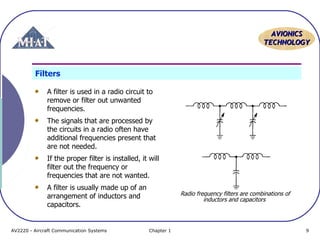
If the AF signal is too weak
compared to the RF signal, the
modulation rate will be low and the
efficiency will also be low.
If the modulation rate is over
100%, there will be distortion in the
signal due to the gaps created.
Figure (on the right-side) gives
examples of 50%, 100% and more
than 100% modulation rates with
AM modulation.
Most radio transmitters are adjusted
to about 90‑95% modulation to
provide a little margin to prevent
distortion.
AV2220 - Aircraft Communication Systems

Chapter 1

Examples of different modulation rates
(A) 50%; (B) 100%;(C) Over 100%
8
AVIONICS
TECHNOLOGY

Filters
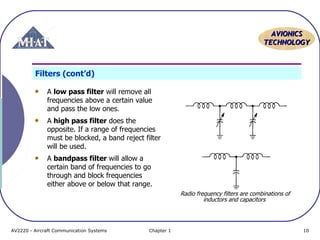
A filter is used in a radio circuit to
remove or filter out unwanted
frequencies.
The signals that are processed by
the circuits in a radio often have
additional frequencies present that
are not needed.
If the proper filter is installed, it will
filter out the frequency or
frequencies that are not wanted.
A filter is usually made up of an
arrangement of inductors and
capacitors.

AV2220 - Aircraft Communication Systems

Radio frequency filters are combinations of
inductors and capacitors

Chapter 1

9
AVIONICS
TECHNOLOGY

Filters (cont’d)
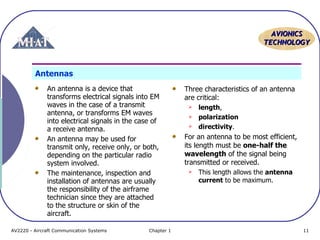
A low pass filter will remove all
frequencies above a certain value
and pass the low ones.
A high pass filter does the
opposite. If a range of frequencies
must be blocked, a band reject filter
will be used.
A bandpass filter will allow a
certain band of frequencies to go
through and block frequencies
either above or below that range.
Radio frequency filters are combinations of
inductors and capacitors

AV2220 - Aircraft Communication Systems

Chapter 1

10
AVIONICS
TECHNOLOGY

Antennas
An antenna is a device that
transforms electrical signals into EM
waves in the case of a transmit
antenna, or transforms EM waves
into electrical signals in the case of
a receive antenna.
An antenna may be used for
transmit only, receive only, or both,
depending on the particular radio
system involved.
The maintenance, inspection and
installation of antennas are usually
the responsibility of the airframe
technician since they are attached
to the structure or skin of the
aircraft.
AV2220 - Aircraft Communication Systems

Chapter 1

Three characteristics of an antenna
are critical:




length,
polarization
directivity.

For an antenna to be most efficient,
its length must be one-half the
wavelength of the signal being
transmitted or received.


This length allows the antenna
current to be maximum.

11
AVIONICS
TECHNOLOGY

Antennas (cont’d)
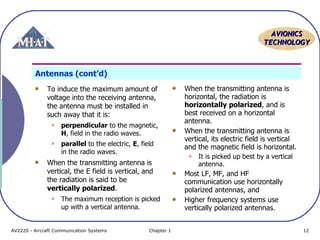
To induce the maximum amount of
voltage into the receiving antenna,
the antenna must be installed in
such away that it is:


perpendicular to the magnetic,
H, field in the radio waves.



parallel to the electric, E, field
in the radio waves.

When the transmitting antenna is
vertical, the E field is vertical, and
the radiation is said to be
vertically polarized.


The maximum reception is picked
up with a vertical antenna.

AV2220 - Aircraft Communication Systems

Chapter 1

When the transmitting antenna is
horizontal, the radiation is
horizontally polarized, and is
best received on a horizontal
antenna.
When the transmitting antenna is
vertical, its electric field is vertical
and the magnetic field is horizontal.


It is picked up best by a vertical
antenna.

Most LF, MF, and HF
communication use horizontally
polarized antennas, and
Higher frequency systems use
vertically polarized antennas.
12
AVIONICS
TECHNOLOGY

Antennas (cont’d)
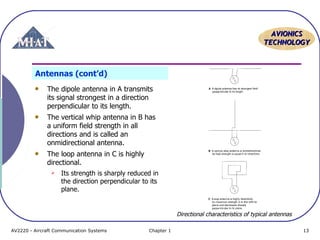
The dipole antenna in A transmits
its signal strongest in a direction
perpendicular to its length.
The vertical whip antenna in B has
a uniform field strength in all
directions and is called an
onmidirectional antenna.
The loop antenna in C is highly
directional.


Its strength is sharply reduced in
the direction perpendicular to its
plane.

Directional characteristics of typical antennas
AV2220 - Aircraft Communication Systems

Chapter 1

13
AVIONICS
TECHNOLOGY

Antennas (cont’d)
Antennas often have general names
that describe some of their basic
characteristics.
Two of the more common types are
the Hertz dipole antenna and the
Marconi monopole antenna.
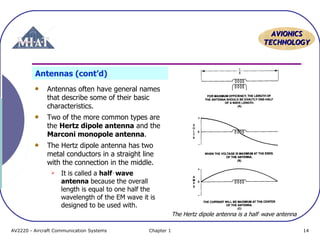
The Hertz dipole antenna has two
metal conductors in a straight line
with the connection in the middle.


It is called a half‑wave
antenna because the overall
length is equal to one half the
wavelength of the EM wave it is
designed to be used with.
The Hertz dipole antenna is a half‑wave antenna

AV2220 - Aircraft Communication Systems

Chapter 1

14
AVIONICS
TECHNOLOGY

Antennas (cont’d)
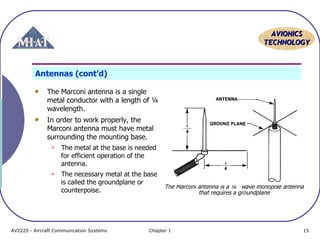
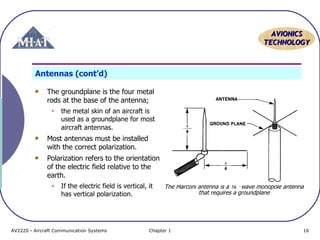
The Marconi antenna is a single
metal conductor with a length of ¼
wavelength.
In order to work properly, the
Marconi antenna must have metal
surrounding the mounting base.


The metal at the base is needed
for efficient operation of the
antenna.



The necessary metal at the base
is called the groundplane or
counterpoise.

AV2220 - Aircraft Communication Systems

The Marconi antenna is a ¼ ‑wave monopole antenna
that requires a groundplane

Chapter 1

15
AVIONICS
TECHNOLOGY

Antennas (cont’d)
The groundplane is the four metal
rods at the base of the antenna;


the metal skin of an aircraft is
used as a groundplane for most
aircraft antennas.

Most antennas must be installed
with the correct polarization.
Polarization refers to the orientation
of the electric field relative to the
earth.


If the electric field is vertical, it
has vertical polarization.

AV2220 - Aircraft Communication Systems

The Marconi antenna is a ¼ ‑wave monopole antenna
that requires a groundplane

Chapter 1

16
AVIONICS
TECHNOLOGY

Antennas (cont’d)

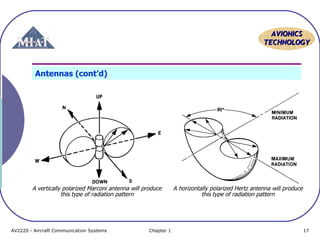
A vertically polarized Marconi antenna will produce
this type of radiation pattern

AV2220 - Aircraft Communication Systems

Chapter 1

A horizontally polarized Hertz antenna will produce
this type of radiation pattern

17
AVIONICS
TECHNOLOGY

Antennas (cont’d)
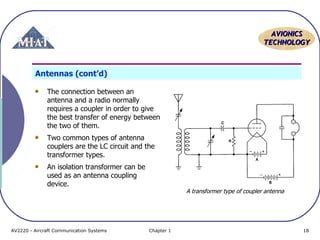
The connection between an
antenna and a radio normally
requires a coupler in order to give
the best transfer of energy between
the two of them.
Two common types of antenna
couplers are the LC circuit and the
transformer types.
An isolation transformer can be
used as an antenna coupling
device.

AV2220 - Aircraft Communication Systems

A transformer type of coupler antenna

Chapter 1

18
AVIONICS
TECHNOLOGY

Antennas (cont’d)
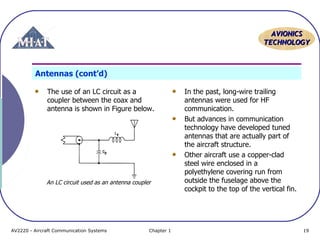
The use of an LC circuit as a
coupler between the coax and
antenna is shown in Figure below.

An LC circuit used as an antenna coupler

AV2220 - Aircraft Communication Systems

Chapter 1

In the past, long-wire trailing
antennas were used for HF
communication.
But advances in communication
technology have developed tuned
antennas that are actually part of
the aircraft structure.
Other aircraft use a copper-clad
steel wire enclosed in a
polyethylene covering run from
outside the fuselage above the
cockpit to the top of the vertical fin.

19
AVIONICS
TECHNOLOGY

Antennas (cont’d)
VHF communication uses the
frequencies between 118 and 136
megahertz, which are just above
the VOR frequencies, and the
antenna used is normally a
quarter-wavelength, vertically
polarized whip.

Many whip antennas are bent so
they can also pick up horizontally
polarized signals.
Broad-band blade antennas provide
more efficient transmission and
reception than simple whips.

The metal in the aircraft structure
provides the other quarterwavelength to make the antenna
electrically a half-wavelength long.

AV2220 - Aircraft Communication Systems

Chapter 1

20
AVIONICS
TECHNOLOGY

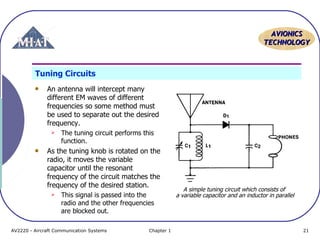
Tuning Circuits
An antenna will intercept many
different EM waves of different
frequencies so some method must
be used to separate out the desired
frequency.


The tuning circuit performs this
function.

As the tuning knob is rotated on the
radio, it moves the variable
capacitor until the resonant
frequency of the circuit matches the
frequency of the desired station.


This signal is passed into the
radio and the other frequencies
are blocked out.

AV2220 - Aircraft Communication Systems

Chapter 1

A simple tuning circuit which consists of
a variable capacitor and an inductor in parallel

21
AVIONICS
TECHNOLOGY

Tuning Circuits (cont’d)
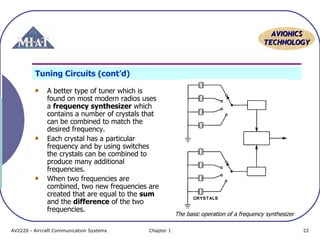
A better type of tuner which is
found on most modern radios uses
a frequency synthesizer which
contains a number of crystals that
can be combined to match the
desired frequency.
Each crystal has a particular
frequency and by using switches
the crystals can be combined to
produce many additional
frequencies.
When two frequencies are
combined, two new frequencies are
created that are equal to the sum
and the difference of the two
frequencies.
AV2220 - Aircraft Communication Systems

Chapter 1

The basic operation of a frequency synthesizer
22
AVIONICS
TECHNOLOGY

Transmitters

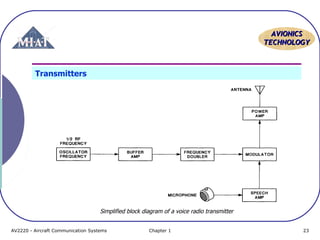
Simplified block diagram of a voice radio transmitter
AV2220 - Aircraft Communication Systems

Chapter 1

23
AVIONICS
TECHNOLOGY

Transmitters (cont’d)
A simple voice radio transmitter consists of:


Frequency oscillator which operates at one half the carrier frequency



Buffer amplifier and frequency doubler which assigned to amplify and doubling
the signal so that it has enough power to radiate into space when it goes to the
antenna.



The modulator combines the AF and RF signals



The power amp which operates to amplify signal before being sent down the
coax to the antenna.

The transmitter uses a crystal oscillator to produce an accurately controlled
carrier frequency, and only this one frequency radiates from the transmitter
antenna.
In order for a receiver to be useful, it must filter out every frequency except the
one that is wanted.


To do this, it employs a special superheterodyne circuit.

AV2220 - Aircraft Communication Systems

Chapter 1

24
AVIONICS
TECHNOLOGY

Receivers
In the 1920s, a new type of radio receiver was invented that produced
better sound quality.


It was called the superheterodyne or superhet radio.

The only major difference between the superhet and earlier radios was
that it reduced the modulated RF signal from the antenna to an AF
signal in more than one jump or stage.

AV2220 - Aircraft Communication Systems

Chapter 1

25
AVIONICS
TECHNOLOGY

Receivers

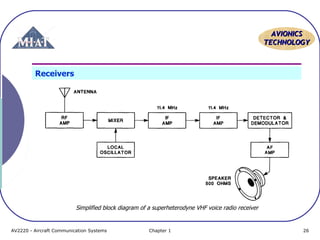
Simplified block diagram of a superheterodyne VHF voice radio receiver

AV2220 - Aircraft Communication Systems

Chapter 1

26
AVIONICS
TECHNOLOGY

Receivers (cont’d)
In a VHF superhet aircraft receiver block diagram above:










The RF signal from the antenna is combined with a local oscillator frequency to
produce a lower IF frequency.
The intermediate frequencies found in a superhet radio are abbreviated as IF.
The output of the mixer is the difference between the RF frequency and the
local oscillator frequency.
The basic principle of the mixer is:
 two different frequencies are combined,
 two new frequencies are created; the sum and the difference of the two
combined frequencies.
The IF signals is amplified and then sent to the detector and demodulator.
The detector chops off half of each sine wave to produce a varying DC signal
from an AC signal.
The AF signal is amplified and used to drive the speaker.

AV2220 - Aircraft Communication Systems

Chapter 1

27
AVIONICS
TECHNOLOGY

Receivers (cont’d)
The antenna picks up all the radio
signals in the area and they are
taken into a tunable preamplifier.


This preamplifier uses an
electronic filter circuit that passes
only the frequency to which the
receiver is tuned and sends all of
the other frequencies to ground.

The preamplifier amplifies any
signal with a frequency of e.g.
1,200 kHz and passes all other
frequencies to ground.

AV2220 - Aircraft Communication Systems

A tunable local oscillator is included
in this circuit.


For most broadcast band receivers,
the frequency of the local oscillator
is always 455 kilohertz higher than
the frequency tuned on the
preamplifier.


Chapter 1

The frequency of this oscillator is
varied so it is always a specific
frequency higher than the
frequency to which the
preamplifier is tuned.

In this case, the local oscillator
produces a signal with a
frequency of 1,655 kilohertz
(1,200 + 455).
28
AVIONICS
TECHNOLOGY

Receivers (cont’d)
The signals from the preamplifier
and the local oscillator are sent to
the mixer.
When signals with two frequencies
are mixed, they produce two other
signals:


one with a frequency that is the
sum of the original two
frequencies and



the other with a frequency that is
the difference between the two.

AV2220 - Aircraft Communication Systems

Chapter 1

The four signals will have
frequencies of:





1,200 kHz
1,655 kHz
2,855 kHz (1,200 + 1,655)
455 kHz (1,655 - 1,200)

The four signals from the mixer are
sent into the intermediate
frequency (IF) amplifier.
This is a very narrow-band amplifier
that is tuned to 455 kHz.
It amplifies the 455 kHz signal and
attenuates, or diminishes, all other
frequencies.

29
AVIONICS
TECHNOLOGY

Receivers (cont’d)
The amplified 455 kHz signal is sent to the detector/demodulator


It removes the 455 kHz IF carrier and leaves the AF envelope that has both
halves of the audio signal.

The detector rectifies the AF signal and removes one half of the envelope.
The AF signal is amplified by a power amplifier stage and drives the speaker.
The output of the speaker is the same as the input to the microphone at the
transmitter.

AV2220 - Aircraft Communication Systems

Chapter 1

30
AVIONICS
TECHNOLOGY

Receivers (cont’d)
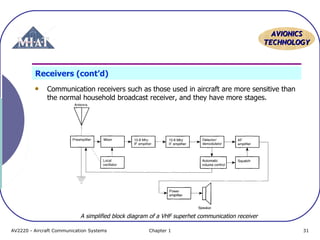
Communication receivers such as those used in aircraft are more sensitive than
the normal household broadcast receiver, and they have more stages.

A simplified block diagram of a VHF superhet communication receiver
AV2220 - Aircraft Communication Systems

Chapter 1

31
AVIONICS
TECHNOLOGY

Receivers (cont’d)
The signal is picked up on the
antenna and amplified by the tuned
preamplifier.
The local oscillator produces a
frequency that is 10.8-megahertz
different from the frequency to
which the preamplifier is tuned.
These two frequencies are fed into
the mixer where they produce a
10.8-MHz intermediate frequency.

AV2220 - Aircraft Communication Systems

Chapter 1

This IF is amplified by two stages of
IF amplification and sent into the
detector/demodulator, where it
emerges as an audio frequency
signal that duplicates the AF
produced by the microphone at the
transmitter.
Some of the detector output is sent
into a squelch circuit that controls
the audio frequency amplifier.
When no signal is being received,
the AF amplifier output is
attenuated, or decreased, so the
background noise that makes a
hissing sound in the speaker is not
loud enough to be annoying.
32
AVIONICS
TECHNOLOGY

Speakers and Microphones
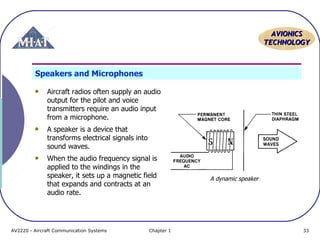
Aircraft radios often supply an audio
output for the pilot and voice
transmitters require an audio input
from a microphone.
A speaker is a device that
transforms electrical signals into
sound waves.
When the audio frequency signal is
applied to the windings in the
speaker, it sets up a magnetic field
that expands and contracts at an
audio rate.

AV2220 - Aircraft Communication Systems

Chapter 1

A dynamic speaker

33
AVIONICS
TECHNOLOGY

Speakers and Microphones (cont’d)
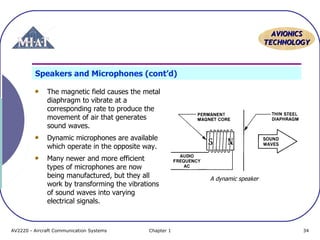
The magnetic field causes the metal
diaphragm to vibrate at a
corresponding rate to produce the
movement of air that generates
sound waves.
Dynamic microphones are available
which operate in the opposite way.
Many newer and more efficient
types of microphones are now
being manufactured, but they all
work by transforming the vibrations
of sound waves into varying
electrical signals.

AV2220 - Aircraft Communication Systems

Chapter 1

A dynamic speaker

34
AVIONICS
TECHNOLOGY

Audio Control Panel
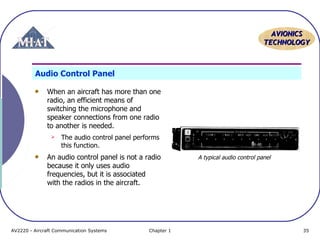
When an aircraft has more than one
radio, an efficient means of
switching the microphone and
speaker connections from one radio
to another is needed.


The audio control panel performs
this function.

An audio control panel is not a radio
because it only uses audio
frequencies, but it is associated
with the radios in the aircraft.

AV2220 - Aircraft Communication Systems

Chapter 1

A typical audio control panel

35
AVIONICS
TECHNOLOGY

Audio Control Panel (cont’d)
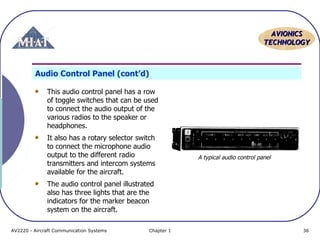
This audio control panel has a row
of toggle switches that can be used
to connect the audio output of the
various radios to the speaker or
headphones.
It also has a rotary selector switch
to connect the microphone audio
output to the different radio
transmitters and intercom systems
available for the aircraft.

A typical audio control panel

The audio control panel illustrated
also has three lights that are the
indicators for the marker beacon
system on the aircraft.
AV2220 - Aircraft Communication Systems

Chapter 1

36
Regulations and
Standards for Radios

AVIONICS
TECHNOLOGY

Aircraft avionics equipment might
have to comply with a number of
different regulations and standards
depending on the type of
equipment and the type of aircraft
in which it is installed.

FCC rules generally apply to
equipment which produces radio
waves.

Regulations from the FAA and the
FCC apply to the manufacture and
use of most types of equipment and
carry the force of law.

Each different type of transmitter
must be listed on the license that is
displayed in the cockpit.

FAA standards for equipment are
usually in the form of TSO
(Technical Standard Order)
approvals.

AV2220 - Aircraft Communication Systems

Chapter 1

An FCC Station License is required
for aircraft that have radio
transmitters other than ELT.

The role of ARINC in established
standards apply to the equipment in
air carrier jets and bizjets primarily.
There are some FAA Regulations
concerning the use of radio
equipment in flight.

37
AVIONICS
TECHNOLOGY

FAR 91.130 (c)
No person may operate an aircraft in an Airport Radar Service Area (ARSA)
unless two‑way radio communication is established and maintained with ATC.
A transponder with Mode C automatic reporting of aircraft pressure altitude is
also required in all ARSAs.

FAR 91.131 (c) and (d)
No person may operate an aircraft in a Terminal Control Area (TCA) unless it
has:
1. A two‑way radio with appropriate frequencies available.
2. An operable transponder with Mode C altitude reporting.

AV2220 - Aircraft Communication Systems

Chapter 1

38
AVIONICS
TECHNOLOGY

FAR 91.205 (d) and (e) Minimum Equipment Requirements for
IFR
 Two‑way radio communications and navigation equipment appropriate to the
ground facilities that will be used.
 At and above 24,000 ft. MSL; approved DME (distance measuring equipment).

AV2220 - Aircraft Communication Systems

Chapter 1

39
AVIONICS
TECHNOLOGY

FAR 91.511
Large and turbine ‑powered, multi‑engine airplanes, if operating over water
more than 30 minutes or 100 nautical miles from the nearest shoreline, must
have:
1. Radio communication equipment appropriate to the ground facilities.
2. Two transmitters.
3. Two microphones.
4. Two headsets (or headset and speaker).
5. Two independent receivers.
6. If needed, one HF transceiver.

AV2220 - Aircraft Communication Systems

Chapter 1

40

Nav Topic 3 radio components

  • 1.
    Basic Radio System Components AVIONICS TECHNOLOGY Amplifiers Anamplifier is a device that increases the strength of a signal.  They are found in both transmitters and receivers.  A transmitter must increase the strength of the signal sent to the antenna so that the EM waves will travel a useful distance outward from the antenna. A receiver needs amplifiers because the strength of the signal from the antenna is very low and must be increased to enable the signal to be heard. AV2220 - Aircraft Communication Systems Amplifiers can be categorized as Class A, Class B and Class C. Chapter 1 The difference between these is the shape of the output waveform. The output of a Class A amplifier is complete sine waves just like the input. The Class B amplifier has an output which shows only half of each sine wave. The Class C amplifier has an output waveform which is less than half of the sine wave 1
  • 2.
    AVIONICS TECHNOLOGY Amplifiers (cont’d) The ClassC amplifier is often used as a power amplifier because of its higher efficiency. The output of the Class C amplifier can be sent through an LC circuit or other device to restore the complete sine wave shape. An example of the output waveform for Class A, B and C amplifiers AV2220 - Aircraft Communication Systems Chapter 1 2
  • 3.
    AVIONICS TECHNOLOGY Oscillators An oscillator isa device that produces the frequencies needed by both receivers and transmitters. A simple oscillator is an LC circuit or tank circuit made up of a capacitor and inductor in parallel. The LC circuit will have a resonant frequency which matches the desired frequency. An LC circuit by itself will not continue to oscillate because of resistance in the components and wires. AV2220 - Aircraft Communication Systems Chapter 1 A parallel LC tank circuit. 3
  • 4.
    AVIONICS TECHNOLOGY Oscillators (cont’d) An LCtank circuit which connected to a battery can produce oscillations. If the switch in Figure on the rightside is moved to position A, the capacitor will be charged by the battery. If the switch is then moved to position C, the tank circuit will start to oscillate as energy is transferred rapidly back and forth between the capacitor and inductor. The oscillations will become weaker and die out because of the resistance in the circuit. AV2220 - Aircraft Communication Systems Chapter 1 A parallel LC tank circuit 4
  • 5.
    AVIONICS TECHNOLOGY Oscillators (cont’d) In orderto maintain oscillations, some energy must be fed back into the tank circuit. The resonant frequency or oscillation frequency is determined by the values of capacitance and inductance in the tank circuit. The LC circuit will not be stable over a period of time and may drift off the correct frequency. An oscillator circuit with feedback supplied by a transistor AV2220 - Aircraft Communication Systems Chapter 1 5
  • 6.
    AVIONICS TECHNOLOGY Oscillators (cont’d) A commontechnique to stabilize the oscillator and produce a more accurate frequency is to use a crystal. The piezoelectric effect of the crystal will produce a more accurate and consistent output frequency from the oscillator. A crystal controlled oscillator AV2220 - Aircraft Communication Systems Chapter 1 6
  • 7.
    AVIONICS TECHNOLOGY Modulators and Demodulators Inthe radio transmitter, a device is needed which will combine the AF signal with the RF carrier wave signal before it is sent to the antenna. This is the function of a modulator, it combines the AF and RF signals so that information can be transmitted. The output of the modulator is called modulated RF. The signal produced by the antenna in a receiver will be modulated RF. AV2220 - Aircraft Communication Systems Chapter 1 In order to hear the voice as an output of the receiver, the AF component must be separated out. The demodulator removes the RF component of the modulated RF signal and produces an AF output. When the AF and RF signals are combined in the modulator, they must have the proper relative strengths for maximum efficiency. The amount of modulation is called the modulation rate. 7
  • 8.
    AVIONICS TECHNOLOGY Modulators and Demodulators Ifthe AF signal is too weak compared to the RF signal, the modulation rate will be low and the efficiency will also be low. If the modulation rate is over 100%, there will be distortion in the signal due to the gaps created. Figure (on the right-side) gives examples of 50%, 100% and more than 100% modulation rates with AM modulation. Most radio transmitters are adjusted to about 90‑95% modulation to provide a little margin to prevent distortion. AV2220 - Aircraft Communication Systems Chapter 1 Examples of different modulation rates (A) 50%; (B) 100%;(C) Over 100% 8
  • 9.
    AVIONICS TECHNOLOGY Filters A filter isused in a radio circuit to remove or filter out unwanted frequencies. The signals that are processed by the circuits in a radio often have additional frequencies present that are not needed. If the proper filter is installed, it will filter out the frequency or frequencies that are not wanted. A filter is usually made up of an arrangement of inductors and capacitors. AV2220 - Aircraft Communication Systems Radio frequency filters are combinations of inductors and capacitors Chapter 1 9
  • 10.
    AVIONICS TECHNOLOGY Filters (cont’d) A lowpass filter will remove all frequencies above a certain value and pass the low ones. A high pass filter does the opposite. If a range of frequencies must be blocked, a band reject filter will be used. A bandpass filter will allow a certain band of frequencies to go through and block frequencies either above or below that range. Radio frequency filters are combinations of inductors and capacitors AV2220 - Aircraft Communication Systems Chapter 1 10
  • 11.
    AVIONICS TECHNOLOGY Antennas An antenna isa device that transforms electrical signals into EM waves in the case of a transmit antenna, or transforms EM waves into electrical signals in the case of a receive antenna. An antenna may be used for transmit only, receive only, or both, depending on the particular radio system involved. The maintenance, inspection and installation of antennas are usually the responsibility of the airframe technician since they are attached to the structure or skin of the aircraft. AV2220 - Aircraft Communication Systems Chapter 1 Three characteristics of an antenna are critical:    length, polarization directivity. For an antenna to be most efficient, its length must be one-half the wavelength of the signal being transmitted or received.  This length allows the antenna current to be maximum. 11
  • 12.
    AVIONICS TECHNOLOGY Antennas (cont’d) To inducethe maximum amount of voltage into the receiving antenna, the antenna must be installed in such away that it is:  perpendicular to the magnetic, H, field in the radio waves.  parallel to the electric, E, field in the radio waves. When the transmitting antenna is vertical, the E field is vertical, and the radiation is said to be vertically polarized.  The maximum reception is picked up with a vertical antenna. AV2220 - Aircraft Communication Systems Chapter 1 When the transmitting antenna is horizontal, the radiation is horizontally polarized, and is best received on a horizontal antenna. When the transmitting antenna is vertical, its electric field is vertical and the magnetic field is horizontal.  It is picked up best by a vertical antenna. Most LF, MF, and HF communication use horizontally polarized antennas, and Higher frequency systems use vertically polarized antennas. 12
  • 13.
    AVIONICS TECHNOLOGY Antennas (cont’d) The dipoleantenna in A transmits its signal strongest in a direction perpendicular to its length. The vertical whip antenna in B has a uniform field strength in all directions and is called an onmidirectional antenna. The loop antenna in C is highly directional.  Its strength is sharply reduced in the direction perpendicular to its plane. Directional characteristics of typical antennas AV2220 - Aircraft Communication Systems Chapter 1 13
  • 14.
    AVIONICS TECHNOLOGY Antennas (cont’d) Antennas oftenhave general names that describe some of their basic characteristics. Two of the more common types are the Hertz dipole antenna and the Marconi monopole antenna. The Hertz dipole antenna has two metal conductors in a straight line with the connection in the middle.  It is called a half‑wave antenna because the overall length is equal to one half the wavelength of the EM wave it is designed to be used with. The Hertz dipole antenna is a half‑wave antenna AV2220 - Aircraft Communication Systems Chapter 1 14
  • 15.
    AVIONICS TECHNOLOGY Antennas (cont’d) The Marconiantenna is a single metal conductor with a length of ¼ wavelength. In order to work properly, the Marconi antenna must have metal surrounding the mounting base.  The metal at the base is needed for efficient operation of the antenna.  The necessary metal at the base is called the groundplane or counterpoise. AV2220 - Aircraft Communication Systems The Marconi antenna is a ¼ ‑wave monopole antenna that requires a groundplane Chapter 1 15
  • 16.
    AVIONICS TECHNOLOGY Antennas (cont’d) The groundplaneis the four metal rods at the base of the antenna;  the metal skin of an aircraft is used as a groundplane for most aircraft antennas. Most antennas must be installed with the correct polarization. Polarization refers to the orientation of the electric field relative to the earth.  If the electric field is vertical, it has vertical polarization. AV2220 - Aircraft Communication Systems The Marconi antenna is a ¼ ‑wave monopole antenna that requires a groundplane Chapter 1 16
  • 17.
    AVIONICS TECHNOLOGY Antennas (cont’d) A verticallypolarized Marconi antenna will produce this type of radiation pattern AV2220 - Aircraft Communication Systems Chapter 1 A horizontally polarized Hertz antenna will produce this type of radiation pattern 17
  • 18.
    AVIONICS TECHNOLOGY Antennas (cont’d) The connectionbetween an antenna and a radio normally requires a coupler in order to give the best transfer of energy between the two of them. Two common types of antenna couplers are the LC circuit and the transformer types. An isolation transformer can be used as an antenna coupling device. AV2220 - Aircraft Communication Systems A transformer type of coupler antenna Chapter 1 18
  • 19.
    AVIONICS TECHNOLOGY Antennas (cont’d) The useof an LC circuit as a coupler between the coax and antenna is shown in Figure below. An LC circuit used as an antenna coupler AV2220 - Aircraft Communication Systems Chapter 1 In the past, long-wire trailing antennas were used for HF communication. But advances in communication technology have developed tuned antennas that are actually part of the aircraft structure. Other aircraft use a copper-clad steel wire enclosed in a polyethylene covering run from outside the fuselage above the cockpit to the top of the vertical fin. 19
  • 20.
    AVIONICS TECHNOLOGY Antennas (cont’d) VHF communicationuses the frequencies between 118 and 136 megahertz, which are just above the VOR frequencies, and the antenna used is normally a quarter-wavelength, vertically polarized whip. Many whip antennas are bent so they can also pick up horizontally polarized signals. Broad-band blade antennas provide more efficient transmission and reception than simple whips. The metal in the aircraft structure provides the other quarterwavelength to make the antenna electrically a half-wavelength long. AV2220 - Aircraft Communication Systems Chapter 1 20
  • 21.
    AVIONICS TECHNOLOGY Tuning Circuits An antennawill intercept many different EM waves of different frequencies so some method must be used to separate out the desired frequency.  The tuning circuit performs this function. As the tuning knob is rotated on the radio, it moves the variable capacitor until the resonant frequency of the circuit matches the frequency of the desired station.  This signal is passed into the radio and the other frequencies are blocked out. AV2220 - Aircraft Communication Systems Chapter 1 A simple tuning circuit which consists of a variable capacitor and an inductor in parallel 21
  • 22.
    AVIONICS TECHNOLOGY Tuning Circuits (cont’d) Abetter type of tuner which is found on most modern radios uses a frequency synthesizer which contains a number of crystals that can be combined to match the desired frequency. Each crystal has a particular frequency and by using switches the crystals can be combined to produce many additional frequencies. When two frequencies are combined, two new frequencies are created that are equal to the sum and the difference of the two frequencies. AV2220 - Aircraft Communication Systems Chapter 1 The basic operation of a frequency synthesizer 22
  • 23.
    AVIONICS TECHNOLOGY Transmitters Simplified block diagramof a voice radio transmitter AV2220 - Aircraft Communication Systems Chapter 1 23
  • 24.
    AVIONICS TECHNOLOGY Transmitters (cont’d) A simplevoice radio transmitter consists of:  Frequency oscillator which operates at one half the carrier frequency  Buffer amplifier and frequency doubler which assigned to amplify and doubling the signal so that it has enough power to radiate into space when it goes to the antenna.  The modulator combines the AF and RF signals  The power amp which operates to amplify signal before being sent down the coax to the antenna. The transmitter uses a crystal oscillator to produce an accurately controlled carrier frequency, and only this one frequency radiates from the transmitter antenna. In order for a receiver to be useful, it must filter out every frequency except the one that is wanted.  To do this, it employs a special superheterodyne circuit. AV2220 - Aircraft Communication Systems Chapter 1 24
  • 25.
    AVIONICS TECHNOLOGY Receivers In the 1920s,a new type of radio receiver was invented that produced better sound quality.  It was called the superheterodyne or superhet radio. The only major difference between the superhet and earlier radios was that it reduced the modulated RF signal from the antenna to an AF signal in more than one jump or stage. AV2220 - Aircraft Communication Systems Chapter 1 25
  • 26.
    AVIONICS TECHNOLOGY Receivers Simplified block diagramof a superheterodyne VHF voice radio receiver AV2220 - Aircraft Communication Systems Chapter 1 26
  • 27.
    AVIONICS TECHNOLOGY Receivers (cont’d) In aVHF superhet aircraft receiver block diagram above:       The RF signal from the antenna is combined with a local oscillator frequency to produce a lower IF frequency. The intermediate frequencies found in a superhet radio are abbreviated as IF. The output of the mixer is the difference between the RF frequency and the local oscillator frequency. The basic principle of the mixer is:  two different frequencies are combined,  two new frequencies are created; the sum and the difference of the two combined frequencies. The IF signals is amplified and then sent to the detector and demodulator. The detector chops off half of each sine wave to produce a varying DC signal from an AC signal. The AF signal is amplified and used to drive the speaker. AV2220 - Aircraft Communication Systems Chapter 1 27
  • 28.
    AVIONICS TECHNOLOGY Receivers (cont’d) The antennapicks up all the radio signals in the area and they are taken into a tunable preamplifier.  This preamplifier uses an electronic filter circuit that passes only the frequency to which the receiver is tuned and sends all of the other frequencies to ground. The preamplifier amplifies any signal with a frequency of e.g. 1,200 kHz and passes all other frequencies to ground. AV2220 - Aircraft Communication Systems A tunable local oscillator is included in this circuit.  For most broadcast band receivers, the frequency of the local oscillator is always 455 kilohertz higher than the frequency tuned on the preamplifier.  Chapter 1 The frequency of this oscillator is varied so it is always a specific frequency higher than the frequency to which the preamplifier is tuned. In this case, the local oscillator produces a signal with a frequency of 1,655 kilohertz (1,200 + 455). 28
  • 29.
    AVIONICS TECHNOLOGY Receivers (cont’d) The signalsfrom the preamplifier and the local oscillator are sent to the mixer. When signals with two frequencies are mixed, they produce two other signals:  one with a frequency that is the sum of the original two frequencies and  the other with a frequency that is the difference between the two. AV2220 - Aircraft Communication Systems Chapter 1 The four signals will have frequencies of:     1,200 kHz 1,655 kHz 2,855 kHz (1,200 + 1,655) 455 kHz (1,655 - 1,200) The four signals from the mixer are sent into the intermediate frequency (IF) amplifier. This is a very narrow-band amplifier that is tuned to 455 kHz. It amplifies the 455 kHz signal and attenuates, or diminishes, all other frequencies. 29
  • 30.
    AVIONICS TECHNOLOGY Receivers (cont’d) The amplified455 kHz signal is sent to the detector/demodulator  It removes the 455 kHz IF carrier and leaves the AF envelope that has both halves of the audio signal. The detector rectifies the AF signal and removes one half of the envelope. The AF signal is amplified by a power amplifier stage and drives the speaker. The output of the speaker is the same as the input to the microphone at the transmitter. AV2220 - Aircraft Communication Systems Chapter 1 30
  • 31.
    AVIONICS TECHNOLOGY Receivers (cont’d) Communication receiverssuch as those used in aircraft are more sensitive than the normal household broadcast receiver, and they have more stages. A simplified block diagram of a VHF superhet communication receiver AV2220 - Aircraft Communication Systems Chapter 1 31
  • 32.
    AVIONICS TECHNOLOGY Receivers (cont’d) The signalis picked up on the antenna and amplified by the tuned preamplifier. The local oscillator produces a frequency that is 10.8-megahertz different from the frequency to which the preamplifier is tuned. These two frequencies are fed into the mixer where they produce a 10.8-MHz intermediate frequency. AV2220 - Aircraft Communication Systems Chapter 1 This IF is amplified by two stages of IF amplification and sent into the detector/demodulator, where it emerges as an audio frequency signal that duplicates the AF produced by the microphone at the transmitter. Some of the detector output is sent into a squelch circuit that controls the audio frequency amplifier. When no signal is being received, the AF amplifier output is attenuated, or decreased, so the background noise that makes a hissing sound in the speaker is not loud enough to be annoying. 32
  • 33.
    AVIONICS TECHNOLOGY Speakers and Microphones Aircraftradios often supply an audio output for the pilot and voice transmitters require an audio input from a microphone. A speaker is a device that transforms electrical signals into sound waves. When the audio frequency signal is applied to the windings in the speaker, it sets up a magnetic field that expands and contracts at an audio rate. AV2220 - Aircraft Communication Systems Chapter 1 A dynamic speaker 33
  • 34.
    AVIONICS TECHNOLOGY Speakers and Microphones(cont’d) The magnetic field causes the metal diaphragm to vibrate at a corresponding rate to produce the movement of air that generates sound waves. Dynamic microphones are available which operate in the opposite way. Many newer and more efficient types of microphones are now being manufactured, but they all work by transforming the vibrations of sound waves into varying electrical signals. AV2220 - Aircraft Communication Systems Chapter 1 A dynamic speaker 34
  • 35.
    AVIONICS TECHNOLOGY Audio Control Panel Whenan aircraft has more than one radio, an efficient means of switching the microphone and speaker connections from one radio to another is needed.  The audio control panel performs this function. An audio control panel is not a radio because it only uses audio frequencies, but it is associated with the radios in the aircraft. AV2220 - Aircraft Communication Systems Chapter 1 A typical audio control panel 35
  • 36.
    AVIONICS TECHNOLOGY Audio Control Panel(cont’d) This audio control panel has a row of toggle switches that can be used to connect the audio output of the various radios to the speaker or headphones. It also has a rotary selector switch to connect the microphone audio output to the different radio transmitters and intercom systems available for the aircraft. A typical audio control panel The audio control panel illustrated also has three lights that are the indicators for the marker beacon system on the aircraft. AV2220 - Aircraft Communication Systems Chapter 1 36
  • 37.
    Regulations and Standards forRadios AVIONICS TECHNOLOGY Aircraft avionics equipment might have to comply with a number of different regulations and standards depending on the type of equipment and the type of aircraft in which it is installed. FCC rules generally apply to equipment which produces radio waves. Regulations from the FAA and the FCC apply to the manufacture and use of most types of equipment and carry the force of law. Each different type of transmitter must be listed on the license that is displayed in the cockpit. FAA standards for equipment are usually in the form of TSO (Technical Standard Order) approvals. AV2220 - Aircraft Communication Systems Chapter 1 An FCC Station License is required for aircraft that have radio transmitters other than ELT. The role of ARINC in established standards apply to the equipment in air carrier jets and bizjets primarily. There are some FAA Regulations concerning the use of radio equipment in flight. 37
  • 38.
    AVIONICS TECHNOLOGY FAR 91.130 (c) Noperson may operate an aircraft in an Airport Radar Service Area (ARSA) unless two‑way radio communication is established and maintained with ATC. A transponder with Mode C automatic reporting of aircraft pressure altitude is also required in all ARSAs. FAR 91.131 (c) and (d) No person may operate an aircraft in a Terminal Control Area (TCA) unless it has: 1. A two‑way radio with appropriate frequencies available. 2. An operable transponder with Mode C altitude reporting. AV2220 - Aircraft Communication Systems Chapter 1 38
  • 39.
    AVIONICS TECHNOLOGY FAR 91.205 (d)and (e) Minimum Equipment Requirements for IFR  Two‑way radio communications and navigation equipment appropriate to the ground facilities that will be used.  At and above 24,000 ft. MSL; approved DME (distance measuring equipment). AV2220 - Aircraft Communication Systems Chapter 1 39
  • 40.
    AVIONICS TECHNOLOGY FAR 91.511 Large andturbine ‑powered, multi‑engine airplanes, if operating over water more than 30 minutes or 100 nautical miles from the nearest shoreline, must have: 1. Radio communication equipment appropriate to the ground facilities. 2. Two transmitters. 3. Two microphones. 4. Two headsets (or headset and speaker). 5. Two independent receivers. 6. If needed, one HF transceiver. AV2220 - Aircraft Communication Systems Chapter 1 40