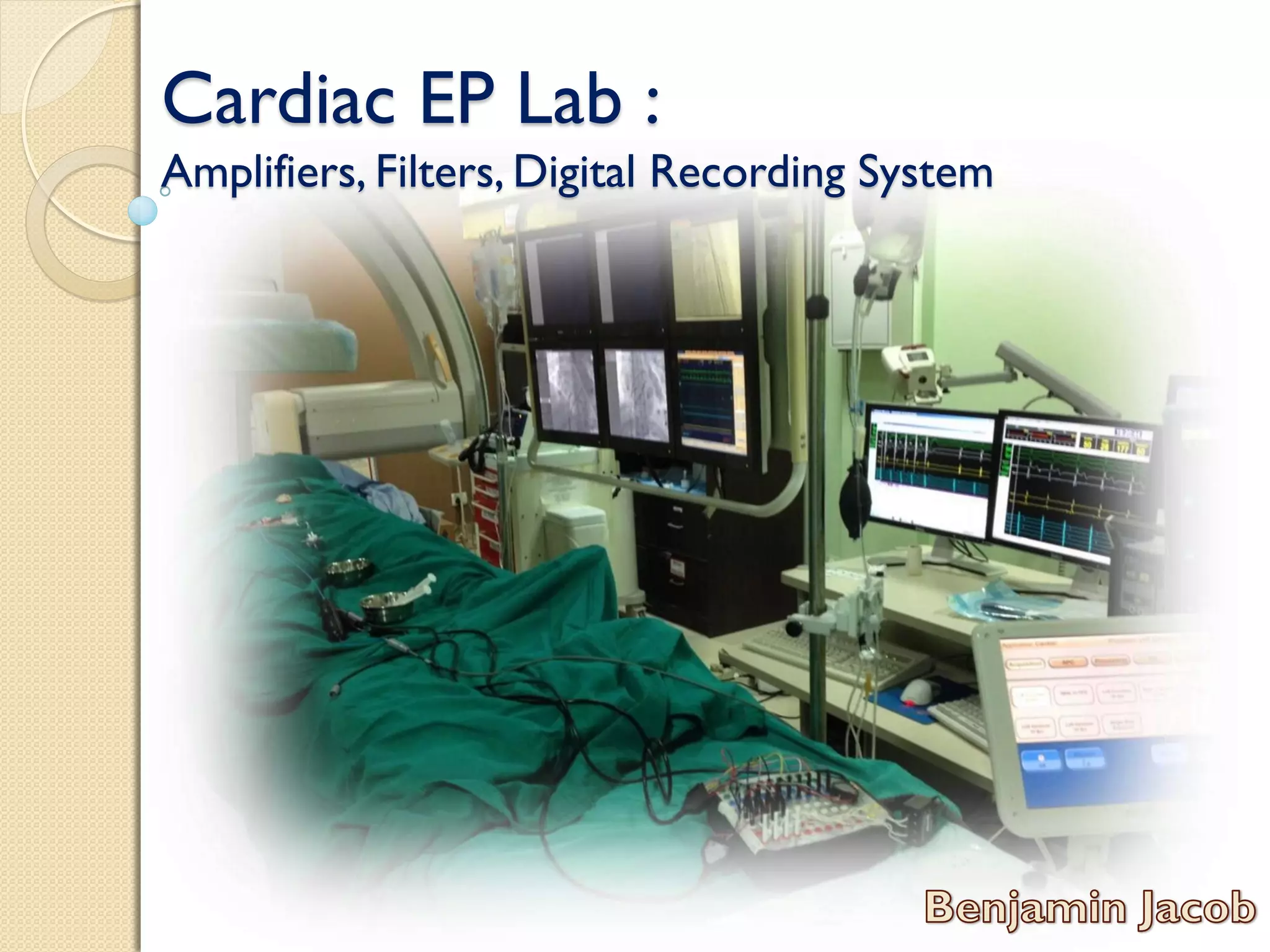
Cardiac EP Lab :
Amplifiers, Filters, Digital Recording System
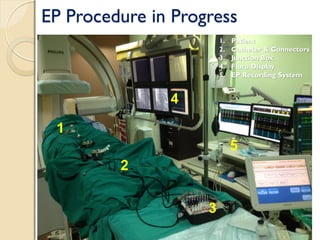
EP Procedure in Progress
1
2
3
4
5
1. Patient
2. Catheter & Connectors
3. Junction Box
4. Fluro Display
5. EP Recording System
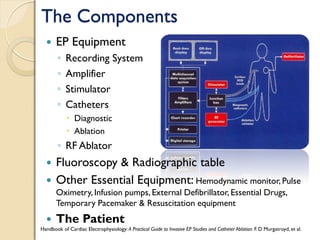
The Components
 EP Equipment
◦ Recording System
◦ Amplifier
◦ Stimulator
◦ Catheters
 Diagnostic
 Ablation
◦ RF Ablator
 Fluoroscopy & Radiographic table
 Other Essential Equipment: Hemodynamic monitor, Pulse
Oximetry, Infusion pumps, External Defibrillator, Essential Drugs,
Temporary Pacemaker & Resuscitation equipment
 The Patient
Handbook of Cardiac Electrophysiology: A Practical Guide to Invasive EP Studies and Catheter Ablation. F. D Murgatroyd, et al.
Diagnostic Catheters
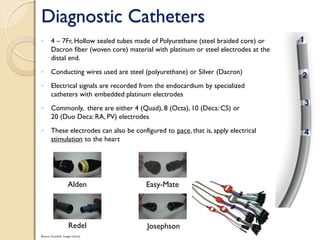
◦ 4 – 7Fr, Hollow sealed tubes made of Polyurethane (steel braided core) or
Dacron fiber (woven core) material with platinum or steel electrodes at the
distal end.
◦ Conducting wires used are steel (polyurethane) or Silver (Dacron)
◦ Electrical signals are recorded from the endocardium by specialized
catheters with embedded platinum electrodes
◦ Commonly, there are either 4 (Quad), 8 (Octa), 10 (Deca: CS) or
20 (Duo Deca: RA, PV) electrodes
◦ These electrodes can also be configured to pace, that is, apply electrical
stimulation to the heart
Boston Scientific Image Library.
1
2
3
4
Alden
Redel
Easy-Mate
Josephson
Ablation Catheter
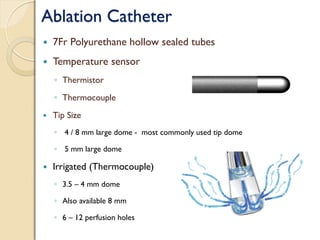
 7Fr Polyurethane hollow sealed tubes
 Temperature sensor
◦ Thermistor
◦ Thermocouple
 Tip Size
◦ 4 / 8 mm large dome - most commonly used tip dome
◦ 5 mm large dome
 Irrigated (Thermocouple)
◦ 3.5 – 4 mm dome
◦ Also available 8 mm
◦ 6 – 12 perfusion holes
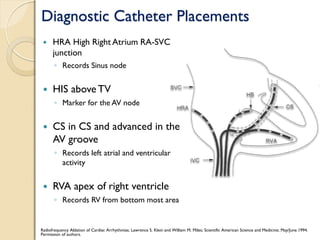
Diagnostic Catheter Placements
 HRA High Right Atrium RA-SVC
junction
◦ Records Sinus node
 HIS above TV
◦ Marker for the AV node
 CS in CS and advanced in the
AV groove
◦ Records left atrial and ventricular
activity
 RVA apex of right ventricle
◦ Records RV from bottom most area
Radiofrequency Ablation of Cardiac Arrhythmias; Lawrence S. Klein and William M. Miles; Scientific American Science and Medicine; May/June 1994.
Permission of authors.
Unipolar Signals
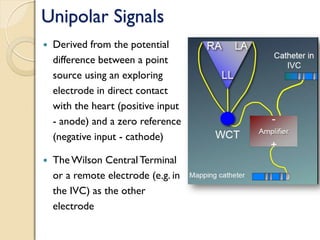
 Derived from the potential
difference between a point
source using an exploring
electrode in direct contact
with the heart (positive input
- anode) and a zero reference
(negative input - cathode)
 The Wilson CentralTerminal
or a remote electrode (e.g. in
the IVC) as the other
electrode
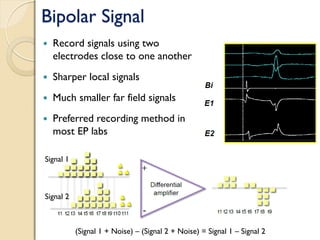
Bipolar Signal
 Record signals using two
electrodes close to one another
 Sharper local signals
 Much smaller far field signals
 Preferred recording method in
most EP labs
(Signal 1 + Noise) – (Signal 2 + Noise) = Signal 1 – Signal 2
Signal 1
Signal 2
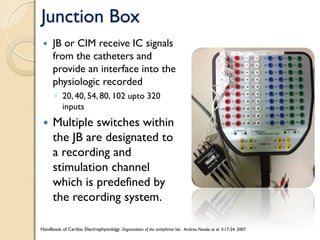
Junction Box
 JB or CIM receive IC signals
from the catheters and
provide an interface into the
physiologic recorded
◦ 20, 40, 54, 80, 102 upto 320
inputs
 Multiple switches within
the JB are designated to
a recording and
stimulation channel
which is predefined by
the recording system.
Handbook of Cardiac Electrophysiology. Organization of the arrhythmia lab. Andrea Natale et al. 3:17-24. 2007.
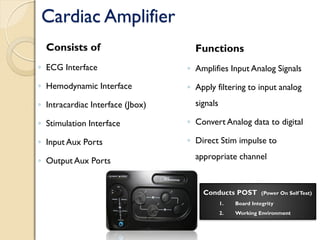
Cardiac Amplifier
Consists of
◦ ECG Interface
◦ Hemodynamic Interface
◦ Intracardiac Interface (Jbox)
◦ Stimulation Interface
◦ Input Aux Ports
◦ Output Aux Ports
Functions
◦ Amplifies Input Analog Signals
◦ Apply filtering to input analog
signals
◦ Convert Analog data to digital
◦ Direct Stim impulse to
appropriate channel
Conducts POST (Power On SelfTest)
1. Board Integrity
2. Working Environment
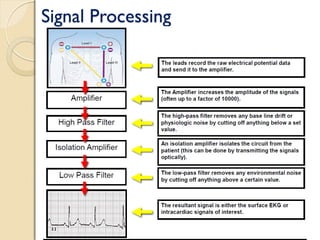
Signal Processing
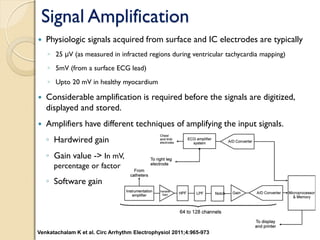
Signal Amplification
 Physiologic signals acquired from surface and IC electrodes are typically
◦ 25 μV (as measured in infracted regions during ventricular tachycardia mapping)
◦ 5mV (from a surface ECG lead)
◦ Upto 20 mV in healthy myocardium
 Considerable amplification is required before the signals are digitized,
displayed and stored.
 Amplifiers have different techniques of amplifying the input signals.
◦ Hardwired gain
◦ Gain value -> In mV,
percentage or factor
◦ Software gain
Venkatachalam K et al. Circ Arrhythm Electrophysiol 2011;4:965-973
Signal Amplification
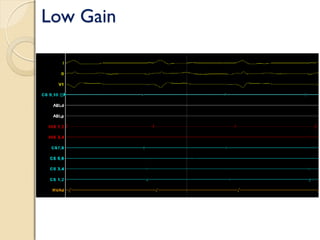
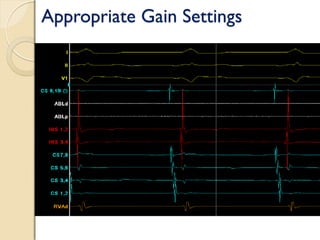
 Low gain - Surface ECG, Unipolar IC signals
 Moderate gain - RV, RA,CS signals
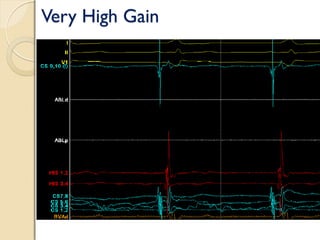
 High gain
◦ His signals (100-μV*)
◦ Mapping catheter signals
◦ Pulmonary vein catheter signals
 Issues include gaining up noise, saturation of current causing amplifier
to blank out (typically flat line) and display no signals
Venkatachalam K et al. Circ Arrhythm Electrophysiol 2011;4:965-973
Low Gain
Very High Gain
Appropriate Gain Settings
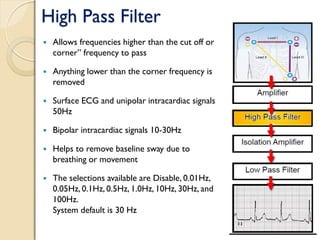
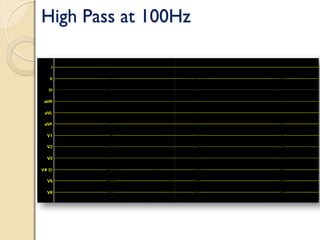
High Pass Filter
 Allows frequencies higher than the cut off or
corner” frequency to pass
 Anything lower than the corner frequency is
removed
 Surface ECG and unipolar intracardiac signals
50Hz
 Bipolar intracardiac signals 10-30Hz
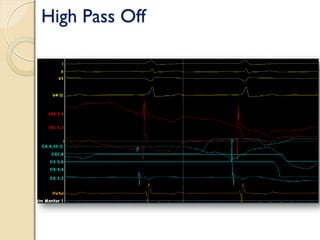
 Helps to remove baseline sway due to
breathing or movement
 The selections available are Disable, 0.01Hz,
0.05Hz, 0.1Hz, 0.5Hz, 1.0Hz, 10Hz, 30Hz, and
100Hz.
System default is 30 Hz
High Pass at 100Hz
High Pass Off
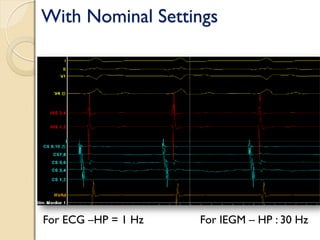
With Nominal Settings
For ECG –HP = 1 Hz For IEGM – HP : 30 Hz
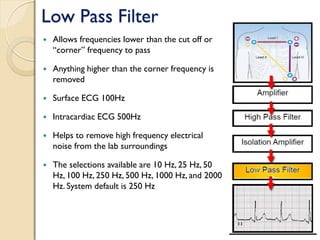
Low Pass Filter
 Allows frequencies lower than the cut off or
“corner” frequency to pass
 Anything higher than the corner frequency is
removed
 Surface ECG 100Hz
 Intracardiac ECG 500Hz
 Helps to remove high frequency electrical
noise from the lab surroundings
 The selections available are 10 Hz, 25 Hz, 50
Hz, 100 Hz, 250 Hz, 500 Hz, 1000 Hz, and 2000
Hz. System default is 250 Hz
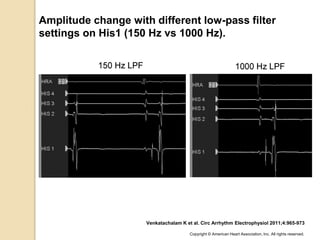
Amplitude change with different low-pass filter
settings on His1 (150 Hz vs 1000 Hz).
Venkatachalam K et al. Circ Arrhythm Electrophysiol 2011;4:965-973
Copyright © American Heart Association, Inc. All rights reserved.
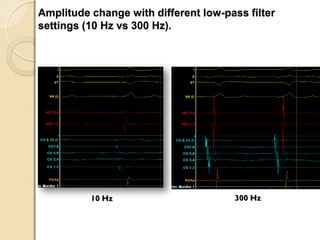
Amplitude change with different low-pass filter
settings (10 Hz vs 300 Hz).
10 Hz 300 Hz
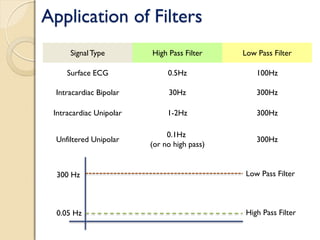
Application of Filters
SignalType High Pass Filter Low Pass Filter
Surface ECG 0.5Hz 100Hz
Intracardiac Bipolar 30Hz 300Hz
Intracardiac Unipolar 1-2Hz 300Hz
Unfiltered Unipolar
0.1Hz
(or no high pass)
300Hz
Low Pass Filter
High Pass Filter0.05 Hz
300 Hz
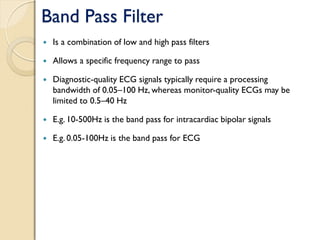
Band Pass Filter
 Is a combination of low and high pass filters
 Allows a specific frequency range to pass
 Diagnostic-quality ECG signals typically require a processing
bandwidth of 0.05–100 Hz, whereas monitor-quality ECGs may be
limited to 0.5–40 Hz
 E.g. 10-500Hz is the band pass for intracardiac bipolar signals
 E.g. 0.05-100Hz is the band pass for ECG
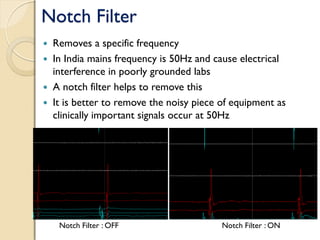
Notch Filter
 Removes a specific frequency
 In India mains frequency is 50Hz and cause electrical
interference in poorly grounded labs
 A notch filter helps to remove this
 It is better to remove the noisy piece of equipment as
clinically important signals occur at 50Hz
Notch Filter : OFF Notch Filter : ON
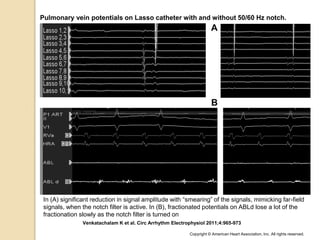
Pulmonary vein potentials on Lasso catheter with and without 50/60 Hz notch.
Venkatachalam K et al. Circ Arrhythm Electrophysiol 2011;4:965-973
Copyright © American Heart Association, Inc. All rights reserved.
In (A) significant reduction in signal amplitude with “smearing” of the signals, mimicking far-field
signals, when the notch filter is active. In (B), fractionated potentials on ABLd lose a lot of the
fractionation slowly as the notch filter is turned on
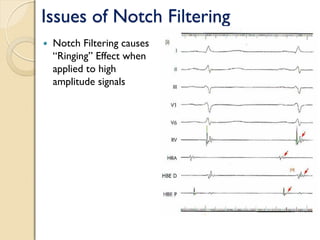
Issues of Notch Filtering
 Notch Filtering causes
“Ringing” Effect when
applied to high
amplitude signals
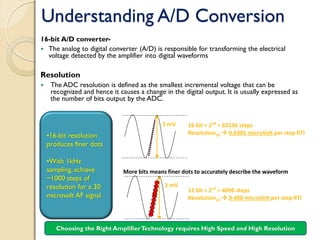
Understanding A/D Conversion
16-bit A/D converter-
 The analog to digital converter (A/D) is responsible for transforming the electrical
voltage detected by the amplifier into digital waveforms
Resolution
 The ADC resolution is defined as the smallest incremental voltage that can be
recognized and hence it causes a change in the digital output. It is usually expressed as
the number of bits output by the ADC.
2 mV 16 bit = 216
= 65536 steps
Resolution16  0.0305 microVolt per step RTI
12 bit = 212
= 4096 steps
Resolution12  0.488 microVolt per step RTI
More bits means finer dots to accurately describe the waveform
2 mV
•16-bit resolution
produces finer dots
•With 1kHz
sampling, achieve
~1000 steps of
resolution for a 30
microvolt AF signal
Choosing the Right AmplifierTechnology requires High Speed and High Resolution
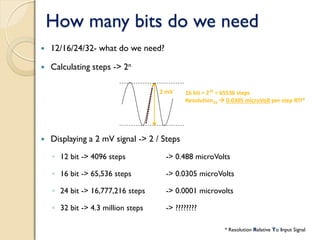
How many bits do we need
 12/16/24/32- what do we need?
 Calculating steps -> 2n
 Displaying a 2 mV signal -> 2 / Steps
◦ 12 bit -> 4096 steps -> 0.488 microVolts
◦ 16 bit -> 65,536 steps -> 0.0305 microVolts
◦ 24 bit -> 16,777,216 steps -> 0.0001 microvolts
◦ 32 bit -> 4.3 million steps -> ????????
2 mV 16 bit = 216
= 65536 steps
Resolution16  0.0305 microVolt per step RTI*
* Resolution Relative To Input Signal
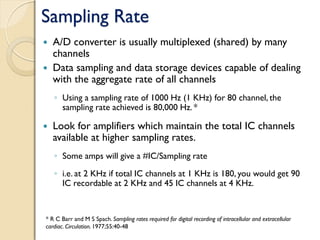
Sampling Rate
 A/D converter is usually multiplexed (shared) by many
channels
 Data sampling and data storage devices capable of dealing
with the aggregate rate of all channels
◦ Using a sampling rate of 1000 Hz (1 KHz) for 80 channel, the
sampling rate achieved is 80,000 Hz. *
 Look for amplifiers which maintain the total IC channels
available at higher sampling rates.
◦ Some amps will give a #IC/Sampling rate
◦ i.e. at 2 KHz if total IC channels at 1 KHz is 180, you would get 90
IC recordable at 2 KHz and 45 IC channels at 4 KHz.
* R C Barr and M S Spach. Sampling rates required for digital recording of intracellular and extracellular
cardiac. Circulation. 1977;55:40-48
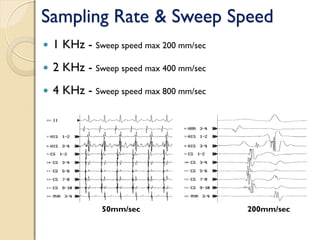
Sampling Rate & Sweep Speed
 1 KHz - Sweep speed max 200 mm/sec
 2 KHz - Sweep speed max 400 mm/sec
 4 KHz - Sweep speed max 800 mm/sec
50mm/sec 200mm/sec
Noise Affecting Signals
 EP laboratory is an extraordinarily noisy environment.
◦ ECG Machine, Pulse Oximeter, External Defib, EAM System,
Catheters.
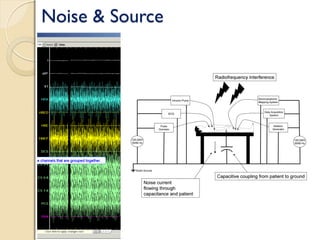
◦ Patient acts are a huge antennae picking up environmental noise like
fluorescent lamps, wireless monitors etc
 Leakage current of upto 10 μA acceptable per equipment
which most patients can tolerate without significant risk of
inducing ventricular fibrillation.
 Leakage current can interfere substantially with our ability
to process extracardiac and intracardiac signals with
minimal artifact.
Venkatachalam K et al. Circ Arrhythm Electrophysiol 2011;4:965-973
Noise & Source
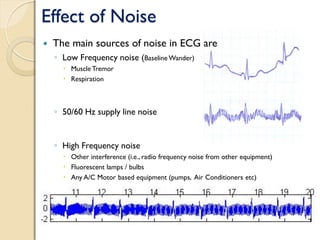
Effect of Noise
 The main sources of noise in ECG are
◦ Low Frequency noise (Baseline Wander)
 Muscle Tremor
 Respiration
◦ 50/60 Hz supply line noise
◦ High Frequency noise
 Other interference (i.e., radio frequency noise from other equipment)
 Fluorescent lamps / bulbs
 Any A/C Motor based equipment (pumps, Air Conditioners etc)
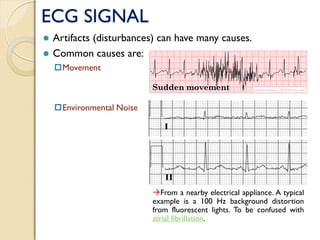
ECG SIGNAL
 Artifacts (disturbances) can have many causes.
 Common causes are:
Movement
Environmental Noise
Sudden movement
From a nearby electrical appliance. A typical
example is a 100 Hz background distortion
from fluorescent lights. To be confused with
atrial fibrillation.
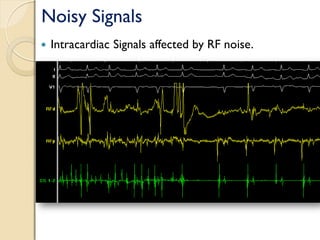
Noisy Signals
 Intracardiac Signals affected by RF noise.
Noise During RF Delivery
 Grounding?
 Connecting cable
 IEGM cable
 Faulty Catheter
 Back patch with inadequate Gel
 Pacing enabled
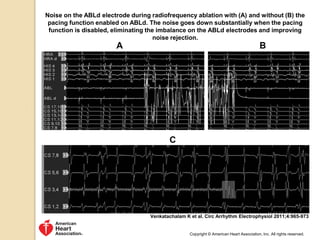
Noise on the ABLd electrode during radiofrequency ablation with (A) and without (B) the
pacing function enabled on ABLd. The noise goes down substantially when the pacing
function is disabled, eliminating the imbalance on the ABLd electrodes and improving
noise rejection.
Venkatachalam K et al. Circ Arrhythm Electrophysiol 2011;4:965-973
Copyright © American Heart Association, Inc. All rights reserved.
Grounding
 Dedicated isolated ground
◦ Pipe
◦ Plate
◦ Water Pipe
◦ Steel encased in Concrete
◦ Ground Ring
 Plate / Pole at a minimum depth of 8-10 ft
 Must have a plate / ground resistance of < 5 ohms
 Add second Plate / Pole if resistance > 5 ohms
The process of making a planned, continuous, connection between NON-
CURRENT CARRYING parts of the electrical wiring installation and the earth
and some other conducting body
Note : Grounding & Earthing are two different systems designed
for two entirely different purposes
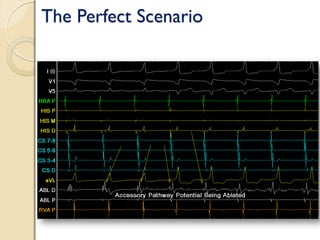
The Perfect Scenario
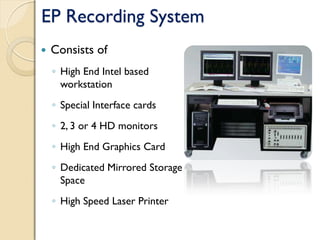
EP Recording System
 Consists of
◦ High End Intel based
workstation
◦ Special Interface cards
◦ 2, 3 or 4 HD monitors
◦ High End Graphics Card
◦ Dedicated Mirrored Storage
Space
◦ High Speed Laser Printer
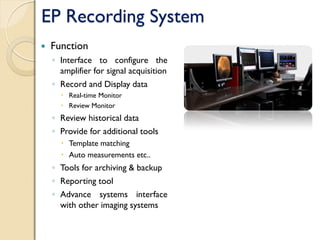
EP Recording System
 Function
◦ Interface to configure the
amplifier for signal acquisition
◦ Record and Display data
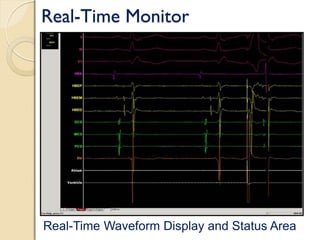
 Real-time Monitor
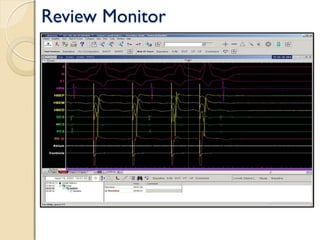
 Review Monitor
◦ Review historical data
◦ Provide for additional tools
 Template matching
 Auto measurements etc..
◦ Tools for archiving & backup
◦ Reporting tool
◦ Advance systems interface
with other imaging systems
Real-Time Monitor
Real-Time Waveform Display and Status Area
Review Monitor
Tools Provided
 Calipers
 Event Log
 Holter Mode
 Stim Sensed Review
 Trigger Mode
 Sweep Speed
 Archive
 Restore
 Backup
Additional Tools
 Template Matching
 T-Wave Subtraction
 Image Acquisition
 Dominant Frequency Analysis
 CFAE / FFT
 Reporting App.
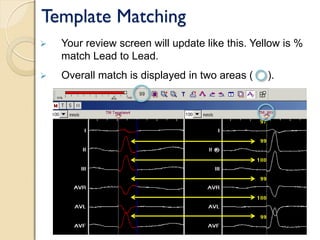
Template Matching
 Your review screen will update like this. Yellow is %
match Lead to Lead.
 Overall match is displayed in two areas ( ).
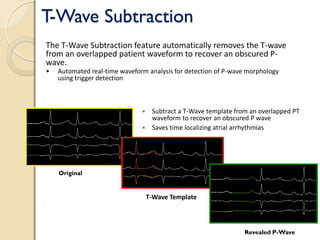
T-Wave Subtraction
 Subtract a T-Wave template from an overlapped PT
waveform to recover an obscured P wave
 Saves time localizing atrial arrhythmias
Original
Revealed P-Wave
T-Wave Template
• Automated real-time waveform analysis for detection of P-wave morphology
using trigger detection
The T-Wave Subtraction feature automatically removes the T-wave
from an overlapped patient waveform to recover an obscured P-
wave.
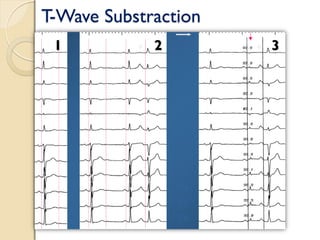
T-Wave Substraction
1 2 3
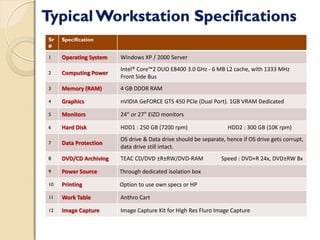
Typical Workstation Specifications
Sr
#
Specification
1 Operating System Windows XP / 2000 Server
2 Computing Power
Intel® Core™2 DUO E8400 3.0 GHz - 6 MB L2 cache, with 1333 MHz
Front Side Bus
3 Memory (RAM) 4 GB DDDR RAM
4 Graphics nVIDIA GeFORCE GTS 450 PCIe (Dual Port). 1GB VRAM Dedicated
5 Monitors 24” or 27” EIZO monitors
6 Hard Disk HDD1 : 250 GB (7200 rpm) HDD2 : 300 GB (10K rpm)
7 Data Protection
OS drive & Data drive should be separate, hence if OS drive gets corrupt,
data drive still intact.
8 DVD/CD Archiving TEAC CD/DVD ±R±RW/DVD-RAM Speed : DVD+R 24x, DVD±RW 8x
9 Power Source Through dedicated isolation box
10 Printing Option to use own specs or HP
11 Work Table Anthro Cart
12 Image Capture Image Capture Kit for High Res Fluro Image Capture
All
The Best

Amplifiers, filters and digital recording systems

  • 1.
    Cardiac EP Lab: Amplifiers, Filters, Digital Recording System
  • 2.
    EP Procedure inProgress 1 2 3 4 5 1. Patient 2. Catheter & Connectors 3. Junction Box 4. Fluro Display 5. EP Recording System
  • 3.
    The Components  EPEquipment ◦ Recording System ◦ Amplifier ◦ Stimulator ◦ Catheters  Diagnostic  Ablation ◦ RF Ablator  Fluoroscopy & Radiographic table  Other Essential Equipment: Hemodynamic monitor, Pulse Oximetry, Infusion pumps, External Defibrillator, Essential Drugs, Temporary Pacemaker & Resuscitation equipment  The Patient Handbook of Cardiac Electrophysiology: A Practical Guide to Invasive EP Studies and Catheter Ablation. F. D Murgatroyd, et al.
  • 4.
    Diagnostic Catheters ◦ 4– 7Fr, Hollow sealed tubes made of Polyurethane (steel braided core) or Dacron fiber (woven core) material with platinum or steel electrodes at the distal end. ◦ Conducting wires used are steel (polyurethane) or Silver (Dacron) ◦ Electrical signals are recorded from the endocardium by specialized catheters with embedded platinum electrodes ◦ Commonly, there are either 4 (Quad), 8 (Octa), 10 (Deca: CS) or 20 (Duo Deca: RA, PV) electrodes ◦ These electrodes can also be configured to pace, that is, apply electrical stimulation to the heart Boston Scientific Image Library. 1 2 3 4 Alden Redel Easy-Mate Josephson
  • 5.
    Ablation Catheter  7FrPolyurethane hollow sealed tubes  Temperature sensor ◦ Thermistor ◦ Thermocouple  Tip Size ◦ 4 / 8 mm large dome - most commonly used tip dome ◦ 5 mm large dome  Irrigated (Thermocouple) ◦ 3.5 – 4 mm dome ◦ Also available 8 mm ◦ 6 – 12 perfusion holes
  • 6.
    Diagnostic Catheter Placements HRA High Right Atrium RA-SVC junction ◦ Records Sinus node  HIS above TV ◦ Marker for the AV node  CS in CS and advanced in the AV groove ◦ Records left atrial and ventricular activity  RVA apex of right ventricle ◦ Records RV from bottom most area Radiofrequency Ablation of Cardiac Arrhythmias; Lawrence S. Klein and William M. Miles; Scientific American Science and Medicine; May/June 1994. Permission of authors.
  • 7.
    Unipolar Signals  Derivedfrom the potential difference between a point source using an exploring electrode in direct contact with the heart (positive input - anode) and a zero reference (negative input - cathode)  The Wilson CentralTerminal or a remote electrode (e.g. in the IVC) as the other electrode
  • 8.
    Bipolar Signal  Recordsignals using two electrodes close to one another  Sharper local signals  Much smaller far field signals  Preferred recording method in most EP labs (Signal 1 + Noise) – (Signal 2 + Noise) = Signal 1 – Signal 2 Signal 1 Signal 2
  • 9.
    Junction Box  JBor CIM receive IC signals from the catheters and provide an interface into the physiologic recorded ◦ 20, 40, 54, 80, 102 upto 320 inputs  Multiple switches within the JB are designated to a recording and stimulation channel which is predefined by the recording system. Handbook of Cardiac Electrophysiology. Organization of the arrhythmia lab. Andrea Natale et al. 3:17-24. 2007.
  • 10.
    Cardiac Amplifier Consists of ◦ECG Interface ◦ Hemodynamic Interface ◦ Intracardiac Interface (Jbox) ◦ Stimulation Interface ◦ Input Aux Ports ◦ Output Aux Ports Functions ◦ Amplifies Input Analog Signals ◦ Apply filtering to input analog signals ◦ Convert Analog data to digital ◦ Direct Stim impulse to appropriate channel Conducts POST (Power On SelfTest) 1. Board Integrity 2. Working Environment
  • 11.
  • 12.
    Signal Amplification  Physiologicsignals acquired from surface and IC electrodes are typically ◦ 25 μV (as measured in infracted regions during ventricular tachycardia mapping) ◦ 5mV (from a surface ECG lead) ◦ Upto 20 mV in healthy myocardium  Considerable amplification is required before the signals are digitized, displayed and stored.  Amplifiers have different techniques of amplifying the input signals. ◦ Hardwired gain ◦ Gain value -> In mV, percentage or factor ◦ Software gain Venkatachalam K et al. Circ Arrhythm Electrophysiol 2011;4:965-973
  • 13.
    Signal Amplification  Lowgain - Surface ECG, Unipolar IC signals  Moderate gain - RV, RA,CS signals  High gain ◦ His signals (100-μV*) ◦ Mapping catheter signals ◦ Pulmonary vein catheter signals  Issues include gaining up noise, saturation of current causing amplifier to blank out (typically flat line) and display no signals Venkatachalam K et al. Circ Arrhythm Electrophysiol 2011;4:965-973
  • 14.
  • 15.
  • 16.
  • 17.
    High Pass Filter Allows frequencies higher than the cut off or corner” frequency to pass  Anything lower than the corner frequency is removed  Surface ECG and unipolar intracardiac signals 50Hz  Bipolar intracardiac signals 10-30Hz  Helps to remove baseline sway due to breathing or movement  The selections available are Disable, 0.01Hz, 0.05Hz, 0.1Hz, 0.5Hz, 1.0Hz, 10Hz, 30Hz, and 100Hz. System default is 30 Hz
  • 18.
  • 19.
  • 20.
    With Nominal Settings ForECG –HP = 1 Hz For IEGM – HP : 30 Hz
  • 21.
    Low Pass Filter Allows frequencies lower than the cut off or “corner” frequency to pass  Anything higher than the corner frequency is removed  Surface ECG 100Hz  Intracardiac ECG 500Hz  Helps to remove high frequency electrical noise from the lab surroundings  The selections available are 10 Hz, 25 Hz, 50 Hz, 100 Hz, 250 Hz, 500 Hz, 1000 Hz, and 2000 Hz. System default is 250 Hz
  • 22.
    Amplitude change withdifferent low-pass filter settings on His1 (150 Hz vs 1000 Hz). Venkatachalam K et al. Circ Arrhythm Electrophysiol 2011;4:965-973 Copyright © American Heart Association, Inc. All rights reserved.
  • 23.
    Amplitude change withdifferent low-pass filter settings (10 Hz vs 300 Hz). 10 Hz 300 Hz
  • 24.
    Application of Filters SignalTypeHigh Pass Filter Low Pass Filter Surface ECG 0.5Hz 100Hz Intracardiac Bipolar 30Hz 300Hz Intracardiac Unipolar 1-2Hz 300Hz Unfiltered Unipolar 0.1Hz (or no high pass) 300Hz Low Pass Filter High Pass Filter0.05 Hz 300 Hz
  • 25.
    Band Pass Filter Is a combination of low and high pass filters  Allows a specific frequency range to pass  Diagnostic-quality ECG signals typically require a processing bandwidth of 0.05–100 Hz, whereas monitor-quality ECGs may be limited to 0.5–40 Hz  E.g. 10-500Hz is the band pass for intracardiac bipolar signals  E.g. 0.05-100Hz is the band pass for ECG
  • 26.
    Notch Filter  Removesa specific frequency  In India mains frequency is 50Hz and cause electrical interference in poorly grounded labs  A notch filter helps to remove this  It is better to remove the noisy piece of equipment as clinically important signals occur at 50Hz Notch Filter : OFF Notch Filter : ON
  • 27.
    Pulmonary vein potentialson Lasso catheter with and without 50/60 Hz notch. Venkatachalam K et al. Circ Arrhythm Electrophysiol 2011;4:965-973 Copyright © American Heart Association, Inc. All rights reserved. In (A) significant reduction in signal amplitude with “smearing” of the signals, mimicking far-field signals, when the notch filter is active. In (B), fractionated potentials on ABLd lose a lot of the fractionation slowly as the notch filter is turned on
  • 28.
    Issues of NotchFiltering  Notch Filtering causes “Ringing” Effect when applied to high amplitude signals
  • 29.
    Understanding A/D Conversion 16-bitA/D converter-  The analog to digital converter (A/D) is responsible for transforming the electrical voltage detected by the amplifier into digital waveforms Resolution  The ADC resolution is defined as the smallest incremental voltage that can be recognized and hence it causes a change in the digital output. It is usually expressed as the number of bits output by the ADC. 2 mV 16 bit = 216 = 65536 steps Resolution16  0.0305 microVolt per step RTI 12 bit = 212 = 4096 steps Resolution12  0.488 microVolt per step RTI More bits means finer dots to accurately describe the waveform 2 mV •16-bit resolution produces finer dots •With 1kHz sampling, achieve ~1000 steps of resolution for a 30 microvolt AF signal Choosing the Right AmplifierTechnology requires High Speed and High Resolution
  • 30.
    How many bitsdo we need  12/16/24/32- what do we need?  Calculating steps -> 2n  Displaying a 2 mV signal -> 2 / Steps ◦ 12 bit -> 4096 steps -> 0.488 microVolts ◦ 16 bit -> 65,536 steps -> 0.0305 microVolts ◦ 24 bit -> 16,777,216 steps -> 0.0001 microvolts ◦ 32 bit -> 4.3 million steps -> ???????? 2 mV 16 bit = 216 = 65536 steps Resolution16  0.0305 microVolt per step RTI* * Resolution Relative To Input Signal
  • 31.
    Sampling Rate  A/Dconverter is usually multiplexed (shared) by many channels  Data sampling and data storage devices capable of dealing with the aggregate rate of all channels ◦ Using a sampling rate of 1000 Hz (1 KHz) for 80 channel, the sampling rate achieved is 80,000 Hz. *  Look for amplifiers which maintain the total IC channels available at higher sampling rates. ◦ Some amps will give a #IC/Sampling rate ◦ i.e. at 2 KHz if total IC channels at 1 KHz is 180, you would get 90 IC recordable at 2 KHz and 45 IC channels at 4 KHz. * R C Barr and M S Spach. Sampling rates required for digital recording of intracellular and extracellular cardiac. Circulation. 1977;55:40-48
  • 32.
    Sampling Rate &Sweep Speed  1 KHz - Sweep speed max 200 mm/sec  2 KHz - Sweep speed max 400 mm/sec  4 KHz - Sweep speed max 800 mm/sec 50mm/sec 200mm/sec
  • 33.
    Noise Affecting Signals EP laboratory is an extraordinarily noisy environment. ◦ ECG Machine, Pulse Oximeter, External Defib, EAM System, Catheters. ◦ Patient acts are a huge antennae picking up environmental noise like fluorescent lamps, wireless monitors etc  Leakage current of upto 10 μA acceptable per equipment which most patients can tolerate without significant risk of inducing ventricular fibrillation.  Leakage current can interfere substantially with our ability to process extracardiac and intracardiac signals with minimal artifact. Venkatachalam K et al. Circ Arrhythm Electrophysiol 2011;4:965-973
  • 34.
  • 35.
    Effect of Noise The main sources of noise in ECG are ◦ Low Frequency noise (Baseline Wander)  Muscle Tremor  Respiration ◦ 50/60 Hz supply line noise ◦ High Frequency noise  Other interference (i.e., radio frequency noise from other equipment)  Fluorescent lamps / bulbs  Any A/C Motor based equipment (pumps, Air Conditioners etc)
  • 36.
    ECG SIGNAL  Artifacts(disturbances) can have many causes.  Common causes are: Movement Environmental Noise Sudden movement From a nearby electrical appliance. A typical example is a 100 Hz background distortion from fluorescent lights. To be confused with atrial fibrillation.
  • 37.
    Noisy Signals  IntracardiacSignals affected by RF noise.
  • 38.
    Noise During RFDelivery  Grounding?  Connecting cable  IEGM cable  Faulty Catheter  Back patch with inadequate Gel  Pacing enabled
  • 39.
    Noise on theABLd electrode during radiofrequency ablation with (A) and without (B) the pacing function enabled on ABLd. The noise goes down substantially when the pacing function is disabled, eliminating the imbalance on the ABLd electrodes and improving noise rejection. Venkatachalam K et al. Circ Arrhythm Electrophysiol 2011;4:965-973 Copyright © American Heart Association, Inc. All rights reserved.
  • 40.
    Grounding  Dedicated isolatedground ◦ Pipe ◦ Plate ◦ Water Pipe ◦ Steel encased in Concrete ◦ Ground Ring  Plate / Pole at a minimum depth of 8-10 ft  Must have a plate / ground resistance of < 5 ohms  Add second Plate / Pole if resistance > 5 ohms The process of making a planned, continuous, connection between NON- CURRENT CARRYING parts of the electrical wiring installation and the earth and some other conducting body Note : Grounding & Earthing are two different systems designed for two entirely different purposes
  • 41.
  • 42.
    EP Recording System Consists of ◦ High End Intel based workstation ◦ Special Interface cards ◦ 2, 3 or 4 HD monitors ◦ High End Graphics Card ◦ Dedicated Mirrored Storage Space ◦ High Speed Laser Printer
  • 43.
    EP Recording System Function ◦ Interface to configure the amplifier for signal acquisition ◦ Record and Display data  Real-time Monitor  Review Monitor ◦ Review historical data ◦ Provide for additional tools  Template matching  Auto measurements etc.. ◦ Tools for archiving & backup ◦ Reporting tool ◦ Advance systems interface with other imaging systems
  • 44.
    Real-Time Monitor Real-Time WaveformDisplay and Status Area
  • 45.
  • 46.
    Tools Provided  Calipers Event Log  Holter Mode  Stim Sensed Review  Trigger Mode  Sweep Speed  Archive  Restore  Backup
  • 47.
    Additional Tools  TemplateMatching  T-Wave Subtraction  Image Acquisition  Dominant Frequency Analysis  CFAE / FFT  Reporting App.
  • 48.
    Template Matching  Yourreview screen will update like this. Yellow is % match Lead to Lead.  Overall match is displayed in two areas ( ).
  • 49.
    T-Wave Subtraction  Subtracta T-Wave template from an overlapped PT waveform to recover an obscured P wave  Saves time localizing atrial arrhythmias Original Revealed P-Wave T-Wave Template • Automated real-time waveform analysis for detection of P-wave morphology using trigger detection The T-Wave Subtraction feature automatically removes the T-wave from an overlapped patient waveform to recover an obscured P- wave.
  • 50.
  • 51.
    Typical Workstation Specifications Sr # Specification 1Operating System Windows XP / 2000 Server 2 Computing Power Intel® Core™2 DUO E8400 3.0 GHz - 6 MB L2 cache, with 1333 MHz Front Side Bus 3 Memory (RAM) 4 GB DDDR RAM 4 Graphics nVIDIA GeFORCE GTS 450 PCIe (Dual Port). 1GB VRAM Dedicated 5 Monitors 24” or 27” EIZO monitors 6 Hard Disk HDD1 : 250 GB (7200 rpm) HDD2 : 300 GB (10K rpm) 7 Data Protection OS drive & Data drive should be separate, hence if OS drive gets corrupt, data drive still intact. 8 DVD/CD Archiving TEAC CD/DVD ±R±RW/DVD-RAM Speed : DVD+R 24x, DVD±RW 8x 9 Power Source Through dedicated isolation box 10 Printing Option to use own specs or HP 11 Work Table Anthro Cart 12 Image Capture Image Capture Kit for High Res Fluro Image Capture
  • 52.