Visit ebookfinal.com to download the full version and
explore more ebooks or textbooks
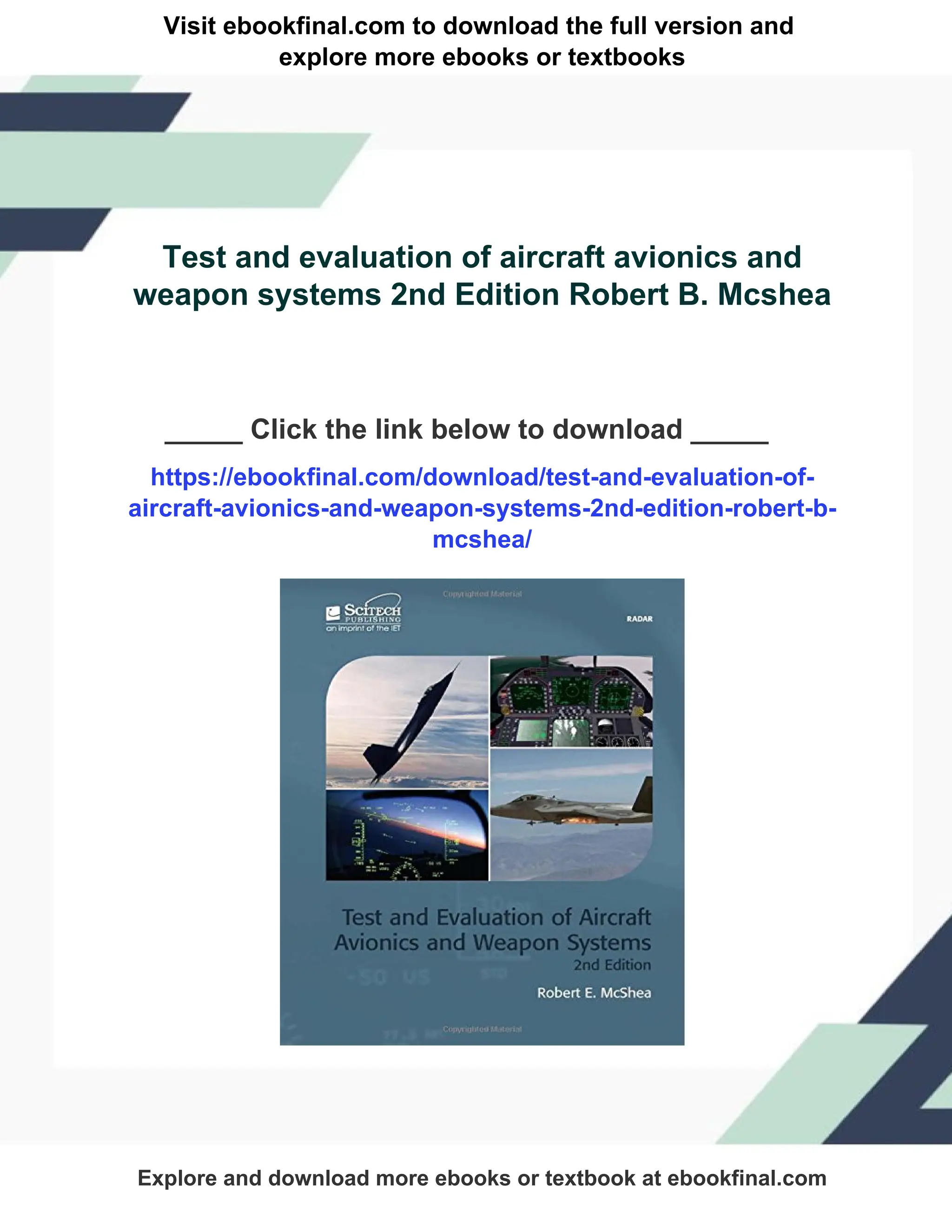
Test and evaluation of aircraft avionics and
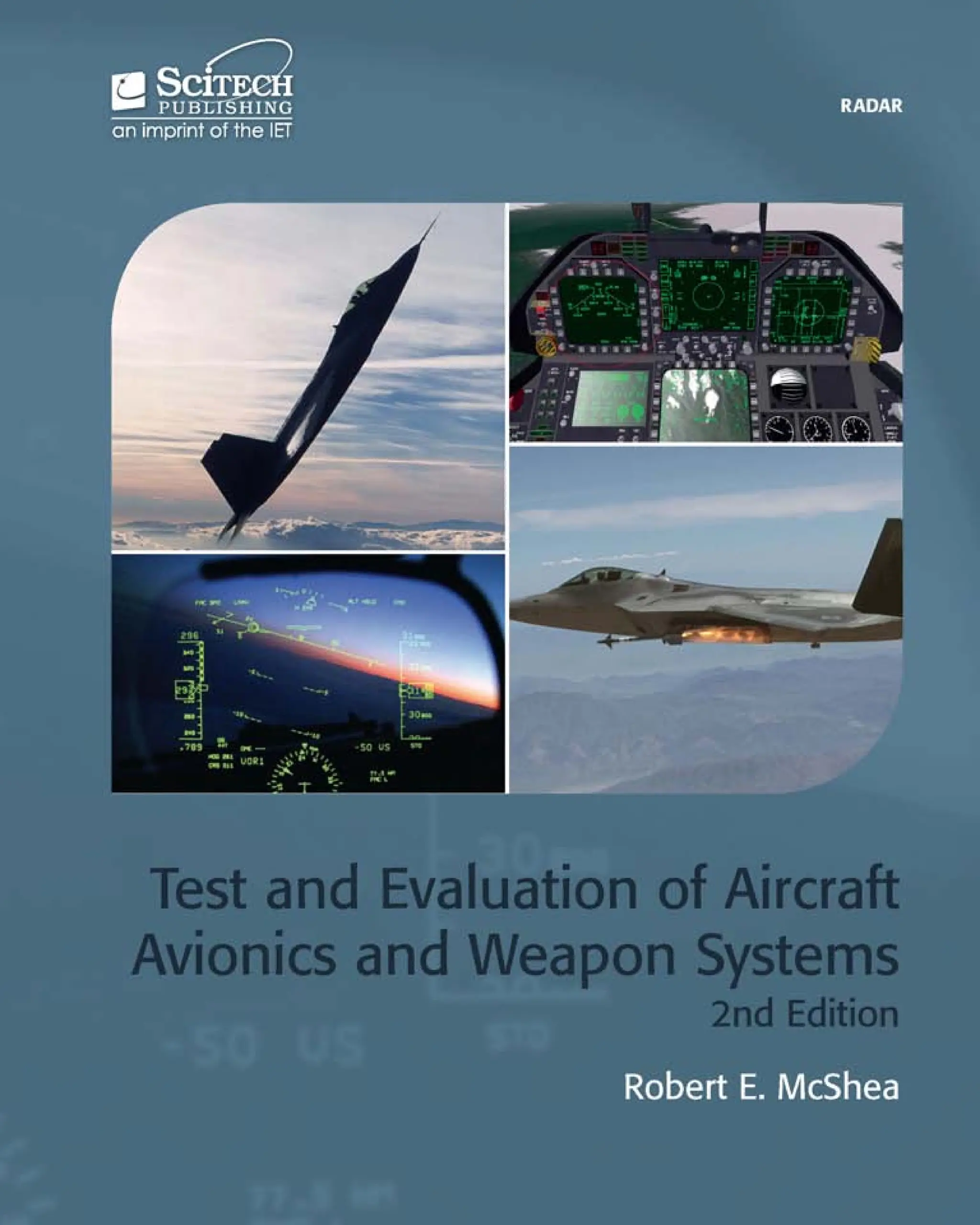
weapon systems 2nd Edition Robert B. Mcshea
_____ Click the link below to download _____
https://ebookfinal.com/download/test-and-evaluation-of-
aircraft-avionics-and-weapon-systems-2nd-edition-robert-b-
mcshea/
Explore and download more ebooks or textbook at ebookfinal.com
Here are some recommended products that we believe you will be
interested in. You can click the link to download.
Reaction Mechanisms of Inorganic and Organometallic
Systems 3rd Edition Robert B. Jordan
https://ebookfinal.com/download/reaction-mechanisms-of-inorganic-and-
organometallic-systems-3rd-edition-robert-b-jordan/
Comparative Analysis of Evaluation Methodologies in Weapon
Collection Programmes 1st Edition United Nations
https://ebookfinal.com/download/comparative-analysis-of-evaluation-
methodologies-in-weapon-collection-programmes-1st-edition-united-
nations/
Aircraft electrical and electronic systems principles
operation and maintenance 1st ed Edition Wyatt
https://ebookfinal.com/download/aircraft-electrical-and-electronic-
systems-principles-operation-and-maintenance-1st-ed-edition-wyatt/
Stability and Control of Aircraft Systems Introduction to
Classical Feedback Control 1st Edition Roy Langton
https://ebookfinal.com/download/stability-and-control-of-aircraft-
systems-introduction-to-classical-feedback-control-1st-edition-roy-
langton/
Practical Program Evaluation Theory Driven Evaluation and
the Integrated Evaluation Perspective 2nd Edition Huey T.
Chen
https://ebookfinal.com/download/practical-program-evaluation-theory-
driven-evaluation-and-the-integrated-evaluation-perspective-2nd-
edition-huey-t-chen/
Cost Benefit Analysis of the 2006 Air Force Materiel
Command Test and Evaluation Proposal 1st Edition Michael
R. Thirtle
https://ebookfinal.com/download/cost-benefit-analysis-of-the-2006-air-
force-materiel-command-test-and-evaluation-proposal-1st-edition-
michael-r-thirtle/
Strapdown Inertial Navigation Technology IEE Radar Sonar
Navigation and Avionics Series 2nd Edition David Titterton
https://ebookfinal.com/download/strapdown-inertial-navigation-
technology-iee-radar-sonar-navigation-and-avionics-series-2nd-edition-
david-titterton/
Evaluation of Enzyme Inhibitors in Drug Discovery Robert
A. Copeland
https://ebookfinal.com/download/evaluation-of-enzyme-inhibitors-in-
drug-discovery-robert-a-copeland/
Information Processing and Living Systems Vladimir B.
Bajic
https://ebookfinal.com/download/information-processing-and-living-
systems-vladimir-b-bajic/
Test and evaluation of aircraft avionics and weapon
systems 2nd Edition Robert B. Mcshea Digital Instant
Download
Author(s): Robert B. McShea
ISBN(s): 9781680158342, 1613531761
Edition: 2
File Details: PDF, 50.20 MB
Year: 2014
Language: english
Test and Evaluation of Aircraft
Avionics and Weapon Systems
Test and Evaluation of Aircraft
Avionics and Weapon Systems
2nd Edition
Robert E. McShea
Edison, NJ
theiet.org
Published by SciTech Publishing, an imprint of the IET.
www.scitechpub.com
www.theiet.org
 2010, 2014 by SciTech Publishing, Edison, NJ. All rights reserved.
First edition 2010
Second edition 2014
No part of this publication may be reproduced, stored in a retrieval system or transmitted in any form or by any
means, electronic, mechanical, photocopying, recording, scanning or otherwise, except as permitted under Sections
107 or 108 of the 1976 United States Copyright Act, without either the prior written permission of the Publisher, or
authorization through payment of the appropriate per-copy fee to the Copyright Clearance Center, 222 Rosewood
Drive, Danvers, MA 01923, (978) 750-8400, fax (978) 646-8600, or on the web at copyright.com. Requests to the
Publisher for permission should be addressed to The Institution of Engineering and Technology, Michael Faraday
House, Six Hills Way, Stevenage, Herts, SG1 2AY, United Kingdom.
While the author and publisher believe that the information and guidance given in this work are correct, all parties
must rely upon their own skill and judgement when making use of them. Neither the author nor publisher assumes
any liability to anyone for any loss or damage caused by any error or omission in the work, whether such an error or
omission is the result of negligence or any other cause. Any and all such liability is disclaimed.
Editor: Dudley R. Kay
10 9 8 7 6 5 4 3 2 1
ISBN 978-1-61353-176-1 (hardback)
ISBN 978-1-61353-180-8 (PDF)
Typeset in India by MPS Limited
Printed in the USA by Sheridan Books Inc.
Printed in the UK by CPI Group (UK) Ltd, Croydon
This Book is Dedicated to
Marlenni Belinni
Friends till the end
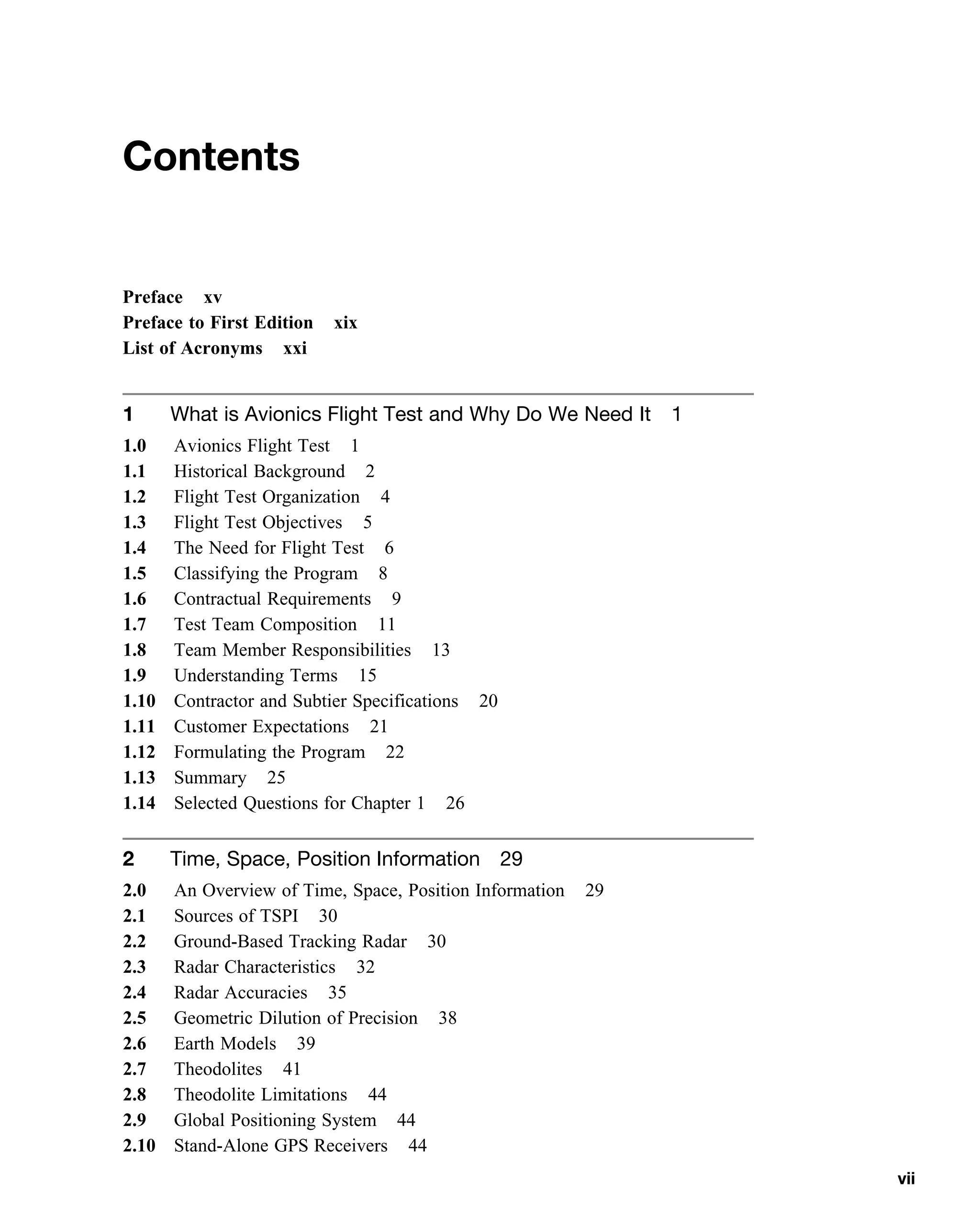
Contents
Preface xv
Preface to First Edition xix
List of Acronyms xxi
1 What is Avionics Flight Test and Why Do We Need It 1
1.0 Avionics Flight Test 1
1.1 Historical Background 2
1.2 Flight Test Organization 4
1.3 Flight Test Objectives 5
1.4 The Need for Flight Test 6
1.5 Classifying the Program 8
1.6 Contractual Requirements 9
1.7 Test Team Composition 11
1.8 Team Member Responsibilities 13
1.9 Understanding Terms 15
1.10 Contractor and Subtier Specifications 20
1.11 Customer Expectations 21
1.12 Formulating the Program 22
1.13 Summary 25
1.14 Selected Questions for Chapter 1 26
2 Time, Space, Position Information 29
2.0 An Overview of Time, Space, Position Information 29
2.1 Sources of TSPI 30
2.2 Ground-Based Tracking Radar 30
2.3 Radar Characteristics 32
2.4 Radar Accuracies 35
2.5 Geometric Dilution of Precision 38
2.6 Earth Models 39
2.7 Theodolites 41
2.8 Theodolite Limitations 44
2.9 Global Positioning System 44
2.10 Stand-Alone GPS Receivers 44
vii
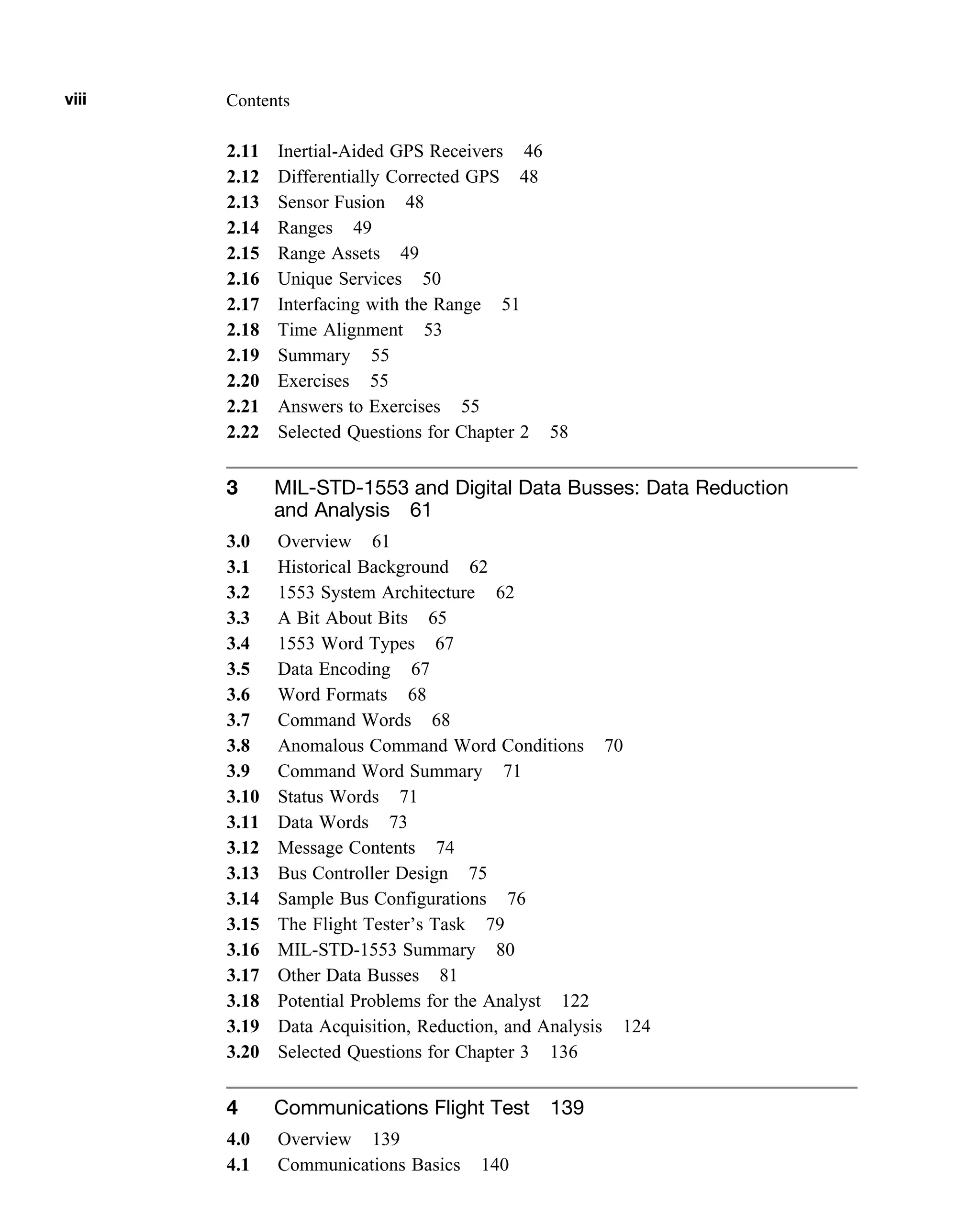
2.11 Inertial-Aided GPS Receivers 46
2.12 Differentially Corrected GPS 48
2.13 Sensor Fusion 48
2.14 Ranges 49
2.15 Range Assets 49
2.16 Unique Services 50
2.17 Interfacing with the Range 51
2.18 Time Alignment 53
2.19 Summary 55
2.20 Exercises 55
2.21 Answers to Exercises 55
2.22 Selected Questions for Chapter 2 58
3 MIL-STD-1553 and Digital Data Busses: Data Reduction
and Analysis 61
3.0 Overview 61
3.1 Historical Background 62
3.2 1553 System Architecture 62
3.3 A Bit About Bits 65
3.4 1553 Word Types 67
3.5 Data Encoding 67
3.6 Word Formats 68
3.7 Command Words 68
3.8 Anomalous Command Word Conditions 70
3.9 Command Word Summary 71
3.10 Status Words 71
3.11 Data Words 73
3.12 Message Contents 74
3.13 Bus Controller Design 75
3.14 Sample Bus Configurations 76
3.15 The Flight Tester’s Task 79
3.16 MIL-STD-1553 Summary 80
3.17 Other Data Busses 81
3.18 Potential Problems for the Analyst 122
3.19 Data Acquisition, Reduction, and Analysis 124
3.20 Selected Questions for Chapter 3 136
4 Communications Flight Test 139
4.0 Overview 139
4.1 Communications Basics 140
viii Contents
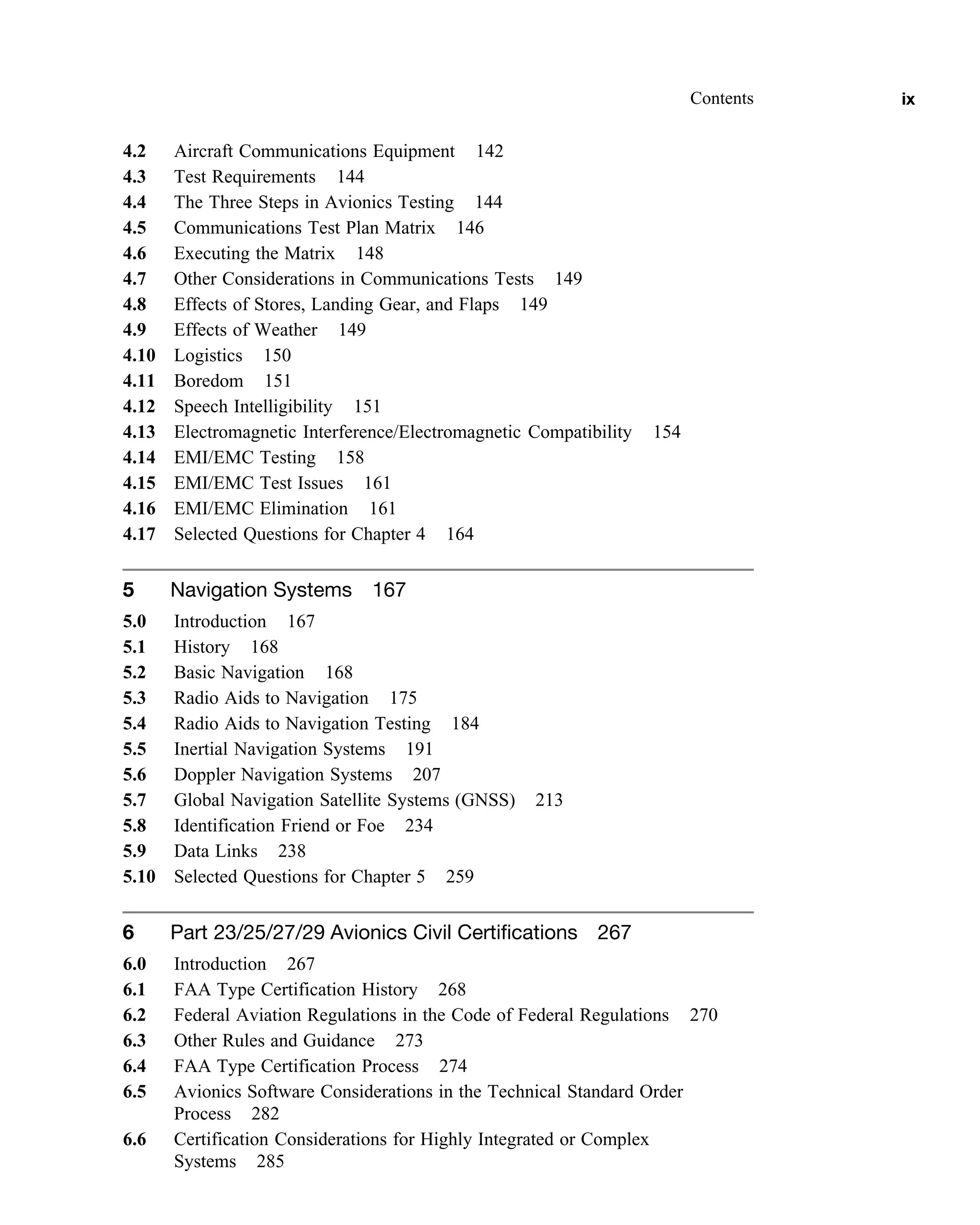
4.2 Aircraft Communications Equipment 142
4.3 Test Requirements 144
4.4 The Three Steps in Avionics Testing 144
4.5 Communications Test Plan Matrix 146
4.6 Executing the Matrix 148
4.7 Other Considerations in Communications Tests 149
4.8 Effects of Stores, Landing Gear, and Flaps 149
4.9 Effects of Weather 149
4.10 Logistics 150
4.11 Boredom 151
4.12 Speech Intelligibility 151
4.13 Electromagnetic Interference/Electromagnetic Compatibility 154
4.14 EMI/EMC Testing 158
4.15 EMI/EMC Test Issues 161
4.16 EMI/EMC Elimination 161
4.17 Selected Questions for Chapter 4 164
5 Navigation Systems 167
5.0 Introduction 167
5.1 History 168
5.2 Basic Navigation 168
5.3 Radio Aids to Navigation 175
5.4 Radio Aids to Navigation Testing 184
5.5 Inertial Navigation Systems 191
5.6 Doppler Navigation Systems 207
5.7 Global Navigation Satellite Systems (GNSS) 213
5.8 Identification Friend or Foe 234
5.9 Data Links 238
5.10 Selected Questions for Chapter 5 259
6 Part 23/25/27/29 Avionics Civil Certifications 267
6.0 Introduction 267
6.1 FAA Type Certification History 268
6.2 Federal Aviation Regulations in the Code of Federal Regulations 270
6.3 Other Rules and Guidance 273
6.4 FAA Type Certification Process 274
6.5 Avionics Software Considerations in the Technical Standard Order
Process 282
6.6 Certification Considerations for Highly Integrated or Complex
Systems 285
Contents ix
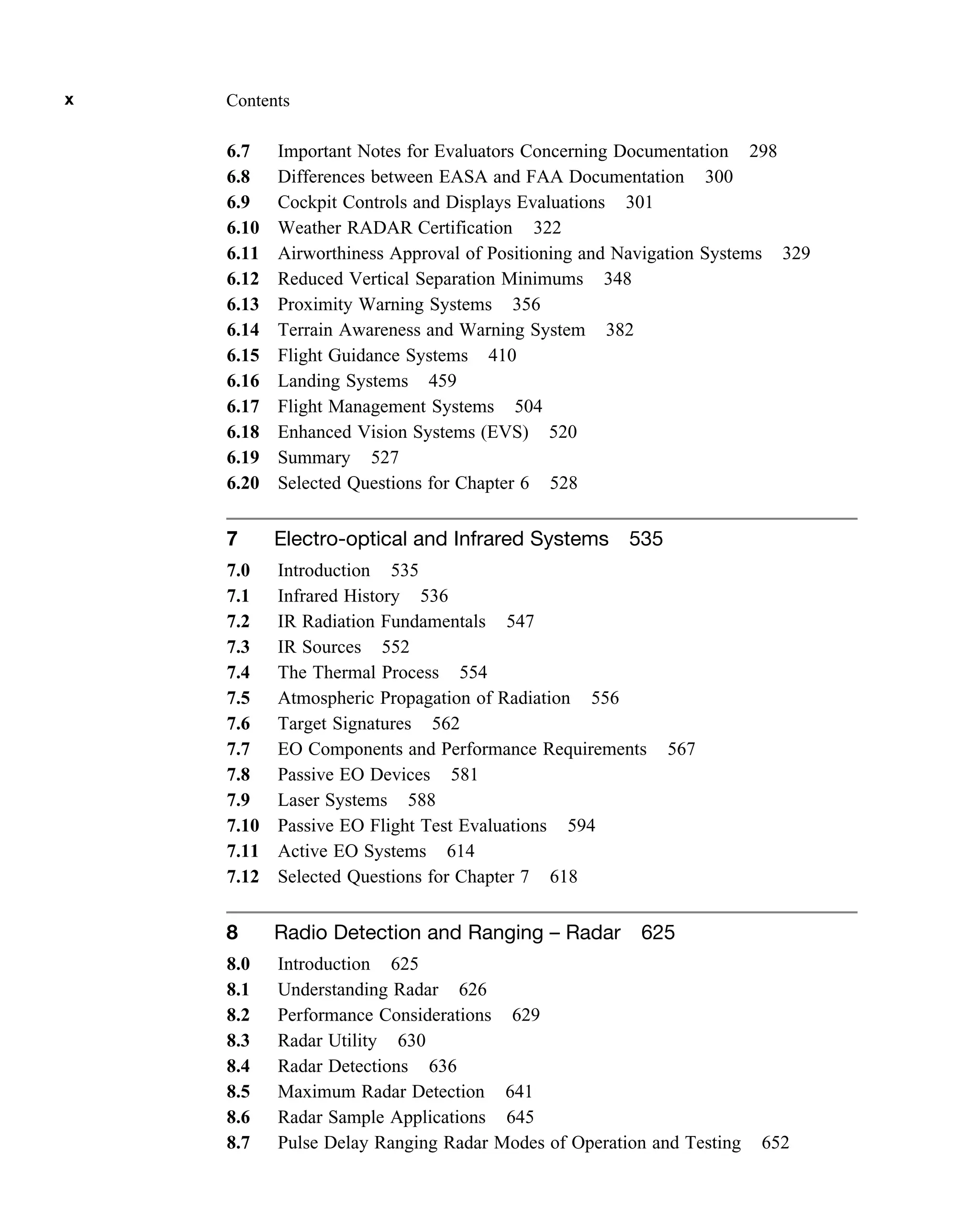
6.7 Important Notes for Evaluators Concerning Documentation 298
6.8 Differences between EASA and FAA Documentation 300
6.9 Cockpit Controls and Displays Evaluations 301
6.10 Weather RADAR Certification 322
6.11 Airworthiness Approval of Positioning and Navigation Systems 329
6.12 Reduced Vertical Separation Minimums 348
6.13 Proximity Warning Systems 356
6.14 Terrain Awareness and Warning System 382
6.15 Flight Guidance Systems 410
6.16 Landing Systems 459
6.17 Flight Management Systems 504
6.18 Enhanced Vision Systems (EVS) 520
6.19 Summary 527
6.20 Selected Questions for Chapter 6 528
7 Electro-optical and Infrared Systems 535
7.0 Introduction 535
7.1 Infrared History 536
7.2 IR Radiation Fundamentals 547
7.3 IR Sources 552
7.4 The Thermal Process 554
7.5 Atmospheric Propagation of Radiation 556
7.6 Target Signatures 562
7.7 EO Components and Performance Requirements 567
7.8 Passive EO Devices 581
7.9 Laser Systems 588
7.10 Passive EO Flight Test Evaluations 594
7.11 Active EO Systems 614
7.12 Selected Questions for Chapter 7 618
8 Radio Detection and Ranging – Radar 625
8.0 Introduction 625
8.1 Understanding Radar 626
8.2 Performance Considerations 629
8.3 Radar Utility 630
8.4 Radar Detections 636
8.5 Maximum Radar Detection 641
8.6 Radar Sample Applications 645
8.7 Pulse Delay Ranging Radar Modes of Operation and Testing 652
x Contents
8.8 Doppler and Pulse Doppler Modes of Operation and Testing 668
8.9 Air-to-Ground Radar 694
8.10 Millimetric Wave Radar 710
8.11 Miscellaneous Modes of Radar 712
8.12 Some Final Considerations in Radar Testing 712
8.13 Selected Questions for Chapter 8 714
9 Electronic Warfare 719
9.0 Introduction 719
9.1 Electronic Warfare Overview 720
9.2 The Threat 724
9.3 Air Defense Systems 728
9.4 Electronic Attack 729
9.5 Noise Jamming 734
9.6 Deception Jamming 738
9.7 Chaff Employment 742
9.8 Flare Employment 743
9.9 Electronic Protection Measures 745
9.10 Electronic Warfare Systems Test and Evaluation 748
9.11 Finally 760
9.12 Selected Questions for Chapter 9 760
10 Air-to-Air/Air-to-Ground Weapons Integration 763
10.0 Introduction 763
10.1 Weapons Overview 764
10.2 Stores Management System 767
10.3 Air-to-Air Missiles 785
10.4 Air-to-Ground Weapons 803
10.5 MIL-HDBK-1763 Test Requirements 812
10.6 AGARD Flight Test Techniques Series, Volume 10 Requirements 820
10.7 Weapons Delivery Considerations for Helicopters 824
10.8 Selected Questions for Chapter 10 828
11 A Typical Avionics Integration Flight Test Program 831
11.0 Introduction 831
11.1 Vehicle Test Requirements 831
11.2 Avionics Test Requirements 833
11.3 Test Planning 835
Contents xi
11.4 Responsibilities of the Test Team 843
11.5 Analysis and Reporting 848
11.6 Selected Questions for Chapter 11 849
12 Unmanned Aerial Vehicles (UAV) 851
12.0 Introduction 851
12.1 UAV Types 852
12.2 Interoperability 856
12.3 The Airworthiness Certificate 857
12.4 UAS Communications Architecture 860
12.5 Navigation 886
12.6 Autopilots 889
12.7 Sense and Avoid Systems 892
12.8 Payload 899
12.9 Optionally Piloted Aircraft (OPA) 901
12.10 Summary 902
12.11 Selected Questions for Chapter 12 902
13 Night Vision Imaging Systems (NVIS) and Helmet
Mounted Displays (HMD) 907
13.0 Introduction 907
13.1 Overview 908
13.2 Image Intensification (I2
) Technology 909
13.3 NVG Human Factors Issues 918
13.4 Lighting Specifications 920
13.5 Interior NVIS Lighting Methods 924
13.6 Exterior Lighting Methods 929
13.7 Test and Evaluation of NVIS Equipment 931
13.8 Some Final Considerations 938
13.9 Helmet Mounted Display Systems (HMD) 939
13.10 HMD Components 942
13.11 Test and Evaluation of HMD Equipment 949
13.12 Selected Questions for Chapter 13 954
14 Acquisition, Test Management, and Operational Test
and Evaluation 957
14.0 Overview 957
14.1 Applicable Documentation 958
xii Contents
14.2 The Acquisition Process 958
14.3 The Operational Requirements Document (ORD) 965
14.4 The Test and Evaluation Master Plan (TEMP) 966
14.5 Operational Test and Evaluation 967
14.6 OTE Test Plan Structure 970
14.7 Reliability, Maintainability, Logistics Supportability,
and Availability (RMLA) 978
14.8 Summary 981
14.9 Selected Questions for Chapter 14 981
Index 983
Contents xiii
Preface
Overview and Goals
The original purpose of this text was to offer the test community, especially the Avionics
and Weapons Systems Test Community, a primer on the basics of Test and Evaluation.
The text is a compilation and refinement of experiences and methods gleaned from a
multitude of programs and test engineers over the past 30 years, and is designed to help
students and readers avoid common mistakes. The text is an invaluable companion to
evaluators of fighter or heavy aircraft systems, military or civilian programs both
manned and unmanned.
A question which is commonly asked is ‘‘Where is the Flight Test Cookbook?’’
Unfortunately, there is no such book, and readers may be disappointed that this text is not
a cookbook either. Each task undertaken in the real world is unique and requires some
rework to the established rules. Avionics Flight Test is no different, and in fact is prob-
ably more dynamic than any other area of test. An engineer, in order to be successful,
must be schooled in the fundamentals of avionics test, understand the ground-rules and
possess a knowledge of similar systems which have been previously tested. This
knowledge, with a little bit of common sense, engineering judgment and luck makes an
Avionics Flight Test Engineer. This text will identify the ground rules and provide
information on systems which were previously tested. Lessons learned (good and bad)
are addressed in each chapter. Exercises to reinforce the instructional material are also
included. Engineering judgment was issued to you when you graduated college (whether
you know it or not) and you must supply the common sense. Luck normally comes to
those who know what they’re doing and is only viewed as luck by those who don’t know
what they’re doing.
The best features of the book are its readability and usability. The author has
received numerous comments and feedback that the text is being used on a daily basis
throughout the industry. The text has been remarkably successful and the author is
honored that it is currently being used as course reference in many short courses and
schools around the world. The revision will keep the format, style and form of the
original text. The intent of this revision is not to change the flavor of the original text,
but rather expand and improve upon it.
Significant Changes to the Original Text
Comments received from readers indicated a desire to include additional material cov-
ering a multitude of systems. The system which generated the most interest was the
unmanned aircraft program as it has gained much attention in the past five years. A new
chapter (Chapter 12) is now devoted to Unmanned Aerial Vehicles (UAV), con-
centrating on the systems aspects of these programs. The chapter builds on previous
sections of the text and then expounds on some of the difficulties encountered when
evaluating these systems. A second request was a natural extension of EO/IR
xv
evaluations: Night Vision Systems and Helmet Mounted Displays found in Chapter 13.
An Operational Test and Evaluation chapter was added to discuss the differences
between development and operational testing in finer detail than previously covered.
Due to significant changes in civilian regulatory and advisory material, Chapter 6,
Civil Certification, has been entirely re-written. Comments from rotary wing readers
requested that helicopter unique certification issues be addressed and they are now
included in the chapter. Other sections throughout the text have been edited and updated
based on the latest advances in technologies. An example is the enhancement of Global
Navigation Satellite Systems (GNSS) and Space Based Augmentation Systems (SBAS)
found in Chapter 5.
Rationale
The author has been working on this book for a number of years with the express
purpose of providing students a reference to fall back on when involved in a multitude of
programs. There are textbooks that describe Avionics Systems, but not how to evaluate
them for their usefulness. There are textbooks available that describe acceptable test
techniques for evaluating an aircraft’s handling and flying qualities but none devoted to
test techniques for evaluating avionics and weapons systems. Many of the modules, and
hence the Chapters, are unique, and to my knowledge, are not taught anywhere else but
at the National Test Pilot School. The text provides these modules to the Test and
Evaluation community in the hopes that it will make life a little simpler.
Audience
The audience for this book will encompass Flight Test Engineers, Program Managers,
military and civilian aerospace workers, Flight Test Range and Instrumentation support.
The book is appropriate for newly hired or assigned personnel at these locations as well
as seasoned veterans in the Test and Evaluation areas. The text is not limited to U.S.
locations as it will find practical applications in the international arena, particularly for
aerospace companies and flight test centers.
Organization of Content
This book is written to accompany a six month course of instruction in Avionics
and Weapons Systems Evaluation which was developed by the author and currently
presented at the National Test Pilot School in Mojave, CA. The book reflects the
culmination of the development of this course as accredited by ABET and approved by
the State of California as a requisite for a Master of Science Degree in Flight Test
Engineering. The chapters of the book are structured to each 40 hour course of curri-
culum taught during this six month period and are sequenced exactly as they are in the
syllabus. The preliminary chapters introduce the student to the fundamentals of Test and
Evaluation and their relationship to aircraft avionics and weapons systems, whereas
subsequent chapters discuss specific aircraft systems such as radar, IR Imaging devices,
navigation systems and weapons. Chapter 6 deals specifically with civil certification
procedures and airworthiness and will prove invaluable to those individuals seeking
to obtain airworthiness certification for avionic systems installed in civilian aircraft.
xvi Preface
Each chapter covers the basic theory of operation of the systems discussed but does not
attempt to re-write the many excellent textbooks available. References used in the
course are cited for the reader when additional information on theory or operation is
required. Formulas are not developed but are included when required to understand the
subject. Each chapter concludes with the methods to successfully evaluate a multitude of
aircraft avionics and weapons systems. Sample questions for each Chapter are used to
reinforce key ideas and concepts.
Acknowledgments
The author would like to first and foremost thank the hundreds of students who have
used draft copies of this text and provided comments, corrections and personal experi-
ences to make it a better reference. The author owes a special debt of gratitude to Chuck
Antonio, Aerospace Medicine/Night Vision Systems Pilot Instructor, National Test Pilot
School, Doctor of Medicine, Medical University of South Carolina, Charleston SC,
Graduate, US Navy Flight Training and Flight Surgeon School, NAS Pensacola FL, and
Edward ‘‘Dick’’ L. Downs, Night Vision Systems Pilot Instructor, National Test Pilot
School, BSc Aeronautical Engineering, Imperial College London, without whose help
the chapter on Night Vision Systems would not have been possible. Also, a sincere thank
you should be given to the numerous community reviewers who gave of their time to
improve the draft manuscript. Finally, thanks to SciTech- IET Editor Dudley Kay and
his colleagues for their work in bringing this title to fruition.
Despite all the reviewing and editing, any errors that remain are my own responsi-
bility. I would very much appreciate being informed of errors found or suggestions for
improvement to subsequent printings and editions.
Bob McShea
Deputy Director for Systems Flight Test Instruction,
Flight Test Engineer Instructor
National Test Pilot School
Mojave, CA
bmcshea@ntps.edu
February 2014
Preface xvii
Preface to First Edition
The purpose of this text is to offer the test community, especially the avionics and
weapons systems flight test community, insight into the differences in avionics testing
from our brethren in the vehicle test world. Whenever flight test is mentioned in
conversation, thoughts are immediately drawn to visions of those magnificent men
in their flying machines, breaking the sound barrier, performing max performance turns,
pressing the ‘‘q’’ limit, or some other glorious adventure. In reality, most of today’s
flight testing involves the upgrading of aircraft with state-of-the-art avionics equipment,
making bombs ‘‘smart,’’ and providing aircrew members with current, correct, and
understandable information. Strain gauges, pressure transducers, and temperature
probes that provide information in hundreds of samples per second have given way to
MIL-STD-1553, ARINC 429, and high-speed data busses that provide information in
megabits per second. Vehicle flight test has not been replaced with avionics flight test,
and the differences between the two are substantial. A newer type of flight test, with its
own set of rules, has evolved over the last 10 to 15 years; this text attempts to explain
those changes and identify what is expected of today’s avionics flight test engineer.
A question that is commonly asked is, ‘‘Where is the flight test cookbook?’’
Unfortunately, there is no such book, and readers may be disappointed that this text is
not a cookbook either. Each task undertaken in the real world is unique and requires
some rework to the established rules. Avionics flight test is no different and, in fact, is
probably more dynamic than any other area of testing. An engineer, in order to be
successful, must be schooled in the fundamentals of avionics testing, understand the
ground rules, and possess a knowledge of similar systems that have been previously
tested. This knowledge, with a little bit of common sense, engineering judgment, and
luck, makes an avionics flight test engineer. This text will identify the ground rules
and provide information on systems that have been tested previously. Lessons learned
(good and bad) are addressed in each chapter. Exercises to reinforce the instructional
material are also included. Engineering judgment was issued to you when you graduated
college (whether you know it or not) and you must supply the common sense. Luck
normally comes to those who know what they’re doing and is only viewed as luck by
those who don’t know what they’re doing.
This text is a compilation of experiences and methods gleaned from a multitude of
programs and test engineers solicited over the past 25 years, and hopefully will prevent
the reader from making some of the same mistakes that were made previously. Humor is
included in the discussions, and the ‘‘war stories’’ are true. The text will prove to be an
invaluable companion to fighter and heavy aircraft, U.S. and foreign national, and
military and contractor testers. Happy testing.
xix
Discovering Diverse Content Through
Random Scribd Documents
him honour. After the drinking, the company divided into two parts,
one composed of inferior clergy, the other of dignitaries, and sang a
doggerel song, each endeavouring to sing its rival down. They
shouted, hissed, howled, cackled, jeered and gesticulated; and the
victors mocked and flouted the vanquished. Then the door-keeper
made a proclamation on behalf of the ‘abbot,’ calling on all to follow
him, on pain of having their breeches slit, and the whole crew rushed
violently out of the church. A progress through the town followed,
which was repeated daily until Christmas eve[1114]. On the three
post-Nativity feasts, a distinct dominus festi, the episcopus stultus,
apparently elected the previous year, took the place of the abbas. On
each of these days he presided at Matins, Mass, and Vespers, sat in
full pontificals on the bishop’s throne, attended by his ‘chaplain,’ and
gave the Benedictions. Both on St. Stephen’s and St. John’s days
these were followed by the recitation of a burlesque formula of
indulgence[1115]. The whole festivity seems to have concluded on
Innocents’ day with the election of a new episcopus, who, after the
shouldering and the drinking-bout, took his stand at a window of the
great hall of the bishop’s palace, and blessed the people of the
city[1116]. The episcopus was bound to give a supper to his fellows.
In 1406 one William Raynoard attempted to evade this obligation. An
action was brought against him in the court of the bishop’s official, by
the then abbas and his predecessor. It was referred to the arbitration
of three canons, who decided that Raynoard must give the supper
on St. Bartholomew’s next, August 24, at the accustomed place (a
tavern, one fears) in the little village of Gras, near Viviers[1117].
Finally, there are examples of the Feast of Fools in Provence. At
Arles it was held in the church of St. Trophime, and is said to have
been presented, out of its due season, it may be supposed, for the
amusement of the Emperor Charles IV at his coronation in 1365, to
have scandalized him and so to have met its end[1118]. Nevertheless
in the fifteenth century an ‘archbishop of Innocents,’ alias stultus, still
sang the ‘O’ on St. Thomas’s day, officiated on the days of St. John
and the Innocents, and on St. Trophime’s day (Dec. 29) paid a visit
to the abadesse fole of the convent of Saint-Césaire. The real
abbess of this convent was bound to provide chicken, bread and
wine for his regaling[1119]. At Fréjus in 1558 an attempt to put down
the feast led to a riot. The bishop, Léon des Ursins, was threatened
with murder, and had to hide while his palace was stormed[1120]. At
Aix the chapter of St. Saviour’s chose on St. Thomas’s day, an
episcopus fatuus vel Innocentium from the choir-boys. He officiated
on Innocents’ day, and boys and canons exchanged stalls. The
custom lasted until at least 1585[1121]. Antibes, as late as 1645,
affords a rare example of the feast held by a religious house. It was
on Innocents’ day in the church of the Franciscans. The choir and
office were left to the lay-brothers, the quêteurs, cooks and
gardeners. These put on the vestments inside out, held the books
upside down, and wore spectacles with rounds of orange peel
instead of glasses. They blew the ashes from the censers upon each
other’s faces and heads, and instead of the proper liturgy chanted
confused and inarticulate gibberish. All this is recorded by the
contemporary free-thinker Mathurin de Neuré in a letter to his leader
and inspirer, Gassendi[1122].
It will be noticed that the range of the Feast of Fools in France, so
far as I have come across it, seems markedly to exclude the west
and south-west of the country. I have not been able to verify an
alleged exception at Bordeaux[1123]. Possibly there is some
ethnographical reason for this. But on the whole, I am inclined to
think that it is an accident, and that a more complete investigation
would disclose a sufficiency of examples in this area. Outside
France, the Feast of Fools is of much less importance. The Spanish
disciplinary councils appear to make no specific mention of it,
although they know the cognate feast of the Boy Bishop, and more
than once prohibit ludi, choreae, and so forth, in general terms[1124].
In Germany, again, I do not know of a case in which the term ‘Fools’
is used. But the feast itself occurs sporadically. As early as the
twelfth century, Herrad von Landsberg, abbess of Hohenburg,
complained that miracle-plays, such as that of the Magi, instituted on
Epiphany and its octave by the Fathers of the Church, had given
place to licence, buffoonery and quarrelling. The priests came into
the churches dressed as knights, to drink and play in the company of
courtesans[1125]. A Mosburg Gradual of 1360 contains a series of
cantiones compiled and partly written by the dean John von
Perchausen for use when the scholarium episcopus was chosen at
the Nativity[1126]. Some of these, however, are shown by their
headings or by internal evidence to belong rather to a New Year’s
day feast, than to one on Innocents’ day[1127]. A festum baculi is
mentioned and an episcopus or praesul who is chosen and
enthroned. One carol has the following refrain[1128]:
‘gaudeamus et psallamus novo praesuli
ad honorem et decorem sumpti baculi.’
Another is so interesting, for its classical turn, and for the names
which it gives to the ‘bishop’ and his crew that I quote it in full[1129].
1. Gregis pastor Tityrus,
asinorum dominus,
noster est episcopus.
Ro. eia, eia, eia,
vocant nos ad gaudia
Tityri cibaria.
2. ad honorem Tityri,
festum colant baculi
satrapae et asini.
Ro. eia, eia, eia,
vocant nos ad gaudia;
Tityri cibaria.
3. applaudamus Tityro
cum melodis organo,
cum chordis et tympano.
4. veneremur Tityrum,
qui nos propter baculum
invitat ad epulum.
The reforms of the council of Basle were adopted for Germany by
the Emperor Albrecht II in the Instrumentum Acceptationis of Mainz
in 1439. In 1536 the council of Cologne, quoting the decretal of
Innocent III, condemned theatrales ludi in churches. A Cologne
Ritual preserves an account of the sub-deacons’ feast upon the
octave of Epiphany[1130]. The sub-deacons were hederaceo serto
coronati. Tapers were lit, and a rex chosen, who acted as
hebdomarius from first to second Vespers. Carols were sung, as at
Mosburg[1131].
John Huss, early in the fifteenth century, describes the Feast of
Fools as it existed in far-off Bohemia[1132]. The revellers, of whom, to
his remorse, Huss had himself been one as a lad, wore masks. A
clerk, grotesquely vested, was dubbed ‘bishop,’ set on an ass with
his face to the tail, and led to mass in the church. He was regaled on
a platter of broth and a bowl of beer, and Huss recalls the unseemly
revel which took place[1133]. Torches were borne instead of candles,
and the clergy turned their garments inside out, and danced. These
ludi had been forbidden by one archbishop John of holy memory.
It would be surprising, in view of the close political and
ecclesiastical relations between mediaeval France and England, if
the Feast of Fools had not found its way across the channel. It did;
but apparently it never became so inveterate as successfully to resist
the disciplinary zeal of reforming bishops, and the few notices of it
are all previous to the end of the fourteenth century. It seems to have
lasted longest at Lincoln, and at Beverley. Of Lincoln, it will be
remembered, Pierre de Corbeil, the probable compiler of the Sens
Officium, was at one time coadjutor bishop. Robert Grosseteste,
whose attack upon the Inductio Maii and other village festivals
served as a starting-point for this discussion, was no less intolerant
of the Feast of Fools. In 1236 he forbade it to be held either in the
cathedral or elsewhere in the diocese[1134]; and two years later he
included the prohibition in his formal Constitutions[1135]. But after
another century and a half, when William Courtney, archbishop of
Canterbury, made a visitation of Lincoln in 1390, he found that the
vicars were still in the habit of disturbing divine service on January 1,
in the name of the feast[1136]. Probably his strict mandate put a stop
to the custom[1137]. At almost precisely the same date the Feast of
Fools was forbidden by the statutes of Beverley minster, although
the sub-deacons and other inferior clergy were still to receive a
special commons on the day of the Circumcision[1138]. Outside
Lincoln and Beverley, the feast is only known in England by the
mention of paraphernalia for it in thirteenth-century inventories of St.
Paul’s[1139], and Salisbury[1140], and by a doubtful allusion in a
sophisticated version of the St. George play[1141].
A brief summary of the data concerning the Feast of Fools
presented in this and the preceding chapter is inevitable. It may be
combined with some indication of the relation in which the feast
stands with regard to the other feasts dealt with in the present
volume. If we look back to Belethus in the twelfth century we find him
speaking of the Feast of Fools as held on the Circumcision, on
Epiphany or on the octave of Epiphany, and as being specifically a
feast of sub-deacons. Later records bear out on the whole the first of
these statements. As a rule the feast focussed on the Circumcision,
although the rejoicings were often prolonged, and the election of the
dominus festi in some instances gave rise to a minor celebration on
an earlier day. Occasionally (Noyon, Laon) the Epiphany, once at
least (Cologne) the octave of the Epiphany, takes the place of the
Circumcision. But we also find the term Feast of Fools extended to
cover one or more of three feasts, distinguished from it by Belethus,
which immediately follow Christmas. Sometimes it includes them all
three (Besançon, Viviers, Vienne), sometimes the feast of the
Innocents alone (Autun, Avallon, Aix, Antibes, Arles), once the feast
of St. Stephen (Châlons-sur-Marne)[1142]. On the other hand, the
definition of the feast as a sub-deacons’ feast is not fully applicable
to its later developments. Traces of a connexion with the sub-
deacons appear more than once (Amiens, Sens, Auxerre, Beverley);
but as a rule the feast is held by the inferior clergy known as vicars,
chaplains, and choir-clerks, all of whom are grouped at Viviers and
Romans under the general term of esclaffardi. At Laon a part is
taken in it by the curés of the various parishes in the city. The
explanation is, I think, fairly obvious. Originally, perhaps, the sub-
deacons held the feast, just as the deacons, priests, and boys held
theirs in Christmas week. But it had its vogue mainly in the great
cathedrals served by secular canons[1143], and in these the
distinction between the canons in different orders—for a sub-deacon
might be a full canon[1144]—was of less importance than the
difference between the canons as a whole and the minor clergy who
made up the rest of the cathedral body, the hired choir-clerks, the
vicars choral who, originally at least, supplied the place in the choir
of absent canons, and the chaplains who served the chantries or
small foundations attached to the cathedral[1145]. The status of
spiritual dignity gave way to the status of material preferment. And
so, as the vicars gradually coalesced into a corporation of their own,
the Feast of Fools passed into their hands, and became a
celebration of the annual election of the head of their body[1146]. The
vicars and their associates were probably an ill-educated and an ill-
paid class. Certainly they were difficult to discipline[1147]; and it is not
surprising that their rare holiday, of which the expenses were met
partly by the chapter, partly by dues levied upon themselves or upon
the bystanders[1148], was an occasion for popular rather than refined
merry-making[1149]. That it should perpetuate or absorb folk-customs
was also, considering the peasant or small bourgeois extraction of
such men, quite natural.
The simple psychology of the last two sentences really gives the
key to the nature of the feast. It was largely an ebullition of the
natural lout beneath the cassock. The vicars hooted and sang
improper ditties, and played dice upon the altar, in a reaction from
the wonted restraints of choir discipline. Familiarity breeds contempt,
and it was almost an obvious sport to burlesque the sacred and
tedious ceremonies with which they were only too painfully familiar.
Indeed, the reverend founders and reformers of the feast had given
a lead to this apishness by the introduction of the symbolical
transference of the baculus at the Deposuit in the Magnificat. The
ruling idea of the feast is the inversion of status, and the
performance, inevitably burlesque, by the inferior clergy of functions
properly belonging to their betters. The fools jangle the bells (Paris,
Amiens, Auxerre), they take the higher stalls (Paris), sing dissonantly
(Sens), repeat meaningless words (Châlons, Antibes), say the
messe liesse (Laon) or the missa fatuorum (Autun), preach the
sermones fatui (Auxerre), cense praepostere (St. Omer) with
pudding and sausage (Beauvais) or with old shoes (Paris
theologians). They have their chapter and their proctors (Auxerre,
Dijon). They install their dominus festi with a ceremony of sacre
(Troyes), or shaving (Sens, Dijon). He is vested in full pontificals,
goes in procession, as at the Rabardiaux of Laon, gives the
benedictions, issues indulgences (Viviers), has his seal (Lille),
perhaps his right of coining (Laon). Much in all these proceedings
was doubtless the merest horseplay; such ingenuity and humour as
they required may have been provided by the wicked wit of the
goliardi[1150].
Now I would point out that this inversion of status so
characteristic of the Feast of Fools is equally characteristic of folk-
festivals. What is Dr. Frazer’s mock king but one of the meanest of
the people chosen out to represent the real king as the priest victim
of a divine sacrifice, and surrounded, for the period of the feast, in a
naïve attempt to outwit heaven, with all the paraphernalia and luxury
of kingship? Precisely such a mock king is the dominus festi with
whom we have to do. His actual titles, indeed, are generally
ecclesiastical. Most often he is a ‘bishop,’ or ‘prelate’ (Senlis); in
metropolitan churches an ‘archbishop,’ in churches exempt from
other authority than that of the Holy See, a ‘pope’ (Amiens, Senlis,
Chartres). More rarely he is a ‘patriarch’ (Laon, Avallon), a ‘cardinal’
(Paris, Besançon), an ‘abbot’ (Vienne, Viviers, Romans, Auxerre)
[1151], or is even content with the humbler dignity of ‘precentor,’
‘bacularius’ or ‘bâtonnier’ (Sens, Dijon). At Autun he is, quite
exceptionally, ‘Herod.’ Nevertheless the term ‘king’ is not unknown. It
is found at Noyon, at Vienne, at Besançon, at Beverley, and the
council of Basle testifies to its use, as well as that of ‘duke.’ Nor is it,
after all, of much importance what the dominus festi is called. The
point is that his existence and functions in the ecclesiastical festivals
afford precise parallels to his existence and functions in folk-festivals
all Europe over.
Besides the ‘king’ many other features of the folk-festivals may
readily be traced at the Feast of Fools. Some here, some there, they
jot up in the records. There are dance and chanson, tripudium and
cantilena (Noyon, Châlons-sur-Marne, Paris theologians, council of
Basle). There is eating and drinking, not merely in the refectory, but
within or at the doors of the church itself (Paris theologians,
Beauvais, Prague). There is ball-playing (Châlons-sur-Marne). There
is the procession or cavalcade through the streets (Laon, Châlons-
sur-Marne, c.). There are torches and lanterns (Sens, Tournai).
Men are led nudi (Sens); they are whipped (Tours); they are
ceremonially ducked or roasted (Sens, Tournai, Vienne, les
Gaigizons at Autun)[1152]. A comparison with earlier chapters of the
present volume will establish the significance which these points,
taken in bulk, possess. Equally characteristic of folk-festivals is the
costume considered proper to the feasts. The riotous clergy wear
their vestments inside out (Antibes), or exchange dress with the laity
(Lincoln, Paris theologians). But they also wear leaves or flowers
(Sens, Laon, Cologne) and women’s dress (Paris theologians); and
above all they wear hideous and monstrous masks, larvae or
personae (decretal of 1207, Paris theologians, council of Basle,
Paris, Soissons, Laon, Lille). These masks, indeed, are perhaps the
one feature of the feast which called down the most unqualified
condemnation from the ecclesiastical authorities. We shall not be far
wrong if we assume them to have been beast-masks, and to have
taken the place of the actual skins and heads of sacrificial animals,
here, as so often, worn at the feast by the worshippers.
An attempt has been made to find an oriental origin for the Feast
of Fools[1153]. Gibbon relates the insults offered to the church at
Constantinople by the Emperor Michael III, the ‘Drunkard’ (842-67)
[1154]. A noisy crew of courtiers dressed themselves in the sacred
vestments. One Theophilus or Grylus, captain of the guard, a mime
and buffoon, was chosen as a mock ‘patriarch.’ The rest were his
twelve ‘metropolitans,’ Michael himself being entitled ‘metropolitan of
Cologne.’ The ‘divine mysteries’ were burlesqued with vinegar and
mustard in a golden cup set with gems. Theophilus rode about the
streets of the city on a white ass, and when he met the real patriarch
Ignatius, exposed him to the mockery of the revellers. After the death
of Michael, this profanity was solemnly anathematized by the council
of Constantinople held under his successor Basil in 869[1155].
Theophilus, though he borrowed the vestments for his mummery,
seems to have carried it on in the streets and the palace, not in the
church. In the tenth century, however, the patriarch Theophylactus
won an unenviable reputation by admitting dances and profane
songs into the ecclesiastical festivals[1156]; while in the twelfth, the
patriarch Balsamon describes his own unavailing struggle against
proceedings at Christmas and Candlemas, which come uncommonly
near the Feast of Fools. The clergy of St. Sophia’s, he says, claim as
of ancient custom to wear masks, and to enter the church in the
guise of soldiers, or of monks, or of four-footed animals. The
superintendents snap their fingers like charioteers, or paint their
faces and mimic women. The rustics are moved to laughter by the
pouring of wine into pitchers, and are allowed to chant Kyrie eleison
in ludicrous iteration at every verse[1157]. Balsamon, who died in
1193, was almost precisely a contemporary of Belethus, and the
earlier Byzantine notices considerably ante-date any records that we
possess of the Feast of Fools in the West. A slight corroboration of
this theory of an eastern origin may be derived from the use of the
term ‘patriarch’ for the dominus festi at Laon and Avallon. It would, I
think, be far-fetched to find another in the fact that Theophilus, like
the western ‘bishops’ of Fools, rode upon an ass, and that the Prose
de l’Âne begins:
‘Orientis partibus,
adventavit asinus.’
In any case, the oriental example can hardly be responsible for more
than the admission of the feast within the doors of the church. One
cannot doubt that it was essentially an adaptation of a folk-custom
long perfectly well known in the West itself. The question of origin
had already presented itself to the learned writers of the thirteenth
century. William of Auxerre, by a misunderstanding which I shall
hope to explain, traced the Feast of Fools to the Roman Parentalia:
Durandus, and the Paris theologians after him, to the January
Kalends. Certainly Durandus was right. The Kalends, unlike the
more specifically Italian feasts, were co-extensive with the Roman
empire, and were naturally widespread in Gaul. The date
corresponds precisely with that by far the most common for the
Feast of Fools. A singular history indeed, that of the ecclesiastical
celebration of the First of January. Up to the eighth century a fast,
with its mass pro prohibendo ab idolis, it gradually took on a festal
character, and became ultimately the one feast in the year in which
paganism made its most startling and persistent recoil upon
Christianity. The attacks upon the Kalends in the disciplinary
documents form a catena which extends very nearly to the point at
which the notices of the Feast of Fools begin. In each alike the
masking, in mimicry of beasts and probably of beast-gods or
‘demons,’ appears to have been a prominent and highly reprobated
feature. It is true that we hear nothing of a dominus festi at the
Kalends; but much stress must not be laid upon the omission of the
disciplinary writers to record any one point in a custom which after all
they were not describing as anthropologists, and it would certainly be
an exceptional Germano-Keltic folk-feast which had not a dominus.
As a matter of fact, there is no mention of a rex in the accounts of
the pre-Christian Kalends in Italy itself. There was a rex at the
Saturnalia, and this, together with an allusion of Belethus in a quite
different connexion to the libertas Decembrica[1158], has led some
writers to find in the Saturnalia, rather than the Kalends, the origin of
the Feast of Fools[1159]. This is, I venture to think, wrong. The
Saturnalia were over well before December 25: there is no evidence
that they had a vogue outside Italy: the Kalends, like the Saturnalia,
were an occasion at which slaves met their masters upon equal
terms, and I believe that the existence of a Kalends rex, both in Italy
and in Gaul, may be taken for granted.
But the parallel between Kalends and the Feast of Fools cannot
be held to be quite perfect, unless we can trace in the latter feast
that most characteristic of all Kalends customs, the Cervulus. Is it
possible that a representative of the Cervulus is to be found in the
Ass, who, whether introduced from Constantinople or not, gave to
the Feast of Fools one of its popular names? The Feast of Asses
has been the sport of controversialists who had not, and were at no
great pains to have, the full facts before them. I do not propose to
awake once more these ancient angers[1160]. The facts themselves
are briefly these. The ‘Prose of the Ass’ was used at Bourges, at
Sens, and at Beauvais. As to the Bourges feast I have no details. At
Sens, the use of the Prose by Pierre de Corbeil is indeed no proof
that he allowed an ass to appear in the ceremony. But the Prose
would not have much point unless it was at least a survival from a
time when an ass did appear; the feast was known as the asinaria
festa; and even now, three centuries after it was abolished, the Sens
choir-boys still play at being âne archbishop on Innocents’ day[1161].
At Beauvais the heading Conductus quando asinus adducitur in the
thirteenth-century Officium seems to show that there at least the ass
appeared, and even entered the church. The document, also of the
thirteenth century, quoted by the editors of Ducange, certainly brings
him, in the ceremony of January 14, into the church and near the
altar. An imitation of his braying is introduced into the service itself.
At Autun the leading of an ass ad processionem, and the cantilena
super dictum asinum were suppressed in 1411. At Châlons-sur-
Marne in 1570 an ass bore the ‘bishop’ to the theatre at the church
door only. At Prague, on the other hand, towards the end of the
fourteenth century, an ass was led, as at Beauvais, right into the
church. These, with doubtful references to fêtes des ânes at St.
Quentin about 1081, at Béthune in 1474, and at Laon in 1527, and
the Mosburg description of the ‘bishop’ as asinorum dominus, are all
the cases I have found in which an ass has anything to do with the
feast. But they are enough to prove that an ass was an early and
widespread, though not an invariable feature. I may quote here a
curious survival in a ronde from the west of France, said to have
been sung at church doors on January 1[1162]. It is called La Mort de
l’Âne, and begins:
‘Quand le bonhomme s’en va,
Quand le bonhomme s’en va,
Trouvit la tête à son âne,
Que le loup mangit au bois.
Parlé. O tête, pauvre tête,
Tâ qui chantas si bé
L’Magnificat à Vêpres.
Daux matin à quat’ leçons,
La sambredondon, bredondaine,
Daux matin à quat’ léçons,
La sambredondon.’
This, like the Sens choir-boys’ custom of calling their ‘archbishop’
âne, would seem to suggest that the dominus festi was himself the
ass, with a mask on; and this may have been sometimes the case.
But in most of the mediaeval instances the ass was probably used to
ride. At Prague, so far as one can judge from Huss’s description, he
was a real ass. There is no proof in any of the French examples that
he was, or was not, merely a ‘hobby-ass.’ If he was, he came all the
nearer to the Cervulus.
It has been pointed out, and will, in the next volume, be pointed
out again, that the ecclesiastical authorities attempted to sanctify the
spirit of play at the Feast of Fools and similar festivities by diverting
the energies of the revellers to ludi of the miracle-play order. In such
ludi they found a place for the ass. He appears for instance as
Balaam’s ass in the later versions from Laon and Rouen of the
Prophetae, and at Rouen he gave to the whole of this performance
the name of the festum or processio asinorum[1163]. At Hamburg, by
a curious combination, he is at once Balaam’s ass and the finder of
the star in a ludus Trium Regum[1164]. His use as the mount of the
Virgin on January 14 at Beauvais, and on some uncertain day at
Sens, seems to suggest another favourite episode in such ludi, that
of the Flight into Egypt. At Varennes, in Picardy, and at Bayonne,
exist carved wooden groups representing this event. That of
Varennes is carried in procession; that of Bayonne is the object of
pilgrimage on the fêtes of the Virgin[1165].
Not at the Feast of Fools alone, or at the miracle-plays connected
with this feast, did the ass make its appearance in Christian worship.
It stood with the ox, on the morning of the Nativity, beside the
Christmas crib. On Palm Sunday it again formed part of a
procession, in the semblance of the beast on which Christ made his
triumphal entry into Jerusalem[1166]. A Cambrai Ordinarium quoted
by Ducange directs that the asina picta shall remain behind the altar
for four days[1167]. Kirchmeyer describes the custom as it existed
during the sixteenth century in Germany[1168]; and the stray tourist
who drops into the wonderful collection of domestic and
ecclesiastical antiquities in the Barfüsserkirche at Basle will find
there three specimens of the Palmesel, including a thirteenth-century
one from Bayern and a seventeenth-century one from Elsass. The
third is not labelled with its provenance, but it is on wheels and has a
hole for the rope by which it was dragged round the church. All three
are of painted wood, and upon each is a figure representing
Christ[1169].
The affiliation of the ecclesiastical New Year revelries to the
pagan Kalends does not explain why those who took part in them
were called ‘Fools.’ The obvious thing to say is that they were called
‘Fools’ because they played the fool; and indeed their mediaeval
critics were not slow to draw this inference. But it is noteworthy that
pagan Rome already had its Feast of Fools, which, indeed, had
nothing to do with the Kalends. The stultorum feriae on February 17
was the last day on which the Fornacalia or ritual sacrifice of the
curiae was held. Upon it all the curiae sacrificed in common, and it
therefore afforded an opportunity for any citizen who did not know
which his curia was to partake in the ceremony[1170]. I am not
prepared to say that the stultorum feriae gave its name to the Feast
of Fools; but the identity of the two names certainly seems to explain
some of the statements which mediaeval scholars make about that
feast. It explains William of Auxerre’s derivation of it from the
Parentalia, for the stultorum feriae fell in the midst of the
Parentalia[1171]. And I think it explains the remark of Belethus, and,
following him, of Durandus, about the ordo subdiaconorum being
incertus. The sub-deacons were a regular ordo, the highest of the
ordines minores from the third century[1172]. But Belethus seems to
be struggling with the notion that the sub-deacons’ feast, closing the
series of post-Nativity feasts held by deacons, priests and choir-
boys, was in some way parallel to the feriae of the Roman stulti who
were incerti as to their curia.
CHAPTER XV
THE BOY BISHOP
[Bibliographical Note.—Most of the authorities for chh.
xiii, xiv, are still available, since many writers have not
been careful to distinguish between the various feasts of
the Twelve nights. The best modern account of the Boy
Bishop is Mr. A. F. Leach’s paper on The Schoolboys’
Feast in The Fortnightly Review, N. S. lix (1896), 128. The
contributions of F. A. Dürr, Commentatio Historica de
Episcopo Puerorum, vulgo vom Schul-Bischoff (1755); F.
A. Specht, Geschichte des Unterrichtswesens in
Deutschland, 222 sqq. (1885); A. Gasté, Les Drames
liturgiques de la Cathédrale de Rouen, 35 sqq. (1893); E.
F. Rimbault, The Festival of the Boy Bishop in England in
The Camden Miscellany, vol. vii (Camden Soc. 1875), are
also valuable. Dr. Rimbault speaks of ‘considerable
collections for a history of the festival of the Boy Bishop
throughout Europe,’ made by Mr. J. G. Nichols, but I do
not know where these are to be found. Brand (ed. Ellis), i.
227 sqq., has some miscellaneous data, and a notice
interesting by reason of its antiquity is that on the
Episcopus Puerorum, in Die Innocentium, in the
Posthuma, 95 sqq., of John Gregory (1649).]
Joannes Belethus, the learned theologian of Paris and Amiens,
towards the end of the twelfth century, describes, as well as the
Feast of Fools, no less than three other tripudia falling in Christmas
week[1173]. Upon the days of St. Stephen, St. John the Evangelist,
and the Holy Innocents, the deacons, the priests, the choir-boys,
held their respective revels, each body in turn claiming that pre-
eminence in the divine services which in the Feast of Fools was
assigned to the sub-deacons. The distinction drawn by Belethus is
not wholly observed in the ecclesiastical prohibitions either of the
thirteenth or of the fifteenth century. In many of these the term ‘Feast
of Fools’ has a wide meaning. The council of Nevers in 1246
includes under it the feasts of the Innocents and the New Year; that
of Langres in 1404 the ‘festivals of the Nativity’; that of Nantes in
1431 the Nativity itself, St. Stephen’s, St. John’s, and the Innocents’.
For the council of Basle it is apparently synonymous with the ‘Feast
of Innocents or Boys’; the Paris theologians speak of its rites as
practised on St. Stephen’s, the Innocents’, the Circumcision, and
other dates. The same tendency to group all these tripudia together
recurs in passages in which the ‘Feast of Fools’ is not in so many
words mentioned. The famous decretal of Pope Innocent III is
directed against the ludibria practised in turns by deacons, priests,
and sub-deacons during the feasts immediately following upon
Christmas. The irrisio servitii inveighed against in the Rememoratio
of Gerson took place on Innocents’ day, on the Circumcision, on the
Epiphany, or at Shrovetide.
Local usage, however, only partly bears out this loose language
of the prohibitions. At Châlons-sur-Marne, in 1570, the ‘bishop’ of
Fools sported on St. Stephen’s day. At Besançon, in 1387, a distinct
dominus festi was chosen on each of the three days after Christmas,
and all alike were called rois des fous. At Autun, during the fifteenth
century, the regna of the ‘bishop’ and ‘dean’ of Innocents and of
‘Herod’ at the New Year were known together as the festa folorum.
Further south, the identification is perhaps more common. At
Avallon, Aix, Antibes, the Feast of Fools was on Innocents’ day; at
Arles the episcopus stultorum officiated both on the Innocents’ and
on St. John’s, at Viviers on all three of the post-Nativity feasts. But
these are exceptions, and, at least outside Provence, the rule seems
to have been to apply the name of ‘Feast of Fools’ to the tripudium,
originally that of the sub-deacons, on New Year’s day or the
Epiphany, and to distinguish from this, as does Belethus, the tripudia
of the deacons, priests, and choir-boys in Christmas week.
We may go further and say, without much hesitation, that the
three latter feasts are of older ecclesiastical standing than their
riotous rival. Belethus is the first writer to mention the Feast of Fools,
but he is by no means the first writer to mention the Christmas
tripudia. They were known to Honorius of Autun[1174], early in the
twelfth century, and to John of Avranches[1175], late in the eleventh.
They can be traced at least from the beginning of the tenth, more
than two hundred and fifty years before the Feast of Fools is heard
of. The earliest notice I have come across is at the monastery of St.
Gall, hard by Constance, in 911. In that year King Conrad I was
spending Christmas with Bishop Solomon of Constance. He heard
so much of the Vespers processions during the triduum at St. Gall
that he insisted on visiting the monastery, and arrived there in the
midst of the revels. It was all very amusing, and especially the
procession of children, so grave and sedate that even when Conrad
bade his train roll apples along the aisle they did not budge[1176].
That the other Vespers processions of the triduum were of deacons
and priests may be taken for granted. I do not know whether the
triduum originated at St. Gall, but the famous song-school of that
monastery was all-important in the movement towards the greater
elaboration of church ceremonial, and even more of chant, which
marked the tenth century. This gave rise to the tropes, of which
much will be said in the next volume; and it is in a tropary, an English
tropary from Winchester, dating from before 980, that the feasts of
the triduum next occur. The ceremonies of those feasts, as
described by Belethus, belong mainly to the Office, and the tropes
are mainly chanted elaborations of the text of the Mass: but the
Winchester tropes for the days of St. Stephen, St. John, and the
Holy Innocents clearly imply the respective connexion of the
services, to which they belong, with deacons, priests, and choir-
boys[1177]. Of the sub-deacons, on Circumcision or Epiphany, there
is as yet nothing. John of Avranches, Honorius of Autun, and
Belethus bridge a gap, and from the thirteenth century the triduum is
normal in service-books, both continental and English, throughout
the Middle Ages[1178]. It is provided for in the Nantes Ordinarium of
1263[1179], in the Amiens Ordinarium of 1291[1180], and in the Tours
Rituale of the fourteenth century[1181]. It required reforming at Vienne
in 1385, but continued to exist there up to 1670[1182]. In the last
three cases it is clearly marked side by side with, but other than, the
Feast of Fools. In Germany, it is contemplated in the Ritual of
Mainz[1183]. In England I trace it at Salisbury[1184], at York[1185], at
Lincoln[1186], at St. Albans[1187]. These instances could doubtless be
multiplied, although there were certainly places where the special
devotion of the three feasts to the three bodies dropped out at an
early date. The Rheims Ordinarium of the fourteenth century, for
instance, knows nothing of it[1188]. The extent of the ceremonies,
again, would naturally be subject to local variation. The germ of them
lay in the procession at first Vespers described by Ekkehard at St.
Gall. But they often grew to a good deal more than this. The
deacons, priests, or choir-boys, as the case might be, took the
higher stalls, and the whole conduct of the services; the Deposuit
was sung; epistolae farcitae were read[1189]; there was a dominus
festi.
The main outlines of the feasts of the triduum are thus almost
exactly parallel, so far as the divine servitium is concerned, to those
of the Feast of Fools, for which indeed they probably served as a
model. And like the Feast of Fools, they had their secular side, which
often became riotousness. Occasionally they were absorbed in, or
overshadowed by, the more popular and wilder merry-making of the
inferior clergy. But elsewhere they have their own history of
reformations or suppression, or are grouped with the Feast of Fools,
as by the decretal of Innocent III, in a common condemnation. The
diversity of local practice is well illustrated by the records of such
acts of discipline. Sometimes, as at Paris[1190], or Soissons[1191], it is
the deacons’ feast alone that has become an abuse; sometimes, as
at Worms, that of the priests’[1192]; sometimes two of them[1193],
sometimes all three[1194], require correction. I need only refer more
particularly to two interesting English examples. One is at Wells,
where a chapter statute of about 1331 condemns the tumult and
ludibrium with which divine service was celebrated from the Nativity
to the octave of the Innocents, and in particular the ludi theatrales
and monstra larvarum introduced into the cathedral by the deacons,
priests, sub-deacons, and even vicars during this period[1195]. Nor
was the abuse easy to check, for about 1338 a second statute was
required to reinforce and strengthen the prohibition[1196]. So, too, in
the neighbouring diocese of Exeter. The register of Bishop
Grandisson records the mandates against ludi inhonesti addressed
by him in 1360 to the chapters of Exeter cathedral, and of the
collegiate churches of Ottery, Crediton, and Glasney. These ludi
were performed by men and boys at Vespers, Matins, and Mass on
Christmas and the three following days. They amounted to a
mockery of the divine worship, did much damage to the church
vestments and ornaments, and brought the clergy into
disrepute[1197]. These southern prohibitions are shortly before the
final suppression of the Feast of Fools in the north at Beverley and
Lincoln. The Wells customs, indeed, probably included a regular
Feast of Fools, for the part taken by the sub-deacons and vicars is
specifically mentioned, and the proceedings lasted over the New
Year. But it is clear that even where the term ‘Feast of Fools’ is not
known to have been in use, the temper of that revel found a ready
vent in other of the winter rejoicings. Nor was it the triduum alone
which afforded its opportunities. More rarely the performances of the
Pastores on Christmas day itself[1198], or the suppers given by the
great officers of cathedrals and monasteries, when they sang their
‘Oes,’ on the nights between December 16 and Christmas[1199],
were the occasions for excesses which called for reprehension.
Already, when Conrad visited St. Gall in 911, the third feast of the
triduum was the most interesting. In after years this reached an
importance denied to the other two. The Vespers procession was the
germ of an annual rejoicing, secular as well as ritual, which became
for the pueri attached as choir-boys and servers to the cathedrals
and great churches very much what the Feast of Fools became for
the adult inferior clergy of the same bodies. Where the two feasts
were not merged in one, this distinction of personnel was retained. A
good example is afforded by Sens. Here, from the middle of the
fourteenth century, the chapter accounts show an archiepiscopus
puerorum side by side with the dominus of the Feast of Fools. Each
feast got its own grant of wine from the chapter, and had its own
prebend in the chapter woods. In the fifteenth century the two fell
and rose together. In the sixteenth, the Feast of Boys was the more
flourishing, and claimed certain dues from a market in Sens, which
were commuted for a small money payment by the chapter. Finally,
both feasts are suppressed together in 1547[1200]. It is to be
observed that the original celebration of the Holy Innocents’ day in
the western Church was not of an unmixed festal character. It
commemorated a martyrdom which typified and might actually have
been that of Christ himself, and it was therefore held cum tristitia. As
in Lent or on Good Friday itself, the ‘joyful chants,’ such as the Te
Deum or the Alleluia, were silenced. This characteristic of the day
was known to Belethus, but even before his time it had begun to give
way to the festal tendencies. Local practice differed widely, as the
notices collected by Martene show, but even when John of
Avranches wrote, at the end of the eleventh century, the ‘modern’
custom was to sing the chants[1201].
Many interesting details of the Feast of Boys, as it was
celebrated in France, are contained in various ceremonial books.
The Officium Infantum of Rouen may be taken as typical[1202]. After
second Vespers on St. John’s day the boys marched out of the
vestry, two by two, with their ‘bishop,’ singing Centum quadraginta.
There was a procession to the altar of the Holy Innocents, and Hi
empti sunt was sung[1203]. Then the ‘bishop’ gave the Benediction.
The feast of the following day was ‘double,’ but the boys might make
it ‘triple,’ if they would. There was a procession, with the Centum
quadraginta, at Matins. At Mass, the boys led the choir. At Vespers
the baculus was handed over, while the Deposuit potentes was
being sung[1204]. At Bayeux the feast followed the same general
lines, but the procession at first Vespers was to the altar, not of the
Holy Innocents, but of St. Nicholas[1205]. Precise directions are given
as to the functions of the ‘bishop.’ He is to wear a silk tunic and
cope, and to have a mitre and pastoral staff, but not a ring. The boys
are to do him the same reverence that is done to the real bishop.
There are also to be a boy cantor and a boy ‘chaplain.’ The ‘bishop’
is to perform the duties of a priest, so long as the feast lasts, except
in the Mass. He is to give the benediction after Benedicamus at first
Vespers. Then the boys are to take the higher stalls, and to keep
them throughout the following day, the ‘bishop’ sitting in the dean’s
Welcome to our website – the ideal destination for book lovers and
knowledge seekers. With a mission to inspire endlessly, we offer a
vast collection of books, ranging from classic literary works to
specialized publications, self-development books, and children's
literature. Each book is a new journey of discovery, expanding
knowledge and enriching the soul of the reade
Our website is not just a platform for buying books, but a bridge
connecting readers to the timeless values of culture and wisdom. With
an elegant, user-friendly interface and an intelligent search system,
we are committed to providing a quick and convenient shopping
experience. Additionally, our special promotions and home delivery
services ensure that you save time and fully enjoy the joy of reading.
Let us accompany you on the journey of exploring knowledge and
personal growth!
ebookfinal.com

Test and evaluation of aircraft avionics and weapon systems 2nd Edition Robert B. Mcshea
  • 1.
    Visit ebookfinal.com todownload the full version and explore more ebooks or textbooks Test and evaluation of aircraft avionics and weapon systems 2nd Edition Robert B. Mcshea _____ Click the link below to download _____ https://ebookfinal.com/download/test-and-evaluation-of- aircraft-avionics-and-weapon-systems-2nd-edition-robert-b- mcshea/ Explore and download more ebooks or textbook at ebookfinal.com

  • 2.
    Here are somerecommended products that we believe you will be interested in. You can click the link to download. Reaction Mechanisms of Inorganic and Organometallic Systems 3rd Edition Robert B. Jordan https://ebookfinal.com/download/reaction-mechanisms-of-inorganic-and- organometallic-systems-3rd-edition-robert-b-jordan/ Comparative Analysis of Evaluation Methodologies in Weapon Collection Programmes 1st Edition United Nations https://ebookfinal.com/download/comparative-analysis-of-evaluation- methodologies-in-weapon-collection-programmes-1st-edition-united- nations/ Aircraft electrical and electronic systems principles operation and maintenance 1st ed Edition Wyatt https://ebookfinal.com/download/aircraft-electrical-and-electronic- systems-principles-operation-and-maintenance-1st-ed-edition-wyatt/ Stability and Control of Aircraft Systems Introduction to Classical Feedback Control 1st Edition Roy Langton https://ebookfinal.com/download/stability-and-control-of-aircraft- systems-introduction-to-classical-feedback-control-1st-edition-roy- langton/
  • 3.
    Practical Program EvaluationTheory Driven Evaluation and the Integrated Evaluation Perspective 2nd Edition Huey T. Chen https://ebookfinal.com/download/practical-program-evaluation-theory- driven-evaluation-and-the-integrated-evaluation-perspective-2nd- edition-huey-t-chen/ Cost Benefit Analysis of the 2006 Air Force Materiel Command Test and Evaluation Proposal 1st Edition Michael R. Thirtle https://ebookfinal.com/download/cost-benefit-analysis-of-the-2006-air- force-materiel-command-test-and-evaluation-proposal-1st-edition- michael-r-thirtle/ Strapdown Inertial Navigation Technology IEE Radar Sonar Navigation and Avionics Series 2nd Edition David Titterton https://ebookfinal.com/download/strapdown-inertial-navigation- technology-iee-radar-sonar-navigation-and-avionics-series-2nd-edition- david-titterton/ Evaluation of Enzyme Inhibitors in Drug Discovery Robert A. Copeland https://ebookfinal.com/download/evaluation-of-enzyme-inhibitors-in- drug-discovery-robert-a-copeland/ Information Processing and Living Systems Vladimir B. Bajic https://ebookfinal.com/download/information-processing-and-living- systems-vladimir-b-bajic/
  • 5.
    Test and evaluationof aircraft avionics and weapon systems 2nd Edition Robert B. Mcshea Digital Instant Download Author(s): Robert B. McShea ISBN(s): 9781680158342, 1613531761 Edition: 2 File Details: PDF, 50.20 MB Year: 2014 Language: english

  • 7.
    Test and Evaluationof Aircraft Avionics and Weapon Systems
  • 9.
    Test and Evaluationof Aircraft Avionics and Weapon Systems 2nd Edition Robert E. McShea Edison, NJ theiet.org
  • 10.
    Published by SciTechPublishing, an imprint of the IET. www.scitechpub.com www.theiet.org 2010, 2014 by SciTech Publishing, Edison, NJ. All rights reserved. First edition 2010 Second edition 2014 No part of this publication may be reproduced, stored in a retrieval system or transmitted in any form or by any means, electronic, mechanical, photocopying, recording, scanning or otherwise, except as permitted under Sections 107 or 108 of the 1976 United States Copyright Act, without either the prior written permission of the Publisher, or authorization through payment of the appropriate per-copy fee to the Copyright Clearance Center, 222 Rosewood Drive, Danvers, MA 01923, (978) 750-8400, fax (978) 646-8600, or on the web at copyright.com. Requests to the Publisher for permission should be addressed to The Institution of Engineering and Technology, Michael Faraday House, Six Hills Way, Stevenage, Herts, SG1 2AY, United Kingdom. While the author and publisher believe that the information and guidance given in this work are correct, all parties must rely upon their own skill and judgement when making use of them. Neither the author nor publisher assumes any liability to anyone for any loss or damage caused by any error or omission in the work, whether such an error or omission is the result of negligence or any other cause. Any and all such liability is disclaimed. Editor: Dudley R. Kay 10 9 8 7 6 5 4 3 2 1 ISBN 978-1-61353-176-1 (hardback) ISBN 978-1-61353-180-8 (PDF) Typeset in India by MPS Limited Printed in the USA by Sheridan Books Inc. Printed in the UK by CPI Group (UK) Ltd, Croydon
  • 11.
    This Book isDedicated to Marlenni Belinni Friends till the end
  • 13.
    Contents Preface xv Preface toFirst Edition xix List of Acronyms xxi 1 What is Avionics Flight Test and Why Do We Need It 1 1.0 Avionics Flight Test 1 1.1 Historical Background 2 1.2 Flight Test Organization 4 1.3 Flight Test Objectives 5 1.4 The Need for Flight Test 6 1.5 Classifying the Program 8 1.6 Contractual Requirements 9 1.7 Test Team Composition 11 1.8 Team Member Responsibilities 13 1.9 Understanding Terms 15 1.10 Contractor and Subtier Specifications 20 1.11 Customer Expectations 21 1.12 Formulating the Program 22 1.13 Summary 25 1.14 Selected Questions for Chapter 1 26 2 Time, Space, Position Information 29 2.0 An Overview of Time, Space, Position Information 29 2.1 Sources of TSPI 30 2.2 Ground-Based Tracking Radar 30 2.3 Radar Characteristics 32 2.4 Radar Accuracies 35 2.5 Geometric Dilution of Precision 38 2.6 Earth Models 39 2.7 Theodolites 41 2.8 Theodolite Limitations 44 2.9 Global Positioning System 44 2.10 Stand-Alone GPS Receivers 44 vii
  • 14.
    2.11 Inertial-Aided GPSReceivers 46 2.12 Differentially Corrected GPS 48 2.13 Sensor Fusion 48 2.14 Ranges 49 2.15 Range Assets 49 2.16 Unique Services 50 2.17 Interfacing with the Range 51 2.18 Time Alignment 53 2.19 Summary 55 2.20 Exercises 55 2.21 Answers to Exercises 55 2.22 Selected Questions for Chapter 2 58 3 MIL-STD-1553 and Digital Data Busses: Data Reduction and Analysis 61 3.0 Overview 61 3.1 Historical Background 62 3.2 1553 System Architecture 62 3.3 A Bit About Bits 65 3.4 1553 Word Types 67 3.5 Data Encoding 67 3.6 Word Formats 68 3.7 Command Words 68 3.8 Anomalous Command Word Conditions 70 3.9 Command Word Summary 71 3.10 Status Words 71 3.11 Data Words 73 3.12 Message Contents 74 3.13 Bus Controller Design 75 3.14 Sample Bus Configurations 76 3.15 The Flight Tester’s Task 79 3.16 MIL-STD-1553 Summary 80 3.17 Other Data Busses 81 3.18 Potential Problems for the Analyst 122 3.19 Data Acquisition, Reduction, and Analysis 124 3.20 Selected Questions for Chapter 3 136 4 Communications Flight Test 139 4.0 Overview 139 4.1 Communications Basics 140 viii Contents
  • 15.
    4.2 Aircraft CommunicationsEquipment 142 4.3 Test Requirements 144 4.4 The Three Steps in Avionics Testing 144 4.5 Communications Test Plan Matrix 146 4.6 Executing the Matrix 148 4.7 Other Considerations in Communications Tests 149 4.8 Effects of Stores, Landing Gear, and Flaps 149 4.9 Effects of Weather 149 4.10 Logistics 150 4.11 Boredom 151 4.12 Speech Intelligibility 151 4.13 Electromagnetic Interference/Electromagnetic Compatibility 154 4.14 EMI/EMC Testing 158 4.15 EMI/EMC Test Issues 161 4.16 EMI/EMC Elimination 161 4.17 Selected Questions for Chapter 4 164 5 Navigation Systems 167 5.0 Introduction 167 5.1 History 168 5.2 Basic Navigation 168 5.3 Radio Aids to Navigation 175 5.4 Radio Aids to Navigation Testing 184 5.5 Inertial Navigation Systems 191 5.6 Doppler Navigation Systems 207 5.7 Global Navigation Satellite Systems (GNSS) 213 5.8 Identification Friend or Foe 234 5.9 Data Links 238 5.10 Selected Questions for Chapter 5 259 6 Part 23/25/27/29 Avionics Civil Certifications 267 6.0 Introduction 267 6.1 FAA Type Certification History 268 6.2 Federal Aviation Regulations in the Code of Federal Regulations 270 6.3 Other Rules and Guidance 273 6.4 FAA Type Certification Process 274 6.5 Avionics Software Considerations in the Technical Standard Order Process 282 6.6 Certification Considerations for Highly Integrated or Complex Systems 285 Contents ix
  • 16.
    6.7 Important Notesfor Evaluators Concerning Documentation 298 6.8 Differences between EASA and FAA Documentation 300 6.9 Cockpit Controls and Displays Evaluations 301 6.10 Weather RADAR Certification 322 6.11 Airworthiness Approval of Positioning and Navigation Systems 329 6.12 Reduced Vertical Separation Minimums 348 6.13 Proximity Warning Systems 356 6.14 Terrain Awareness and Warning System 382 6.15 Flight Guidance Systems 410 6.16 Landing Systems 459 6.17 Flight Management Systems 504 6.18 Enhanced Vision Systems (EVS) 520 6.19 Summary 527 6.20 Selected Questions for Chapter 6 528 7 Electro-optical and Infrared Systems 535 7.0 Introduction 535 7.1 Infrared History 536 7.2 IR Radiation Fundamentals 547 7.3 IR Sources 552 7.4 The Thermal Process 554 7.5 Atmospheric Propagation of Radiation 556 7.6 Target Signatures 562 7.7 EO Components and Performance Requirements 567 7.8 Passive EO Devices 581 7.9 Laser Systems 588 7.10 Passive EO Flight Test Evaluations 594 7.11 Active EO Systems 614 7.12 Selected Questions for Chapter 7 618 8 Radio Detection and Ranging – Radar 625 8.0 Introduction 625 8.1 Understanding Radar 626 8.2 Performance Considerations 629 8.3 Radar Utility 630 8.4 Radar Detections 636 8.5 Maximum Radar Detection 641 8.6 Radar Sample Applications 645 8.7 Pulse Delay Ranging Radar Modes of Operation and Testing 652 x Contents
  • 17.
    8.8 Doppler andPulse Doppler Modes of Operation and Testing 668 8.9 Air-to-Ground Radar 694 8.10 Millimetric Wave Radar 710 8.11 Miscellaneous Modes of Radar 712 8.12 Some Final Considerations in Radar Testing 712 8.13 Selected Questions for Chapter 8 714 9 Electronic Warfare 719 9.0 Introduction 719 9.1 Electronic Warfare Overview 720 9.2 The Threat 724 9.3 Air Defense Systems 728 9.4 Electronic Attack 729 9.5 Noise Jamming 734 9.6 Deception Jamming 738 9.7 Chaff Employment 742 9.8 Flare Employment 743 9.9 Electronic Protection Measures 745 9.10 Electronic Warfare Systems Test and Evaluation 748 9.11 Finally 760 9.12 Selected Questions for Chapter 9 760 10 Air-to-Air/Air-to-Ground Weapons Integration 763 10.0 Introduction 763 10.1 Weapons Overview 764 10.2 Stores Management System 767 10.3 Air-to-Air Missiles 785 10.4 Air-to-Ground Weapons 803 10.5 MIL-HDBK-1763 Test Requirements 812 10.6 AGARD Flight Test Techniques Series, Volume 10 Requirements 820 10.7 Weapons Delivery Considerations for Helicopters 824 10.8 Selected Questions for Chapter 10 828 11 A Typical Avionics Integration Flight Test Program 831 11.0 Introduction 831 11.1 Vehicle Test Requirements 831 11.2 Avionics Test Requirements 833 11.3 Test Planning 835 Contents xi
  • 18.
    11.4 Responsibilities ofthe Test Team 843 11.5 Analysis and Reporting 848 11.6 Selected Questions for Chapter 11 849 12 Unmanned Aerial Vehicles (UAV) 851 12.0 Introduction 851 12.1 UAV Types 852 12.2 Interoperability 856 12.3 The Airworthiness Certificate 857 12.4 UAS Communications Architecture 860 12.5 Navigation 886 12.6 Autopilots 889 12.7 Sense and Avoid Systems 892 12.8 Payload 899 12.9 Optionally Piloted Aircraft (OPA) 901 12.10 Summary 902 12.11 Selected Questions for Chapter 12 902 13 Night Vision Imaging Systems (NVIS) and Helmet Mounted Displays (HMD) 907 13.0 Introduction 907 13.1 Overview 908 13.2 Image Intensification (I2 ) Technology 909 13.3 NVG Human Factors Issues 918 13.4 Lighting Specifications 920 13.5 Interior NVIS Lighting Methods 924 13.6 Exterior Lighting Methods 929 13.7 Test and Evaluation of NVIS Equipment 931 13.8 Some Final Considerations 938 13.9 Helmet Mounted Display Systems (HMD) 939 13.10 HMD Components 942 13.11 Test and Evaluation of HMD Equipment 949 13.12 Selected Questions for Chapter 13 954 14 Acquisition, Test Management, and Operational Test and Evaluation 957 14.0 Overview 957 14.1 Applicable Documentation 958 xii Contents
  • 19.
    14.2 The AcquisitionProcess 958 14.3 The Operational Requirements Document (ORD) 965 14.4 The Test and Evaluation Master Plan (TEMP) 966 14.5 Operational Test and Evaluation 967 14.6 OTE Test Plan Structure 970 14.7 Reliability, Maintainability, Logistics Supportability, and Availability (RMLA) 978 14.8 Summary 981 14.9 Selected Questions for Chapter 14 981 Index 983 Contents xiii
  • 21.
    Preface Overview and Goals Theoriginal purpose of this text was to offer the test community, especially the Avionics and Weapons Systems Test Community, a primer on the basics of Test and Evaluation. The text is a compilation and refinement of experiences and methods gleaned from a multitude of programs and test engineers over the past 30 years, and is designed to help students and readers avoid common mistakes. The text is an invaluable companion to evaluators of fighter or heavy aircraft systems, military or civilian programs both manned and unmanned. A question which is commonly asked is ‘‘Where is the Flight Test Cookbook?’’ Unfortunately, there is no such book, and readers may be disappointed that this text is not a cookbook either. Each task undertaken in the real world is unique and requires some rework to the established rules. Avionics Flight Test is no different, and in fact is prob- ably more dynamic than any other area of test. An engineer, in order to be successful, must be schooled in the fundamentals of avionics test, understand the ground-rules and possess a knowledge of similar systems which have been previously tested. This knowledge, with a little bit of common sense, engineering judgment and luck makes an Avionics Flight Test Engineer. This text will identify the ground rules and provide information on systems which were previously tested. Lessons learned (good and bad) are addressed in each chapter. Exercises to reinforce the instructional material are also included. Engineering judgment was issued to you when you graduated college (whether you know it or not) and you must supply the common sense. Luck normally comes to those who know what they’re doing and is only viewed as luck by those who don’t know what they’re doing. The best features of the book are its readability and usability. The author has received numerous comments and feedback that the text is being used on a daily basis throughout the industry. The text has been remarkably successful and the author is honored that it is currently being used as course reference in many short courses and schools around the world. The revision will keep the format, style and form of the original text. The intent of this revision is not to change the flavor of the original text, but rather expand and improve upon it. Significant Changes to the Original Text Comments received from readers indicated a desire to include additional material cov- ering a multitude of systems. The system which generated the most interest was the unmanned aircraft program as it has gained much attention in the past five years. A new chapter (Chapter 12) is now devoted to Unmanned Aerial Vehicles (UAV), con- centrating on the systems aspects of these programs. The chapter builds on previous sections of the text and then expounds on some of the difficulties encountered when evaluating these systems. A second request was a natural extension of EO/IR xv
  • 22.
    evaluations: Night VisionSystems and Helmet Mounted Displays found in Chapter 13. An Operational Test and Evaluation chapter was added to discuss the differences between development and operational testing in finer detail than previously covered. Due to significant changes in civilian regulatory and advisory material, Chapter 6, Civil Certification, has been entirely re-written. Comments from rotary wing readers requested that helicopter unique certification issues be addressed and they are now included in the chapter. Other sections throughout the text have been edited and updated based on the latest advances in technologies. An example is the enhancement of Global Navigation Satellite Systems (GNSS) and Space Based Augmentation Systems (SBAS) found in Chapter 5. Rationale The author has been working on this book for a number of years with the express purpose of providing students a reference to fall back on when involved in a multitude of programs. There are textbooks that describe Avionics Systems, but not how to evaluate them for their usefulness. There are textbooks available that describe acceptable test techniques for evaluating an aircraft’s handling and flying qualities but none devoted to test techniques for evaluating avionics and weapons systems. Many of the modules, and hence the Chapters, are unique, and to my knowledge, are not taught anywhere else but at the National Test Pilot School. The text provides these modules to the Test and Evaluation community in the hopes that it will make life a little simpler. Audience The audience for this book will encompass Flight Test Engineers, Program Managers, military and civilian aerospace workers, Flight Test Range and Instrumentation support. The book is appropriate for newly hired or assigned personnel at these locations as well as seasoned veterans in the Test and Evaluation areas. The text is not limited to U.S. locations as it will find practical applications in the international arena, particularly for aerospace companies and flight test centers. Organization of Content This book is written to accompany a six month course of instruction in Avionics and Weapons Systems Evaluation which was developed by the author and currently presented at the National Test Pilot School in Mojave, CA. The book reflects the culmination of the development of this course as accredited by ABET and approved by the State of California as a requisite for a Master of Science Degree in Flight Test Engineering. The chapters of the book are structured to each 40 hour course of curri- culum taught during this six month period and are sequenced exactly as they are in the syllabus. The preliminary chapters introduce the student to the fundamentals of Test and Evaluation and their relationship to aircraft avionics and weapons systems, whereas subsequent chapters discuss specific aircraft systems such as radar, IR Imaging devices, navigation systems and weapons. Chapter 6 deals specifically with civil certification procedures and airworthiness and will prove invaluable to those individuals seeking to obtain airworthiness certification for avionic systems installed in civilian aircraft. xvi Preface
  • 23.
    Each chapter coversthe basic theory of operation of the systems discussed but does not attempt to re-write the many excellent textbooks available. References used in the course are cited for the reader when additional information on theory or operation is required. Formulas are not developed but are included when required to understand the subject. Each chapter concludes with the methods to successfully evaluate a multitude of aircraft avionics and weapons systems. Sample questions for each Chapter are used to reinforce key ideas and concepts. Acknowledgments The author would like to first and foremost thank the hundreds of students who have used draft copies of this text and provided comments, corrections and personal experi- ences to make it a better reference. The author owes a special debt of gratitude to Chuck Antonio, Aerospace Medicine/Night Vision Systems Pilot Instructor, National Test Pilot School, Doctor of Medicine, Medical University of South Carolina, Charleston SC, Graduate, US Navy Flight Training and Flight Surgeon School, NAS Pensacola FL, and Edward ‘‘Dick’’ L. Downs, Night Vision Systems Pilot Instructor, National Test Pilot School, BSc Aeronautical Engineering, Imperial College London, without whose help the chapter on Night Vision Systems would not have been possible. Also, a sincere thank you should be given to the numerous community reviewers who gave of their time to improve the draft manuscript. Finally, thanks to SciTech- IET Editor Dudley Kay and his colleagues for their work in bringing this title to fruition. Despite all the reviewing and editing, any errors that remain are my own responsi- bility. I would very much appreciate being informed of errors found or suggestions for improvement to subsequent printings and editions. Bob McShea Deputy Director for Systems Flight Test Instruction, Flight Test Engineer Instructor National Test Pilot School Mojave, CA bmcshea@ntps.edu February 2014 Preface xvii
  • 25.
    Preface to FirstEdition The purpose of this text is to offer the test community, especially the avionics and weapons systems flight test community, insight into the differences in avionics testing from our brethren in the vehicle test world. Whenever flight test is mentioned in conversation, thoughts are immediately drawn to visions of those magnificent men in their flying machines, breaking the sound barrier, performing max performance turns, pressing the ‘‘q’’ limit, or some other glorious adventure. In reality, most of today’s flight testing involves the upgrading of aircraft with state-of-the-art avionics equipment, making bombs ‘‘smart,’’ and providing aircrew members with current, correct, and understandable information. Strain gauges, pressure transducers, and temperature probes that provide information in hundreds of samples per second have given way to MIL-STD-1553, ARINC 429, and high-speed data busses that provide information in megabits per second. Vehicle flight test has not been replaced with avionics flight test, and the differences between the two are substantial. A newer type of flight test, with its own set of rules, has evolved over the last 10 to 15 years; this text attempts to explain those changes and identify what is expected of today’s avionics flight test engineer. A question that is commonly asked is, ‘‘Where is the flight test cookbook?’’ Unfortunately, there is no such book, and readers may be disappointed that this text is not a cookbook either. Each task undertaken in the real world is unique and requires some rework to the established rules. Avionics flight test is no different and, in fact, is probably more dynamic than any other area of testing. An engineer, in order to be successful, must be schooled in the fundamentals of avionics testing, understand the ground rules, and possess a knowledge of similar systems that have been previously tested. This knowledge, with a little bit of common sense, engineering judgment, and luck, makes an avionics flight test engineer. This text will identify the ground rules and provide information on systems that have been tested previously. Lessons learned (good and bad) are addressed in each chapter. Exercises to reinforce the instructional material are also included. Engineering judgment was issued to you when you graduated college (whether you know it or not) and you must supply the common sense. Luck normally comes to those who know what they’re doing and is only viewed as luck by those who don’t know what they’re doing. This text is a compilation of experiences and methods gleaned from a multitude of programs and test engineers solicited over the past 25 years, and hopefully will prevent the reader from making some of the same mistakes that were made previously. Humor is included in the discussions, and the ‘‘war stories’’ are true. The text will prove to be an invaluable companion to fighter and heavy aircraft, U.S. and foreign national, and military and contractor testers. Happy testing. xix
  • 26.
    Discovering Diverse ContentThrough Random Scribd Documents
  • 27.
    him honour. Afterthe drinking, the company divided into two parts, one composed of inferior clergy, the other of dignitaries, and sang a doggerel song, each endeavouring to sing its rival down. They shouted, hissed, howled, cackled, jeered and gesticulated; and the victors mocked and flouted the vanquished. Then the door-keeper made a proclamation on behalf of the ‘abbot,’ calling on all to follow him, on pain of having their breeches slit, and the whole crew rushed violently out of the church. A progress through the town followed, which was repeated daily until Christmas eve[1114]. On the three post-Nativity feasts, a distinct dominus festi, the episcopus stultus, apparently elected the previous year, took the place of the abbas. On each of these days he presided at Matins, Mass, and Vespers, sat in full pontificals on the bishop’s throne, attended by his ‘chaplain,’ and gave the Benedictions. Both on St. Stephen’s and St. John’s days these were followed by the recitation of a burlesque formula of indulgence[1115]. The whole festivity seems to have concluded on Innocents’ day with the election of a new episcopus, who, after the shouldering and the drinking-bout, took his stand at a window of the great hall of the bishop’s palace, and blessed the people of the city[1116]. The episcopus was bound to give a supper to his fellows. In 1406 one William Raynoard attempted to evade this obligation. An action was brought against him in the court of the bishop’s official, by the then abbas and his predecessor. It was referred to the arbitration of three canons, who decided that Raynoard must give the supper on St. Bartholomew’s next, August 24, at the accustomed place (a tavern, one fears) in the little village of Gras, near Viviers[1117]. Finally, there are examples of the Feast of Fools in Provence. At Arles it was held in the church of St. Trophime, and is said to have been presented, out of its due season, it may be supposed, for the amusement of the Emperor Charles IV at his coronation in 1365, to have scandalized him and so to have met its end[1118]. Nevertheless in the fifteenth century an ‘archbishop of Innocents,’ alias stultus, still sang the ‘O’ on St. Thomas’s day, officiated on the days of St. John and the Innocents, and on St. Trophime’s day (Dec. 29) paid a visit to the abadesse fole of the convent of Saint-Césaire. The real abbess of this convent was bound to provide chicken, bread and
  • 28.
    wine for hisregaling[1119]. At Fréjus in 1558 an attempt to put down the feast led to a riot. The bishop, Léon des Ursins, was threatened with murder, and had to hide while his palace was stormed[1120]. At Aix the chapter of St. Saviour’s chose on St. Thomas’s day, an episcopus fatuus vel Innocentium from the choir-boys. He officiated on Innocents’ day, and boys and canons exchanged stalls. The custom lasted until at least 1585[1121]. Antibes, as late as 1645, affords a rare example of the feast held by a religious house. It was on Innocents’ day in the church of the Franciscans. The choir and office were left to the lay-brothers, the quêteurs, cooks and gardeners. These put on the vestments inside out, held the books upside down, and wore spectacles with rounds of orange peel instead of glasses. They blew the ashes from the censers upon each other’s faces and heads, and instead of the proper liturgy chanted confused and inarticulate gibberish. All this is recorded by the contemporary free-thinker Mathurin de Neuré in a letter to his leader and inspirer, Gassendi[1122]. It will be noticed that the range of the Feast of Fools in France, so far as I have come across it, seems markedly to exclude the west and south-west of the country. I have not been able to verify an alleged exception at Bordeaux[1123]. Possibly there is some ethnographical reason for this. But on the whole, I am inclined to think that it is an accident, and that a more complete investigation would disclose a sufficiency of examples in this area. Outside France, the Feast of Fools is of much less importance. The Spanish disciplinary councils appear to make no specific mention of it, although they know the cognate feast of the Boy Bishop, and more than once prohibit ludi, choreae, and so forth, in general terms[1124]. In Germany, again, I do not know of a case in which the term ‘Fools’ is used. But the feast itself occurs sporadically. As early as the twelfth century, Herrad von Landsberg, abbess of Hohenburg, complained that miracle-plays, such as that of the Magi, instituted on Epiphany and its octave by the Fathers of the Church, had given place to licence, buffoonery and quarrelling. The priests came into the churches dressed as knights, to drink and play in the company of
  • 29.
    courtesans[1125]. A MosburgGradual of 1360 contains a series of cantiones compiled and partly written by the dean John von Perchausen for use when the scholarium episcopus was chosen at the Nativity[1126]. Some of these, however, are shown by their headings or by internal evidence to belong rather to a New Year’s day feast, than to one on Innocents’ day[1127]. A festum baculi is mentioned and an episcopus or praesul who is chosen and enthroned. One carol has the following refrain[1128]: ‘gaudeamus et psallamus novo praesuli ad honorem et decorem sumpti baculi.’ Another is so interesting, for its classical turn, and for the names which it gives to the ‘bishop’ and his crew that I quote it in full[1129]. 1. Gregis pastor Tityrus, asinorum dominus, noster est episcopus. Ro. eia, eia, eia, vocant nos ad gaudia Tityri cibaria. 2. ad honorem Tityri, festum colant baculi satrapae et asini. Ro. eia, eia, eia, vocant nos ad gaudia; Tityri cibaria. 3. applaudamus Tityro cum melodis organo, cum chordis et tympano. 4. veneremur Tityrum,
  • 30.
    qui nos propterbaculum invitat ad epulum. The reforms of the council of Basle were adopted for Germany by the Emperor Albrecht II in the Instrumentum Acceptationis of Mainz in 1439. In 1536 the council of Cologne, quoting the decretal of Innocent III, condemned theatrales ludi in churches. A Cologne Ritual preserves an account of the sub-deacons’ feast upon the octave of Epiphany[1130]. The sub-deacons were hederaceo serto coronati. Tapers were lit, and a rex chosen, who acted as hebdomarius from first to second Vespers. Carols were sung, as at Mosburg[1131]. John Huss, early in the fifteenth century, describes the Feast of Fools as it existed in far-off Bohemia[1132]. The revellers, of whom, to his remorse, Huss had himself been one as a lad, wore masks. A clerk, grotesquely vested, was dubbed ‘bishop,’ set on an ass with his face to the tail, and led to mass in the church. He was regaled on a platter of broth and a bowl of beer, and Huss recalls the unseemly revel which took place[1133]. Torches were borne instead of candles, and the clergy turned their garments inside out, and danced. These ludi had been forbidden by one archbishop John of holy memory. It would be surprising, in view of the close political and ecclesiastical relations between mediaeval France and England, if the Feast of Fools had not found its way across the channel. It did; but apparently it never became so inveterate as successfully to resist the disciplinary zeal of reforming bishops, and the few notices of it are all previous to the end of the fourteenth century. It seems to have lasted longest at Lincoln, and at Beverley. Of Lincoln, it will be remembered, Pierre de Corbeil, the probable compiler of the Sens Officium, was at one time coadjutor bishop. Robert Grosseteste, whose attack upon the Inductio Maii and other village festivals served as a starting-point for this discussion, was no less intolerant of the Feast of Fools. In 1236 he forbade it to be held either in the cathedral or elsewhere in the diocese[1134]; and two years later he included the prohibition in his formal Constitutions[1135]. But after
  • 31.
    another century anda half, when William Courtney, archbishop of Canterbury, made a visitation of Lincoln in 1390, he found that the vicars were still in the habit of disturbing divine service on January 1, in the name of the feast[1136]. Probably his strict mandate put a stop to the custom[1137]. At almost precisely the same date the Feast of Fools was forbidden by the statutes of Beverley minster, although the sub-deacons and other inferior clergy were still to receive a special commons on the day of the Circumcision[1138]. Outside Lincoln and Beverley, the feast is only known in England by the mention of paraphernalia for it in thirteenth-century inventories of St. Paul’s[1139], and Salisbury[1140], and by a doubtful allusion in a sophisticated version of the St. George play[1141]. A brief summary of the data concerning the Feast of Fools presented in this and the preceding chapter is inevitable. It may be combined with some indication of the relation in which the feast stands with regard to the other feasts dealt with in the present volume. If we look back to Belethus in the twelfth century we find him speaking of the Feast of Fools as held on the Circumcision, on Epiphany or on the octave of Epiphany, and as being specifically a feast of sub-deacons. Later records bear out on the whole the first of these statements. As a rule the feast focussed on the Circumcision, although the rejoicings were often prolonged, and the election of the dominus festi in some instances gave rise to a minor celebration on an earlier day. Occasionally (Noyon, Laon) the Epiphany, once at least (Cologne) the octave of the Epiphany, takes the place of the Circumcision. But we also find the term Feast of Fools extended to cover one or more of three feasts, distinguished from it by Belethus, which immediately follow Christmas. Sometimes it includes them all three (Besançon, Viviers, Vienne), sometimes the feast of the Innocents alone (Autun, Avallon, Aix, Antibes, Arles), once the feast of St. Stephen (Châlons-sur-Marne)[1142]. On the other hand, the definition of the feast as a sub-deacons’ feast is not fully applicable to its later developments. Traces of a connexion with the sub- deacons appear more than once (Amiens, Sens, Auxerre, Beverley); but as a rule the feast is held by the inferior clergy known as vicars, chaplains, and choir-clerks, all of whom are grouped at Viviers and
  • 32.
    Romans under thegeneral term of esclaffardi. At Laon a part is taken in it by the curés of the various parishes in the city. The explanation is, I think, fairly obvious. Originally, perhaps, the sub- deacons held the feast, just as the deacons, priests, and boys held theirs in Christmas week. But it had its vogue mainly in the great cathedrals served by secular canons[1143], and in these the distinction between the canons in different orders—for a sub-deacon might be a full canon[1144]—was of less importance than the difference between the canons as a whole and the minor clergy who made up the rest of the cathedral body, the hired choir-clerks, the vicars choral who, originally at least, supplied the place in the choir of absent canons, and the chaplains who served the chantries or small foundations attached to the cathedral[1145]. The status of spiritual dignity gave way to the status of material preferment. And so, as the vicars gradually coalesced into a corporation of their own, the Feast of Fools passed into their hands, and became a celebration of the annual election of the head of their body[1146]. The vicars and their associates were probably an ill-educated and an ill- paid class. Certainly they were difficult to discipline[1147]; and it is not surprising that their rare holiday, of which the expenses were met partly by the chapter, partly by dues levied upon themselves or upon the bystanders[1148], was an occasion for popular rather than refined merry-making[1149]. That it should perpetuate or absorb folk-customs was also, considering the peasant or small bourgeois extraction of such men, quite natural. The simple psychology of the last two sentences really gives the key to the nature of the feast. It was largely an ebullition of the natural lout beneath the cassock. The vicars hooted and sang improper ditties, and played dice upon the altar, in a reaction from the wonted restraints of choir discipline. Familiarity breeds contempt, and it was almost an obvious sport to burlesque the sacred and tedious ceremonies with which they were only too painfully familiar. Indeed, the reverend founders and reformers of the feast had given a lead to this apishness by the introduction of the symbolical transference of the baculus at the Deposuit in the Magnificat. The
  • 33.
    ruling idea ofthe feast is the inversion of status, and the performance, inevitably burlesque, by the inferior clergy of functions properly belonging to their betters. The fools jangle the bells (Paris, Amiens, Auxerre), they take the higher stalls (Paris), sing dissonantly (Sens), repeat meaningless words (Châlons, Antibes), say the messe liesse (Laon) or the missa fatuorum (Autun), preach the sermones fatui (Auxerre), cense praepostere (St. Omer) with pudding and sausage (Beauvais) or with old shoes (Paris theologians). They have their chapter and their proctors (Auxerre, Dijon). They install their dominus festi with a ceremony of sacre (Troyes), or shaving (Sens, Dijon). He is vested in full pontificals, goes in procession, as at the Rabardiaux of Laon, gives the benedictions, issues indulgences (Viviers), has his seal (Lille), perhaps his right of coining (Laon). Much in all these proceedings was doubtless the merest horseplay; such ingenuity and humour as they required may have been provided by the wicked wit of the goliardi[1150]. Now I would point out that this inversion of status so characteristic of the Feast of Fools is equally characteristic of folk- festivals. What is Dr. Frazer’s mock king but one of the meanest of the people chosen out to represent the real king as the priest victim of a divine sacrifice, and surrounded, for the period of the feast, in a naïve attempt to outwit heaven, with all the paraphernalia and luxury of kingship? Precisely such a mock king is the dominus festi with whom we have to do. His actual titles, indeed, are generally ecclesiastical. Most often he is a ‘bishop,’ or ‘prelate’ (Senlis); in metropolitan churches an ‘archbishop,’ in churches exempt from other authority than that of the Holy See, a ‘pope’ (Amiens, Senlis, Chartres). More rarely he is a ‘patriarch’ (Laon, Avallon), a ‘cardinal’ (Paris, Besançon), an ‘abbot’ (Vienne, Viviers, Romans, Auxerre) [1151], or is even content with the humbler dignity of ‘precentor,’ ‘bacularius’ or ‘bâtonnier’ (Sens, Dijon). At Autun he is, quite exceptionally, ‘Herod.’ Nevertheless the term ‘king’ is not unknown. It is found at Noyon, at Vienne, at Besançon, at Beverley, and the council of Basle testifies to its use, as well as that of ‘duke.’ Nor is it, after all, of much importance what the dominus festi is called. The
  • 34.
    point is thathis existence and functions in the ecclesiastical festivals afford precise parallels to his existence and functions in folk-festivals all Europe over. Besides the ‘king’ many other features of the folk-festivals may readily be traced at the Feast of Fools. Some here, some there, they jot up in the records. There are dance and chanson, tripudium and cantilena (Noyon, Châlons-sur-Marne, Paris theologians, council of Basle). There is eating and drinking, not merely in the refectory, but within or at the doors of the church itself (Paris theologians, Beauvais, Prague). There is ball-playing (Châlons-sur-Marne). There is the procession or cavalcade through the streets (Laon, Châlons- sur-Marne, c.). There are torches and lanterns (Sens, Tournai). Men are led nudi (Sens); they are whipped (Tours); they are ceremonially ducked or roasted (Sens, Tournai, Vienne, les Gaigizons at Autun)[1152]. A comparison with earlier chapters of the present volume will establish the significance which these points, taken in bulk, possess. Equally characteristic of folk-festivals is the costume considered proper to the feasts. The riotous clergy wear their vestments inside out (Antibes), or exchange dress with the laity (Lincoln, Paris theologians). But they also wear leaves or flowers (Sens, Laon, Cologne) and women’s dress (Paris theologians); and above all they wear hideous and monstrous masks, larvae or personae (decretal of 1207, Paris theologians, council of Basle, Paris, Soissons, Laon, Lille). These masks, indeed, are perhaps the one feature of the feast which called down the most unqualified condemnation from the ecclesiastical authorities. We shall not be far wrong if we assume them to have been beast-masks, and to have taken the place of the actual skins and heads of sacrificial animals, here, as so often, worn at the feast by the worshippers. An attempt has been made to find an oriental origin for the Feast of Fools[1153]. Gibbon relates the insults offered to the church at Constantinople by the Emperor Michael III, the ‘Drunkard’ (842-67) [1154]. A noisy crew of courtiers dressed themselves in the sacred vestments. One Theophilus or Grylus, captain of the guard, a mime and buffoon, was chosen as a mock ‘patriarch.’ The rest were his twelve ‘metropolitans,’ Michael himself being entitled ‘metropolitan of
  • 35.
    Cologne.’ The ‘divinemysteries’ were burlesqued with vinegar and mustard in a golden cup set with gems. Theophilus rode about the streets of the city on a white ass, and when he met the real patriarch Ignatius, exposed him to the mockery of the revellers. After the death of Michael, this profanity was solemnly anathematized by the council of Constantinople held under his successor Basil in 869[1155]. Theophilus, though he borrowed the vestments for his mummery, seems to have carried it on in the streets and the palace, not in the church. In the tenth century, however, the patriarch Theophylactus won an unenviable reputation by admitting dances and profane songs into the ecclesiastical festivals[1156]; while in the twelfth, the patriarch Balsamon describes his own unavailing struggle against proceedings at Christmas and Candlemas, which come uncommonly near the Feast of Fools. The clergy of St. Sophia’s, he says, claim as of ancient custom to wear masks, and to enter the church in the guise of soldiers, or of monks, or of four-footed animals. The superintendents snap their fingers like charioteers, or paint their faces and mimic women. The rustics are moved to laughter by the pouring of wine into pitchers, and are allowed to chant Kyrie eleison in ludicrous iteration at every verse[1157]. Balsamon, who died in 1193, was almost precisely a contemporary of Belethus, and the earlier Byzantine notices considerably ante-date any records that we possess of the Feast of Fools in the West. A slight corroboration of this theory of an eastern origin may be derived from the use of the term ‘patriarch’ for the dominus festi at Laon and Avallon. It would, I think, be far-fetched to find another in the fact that Theophilus, like the western ‘bishops’ of Fools, rode upon an ass, and that the Prose de l’Âne begins: ‘Orientis partibus, adventavit asinus.’ In any case, the oriental example can hardly be responsible for more than the admission of the feast within the doors of the church. One cannot doubt that it was essentially an adaptation of a folk-custom long perfectly well known in the West itself. The question of origin
  • 36.
    had already presenteditself to the learned writers of the thirteenth century. William of Auxerre, by a misunderstanding which I shall hope to explain, traced the Feast of Fools to the Roman Parentalia: Durandus, and the Paris theologians after him, to the January Kalends. Certainly Durandus was right. The Kalends, unlike the more specifically Italian feasts, were co-extensive with the Roman empire, and were naturally widespread in Gaul. The date corresponds precisely with that by far the most common for the Feast of Fools. A singular history indeed, that of the ecclesiastical celebration of the First of January. Up to the eighth century a fast, with its mass pro prohibendo ab idolis, it gradually took on a festal character, and became ultimately the one feast in the year in which paganism made its most startling and persistent recoil upon Christianity. The attacks upon the Kalends in the disciplinary documents form a catena which extends very nearly to the point at which the notices of the Feast of Fools begin. In each alike the masking, in mimicry of beasts and probably of beast-gods or ‘demons,’ appears to have been a prominent and highly reprobated feature. It is true that we hear nothing of a dominus festi at the Kalends; but much stress must not be laid upon the omission of the disciplinary writers to record any one point in a custom which after all they were not describing as anthropologists, and it would certainly be an exceptional Germano-Keltic folk-feast which had not a dominus. As a matter of fact, there is no mention of a rex in the accounts of the pre-Christian Kalends in Italy itself. There was a rex at the Saturnalia, and this, together with an allusion of Belethus in a quite different connexion to the libertas Decembrica[1158], has led some writers to find in the Saturnalia, rather than the Kalends, the origin of the Feast of Fools[1159]. This is, I venture to think, wrong. The Saturnalia were over well before December 25: there is no evidence that they had a vogue outside Italy: the Kalends, like the Saturnalia, were an occasion at which slaves met their masters upon equal terms, and I believe that the existence of a Kalends rex, both in Italy and in Gaul, may be taken for granted. But the parallel between Kalends and the Feast of Fools cannot be held to be quite perfect, unless we can trace in the latter feast
  • 37.
    that most characteristicof all Kalends customs, the Cervulus. Is it possible that a representative of the Cervulus is to be found in the Ass, who, whether introduced from Constantinople or not, gave to the Feast of Fools one of its popular names? The Feast of Asses has been the sport of controversialists who had not, and were at no great pains to have, the full facts before them. I do not propose to awake once more these ancient angers[1160]. The facts themselves are briefly these. The ‘Prose of the Ass’ was used at Bourges, at Sens, and at Beauvais. As to the Bourges feast I have no details. At Sens, the use of the Prose by Pierre de Corbeil is indeed no proof that he allowed an ass to appear in the ceremony. But the Prose would not have much point unless it was at least a survival from a time when an ass did appear; the feast was known as the asinaria festa; and even now, three centuries after it was abolished, the Sens choir-boys still play at being âne archbishop on Innocents’ day[1161]. At Beauvais the heading Conductus quando asinus adducitur in the thirteenth-century Officium seems to show that there at least the ass appeared, and even entered the church. The document, also of the thirteenth century, quoted by the editors of Ducange, certainly brings him, in the ceremony of January 14, into the church and near the altar. An imitation of his braying is introduced into the service itself. At Autun the leading of an ass ad processionem, and the cantilena super dictum asinum were suppressed in 1411. At Châlons-sur- Marne in 1570 an ass bore the ‘bishop’ to the theatre at the church door only. At Prague, on the other hand, towards the end of the fourteenth century, an ass was led, as at Beauvais, right into the church. These, with doubtful references to fêtes des ânes at St. Quentin about 1081, at Béthune in 1474, and at Laon in 1527, and the Mosburg description of the ‘bishop’ as asinorum dominus, are all the cases I have found in which an ass has anything to do with the feast. But they are enough to prove that an ass was an early and widespread, though not an invariable feature. I may quote here a curious survival in a ronde from the west of France, said to have been sung at church doors on January 1[1162]. It is called La Mort de l’Âne, and begins:
  • 38.
    ‘Quand le bonhommes’en va, Quand le bonhomme s’en va, Trouvit la tête à son âne, Que le loup mangit au bois. Parlé. O tête, pauvre tête, Tâ qui chantas si bé L’Magnificat à Vêpres. Daux matin à quat’ leçons, La sambredondon, bredondaine, Daux matin à quat’ léçons, La sambredondon.’ This, like the Sens choir-boys’ custom of calling their ‘archbishop’ âne, would seem to suggest that the dominus festi was himself the ass, with a mask on; and this may have been sometimes the case. But in most of the mediaeval instances the ass was probably used to ride. At Prague, so far as one can judge from Huss’s description, he was a real ass. There is no proof in any of the French examples that he was, or was not, merely a ‘hobby-ass.’ If he was, he came all the nearer to the Cervulus. It has been pointed out, and will, in the next volume, be pointed out again, that the ecclesiastical authorities attempted to sanctify the spirit of play at the Feast of Fools and similar festivities by diverting the energies of the revellers to ludi of the miracle-play order. In such ludi they found a place for the ass. He appears for instance as Balaam’s ass in the later versions from Laon and Rouen of the Prophetae, and at Rouen he gave to the whole of this performance the name of the festum or processio asinorum[1163]. At Hamburg, by a curious combination, he is at once Balaam’s ass and the finder of the star in a ludus Trium Regum[1164]. His use as the mount of the Virgin on January 14 at Beauvais, and on some uncertain day at Sens, seems to suggest another favourite episode in such ludi, that of the Flight into Egypt. At Varennes, in Picardy, and at Bayonne, exist carved wooden groups representing this event. That of
  • 39.
    Varennes is carriedin procession; that of Bayonne is the object of pilgrimage on the fêtes of the Virgin[1165]. Not at the Feast of Fools alone, or at the miracle-plays connected with this feast, did the ass make its appearance in Christian worship. It stood with the ox, on the morning of the Nativity, beside the Christmas crib. On Palm Sunday it again formed part of a procession, in the semblance of the beast on which Christ made his triumphal entry into Jerusalem[1166]. A Cambrai Ordinarium quoted by Ducange directs that the asina picta shall remain behind the altar for four days[1167]. Kirchmeyer describes the custom as it existed during the sixteenth century in Germany[1168]; and the stray tourist who drops into the wonderful collection of domestic and ecclesiastical antiquities in the Barfüsserkirche at Basle will find there three specimens of the Palmesel, including a thirteenth-century one from Bayern and a seventeenth-century one from Elsass. The third is not labelled with its provenance, but it is on wheels and has a hole for the rope by which it was dragged round the church. All three are of painted wood, and upon each is a figure representing Christ[1169]. The affiliation of the ecclesiastical New Year revelries to the pagan Kalends does not explain why those who took part in them were called ‘Fools.’ The obvious thing to say is that they were called ‘Fools’ because they played the fool; and indeed their mediaeval critics were not slow to draw this inference. But it is noteworthy that pagan Rome already had its Feast of Fools, which, indeed, had nothing to do with the Kalends. The stultorum feriae on February 17 was the last day on which the Fornacalia or ritual sacrifice of the curiae was held. Upon it all the curiae sacrificed in common, and it therefore afforded an opportunity for any citizen who did not know which his curia was to partake in the ceremony[1170]. I am not prepared to say that the stultorum feriae gave its name to the Feast of Fools; but the identity of the two names certainly seems to explain some of the statements which mediaeval scholars make about that feast. It explains William of Auxerre’s derivation of it from the Parentalia, for the stultorum feriae fell in the midst of the
  • 40.
    Parentalia[1171]. And Ithink it explains the remark of Belethus, and, following him, of Durandus, about the ordo subdiaconorum being incertus. The sub-deacons were a regular ordo, the highest of the ordines minores from the third century[1172]. But Belethus seems to be struggling with the notion that the sub-deacons’ feast, closing the series of post-Nativity feasts held by deacons, priests and choir- boys, was in some way parallel to the feriae of the Roman stulti who were incerti as to their curia.
  • 41.
    CHAPTER XV THE BOYBISHOP [Bibliographical Note.—Most of the authorities for chh. xiii, xiv, are still available, since many writers have not been careful to distinguish between the various feasts of the Twelve nights. The best modern account of the Boy Bishop is Mr. A. F. Leach’s paper on The Schoolboys’ Feast in The Fortnightly Review, N. S. lix (1896), 128. The contributions of F. A. Dürr, Commentatio Historica de Episcopo Puerorum, vulgo vom Schul-Bischoff (1755); F. A. Specht, Geschichte des Unterrichtswesens in Deutschland, 222 sqq. (1885); A. Gasté, Les Drames liturgiques de la Cathédrale de Rouen, 35 sqq. (1893); E. F. Rimbault, The Festival of the Boy Bishop in England in The Camden Miscellany, vol. vii (Camden Soc. 1875), are also valuable. Dr. Rimbault speaks of ‘considerable collections for a history of the festival of the Boy Bishop throughout Europe,’ made by Mr. J. G. Nichols, but I do not know where these are to be found. Brand (ed. Ellis), i. 227 sqq., has some miscellaneous data, and a notice interesting by reason of its antiquity is that on the Episcopus Puerorum, in Die Innocentium, in the Posthuma, 95 sqq., of John Gregory (1649).] Joannes Belethus, the learned theologian of Paris and Amiens, towards the end of the twelfth century, describes, as well as the Feast of Fools, no less than three other tripudia falling in Christmas week[1173]. Upon the days of St. Stephen, St. John the Evangelist, and the Holy Innocents, the deacons, the priests, the choir-boys, held their respective revels, each body in turn claiming that pre- eminence in the divine services which in the Feast of Fools was assigned to the sub-deacons. The distinction drawn by Belethus is
  • 42.
    not wholly observedin the ecclesiastical prohibitions either of the thirteenth or of the fifteenth century. In many of these the term ‘Feast of Fools’ has a wide meaning. The council of Nevers in 1246 includes under it the feasts of the Innocents and the New Year; that of Langres in 1404 the ‘festivals of the Nativity’; that of Nantes in 1431 the Nativity itself, St. Stephen’s, St. John’s, and the Innocents’. For the council of Basle it is apparently synonymous with the ‘Feast of Innocents or Boys’; the Paris theologians speak of its rites as practised on St. Stephen’s, the Innocents’, the Circumcision, and other dates. The same tendency to group all these tripudia together recurs in passages in which the ‘Feast of Fools’ is not in so many words mentioned. The famous decretal of Pope Innocent III is directed against the ludibria practised in turns by deacons, priests, and sub-deacons during the feasts immediately following upon Christmas. The irrisio servitii inveighed against in the Rememoratio of Gerson took place on Innocents’ day, on the Circumcision, on the Epiphany, or at Shrovetide. Local usage, however, only partly bears out this loose language of the prohibitions. At Châlons-sur-Marne, in 1570, the ‘bishop’ of Fools sported on St. Stephen’s day. At Besançon, in 1387, a distinct dominus festi was chosen on each of the three days after Christmas, and all alike were called rois des fous. At Autun, during the fifteenth century, the regna of the ‘bishop’ and ‘dean’ of Innocents and of ‘Herod’ at the New Year were known together as the festa folorum. Further south, the identification is perhaps more common. At Avallon, Aix, Antibes, the Feast of Fools was on Innocents’ day; at Arles the episcopus stultorum officiated both on the Innocents’ and on St. John’s, at Viviers on all three of the post-Nativity feasts. But these are exceptions, and, at least outside Provence, the rule seems to have been to apply the name of ‘Feast of Fools’ to the tripudium, originally that of the sub-deacons, on New Year’s day or the Epiphany, and to distinguish from this, as does Belethus, the tripudia of the deacons, priests, and choir-boys in Christmas week. We may go further and say, without much hesitation, that the three latter feasts are of older ecclesiastical standing than their riotous rival. Belethus is the first writer to mention the Feast of Fools,
  • 43.
    but he isby no means the first writer to mention the Christmas tripudia. They were known to Honorius of Autun[1174], early in the twelfth century, and to John of Avranches[1175], late in the eleventh. They can be traced at least from the beginning of the tenth, more than two hundred and fifty years before the Feast of Fools is heard of. The earliest notice I have come across is at the monastery of St. Gall, hard by Constance, in 911. In that year King Conrad I was spending Christmas with Bishop Solomon of Constance. He heard so much of the Vespers processions during the triduum at St. Gall that he insisted on visiting the monastery, and arrived there in the midst of the revels. It was all very amusing, and especially the procession of children, so grave and sedate that even when Conrad bade his train roll apples along the aisle they did not budge[1176]. That the other Vespers processions of the triduum were of deacons and priests may be taken for granted. I do not know whether the triduum originated at St. Gall, but the famous song-school of that monastery was all-important in the movement towards the greater elaboration of church ceremonial, and even more of chant, which marked the tenth century. This gave rise to the tropes, of which much will be said in the next volume; and it is in a tropary, an English tropary from Winchester, dating from before 980, that the feasts of the triduum next occur. The ceremonies of those feasts, as described by Belethus, belong mainly to the Office, and the tropes are mainly chanted elaborations of the text of the Mass: but the Winchester tropes for the days of St. Stephen, St. John, and the Holy Innocents clearly imply the respective connexion of the services, to which they belong, with deacons, priests, and choir- boys[1177]. Of the sub-deacons, on Circumcision or Epiphany, there is as yet nothing. John of Avranches, Honorius of Autun, and Belethus bridge a gap, and from the thirteenth century the triduum is normal in service-books, both continental and English, throughout the Middle Ages[1178]. It is provided for in the Nantes Ordinarium of 1263[1179], in the Amiens Ordinarium of 1291[1180], and in the Tours Rituale of the fourteenth century[1181]. It required reforming at Vienne in 1385, but continued to exist there up to 1670[1182]. In the last three cases it is clearly marked side by side with, but other than, the
  • 44.
    Feast of Fools.In Germany, it is contemplated in the Ritual of Mainz[1183]. In England I trace it at Salisbury[1184], at York[1185], at Lincoln[1186], at St. Albans[1187]. These instances could doubtless be multiplied, although there were certainly places where the special devotion of the three feasts to the three bodies dropped out at an early date. The Rheims Ordinarium of the fourteenth century, for instance, knows nothing of it[1188]. The extent of the ceremonies, again, would naturally be subject to local variation. The germ of them lay in the procession at first Vespers described by Ekkehard at St. Gall. But they often grew to a good deal more than this. The deacons, priests, or choir-boys, as the case might be, took the higher stalls, and the whole conduct of the services; the Deposuit was sung; epistolae farcitae were read[1189]; there was a dominus festi. The main outlines of the feasts of the triduum are thus almost exactly parallel, so far as the divine servitium is concerned, to those of the Feast of Fools, for which indeed they probably served as a model. And like the Feast of Fools, they had their secular side, which often became riotousness. Occasionally they were absorbed in, or overshadowed by, the more popular and wilder merry-making of the inferior clergy. But elsewhere they have their own history of reformations or suppression, or are grouped with the Feast of Fools, as by the decretal of Innocent III, in a common condemnation. The diversity of local practice is well illustrated by the records of such acts of discipline. Sometimes, as at Paris[1190], or Soissons[1191], it is the deacons’ feast alone that has become an abuse; sometimes, as at Worms, that of the priests’[1192]; sometimes two of them[1193], sometimes all three[1194], require correction. I need only refer more particularly to two interesting English examples. One is at Wells, where a chapter statute of about 1331 condemns the tumult and ludibrium with which divine service was celebrated from the Nativity to the octave of the Innocents, and in particular the ludi theatrales and monstra larvarum introduced into the cathedral by the deacons, priests, sub-deacons, and even vicars during this period[1195]. Nor was the abuse easy to check, for about 1338 a second statute was
  • 45.
    required to reinforceand strengthen the prohibition[1196]. So, too, in the neighbouring diocese of Exeter. The register of Bishop Grandisson records the mandates against ludi inhonesti addressed by him in 1360 to the chapters of Exeter cathedral, and of the collegiate churches of Ottery, Crediton, and Glasney. These ludi were performed by men and boys at Vespers, Matins, and Mass on Christmas and the three following days. They amounted to a mockery of the divine worship, did much damage to the church vestments and ornaments, and brought the clergy into disrepute[1197]. These southern prohibitions are shortly before the final suppression of the Feast of Fools in the north at Beverley and Lincoln. The Wells customs, indeed, probably included a regular Feast of Fools, for the part taken by the sub-deacons and vicars is specifically mentioned, and the proceedings lasted over the New Year. But it is clear that even where the term ‘Feast of Fools’ is not known to have been in use, the temper of that revel found a ready vent in other of the winter rejoicings. Nor was it the triduum alone which afforded its opportunities. More rarely the performances of the Pastores on Christmas day itself[1198], or the suppers given by the great officers of cathedrals and monasteries, when they sang their ‘Oes,’ on the nights between December 16 and Christmas[1199], were the occasions for excesses which called for reprehension. Already, when Conrad visited St. Gall in 911, the third feast of the triduum was the most interesting. In after years this reached an importance denied to the other two. The Vespers procession was the germ of an annual rejoicing, secular as well as ritual, which became for the pueri attached as choir-boys and servers to the cathedrals and great churches very much what the Feast of Fools became for the adult inferior clergy of the same bodies. Where the two feasts were not merged in one, this distinction of personnel was retained. A good example is afforded by Sens. Here, from the middle of the fourteenth century, the chapter accounts show an archiepiscopus puerorum side by side with the dominus of the Feast of Fools. Each feast got its own grant of wine from the chapter, and had its own prebend in the chapter woods. In the fifteenth century the two fell and rose together. In the sixteenth, the Feast of Boys was the more
  • 46.
    flourishing, and claimedcertain dues from a market in Sens, which were commuted for a small money payment by the chapter. Finally, both feasts are suppressed together in 1547[1200]. It is to be observed that the original celebration of the Holy Innocents’ day in the western Church was not of an unmixed festal character. It commemorated a martyrdom which typified and might actually have been that of Christ himself, and it was therefore held cum tristitia. As in Lent or on Good Friday itself, the ‘joyful chants,’ such as the Te Deum or the Alleluia, were silenced. This characteristic of the day was known to Belethus, but even before his time it had begun to give way to the festal tendencies. Local practice differed widely, as the notices collected by Martene show, but even when John of Avranches wrote, at the end of the eleventh century, the ‘modern’ custom was to sing the chants[1201]. Many interesting details of the Feast of Boys, as it was celebrated in France, are contained in various ceremonial books. The Officium Infantum of Rouen may be taken as typical[1202]. After second Vespers on St. John’s day the boys marched out of the vestry, two by two, with their ‘bishop,’ singing Centum quadraginta. There was a procession to the altar of the Holy Innocents, and Hi empti sunt was sung[1203]. Then the ‘bishop’ gave the Benediction. The feast of the following day was ‘double,’ but the boys might make it ‘triple,’ if they would. There was a procession, with the Centum quadraginta, at Matins. At Mass, the boys led the choir. At Vespers the baculus was handed over, while the Deposuit potentes was being sung[1204]. At Bayeux the feast followed the same general lines, but the procession at first Vespers was to the altar, not of the Holy Innocents, but of St. Nicholas[1205]. Precise directions are given as to the functions of the ‘bishop.’ He is to wear a silk tunic and cope, and to have a mitre and pastoral staff, but not a ring. The boys are to do him the same reverence that is done to the real bishop. There are also to be a boy cantor and a boy ‘chaplain.’ The ‘bishop’ is to perform the duties of a priest, so long as the feast lasts, except in the Mass. He is to give the benediction after Benedicamus at first Vespers. Then the boys are to take the higher stalls, and to keep them throughout the following day, the ‘bishop’ sitting in the dean’s
  • 47.
    Welcome to ourwebsite – the ideal destination for book lovers and knowledge seekers. With a mission to inspire endlessly, we offer a vast collection of books, ranging from classic literary works to specialized publications, self-development books, and children's literature. Each book is a new journey of discovery, expanding knowledge and enriching the soul of the reade Our website is not just a platform for buying books, but a bridge connecting readers to the timeless values of culture and wisdom. With an elegant, user-friendly interface and an intelligent search system, we are committed to providing a quick and convenient shopping experience. Additionally, our special promotions and home delivery services ensure that you save time and fully enjoy the joy of reading. Let us accompany you on the journey of exploring knowledge and personal growth! ebookfinal.com