ANALOG COMMUNICATION SYSTEMS
By
Ms. Swati Shrrpal Halunde
Assistant Professor DEPT. of
E.C.E S.I.T.C.O.E. Yadrav-
Ichalkaranji
Basic of Analog Communication system
Introduction
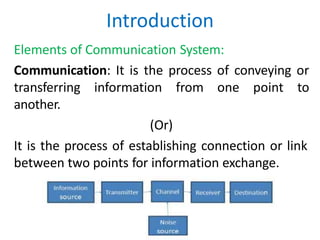
Elements of Communication System:
Communication: It is the process of conveying or
transferring information from one point to
another.
(Or)
It is the process of establishing connection or link
between two points for information exchange.
Elements of Communication System:
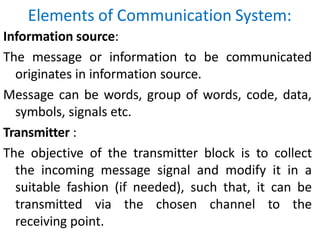
Information source:
The message or information to be communicated
originates in information source.
Message can be words, group of words, code, data,
symbols, signals etc.
Transmitter :
The objective of the transmitter block is to collect
the incoming message signal and modify it in a
suitable fashion (if needed), such that, it can be
transmitted via the chosen channel to the
receiving point.
Elements of Communication System:
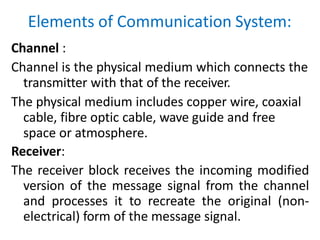
Channel :
Channel is the physical medium which connects the
transmitter with that of the receiver.
The physical medium includes copper wire, coaxial
cable, fibre optic cable, wave guide and free
space or atmosphere.
Receiver:
The receiver block receives the incoming modified
version of the message signal from the channel
and processes it to recreate the original (non-
electrical) form of the message signal.
Signal, Message, Information
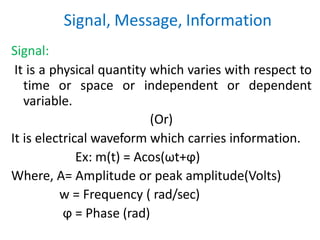
Signal:
It is a physical quantity which varies with respect to
time or space or independent or dependent
variable.
(Or)
It is electrical waveform which carries information.
Ex: m(t) = Acos(ωt+ϕ)
Where, A= Amplitude or peak amplitude(Volts)
w = Frequency ( rad/sec)
ϕ = Phase (rad)
Types of Signals
• Analog or Continuous Signal
• Digital Signal
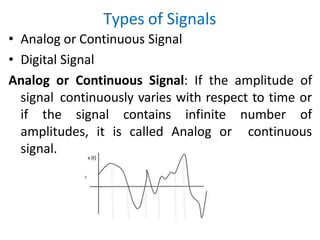
Analog or Continuous Signal: If the amplitude of
signal continuously varies with respect to time or
if the signal contains infinite number of
amplitudes, it is called Analog or continuous
signal.
Types of Signals
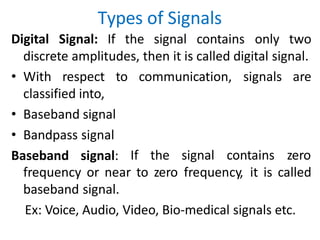
Digital Signal: If the signal contains only two
discrete amplitudes, then it is called digital signal.
• With respect to
classified into,
• Baseband signal
• Bandpass signal
Baseband signal:
communication, signals are
If the signal contains zero
frequency or near to zero frequency, it is called
baseband signal.
Ex: Voice, Audio, Video, Bio-medical signals etc.
Types of Signals
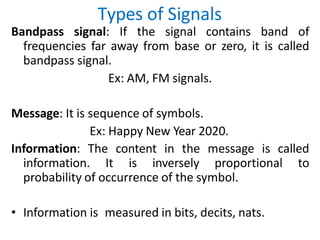
Bandpass signal: If the signal contains band of
frequencies far away from base or zero, it is called
bandpass signal.
Ex: AM, FM signals.
Message: It is sequence of symbols.
Ex: Happy New Year 2020.
Information: The content in the message is called
information. It is inversely proportional to
probability of occurrence of the symbol.
• Information is measured in bits, decits, nats.
Limitations of Communication System
• Technological Problems:
To implement communication systems, Tx, Rx, channel
are required which requires hardware.
Communication system is expensive and complex.
• Bandwidth & Noise:
The effect of noise can be reduced by providing
more bandwidth to stations but due to this less
number of stations can only be accommodated.
• Signal to Noise Ratio (SNR):Noise should be low to
increase channel capacity but it is an unavoidable
aspect of communication system.
Modulation
It is the process of varying the characteristics of
high frequency carrier in accordance with
instantaneous values of modulating or message
or baseband signal.
(Or)
It is a frequency translation technique which
converts baseband or low frequency signal to
bandpass or high frequency signal.
Modulation is used in the transmitter.

Basic of analog communication system.pptx

  • 1.
    ANALOG COMMUNICATION SYSTEMS By Ms.Swati Shrrpal Halunde Assistant Professor DEPT. of E.C.E S.I.T.C.O.E. Yadrav- Ichalkaranji Basic of Analog Communication system
  • 2.
    Introduction Elements of CommunicationSystem: Communication: It is the process of conveying or transferring information from one point to another. (Or) It is the process of establishing connection or link between two points for information exchange.
  • 3.
    Elements of CommunicationSystem: Information source: The message or information to be communicated originates in information source. Message can be words, group of words, code, data, symbols, signals etc. Transmitter : The objective of the transmitter block is to collect the incoming message signal and modify it in a suitable fashion (if needed), such that, it can be transmitted via the chosen channel to the receiving point.
  • 4.
    Elements of CommunicationSystem: Channel : Channel is the physical medium which connects the transmitter with that of the receiver. The physical medium includes copper wire, coaxial cable, fibre optic cable, wave guide and free space or atmosphere. Receiver: The receiver block receives the incoming modified version of the message signal from the channel and processes it to recreate the original (non- electrical) form of the message signal.
  • 5.
    Signal, Message, Information Signal: Itis a physical quantity which varies with respect to time or space or independent or dependent variable. (Or) It is electrical waveform which carries information. Ex: m(t) = Acos(ωt+ϕ) Where, A= Amplitude or peak amplitude(Volts) w = Frequency ( rad/sec) ϕ = Phase (rad)
  • 6.
    Types of Signals •Analog or Continuous Signal • Digital Signal Analog or Continuous Signal: If the amplitude of signal continuously varies with respect to time or if the signal contains infinite number of amplitudes, it is called Analog or continuous signal.
  • 7.
    Types of Signals DigitalSignal: If the signal contains only two discrete amplitudes, then it is called digital signal. • With respect to classified into, • Baseband signal • Bandpass signal Baseband signal: communication, signals are If the signal contains zero frequency or near to zero frequency, it is called baseband signal. Ex: Voice, Audio, Video, Bio-medical signals etc.
  • 8.
    Types of Signals Bandpasssignal: If the signal contains band of frequencies far away from base or zero, it is called bandpass signal. Ex: AM, FM signals. Message: It is sequence of symbols. Ex: Happy New Year 2020. Information: The content in the message is called information. It is inversely proportional to probability of occurrence of the symbol. • Information is measured in bits, decits, nats.
  • 9.
    Limitations of CommunicationSystem • Technological Problems: To implement communication systems, Tx, Rx, channel are required which requires hardware. Communication system is expensive and complex. • Bandwidth & Noise: The effect of noise can be reduced by providing more bandwidth to stations but due to this less number of stations can only be accommodated. • Signal to Noise Ratio (SNR):Noise should be low to increase channel capacity but it is an unavoidable aspect of communication system.
  • 10.
    Modulation It is theprocess of varying the characteristics of high frequency carrier in accordance with instantaneous values of modulating or message or baseband signal. (Or) It is a frequency translation technique which converts baseband or low frequency signal to bandpass or high frequency signal. Modulation is used in the transmitter.