Lecture Notes on Feedback
Amplifiers and its Types
for
Open Educational Resource
On
Electronic Devices and Circuits (EC201)
by
Dr. Piyush Charan
Assistant Professor
Department of Electronics and Communication Engg.
Integral University, Lucknow
Contents
Basic concept of feedback
General Characteristics of negative feedback amplifiers
Classification of feedback
Voltage/Current shunt and series feedback
stability of feedback amplifiers
Multistage Amplifiers, and
Tuned Amplifier.
12/01/2020 2Dr. Piyush Charan, Dept. of ECE, Integral University, Lucknow
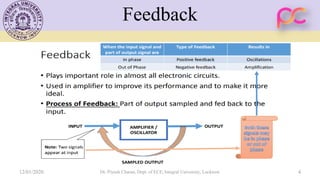
Feedback
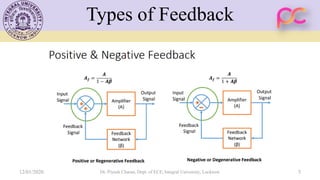
• Feedback implies feeding back (i.e., returning back) a part of the
processed signal to the input side so as to enhance or diminish the
input signal.
• When the input signal (current or voltage) is diminished, it is
considered as negative feedback.
• When the input signal is enhanced, it is known as positive feedback.
• Negative feedback is employed in amplifying systems to achieve
certain special characteristics that are not obtainable from the basic
amplifier.
• Positive feedback is employed to produce signal generator, such as
oscillators.
12/01/2020 Dr. Piyush Charan, Dept. of ECE, Integral University, Lucknow 3
Feedback
12/01/2020 4Dr. Piyush Charan, Dept. of ECE, Integral University, Lucknow
Types of Feedback
12/01/2020 Dr. Piyush Charan, Dept. of ECE, Integral University, Lucknow 5
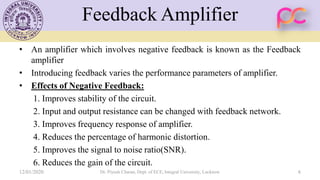
Feedback Amplifier
• An amplifier which involves negative feedback is known as the Feedback
amplifier
• Introducing feedback varies the performance parameters of amplifier.
• Effects of Negative Feedback:
1. Improves stability of the circuit.
2. Input and output resistance can be changed with feedback network.
3. Improves frequency response of amplifier.
4. Reduces the percentage of harmonic distortion.
5. Improves the signal to noise ratio(SNR).
6. Reduces the gain of the circuit.
12/01/2020 Dr. Piyush Charan, Dept. of ECE, Integral University, Lucknow 6
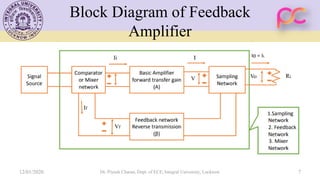
Block Diagram of Feedback
Amplifier
12/01/2020 Dr. Piyush Charan, Dept. of ECE, Integral University, Lucknow 7
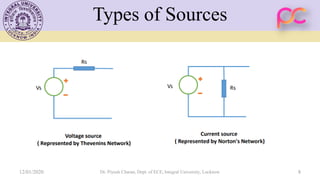
Types of Sources
12/01/2020 Dr. Piyush Charan, Dept. of ECE, Integral University, Lucknow 8
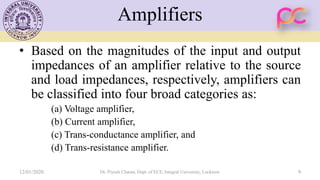
Amplifiers
• Based on the magnitudes of the input and output
impedances of an amplifier relative to the source
and load impedances, respectively, amplifiers can
be classified into four broad categories as:
(a) Voltage amplifier,
(b) Current amplifier,
(c) Trans-conductance amplifier, and
(d) Trans-resistance amplifier.
12/01/2020 Dr. Piyush Charan, Dept. of ECE, Integral University, Lucknow 9
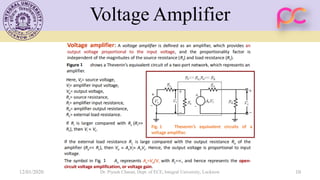
Voltage Amplifier
12/01/2020 Dr. Piyush Charan, Dept. of ECE, Integral University, Lucknow 10
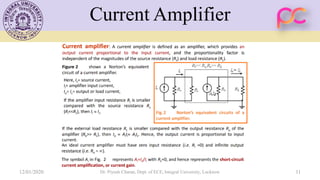
Current Amplifier
12/01/2020 Dr. Piyush Charan, Dept. of ECE, Integral University, Lucknow 11
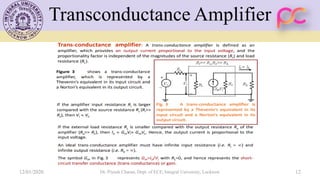
Transconductance Amplifier
12/01/2020 Dr. Piyush Charan, Dept. of ECE, Integral University, Lucknow 12
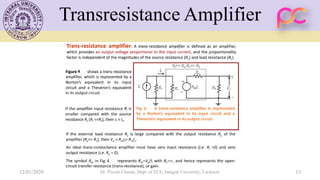
Transresistance Amplifier
12/01/2020 Dr. Piyush Charan, Dept. of ECE, Integral University, Lucknow 13
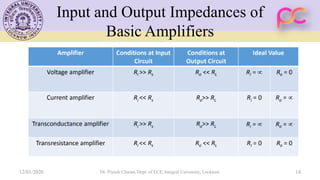
Input and Output Impedances of
Basic Amplifiers
12/01/2020 Dr. Piyush Charan, Dept. of ECE, Integral University, Lucknow 14
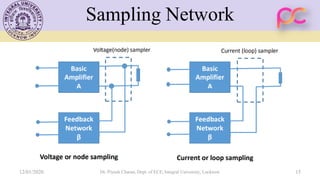
Sampling Network
12/01/2020 Dr. Piyush Charan, Dept. of ECE, Integral University, Lucknow 15
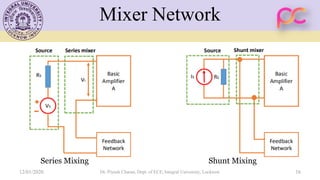
Mixer Network
12/01/2020 Dr. Piyush Charan, Dept. of ECE, Integral University, Lucknow 16
Series Mixing Shunt Mixing
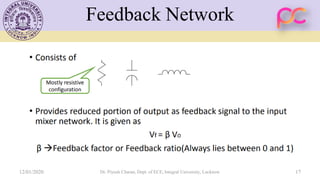
Feedback Network
12/01/2020 Dr. Piyush Charan, Dept. of ECE, Integral University, Lucknow 17
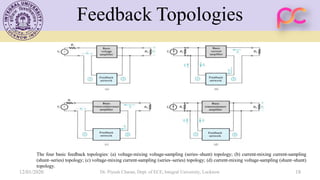
Feedback Topologies
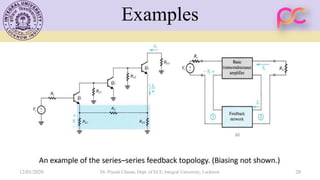
The four basic feedback topologies: (a) voltage-mixing voltage-sampling (series–shunt) topology; (b) current-mixing current-sampling
(shunt–series) topology; (c) voltage-mixing current-sampling (series–series) topology; (d) current-mixing voltage-sampling (shunt–shunt)
topology.
12/01/2020 Dr. Piyush Charan, Dept. of ECE, Integral University, Lucknow 18
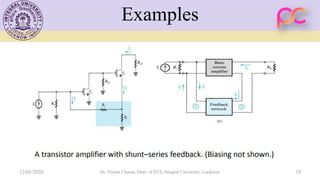
Examples
12/01/2020 Dr. Piyush Charan, Dept. of ECE, Integral University, Lucknow 19
Examples
12/01/2020 Dr. Piyush Charan, Dept. of ECE, Integral University, Lucknow 20
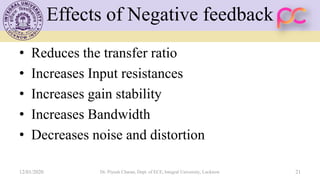
Effects of Negative feedback
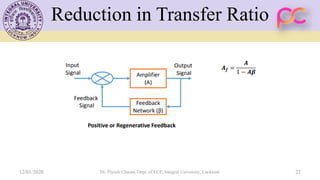
• Reduces the transfer ratio
• Increases Input resistances
• Increases gain stability
• Increases Bandwidth
• Decreases noise and distortion
12/01/2020 Dr. Piyush Charan, Dept. of ECE, Integral University, Lucknow 21
Reduction in Transfer Ratio
12/01/2020 Dr. Piyush Charan, Dept. of ECE, Integral University, Lucknow 22

Unit 4 feedback amplifiers

  • 1.
    Lecture Notes onFeedback Amplifiers and its Types for Open Educational Resource On Electronic Devices and Circuits (EC201) by Dr. Piyush Charan Assistant Professor Department of Electronics and Communication Engg. Integral University, Lucknow
  • 2.
    Contents Basic concept offeedback General Characteristics of negative feedback amplifiers Classification of feedback Voltage/Current shunt and series feedback stability of feedback amplifiers Multistage Amplifiers, and Tuned Amplifier. 12/01/2020 2Dr. Piyush Charan, Dept. of ECE, Integral University, Lucknow
  • 3.
    Feedback • Feedback impliesfeeding back (i.e., returning back) a part of the processed signal to the input side so as to enhance or diminish the input signal. • When the input signal (current or voltage) is diminished, it is considered as negative feedback. • When the input signal is enhanced, it is known as positive feedback. • Negative feedback is employed in amplifying systems to achieve certain special characteristics that are not obtainable from the basic amplifier. • Positive feedback is employed to produce signal generator, such as oscillators. 12/01/2020 Dr. Piyush Charan, Dept. of ECE, Integral University, Lucknow 3
  • 4.
    Feedback 12/01/2020 4Dr. PiyushCharan, Dept. of ECE, Integral University, Lucknow
  • 5.
    Types of Feedback 12/01/2020Dr. Piyush Charan, Dept. of ECE, Integral University, Lucknow 5
  • 6.
    Feedback Amplifier • Anamplifier which involves negative feedback is known as the Feedback amplifier • Introducing feedback varies the performance parameters of amplifier. • Effects of Negative Feedback: 1. Improves stability of the circuit. 2. Input and output resistance can be changed with feedback network. 3. Improves frequency response of amplifier. 4. Reduces the percentage of harmonic distortion. 5. Improves the signal to noise ratio(SNR). 6. Reduces the gain of the circuit. 12/01/2020 Dr. Piyush Charan, Dept. of ECE, Integral University, Lucknow 6
  • 7.
    Block Diagram ofFeedback Amplifier 12/01/2020 Dr. Piyush Charan, Dept. of ECE, Integral University, Lucknow 7
  • 8.
    Types of Sources 12/01/2020Dr. Piyush Charan, Dept. of ECE, Integral University, Lucknow 8
  • 9.
    Amplifiers • Based onthe magnitudes of the input and output impedances of an amplifier relative to the source and load impedances, respectively, amplifiers can be classified into four broad categories as: (a) Voltage amplifier, (b) Current amplifier, (c) Trans-conductance amplifier, and (d) Trans-resistance amplifier. 12/01/2020 Dr. Piyush Charan, Dept. of ECE, Integral University, Lucknow 9
  • 10.
    Voltage Amplifier 12/01/2020 Dr.Piyush Charan, Dept. of ECE, Integral University, Lucknow 10
  • 11.
    Current Amplifier 12/01/2020 Dr.Piyush Charan, Dept. of ECE, Integral University, Lucknow 11
  • 12.
    Transconductance Amplifier 12/01/2020 Dr.Piyush Charan, Dept. of ECE, Integral University, Lucknow 12
  • 13.
    Transresistance Amplifier 12/01/2020 Dr.Piyush Charan, Dept. of ECE, Integral University, Lucknow 13
  • 14.
    Input and OutputImpedances of Basic Amplifiers 12/01/2020 Dr. Piyush Charan, Dept. of ECE, Integral University, Lucknow 14
  • 15.
    Sampling Network 12/01/2020 Dr.Piyush Charan, Dept. of ECE, Integral University, Lucknow 15
  • 16.
    Mixer Network 12/01/2020 Dr.Piyush Charan, Dept. of ECE, Integral University, Lucknow 16 Series Mixing Shunt Mixing
  • 17.
    Feedback Network 12/01/2020 Dr.Piyush Charan, Dept. of ECE, Integral University, Lucknow 17
  • 18.
    Feedback Topologies The fourbasic feedback topologies: (a) voltage-mixing voltage-sampling (series–shunt) topology; (b) current-mixing current-sampling (shunt–series) topology; (c) voltage-mixing current-sampling (series–series) topology; (d) current-mixing voltage-sampling (shunt–shunt) topology. 12/01/2020 Dr. Piyush Charan, Dept. of ECE, Integral University, Lucknow 18
  • 19.
    Examples 12/01/2020 Dr. PiyushCharan, Dept. of ECE, Integral University, Lucknow 19
  • 20.
    Examples 12/01/2020 Dr. PiyushCharan, Dept. of ECE, Integral University, Lucknow 20
  • 21.
    Effects of Negativefeedback • Reduces the transfer ratio • Increases Input resistances • Increases gain stability • Increases Bandwidth • Decreases noise and distortion 12/01/2020 Dr. Piyush Charan, Dept. of ECE, Integral University, Lucknow 21
  • 22.
    Reduction in TransferRatio 12/01/2020 Dr. Piyush Charan, Dept. of ECE, Integral University, Lucknow 22