Plant Diversity
 The Evolution and
  Classification of
       Plants


More free powerpoints at http://www.worldofteaching.com
Slide # 3


    PLANT CHARACTERISTICS
  • Multicellular eukaryotes
  • Photosynthetic autotrophs containing
    chloroplasts.
  • Non-mobile (fixed to one spot)
  • Cell walls made of cellulose
  • Responds to environment and grows
    through the use of hormones
Slide # 4

        Plants Make the The Move to Land
The ancestors of plants were multicellular green algae. They
 were completely immersed in water & dissolved minerals.
     To move onto land, plants had to solve these problems:

 How to get chemical resources (water, minerals,
  oxygen, and carbon dioxide) separated into air and
  soil
 How to transport resources within the plant.
 How to prevent from drying out
 How to reproduce without water
Slide # 5
            Some Adaptations (solutions)-
   Have body parts extending into both air and
    soil
   Develop a vascular system to transport
    resources in plant
   Have a protective layer – cuticle (waxy outer
    layer) to keep from drying out
   Specialized structures for reproduction
    including spores & seeds that do not dry out
Slide # 6


        Plants are classified based on
          whether or not they have

  1. Vascular System (transport)

  2. Seeds

  3. Flowers (enclosed seeds)
Slide # 7


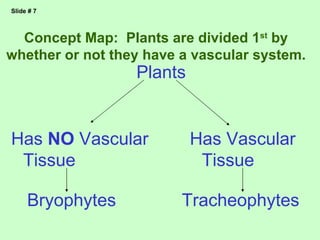
  Concept Map: Plants are divided 1st by
whether or not they have a vascular system.
                  Plants


Has NO Vascular            Has Vascular
 Tissue                     Tissue

     Bryophytes          Tracheophytes
Slide # 8
            Bryophytes
        -NONVASCULAR
 Most primitive plants
 Found in moist, shady areas
 NO vascular (transport) system
 Small size due to no vascular tissue
 No true roots, stems, or leaves
 Needs water for reproduction.
 Reproduces using spores, -a water-proof
  single cell that can grow into a new organism.
 Most common example: Mosses
Slide # 9
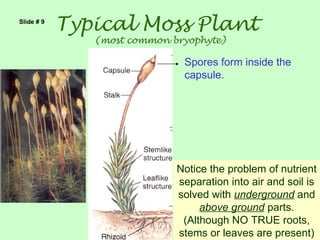
            Typical Moss Plant
               (most common bryophyte)

                              Spores form inside the
                              capsule.


                             Notice the problem of nutrient
                             separation into air and soil is
                             solved with underground and
                                  above ground parts.
                              (Although NO TRUE roots,
                             stems or leaves are present)
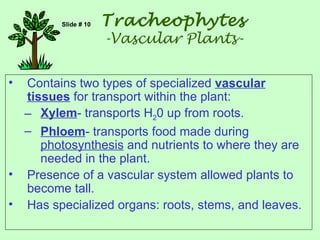
Slide # 10   Tracheophytes
                      -Vascular Plants-


• Contains two types of specialized vascular
  tissues for transport within the plant:
  – Xylem- transports H20 up from roots.
  – Phloem- transports food made during
     photosynthesis and nutrients to where they are
     needed in the plant.
• Presence of a vascular system allowed plants to
  become tall.
• Has specialized organs: roots, stems, and leaves.
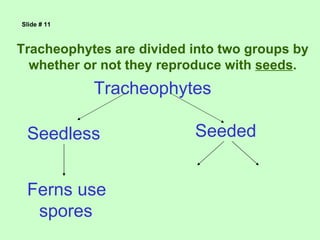
Slide # 11


Tracheophytes are divided into two groups by
  whether or not they reproduce with seeds.
             Tracheophytes

 Seedless                 Seeded


 Ferns use
  spores
Slide # 12

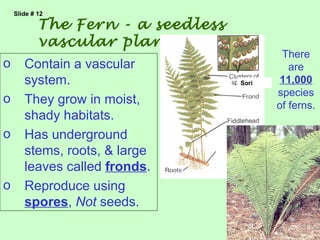
            The Fern - a seedless
            vascular plant
                                            There
o      Contain a vascular                     are
       system.                      Sori    11,000
                                           species
o      They grow in moist,                 of ferns.
       shady habitats.
o      Has underground
       stems, roots, & large
       leaves called fronds.
o      Reproduce using
       spores, Not seeds.
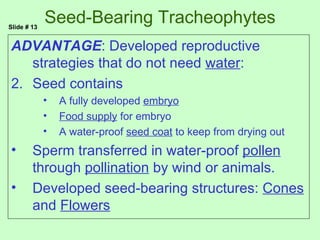
Slide # 13
             Seed-Bearing Tracheophytes
ADVANTAGE: Developed reproductive
   strategies that do not need water:
2. Seed contains
             •   A fully developed embryo
             •   Food supply for embryo
             •   A water-proof seed coat to keep from drying out
•       Sperm transferred in water-proof pollen
        through pollination by wind or animals.
•       Developed seed-bearing structures: Cones
        and Flowers
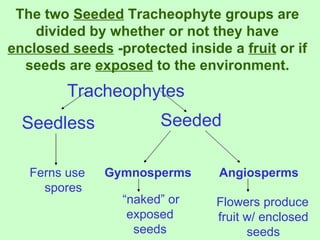
The two Seeded Tracheophyte groups are
    divided by whether or not they have
enclosed seeds -protected inside a fruit or if
  seeds are exposed to the environment.
         Tracheophytes
  Seedless             Seeded

   Ferns use   Gymnosperms      Angiosperms
     spores
                 “naked” or     Flowers produce
                  exposed       fruit w/ enclosed
                   seeds              seeds
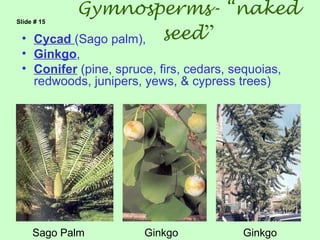
Gymnosperms- “naked
Slide # 15

 •    Cycad (Sago palm), seed”
 • Ginkgo,
 • Conifer (pine, spruce, firs, cedars, sequoias,
   redwoods, junipers, yews, & cypress trees)


     Sago Palm         Ginkgo            Ginkgo
Slide # 16
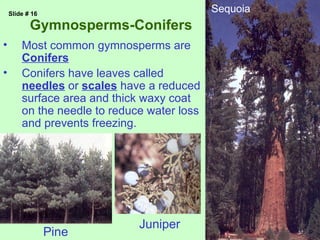
                                             Sequoia
           Gymnosperms-Conifers
•       Most common gymnosperms are
        Conifers
•       Conifers have leaves called
        needles or scales have a reduced
        surface area and thick waxy coat
        on the needle to reduce water loss
        and prevents freezing.


                              Juniper
                 Pine
Slide # 17

           Conifer
•
      Reproduction
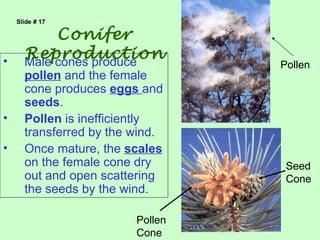
      Male cones produce          Pollen
      pollen and the female
      cone produces eggs and
      seeds.
•     Pollen is inefficiently
      transferred by the wind.
•     Once mature, the scales
      on the female cone dry       Seed
      out and open scattering      Cone
      the seeds by the wind.

                         Pollen
                         Cone
Slide # 18
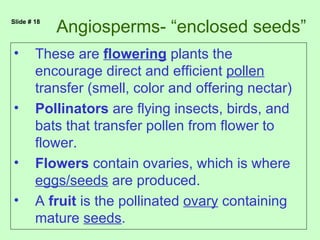
             Angiosperms- “enclosed seeds”
•       These are flowering plants the
        encourage direct and efficient pollen
        transfer (smell, color and offering nectar)
•       Pollinators are flying insects, birds, and
        bats that transfer pollen from flower to
        flower.
•       Flowers contain ovaries, which is where
        eggs/seeds are produced.
•       A fruit is the pollinated ovary containing
        mature seeds.
Slide # 19
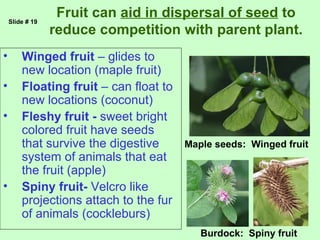
                  Fruit can aid in dispersal of seed to
                 reduce competition with parent plant.
•       Winged fruit – glides to
        new location (maple fruit)
•       Floating fruit – can float to
        new locations (coconut)
•       Fleshy fruit - sweet bright
        colored fruit have seeds
        that survive the digestive      Maple seeds: Winged fruit
        system of animals that eat
        the fruit (apple)
•       Spiny fruit- Velcro like
        projections attach to the fur
        of animals (cockleburs)
                                           Burdock: Spiny fruit

Naturalists at Large: Plant divisions

  • 1.
    Plant Diversity TheEvolution and Classification of Plants More free powerpoints at http://www.worldofteaching.com
  • 2.
    Slide # 3 PLANT CHARACTERISTICS • Multicellular eukaryotes • Photosynthetic autotrophs containing chloroplasts. • Non-mobile (fixed to one spot) • Cell walls made of cellulose • Responds to environment and grows through the use of hormones
  • 3.
    Slide # 4 Plants Make the The Move to Land The ancestors of plants were multicellular green algae. They were completely immersed in water & dissolved minerals. To move onto land, plants had to solve these problems:  How to get chemical resources (water, minerals, oxygen, and carbon dioxide) separated into air and soil  How to transport resources within the plant.  How to prevent from drying out  How to reproduce without water
  • 4.
    Slide # 5 Some Adaptations (solutions)-  Have body parts extending into both air and soil  Develop a vascular system to transport resources in plant  Have a protective layer – cuticle (waxy outer layer) to keep from drying out  Specialized structures for reproduction including spores & seeds that do not dry out
  • 5.
    Slide # 6 Plants are classified based on whether or not they have 1. Vascular System (transport) 2. Seeds 3. Flowers (enclosed seeds)
  • 6.
    Slide # 7 Concept Map: Plants are divided 1st by whether or not they have a vascular system. Plants Has NO Vascular Has Vascular Tissue Tissue Bryophytes Tracheophytes
  • 7.
    Slide # 8 Bryophytes -NONVASCULAR  Most primitive plants  Found in moist, shady areas  NO vascular (transport) system  Small size due to no vascular tissue  No true roots, stems, or leaves  Needs water for reproduction.  Reproduces using spores, -a water-proof single cell that can grow into a new organism.  Most common example: Mosses
  • 8.
    Slide # 9 Typical Moss Plant (most common bryophyte) Spores form inside the capsule. Notice the problem of nutrient separation into air and soil is solved with underground and above ground parts. (Although NO TRUE roots, stems or leaves are present)
  • 9.
    Slide # 10 Tracheophytes -Vascular Plants- • Contains two types of specialized vascular tissues for transport within the plant: – Xylem- transports H20 up from roots. – Phloem- transports food made during photosynthesis and nutrients to where they are needed in the plant. • Presence of a vascular system allowed plants to become tall. • Has specialized organs: roots, stems, and leaves.
  • 10.
    Slide # 11 Tracheophytesare divided into two groups by whether or not they reproduce with seeds. Tracheophytes Seedless Seeded Ferns use spores
  • 11.
    Slide # 12 The Fern - a seedless vascular plant There o Contain a vascular are system. Sori 11,000 species o They grow in moist, of ferns. shady habitats. o Has underground stems, roots, & large leaves called fronds. o Reproduce using spores, Not seeds.
  • 12.
    Slide # 13 Seed-Bearing Tracheophytes ADVANTAGE: Developed reproductive strategies that do not need water: 2. Seed contains • A fully developed embryo • Food supply for embryo • A water-proof seed coat to keep from drying out • Sperm transferred in water-proof pollen through pollination by wind or animals. • Developed seed-bearing structures: Cones and Flowers
  • 13.
    The two SeededTracheophyte groups are divided by whether or not they have enclosed seeds -protected inside a fruit or if seeds are exposed to the environment. Tracheophytes Seedless Seeded Ferns use Gymnosperms Angiosperms spores “naked” or Flowers produce exposed fruit w/ enclosed seeds seeds
  • 14.
    Gymnosperms- “naked Slide #15 • Cycad (Sago palm), seed” • Ginkgo, • Conifer (pine, spruce, firs, cedars, sequoias, redwoods, junipers, yews, & cypress trees) Sago Palm Ginkgo Ginkgo
  • 15.
    Slide # 16 Sequoia Gymnosperms-Conifers • Most common gymnosperms are Conifers • Conifers have leaves called needles or scales have a reduced surface area and thick waxy coat on the needle to reduce water loss and prevents freezing. Juniper Pine
  • 16.
    Slide # 17 Conifer • Reproduction Male cones produce Pollen pollen and the female cone produces eggs and seeds. • Pollen is inefficiently transferred by the wind. • Once mature, the scales on the female cone dry Seed out and open scattering Cone the seeds by the wind. Pollen Cone
  • 17.
    Slide # 18 Angiosperms- “enclosed seeds” • These are flowering plants the encourage direct and efficient pollen transfer (smell, color and offering nectar) • Pollinators are flying insects, birds, and bats that transfer pollen from flower to flower. • Flowers contain ovaries, which is where eggs/seeds are produced. • A fruit is the pollinated ovary containing mature seeds.
  • 18.
    Slide # 19 Fruit can aid in dispersal of seed to reduce competition with parent plant. • Winged fruit – glides to new location (maple fruit) • Floating fruit – can float to new locations (coconut) • Fleshy fruit - sweet bright colored fruit have seeds that survive the digestive Maple seeds: Winged fruit system of animals that eat the fruit (apple) • Spiny fruit- Velcro like projections attach to the fur of animals (cockleburs) Burdock: Spiny fruit