Reproduction – The production of new individuals from their
parents is known as reproduction.
There are two modes of reproduction in plants as :-
1.Asexual reproduction
2.Sexual reproduction
Asexual Reproduction – The type of reproduction in
which new plants arise without the formation of seeds.
It is of following types :-
1.Vegetative Propagation
2.Budding
3.Fragmentation
4.Spore Formation
A. Vegetative Propagation :-The type of reproduction
in which new plants arise from vegetative parts of
the plant is called vegetative propagation.
o In this type of reproduction, new plants arise
from pre – existing parts of the plant.
o The examples can be as :-
•Stem in rose, sugarcane, potato & ginger.
•Leaves in bryophyllum.
•Roots in sweet potato and dahlia.
Bryophyllum Rose
Potato Ginger
B. Budding :- The reproduction which occurs through
the formation of buds is called budding.
o Bud – The small bulb like projection coming out
from cell is called budding.
o The bud gradually grows and gets detached from
the parent cell and forms new cell.
o The process of budding can be seen in yeast.
Budding in Yeast
C. Fragmentation :- The type of
reproduction in which a cell breaks up
into two or more fragments.
o These fragments grow into new
individuals.
o The mode of budding can be seen in
algae.
Fragmentation in Spirogyra
D. Spore Formation :- The reproduction through the
formation of spores is called spore formation.
o The spores are asexual reproductive bodies.
o Under favourable conditions, a spore germinates
and develops
o into a new individual.
o Reproduction through spore formation takes
place in mosses and ferns
Spore Formation in Fern
Sexual Reproduction – The type of reproduction in which new
plants arise with the formation of seeds.
In this type of reproduction, the reproductive parts of a plants i.e.
flowers are involved.
Flower consists of two parts as :-
A.Attractive
B.Reproductive
Attractive Parts – Those parts which attract insects towards
them and which protect the flower are called attractive parts.
•There are two attractive parts namely :-
1.Petals
2.Sepals
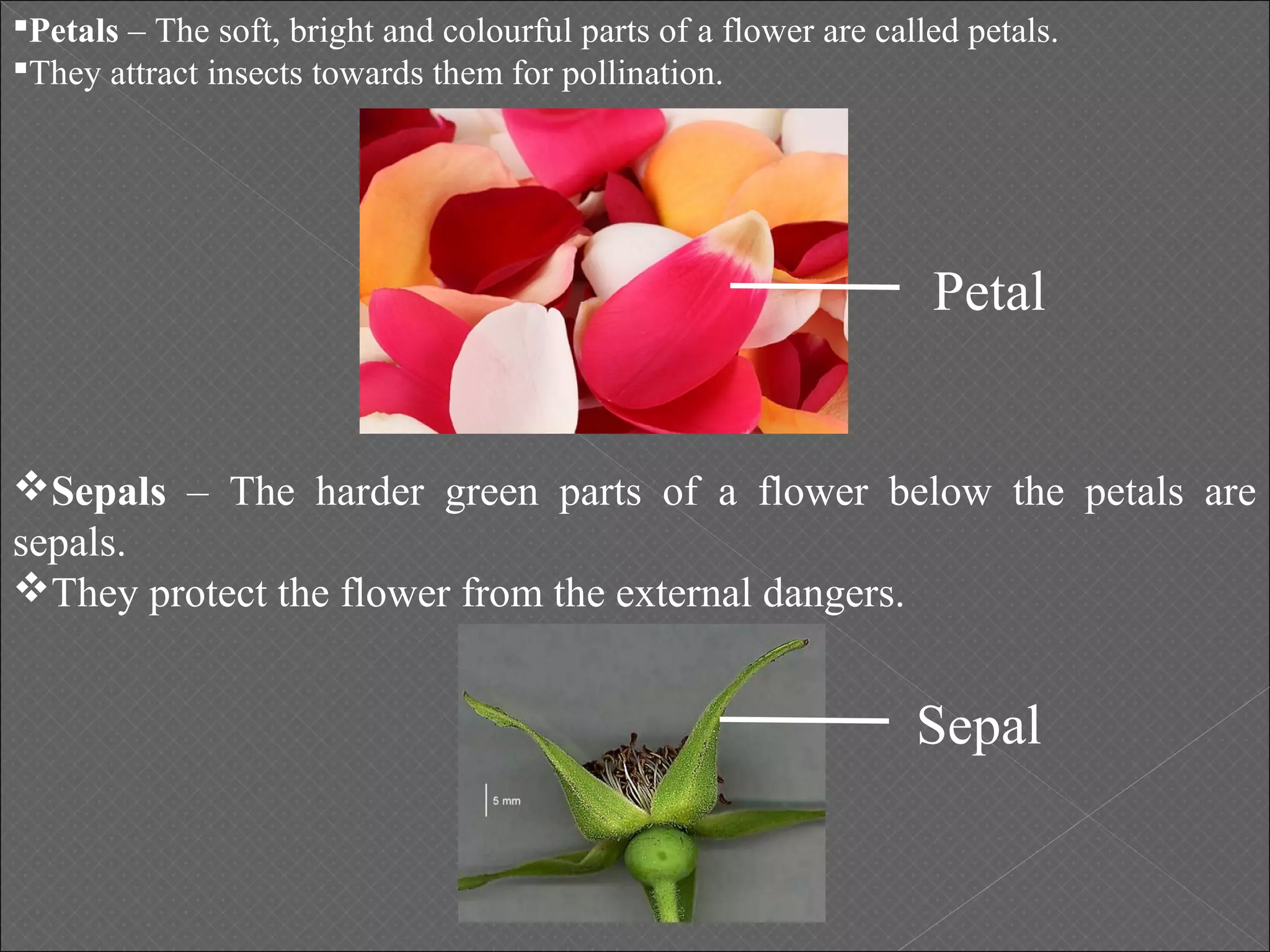
Petals – The soft, bright and colourful parts of a flower are called petals.
They attract insects towards them for pollination.
Sepals – The harder green parts of a flower below the petals are
sepals.
They protect the flower from the external dangers.
Petal
Sepal
Reproductive Parts – Those parts of the flower which help in
reproduction are called the reproductive parts of a flower.
There are two reproductive parts namely :-
1)Stamen (Male part)
2)Pistil (Female part)
Stamen – The male reproductive part of a flower is called
the stamen.
A stamen consists of two parts. They are :-
I.Anther
II.Filament
Stamen
Anther – A small stage like part of the stamen is called anther.
It holds the pollen grains on it.
Anther
Filament – A stick like structure below the anther is called
filament.
It holds the anther above it.
Filament
Pistil – The female reproductive part of a flower is called pistil.
A pistil consists of three parts. They are –
a)Stigma
b)Style
c)Ovary
Pistil
Stigma – A small stage like part of pistil is called stigma.
It holds the pollen grain which falls on it during pollination.
Stigma
Style – A tube like part connecting the stigma and ovary is style.
Pollen tube grows in it during fertilisation.
Style
Ovary – A small ball like structure under the style is called ovary.
It consists of ovules.
Ovary
On the basis of presence of reproductive parts, flowers are of two
types. They are :-
Unisexual – Consist either stamen or pistil but not both. E.g. Corn,
papaya & cucumber.
Bisexual – Consist both stamen and pistil. E.g. Mustard, rose &
petunia.
Unisexual Papaya Flower Bisexual Mustard Flower
These are the parts of reproductive parts of a flower.
They are of two types :-
i.Male Gametes – These are produced by pollen grains
and are found on the anther.
ii.Female gametes – These are found in the ovule of
the plant. It is also called egg.
In fertilisation the male and female gametes fuse to
form the zygote.
The process of transfer of pollen grains from
stamen of a flower to pistil of the same or
different flower is called pollination.
It is of two types as :-
a.Self Pollination
b.Cross Pollination
Self Pollination
The transfer of pollen grain from the anther of a flower to
the pistil of the same flower is called self pollination.
In this case, mostly the pollination occurs easily without any
external agency.
It takes place only in bisexual flowers.
Cross Pollination
The transfer of pollen grains from the anther of a flower to
the pistil of another flower is called cross pollination.
In this case, an external agency such as insects is a must.
It can take place in unisexual as well as bisexual flowers.
i. The process of fusion of male and female
gametes is called fertilisation.
ii.After fertilisation, a new cell is formed.
iii.The cell which results after fusion of the
gametes is called zygote.
iv.The zygote further develops to form an
embryo.
Fertilisation (Zygote
Formation)
1. Fruit – The ovary, after fertilisation, grows
into a fruit.
The ripened fruit is ovary.
2. Seed - The ovules, after fertilisation, grows
into seed.
The seed contains an embryo inside a tough
seed coat.
1. A same kind of plant grows in different
places. It is due to the process of seed
dispersal.
2. The process of carrying of seeds from one
place to another is called seed dispersal.
3. Their are many modes of seed dispersal
either by wind, by water, by some animals
or by blasting.
Through Air
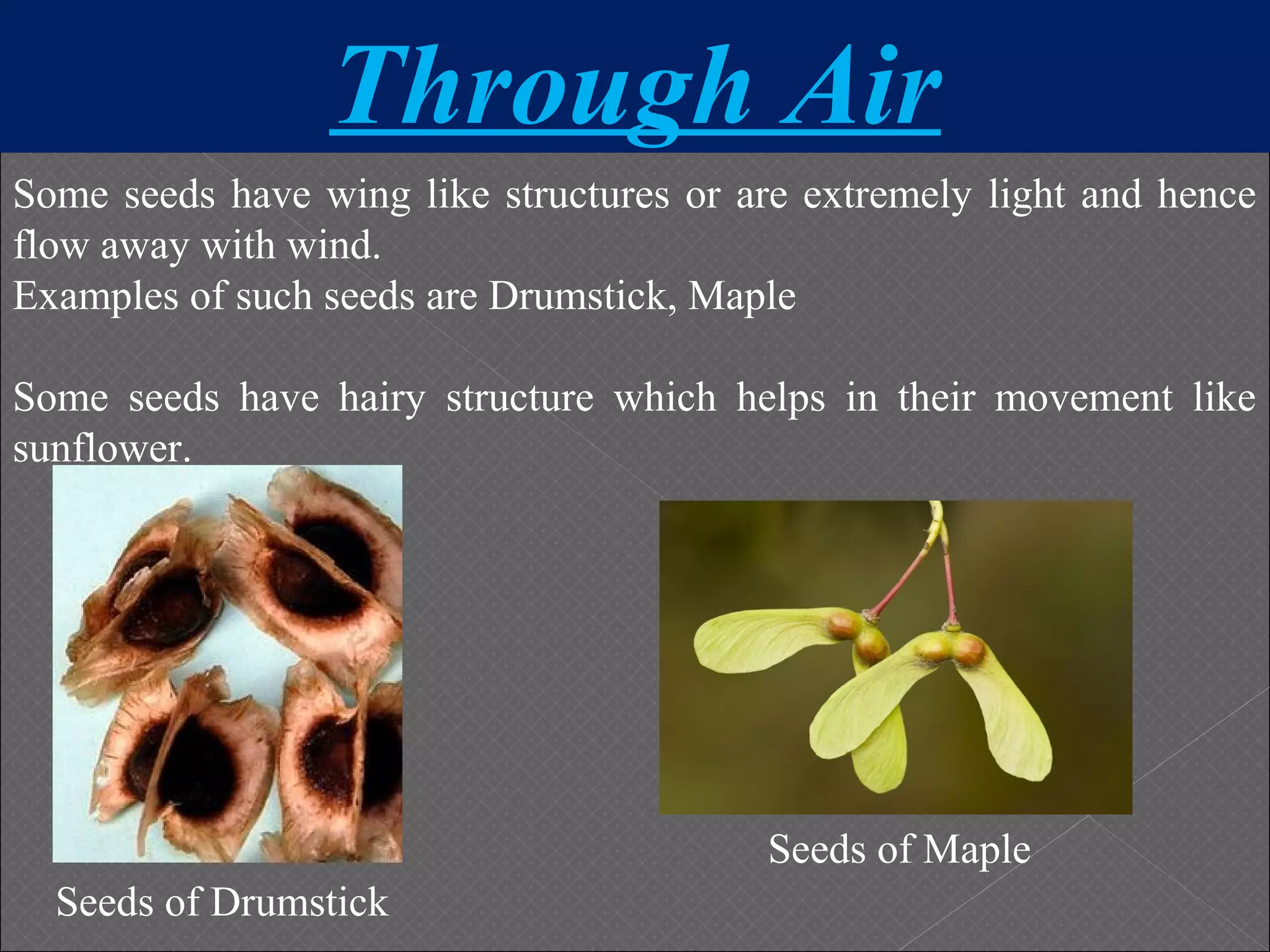
Some seeds have wing like structures or are extremely light and hence
flow away with wind.
Examples of such seeds are Drumstick, Maple
Some seeds have hairy structure which helps in their movement like
sunflower.
Seeds of Drumstick
Seeds of Maple
Fruit of Sunflower
Through Water
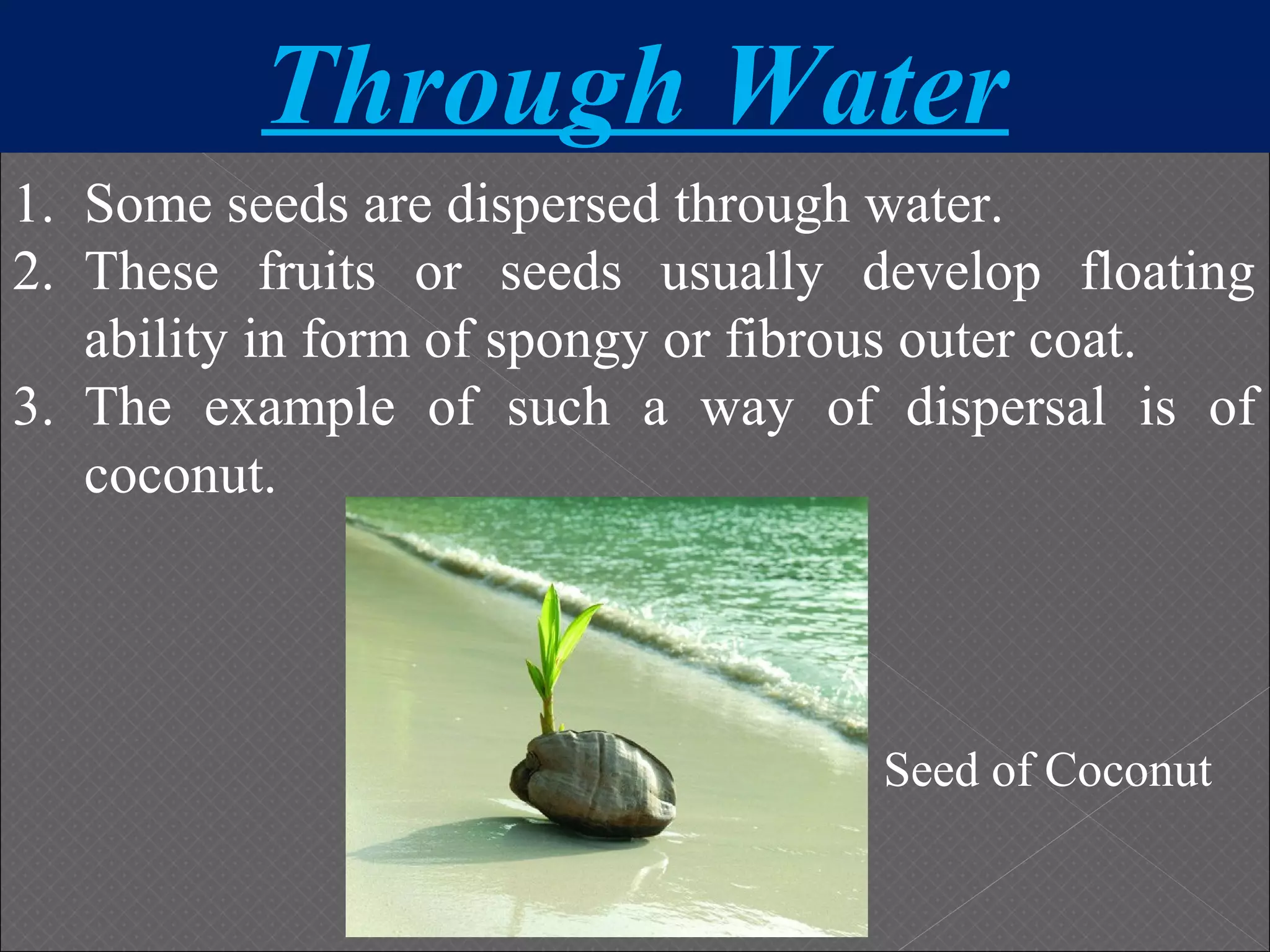
1. Some seeds are dispersed through water.
2. These fruits or seeds usually develop floating
ability in form of spongy or fibrous outer coat.
3. The example of such a way of dispersal is of
coconut.
Seed of Coconut
By Animals
1. Some seeds are dispersed by animals.
2. These are spiny seeds with hooks.
3. They get attached to the body of animals and are carried to distant
places.
4. Examples are of seeds of Xanthium and Urena (Caesar’s Weed).
Seed of Xanthium Seed of Urena (Caesar’s Weed)
By Blasting
1. Some seeds are dispersed when the fruit bursts with
sudden jerks.
2. These seeds are scattered far from the parent plant.
3. Examples are of seeds of Castor and Balsam.
Balsam seed and its
covering
Reproduction in plants: A Short Description

Reproduction in plants: A Short Description

  • 4.
    Reproduction – Theproduction of new individuals from their parents is known as reproduction. There are two modes of reproduction in plants as :- 1.Asexual reproduction 2.Sexual reproduction
  • 6.
    Asexual Reproduction –The type of reproduction in which new plants arise without the formation of seeds. It is of following types :- 1.Vegetative Propagation 2.Budding 3.Fragmentation 4.Spore Formation
  • 7.
    A. Vegetative Propagation:-The type of reproduction in which new plants arise from vegetative parts of the plant is called vegetative propagation. o In this type of reproduction, new plants arise from pre – existing parts of the plant. o The examples can be as :- •Stem in rose, sugarcane, potato & ginger. •Leaves in bryophyllum. •Roots in sweet potato and dahlia.
  • 8.
  • 9.
    B. Budding :-The reproduction which occurs through the formation of buds is called budding. o Bud – The small bulb like projection coming out from cell is called budding. o The bud gradually grows and gets detached from the parent cell and forms new cell. o The process of budding can be seen in yeast.
  • 10.
  • 11.
    C. Fragmentation :-The type of reproduction in which a cell breaks up into two or more fragments. o These fragments grow into new individuals. o The mode of budding can be seen in algae.
  • 12.
  • 13.
    D. Spore Formation:- The reproduction through the formation of spores is called spore formation. o The spores are asexual reproductive bodies. o Under favourable conditions, a spore germinates and develops o into a new individual. o Reproduction through spore formation takes place in mosses and ferns
  • 14.
  • 16.
    Sexual Reproduction –The type of reproduction in which new plants arise with the formation of seeds. In this type of reproduction, the reproductive parts of a plants i.e. flowers are involved. Flower consists of two parts as :- A.Attractive B.Reproductive
  • 17.
    Attractive Parts –Those parts which attract insects towards them and which protect the flower are called attractive parts. •There are two attractive parts namely :- 1.Petals 2.Sepals
  • 18.
    Petals – Thesoft, bright and colourful parts of a flower are called petals. They attract insects towards them for pollination. Sepals – The harder green parts of a flower below the petals are sepals. They protect the flower from the external dangers. Petal Sepal
  • 19.
    Reproductive Parts –Those parts of the flower which help in reproduction are called the reproductive parts of a flower. There are two reproductive parts namely :- 1)Stamen (Male part) 2)Pistil (Female part)
  • 20.
    Stamen – Themale reproductive part of a flower is called the stamen. A stamen consists of two parts. They are :- I.Anther II.Filament Stamen
  • 21.
    Anther – Asmall stage like part of the stamen is called anther. It holds the pollen grains on it. Anther Filament – A stick like structure below the anther is called filament. It holds the anther above it. Filament
  • 22.
    Pistil – Thefemale reproductive part of a flower is called pistil. A pistil consists of three parts. They are – a)Stigma b)Style c)Ovary Pistil
  • 23.
    Stigma – Asmall stage like part of pistil is called stigma. It holds the pollen grain which falls on it during pollination. Stigma Style – A tube like part connecting the stigma and ovary is style. Pollen tube grows in it during fertilisation. Style Ovary – A small ball like structure under the style is called ovary. It consists of ovules. Ovary
  • 24.
    On the basisof presence of reproductive parts, flowers are of two types. They are :- Unisexual – Consist either stamen or pistil but not both. E.g. Corn, papaya & cucumber. Bisexual – Consist both stamen and pistil. E.g. Mustard, rose & petunia. Unisexual Papaya Flower Bisexual Mustard Flower
  • 25.
    These are theparts of reproductive parts of a flower. They are of two types :- i.Male Gametes – These are produced by pollen grains and are found on the anther. ii.Female gametes – These are found in the ovule of the plant. It is also called egg. In fertilisation the male and female gametes fuse to form the zygote.
  • 26.
    The process oftransfer of pollen grains from stamen of a flower to pistil of the same or different flower is called pollination. It is of two types as :- a.Self Pollination b.Cross Pollination
  • 27.
    Self Pollination The transferof pollen grain from the anther of a flower to the pistil of the same flower is called self pollination. In this case, mostly the pollination occurs easily without any external agency. It takes place only in bisexual flowers.
  • 28.
    Cross Pollination The transferof pollen grains from the anther of a flower to the pistil of another flower is called cross pollination. In this case, an external agency such as insects is a must. It can take place in unisexual as well as bisexual flowers.
  • 29.
    i. The processof fusion of male and female gametes is called fertilisation. ii.After fertilisation, a new cell is formed. iii.The cell which results after fusion of the gametes is called zygote. iv.The zygote further develops to form an embryo.
  • 30.
  • 31.
    1. Fruit –The ovary, after fertilisation, grows into a fruit. The ripened fruit is ovary. 2. Seed - The ovules, after fertilisation, grows into seed. The seed contains an embryo inside a tough seed coat.
  • 32.
    1. A samekind of plant grows in different places. It is due to the process of seed dispersal. 2. The process of carrying of seeds from one place to another is called seed dispersal. 3. Their are many modes of seed dispersal either by wind, by water, by some animals or by blasting.
  • 33.
    Through Air Some seedshave wing like structures or are extremely light and hence flow away with wind. Examples of such seeds are Drumstick, Maple Some seeds have hairy structure which helps in their movement like sunflower. Seeds of Drumstick Seeds of Maple
  • 34.
  • 35.
    Through Water 1. Someseeds are dispersed through water. 2. These fruits or seeds usually develop floating ability in form of spongy or fibrous outer coat. 3. The example of such a way of dispersal is of coconut. Seed of Coconut
  • 36.
    By Animals 1. Someseeds are dispersed by animals. 2. These are spiny seeds with hooks. 3. They get attached to the body of animals and are carried to distant places. 4. Examples are of seeds of Xanthium and Urena (Caesar’s Weed). Seed of Xanthium Seed of Urena (Caesar’s Weed)
  • 37.
    By Blasting 1. Someseeds are dispersed when the fruit bursts with sudden jerks. 2. These seeds are scattered far from the parent plant. 3. Examples are of seeds of Castor and Balsam. Balsam seed and its covering