By
SURYAKANT VERMA
Assistant Professor,
Department of Pharmaceutics,
Dr. K. N. Modi Institute of Pharmaceutical Education &
Research, Modinagar, U.P., India.
Natural Resource:
Natural resources are materials and components (something that can be
used) that can be found within the environment. Every man-made product
is composed of natural resources (at its fundamental level). A natural
resource may exist as a separate entity such as fresh water, and air, as well as
a living organism such as a fish, or it may exist in an alternate form which
must be processed to obtain the resource such as metal ores, oil, and most
forms of energy.
Natural resources
 The resources that are derived from the
environment are called as natural resources.
 Some of them are most essential for our
living while most of them are used for
satisfying our needs.
 They are used to promote the man kind.
 Every man made item consists of natural
resources.
 Sun is the major natural resource which
never ends.
TYPES OF CLASSIFICATION:
 Natural Resources are classified into different types based
on their origin and availability
 Based on their origin natural resources are of 2 types they
are:
 Biotic – Biotic resources are obtained from
the biosphere (living and organic material), such
as forests, animals, birds, and fish and the materials that
can be obtained from them. Fossil fuels such
as coal and petroleum are also included in this category
because they are formed from decayed organic matter.
 Abiotic – Abiotic resources are those that come from
non-living, non-organic material. Examples of abiotic
resources include land, fresh water, air and heavy metals
including ores such as gold, iron, copper, silver, etc.
Types of Natural Resources
 They are mainly classified into 6 types:
1. Forest Resources
2. Water Resources
3. Mineral Resources
4. Food Resources
5. Land Resources
6. Energy Resources
Forest Resources
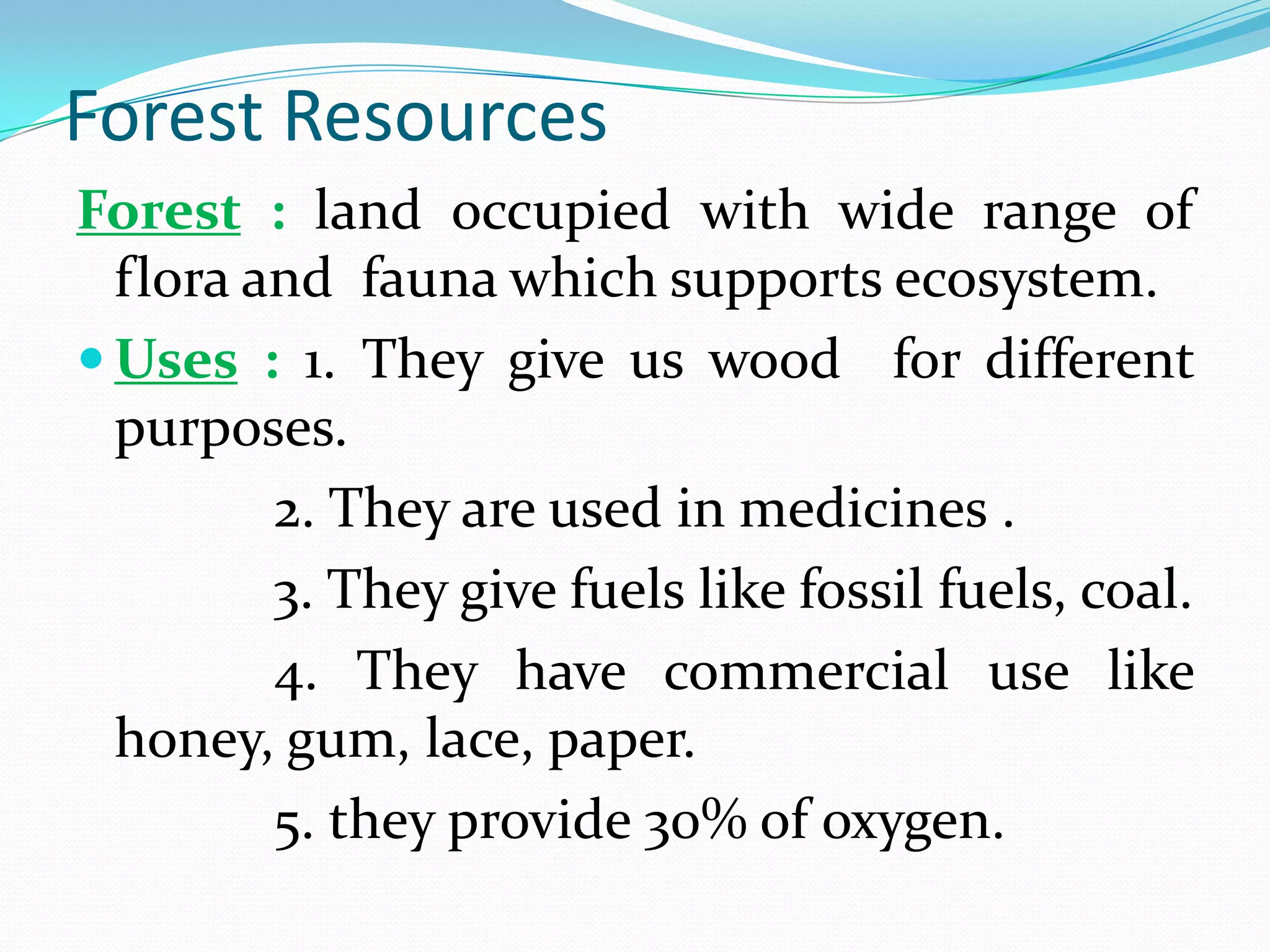
Forest : land occupied with wide range of
flora and fauna which supports ecosystem.
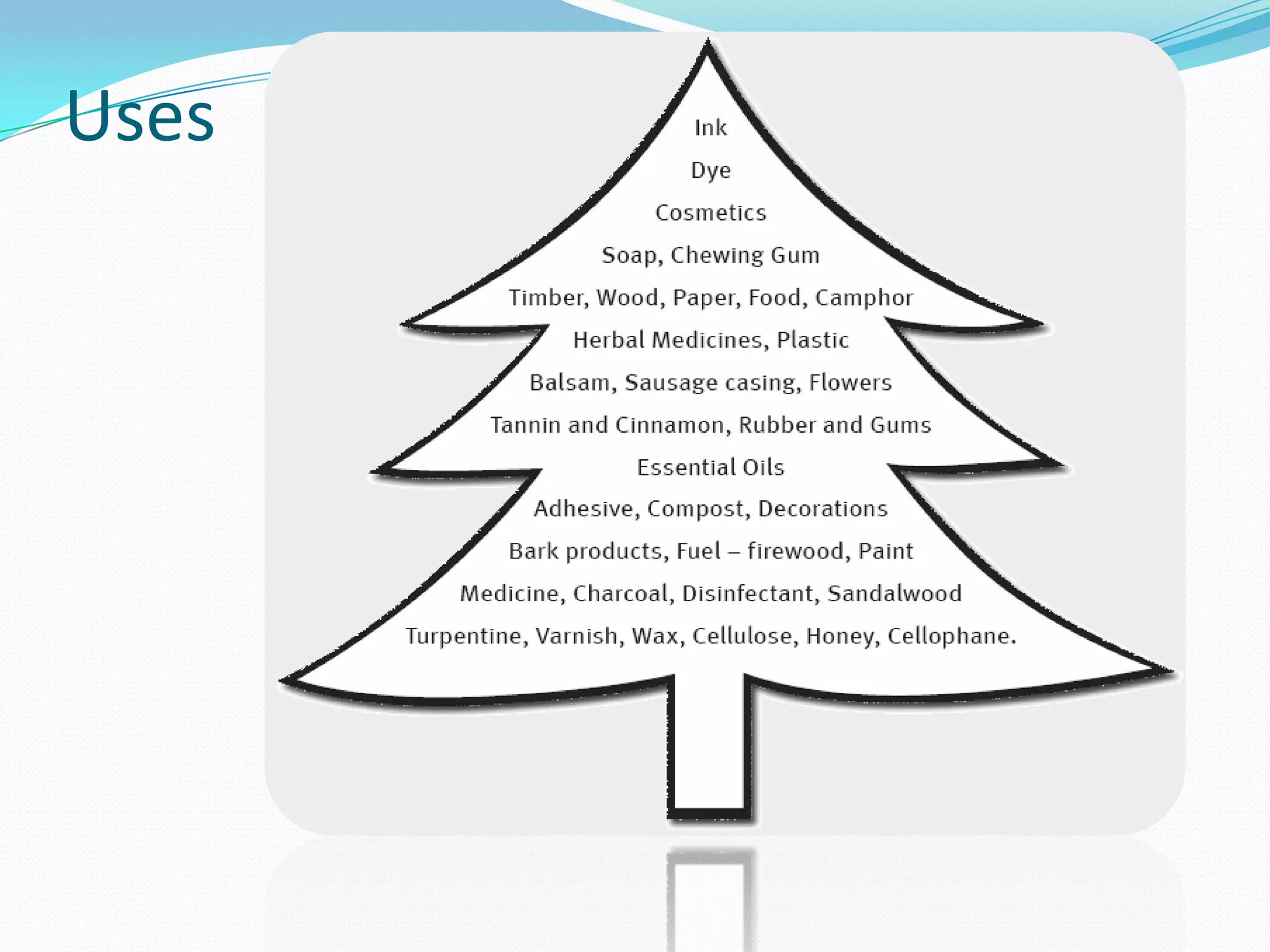
 Uses : 1. They give us wood for different
purposes.
2. They are used in medicines .
3. They give fuels like fossil fuels, coal.
4. They have commercial use like
honey, gum, lace, paper.
5. they provide 30% of oxygen.
Uses
Threats
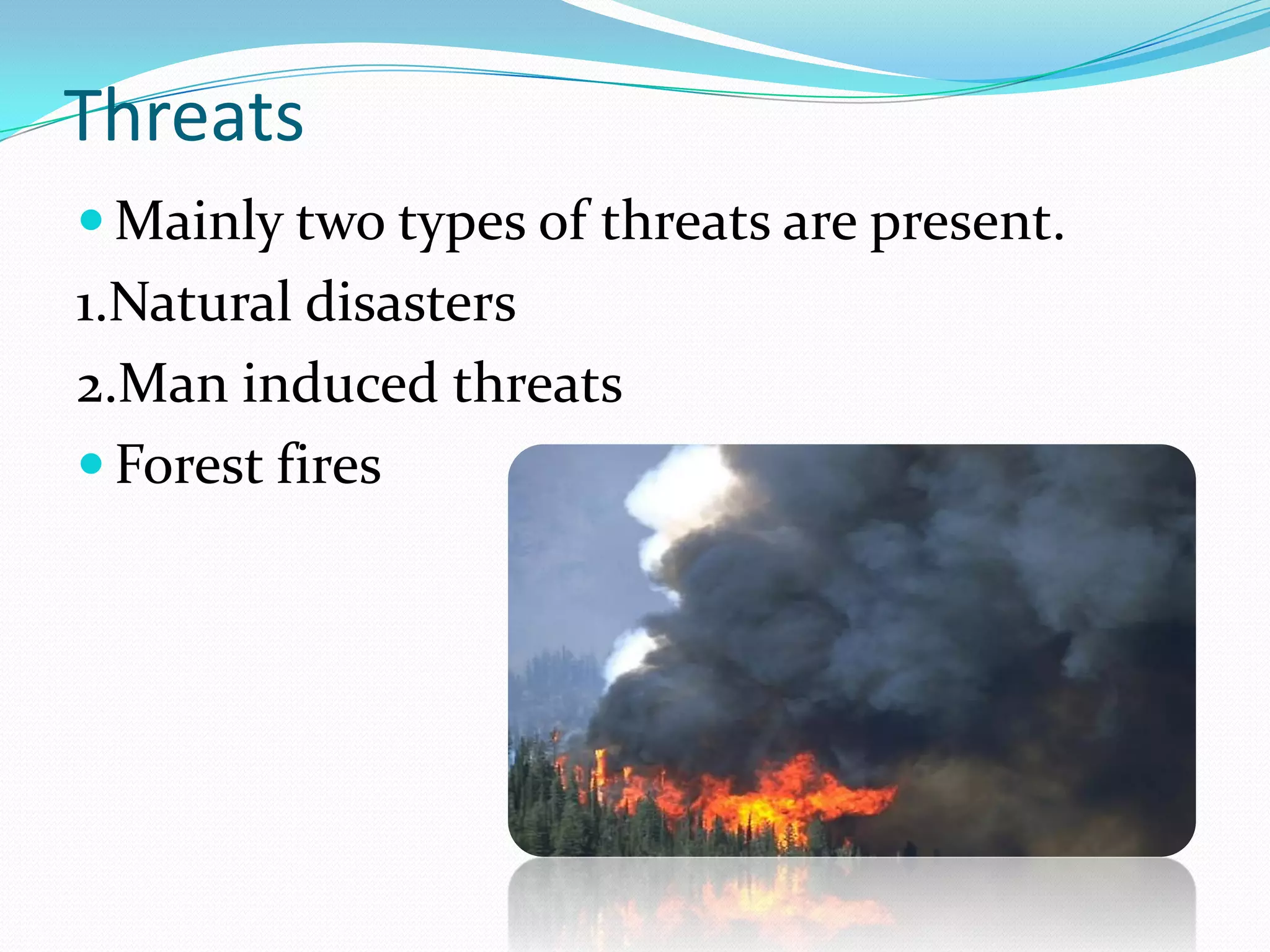
 Mainly two types of threats are present.
1.Natural disasters
2.Man induced threats
 Forest fires
* International Federation of Red Cross and Red Crescent Societies (The Economist, Sept 6, 1997)
High wind: 21%
Earthquake: 8%
Flood: 19%
Other natural
disasters: 21%
Volcanoes: 1%
Drought & Famine: 6%Landslides: 3%
Man-made
disasters: 34%
Disasters*
by type: 1971-96
Total: 8,219,000
Reasons for depletion of Forest
resources
 Over-consumption/excessive or unnecessary use of resources
 Non-equitable distribution of resources
 Overpopulation.
 Slash and burn agricultural practices, currently occurring in
many developing countries.
 Technological and industrial development.
 Erosion
 Habitat degradation leads to the loss of Biodiversity.
 Irrigation
 Mining for oil and minerals.
 Aquifer depletion.
 Forestry Forest Reserves within a particular country.
 Pollution or contamination of resources.
Control Measures
 Controlling deforestation :
 Efforts to control deforestation must be taken on a
global scale.
 In addition to making sure that emissions from
deforestation are kept to a minimum, an effort to
educate people .
 Reforestation is also being encouraged in many
countries in an attempt to repair the damage that
deforestation has done.
 Participate in your community's recycling programs.
Implement a recycling program at your office too.
 Buy products manufactured with recycled paper.
Many companies use their reputation as recyclers to
attract business from eco-conscious customers.
 Reuse junk mail and scraps of paper whenever
possible. Instead of pitching old envelopes, use them
to keep notes or make grocery lists.
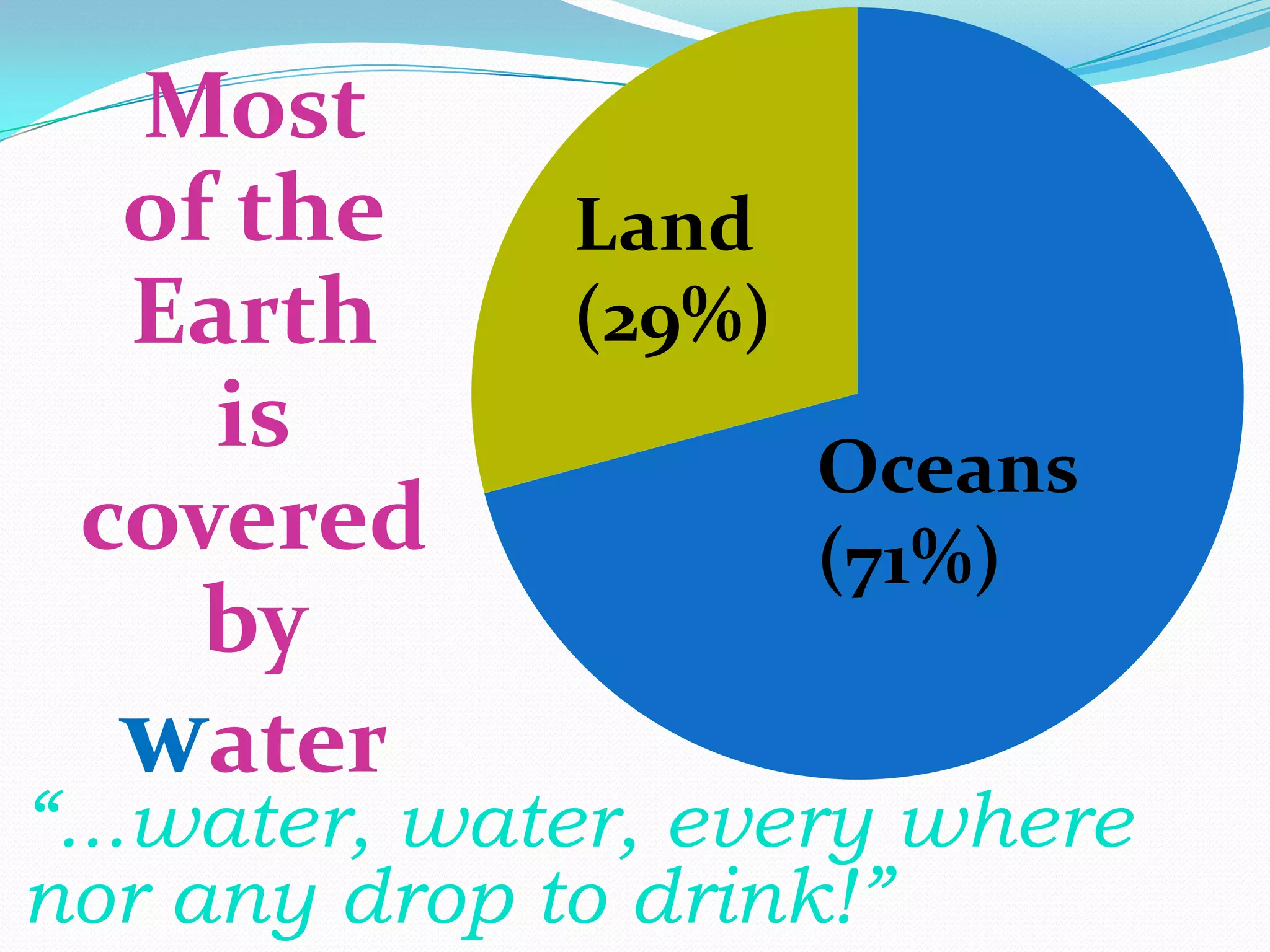
Oceans
(71%)
Land
(29%)
Most
of the
Earth
is
covered
by
water
“...water, water, every where
nor any drop to drink!”
Water Pollution
 Water pollution:
1.The main problems of pollution that need to be
addressed in the country are the following:
 Pollution from domestic sewage
 The high rates of drinking water and drainage
 The general lack of sewage treatment plants.
 The discharge of large quantities of untreated sewage
at specific points of the water resource systems or
along the coastline constitute the main water pollution
source in our country.
Remedies for depletion of Water
resources
 Improvement of efficiency in water use.
 Identification of water resources.
 Technical training and education about water .
 Information about water resources and flood
mitigation.
 Several programs are implemented such as
 1.Integrated development and use of water resources .
 2.Drinking water supply and sanitation
Mineral Resources
 Minerals : which have definite chemical
properties and indefinite chemical properties .
 There are 2 types of minerals namely
1.Metallic
2.Non-metallic
 Examples for metallic minerals are Iron , gold ,
Alluminium , Silver etc.,
 Examples for some non metallic minerals are
Gypsum , Lime stone , Coal etc.,
Threats to Mineral Resources
1.Mining
2.Disturbences to mantle layer which leads to Earth
quakes , drowning of land.
3.Deforestration –leads to loss of Bio diversity.
4.The acid mine drain-by usage of acids to extraction
process which leads to mix of acids in soil and Aquifer.
5.Loss of marine life due to oil spils while extracting oil.
Remedies for depletion of Mineral
resources
 We must go for bio mining where we use microbial
organisms for mining purpose.
 Mining waste treatment technology.
 EOR: This process must be implemented to extract oil
by using bacteria.
Food Resources
 Food is any substance consumed to provide nutritional
support for the body.
 It is usually of plants or animal origin, and contains
essential nutrients, such as carbohydrates, fats, proteins,
vitamins, or minerals.
 It is also said as source of energy for human activities.
 Based on production rate agriculture is divided into 2 types
as
1.Subsistence
2.Intensive
These are traditional practices
 Green revolution shifted traditional
practices to modern practices.
 It was first given by Norman Borlang .
 There were many draw backs such as salinity
, soil erosion , water logging , death of non
micro organisms.
 For these problems Albert Howard
introduced some practices known as organic
farming.
Remedies for depletion of Food
Resources
 Organic farming must be followed which is a
combination of traditional farming and modern
farming.
 Crop rotation method must be followed .
 Contour farming or terrace farming method must be
followed to overcome irrigation problems.
 We have to enrich the soil fertility by using natural
ways not by using pesticides.
Land Resources
 Land is an area which constitutes of biotic and a biotic
compounds.
 Due to soil erosion and land degradation soil is being
eroded by agents like wind , water and human
activities .
 Improper agricultural practices like Monoculture and
also introduction of alien species through hybrid
varieties also leads for the erosion of soil.
Control Measures
 Two control measures like
1.Biological control
2.Mechanical control are practices .
• In biological control measures
1.Mulching
2.Polyculture
3.Crop rotation must be followed .
In mechanical control process
1.counter farming
2.terrace farming
3.Step farming must be practiced .
Energy resources
 The capacity to do work is known as energy.
 It is divided as 2 types:
1.Renwable
2.Non renewable resources
 There are many disadvantages by using these resources
1.They leads to global warming .
2.They pollute air.
3.Release of carbon dioxide and other harmful gases.
Renewable resources are costly and space occupying
Sun cannot be used in cooler areas.
Energy Resource:
Materials which provides energy are called
energy resources. Based on availability they are
classified into two types:
Remedies to control depletion of
Energy Resources
 Use diesel car to reduce your dependence on fossil
fuels.
 Go solar to reduce the use of non renewable resources.
 Telecommute.
 Turn your lawn into an organic garden.
 Heat with wood to reduce your dependence on non
renewable resources and fossil fuels.
References
 Class notes
 Wikipedia

Natural resources

  • 1.
    By SURYAKANT VERMA Assistant Professor, Departmentof Pharmaceutics, Dr. K. N. Modi Institute of Pharmaceutical Education & Research, Modinagar, U.P., India.
  • 2.
    Natural Resource: Natural resourcesare materials and components (something that can be used) that can be found within the environment. Every man-made product is composed of natural resources (at its fundamental level). A natural resource may exist as a separate entity such as fresh water, and air, as well as a living organism such as a fish, or it may exist in an alternate form which must be processed to obtain the resource such as metal ores, oil, and most forms of energy.
  • 3.
    Natural resources  Theresources that are derived from the environment are called as natural resources.  Some of them are most essential for our living while most of them are used for satisfying our needs.  They are used to promote the man kind.  Every man made item consists of natural resources.  Sun is the major natural resource which never ends.
  • 4.
    TYPES OF CLASSIFICATION: Natural Resources are classified into different types based on their origin and availability  Based on their origin natural resources are of 2 types they are:  Biotic – Biotic resources are obtained from the biosphere (living and organic material), such as forests, animals, birds, and fish and the materials that can be obtained from them. Fossil fuels such as coal and petroleum are also included in this category because they are formed from decayed organic matter.  Abiotic – Abiotic resources are those that come from non-living, non-organic material. Examples of abiotic resources include land, fresh water, air and heavy metals including ores such as gold, iron, copper, silver, etc.
  • 5.
    Types of NaturalResources  They are mainly classified into 6 types: 1. Forest Resources 2. Water Resources 3. Mineral Resources 4. Food Resources 5. Land Resources 6. Energy Resources
  • 6.
    Forest Resources Forest :land occupied with wide range of flora and fauna which supports ecosystem.  Uses : 1. They give us wood for different purposes. 2. They are used in medicines . 3. They give fuels like fossil fuels, coal. 4. They have commercial use like honey, gum, lace, paper. 5. they provide 30% of oxygen.
  • 7.
  • 8.
    Threats  Mainly twotypes of threats are present. 1.Natural disasters 2.Man induced threats  Forest fires
  • 9.
    * International Federationof Red Cross and Red Crescent Societies (The Economist, Sept 6, 1997) High wind: 21% Earthquake: 8% Flood: 19% Other natural disasters: 21% Volcanoes: 1% Drought & Famine: 6%Landslides: 3% Man-made disasters: 34% Disasters* by type: 1971-96 Total: 8,219,000
  • 10.
    Reasons for depletionof Forest resources  Over-consumption/excessive or unnecessary use of resources  Non-equitable distribution of resources  Overpopulation.  Slash and burn agricultural practices, currently occurring in many developing countries.  Technological and industrial development.  Erosion  Habitat degradation leads to the loss of Biodiversity.  Irrigation  Mining for oil and minerals.  Aquifer depletion.  Forestry Forest Reserves within a particular country.  Pollution or contamination of resources.
  • 11.
    Control Measures  Controllingdeforestation :  Efforts to control deforestation must be taken on a global scale.  In addition to making sure that emissions from deforestation are kept to a minimum, an effort to educate people .  Reforestation is also being encouraged in many countries in an attempt to repair the damage that deforestation has done.
  • 12.
     Participate inyour community's recycling programs. Implement a recycling program at your office too.  Buy products manufactured with recycled paper. Many companies use their reputation as recyclers to attract business from eco-conscious customers.  Reuse junk mail and scraps of paper whenever possible. Instead of pitching old envelopes, use them to keep notes or make grocery lists.
  • 13.
  • 14.
    Water Pollution  Waterpollution: 1.The main problems of pollution that need to be addressed in the country are the following:  Pollution from domestic sewage  The high rates of drinking water and drainage  The general lack of sewage treatment plants.  The discharge of large quantities of untreated sewage at specific points of the water resource systems or along the coastline constitute the main water pollution source in our country.
  • 15.
    Remedies for depletionof Water resources  Improvement of efficiency in water use.  Identification of water resources.  Technical training and education about water .  Information about water resources and flood mitigation.  Several programs are implemented such as  1.Integrated development and use of water resources .  2.Drinking water supply and sanitation
  • 16.
    Mineral Resources  Minerals: which have definite chemical properties and indefinite chemical properties .  There are 2 types of minerals namely 1.Metallic 2.Non-metallic  Examples for metallic minerals are Iron , gold , Alluminium , Silver etc.,  Examples for some non metallic minerals are Gypsum , Lime stone , Coal etc.,
  • 17.
    Threats to MineralResources 1.Mining 2.Disturbences to mantle layer which leads to Earth quakes , drowning of land. 3.Deforestration –leads to loss of Bio diversity. 4.The acid mine drain-by usage of acids to extraction process which leads to mix of acids in soil and Aquifer. 5.Loss of marine life due to oil spils while extracting oil.
  • 18.
    Remedies for depletionof Mineral resources  We must go for bio mining where we use microbial organisms for mining purpose.  Mining waste treatment technology.  EOR: This process must be implemented to extract oil by using bacteria.
  • 19.
    Food Resources  Foodis any substance consumed to provide nutritional support for the body.  It is usually of plants or animal origin, and contains essential nutrients, such as carbohydrates, fats, proteins, vitamins, or minerals.  It is also said as source of energy for human activities.  Based on production rate agriculture is divided into 2 types as 1.Subsistence 2.Intensive These are traditional practices
  • 20.
     Green revolutionshifted traditional practices to modern practices.  It was first given by Norman Borlang .  There were many draw backs such as salinity , soil erosion , water logging , death of non micro organisms.  For these problems Albert Howard introduced some practices known as organic farming.
  • 21.
    Remedies for depletionof Food Resources  Organic farming must be followed which is a combination of traditional farming and modern farming.  Crop rotation method must be followed .  Contour farming or terrace farming method must be followed to overcome irrigation problems.  We have to enrich the soil fertility by using natural ways not by using pesticides.
  • 22.
    Land Resources  Landis an area which constitutes of biotic and a biotic compounds.  Due to soil erosion and land degradation soil is being eroded by agents like wind , water and human activities .  Improper agricultural practices like Monoculture and also introduction of alien species through hybrid varieties also leads for the erosion of soil.
  • 23.
    Control Measures  Twocontrol measures like 1.Biological control 2.Mechanical control are practices . • In biological control measures 1.Mulching 2.Polyculture 3.Crop rotation must be followed . In mechanical control process 1.counter farming 2.terrace farming 3.Step farming must be practiced .
  • 24.
    Energy resources  Thecapacity to do work is known as energy.  It is divided as 2 types: 1.Renwable 2.Non renewable resources  There are many disadvantages by using these resources 1.They leads to global warming . 2.They pollute air. 3.Release of carbon dioxide and other harmful gases. Renewable resources are costly and space occupying Sun cannot be used in cooler areas.
  • 25.
    Energy Resource: Materials whichprovides energy are called energy resources. Based on availability they are classified into two types:
  • 26.
    Remedies to controldepletion of Energy Resources  Use diesel car to reduce your dependence on fossil fuels.  Go solar to reduce the use of non renewable resources.  Telecommute.  Turn your lawn into an organic garden.  Heat with wood to reduce your dependence on non renewable resources and fossil fuels.
  • 27.