REFRACTIVE INDEX, OPTICAL
ROTATION & DISSOCIATION
CONSTANT
By
SURYAKANT VERMA
AssistantProfessor,
Department of Pharmaceutics,
Refractive Index
Light passes more slowly through a substance than
through a vacuum. As light enters a denser substance, the
advancing waves at the interface are modified by being
closer together owing to their slower speed and shorter
wave-length.
If the light enters a denser substance at an angle, one
part of the wave slows down more quickly as it passes the
interface, and this produces bending of the wave toward
the interface. This phenomenon is called refraction.
The relative value of refraction or bending of light
between two substances is given by the refractive index, n:
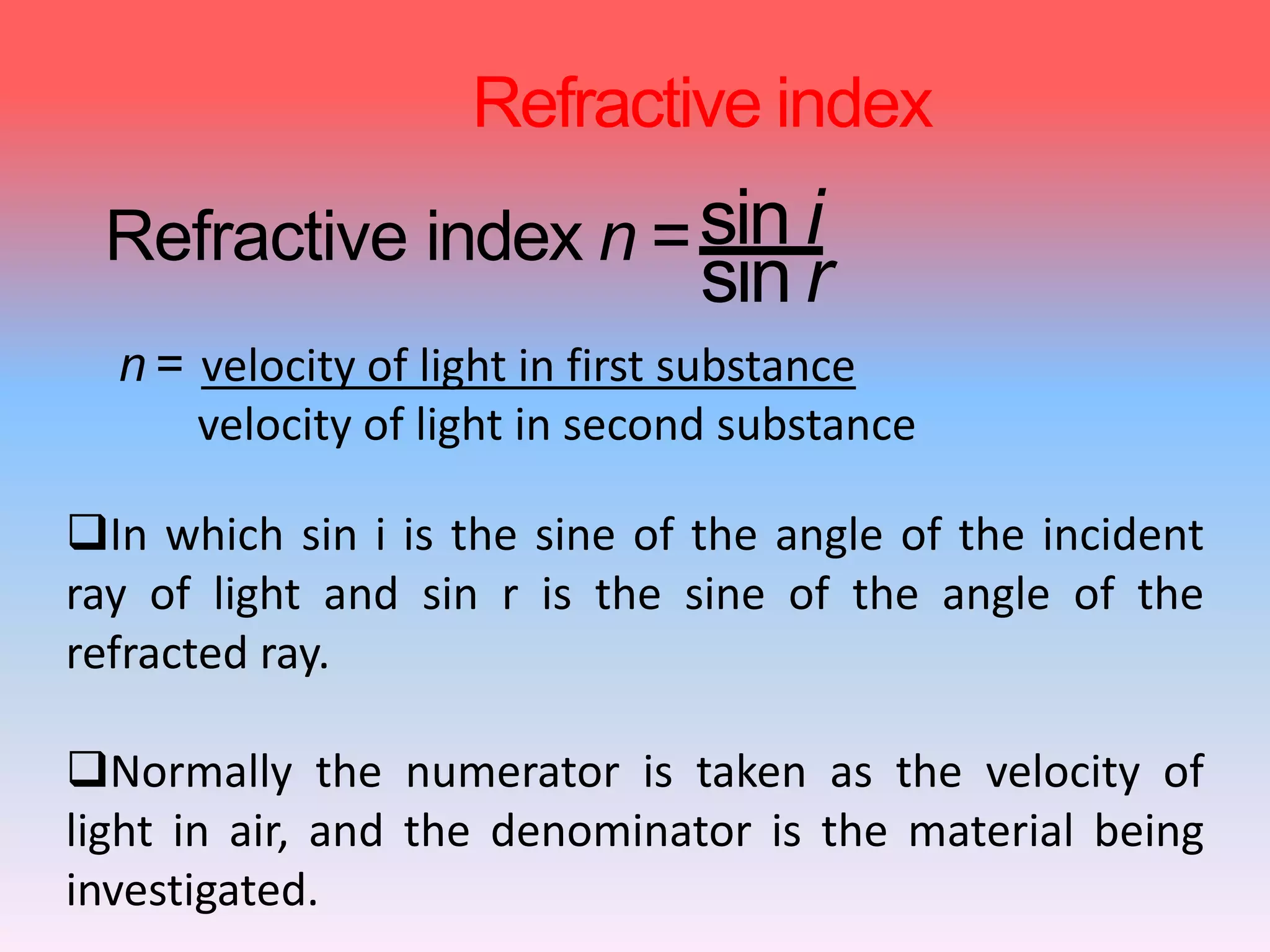
sin r
Refractive index n =sin i
Refractive index
n = velocity of light in first substance
velocity of light in second substance
In which sin i is the sine of the angle of the incident
ray of light and sin r is the sine of the angle of the
refracted ray.
Normally the numerator is taken as the velocity of
light in air, and the denominator is the material being
investigated.
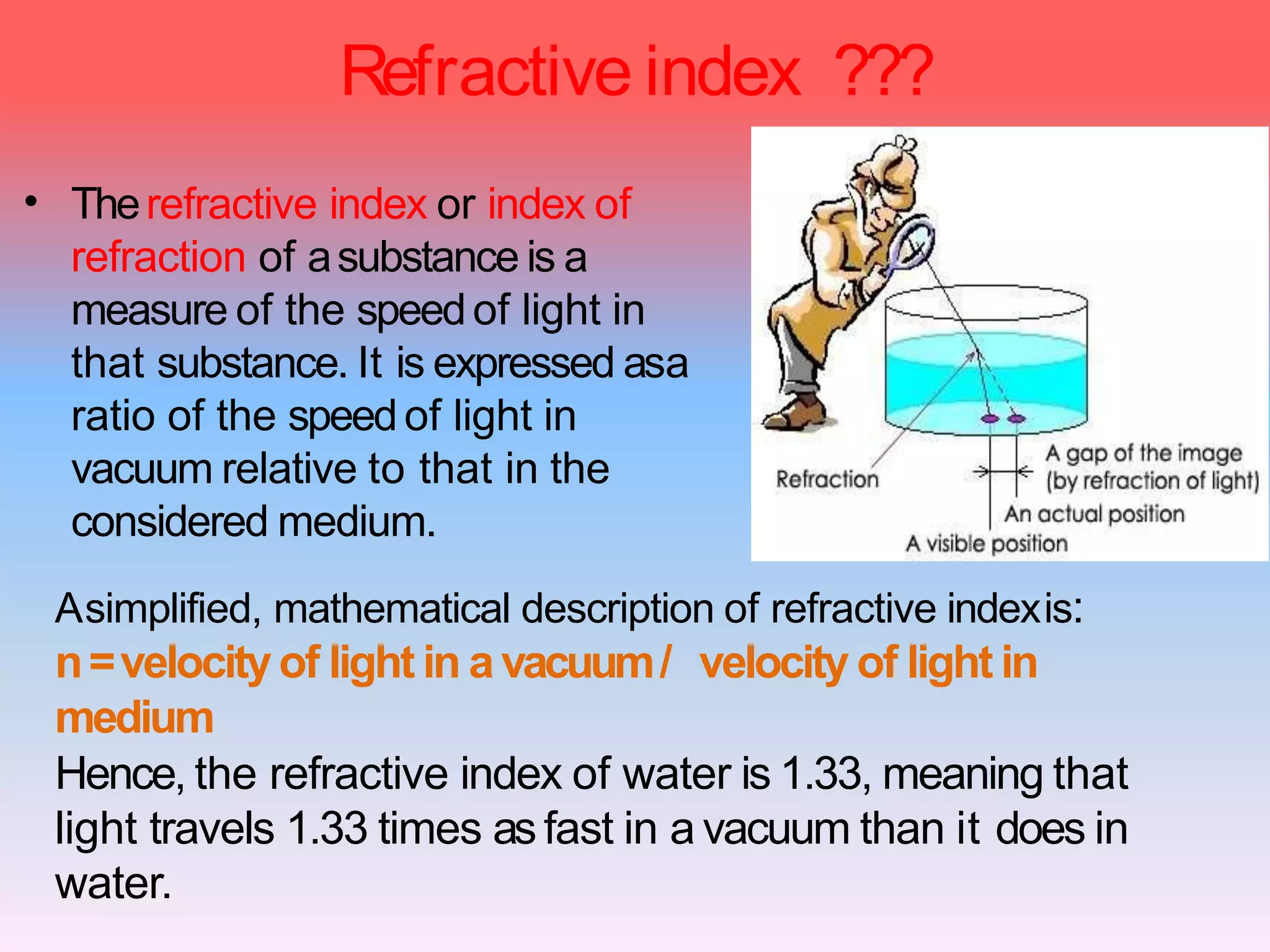
Refractive index ???
• Therefractive index or index of
refraction of asubstance is a
measure of the speedof light in
that substance. It is expressed asa
ratio of the speedof light in
vacuum relative to that in the
considered medium.
Asimplified, mathematical description of refractive indexis:
n=velocityof light in avacuum/ velocity of light in
medium
Hence, the refractive index of water is 1.33, meaning that
light travels 1.33 times asfast in a vacuum than it does in
water.
WhyRefractive indexisImportant ?
The refractive index of a material medium is an important optical
parameter sinceitexhibits the opticalpropertiesof the material.
Its values are often required to interpret various types of spectroscopic
data. SuchasDOAS,ES,RPFTS,IRRS,PWMS.
It is used to calculate the focusing power of lenses, and the dispersive
powerofprisms.
Therefractive index coefficients are important parameters in the design
of asolidstatelaser.
The adulteration problem is increasing day by day and hence simple,
automatic and accurate measurement of the refractive index of materials
isofgreat importance these days.
Refractive Index (RI) Detector is designed for high-performance
liquid chromatography (HPLC) applications. It provides sensitivity,
stability, and reproducibility for the analysis of components with
limited or noUVabsorption
Various methods and techniques for the measurement of refractive
indices of liquids, solids and gases. Sensitive determination of the
refractive indices of certain materials is very important in many fields
of research such as material analysis and environmental pollution
monitoring.
Refractometric measurements are used for qualitative analysis for
different type of packagingmaterial like glass,plastics, rubber, silketc.
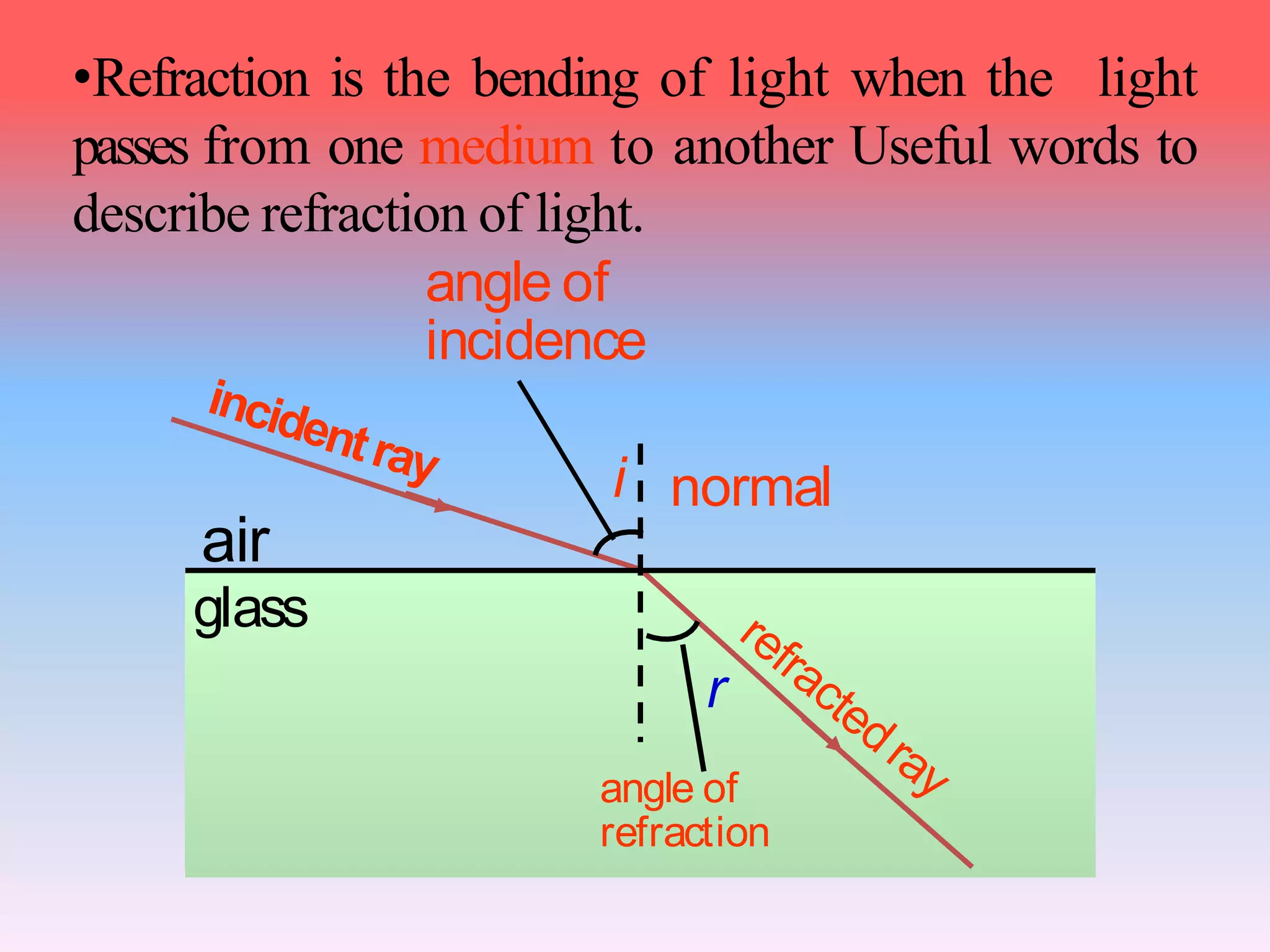
air
glass
normal
angle of
incidence
•Refraction is the bending of light when the light
passes from one medium to another Useful words to
describe refraction of light.
i
r
angle of
refraction
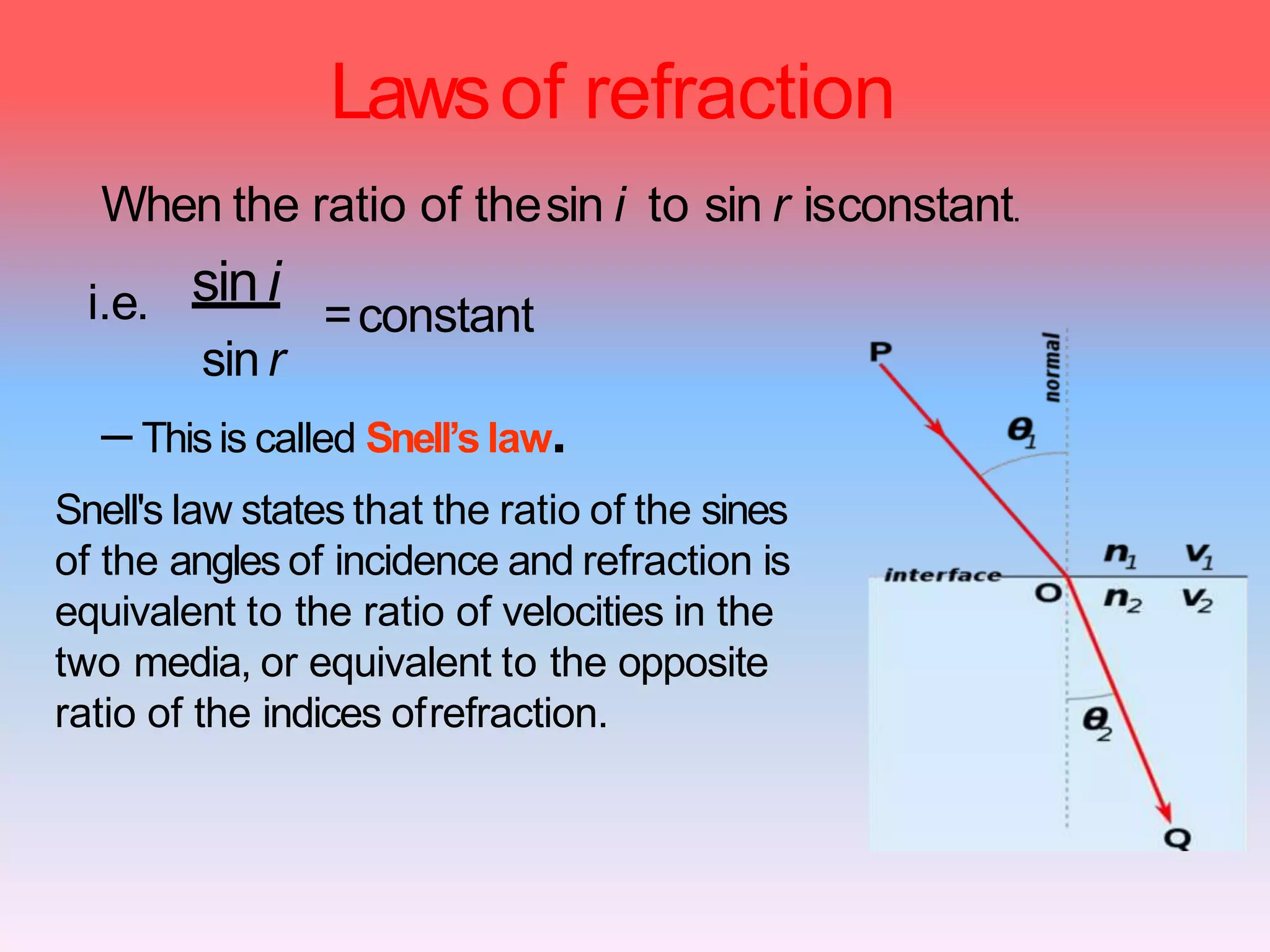
i.e. sini
sin r
=constant
When the ratio of thesin i to sin r isconstant.
Lawsof refraction
– Thisis called Snell’s law.
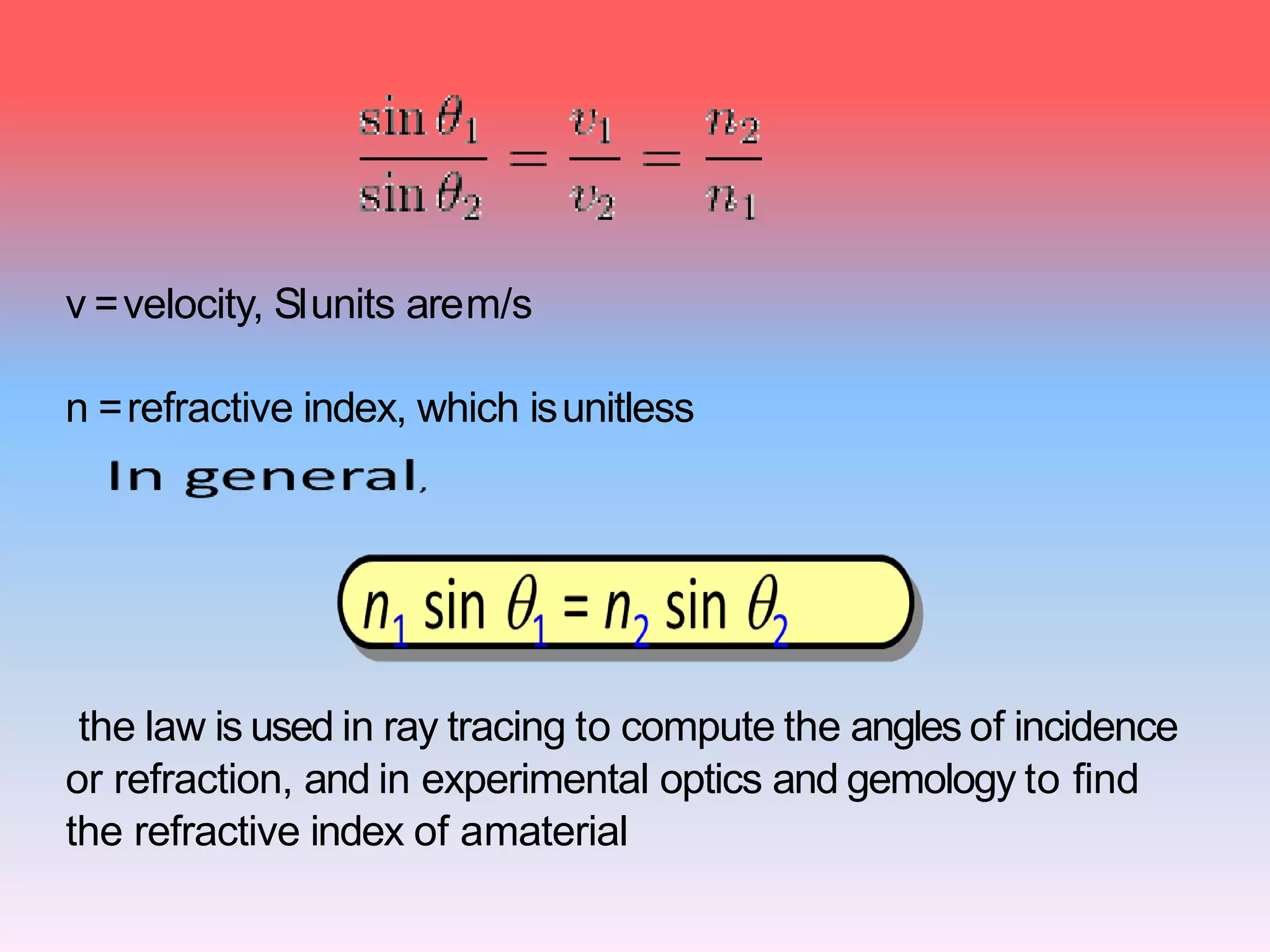
Snell's law states that the ratio of the sines
of the angles of incidence and refraction is
equivalent to the ratio of velocities in the
two media, or equivalent to the opposite
ratio of the indices ofrefraction.
the law is used in ray tracing to compute the angles of incidence
or refraction, and in experimental optics and gemology to find
the refractive index of amaterial
v =velocity, SIunits arem/s
n =refractive index, which isunitless
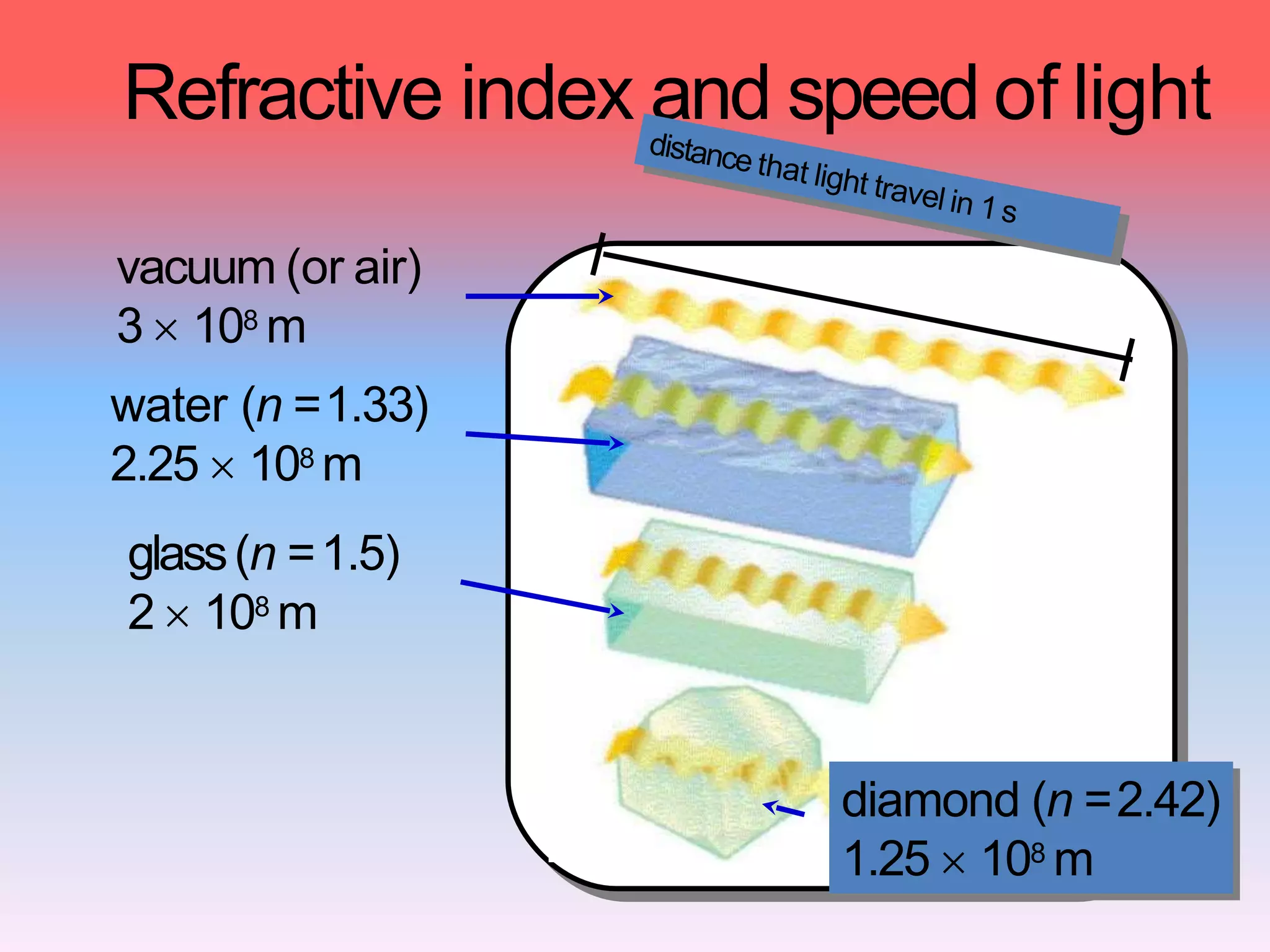
Refractive index and speed of light
vacuum (or air)
3  108 m
water (n =1.33)
2.25  108 m
glass(n =1.5)
2  108 m
diamond (n =2.42)
1.25  108 m
Optical Rotation
Optical rotation or optical activity (sometimes referred to
as rotary polarization) is the rotation of the plane
of polarization of linearly polarized light as it travels through certain
materials.
 Optical activity occurs only in chiral materials, those lacking
microscopic mirror symmetry. Unlike other sources
of birefringence which alter a beam's state of polarization, optical
activity can be observed in fluids.
This can include gases or solutions of chiral molecules such as
sugars, molecules with helical secondary structure such as some
proteins, and also chiral liquid crystals.
It can also be observed in chiral solids such as certain crystals
with a rotation between adjacent crystal planes (such as quartz)
or metamaterials.
Rotation of light's plane of polarization may also occur through
the Faraday effect which involves a static magnetic field, however
this is a distinct phenomenon that is not usually classified under
"optical activity."
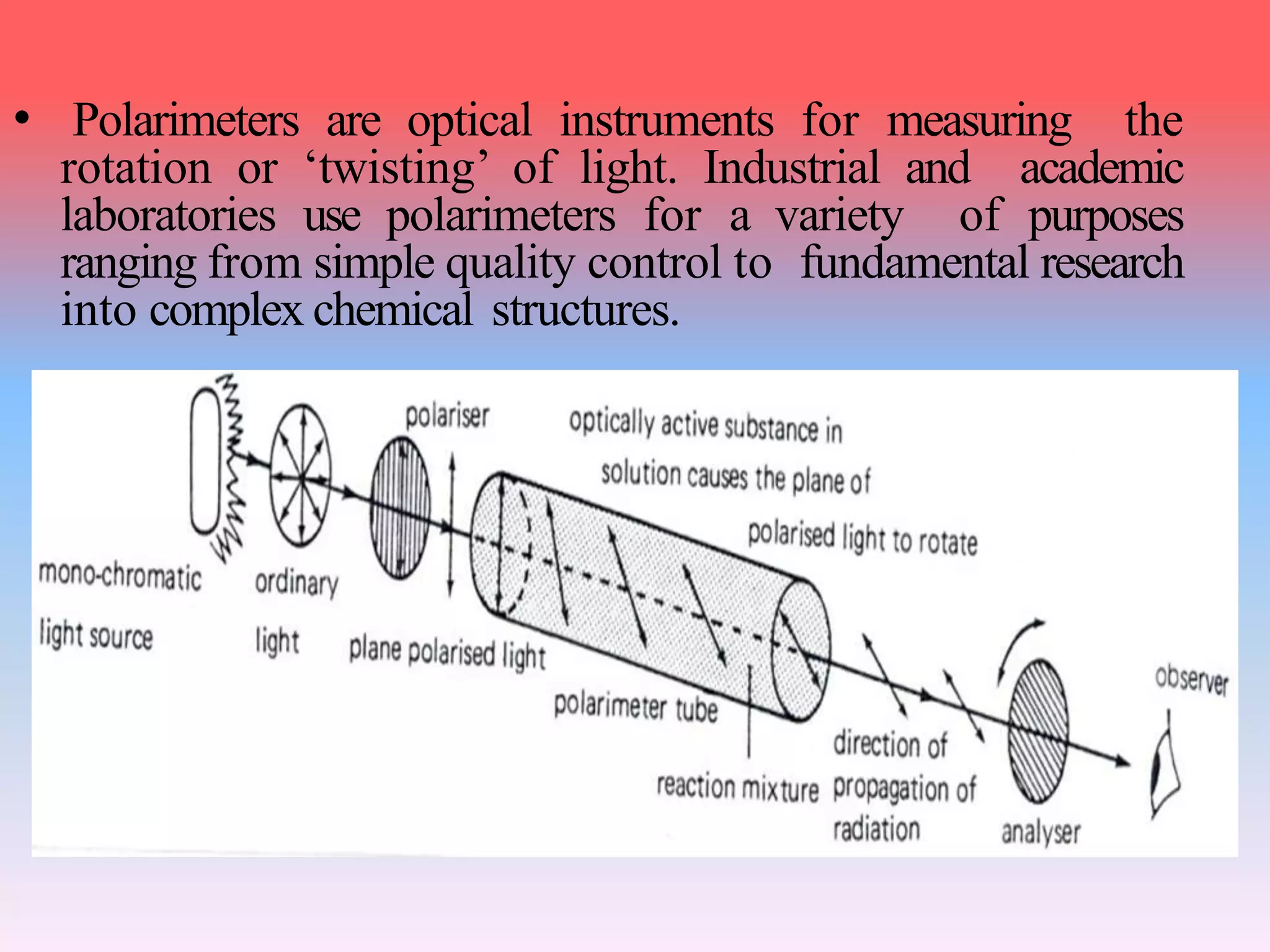
• Polarimeters are optical instruments for measuring the
rotation or ‘twisting’ of light. Industrial and academic
laboratories use polarimeters for a variety of purposes
ranging from simple quality control to fundamental research
into complex chemical structures.
• A sample tube containing the test liquid (solution) is
placed between two polarising elements (polaroid strip or
a calcite crystal). The first element, the polariser, polarises
the light before it passes into the sample. The second
element, the analyser, can be rotated to counteract any
rotation by the sample and hence locates the resultant
angular position of the light plane and hence the amount
of rotation causedby thesample.
Optical Activity
• When certain organic liquids, Solutions (like suger) or quartz
crystal are placed in the path of plane polarized light, the
plane of polarization is rotated. The property by vertue of
which the plane of polarization of light is rotated called
optical activity and the substance possessing this property are
said to beopticalactive.
• The substance which are rotate the plane of polarized light
towards the right (Clockwise) are called DEXTRO-ROTATARY
(+) while which rotate towards left (anticlockwise) called
LAEVE-ROTATARY (-). A mixture of these two varieties in
equal proportion will optically inactive called racemic
mixture
The magnitude of rotation depends upon the
following factor
1. Nature of substance.
2. Length of liquid column (l) through which
light passes.
3. Concentration of solution
4. Nature of thesolvent
5. Tempof the solution
6. Wavelength of light isused.
•
•
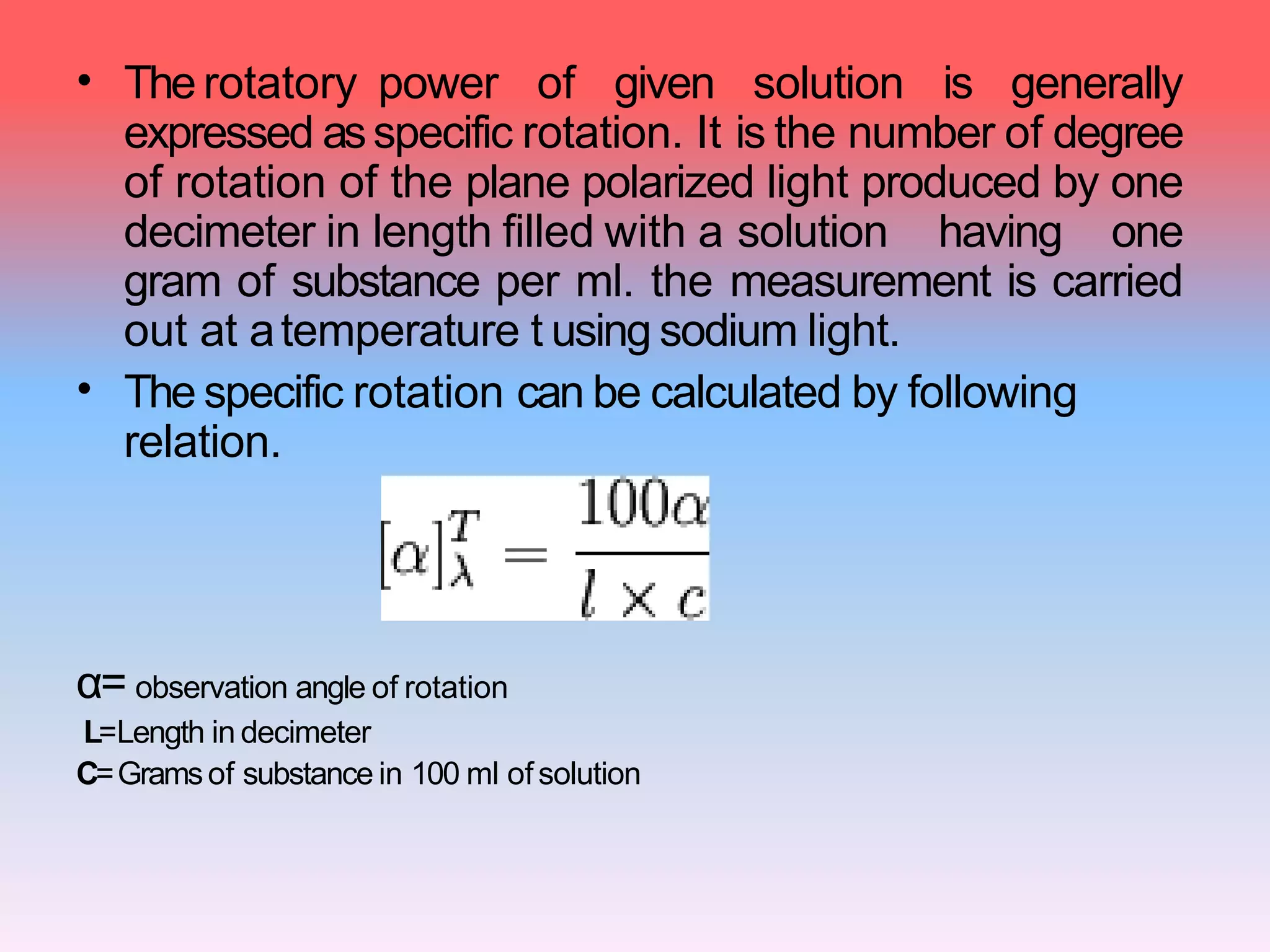
The rotatory power of given solution is generally
expressed asspecific rotation. It is the number of degree
of rotation of the plane polarized light produced by one
decimeter in length filled with a solution having one
gram of substance per ml. the measurement is carried
out at atemperature t using sodium light.
The specific rotation can be calculated by following
relation.
α= observation angle of rotation
L=Length in decimeter
C=Gramsof substance in 100 ml ofsolution
Application of optical Activity andoptical
rotation
A convenient method for study of optical isomerism, configuration and
conformation of compound.
If the specific rotation of the sample is known, the concentration of optically
active substance in the solution can be calculated. Alternatively . If the
concentration of the material in the sample is known, the specific rotation can
be calculated and used for identification purpose.
Quantitative methods of analysis by polarimetry are widespread particularly
for plant control in the pharmaceutical industry. The most extensive
application in the sugar industry.
In other applications, for example R&D, the user may be required to be fully
conversant with the principles and to be in a position to investigate optical
properties of test materials, possiblyfor the first time.
•a quantity expressing the extent to which a particular substance
in solution is dissociated into ions, equal to the product of the
concentrations of the respective ions divided by the
concentration of the undissociated molecule.
•In chemistry, biochemistry, and pharmacology, a dissociation
constant K{d} specific type of equilibrium constant that
measures the propensity of a larger object to separate (dissociate)
reversibly into smaller components, as when a complex falls
apart into its component molecules, or when a salt splits up into
its component ions. The dissociation constant is the inverse of
the association constant. In the special case of salts, the
dissociation constant can also be called an ionization constant.
DISSOCIATION CONSTANT
THANK YOU

Refractive index

  • 1.
    REFRACTIVE INDEX, OPTICAL ROTATION& DISSOCIATION CONSTANT By SURYAKANT VERMA AssistantProfessor, Department of Pharmaceutics,
  • 2.
    Refractive Index Light passesmore slowly through a substance than through a vacuum. As light enters a denser substance, the advancing waves at the interface are modified by being closer together owing to their slower speed and shorter wave-length. If the light enters a denser substance at an angle, one part of the wave slows down more quickly as it passes the interface, and this produces bending of the wave toward the interface. This phenomenon is called refraction. The relative value of refraction or bending of light between two substances is given by the refractive index, n:
  • 3.
    sin r Refractive indexn =sin i Refractive index n = velocity of light in first substance velocity of light in second substance In which sin i is the sine of the angle of the incident ray of light and sin r is the sine of the angle of the refracted ray. Normally the numerator is taken as the velocity of light in air, and the denominator is the material being investigated.
  • 4.
    Refractive index ??? •Therefractive index or index of refraction of asubstance is a measure of the speedof light in that substance. It is expressed asa ratio of the speedof light in vacuum relative to that in the considered medium. Asimplified, mathematical description of refractive indexis: n=velocityof light in avacuum/ velocity of light in medium Hence, the refractive index of water is 1.33, meaning that light travels 1.33 times asfast in a vacuum than it does in water.
  • 5.
    WhyRefractive indexisImportant ? Therefractive index of a material medium is an important optical parameter sinceitexhibits the opticalpropertiesof the material. Its values are often required to interpret various types of spectroscopic data. SuchasDOAS,ES,RPFTS,IRRS,PWMS. It is used to calculate the focusing power of lenses, and the dispersive powerofprisms. Therefractive index coefficients are important parameters in the design of asolidstatelaser. The adulteration problem is increasing day by day and hence simple, automatic and accurate measurement of the refractive index of materials isofgreat importance these days.
  • 6.
    Refractive Index (RI)Detector is designed for high-performance liquid chromatography (HPLC) applications. It provides sensitivity, stability, and reproducibility for the analysis of components with limited or noUVabsorption Various methods and techniques for the measurement of refractive indices of liquids, solids and gases. Sensitive determination of the refractive indices of certain materials is very important in many fields of research such as material analysis and environmental pollution monitoring. Refractometric measurements are used for qualitative analysis for different type of packagingmaterial like glass,plastics, rubber, silketc.
  • 7.
    air glass normal angle of incidence •Refraction isthe bending of light when the light passes from one medium to another Useful words to describe refraction of light. i r angle of refraction
  • 8.
    i.e. sini sin r =constant Whenthe ratio of thesin i to sin r isconstant. Lawsof refraction – Thisis called Snell’s law. Snell's law states that the ratio of the sines of the angles of incidence and refraction is equivalent to the ratio of velocities in the two media, or equivalent to the opposite ratio of the indices ofrefraction.
  • 9.
    the law isused in ray tracing to compute the angles of incidence or refraction, and in experimental optics and gemology to find the refractive index of amaterial v =velocity, SIunits arem/s n =refractive index, which isunitless
  • 10.
    Refractive index andspeed of light vacuum (or air) 3  108 m water (n =1.33) 2.25  108 m glass(n =1.5) 2  108 m diamond (n =2.42) 1.25  108 m
  • 12.
  • 13.
    Optical rotation oroptical activity (sometimes referred to as rotary polarization) is the rotation of the plane of polarization of linearly polarized light as it travels through certain materials.  Optical activity occurs only in chiral materials, those lacking microscopic mirror symmetry. Unlike other sources of birefringence which alter a beam's state of polarization, optical activity can be observed in fluids. This can include gases or solutions of chiral molecules such as sugars, molecules with helical secondary structure such as some proteins, and also chiral liquid crystals. It can also be observed in chiral solids such as certain crystals with a rotation between adjacent crystal planes (such as quartz) or metamaterials. Rotation of light's plane of polarization may also occur through the Faraday effect which involves a static magnetic field, however this is a distinct phenomenon that is not usually classified under "optical activity."
  • 14.
    • Polarimeters areoptical instruments for measuring the rotation or ‘twisting’ of light. Industrial and academic laboratories use polarimeters for a variety of purposes ranging from simple quality control to fundamental research into complex chemical structures.
  • 15.
    • A sampletube containing the test liquid (solution) is placed between two polarising elements (polaroid strip or a calcite crystal). The first element, the polariser, polarises the light before it passes into the sample. The second element, the analyser, can be rotated to counteract any rotation by the sample and hence locates the resultant angular position of the light plane and hence the amount of rotation causedby thesample.
  • 16.
    Optical Activity • Whencertain organic liquids, Solutions (like suger) or quartz crystal are placed in the path of plane polarized light, the plane of polarization is rotated. The property by vertue of which the plane of polarization of light is rotated called optical activity and the substance possessing this property are said to beopticalactive. • The substance which are rotate the plane of polarized light towards the right (Clockwise) are called DEXTRO-ROTATARY (+) while which rotate towards left (anticlockwise) called LAEVE-ROTATARY (-). A mixture of these two varieties in equal proportion will optically inactive called racemic mixture
  • 17.
    The magnitude ofrotation depends upon the following factor 1. Nature of substance. 2. Length of liquid column (l) through which light passes. 3. Concentration of solution 4. Nature of thesolvent 5. Tempof the solution 6. Wavelength of light isused.
  • 18.
    • • The rotatory powerof given solution is generally expressed asspecific rotation. It is the number of degree of rotation of the plane polarized light produced by one decimeter in length filled with a solution having one gram of substance per ml. the measurement is carried out at atemperature t using sodium light. The specific rotation can be calculated by following relation. α= observation angle of rotation L=Length in decimeter C=Gramsof substance in 100 ml ofsolution
  • 19.
    Application of opticalActivity andoptical rotation A convenient method for study of optical isomerism, configuration and conformation of compound. If the specific rotation of the sample is known, the concentration of optically active substance in the solution can be calculated. Alternatively . If the concentration of the material in the sample is known, the specific rotation can be calculated and used for identification purpose. Quantitative methods of analysis by polarimetry are widespread particularly for plant control in the pharmaceutical industry. The most extensive application in the sugar industry. In other applications, for example R&D, the user may be required to be fully conversant with the principles and to be in a position to investigate optical properties of test materials, possiblyfor the first time.
  • 20.
    •a quantity expressingthe extent to which a particular substance in solution is dissociated into ions, equal to the product of the concentrations of the respective ions divided by the concentration of the undissociated molecule. •In chemistry, biochemistry, and pharmacology, a dissociation constant K{d} specific type of equilibrium constant that measures the propensity of a larger object to separate (dissociate) reversibly into smaller components, as when a complex falls apart into its component molecules, or when a salt splits up into its component ions. The dissociation constant is the inverse of the association constant. In the special case of salts, the dissociation constant can also be called an ionization constant. DISSOCIATION CONSTANT
  • 21.