From Unsustainable to
Sustainable Development
Presented by
Dr. Syed Hayath Basha
Assistant Professor of Education
Aligarh Muslim University Centre,
Malappuram, Kerala-679340 (India)
Email: hayath83n@gmail.com
Mob: 9990359350/7736338828
Dated: 29-03-2017
29 March 2017 1Dr. S.H. Basha
Outline of Today’s Presentation
• What is Unsustainable Development?
• What are the Causes of Unsustainable
Development?
• What is Sustainable Development?
• Definitions of Sustainable Development?
• Pillars of Sustainable Development
• Measures for Sustainable Development
• Concluding Remarks
29th
March 2017 2Dr. S.H. Basha
What is Unsustainable Development?
It is
• Unsystematic planning
• Irresponsible Planning
• Living without planning
• Living without thinking about others
29th
March 2017 3Dr.S.H. Basha
Causes of Unsustainable Development
• Climate Change
• Human Health
• Technological Change
• Urban Problems related to energy
• Water Conservation
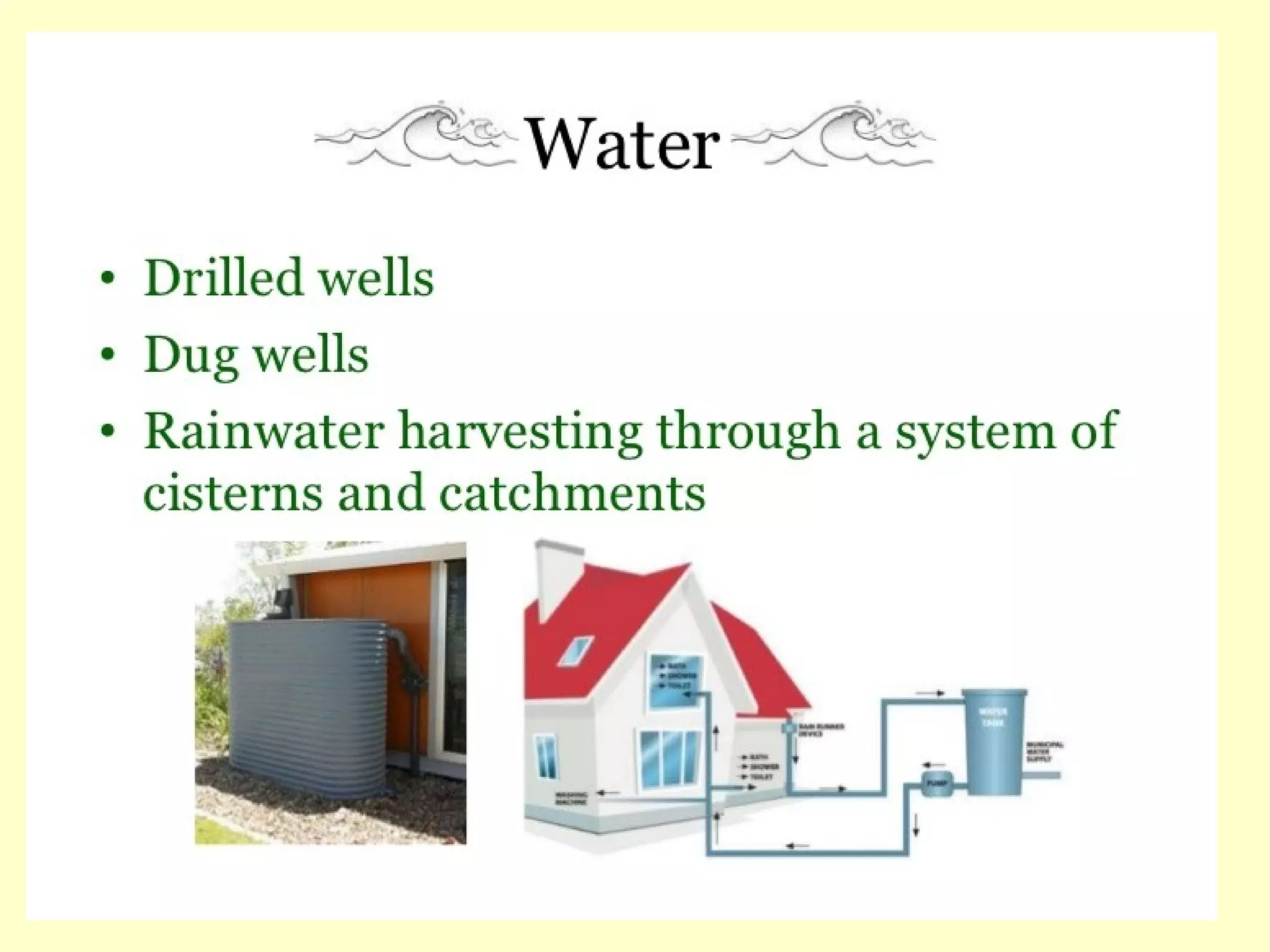
• Rain water Harvesting
• Watershed Management
29th
March 2017 4Dr.S.H. Basha
…Continued.
• Environmental Ethics
• Global warming
• Water and Sanitation
• Agriculture
• Livestock Development
• Protection of Natural Resources
• Public Awareness
29th
March 2017 5Dr.S.H. Basha
Priority Areas for Action
Priority areas for action, identified by UN Secretary-General Kofi Annan
• Water and sanitation
• Energy
• Health
• Agriculture
• Biodiversity protection and ecosystem management
March 23, 2018 6Dr. S.H. Basha
Human Health
“Good health is vital for eradicating poverty and
achieving sustainable development.”
Some key issues:
– Reduce mortality rates in 2015: by 66.7% for children &
infants under 5; by 75% for maternal mortality rates
– Control & eradicate communicable diseases, reduce HIV
prevalence, combat malaria, tuberculosis
– Ensure that chemicals are not used and produced in ways
that harm human health
– Reduce air pollution
March 23, 2018 7Dr. S.H. Basha
Water and Sanitation
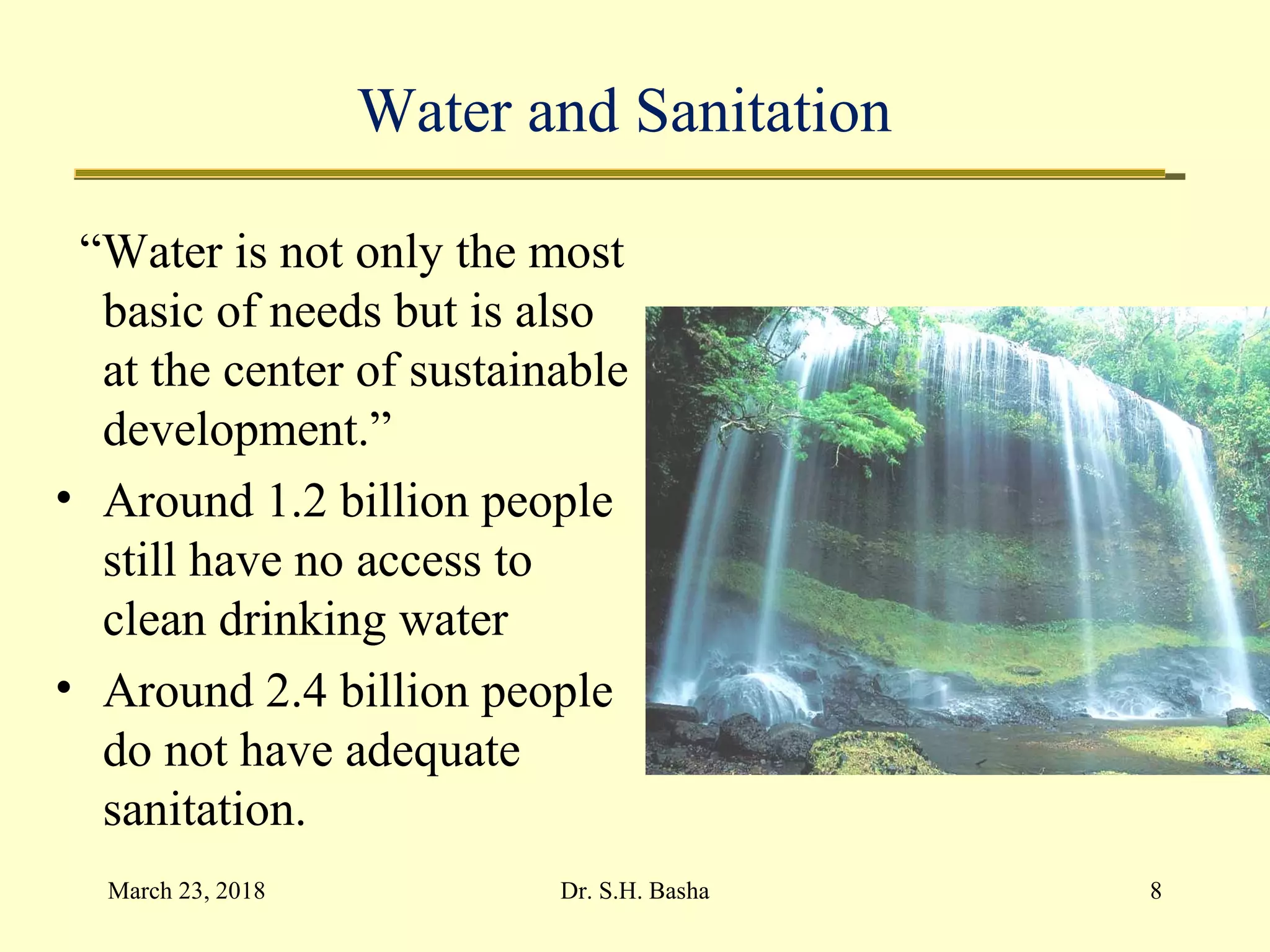
“Water is not only the most
basic of needs but is also
at the center of sustainable
development.”
• Around 1.2 billion people
still have no access to
clean drinking water
• Around 2.4 billion people
do not have adequate
sanitation.
March 23, 2018 8Dr. S.H. Basha
March 23, 2018 M. Shamsul Arefin 9
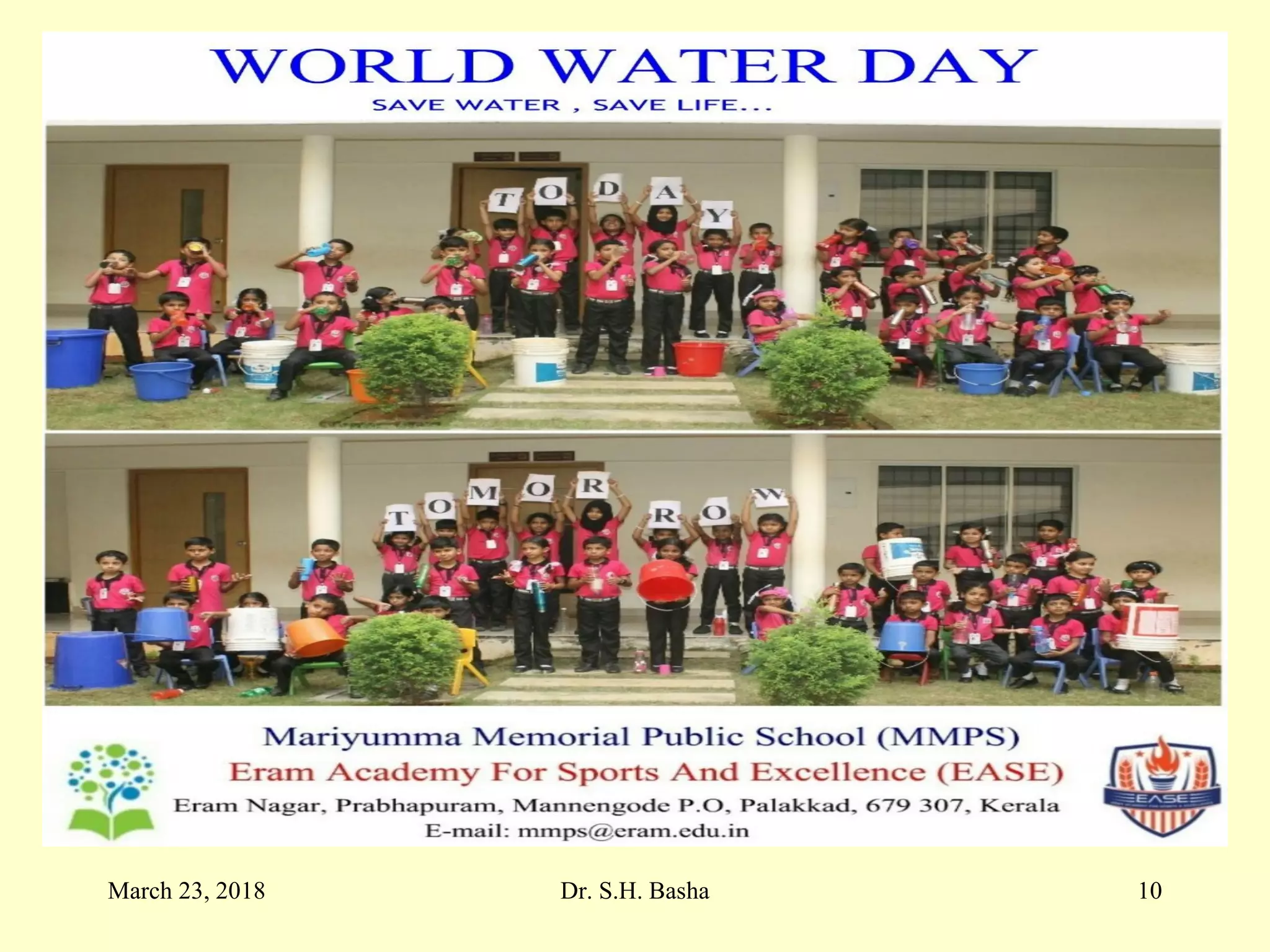
March 23, 2018 Dr. S.H. Basha 10
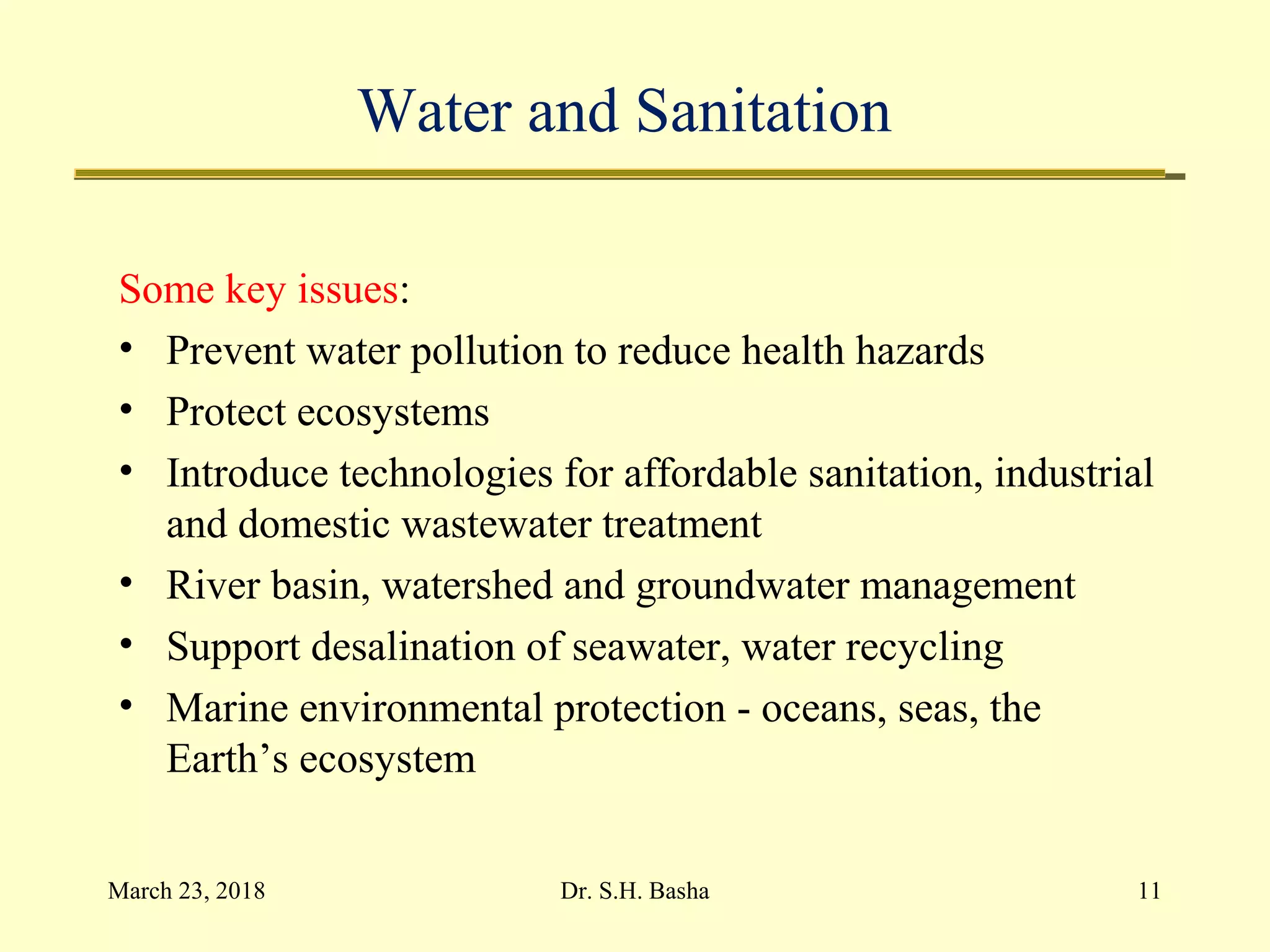
Water and Sanitation
Some key issues:
• Prevent water pollution to reduce health hazards
• Protect ecosystems
• Introduce technologies for affordable sanitation, industrial
and domestic wastewater treatment
• River basin, watershed and groundwater management
• Support desalination of seawater, water recycling
• Marine environmental protection - oceans, seas, the
Earth’s ecosystem
March 23, 2018 11Dr. S.H. Basha
March 23, 2018 Dr. S. H. Basha 12
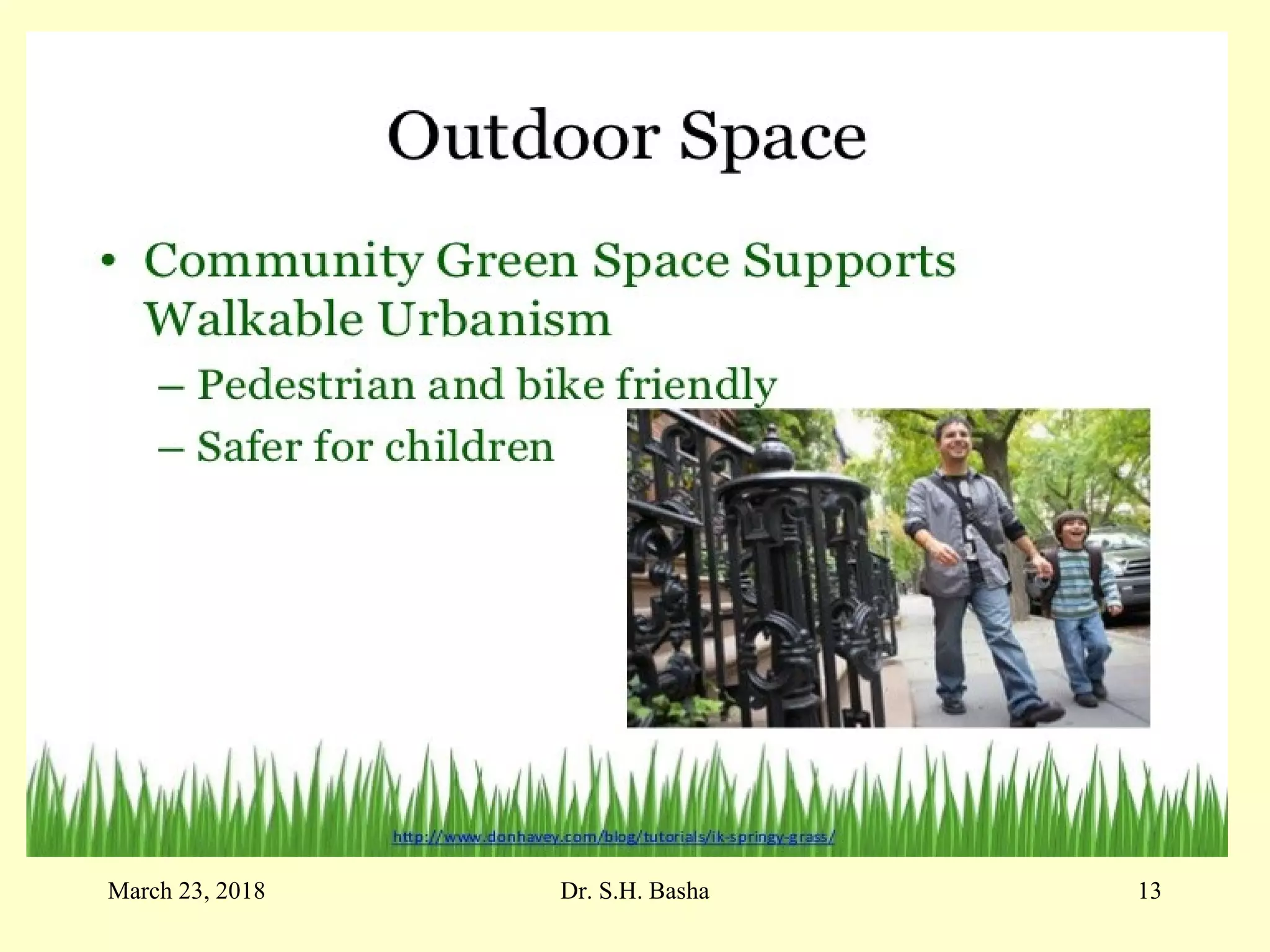
March 23, 2018 Dr. S.H. Basha 13
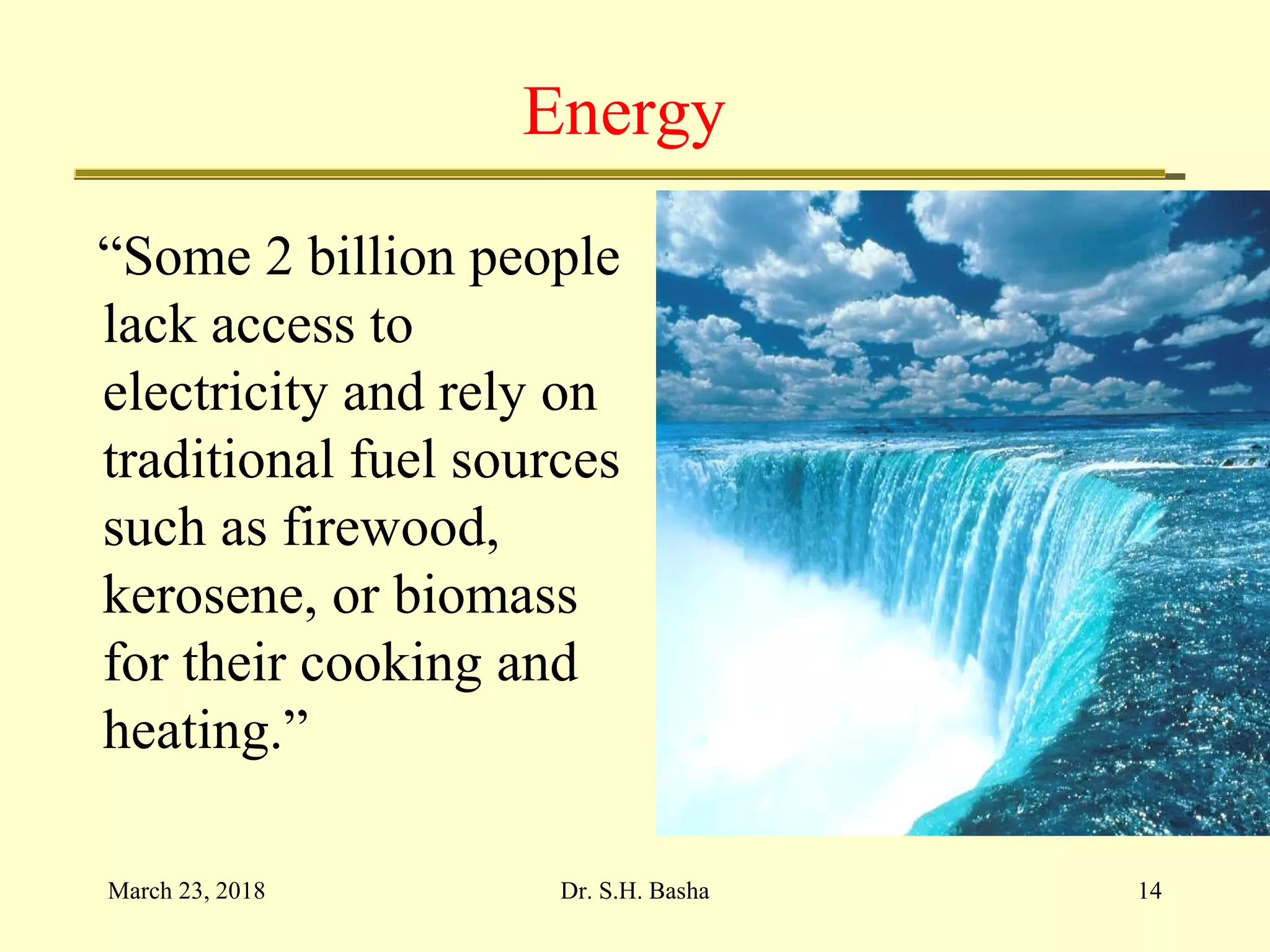
Energy
“Some 2 billion people
lack access to
electricity and rely on
traditional fuel sources
such as firewood,
kerosene, or biomass
for their cooking and
heating.”
March 23, 2018 14Dr. S.H. Basha
Energy
Some key issues:
• Focus on access to energy in rural areas
• Energy conservation and energy efficiency – building
design & management, better mass transportation,
advanced and innovative cleaner technologies
• Promotion of renewable energy
• Action on climate change – ratification by countries of
the Kyoto Protocol
March 23, 2018 15Dr. S.H. Basha
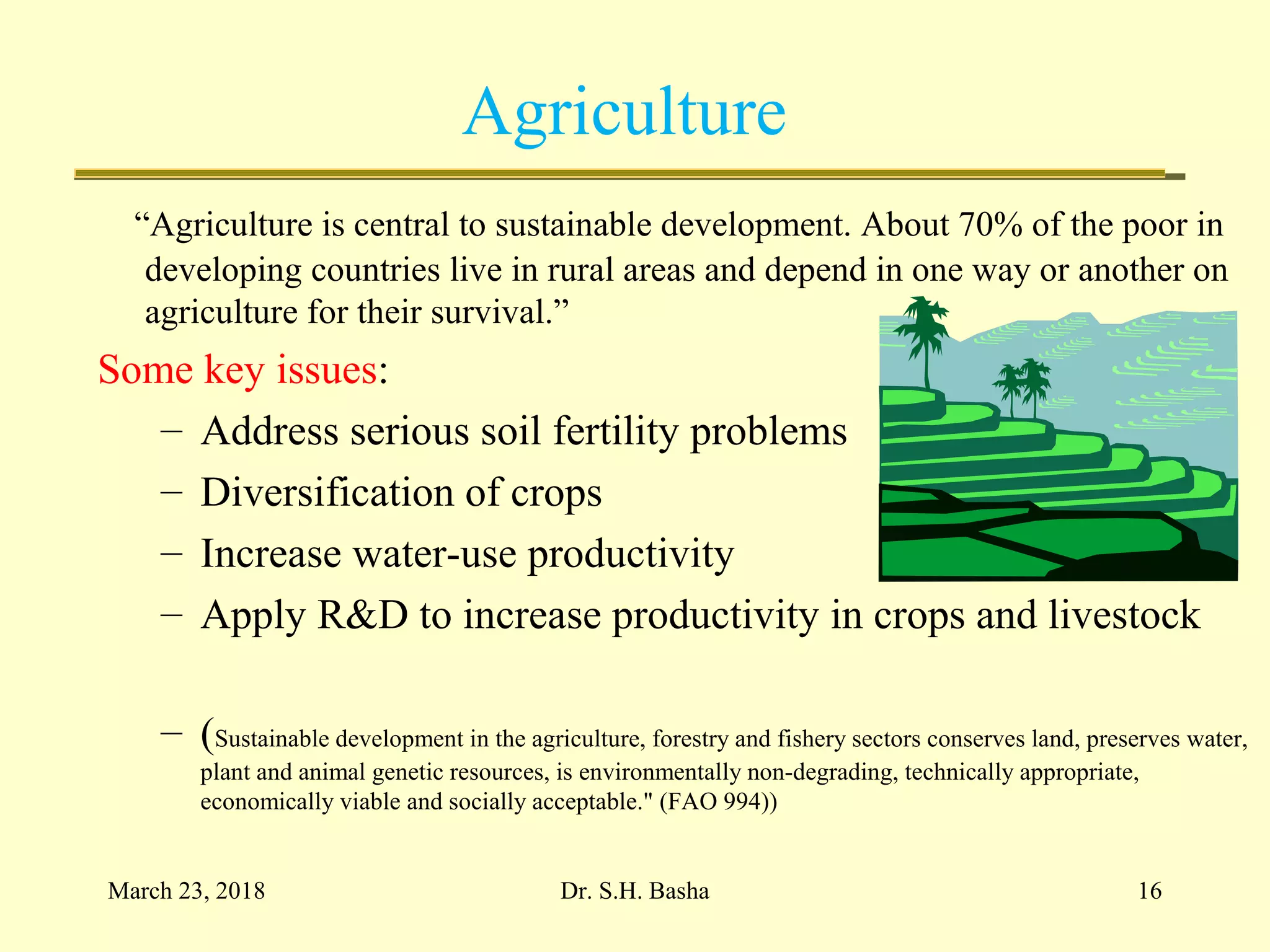
Agriculture
“Agriculture is central to sustainable development. About 70% of the poor in
developing countries live in rural areas and depend in one way or another on
agriculture for their survival.”
Some key issues:
– Address serious soil fertility problems
– Diversification of crops
– Increase water-use productivity
– Apply R&D to increase productivity in crops and livestock
– (Sustainable development in the agriculture, forestry and fishery sectors conserves land, preserves water,
plant and animal genetic resources, is environmentally non-degrading, technically appropriate,
economically viable and socially acceptable." (FAO 994))
March 23, 2018 16Dr. S.H. Basha
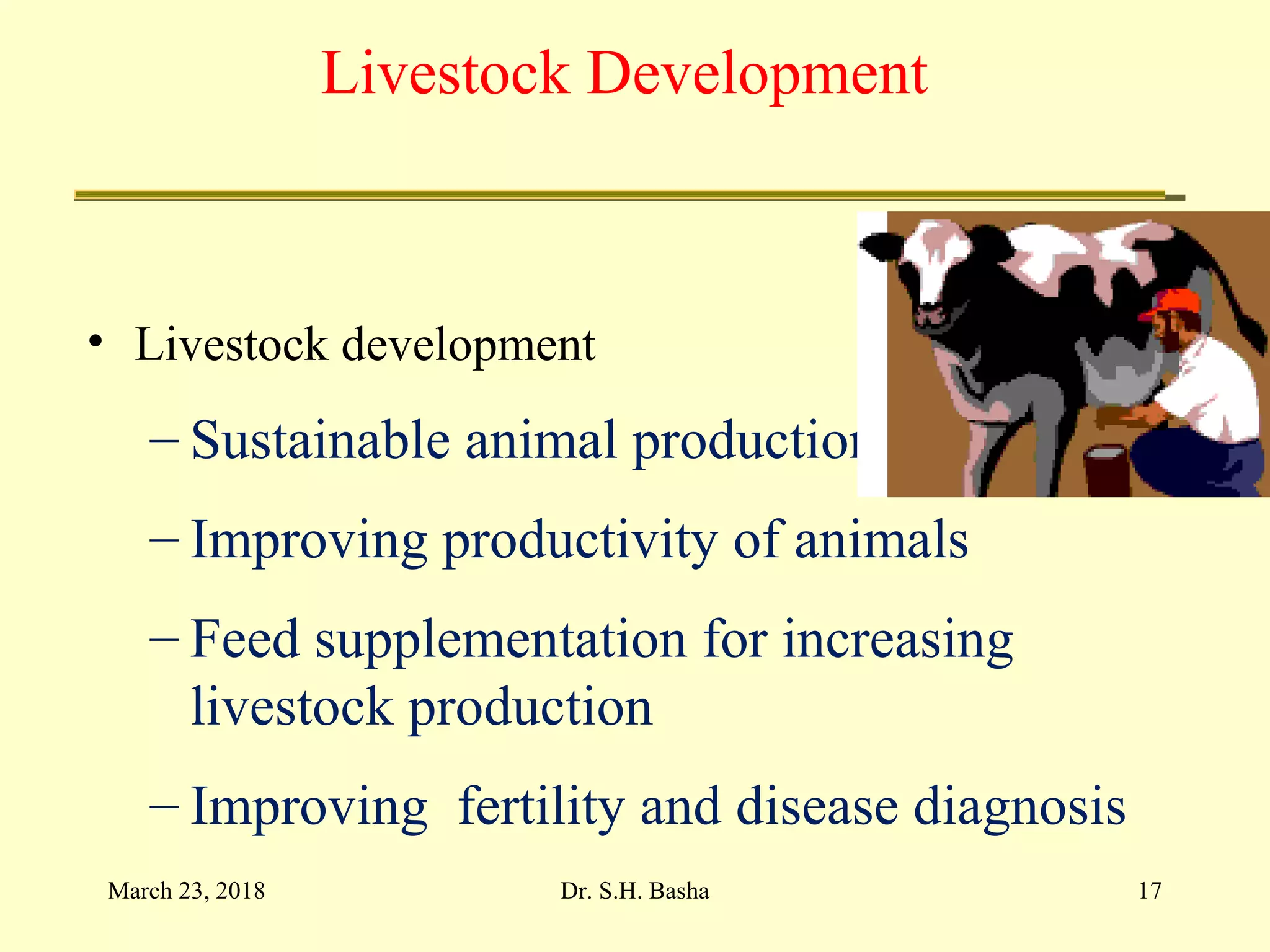
Livestock Development
• Livestock development
– Sustainable animal production
– Improving productivity of animals
– Feed supplementation for increasing
livestock production
– Improving fertility and disease diagnosis
March 23, 2018 17Dr. S.H. Basha
Biodiversity
Biodiversity is a modern term which simply means " the variety of life
on earth". This variety can be measured on several different levels.
 Genetic - variation between individuals of the same species. This
includes genetic variation between individuals in a single population ,
as well as variations between different populations of the same
species.
Species - species diversity is the variety of species in a given region
or area. This can be determined by counting the number of different
species
Ecosystem - Communities of plants and animals, together with the
physical characteristics of their environment (e.g. geology, soil and
climate) interlink together as an 'ecosystem'. Ecosystem diversity is
more difficult to measure because there are rarely clear boundaries
between different ecosystems
March 23, 2018 18Dr. S.H. Basha
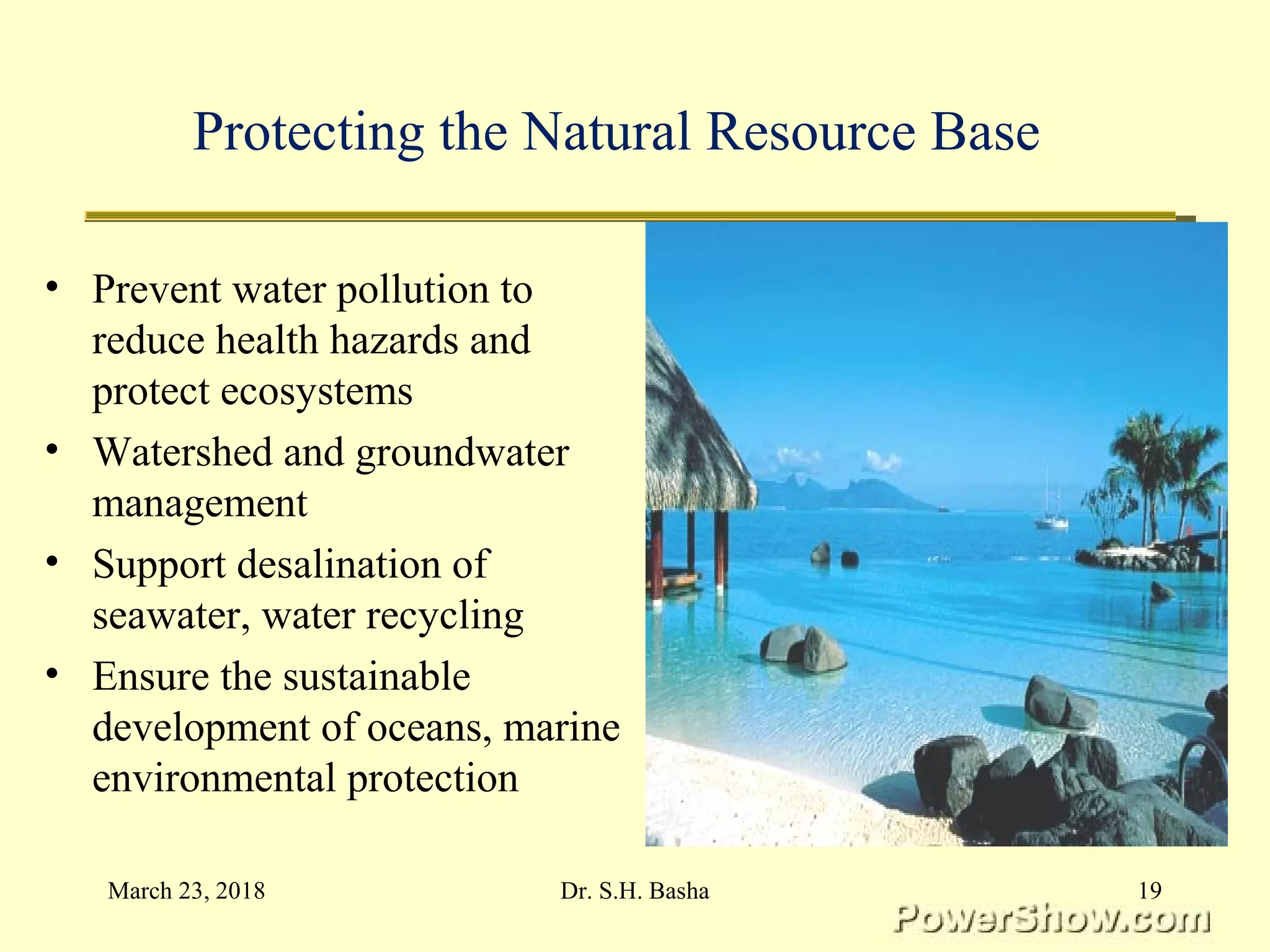
Protecting the Natural Resource Base
• Prevent water pollution to
reduce health hazards and
protect ecosystems
• Watershed and groundwater
management
• Support desalination of
seawater, water recycling
• Ensure the sustainable
development of oceans, marine
environmental protection
March 23, 2018 19Dr. S.H. Basha
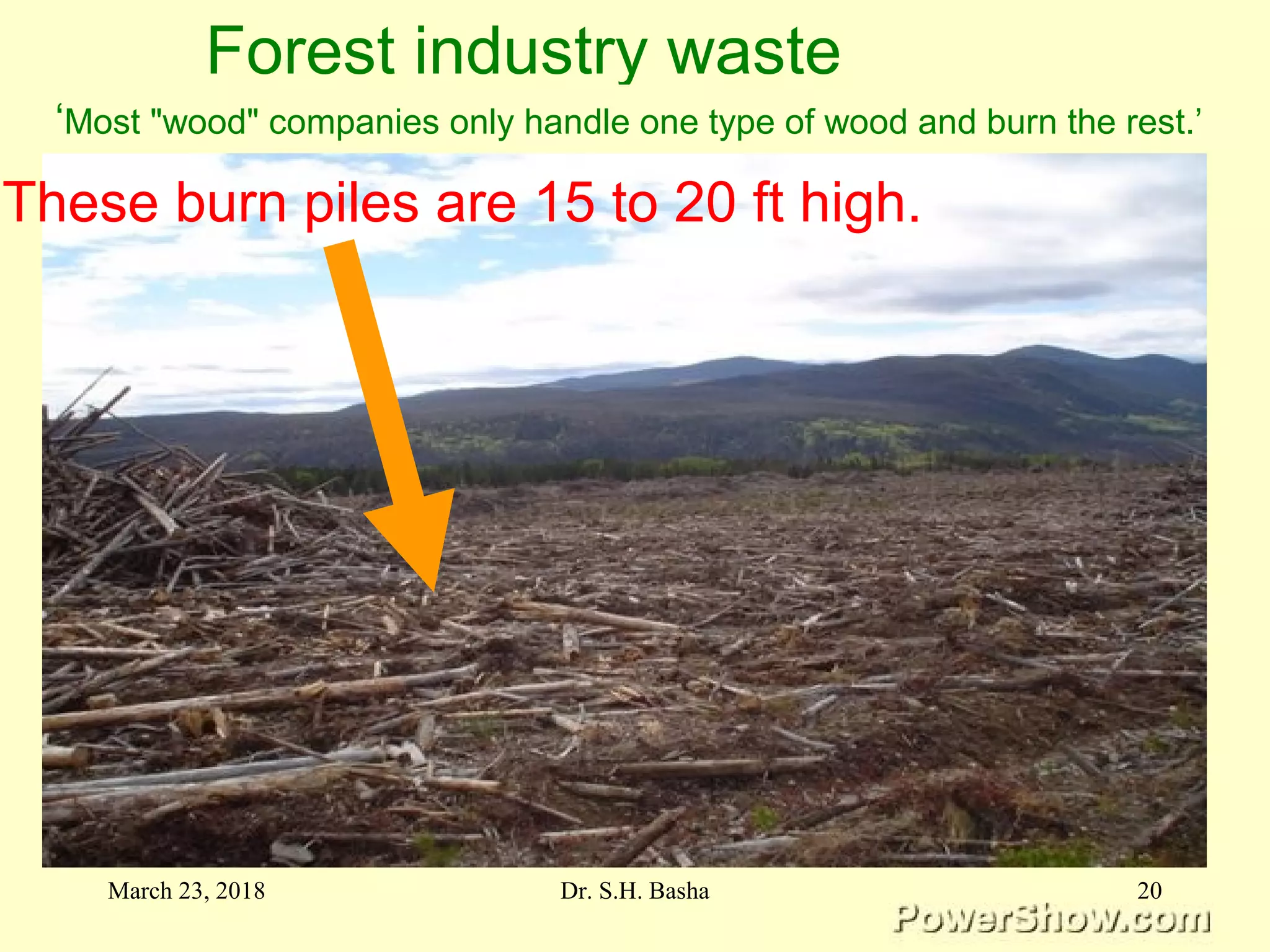
Forest industry waste
‘Most "wood" companies only handle one type of wood and burn the rest.’
These burn piles are 15 to 20 ft high.
March 23, 2018 20Dr. S.H. Basha
Source: http://rekkerd.org/citarum-river-a-shocking-display-of-abuse/
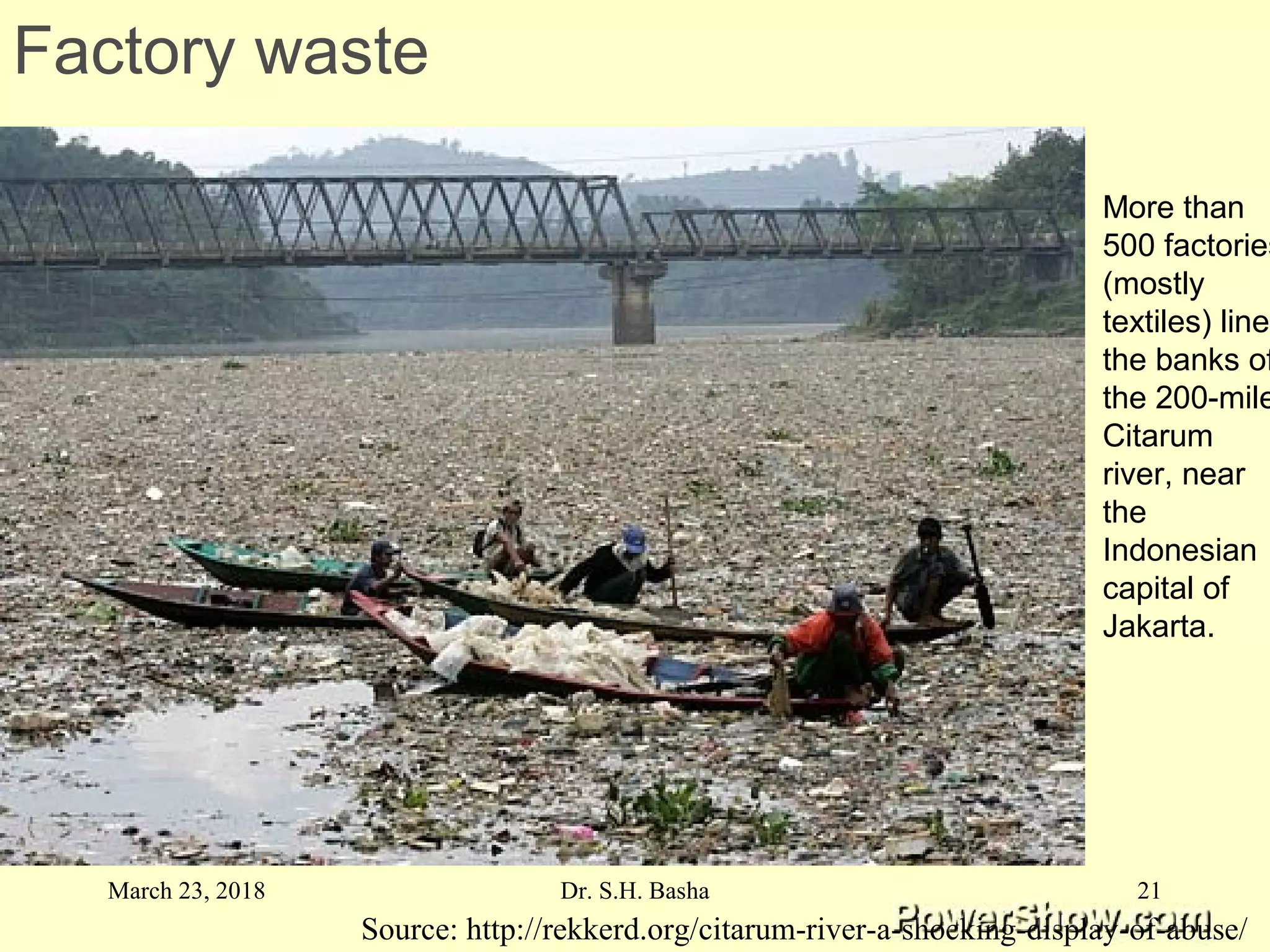
More than
500 factories
(mostly
textiles) line
the banks of
the 200-mile
Citarum
river, near
the
Indonesian
capital of
Jakarta.
Factory waste
March 23, 2018 21Dr. S.H. Basha
Source: http://www.greenpeace.org/international/photosvideos/photos/
close-up-of-a-huge-pile-of-com
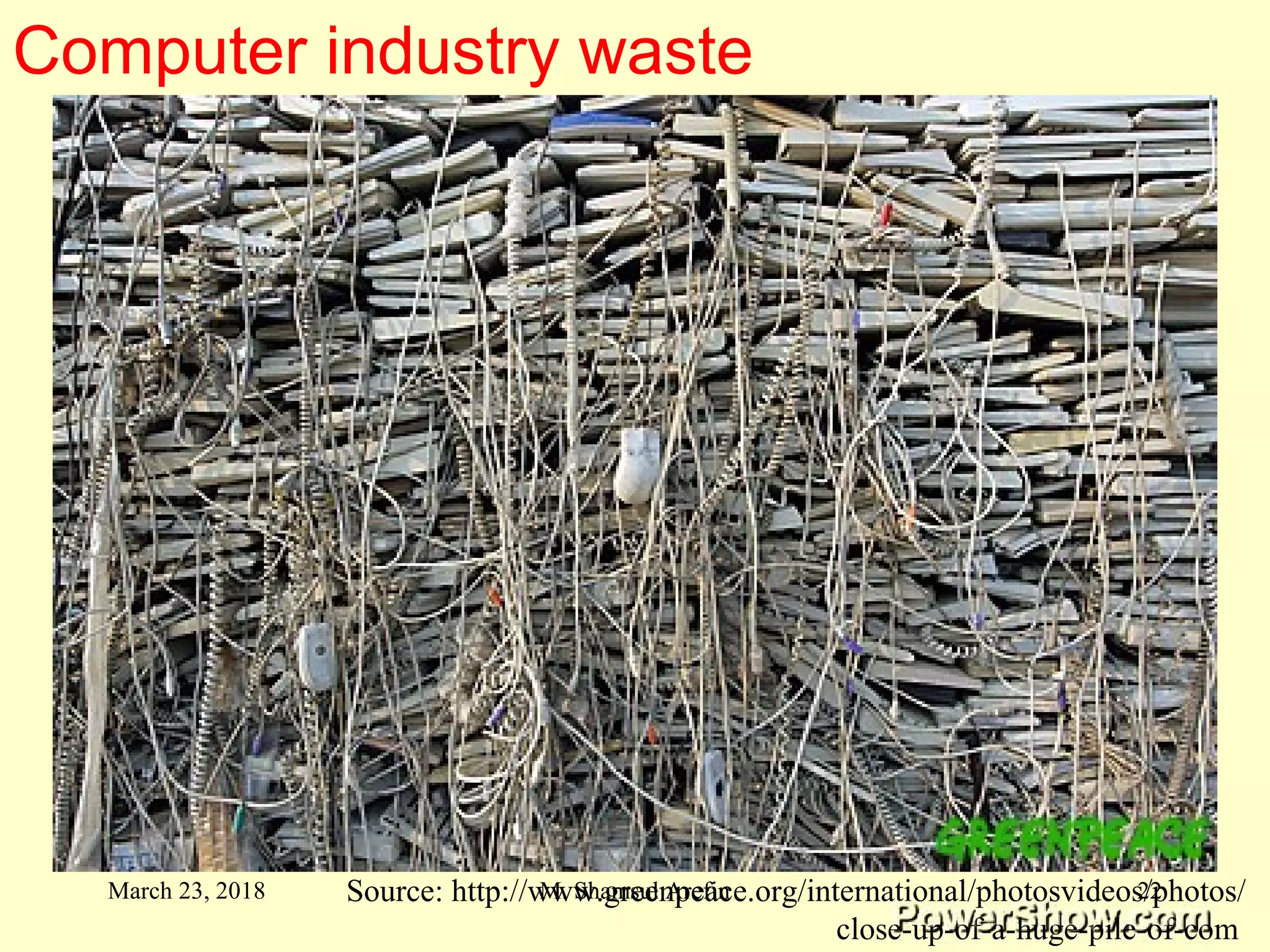
Computer industry waste
March 23, 2018 22M. Shamsul Arefin
March 23, 2018 Dr. S.H. Basha 23
March 23, 2018
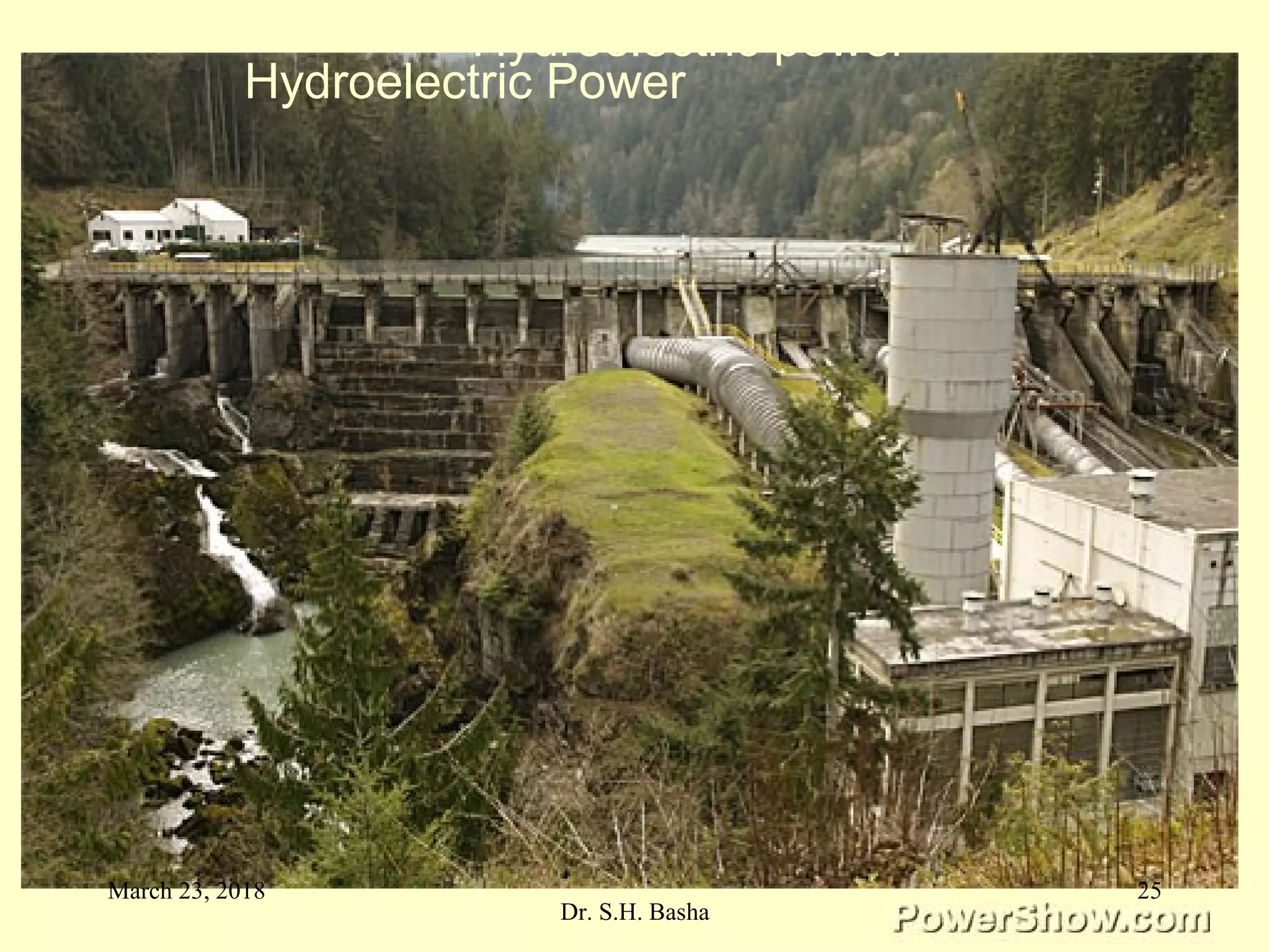
Why hydroelectric power is important?
Once the dam is built, the energy is virtually free.
No waste or pollution produced.
Much more reliable than wind, solar or wave power.
Water can be stored above the dam ready to cope
with peaks in demand.
Hydro-electric power stations can increase to full
power very quickly, unlike other power stations.

Hydroelectric Power
24Dr. S.H.Basha
Hydroelectric power
Hydroelectric Power
March 23, 2018 25
Dr. S.H. Basha
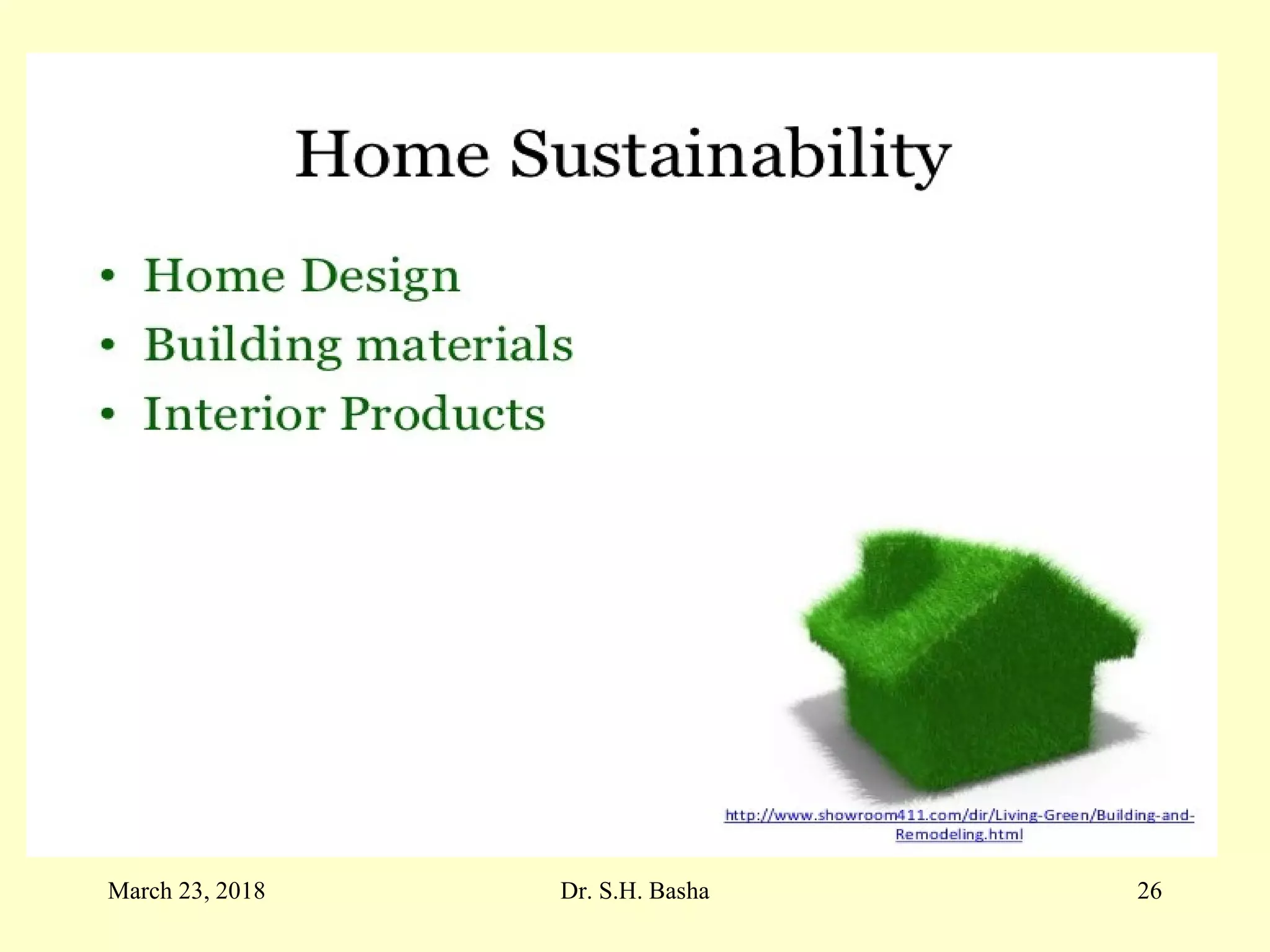
March 23, 2018 Dr. S.H. Basha 26
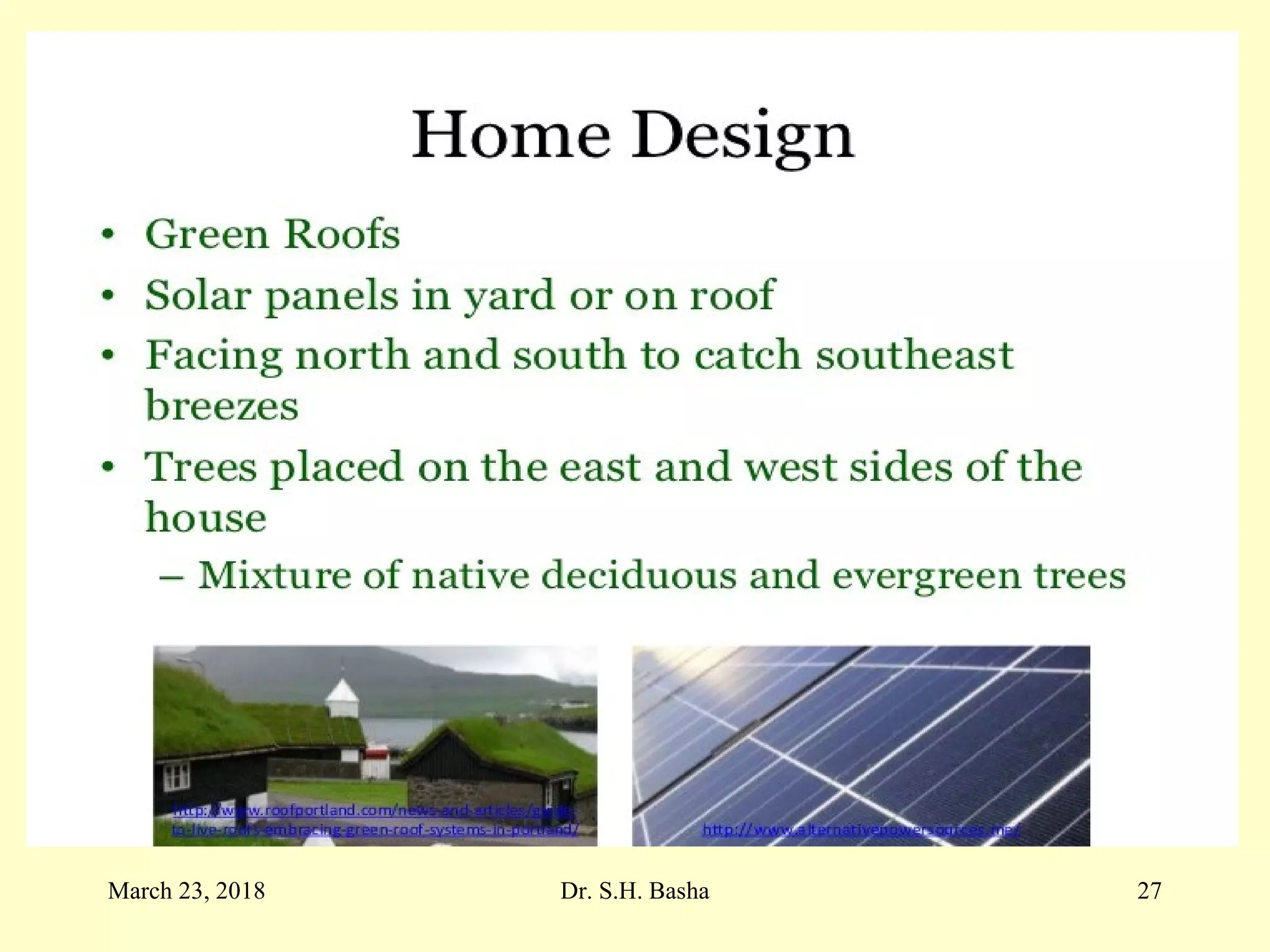
March 23, 2018 Dr. S.H. Basha 27
What is Sustainable Development?
• Living good life
• Thinking about future generation
• Systematic planning
• Living quality life within the carrying capacity
of ecosystem.
• Dynamic process
• Meeting the needs of future generations
29th
March 2017 Dr. S.H. Basha 28
Definitions of Sustainable Development
• Sustainability is just another way of “The Good Life” as a
combination of (a) a high level of human well-being and (b) the
high level of ecosystem well-being that supports it” .
(Allen Presscott)
• “To improve the quality of life while living within the carrying
capacity of ecosystem”.
(International Union for Conservation Union-1991)
• “Sustainable Development is development that meets the needs
of the present without compromising the ability of future
generations to meet their own needs.”
(Brudtland Commission-1987)
29th
March 2017 29Dr. S.H. Basha
….Continued.
• “Any development activity can be sustainable if it is a dynamic
process which enables all people to realize their potential, and to
improve their quality of life, in ways which simultaneously
protect and enhance the earth’s life support systems”.
(Forum for the Future, Annual Report, 2000)
March 23, 2018 30Dr. S.H. Basha
Pillars of Sustainable Development
• Economic Development – poverty eradication
• Social Development – active participation of
women; education; good governance
• Environmental Protection – prevent environmental
degradation and patterns of unsustainable Dev.
At the local, national, regional, and global levels
29 March, 2017 31Dr. S.H. Basha
Economic Development
• Poverty eradication
• Halve, by 2015, the proportion of the world’s
people with income less than $1/day
• Basic health services for all, reduce health threats
• Increase food availability
• Combat desertification, mitigate effects of drought
and floods
• Provision of clean drinking water
• Enhance industrial productivity
March 23, 2018 32Dr. S.H. Basha
Measures for Sustainable Development
• Using appropriate technology
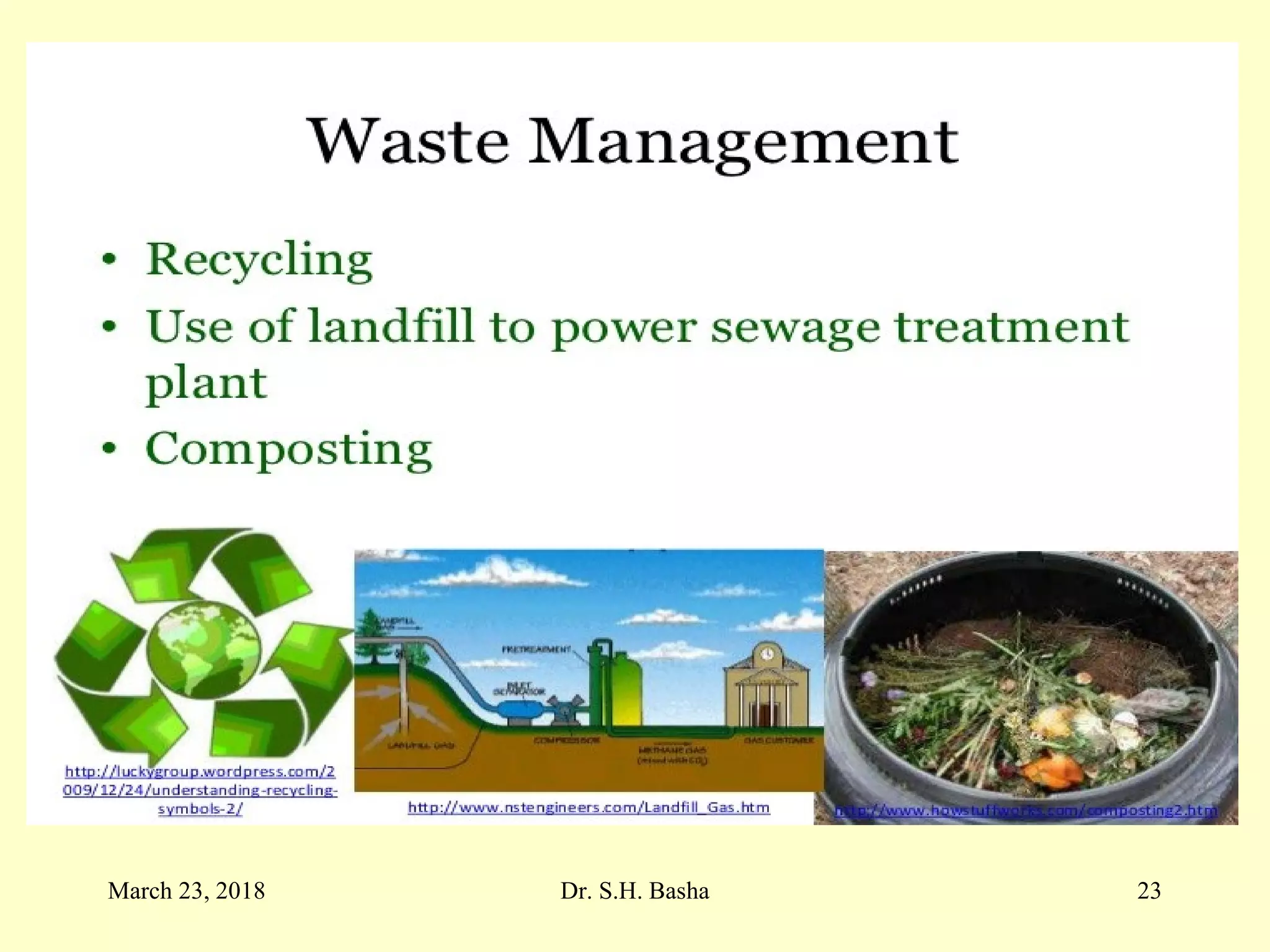
• Adopting Reduce, Reuse and Recycle approach
(3-R)
• Promoting Environmental Education and
Awareness
• Resource Utilization as per carrying capacity
• Improving quality of life including social,
cultural and economic dimensions
March 23, 2018 Dr. S.H. Basha 33
Concluding Remarks
• “We have only one earth and if we destroy
it by our actions, our children and future
generation will not have a place to live
happy and prosperous life on the earth.
Even we face many problems and
unsuitability on this earth”.
• So, Please think about our future
generation and maintain environmental
ethics.
29th
March 2017 Dr. S.H. Basha 34
End of the Presentation
• From Unsustainable Development to
Sustainable Development
• Definitions
• Causes of Unsustainable Developments
• Pillars of Sustainable Development
• Concluding Remarks
29th
March 2017 Dr. S.H. Basha 35
References and Suggestions for further studies
• Basha, S.H. (2009). Role of Teachers towards Environmental Diseases: Need
for Prevention and Protection. (Ed.). Evironmental Education: New Delhi. APH
Publications. pp.
• Nasrin (2008). Education, Environment and Society. APH Publishing
Corporations, New Delhi.
• Radha, S. and Sankhyan, A.S., (Eds. 2004). Environmental Challenges of the
21st
Century,. Deep Publications, New Delhi.
• Rangarajan, M. (2009). Environmental Issues in India. Pearson Publication,
India.
• Rasure, K.A. (2007). Environment and Sustainable Development. Serials
Publications, New Delhi.
• Saxena, H.M. (2006). Environmental Studies. Rawat Publications, Jaipur.
29th
March, 2017 Dr. S.H. Basha 36
Feel Free to share….
• Any Question?
• Any Clarification?
• Any Observation?
• Any Suggestion?
• Any Comments?
• Any Complements?
29th
March 2017 Dr. S.H. Basha 37
THANK YOU FOR YOUR PATIENT HEARINGTHANK YOU FOR YOUR PATIENT HEARING
29 th March 2017 38Dr. S.H. Basha
Even for More understanding
and clarification
• You may connect to Dr. S.H. Basha at any
time through
• hayath83n@gmail.com
29th
March 2017 Dr. S.H. Basha 39
THANK YOU FOR YOUR INTERACTIONTHANK YOU FOR YOUR INTERACTION
29th March 2017 40Dr. S.H. Basha

From Unsustainable Development to Sustainable Development

  • 1.
    From Unsustainable to SustainableDevelopment Presented by Dr. Syed Hayath Basha Assistant Professor of Education Aligarh Muslim University Centre, Malappuram, Kerala-679340 (India) Email: hayath83n@gmail.com Mob: 9990359350/7736338828 Dated: 29-03-2017 29 March 2017 1Dr. S.H. Basha
  • 2.
    Outline of Today’sPresentation • What is Unsustainable Development? • What are the Causes of Unsustainable Development? • What is Sustainable Development? • Definitions of Sustainable Development? • Pillars of Sustainable Development • Measures for Sustainable Development • Concluding Remarks 29th March 2017 2Dr. S.H. Basha
  • 3.
    What is UnsustainableDevelopment? It is • Unsystematic planning • Irresponsible Planning • Living without planning • Living without thinking about others 29th March 2017 3Dr.S.H. Basha
  • 4.
    Causes of UnsustainableDevelopment • Climate Change • Human Health • Technological Change • Urban Problems related to energy • Water Conservation • Rain water Harvesting • Watershed Management 29th March 2017 4Dr.S.H. Basha
  • 5.
    …Continued. • Environmental Ethics •Global warming • Water and Sanitation • Agriculture • Livestock Development • Protection of Natural Resources • Public Awareness 29th March 2017 5Dr.S.H. Basha
  • 6.
    Priority Areas forAction Priority areas for action, identified by UN Secretary-General Kofi Annan • Water and sanitation • Energy • Health • Agriculture • Biodiversity protection and ecosystem management March 23, 2018 6Dr. S.H. Basha
  • 7.
    Human Health “Good healthis vital for eradicating poverty and achieving sustainable development.” Some key issues: – Reduce mortality rates in 2015: by 66.7% for children & infants under 5; by 75% for maternal mortality rates – Control & eradicate communicable diseases, reduce HIV prevalence, combat malaria, tuberculosis – Ensure that chemicals are not used and produced in ways that harm human health – Reduce air pollution March 23, 2018 7Dr. S.H. Basha
  • 8.
    Water and Sanitation “Wateris not only the most basic of needs but is also at the center of sustainable development.” • Around 1.2 billion people still have no access to clean drinking water • Around 2.4 billion people do not have adequate sanitation. March 23, 2018 8Dr. S.H. Basha
  • 9.
    March 23, 2018M. Shamsul Arefin 9
  • 10.
    March 23, 2018Dr. S.H. Basha 10
  • 11.
    Water and Sanitation Somekey issues: • Prevent water pollution to reduce health hazards • Protect ecosystems • Introduce technologies for affordable sanitation, industrial and domestic wastewater treatment • River basin, watershed and groundwater management • Support desalination of seawater, water recycling • Marine environmental protection - oceans, seas, the Earth’s ecosystem March 23, 2018 11Dr. S.H. Basha
  • 12.
    March 23, 2018Dr. S. H. Basha 12
  • 13.
    March 23, 2018Dr. S.H. Basha 13
  • 14.
    Energy “Some 2 billionpeople lack access to electricity and rely on traditional fuel sources such as firewood, kerosene, or biomass for their cooking and heating.” March 23, 2018 14Dr. S.H. Basha
  • 15.
    Energy Some key issues: •Focus on access to energy in rural areas • Energy conservation and energy efficiency – building design & management, better mass transportation, advanced and innovative cleaner technologies • Promotion of renewable energy • Action on climate change – ratification by countries of the Kyoto Protocol March 23, 2018 15Dr. S.H. Basha
  • 16.
    Agriculture “Agriculture is centralto sustainable development. About 70% of the poor in developing countries live in rural areas and depend in one way or another on agriculture for their survival.” Some key issues: – Address serious soil fertility problems – Diversification of crops – Increase water-use productivity – Apply R&D to increase productivity in crops and livestock – (Sustainable development in the agriculture, forestry and fishery sectors conserves land, preserves water, plant and animal genetic resources, is environmentally non-degrading, technically appropriate, economically viable and socially acceptable." (FAO 994)) March 23, 2018 16Dr. S.H. Basha
  • 17.
    Livestock Development • Livestockdevelopment – Sustainable animal production – Improving productivity of animals – Feed supplementation for increasing livestock production – Improving fertility and disease diagnosis March 23, 2018 17Dr. S.H. Basha
  • 18.
    Biodiversity Biodiversity is amodern term which simply means " the variety of life on earth". This variety can be measured on several different levels.  Genetic - variation between individuals of the same species. This includes genetic variation between individuals in a single population , as well as variations between different populations of the same species. Species - species diversity is the variety of species in a given region or area. This can be determined by counting the number of different species Ecosystem - Communities of plants and animals, together with the physical characteristics of their environment (e.g. geology, soil and climate) interlink together as an 'ecosystem'. Ecosystem diversity is more difficult to measure because there are rarely clear boundaries between different ecosystems March 23, 2018 18Dr. S.H. Basha
  • 19.
    Protecting the NaturalResource Base • Prevent water pollution to reduce health hazards and protect ecosystems • Watershed and groundwater management • Support desalination of seawater, water recycling • Ensure the sustainable development of oceans, marine environmental protection March 23, 2018 19Dr. S.H. Basha
  • 20.
    Forest industry waste ‘Most"wood" companies only handle one type of wood and burn the rest.’ These burn piles are 15 to 20 ft high. March 23, 2018 20Dr. S.H. Basha
  • 21.
    Source: http://rekkerd.org/citarum-river-a-shocking-display-of-abuse/ More than 500factories (mostly textiles) line the banks of the 200-mile Citarum river, near the Indonesian capital of Jakarta. Factory waste March 23, 2018 21Dr. S.H. Basha
  • 22.
  • 23.
    March 23, 2018Dr. S.H. Basha 23
  • 24.
    March 23, 2018 Whyhydroelectric power is important? Once the dam is built, the energy is virtually free. No waste or pollution produced. Much more reliable than wind, solar or wave power. Water can be stored above the dam ready to cope with peaks in demand. Hydro-electric power stations can increase to full power very quickly, unlike other power stations. Hydroelectric Power 24Dr. S.H.Basha
  • 25.
  • 26.
    March 23, 2018Dr. S.H. Basha 26
  • 27.
    March 23, 2018Dr. S.H. Basha 27
  • 28.
    What is SustainableDevelopment? • Living good life • Thinking about future generation • Systematic planning • Living quality life within the carrying capacity of ecosystem. • Dynamic process • Meeting the needs of future generations 29th March 2017 Dr. S.H. Basha 28
  • 29.
    Definitions of SustainableDevelopment • Sustainability is just another way of “The Good Life” as a combination of (a) a high level of human well-being and (b) the high level of ecosystem well-being that supports it” . (Allen Presscott) • “To improve the quality of life while living within the carrying capacity of ecosystem”. (International Union for Conservation Union-1991) • “Sustainable Development is development that meets the needs of the present without compromising the ability of future generations to meet their own needs.” (Brudtland Commission-1987) 29th March 2017 29Dr. S.H. Basha
  • 30.
    ….Continued. • “Any developmentactivity can be sustainable if it is a dynamic process which enables all people to realize their potential, and to improve their quality of life, in ways which simultaneously protect and enhance the earth’s life support systems”. (Forum for the Future, Annual Report, 2000) March 23, 2018 30Dr. S.H. Basha
  • 31.
    Pillars of SustainableDevelopment • Economic Development – poverty eradication • Social Development – active participation of women; education; good governance • Environmental Protection – prevent environmental degradation and patterns of unsustainable Dev. At the local, national, regional, and global levels 29 March, 2017 31Dr. S.H. Basha
  • 32.
    Economic Development • Povertyeradication • Halve, by 2015, the proportion of the world’s people with income less than $1/day • Basic health services for all, reduce health threats • Increase food availability • Combat desertification, mitigate effects of drought and floods • Provision of clean drinking water • Enhance industrial productivity March 23, 2018 32Dr. S.H. Basha
  • 33.
    Measures for SustainableDevelopment • Using appropriate technology • Adopting Reduce, Reuse and Recycle approach (3-R) • Promoting Environmental Education and Awareness • Resource Utilization as per carrying capacity • Improving quality of life including social, cultural and economic dimensions March 23, 2018 Dr. S.H. Basha 33
  • 34.
    Concluding Remarks • “Wehave only one earth and if we destroy it by our actions, our children and future generation will not have a place to live happy and prosperous life on the earth. Even we face many problems and unsuitability on this earth”. • So, Please think about our future generation and maintain environmental ethics. 29th March 2017 Dr. S.H. Basha 34
  • 35.
    End of thePresentation • From Unsustainable Development to Sustainable Development • Definitions • Causes of Unsustainable Developments • Pillars of Sustainable Development • Concluding Remarks 29th March 2017 Dr. S.H. Basha 35
  • 36.
    References and Suggestionsfor further studies • Basha, S.H. (2009). Role of Teachers towards Environmental Diseases: Need for Prevention and Protection. (Ed.). Evironmental Education: New Delhi. APH Publications. pp. • Nasrin (2008). Education, Environment and Society. APH Publishing Corporations, New Delhi. • Radha, S. and Sankhyan, A.S., (Eds. 2004). Environmental Challenges of the 21st Century,. Deep Publications, New Delhi. • Rangarajan, M. (2009). Environmental Issues in India. Pearson Publication, India. • Rasure, K.A. (2007). Environment and Sustainable Development. Serials Publications, New Delhi. • Saxena, H.M. (2006). Environmental Studies. Rawat Publications, Jaipur. 29th March, 2017 Dr. S.H. Basha 36
  • 37.
    Feel Free toshare…. • Any Question? • Any Clarification? • Any Observation? • Any Suggestion? • Any Comments? • Any Complements? 29th March 2017 Dr. S.H. Basha 37
  • 38.
    THANK YOU FORYOUR PATIENT HEARINGTHANK YOU FOR YOUR PATIENT HEARING 29 th March 2017 38Dr. S.H. Basha
  • 39.
    Even for Moreunderstanding and clarification • You may connect to Dr. S.H. Basha at any time through • hayath83n@gmail.com 29th March 2017 Dr. S.H. Basha 39
  • 40.
    THANK YOU FORYOUR INTERACTIONTHANK YOU FOR YOUR INTERACTION 29th March 2017 40Dr. S.H. Basha