BY- Kiran Prasad
Contents

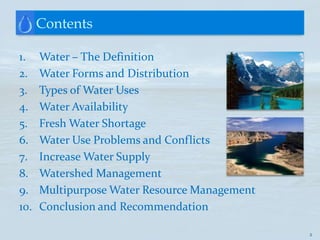
1.    Water – The Definition
2.    Water Forms and Distribution
3.    Types of Water Uses
4.    Water Availability
5.    Fresh Water Shortage
6.    Water Use Problems and Conflicts
7.    Increase Water Supply
8.    Watershed Management
9.    Multipurpose Water Resource Management
10.   Conclusion and Recommendation

                                               2
1. Water – The Definition

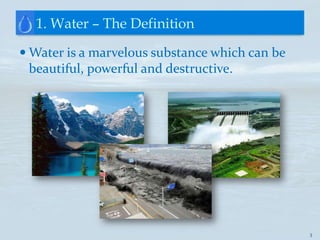
 Water is a marvelous substance which can be
 beautiful, powerful and destructive.


                                                3
1.1. Water Physical Attributes
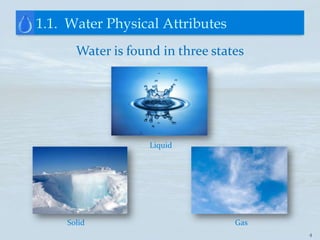
      Water is found in three states


                   Liquid


    Solid                         Gas
                                        4
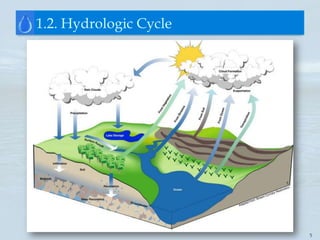
1.2. Hydrologic Cycle


                        5
2. Water Forms and Distribution

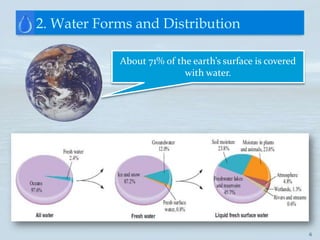
            About 71% of the earth’s surface is covered
                           with water.


                                                          6
2. Water Forms and Distribution


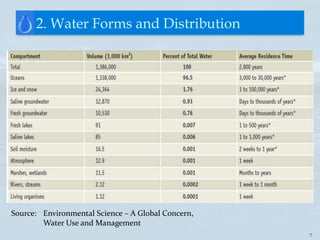
Source: Environmental Science – A Global Concern,
        Water Use and Management
                                                    7
2.1. Oceans

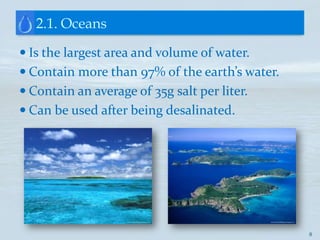
 Is the largest area and volume of water.
 Contain more than 97% of the earth’s water.
 Contain an average of 35g salt per liter.
 Can be used after being desalinated.


                                                8
2.2. Ice and Snow

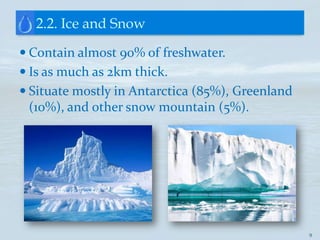
 Contain almost 90% of freshwater.
 Is as much as 2km thick.
 Situate mostly in Antarctica (85%), Greenland
  (10%), and other snow mountain (5%).


                                                  9
2.3. Groundwater

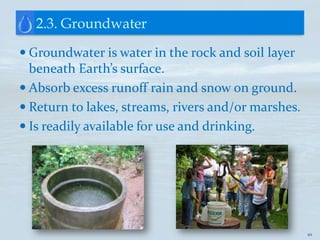
 Groundwater is water in the rock and soil layer
  beneath Earth’s surface.
 Absorb excess runoff rain and snow on ground.
 Return to lakes, streams, rivers and/or marshes.
 Is readily available for use and drinking.


                                                     10
2.4. Lakes
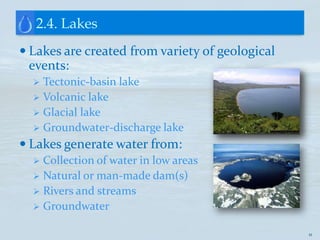
 Lakes are created from variety of geological
 events:
   Tectonic-basin lake
   Volcanic lake
   Glacial lake
   Groundwater-discharge lake
 Lakes generate water from:
   Collection of water in low areas
   Natural or man-made dam(s)
   Rivers and streams
   Groundwater


                                                 11
2.4. Lakes (cont.)
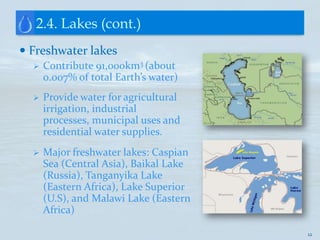
 Freshwater lakes
     Contribute 91,000km3 (about
      0.007% of total Earth’s water)
     Provide water for agricultural
      irrigation, industrial
      processes, municipal uses and
      residential water supplies.
     Major freshwater lakes: Caspian
      Sea (Central Asia), Baikal Lake
      (Russia), Tanganyika Lake
      (Eastern Africa), Lake Superior
      (U.S), and Malawi Lake (Eastern
      Africa)

                                        12
2.4. Lakes (cont.)
 Saline lakes
     Possess 85,000km3 (about
      0.006% of total Earth’s water)

     Saline lakes’ water cannot be
      used due to high salinity.
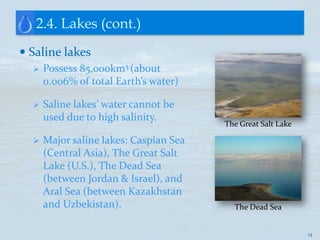
                                        The Great Salt Lake

     Major saline lakes: Caspian Sea
      (Central Asia), The Great Salt
      Lake (U.S.), The Dead Sea
      (between Jordan & Israel), and
      Aral Sea (between Kazakhstan
      and Uzbekistan).                    The Dead Sea


                                                              13
2.5. Rivers and Streams
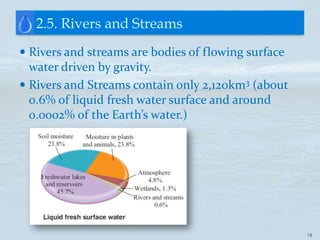
 Rivers and streams are bodies of flowing surface
  water driven by gravity.
 Rivers and Streams contain only 2,120km3 (about
  0.6% of liquid fresh water surface and around
  0.0002% of the Earth’s water.)


                                                     14
2.5. Rivers and Streams (cont.)
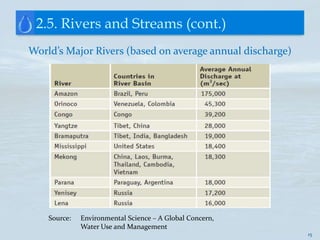
World’s Major Rivers (based on average annual discharge)


    Source:   Environmental Science – A Global Concern,
              Water Use and Management
                                                           15
2.6. Wetlands and Soil Moisture
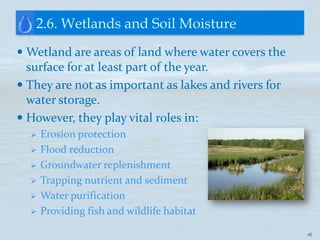
 Wetland are areas of land where water covers the
  surface for at least part of the year.
 They are not as important as lakes and rivers for
  water storage.
 However, they play vital roles in:
     Erosion protection
     Flood reduction
     Groundwater replenishment
     Trapping nutrient and sediment
     Water purification
     Providing fish and wildlife habitat

                                                      16
5.7. Atmosphere
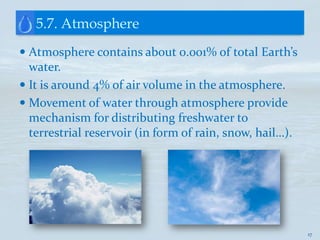
 Atmosphere contains about 0.001% of total Earth’s
  water.
 It is around 4% of air volume in the atmosphere.
 Movement of water through atmosphere provide
  mechanism for distributing freshwater to
 terrestrial reservoir (in form of rain, snow, hail…).


                                                         17
3. Types of Water Uses
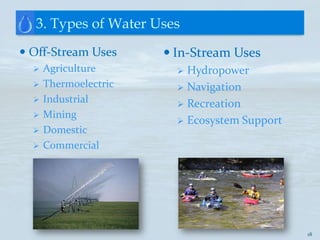
 Off-Stream Uses       In-Stream Uses
     Agriculture         Hydropower
     Thermoelectric      Navigation
     Industrial          Recreation
     Mining
                          Ecosystem Support
     Domestic
     Commercial


                                               18
3. Types of Water Uses

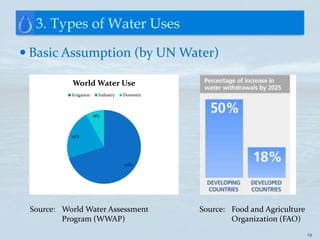
 Basic Assumption (by UN Water)

           World Water Use
           Irrigation    Industry   Domestic


                        8%


           22%


                                    70%


 Source: World Water Assessment                Source: Food and Agriculture
         Program (WWAP)                                Organization (FAO)
                                                                              19
3. Types of Water Uses
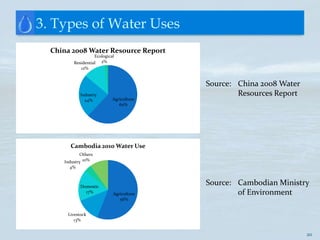
  China 2008 Water Resource Report
                   Ecological
         Residential 2%
            12%


                                          Source: China 2008 Water
            Industry                              Resources Report
              24%           Agriculture
                               62%


       Cambodia 2010 Water Use
            Others
     Industry 10%
       4%


            Domestic
                                          Source: Cambodian Ministry
              17%           Agriculture           of Environment
                               56%


      Livestock
         13%


                                                                     20
3.1. Off-Stream Uses
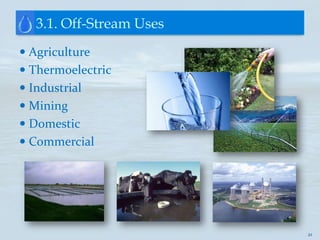
 Agriculture
 Thermoelectric
 Industrial
 Mining
 Domestic
 Commercial


                          21
a. Agriculture

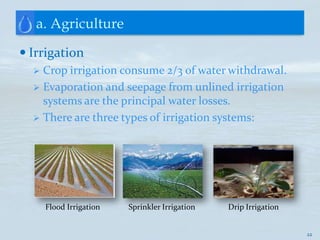
 Irrigation
   Crop irrigation consume 2/3 of water withdrawal.
   Evaporation and seepage from unlined irrigation
    systems are the principal water losses.
   There are three types of irrigation systems:


      Flood Irrigation   Sprinkler Irrigation   Drip Irrigation


                                                                  22
a. Agriculture

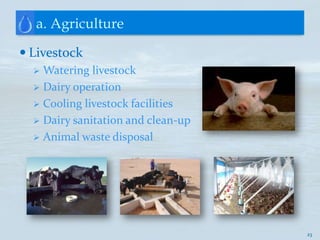
 Livestock
   Watering livestock
   Dairy operation
   Cooling livestock facilities
   Dairy sanitation and clean-up
   Animal waste disposal


                                    23
a. Agriculture (cont.)

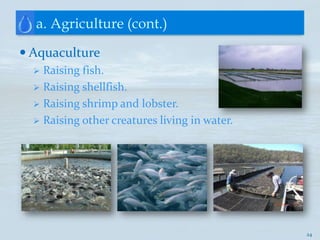
 Aquaculture
   Raising fish.
   Raising shellfish.
   Raising shrimp and lobster.
   Raising other creatures living in water.


                                               24
b. Thermoelectric
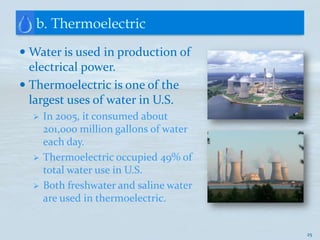
 Water is used in production of
  electrical power.
 Thermoelectric is one of the
  largest uses of water in U.S.
     In 2005, it consumed about
      201,000 million gallons of water
      each day.
     Thermoelectric occupied 49% of
      total water use in U.S.
     Both freshwater and saline water
      are used in thermoelectric.


                                         25
c. Industrial
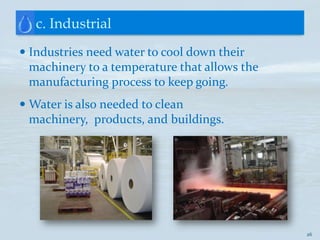
 Industries need water to cool down their
  machinery to a temperature that allows the
 manufacturing process to keep going.
 Water is also needed to clean
  machinery, products, and buildings.


                                               26
c. Industrial

 In 2005, U.S. industrial uses were 83% (15,000
 gallons/day) surface water and 17% (3,110
 gallons/day) groundwater.
 In Cambodia, rough estimation by Water
 Environment Partnership in Asia showed:
   Major industry consumed: 1,000-2,000 m3/day
   Large industry consumed: 100-500 m3/day
   Medium & small industry: 50 m3/day


                                                   27
d. Mining

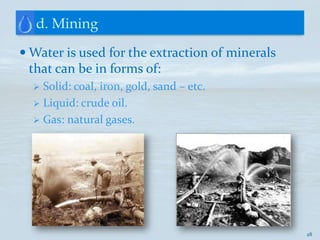
 Water is used for the extraction of minerals
 that can be in forms of:
   Solid: coal, iron, gold, sand – etc.
   Liquid: crude oil.
   Gas: natural gases.


                                                 28
e. Domestic
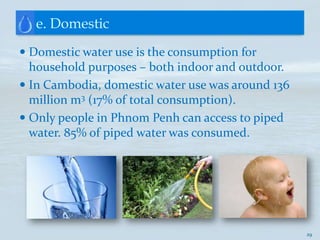
 Domestic water use is the consumption for
  household purposes – both indoor and outdoor.
 In Cambodia, domestic water use was around 136
  million m3 (17% of total consumption).
 Only people in Phnom Penh can access to piped
 water. 85% of piped water was consumed.


                                                   29
f. Commercial
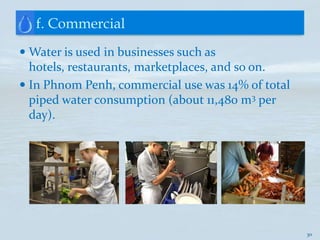
 Water is used in businesses such as
  hotels, restaurants, marketplaces, and so on.
 In Phnom Penh, commercial use was 14% of total
  piped water consumption (about 11,480 m3 per
  day).


                                                   30
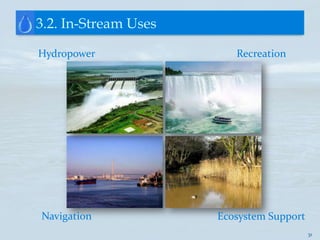
3.2. In-Stream Uses

Hydropower               Recreation


Navigation            Ecosystem Support
                                          31
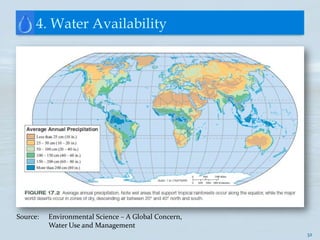
4. Water Availability


Source:   Environmental Science – A Global Concern,
          Water Use and Management
                                                      32
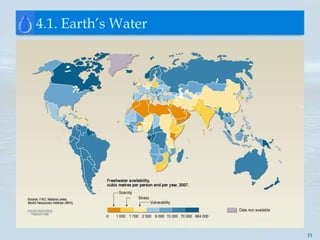
4.1. Earth’s Water


                     33
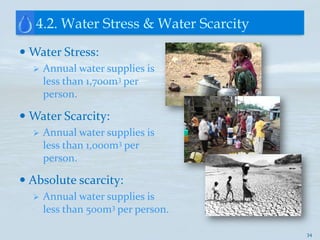
4.2. Water Stress & Water Scarcity
 Water Stress:
     Annual water supplies is
      less than 1,700m3 per
      person.

 Water Scarcity:
     Annual water supplies is
      less than 1,000m3 per
      person.

 Absolute scarcity:
     Annual water supplies is
      less than 500m3 per person.

                                        34
35
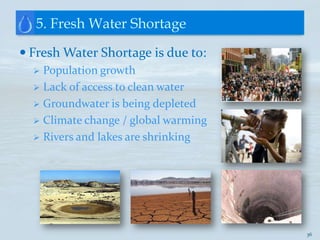
5. Fresh Water Shortage

 Fresh Water Shortage is due to:
   Population growth
   Lack of access to clean water
   Groundwater is being depleted
   Climate change / global warming
   Rivers and lakes are shrinking


                                      36
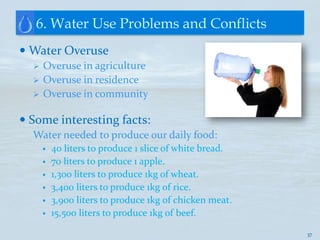
6. Water Use Problems and Conflicts
 Water Overuse
     Overuse in agriculture
     Overuse in residence
     Overuse in community

 Some interesting facts:
  Water needed to produce our daily food:
         40 liters to produce 1 slice of white bread.
         70 liters to produce 1 apple.
         1,300 liters to produce 1kg of wheat.
         3,400 liters to produce 1kg of rice.
         3,900 liters to produce 1kg of chicken meat.
         15,500 liters to produce 1kg of beef.

                                                         37
6. Water Use Problems and Conflicts
Water Conflict
      Control of Water Resources: where water
       supplies or access to water is at the root of
       tensions.
      Military Tool: where water resources, or water
       systems themselves, are used by a nation or state
       as a weapon during a military action.
      Political Tool: where water resources, or water
       systems themselves, are used by a nation, state, or
       non-state actor for a political goal.
      Terrorism: where water resources, or water
       systems, are either targets or tools of violence or
       coercion by non-state actors.
      Military Target: where water resource systems
       are targets of military actions by nations or states.
      Development Disputes: where water resources
       or water systems are a major source of contention
       and dispute in the context of economic and social
       development
                                                               38
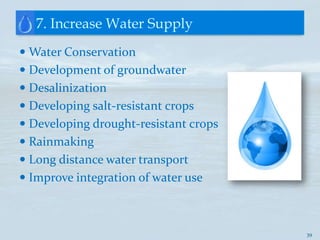
7. Increase Water Supply
 Water Conservation
 Development of groundwater
 Desalinization
 Developing salt-resistant crops
 Developing drought-resistant crops
 Rainmaking
 Long distance water transport
 Improve integration of water use


                                       39
8. Watershed Management
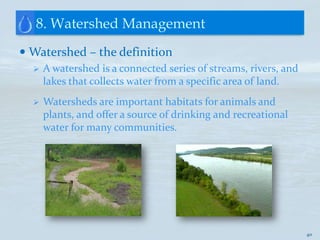
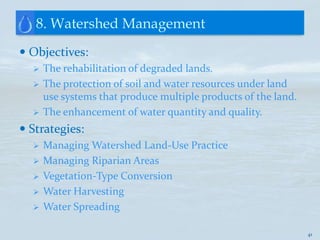
 Watershed – the definition
     A watershed is a connected series of streams, rivers, and
      lakes that collects water from a specific area of land.
     Watersheds are important habitats for animals and
      plants, and offer a source of drinking and recreational
      water for many communities.


                                                                  40
8. Watershed Management
 Objectives:
     The rehabilitation of degraded lands.
     The protection of soil and water resources under land
      use systems that produce multiple products of the land.
     The enhancement of water quantity and quality.
 Strategies:
     Managing Watershed Land-Use Practice
     Managing Riparian Areas
     Vegetation-Type Conversion
     Water Harvesting
     Water Spreading

                                                                41
9. Multipurpose Water Resource Management

 Integrated water resource management
     Flood-damage reduction
     Irrigation and water supply
     Navigation
     Recreation
     Environmental protection & improvement

 Water Management Engineering
     Reservoir construction
     Levee construction
     Dredging
     Stream drainage channelization

                                               42
10. Conclusion & Recommendation
 Water resources is EVERYONE’s concern!
 The consumption has been increased
  significantly due to population growth.
 Water availability is decreasing due to human
  overuse and natural degradation.
 Many sources of water have become unusable.
 Allegedly control over water lead to
  intraboundary and transboundary conflicts.
 Effective water resource management and
  policy must be implemented on both local and
  international levels.
                                                  43
Tips on How to Save Water
 Increasing water resources start from all of us!
 Don’t flush every time you use the toilet.
 Take shorter showers
 Don’t wash your car so often.
 Don’t let the faucet run while washing
  hands, dishes, food, or brushing your teeth.
 Don’t run the dishwasher when half full.
 Dispose of used motor oil, household hazardous
  waste, batteries, etc., responsibly.


                                                     44
Tips on How to Save Water
 Don’t dump anything down a storm sewer that you
    wouldn’t want to drink.
   Avoid using toxic or hazardous chemicals for simple
    cleaning or plumbing jobs.
   If you have a lawn, use water sparingly. Water your grass
    and garden at night, not in the middle of the day.
   Use water-conserving appliances: low-flow showers, low-
    flush toilets.
   Check your toilet for leaks.


                                                                45
 THANK YOU ALL


                  46

Water Resources

  • 1.
  • 2.
    Contents 1. Water – The Definition 2. Water Forms and Distribution 3. Types of Water Uses 4. Water Availability 5. Fresh Water Shortage 6. Water Use Problems and Conflicts 7. Increase Water Supply 8. Watershed Management 9. Multipurpose Water Resource Management 10. Conclusion and Recommendation 2
  • 3.
    1. Water –The Definition  Water is a marvelous substance which can be beautiful, powerful and destructive. 3
  • 4.
    1.1. Water PhysicalAttributes Water is found in three states Liquid Solid Gas 4
  • 5.
  • 6.
    2. Water Formsand Distribution About 71% of the earth’s surface is covered with water. 6
  • 7.
    2. Water Formsand Distribution Source: Environmental Science – A Global Concern, Water Use and Management 7
  • 8.
    2.1. Oceans  Isthe largest area and volume of water.  Contain more than 97% of the earth’s water.  Contain an average of 35g salt per liter.  Can be used after being desalinated. 8
  • 9.
    2.2. Ice andSnow  Contain almost 90% of freshwater.  Is as much as 2km thick.  Situate mostly in Antarctica (85%), Greenland (10%), and other snow mountain (5%). 9
  • 10.
    2.3. Groundwater  Groundwateris water in the rock and soil layer beneath Earth’s surface.  Absorb excess runoff rain and snow on ground.  Return to lakes, streams, rivers and/or marshes.  Is readily available for use and drinking. 10
  • 11.
    2.4. Lakes  Lakesare created from variety of geological events:  Tectonic-basin lake  Volcanic lake  Glacial lake  Groundwater-discharge lake  Lakes generate water from:  Collection of water in low areas  Natural or man-made dam(s)  Rivers and streams  Groundwater 11
  • 12.
    2.4. Lakes (cont.) Freshwater lakes  Contribute 91,000km3 (about 0.007% of total Earth’s water)  Provide water for agricultural irrigation, industrial processes, municipal uses and residential water supplies.  Major freshwater lakes: Caspian Sea (Central Asia), Baikal Lake (Russia), Tanganyika Lake (Eastern Africa), Lake Superior (U.S), and Malawi Lake (Eastern Africa) 12
  • 13.
    2.4. Lakes (cont.) Saline lakes  Possess 85,000km3 (about 0.006% of total Earth’s water)  Saline lakes’ water cannot be used due to high salinity. The Great Salt Lake  Major saline lakes: Caspian Sea (Central Asia), The Great Salt Lake (U.S.), The Dead Sea (between Jordan & Israel), and Aral Sea (between Kazakhstan and Uzbekistan). The Dead Sea 13
  • 14.
    2.5. Rivers andStreams  Rivers and streams are bodies of flowing surface water driven by gravity.  Rivers and Streams contain only 2,120km3 (about 0.6% of liquid fresh water surface and around 0.0002% of the Earth’s water.) 14
  • 15.
    2.5. Rivers andStreams (cont.) World’s Major Rivers (based on average annual discharge) Source: Environmental Science – A Global Concern, Water Use and Management 15
  • 16.
    2.6. Wetlands andSoil Moisture  Wetland are areas of land where water covers the surface for at least part of the year.  They are not as important as lakes and rivers for water storage.  However, they play vital roles in:  Erosion protection  Flood reduction  Groundwater replenishment  Trapping nutrient and sediment  Water purification  Providing fish and wildlife habitat 16
  • 17.
    5.7. Atmosphere  Atmospherecontains about 0.001% of total Earth’s water.  It is around 4% of air volume in the atmosphere.  Movement of water through atmosphere provide mechanism for distributing freshwater to terrestrial reservoir (in form of rain, snow, hail…). 17
  • 18.
    3. Types ofWater Uses  Off-Stream Uses  In-Stream Uses  Agriculture  Hydropower  Thermoelectric  Navigation  Industrial  Recreation  Mining  Ecosystem Support  Domestic  Commercial 18
  • 19.
    3. Types ofWater Uses  Basic Assumption (by UN Water) World Water Use Irrigation Industry Domestic 8% 22% 70% Source: World Water Assessment Source: Food and Agriculture Program (WWAP) Organization (FAO) 19
  • 20.
    3. Types ofWater Uses China 2008 Water Resource Report Ecological Residential 2% 12% Source: China 2008 Water Industry Resources Report 24% Agriculture 62% Cambodia 2010 Water Use Others Industry 10% 4% Domestic Source: Cambodian Ministry 17% Agriculture of Environment 56% Livestock 13% 20
  • 21.
    3.1. Off-Stream Uses Agriculture  Thermoelectric  Industrial  Mining  Domestic  Commercial 21
  • 22.
    a. Agriculture  Irrigation  Crop irrigation consume 2/3 of water withdrawal.  Evaporation and seepage from unlined irrigation systems are the principal water losses.  There are three types of irrigation systems: Flood Irrigation Sprinkler Irrigation Drip Irrigation 22
  • 23.
    a. Agriculture  Livestock  Watering livestock  Dairy operation  Cooling livestock facilities  Dairy sanitation and clean-up  Animal waste disposal 23
  • 24.
    a. Agriculture (cont.) Aquaculture  Raising fish.  Raising shellfish.  Raising shrimp and lobster.  Raising other creatures living in water. 24
  • 25.
    b. Thermoelectric  Wateris used in production of electrical power.  Thermoelectric is one of the largest uses of water in U.S.  In 2005, it consumed about 201,000 million gallons of water each day.  Thermoelectric occupied 49% of total water use in U.S.  Both freshwater and saline water are used in thermoelectric. 25
  • 26.
    c. Industrial  Industriesneed water to cool down their machinery to a temperature that allows the manufacturing process to keep going.  Water is also needed to clean machinery, products, and buildings. 26
  • 27.
    c. Industrial  In2005, U.S. industrial uses were 83% (15,000 gallons/day) surface water and 17% (3,110 gallons/day) groundwater.  In Cambodia, rough estimation by Water Environment Partnership in Asia showed:  Major industry consumed: 1,000-2,000 m3/day  Large industry consumed: 100-500 m3/day  Medium & small industry: 50 m3/day 27
  • 28.
    d. Mining  Wateris used for the extraction of minerals that can be in forms of:  Solid: coal, iron, gold, sand – etc.  Liquid: crude oil.  Gas: natural gases. 28
  • 29.
    e. Domestic  Domesticwater use is the consumption for household purposes – both indoor and outdoor.  In Cambodia, domestic water use was around 136 million m3 (17% of total consumption).  Only people in Phnom Penh can access to piped water. 85% of piped water was consumed. 29
  • 30.
    f. Commercial  Wateris used in businesses such as hotels, restaurants, marketplaces, and so on.  In Phnom Penh, commercial use was 14% of total piped water consumption (about 11,480 m3 per day). 30
  • 31.
    3.2. In-Stream Uses Hydropower Recreation Navigation Ecosystem Support 31
  • 32.
    4. Water Availability Source: Environmental Science – A Global Concern, Water Use and Management 32
  • 33.
  • 34.
    4.2. Water Stress& Water Scarcity  Water Stress:  Annual water supplies is less than 1,700m3 per person.  Water Scarcity:  Annual water supplies is less than 1,000m3 per person.  Absolute scarcity:  Annual water supplies is less than 500m3 per person. 34
  • 35.
  • 36.
    5. Fresh WaterShortage  Fresh Water Shortage is due to:  Population growth  Lack of access to clean water  Groundwater is being depleted  Climate change / global warming  Rivers and lakes are shrinking 36
  • 37.
    6. Water UseProblems and Conflicts  Water Overuse  Overuse in agriculture  Overuse in residence  Overuse in community  Some interesting facts: Water needed to produce our daily food:  40 liters to produce 1 slice of white bread.  70 liters to produce 1 apple.  1,300 liters to produce 1kg of wheat.  3,400 liters to produce 1kg of rice.  3,900 liters to produce 1kg of chicken meat.  15,500 liters to produce 1kg of beef. 37
  • 38.
    6. Water UseProblems and Conflicts Water Conflict  Control of Water Resources: where water supplies or access to water is at the root of tensions.  Military Tool: where water resources, or water systems themselves, are used by a nation or state as a weapon during a military action.  Political Tool: where water resources, or water systems themselves, are used by a nation, state, or non-state actor for a political goal.  Terrorism: where water resources, or water systems, are either targets or tools of violence or coercion by non-state actors.  Military Target: where water resource systems are targets of military actions by nations or states.  Development Disputes: where water resources or water systems are a major source of contention and dispute in the context of economic and social development 38
  • 39.
    7. Increase WaterSupply  Water Conservation  Development of groundwater  Desalinization  Developing salt-resistant crops  Developing drought-resistant crops  Rainmaking  Long distance water transport  Improve integration of water use 39
  • 40.
    8. Watershed Management Watershed – the definition  A watershed is a connected series of streams, rivers, and lakes that collects water from a specific area of land.  Watersheds are important habitats for animals and plants, and offer a source of drinking and recreational water for many communities. 40
  • 41.
    8. Watershed Management Objectives:  The rehabilitation of degraded lands.  The protection of soil and water resources under land use systems that produce multiple products of the land.  The enhancement of water quantity and quality.  Strategies:  Managing Watershed Land-Use Practice  Managing Riparian Areas  Vegetation-Type Conversion  Water Harvesting  Water Spreading 41
  • 42.
    9. Multipurpose WaterResource Management  Integrated water resource management  Flood-damage reduction  Irrigation and water supply  Navigation  Recreation  Environmental protection & improvement  Water Management Engineering  Reservoir construction  Levee construction  Dredging  Stream drainage channelization 42
  • 43.
    10. Conclusion &Recommendation  Water resources is EVERYONE’s concern!  The consumption has been increased significantly due to population growth.  Water availability is decreasing due to human overuse and natural degradation.  Many sources of water have become unusable.  Allegedly control over water lead to intraboundary and transboundary conflicts.  Effective water resource management and policy must be implemented on both local and international levels. 43
  • 44.
    Tips on Howto Save Water  Increasing water resources start from all of us!  Don’t flush every time you use the toilet.  Take shorter showers  Don’t wash your car so often.  Don’t let the faucet run while washing hands, dishes, food, or brushing your teeth.  Don’t run the dishwasher when half full.  Dispose of used motor oil, household hazardous waste, batteries, etc., responsibly. 44
  • 45.
    Tips on Howto Save Water  Don’t dump anything down a storm sewer that you wouldn’t want to drink.  Avoid using toxic or hazardous chemicals for simple cleaning or plumbing jobs.  If you have a lawn, use water sparingly. Water your grass and garden at night, not in the middle of the day.  Use water-conserving appliances: low-flow showers, low- flush toilets.  Check your toilet for leaks. 45
  • 46.

Editor's Notes

  • #9 Gift: What are the five biggest oceans in the world?Explain more about Point 3: some are only 6g/liter and some are 40g/liter.
  • #12 Tectonic lake: Lake VictoriaVolcanic lake: Crater Lake (Oregon)Glacial lake: The Great LakeGroundwater lake: Union City Lake
  • #13 http://www.worldlakes.org/lakeprofiles.asp?anchor=volume
  • #14 Caspian Sea is a freshwater lake. It’s saltier only one the Iranian side; however, salinity is only 1/3 of ocean’s.
  • #19 http://commerce.wi.gov/ie/IE-MexicoWaterReport-2011-Winter-Article-AgricultureWater.htmlhttp://www.chinawaternexus.com/?p=207http://www.fao.org/nr/water/aquastat/countries_regions/cambodia/index.stm
  • #23 Pic link: http://www.statcan.gc.ca/pub/16-002-x/2008001/charts/5008076-eng.htm