Natural
Resource
Natural Resources
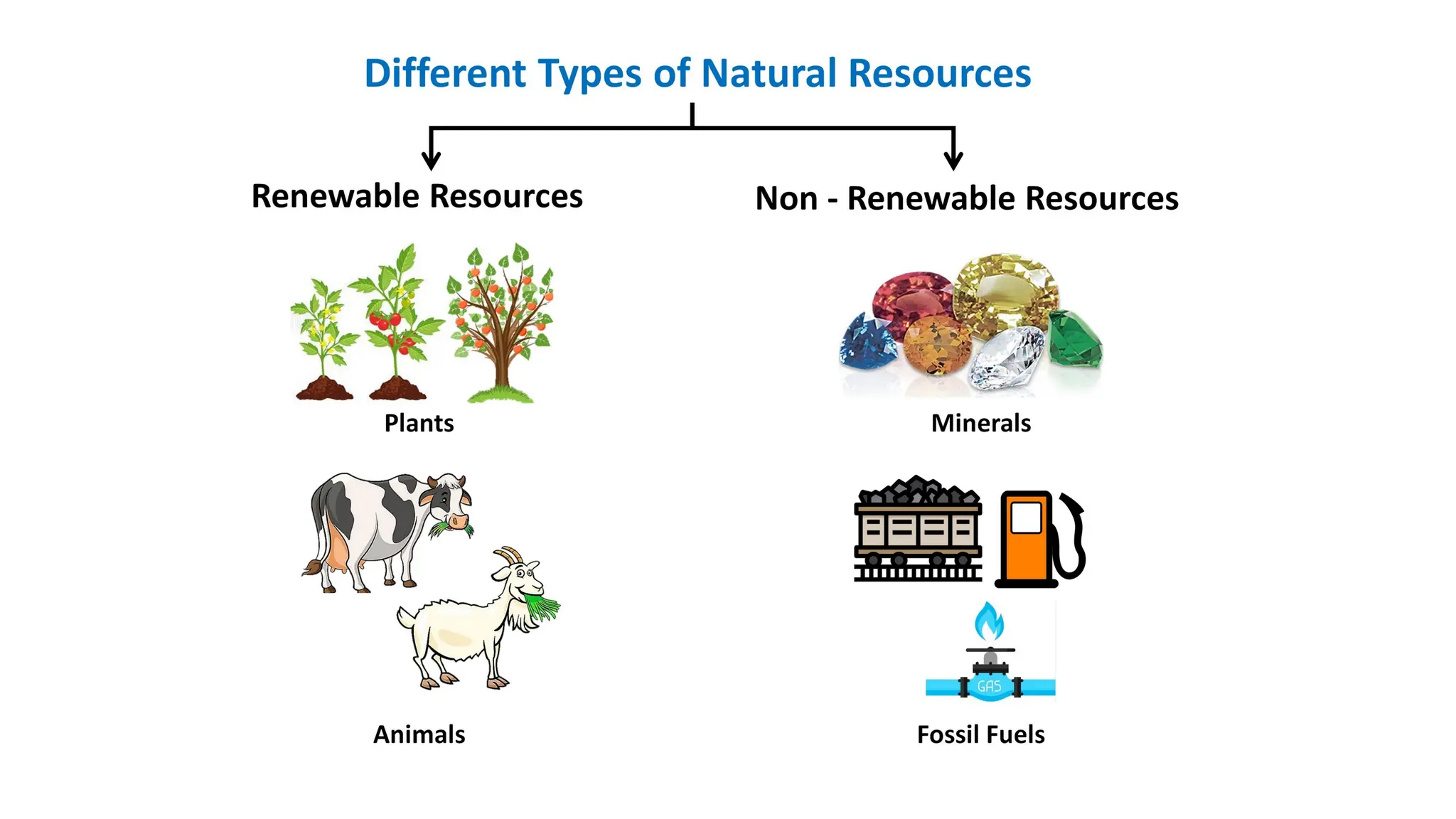
Renewable and Non-renewable resources
Forest Resources
Water Resources
Mineral Resources
Food Resources
Role of an individual in conservation of natural resources
Index
Natural Resources
• Natural resources includes air, water, forests, animals, fishes, marine life,
biomass, fossil fuels, like coal, petroleum and natural gases, wild life, renewable
energy sources like solar energy, wind energy, biomass energy, geothermal
energy etc.
• Prosperity of a nation is dependent on the natural resources available in nation.
Renewable Resource
• Renewable energy is energy which is generated from natural sources i.e. sun, wind, rain, tides and
can be generated again and again as and when required.
• They are available are plenty and by far most the cleanest source of energy available on this planet.
• Solar Energy, Wind Energy, Geothermal Energy, Biomass Energy From Plants, Tidal Energy are the
examples of Renewable resources.
Non-renewable Resource
• A non renewable resource is a natural resource that cannot be re-made or re-grown at a scale comparable to
its consumption.
• Non-renewable sources are not environmental friendly and can have serious effect on our health.
• They are called non-renewable because they cannot be re-generated within a short span of time.
• Non-renewable sources exist in the form of fossil fuels, natural gas, oil and coal.
Forest Resources
• Scientists estimate that India should have 33% of its land under
forest. Today we have only about 12%. Thus we need only to protect
existing but also to increase our forest cover.
Uses Of Forest Resources
• They stop the rain-bearing winds and cause the rainfall.
• They improve the sanitary of revenue to the goverment.
• They minimize the extreme variation in climatic condition and make the climate more
equable.
• They control floods during heavy rain by absorbing excess rain water.
• They prevent soil erosion by checking the force of flowing water.
• The thick roots of the trees absorb large quantity of water thus, forest help in the flow of
rivers and streams.
• They also provide us herbal medicines.
Reason For The Large Scale
Depletion Of Forest
• Expansion of agriculture, more forest have been cleared for agriculture.
• Large are of forest lands have been cleared for urbanization and human settlement.
• Commercial exploitation of forest.
• Forest fires.
• Mining activities in forest areas.
• Forest diseases are also partly responsible for depletion forest.
Adverse Effect Of Depletion
Of trees
• It has contributed to rise in temperature.
• It has contributed to lesser precipitation.
• It is responsible for increased rate of soil erosion.
• It has lead to loss of soil productivity.
• It is responsible for loss of biodiversity.
• It has lead to extinction of several species of plant and animas.
• It has caused imbalance in ecosystem.
Conservation Of forest
• Regulated and planned cutting of trees.
• Control over forest fires.
• Reforestation.
• Afforestation.
• Check on forest clearance for agriculture and human habitation and settlement.
• Development green belt around cities.
• Check on mining activities in forest areas.
• Protection fo existing forest.
• Conservation of threatened species of trees.
Deforestation
• Deforestation means reckless or large-scale felling or cutting of trees by man
for commercial and other purpose.
Causes Of Deforestation
• Desertification.
• Soil degradation and soil erosion.
• Loss of vegetation cover.
• Destruction in climatic condition.
• Environmental pollution.
• Damage to ecosystem.
• Reduction in soil moisture.
Causes Of Deforestation
• Preventation of human settlement in forest areas.
• Check on expansion of agriculture into forest lands.
• Prohibition of setting up of agriculture into forest lands.
• Check on reckless cutting of trees.
• Controlled mining in forest areas.
• Check on construction of large dams in forest areas.
• Control on over grazing in forest areas.
Water Resources
• While 67% of Earth’s surface is covered by water only less than 2.7%
of global water is freshwater. Most of the freshwater(2.05%) are
locked in ice caps and glaciers. Only less than 0.7% is available for
human use.
Overutilization And Pollution Of Surface
And Ground Water
• With the growth of human population there is an increasing need for larger amounts of water to
fulfil a variety of basics needs. Today in many areas this requirement cannot be met.
• Overutilization of water occur at various levels. Most people use more water than really needed.
Most of us waster water during a bath by using shower or during washing of clothes. Many
agriculturists use more water than necessary to grow crops. There are many ways in which
farmers can use less water without reducing the yields such as the of drip irrigation systems.
• Agriculture also pollutes surface water and underground water stores by the excessive use of
chemical fertilizers and pesticides. Method such as the use of biomass as fertilizers and non toxic
pesticides such as neem products reduces the agricultural pollution of surface and ground water.
• Industry tends to maximise short-term economic gains by not bothering about its liquid waste
and releasing it into the streams, rivers,sea.
Floods
• Floods have been a serious environmental hazard from centuries.
• Deforestation causes flood that kills people, damage crops and
destroy homes.
• Rivers changes its course during floods and tons of valuable soil is lost
to the sea.
• As the forest are degrades, rain water no longer percolates slowly
into the sub-soil but runs off down the mountainside bearing large
amount of top soil.
Droughts
• In most arid regions of the world the rains are unpredictable. This
leads to a periods when there is a serious scarcity of water to drink,
use in farm or provide for urban or industrial use.
• One of the factor that worsens the effect of droughts is deforestation.
• Drought is one of the major problem in our country, due to
unpredicted climatic condition or due to the failure of one and more
monsoon.
Water Management
• Building several small reservoirs instead of few mega product.
• Develop few catchment dams.
• Afforestation permits recharging of underground water.
• Treatment and recycling municipal waste water for agriculture use.
• Preventing leakages from dams and canals.
• Preventing loss in municipal pipes.
• Effevtive rain water harvesting in urban environments.
• Water conservation measures un agriculture such as using drip irrigation.
• Pricing the water at its real value makes people use it more responsibly and efficiently
and reduce the water wasting.
Mineral Resources
• A mineral is a naturally occurring substances of definite chemical composition and
identifiable physical properties.
• Minerals are formed over a period of millions of year in the earths crust.
• Iron, aluminium, zinc, manganese and copper are the important raw materials for the
industrial use.
• Important non-metal resources includes coal, salt, clay, cement and silica.
• Stone used for building materials, such as granite, marble, limestone, constitute another
category of the minerals.
• Minerals with special properties that humans values such as diamonds, emeralds, rubies.
The luster of gold, silver and platinum are used for the ornaments.
• Minerals in the form of the oil, gas and coal were formed when ancient plants and
animals were converted into underground fossil fuels.
Mining
• The extraction of the minerals and their ores from the earths interior
so that they can be used this process is known as mining.
• Mines are of two types surface or deep pr shaft mines.
• Mining is hazardous occupation, and they safety of the mine workers
is an important.
• Surface mining is less hazardous than underground mining.
• Metal mining is less hazardous than coal mining.
• Radiation is hazardous in uranium mines.
•
Food Resources
• Today our food comes almost entirely from agriculture, animal
husbandry and fishing.
• Although india is self-sufficient in food production, it is only because
of modern patterns of agriculture that are unsustainable and which
pollutes of environment with the excess use of fertilizers and
pesticides.
• In this crops are hit by the pest, the entire crop can be devasted,
leaving the farmer no income during the year.
Major Food Resources
• Wheat
• Rice
• Maize
• Potato
• Barley
• Oats
• pulses
• Vegetables
• Sugarcane
• Fruits
• Milk
• Fish
• Meat
World Food Problem
• In many developing countries where populations are expanding rapidly, the production of food
is unable to keep pace with the growing demand.
• Food production in 64 of the 105 developing countries is lagging behind the population growth
levels. These countries are unable to produce more food, or do not have the financial means to
import it.
• India is the one of the country that have been able to produce enough food by cultivating its
large proportion of land through irrigation. The Green revolution of 60's reduced starvation in
the country.
Fisheries
• Fish is an important protein food in many part of the world.
• This includes fresh water and marine water fish.
• The supply of the food from fisheries has been increased now a days.

Natural Resources PPT Presentation - Anuj Gawali.pptx

  • 1.
  • 2.
    Natural Resources Renewable andNon-renewable resources Forest Resources Water Resources Mineral Resources Food Resources Role of an individual in conservation of natural resources Index
  • 3.
    Natural Resources • Naturalresources includes air, water, forests, animals, fishes, marine life, biomass, fossil fuels, like coal, petroleum and natural gases, wild life, renewable energy sources like solar energy, wind energy, biomass energy, geothermal energy etc. • Prosperity of a nation is dependent on the natural resources available in nation.
  • 6.
    Renewable Resource • Renewableenergy is energy which is generated from natural sources i.e. sun, wind, rain, tides and can be generated again and again as and when required. • They are available are plenty and by far most the cleanest source of energy available on this planet. • Solar Energy, Wind Energy, Geothermal Energy, Biomass Energy From Plants, Tidal Energy are the examples of Renewable resources.
  • 7.
    Non-renewable Resource • Anon renewable resource is a natural resource that cannot be re-made or re-grown at a scale comparable to its consumption. • Non-renewable sources are not environmental friendly and can have serious effect on our health. • They are called non-renewable because they cannot be re-generated within a short span of time. • Non-renewable sources exist in the form of fossil fuels, natural gas, oil and coal.
  • 8.
    Forest Resources • Scientistsestimate that India should have 33% of its land under forest. Today we have only about 12%. Thus we need only to protect existing but also to increase our forest cover.
  • 9.
    Uses Of ForestResources • They stop the rain-bearing winds and cause the rainfall. • They improve the sanitary of revenue to the goverment. • They minimize the extreme variation in climatic condition and make the climate more equable. • They control floods during heavy rain by absorbing excess rain water. • They prevent soil erosion by checking the force of flowing water. • The thick roots of the trees absorb large quantity of water thus, forest help in the flow of rivers and streams. • They also provide us herbal medicines.
  • 10.
    Reason For TheLarge Scale Depletion Of Forest • Expansion of agriculture, more forest have been cleared for agriculture. • Large are of forest lands have been cleared for urbanization and human settlement. • Commercial exploitation of forest. • Forest fires. • Mining activities in forest areas. • Forest diseases are also partly responsible for depletion forest.
  • 11.
    Adverse Effect OfDepletion Of trees • It has contributed to rise in temperature. • It has contributed to lesser precipitation. • It is responsible for increased rate of soil erosion. • It has lead to loss of soil productivity. • It is responsible for loss of biodiversity. • It has lead to extinction of several species of plant and animas. • It has caused imbalance in ecosystem.
  • 12.
    Conservation Of forest •Regulated and planned cutting of trees. • Control over forest fires. • Reforestation. • Afforestation. • Check on forest clearance for agriculture and human habitation and settlement. • Development green belt around cities. • Check on mining activities in forest areas. • Protection fo existing forest. • Conservation of threatened species of trees.
  • 13.
    Deforestation • Deforestation meansreckless or large-scale felling or cutting of trees by man for commercial and other purpose.
  • 14.
    Causes Of Deforestation •Desertification. • Soil degradation and soil erosion. • Loss of vegetation cover. • Destruction in climatic condition. • Environmental pollution. • Damage to ecosystem. • Reduction in soil moisture.
  • 15.
    Causes Of Deforestation •Preventation of human settlement in forest areas. • Check on expansion of agriculture into forest lands. • Prohibition of setting up of agriculture into forest lands. • Check on reckless cutting of trees. • Controlled mining in forest areas. • Check on construction of large dams in forest areas. • Control on over grazing in forest areas.
  • 16.
    Water Resources • While67% of Earth’s surface is covered by water only less than 2.7% of global water is freshwater. Most of the freshwater(2.05%) are locked in ice caps and glaciers. Only less than 0.7% is available for human use.
  • 17.
    Overutilization And PollutionOf Surface And Ground Water • With the growth of human population there is an increasing need for larger amounts of water to fulfil a variety of basics needs. Today in many areas this requirement cannot be met. • Overutilization of water occur at various levels. Most people use more water than really needed. Most of us waster water during a bath by using shower or during washing of clothes. Many agriculturists use more water than necessary to grow crops. There are many ways in which farmers can use less water without reducing the yields such as the of drip irrigation systems. • Agriculture also pollutes surface water and underground water stores by the excessive use of chemical fertilizers and pesticides. Method such as the use of biomass as fertilizers and non toxic pesticides such as neem products reduces the agricultural pollution of surface and ground water. • Industry tends to maximise short-term economic gains by not bothering about its liquid waste and releasing it into the streams, rivers,sea.
  • 18.
    Floods • Floods havebeen a serious environmental hazard from centuries. • Deforestation causes flood that kills people, damage crops and destroy homes. • Rivers changes its course during floods and tons of valuable soil is lost to the sea. • As the forest are degrades, rain water no longer percolates slowly into the sub-soil but runs off down the mountainside bearing large amount of top soil.
  • 19.
    Droughts • In mostarid regions of the world the rains are unpredictable. This leads to a periods when there is a serious scarcity of water to drink, use in farm or provide for urban or industrial use. • One of the factor that worsens the effect of droughts is deforestation. • Drought is one of the major problem in our country, due to unpredicted climatic condition or due to the failure of one and more monsoon.
  • 20.
    Water Management • Buildingseveral small reservoirs instead of few mega product. • Develop few catchment dams. • Afforestation permits recharging of underground water. • Treatment and recycling municipal waste water for agriculture use. • Preventing leakages from dams and canals. • Preventing loss in municipal pipes. • Effevtive rain water harvesting in urban environments. • Water conservation measures un agriculture such as using drip irrigation. • Pricing the water at its real value makes people use it more responsibly and efficiently and reduce the water wasting.
  • 21.
    Mineral Resources • Amineral is a naturally occurring substances of definite chemical composition and identifiable physical properties. • Minerals are formed over a period of millions of year in the earths crust. • Iron, aluminium, zinc, manganese and copper are the important raw materials for the industrial use. • Important non-metal resources includes coal, salt, clay, cement and silica. • Stone used for building materials, such as granite, marble, limestone, constitute another category of the minerals. • Minerals with special properties that humans values such as diamonds, emeralds, rubies. The luster of gold, silver and platinum are used for the ornaments. • Minerals in the form of the oil, gas and coal were formed when ancient plants and animals were converted into underground fossil fuels.
  • 22.
    Mining • The extractionof the minerals and their ores from the earths interior so that they can be used this process is known as mining. • Mines are of two types surface or deep pr shaft mines. • Mining is hazardous occupation, and they safety of the mine workers is an important. • Surface mining is less hazardous than underground mining. • Metal mining is less hazardous than coal mining. • Radiation is hazardous in uranium mines. •
  • 23.
    Food Resources • Todayour food comes almost entirely from agriculture, animal husbandry and fishing. • Although india is self-sufficient in food production, it is only because of modern patterns of agriculture that are unsustainable and which pollutes of environment with the excess use of fertilizers and pesticides. • In this crops are hit by the pest, the entire crop can be devasted, leaving the farmer no income during the year.
  • 24.
    Major Food Resources •Wheat • Rice • Maize • Potato • Barley • Oats • pulses • Vegetables • Sugarcane • Fruits • Milk • Fish • Meat
  • 25.
    World Food Problem •In many developing countries where populations are expanding rapidly, the production of food is unable to keep pace with the growing demand. • Food production in 64 of the 105 developing countries is lagging behind the population growth levels. These countries are unable to produce more food, or do not have the financial means to import it. • India is the one of the country that have been able to produce enough food by cultivating its large proportion of land through irrigation. The Green revolution of 60's reduced starvation in the country.
  • 26.
    Fisheries • Fish isan important protein food in many part of the world. • This includes fresh water and marine water fish. • The supply of the food from fisheries has been increased now a days.