REVISED NATIONAL
TUBERCULOSIS CONTROL
PROGRAMME
BY
HARIOM MEHTA
Introduction
 Tuberculosis is one of the leading causes of
mortality in india- killing -2 persons every three
minute, nearly 1,000 every day.
 tuberculosis is a chronic infectious disease
caused by mycobacterium tuberculosis which was
discovered by ROBERT KOCH also known as koch’s
bacillus.
 it left untreated, a person with sputum positive
TB will infect an average of 10-15 people in a
year.
Conti..
 1962 – national TB Program (NTP)
 1992 – revised national tuberculosis control
program
World Scenario
• TB continues to be one of the most important
public health problem worldwide.
• in 2014 an estimated 9.6 million people
developed TB and 1.5 million died from the
disease, 4,00000 of whom were HIV positive.
• In 2014 an estimated 3.2 million cases were
women.
• Globally about 1.1 million new cases and
1,30,000 deaths occur annually due to TB among
children ( acc. to global TB report 2015)
Indian Scenario
• India is the highest TB burden country
according for more than one fifth of the global
incidence.
• everyday about 20,000 people become
infected, 5000 develop TB and more than
1000 die due to the disease.
• In simple terms, 2 persons become sputum
infected for the TB and almost 1 person is
killed every minute due to the disease.
Revised National Tuberculosis Control
program(1992)
The government of india, WHO and world
bank together reviewed the NTP in the year
1992. based on the findings a revised strategy
for NTP was evolved.
GOAL:-
-To reduce mortality and morbidity from TB.
-To interrupt chain of transmission.
STRATEGY :-
 Achievement of at least 85% cure rate of
infectious cases.
Detection of at least 70% of estimated cases.
Information, education, communication and
improved operation research activities.
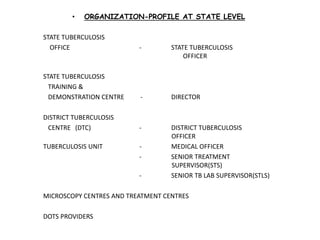
• ORGANIZATION-PROFILE AT STATE LEVEL
STATE TUBERCULOSIS
OFFICE - STATE TUBERCULOSIS
OFFICER
STATE TUBERCULOSIS
TRAINING &
DEMONSTRATION CENTRE - DIRECTOR
DISTRICT TUBERCULOSIS
CENTRE (DTC) - DISTRICT TUBERCULOSIS
OFFICER
TUBERCULOSIS UNIT - MEDICAL OFFICER
- SENIOR TREATMENT
SUPERVISOR(STS)
- SENIOR TB LAB SUPERVISOR(STLS)
MICROSCOPY CENTRES AND TREATMENT CENTRES
DOTS PROVIDERS
TREATMENT
• Provide drug free of cost
• Three components:-
- appropriate medical treatment
- supervision and motivation
- monitoring of the disease status
DOTS depend on the five components
Good quality sputum microscopy
Uninterrupted supply of good quality drugs
Directly observed treatment
Accountability
Political commitment
DOTS PROVIDER:-
o May be a peripheral health staff or voluntary
workers (teachers, social workers, anganwadi
workers, Ex-patient ,etc.)
o They are known as “DOTS AGENT”
o Paid an incentive of rs. 150 per patent
completing the treatment.
DOTS DRUG AND DOSASE
RIFAMPICIN - 450mg (10mg/kg)
ISONIAZID - 600mg (10-15mg/kg)
STREPTOMYCIN - 750mg (15mg/kg)
PYRAZINAMIDE - 1500mg (30-35mg/kg)
ETHAMBUTOL - 1200mg (15mg/kg)
RNTCP PHASE I (1997-2006)
• To ensure high quality DOTS expansion in the
country, addressing the five primary
components of the DOTS strategy
• Political and administrative commitment
• Good quality diagnosis through sputum
microscopy
• Directly observed treatment
• Systematic monitoring
RNTCP PHASE II (2006-2011)
AIMS :-
 Consolidate the achievements of phase I
 Maintain its progressive trend and effect
further improvement in its functioning.
• TB HIV CO-ORDINATION
• RNTCP AND NACO – “JOINT ACTION PLAN”
• OBJECTIVE
 TO REDUCE TB ASSOCIATED MORBIDITY AND MORTALITY IN TB-HIV
PATIENTS
 FOR EFFECTIVE PREVETION AND CONTROL OF BOTH THE DISEASES
• PHASE I
 2OOI
 IN 6 HIGH HIV PREVALENT STATES(AP, KARNATAKA, MAHARASHTRA,
MANIPUR, NAGALAND, TN)
• PHASE II
 2003
 8 ADDITIONAL STATES(DELHI, GUJARAT, HP, KERALA, ORISSA,PUNJAB,
RAJASTHAN, WB)
 PLAN TO BE EXTENDED TO ALL OTHER STATES IN DUE COURSE
• Early detection and treatment of at least 90
%of estimated TB case in the community,
including HIV-associated TB
• Initial screening of all re treatment smear
positive cases for drug resistant TB &
appropriate treatment
TARGETS (2012-2017)
• Offer of HIV counseling and testing for all TB
patients and linking HIV-infected TBpatients
to HIV care and support
• Successful treatment of at least 90 percent
of all new TB patients
• Extend RNTCP services to patients diagnosed
and treated in the private sector
• PROGRAMME ACTIVITIES
NECESSARY TO ACHIEVE RNTCP
(2012-2017) TARGETC
• THE NATIONAL STRATEGIC PLAN
2012-2017
• Strengthening and improving the
quality of basic DOTS services
• Further strengthen and align with
the health system under National
Rural Health Mission (NRHM)
• Improve communication and
outreach and social mobilization
• Promote research for development
and implementation of improved
tools and strategies
OBJECTIVES
• To achieve 90% notification rate for all
cases.
• To achieve 90% success rate for all new
& 85% for re treatment cases.
• To achieve decreased morbidity & mortality if
HIV associated TB.
• To improve outcomes of TB care in private
sector.
• To significantly improve the successful
outcomes of treatment for drug resistant
cases.
ACHIEVEMENTS
• Death rate has been brought down seven
folds (29% to 4%).
• The programme involves more than 1971
NGOs, >10894 private practitioners, >297
medical colleges & >150 corporate health
facilities are involved
Rntcp program

Rntcp program

  • 1.
  • 2.
    Introduction  Tuberculosis isone of the leading causes of mortality in india- killing -2 persons every three minute, nearly 1,000 every day.  tuberculosis is a chronic infectious disease caused by mycobacterium tuberculosis which was discovered by ROBERT KOCH also known as koch’s bacillus.  it left untreated, a person with sputum positive TB will infect an average of 10-15 people in a year.
  • 3.
    Conti..  1962 –national TB Program (NTP)  1992 – revised national tuberculosis control program
  • 4.
    World Scenario • TBcontinues to be one of the most important public health problem worldwide. • in 2014 an estimated 9.6 million people developed TB and 1.5 million died from the disease, 4,00000 of whom were HIV positive. • In 2014 an estimated 3.2 million cases were women. • Globally about 1.1 million new cases and 1,30,000 deaths occur annually due to TB among children ( acc. to global TB report 2015)
  • 5.
    Indian Scenario • Indiais the highest TB burden country according for more than one fifth of the global incidence. • everyday about 20,000 people become infected, 5000 develop TB and more than 1000 die due to the disease. • In simple terms, 2 persons become sputum infected for the TB and almost 1 person is killed every minute due to the disease.
  • 7.
    Revised National TuberculosisControl program(1992) The government of india, WHO and world bank together reviewed the NTP in the year 1992. based on the findings a revised strategy for NTP was evolved. GOAL:- -To reduce mortality and morbidity from TB. -To interrupt chain of transmission.
  • 8.
    STRATEGY :-  Achievementof at least 85% cure rate of infectious cases. Detection of at least 70% of estimated cases. Information, education, communication and improved operation research activities.
  • 9.
    • ORGANIZATION-PROFILE ATSTATE LEVEL STATE TUBERCULOSIS OFFICE - STATE TUBERCULOSIS OFFICER STATE TUBERCULOSIS TRAINING & DEMONSTRATION CENTRE - DIRECTOR DISTRICT TUBERCULOSIS CENTRE (DTC) - DISTRICT TUBERCULOSIS OFFICER TUBERCULOSIS UNIT - MEDICAL OFFICER - SENIOR TREATMENT SUPERVISOR(STS) - SENIOR TB LAB SUPERVISOR(STLS) MICROSCOPY CENTRES AND TREATMENT CENTRES DOTS PROVIDERS
  • 11.
    TREATMENT • Provide drugfree of cost • Three components:- - appropriate medical treatment - supervision and motivation - monitoring of the disease status DOTS depend on the five components Good quality sputum microscopy Uninterrupted supply of good quality drugs Directly observed treatment Accountability Political commitment
  • 12.
    DOTS PROVIDER:- o Maybe a peripheral health staff or voluntary workers (teachers, social workers, anganwadi workers, Ex-patient ,etc.) o They are known as “DOTS AGENT” o Paid an incentive of rs. 150 per patent completing the treatment.
  • 13.
    DOTS DRUG ANDDOSASE RIFAMPICIN - 450mg (10mg/kg) ISONIAZID - 600mg (10-15mg/kg) STREPTOMYCIN - 750mg (15mg/kg) PYRAZINAMIDE - 1500mg (30-35mg/kg) ETHAMBUTOL - 1200mg (15mg/kg)
  • 14.
    RNTCP PHASE I(1997-2006) • To ensure high quality DOTS expansion in the country, addressing the five primary components of the DOTS strategy • Political and administrative commitment • Good quality diagnosis through sputum microscopy • Directly observed treatment • Systematic monitoring
  • 15.
    RNTCP PHASE II(2006-2011) AIMS :-  Consolidate the achievements of phase I  Maintain its progressive trend and effect further improvement in its functioning.
  • 16.
    • TB HIVCO-ORDINATION • RNTCP AND NACO – “JOINT ACTION PLAN” • OBJECTIVE  TO REDUCE TB ASSOCIATED MORBIDITY AND MORTALITY IN TB-HIV PATIENTS  FOR EFFECTIVE PREVETION AND CONTROL OF BOTH THE DISEASES • PHASE I  2OOI  IN 6 HIGH HIV PREVALENT STATES(AP, KARNATAKA, MAHARASHTRA, MANIPUR, NAGALAND, TN) • PHASE II  2003  8 ADDITIONAL STATES(DELHI, GUJARAT, HP, KERALA, ORISSA,PUNJAB, RAJASTHAN, WB)  PLAN TO BE EXTENDED TO ALL OTHER STATES IN DUE COURSE
  • 17.
    • Early detectionand treatment of at least 90 %of estimated TB case in the community, including HIV-associated TB • Initial screening of all re treatment smear positive cases for drug resistant TB & appropriate treatment TARGETS (2012-2017)
  • 18.
    • Offer ofHIV counseling and testing for all TB patients and linking HIV-infected TBpatients to HIV care and support • Successful treatment of at least 90 percent of all new TB patients • Extend RNTCP services to patients diagnosed and treated in the private sector
  • 19.
    • PROGRAMME ACTIVITIES NECESSARYTO ACHIEVE RNTCP (2012-2017) TARGETC • THE NATIONAL STRATEGIC PLAN 2012-2017
  • 20.
    • Strengthening andimproving the quality of basic DOTS services • Further strengthen and align with the health system under National Rural Health Mission (NRHM)
  • 21.
    • Improve communicationand outreach and social mobilization • Promote research for development and implementation of improved tools and strategies
  • 22.
    OBJECTIVES • To achieve90% notification rate for all cases. • To achieve 90% success rate for all new & 85% for re treatment cases.
  • 23.
    • To achievedecreased morbidity & mortality if HIV associated TB. • To improve outcomes of TB care in private sector. • To significantly improve the successful outcomes of treatment for drug resistant cases.
  • 24.
    ACHIEVEMENTS • Death ratehas been brought down seven folds (29% to 4%). • The programme involves more than 1971 NGOs, >10894 private practitioners, >297 medical colleges & >150 corporate health facilities are involved