PRESENTED BY- KOMAL SINGH
Bsc . Nursing 4th year
Community Health Nursing II
 Introduction
 National AIDS control programme
 National AIDS control organization
 Milestone of the programme
 NACP I Phase(1992-1999)
 NACP II Phase (1999_2006)
 NACP III Phase(2006-2012)
 NACP IV Phase(2012-2017)
 National strategic plan(2017-2024)
 Conclusion
 Bibliography
 Human immunodeficiency virus (HIV) is
a tent virus that belong to the retrovirus group may cause
(HIV) infection/(AIDS) Acquired immunodeficiency syndrome.
It has emerged as one of the most serious public health
problem in the country.
 The first case of (HIV) was detected in Chennai in (1986) in
female sex workers. The greatest speed in the sex high
prevalence state of Andhra Pradesh, Maharashtra, Manipur,
Nagaland, Karnataka and Tamil Nadu.
 The Government forming the National AIDS
committee (NAC)headed by the union health
secretary.
 The National AIDS Control Programme was
Launched in the year (1987)
 National AIDS Control Organisation (NACO) 1992 is a organization of
Government of India under the Ministry of Health and Family welfare
with the primary objective to control the epidemic in India.
 NACO also aims at facilitating and improving access to treatment for
HIV+ people and also be Phase to promote and protect their human
rights.
 Ever since its establishment, NACO has been working to create
awareness about HIV/AIDS, giving accurate and reliable information on
the menace, clearing existing myths and misconceptions and providing
practical skills that can be implemented at the individual's level so as
to lead to behaviour changes that minimize the risk of HIV infection.
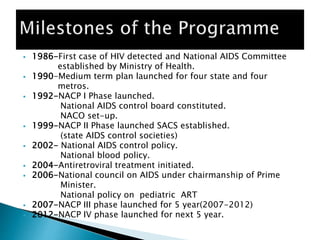
 1986-First case of HIV detected and National AIDS Committee
established by Ministry of Health.
 1990-Medium term plan launched for four state and four
metros.
 1992-NACP I Phase launched.
National AIDS control board constituted.
NACO set-up.
 1999-NACP II Phase launched SACS established.
(state AIDS control societies)
 2002- National AIDS control policy.
National blood policy.
 2004-Antiretroviral treatment initiated.
 2006-National council on AIDS under chairmanship of Prime
Minister.
National policy on pediatric ART
 2007-NACP III phase launched for 5 year(2007-2012)
 2012-NACP IV phase launched for next 5 year.
 During these phase, the National AIDS control
project was developed for prevention and control of AIDS in the
country.
Objective:
 Slow and prevent spread of HIV through a major efforts to prevent
its transmission.
Strategies:
 To attain a satisfactory level of public awareness on
HIV transmission and prevention.
 To screen all blood unites collected for blood transfusion.
 To decrease the practice of professional blood donation.
 To strengthen and control of sexually transmitted disease.
 To monitor the development of the HIVAIDS.
 Awareness level that were almost insignificant
have increased to about 70-80%in urban areas
even through the level of awareness in rural
areas remain low at about 30%.
 Modernization and strengthening of blood banks
 Introduction of licensing system of blood banks
and gradual phasing out of professional blood
donors.
 Availability of good quality condoms through
social marketing has made a significant increase
in its use.
 NACP has become effective in 1999. It is a 100% centrally
sponsored scheme implemented in 32 state UT and
municipal corporation namely Chennai, Ahmedabad and
Mumbai through AIDS control societies.
Objective:
 To reduce the spread of HIV infection in India
through a behaviour change.
Strategies:
 To shift the focus from raising awareness to
changing behaviour through intervention.
 Prevention among high risk population.
 To protect human rights by encouraging voluntary
counselling and testing.
 At the operational level 1,033 targeted
intervention set up, 875 voluntary counselling
and testing centres (VCTC) and 679 clinics at
the district level.
 Nationwide and state level behaviour sentinel
surveillance (BSS) surveys were conducted.
 Prevention of parents to child transmission
(PPTCT) programme was expanded.
 In April 2002 Government of India approved the
National AIDS prevention and control policy
Objective:
 Zero transmission rate.
 Prevent further spread of the disease.
 Improve services for PLWA.
Care of PLWA
• Protection of there rights.
• Proper care and supports in the hospital and community.
• Keeping confidentiality.
• Proper counselling of HIV positive mothers.
• Clinical management of HIVAIDS.
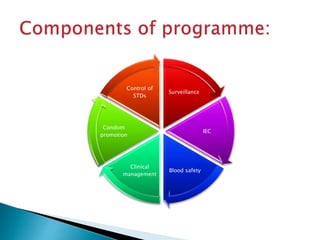
Surveillance
IEC
Blood safety
Clinical
management
Condom
promotion
Control of
STDs
 Only licensed blood banks to operate.
 To encourage voluntary blood donation.
 Ensure safety in collection, processing,
storage and distribution of blood and blood
product.
 Establishment of zonal blood centre.
 Testing every unit of blood for HIV, hepatitis
B, Malaria, Syphilis and HCV is mandatory.
 Integrating service for treatment of
reproductive tract infection and sexually
transmitted infection.
 Training of all the medical and paramedical
workers engaged in providing STDsRTIs
services.
 Hence, early diagnosis and treatment of STDs
is now recognised as one of the major
strategies to control spread of HIV infection.
 85% of HIV infection are due to unprotected sex
and multi partner contact.
 This can be prevented by constitute use of good
quality condom.
 Progress made by NACO in condom
programming:
a. Quality control of condom by specifying
parameters as prescribed by WHO.
b. Using social marketing strategy for condom
promotion.
c. Involvement of NGOs and private voluntary
organization in the programme.
 Among HIV positive women:
• 5 to 10 infant will be infected during pregnancy.
• 10 to 20 infant will be infected during labour and
delivery.
• 20 to 30 infant will be infected during breast
feeding.
 Prevention:
o A short course anti retroviral regimen given to the
mother it can substantially reduce the risk of
Perinatal transmission of HIV during pregnancy and
child birth.
o It has been started from 1st October 2001.
 Information education and communication is the
key to generating awareness on prevention as
well as motivation access to testing, care and
supports.
a. To increase knowledge about general population
(especially youth and women) on safe sexual
behaviour.
b. To sustain behaviour change in high risk group
and treatment.
c. To generate demand for care, support and
treatment service.
d. To make appropriate change in societal norms
reinforce positive attitude.
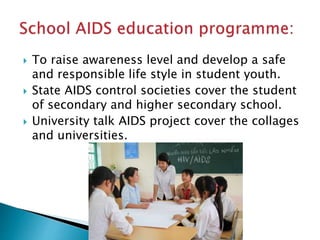
 To raise awareness level and develop a safe
and responsible life style in student youth.
 State AIDS control societies cover the student
of secondary and higher secondary school.
 University talk AIDS project cover the collages
and universities.
 To raise the awareness level regarding
HIDAIDS in rural and slum areas and other
vulnerable groups of the population.
 To make people aware about the services
available under the sector for management of
RTISTD.
 To facilitate the early detection and prompt
treatment of RTISTD cases.
 To aware that HIV can be transmitted from
the infected mother to her baby during
pregnancy , delivery and breastfeeding.
Surveillance are being carried out to detect
spread of the disease and to make appropriate
strategy for prevention and control.
a. For identification of geographical spread of HIV.
b. For determining the major modes of
transmission.
Types of surveillance:
i. HIV sentinel surveillance
ii. HIV Sero surveillance
iii. AIDS case surveillance
iv. STDs surveillance
v. Behavioural surveillance
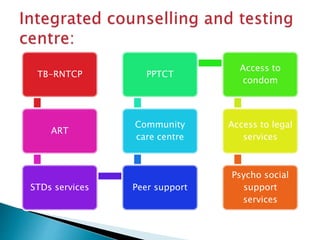
TB-RNTCP
ART
STDs services Peer support
Community
care centre
PPTCT
Access to
condom
Access to legal
services
Psycho social
support
services
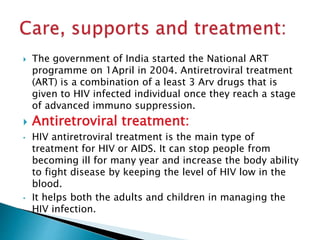
 The government of India started the National ART
programme on 1April in 2004. Antiretroviral treatment
(ART) is a combination of a least 3 Arv drugs that is
given to HIV infected individual once they reach a stage
of advanced immuno suppression.
 Antiretroviral treatment:
• HIV antiretroviral treatment is the main type of
treatment for HIV or AIDS. It can stop people from
becoming ill for many year and increase the body ability
to fight disease by keeping the level of HIV low in the
blood.
• It helps both the adults and children in managing the
HIV infection.
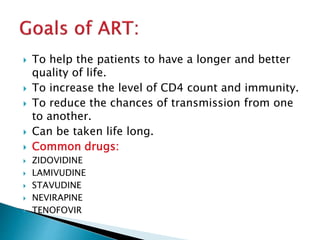
 To help the patients to have a longer and better
quality of life.
 To increase the level of CD4 count and immunity.
 To reduce the chances of transmission from one
to another.
 Can be taken life long.
 Common drugs:
 ZIDOVIDINE
 LAMIVUDINE
 STAVUDINE
 NEVIRAPINE
 TENOFOVIR
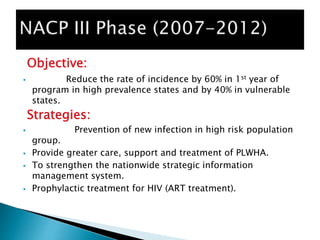
Objective:
 Reduce the rate of incidence by 60% in 1st year of
program in high prevalence states and by 40% in vulnerable
states.
Strategies:
 Prevention of new infection in high risk population
group.
 Provide greater care, support and treatment of PLWHA.
 To strengthen the nationwide strategic information
management system.
 Prophylactic treatment for HIV (ART treatment).
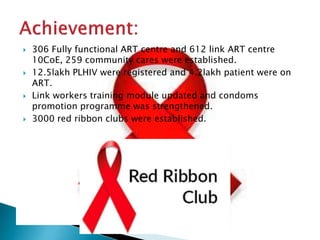
 306 Fully functional ART centre and 612 link ART centre
10CoE, 259 community cares were established.
 12.5lakh PLHIV were registered and 4.2lakh patient were on
ART.
 Link workers training module updated and condoms
promotion programme was strengthened.
 3000 red ribbon clubs were established.
 The cabinet committee on economic Affairs chaired by the
Prime Minister has given its approval for continuation of
National AIDS control programme-(NACP IV) beyond 12th five
year plan for a period of three year from April,2017 to
March,2020.
Objective:
 To reduce new infection by 50% (2007
Baseline of NACP III).
 Provide comprehensive care and supports to all person living
with HIVAIDS and treatment service for all those who
required it.
 Strategy 1: Intensifying and consolidating
prevention services.
 Strategy 2: Comprehensive care, support and
treatment.
 Strategy 3: Expanding IEC services.
 Strategy 4: Strengthening institutional
capacities.
 Strategy 5: Strategic Information Management
system.
 Prevention will continue to be the core strategy of NACP-IV as
more than 99% of the people are HIV negatives.
 Activities:
 Saturating quality HIV prevention service to all HRG groups,
based on emerging behaviour patterns and evidence.
 Strengthening needle exchange programme, drug
substitution programme and providing Opioid substitution
therapy (OST).
 Providing quality STIsRTI services.
 Strengthening management structure of blood transfusion
services.
 Expand the ICTC services and strengthen referral linkage.
 Additional centres of excellence (COEs) and upgraded ART
plus centres will be established to provide high quality
treatment.
Activities:
 Scale up ART centres and COEs ART services.
 Strengthening follow up of patients on ART and improving
quality of counselling services at ART services delivery points.
 Comprehensive care and supports services for PLHIV through
linkages.
 Provide guidelines and training for integration in health care
settings to NRHM.
 Increasing awareness among general
population in women and youth.
 Behaviour change communication strategies
for HRG and vulnerable groups.
 Continued focus on demand generation of
services.
 Reach out to vulnerable population in rural
settings.
 Extending services to tribal groups and hard
to reach population.
 The programme management structure established under
NACP will be strengthened.
 Programme planning and management responsibilities will be
enhanced at National, state, district and facility levels.
Strategy 5 : Information management
system
This will ensure:
 High quality of data generation system such as surveillance,
programme monitoring and research.
 Strengthening systematic analysis, synthesis, development
and dissemination of knowledge products in various forms.
 Continued emphasis on three ones one
agreed action framework, one National
HIVAIDS coordinating authority and one
agreed National system.
 Equity.
 Gender.
 Respect for the rights of the PLHIV.
 Civil society representation and participation.
 Improved public private partnerships.
 Preventing new infection by sustaining the reach
of current intervention and effectively addressing
emerging epidemics.
 Prevention of parent to child transmission.
 Focusing on IEC strategies for behaviour change.
 Providing comprehensive care, supports and
treatment of PLHIV.
 Ensuring effective use of strategic information at
all levels of programme.
 Integrating HIV services with health systems in a
phased manner.
 Ensure a more effective, sustained and comprehensive
coverage of AIDS related services NACO has implemented a
seven year National strategic plan on HIVAIDS and STI,
2017-24.This National strategic plan (NSP) will herald the
country to the midpoint of the 2030 goals.
Vision-:
The vision of the NACO is that of ‘paving the way for an
AIDS free India’ through attaining universal coverage of HIV
prevention, treatment to care continuum of services that are
effective, inclusive, equitable and adapted to needs.
Goals-:
The goals remain those of the Three zero i.e. zero new
infection, zero AIDS related deaths and zero discrimination
which from the basis of this strategic plan. By 2020, the focus
of the National programme will be on achieving the following
fast targets.
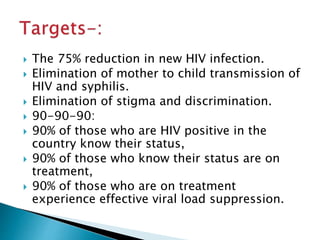
 The 75% reduction in new HIV infection.
 Elimination of mother to child transmission of
HIV and syphilis.
 Elimination of stigma and discrimination.
 90-90-90:
 90% of those who are HIV positive in the
country know their status,
 90% of those who know their status are on
treatment,
 90% of those who are on treatment
experience effective viral load suppression.
 To reduce the spread of HIV infection in India.
 Strengthen India capacity to respond to
HIV/AIDS on a long term basis.
 State level AIDS control societies and improve
drug and equipment practice.
 NEELAM KUMARI “ Community health nursing-II”
published by S. Vikas & company India 2011 edition
page number 751 -762.
 NEELAM KUMARI “ Community health nursing-II”
published by S. Vikas & company India 3rd edition page
number 110-112.
 R. P. SAXENA “A text book of community health
nursing-II” published by Rajinder kapoor, edition 3rd
2020, page number 530-535.
 https://www.slideshare.net/DrLipilekhapatnaik/Nationa
l-AIDS-control-programme.
 https://www.slideshare.net/maheswarjikumar/National
-AIDS-control-programme.
 Thank you
t

National AIDS control programme ppt

  • 1.
    PRESENTED BY- KOMALSINGH Bsc . Nursing 4th year Community Health Nursing II
  • 2.
     Introduction  NationalAIDS control programme  National AIDS control organization  Milestone of the programme  NACP I Phase(1992-1999)  NACP II Phase (1999_2006)  NACP III Phase(2006-2012)  NACP IV Phase(2012-2017)  National strategic plan(2017-2024)  Conclusion  Bibliography
  • 3.
     Human immunodeficiencyvirus (HIV) is a tent virus that belong to the retrovirus group may cause (HIV) infection/(AIDS) Acquired immunodeficiency syndrome. It has emerged as one of the most serious public health problem in the country.  The first case of (HIV) was detected in Chennai in (1986) in female sex workers. The greatest speed in the sex high prevalence state of Andhra Pradesh, Maharashtra, Manipur, Nagaland, Karnataka and Tamil Nadu.
  • 4.
     The Governmentforming the National AIDS committee (NAC)headed by the union health secretary.  The National AIDS Control Programme was Launched in the year (1987)
  • 5.
     National AIDSControl Organisation (NACO) 1992 is a organization of Government of India under the Ministry of Health and Family welfare with the primary objective to control the epidemic in India.  NACO also aims at facilitating and improving access to treatment for HIV+ people and also be Phase to promote and protect their human rights.  Ever since its establishment, NACO has been working to create awareness about HIV/AIDS, giving accurate and reliable information on the menace, clearing existing myths and misconceptions and providing practical skills that can be implemented at the individual's level so as to lead to behaviour changes that minimize the risk of HIV infection.
  • 6.
     1986-First caseof HIV detected and National AIDS Committee established by Ministry of Health.  1990-Medium term plan launched for four state and four metros.  1992-NACP I Phase launched. National AIDS control board constituted. NACO set-up.  1999-NACP II Phase launched SACS established. (state AIDS control societies)  2002- National AIDS control policy. National blood policy.  2004-Antiretroviral treatment initiated.  2006-National council on AIDS under chairmanship of Prime Minister. National policy on pediatric ART  2007-NACP III phase launched for 5 year(2007-2012)  2012-NACP IV phase launched for next 5 year.
  • 7.
     During thesephase, the National AIDS control project was developed for prevention and control of AIDS in the country. Objective:  Slow and prevent spread of HIV through a major efforts to prevent its transmission. Strategies:  To attain a satisfactory level of public awareness on HIV transmission and prevention.  To screen all blood unites collected for blood transfusion.  To decrease the practice of professional blood donation.  To strengthen and control of sexually transmitted disease.  To monitor the development of the HIVAIDS.
  • 8.
     Awareness levelthat were almost insignificant have increased to about 70-80%in urban areas even through the level of awareness in rural areas remain low at about 30%.  Modernization and strengthening of blood banks  Introduction of licensing system of blood banks and gradual phasing out of professional blood donors.  Availability of good quality condoms through social marketing has made a significant increase in its use.
  • 9.
     NACP hasbecome effective in 1999. It is a 100% centrally sponsored scheme implemented in 32 state UT and municipal corporation namely Chennai, Ahmedabad and Mumbai through AIDS control societies. Objective:  To reduce the spread of HIV infection in India through a behaviour change. Strategies:  To shift the focus from raising awareness to changing behaviour through intervention.  Prevention among high risk population.  To protect human rights by encouraging voluntary counselling and testing.
  • 10.
     At theoperational level 1,033 targeted intervention set up, 875 voluntary counselling and testing centres (VCTC) and 679 clinics at the district level.  Nationwide and state level behaviour sentinel surveillance (BSS) surveys were conducted.  Prevention of parents to child transmission (PPTCT) programme was expanded.
  • 11.
     In April2002 Government of India approved the National AIDS prevention and control policy Objective:  Zero transmission rate.  Prevent further spread of the disease.  Improve services for PLWA. Care of PLWA • Protection of there rights. • Proper care and supports in the hospital and community. • Keeping confidentiality. • Proper counselling of HIV positive mothers. • Clinical management of HIVAIDS.
  • 12.
  • 13.
     Only licensedblood banks to operate.  To encourage voluntary blood donation.  Ensure safety in collection, processing, storage and distribution of blood and blood product.  Establishment of zonal blood centre.  Testing every unit of blood for HIV, hepatitis B, Malaria, Syphilis and HCV is mandatory.
  • 14.
     Integrating servicefor treatment of reproductive tract infection and sexually transmitted infection.  Training of all the medical and paramedical workers engaged in providing STDsRTIs services.  Hence, early diagnosis and treatment of STDs is now recognised as one of the major strategies to control spread of HIV infection.
  • 15.
     85% ofHIV infection are due to unprotected sex and multi partner contact.  This can be prevented by constitute use of good quality condom.  Progress made by NACO in condom programming: a. Quality control of condom by specifying parameters as prescribed by WHO. b. Using social marketing strategy for condom promotion. c. Involvement of NGOs and private voluntary organization in the programme.
  • 16.
     Among HIVpositive women: • 5 to 10 infant will be infected during pregnancy. • 10 to 20 infant will be infected during labour and delivery. • 20 to 30 infant will be infected during breast feeding.  Prevention: o A short course anti retroviral regimen given to the mother it can substantially reduce the risk of Perinatal transmission of HIV during pregnancy and child birth. o It has been started from 1st October 2001.
  • 17.
     Information educationand communication is the key to generating awareness on prevention as well as motivation access to testing, care and supports. a. To increase knowledge about general population (especially youth and women) on safe sexual behaviour. b. To sustain behaviour change in high risk group and treatment. c. To generate demand for care, support and treatment service. d. To make appropriate change in societal norms reinforce positive attitude.
  • 18.
     To raiseawareness level and develop a safe and responsible life style in student youth.  State AIDS control societies cover the student of secondary and higher secondary school.  University talk AIDS project cover the collages and universities.
  • 19.
     To raisethe awareness level regarding HIDAIDS in rural and slum areas and other vulnerable groups of the population.  To make people aware about the services available under the sector for management of RTISTD.  To facilitate the early detection and prompt treatment of RTISTD cases.  To aware that HIV can be transmitted from the infected mother to her baby during pregnancy , delivery and breastfeeding.
  • 20.
    Surveillance are beingcarried out to detect spread of the disease and to make appropriate strategy for prevention and control. a. For identification of geographical spread of HIV. b. For determining the major modes of transmission. Types of surveillance: i. HIV sentinel surveillance ii. HIV Sero surveillance iii. AIDS case surveillance iv. STDs surveillance v. Behavioural surveillance
  • 21.
    TB-RNTCP ART STDs services Peersupport Community care centre PPTCT Access to condom Access to legal services Psycho social support services
  • 22.
     The governmentof India started the National ART programme on 1April in 2004. Antiretroviral treatment (ART) is a combination of a least 3 Arv drugs that is given to HIV infected individual once they reach a stage of advanced immuno suppression.  Antiretroviral treatment: • HIV antiretroviral treatment is the main type of treatment for HIV or AIDS. It can stop people from becoming ill for many year and increase the body ability to fight disease by keeping the level of HIV low in the blood. • It helps both the adults and children in managing the HIV infection.
  • 23.
     To helpthe patients to have a longer and better quality of life.  To increase the level of CD4 count and immunity.  To reduce the chances of transmission from one to another.  Can be taken life long.  Common drugs:  ZIDOVIDINE  LAMIVUDINE  STAVUDINE  NEVIRAPINE  TENOFOVIR
  • 24.
    Objective:  Reduce therate of incidence by 60% in 1st year of program in high prevalence states and by 40% in vulnerable states. Strategies:  Prevention of new infection in high risk population group.  Provide greater care, support and treatment of PLWHA.  To strengthen the nationwide strategic information management system.  Prophylactic treatment for HIV (ART treatment).
  • 25.
     306 Fullyfunctional ART centre and 612 link ART centre 10CoE, 259 community cares were established.  12.5lakh PLHIV were registered and 4.2lakh patient were on ART.  Link workers training module updated and condoms promotion programme was strengthened.  3000 red ribbon clubs were established.
  • 26.
     The cabinetcommittee on economic Affairs chaired by the Prime Minister has given its approval for continuation of National AIDS control programme-(NACP IV) beyond 12th five year plan for a period of three year from April,2017 to March,2020. Objective:  To reduce new infection by 50% (2007 Baseline of NACP III).  Provide comprehensive care and supports to all person living with HIVAIDS and treatment service for all those who required it.
  • 27.
     Strategy 1:Intensifying and consolidating prevention services.  Strategy 2: Comprehensive care, support and treatment.  Strategy 3: Expanding IEC services.  Strategy 4: Strengthening institutional capacities.  Strategy 5: Strategic Information Management system.

  • 28.
     Prevention willcontinue to be the core strategy of NACP-IV as more than 99% of the people are HIV negatives.  Activities:  Saturating quality HIV prevention service to all HRG groups, based on emerging behaviour patterns and evidence.  Strengthening needle exchange programme, drug substitution programme and providing Opioid substitution therapy (OST).  Providing quality STIsRTI services.  Strengthening management structure of blood transfusion services.  Expand the ICTC services and strengthen referral linkage.
  • 29.
     Additional centresof excellence (COEs) and upgraded ART plus centres will be established to provide high quality treatment. Activities:  Scale up ART centres and COEs ART services.  Strengthening follow up of patients on ART and improving quality of counselling services at ART services delivery points.  Comprehensive care and supports services for PLHIV through linkages.  Provide guidelines and training for integration in health care settings to NRHM.
  • 30.
     Increasing awarenessamong general population in women and youth.  Behaviour change communication strategies for HRG and vulnerable groups.  Continued focus on demand generation of services.  Reach out to vulnerable population in rural settings.  Extending services to tribal groups and hard to reach population.
  • 31.
     The programmemanagement structure established under NACP will be strengthened.  Programme planning and management responsibilities will be enhanced at National, state, district and facility levels. Strategy 5 : Information management system This will ensure:  High quality of data generation system such as surveillance, programme monitoring and research.  Strengthening systematic analysis, synthesis, development and dissemination of knowledge products in various forms.
  • 32.
     Continued emphasison three ones one agreed action framework, one National HIVAIDS coordinating authority and one agreed National system.  Equity.  Gender.  Respect for the rights of the PLHIV.  Civil society representation and participation.  Improved public private partnerships.
  • 33.
     Preventing newinfection by sustaining the reach of current intervention and effectively addressing emerging epidemics.  Prevention of parent to child transmission.  Focusing on IEC strategies for behaviour change.  Providing comprehensive care, supports and treatment of PLHIV.  Ensuring effective use of strategic information at all levels of programme.  Integrating HIV services with health systems in a phased manner.
  • 34.
     Ensure amore effective, sustained and comprehensive coverage of AIDS related services NACO has implemented a seven year National strategic plan on HIVAIDS and STI, 2017-24.This National strategic plan (NSP) will herald the country to the midpoint of the 2030 goals. Vision-: The vision of the NACO is that of ‘paving the way for an AIDS free India’ through attaining universal coverage of HIV prevention, treatment to care continuum of services that are effective, inclusive, equitable and adapted to needs. Goals-: The goals remain those of the Three zero i.e. zero new infection, zero AIDS related deaths and zero discrimination which from the basis of this strategic plan. By 2020, the focus of the National programme will be on achieving the following fast targets.
  • 35.
     The 75%reduction in new HIV infection.  Elimination of mother to child transmission of HIV and syphilis.  Elimination of stigma and discrimination.  90-90-90:  90% of those who are HIV positive in the country know their status,  90% of those who know their status are on treatment,  90% of those who are on treatment experience effective viral load suppression.
  • 36.
     To reducethe spread of HIV infection in India.  Strengthen India capacity to respond to HIV/AIDS on a long term basis.  State level AIDS control societies and improve drug and equipment practice.
  • 37.
     NEELAM KUMARI“ Community health nursing-II” published by S. Vikas & company India 2011 edition page number 751 -762.  NEELAM KUMARI “ Community health nursing-II” published by S. Vikas & company India 3rd edition page number 110-112.  R. P. SAXENA “A text book of community health nursing-II” published by Rajinder kapoor, edition 3rd 2020, page number 530-535.  https://www.slideshare.net/DrLipilekhapatnaik/Nationa l-AIDS-control-programme.  https://www.slideshare.net/maheswarjikumar/National -AIDS-control-programme.
  • 38.