LEFT VENTRICULAR NON- COMPACTION
SHORT REVIEW
DR MAHENDRA
CARDIOLOGY,JIPMER
1
INTRODUCTION
• Spongy appearance of the myocardium first described by
Grant in 1926.
• Developmental considerations-
• development of the myocardial architecture which passes
through four distinct steps
• (i) early heart tube
• (ii) emergence of trabeculations
• (iii) trabecular remodeling
• (iv) development of the multilayered spiral system
• Emergence of trabeculations and trabecular remodeling are
the key steps to understand LVNC
2
• Emergence of trabeculations-
• emerge after looping of the primitive heart tube at the end of
the fourth week of gestation.
• trabeculation patterns are ventricle-specific
• trabeculations in the LV are generally thicker and the
corresponding intertrabecular spaces are larger at this
embryonic stage.
3
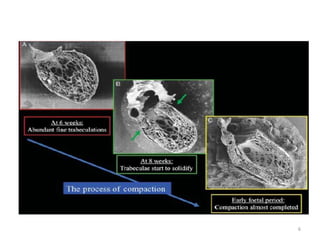
• Trabecular remodeling-
• remodelling starts after completion of ventricular septation at
8 weeks of gestation in human.
• Increase in ventricular volumes results in compression of the
trabeculations with an increase in the thickness of the
compacted myocardium.
• compaction process coincides with the invasion of epicardial
coronary arteries and vascularization of the myocardium
4
• progresses from-
• epicardium to the endocardium
• base to the apex
• septum to the free wall in the LV
• more in LV than right ventricle
• time of arrest of normal embryonic myocardial maturation
determines the severity and extension of LVNC
5
6
7
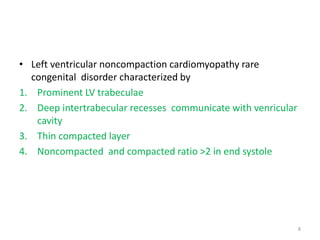
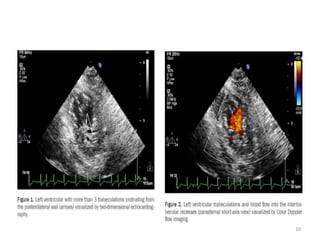
• Left ventricular noncompaction cardiomyopathy rare
congenital disorder characterized by
1. Prominent LV trabeculae
2. Deep intertrabecular recesses communicate with venricular
cavity
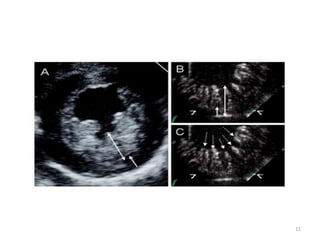
3. Thin compacted layer
4. Noncompacted and compacted ratio >2 in end systole
8
• persistent sinusoids
• describe ventriculo-coronary arterial communications or
intertrabecular spaces connecting the ventricular cavity with
the epicardial coronary artery system through the capillary
bed.
• seen in pulmonary atresia with intact ventricular septum.
• hypertrabeculation-
• increased number of normally formed trabeculations
9
10
11
PREVALENCE
• In adults based on Echo ranges fom 0.014% to 1.3%
• In Australian children with cardiomyopathy prevalence higher-
5% to 9.2%.
• phenotype of noncompaction can vary even within familial
cases and range from clinically benign to fatal.
12
Genetics of LVNC
• Sporadic and familial form.
• AD more common than X-linked inheritance
• Familial recurrence between 18 and 50%
• Mutations in the G4.5 gene on Xq28 resulting Barth syndrome
with DCM and LVNC in a pediatric population.
• Loci for LVNC were also described on chromosome 1, 5, and
11.
13
14
• Acquired NCLV-
• Young athlete
• Pregnancy
• Sickle cell anemia
15
16
17
18
CLASSIFICATION
• AHA classifies LVNC as a genetic cardiomyopathy.
• ESC and WHO classify LVNC as an unclassified
cardiomyopathy.
19
Diagnostic criteria-
• Normal variants-
• Boyd et al. reported the frequency and localization of
prominent LV trabeculations at autopsy in 474 normal hearts
• 53% of them exhibited two or more.
• More than three prominent trabeculations were observed in
only 3%.
• but none of the hearts had more than five.
• Most of the trabeculations (85%) were septomarginal bundles
inserting into both the free wall and the septum
20
Non-compaction
(California criteria)
21
22
Zurich criteria
23
Vienna criteria
24
25
Limitations of echocardiographic criteria
• poor correlation between three echocardiographic definitions
• 24% of the study population fulfilled one or more
echocardiographic definitions for LVNC.
• only 30% fulfilled all three criteria.
• 8% of apparently healthy individuals also satisfied one or
more diagnostic criteria for LVNC
• Contrast echocardiogram is useful to better image
intertrabecular spaces
26
27
28
29
30
Cardiac magnetic resonance imaging
• Method of choice to confirm or rule out the diagnosis of LVNC
• The NC areas are most commonly found in the apical and
lateral portions of the left ventricle
• ratio of NC to C layers > than 2.3 at end diastole (Petersen et
al.)
• Trabeculated LV mass >20% of global LV mass (Jacquier et al.)
31
32
33
Zuccarino et al. AJR:204 May 2015
• Differential diagnosis-
• Apical form of hypertrophic cardiomyopathy, a combination of
both apical hypertrophic cardiomyopathy and LVNC
• hypertensive cardiomyopathy
• endocardial fibroelastosis
• abnormal chords
• Apical thrombus, or tumours
34
ASSOCIATED CONDITIONS
• Coronary cameral fistulas
• LVOT abnormalities
• Ebstein’s anomaly
• Bicuspid aortic valve
• Transposition of great vessels
• Metabolic diseases and genetic syndromes, including the
Barth syndrome, the Charco-Marie-Tooth disease
• Muscular dystrophy
35
36
MANAGEMENT
• No specific treatment available
• Family members of proband should be screened using ECHO
• Genetic testing may useful in identifying familial forms
• Anticoagulation-(INR 2-3)
1. Decreased systolic function with EF below 40%
2. History of thromboembolism
3. Atrial fibrillation
37
• ICD/biventricular pacing-
• no robust data available for guideline
• indication for device therapy as per current guideline.
38
39
40
Take home message
• Many pt with trabeculae but normal LV function diagnosed
as NVLC.
• Should not labeled unless truly meet diagnostic criteria.
• Jenni criteria appear to best at present.
• Trabeculation may progress or change under physiologic
condition like pregnancy, serial evaluation is necessary.
• Difference in LV mass and trabecular feature between racial
background
• Screening of relative is crucially important.
41
THANK YOU
42

Left ventricular non compaction

  • 1.
    LEFT VENTRICULAR NON-COMPACTION SHORT REVIEW DR MAHENDRA CARDIOLOGY,JIPMER 1
  • 2.
    INTRODUCTION • Spongy appearanceof the myocardium first described by Grant in 1926. • Developmental considerations- • development of the myocardial architecture which passes through four distinct steps • (i) early heart tube • (ii) emergence of trabeculations • (iii) trabecular remodeling • (iv) development of the multilayered spiral system • Emergence of trabeculations and trabecular remodeling are the key steps to understand LVNC 2
  • 3.
    • Emergence oftrabeculations- • emerge after looping of the primitive heart tube at the end of the fourth week of gestation. • trabeculation patterns are ventricle-specific • trabeculations in the LV are generally thicker and the corresponding intertrabecular spaces are larger at this embryonic stage. 3
  • 4.
    • Trabecular remodeling- •remodelling starts after completion of ventricular septation at 8 weeks of gestation in human. • Increase in ventricular volumes results in compression of the trabeculations with an increase in the thickness of the compacted myocardium. • compaction process coincides with the invasion of epicardial coronary arteries and vascularization of the myocardium 4
  • 5.
    • progresses from- •epicardium to the endocardium • base to the apex • septum to the free wall in the LV • more in LV than right ventricle • time of arrest of normal embryonic myocardial maturation determines the severity and extension of LVNC 5
  • 6.
  • 7.
  • 8.
    • Left ventricularnoncompaction cardiomyopathy rare congenital disorder characterized by 1. Prominent LV trabeculae 2. Deep intertrabecular recesses communicate with venricular cavity 3. Thin compacted layer 4. Noncompacted and compacted ratio >2 in end systole 8
  • 9.
    • persistent sinusoids •describe ventriculo-coronary arterial communications or intertrabecular spaces connecting the ventricular cavity with the epicardial coronary artery system through the capillary bed. • seen in pulmonary atresia with intact ventricular septum. • hypertrabeculation- • increased number of normally formed trabeculations 9
  • 10.
  • 11.
  • 12.
    PREVALENCE • In adultsbased on Echo ranges fom 0.014% to 1.3% • In Australian children with cardiomyopathy prevalence higher- 5% to 9.2%. • phenotype of noncompaction can vary even within familial cases and range from clinically benign to fatal. 12
  • 13.
    Genetics of LVNC •Sporadic and familial form. • AD more common than X-linked inheritance • Familial recurrence between 18 and 50% • Mutations in the G4.5 gene on Xq28 resulting Barth syndrome with DCM and LVNC in a pediatric population. • Loci for LVNC were also described on chromosome 1, 5, and 11. 13
  • 14.
  • 15.
    • Acquired NCLV- •Young athlete • Pregnancy • Sickle cell anemia 15
  • 16.
  • 17.
  • 18.
  • 19.
    CLASSIFICATION • AHA classifiesLVNC as a genetic cardiomyopathy. • ESC and WHO classify LVNC as an unclassified cardiomyopathy. 19
  • 20.
    Diagnostic criteria- • Normalvariants- • Boyd et al. reported the frequency and localization of prominent LV trabeculations at autopsy in 474 normal hearts • 53% of them exhibited two or more. • More than three prominent trabeculations were observed in only 3%. • but none of the hearts had more than five. • Most of the trabeculations (85%) were septomarginal bundles inserting into both the free wall and the septum 20
  • 21.
  • 22.
  • 23.
  • 24.
  • 25.
  • 26.
    Limitations of echocardiographiccriteria • poor correlation between three echocardiographic definitions • 24% of the study population fulfilled one or more echocardiographic definitions for LVNC. • only 30% fulfilled all three criteria. • 8% of apparently healthy individuals also satisfied one or more diagnostic criteria for LVNC • Contrast echocardiogram is useful to better image intertrabecular spaces 26
  • 27.
  • 28.
  • 29.
  • 30.
  • 31.
    Cardiac magnetic resonanceimaging • Method of choice to confirm or rule out the diagnosis of LVNC • The NC areas are most commonly found in the apical and lateral portions of the left ventricle • ratio of NC to C layers > than 2.3 at end diastole (Petersen et al.) • Trabeculated LV mass >20% of global LV mass (Jacquier et al.) 31
  • 32.
  • 33.
    33 Zuccarino et al.AJR:204 May 2015
  • 34.
    • Differential diagnosis- •Apical form of hypertrophic cardiomyopathy, a combination of both apical hypertrophic cardiomyopathy and LVNC • hypertensive cardiomyopathy • endocardial fibroelastosis • abnormal chords • Apical thrombus, or tumours 34
  • 35.
    ASSOCIATED CONDITIONS • Coronarycameral fistulas • LVOT abnormalities • Ebstein’s anomaly • Bicuspid aortic valve • Transposition of great vessels • Metabolic diseases and genetic syndromes, including the Barth syndrome, the Charco-Marie-Tooth disease • Muscular dystrophy 35
  • 36.
  • 37.
    MANAGEMENT • No specifictreatment available • Family members of proband should be screened using ECHO • Genetic testing may useful in identifying familial forms • Anticoagulation-(INR 2-3) 1. Decreased systolic function with EF below 40% 2. History of thromboembolism 3. Atrial fibrillation 37
  • 38.
    • ICD/biventricular pacing- •no robust data available for guideline • indication for device therapy as per current guideline. 38
  • 39.
  • 40.
  • 41.
    Take home message •Many pt with trabeculae but normal LV function diagnosed as NVLC. • Should not labeled unless truly meet diagnostic criteria. • Jenni criteria appear to best at present. • Trabeculation may progress or change under physiologic condition like pregnancy, serial evaluation is necessary. • Difference in LV mass and trabecular feature between racial background • Screening of relative is crucially important. 41
  • 42.