Sandia is a multi-program laboratory operated by Sandia Corporation, a Lockheed Martin Company,
for the United States Department of Energy’s National Nuclear Security Administration
under contract DE-AC04-94AL85000.
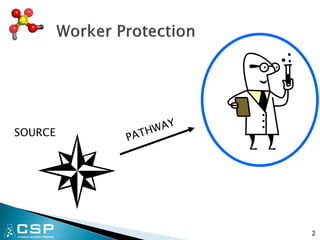
SOURCE
2
 Should be a last resort, but may be necessary
if:
• engineering controls inadequate or being installed
• administrative controls don’t do the job
• emergency response or spill cleanup
• supplement other control techniques if can’t
achieve required level
 Depends upon human behavior
• proper selection, fit and comfort issues
 Hazard is still present with PPE …
3
 Eye and face protection
• 29 CFR 1910.133
 Respiratory protection
• 29 CFR 1910.134
 Head protection
• 29 CFR 1910.135
 Foot protection
• 29 CFR 1910.136
 Hand protection
• 29 CFR 1910.138
 Hearing Protection
• 29 CFR 1910.95 www.osha.gov/Publications/osha3151.pdf
www.osha.gov/SLTC/personalprotectiveequipment/index.html
www.cdc.gov/nasd/menu/topic/ppe.html
4
‣ When PPE is necessary?
‣ What PPE is necessary?
‣ How to properly don, doff,
adjust and wear PPE.
‣ Limitations of PPE.
‣ Proper care, storage,
maintenance, useful life, and
disposal of PPE.
Employees should be trained to know:
www.free-training.com/osha/ppe/ppemenu.htm
5
‣ Change in the process.
‣ Change in type of PPE used.
‣ Inadequate employee
knowledge or use of PPE.
• retrain to reinforce
understanding or skill
Retraining is necessary when there is:
6
Personal Protective Clothing (PPE)
‣ Evaluate task, select appropriate
type and train to use it properly
• lab coats, gowns, aprons
• safety glasses (with side shields),
goggles, face shields
• gloves
‣ Remove PPE before leaving the lab
7
Protective Equipment Works
An experiment reacted unexpectedly and a flammable
solvent from a hood splashed out and landed on the
bottom of the lab coat
“It's a hot day, why wear a lab coat?”
8
‣ Thousands are blinded each year from work-related
eye injuries.
‣ Nearly three out of five workers are injured while
failing to wear eye and face protection.
9
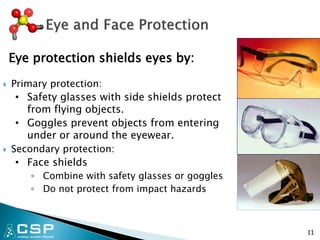
 Safety glasses
 Goggles
 Face shield
 Primary protection:
• Safety glasses with side shields protect
from flying objects.
• Goggles prevent objects from entering
under or around the eyewear.
 Secondary protection:
• Face shields
◦ Combine with safety glasses or goggles
◦ Do not protect from impact hazards
Eye protection shields eyes by:
11
Hazard Type Hazard Type Common related tasks
Impact Flying objects such as large
chips, fragments, particles,
sand, and dirt
Chipping, grinding, machining, masonry work,
wood working, sawing, drilling, riveting,
sanding,…
Heat Anything emitting extreme heat Furnace operations, pouring, casting, hot
dipping, welding, …
Chemicals Splash, fumes, vapors, and
irritating mists
Acid and chemical handling, degreasing,
plating, and working with blood or OPIMs
Dust Harmful dust Woodworking, buffing, and general dusty
conditions
Optical
Radiation
Radiant energy, glare, and
intense light
Welding, torch-cutting, brazing,
soldering, and laser work
Biohazards
Contaminated blood or bodily fluids may result in transmission through
the eyes.
Use caution anytime you are working with blood or other bodily fluids.
13
Eye and Face Protection
‣Optical Hazards
• Welding helmets are secondary
protection to shield from UV,
heat, and impact.
• Exposure to laser beams requires
suitable laser safety goggles with
protection for the specific
wavelength.
14
 Eye and face protection should comply with
the American National Standards Institute:
• ANSI Z87.1-1989
 Ensure employees who wear prescription
lenses or contact lenses:
• Use safety eyewear that incorporates the
prescription
• Use eye protection that can be worn over
prescription lenses
15
‣ Provide adequate protection against the specific
hazards.
‣ Safe design and construction for the work to be
performed.
‣ Comfortable.
‣ Don’t interfere with the wearer’s movements.
‣ Durable!
‣ Capable of being disinfected.
‣ Easily cleaned.
‣ Distinctly marked to indicate they are approved eye
protection.
‣ Worker satisfaction.
 Include workers in the selection process.
16
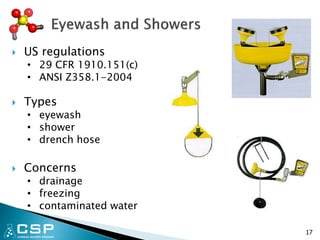
 US regulations
• 29 CFR 1910.151(c)
• ANSI Z358.1-2004
 Types
• eyewash
• shower
• drench hose
 Concerns
• drainage
• freezing
• contaminated water
17
Eyewash and Showers
‣ Know their locations
‣ Maintenance and testing program
‣ Concerns:
• drainage
• freezing
• contaminated water
18
‣ Eye wash stations
 Minimum 0.4 to 3.5 gal/min
(1.4 – 13.2 l/min.)
 Flush for 15 minutes
‣ Provide flow for both eyes
 Hold eyes open
 Tepid, pH match eye (preferred)
‣ Easily accessible locations
 33 to 45 in. (84-114 cm) from floor
 6 in. (15cm) from wall
‣ Test weekly
 Portable: clean/refill (6 mo – 2 yrs)
‣ Various types ANSI Z358.1
NC DOL Guide:
www.nclabor.com/osha/etta/indguide/ig2
8.pdf
19
 Within 55 ft. (17 m) or 10 seconds
• Normal walking = 3.8 mph (6.1 km/hr)
 Test monthly
 Pull within reach (highly visible)
• 82 to 96 in. high (208 – 244 cm)
• Deliver 20 in (51 cm) column
• Height: 60” (152 cm) above floor
 20–30 gal/min (76-114 L/min)
 Tepid: 60 to 100 °F (16 – 38oC)
20
Safety Shower Standards cont.
‣ Consider:
• Drains
• Blankets/modesty curtains
Avoid or protect electrical outlets
• ANSI Z358.1-2004
22
‣ Glove considerations
• Type glove
◦ Dexterity required
◦ Chemical & physical
- material
- strength
◦ Exposure time
- breakthrough time
◦ Size, comfort, reusable/disposable
• Manufacturer selection charts
25
 Considerations:
• Chemicals (splashes vs immersion)
• Thermal (extreme heat/cold)
• Abrasion; cuts; snags; splinters;
punctures
• Grip: oily, wet, dry
• Comfort, fit, size
• Ergonomics
26
 Permeation (“silent killer”)
• Substances pass through intact material on a
molecular level.
 Penetration
• Substances pass through seams, zippers,
stitches, pinholes, or damaged material.
 Degradation
• Substance damages material making it less
resist or resulting in physical breakdown.
 Contamination
• Substances transferred inside material
(improper doffing or decontamination).
27
Permeation Rate
(PR)
Permeation
Breakthrough (PB)
Permeation Degradation rate
(DR)
E- Excellent; permeation rate of
less than 0.9 mg/cm2/min
>Greater than
(time - minutes)
E - Excellent; fluid has very little
degrading effect.
VG - Very Good; permeation
rate of less than 9 mg/cm2/min
< Less than
(time - minutes)
G - Good; fluid has minor
degrading effect.
G - Good; permeation rate of
less than 90 mg/cm2/min
F - Fair; fluid has moderate
degrading effect.
F - Fair; permeation rate of less
than 900 mg/cm2/min
P - Poor; fluid has pronounced
degrading effect.
P - Poor; permeation rate of less
than 9000 mg/cm2/min
NR - Fluid is not recommended
with this material.
NR - Not recommended;
permeation rate greater than
9000 mg/cm2/min
† Not tested, but breakthrough
time > 480 min DR expected to be
Good to Excellent
†† Not tested, but expected to be
Good to Excellent based on
similar tested materials
Gloves
‣ It’s important to have the right glove for the job and
know how long it will last.
‣ Glove Chart Examples:
• Consider several glove manufactures data before
final selection.
• www.bestglove.com/site/chemrest/
29
Gloves
‣ Polyethylene/Ethylene-vinyl Alcohol {“Silver
Shield®”}
• Resists permeation and breakthrough
with chemicals.
• Uses: aromatics, esters, ketones, and
chlorines.
‣ Butyl
• Highest permeation resistance to gas
or water vapors.
• Uses: ketones (MEK, acetone) and
esters (amyl acetate, ethyl acetate).
31
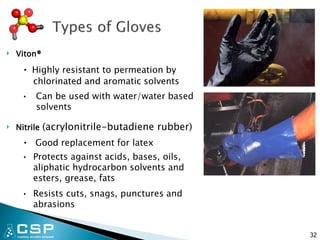
‣ Viton®
• Highly resistant to permeation by
chlorinated and aromatic solvents
• Can be used with water/water based
solvents
‣ Nitrile (acrylonitrile-butadiene rubber)
• Good replacement for latex
• Protects against acids, bases, oils,
aliphatic hydrocarbon solvents and
esters, grease, fats
• Resists cuts, snags, punctures and
abrasions
32
‣ Neoprene
• Protects against acids, caustics,
DMSO.
• Resists amines, alcohols, glycols.
• Limited use for aldehydes
and ketones.
‣ Poly vinyl chloride (PVC)
• Protects against acids, caustics.
• Resists alcohols, glycols.
• Not useful for aromatics, aldehydes
and ketones.
33
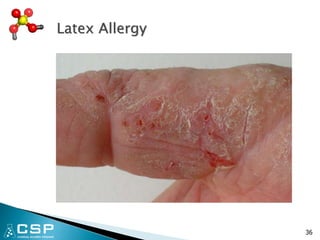
 Natural rubber latex is from the rubber tree
Hevea brasiliensis.
 The major route of occupational exposure is
absorption of latex protein through the skin.
 Allergens in or on gloves can be transferred to
the person’s tissue.
34
 Symptoms may occur within minutes of exposure
or may take several hours depending on the
individual.
• Skin Redness
• Hives
• Itching
• Respiratory Symptoms
◦ Runny Nose
◦ Itchy Eyes
◦ Scratchy Throat
◦ Asthma
35
Latex Allergy
36
 To prevent latex allergies consider:
• Using non-latex gloves.
• If you choose latex gloves, use the powder-free
version.
• When using gloves, do not use oil-based hand
cream or lotions (these cause glove deterioration).
• Recognize the symptoms of latex allergy.
• Always wash hands after removing gloves.
http://www.cdc.gov/niosh/topics/latex/
http://www.nursingworld.org/osh/latex.htm
37
Proper Steps for Removing Gloves
1 2 3
4 5 6
38
Respiratory Protection Program
• Written program
• Administered by Safety Office
• Medical clearance
◦ Respiratory Protection
Questionnaire
◦ No beards
• Fit testing
• Respirator selection
◦ Air monitoring
• Training (annual refresher)
39
 29 CFR 1910.134
• OSHA Respiratory Protection Standard
• New OSHA Assigned Protection Factors
 ANSI Z88.2–1992
• ANSI Voluntary Consensus Standard
Conduct an Exposure Assessment:
www.osha.gov/SLTC/etools/respiratory/haz_expose/haz_expose.html
40
 Air purifying (APR)
• Half Face
• Full Face
• PAPR
 Air supply
• Air line
• SCBA
41
 Must have at least 19.5% oxygen.
• Never use in O2 deficient atmospheres
 Only filters the air.
• Particulate filters
◦ Removes aerosols
• Chemical cartridges or canisters
◦ Remove gases and vapors
 Concentrations must not exceed limitations of
filter/cartridge.
 PAPR (Powered Air Purifying Respirator)
• Uses a blower to force air through an air purifying element
42
 Specific gases or vapors
 NIOSH or MSHA approval
 Adequate warning properties
 End of service life
 Mechanisms
• adsorption
• absorption
• chemical reaction
 Breakthrough times
 Proper maintenance and
storage
43
Cartridge Description
Organic Vapor
Organic Vapor and acid gases
Ammonia, methylamine and
P100 any particulates filter
99.97% minimum filter
efficiency
44
There are very few NIOSH-approved ESLI’s:
• ammonia
• carbon monoxide
• ethylene oxide
• hydrogen chloride
• hydrogen fluoride
• hydrogen sulfide
• mercury
• sulfur dioxide
• toluene-2,4-diisocyanate
• vinyl chloride
45
 Level of workplace respiratory protection that a
respirator or class of respirators is expected to
provide.
 Each specific type of respirator has an Assigned
Protection Factor (APF).
 Select respirator based on the exposure limit of
a contaminant and the level in the workplace.
Maximum Use Concentration (MUC)
= APF x Occupational Exposure Limit
(e.g.OEL, TLV)
46
Type of Respirator Half Face
Mask
Full
Facepiece
Helmet/
Hood
Loose-Fitting
Facepiece
Air-Purifying 10 50 - -
PAPR 50 1,000 25/1,000 25
Supplied-Air or Airline
– Demand
– Continuous flow
– Pressure demand
10
50
50
50
1,000
1,000
-
25/1000
-
-
25
-
SCBA
– Demand
– Pressure Demand
10
-
50
10,000
50
10,000
-
-
47
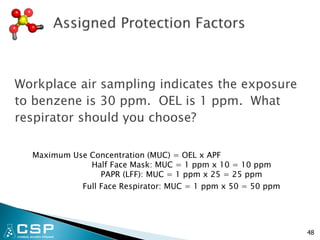
Workplace air sampling indicates the exposure
to benzene is 30 ppm. OEL is 1 ppm. What
respirator should you choose?
Maximum Use Concentration (MUC) = OEL x APF
Half Face Mask: MUC = 1 ppm x 10 = 10 ppm
PAPR (LFF): MUC = 1 ppm x 25 = 25 ppm
Full Face Respirator: MUC = 1 ppm x 50 = 50 ppm
48
49
50
 Qualitative
• Irritant smoke (stannic chloride)
• Isoamyl acetate (banana oil)
• Saccharin
• Bitrex (bitter taste)
• Employees should perform a user seal check each
time they put on a tight-fitting respirator
 Quantitative
• Portacount
51
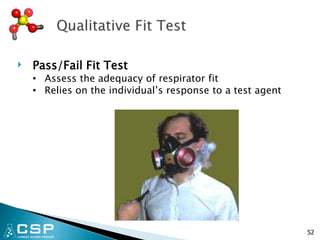
‣ Pass/Fail Fit Test
• Assess the adequacy of respirator fit
• Relies on the individual’s response to a test agent
52
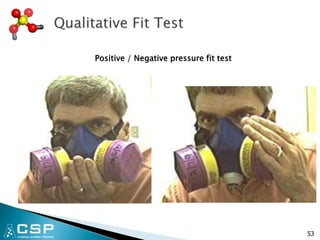
Positive / Negative pressure fit test
53
 Supplies breathing air to employee
 Examples:
• SCBA
• Airline
 Grade D Air
 Limitations
54
 Compressed breathing air must be at least
Type 1 - Grade D [ANSI/CGA G-7.1-1989]:
• Oxygen content = 19.5 - 23.5%
• Hydrocarbon (condensed) = 5 mg/m3 or less
• CO  10 ppm or less
• CO2 of 1,000 ppm or less
• Lack of noticeable odor
 Compressors equipped with in-line air-
purifying sorbent beds and filters.
55
 Non-oil lubricated compressors
• CO levels in the breathing air  10 ppm
 Oil-lubricated compressors
• High-temperature or CO alarm, or both
• If only high-temperature alarm, the air
supply must be monitored to prevent CO
levels from exceeding 10 ppm
56
 Disposable filtering face-piece:
• Dispose after use
 Half-mask:
• Write expiration date (current date +estimate)
making sure to keep entire label legible
• Discard cartridges based on expiration date, end-
of-service life indicator or calculated service life
• Clean
• Dry
• Place in sealable bag (write your name on bag)
• Contact Safety Office for repairs
57
 Exclusive use of an employee:
• Clean and disinfect as often as necessary to be
maintained in a sanitary condition.
• Discard cartridges based on expiration date, end-of-
service life indicator or calculated service life.
 Respirators issued to more than one employee or
maintained for emergency use:
• Clean and disinfect before worn by different
individuals or after each use.
 Respirators used in fit testing and training:
• Clean and disinfect after each use
 All respirators must be stored in clean, dry bags
58
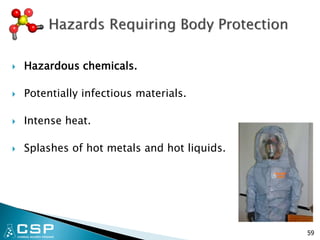
 Hazardous chemicals.
 Potentially infectious materials.
 Intense heat.
 Splashes of hot metals and hot liquids.
59
Full suits:
• Class A
• Class B
• Class C
• Class D
60
Potential exposure to unknown:
• Greatest level of skin,
respiratory, and eye
protection.
• Positive-pressure, full face-
piece Self Contained Breathing
Apparatus (SCBA) or positive
pressure supplied air
respirator with escape SCBA.
• Totally encapsulated (air-
tight) chemical and vapor
protective suit.
• Inner and outer chemical-
resistant gloves, and boots.
61
 Atmospheric vapors or gas levels
not sufficient to warrant level A
protection.
 Highest level of respiratory
protection, with lesser level of skin
protection.
• Positive-pressure, full face-piece self
contained breathing apparatus (SCBA)
or positive pressure supplied air
respirator with escape SCBA
• Hooded chemical resistant clothing or
coveralls (non-totally-encapsulating
suit), inner and outer chemical-
resistant gloves, and boots
62
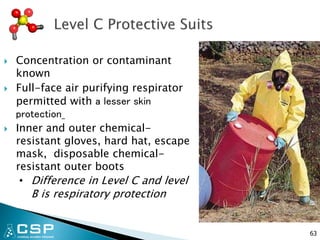
 Concentration or contaminant
known
 Full-face air purifying respirator
permitted with a lesser skin
protection
 Inner and outer chemical-
resistant gloves, hard hat, escape
mask, disposable chemical-
resistant outer boots
• Difference in Level C and level
B is respiratory protection
63
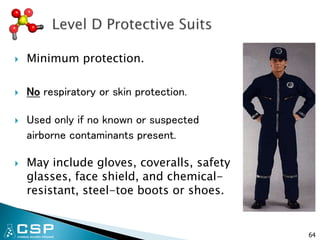
 Minimum protection.
 No respiratory or skin protection.
 Used only if no known or suspected
airborne contaminants present.
 May include gloves, coveralls, safety
glasses, face shield, and chemical-
resistant, steel-toe boots or shoes.
64
Should meet or exceed ANSI Standard.
Types:
 Impact, penetration, compression, steel toe, etc.
 Non-skid, with slip resistant soles.
 Chemical resistant (rubber, vinyl, plastic, with synthetic
stitching to resist chemical penetration).
 Anti-static
 Temperature resistant (high or low extremes).
 Electrical protection (non-conducting).
 Water resistant
 Combination shoes
65
66
‣ Steel toe-safety shoes are not necessary for
laboratory work unless there is a serious risk
from transporting or handling heavy objects.
However,
open toe shoes
should NOT be worn in labs.
Should meet or exceed Z89.1-2003
Types:
 Bump caps - don’t meet ANSI standard, provide minor
protection
 Electrical protection 2200-22,000 v, depends on
class)
 Mining protection
 Classic-- high impact general purpose protection.
 Impact 850-1000 pounds (386 - 454Kg)
 Penetration 3/8” (~1cm)
67
68

5 ppe eng-1

  • 1.
    Sandia is amulti-program laboratory operated by Sandia Corporation, a Lockheed Martin Company, for the United States Department of Energy’s National Nuclear Security Administration under contract DE-AC04-94AL85000.
  • 2.
  • 3.
     Should bea last resort, but may be necessary if: • engineering controls inadequate or being installed • administrative controls don’t do the job • emergency response or spill cleanup • supplement other control techniques if can’t achieve required level  Depends upon human behavior • proper selection, fit and comfort issues  Hazard is still present with PPE … 3
  • 4.
     Eye andface protection • 29 CFR 1910.133  Respiratory protection • 29 CFR 1910.134  Head protection • 29 CFR 1910.135  Foot protection • 29 CFR 1910.136  Hand protection • 29 CFR 1910.138  Hearing Protection • 29 CFR 1910.95 www.osha.gov/Publications/osha3151.pdf www.osha.gov/SLTC/personalprotectiveequipment/index.html www.cdc.gov/nasd/menu/topic/ppe.html 4
  • 5.
    ‣ When PPEis necessary? ‣ What PPE is necessary? ‣ How to properly don, doff, adjust and wear PPE. ‣ Limitations of PPE. ‣ Proper care, storage, maintenance, useful life, and disposal of PPE. Employees should be trained to know: www.free-training.com/osha/ppe/ppemenu.htm 5
  • 6.
    ‣ Change inthe process. ‣ Change in type of PPE used. ‣ Inadequate employee knowledge or use of PPE. • retrain to reinforce understanding or skill Retraining is necessary when there is: 6
  • 7.
    Personal Protective Clothing(PPE) ‣ Evaluate task, select appropriate type and train to use it properly • lab coats, gowns, aprons • safety glasses (with side shields), goggles, face shields • gloves ‣ Remove PPE before leaving the lab 7
  • 8.
    Protective Equipment Works Anexperiment reacted unexpectedly and a flammable solvent from a hood splashed out and landed on the bottom of the lab coat “It's a hot day, why wear a lab coat?” 8
  • 9.
    ‣ Thousands areblinded each year from work-related eye injuries. ‣ Nearly three out of five workers are injured while failing to wear eye and face protection. 9
  • 10.
     Safety glasses Goggles  Face shield
  • 11.
     Primary protection: •Safety glasses with side shields protect from flying objects. • Goggles prevent objects from entering under or around the eyewear.  Secondary protection: • Face shields ◦ Combine with safety glasses or goggles ◦ Do not protect from impact hazards Eye protection shields eyes by: 11
  • 12.
    Hazard Type HazardType Common related tasks Impact Flying objects such as large chips, fragments, particles, sand, and dirt Chipping, grinding, machining, masonry work, wood working, sawing, drilling, riveting, sanding,… Heat Anything emitting extreme heat Furnace operations, pouring, casting, hot dipping, welding, … Chemicals Splash, fumes, vapors, and irritating mists Acid and chemical handling, degreasing, plating, and working with blood or OPIMs Dust Harmful dust Woodworking, buffing, and general dusty conditions Optical Radiation Radiant energy, glare, and intense light Welding, torch-cutting, brazing, soldering, and laser work
  • 13.
    Biohazards Contaminated blood orbodily fluids may result in transmission through the eyes. Use caution anytime you are working with blood or other bodily fluids. 13
  • 14.
    Eye and FaceProtection ‣Optical Hazards • Welding helmets are secondary protection to shield from UV, heat, and impact. • Exposure to laser beams requires suitable laser safety goggles with protection for the specific wavelength. 14
  • 15.
     Eye andface protection should comply with the American National Standards Institute: • ANSI Z87.1-1989  Ensure employees who wear prescription lenses or contact lenses: • Use safety eyewear that incorporates the prescription • Use eye protection that can be worn over prescription lenses 15
  • 16.
    ‣ Provide adequateprotection against the specific hazards. ‣ Safe design and construction for the work to be performed. ‣ Comfortable. ‣ Don’t interfere with the wearer’s movements. ‣ Durable! ‣ Capable of being disinfected. ‣ Easily cleaned. ‣ Distinctly marked to indicate they are approved eye protection. ‣ Worker satisfaction.  Include workers in the selection process. 16
  • 17.
     US regulations •29 CFR 1910.151(c) • ANSI Z358.1-2004  Types • eyewash • shower • drench hose  Concerns • drainage • freezing • contaminated water 17
  • 18.
    Eyewash and Showers ‣Know their locations ‣ Maintenance and testing program ‣ Concerns: • drainage • freezing • contaminated water 18
  • 19.
    ‣ Eye washstations  Minimum 0.4 to 3.5 gal/min (1.4 – 13.2 l/min.)  Flush for 15 minutes ‣ Provide flow for both eyes  Hold eyes open  Tepid, pH match eye (preferred) ‣ Easily accessible locations  33 to 45 in. (84-114 cm) from floor  6 in. (15cm) from wall ‣ Test weekly  Portable: clean/refill (6 mo – 2 yrs) ‣ Various types ANSI Z358.1 NC DOL Guide: www.nclabor.com/osha/etta/indguide/ig2 8.pdf 19
  • 20.
     Within 55ft. (17 m) or 10 seconds • Normal walking = 3.8 mph (6.1 km/hr)  Test monthly  Pull within reach (highly visible) • 82 to 96 in. high (208 – 244 cm) • Deliver 20 in (51 cm) column • Height: 60” (152 cm) above floor  20–30 gal/min (76-114 L/min)  Tepid: 60 to 100 °F (16 – 38oC) 20
  • 21.
    Safety Shower Standardscont. ‣ Consider: • Drains • Blankets/modesty curtains Avoid or protect electrical outlets • ANSI Z358.1-2004
  • 22.
  • 25.
    ‣ Glove considerations •Type glove ◦ Dexterity required ◦ Chemical & physical - material - strength ◦ Exposure time - breakthrough time ◦ Size, comfort, reusable/disposable • Manufacturer selection charts 25
  • 26.
     Considerations: • Chemicals(splashes vs immersion) • Thermal (extreme heat/cold) • Abrasion; cuts; snags; splinters; punctures • Grip: oily, wet, dry • Comfort, fit, size • Ergonomics 26
  • 27.
     Permeation (“silentkiller”) • Substances pass through intact material on a molecular level.  Penetration • Substances pass through seams, zippers, stitches, pinholes, or damaged material.  Degradation • Substance damages material making it less resist or resulting in physical breakdown.  Contamination • Substances transferred inside material (improper doffing or decontamination). 27
  • 28.
    Permeation Rate (PR) Permeation Breakthrough (PB) PermeationDegradation rate (DR) E- Excellent; permeation rate of less than 0.9 mg/cm2/min >Greater than (time - minutes) E - Excellent; fluid has very little degrading effect. VG - Very Good; permeation rate of less than 9 mg/cm2/min < Less than (time - minutes) G - Good; fluid has minor degrading effect. G - Good; permeation rate of less than 90 mg/cm2/min F - Fair; fluid has moderate degrading effect. F - Fair; permeation rate of less than 900 mg/cm2/min P - Poor; fluid has pronounced degrading effect. P - Poor; permeation rate of less than 9000 mg/cm2/min NR - Fluid is not recommended with this material. NR - Not recommended; permeation rate greater than 9000 mg/cm2/min † Not tested, but breakthrough time > 480 min DR expected to be Good to Excellent †† Not tested, but expected to be Good to Excellent based on similar tested materials
  • 29.
    Gloves ‣ It’s importantto have the right glove for the job and know how long it will last. ‣ Glove Chart Examples: • Consider several glove manufactures data before final selection. • www.bestglove.com/site/chemrest/ 29
  • 30.
  • 31.
    ‣ Polyethylene/Ethylene-vinyl Alcohol{“Silver Shield®”} • Resists permeation and breakthrough with chemicals. • Uses: aromatics, esters, ketones, and chlorines. ‣ Butyl • Highest permeation resistance to gas or water vapors. • Uses: ketones (MEK, acetone) and esters (amyl acetate, ethyl acetate). 31
  • 32.
    ‣ Viton® • Highlyresistant to permeation by chlorinated and aromatic solvents • Can be used with water/water based solvents ‣ Nitrile (acrylonitrile-butadiene rubber) • Good replacement for latex • Protects against acids, bases, oils, aliphatic hydrocarbon solvents and esters, grease, fats • Resists cuts, snags, punctures and abrasions 32
  • 33.
    ‣ Neoprene • Protectsagainst acids, caustics, DMSO. • Resists amines, alcohols, glycols. • Limited use for aldehydes and ketones. ‣ Poly vinyl chloride (PVC) • Protects against acids, caustics. • Resists alcohols, glycols. • Not useful for aromatics, aldehydes and ketones. 33
  • 34.
     Natural rubberlatex is from the rubber tree Hevea brasiliensis.  The major route of occupational exposure is absorption of latex protein through the skin.  Allergens in or on gloves can be transferred to the person’s tissue. 34
  • 35.
     Symptoms mayoccur within minutes of exposure or may take several hours depending on the individual. • Skin Redness • Hives • Itching • Respiratory Symptoms ◦ Runny Nose ◦ Itchy Eyes ◦ Scratchy Throat ◦ Asthma 35
  • 36.
  • 37.
     To preventlatex allergies consider: • Using non-latex gloves. • If you choose latex gloves, use the powder-free version. • When using gloves, do not use oil-based hand cream or lotions (these cause glove deterioration). • Recognize the symptoms of latex allergy. • Always wash hands after removing gloves. http://www.cdc.gov/niosh/topics/latex/ http://www.nursingworld.org/osh/latex.htm 37
  • 38.
    Proper Steps forRemoving Gloves 1 2 3 4 5 6 38
  • 39.
    Respiratory Protection Program •Written program • Administered by Safety Office • Medical clearance ◦ Respiratory Protection Questionnaire ◦ No beards • Fit testing • Respirator selection ◦ Air monitoring • Training (annual refresher) 39
  • 40.
     29 CFR1910.134 • OSHA Respiratory Protection Standard • New OSHA Assigned Protection Factors  ANSI Z88.2–1992 • ANSI Voluntary Consensus Standard Conduct an Exposure Assessment: www.osha.gov/SLTC/etools/respiratory/haz_expose/haz_expose.html 40
  • 41.
     Air purifying(APR) • Half Face • Full Face • PAPR  Air supply • Air line • SCBA 41
  • 42.
     Must haveat least 19.5% oxygen. • Never use in O2 deficient atmospheres  Only filters the air. • Particulate filters ◦ Removes aerosols • Chemical cartridges or canisters ◦ Remove gases and vapors  Concentrations must not exceed limitations of filter/cartridge.  PAPR (Powered Air Purifying Respirator) • Uses a blower to force air through an air purifying element 42
  • 43.
     Specific gasesor vapors  NIOSH or MSHA approval  Adequate warning properties  End of service life  Mechanisms • adsorption • absorption • chemical reaction  Breakthrough times  Proper maintenance and storage 43
  • 44.
    Cartridge Description Organic Vapor OrganicVapor and acid gases Ammonia, methylamine and P100 any particulates filter 99.97% minimum filter efficiency 44
  • 45.
    There are veryfew NIOSH-approved ESLI’s: • ammonia • carbon monoxide • ethylene oxide • hydrogen chloride • hydrogen fluoride • hydrogen sulfide • mercury • sulfur dioxide • toluene-2,4-diisocyanate • vinyl chloride 45
  • 46.
     Level ofworkplace respiratory protection that a respirator or class of respirators is expected to provide.  Each specific type of respirator has an Assigned Protection Factor (APF).  Select respirator based on the exposure limit of a contaminant and the level in the workplace. Maximum Use Concentration (MUC) = APF x Occupational Exposure Limit (e.g.OEL, TLV) 46
  • 47.
    Type of RespiratorHalf Face Mask Full Facepiece Helmet/ Hood Loose-Fitting Facepiece Air-Purifying 10 50 - - PAPR 50 1,000 25/1,000 25 Supplied-Air or Airline – Demand – Continuous flow – Pressure demand 10 50 50 50 1,000 1,000 - 25/1000 - - 25 - SCBA – Demand – Pressure Demand 10 - 50 10,000 50 10,000 - - 47
  • 48.
    Workplace air samplingindicates the exposure to benzene is 30 ppm. OEL is 1 ppm. What respirator should you choose? Maximum Use Concentration (MUC) = OEL x APF Half Face Mask: MUC = 1 ppm x 10 = 10 ppm PAPR (LFF): MUC = 1 ppm x 25 = 25 ppm Full Face Respirator: MUC = 1 ppm x 50 = 50 ppm 48
  • 49.
  • 50.
  • 51.
     Qualitative • Irritantsmoke (stannic chloride) • Isoamyl acetate (banana oil) • Saccharin • Bitrex (bitter taste) • Employees should perform a user seal check each time they put on a tight-fitting respirator  Quantitative • Portacount 51
  • 52.
    ‣ Pass/Fail FitTest • Assess the adequacy of respirator fit • Relies on the individual’s response to a test agent 52
  • 53.
    Positive / Negativepressure fit test 53
  • 54.
     Supplies breathingair to employee  Examples: • SCBA • Airline  Grade D Air  Limitations 54
  • 55.
     Compressed breathingair must be at least Type 1 - Grade D [ANSI/CGA G-7.1-1989]: • Oxygen content = 19.5 - 23.5% • Hydrocarbon (condensed) = 5 mg/m3 or less • CO  10 ppm or less • CO2 of 1,000 ppm or less • Lack of noticeable odor  Compressors equipped with in-line air- purifying sorbent beds and filters. 55
  • 56.
     Non-oil lubricatedcompressors • CO levels in the breathing air  10 ppm  Oil-lubricated compressors • High-temperature or CO alarm, or both • If only high-temperature alarm, the air supply must be monitored to prevent CO levels from exceeding 10 ppm 56
  • 57.
     Disposable filteringface-piece: • Dispose after use  Half-mask: • Write expiration date (current date +estimate) making sure to keep entire label legible • Discard cartridges based on expiration date, end- of-service life indicator or calculated service life • Clean • Dry • Place in sealable bag (write your name on bag) • Contact Safety Office for repairs 57
  • 58.
     Exclusive useof an employee: • Clean and disinfect as often as necessary to be maintained in a sanitary condition. • Discard cartridges based on expiration date, end-of- service life indicator or calculated service life.  Respirators issued to more than one employee or maintained for emergency use: • Clean and disinfect before worn by different individuals or after each use.  Respirators used in fit testing and training: • Clean and disinfect after each use  All respirators must be stored in clean, dry bags 58
  • 59.
     Hazardous chemicals. Potentially infectious materials.  Intense heat.  Splashes of hot metals and hot liquids. 59
  • 60.
    Full suits: • ClassA • Class B • Class C • Class D 60
  • 61.
    Potential exposure tounknown: • Greatest level of skin, respiratory, and eye protection. • Positive-pressure, full face- piece Self Contained Breathing Apparatus (SCBA) or positive pressure supplied air respirator with escape SCBA. • Totally encapsulated (air- tight) chemical and vapor protective suit. • Inner and outer chemical- resistant gloves, and boots. 61
  • 62.
     Atmospheric vaporsor gas levels not sufficient to warrant level A protection.  Highest level of respiratory protection, with lesser level of skin protection. • Positive-pressure, full face-piece self contained breathing apparatus (SCBA) or positive pressure supplied air respirator with escape SCBA • Hooded chemical resistant clothing or coveralls (non-totally-encapsulating suit), inner and outer chemical- resistant gloves, and boots 62
  • 63.
     Concentration orcontaminant known  Full-face air purifying respirator permitted with a lesser skin protection  Inner and outer chemical- resistant gloves, hard hat, escape mask, disposable chemical- resistant outer boots • Difference in Level C and level B is respiratory protection 63
  • 64.
     Minimum protection. No respiratory or skin protection.  Used only if no known or suspected airborne contaminants present.  May include gloves, coveralls, safety glasses, face shield, and chemical- resistant, steel-toe boots or shoes. 64
  • 65.
    Should meet orexceed ANSI Standard. Types:  Impact, penetration, compression, steel toe, etc.  Non-skid, with slip resistant soles.  Chemical resistant (rubber, vinyl, plastic, with synthetic stitching to resist chemical penetration).  Anti-static  Temperature resistant (high or low extremes).  Electrical protection (non-conducting).  Water resistant  Combination shoes 65
  • 66.
    66 ‣ Steel toe-safetyshoes are not necessary for laboratory work unless there is a serious risk from transporting or handling heavy objects. However, open toe shoes should NOT be worn in labs.
  • 67.
    Should meet orexceed Z89.1-2003 Types:  Bump caps - don’t meet ANSI standard, provide minor protection  Electrical protection 2200-22,000 v, depends on class)  Mining protection  Classic-- high impact general purpose protection.  Impact 850-1000 pounds (386 - 454Kg)  Penetration 3/8” (~1cm) 67
  • 68.