
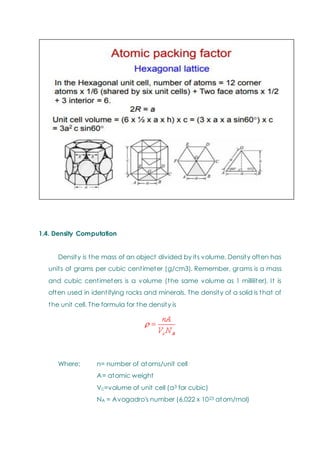





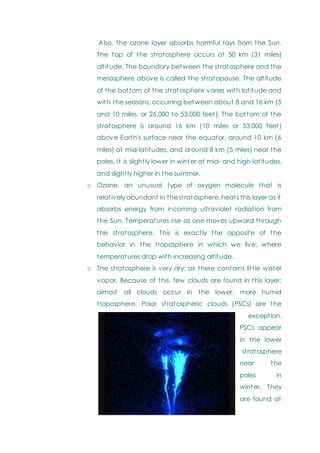
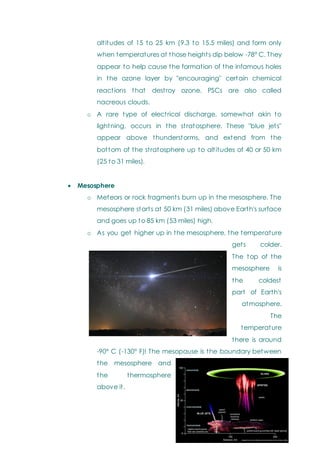
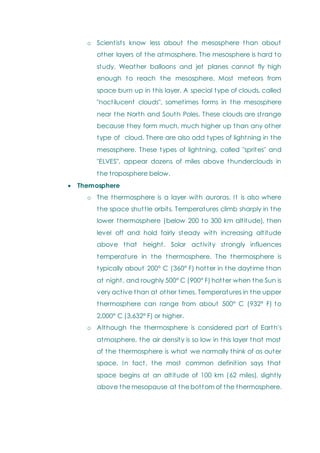
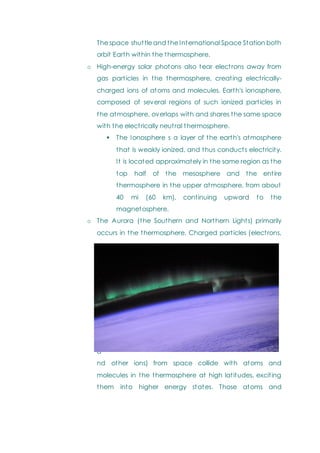


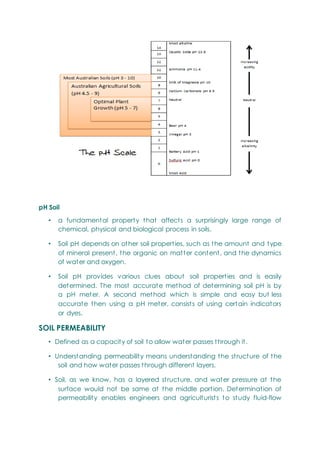
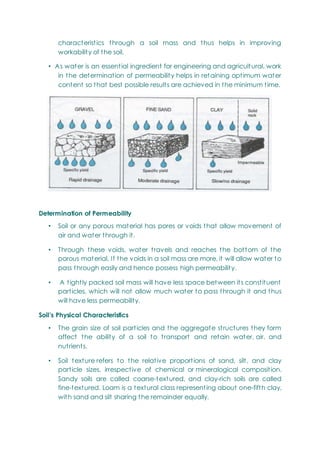
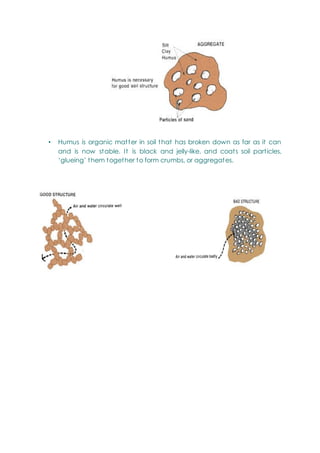
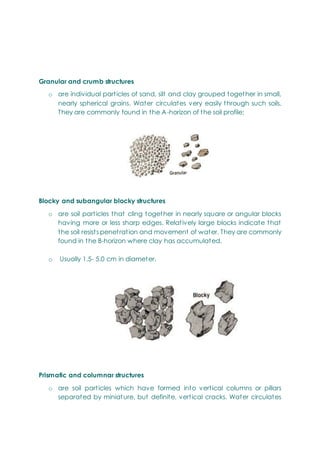
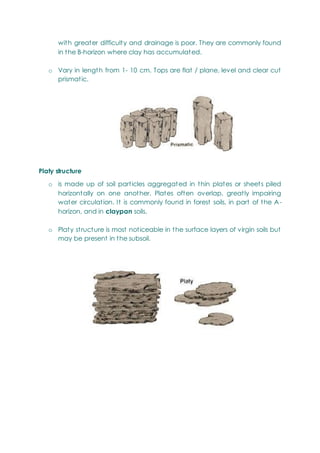

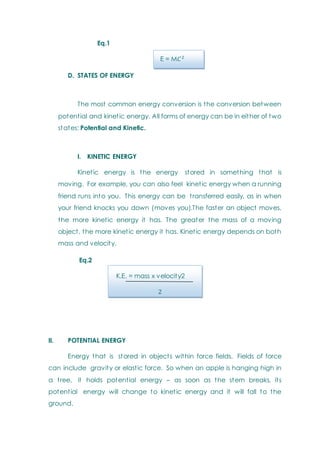
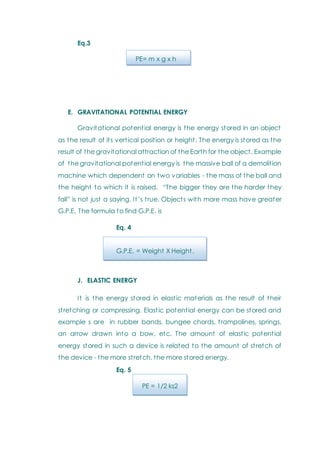
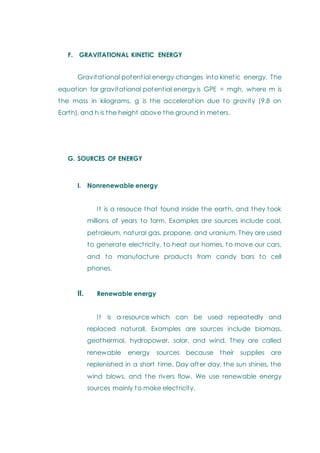
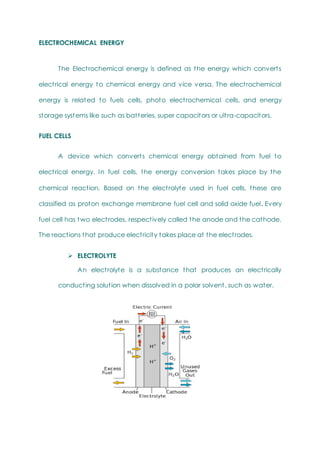
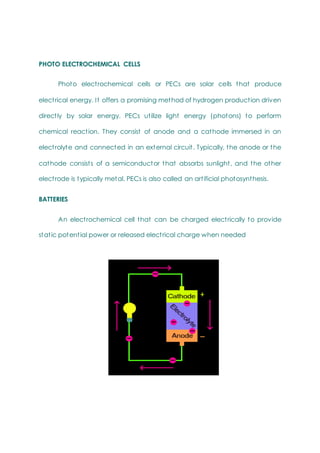
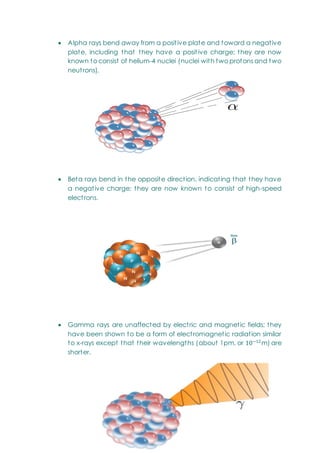
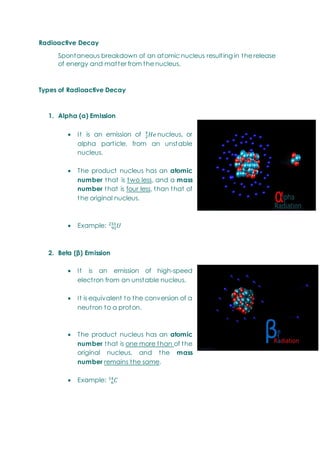
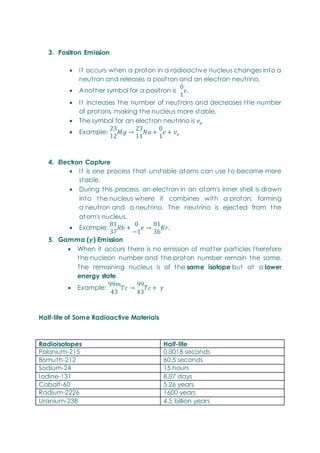
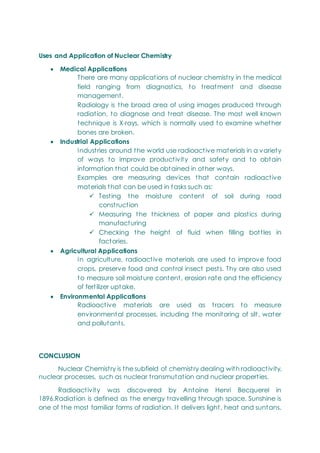

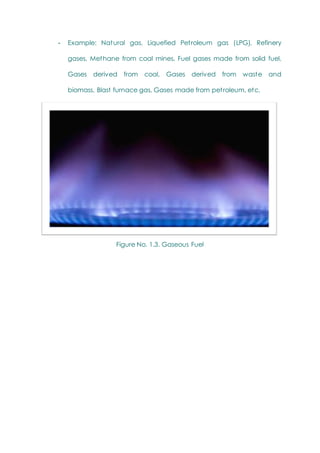



Cover
CHEMISTRY
FOR THE
ENGINEERS
BCHE 111 (2853) : BE 221 : CEE - BSCE
TABLE OF CONTENTS
THE CHEMISTRY OF ENGINEERING MATERIALS
o Basic Concepts of Crystal Structure
o Metals
o Polymers
o Engineered Nano-materials
THE CHEMISTRY OF THE ENVIRONMENT
o The Chemistry of the Environment
o The Chemistry of Water
o Soil Chemistry
ENERGY
o Electrochemical Energy
o Nuclear Chemistry
o Fuels
INTRODUCTION TO CHEMICAL SAFETY
REFERENCES
Cover
(The Chemistry of Engineering Materials)
THE CHEMISTRY OF
ENGINEERING
MATERIALS
The Chemistry of Engineering Materials
Engineering materials are materials that are used as raw materials for
any sort of construction or manufacturing in an organized way of engineering
application. Engineering material is part of inanimate matter, which is useful
to engineering to produce products according to the needs and demand of
the society.
Almost every substance known to man has found its way into
engineering workshop at some time or other. The easiest way to explain this is
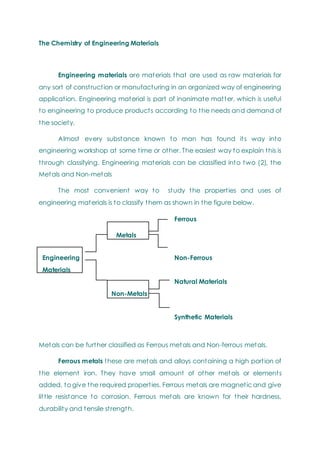
through classifying. Engineering materials can be classified into two (2), the
Metals and Non-metals
The most convenient way to study the properties and uses of
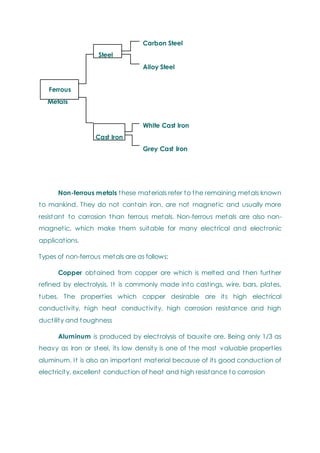
engineering materials is to classify them as shown in the figure below.
Ferrous
Metals
Engineering Non-Ferrous
Materials
Natural Materials
Non-Metals
Synthetic Materials
Metals can be further classified as Ferrous metals and Non-ferrous metals.
Ferrous metals these are metals and alloys containing a high portion of
the element iron. They have small amount of other metals or elements
added, to give the required properties. Ferrous metals are magnetic and give
little resistance to corrosion. Ferrous metals are known for their hardness,
durability and tensile strength.
Types of ferrous metals are as follows:
Steel is an alloy of carbon and iron which constitute carbon up to 2.1%.
Pure iron is a soft metal and as the carbon content in it increases, the metal
becomes harder and tougher. Steels are divided into plain Carbon and Alloy
steels.
Carbon steels are grouped according to their carbon content from
low, medium and high carbon. Hardness, strength and often brittleness
increase with increasing carbon content. Impurities such as phosphorus or
sulfur will lower the ductility and malleability qualities of steel.
Alloy steel is steel that is alloyed with a variety if elements between 1%
and 50% by weight to alter its mechanical properties. The main advantages
of alloy steels are the ability to respond to heat treatment, improved
corrosion resistance, improved properties at high and low temperatures and
combination with high strength with good ductility.
Cast iron consists of more than 2% carbon. The high carbon content
makes them excellent materials to use for casting and at much lower
temperatures than those required to cast steel. Cast iron is brittle and easily
break through hammer.
White cast iron is produced if most of the carbon is combined
chemically with the iron, performed by rapidly cooling it within molds. It is very
hard and brittle, and used for machinery parts which are subjected to
excessive wear, such as crusher jaws and grinding mill balls and liners.
Grey cast iron the molten iron is cooled slowly, it causes the carbon to
disassociate from the iron and form into graphite. Grey cast iron is softer, with
good compressive strength, and is widely used for machinery bases and
supports.
Carbon Steel
Steel
Alloy Steel
Ferrous
Metals
White Cast Iron
Cast Iron
Grey Cast Iron
Non-ferrous metals these materials refer to the remaining metals known
to mankind. They do not contain iron, are not magnetic and usually more
resistant to corrosion than ferrous metals. Non-ferrous metals are also non-
magnetic, which make them suitable for many electrical and electronic
applications.
Types of non-ferrous metals are as follows:
Copper obtained from copper ore which is melted and then further
refined by electrolysis. It is commonly made into castings, wire, bars, plates,
tubes. The properties which copper desirable are its high electrical
conductivity, high heat conductivity, high corrosion resistance and high
ductility and toughness
Aluminum is produced by electrolysis of bauxite ore. Being only 1/3 as
heavy as iron or steel, its low density is one of the most valuable properties
aluminum. It is also an important material because of its good conduction of
electricity, excellent conduction of heat and high resistance to corrosion
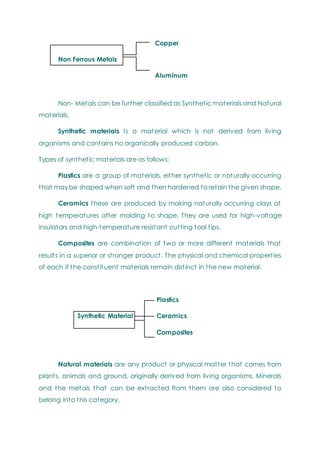
Copper
Non Ferrous Metals
Aluminum
Non- Metals can be further classified as Synthetic materials and Natural
materials.
Synthetic materials Is a material which is not derived from living
organisms and contains no organically produced carbon.
Types of synthetic materials are as follows:
Plastics are a group of materials, either synthetic or naturally occurring
that may be shaped when soft and then hardened to retain the given shape.
Ceramics these are produced by making naturally occurring clays at
high temperatures after molding to shape. They are used for high-voltage
insulators and high-temperature resistant cutting tool tips.
Composites are combination of two or more different materials that
results in a superior or stronger product. The physical and chemical properties
of each if the constituent materials remain distinct in the new material.
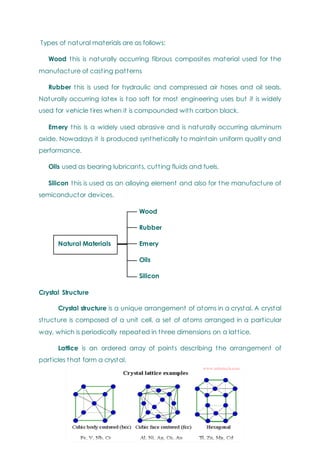
Plastics
Synthetic Material Ceramics
Composites
Natural materials are any product or physical matter that comes from
plants, animals and ground, originally derived from living organisms. Minerals
and the metals that can be extracted from them are also considered to
belong into this category.
Types of natural materials are as follows:
Wood this is naturally occurring fibrous composites material used for the
manufacture of casting patterns
Rubber this is used for hydraulic and compressed air hoses and oil seals.
Naturally occurring latex is too soft for most engineering uses but it is widely
used for vehicle tires when it is compounded with carbon black.
Emery this is a widely used abrasive and is naturally occurring aluminum
oxide. Nowadays it is produced synthetically to maintain uniform quality and
performance.
Oils used as bearing lubricants, cutting fluids and fuels.
Silicon this is used as an alloying element and also for the manufacture of
semiconductor devices.
Wood
Rubber
Natural Materials Emery
Oils
Silicon
Crystal Structure
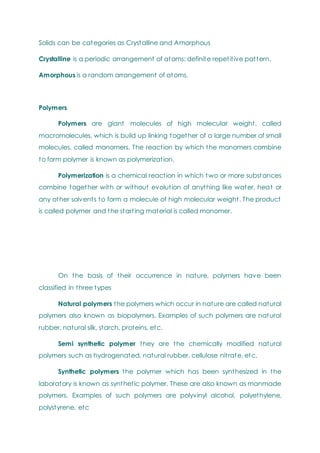
Crystal structure is a unique arrangement of atoms in a crystal. A crystal
structure is composed of a unit cell, a set of atoms arranged in a particular
way, which is periodically repeated in three dimensions on a lattice.
Lattice is an ordered array of points describing the arrangement of
particles that form a crystal.
Solids can be categories as Crystalline and Amorphous
Crystalline is a periodic arrangement of atoms; definite repetitive pattern.
Amorphous is a random arrangement of atoms.
Polymers
Polymers are giant molecules of high molecular weight, called
macromolecules, which is build up linking together of a large number of small
molecules, called monomers. The reaction by which the monomers combine
to form polymer is known as polymerization.
Polymerization is a chemical reaction in which two or more substances
combine together with or without evolution of anything like water, heat or
any other solvents to form a molecule of high molecular weight. The product
is called polymer and the starting material is called monomer.
On the basis of their occurrence in nature, polymers have been
classified in three types
Natural polymers the polymers which occur in nature are called natural
polymers also known as biopolymers. Examples of such polymers are natural
rubber, natural silk, starch, proteins, etc.
Semi synthetic polymer they are the chemically modified natural
polymers such as hydrogenated, natural rubber, cellulose nitrate, etc.
Synthetic polymers the polymer which has been synthesized in the
laboratory is known as synthetic polymer. These are also known as manmade
polymers. Examples of such polymers are polyvinyl alcohol, polyethylene,
polystyrene, etc
On the basis of thermal response, polymers can be classified into two
groups
Thermoplastic polymers they can be softened or plasticized repeatedly
on application of thermal energy, without much change in properties if
repeated with certain precautions. Examples of such polymers are nylons,
PVC, sealing wax, etc.
Thermosetting polymers soome polymers undergo certain chemical
changes on heating and convert themselves into an infusible mass. The
curing or setting process involves chemical reaction leading to further growth
and cross linking of the polymer chain molecules and producing giant
molecules. For example, diene rubbers, epoxy resins, etc.
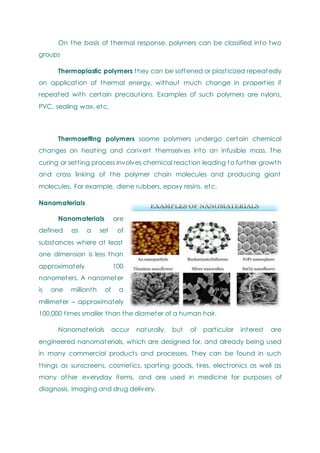
Nanomaterials
Nanomaterials are
defined as a set of
substances where at least
one dimension is less than
approximately 100
nanometers. A nanometer
is one millionth of a
millimeter – approximately
100,000 times smaller than the diameter of a human hair.
Nanomaterials occur naturally, but of particular interest are
engineered nanomaterials, which are designed for, and already being used
in many commercial products and processes. They can be found in such
things as sunscreens, cosmetics, sporting goods, tires, electronics as well as
many other everyday items, and are used in medicine for purposes of
diagnosis, imaging and drug delivery.
Cover
(Basic Concepts of Crystal Structures)
BASIC CONCEPTS
OF
CRYSTAL
STRUCTURES
Basic Concepts Of Crystal Structures
1.1 Fundamental Concepts
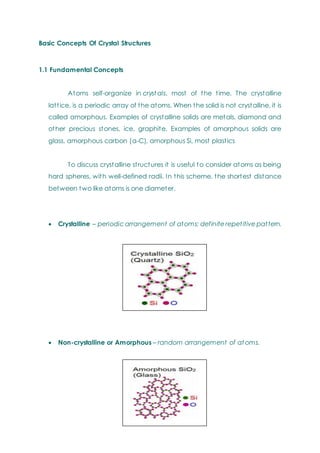
Atoms self-organize in cryst als, most of the time. The crystalline
lattice, is a periodic array of the atoms. When the solid is not crystalline, it is
called amorphous. Examples of crystalline solids are metals, diamond and
other precious stones, ice, graphite. Examples of amorphous solids are
glass, amorphous carbon (a-C), amorphous Si, most plastics
To discuss crystalline structures it is useful to consider atoms as being
hard spheres, with well-defined radii. In this scheme, the shortest distance
between two like atoms is one diameter.
 Crystalline – periodic arrangement of atoms: definite repetitive pattern.
 Non-crystalline or Amorphous – random arrangement of at oms.
1.2 Unit Cells
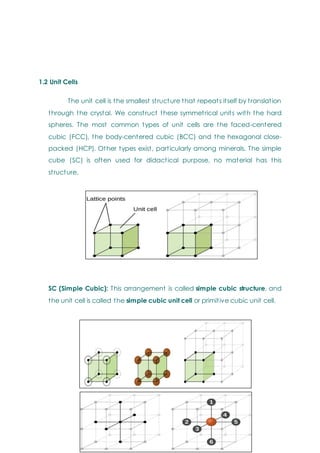
The unit cell is the smallest structure that repeats itself by translation
through the crystal. We construct these symmetrical units with the hard
spheres. The most common types of unit cells are the faced-centered
cubic (FCC), the body-centered cubic (BCC) and the hexagonal close-
packed (HCP). Other types exist, particularly among minerals. The simple
cube (SC) is often used for didactical purpose, no material has this
structure.
SC (Simple Cubic): This arrangement is called simple cubic structure, and
the unit cell is called the simple cubic unit cell or primitive cubic unit cell.
Coordination number of a Simple Cube.
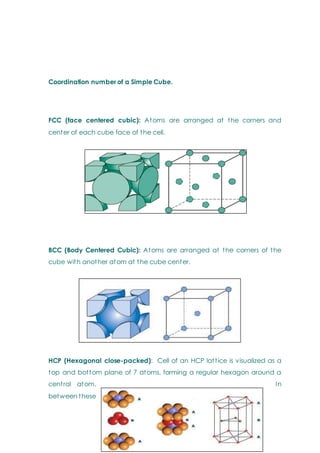
FCC (face centered cubic): Atoms are arranged at the corners and
center of each cube face of the cell.
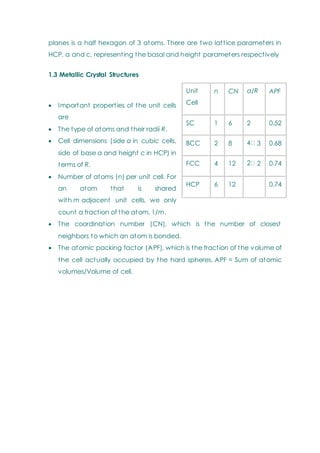
BCC (Body Centered Cubic): Atoms are arranged at the corners of the
cube with another atom at the cube center.
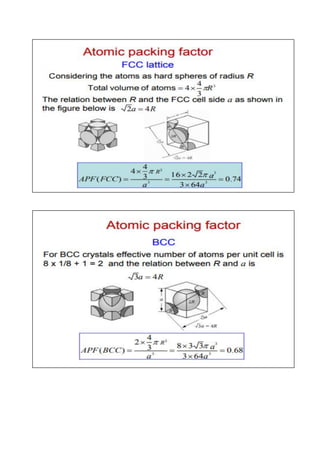
HCP (Hexagonal close-packed): Cell of an HCP lattice is visualized as a
top and bottom plane of 7 atoms, forming a regular hexagon around a
central atom. In
between these
planes is a half hexagon of 3 atoms. There are two lattice parameters in
HCP, a and c, representing the basal and height parameters respectively
1.3 Metallic Crystal Structures
 Important properties of the unit cells
are
 The type of atoms and their radii R.
 Cell dimensions (side a in cubic cells,
side of base a and height c in HCP) in
terms of R.
 Number of atoms (n) per unit cell. For
an atom that is shared
with m adjacent unit cells, we only
count a fraction of the atom, 1/m.
 The coordination number (CN), which is the number of closest
neighbors to which an atom is bonded.
 The atomic packing factor (APF), which is the fraction of the volume of
the cell actually occupied by the hard spheres. APF = Sum of atomic
volumes/Volume of cell.
Unit
Cell
n CN a/R APF
SC 1 6 2 0.52
BCC 2 8 3 0.68
FCC 4 12 2 0.74
HCP 6 12 0.74
 Atomic packing factor (APF) or packing efficiency indicates how
closely atoms are packed in a unit cell and is given by the ratio of
volume of atoms in the unit cell and volume of the unit cell. APF=
Volume of atoms/Volume of unit cell
1.4. Density Computation
Density is the mass of an object divided by its volume. Density often has
units of grams per cubic centimeter (g/cm3). Remember, grams is a mass
and cubic centimeters is a volume (the same volume as 1 milliliter). It is
often used in identifying rocks and minerals. The density of a solid is that of
the unit cell. The formula for the density is
Where: n= number of atoms/unit cell
A= atomic weight
Vc=volume of unit cell (a3 for cubic)
NA = Avogadro's number (6.022 x 10²³ atom/mol)
1.5. Polymorphism and Allotropy
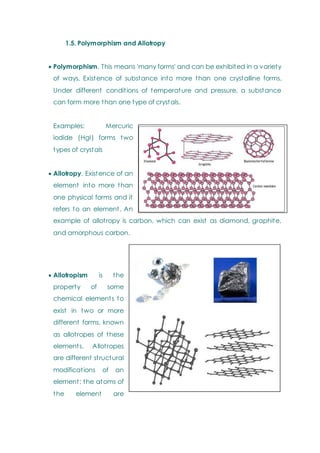
 Polymorphism. This means 'many forms' and can be exhibited in a variety
of ways. Existence of substance into more than one crystalline forms.
Under different conditions of temperature and pressure, a substance
can form more than one type of crystals.
Examples: Mercuric
iodide (HgI) forms two
types of crystals
 Allotropy. Existence of an
element into more than
one physical forms and it
refers to an element. An
example of allotropy is carbon, which can exist as diamond, graphite,
and amorphous carbon.
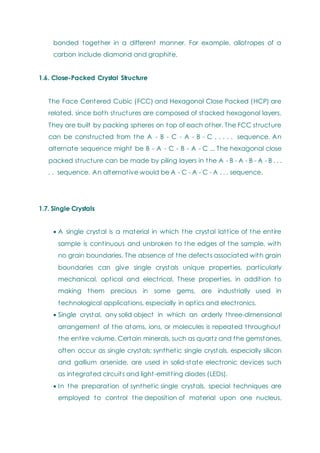
 Allotropism is the
property of some
chemical elements to
exist in two or more
different forms, known
as allotropes of these
elements. Allotropes
are different structural
modifications of an
element; the atoms of
the element are
bonded together in a different manner. For example, allotropes of a
carbon include diamond and graphite.
1.6. Close-Packed Crystal Structure
The Face Centered Cubic (FCC) and Hexagonal Close Packed (HCP) are
related, since both structures are composed of stacked hexagonal layers.
They are built by packing spheres on top of each other. The FCC structure
can be constructed from the A - B - C - A - B - C . . . . . sequence. An
alternate sequence might be B - A - C - B - A - C ... The hexagonal close
packed structure can be made by piling layers in the A - B - A - B - A - B . . .
. . sequence. An alternative would be A - C - A - C - A . . . sequence.
1.7. Single Crystals
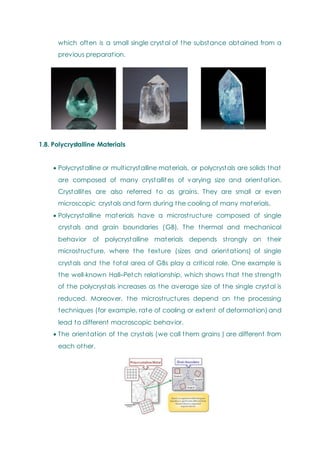
 A single crystal is a material in which the crystal lattice of the entire
sample is continuous and unbroken to the edges of the sample, with
no grain boundaries. The absence of the defects associated with grain
boundaries can give single crystals unique properties, particularly
mechanical, optical and electrical. These properties, in addition to
making them precious in some gems, are industrially used in
technological applications, especially in optics and electronics.
 Single crystal, any solid object in which an orderly three-dimensional
arrangement of the atoms, ions, or molecules is repeated throughout
the entire volume. Certain minerals, such as quartz and the gemstones,
often occur as single crystals; synthetic single crystals, especially silicon
and gallium arsenide, are used in solid-state electronic devices such
as integrated circuits and light-emitting diodes (LEDs).
 In the preparation of synthetic single crystals, special techniques are
employed to control the deposition of material upon one nucleus,
which often is a small single crystal of the substance obtained from a
previous preparation.
1.8. Polycrystalline Materials
 Polycrystalline or multicrystalline materials, or polycrystals are solids that
are composed of many crystallites of varying size and orientation.
Crystallites are also referred to as grains. They are small or even
microscopic crystals and form during the cooling of many materials.
 Polycrystalline materials have a microstructure composed of single
crystals and grain boundaries (GB). The thermal and mechanical
behavior of polycrystalline materials depends strongly on their
microstructure, where the texture (sizes and orientations) of single
crystals and the total area of GBs play a critical role. One example is
the well-known Hall–Petch relationship, which shows that the strength
of the polycrystals increases as the average size of the single crystal is
reduced. Moreover, the microstructures depend on the processing
techniques (for example, rate of cooling or extent of deformation) and
lead to different macroscopic behavior.
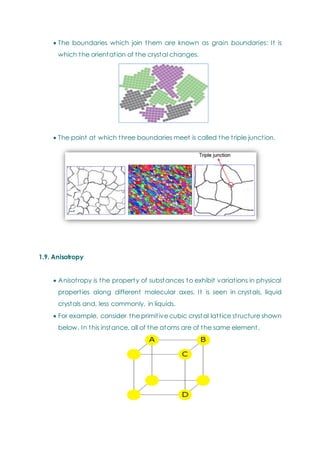
 The orientation of the crystals (we call them grains ) are different from
each other.
 The boundaries which join them are known as grain boundaries: It is
which the orientation of the crystal changes.
 The point at which three boundaries meet is called the triple junction.
1.9. Anisotropy
 Anisotropy is the property of substances to exhibit variations in physical
properties along different molecular axes. It is seen in crystals, liquid
crystals and, less commonly, in liquids.
 For example, consider the primitive cubic crystal lattice structure shown
below. In this instance, all of the atoms are of the same element.
 To recognize this structure's anisotropy, consider the distances A-B, A-C
and A-D; they are all different.
 Assuming that A-B distance is 1 unit, A-C is √2 units, and A-D is √3 units.
 Viewing the structure along an axis following the direction A-B looks
different from along an axis following the directions A-C or A-D. This
leads to different physical and mechanical properties in a single crystal
along the different axes.
Additional Information:
 Anisotropy is most easily observed in single crystals of solid elements
or compounds, in which atoms, ions, or molecules are arranged in
regular lattices. In contrast, the random distribution of particles in
liquids, and especially in gases, causes them rarely, if ever, to be
anisotropic.
 A familiar example of anisotropy is the difference in the speed of
light along different axes of crystals of the mineral calcite. Another
example is the electrical resistivity of selenium, which is high in one
direction but low in the other; when an alternating current is applied to
this material, it is transmitted in only one direction (rectified), thus
becoming a direct current.
1.10. Amorphous (Non-crystalline Solids) Materials
 These are solids with irregular geometrical shape due to random
distribution of particles in three dimensions.
 These are made up of randomly orientated atoms, ions, or molecules
that do not form defined patterns or lattice structures.
 Some common examples of non crystalline solids are coke, glass,
plastic, and rubber. The solid materials can be composed of ions,
molecules or metal ions which are held together with strong attractive
forces between them. The position of constituent particles of solids is
essentially fixed in space therefore they cannot change their position.
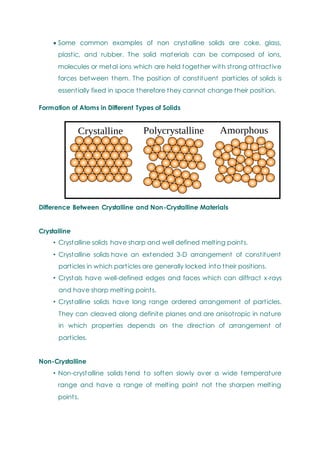
Formation of Atoms in Different Types of Solids
Difference Between Crystalline and Non-Crystalline Materials
Crystalline
• Crystalline solids have sharp and well defined melting points.
• Crystalline solids have an extended 3-D arrangement of constituent
particles in which particles are generally locked into their positions.
• Crystals have well-defined edges and faces which can diffract x-rays
and have sharp melting points.
• Crystalline solids have long range ordered arrangement of particles.
They can cleaved along definite planes and are anisotropic in nature
in which properties depends on the direction of arrangement of
particles.
Non-Crystalline
• Non-crystalline solids tend to soften slowly over a wide temperature
range and have a range of melting point not the sharpen melting
points.
• Non crystalline solids have irregular, curved surfaces which do not give
x-ray diffraction patterns.
• Non crystalline solids have short range order arrangement of particles
and can easily soften in a range of temperature. They undergo
irregular breakage and isotropic in nature in which properties do not
depend on the direction of arrangement of particles.
Cover
Metals
METALS
Metals
Characterized by metallic inter atomic bonding with valence shell
electrons forming a cloud of electrons around the atoms or ions. Are solid
chemical elements except hydrogen. Opaque, lustrous Elements that are
good conductors of Heat and Electricity. Most of it are malleable and
ductile. In general, metals are denser than the other elemental substances.
―Metals are a unique class of toxicants since they cannot be broken down to
on-toxic forms.‖
Metals are used in…
• Transportation;
• Aerospace;
• Computers and other devices that requires conductors;
• Construction;
• Biomedical Applications;
• Electrical power production and distribution;
• Farming and household conveniences.
TYPES OF METALS
1. Ferrous Metals
2. Non-Ferrous Metals
Ferrous Metals: Non-Ferrous Metals:
- Cast Iron - Stainless Steel - Aluminum - Beryllium
- Carbon Steel - Tool Steel - Copper - Magnesium
- Alloy Steel - HSLA Steel - Nickel - Tin
- - - Titanium - Zinc
Ferrous Metals:
Cast Iron
Defined as an iron alloy with more than 2% carbon as the main alloying
element. In addition to carbon, cast irons must also contain from 1% to 3%
silicon which combined with carbon. Has a much lower melting temperature
than steel and is more fluid and less reactive with molding materials.
However, they do not have enough ductility to be rolled or forged.
TYPES OF CAST IRON
• White Iron
• Gray Iron
• Ductile Iron
• Malleable Iron
White Cast Iron - Characterized by the prevalence of carbides, impacting,
high compressive strength; Hardness; Good resistance to wear
Gray Iron - Characterized with graphite in the microstructure, giving good
machinability and good resistance to wear and galling.
Ductile Iron- Gray iron with small amounts of magnesium and cesium which
modulates the graphite, resulting high strength and high ductility.
Malleable Iron - White cast iron heat-treated to improve higher ductility.
Carbon Steel
Is a malleable, iron-based metal containing less than 2 % carbon, small
amounts of manganese and other trace elements. Specified by chemical
composition, mechanical properties, method of deoxidation, or thermal
treatment.
Alloy Steel
Steels that contain specified amounts of alloying elements – other than
carbon and the commonly accepted amounts of manganese, copper,
silicon, sulfur, and phosphorus. Added to change mechanical or physical
properties. A steel is considered to be an alloy when the maximum of the
range given for the content of alloying elements exceeds one or more of
these limits: 1.65% Mn, 0.60% Si, or 0.60% Cu.
Stainless Steel
Generic name for a number of different steels used primarily for their
resistance to corrosion.
Commonly divided into Five Groups
1. Martensitic
2. Ferritic
3. Austenitic
4. Duplex
5. Precipitation-Hardening
Tool Steel
Defining properties include resistance to wear, stability during heat
treatment, strength at high temperature and toughness. Always heat treated.
Classified into several broad groups, some of which are further divided into
subgroups according to alloy composition, hardenability, or mechanical
similarities.
HSLA Steel
High-Strength Low Alloy have higher strength to weight ratio than
conventional low carbon steels. They can be used in thinner sections. Usually
low carbon steels with up to 1.5% manganese, strengthened by small
additions of elements, such as columbium, copper, vanadium or titanium.
Non- Ferrous Metals:
Aluminum - Silvery white metal with many desirable characteristics. It is light,
nontoxic, nonmagnetic and non-sparking. Easily formed, machined, and
cast. Also, soft and lacks strength but very useful properties. Abundant
element in the earth‘s crust, but is not found free in nature. Aluminum‘s
mechanical and physical properties, is an extremely convenient and widely
used metal.
Beryllium - Highest melting points of the light metals. It has excellent thermal
conductivity, is nonmagnetic and resists attack by concentrated nitric acid.
A very light weight metal with a high modulus of elasticity High specific heat
and high specific strength. Commonly use as: alloying agents in the
production of beryllium-copper, used in x-rays.
Copper - Provides diverse range of properties: good thermal and electrical
conductivity, corrosion resistance, ease of forming, ease of joining and color.
Relatively low strength to weight ratios and low strengths at elevated
temperatures. Has a disagreeable taste and peculiar smell. Commonly use
as: tube shapes, forgings, wires, castings, rod and plate.
Magnesium - Lightest structural metal. Has a high strength to weight ratio. Is
sensitive to stress concentration, however, notches sharp corners, and abrupt
section changes should be avoided. Easiest of the structural metals to
machine and they can be shaped and fabricated. Commonly use as:
metalworking processes and welding.
Nickel - Fits many applications that require specific corrosion resistance or
elevated temperature strength. Some are among the toughest structural
materials known. Have ultrahigh strength, high proportional limits, and high
moduli of elasticity. Commercially pure nickel has good electrical, magnetic,
and magneto strictive properties.
Tin - Characterized by a low melting point. The metal is nontoxic, solderable,
and has high boiling point. Also used in bronze, pewter and bearing alloys.
Principal uses for tin are a constituent of solder and as coating for steel.
Titanium - There are three structural types of titanium alloys:
1. Alpha Alloys – non heat treatable and are generally very weld-able; low to
medium strength, good notch toughness, reasonably good ductility.
2. Alpha-Beta Alloys – are heat treatable and most are weldable. Strength
levels medium to high.
3. Beta or near-beta Alloys – are readily heat treatable, generally weldable,
capable of high strengths and good creep resistance to intermediate
temperatures; have good combinations of properties in sheet , heavy
sections, fasteners and spring applications.
Iron - Relatively low melting point and boiling point. Zinc are after alloying
with small amounts of other metals or as a protective coating for steel. Is also
used to make brass, bronze, coil and activators and stabilizers for plastics.
Cover
(Polymers)
POLYMERS
Polymers
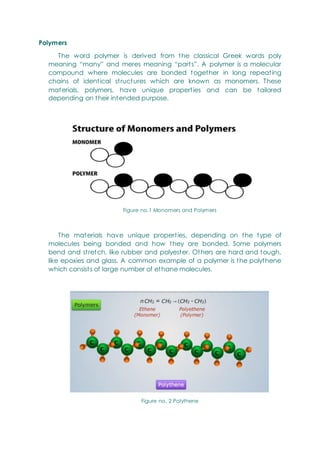
The word polymer is derived from the classical Greek words poly
meaning ―many‖ and meres meaning ―parts‖. A polymer is a molecular
compound where molecules are bonded together in long repeating
chains of identical structures which are known as monomers. These
materials, polymers, have unique properties and can be tailored
depending on their intended purpose.
Figure no.1 Monomers and Polymers
The materials have unique properties, depending on the type of
molecules being bonded and how they are bonded. Some polymers
bend and stretch, like rubber and polyester. Others are hard and tough,
like epoxies and glass. A common example of a polymer is the polythene
which consists of large number of ethane molecules.
Figure no. 2 Polythene
I. Polymerization
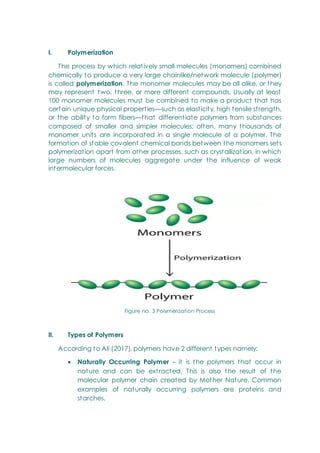
The process by which relatively small molecules (monomers) combined
chemically to produce a very large chainlike/network molecule (polymer)
is called polymerization. The monomer molecules may be all alike, or they
may represent two, three, or more different compounds. Usually at least
100 monomer molecules must be combined to make a product that has
certain unique physical properties—such as elasticity, high tensile strength,
or the ability to form fibers—that differentiate polymers from substances
composed of smaller and simpler molecules; often, many thousands of
monomer units are incorporated in a single molecule of a polymer. The
formation of stable covalent chemical bonds between the monomers sets
polymerization apart from other processes, such as crystallization, in which
large numbers of molecules aggregate under the influence of weak
intermolecular forces.
Figure no. 3 Polymerization Process
II. Types of Polymers
According to Ali (2017), polymers have 2 different types namely:
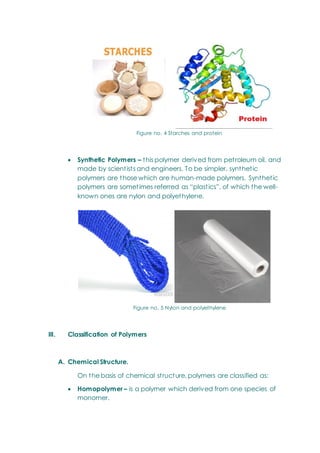
 Naturally Occurring Polymer – it is the polymers that occur in
nature and can be extracted. This is also the result of the
molecular polymer chain created by Mother Nature. Common
examples of naturally occurring polymers are proteins and
starches.
Figure no. 4 Starches and protein
 Synthetic Polymers – this polymer derived from petroleum oil, and
made by scientists and engineers. To be simpler, synthetic
polymers are those which are human-made polymers. Synthetic
polymers are sometimes referred as ―plastics‖, of which the well-
known ones are nylon and polyethylene.
Figure no. 5 Nylon and polyethylene
III. Classification of Polymers
A. Chemical Structure.
On the basis of chemical structure, polymers are classified as:
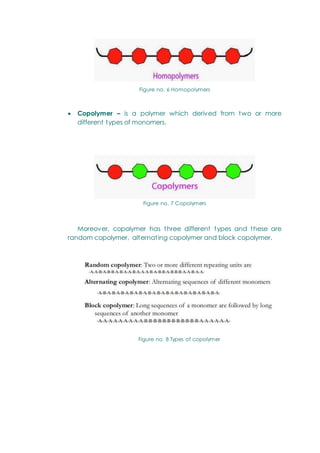
 Homopolymer – is a polymer which derived from one species of
monomer.
Figure no. 6 Homopolymers
 Copolymer – is a polymer which derived from two or more
different types of monomers.
Figure no. 7 Copolymers
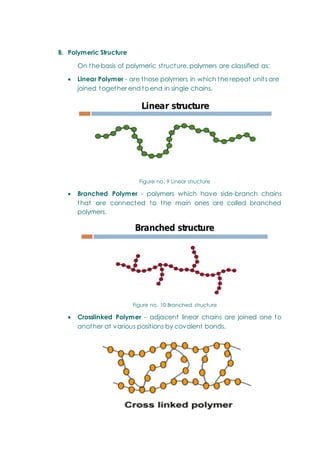
Moreover, copolymer has three different types and these are
random copolymer, alternating copolymer and block copolymer.
Figure no. 8 Types of copolymer
B. Polymeric Structure
On the basis of polymeric structure, polymers are classified as:
 Linear Polymer - are those polymers in which the repeat units are
joined together end to end in single chains.
Figure no. 9 Linear structure
 Branched Polymer - polymers which have side-branch chains
that are connected to the main ones are called branched
polymers.
Figure no. 10 Branched structure
 Crosslinked Polymer - adjacent linear chains are joined one to
another at various positions by covalent bonds.
Figure no. 11 Crosslinked Structure
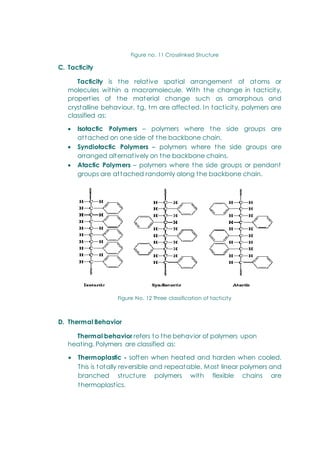
C. Tacticity
Tacticity is the relative spatial arrangement of atoms or
molecules within a macromolecule. With the change in tacticity,
properties of the material change such as amorphous and
crystalline behaviour, tg, tm are affected. In tacticity, polymers are
classified as:
 Isotactic Polymers – polymers where the side groups are
attached on one side of the backbone chain.
 Syndiotactic Polymers – polymers where the side groups are
arranged alternatively on the backbone chains.
 Atactic Polymers – polymers where the side groups or pendant
groups are attached randomly along the backbone chain.
Figure No. 12 Three classification of tacticity
D. Thermal Behavior
Thermal behavior refers to the behavior of polymers upon
heating. Polymers are classified as:
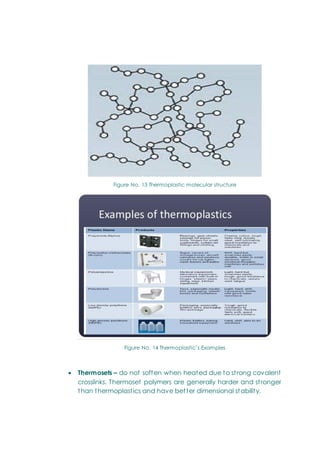
 Thermoplastic - soften when heated and harden when cooled.
This is totally reversible and repeatable. Most linear polymers and
branched structure polymers with flexible chains are
thermoplastics.
Figure No. 13 Thermoplastic molecular structure
Figure No. 14 Thermoplastic‘s Examples
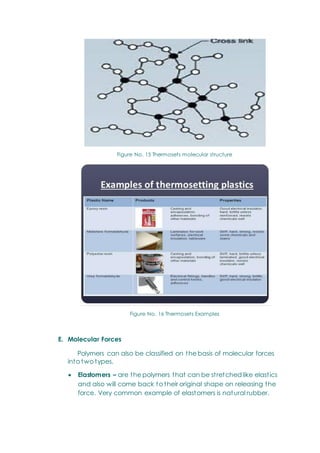
 Thermosets – do not soften when heated due to strong covalent
crosslinks. Thermoset polymers are generally harder and stronger
than thermoplastics and have better dimensional stability.
Figure No. 15 Thermosets molecular structure
Figure No. 16 Thermosets Examples
E. Molecular Forces
Polymers can also be classified on the basis of molecular forces
into two types.
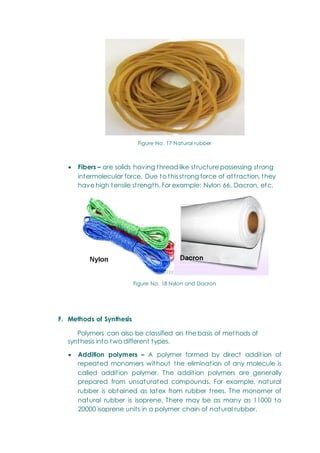
 Elastomers – are the polymers that can be stretched like elastics
and also will come back to their original shape on releasing the
force. Very common example of elastomers is natural rubber.
Figure No. 17 Natural rubber
 Fibers – are solids having thread like structure possessing strong
intermolecular force. Due to this strong force of attraction, they
have high tensile strength. For example: Nylon 66, Dacron, etc.
Figure No. 18 Nylon and Dacron
F. Methods of Synthesis
Polymers can also be classified on the basis of methods of
synthesis into two different types.
 Addition polymers – A polymer formed by direct addition of
repeated monomers without the elimination of any molecule is
called addition polymer. The addition polymers are generally
prepared from unsaturated compounds. For example, natural
rubber is obtained as latex from rubber trees. The monomer of
natural rubber is isoprene. There may be as many as 11000 to
20000 isoprene units in a polymer chain of natural rubber.
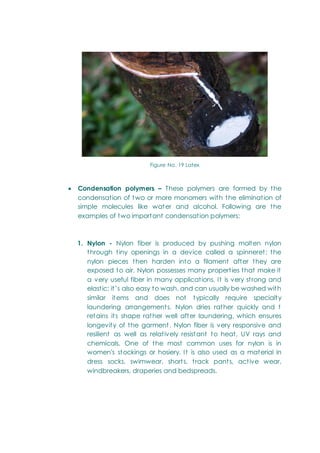
Figure No. 19 Latex
 Condensation polymers – These polymers are formed by the
condensation of two or more monomers with the elimination of
simple molecules like water and alcohol. Following are the
examples of two important condensation polymers:
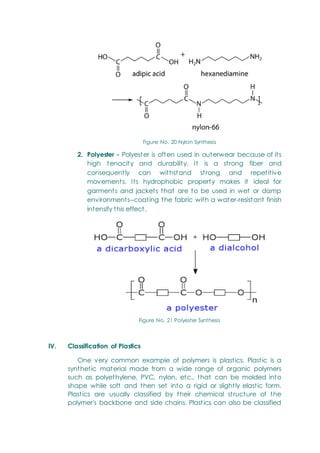
1. Nylon - Nylon fiber is produced by pushing molten nylon
through tiny openings in a device called a spinneret; the
nylon pieces then harden into a filament after they are
exposed to air. Nylon possesses many properties that make it
a very useful fiber in many applications. It is very strong and
elastic; it‘s also easy to wash, and can usually be washed with
similar items and does not typically require specialty
laundering arrangements. Nylon dries rather quickly and t
retains its shape rather well after laundering, which ensures
longevity of the garment. Nylon fiber is very responsive and
resilient as well as relatively resistant to heat, UV rays and
chemicals. One of the most common uses for nylon is in
women's stockings or hosiery. It is also used as a material in
dress socks, swimwear, shorts, track pants, active wear,
windbreakers, draperies and bedspreads.
Figure No. 20 Nylon Synthesis
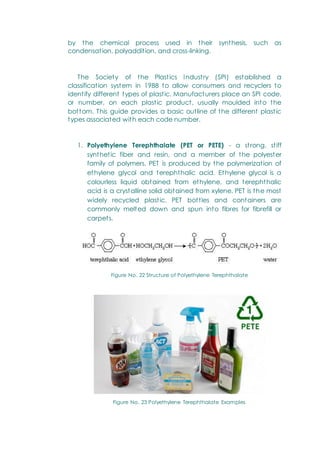
2. Polyester - Polyester is often used in outerwear because of its
high tenacity and durability. It is a strong fiber and
consequently can withstand strong and repetitive
movements. Its hydrophobic property makes it ideal for
garments and jackets that are to be used in wet or damp
environments--coating the fabric with a water-resistant finish
intensify this effect.
Figure No. 21 Polyester Synthesis
IV. Classification of Plastics
One very common example of polymers is plastics. Plastic is a
synthetic material made from a wide range of organic polymers
such as polyethylene, PVC, nylon, etc., that can be molded into
shape while soft and then set into a rigid or slightly elastic form.
Plastics are usually classified by their chemical structure of the
polymer's backbone and side chains. Plastics can also be classified
by the chemical process used in their synthesis, such as
condensation, polyaddition, and cross-linking.
The Society of the Plastics Industry (SPI) established a
classification system in 1988 to allow consumers and recyclers to
identify different types of plastic. Manufacturers place an SPI code,
or number, on each plastic product, usually moulded into the
bottom. This guide provides a basic outline of the different plastic
types associated with each code number.
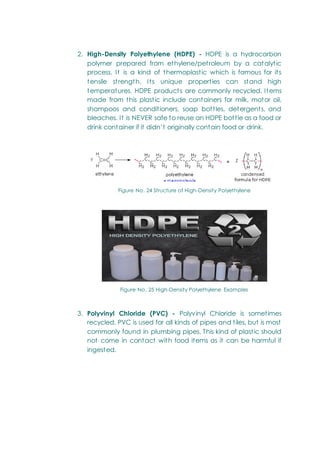
1. Polyethylene Terephthalate (PET or PETE) - a strong, stiff
synthetic fiber and resin, and a member of the polyester
family of polymers. PET is produced by the polymerization of
ethylene glycol and terephthalic acid. Ethylene glycol is a
colourless liquid obtained from ethylene, and terephthalic
acid is a crystalline solid obtained from xylene. PET is the most
widely recycled plastic. PET bottles and containers are
commonly melted down and spun into fibres for fibrefill or
carpets.
Figure No. 22 Structure of Polyethylene Terephthalate
Figure No. 23 Polyethylene Terephthalate Examples
2. High-Density Polyethylene (HDPE) - HDPE is a hydrocarbon
polymer prepared from ethylene/petroleum by a catalytic
process. It is a kind of thermoplastic which is famous for its
tensile strength. Its unique properties can stand high
temperatures. HDPE products are commonly recycled. Items
made from this plastic include containers for milk, motor oil,
shampoos and conditioners, soap bottles, detergents, and
bleaches. It is NEVER safe to reuse an HDPE bottle as a food or
drink container if it didn‘t originally contain food or drink.
Figure No. 24 Structure of High-Density Polyethylene
Figure No. 25 High-Density Polyethylene Examples
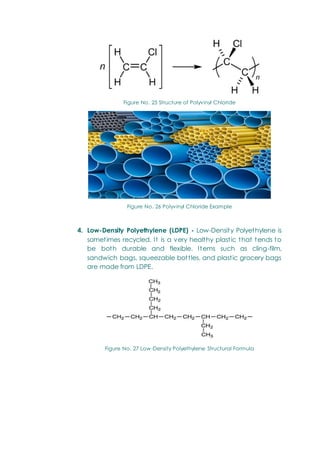
3. Polyvinyl Chloride (PVC) - Polyvinyl Chloride is sometimes
recycled. PVC is used for all kinds of pipes and tiles, but is most
commonly found in plumbing pipes. This kind of plastic should
not come in contact with food items as it can be harmful if
ingested.
Figure No. 25 Structure of Polyvinyl Chloride
Figure No. 26 Polyvinyl Chloride Example
4. Low-Density Polyethylene (LDPE) - Low-Density Polyethylene is
sometimes recycled. It is a very healthy plastic that tends to
be both durable and flexible. Items such as cling-film,
sandwich bags, squeezable bottles, and plastic grocery bags
are made from LDPE.
Figure No. 27 Low-Density Polyethylene Structural Formula
Figure No. 28 Low-Density Polyethylene Example
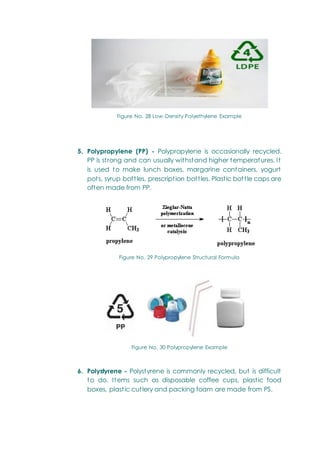
5. Polypropylene (PP) - Polypropylene is occasionally recycled.
PP is strong and can usually withstand higher temperatures. It
is used to make lunch boxes, margarine containers, yogurt
pots, syrup bottles, prescription bottles. Plastic bottle caps are
often made from PP.
Figure No. 29 Polypropylene Structural Formula
Figure No. 30 Polypropylene Example
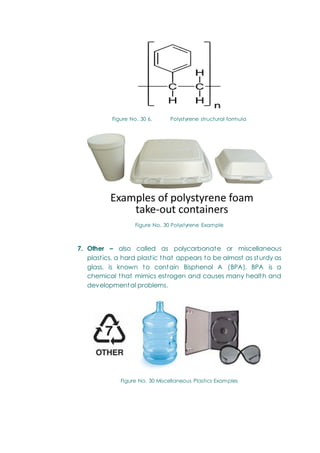
6. Polystyrene - Polystyrene is commonly recycled, but is difficult
to do. Items such as disposable coffee cups, plastic food
boxes, plastic cutlery and packing foam are made from PS.
Figure No. 30 6. Polystyrene structural formula
Figure No. 30 Polystyrene Example
7. Other – also called as polycarbonate or miscellaneous
plastics, a hard plastic that appears to be almost as sturdy as
glass, is known to contain Bisphenol A (BPA). BPA is a
chemical that mimics estrogen and causes many health and
developmental problems.
Figure No. 30 Miscellaneous Plastics Examples
Devices
(Engineered Nano Materials)
Engineered
Nano
Materials
INTRODUCTION
The rapid development of engineered nanomaterials (ENMs) has
grown dramatically in the last decade, with increased use in consumer
products, industrial materials, and nanomedicines. Engineered nanomaterials
are found in many products we use every day. Because of their size, they
have interesting properties in many applications. For example, they are used
in electrical appliances, medicines, cleaning products, cosmetics (such as a
component of some sunscreens), paints and building materials, textiles (for
example mainly to get an antibacterial effect), pollution control applications.
Globally, the ENMs are now becoming a significant fraction of the
material flows in the economy. We are already reaping the benefits of
improved energy efficiency, material use reduction, and better performance
in many existing and new applications that have been enabled by these
technological advances (Keller et. al., 2013).
In the Asia-Pacific Region like Thailand, China, India, Korea, Japan,
Australia, and many other countries, the commercialization of products
containing engineered nanomaterials have widely increased (Azoulay et. al.,
2013). The use of engineered nanomaterials has been a huge contribution in
our daily lives.
Though ENMs have been invented and developed still, many do not
know and are unfamiliar the about this nanomaterials and nanoparticles.
Knowing these terms as well as their deeper meaning and functions can
improve our knowledge in science and technology and might push us to
discover new things. To widen our knowledge about such topic, the
Engineered Nanomaterials, Two Main Sources of Nanomaterials, Properties of
Nanomaterials, Examples of Engineered Nanomaterials and the Application
of Engineered Nanomaterials are discussed on the next pages.
ENGINEERED NANOMATERIALS
Engineered nanomaterials are intentionally produced and designed with
physico-chemical properties for specific purpose or function. They are
produced by scientist, or any experts. They also have unique properties that
make them useful and dangerous.
Structure of Nanomaterials
The structure of the nanomaterials can be classified by their dimensions:
the zero-dimensional and one-dimensional nanostructures.
The zero-dimensional nanostructures are nanoparticles. Nanopart icles
have one dimension that measures 100 nanometers or less. The properties of
many conventional materials change when formed from nanoparticles. They
are used, or being evaluated for use, in many fields. The list below introduces
several of the uses under development.
The one-dimensional nanostructures are whiskers, fibers (or fibrils),
nanowires and nanorods. In many cases, nanocables and nanotubes are
also considered one-dimensional structures. Thin films are considered as two-
dimensional nanostructures. Colloids bearing complex shapes have three-
dimensional nanostructures.
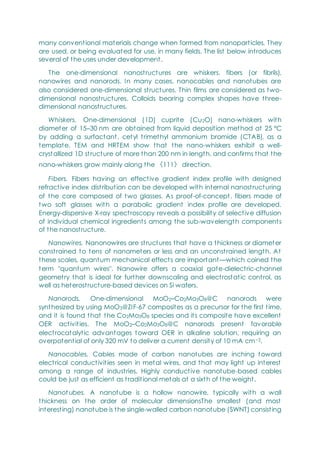
Whiskers. One-dimensional (1D) cuprite (Cu2O) nano-whiskers with
diameter of 15–30 nm are obtained from liquid deposition method at 25 °C
by adding a surfactant, cetyl trimethyl ammonium bromide (CTAB), as a
template. TEM and HRTEM show that the nano-whiskers exhibit a well-
crystallized 1D structure of more than 200 nm in length, and confirms that the
nano-whiskers grow mainly along the 〈111〉 direction.
Fibers. Fibers having an effective gradient index profile with designed
refractive index distribution can be developed with internal nanostructuring
of the core composed of two glasses. As proof-of-concept, fibers made of
two soft glasses with a parabolic gradient index profile are developed.
Energy-dispersive X-ray spectroscopy reveals a possibility of selective diffusion
of individual chemical ingredients among the sub-wavelength components
of the nanostructure.
Nanowires. Nanonowires are structures that have a thickness or diameter
constrained to tens of nanometers or less and an unconstrained length. At
these scales, quantum mechanical effects are important—which coined the
term "quantum wires". Nanowire offers a coaxial gate-dielectric-channel
geometry that is ideal for further downscaling and electrostatic control, as
well as heterostructure-based devices on Si wafers.
Nanorods. One-dimensional MoO2–Co2Mo3O8@C nanorods were
synthesized by using MoO3@ZIF-67 composites as a precursor for the first time,
and it is found that the Co2Mo3O8 species and its composite have excellent
OER activities. The MoO2–Co2Mo3O8@C nanorods present favorable
electrocatalytic advantages toward OER in alkaline solution, requiring an
overpotential of only 320 mV to deliver a current density of 10 mA cm−2.
Nanocables. Cables made of carbon nanotubes are inching toward
electrical conductivities seen in metal wires, and that may light up interest
among a range of industries. Highly conductive nanotube-based cables
could be just as efficient as traditional metals at a sixth of the weight.
Nanot ubes. A nanotube is a hollow nanowire, typically with a wall
thickness on the order of molecular dimensionsThe smallest (and most
interesting) nanotube is the single-walled carbon nanotube (SWNT) consisting
of a single graphenesheet rolled up into a tube. SWNTs are ideal systems for
investigating fundamental properties in one-dimensional electronic systems
and have the potential to revolutionize many aspects of nano/molecular
electronics.
Four Types of Engineered Nano materials
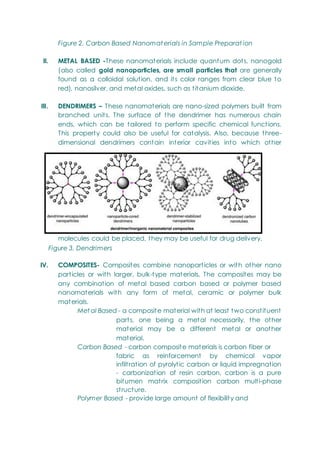
There are four types of engineered nanomaterials, namely: Carbon
Based, Metal Based, Dendrimers and Composites.
Figure 1. Types of Nanomat erials
I. CARBON BASED- These nanomaterial are composed mostly of carbon,
most commonly taking the form of a hollow spheres, ellipsoids, or tubes.
Spherical and ellipsoidal carbon nanomaterials are referred to as
FULLERENES, while cylindrical ones are called nanotubes (Carbon
Nanotubes) CNTs.
Figure 2. Carbon Based Nanomat erials in Sample Preparat ion
II. METAL BASED -These nanomaterials include quantum dots, nanogold
(also called gold nanoparticles, are small particles that are generally
found as a colloidal solution, and its color ranges from clear blue to
red), nanosilver, and metal oxides, such as titanium dioxide.
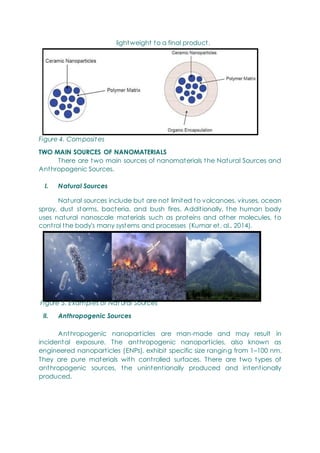
III. DENDRIMERS – These nanomaterials are nano-sized polymers built from
branched units. The surface of the dendrimer has numerous chain
ends, which can be tailored to perform specific chemical functions.
This property could also be useful for catalysis. Also, because three-
dimensional dendrimers contain interior cavities into which other
molecules could be placed, they may be useful for drug delivery.
Figure 3. Dendrimers
IV. COMPOSITES- Composites combine nanoparticles or with other nano
particles or with larger, bulk-type materials. The composites may be
any combination of metal based carbon based or polymer based
nanomaterials with any form of metal, ceramic or polymer bulk
materials.
Met al Based - a composite material with at least two constituent
parts, one being a metal necessarily, the other
material may be a different metal or another
material.
Carbon Based - carbon composite materials is carbon fiber or
fabric as reinforcement by chemical vapor
infiltration of pyrolytic carbon or liquid impregnation
- carbonization of resin carbon, carbon is a pure
bitumen matrix composition carbon multi-phase
structure.
Polymer Based - provide large amount of flexibility and
lightweight to a final product.
Figure 4. Composit es
TWO MAIN SOURCES OF NANOMATERIALS
There are two main sources of nanomaterials the Natural Sources and
Anthropogenic Sources.
I. Natural Sources
Natural sources include but are not limited to volcanoes, viruses, ocean
spray, dust storms, bacteria, and bush fires. Additionally, the human body
uses natural nanoscale materials such as proteins and other molecules, to
control the body's many systems and processes (Kumar et. al., 2014).
Figure 5. Examples of Nat ural Sources
II. Anthropogenic Sources
Anthropogenic nanoparticles are man-made and may result in
incidental exposure. The anthropogenic nanoparticles, also known as
engineered nanoparticles (ENPs), exhibit specific size ranging from 1–100 nm.
They are pure materials with controlled surfaces. There are two types of
anthropogenic sources, the unintentionally produced and intentionally
produced.
Unint ent ionally Produced
Combustion aerosols, particularly motor vehicle exhaust emission, coal
fly ash, and wielding operations (Kumar et. al., 2014).
Int ent ionally Produce
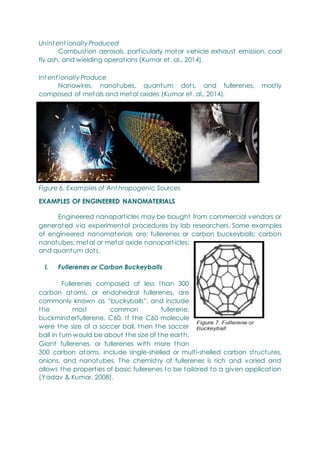
Nanowires, nanotubes, quantum dots, and fullerenes, mostly
composed of metals and metal oxides (Kumar et. al., 2014).
Figure 6. Examples of Ant hropogenic Sources
EXAMPLES OF ENGINEERED NANOMATERIALS
Engineered nanoparticles may be bought from commercial vendors or
generated via experimental procedures by lab researchers. Some examples
of engineered nanomaterials are: fullerenes or carbon buckeyballs; carbon
nanotubes; metal or metal oxide nanoparticles;
and quantum dots.
I. Fullerenes or Carbon Buckeyballs
Fullerenes composed of less than 300
carbon atoms, or endohedral fullerenes, are
commonly known as ―buckyballs‖, and include
the most common fullerene,
buckminsterfullerene, C60. If the C60 molecule
were the size of a soccer ball, then the soccer
ball in turn would be about the size of the earth.
Giant fullerenes, or fullerenes with more than
300 carbon atoms, include single-shelled or multi-shelled carbon structures,
onions, and nanotubes. The chemistry of fullerenes is rich and varied and
allows the properties of basic fullerenes to be tailored to a given application
(Yadav & Kumar, 2008).
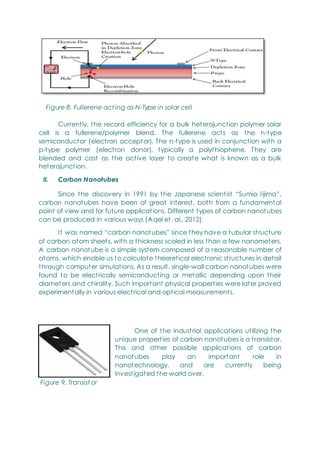
Figure 8. Fullerene act ing as N-Type in solar cell
Currently, the record efficiency for a bulk heterojunction polymer solar
cell is a fullerene/polymer blend. The fullerene acts as the n-type
semiconductor (electron acceptor). The n-type is used in conjunction with a
p-type polymer (electron donor), typically a polythiophene. They are
blended and cast as the active layer to create what is known as a bulk
heterojunction.
II. Carbon Nanotubes
Since the discovery in 1991 by the Japanese scientist ―Sumio Iijima‖,
carbon nanotubes have been of great interest, both from a fundamental
point of view and for future applications. Different types of carbon nanotubes
can be produced in various ways (Aqel et. al., 2012).
It was named ―carbon nanotubes‖ since they have a tubular structure
of carbon atom sheets, with a thickness scaled in less than a few nanometers.
A carbon nanotube is a simple system composed of a reasonable number of
atoms, which enable us to calculate theoretical electronic structures in detail
through computer simulations. As a result, single-wall carbon nanotubes were
found to be electrically semiconducting or metallic depending upon their
diameters and chirality. Such important physical properties were later proved
experimentally in various electrical and optical measurements.
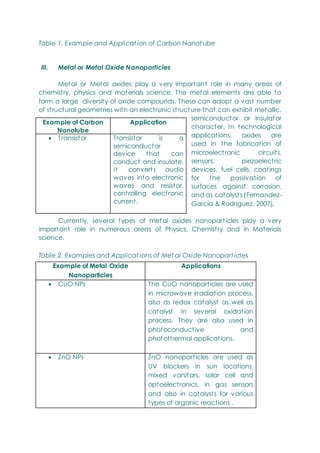
One of the industrial applications utilizing the
unique properties of carbon nanotubes is a transistor.
This and other possible applications of carbon
nanotubes play an important role in
nanotechnology, and are currently being
investigated the world over.
Figure 9. Transist or
Table 1. Example and Applicat ion of Carbon Nanot ube
III. Metal or Metal Oxide Nanoparticles
Metal or Metal oxides play a very important role in many areas of
chemistry, physics and materials science. The metal elements are able to
form a large diversity of oxide compounds. These can adopt a vast number
of structural geometries with an electronic structure that can exhibit metallic,
semiconductor or insulator
character. In technological
applications, oxides are
used in the fabrication of
microelectronic circuits,
sensors, piezoelectric
devices, fuel cells, coatings
for the passivation of
surfaces against corrosion,
and as catalysts (Fernandez-
Garcia & Rodriguez, 2007).
Currently, several types of metal oxides nanoparticles play a very
important role in numerous areas of Physics, Chemistry and in Materials
science.
Table 2. Examples and Applicat ions of Met al Oxide Nanopart icles
Example of Carbon
Nanotube
Application
 Transistor Transistor is a
semiconductor
device that can
conduct and insulate.
It converts audio
waves into electronic
waves and resistor,
controlling electronic
current.
Example of Metal Oxide
Nanoparticles
Applications
 CuO NPs The CuO nanoparticles are used
in microwave irradiation process,
also as redox catalyst as well as
catalyst in several oxidation
process. They are also used in
photoconductive and
photothermal applications.
 ZnO NPs ZnO nanoparticles are used as
UV blockers in sun locations,
mixed varsitors, solar cell and
optoelectronics, in gas sensors
and also in catalysts for various
types of organic reactions .
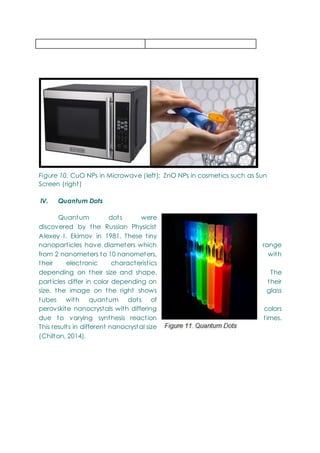
Figure 10. CuO NPs in Microwave (left); ZnO NPs in cosmetics such as Sun
Screen (right)
IV. Quantum Dots
Quantum dots were
discovered by the Russian Physicist
Alexey I. Ekimov in 1981. These tiny
nanoparticles have diameters which range
from 2 nanometers to 10 nanometers, with
their electronic characteristics
depending on their size and shape. The
particles differ in color depending on their
size, the image on the right shows glass
tubes with quantum dots of
perovskite nanocrystals with differing colors
due to varying synthesis reaction times.
This results in different nanocrystal size
(Chilton, 2014).
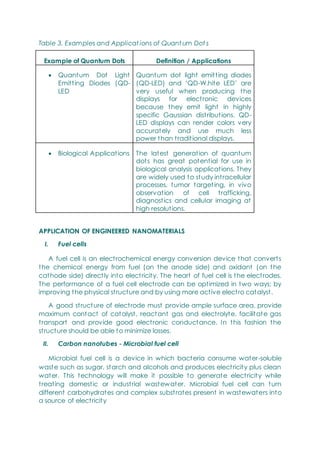
Table 3. Examples and Applicat ions of Quant um Dot s
APPLICATION OF ENGINEERED NANOMATERIALS
I. Fuel cells
A fuel cell is an electrochemical energy conversion device that converts
the chemical energy from fuel (on the anode side) and oxidant (on the
cathode side) directly into electricity. The heart of fuel cell is the electrodes.
The performance of a fuel cell electrode can be optimized in two ways; by
improving the physical structure and by using more active electro catalyst.
A good structure of electrode must provide ample surface area, provide
maximum contact of catalyst, reactant gas and electrolyte, facilitate gas
transport and provide good electronic conductance. In this fashion the
structure should be able to minimize losses.
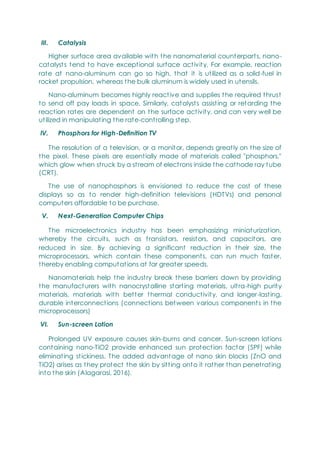
II. Carbon nanotubes - Microbial fuel cell
Microbial fuel cell is a device in which bacteria consume water-soluble
waste such as sugar, starch and alcohols and produces electricity plus clean
water. This technology will make it possible to generate electricity while
treating domestic or industrial wastewater. Microbial fuel cell can turn
different carbohydrates and complex substrates present in wastewaters into
a source of electricity
Example of Quantum Dots Definition / Applications
 Quantum Dot Light
Emitting Diodes (QD-
LED
Quantum dot light emitting diodes
(QD-LED) and ‗QD-W.hite LED‘ are
very useful when producing the
displays for electronic devices
because they emit light in highly
specific Gaussian distributions. QD-
LED displays can render colors very
accurately and use much less
power than traditional displays.
 Biological Applications The latest generation of quantum
dots has great potential for use in
biological analysis applications. They
are widely used to study intracellular
processes, tumor targeting, in vivo
observation of cell trafficking,
diagnostics and cellular imaging at
high resolutions.
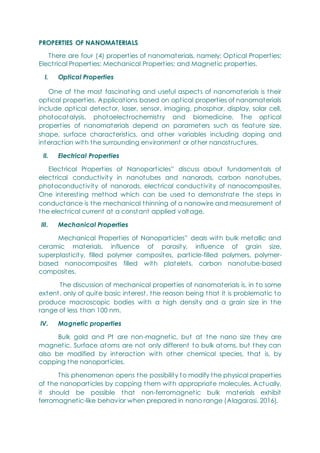
III. Catalysis
Higher surface area available with the nanomaterial counterparts, nano-
catalysts tend to have exceptional surface activity. For example, reaction
rate at nano-aluminum can go so high, that it is utilized as a solid-fuel in
rocket propulsion, whereas the bulk aluminum is widely used in utensils.
Nano-aluminum becomes highly reactive and supplies the required thrust
to send off pay loads in space. Similarly, catalysts assisting or retarding the
reaction rates are dependent on the surface activity, and can very well be
utilized in manipulating the rate-controlling step.
IV. Phosphors for High-Definition TV
The resolution of a television, or a monitor, depends greatly on the size of
the pixel. These pixels are essentially made of materials called "phosphors,"
which glow when struck by a stream of electrons inside the cathode ray tube
(CRT).
The use of nanophosphors is envisioned to reduce the cost of these
displays so as to render high-definition televisions (HDTVs) and personal
computers affordable to be purchase.
V. Next-Generation Computer Chips
The microelectronics industry has been emphasizing miniaturization,
whereby the circuits, such as transistors, resistors, and capacitors, are
reduced in size. By achieving a significant reduction in their size, the
microprocessors, which contain these components, can run much faster,
thereby enabling computations at far greater speeds.
Nanomaterials help the industry break these barriers down by providing
the manufacturers with nanocrystalline starting materials, ultra-high purity
materials, materials with better thermal conductivity, and longer-lasting,
durable interconnections (connections between various components in the
microprocessors)
VI. Sun-screen Lotion
Prolonged UV exposure causes skin-burns and cancer. Sun-screen lotions
containing nano-TiO2 provide enhanced sun protection factor (SPF) while
eliminating stickiness. The added advantage of nano skin blocks (ZnO and
TiO2) arises as they protect the skin by sitting onto it rather than penetrating
into the skin (Alagarasi, 2016).
PROPERTIES OF NANOMATERIALS
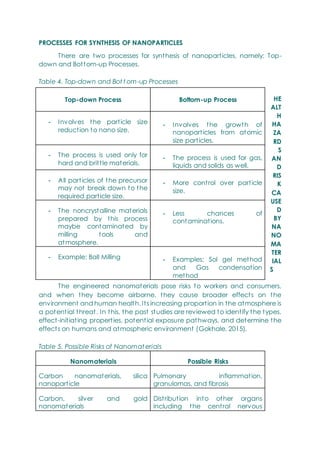
There are four (4) properties of nanomaterials, namely: Optical Properties;
Electrical Properties; Mechanical Properties; and Magnetic properties.
I. Optical Properties
One of the most fascinating and useful aspects of nanomaterials is their
optical properties. Applications based on optical properties of nanomaterials
include optical detector, laser, sensor, imaging, phosphor, display, solar cell,
photocatalysis, photoelectrochemistry and biomedicine. The optical
properties of nanomaterials depend on parameters such as feature size,
shape, surface characteristics, and other variables including doping and
interaction with the surrounding environment or other nanostructures.
II. Electrical Properties
Electrical Properties of Nanoparticles‖ discuss about fundamentals of
electrical conductivity in nanotubes and nanorods, carbon nanotubes,
photoconductivity of nanorods, electrical conductivity of nanocomposites.
One interesting method which can be used to demonstrate the steps in
conductance is the mechanical thinning of a nanowire and measurement of
the electrical current at a constant applied voltage.
III. Mechanical Properties
Mechanical Properties of Nanoparticles‖ deals with bulk metallic and
ceramic materials, influence of porosity, influence of grain size,
superplasticity, filled polymer composites, particle-filled polymers, polymer-
based nanocomposites filled with platelets, carbon nanotube-based
composites.
The discussion of mechanical properties of nanomaterials is, in to some
extent, only of quite basic interest, the reason being that it is problematic to
produce macroscopic bodies with a high density and a grain size in the
range of less than 100 nm.
IV. Magnetic properties
Bulk gold and Pt are non-magnetic, but at the nano size they are
magnetic. Surface atoms are not only different to bulk atoms, but they can
also be modified by interaction with other chemical species, that is, by
capping the nanoparticles.
This phenomenon opens the possibility to modify the physical properties
of the nanoparticles by capping them with appropriate molecules. Actually,
it should be possible that non-ferromagnetic bulk materials exhibit
ferromagnetic-like behavior when prepared in nano range (Alagarasi, 2016).
PROCESSES FOR SYNTHESIS OF NANOPARTICLES
There are two processes for synthesis of nanoparticles, namely: Top-
down and Bottom-up Processes.
Table 4. Top-down and Bot t om-up Processes
HE
ALT
H
HA
ZA
RD
S
AN
D
RIS
K
CA
USE
D
BY
NA
NO
MA
TER
IAL
S
The engineered nanomaterials pose risks to workers and consumers,
and when they become airborne, they cause broader effects on the
environment and human health. Its increasing proportion in the atmosphere is
a potential threat. In this, the past studies are reviewed to identify the types,
effect-initiating properties, potential exposure pathways, and determine the
effects on humans and atmospheric environment (Gokhale, 2015).
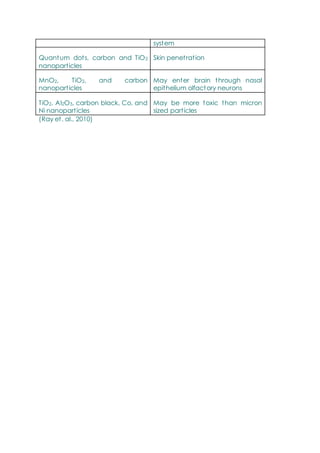
Table 5. Possible Risks of Nanomat erials
Nanomaterials Possible Risks
Carbon nanomaterials, silica
nanoparticle
Pulmonary inflammation,
granulomas, and fibrosis
Carbon, silver and gold
nanomaterials
Distribution into other organs
including the central nervous
Top-down Process Bottom-up Process
- Involves the particle size
reduction to nano size.
- Involves the growth of
nanoparticles from atomic
size particles.
- The process is used only for
hard and brittle materials.
- The process is used for gas,
liquids and solids as well.
- All particles of the precursor
may not break down to the
required particle size.
- More control over particle
size.
- The noncrystalline materials
prepared by this process
maybe contaminated by
milling tools and
atmosphere.
- Less chances of
contaminations.
- Example: Ball Milling - Examples: Sol gel method
and Gas condensation
method
system
Quantum dots, carbon and TiO2
nanoparticles
Skin penetration
MnO2, TiO2, and carbon
nanoparticles
May enter brain through nasal
epithelium olfactory neurons
TiO2, Al2O3, carbon black, Co, and
Ni nanoparticles
May be more toxic than micron
sized particles
(Ray et. al., 2010)
Cover
(THE CHEMISTRYOF THE ENVIRONMENT)
CHEMISTY OF THE
ENVIRONMENT
The Chemistry of the Environment
ENVIRONMENT is the total of all surroundings of a living organism,
including natural forces and other living things. Which provide conditions for
development and growth as well as of danger and damage.
Environment that surrounds us. Different organisms live in different type
of surroundings such as air, water and soil. Different kinds of living organisms
share these surroundings with other. Chemistry of the environment deals with
the study of the origin, transport, reaction, effects and fates of chemical
species in the environment.
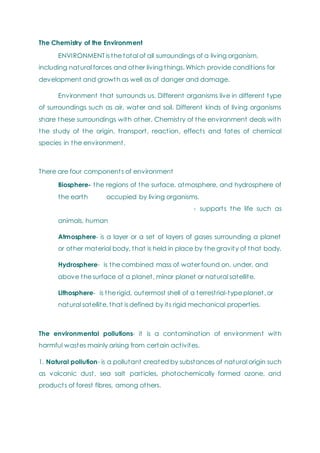
There are four components of environment
Biosphere- the regions of the surface, atmosphere, and hydrosphere of
the earth occupied by living organisms.
- supports the life such as
animals, human
Atmosphere- is a layer or a set of layers of gases surrounding a planet
or other material body, that is held in place by the gravity of that body.
Hydrosphere- is the combined mass of water found on, under, and
above the surface of a planet, minor planet or natural satellite.
Lithosphere- is the rigid, outermost shell of a terrestrial-type planet, or
natural satellite, that is defined by its rigid mechanical properties.
The environmental pollutions- it is a contamination of environment with
harmful wastes mainly arising from certain activites.
1. Natural pollution- is a pollutant created by substances of natural origin such
as volcanic dust, sea salt particles, photochemically formed ozone, and
products of forest fibres, among others.
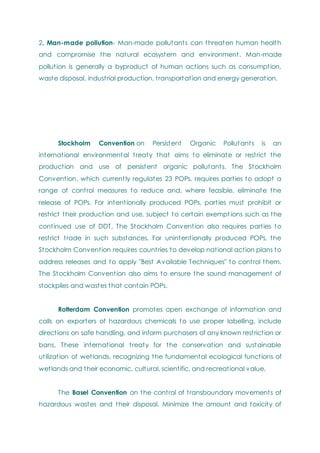
2. Man-made pollution- Man-made pollutants can threaten human health
and compromise the natural ecosystem and environment. Man-made
pollution is generally a byproduct of human actions such as consumption,
waste disposal, industrial production, transportation and energy generation.
Stockholm Convention on Persistent Organic Pollutants is an
international environmental treaty that aims to eliminate or restrict the
production and use of persistent organic pollutants. The Stockholm
Convention, which currently regulates 23 POPs, requires parties to adopt a
range of control measures to reduce and, where feasible, eliminate the
release of POPs. For intentionally produced POPs, parties must prohibit or
restrict their production and use, subject to certain exempt ions such as the
continued use of DDT. The Stockholm Convention also requires parties to
restrict trade in such substances. For unintentionally produced POPs, the
Stockholm Convention requires countries to develop national action plans to
address releases and to apply "Best Available Techniques" to control them.
The Stockholm Convention also aims to ensure the sound management of
stockpiles and wastes that contain POPs.
Rotterdam Convention promotes open exchange of information and
calls on exporters of hazardous chemicals to use proper labelling, include
directions on safe handling, and inform purchasers of any known restriction or
bans. These international treaty for the conservation and sustainable
utilization of wetlands, recognizing the fundamental ecological functions of
wetlands and their economic, cultural, scientific, and recreational value.
The Basel Convention on the control of transboundary movements of
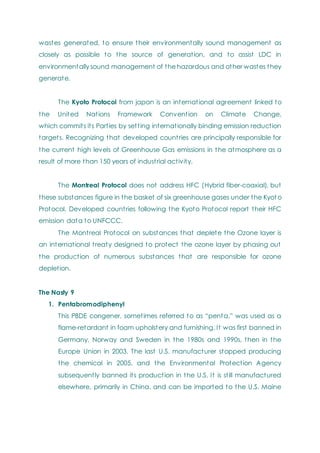
hazardous wastes and their disposal. Minimize the amount and toxicity of
wastes generated, to ensure their environmentally sound management as
closely as possible to the source of generation, and to assist LDC in
environmentally sound management of the hazardous and other wastes they
generate.
The Kyoto Protocol from japan is an international agreement linked to
the United Nations Framework Convention on Climate Change,
which commits its Parties by setting internationally binding emission reduction
targets. Recognizing that developed countries are principally responsible for
the current high levels of Greenhouse Gas emissions in the atmosphere as a
result of more than 150 years of industrial activity.
The Montreal Protocol does not address HFC (Hybrid fiber-coaxial), but
these substances figure in the basket of six greenhouse gases under the Kyot o
Protocol. Developed countries following the Kyoto Protocol report their HFC
emission data to UNFCCC.
The Montreal Protocol on substances that deplete the Ozone layer is
an international treaty designed to protect the ozone layer by phasing out
the production of numerous substances that are responsible for ozone
depletion.
The Nasty 9
1. Pentabromodiphenyl
This PBDE congener, sometimes referred to as ―penta,‖ was used as a
flame-retardant in foam upholstery and furnishing. It was first banned in
Germany, Norway and Sweden in the 1980s and 1990s, then in the
Europe Union in 2003. The last U.S. manufacturer stopped producing
the chemical in 2005, and the Environmental Protection Agency
subsequently banned its production in the U.S. It is still manufactured
elsewhere, primarily in China, and can be imported to the U.S. Maine
and Washington have banned it and nine other states have proposed
bans.
The chemical may cause a range of health problems, including liver
disease and reproductive and developmental problems. It has been
found in human breast milk.
2. Octabromodiphenyl
Like its sister ―penta‖ this polybrominated diphenyl ether, or PBDE, has
been linked to health issues and has largely been phased out in
developed nations. It used in conjunction with antimony trioxide as a
flame retardant in the housings of electrical and electronic equipment,
mainly in the plastic acrylonitrile butadiene styrene, but also in high
impact polystyrene, polybutylene
terephthalate and polyamides. Typically 12–15% of the weight of the
final product will consist of octabromodiphenyl.
3. Chlordecone
This insecticide, also known as Kepone, was used until 1978 in the
United States on tobacco, ornamental shrubs, bananas and citrus
trees, and in ant and roach traps. It is chemically almost identical to
Mirex, which was one of the original ―Dirty Dozen‖ banned by the
treaty.
Workers using chlordecone suffered damage to the nervous system,
skin, liver and male reproductive system. It may still be in use in
developing nations, despite its being banned in the industrialized world.
4. Lindane
An agricultural insecticide also used to treat head lice and scabies in
people, lindane has been banned in 50 nations because the
organochlorine pesticide can attack the nervous system. In t he United
States, it was used until 2007 on farms, and it is still used as a ―second-
line‖ treatment for head lice when other treatments fail.
Additionally, because Lindane is the only useful product in a family of
chemicals generated to produce the pesticide, there is persistent
chemical waste created by the process. For every ton of Lindane
produced, six to 10 tons of waste are produced.
5. Alpha-hexachlorocyclohexane
One of the persistent chemical waste products produced by making
Lindane, alpha-hexachlorocyclohexane may cause cancer and liver
or kidney problems.
6. Beta-hexachlorocyclohexane
Another of the persistent chemical waste products produced by
making Lindane, beta-hexachlorocyclohexane may cause cancer
and reproductive problems.
7. PFOS (Perfluorooctanesulfonic acid)
The company 3M used PFOS to make Scotchgard fabric and other
stain-resistant products until 2002. The chemical is also used in a
number of industrial processes. It is found in the bodies of people
around the world, and in relatively high concentrations in Arctic wildlife
— reflecting the global transport of persistent chemicals like these.
Unlike the other chemicals on the ―nasty nine‖ list, PFOS will have its use
restricted, not banned.
8. Hexabromobiphenyl
A polybrominated biphenyl, or PBB, hexabromobiphenyl is a flame
retardant that has been linked to a range of health problems, including
weight loss, skin disorders, nervous and immune systems effects, and
effects on the liver, kidneys, and thyroid gland. While it is no longer
used in developed nations, it may still be in use in developing nation.
9. Pentachlorobenzene
Used in the manufacture of an insecticide, and as a flame retardant,
Pentachlorobenzene may damage the nervous and reproductive
systems, as well as the liver and kidneys. It is also used as a head lice
treatment and can be found in the waste streams of some paper mills,
petroleum refineries, sewage treatment plants and incinerators.
Environmental Working Group released Dirty Dozen list and it serves as a solid
reminder that we still have a lot of work to do when it comes to cleaning up
the food system. This year, the report found that almost 70 percent of non-
organic samples tested positive for at least one pesticide. (In many cases, the
numbers were much higher.) A single strawberry sample harbored 22
different pesticide and pesticide breakdown residues. Polychlorinated
biphenyls were once widely deployed as dielectric and coolant fluids in
electrical apparatus, carbonless copy paper and in heat transfer fluids.
Philippines5 Environmental Laws
1. REPUBLIC ACT 9003 ECOLOGICAL SOLID WASTE MANAGEMENT ACT OF
2000
In partnership with stakeholders, the law aims to adopt a systematic,
comprehensive and ecological solid waste management program that shall
ensure the protection of public health and environment. The law ensures
proper segregation, collection, storage, treatment and disposal of solid waste
through the formulation and adaptation of best eco-waste products.
2. REPUBLIC ACT 9275 PHILIPPINE CLEAN WATER ACT OF 2004
The law aims to protect the country's water bodies from pollution from land-
based sources (industries and commercial establishments, agriculture and
community/household activities). It provides for comprehensive and
integrated strategy to prevent and minimize pollution through a multi-sectoral
and participatory approach involving all the stakeholders.
3. REPUBLIC ACT 8749 PHILIPPINE CLEAN AIR ACT OF 1999
The law aims to achieve and maintain clean air t hat meets the National Air
Quality guideline values for criteria pollutants, throughout the Philippines,
while minimizing the possible associated impacts to the economy.
4. REPUBLIC ACT 6969 TOXIC SUBSTANCES, HAZARDOUS AND NUCLEAR
WASTE CONTROL ACT OF 1990
The law aims to regulate restrict or prohibit the importation, manufacture,
processing, sale, distribution, use and disposal of chemical substances and
mixtures the present unreasonable risk to human health. It likewise prohibits
the entry, even in transit, of hazardous and nuclear wastes and their disposal
into the Philippine territorial limits for whatever purpose; and to provide
advancement and facilitate research and studies on toxic chemicals.
5. PRESIDENTIAL DECREE 1586 ENVIRONMENTAL IMPACT STATEMENT (EIS)
STATEMENT OF 1978
The Environment Impact Assessment System was formally established in 1978
with the enactment of Presidential Decree no. 1586 to facilitate the
attainment and maintenance of rational and orderly balance between
socio-economic development and environmental protection.
Cover
(Chemistry of the Atmossphere)
THE CHEMISTRY
OF THE
ATMOSTPHERE
Earth’s Atmosphere
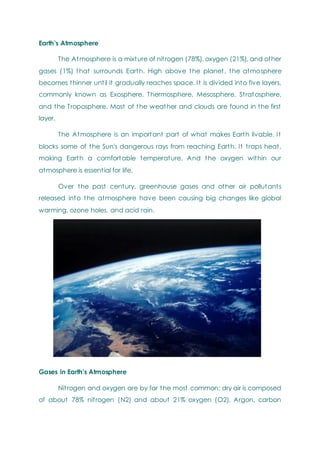
The Atmosphere is a mixture of nitrogen (78%), oxygen (21%), and other
gases (1%) that surrounds Earth. High above the planet, the atmosphere
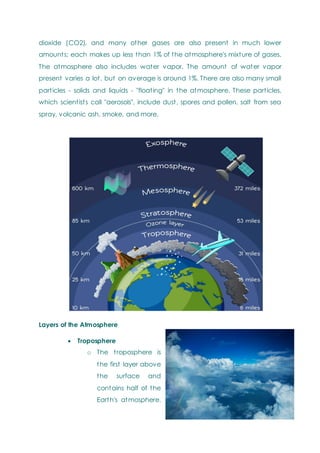
becomes thinner until it gradually reaches space. It is divided into five layers,
commonly known as Exosphere, Thermosphere, Mesosphere, Stratosphere,
and the Troposphere. Most of the weather and clouds are found in the first
layer.
The Atmosphere is an important part of what makes Earth livable. It
blocks some of the Sun's dangerous rays from reaching Earth. It traps heat,
making Earth a comfortable temperature. And the oxygen within our
atmosphere is essential for life.
Over the past century, greenhouse gases and other air pollutants
released into the atmosphere have been causing big changes like global
warming, ozone holes, and acid rain.
Gases in Earth's Atmosphere
Nitrogen and oxygen are by far the most common; dry air is composed
of about 78% nitrogen (N2) and about 21% oxygen (O2). Argon, carbon
dioxide (CO2), and many other gases are also present in much lower
amounts; each makes up less than 1% of the atmosphere's mixture of gases.
The atmosphere also includes water vapor. The amount of water vapor
present varies a lot, but on average is around 1%. There are also many small
particles - solids and liquids - "floating" in the atmosphere. These particles,
which scientists call "aerosols", include dust, spores and pollen, salt from sea
spray, volcanic ash, smoke, and more.
Layers of the Atmosphere
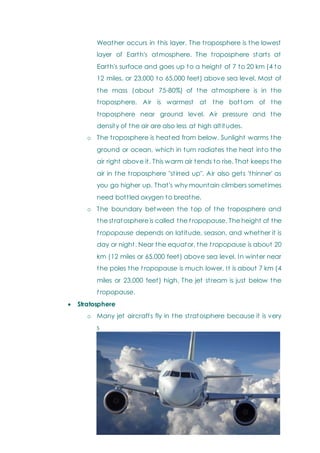
 Troposphere
o The troposphere is
the first layer above
the surface and
contains half of the
Earth's atmosphere.
Weather occurs in this layer. The troposphere is the lowest
layer of Earth's atmosphere. The troposphere starts at
Earth's surface and goes up to a height of 7 to 20 km (4 to
12 miles, or 23,000 to 65,000 feet) above sea level. Most of
the mass (about 75-80%) of the atmosphere is in the
troposphere. Air is warmest at the bottom of the
troposphere near ground level. Air pressure and the
density of the air are also less at high altitudes.
o The troposphere is heated from below. Sunlight warms the
ground or ocean, which in turn radiates the heat into the
air right above it. This warm air tends to rise. That keeps the
air in the troposphere "stirred up". Air also gets 'thinner' as
you go higher up. That's why mountain climbers sometimes
need bottled oxygen to breathe.
o The boundary between the top of the troposphere and
the stratosphere is called the t ropopause. The height of the
t ropopause depends on latitude, season, and whether it is
day or night. Near the equator, the t ropopause is about 20
km (12 miles or 65,000 feet) above sea level. In winter near
the poles the t ropopause is much lower. It is about 7 km (4
miles or 23,000 feet) high. The jet stream is just below the
t ropopause.
 Stratosphere
o Many jet aircrafts fly in the stratosphere because it is very
s
t
a
b
l
e
.
Also, the ozone layer absorbs harmful rays from the Sun.
The top of the stratosphere occurs at 50 km (31 miles)
altitude. The boundary between the stratosphere and the
mesosphere above is called the stratopause. The altitude
of the bottom of the stratosphere varies with latitude and
with the seasons, occurring between about 8 and 16 km (5
and 10 miles, or 26,000 to 53,000 feet). The bottom of the
stratosphere is around 16 km (10 miles or 53,000 feet)
above Earth's surface near the equator, around 10 km (6
miles) at mid-latitudes, and around 8 km (5 miles) near the
poles. It is slightly lower in winter at mid- and high-latitudes,
and slightly higher in the summer.
o Ozone, an unusual type of oxygen molecule that is
relatively abundant in the stratosphere, heats this layer as it
absorbs energy from incoming ultraviolet radiation from
the Sun. Temperatures rise as one moves upward through
the stratosphere. This is exactly the opposite of the
behavior in the troposphere in which we live, where
temperatures drop with increasing altitude.
o The stratosphere is very dry; air there contains little water
vapor. Because of this, few clouds are found in this layer;
almost all clouds occur in the lower, more humid
troposphere. Polar stratospheric clouds (PSCs) are the
exception.
PSCs appear
in the lower
stratosphere
near the
poles in
winter. They
are found at
altitudes of 15 to 25 km (9.3 to 15.5 miles) and form only
when temperatures at those heights dip below -78° C. They
appear to help cause the formation of the infamous holes
in the ozone layer by "encouraging" certain chemical
reactions that destroy ozone. PSCs are also called
nacreous clouds.
o A rare type of electrical discharge, somewhat akin to
lightning, occurs in the stratosphere. These "blue jets"
appear above thunderstorms, and extend from the
bottom of the stratosphere up to altitudes of 40 or 50 km
(25 to 31 miles).
 Mesosphere
o Meteors or rock fragments burn up in the mesosphere. The
mesosphere starts at 50 km (31 miles) above Earth's surface
and goes up to 85 km (53 miles) high.
o As you get higher up in the mesosphere, the temperature
gets colder.
The top of the
mesosphere is
the coldest
part of Earth's
atmosphere.
The
temperature
there is around
-90° C (-130° F)! The mesopause is the boundary between
the mesosphere and
the thermosphere
above it.
o Scientists know less about the mesosphere than about
other layers of the atmosphere. The mesosphere is hard to
study. Weather balloons and jet planes cannot fly high
enough to reach the mesosphere. Most meteors from
space burn up in this layer. A special type of clouds, called
"noctilucent clouds", sometimes forms in the mesosphere
near the North and South Poles. These clouds are strange
because they form much, much higher up than any other
type of cloud. There are also odd types of lightning in the
mesosphere. These types of lightning, called "sprites" and
"ELVES", appear dozens of miles above thunderclouds in
the troposphere below.
 Themosphere
o The thermosphere is a layer with auroras. It is also where
the space shuttle orbits. Temperatures climb sharply in the
lower thermosphere (below 200 to 300 km altitude), then
level off and hold fairly steady with increasing altitude
above that height. Solar activity strongly influences
temperature in the thermosphere. The thermosphere is
typically about 200° C (360° F) hotter in the daytime than
at night, and roughly 500° C (900° F) hotter when the Sun is
very active than at other times. Temperatures in the upper
thermosphere can range from about 500° C (932° F) to
2,000° C (3,632° F) or higher.
o Although the thermosphere is considered part of Earth's
atmosphere, the air density is so low in this layer that most
of the thermosphere is what we normally think of as outer
space. In fact, the most common definition says that
space begins at an altitude of 100 km (62 miles), slightly
above the mesopause at the bottom of the thermosphere.
The space shuttle and the International Space Station both
orbit Earth within the thermosphere.
o High-energy solar photons also tear electrons away from
gas particles in the thermosphere, creating electrically-
charged ions of atoms and molecules. Earth's ionosphere,
composed of several regions of such ionized particles in
the atmosphere, overlaps with and shares the same space
with the electrically neutral thermosphere.
 The Ionosphere s a layer of the earth's atmosphere
that is weakly ionized, and thus conducts electricity.
It is located approximately in the same region as the
top half of the mesosphere and the entire
thermosphere in the upper atmosphere, from about
40 mi (60 km), continuing upward to the
magnetosphere.
o The Aurora (the Southern and Northern Lights) primarily
occurs in the thermosphere. Charged particles (electrons,
p
r
o
t
o
n
s
,
a
nd other ions) from space collide with atoms and
molecules in the thermosphere at high latitudes, exciting
them into higher energy states. Those atoms and
molecules shed this excess energy by emitting photons of
light, which we see as colorful Auroral displays.
 Exosphere
o The atmosphere merges into space in the extremely thin
exosphere. This is the upper limit of our atmosphere. Very
high up, the Earth's atmosphere becomes very thin. The
exosphere is the outermost layer of our atmosphere. ―Exo‖
means outside and is the same prefix used to describe
insects like grasshoppers that have a hard shell or
―exoskeleton‖ on
the outside of their
body.
o The exosphere is the
very edge of our
atmosphere. This
layer separates the
rest of the atmosphere from outer space. It‘s about 6,200
miles (10,000 kilometers) thick. That‘s almost as wide as
Earth itself. The exosphere is really, really big. That means
that to get to outer space, you have to be really far from
Earth.
o The exosphere has gases like hydrogen and helium, but
they are very spread out. There is a lot of empty space in
between. There is no air to breathe, and it‘s very cold.
All of these layers, the most important layer of the atmosphere is the
troposphere it is protected from the hard ultraviolet radiation of the Sun by
the higher layers of the atmosphere, namely by the stratospheric ozone layer.
Because of this protection, many molecules are more stable in the
troposphere then elsewhere in the atmosphere. This protection makes life
possible on Earth. Carbon dioxide has a very long life span in the atmosphere
(several centuries). The presence of carbon dioxide is strongly linked to life on
Earth. CO2 is necessary for plant growth, since the carbon in animals and
plants originates exclusively from atmospheric CO2.
WEATHER OF ATMOSPHERE
Weather- is the state of the atmosphere at a given time and place.
Troposphere- The lowest layer of the atmosphere. The troposphere is heated
from below. Sunlight warms the ground or ocean, which in turn radiates the
heat into the air right above it. This warm air tends to rise. That keeps the air in
the troposphere "stirred up". The top of the troposphere is quite cold.
Weather describe in many variety of ways:
1. Air
TEMPERATURE- The real definition of temperature is the measure of the
average speed of air molecules. Temperature is measured in degrees by
using a thermometer. Even though temperature changes every day and
every season, the Earth's temperature is always in the right range to
support life.The temperature of the air depends on the temperature of the
surface directly below
PRESSURE- is an idea scientists use to describe how gases and liquids
"push" on things. The atmosphere has pressure. Atmospheric pressure is not
always the same. If a low pressure system or a high pressure system is passing
over your house, that will change the atmospheric pressure. Air pressure also
changes as you go up! The air pressure in Earth's atmosphere is pretty strong
when you are near sea level. When you go higher up, in an airplane or to the
top of a mountain, there is less pressure.
2. PRECIPITATION- (pre-sip-uh-tay-shun) is any form of water that falls to
the Earth's surface. Different forms of precipitation
include drizzle, rain, hail, snow, sleet, and freezing rain. Precipitation is
important because it helps maintain the atmospheric balance. Without
precipitation, all of the land on the planet would be desert . Precipitation can
also be damaging. Too much rain and snow can cause severe flooding and
lots of traffic accidents.
3. WIND- is moving air. Warm air rises, and cool air comes in to take its
place. This movement creates different pressures in the atmosphere which
creates the winds around the globe. Since the Earth spins, the winds try to
move to the right in the Northern Hemisphere, and to the left in the Southern
Hemisphere. This is called the Coriolis Effect.
4. TYPES OF CLOUD
CUMULUS CLOUDS-have sharp outlines and a flat base. Cumulus clouds
generally have a base height of 1000m and a width of 1km. Cumulus clouds
can be associated with good or bad weather. Cumulus humilis clouds are
associated with fair weather.
CIRRUS- Cirrus clouds are the most common of the High Cloud (5000-
13000m) group. They are composed entirely of ice and consist of long, thin,
wispy streamers. They are commonly known as "mare's tails" because of their
appearance. Cirrus clouds are usually white and predict fair weather.
CUMULONIMBUS- Cumulonimbus clouds belong to the Clouds with
Vertical Growth group. They are generally known as thunderstorm clouds.
Cumulonimbus clouds are associated with heavy rain, snow, hail, lightning,
and tornadoes.
STRATUS- Stratus clouds belong to the Low Cloud (surface-2000m up)
group. They are uniform gray in color and can cover most or all of the sky.
Stratus clouds can look like a fog that doesn't reach the ground.
LENTICULAR- Lenticular clouds form on the downwind side of
mountains. Wind blows most types of clouds across the sky, but lenticular
clouds seem to stay in one place. Air moves up and over a mountain, and at
the point where the air goes past the mountaintop the lenticular cloud forms,
and then the air evaporates on the side farther away from the mountains.
Weather changes each day because the air in our atmosphere is
always moving. While weather can change rapidly, climate changes slowly.
Over the past century, greenhouse gases and other air pollutants
released into the atmosphere have been causing big changes like global
warming, ozone holes, and acid rain.
CLIMATE CHANGE
Warm near the equator and cold at the poles. The scientific
consensus is that climate is warming as a result of the addition of heat -
trapping greenhouse gases. Climate has cooled and warmed
throughout Earth history for various reasons. Rapid warming like we see
today is unusual in the history of our planet.
POLAR ATMOSPHERE
There are some unique phenomena that happen in the atmosphere
that is above the Earth's polar regions.
AURORA- High in the thermosphere layer of Earth's atmosphere,
energized particles that come from the Sun follow Earth's magnetic field lines
toward the Poles. The gases of the upper atmosphere light up with the added
energy. The display is called the aurora. It can only be seen at high latitudes
and is called the Northern Lights in the Northern Hemisphere and the
Southern Lights in the Southern Hemisphere.
NOCTILUCENT CLOUDS- In the mesosphere layer of Earth‘s atmosphere,
below the thermosphere and above the stratosphere, noctilucent clouds
form in the polar regions. This is much higher in the atmosphere than typical
clouds, but noctilucent clouds are not typical clouds. The word noctilucent
means to glow, and these clouds do glow blue in color when they are lit from
below by the setting Sun.
LESS OZONE- The ozone layer, located in the stratosphere layer of the
atmosphere, shields our planet from harmful UV radiation. Most of the ozone
destruction happened in the part of the stratosphere that is over Earth‘s polar
regions.
COLD WEATHER- Less solar energy gets to the poles making for lots of
cold weather. However, even though both poles get the same amount of
sunlight, the North Pole is less cold and has different weather than the South
Pole.
ATMOSPHERIC OPTICS
Atmospheric Optics shows us how light behaves as it passes through the
atmosphere.
MECHANISMS
REFLECTION- Is the change in direction of a wave front at
an interface between two different media so that the wave front returns into
the medium from which it originated.
REFRACTION- Refraction is the bending of light (it also happens with sound,
water and other waves) as it passes from one transparent substance into
another. This bending by refraction makes it possible for us to have lenses,
magnifying glasses, prisms and rainbows.
SCATTERING- A change in the direction of motion of a particle because of
the collision with another particle. As defined in physics, a collision can occur
between particles that repel one another, such as two positive (or negative)
ions, and need not involve direct physical contact of the particles.
DIFFRACTION- Is the slight bending of light as it passes around the edge of an
object. The amount of bending depends on the relative size of the
wavelength of light to the size of the opening.
Why the Sky is Blue?
The atmosphere is made up of mostly nitrogen and oxygen. They are
selective scatters, meaning they scatter short wavelengths best (violet, blue,
and green). Our eyes are most sensitive to blue light, so the sky appears blue
to us!
Why do clouds look white and sometimes dark?
Water vapors (clouds) scatter all wavelengths equally. The result is
white. When clouds are thick (like thunderclouds) they absorb much of the
light. Water drops also tend to absorb light. The result is a darker cloud.
The Green Flash
Green flash is an atmospheric phenomenon observed occasionally at
sunset. Remember at sunset that the light travels through a much greater
amount of atmosphere—this bends the light from the setting sun so that we
see the sun for a short while after it has actually set. Blue light bends the most
so we should see some blue light at the top of the setting sun. However
because the blue light is scattered out the most very little reaches us and we
see green light instead.
Crepuscular Rays (Jacobs Ladder)
Particles in the sky (dust, water droplets, or haze) scatter light in their path
making that region appear bright with rays.
Halo around the sun
Light is refracted by tiny suspended ice crystals.
Rainbow
Sunlight hitting a raindrop in the atmosphere is refracted on the surface
of the raindrop and enters the droplet. Once refraction occurs, the light
breaks up into seven colors inside the raindrop; it is then reflected to the other
side of the raindrop after traveling inside it. When the light in the raindrop
refracts, the spectrum forms to make the 7 colors of the rainbow appear.
During reflection, the angle (of reflection) is equal to the angle of incidence;
this means that reflected light travels along a set path and maintains the
difference of the refraction angle. A rainbow is a bunch of raindrops hanging
in the atmosphere that divide the sunlight into 7 colors, like a prism.
AIR POLLUTION
Air pollution refers to the release of pollutants into the air that are detrimental
to human health and the planet as a whole.
COMMON EXAMPLES OF AIR POLLUTION
Smog- A kind of air pollution, originally named for the mixture of smoke and
fog in the air.
Acid rain - Is a general term used to describe different kinds of acidic air
pollution such as sulfur dioxide and nitrogen oxide. Can have harmful impacts
on the ecosystems in the environment. It acidifies the soil and water where it
falls, damaging or killing plants and animals.
Carbon Monoxide- An odorless, colorless, tasteless, and toxic air pollutant.
Produced in the incomplete combustion of carbon containing fuels, such as
gasoline, natural gas, oil, coal and wood.
Tropospheric Ozone- Ozone is released naturally in the troposphere by plants
and soil. These are such small amounts that they are not harmful to the health
of humans, animals or the environment.
NATURAL VS. MAN-MADE
Natural
Natural processes impacting the atmosphere include volcanoes, biological
decay, and dust storms. Plants, trees, and grass release volatile organic
compounds (VOCs), such as methane, into the air.
Man-Made
Human-made pollutants include carbon monoxide, sulfur dioxide, VOCs, and
nitrogen oxides. The largest source of human-made pollution is the burning of
fossil fuels, including coal, oil, and gas, in our homes, factories, and cars.
PRIMARY OR SECONDARY AIR POLLUTION
Primary pollution is put directly to the air, such as smoke and car exhausts.
Secondary pollution forms in the air when chemical reactions changes
primary pollutants. The formation of tropospheric ozone is an example of
secondary air pollution.
EFFECTS OF AIR POLLUTION
1. Respiratory and heart problems: The effects of Air pollution are alarming.
They are known to create several respiratory and heart conditions along with
Cancer, among other threats to the body.
2. Global warming: With increased temperatures world wide, increase in sea
levels and melting of ice from colder regions and icebergs, displacement
and loss of habitat have already signaled an impending disaster if actions for
preservation and normalization aren‘t undertaken soon.
3. Eutrophication: Eutrophication is a condition where high amount of
nitrogen present in some pollutants gets developed on sea‘s surface and
turns itself into algae and adversely affect fish, plants and animal species.
4. Effect on Wildlife: Toxic chemicals present in the air can force wildlife
species to move to new place and change their habitat.
5. Depletion of Ozone layer: Earth‘s ozone layer is depleting due to the
presence of chlorofluorocarbons, hydro chlorofluorocarbons in the
atmosphere. As ozone layer will go thin, it will emit harmful rays back on earth
and can cause skin and eye related problems.
OZONE HOLES
Ozone depletion, gradual thinning of Earth‘s ozone layer in the
upper atmosphere caused by the release of
chemical compounds containing gaseous chlorine or bromine from industry
and other human activities.
OZONE LAYER
The ozone layer is a range of altitudes in Earth's stratosphere which has a
higher concentration of ozone molecules. Ozone is an unusual type
of oxygen molecule. It is created when high-energy ultraviolet light from the
Sun strikes a normal oxygen molecule.
OZONE IN THE STRATOSPHERE
Ozone in the stratosphere protects us from ultraviolet radiation in sunlight. The
ozone layer is sort of like sunscreen for planet Earth. It absorbs most of the
incoming UV "light" before it reaches the ground.
Various chemicals that humans release into the atmosphere can destroy
ozone in the stratosphere. That is a problem since it allows more UV radiation
to make it to the surface. In the 1980s, scientists noticed that the ozone layer
was thinning. They also noticed huge holes in the ozone layer, especially over
Antarctica. They convinced people and governments around the world to
reduce emissions of ozone-destroying chemicals. They hope the ozone layer
will heal itself over time.
Cover
(The Chemistry of Water)
THE CHEMISTRY OF
WATER
Introduction
The chemistry of water deals with the fundamental chemical property and
information about water. Water is very important resource of life and life is not
possible without this. As we dig deeper, Hydrosphere is the total water system
of planet earth and within earth, it undergoes hydrospheric processes. Waters
containing calcium and magnesium is called hard water. Soft water has only
ion – sodium. In part of hard water, temporary hardness is the amount of
metal ions removed from boiling and permanent hardness is the amount of
metal ions that remained. Hard water can be converted to soft water
through ion exchange. Hard water is good for drinking while soft water is
suitable for household chores. Water is seen as the source of life. Many living
organisms live in water and balance it to survive. There are some essential
electrolytes to support human life. 70 percent of human body weight is water
which contributed to its major compartments. Electrolytes can be found in
sports drink to replaced the diminished electrolytes during activities.
V. What is water?
Water is the most important resource. Without water life is not
possible. From a chemical point of view, water, H2O, is a pure
compound, but in reality, you seldom drink, see, touch or use pure
water. Water from various sources contains dissolved gases,
minerals, organic and inorganic substances.
Figure no.1 Water, or H2O
VI. THE HYDROSPHERE
The total water system surrounding the Planet Earth is called
Hydrosphere.
Includes: Freshwater system, oceans, atmosphere vapor, and
biological waters.
Oceans 97%
Fresh water 1%
Ice caps and glaciers 2-3%
Hydrospheric processes are steps by which water cycles on the
planet Earth. These processes include sublimation of ice,
evaporation of liquid, transportation of moisture by air, rain, snow,
river, lake, and ocean currents. All these processes are related to
the physical and chemical properties of water, and many
government agencies are set up to study and record phenomena
related to them. The study of these processes is called hydrology.
Figure no.2 Hydrospheric process
Among the planets, Earth is the only one in which there are solid,
liquid and gaseous waters. Water is the most abundant substance in
the biosphere of Earth. Groundwater is an important part of the
water system. When vapor is cooled, clouds and rain develop.
Some of the rain percolate through the soil and into the underlying
rocks. The water in the rocks is groundwater, which moves slowly. A
body of rock, which contains appreciable quantities of water, is
called an aquifer.
VII. HARD WATER
Waters containing Ca2+ and Mg2+ ions are usually called hard
water Hard waters need to be treated for the following applications.
• Heat transfer carrier in boilers and in cooling systems
• Solvents and reagents in industrial chemical applications
• Domestic water for washing and cleaning
Soft water is treated water in which the only ion is sodium. Soft
water is suitable for household chores because its ion has a positive
reaction towards any cleaning detergent. While hard water is less
effective in detergents due to its reaction to the magnesium and
calcium.
VIII. TEMPORARY VS. PERMANENT HARD WATER
Water containing Ca2+, Mg2+ and CO32- ions is called temporary
hard water, because the hardness can be removed by boiling.
Boiling drives the reverse reaction, causing deposit in pipes and
scales in boilers. The deposits lower the efficiency of heat transfer in
boilers, and diminish flow rates of water in pipes. Thus, temporary
hard water has to be softened before it enters the boiler, hot -water
tank, or a cooling system. The amount of metal ions that can be
removed by boiling is called temporary hardness
Amount of metal ions that cannot be removed by boiling is
called permanent hardness. Total hardness is the sum of temporary
hardness and permanent hardness.
IX. ION EXCHANGE TO CONVERT HARD WATER TO SOFT WATER
The exchange takes place by passing hard water over man-
made ion exchange resin beads/zeolite, in a suitable pressure vessel
tank. The resin in most modern softeners (polystyrene divinyl
benzene) consists of millions of tiny plastic beads, all of which are
negatively charged exchange sites. The ions considered in this
process (calcium, magnesium and sodium) are all positively
charged ions. When the resin is in the base state, the negatively
charged resin beads hold positively charged sodium ions. As the
calcium and magnesium contact the resin beads in their travel
through the resin tank, they displace the sodium ions from the
exchange sites.
Figure no.3 Ion exchange
X. HOW LIFE STARTED
Water dissolves or emulsifies other life-supporting substances and
transport them to intercellular and intracellular fluids. It is also a
medium in which reactions take place. Reactions provide energy
(non-matter) for living. Energy causes changes, and manifestation
of changes is at least related to, if not t he whole, life. An organized
and systematized set of reactions is essential in each life.
There are strong evidences that life on earth appeared in a body of
water. Only the planet Earth has three states of water, and it offers a
suitable environment for life to begin, among all nine solar planets.
Since all life forms involve water. Water is seen as the source, matrix,
and mother of life. Water is important, because water is required for
life, and some people even consider water as life blood.
XI. BALANCING WATER IN BIO-SYSTEMS
Many living organisms live their lives entirely in water. Aquatic
living organisms extract nutrients from water, yet maintaining a
balance of electrolyte and nourishment concentration in their cells.
For living things not living in water, they extract water from their
environment by whatever mechanism they can. Cells in their body
are surrounded by body fluid, and all cells maintain constant
concentrations of electrolytes, neutrints, and metabolites. The
process of maintaining constant concentrations is called
homeostasis. Certainly, some active transport mechanisms are
involved in this balance.
XII. ESSENTIAL ELECTROLYTES FOR LIFE SUPPORT
Many inorganic substances or minerals are essential to life. These
substances ionize in water to form ions and their solutions conduct
electricity. Therefore, they are called electrolytes. Because most of
these substances are already dissolved in natural water, we list ions
instead of the mineral they come from.
List of description of some essential ions or salts as electrolytes.
• Sodium chloride, Na+ and Cl-
NaCl is readily dissolved and absorbed in extracellular fluid. The two
ions help to balance water, acid/base, osmotic pressure, carbon
dioxide transport, and excreted in human urine and sweat. Lack of
sodium chloride shows symptoms of dehydration.
• Potassium, K+
Good sources of potassium ions are vegetables, fruits, grains, meat,
milk, and legumes. It is readily absorbed, and actively transported into
the intracellular fluid. Its function is similar to that of sodium ions, but
cells prefer potassium ions over sodium. Lack of potassium leads to
cardiac arrest.
• Calcium, Ca2+
Divalent calcium ions are usually poorly absorbed by human, but
they are essential for the bones, teeth, blood clotting. Lack of calcium
hinders growth and osteoporosis in old age.
• Phosphates, PO43-
Calcium phosphate is essential for bones, teeth, etc. However,
phosphates are also responsible for many life reactions. ATP, NAD, FAD
etc are metabolic intermediates, and they involve phosphate.
Phospholipids and phosphoproteins are some other phosphate
containing species.
• Magnesium, Mg2+
Magnesium and calcium ions are present in hard water, and this link
alerts the lack of magnesium leading to cardiovascular disease.
• Ferrous or ferric ions, Fe2+ or Fe3+
Usually known as iron, but iron are present either as divalent or as
trivalent ions. Iron is absorbed according to body need; aided by HCl,
ascorbic acid (vitamin C), and regulated by apoferritin. Iron deficiency
leads to anemia. Good food sources of iron are liver, meats, egg yolk,
green vegetables, and whole grains.
• Zinc ions, Zn2+
Zinc ions are important ingredients for many enzymes. They are present
in insulin, carbonic anhydrase, carboxypeptidase, lactic
dehydrogenase, alcohol dehydrogenase, alkaline phosphatase etc.
Like iron, zinc deficiency leads to anemia and poor growth.
• Copper ions, Cu2+
Copper ions help iron utilization, and this metal is present in may
enzymes.
• Cobalt ions, Co2+
Cobalt ions are centers of vitamin B12, and deficiency of which leads
to anemia.
• Iodine ions, I-
Iodine is a constituent of thyroxin, which regulates cellular oxidation.
• Fluoride ions, F-
Fluoridation of drinking water is often a controversial issue. Children‘s
teeth are less susceptible to decay. Once they began to brush their
teeth, the fluoride in tooth paste is sufficient.
Electrolyte balance are maintained by passive transport or
diffusion and selective active transport mechanisms. Diffusion
process tends to make the concentration all the same throughout
the entire fluid, but active or selective transport moves ions to
special compartment.
Hormones are produced by special cells, and they are
responsible for the communication between various part of the
body. Some complicate hormones actions regulate the rate of
transport and balance the ion concentrations depending on the
portion of the tissue and the need. This is generally called
the hormonal effects following the suggestion of human
biochemist ry.
XIII. WATER IN HUMAN BIOLOGY
In human, water in the tissue and body fluid is mostly free, but
some fraction may be bounded in pockets of hydrophilic
compartments. Body fluids have many electrolytes and nutrients
dissolve in them.
It is suggested that about 70% of human body weight is water, most
found in three major compartments: 70% intracellular fluid, 20%
interstitial fluid, and 7% blood plasma, and only 3 % in intestinal
lumen, cerebrospinal fluid and other compartments.
Intracellular fluid 70%
Interstitial fluid (lymph) 20%
Blood plasma 7%
Intestinal lumen etc. 3%
Water in human comes from ingestion. When food is oxidized in the
cells, all hydrogen in food converts to water, which is called
metabolic water. Water is excreted via urine, feces, skin, and
expiration. Water balance is maintained between cells and fluid,
and the output depends on kidney functions and body insensible
perspiration (Expired air from the lung is saturated with water vapor,
and evaporation from the skin).
XIV. DRINKING WATER
Drinking water affects health. Safe drinking water is a suitable
combination of minerals and electrolytes. Usually, one should not
drink water softened by water softeners. Using distilled water for
beverages and cooking may not reach your set goals. Hard water
with calcium and magnesium ions is good for drinking.
The Environmental Protection Agency of the U.S. gives a list of
contaminants. The list has suggested limits, and it divides the
contaminants into
• Inorganic substances - limits are given to contents of antimony, arsenic,
asbestos, barium, beryllium, cadmium, chromium, copper, mercury,
nitrate, nitrite, selenium, and thallium.
• Organic substances - acrylamide, benzene, carbon tetrachloride,
chlorobenzene, 2 4 D, dichlorobenzene, dioxin, polychlorinated
biphenyls (PCBs), toluene, and vinyl chloride. Many of these have a
zero limit.
• Radio activities - (alpha and beta rays, radium)
• Micro-organisms - Giardia lamblia, and Legionella, are checked.
Furthermore, viruses, turbidity, total coliforms, and heterotrophic plate
should be checked.
XV. SPORTS DRINK
During sweating, you're losing sodium, potassium and small
quantities of other electrolytes. If you're exercising particularly long
or hard, you need to replace those electrolytes. Researchers found
that adding some salt to water replaced the salt lost through
sweating and helped the body to get water to the cells. If you look
at a label on a Gatorade or other drink, you'll find that the main
electrolyte is simple salt. But if you put too much of the electrolytes
in the water, the cells shrivel up.
Water is very essential to every living thing where life depends on
it.
As the day passed by, we tend to know that hydrosphere is the total
water system of planet earth and within earth, it undergoes
hydrospheric processes. A hard water is contained with magnesium
and calcium and preferred drinking water. Soft water has high
concentration of sodium. Some people convert hard water to soft
water for cleaning purposes. The conversion is called Ion exchange.
Water is seen as the source of life. Many living organisms live in
water and balance it to survive. There are some essential
electrolytes to support human life. Water can also be observed in
human body. One of the reasons why life is here because of t he
water, mostly living you can see depends on it and it also sustain the
beauty of planet earth.
Cover
(Soil Chemistry)
THE CHEMISTRY OF
SOIL
SOIL CHEMISTRY
Soil is a mixture of inorganic and organic solids, air and water.
Soil chemistry involves the chemical reactions and processes between these
components and particularly focuses on investigating the fate of
contaminated and nutrients within soils. Soil chemistry has traditionally
focused on the chemical reactions in soils that affect plant growth and plant
nutrition. However, beginning in the 1970s and certainly in the 1990s, as
concerns increased about inorganic and organic contaminants in water and
soil and their impact on plant, animal, and human health, the emphasis of soil
chemistry is now on environmental soil chemistry.
Nutrients that plants obtain from soil:
Macronutrients
(needed in large
amounts)
Micronutrients
(needed in small
amounts)
Nitrogen (N)
Phosphorus (P)
Potassium (K)
Calcium (Ca)
Magnesium (Mg)
Sulfur (S)
Chlorine (Cl)
Cobalt (Co)
Copper (Cu)
Iron (Fe)
Manganese (Mn)
Molybdenum (Mo)
Nickel (Ni)
Zinc (Zn)
Defining and measuring Soil pH
• The pH of a solution is used to describe how acidic or alkaline a
substance is or Power of Hydrogen
Greater than 7 alkaline (ex. ammonia)
7 neutral (ex. pure water)
Less than 7 acidic (ex. vinegar)
pH Soil
• a fundamental property that affects a surprisingly large range of
chemical, physical and biological process in soils.
• Soil pH depends on other soil properties, such as the amount and type
of mineral present, the organic on matter content, and the dynamics
of water and oxygen.
• Soil pH provides various clues about soil properties and is easily
determined. The most accurate method of determining soil pH is by
a pH meter. A second method which is simple and easy but less
accurate then using a pH meter, consists of using certain indicators
or dyes.
SOIL PERMEABILITY
• Defined as a capacity of soil to allow water passes through it.
• Understanding permeability means understanding the structure of the
soil and how water passes through different layers.
• Soil, as we know, has a layered structure, and water pressure at the
surface would not be same at the middle portion. Determination of
permeability enables engineers and agriculturists to study fluid-flow
characteristics through a soil mass and thus helps in improving
workability of the soil.
• As water is an essential ingredient for engineering and agricultural, work
in the determination of permeability helps in retaining optimum water
content so that best possible results are achieved in the minimum time.
Determination of Permeability
• Soil or any porous material has pores or voids that allow movement of
air and water through it.
• Through these voids, water travels and reaches the bottom of the
porous material. If the voids in a soil mass are more, it will allow water to
pass through easily and hence possess high permeability.
• A tightly packed soil mass will have less space between its constituent
particles, which will not allow much water to pass through it and thus
will have less permeability.
Soil’s Physical Characteristics
• The grain size of soil particles and the aggregate structures they form
affect the ability of a soil to transport and retain water, air, and
nutrients.
• Soil texture refers to the relative proportions of sand, silt, and clay
particle sizes, irrespective of chemical or mineralogical composition.
Sandy soils are called coarse-textured, and clay-rich soils are called
fine-textured. Loam is a textural class representing about one-fifth clay,
with sand and silt sharing the remainder equally.
Soil Porosity
• Reflects the capacity of soil to hold air and water,
and permeability describes the ease of transport of fluids and their
dissolved components.
• The porosity of a soil horizon increases as its texture becomes finer,
whereas the permeability decreases as the average pore size
becomes smaller.
• Small pores not only restrict the passage of matter, but they also bring it
into close proximity with chemical binding sites on the part icle surface
that can slow its movement.
• Clay and humus affect both soil porosity and permeability by binding
soil grains together into aggregates, thereby creating a network of
larger pores (macropores) that facilitate the movement of water.
Soil Structure
• Soil structure is defined by the way individual particles of sand, silt, and
clay are assembled. Single particles when assembled appear as larger
particles. These are called aggregates.
• Aggregation of soil particles can occur in different patterns, resulting in
different soil structures.
• Humus is organic matter in soil that has broken down as far as it can
and is now stable. It is black and jelly-like, and coats soil particles,
‗glueing‘ them together to form crumbs, or aggregates.
Grades of soil structure
 STUCTURELESS
o has no observable aggregation or no definite orderly
arrangement of natural lines of weakness, such as
o Massive structure (coherent) where the entire soil horizon
appears cemented in one great mass;
o Single-grain structure (non-coherent) where the individual soil
particles show no tendency to cling together, such as pure sand;
 WEAK STRUCTURE
o poorly formed from indistinct aggregates that can barely be
observed in place.
o the soil material breaks down into a mixture of very few entire
aggregates, many broken aggregates and much unaggregated
material;
 MODERATE STRUCTURE
o is well formed from distinct aggregates that are moderately
durable and evident but not distinct in undisturbed soil.
o When removed from the profile, the soil material breaks down
into a mixture of many distinct entire aggregates, some broken
aggregates and little unaggregated material;
 STRONG STRUCTURE
o is well formed from distinct aggregates that are durable and
quite evident in undisturbed soil.
o the soil material consists very largely of entire aggregates and
includes few broken ones and little or no non-aggregated
material.
Classes and types of Soil Structure
• Very fine or very thin;
• Fine or thin;
• Medium;
• Coarse or thick;
• Very coarse or very thick.
Granular and crumb structures
o are individual particles of sand, silt and clay grouped together in small,
nearly spherical grains. Water circulates very easily through such soils.
They are commonly found in the A-horizon of the soil profile;
Blocky and subangular blocky structures
o are soil particles that cling together in nearly square or angular blocks
having more or less sharp edges. Relatively large blocks indicate that
the soil resists penetration and movement of water. They are commonly
found in the B-horizon where clay has accumulated.
o Usually 1.5- 5.0 cm in diameter.
Prismatic and columnar structures
o are soil particles which have formed into vertical columns or pillars
separated by miniature, but definite, vertical cracks. Water circulates
with greater difficulty and drainage is poor. They are commonly found
in the B-horizon where clay has accumulated.
o Vary in length from 1- 10 cm. Tops are flat / plane, level and clear cut
prismatic.
Platy structure
o is made up of soil particles aggregated in thin plates or sheets piled
horizontally on one another. Plates often overlap, greatly impairing
water circulation. It is commonly found in forest soils, in part of the A-
horizon, and in claypan soils.
o Platy structure is most noticeable in the surface layers of virgin soils but
may be present in the subsoil.
Cover
(ENERGY)
ENERGY
INTRODUCTION
Energy is the basis of our existence. Thousands of years ago people
used the heat produced directly from burning wood to cook food. Now
we use stoves and ovens that are powered by electricity In our day to
day life, some of the key areas where we can not survive without energy
include transportation, food, communication, lighting, heating/cooling,
etc. Energy is something that causes another thing to change. It is what
creates changes and movement in everything around us. Energy makes
plants grow, it helps people to carry things, it cooks food and it lights our
homes. Scientists say that energy is what does 'work'. When something is
lifted up, pulled along or pushed somewhere, it means that 'work' has
been done. You can hear energy as sound, you can see energy as light
and you can feel it as wind. Thus, energy is all around you!
What is energy that it can be involved in so many different activities?
Energy can be defined as the ability to do work.If an object or
organism does work (exerts a force over a distance to move an object) the
object or organism uses energy.
Because of the direct connection between energy and work, energy is
measured in the same unit as work: joules (J).In addition to using energy to do
work, objects gain energy because work is being done on them.
A. There are five main forms of energy these are Thermal (Heat),
Chemical, Electromagnetic, Nuclear and Mechanical
I. THERMAL (HEAT) ENERGY
The internal motion of the atoms is called heat energy, because
moving particles produce heat. Heat energy can be produced by friction.
Heat energy causes changes in temperature and phase of any form of
matter. Heat is really energy that is stored in electrons and which makes
them move around. Adding more heat energy to a substance like ice,
for example, can make its electrons move more and spread out to
become liquid water.
II. CHEMICAL ENERGY
Chemical Energy is required to bond atoms together. And when
bonds are broken, energy is released. Chemical energy is the
energy held in the bonds between atoms in molecules. When
different molecules react or are heated, for example, energy can
be released. The most familiar examples of this is the chemical
energy held in the food that we use for energy or in the gasoline
we burn to power our cars.
III. ELECTROMAGNETIC ENERGY
Power lines carry electromagnetic energy into your home in the
form of electricity. Light is a form of electromagnetic energy. Each
color of light (RoyGBv) represents a different amount of
electromagnetic energy. Electromagnetic Energy is also carried by
X-rays, radio waves, and laser light.
IV. NUCLEAR ENERGY
The nucleus of an atom is the source of nuclear energy and is the
most concentrated form of energy. When the nucleus splits (fission),
nuclear energy is released in the form of heat energy and light energy.
Nuclear energy is also released when nuclei collide at high speeds and
join (fuse). The sun‘s energy is produced from a nuclear fusion reaction
in which hydrogen nuclei fuse to form helium nuclei
V. MECHANICAL ENERGY
It is the sum of kinetic and potentialenergy in an object that is used
to do work. In other words, it is energy in an object due to its motion or
position, or both. When work is done to an object, it acquires energy. For
example, when you kick a football, you give mechanical energy to the
football to make it move. When you throw a balling ball, you give it
energy. When that bowling ball hits the pins, some of the energy is
transferred to the pins (transfer of momentum).
B. ENERGY CONSERVATION
It is made to reduce the consumption of energy by using less of
an energy service. This can be achieved either by using energy more
efficiently (using less energy for a constant service) or by reducing the
amount of service used (for example, by driving less. )Energy can be
changed from one form to another. Changes in the form of energy are
called energy conversions. All forms of energy can be converted into
other forms. For example, the sun‘s energy through solar cells can be
converted directly into electricity and the mechanical energy of a
waterfall is converted to electrical energy in a generator.
C. THE LAW OF CONSERVATION OF ENERGY
Energy can be neither created nor destroyed by ordinary
means.It can only be converted from one form to another. If energy
seems to disappear, then scientists look for it – leading to many
important discoveries. In 1905, Albert Einstein said that mass and energy
can be converted into each other. He showed that if matter is
destroyed, energy is created, and if energy is destroyed mass is
created.
Eq.1
E = M
D. STATES OF ENERGY
The most common energy conversion is the conversion between
potential and kinetic energy. All forms of energy can be in either of two
states: Potential and Kinetic.
I. KINETIC ENERGY
Kinetic energy is the energy stored in something that is
moving. For example, you can also feel kinetic energy when a running
friend runs into you. This energy can be transferred easily, as in when
your friend knocks you down (moves you).The faster an object moves,
the more kinetic energy it has. The greater the mass of a moving
object, the more kinetic energy it has. Kinetic energy depends on both
mass and velocity.
Eq.2
K.E. = mass x velocity2
II. POTENTIAL ENERGY
Energy that is stored in objects within force fields. Fields of force
can include gravity or elastic force. So when an apple is hanging high in
a tree, it holds potential energy – as soon as the stem breaks, its
potential energy will change to kinetic energy and it will fall to the
ground.
Eq.3
PE= m x g x h
E. GRAVITATIONAL POTENTIAL ENERGY
Gravitational potential energy is the energy stored in an object
as the result of its vertical position or height. The energy is stored as the
result of the gravitational attraction of the Earth for the object. Example
of the gravitational potential energy is the massive ball of a demolition
machine which dependent on two variables - the mass of the ball and
the height to which it is raised. ―The bigger they are the harder they
fall‖ is not just a saying. It‘s true. Objects with more mass have greater
G.P.E. The formula to find G.P.E. is
Eq. 4
G.P.E. = Weight X Height.
J. ELASTIC ENERGY
It is the energy stored in elastic materials as the result of their
stretching or compressing. Elastic potential energy can be stored and
example s are in rubber bands, bungee chords, trampolines, springs,
an arrow drawn into a bow, etc. The amount of elastic potential
energy stored in such a device is related to the amount of stretch of
the device - the more stretch, the more stored energy.
Eq. 5
PE = 1/2 ks2
F. GRAVITATIONAL KINETIC ENERGY
Gravitational potential energy changes into kinetic energy. The
equation for gravitational potential energy is GPE = mgh, where m is
the mass in kilograms, g is the acceleration due to gravity (9.8 on
Earth), and h is the height above the ground in meters.
G. SOURCES OF ENERGY
I. Nonrenewable energy
It is a resouce that found inside the earth, and they took
millions of years to form. Examples are sources include coal,
petroleum, natural gas, propane, and uranium. They are used
to generate electricity, to heat our homes, to move our cars,
and to manufacture products from candy bars to cell
phones.
II. Renewable energy
It is a resource which can be used repeatedly and
replaced naturall. Examples are sources include biomass,
geothermal, hydropower, solar, and wind. They are called
renewable energy sources because their supplies are
replenished in a short time. Day after day, the sun shines, the
wind blows, and the rivers flow. We use renewable energy
sources mainly to make electricity.
H. CONCLUSION
In my conclusion, electricity that we depend on every day comes from
a large variety of sources. Each energy source has its advantages and
disadvantages, but will continue to advance and develop. There will likely
never be one clear source of energy that will serve all our needs, but a
combination of all technologies can that compensate for each other seems
to be the best bet for providing our energy needs.
Energy is all around us, but the trick is harnessing it in a useful way.
Energy technologies work so well, that we tend take electricity for granted
when it's as easy as turning on a switch. Whatever energy sources and
technologies we rely on, we can look forward to a clean, healthy
and bright future as well.
Cover
(ElectroChemical Engergy)
Electrochemistry
ELECTROCHEMICAL ENERGY
The Electrochemical energy is defined as the energy which converts
electrical energy to chemical energy and vice versa. The electrochemical
energy is related to fuels cells, photo electrochemical cells, and energy
storage systems like such as batteries, super capacitors or ultra-capacitors.
FUEL CELLS
A device which converts chemical energy obtained from fuel to
electrical energy. In fuel cells, the energy conversion takes place by the
chemical reaction. Based on the electrolyte used in fuel cells, these are
classified as proton exchange membrane fuel cell and solid oxide fuel. Every
fuel cell has two electrodes, respectively called the anode and the cathode.
The reactions that produce electricity takes place at the electrodes.
 ELECTROLYTE
An electrolyte is a substance that produces an electrically
conducting solution when dissolved in a polar solvent, such as water.
PHOTO ELECTROCHEMICAL CELLS
Photo electrochemical cells or PECs are solar cells that produce
electrical energy. It offers a promising method of hydrogen production driven
directly by solar energy. PECs utilize light energy (photons) to perform
chemical reaction. They consist of anode and a cathode immersed in an
electrolyte and connected in an external circuit. Typically, the anode or the
cathode consists of a semiconductor that absorbs sunlight, and the other
electrode is typically metal. PECs is also called an artificial photosynthesis.
BATTERIES
An electrochemical cell that can be charged electrically to provide
static potential power or released electrical charge when needed
SUPER CAPACITORS
Are electronic devices which are used to store extremely large
amounts of electrical charge.
ELECTROCHEMISTRY
Electrochemistry is the study of chemical process that causes the
electrons to move. It is a branch of chemistry that examines the
phenomena resulting from combined chemical and electrical effects. This
movement of electrons is called electricity, which can be generated by
movements of electrons from one element to another in a reactions
known as the reduction and oxidation. Also called as the ―redox
reaction‖.
A redox reaction is a reaction that involves a change in oxidation
state of one or more elements. When a substance loses an electron its
oxidation state increases; this, it is oxidized. When a substance gains an
electron, its oxidation state decreases, thus it is being reduced.
Oxidation is the loss of the electrons, whereas reduction refers to the
acquisition of electrons. The species that is being oxidized is called as the
reducing agent or reductant, and the species being reduced is called the
oxidizing agent or oxidant.
ELECTROCHEMICAL CELL
An electrochemical cell generally consists of two half-cells, each
containing an electrode in contact with an electrolyte.
TWO TYPES OF ELECTROCHEMICAL CELL
 GALVANIC or VOLTAIC CELLS
 ELECTROLYTIC CELL
VOLTAIC CELLS or GALVANIC CELLS
Voltaic (galvanic) cells are electrochemical cells that contain a
spontaneous reaction, and always have a positive voltage. The electrical
energy released during the reaction can be used to do work. A voltaic cell
consists of tow compartments called half-cells. The half-cell where oxidation
occurs is called the anode. The other half-cell, where reduction occurs, is
called the cathode. The electrons from voltaic cells flow from the negative
electrode to the positive electrode—from one ANODE TO CATHODE.
For an oxidation-reduction reaction to occur, the two substances in
each respective half-cell are connected by a closed circuit such that
electrons can flow from the reducing agent to the oxidizing agent. A salt
bridge is also required to maintain electrical neutrality and allow the reaction
to continue.
ELECTROLYTIC CELL
ELECTROLYTIC CELL consists of two electrodes that are immersed in
a conducting liquid, usually an aqueous solution or a molten salt.
Cover
(Nuclear Engrgy)
NUCLEAR
ENERGY
Nuclear Chemistry
 It is the study of the chemical and physical
properties of elements as influenced by
changes in the structure of the atomic nucleus.
 Modern nuclear chemistry, sometimes referred
to as radiochemistry, has become very
interdisciplinary in its applications, ranging from
the study of the formation of the elements in
the universe to the design of radioactive drugs
for diagnostic medicine.
 In fact, the chemical techniques pioneered by nuclear chemists
have become so important that biologists, geologists, and physicists
use nuclear chemistry as ordinary tools of their disciplines.
Radioactivity
 The phenomenon of radioactivity was
discovered by Antoine Henri Becquerel in 1896.
 He discovered that photographic plated
develop bright spots exposed to uranium
minerals, and he concluded that the minerals
give off some sort of radiation.
 The radiation from uranium minerals was later
show to be separable by electric and magnetic fields into three
types: alpha (α), beta (β), and gamma (γ) rays.
 Alpha rays bend away from a positive plate and toward a negative
plate, including that they have a posit ive charge; they are now
known to consist of helium-4 nuclei (nuclei with two protons and two
neutrons).
 Beta rays bend in the opposite direction, indicating that they have
a negative charge; they are now known to consist of high-speed
electrons.
 Gamma rays are unaffected by electric and magnetic fields; they
have been shown to be a form of electromagnetic radiation similar
to x-rays except that their wavelengths (about 1pm, or m) are
shorter.
Radioactive Decay
Spontaneous breakdown of an atomic nucleus resulting in the release
of energy and matter from the nucleus.
Types of Radioactive Decay
1. Alpha (α) Emission
 It is an emission of nucleus, or
alpha particle, from an unstable
nucleus.
 The product nucleus has an atomic
number that is two less, and a mass
number that is four less, than that of
the original nucleus.
 Example:
2. Beta (β) Emission
 It is an emission of high-speed
electron from an unstable nucleus.
 It is equivalent to the conversion of a
neutron to a proton.
 The product nucleus has an atomic
number that is one more than of the
original nucleus, and the mass
number remains the same.
 Example:
3. Positron Emission
 It occurs when a proton in a radioactive nucleus changes into a
neutron and releases a positron and an electron neutrino.
 Another symbol for a positron is
 It increases the number of neutrons and decreases the number
of protons, making the nucleus more stable.
 The symbol for an electron neutrino is
 Example:
4. Electron Capture
 It is one process that unstable atoms can use to become more
stable.
 During this process, an electron in an atom's inner shell is drawn
into the nucleus where it combines with a proton, forming
a neutron and a neutrino. The neutrino is ejected from the
atom's nucleus.
 Example:
5. Gamma ( ) Emission
 When it occurs there is no emission of matter particles therefore
the nucleon number and the proton number remain the same.
The remaining nucleus is of the same isotope but at a lower
energy state.
 Example:
Half-life of Some Radioactive Materials
Radioisotopes Half-life
Polonium-215 0.0018 seconds
Bismuth-212 60.5 seconds
Sodium-24 15 hours
Iodine-131 8.07 days
Cobalt-60 5.26 years
Radium-2226 1600 years
Uranium-238 4.5 billion years
Uses and Application of Nuclear Chemistry
 Medical Applications
There are many applications of nuclear chemistry in the medical
field ranging from diagnostics, to treatment and disease
management.
Radiology is the broad area of using images produced through
radiation, to diagnose and treat disease. The most well known
technique is X-rays, which is normally used to examine whether
bones are broken.
 Industrial Applications
Industries around the world use radioactive materials in a variety
of ways to improve productivity and safety and to obtain
information that could be obtained in other ways.
Examples are measuring devices that contain radioactive
materials that can be used in tasks such as:
 Testing the moisture content of soil during road
construction
 Measuring the thickness of paper and plastics during
manufacturing
 Checking the height of fluid when filling bottles in
factories.
 Agricultural Applications
In agriculture, radioactive materials are used to improve food
crops, preserve food and control insect pests. Thy are also used
to measure soil moisture content, erosion rate and the efficiency
of fertilizer uptake.
 Environmental Applications
Radioactive materials are used as tracers to measure
environmental processes, including the monitoring of silt, water
and pollutants.
CONCLUSION
Nuclear Chemistry is the subfield of chemistry dealing with radioactivity,
nuclear processes, such as nuclear transmutation and nuclear properties.
Radioactivity was discovered by Antoine Henri Becquerel in
1896.Radiation is defined as the energy travelling through space. Sunshine is
one of the most familiar forms of radiation. It delivers light, heat and suntans.
While enjoying and depending on it, we control our exposure to it because it
is somewhat dangerous for us.
Nuclear Chemistry affects our lives in a variety of ways. Radioactive
elements are widely used in medicine as diagnostic tools and as a means of
treatment but also it produces waste that possesses threat to the
environment and to the humans.
Cover
(Fuels)
FUELS
Introduction
Fuel is one of the most widely-used sources of energy in the world today.
Most fuels are natural substances such as petro fuel, diesel, and natural gas,
which are either extracted straight from the earth or produced by refining
substances such as petroleum. The energy produced by burning fuel has
many applications, such as powering vehicles, ships, and airplanes as well as
providing electricity for homes and buildings. Some common types of fuels
are petro fuel, gas oil, diesel fuel, fuel oils, aviation fuel, jet fuel, and marine
fuels.
A fuel is a substance which gives heat energy on combustion. A fuel
contains carbon and hydrogen as main combustible elements. fuel is any
material that can be made to react with other substances so that it releases
chemical or nuclear energy as heat or to be used for work. heat energy
released by reactions of fuels is converted into mechanical energy via a heat
engine. Other times the heat itself is valued for warmth, cooking, or industrial
processes, as well as the illumination that comes with combustion. Fuels are
also used in the cells of organisms in a process known as cellular respiration,
where organic molecules are oxidized to release usable energy.
Fuel are dense repositories of energy that are consumed to
provide energy services such as heating, transportation and electrical
generation. A fuel is a substance which gives heat energy on combustion. A
fuel contains carbon and hydrogen as main combustible elements. Fuel is
any material that can be made to react with other substances so that it
releases chemical or nuclear energy as heat or to be used for work. Heat
energy released by reactions of fuels is converted into mechanical energy
via a heat engine.
I. Classification of Fuels
Flow Chart No. 1. The Classification of Fuels
Classification of Fuels
Basedon Occurrence Basedon Physical State
Primary or
Natural Fuels
Secondary or
PreparedFuels
Wood or Coal Charcoal,
Petrole and
um coke
Liquid Fuel
Basedon Physical State
Solid Liquid
Wood and Coal
Gaseous Fuel
Natural Gas
A. Liquid Fuels
- Like furnace oil and are predominantly used in industrial
applications. Most liquid fuels in widespread use are derived from
the fossilized remains of dead plants and animals by exposure to
heat and pressure in the Earth's crust. However, there are several
types, such as hydrogen fuel (for automotive uses), ethanol, jet fuel
and biodiesel which are all categorized as a liquid fuel.
- Example: Petroleum, Oils from distillation of petroleum, Coal tar,
Shale-oil, Alcohols, etc.
Figure
No. 1.1. Liquid Fuel
 Shale Oil
- Is a petroleum source rock that has not undergone the natural
processes required to convert its organic matter to oil and gas.
 Petroleum
- Is a naturally occurring liquid found beneath the Earth‘s surface that
can be refined into fuel. Petroleum is a fossil fuel, meaning that it has
been created by the decomposition of organic matter over millions
of years.
 Oils from distillation of petroleum
- It is a petroleum refining processes are the chemical
engineering processes and other facilities used in petroleum
refineries (also referred to as oil refineries) to transform crude oil into
useful products such as liquefied petroleum gas (LPG), gasoline or
petrol, kerosene, jet fuel, diesel oil and fuel oils.
 Coal Tar
- It is a black to brown oily and viscous fluid of characteristic odor
produced during high or low temperature carbonization of coal
during coke manufacture.
 Alcohol
- Alcohol molecules are organic molecules that contain an -OH
group. This -OH group makes the molecule reactive, so it is called a
functional group.
B. Solid Fuels
- Solid fuel refers to various types of solid material that are used as fuel
to produce energy and provide heating, usually released through
combustion. Coal is classified into three major types; anthracite,
bituminous, and lignite. However, there is no clear demarcation
between them. Coal is further classified as semi-anthracite, semi-
bituminous, and sub-bituminous.
- Example: Wood, Coal, Oil Shale, Tanbark, Bagasse, Straw, Charcoal,
Coke, Briquettes.
Figure No. 1.2. Solid Fuel
 Wood
- Is a fuel that available as a firewood, pellets, chips, charcoal and
sawdust. It is mainly used for space and water heating. Wood
burning to power steam engines to generate electricity is rare.
 Oil Shale
- Is a sedimentary shale rock that contains oil-prone kerogen (partially
converted fossil organic matter) which has not been submitted to
enough pressure and temperature over million years to release oil.
 Tanbark
- also called tanoak, oak like ornamental evergreen tree with tannin-
rich bark.
 Bagasse
- Also called megass, fiber remaining after the extraction of the sugar-
bearing juice from sugarcane.
 Straw
- is a renewable biomass with considerable potential as a fuel in most
countries with cereal production.
 Charcoal
- is a solid fuel used for heating and cooking that is created through
the process of carbonization, which is a process where
complex carbon substances, such as wood or other biomass, are
broken down through a slow heating process into carbon and other
chemical compounds.
 Coke
- solid residue remaining after certain types of bituminous coals are
heated to a high temperature out of contact with air until
substantially all of the volatile constituents have been driven off.
 Briquettes
- Are blocks of compressed biomass material such as farming waste,
charcoal dust or waste paper. They are used for fuel in households
for cooking, water heating, and space heating.
C. Gaseous Fuel
- Fuel gas is any one of a number of fuels that under ordinary
conditions are gaseous. Many fuel gases are composed of
hydrocarbons, hydrogen, carbon monoxide, or mixtures thereof.
Such gases are sources of potential heat energy or light energy that
can be readily transmitted and distributed through pipes from the
point of origin directly to the place of consumption. Fuel gas is
contrasted with liquid fuels and from solid fuels, though some fuel
gases are liquefied for storage or transport. While their gaseous
nature can be advantageous, avoiding the difficulty of transporting
solid fuel and the dangers of spillage inherent in liquid fuels, it can
also be dangerous.
- Example: Natural gas, Liquefied Petroleum gas (LPG), Refinery
gases, Methane from coal mines, Fuel gases made from solid fuel,
Gases derived from coal, Gases derived from waste and
biomass, Blast furnace gas, Gases made from petroleum, etc.
Figure No. 1.3. Gaseous Fuel
 Natural gas
- Natural gas occurs deep beneath the earth's surface. Natural gas
consists mainly of methane, a compound with one carbon atom
and four hydrogen atoms. Natural gas also contains small amounts
of hydrocarbon gas liquids and nonhydrocarbon gases. We use
natural gas as a fuel and to make materials and chemicals.
 Liquified petroleum gas (LPG)
- Liquefied Petroleum Gas – describes flammable hydrocarbon gases
including propane, butane and mixtures of these gases.
 Refinery gas
- which is Latin for rock oil, is a fossil fuel, meaning it was made
naturally from decaying prehistoric plant and animal remains. It is a
mixture of hundreds of different hydrocarbons molecules containing
hydrogen and carbon that exist sometimes as a liquid (crude oil)
and sometimes as a vapor (natural gas).
 Methane from coal mines
- Methane is released as a direct result of the physical process of coal
extraction. Coal is extracted through mining which in turn releases
methane previously trapped within the coal seam into the air supply
of the mine as layers of the coal face are removed, thus creating a
potential safety hazard.
 Fuel gases made from solid fuel
- Refers to various forms of solid material that can be burnt to release
energy, providing heat and light through the process of combustion.
 Gases derive from coal
- gaseous mixture mainly hydrogen, methane, and carbon
monoxide, formed by the destructive distillation (i.e., heating in the
absence of air) of bituminous coal and used as a fuel.
 Gases derive from waste and biomass
- Biomass is organic material that comes from plants and animals,
and it is a renewable source of energy.
 Blast furnace gas
- Is a byproduct gas produced during production of hot metal in a
blast furnace, where iron ore is reduced with coke to produced hot
metal.
 Gases made from petroleum
- It is the lightest hydrocarbon stream produced from refinery process
units. It is typically made of methane and ethane, cut can also have
some propane, butane, and hydrogen in it.
Types of Fuels
 Ethanol
- Also known as ethyl alcohol or grain alcohol, this flammable,
colorless liquid is made by the fermentation of sugars in certain
plants.
 Methanol
- Also known as methyl alcohol or wood alcohol, this flammable,
colorless liquid is the simplest alcohol. The process for converting raw
materials to methanol is simpler than with ethanol, making the
potential cost savings to the consumer very attractive. Anything that
once was biomass can be converted to methanol for use as a fuel.
 Gasoline
- Only 19 gallons out of every 42-gallon barrel of crude oil ends up as
gasoline. After being extracted from the ground, crude is shipped to
an oil refinery, where it is heated to temperatures above 350°C in a
pressurized chamber and distilled into gasoline.
 Diesel
- Like gasoline, diesel fuel must also undergo a refining process before
it‘s ready for use, with approximately 12 gallons of diesel being
made from every 42-gallon barrel of crude oil. At the refinery, crude
is heated to temperatures between 200°C and 350°C and then
distilled into diesel fuel.
 Natural Gas
- Methane (CH4) is the main component of natural gas, and it‘s often
found in the same wells that bring up oil. Methane is a simple
molecule that burns cleanly, and currently there‘s so much of it
underground in the United States that oil drillers find it unprofitable to
capture, so it‘s burned off into the atmosphere.
 Hydrogen
-The most common element on Earth, hydrogen (H2) is used as a
transportation fuel when it‘s contained inside electrochemical cells.
Hydrogen is pumped into the fuel cell as a gas, and when it ignites, it
combines with oxygen to produce only water and heat, with zero toxic
emissions.
 Biodiesel
- This is vegetable oil that has had a glycerol removed, a process that
involves adding methanol and lye. This makes the mixture less
viscous and gives it additional energy density.
II. Fossil Fuels
- Fossil fuels are hydrocarbons, primarily coal, fuel oil or natural gas,
formed from the remains of dead plants and animals.
- Fossil fuel is a general term for buried combustible geologic deposits
of organic materials, formed from decayed plants and animals that
have been converted to crude oil, coal, natural gas, or heavy oils
by exposure to heat and pressure in the earth's crust over hundreds
of millions of years.
III. Five Main Fossil Fuels
 Coal
- Is a solid fossil fuel formed over millions of year by decay of land
vegetation. A flammable black or brown organic sedimentary rock.
It‘s mostly carbon and is typically found as layers (coal beds) or
veins (coal seams).
 Oil
- Is a liquid fossil fuel that is formed from the remains of marine
microorganisms deposited on the sea floor. Mostly known as crude
oil or condensate, but includes all liquid hydrocarbon fossil fuels.
 Natural Gas
- Is a gaseous fossil fuel that is versatile, abundant and relatively clean
compared to coal and oil. A combustible mix of hydrocarbon
gases. It‘s colourless and consist mainly of methane (CH4).
―Conventional gas‖ is easily extracted; ―unconventional gas;
requires more sophisticated extraction technologies.
 Conventional Gas
- Conventional Gas refers to natural gas that can be produced from
reservoirs using traditional drilling, pumping and compression
techniques.
 Unconventional Gas
- Unconventional Gas refers to natural gas that requires advance
production method. Main types include gas within tight pore
spaces, shale gas and coal bed, methane and gas that is trapped
ice on the sea floor – gas hydrates.
 Petroleum
- Is a liquid fuel made of hydrocarbon and other liquid organic
compound. It refers to both naturally occurring unprocessed crude
oils and petroleum products made of refine crude oil.
 Liquified Petroleum Gas (LPG)
- Heavier than natural gas. Although gaseous under normal
atmospheric conditions, LPG is stored under modest pressure in its
liquid form and so can be more easily transported and stored.
VI. Four Stages of Coal Formation
 Peat
- Peat is the first stage in the formation of coal. Normally, vegetable
matter is oxidized to water and carbon dioxide. Peat is a fibrous,
soft, spongy substance in which plant remains are easily
recognizable. It contains a large amount of water and must be
dried before use. Therefore, it is seldom used as a source of heat.
Peat burns with a long flame and considerable smoke.
- Peat heat value: 5,000 – 7,000 BTU/lb
Figure No. 6.1. Peat
 Lignite
- Lignite, the second stage, is formed when peat is subjected to
increased vertical pressure from accumulating sediments. Lignite is
dark brown in colour and, like peat, contains traces of plants. It is
found in many places but is used only when more efficient fuel is not
available. It crumbles easily and should not be shipped or handled
before use.
Lignite heating value: 7,000 – 9,000 BTU/lb
Figure No. 6.2. Lignite Coal
 Bituminous Coal
- Bituminous Coal is the third stage. Added pressure has made it
compact and virtually all traces of plant life have disappeared. Also
known as ―soft coal‖, bituminous coal is the type found in Cape
Breton and is our most abundant fuel. It is greatly used in industry as
a source of heat energy.
- Bituminous heating value: 11,500 – 14,000 BTU/lb
Figure No. 6.3. Bituminous Coal
 Anthracite
- Anthracite, the fourth stage in coal formation, is also known as
―hard coal‖ because it is hard and has a high lustre. It appears to
have been formed as a result of combined pressure and high
temperature. Anthracite burns with a short flame and little smoke.
- Anthracite heating value: 14,000 BTU/lb
Figure No. 6.4 Anthracite
VII. Nuclear Fuel
- Nuclear fuel is the fuel that is used in a nuclear reactor to sustain
a nuclear chain reaction. These fuels are fissile, and the most
common nuclear fuels are the radioactive metalsuranium-235
and plutonium-239.
- All processes involved in obtaining, refining, and using this fuel make
up a cycle known as the nuclear fuel cycle.
Figure No 7.1. Nuclear Fuel Cycle
VIII. Synthetic Fuel
- Synthetic, or carbon-neutral, fuels capture CO₂ in the
manufacturing process. In this way, this greenhouse gas becomes a
raw material, from which gasoline, diesel, and substitute natural gas
can be produced with the help of electricity from renewable
sources.
- Synthetic fuels are usually thought of as liquid fuel substitutes for
gasoline and diesel fuel made from petroleum sources. In broad
context, the source of these synthetics can be any feedstock
containing the combustible elements carbon or hydrogen. These
include coal, oil shale, peat, biomass, tar sands, and natural gas.
Figure No. 8.1. The Process Flow Chart of Production of
Ethanol from Carbon Gas
Figure No. 8.2. The Process Flow Chart of Production of Ethanol
from Solid /Liquid Carbonaceous Material
Cover
Introduction to Chemical Safety(
INTRODUCTION
TO
CHEMICAL SAFETY
INTRODUCTION
Wide range of chemicals are used in research laboratories of the Institute,
each with its own inherent hazards. An understanding of the potential
hazards and precautions required in handling of chemicals is of outmost
importance in preventing exposure to chemicals and mishaps.
I.Risk and Hazards in handling chemicals
 The first step in assessing the risks of hazardous chemicals is to read the
safety data sheet (SDS).
 How can you tell if the chemical you are working working with is
hazardous?
-Perform a Hazard Determination, Review the Container Label, Review
the Material Safety Data Sheet
II.Chemical Symbols and Pictorgraph
Health Hazard Flame Exclamation mark
Gas Cylinder Corrosion Exploding bomb
Flame over Circle Environment Skull and Crossbones
Health Hazard: Serious health hazard
Flame: Flammable
Exclamation Mark: Hazardous to ozone layer
Gas Cylinder: Gas under pressure
Corrosion: Corrosive
Exploding bomb: Explosive
Flame over Circle: Oxidising
Environment: Hazardous to environment
Skull and Crossbones: Toxic
III. Materials Safety Data Sheet (MSDS)
 What is Material safety data sheet?
-means written or printed material concerning a hazardous chemical
 Chemical manufacturers and importers shall obtain or develop a
material safety data sheet for each hazardous chemical they produce
or import.
 There are basically two formats for MSDS:
• OSHA Non-Mandatory MSDS Format (OSHA Form 174).
• ANSI Recommended MSDS Format (ANSI Z400.1-1998)

IV. Chemical Safety
A.Routes of entry
 The main routes of entry of the chemicals into the human body are:
 Inhalation into lungs.
 Absorption through skin membrane/cuts in the skin.
 Ingestion via mouth into the gastrointestinal system.
B. Ordering of chemicals
• Always order the smallest possible quantity of chemical. This reduces
hazards and chemical waste.
• Understand the hazardous properties of the chemical that is to be
purchased.
• Where possible, purchase a less hazardous chemical.
C.Storage of chemicals
 Bulk stocks must be stored in a separate building.
 A spill or fire involving bulk containers will be difficult to tackle when
compared with that involving smaller bottles.
 Chemicals must not be placed indiscriminately in the storage shelf.
They must be grouped based on their compatibility
 Separate chemicals into compatible groups and store alphabetically
within compatible groups.
D.Handling of chemicals
 Bench tops must not be used as storage area to prevent clutter. Keep
only chemical bottles that is for immediate use on bench tops.
 All chemical bottles must be tightly closed after use and must not be
placed on edge of the bench or shelf from which they can fall.
 Chemicals must not be stored in drinking water bottles.
 Use secondary containment when transporting chemicals.
E.Chemical inventory
 The inventory of stored chemicals must be examined at least annually.
Annual inventory checks helps in many ways:
 It ensures that chemicals are segregated according to their
compatibility.
 Discarding expired chemicals help to save space.
 Help to quickly locate the chemicals.
 The expiration date of peroxides can be monitored.
 Help to identify bottles with worn out labels or those which are leaking
F.Safety Precautions
 Wear appropriate personal protective equipment, a laboratory apron
or coat, safety glasses and toe covered footwear at all times in the
laboratory.
 Wear suitable gloves when handling chemicals. Inspect all gloves for
defects before usage
 When heating a test tube or other apparatus, never point it towards
yourself or others.
 Be sure that glassware has cooled before touching it.
 All chemical splashes on the skin must be immediately flushed under
running water.
G.Disposal of chemicals
 Laboratories must maintain labelled carboys/cans for collecting spent
chemicals.
 Care must be taken to prevent mixing of incompatible chemicals
while transferring spent chemicals.
 There should be at least 2 inch head space above the liquid surface in
the chemical container.
Conclusion:
Chemical exposure may cause or contribute to many serious health
effects such as heart ailments, kidney and lung damage, sterility, cancer,
burns, and rashes. Some chemicals may also be safety hazards and have
the potential to cause fires and explosions and other serious accidents.
REFERENCES
Aran, A. (2007) Manufacturing properties of engineering materials lecture
notes. Retrieved from
http://www2.isikun.edu.tr/personel/ahmet.aran/mfgprop.pdf
Mahmood, S. (2018). Engineering materials Retrieved from
http://www.dl4a.org/uploads/pdf/Engineering%20Materials.pdf
Engineering materials. (n.d). Retrieved from
http://www.thewarren.org/GCSERevision/engineering/engineering%20
materials.html
Edelstein, A. (1999). Nanomaterials: Properties and Applications. Retrieved
from
http://www.shodhganga.inflibnet.ac.in/bitstream/10603/22774/9/09_ch
apter1.pdf
Introduction to nanomaterials. (n.d) Retrieved from
https://nccr.iitm.ac.in/2011.pdf
Britannica, T. E. (2012, August 19). Single crystal. Retrieved from
https://www.britannica.com/science/single-crystal
Britannica, T. E. (2017, December 26). Anisotropy. Retrieved from
https://www.britannica.com/science/anisotropy
Calculating Density. (2016, November 09). Retrieved from
https://serc.carleton.edu/mathyouneed/density/index.html
Chemistry Dictionary. (n.d.). Retrieved from
https://www.chemicool.com/definition/anisotropy.html
Crystal Structures. (n.d.). Retrieved from
http://www.virginia.edu/bohr/mse209/chapter3.htm
Crystal Structure. (n.d.). Retrieved from
https://web.iit.edu/sites/web/files/departments/academic-
affairs/academic- resource-center/pdfs/Crystal_Structures.pdf
Crystal Structure. (n.d.). Retrieved from
https://nptel.ac.in/courses/113106032/4%20- %20Crystal%20structure.pdf
Pheng, S. (1970, January 01). Steve Pheng. Retrieved from
http://stevepheng.blogspot.com/2014/04/polymorphism.html?m=1
Polymorphism videos, news and facts. (n.d.). Retrieved from
http://www.bbc.co.uk/nature/adaptations/Polymorphism_(biology)
Sauls, B. (n.d.). Close Packed Structures. Retrieved from
http://departments.kings.edu/chemlab/animation/clospack.html
Bettelheim, F. (2007). Engineer‘s Handbook: Ferrous and Non-Ferrous Metals
(eight ed.). Thomson Brooks/Cole: Singapore.
Ali, S. (2017). What are the types of polymers. Retrieved from
https://www.quora.com/What-are-the-types-of-polymers
Augustyn, A. et.al. (2018). Polyethylene terephthalate: Chemical compound.
Retrieved from https://www.britannica.com/science/polyethylene-
terephthalate
Bradford, A. (2017). What Is a Polymer. Retrieved from
https://www.livescience.com/60682-polymers.html
Byjus (2018). Synthetic Polymers. Retrieved from
https://byjus.com/chemistry/synthetic-polymers/
Christensen, D. (2018). Nylon's Properties & Uses. Retrieved from
https://sciencing.com/nylons-properties-uses-8627049.html
Deepak Rawal, B.Sc. (H) Polymer, University of Delhi (2018). Retrieved from
https://www.quora.com/What-is-the-difference-between-atactic-
isotactic-and- syndiotactic-polymers
Essential chemical industry (2013). Polymers: an overview. Retrieved from
http://www.essentialchemicalindustry.org/polymers/polymers-an-
overview.html
Hatton, F. Dr. (2017). Naturally Occurring Polymers. Retrieved from
http://blogs.rsc.org/py/2017/06/05/focus-on-naturally-occurring-
polymers/?doing_wp_cron=1529773989.1977000236511230468750
Johnson, T. (2017). What Is A Polymer: Discovering The Basics of Polymers.
Retrieved from https://www.thoughtco.com/what-is-a-polymer-820536
Pady (2017). Explain the Classification of Polymers Based on Molecular Forces.
Retrieved from https://clay6.com/qa/81618/explain-the-classification-of-
polymers-based-on-molecular-forces
Redwing, R. (2018). Thermoplastic and Thermosetting Polymers. Retrieved
from https://www.e- education.psu.edu/matse81/node/2209
Sampaolo, M. et.al (2016). Polymerization: Chemical Reaction. Retrieved from
https://www.britannica.com/science/polymerization
Toppr. (n.d.). Classification of Polymers. Retrieved from
https://www.toppr.com/guides/chemistry/polymers/classification-of-
polymers/
Alagarasi, A. (2016). Research Gate. Retrieved from www.researchgate.net:
https://researchgate.net/publication/259118068_Chapter_-
_INTRODUCTION_TO_NANOMATERIALS
Aqel, A., AboulEl-Nour, K,Ammar, R, & Al-Warthan, A. (2012). Carbon
Nanotubes, Science and Technology PART (I)Structure, Synthesis and
Characterization. Retrieved from https://www.sciencedirect.com/
Azoulay, D., Senjen, R., & Foladori, G. (2013). Retrieved from
https://ipen.org/.../Social%20and%20Enviro%20Implications%20of%
Buczyński,R., Klimczak, M., Stefaniuk, T., Kasztelanic, R., Siwicki, B., Stępniewski,
G., Cimek, J., Pysz, D., & Stępień, R. (2015). Optical Fibers with Gradient
Index Nanostructured Core. Retrieved
fromhttps://www.osapublishing.org/oe/abstract.cfm?uri=oe-23-20-25588
Chilton, A. (2014). The Properties and Applications of Quantum Dots.
Retrieved from https://www.azoquantum.com/Article.aspx?ArticleID=31
Fernandez-Garcia, M. & Rodriguez, J. (2007). Metal Oxide Particles. Retrieved
from https://www.bnl.gov/isd/documents/41042.pdf
Ghosh, P. (n.d.). Introduction to nanomaterials & nanotechnology. Retrieved
from https://nptel.ac.in/courses/103103033/module9/lecture1.pdf
Gokhale, S. (2015). Effects of Engineered Nanomaterials Released into the
Atmosphere. Retrieved from
https://ascelibrary.org/doi/10.1061/%28ASCE%29HZ.2153-5515.0000301
Hawk's Perch Technical Writing, LLC. (n.d.) Nanoparticle Appllications and
Uses. Retrieved from https://www.understandingnano.com
Keller, A., McFerran, S., Lazareva, A., & Suh, S. (2013). Global Life Cycle
Releases of Engineered Nanomaterials. Retrieved from
https://www.researchgate.net/publication/257630058
Kumar, A., Fernandes T., et al. (2014). Engineered Nanomaterials. Journal of
Nanomaterials,16 Retrieved from https://www.hindawi.com/journals/
Larson, J.(2016). Engineered Nanomaterials: An Emerging Class of
NovelEndocrine Disruptors. Retrieved from
https://www.researchgate.net/publication/262885184_Engineered_Nan
omaterials_An_Emerging_Class_of_Novel_Endocrine_Disruptors
Ray, P., Hongtao, Y. & Fu, P. (2010). Toxicity and Environmental Risks
ofNanomaterials: Challenges and Future Needs. Retrieved from https://
www.ncbi.nlm.nih.gov/pmc/articles/PMC2844666/
Sadik, O. (2013). Anthropogenic Nanoparticles in the Environment. Retrieved
from https://pubs.rsc.org/en/content/articlehtml/2013/em/c2em90063g
Stanford University. (n.d.). Nanomaterials. Retrieved from
https://ehs.stanford.edu/topic/hazardous-materials/nanomaterials
Teri, O., Jin, H. & Lieber, C. (2002). Single-Walled Carbon Nanotubes
fromFundamental Studies to New Device Concepts. Retrieved from
https://www.google.com/search?q=onedimensional+nanotubes&ie=utf
-8&oe=utf-8&client=firefox-b-ab
Thelander, I., Agarwal, P., Brongersma, S., Eymery, J., Feiner, F., Forchel, A.,
Scheffler, M., Riess, W., Ohisson, B., Gosele, U. & Samuelson, L. (2016).
Nanowire-Based One-Dimensional Electronics. Retrieved from
https://www.sciencedirect.com/science/article/pii/S1369702106716510
United States Environmental Protection Agency. (2007). Classification of
nanomaterials: The four main types of intentionally produced
nanomaterials. Retrieved from https://www.azonano.com/article.aspx?
Yadav, B. (2008). Structure, Properties and Applications of Fullerene.
Retrieved from
https://www.researchgate.net/publication/233816061_Structure_properti
es and applications_of_fullerene
Yanqiang, L., Haibin, X., Huiyong, H., Chao, W., Liguo, G. & Tingli, M.
(2018).One-Dimensional MoO2–Co2Mo3O8@C Nanorods: A Novel and
Highly Efficient Oxygen Evolution Reaction Catalyst Derived from Metal–
Organic Framework Composites. Retrieved from
https://pubs.rsc.org/en/content/articlelanding/2018/cc/c8cc00025e#!di
vAbstract
Yao, Z. (2011). Nanocables Light Way to the Future: Researchers Power Line-
Voltage Light Bulb with Nanotube Wire. Retrieved from https://
phys.org/news/2011-09-nanocables-future-power-line-voltagebulb.html
Ying, Y., Fei, D., Yu, J., Yuan, Y. & Po, W. (2004). One-Dimensional Shape-
Controlled Preparation of Porous Cu2O Nano-whiskers by using CTAB as
a Template. Retrieved from
https://www.sciencedirect.com/science/article/pii/S0022459604005559
United Nations Climate Change (2005). Kyoto Protocol an overview.
Retrieved from https://unfccc.int/process/the-kyoto-protocol
Planck, M. (2018). Climate Protection Agreements. Retrieved from
http://opil.ouplaw.com/view/10.1093/law-epil/9780199231690/law-
9780199231690-e2207
Stockholm Convention (2001) Stockholm convention. Retrieved from
http://chm.pops.int/TheConvention/Overview/tabid/3351/Default.aspx
Rakestraw, M. (May 2009). 9 More toxic chemicals added to world banned
list. Retrieved from (https://humaneeducation.org/blog/2009/9-more-
toxic-chemicals-added-to-world-banned-list/
Environmental compliance assistance center (September 2018). Major
environmental laws. Retrieved from
http://ecac.emb.gov.ph/?page_id=43
UCAR.Earth's Atmosphere. (2015). Retrieved from https://scied.ucar.edu/
shortcontent/earths-atmosphere
Earth's Atmosphere. (n.d.). Retrieved from
https://www.windows2universe.org/earth/Atmosphere/overview.html
NASA. (n.d.). Retrieved from https://spaceplace.nasa.gov/exosphere/en/
Brown, T., et. al. (2000). Chemistry: The central science. Retrieved from
https://chem.libretexts.org/Textbook_Maps/General_Chemistry/Map%3A
_Chemistry_-
_The_Central_Science_(Brown_et_al.)/18%3A_Chemistry_of_the_Environ
ment/18.5%3A_The_World_Ocean
Brown, T., et. al. (2000). Chemistry: The central science. Retrieved from
https://chem.libretexts.org/Textbook_Maps/General_Chemistry/Map%3A
_Chemistry_-
_The_Central_Science_(Brown_et_al.)/18%3A_Chemistry_of_the_Environ
ment/18.6%3A_Fresh_Water
https://waterstories.nestle-waters.com/environment/how-does-a-rainbow-
form/
http://www.theozonehole.com/ozonelayer.html.nap.edu
https://en.wikipedia.org/wiki/Reflection_(physics)
https://www.sciencelearn.org.nz/resources/49-refraction-of-light
https://www.britannica.com/science/scattering
http://ww2010.atmos.uiuc.edu/(Gh)/guides/mtr/opt/mch/diff.rxml
https://www.conserve-energy-future.com/causes-effects-solutions-of-air-
pollution.php
https://www.windows2universe.org/earth/Atmosphere/ozone_hole.html
https://www.nrdc.org/stories/air-pollution-everything-you-need-know
Donald L. Sparks, in Environmental Soil Chemistry (Second Edition), 2003
https://www.sciencedirect.com/topics/earth-and-planetary-
sciences/soil-chemistry
SUNY College of Environmental Science and Forestry
http://www.esf.edu/pubprog/brochure/soilph/soilph.htm
Tarun Goel, Geotechnical Topics: Soil Permeability, 2011
https://www.brighthubengineering.com/geotechnical-
engineering/119946-geotechnical-topics-soil-permeability/
Garrison Sposito, Soil Porosity and Physical Charateristics of Soil, NY
https://www.britannica.com/science/soil#ref709148
http://www.fao.org/tempref/FI/CDrom/FAO_Training/FAO_Training/General/x
6706e/x6706e07.htm
The Need Project (2013). Retrieved from
http://www.switchenergyproject.com/education/CurriculaPDFs/SwitchC
urricula-Intermediate-Introduction/SwitchCurricula-Intermediate-
Intro.pdf
Enotes.com, Inc. (2018). Retrieved from https://www.enotes.com/homework-
help/1-give-four-examples-how-energy-plays-role-our-548285 Red Apple
Education Ltd (2018). Retrieved from http://www.skwirk.com/p-c_s-11_u-
131_t-365_c-1276/introduction-to-energy/nsw/science-
technology/environment-matters/resources-and-energy-introduction
Marlene Stephen (2015). Retrieved from https://www.quora.com/What -are-
different-forms-of-energy
The Physics Classroom (2018). Retrieved from
https://www.physicsclassroom.com/class/energy/Lesson-1/Potential-
Energy
Kinard, F. W. (2018). Nuclear Chemistry. Retrieved from
www.chemistryexplained.com on September 29, 2018.
Environmental Biochemistry of Trace Metals. (N.D.). Introduction to Nuclear
Chemistry. Retrieved from https://soils.ifas.ufl.edu>lqma>handout -1 on
September 29, 2018.
Ernest Z. (2014). How does Positron Emission Occur. Retrieve from
https://socratic.org/questions/how-does-positron-emission-occur on
September 29, 2018.
Cyberphysics. (2018). Gamma Ray Emission. Retrieve from
http://www.cyberphysics.co.uk/topics/radioact/Radio/gamma.html on
September 29, 2018
Steve G. (N.D). Glossary: Electron Capture. Retrieve from
https://education.jlab.org/glossary/electroncapture.html on September
29, 2018.
NDT Resource Center. (N.D). Radioactive Decay. Retrieve from
https://www.nde-
ed.org/EducationResources/HighSchool/Radiography/radioactivedeca
y.htm on September 29, 2018.
NDT Resource Center. (N.D). Radioactive Half-life. Retrieve from
https://www.nde-
ed.org/EducationResources/HighSchool/Radiography/halflife2.htm on
September 29, 2018.
Ainsworth Energy. Renewable Energy. Retrieved from
ainsworthenergy.com:http://ainsworthenergy.com/about-
us/environment/renewable-fuels/
Catalyst Forum. Wood. Retrieved from catalystforum.org.uk:
https://www.catalystforum.org.uk/wood-fuel.html
Enclopaedia Britanicca. Bagasse. Retrieved from
britannica.com:https://www.britannica.com/technology/bagasse
Enclopaedia Britanicca. Coke. Retrieved from
britannica.com:https://www.britannica.com/technology/coke
Enclopaedia Britanicca. Tanbark. Retrieved from
britannica.com:https://www.britannica.com/plant/tanbark-oak
Encyclopedia. Synthetic Fuels. Retrieved from
encyclopedia.com:https://www.encyclopedia.com/environment/ency
clopedias-almanacs-transcripts-and-maps/synthetic-fuels-0
Energy Education. Charcoal. Retrieved from
energyeducation.c:https://energyeducation.ca/encyclopedia/Charco
al
Energy Education. Fuel. Retrieved from
energyeducation.ca:https://energyeducation.ca/encyclopedia/Fuel
Energy Education. Nuclear Fuel. Retrieved from
energyeducation.ca:https://energyeducation.ca/encyclopedia/Nuclea
r_fuel
Eguruchela. Classification of Fuels. Retrieved from
eguruchela.com:http://eguruchela.com/chemistry/learning/Classificati
on_of_fuels.php
Fuel Freedom Foundation. Fuel Types. Retrieved from
fuelfreedom.org:https://www.fuelfreedom.org/our-work/fuels-101/fuel-
types/
Lenntech. Fossil Fuels. Retrieved from lenntech.com:
https://www.lenntech.com/greenhouse-effect/fossil-fuels.htm
Miners Museum. Coal Formation. Retrieved from
minersmuseum.com:http://www.minersmuseum.com/history-of-
mining/coal-formation/
Origin Energy. Fossil Fuels. Retrieved from
originenergy.com:https://www.originenergy.com.au/blog/about-
energy/fossil-fuels.html
Science Direct. Straw. Retrieved from
sciencedirect.com:https://www.sciencedirect.com/science/article/pii/S
0961953497000251
Student Energy. Conventional Gas. Retrieved from
studentenergy.org:https://www.studentenergy.org/topics/conventional-
gas
Student Energy. Oil Shale. Retrieved from studentenergy.org:
https://www.studentenergy.org/topics/oil-shale
Student Energy. Unconventional Gas. Retrieved from
studentenergy.org:https://www.studentenergy.org/topics/unconvention
al-gas
Technology Exchange Lab. Briquettes. Retrieved from
techxlab.org:https://www.techxlab.org/solutions/practical-action-eco-
fuel-briquettes
Your Dictionary. Non-renewable Energy. Retrieved from
yourdictionary.com:http://examples.yourdictionary.com/examples-of-
non-renewable-resources.html
https://ehs.unl.edu/training/colloquium/2007-09_Presentation.pdf
http://www.iitb.ac.in/safety/sites/default/files/Chemical%20Safet y_0.pdf
http://www.hse.gov.uk/chemical-classification/labelling-packaging/hazard-
symbols-hazard-pictograms.htm
LIBRETECT PROJECT. (2017, June 16). Retrieved September 26, 2018, from
https://chem.libretexts.org/Textbooks_maps/Analytical_Chemistry/Suppl
emental_Modules_(Analytical_Chemistry)/Electrochemistry/Basics_of_Ele
ctrochemistry

Chemistry for the_engineers_be221

  • 1.
    Cover CHEMISTRY FOR THE ENGINEERS BCHE 111(2853) : BE 221 : CEE - BSCE
  • 2.
    TABLE OF CONTENTS THECHEMISTRY OF ENGINEERING MATERIALS o Basic Concepts of Crystal Structure o Metals o Polymers o Engineered Nano-materials THE CHEMISTRY OF THE ENVIRONMENT o The Chemistry of the Environment o The Chemistry of Water o Soil Chemistry ENERGY o Electrochemical Energy o Nuclear Chemistry o Fuels INTRODUCTION TO CHEMICAL SAFETY REFERENCES
  • 3.
    Cover (The Chemistry ofEngineering Materials) THE CHEMISTRY OF ENGINEERING MATERIALS
  • 4.
    The Chemistry ofEngineering Materials Engineering materials are materials that are used as raw materials for any sort of construction or manufacturing in an organized way of engineering application. Engineering material is part of inanimate matter, which is useful to engineering to produce products according to the needs and demand of the society. Almost every substance known to man has found its way into engineering workshop at some time or other. The easiest way to explain this is through classifying. Engineering materials can be classified into two (2), the Metals and Non-metals The most convenient way to study the properties and uses of engineering materials is to classify them as shown in the figure below. Ferrous Metals Engineering Non-Ferrous Materials Natural Materials Non-Metals Synthetic Materials Metals can be further classified as Ferrous metals and Non-ferrous metals. Ferrous metals these are metals and alloys containing a high portion of the element iron. They have small amount of other metals or elements added, to give the required properties. Ferrous metals are magnetic and give little resistance to corrosion. Ferrous metals are known for their hardness, durability and tensile strength.
  • 5.
    Types of ferrousmetals are as follows: Steel is an alloy of carbon and iron which constitute carbon up to 2.1%. Pure iron is a soft metal and as the carbon content in it increases, the metal becomes harder and tougher. Steels are divided into plain Carbon and Alloy steels. Carbon steels are grouped according to their carbon content from low, medium and high carbon. Hardness, strength and often brittleness increase with increasing carbon content. Impurities such as phosphorus or sulfur will lower the ductility and malleability qualities of steel. Alloy steel is steel that is alloyed with a variety if elements between 1% and 50% by weight to alter its mechanical properties. The main advantages of alloy steels are the ability to respond to heat treatment, improved corrosion resistance, improved properties at high and low temperatures and combination with high strength with good ductility. Cast iron consists of more than 2% carbon. The high carbon content makes them excellent materials to use for casting and at much lower temperatures than those required to cast steel. Cast iron is brittle and easily break through hammer. White cast iron is produced if most of the carbon is combined chemically with the iron, performed by rapidly cooling it within molds. It is very hard and brittle, and used for machinery parts which are subjected to excessive wear, such as crusher jaws and grinding mill balls and liners. Grey cast iron the molten iron is cooled slowly, it causes the carbon to disassociate from the iron and form into graphite. Grey cast iron is softer, with good compressive strength, and is widely used for machinery bases and supports.
  • 6.
    Carbon Steel Steel Alloy Steel Ferrous Metals WhiteCast Iron Cast Iron Grey Cast Iron Non-ferrous metals these materials refer to the remaining metals known to mankind. They do not contain iron, are not magnetic and usually more resistant to corrosion than ferrous metals. Non-ferrous metals are also non- magnetic, which make them suitable for many electrical and electronic applications. Types of non-ferrous metals are as follows: Copper obtained from copper ore which is melted and then further refined by electrolysis. It is commonly made into castings, wire, bars, plates, tubes. The properties which copper desirable are its high electrical conductivity, high heat conductivity, high corrosion resistance and high ductility and toughness Aluminum is produced by electrolysis of bauxite ore. Being only 1/3 as heavy as iron or steel, its low density is one of the most valuable properties aluminum. It is also an important material because of its good conduction of electricity, excellent conduction of heat and high resistance to corrosion
  • 7.
    Copper Non Ferrous Metals Aluminum Non-Metals can be further classified as Synthetic materials and Natural materials. Synthetic materials Is a material which is not derived from living organisms and contains no organically produced carbon. Types of synthetic materials are as follows: Plastics are a group of materials, either synthetic or naturally occurring that may be shaped when soft and then hardened to retain the given shape. Ceramics these are produced by making naturally occurring clays at high temperatures after molding to shape. They are used for high-voltage insulators and high-temperature resistant cutting tool tips. Composites are combination of two or more different materials that results in a superior or stronger product. The physical and chemical properties of each if the constituent materials remain distinct in the new material. Plastics Synthetic Material Ceramics Composites Natural materials are any product or physical matter that comes from plants, animals and ground, originally derived from living organisms. Minerals and the metals that can be extracted from them are also considered to belong into this category.
  • 8.
    Types of naturalmaterials are as follows: Wood this is naturally occurring fibrous composites material used for the manufacture of casting patterns Rubber this is used for hydraulic and compressed air hoses and oil seals. Naturally occurring latex is too soft for most engineering uses but it is widely used for vehicle tires when it is compounded with carbon black. Emery this is a widely used abrasive and is naturally occurring aluminum oxide. Nowadays it is produced synthetically to maintain uniform quality and performance. Oils used as bearing lubricants, cutting fluids and fuels. Silicon this is used as an alloying element and also for the manufacture of semiconductor devices. Wood Rubber Natural Materials Emery Oils Silicon Crystal Structure Crystal structure is a unique arrangement of atoms in a crystal. A crystal structure is composed of a unit cell, a set of atoms arranged in a particular way, which is periodically repeated in three dimensions on a lattice. Lattice is an ordered array of points describing the arrangement of particles that form a crystal.
  • 9.
    Solids can becategories as Crystalline and Amorphous Crystalline is a periodic arrangement of atoms; definite repetitive pattern. Amorphous is a random arrangement of atoms. Polymers Polymers are giant molecules of high molecular weight, called macromolecules, which is build up linking together of a large number of small molecules, called monomers. The reaction by which the monomers combine to form polymer is known as polymerization. Polymerization is a chemical reaction in which two or more substances combine together with or without evolution of anything like water, heat or any other solvents to form a molecule of high molecular weight. The product is called polymer and the starting material is called monomer. On the basis of their occurrence in nature, polymers have been classified in three types Natural polymers the polymers which occur in nature are called natural polymers also known as biopolymers. Examples of such polymers are natural rubber, natural silk, starch, proteins, etc. Semi synthetic polymer they are the chemically modified natural polymers such as hydrogenated, natural rubber, cellulose nitrate, etc. Synthetic polymers the polymer which has been synthesized in the laboratory is known as synthetic polymer. These are also known as manmade polymers. Examples of such polymers are polyvinyl alcohol, polyethylene, polystyrene, etc
  • 10.
    On the basisof thermal response, polymers can be classified into two groups Thermoplastic polymers they can be softened or plasticized repeatedly on application of thermal energy, without much change in properties if repeated with certain precautions. Examples of such polymers are nylons, PVC, sealing wax, etc. Thermosetting polymers soome polymers undergo certain chemical changes on heating and convert themselves into an infusible mass. The curing or setting process involves chemical reaction leading to further growth and cross linking of the polymer chain molecules and producing giant molecules. For example, diene rubbers, epoxy resins, etc. Nanomaterials Nanomaterials are defined as a set of substances where at least one dimension is less than approximately 100 nanometers. A nanometer is one millionth of a millimeter – approximately 100,000 times smaller than the diameter of a human hair. Nanomaterials occur naturally, but of particular interest are engineered nanomaterials, which are designed for, and already being used in many commercial products and processes. They can be found in such things as sunscreens, cosmetics, sporting goods, tires, electronics as well as many other everyday items, and are used in medicine for purposes of diagnosis, imaging and drug delivery.
  • 11.
    Cover (Basic Concepts ofCrystal Structures) BASIC CONCEPTS OF CRYSTAL STRUCTURES
  • 12.
    Basic Concepts OfCrystal Structures 1.1 Fundamental Concepts Atoms self-organize in cryst als, most of the time. The crystalline lattice, is a periodic array of the atoms. When the solid is not crystalline, it is called amorphous. Examples of crystalline solids are metals, diamond and other precious stones, ice, graphite. Examples of amorphous solids are glass, amorphous carbon (a-C), amorphous Si, most plastics To discuss crystalline structures it is useful to consider atoms as being hard spheres, with well-defined radii. In this scheme, the shortest distance between two like atoms is one diameter.  Crystalline – periodic arrangement of atoms: definite repetitive pattern.  Non-crystalline or Amorphous – random arrangement of at oms.
  • 13.
    1.2 Unit Cells Theunit cell is the smallest structure that repeats itself by translation through the crystal. We construct these symmetrical units with the hard spheres. The most common types of unit cells are the faced-centered cubic (FCC), the body-centered cubic (BCC) and the hexagonal close- packed (HCP). Other types exist, particularly among minerals. The simple cube (SC) is often used for didactical purpose, no material has this structure. SC (Simple Cubic): This arrangement is called simple cubic structure, and the unit cell is called the simple cubic unit cell or primitive cubic unit cell.
  • 14.
    Coordination number ofa Simple Cube. FCC (face centered cubic): Atoms are arranged at the corners and center of each cube face of the cell. BCC (Body Centered Cubic): Atoms are arranged at the corners of the cube with another atom at the cube center. HCP (Hexagonal close-packed): Cell of an HCP lattice is visualized as a top and bottom plane of 7 atoms, forming a regular hexagon around a central atom. In between these
  • 15.
    planes is ahalf hexagon of 3 atoms. There are two lattice parameters in HCP, a and c, representing the basal and height parameters respectively 1.3 Metallic Crystal Structures  Important properties of the unit cells are  The type of atoms and their radii R.  Cell dimensions (side a in cubic cells, side of base a and height c in HCP) in terms of R.  Number of atoms (n) per unit cell. For an atom that is shared with m adjacent unit cells, we only count a fraction of the atom, 1/m.  The coordination number (CN), which is the number of closest neighbors to which an atom is bonded.  The atomic packing factor (APF), which is the fraction of the volume of the cell actually occupied by the hard spheres. APF = Sum of atomic volumes/Volume of cell. Unit Cell n CN a/R APF SC 1 6 2 0.52 BCC 2 8 3 0.68 FCC 4 12 2 0.74 HCP 6 12 0.74
  • 16.
     Atomic packingfactor (APF) or packing efficiency indicates how closely atoms are packed in a unit cell and is given by the ratio of volume of atoms in the unit cell and volume of the unit cell. APF= Volume of atoms/Volume of unit cell
  • 18.
    1.4. Density Computation Densityis the mass of an object divided by its volume. Density often has units of grams per cubic centimeter (g/cm3). Remember, grams is a mass and cubic centimeters is a volume (the same volume as 1 milliliter). It is often used in identifying rocks and minerals. The density of a solid is that of the unit cell. The formula for the density is Where: n= number of atoms/unit cell A= atomic weight Vc=volume of unit cell (a3 for cubic) NA = Avogadro's number (6.022 x 10²³ atom/mol)
  • 19.
    1.5. Polymorphism andAllotropy  Polymorphism. This means 'many forms' and can be exhibited in a variety of ways. Existence of substance into more than one crystalline forms. Under different conditions of temperature and pressure, a substance can form more than one type of crystals. Examples: Mercuric iodide (HgI) forms two types of crystals  Allotropy. Existence of an element into more than one physical forms and it refers to an element. An example of allotropy is carbon, which can exist as diamond, graphite, and amorphous carbon.  Allotropism is the property of some chemical elements to exist in two or more different forms, known as allotropes of these elements. Allotropes are different structural modifications of an element; the atoms of the element are
  • 20.
    bonded together ina different manner. For example, allotropes of a carbon include diamond and graphite. 1.6. Close-Packed Crystal Structure The Face Centered Cubic (FCC) and Hexagonal Close Packed (HCP) are related, since both structures are composed of stacked hexagonal layers. They are built by packing spheres on top of each other. The FCC structure can be constructed from the A - B - C - A - B - C . . . . . sequence. An alternate sequence might be B - A - C - B - A - C ... The hexagonal close packed structure can be made by piling layers in the A - B - A - B - A - B . . . . . sequence. An alternative would be A - C - A - C - A . . . sequence. 1.7. Single Crystals  A single crystal is a material in which the crystal lattice of the entire sample is continuous and unbroken to the edges of the sample, with no grain boundaries. The absence of the defects associated with grain boundaries can give single crystals unique properties, particularly mechanical, optical and electrical. These properties, in addition to making them precious in some gems, are industrially used in technological applications, especially in optics and electronics.  Single crystal, any solid object in which an orderly three-dimensional arrangement of the atoms, ions, or molecules is repeated throughout the entire volume. Certain minerals, such as quartz and the gemstones, often occur as single crystals; synthetic single crystals, especially silicon and gallium arsenide, are used in solid-state electronic devices such as integrated circuits and light-emitting diodes (LEDs).  In the preparation of synthetic single crystals, special techniques are employed to control the deposition of material upon one nucleus,
  • 21.
    which often isa small single crystal of the substance obtained from a previous preparation. 1.8. Polycrystalline Materials  Polycrystalline or multicrystalline materials, or polycrystals are solids that are composed of many crystallites of varying size and orientation. Crystallites are also referred to as grains. They are small or even microscopic crystals and form during the cooling of many materials.  Polycrystalline materials have a microstructure composed of single crystals and grain boundaries (GB). The thermal and mechanical behavior of polycrystalline materials depends strongly on their microstructure, where the texture (sizes and orientations) of single crystals and the total area of GBs play a critical role. One example is the well-known Hall–Petch relationship, which shows that the strength of the polycrystals increases as the average size of the single crystal is reduced. Moreover, the microstructures depend on the processing techniques (for example, rate of cooling or extent of deformation) and lead to different macroscopic behavior.  The orientation of the crystals (we call them grains ) are different from each other.
  • 22.
     The boundarieswhich join them are known as grain boundaries: It is which the orientation of the crystal changes.  The point at which three boundaries meet is called the triple junction. 1.9. Anisotropy  Anisotropy is the property of substances to exhibit variations in physical properties along different molecular axes. It is seen in crystals, liquid crystals and, less commonly, in liquids.  For example, consider the primitive cubic crystal lattice structure shown below. In this instance, all of the atoms are of the same element.
  • 23.
     To recognizethis structure's anisotropy, consider the distances A-B, A-C and A-D; they are all different.  Assuming that A-B distance is 1 unit, A-C is √2 units, and A-D is √3 units.  Viewing the structure along an axis following the direction A-B looks different from along an axis following the directions A-C or A-D. This leads to different physical and mechanical properties in a single crystal along the different axes. Additional Information:  Anisotropy is most easily observed in single crystals of solid elements or compounds, in which atoms, ions, or molecules are arranged in regular lattices. In contrast, the random distribution of particles in liquids, and especially in gases, causes them rarely, if ever, to be anisotropic.  A familiar example of anisotropy is the difference in the speed of light along different axes of crystals of the mineral calcite. Another example is the electrical resistivity of selenium, which is high in one direction but low in the other; when an alternating current is applied to this material, it is transmitted in only one direction (rectified), thus becoming a direct current. 1.10. Amorphous (Non-crystalline Solids) Materials  These are solids with irregular geometrical shape due to random distribution of particles in three dimensions.  These are made up of randomly orientated atoms, ions, or molecules that do not form defined patterns or lattice structures.
  • 24.
     Some commonexamples of non crystalline solids are coke, glass, plastic, and rubber. The solid materials can be composed of ions, molecules or metal ions which are held together with strong attractive forces between them. The position of constituent particles of solids is essentially fixed in space therefore they cannot change their position. Formation of Atoms in Different Types of Solids Difference Between Crystalline and Non-Crystalline Materials Crystalline • Crystalline solids have sharp and well defined melting points. • Crystalline solids have an extended 3-D arrangement of constituent particles in which particles are generally locked into their positions. • Crystals have well-defined edges and faces which can diffract x-rays and have sharp melting points. • Crystalline solids have long range ordered arrangement of particles. They can cleaved along definite planes and are anisotropic in nature in which properties depends on the direction of arrangement of particles. Non-Crystalline • Non-crystalline solids tend to soften slowly over a wide temperature range and have a range of melting point not the sharpen melting points.
  • 25.
    • Non crystallinesolids have irregular, curved surfaces which do not give x-ray diffraction patterns. • Non crystalline solids have short range order arrangement of particles and can easily soften in a range of temperature. They undergo irregular breakage and isotropic in nature in which properties do not depend on the direction of arrangement of particles.
  • 26.
  • 27.
    Metals Characterized by metallicinter atomic bonding with valence shell electrons forming a cloud of electrons around the atoms or ions. Are solid chemical elements except hydrogen. Opaque, lustrous Elements that are good conductors of Heat and Electricity. Most of it are malleable and ductile. In general, metals are denser than the other elemental substances. ―Metals are a unique class of toxicants since they cannot be broken down to on-toxic forms.‖ Metals are used in… • Transportation; • Aerospace; • Computers and other devices that requires conductors; • Construction; • Biomedical Applications; • Electrical power production and distribution; • Farming and household conveniences. TYPES OF METALS 1. Ferrous Metals 2. Non-Ferrous Metals Ferrous Metals: Non-Ferrous Metals: - Cast Iron - Stainless Steel - Aluminum - Beryllium - Carbon Steel - Tool Steel - Copper - Magnesium - Alloy Steel - HSLA Steel - Nickel - Tin - - - Titanium - Zinc
  • 28.
    Ferrous Metals: Cast Iron Definedas an iron alloy with more than 2% carbon as the main alloying element. In addition to carbon, cast irons must also contain from 1% to 3% silicon which combined with carbon. Has a much lower melting temperature than steel and is more fluid and less reactive with molding materials. However, they do not have enough ductility to be rolled or forged. TYPES OF CAST IRON • White Iron • Gray Iron • Ductile Iron • Malleable Iron White Cast Iron - Characterized by the prevalence of carbides, impacting, high compressive strength; Hardness; Good resistance to wear Gray Iron - Characterized with graphite in the microstructure, giving good machinability and good resistance to wear and galling. Ductile Iron- Gray iron with small amounts of magnesium and cesium which modulates the graphite, resulting high strength and high ductility. Malleable Iron - White cast iron heat-treated to improve higher ductility. Carbon Steel Is a malleable, iron-based metal containing less than 2 % carbon, small amounts of manganese and other trace elements. Specified by chemical composition, mechanical properties, method of deoxidation, or thermal treatment. Alloy Steel Steels that contain specified amounts of alloying elements – other than carbon and the commonly accepted amounts of manganese, copper, silicon, sulfur, and phosphorus. Added to change mechanical or physical properties. A steel is considered to be an alloy when the maximum of the
  • 29.
    range given forthe content of alloying elements exceeds one or more of these limits: 1.65% Mn, 0.60% Si, or 0.60% Cu. Stainless Steel Generic name for a number of different steels used primarily for their resistance to corrosion. Commonly divided into Five Groups 1. Martensitic 2. Ferritic 3. Austenitic 4. Duplex 5. Precipitation-Hardening
  • 30.
    Tool Steel Defining propertiesinclude resistance to wear, stability during heat treatment, strength at high temperature and toughness. Always heat treated. Classified into several broad groups, some of which are further divided into subgroups according to alloy composition, hardenability, or mechanical similarities. HSLA Steel High-Strength Low Alloy have higher strength to weight ratio than conventional low carbon steels. They can be used in thinner sections. Usually low carbon steels with up to 1.5% manganese, strengthened by small additions of elements, such as columbium, copper, vanadium or titanium. Non- Ferrous Metals: Aluminum - Silvery white metal with many desirable characteristics. It is light, nontoxic, nonmagnetic and non-sparking. Easily formed, machined, and cast. Also, soft and lacks strength but very useful properties. Abundant element in the earth‘s crust, but is not found free in nature. Aluminum‘s mechanical and physical properties, is an extremely convenient and widely used metal. Beryllium - Highest melting points of the light metals. It has excellent thermal conductivity, is nonmagnetic and resists attack by concentrated nitric acid. A very light weight metal with a high modulus of elasticity High specific heat and high specific strength. Commonly use as: alloying agents in the production of beryllium-copper, used in x-rays. Copper - Provides diverse range of properties: good thermal and electrical conductivity, corrosion resistance, ease of forming, ease of joining and color. Relatively low strength to weight ratios and low strengths at elevated temperatures. Has a disagreeable taste and peculiar smell. Commonly use as: tube shapes, forgings, wires, castings, rod and plate.
  • 31.
    Magnesium - Lighteststructural metal. Has a high strength to weight ratio. Is sensitive to stress concentration, however, notches sharp corners, and abrupt section changes should be avoided. Easiest of the structural metals to machine and they can be shaped and fabricated. Commonly use as: metalworking processes and welding. Nickel - Fits many applications that require specific corrosion resistance or elevated temperature strength. Some are among the toughest structural materials known. Have ultrahigh strength, high proportional limits, and high moduli of elasticity. Commercially pure nickel has good electrical, magnetic, and magneto strictive properties. Tin - Characterized by a low melting point. The metal is nontoxic, solderable, and has high boiling point. Also used in bronze, pewter and bearing alloys. Principal uses for tin are a constituent of solder and as coating for steel. Titanium - There are three structural types of titanium alloys: 1. Alpha Alloys – non heat treatable and are generally very weld-able; low to medium strength, good notch toughness, reasonably good ductility. 2. Alpha-Beta Alloys – are heat treatable and most are weldable. Strength levels medium to high. 3. Beta or near-beta Alloys – are readily heat treatable, generally weldable, capable of high strengths and good creep resistance to intermediate temperatures; have good combinations of properties in sheet , heavy sections, fasteners and spring applications. Iron - Relatively low melting point and boiling point. Zinc are after alloying with small amounts of other metals or as a protective coating for steel. Is also used to make brass, bronze, coil and activators and stabilizers for plastics.
  • 32.
  • 33.
    Polymers The word polymeris derived from the classical Greek words poly meaning ―many‖ and meres meaning ―parts‖. A polymer is a molecular compound where molecules are bonded together in long repeating chains of identical structures which are known as monomers. These materials, polymers, have unique properties and can be tailored depending on their intended purpose. Figure no.1 Monomers and Polymers The materials have unique properties, depending on the type of molecules being bonded and how they are bonded. Some polymers bend and stretch, like rubber and polyester. Others are hard and tough, like epoxies and glass. A common example of a polymer is the polythene which consists of large number of ethane molecules. Figure no. 2 Polythene
  • 34.
    I. Polymerization The processby which relatively small molecules (monomers) combined chemically to produce a very large chainlike/network molecule (polymer) is called polymerization. The monomer molecules may be all alike, or they may represent two, three, or more different compounds. Usually at least 100 monomer molecules must be combined to make a product that has certain unique physical properties—such as elasticity, high tensile strength, or the ability to form fibers—that differentiate polymers from substances composed of smaller and simpler molecules; often, many thousands of monomer units are incorporated in a single molecule of a polymer. The formation of stable covalent chemical bonds between the monomers sets polymerization apart from other processes, such as crystallization, in which large numbers of molecules aggregate under the influence of weak intermolecular forces. Figure no. 3 Polymerization Process II. Types of Polymers According to Ali (2017), polymers have 2 different types namely:  Naturally Occurring Polymer – it is the polymers that occur in nature and can be extracted. This is also the result of the molecular polymer chain created by Mother Nature. Common examples of naturally occurring polymers are proteins and starches.
  • 35.
    Figure no. 4Starches and protein  Synthetic Polymers – this polymer derived from petroleum oil, and made by scientists and engineers. To be simpler, synthetic polymers are those which are human-made polymers. Synthetic polymers are sometimes referred as ―plastics‖, of which the well- known ones are nylon and polyethylene. Figure no. 5 Nylon and polyethylene III. Classification of Polymers A. Chemical Structure. On the basis of chemical structure, polymers are classified as:  Homopolymer – is a polymer which derived from one species of monomer.
  • 36.
    Figure no. 6Homopolymers  Copolymer – is a polymer which derived from two or more different types of monomers. Figure no. 7 Copolymers Moreover, copolymer has three different types and these are random copolymer, alternating copolymer and block copolymer. Figure no. 8 Types of copolymer
  • 37.
    B. Polymeric Structure Onthe basis of polymeric structure, polymers are classified as:  Linear Polymer - are those polymers in which the repeat units are joined together end to end in single chains. Figure no. 9 Linear structure  Branched Polymer - polymers which have side-branch chains that are connected to the main ones are called branched polymers. Figure no. 10 Branched structure  Crosslinked Polymer - adjacent linear chains are joined one to another at various positions by covalent bonds.
  • 38.
    Figure no. 11Crosslinked Structure C. Tacticity Tacticity is the relative spatial arrangement of atoms or molecules within a macromolecule. With the change in tacticity, properties of the material change such as amorphous and crystalline behaviour, tg, tm are affected. In tacticity, polymers are classified as:  Isotactic Polymers – polymers where the side groups are attached on one side of the backbone chain.  Syndiotactic Polymers – polymers where the side groups are arranged alternatively on the backbone chains.  Atactic Polymers – polymers where the side groups or pendant groups are attached randomly along the backbone chain. Figure No. 12 Three classification of tacticity D. Thermal Behavior Thermal behavior refers to the behavior of polymers upon heating. Polymers are classified as:  Thermoplastic - soften when heated and harden when cooled. This is totally reversible and repeatable. Most linear polymers and branched structure polymers with flexible chains are thermoplastics.
  • 39.
    Figure No. 13Thermoplastic molecular structure Figure No. 14 Thermoplastic‘s Examples  Thermosets – do not soften when heated due to strong covalent crosslinks. Thermoset polymers are generally harder and stronger than thermoplastics and have better dimensional stability.
  • 40.
    Figure No. 15Thermosets molecular structure Figure No. 16 Thermosets Examples E. Molecular Forces Polymers can also be classified on the basis of molecular forces into two types.  Elastomers – are the polymers that can be stretched like elastics and also will come back to their original shape on releasing the force. Very common example of elastomers is natural rubber.
  • 41.
    Figure No. 17Natural rubber  Fibers – are solids having thread like structure possessing strong intermolecular force. Due to this strong force of attraction, they have high tensile strength. For example: Nylon 66, Dacron, etc. Figure No. 18 Nylon and Dacron F. Methods of Synthesis Polymers can also be classified on the basis of methods of synthesis into two different types.  Addition polymers – A polymer formed by direct addition of repeated monomers without the elimination of any molecule is called addition polymer. The addition polymers are generally prepared from unsaturated compounds. For example, natural rubber is obtained as latex from rubber trees. The monomer of natural rubber is isoprene. There may be as many as 11000 to 20000 isoprene units in a polymer chain of natural rubber.
  • 42.
    Figure No. 19Latex  Condensation polymers – These polymers are formed by the condensation of two or more monomers with the elimination of simple molecules like water and alcohol. Following are the examples of two important condensation polymers: 1. Nylon - Nylon fiber is produced by pushing molten nylon through tiny openings in a device called a spinneret; the nylon pieces then harden into a filament after they are exposed to air. Nylon possesses many properties that make it a very useful fiber in many applications. It is very strong and elastic; it‘s also easy to wash, and can usually be washed with similar items and does not typically require specialty laundering arrangements. Nylon dries rather quickly and t retains its shape rather well after laundering, which ensures longevity of the garment. Nylon fiber is very responsive and resilient as well as relatively resistant to heat, UV rays and chemicals. One of the most common uses for nylon is in women's stockings or hosiery. It is also used as a material in dress socks, swimwear, shorts, track pants, active wear, windbreakers, draperies and bedspreads.
  • 43.
    Figure No. 20Nylon Synthesis 2. Polyester - Polyester is often used in outerwear because of its high tenacity and durability. It is a strong fiber and consequently can withstand strong and repetitive movements. Its hydrophobic property makes it ideal for garments and jackets that are to be used in wet or damp environments--coating the fabric with a water-resistant finish intensify this effect. Figure No. 21 Polyester Synthesis IV. Classification of Plastics One very common example of polymers is plastics. Plastic is a synthetic material made from a wide range of organic polymers such as polyethylene, PVC, nylon, etc., that can be molded into shape while soft and then set into a rigid or slightly elastic form. Plastics are usually classified by their chemical structure of the polymer's backbone and side chains. Plastics can also be classified
  • 44.
    by the chemicalprocess used in their synthesis, such as condensation, polyaddition, and cross-linking. The Society of the Plastics Industry (SPI) established a classification system in 1988 to allow consumers and recyclers to identify different types of plastic. Manufacturers place an SPI code, or number, on each plastic product, usually moulded into the bottom. This guide provides a basic outline of the different plastic types associated with each code number. 1. Polyethylene Terephthalate (PET or PETE) - a strong, stiff synthetic fiber and resin, and a member of the polyester family of polymers. PET is produced by the polymerization of ethylene glycol and terephthalic acid. Ethylene glycol is a colourless liquid obtained from ethylene, and terephthalic acid is a crystalline solid obtained from xylene. PET is the most widely recycled plastic. PET bottles and containers are commonly melted down and spun into fibres for fibrefill or carpets. Figure No. 22 Structure of Polyethylene Terephthalate Figure No. 23 Polyethylene Terephthalate Examples
  • 45.
    2. High-Density Polyethylene(HDPE) - HDPE is a hydrocarbon polymer prepared from ethylene/petroleum by a catalytic process. It is a kind of thermoplastic which is famous for its tensile strength. Its unique properties can stand high temperatures. HDPE products are commonly recycled. Items made from this plastic include containers for milk, motor oil, shampoos and conditioners, soap bottles, detergents, and bleaches. It is NEVER safe to reuse an HDPE bottle as a food or drink container if it didn‘t originally contain food or drink. Figure No. 24 Structure of High-Density Polyethylene Figure No. 25 High-Density Polyethylene Examples 3. Polyvinyl Chloride (PVC) - Polyvinyl Chloride is sometimes recycled. PVC is used for all kinds of pipes and tiles, but is most commonly found in plumbing pipes. This kind of plastic should not come in contact with food items as it can be harmful if ingested.
  • 46.
    Figure No. 25Structure of Polyvinyl Chloride Figure No. 26 Polyvinyl Chloride Example 4. Low-Density Polyethylene (LDPE) - Low-Density Polyethylene is sometimes recycled. It is a very healthy plastic that tends to be both durable and flexible. Items such as cling-film, sandwich bags, squeezable bottles, and plastic grocery bags are made from LDPE. Figure No. 27 Low-Density Polyethylene Structural Formula
  • 47.
    Figure No. 28Low-Density Polyethylene Example 5. Polypropylene (PP) - Polypropylene is occasionally recycled. PP is strong and can usually withstand higher temperatures. It is used to make lunch boxes, margarine containers, yogurt pots, syrup bottles, prescription bottles. Plastic bottle caps are often made from PP. Figure No. 29 Polypropylene Structural Formula Figure No. 30 Polypropylene Example 6. Polystyrene - Polystyrene is commonly recycled, but is difficult to do. Items such as disposable coffee cups, plastic food boxes, plastic cutlery and packing foam are made from PS.
  • 48.
    Figure No. 306. Polystyrene structural formula Figure No. 30 Polystyrene Example 7. Other – also called as polycarbonate or miscellaneous plastics, a hard plastic that appears to be almost as sturdy as glass, is known to contain Bisphenol A (BPA). BPA is a chemical that mimics estrogen and causes many health and developmental problems. Figure No. 30 Miscellaneous Plastics Examples
  • 49.
  • 50.
    INTRODUCTION The rapid developmentof engineered nanomaterials (ENMs) has grown dramatically in the last decade, with increased use in consumer products, industrial materials, and nanomedicines. Engineered nanomaterials are found in many products we use every day. Because of their size, they have interesting properties in many applications. For example, they are used in electrical appliances, medicines, cleaning products, cosmetics (such as a component of some sunscreens), paints and building materials, textiles (for example mainly to get an antibacterial effect), pollution control applications. Globally, the ENMs are now becoming a significant fraction of the material flows in the economy. We are already reaping the benefits of improved energy efficiency, material use reduction, and better performance in many existing and new applications that have been enabled by these technological advances (Keller et. al., 2013). In the Asia-Pacific Region like Thailand, China, India, Korea, Japan, Australia, and many other countries, the commercialization of products containing engineered nanomaterials have widely increased (Azoulay et. al., 2013). The use of engineered nanomaterials has been a huge contribution in our daily lives. Though ENMs have been invented and developed still, many do not know and are unfamiliar the about this nanomaterials and nanoparticles. Knowing these terms as well as their deeper meaning and functions can improve our knowledge in science and technology and might push us to discover new things. To widen our knowledge about such topic, the Engineered Nanomaterials, Two Main Sources of Nanomaterials, Properties of Nanomaterials, Examples of Engineered Nanomaterials and the Application of Engineered Nanomaterials are discussed on the next pages. ENGINEERED NANOMATERIALS Engineered nanomaterials are intentionally produced and designed with physico-chemical properties for specific purpose or function. They are produced by scientist, or any experts. They also have unique properties that make them useful and dangerous. Structure of Nanomaterials The structure of the nanomaterials can be classified by their dimensions: the zero-dimensional and one-dimensional nanostructures. The zero-dimensional nanostructures are nanoparticles. Nanopart icles have one dimension that measures 100 nanometers or less. The properties of
  • 51.
    many conventional materialschange when formed from nanoparticles. They are used, or being evaluated for use, in many fields. The list below introduces several of the uses under development. The one-dimensional nanostructures are whiskers, fibers (or fibrils), nanowires and nanorods. In many cases, nanocables and nanotubes are also considered one-dimensional structures. Thin films are considered as two- dimensional nanostructures. Colloids bearing complex shapes have three- dimensional nanostructures. Whiskers. One-dimensional (1D) cuprite (Cu2O) nano-whiskers with diameter of 15–30 nm are obtained from liquid deposition method at 25 °C by adding a surfactant, cetyl trimethyl ammonium bromide (CTAB), as a template. TEM and HRTEM show that the nano-whiskers exhibit a well- crystallized 1D structure of more than 200 nm in length, and confirms that the nano-whiskers grow mainly along the 〈111〉 direction. Fibers. Fibers having an effective gradient index profile with designed refractive index distribution can be developed with internal nanostructuring of the core composed of two glasses. As proof-of-concept, fibers made of two soft glasses with a parabolic gradient index profile are developed. Energy-dispersive X-ray spectroscopy reveals a possibility of selective diffusion of individual chemical ingredients among the sub-wavelength components of the nanostructure. Nanowires. Nanonowires are structures that have a thickness or diameter constrained to tens of nanometers or less and an unconstrained length. At these scales, quantum mechanical effects are important—which coined the term "quantum wires". Nanowire offers a coaxial gate-dielectric-channel geometry that is ideal for further downscaling and electrostatic control, as well as heterostructure-based devices on Si wafers. Nanorods. One-dimensional MoO2–Co2Mo3O8@C nanorods were synthesized by using MoO3@ZIF-67 composites as a precursor for the first time, and it is found that the Co2Mo3O8 species and its composite have excellent OER activities. The MoO2–Co2Mo3O8@C nanorods present favorable electrocatalytic advantages toward OER in alkaline solution, requiring an overpotential of only 320 mV to deliver a current density of 10 mA cm−2. Nanocables. Cables made of carbon nanotubes are inching toward electrical conductivities seen in metal wires, and that may light up interest among a range of industries. Highly conductive nanotube-based cables could be just as efficient as traditional metals at a sixth of the weight. Nanot ubes. A nanotube is a hollow nanowire, typically with a wall thickness on the order of molecular dimensionsThe smallest (and most interesting) nanotube is the single-walled carbon nanotube (SWNT) consisting
  • 52.
    of a singlegraphenesheet rolled up into a tube. SWNTs are ideal systems for investigating fundamental properties in one-dimensional electronic systems and have the potential to revolutionize many aspects of nano/molecular electronics. Four Types of Engineered Nano materials There are four types of engineered nanomaterials, namely: Carbon Based, Metal Based, Dendrimers and Composites. Figure 1. Types of Nanomat erials I. CARBON BASED- These nanomaterial are composed mostly of carbon, most commonly taking the form of a hollow spheres, ellipsoids, or tubes. Spherical and ellipsoidal carbon nanomaterials are referred to as FULLERENES, while cylindrical ones are called nanotubes (Carbon Nanotubes) CNTs.
  • 53.
    Figure 2. CarbonBased Nanomat erials in Sample Preparat ion II. METAL BASED -These nanomaterials include quantum dots, nanogold (also called gold nanoparticles, are small particles that are generally found as a colloidal solution, and its color ranges from clear blue to red), nanosilver, and metal oxides, such as titanium dioxide. III. DENDRIMERS – These nanomaterials are nano-sized polymers built from branched units. The surface of the dendrimer has numerous chain ends, which can be tailored to perform specific chemical functions. This property could also be useful for catalysis. Also, because three- dimensional dendrimers contain interior cavities into which other molecules could be placed, they may be useful for drug delivery. Figure 3. Dendrimers IV. COMPOSITES- Composites combine nanoparticles or with other nano particles or with larger, bulk-type materials. The composites may be any combination of metal based carbon based or polymer based nanomaterials with any form of metal, ceramic or polymer bulk materials. Met al Based - a composite material with at least two constituent parts, one being a metal necessarily, the other material may be a different metal or another material. Carbon Based - carbon composite materials is carbon fiber or fabric as reinforcement by chemical vapor infiltration of pyrolytic carbon or liquid impregnation - carbonization of resin carbon, carbon is a pure bitumen matrix composition carbon multi-phase structure. Polymer Based - provide large amount of flexibility and
  • 54.
    lightweight to afinal product. Figure 4. Composit es TWO MAIN SOURCES OF NANOMATERIALS There are two main sources of nanomaterials the Natural Sources and Anthropogenic Sources. I. Natural Sources Natural sources include but are not limited to volcanoes, viruses, ocean spray, dust storms, bacteria, and bush fires. Additionally, the human body uses natural nanoscale materials such as proteins and other molecules, to control the body's many systems and processes (Kumar et. al., 2014). Figure 5. Examples of Nat ural Sources II. Anthropogenic Sources Anthropogenic nanoparticles are man-made and may result in incidental exposure. The anthropogenic nanoparticles, also known as engineered nanoparticles (ENPs), exhibit specific size ranging from 1–100 nm. They are pure materials with controlled surfaces. There are two types of anthropogenic sources, the unintentionally produced and intentionally produced.
  • 55.
    Unint ent ionallyProduced Combustion aerosols, particularly motor vehicle exhaust emission, coal fly ash, and wielding operations (Kumar et. al., 2014). Int ent ionally Produce Nanowires, nanotubes, quantum dots, and fullerenes, mostly composed of metals and metal oxides (Kumar et. al., 2014). Figure 6. Examples of Ant hropogenic Sources EXAMPLES OF ENGINEERED NANOMATERIALS Engineered nanoparticles may be bought from commercial vendors or generated via experimental procedures by lab researchers. Some examples of engineered nanomaterials are: fullerenes or carbon buckeyballs; carbon nanotubes; metal or metal oxide nanoparticles; and quantum dots. I. Fullerenes or Carbon Buckeyballs Fullerenes composed of less than 300 carbon atoms, or endohedral fullerenes, are commonly known as ―buckyballs‖, and include the most common fullerene, buckminsterfullerene, C60. If the C60 molecule were the size of a soccer ball, then the soccer ball in turn would be about the size of the earth. Giant fullerenes, or fullerenes with more than 300 carbon atoms, include single-shelled or multi-shelled carbon structures, onions, and nanotubes. The chemistry of fullerenes is rich and varied and allows the properties of basic fullerenes to be tailored to a given application (Yadav & Kumar, 2008).
  • 56.
    Figure 8. Fullereneact ing as N-Type in solar cell Currently, the record efficiency for a bulk heterojunction polymer solar cell is a fullerene/polymer blend. The fullerene acts as the n-type semiconductor (electron acceptor). The n-type is used in conjunction with a p-type polymer (electron donor), typically a polythiophene. They are blended and cast as the active layer to create what is known as a bulk heterojunction. II. Carbon Nanotubes Since the discovery in 1991 by the Japanese scientist ―Sumio Iijima‖, carbon nanotubes have been of great interest, both from a fundamental point of view and for future applications. Different types of carbon nanotubes can be produced in various ways (Aqel et. al., 2012). It was named ―carbon nanotubes‖ since they have a tubular structure of carbon atom sheets, with a thickness scaled in less than a few nanometers. A carbon nanotube is a simple system composed of a reasonable number of atoms, which enable us to calculate theoretical electronic structures in detail through computer simulations. As a result, single-wall carbon nanotubes were found to be electrically semiconducting or metallic depending upon their diameters and chirality. Such important physical properties were later proved experimentally in various electrical and optical measurements. One of the industrial applications utilizing the unique properties of carbon nanotubes is a transistor. This and other possible applications of carbon nanotubes play an important role in nanotechnology, and are currently being investigated the world over. Figure 9. Transist or
  • 57.
    Table 1. Exampleand Applicat ion of Carbon Nanot ube III. Metal or Metal Oxide Nanoparticles Metal or Metal oxides play a very important role in many areas of chemistry, physics and materials science. The metal elements are able to form a large diversity of oxide compounds. These can adopt a vast number of structural geometries with an electronic structure that can exhibit metallic, semiconductor or insulator character. In technological applications, oxides are used in the fabrication of microelectronic circuits, sensors, piezoelectric devices, fuel cells, coatings for the passivation of surfaces against corrosion, and as catalysts (Fernandez- Garcia & Rodriguez, 2007). Currently, several types of metal oxides nanoparticles play a very important role in numerous areas of Physics, Chemistry and in Materials science. Table 2. Examples and Applicat ions of Met al Oxide Nanopart icles Example of Carbon Nanotube Application  Transistor Transistor is a semiconductor device that can conduct and insulate. It converts audio waves into electronic waves and resistor, controlling electronic current. Example of Metal Oxide Nanoparticles Applications  CuO NPs The CuO nanoparticles are used in microwave irradiation process, also as redox catalyst as well as catalyst in several oxidation process. They are also used in photoconductive and photothermal applications.  ZnO NPs ZnO nanoparticles are used as UV blockers in sun locations, mixed varsitors, solar cell and optoelectronics, in gas sensors and also in catalysts for various types of organic reactions .
  • 58.
    Figure 10. CuONPs in Microwave (left); ZnO NPs in cosmetics such as Sun Screen (right) IV. Quantum Dots Quantum dots were discovered by the Russian Physicist Alexey I. Ekimov in 1981. These tiny nanoparticles have diameters which range from 2 nanometers to 10 nanometers, with their electronic characteristics depending on their size and shape. The particles differ in color depending on their size, the image on the right shows glass tubes with quantum dots of perovskite nanocrystals with differing colors due to varying synthesis reaction times. This results in different nanocrystal size (Chilton, 2014).
  • 59.
    Table 3. Examplesand Applicat ions of Quant um Dot s APPLICATION OF ENGINEERED NANOMATERIALS I. Fuel cells A fuel cell is an electrochemical energy conversion device that converts the chemical energy from fuel (on the anode side) and oxidant (on the cathode side) directly into electricity. The heart of fuel cell is the electrodes. The performance of a fuel cell electrode can be optimized in two ways; by improving the physical structure and by using more active electro catalyst. A good structure of electrode must provide ample surface area, provide maximum contact of catalyst, reactant gas and electrolyte, facilitate gas transport and provide good electronic conductance. In this fashion the structure should be able to minimize losses. II. Carbon nanotubes - Microbial fuel cell Microbial fuel cell is a device in which bacteria consume water-soluble waste such as sugar, starch and alcohols and produces electricity plus clean water. This technology will make it possible to generate electricity while treating domestic or industrial wastewater. Microbial fuel cell can turn different carbohydrates and complex substrates present in wastewaters into a source of electricity Example of Quantum Dots Definition / Applications  Quantum Dot Light Emitting Diodes (QD- LED Quantum dot light emitting diodes (QD-LED) and ‗QD-W.hite LED‘ are very useful when producing the displays for electronic devices because they emit light in highly specific Gaussian distributions. QD- LED displays can render colors very accurately and use much less power than traditional displays.  Biological Applications The latest generation of quantum dots has great potential for use in biological analysis applications. They are widely used to study intracellular processes, tumor targeting, in vivo observation of cell trafficking, diagnostics and cellular imaging at high resolutions.
  • 60.
    III. Catalysis Higher surfacearea available with the nanomaterial counterparts, nano- catalysts tend to have exceptional surface activity. For example, reaction rate at nano-aluminum can go so high, that it is utilized as a solid-fuel in rocket propulsion, whereas the bulk aluminum is widely used in utensils. Nano-aluminum becomes highly reactive and supplies the required thrust to send off pay loads in space. Similarly, catalysts assisting or retarding the reaction rates are dependent on the surface activity, and can very well be utilized in manipulating the rate-controlling step. IV. Phosphors for High-Definition TV The resolution of a television, or a monitor, depends greatly on the size of the pixel. These pixels are essentially made of materials called "phosphors," which glow when struck by a stream of electrons inside the cathode ray tube (CRT). The use of nanophosphors is envisioned to reduce the cost of these displays so as to render high-definition televisions (HDTVs) and personal computers affordable to be purchase. V. Next-Generation Computer Chips The microelectronics industry has been emphasizing miniaturization, whereby the circuits, such as transistors, resistors, and capacitors, are reduced in size. By achieving a significant reduction in their size, the microprocessors, which contain these components, can run much faster, thereby enabling computations at far greater speeds. Nanomaterials help the industry break these barriers down by providing the manufacturers with nanocrystalline starting materials, ultra-high purity materials, materials with better thermal conductivity, and longer-lasting, durable interconnections (connections between various components in the microprocessors) VI. Sun-screen Lotion Prolonged UV exposure causes skin-burns and cancer. Sun-screen lotions containing nano-TiO2 provide enhanced sun protection factor (SPF) while eliminating stickiness. The added advantage of nano skin blocks (ZnO and TiO2) arises as they protect the skin by sitting onto it rather than penetrating into the skin (Alagarasi, 2016).
  • 61.
    PROPERTIES OF NANOMATERIALS Thereare four (4) properties of nanomaterials, namely: Optical Properties; Electrical Properties; Mechanical Properties; and Magnetic properties. I. Optical Properties One of the most fascinating and useful aspects of nanomaterials is their optical properties. Applications based on optical properties of nanomaterials include optical detector, laser, sensor, imaging, phosphor, display, solar cell, photocatalysis, photoelectrochemistry and biomedicine. The optical properties of nanomaterials depend on parameters such as feature size, shape, surface characteristics, and other variables including doping and interaction with the surrounding environment or other nanostructures. II. Electrical Properties Electrical Properties of Nanoparticles‖ discuss about fundamentals of electrical conductivity in nanotubes and nanorods, carbon nanotubes, photoconductivity of nanorods, electrical conductivity of nanocomposites. One interesting method which can be used to demonstrate the steps in conductance is the mechanical thinning of a nanowire and measurement of the electrical current at a constant applied voltage. III. Mechanical Properties Mechanical Properties of Nanoparticles‖ deals with bulk metallic and ceramic materials, influence of porosity, influence of grain size, superplasticity, filled polymer composites, particle-filled polymers, polymer- based nanocomposites filled with platelets, carbon nanotube-based composites. The discussion of mechanical properties of nanomaterials is, in to some extent, only of quite basic interest, the reason being that it is problematic to produce macroscopic bodies with a high density and a grain size in the range of less than 100 nm. IV. Magnetic properties Bulk gold and Pt are non-magnetic, but at the nano size they are magnetic. Surface atoms are not only different to bulk atoms, but they can also be modified by interaction with other chemical species, that is, by capping the nanoparticles. This phenomenon opens the possibility to modify the physical properties of the nanoparticles by capping them with appropriate molecules. Actually, it should be possible that non-ferromagnetic bulk materials exhibit ferromagnetic-like behavior when prepared in nano range (Alagarasi, 2016).
  • 62.
    PROCESSES FOR SYNTHESISOF NANOPARTICLES There are two processes for synthesis of nanoparticles, namely: Top- down and Bottom-up Processes. Table 4. Top-down and Bot t om-up Processes HE ALT H HA ZA RD S AN D RIS K CA USE D BY NA NO MA TER IAL S The engineered nanomaterials pose risks to workers and consumers, and when they become airborne, they cause broader effects on the environment and human health. Its increasing proportion in the atmosphere is a potential threat. In this, the past studies are reviewed to identify the types, effect-initiating properties, potential exposure pathways, and determine the effects on humans and atmospheric environment (Gokhale, 2015). Table 5. Possible Risks of Nanomat erials Nanomaterials Possible Risks Carbon nanomaterials, silica nanoparticle Pulmonary inflammation, granulomas, and fibrosis Carbon, silver and gold nanomaterials Distribution into other organs including the central nervous Top-down Process Bottom-up Process - Involves the particle size reduction to nano size. - Involves the growth of nanoparticles from atomic size particles. - The process is used only for hard and brittle materials. - The process is used for gas, liquids and solids as well. - All particles of the precursor may not break down to the required particle size. - More control over particle size. - The noncrystalline materials prepared by this process maybe contaminated by milling tools and atmosphere. - Less chances of contaminations. - Example: Ball Milling - Examples: Sol gel method and Gas condensation method
  • 63.
    system Quantum dots, carbonand TiO2 nanoparticles Skin penetration MnO2, TiO2, and carbon nanoparticles May enter brain through nasal epithelium olfactory neurons TiO2, Al2O3, carbon black, Co, and Ni nanoparticles May be more toxic than micron sized particles (Ray et. al., 2010)
  • 64.
    Cover (THE CHEMISTRYOF THEENVIRONMENT) CHEMISTY OF THE ENVIRONMENT
  • 65.
    The Chemistry ofthe Environment ENVIRONMENT is the total of all surroundings of a living organism, including natural forces and other living things. Which provide conditions for development and growth as well as of danger and damage. Environment that surrounds us. Different organisms live in different type of surroundings such as air, water and soil. Different kinds of living organisms share these surroundings with other. Chemistry of the environment deals with the study of the origin, transport, reaction, effects and fates of chemical species in the environment. There are four components of environment Biosphere- the regions of the surface, atmosphere, and hydrosphere of the earth occupied by living organisms. - supports the life such as animals, human Atmosphere- is a layer or a set of layers of gases surrounding a planet or other material body, that is held in place by the gravity of that body. Hydrosphere- is the combined mass of water found on, under, and above the surface of a planet, minor planet or natural satellite. Lithosphere- is the rigid, outermost shell of a terrestrial-type planet, or natural satellite, that is defined by its rigid mechanical properties. The environmental pollutions- it is a contamination of environment with harmful wastes mainly arising from certain activites. 1. Natural pollution- is a pollutant created by substances of natural origin such as volcanic dust, sea salt particles, photochemically formed ozone, and products of forest fibres, among others.
  • 66.
    2. Man-made pollution-Man-made pollutants can threaten human health and compromise the natural ecosystem and environment. Man-made pollution is generally a byproduct of human actions such as consumption, waste disposal, industrial production, transportation and energy generation. Stockholm Convention on Persistent Organic Pollutants is an international environmental treaty that aims to eliminate or restrict the production and use of persistent organic pollutants. The Stockholm Convention, which currently regulates 23 POPs, requires parties to adopt a range of control measures to reduce and, where feasible, eliminate the release of POPs. For intentionally produced POPs, parties must prohibit or restrict their production and use, subject to certain exempt ions such as the continued use of DDT. The Stockholm Convention also requires parties to restrict trade in such substances. For unintentionally produced POPs, the Stockholm Convention requires countries to develop national action plans to address releases and to apply "Best Available Techniques" to control them. The Stockholm Convention also aims to ensure the sound management of stockpiles and wastes that contain POPs. Rotterdam Convention promotes open exchange of information and calls on exporters of hazardous chemicals to use proper labelling, include directions on safe handling, and inform purchasers of any known restriction or bans. These international treaty for the conservation and sustainable utilization of wetlands, recognizing the fundamental ecological functions of wetlands and their economic, cultural, scientific, and recreational value. The Basel Convention on the control of transboundary movements of hazardous wastes and their disposal. Minimize the amount and toxicity of
  • 67.
    wastes generated, toensure their environmentally sound management as closely as possible to the source of generation, and to assist LDC in environmentally sound management of the hazardous and other wastes they generate. The Kyoto Protocol from japan is an international agreement linked to the United Nations Framework Convention on Climate Change, which commits its Parties by setting internationally binding emission reduction targets. Recognizing that developed countries are principally responsible for the current high levels of Greenhouse Gas emissions in the atmosphere as a result of more than 150 years of industrial activity. The Montreal Protocol does not address HFC (Hybrid fiber-coaxial), but these substances figure in the basket of six greenhouse gases under the Kyot o Protocol. Developed countries following the Kyoto Protocol report their HFC emission data to UNFCCC. The Montreal Protocol on substances that deplete the Ozone layer is an international treaty designed to protect the ozone layer by phasing out the production of numerous substances that are responsible for ozone depletion. The Nasty 9 1. Pentabromodiphenyl This PBDE congener, sometimes referred to as ―penta,‖ was used as a flame-retardant in foam upholstery and furnishing. It was first banned in Germany, Norway and Sweden in the 1980s and 1990s, then in the Europe Union in 2003. The last U.S. manufacturer stopped producing the chemical in 2005, and the Environmental Protection Agency subsequently banned its production in the U.S. It is still manufactured elsewhere, primarily in China, and can be imported to the U.S. Maine
  • 68.
    and Washington havebanned it and nine other states have proposed bans. The chemical may cause a range of health problems, including liver disease and reproductive and developmental problems. It has been found in human breast milk. 2. Octabromodiphenyl Like its sister ―penta‖ this polybrominated diphenyl ether, or PBDE, has been linked to health issues and has largely been phased out in developed nations. It used in conjunction with antimony trioxide as a flame retardant in the housings of electrical and electronic equipment, mainly in the plastic acrylonitrile butadiene styrene, but also in high impact polystyrene, polybutylene terephthalate and polyamides. Typically 12–15% of the weight of the final product will consist of octabromodiphenyl. 3. Chlordecone This insecticide, also known as Kepone, was used until 1978 in the United States on tobacco, ornamental shrubs, bananas and citrus trees, and in ant and roach traps. It is chemically almost identical to Mirex, which was one of the original ―Dirty Dozen‖ banned by the treaty. Workers using chlordecone suffered damage to the nervous system, skin, liver and male reproductive system. It may still be in use in developing nations, despite its being banned in the industrialized world. 4. Lindane An agricultural insecticide also used to treat head lice and scabies in people, lindane has been banned in 50 nations because the organochlorine pesticide can attack the nervous system. In t he United
  • 69.
    States, it wasused until 2007 on farms, and it is still used as a ―second- line‖ treatment for head lice when other treatments fail. Additionally, because Lindane is the only useful product in a family of chemicals generated to produce the pesticide, there is persistent chemical waste created by the process. For every ton of Lindane produced, six to 10 tons of waste are produced. 5. Alpha-hexachlorocyclohexane One of the persistent chemical waste products produced by making Lindane, alpha-hexachlorocyclohexane may cause cancer and liver or kidney problems. 6. Beta-hexachlorocyclohexane Another of the persistent chemical waste products produced by making Lindane, beta-hexachlorocyclohexane may cause cancer and reproductive problems. 7. PFOS (Perfluorooctanesulfonic acid) The company 3M used PFOS to make Scotchgard fabric and other stain-resistant products until 2002. The chemical is also used in a number of industrial processes. It is found in the bodies of people around the world, and in relatively high concentrations in Arctic wildlife — reflecting the global transport of persistent chemicals like these. Unlike the other chemicals on the ―nasty nine‖ list, PFOS will have its use restricted, not banned. 8. Hexabromobiphenyl A polybrominated biphenyl, or PBB, hexabromobiphenyl is a flame retardant that has been linked to a range of health problems, including weight loss, skin disorders, nervous and immune systems effects, and
  • 70.
    effects on theliver, kidneys, and thyroid gland. While it is no longer used in developed nations, it may still be in use in developing nation. 9. Pentachlorobenzene Used in the manufacture of an insecticide, and as a flame retardant, Pentachlorobenzene may damage the nervous and reproductive systems, as well as the liver and kidneys. It is also used as a head lice treatment and can be found in the waste streams of some paper mills, petroleum refineries, sewage treatment plants and incinerators. Environmental Working Group released Dirty Dozen list and it serves as a solid reminder that we still have a lot of work to do when it comes to cleaning up the food system. This year, the report found that almost 70 percent of non- organic samples tested positive for at least one pesticide. (In many cases, the numbers were much higher.) A single strawberry sample harbored 22 different pesticide and pesticide breakdown residues. Polychlorinated biphenyls were once widely deployed as dielectric and coolant fluids in electrical apparatus, carbonless copy paper and in heat transfer fluids. Philippines5 Environmental Laws 1. REPUBLIC ACT 9003 ECOLOGICAL SOLID WASTE MANAGEMENT ACT OF 2000 In partnership with stakeholders, the law aims to adopt a systematic, comprehensive and ecological solid waste management program that shall ensure the protection of public health and environment. The law ensures proper segregation, collection, storage, treatment and disposal of solid waste through the formulation and adaptation of best eco-waste products. 2. REPUBLIC ACT 9275 PHILIPPINE CLEAN WATER ACT OF 2004 The law aims to protect the country's water bodies from pollution from land- based sources (industries and commercial establishments, agriculture and community/household activities). It provides for comprehensive and
  • 71.
    integrated strategy toprevent and minimize pollution through a multi-sectoral and participatory approach involving all the stakeholders. 3. REPUBLIC ACT 8749 PHILIPPINE CLEAN AIR ACT OF 1999 The law aims to achieve and maintain clean air t hat meets the National Air Quality guideline values for criteria pollutants, throughout the Philippines, while minimizing the possible associated impacts to the economy. 4. REPUBLIC ACT 6969 TOXIC SUBSTANCES, HAZARDOUS AND NUCLEAR WASTE CONTROL ACT OF 1990 The law aims to regulate restrict or prohibit the importation, manufacture, processing, sale, distribution, use and disposal of chemical substances and mixtures the present unreasonable risk to human health. It likewise prohibits the entry, even in transit, of hazardous and nuclear wastes and their disposal into the Philippine territorial limits for whatever purpose; and to provide advancement and facilitate research and studies on toxic chemicals. 5. PRESIDENTIAL DECREE 1586 ENVIRONMENTAL IMPACT STATEMENT (EIS) STATEMENT OF 1978 The Environment Impact Assessment System was formally established in 1978 with the enactment of Presidential Decree no. 1586 to facilitate the attainment and maintenance of rational and orderly balance between socio-economic development and environmental protection.
  • 72.
    Cover (Chemistry of theAtmossphere) THE CHEMISTRY OF THE ATMOSTPHERE
  • 73.
    Earth’s Atmosphere The Atmosphereis a mixture of nitrogen (78%), oxygen (21%), and other gases (1%) that surrounds Earth. High above the planet, the atmosphere becomes thinner until it gradually reaches space. It is divided into five layers, commonly known as Exosphere, Thermosphere, Mesosphere, Stratosphere, and the Troposphere. Most of the weather and clouds are found in the first layer. The Atmosphere is an important part of what makes Earth livable. It blocks some of the Sun's dangerous rays from reaching Earth. It traps heat, making Earth a comfortable temperature. And the oxygen within our atmosphere is essential for life. Over the past century, greenhouse gases and other air pollutants released into the atmosphere have been causing big changes like global warming, ozone holes, and acid rain. Gases in Earth's Atmosphere Nitrogen and oxygen are by far the most common; dry air is composed of about 78% nitrogen (N2) and about 21% oxygen (O2). Argon, carbon
  • 74.
    dioxide (CO2), andmany other gases are also present in much lower amounts; each makes up less than 1% of the atmosphere's mixture of gases. The atmosphere also includes water vapor. The amount of water vapor present varies a lot, but on average is around 1%. There are also many small particles - solids and liquids - "floating" in the atmosphere. These particles, which scientists call "aerosols", include dust, spores and pollen, salt from sea spray, volcanic ash, smoke, and more. Layers of the Atmosphere  Troposphere o The troposphere is the first layer above the surface and contains half of the Earth's atmosphere.
  • 75.
    Weather occurs inthis layer. The troposphere is the lowest layer of Earth's atmosphere. The troposphere starts at Earth's surface and goes up to a height of 7 to 20 km (4 to 12 miles, or 23,000 to 65,000 feet) above sea level. Most of the mass (about 75-80%) of the atmosphere is in the troposphere. Air is warmest at the bottom of the troposphere near ground level. Air pressure and the density of the air are also less at high altitudes. o The troposphere is heated from below. Sunlight warms the ground or ocean, which in turn radiates the heat into the air right above it. This warm air tends to rise. That keeps the air in the troposphere "stirred up". Air also gets 'thinner' as you go higher up. That's why mountain climbers sometimes need bottled oxygen to breathe. o The boundary between the top of the troposphere and the stratosphere is called the t ropopause. The height of the t ropopause depends on latitude, season, and whether it is day or night. Near the equator, the t ropopause is about 20 km (12 miles or 65,000 feet) above sea level. In winter near the poles the t ropopause is much lower. It is about 7 km (4 miles or 23,000 feet) high. The jet stream is just below the t ropopause.  Stratosphere o Many jet aircrafts fly in the stratosphere because it is very s t a b l e .
  • 76.
    Also, the ozonelayer absorbs harmful rays from the Sun. The top of the stratosphere occurs at 50 km (31 miles) altitude. The boundary between the stratosphere and the mesosphere above is called the stratopause. The altitude of the bottom of the stratosphere varies with latitude and with the seasons, occurring between about 8 and 16 km (5 and 10 miles, or 26,000 to 53,000 feet). The bottom of the stratosphere is around 16 km (10 miles or 53,000 feet) above Earth's surface near the equator, around 10 km (6 miles) at mid-latitudes, and around 8 km (5 miles) near the poles. It is slightly lower in winter at mid- and high-latitudes, and slightly higher in the summer. o Ozone, an unusual type of oxygen molecule that is relatively abundant in the stratosphere, heats this layer as it absorbs energy from incoming ultraviolet radiation from the Sun. Temperatures rise as one moves upward through the stratosphere. This is exactly the opposite of the behavior in the troposphere in which we live, where temperatures drop with increasing altitude. o The stratosphere is very dry; air there contains little water vapor. Because of this, few clouds are found in this layer; almost all clouds occur in the lower, more humid troposphere. Polar stratospheric clouds (PSCs) are the exception. PSCs appear in the lower stratosphere near the poles in winter. They are found at
  • 77.
    altitudes of 15to 25 km (9.3 to 15.5 miles) and form only when temperatures at those heights dip below -78° C. They appear to help cause the formation of the infamous holes in the ozone layer by "encouraging" certain chemical reactions that destroy ozone. PSCs are also called nacreous clouds. o A rare type of electrical discharge, somewhat akin to lightning, occurs in the stratosphere. These "blue jets" appear above thunderstorms, and extend from the bottom of the stratosphere up to altitudes of 40 or 50 km (25 to 31 miles).  Mesosphere o Meteors or rock fragments burn up in the mesosphere. The mesosphere starts at 50 km (31 miles) above Earth's surface and goes up to 85 km (53 miles) high. o As you get higher up in the mesosphere, the temperature gets colder. The top of the mesosphere is the coldest part of Earth's atmosphere. The temperature there is around -90° C (-130° F)! The mesopause is the boundary between the mesosphere and the thermosphere above it.
  • 78.
    o Scientists knowless about the mesosphere than about other layers of the atmosphere. The mesosphere is hard to study. Weather balloons and jet planes cannot fly high enough to reach the mesosphere. Most meteors from space burn up in this layer. A special type of clouds, called "noctilucent clouds", sometimes forms in the mesosphere near the North and South Poles. These clouds are strange because they form much, much higher up than any other type of cloud. There are also odd types of lightning in the mesosphere. These types of lightning, called "sprites" and "ELVES", appear dozens of miles above thunderclouds in the troposphere below.  Themosphere o The thermosphere is a layer with auroras. It is also where the space shuttle orbits. Temperatures climb sharply in the lower thermosphere (below 200 to 300 km altitude), then level off and hold fairly steady with increasing altitude above that height. Solar activity strongly influences temperature in the thermosphere. The thermosphere is typically about 200° C (360° F) hotter in the daytime than at night, and roughly 500° C (900° F) hotter when the Sun is very active than at other times. Temperatures in the upper thermosphere can range from about 500° C (932° F) to 2,000° C (3,632° F) or higher. o Although the thermosphere is considered part of Earth's atmosphere, the air density is so low in this layer that most of the thermosphere is what we normally think of as outer space. In fact, the most common definition says that space begins at an altitude of 100 km (62 miles), slightly above the mesopause at the bottom of the thermosphere.
  • 79.
    The space shuttleand the International Space Station both orbit Earth within the thermosphere. o High-energy solar photons also tear electrons away from gas particles in the thermosphere, creating electrically- charged ions of atoms and molecules. Earth's ionosphere, composed of several regions of such ionized particles in the atmosphere, overlaps with and shares the same space with the electrically neutral thermosphere.  The Ionosphere s a layer of the earth's atmosphere that is weakly ionized, and thus conducts electricity. It is located approximately in the same region as the top half of the mesosphere and the entire thermosphere in the upper atmosphere, from about 40 mi (60 km), continuing upward to the magnetosphere. o The Aurora (the Southern and Northern Lights) primarily occurs in the thermosphere. Charged particles (electrons, p r o t o n s , a nd other ions) from space collide with atoms and molecules in the thermosphere at high latitudes, exciting them into higher energy states. Those atoms and
  • 80.
    molecules shed thisexcess energy by emitting photons of light, which we see as colorful Auroral displays.  Exosphere o The atmosphere merges into space in the extremely thin exosphere. This is the upper limit of our atmosphere. Very high up, the Earth's atmosphere becomes very thin. The exosphere is the outermost layer of our atmosphere. ―Exo‖ means outside and is the same prefix used to describe insects like grasshoppers that have a hard shell or ―exoskeleton‖ on the outside of their body. o The exosphere is the very edge of our atmosphere. This layer separates the rest of the atmosphere from outer space. It‘s about 6,200 miles (10,000 kilometers) thick. That‘s almost as wide as Earth itself. The exosphere is really, really big. That means that to get to outer space, you have to be really far from Earth. o The exosphere has gases like hydrogen and helium, but they are very spread out. There is a lot of empty space in between. There is no air to breathe, and it‘s very cold. All of these layers, the most important layer of the atmosphere is the troposphere it is protected from the hard ultraviolet radiation of the Sun by the higher layers of the atmosphere, namely by the stratospheric ozone layer. Because of this protection, many molecules are more stable in the troposphere then elsewhere in the atmosphere. This protection makes life possible on Earth. Carbon dioxide has a very long life span in the atmosphere (several centuries). The presence of carbon dioxide is strongly linked to life on
  • 81.
    Earth. CO2 isnecessary for plant growth, since the carbon in animals and plants originates exclusively from atmospheric CO2. WEATHER OF ATMOSPHERE Weather- is the state of the atmosphere at a given time and place. Troposphere- The lowest layer of the atmosphere. The troposphere is heated from below. Sunlight warms the ground or ocean, which in turn radiates the heat into the air right above it. This warm air tends to rise. That keeps the air in the troposphere "stirred up". The top of the troposphere is quite cold. Weather describe in many variety of ways: 1. Air TEMPERATURE- The real definition of temperature is the measure of the average speed of air molecules. Temperature is measured in degrees by using a thermometer. Even though temperature changes every day and every season, the Earth's temperature is always in the right range to support life.The temperature of the air depends on the temperature of the surface directly below PRESSURE- is an idea scientists use to describe how gases and liquids "push" on things. The atmosphere has pressure. Atmospheric pressure is not always the same. If a low pressure system or a high pressure system is passing over your house, that will change the atmospheric pressure. Air pressure also
  • 82.
    changes as yougo up! The air pressure in Earth's atmosphere is pretty strong when you are near sea level. When you go higher up, in an airplane or to the top of a mountain, there is less pressure. 2. PRECIPITATION- (pre-sip-uh-tay-shun) is any form of water that falls to the Earth's surface. Different forms of precipitation include drizzle, rain, hail, snow, sleet, and freezing rain. Precipitation is important because it helps maintain the atmospheric balance. Without precipitation, all of the land on the planet would be desert . Precipitation can also be damaging. Too much rain and snow can cause severe flooding and lots of traffic accidents. 3. WIND- is moving air. Warm air rises, and cool air comes in to take its place. This movement creates different pressures in the atmosphere which creates the winds around the globe. Since the Earth spins, the winds try to move to the right in the Northern Hemisphere, and to the left in the Southern Hemisphere. This is called the Coriolis Effect. 4. TYPES OF CLOUD CUMULUS CLOUDS-have sharp outlines and a flat base. Cumulus clouds generally have a base height of 1000m and a width of 1km. Cumulus clouds can be associated with good or bad weather. Cumulus humilis clouds are associated with fair weather. CIRRUS- Cirrus clouds are the most common of the High Cloud (5000- 13000m) group. They are composed entirely of ice and consist of long, thin, wispy streamers. They are commonly known as "mare's tails" because of their appearance. Cirrus clouds are usually white and predict fair weather. CUMULONIMBUS- Cumulonimbus clouds belong to the Clouds with Vertical Growth group. They are generally known as thunderstorm clouds. Cumulonimbus clouds are associated with heavy rain, snow, hail, lightning, and tornadoes. STRATUS- Stratus clouds belong to the Low Cloud (surface-2000m up) group. They are uniform gray in color and can cover most or all of the sky. Stratus clouds can look like a fog that doesn't reach the ground. LENTICULAR- Lenticular clouds form on the downwind side of mountains. Wind blows most types of clouds across the sky, but lenticular clouds seem to stay in one place. Air moves up and over a mountain, and at
  • 83.
    the point wherethe air goes past the mountaintop the lenticular cloud forms, and then the air evaporates on the side farther away from the mountains.
  • 84.
    Weather changes eachday because the air in our atmosphere is always moving. While weather can change rapidly, climate changes slowly. Over the past century, greenhouse gases and other air pollutants released into the atmosphere have been causing big changes like global warming, ozone holes, and acid rain. CLIMATE CHANGE Warm near the equator and cold at the poles. The scientific consensus is that climate is warming as a result of the addition of heat - trapping greenhouse gases. Climate has cooled and warmed throughout Earth history for various reasons. Rapid warming like we see today is unusual in the history of our planet. POLAR ATMOSPHERE There are some unique phenomena that happen in the atmosphere that is above the Earth's polar regions. AURORA- High in the thermosphere layer of Earth's atmosphere, energized particles that come from the Sun follow Earth's magnetic field lines toward the Poles. The gases of the upper atmosphere light up with the added energy. The display is called the aurora. It can only be seen at high latitudes and is called the Northern Lights in the Northern Hemisphere and the Southern Lights in the Southern Hemisphere. NOCTILUCENT CLOUDS- In the mesosphere layer of Earth‘s atmosphere, below the thermosphere and above the stratosphere, noctilucent clouds form in the polar regions. This is much higher in the atmosphere than typical clouds, but noctilucent clouds are not typical clouds. The word noctilucent means to glow, and these clouds do glow blue in color when they are lit from below by the setting Sun. LESS OZONE- The ozone layer, located in the stratosphere layer of the atmosphere, shields our planet from harmful UV radiation. Most of the ozone destruction happened in the part of the stratosphere that is over Earth‘s polar regions. COLD WEATHER- Less solar energy gets to the poles making for lots of cold weather. However, even though both poles get the same amount of
  • 85.
    sunlight, the NorthPole is less cold and has different weather than the South Pole. ATMOSPHERIC OPTICS Atmospheric Optics shows us how light behaves as it passes through the atmosphere. MECHANISMS REFLECTION- Is the change in direction of a wave front at an interface between two different media so that the wave front returns into the medium from which it originated. REFRACTION- Refraction is the bending of light (it also happens with sound, water and other waves) as it passes from one transparent substance into another. This bending by refraction makes it possible for us to have lenses, magnifying glasses, prisms and rainbows. SCATTERING- A change in the direction of motion of a particle because of the collision with another particle. As defined in physics, a collision can occur between particles that repel one another, such as two positive (or negative) ions, and need not involve direct physical contact of the particles. DIFFRACTION- Is the slight bending of light as it passes around the edge of an object. The amount of bending depends on the relative size of the wavelength of light to the size of the opening. Why the Sky is Blue? The atmosphere is made up of mostly nitrogen and oxygen. They are selective scatters, meaning they scatter short wavelengths best (violet, blue, and green). Our eyes are most sensitive to blue light, so the sky appears blue to us! Why do clouds look white and sometimes dark? Water vapors (clouds) scatter all wavelengths equally. The result is white. When clouds are thick (like thunderclouds) they absorb much of the light. Water drops also tend to absorb light. The result is a darker cloud. The Green Flash Green flash is an atmospheric phenomenon observed occasionally at sunset. Remember at sunset that the light travels through a much greater amount of atmosphere—this bends the light from the setting sun so that we see the sun for a short while after it has actually set. Blue light bends the most so we should see some blue light at the top of the setting sun. However
  • 86.
    because the bluelight is scattered out the most very little reaches us and we see green light instead. Crepuscular Rays (Jacobs Ladder) Particles in the sky (dust, water droplets, or haze) scatter light in their path making that region appear bright with rays. Halo around the sun Light is refracted by tiny suspended ice crystals. Rainbow Sunlight hitting a raindrop in the atmosphere is refracted on the surface of the raindrop and enters the droplet. Once refraction occurs, the light breaks up into seven colors inside the raindrop; it is then reflected to the other side of the raindrop after traveling inside it. When the light in the raindrop refracts, the spectrum forms to make the 7 colors of the rainbow appear. During reflection, the angle (of reflection) is equal to the angle of incidence; this means that reflected light travels along a set path and maintains the difference of the refraction angle. A rainbow is a bunch of raindrops hanging in the atmosphere that divide the sunlight into 7 colors, like a prism. AIR POLLUTION Air pollution refers to the release of pollutants into the air that are detrimental to human health and the planet as a whole. COMMON EXAMPLES OF AIR POLLUTION Smog- A kind of air pollution, originally named for the mixture of smoke and fog in the air. Acid rain - Is a general term used to describe different kinds of acidic air pollution such as sulfur dioxide and nitrogen oxide. Can have harmful impacts on the ecosystems in the environment. It acidifies the soil and water where it falls, damaging or killing plants and animals. Carbon Monoxide- An odorless, colorless, tasteless, and toxic air pollutant. Produced in the incomplete combustion of carbon containing fuels, such as gasoline, natural gas, oil, coal and wood. Tropospheric Ozone- Ozone is released naturally in the troposphere by plants and soil. These are such small amounts that they are not harmful to the health of humans, animals or the environment. NATURAL VS. MAN-MADE Natural
  • 87.
    Natural processes impactingthe atmosphere include volcanoes, biological decay, and dust storms. Plants, trees, and grass release volatile organic compounds (VOCs), such as methane, into the air. Man-Made Human-made pollutants include carbon monoxide, sulfur dioxide, VOCs, and nitrogen oxides. The largest source of human-made pollution is the burning of fossil fuels, including coal, oil, and gas, in our homes, factories, and cars. PRIMARY OR SECONDARY AIR POLLUTION Primary pollution is put directly to the air, such as smoke and car exhausts. Secondary pollution forms in the air when chemical reactions changes primary pollutants. The formation of tropospheric ozone is an example of secondary air pollution. EFFECTS OF AIR POLLUTION 1. Respiratory and heart problems: The effects of Air pollution are alarming. They are known to create several respiratory and heart conditions along with Cancer, among other threats to the body. 2. Global warming: With increased temperatures world wide, increase in sea levels and melting of ice from colder regions and icebergs, displacement and loss of habitat have already signaled an impending disaster if actions for preservation and normalization aren‘t undertaken soon. 3. Eutrophication: Eutrophication is a condition where high amount of nitrogen present in some pollutants gets developed on sea‘s surface and turns itself into algae and adversely affect fish, plants and animal species. 4. Effect on Wildlife: Toxic chemicals present in the air can force wildlife species to move to new place and change their habitat. 5. Depletion of Ozone layer: Earth‘s ozone layer is depleting due to the presence of chlorofluorocarbons, hydro chlorofluorocarbons in the atmosphere. As ozone layer will go thin, it will emit harmful rays back on earth and can cause skin and eye related problems.
  • 88.
    OZONE HOLES Ozone depletion,gradual thinning of Earth‘s ozone layer in the upper atmosphere caused by the release of chemical compounds containing gaseous chlorine or bromine from industry and other human activities. OZONE LAYER The ozone layer is a range of altitudes in Earth's stratosphere which has a higher concentration of ozone molecules. Ozone is an unusual type of oxygen molecule. It is created when high-energy ultraviolet light from the Sun strikes a normal oxygen molecule. OZONE IN THE STRATOSPHERE Ozone in the stratosphere protects us from ultraviolet radiation in sunlight. The ozone layer is sort of like sunscreen for planet Earth. It absorbs most of the incoming UV "light" before it reaches the ground. Various chemicals that humans release into the atmosphere can destroy ozone in the stratosphere. That is a problem since it allows more UV radiation to make it to the surface. In the 1980s, scientists noticed that the ozone layer was thinning. They also noticed huge holes in the ozone layer, especially over Antarctica. They convinced people and governments around the world to reduce emissions of ozone-destroying chemicals. They hope the ozone layer will heal itself over time.
  • 89.
    Cover (The Chemistry ofWater) THE CHEMISTRY OF WATER
  • 90.
    Introduction The chemistry ofwater deals with the fundamental chemical property and information about water. Water is very important resource of life and life is not possible without this. As we dig deeper, Hydrosphere is the total water system of planet earth and within earth, it undergoes hydrospheric processes. Waters containing calcium and magnesium is called hard water. Soft water has only ion – sodium. In part of hard water, temporary hardness is the amount of metal ions removed from boiling and permanent hardness is the amount of metal ions that remained. Hard water can be converted to soft water through ion exchange. Hard water is good for drinking while soft water is suitable for household chores. Water is seen as the source of life. Many living organisms live in water and balance it to survive. There are some essential electrolytes to support human life. 70 percent of human body weight is water which contributed to its major compartments. Electrolytes can be found in sports drink to replaced the diminished electrolytes during activities. V. What is water? Water is the most important resource. Without water life is not possible. From a chemical point of view, water, H2O, is a pure compound, but in reality, you seldom drink, see, touch or use pure water. Water from various sources contains dissolved gases, minerals, organic and inorganic substances. Figure no.1 Water, or H2O VI. THE HYDROSPHERE
  • 91.
    The total watersystem surrounding the Planet Earth is called Hydrosphere. Includes: Freshwater system, oceans, atmosphere vapor, and biological waters. Oceans 97% Fresh water 1% Ice caps and glaciers 2-3% Hydrospheric processes are steps by which water cycles on the planet Earth. These processes include sublimation of ice, evaporation of liquid, transportation of moisture by air, rain, snow, river, lake, and ocean currents. All these processes are related to the physical and chemical properties of water, and many government agencies are set up to study and record phenomena related to them. The study of these processes is called hydrology. Figure no.2 Hydrospheric process Among the planets, Earth is the only one in which there are solid, liquid and gaseous waters. Water is the most abundant substance in the biosphere of Earth. Groundwater is an important part of the water system. When vapor is cooled, clouds and rain develop. Some of the rain percolate through the soil and into the underlying rocks. The water in the rocks is groundwater, which moves slowly. A body of rock, which contains appreciable quantities of water, is called an aquifer.
  • 92.
    VII. HARD WATER Waterscontaining Ca2+ and Mg2+ ions are usually called hard water Hard waters need to be treated for the following applications. • Heat transfer carrier in boilers and in cooling systems • Solvents and reagents in industrial chemical applications • Domestic water for washing and cleaning Soft water is treated water in which the only ion is sodium. Soft water is suitable for household chores because its ion has a positive reaction towards any cleaning detergent. While hard water is less effective in detergents due to its reaction to the magnesium and calcium. VIII. TEMPORARY VS. PERMANENT HARD WATER Water containing Ca2+, Mg2+ and CO32- ions is called temporary hard water, because the hardness can be removed by boiling. Boiling drives the reverse reaction, causing deposit in pipes and scales in boilers. The deposits lower the efficiency of heat transfer in boilers, and diminish flow rates of water in pipes. Thus, temporary hard water has to be softened before it enters the boiler, hot -water tank, or a cooling system. The amount of metal ions that can be removed by boiling is called temporary hardness Amount of metal ions that cannot be removed by boiling is called permanent hardness. Total hardness is the sum of temporary hardness and permanent hardness. IX. ION EXCHANGE TO CONVERT HARD WATER TO SOFT WATER The exchange takes place by passing hard water over man- made ion exchange resin beads/zeolite, in a suitable pressure vessel tank. The resin in most modern softeners (polystyrene divinyl benzene) consists of millions of tiny plastic beads, all of which are negatively charged exchange sites. The ions considered in this process (calcium, magnesium and sodium) are all positively charged ions. When the resin is in the base state, the negatively charged resin beads hold positively charged sodium ions. As the calcium and magnesium contact the resin beads in their travel
  • 93.
    through the resintank, they displace the sodium ions from the exchange sites. Figure no.3 Ion exchange X. HOW LIFE STARTED Water dissolves or emulsifies other life-supporting substances and transport them to intercellular and intracellular fluids. It is also a medium in which reactions take place. Reactions provide energy (non-matter) for living. Energy causes changes, and manifestation of changes is at least related to, if not t he whole, life. An organized and systematized set of reactions is essential in each life. There are strong evidences that life on earth appeared in a body of water. Only the planet Earth has three states of water, and it offers a suitable environment for life to begin, among all nine solar planets. Since all life forms involve water. Water is seen as the source, matrix, and mother of life. Water is important, because water is required for life, and some people even consider water as life blood. XI. BALANCING WATER IN BIO-SYSTEMS Many living organisms live their lives entirely in water. Aquatic living organisms extract nutrients from water, yet maintaining a balance of electrolyte and nourishment concentration in their cells. For living things not living in water, they extract water from their environment by whatever mechanism they can. Cells in their body are surrounded by body fluid, and all cells maintain constant concentrations of electrolytes, neutrints, and metabolites. The
  • 94.
    process of maintainingconstant concentrations is called homeostasis. Certainly, some active transport mechanisms are involved in this balance. XII. ESSENTIAL ELECTROLYTES FOR LIFE SUPPORT Many inorganic substances or minerals are essential to life. These substances ionize in water to form ions and their solutions conduct electricity. Therefore, they are called electrolytes. Because most of these substances are already dissolved in natural water, we list ions instead of the mineral they come from. List of description of some essential ions or salts as electrolytes. • Sodium chloride, Na+ and Cl- NaCl is readily dissolved and absorbed in extracellular fluid. The two ions help to balance water, acid/base, osmotic pressure, carbon dioxide transport, and excreted in human urine and sweat. Lack of sodium chloride shows symptoms of dehydration. • Potassium, K+ Good sources of potassium ions are vegetables, fruits, grains, meat, milk, and legumes. It is readily absorbed, and actively transported into the intracellular fluid. Its function is similar to that of sodium ions, but cells prefer potassium ions over sodium. Lack of potassium leads to cardiac arrest. • Calcium, Ca2+ Divalent calcium ions are usually poorly absorbed by human, but they are essential for the bones, teeth, blood clotting. Lack of calcium hinders growth and osteoporosis in old age. • Phosphates, PO43- Calcium phosphate is essential for bones, teeth, etc. However, phosphates are also responsible for many life reactions. ATP, NAD, FAD etc are metabolic intermediates, and they involve phosphate. Phospholipids and phosphoproteins are some other phosphate containing species. • Magnesium, Mg2+
  • 95.
    Magnesium and calciumions are present in hard water, and this link alerts the lack of magnesium leading to cardiovascular disease. • Ferrous or ferric ions, Fe2+ or Fe3+ Usually known as iron, but iron are present either as divalent or as trivalent ions. Iron is absorbed according to body need; aided by HCl, ascorbic acid (vitamin C), and regulated by apoferritin. Iron deficiency leads to anemia. Good food sources of iron are liver, meats, egg yolk, green vegetables, and whole grains. • Zinc ions, Zn2+ Zinc ions are important ingredients for many enzymes. They are present in insulin, carbonic anhydrase, carboxypeptidase, lactic dehydrogenase, alcohol dehydrogenase, alkaline phosphatase etc. Like iron, zinc deficiency leads to anemia and poor growth. • Copper ions, Cu2+ Copper ions help iron utilization, and this metal is present in may enzymes. • Cobalt ions, Co2+ Cobalt ions are centers of vitamin B12, and deficiency of which leads to anemia. • Iodine ions, I- Iodine is a constituent of thyroxin, which regulates cellular oxidation. • Fluoride ions, F- Fluoridation of drinking water is often a controversial issue. Children‘s teeth are less susceptible to decay. Once they began to brush their teeth, the fluoride in tooth paste is sufficient. Electrolyte balance are maintained by passive transport or diffusion and selective active transport mechanisms. Diffusion process tends to make the concentration all the same throughout the entire fluid, but active or selective transport moves ions to special compartment. Hormones are produced by special cells, and they are responsible for the communication between various part of the body. Some complicate hormones actions regulate the rate of transport and balance the ion concentrations depending on the
  • 96.
    portion of thetissue and the need. This is generally called the hormonal effects following the suggestion of human biochemist ry. XIII. WATER IN HUMAN BIOLOGY In human, water in the tissue and body fluid is mostly free, but some fraction may be bounded in pockets of hydrophilic compartments. Body fluids have many electrolytes and nutrients dissolve in them. It is suggested that about 70% of human body weight is water, most found in three major compartments: 70% intracellular fluid, 20% interstitial fluid, and 7% blood plasma, and only 3 % in intestinal lumen, cerebrospinal fluid and other compartments. Intracellular fluid 70% Interstitial fluid (lymph) 20% Blood plasma 7% Intestinal lumen etc. 3% Water in human comes from ingestion. When food is oxidized in the cells, all hydrogen in food converts to water, which is called metabolic water. Water is excreted via urine, feces, skin, and expiration. Water balance is maintained between cells and fluid, and the output depends on kidney functions and body insensible perspiration (Expired air from the lung is saturated with water vapor, and evaporation from the skin).
  • 97.
    XIV. DRINKING WATER Drinkingwater affects health. Safe drinking water is a suitable combination of minerals and electrolytes. Usually, one should not drink water softened by water softeners. Using distilled water for beverages and cooking may not reach your set goals. Hard water with calcium and magnesium ions is good for drinking. The Environmental Protection Agency of the U.S. gives a list of contaminants. The list has suggested limits, and it divides the contaminants into • Inorganic substances - limits are given to contents of antimony, arsenic, asbestos, barium, beryllium, cadmium, chromium, copper, mercury, nitrate, nitrite, selenium, and thallium. • Organic substances - acrylamide, benzene, carbon tetrachloride, chlorobenzene, 2 4 D, dichlorobenzene, dioxin, polychlorinated biphenyls (PCBs), toluene, and vinyl chloride. Many of these have a zero limit. • Radio activities - (alpha and beta rays, radium) • Micro-organisms - Giardia lamblia, and Legionella, are checked. Furthermore, viruses, turbidity, total coliforms, and heterotrophic plate should be checked. XV. SPORTS DRINK During sweating, you're losing sodium, potassium and small quantities of other electrolytes. If you're exercising particularly long or hard, you need to replace those electrolytes. Researchers found that adding some salt to water replaced the salt lost through sweating and helped the body to get water to the cells. If you look at a label on a Gatorade or other drink, you'll find that the main electrolyte is simple salt. But if you put too much of the electrolytes in the water, the cells shrivel up. Water is very essential to every living thing where life depends on it. As the day passed by, we tend to know that hydrosphere is the total water system of planet earth and within earth, it undergoes hydrospheric processes. A hard water is contained with magnesium
  • 98.
    and calcium andpreferred drinking water. Soft water has high concentration of sodium. Some people convert hard water to soft water for cleaning purposes. The conversion is called Ion exchange. Water is seen as the source of life. Many living organisms live in water and balance it to survive. There are some essential electrolytes to support human life. Water can also be observed in human body. One of the reasons why life is here because of t he water, mostly living you can see depends on it and it also sustain the beauty of planet earth.
  • 99.
  • 100.
    SOIL CHEMISTRY Soil isa mixture of inorganic and organic solids, air and water. Soil chemistry involves the chemical reactions and processes between these components and particularly focuses on investigating the fate of contaminated and nutrients within soils. Soil chemistry has traditionally focused on the chemical reactions in soils that affect plant growth and plant nutrition. However, beginning in the 1970s and certainly in the 1990s, as concerns increased about inorganic and organic contaminants in water and soil and their impact on plant, animal, and human health, the emphasis of soil chemistry is now on environmental soil chemistry. Nutrients that plants obtain from soil: Macronutrients (needed in large amounts) Micronutrients (needed in small amounts) Nitrogen (N) Phosphorus (P) Potassium (K) Calcium (Ca) Magnesium (Mg) Sulfur (S) Chlorine (Cl) Cobalt (Co) Copper (Cu) Iron (Fe) Manganese (Mn) Molybdenum (Mo) Nickel (Ni) Zinc (Zn)
  • 101.
    Defining and measuringSoil pH • The pH of a solution is used to describe how acidic or alkaline a substance is or Power of Hydrogen Greater than 7 alkaline (ex. ammonia) 7 neutral (ex. pure water) Less than 7 acidic (ex. vinegar)
  • 102.
    pH Soil • afundamental property that affects a surprisingly large range of chemical, physical and biological process in soils. • Soil pH depends on other soil properties, such as the amount and type of mineral present, the organic on matter content, and the dynamics of water and oxygen. • Soil pH provides various clues about soil properties and is easily determined. The most accurate method of determining soil pH is by a pH meter. A second method which is simple and easy but less accurate then using a pH meter, consists of using certain indicators or dyes. SOIL PERMEABILITY • Defined as a capacity of soil to allow water passes through it. • Understanding permeability means understanding the structure of the soil and how water passes through different layers. • Soil, as we know, has a layered structure, and water pressure at the surface would not be same at the middle portion. Determination of permeability enables engineers and agriculturists to study fluid-flow
  • 103.
    characteristics through asoil mass and thus helps in improving workability of the soil. • As water is an essential ingredient for engineering and agricultural, work in the determination of permeability helps in retaining optimum water content so that best possible results are achieved in the minimum time. Determination of Permeability • Soil or any porous material has pores or voids that allow movement of air and water through it. • Through these voids, water travels and reaches the bottom of the porous material. If the voids in a soil mass are more, it will allow water to pass through easily and hence possess high permeability. • A tightly packed soil mass will have less space between its constituent particles, which will not allow much water to pass through it and thus will have less permeability. Soil’s Physical Characteristics • The grain size of soil particles and the aggregate structures they form affect the ability of a soil to transport and retain water, air, and nutrients. • Soil texture refers to the relative proportions of sand, silt, and clay particle sizes, irrespective of chemical or mineralogical composition. Sandy soils are called coarse-textured, and clay-rich soils are called fine-textured. Loam is a textural class representing about one-fifth clay, with sand and silt sharing the remainder equally.
  • 104.
    Soil Porosity • Reflectsthe capacity of soil to hold air and water, and permeability describes the ease of transport of fluids and their dissolved components. • The porosity of a soil horizon increases as its texture becomes finer, whereas the permeability decreases as the average pore size becomes smaller. • Small pores not only restrict the passage of matter, but they also bring it into close proximity with chemical binding sites on the part icle surface that can slow its movement. • Clay and humus affect both soil porosity and permeability by binding soil grains together into aggregates, thereby creating a network of larger pores (macropores) that facilitate the movement of water. Soil Structure • Soil structure is defined by the way individual particles of sand, silt, and clay are assembled. Single particles when assembled appear as larger particles. These are called aggregates. • Aggregation of soil particles can occur in different patterns, resulting in different soil structures.
  • 105.
    • Humus isorganic matter in soil that has broken down as far as it can and is now stable. It is black and jelly-like, and coats soil particles, ‗glueing‘ them together to form crumbs, or aggregates.
  • 106.
    Grades of soilstructure  STUCTURELESS o has no observable aggregation or no definite orderly arrangement of natural lines of weakness, such as o Massive structure (coherent) where the entire soil horizon appears cemented in one great mass; o Single-grain structure (non-coherent) where the individual soil particles show no tendency to cling together, such as pure sand;  WEAK STRUCTURE o poorly formed from indistinct aggregates that can barely be observed in place. o the soil material breaks down into a mixture of very few entire aggregates, many broken aggregates and much unaggregated material;  MODERATE STRUCTURE o is well formed from distinct aggregates that are moderately durable and evident but not distinct in undisturbed soil. o When removed from the profile, the soil material breaks down into a mixture of many distinct entire aggregates, some broken aggregates and little unaggregated material;  STRONG STRUCTURE o is well formed from distinct aggregates that are durable and quite evident in undisturbed soil. o the soil material consists very largely of entire aggregates and includes few broken ones and little or no non-aggregated material. Classes and types of Soil Structure • Very fine or very thin; • Fine or thin; • Medium; • Coarse or thick; • Very coarse or very thick.
  • 107.
    Granular and crumbstructures o are individual particles of sand, silt and clay grouped together in small, nearly spherical grains. Water circulates very easily through such soils. They are commonly found in the A-horizon of the soil profile; Blocky and subangular blocky structures o are soil particles that cling together in nearly square or angular blocks having more or less sharp edges. Relatively large blocks indicate that the soil resists penetration and movement of water. They are commonly found in the B-horizon where clay has accumulated. o Usually 1.5- 5.0 cm in diameter. Prismatic and columnar structures o are soil particles which have formed into vertical columns or pillars separated by miniature, but definite, vertical cracks. Water circulates
  • 108.
    with greater difficultyand drainage is poor. They are commonly found in the B-horizon where clay has accumulated. o Vary in length from 1- 10 cm. Tops are flat / plane, level and clear cut prismatic. Platy structure o is made up of soil particles aggregated in thin plates or sheets piled horizontally on one another. Plates often overlap, greatly impairing water circulation. It is commonly found in forest soils, in part of the A- horizon, and in claypan soils. o Platy structure is most noticeable in the surface layers of virgin soils but may be present in the subsoil.
  • 109.
  • 110.
    INTRODUCTION Energy is thebasis of our existence. Thousands of years ago people used the heat produced directly from burning wood to cook food. Now we use stoves and ovens that are powered by electricity In our day to day life, some of the key areas where we can not survive without energy include transportation, food, communication, lighting, heating/cooling, etc. Energy is something that causes another thing to change. It is what creates changes and movement in everything around us. Energy makes plants grow, it helps people to carry things, it cooks food and it lights our homes. Scientists say that energy is what does 'work'. When something is lifted up, pulled along or pushed somewhere, it means that 'work' has been done. You can hear energy as sound, you can see energy as light and you can feel it as wind. Thus, energy is all around you! What is energy that it can be involved in so many different activities? Energy can be defined as the ability to do work.If an object or organism does work (exerts a force over a distance to move an object) the object or organism uses energy. Because of the direct connection between energy and work, energy is measured in the same unit as work: joules (J).In addition to using energy to do work, objects gain energy because work is being done on them. A. There are five main forms of energy these are Thermal (Heat), Chemical, Electromagnetic, Nuclear and Mechanical I. THERMAL (HEAT) ENERGY The internal motion of the atoms is called heat energy, because moving particles produce heat. Heat energy can be produced by friction. Heat energy causes changes in temperature and phase of any form of
  • 111.
    matter. Heat isreally energy that is stored in electrons and which makes them move around. Adding more heat energy to a substance like ice, for example, can make its electrons move more and spread out to become liquid water. II. CHEMICAL ENERGY Chemical Energy is required to bond atoms together. And when bonds are broken, energy is released. Chemical energy is the energy held in the bonds between atoms in molecules. When different molecules react or are heated, for example, energy can be released. The most familiar examples of this is the chemical energy held in the food that we use for energy or in the gasoline we burn to power our cars. III. ELECTROMAGNETIC ENERGY Power lines carry electromagnetic energy into your home in the form of electricity. Light is a form of electromagnetic energy. Each color of light (RoyGBv) represents a different amount of electromagnetic energy. Electromagnetic Energy is also carried by X-rays, radio waves, and laser light. IV. NUCLEAR ENERGY The nucleus of an atom is the source of nuclear energy and is the most concentrated form of energy. When the nucleus splits (fission), nuclear energy is released in the form of heat energy and light energy. Nuclear energy is also released when nuclei collide at high speeds and join (fuse). The sun‘s energy is produced from a nuclear fusion reaction in which hydrogen nuclei fuse to form helium nuclei
  • 112.
    V. MECHANICAL ENERGY Itis the sum of kinetic and potentialenergy in an object that is used to do work. In other words, it is energy in an object due to its motion or position, or both. When work is done to an object, it acquires energy. For example, when you kick a football, you give mechanical energy to the football to make it move. When you throw a balling ball, you give it energy. When that bowling ball hits the pins, some of the energy is transferred to the pins (transfer of momentum). B. ENERGY CONSERVATION It is made to reduce the consumption of energy by using less of an energy service. This can be achieved either by using energy more efficiently (using less energy for a constant service) or by reducing the amount of service used (for example, by driving less. )Energy can be changed from one form to another. Changes in the form of energy are called energy conversions. All forms of energy can be converted into other forms. For example, the sun‘s energy through solar cells can be converted directly into electricity and the mechanical energy of a waterfall is converted to electrical energy in a generator. C. THE LAW OF CONSERVATION OF ENERGY Energy can be neither created nor destroyed by ordinary means.It can only be converted from one form to another. If energy seems to disappear, then scientists look for it – leading to many important discoveries. In 1905, Albert Einstein said that mass and energy can be converted into each other. He showed that if matter is destroyed, energy is created, and if energy is destroyed mass is created.
  • 113.
    Eq.1 E = M D.STATES OF ENERGY The most common energy conversion is the conversion between potential and kinetic energy. All forms of energy can be in either of two states: Potential and Kinetic. I. KINETIC ENERGY Kinetic energy is the energy stored in something that is moving. For example, you can also feel kinetic energy when a running friend runs into you. This energy can be transferred easily, as in when your friend knocks you down (moves you).The faster an object moves, the more kinetic energy it has. The greater the mass of a moving object, the more kinetic energy it has. Kinetic energy depends on both mass and velocity. Eq.2 K.E. = mass x velocity2 II. POTENTIAL ENERGY Energy that is stored in objects within force fields. Fields of force can include gravity or elastic force. So when an apple is hanging high in a tree, it holds potential energy – as soon as the stem breaks, its potential energy will change to kinetic energy and it will fall to the ground.
  • 114.
    Eq.3 PE= m xg x h E. GRAVITATIONAL POTENTIAL ENERGY Gravitational potential energy is the energy stored in an object as the result of its vertical position or height. The energy is stored as the result of the gravitational attraction of the Earth for the object. Example of the gravitational potential energy is the massive ball of a demolition machine which dependent on two variables - the mass of the ball and the height to which it is raised. ―The bigger they are the harder they fall‖ is not just a saying. It‘s true. Objects with more mass have greater G.P.E. The formula to find G.P.E. is Eq. 4 G.P.E. = Weight X Height. J. ELASTIC ENERGY It is the energy stored in elastic materials as the result of their stretching or compressing. Elastic potential energy can be stored and example s are in rubber bands, bungee chords, trampolines, springs, an arrow drawn into a bow, etc. The amount of elastic potential energy stored in such a device is related to the amount of stretch of the device - the more stretch, the more stored energy. Eq. 5 PE = 1/2 ks2
  • 115.
    F. GRAVITATIONAL KINETICENERGY Gravitational potential energy changes into kinetic energy. The equation for gravitational potential energy is GPE = mgh, where m is the mass in kilograms, g is the acceleration due to gravity (9.8 on Earth), and h is the height above the ground in meters. G. SOURCES OF ENERGY I. Nonrenewable energy It is a resouce that found inside the earth, and they took millions of years to form. Examples are sources include coal, petroleum, natural gas, propane, and uranium. They are used to generate electricity, to heat our homes, to move our cars, and to manufacture products from candy bars to cell phones. II. Renewable energy It is a resource which can be used repeatedly and replaced naturall. Examples are sources include biomass, geothermal, hydropower, solar, and wind. They are called renewable energy sources because their supplies are replenished in a short time. Day after day, the sun shines, the wind blows, and the rivers flow. We use renewable energy sources mainly to make electricity.
  • 116.
    H. CONCLUSION In myconclusion, electricity that we depend on every day comes from a large variety of sources. Each energy source has its advantages and disadvantages, but will continue to advance and develop. There will likely never be one clear source of energy that will serve all our needs, but a combination of all technologies can that compensate for each other seems to be the best bet for providing our energy needs. Energy is all around us, but the trick is harnessing it in a useful way. Energy technologies work so well, that we tend take electricity for granted when it's as easy as turning on a switch. Whatever energy sources and technologies we rely on, we can look forward to a clean, healthy and bright future as well.
  • 117.
  • 118.
    ELECTROCHEMICAL ENERGY The Electrochemicalenergy is defined as the energy which converts electrical energy to chemical energy and vice versa. The electrochemical energy is related to fuels cells, photo electrochemical cells, and energy storage systems like such as batteries, super capacitors or ultra-capacitors. FUEL CELLS A device which converts chemical energy obtained from fuel to electrical energy. In fuel cells, the energy conversion takes place by the chemical reaction. Based on the electrolyte used in fuel cells, these are classified as proton exchange membrane fuel cell and solid oxide fuel. Every fuel cell has two electrodes, respectively called the anode and the cathode. The reactions that produce electricity takes place at the electrodes.  ELECTROLYTE An electrolyte is a substance that produces an electrically conducting solution when dissolved in a polar solvent, such as water.
  • 119.
    PHOTO ELECTROCHEMICAL CELLS Photoelectrochemical cells or PECs are solar cells that produce electrical energy. It offers a promising method of hydrogen production driven directly by solar energy. PECs utilize light energy (photons) to perform chemical reaction. They consist of anode and a cathode immersed in an electrolyte and connected in an external circuit. Typically, the anode or the cathode consists of a semiconductor that absorbs sunlight, and the other electrode is typically metal. PECs is also called an artificial photosynthesis. BATTERIES An electrochemical cell that can be charged electrically to provide static potential power or released electrical charge when needed
  • 120.
    SUPER CAPACITORS Are electronicdevices which are used to store extremely large amounts of electrical charge. ELECTROCHEMISTRY Electrochemistry is the study of chemical process that causes the electrons to move. It is a branch of chemistry that examines the phenomena resulting from combined chemical and electrical effects. This movement of electrons is called electricity, which can be generated by movements of electrons from one element to another in a reactions known as the reduction and oxidation. Also called as the ―redox reaction‖. A redox reaction is a reaction that involves a change in oxidation state of one or more elements. When a substance loses an electron its oxidation state increases; this, it is oxidized. When a substance gains an electron, its oxidation state decreases, thus it is being reduced. Oxidation is the loss of the electrons, whereas reduction refers to the acquisition of electrons. The species that is being oxidized is called as the reducing agent or reductant, and the species being reduced is called the oxidizing agent or oxidant. ELECTROCHEMICAL CELL
  • 121.
    An electrochemical cellgenerally consists of two half-cells, each containing an electrode in contact with an electrolyte. TWO TYPES OF ELECTROCHEMICAL CELL  GALVANIC or VOLTAIC CELLS  ELECTROLYTIC CELL VOLTAIC CELLS or GALVANIC CELLS Voltaic (galvanic) cells are electrochemical cells that contain a spontaneous reaction, and always have a positive voltage. The electrical energy released during the reaction can be used to do work. A voltaic cell consists of tow compartments called half-cells. The half-cell where oxidation occurs is called the anode. The other half-cell, where reduction occurs, is called the cathode. The electrons from voltaic cells flow from the negative electrode to the positive electrode—from one ANODE TO CATHODE. For an oxidation-reduction reaction to occur, the two substances in each respective half-cell are connected by a closed circuit such that electrons can flow from the reducing agent to the oxidizing agent. A salt bridge is also required to maintain electrical neutrality and allow the reaction to continue.
  • 122.
    ELECTROLYTIC CELL ELECTROLYTIC CELLconsists of two electrodes that are immersed in a conducting liquid, usually an aqueous solution or a molten salt.
  • 123.
  • 124.
    Nuclear Chemistry  Itis the study of the chemical and physical properties of elements as influenced by changes in the structure of the atomic nucleus.  Modern nuclear chemistry, sometimes referred to as radiochemistry, has become very interdisciplinary in its applications, ranging from the study of the formation of the elements in the universe to the design of radioactive drugs for diagnostic medicine.  In fact, the chemical techniques pioneered by nuclear chemists have become so important that biologists, geologists, and physicists use nuclear chemistry as ordinary tools of their disciplines. Radioactivity  The phenomenon of radioactivity was discovered by Antoine Henri Becquerel in 1896.  He discovered that photographic plated develop bright spots exposed to uranium minerals, and he concluded that the minerals give off some sort of radiation.  The radiation from uranium minerals was later show to be separable by electric and magnetic fields into three types: alpha (α), beta (β), and gamma (γ) rays.
  • 125.
     Alpha raysbend away from a positive plate and toward a negative plate, including that they have a posit ive charge; they are now known to consist of helium-4 nuclei (nuclei with two protons and two neutrons).  Beta rays bend in the opposite direction, indicating that they have a negative charge; they are now known to consist of high-speed electrons.  Gamma rays are unaffected by electric and magnetic fields; they have been shown to be a form of electromagnetic radiation similar to x-rays except that their wavelengths (about 1pm, or m) are shorter.
  • 126.
    Radioactive Decay Spontaneous breakdownof an atomic nucleus resulting in the release of energy and matter from the nucleus. Types of Radioactive Decay 1. Alpha (α) Emission  It is an emission of nucleus, or alpha particle, from an unstable nucleus.  The product nucleus has an atomic number that is two less, and a mass number that is four less, than that of the original nucleus.  Example: 2. Beta (β) Emission  It is an emission of high-speed electron from an unstable nucleus.  It is equivalent to the conversion of a neutron to a proton.  The product nucleus has an atomic number that is one more than of the original nucleus, and the mass number remains the same.  Example:
  • 127.
    3. Positron Emission It occurs when a proton in a radioactive nucleus changes into a neutron and releases a positron and an electron neutrino.  Another symbol for a positron is  It increases the number of neutrons and decreases the number of protons, making the nucleus more stable.  The symbol for an electron neutrino is  Example: 4. Electron Capture  It is one process that unstable atoms can use to become more stable.  During this process, an electron in an atom's inner shell is drawn into the nucleus where it combines with a proton, forming a neutron and a neutrino. The neutrino is ejected from the atom's nucleus.  Example: 5. Gamma ( ) Emission  When it occurs there is no emission of matter particles therefore the nucleon number and the proton number remain the same. The remaining nucleus is of the same isotope but at a lower energy state.  Example: Half-life of Some Radioactive Materials Radioisotopes Half-life Polonium-215 0.0018 seconds Bismuth-212 60.5 seconds Sodium-24 15 hours Iodine-131 8.07 days Cobalt-60 5.26 years Radium-2226 1600 years Uranium-238 4.5 billion years
  • 128.
    Uses and Applicationof Nuclear Chemistry  Medical Applications There are many applications of nuclear chemistry in the medical field ranging from diagnostics, to treatment and disease management. Radiology is the broad area of using images produced through radiation, to diagnose and treat disease. The most well known technique is X-rays, which is normally used to examine whether bones are broken.  Industrial Applications Industries around the world use radioactive materials in a variety of ways to improve productivity and safety and to obtain information that could be obtained in other ways. Examples are measuring devices that contain radioactive materials that can be used in tasks such as:  Testing the moisture content of soil during road construction  Measuring the thickness of paper and plastics during manufacturing  Checking the height of fluid when filling bottles in factories.  Agricultural Applications In agriculture, radioactive materials are used to improve food crops, preserve food and control insect pests. Thy are also used to measure soil moisture content, erosion rate and the efficiency of fertilizer uptake.  Environmental Applications Radioactive materials are used as tracers to measure environmental processes, including the monitoring of silt, water and pollutants. CONCLUSION Nuclear Chemistry is the subfield of chemistry dealing with radioactivity, nuclear processes, such as nuclear transmutation and nuclear properties. Radioactivity was discovered by Antoine Henri Becquerel in 1896.Radiation is defined as the energy travelling through space. Sunshine is one of the most familiar forms of radiation. It delivers light, heat and suntans.
  • 129.
    While enjoying anddepending on it, we control our exposure to it because it is somewhat dangerous for us. Nuclear Chemistry affects our lives in a variety of ways. Radioactive elements are widely used in medicine as diagnostic tools and as a means of treatment but also it produces waste that possesses threat to the environment and to the humans.
  • 130.
  • 131.
    Introduction Fuel is oneof the most widely-used sources of energy in the world today. Most fuels are natural substances such as petro fuel, diesel, and natural gas, which are either extracted straight from the earth or produced by refining substances such as petroleum. The energy produced by burning fuel has many applications, such as powering vehicles, ships, and airplanes as well as providing electricity for homes and buildings. Some common types of fuels are petro fuel, gas oil, diesel fuel, fuel oils, aviation fuel, jet fuel, and marine fuels. A fuel is a substance which gives heat energy on combustion. A fuel contains carbon and hydrogen as main combustible elements. fuel is any material that can be made to react with other substances so that it releases chemical or nuclear energy as heat or to be used for work. heat energy released by reactions of fuels is converted into mechanical energy via a heat engine. Other times the heat itself is valued for warmth, cooking, or industrial processes, as well as the illumination that comes with combustion. Fuels are also used in the cells of organisms in a process known as cellular respiration, where organic molecules are oxidized to release usable energy. Fuel are dense repositories of energy that are consumed to provide energy services such as heating, transportation and electrical generation. A fuel is a substance which gives heat energy on combustion. A fuel contains carbon and hydrogen as main combustible elements. Fuel is any material that can be made to react with other substances so that it
  • 132.
    releases chemical ornuclear energy as heat or to be used for work. Heat energy released by reactions of fuels is converted into mechanical energy via a heat engine. I. Classification of Fuels Flow Chart No. 1. The Classification of Fuels Classification of Fuels Basedon Occurrence Basedon Physical State Primary or Natural Fuels Secondary or PreparedFuels Wood or Coal Charcoal, Petrole and um coke Liquid Fuel Basedon Physical State Solid Liquid Wood and Coal Gaseous Fuel Natural Gas
  • 133.
    A. Liquid Fuels -Like furnace oil and are predominantly used in industrial applications. Most liquid fuels in widespread use are derived from the fossilized remains of dead plants and animals by exposure to heat and pressure in the Earth's crust. However, there are several types, such as hydrogen fuel (for automotive uses), ethanol, jet fuel and biodiesel which are all categorized as a liquid fuel. - Example: Petroleum, Oils from distillation of petroleum, Coal tar, Shale-oil, Alcohols, etc. Figure No. 1.1. Liquid Fuel  Shale Oil - Is a petroleum source rock that has not undergone the natural processes required to convert its organic matter to oil and gas.  Petroleum - Is a naturally occurring liquid found beneath the Earth‘s surface that can be refined into fuel. Petroleum is a fossil fuel, meaning that it has
  • 134.
    been created bythe decomposition of organic matter over millions of years.  Oils from distillation of petroleum - It is a petroleum refining processes are the chemical engineering processes and other facilities used in petroleum refineries (also referred to as oil refineries) to transform crude oil into useful products such as liquefied petroleum gas (LPG), gasoline or petrol, kerosene, jet fuel, diesel oil and fuel oils.  Coal Tar - It is a black to brown oily and viscous fluid of characteristic odor produced during high or low temperature carbonization of coal during coke manufacture.
  • 135.
     Alcohol - Alcoholmolecules are organic molecules that contain an -OH group. This -OH group makes the molecule reactive, so it is called a functional group. B. Solid Fuels - Solid fuel refers to various types of solid material that are used as fuel to produce energy and provide heating, usually released through combustion. Coal is classified into three major types; anthracite, bituminous, and lignite. However, there is no clear demarcation between them. Coal is further classified as semi-anthracite, semi- bituminous, and sub-bituminous. - Example: Wood, Coal, Oil Shale, Tanbark, Bagasse, Straw, Charcoal, Coke, Briquettes. Figure No. 1.2. Solid Fuel
  • 136.
     Wood - Isa fuel that available as a firewood, pellets, chips, charcoal and sawdust. It is mainly used for space and water heating. Wood burning to power steam engines to generate electricity is rare.  Oil Shale - Is a sedimentary shale rock that contains oil-prone kerogen (partially converted fossil organic matter) which has not been submitted to enough pressure and temperature over million years to release oil.  Tanbark - also called tanoak, oak like ornamental evergreen tree with tannin- rich bark.  Bagasse - Also called megass, fiber remaining after the extraction of the sugar- bearing juice from sugarcane.  Straw - is a renewable biomass with considerable potential as a fuel in most countries with cereal production.  Charcoal - is a solid fuel used for heating and cooking that is created through the process of carbonization, which is a process where complex carbon substances, such as wood or other biomass, are broken down through a slow heating process into carbon and other chemical compounds.
  • 137.
     Coke - solidresidue remaining after certain types of bituminous coals are heated to a high temperature out of contact with air until substantially all of the volatile constituents have been driven off.  Briquettes - Are blocks of compressed biomass material such as farming waste, charcoal dust or waste paper. They are used for fuel in households for cooking, water heating, and space heating. C. Gaseous Fuel - Fuel gas is any one of a number of fuels that under ordinary conditions are gaseous. Many fuel gases are composed of hydrocarbons, hydrogen, carbon monoxide, or mixtures thereof. Such gases are sources of potential heat energy or light energy that can be readily transmitted and distributed through pipes from the point of origin directly to the place of consumption. Fuel gas is contrasted with liquid fuels and from solid fuels, though some fuel gases are liquefied for storage or transport. While their gaseous nature can be advantageous, avoiding the difficulty of transporting solid fuel and the dangers of spillage inherent in liquid fuels, it can also be dangerous.
  • 138.
    - Example: Naturalgas, Liquefied Petroleum gas (LPG), Refinery gases, Methane from coal mines, Fuel gases made from solid fuel, Gases derived from coal, Gases derived from waste and biomass, Blast furnace gas, Gases made from petroleum, etc. Figure No. 1.3. Gaseous Fuel
  • 139.
     Natural gas -Natural gas occurs deep beneath the earth's surface. Natural gas consists mainly of methane, a compound with one carbon atom and four hydrogen atoms. Natural gas also contains small amounts of hydrocarbon gas liquids and nonhydrocarbon gases. We use natural gas as a fuel and to make materials and chemicals.  Liquified petroleum gas (LPG) - Liquefied Petroleum Gas – describes flammable hydrocarbon gases including propane, butane and mixtures of these gases.  Refinery gas - which is Latin for rock oil, is a fossil fuel, meaning it was made naturally from decaying prehistoric plant and animal remains. It is a mixture of hundreds of different hydrocarbons molecules containing hydrogen and carbon that exist sometimes as a liquid (crude oil) and sometimes as a vapor (natural gas).  Methane from coal mines - Methane is released as a direct result of the physical process of coal extraction. Coal is extracted through mining which in turn releases methane previously trapped within the coal seam into the air supply of the mine as layers of the coal face are removed, thus creating a potential safety hazard.  Fuel gases made from solid fuel - Refers to various forms of solid material that can be burnt to release energy, providing heat and light through the process of combustion.
  • 140.
     Gases derivefrom coal - gaseous mixture mainly hydrogen, methane, and carbon monoxide, formed by the destructive distillation (i.e., heating in the absence of air) of bituminous coal and used as a fuel.  Gases derive from waste and biomass - Biomass is organic material that comes from plants and animals, and it is a renewable source of energy.  Blast furnace gas - Is a byproduct gas produced during production of hot metal in a blast furnace, where iron ore is reduced with coke to produced hot metal.  Gases made from petroleum - It is the lightest hydrocarbon stream produced from refinery process units. It is typically made of methane and ethane, cut can also have some propane, butane, and hydrogen in it. Types of Fuels  Ethanol - Also known as ethyl alcohol or grain alcohol, this flammable, colorless liquid is made by the fermentation of sugars in certain plants.  Methanol - Also known as methyl alcohol or wood alcohol, this flammable, colorless liquid is the simplest alcohol. The process for converting raw materials to methanol is simpler than with ethanol, making the
  • 141.
    potential cost savingsto the consumer very attractive. Anything that once was biomass can be converted to methanol for use as a fuel.  Gasoline - Only 19 gallons out of every 42-gallon barrel of crude oil ends up as gasoline. After being extracted from the ground, crude is shipped to an oil refinery, where it is heated to temperatures above 350°C in a pressurized chamber and distilled into gasoline.  Diesel - Like gasoline, diesel fuel must also undergo a refining process before it‘s ready for use, with approximately 12 gallons of diesel being made from every 42-gallon barrel of crude oil. At the refinery, crude is heated to temperatures between 200°C and 350°C and then distilled into diesel fuel.  Natural Gas - Methane (CH4) is the main component of natural gas, and it‘s often found in the same wells that bring up oil. Methane is a simple molecule that burns cleanly, and currently there‘s so much of it underground in the United States that oil drillers find it unprofitable to capture, so it‘s burned off into the atmosphere.  Hydrogen -The most common element on Earth, hydrogen (H2) is used as a transportation fuel when it‘s contained inside electrochemical cells. Hydrogen is pumped into the fuel cell as a gas, and when it ignites, it
  • 142.
    combines with oxygento produce only water and heat, with zero toxic emissions.  Biodiesel - This is vegetable oil that has had a glycerol removed, a process that involves adding methanol and lye. This makes the mixture less viscous and gives it additional energy density. II. Fossil Fuels - Fossil fuels are hydrocarbons, primarily coal, fuel oil or natural gas, formed from the remains of dead plants and animals. - Fossil fuel is a general term for buried combustible geologic deposits of organic materials, formed from decayed plants and animals that have been converted to crude oil, coal, natural gas, or heavy oils by exposure to heat and pressure in the earth's crust over hundreds of millions of years.
  • 143.
    III. Five MainFossil Fuels  Coal - Is a solid fossil fuel formed over millions of year by decay of land vegetation. A flammable black or brown organic sedimentary rock. It‘s mostly carbon and is typically found as layers (coal beds) or veins (coal seams).  Oil - Is a liquid fossil fuel that is formed from the remains of marine microorganisms deposited on the sea floor. Mostly known as crude oil or condensate, but includes all liquid hydrocarbon fossil fuels.  Natural Gas - Is a gaseous fossil fuel that is versatile, abundant and relatively clean compared to coal and oil. A combustible mix of hydrocarbon gases. It‘s colourless and consist mainly of methane (CH4). ―Conventional gas‖ is easily extracted; ―unconventional gas; requires more sophisticated extraction technologies.  Conventional Gas - Conventional Gas refers to natural gas that can be produced from reservoirs using traditional drilling, pumping and compression techniques.  Unconventional Gas - Unconventional Gas refers to natural gas that requires advance production method. Main types include gas within tight pore
  • 144.
    spaces, shale gasand coal bed, methane and gas that is trapped ice on the sea floor – gas hydrates.  Petroleum - Is a liquid fuel made of hydrocarbon and other liquid organic compound. It refers to both naturally occurring unprocessed crude oils and petroleum products made of refine crude oil.  Liquified Petroleum Gas (LPG) - Heavier than natural gas. Although gaseous under normal atmospheric conditions, LPG is stored under modest pressure in its liquid form and so can be more easily transported and stored. VI. Four Stages of Coal Formation  Peat - Peat is the first stage in the formation of coal. Normally, vegetable matter is oxidized to water and carbon dioxide. Peat is a fibrous, soft, spongy substance in which plant remains are easily recognizable. It contains a large amount of water and must be dried before use. Therefore, it is seldom used as a source of heat. Peat burns with a long flame and considerable smoke. - Peat heat value: 5,000 – 7,000 BTU/lb
  • 145.
  • 146.
     Lignite - Lignite,the second stage, is formed when peat is subjected to increased vertical pressure from accumulating sediments. Lignite is dark brown in colour and, like peat, contains traces of plants. It is found in many places but is used only when more efficient fuel is not available. It crumbles easily and should not be shipped or handled before use. Lignite heating value: 7,000 – 9,000 BTU/lb Figure No. 6.2. Lignite Coal  Bituminous Coal - Bituminous Coal is the third stage. Added pressure has made it compact and virtually all traces of plant life have disappeared. Also known as ―soft coal‖, bituminous coal is the type found in Cape
  • 147.
    Breton and isour most abundant fuel. It is greatly used in industry as a source of heat energy. - Bituminous heating value: 11,500 – 14,000 BTU/lb Figure No. 6.3. Bituminous Coal  Anthracite - Anthracite, the fourth stage in coal formation, is also known as ―hard coal‖ because it is hard and has a high lustre. It appears to have been formed as a result of combined pressure and high temperature. Anthracite burns with a short flame and little smoke.
  • 148.
    - Anthracite heatingvalue: 14,000 BTU/lb Figure No. 6.4 Anthracite
  • 149.
    VII. Nuclear Fuel -Nuclear fuel is the fuel that is used in a nuclear reactor to sustain a nuclear chain reaction. These fuels are fissile, and the most common nuclear fuels are the radioactive metalsuranium-235 and plutonium-239. - All processes involved in obtaining, refining, and using this fuel make up a cycle known as the nuclear fuel cycle. Figure No 7.1. Nuclear Fuel Cycle VIII. Synthetic Fuel - Synthetic, or carbon-neutral, fuels capture CO₂ in the manufacturing process. In this way, this greenhouse gas becomes a raw material, from which gasoline, diesel, and substitute natural gas can be produced with the help of electricity from renewable sources. - Synthetic fuels are usually thought of as liquid fuel substitutes for gasoline and diesel fuel made from petroleum sources. In broad
  • 150.
    context, the sourceof these synthetics can be any feedstock containing the combustible elements carbon or hydrogen. These include coal, oil shale, peat, biomass, tar sands, and natural gas. Figure No. 8.1. The Process Flow Chart of Production of Ethanol from Carbon Gas Figure No. 8.2. The Process Flow Chart of Production of Ethanol from Solid /Liquid Carbonaceous Material
  • 151.
    Cover Introduction to ChemicalSafety( INTRODUCTION TO CHEMICAL SAFETY
  • 152.
    INTRODUCTION Wide range ofchemicals are used in research laboratories of the Institute, each with its own inherent hazards. An understanding of the potential hazards and precautions required in handling of chemicals is of outmost importance in preventing exposure to chemicals and mishaps. I.Risk and Hazards in handling chemicals  The first step in assessing the risks of hazardous chemicals is to read the safety data sheet (SDS).  How can you tell if the chemical you are working working with is hazardous? -Perform a Hazard Determination, Review the Container Label, Review the Material Safety Data Sheet II.Chemical Symbols and Pictorgraph Health Hazard Flame Exclamation mark Gas Cylinder Corrosion Exploding bomb
  • 153.
    Flame over CircleEnvironment Skull and Crossbones Health Hazard: Serious health hazard Flame: Flammable Exclamation Mark: Hazardous to ozone layer Gas Cylinder: Gas under pressure Corrosion: Corrosive Exploding bomb: Explosive Flame over Circle: Oxidising Environment: Hazardous to environment Skull and Crossbones: Toxic III. Materials Safety Data Sheet (MSDS)  What is Material safety data sheet? -means written or printed material concerning a hazardous chemical  Chemical manufacturers and importers shall obtain or develop a material safety data sheet for each hazardous chemical they produce or import.  There are basically two formats for MSDS: • OSHA Non-Mandatory MSDS Format (OSHA Form 174). • ANSI Recommended MSDS Format (ANSI Z400.1-1998) 
  • 154.
    IV. Chemical Safety A.Routesof entry  The main routes of entry of the chemicals into the human body are:  Inhalation into lungs.  Absorption through skin membrane/cuts in the skin.  Ingestion via mouth into the gastrointestinal system. B. Ordering of chemicals • Always order the smallest possible quantity of chemical. This reduces hazards and chemical waste. • Understand the hazardous properties of the chemical that is to be purchased. • Where possible, purchase a less hazardous chemical. C.Storage of chemicals  Bulk stocks must be stored in a separate building.  A spill or fire involving bulk containers will be difficult to tackle when compared with that involving smaller bottles.  Chemicals must not be placed indiscriminately in the storage shelf. They must be grouped based on their compatibility  Separate chemicals into compatible groups and store alphabetically within compatible groups. D.Handling of chemicals
  • 155.
     Bench topsmust not be used as storage area to prevent clutter. Keep only chemical bottles that is for immediate use on bench tops.  All chemical bottles must be tightly closed after use and must not be placed on edge of the bench or shelf from which they can fall.  Chemicals must not be stored in drinking water bottles.  Use secondary containment when transporting chemicals. E.Chemical inventory  The inventory of stored chemicals must be examined at least annually. Annual inventory checks helps in many ways:  It ensures that chemicals are segregated according to their compatibility.  Discarding expired chemicals help to save space.  Help to quickly locate the chemicals.  The expiration date of peroxides can be monitored.  Help to identify bottles with worn out labels or those which are leaking F.Safety Precautions  Wear appropriate personal protective equipment, a laboratory apron or coat, safety glasses and toe covered footwear at all times in the laboratory.  Wear suitable gloves when handling chemicals. Inspect all gloves for defects before usage  When heating a test tube or other apparatus, never point it towards yourself or others.
  • 156.
     Be surethat glassware has cooled before touching it.  All chemical splashes on the skin must be immediately flushed under running water. G.Disposal of chemicals  Laboratories must maintain labelled carboys/cans for collecting spent chemicals.  Care must be taken to prevent mixing of incompatible chemicals while transferring spent chemicals.  There should be at least 2 inch head space above the liquid surface in the chemical container. Conclusion: Chemical exposure may cause or contribute to many serious health effects such as heart ailments, kidney and lung damage, sterility, cancer, burns, and rashes. Some chemicals may also be safety hazards and have the potential to cause fires and explosions and other serious accidents.
  • 157.
    REFERENCES Aran, A. (2007)Manufacturing properties of engineering materials lecture notes. Retrieved from http://www2.isikun.edu.tr/personel/ahmet.aran/mfgprop.pdf Mahmood, S. (2018). Engineering materials Retrieved from http://www.dl4a.org/uploads/pdf/Engineering%20Materials.pdf Engineering materials. (n.d). Retrieved from http://www.thewarren.org/GCSERevision/engineering/engineering%20 materials.html Edelstein, A. (1999). Nanomaterials: Properties and Applications. Retrieved from http://www.shodhganga.inflibnet.ac.in/bitstream/10603/22774/9/09_ch apter1.pdf Introduction to nanomaterials. (n.d) Retrieved from https://nccr.iitm.ac.in/2011.pdf Britannica, T. E. (2012, August 19). Single crystal. Retrieved from https://www.britannica.com/science/single-crystal Britannica, T. E. (2017, December 26). Anisotropy. Retrieved from https://www.britannica.com/science/anisotropy Calculating Density. (2016, November 09). Retrieved from https://serc.carleton.edu/mathyouneed/density/index.html Chemistry Dictionary. (n.d.). Retrieved from https://www.chemicool.com/definition/anisotropy.html Crystal Structures. (n.d.). Retrieved from http://www.virginia.edu/bohr/mse209/chapter3.htm Crystal Structure. (n.d.). Retrieved from https://web.iit.edu/sites/web/files/departments/academic- affairs/academic- resource-center/pdfs/Crystal_Structures.pdf Crystal Structure. (n.d.). Retrieved from https://nptel.ac.in/courses/113106032/4%20- %20Crystal%20structure.pdf Pheng, S. (1970, January 01). Steve Pheng. Retrieved from http://stevepheng.blogspot.com/2014/04/polymorphism.html?m=1 Polymorphism videos, news and facts. (n.d.). Retrieved from http://www.bbc.co.uk/nature/adaptations/Polymorphism_(biology)
  • 158.
    Sauls, B. (n.d.).Close Packed Structures. Retrieved from http://departments.kings.edu/chemlab/animation/clospack.html Bettelheim, F. (2007). Engineer‘s Handbook: Ferrous and Non-Ferrous Metals (eight ed.). Thomson Brooks/Cole: Singapore. Ali, S. (2017). What are the types of polymers. Retrieved from https://www.quora.com/What-are-the-types-of-polymers Augustyn, A. et.al. (2018). Polyethylene terephthalate: Chemical compound. Retrieved from https://www.britannica.com/science/polyethylene- terephthalate Bradford, A. (2017). What Is a Polymer. Retrieved from https://www.livescience.com/60682-polymers.html Byjus (2018). Synthetic Polymers. Retrieved from https://byjus.com/chemistry/synthetic-polymers/ Christensen, D. (2018). Nylon's Properties & Uses. Retrieved from https://sciencing.com/nylons-properties-uses-8627049.html Deepak Rawal, B.Sc. (H) Polymer, University of Delhi (2018). Retrieved from https://www.quora.com/What-is-the-difference-between-atactic- isotactic-and- syndiotactic-polymers Essential chemical industry (2013). Polymers: an overview. Retrieved from http://www.essentialchemicalindustry.org/polymers/polymers-an- overview.html Hatton, F. Dr. (2017). Naturally Occurring Polymers. Retrieved from http://blogs.rsc.org/py/2017/06/05/focus-on-naturally-occurring- polymers/?doing_wp_cron=1529773989.1977000236511230468750 Johnson, T. (2017). What Is A Polymer: Discovering The Basics of Polymers. Retrieved from https://www.thoughtco.com/what-is-a-polymer-820536 Pady (2017). Explain the Classification of Polymers Based on Molecular Forces. Retrieved from https://clay6.com/qa/81618/explain-the-classification-of- polymers-based-on-molecular-forces Redwing, R. (2018). Thermoplastic and Thermosetting Polymers. Retrieved from https://www.e- education.psu.edu/matse81/node/2209 Sampaolo, M. et.al (2016). Polymerization: Chemical Reaction. Retrieved from https://www.britannica.com/science/polymerization Toppr. (n.d.). Classification of Polymers. Retrieved from https://www.toppr.com/guides/chemistry/polymers/classification-of- polymers/
  • 159.
    Alagarasi, A. (2016).Research Gate. Retrieved from www.researchgate.net: https://researchgate.net/publication/259118068_Chapter_- _INTRODUCTION_TO_NANOMATERIALS Aqel, A., AboulEl-Nour, K,Ammar, R, & Al-Warthan, A. (2012). Carbon Nanotubes, Science and Technology PART (I)Structure, Synthesis and Characterization. Retrieved from https://www.sciencedirect.com/ Azoulay, D., Senjen, R., & Foladori, G. (2013). Retrieved from https://ipen.org/.../Social%20and%20Enviro%20Implications%20of% Buczyński,R., Klimczak, M., Stefaniuk, T., Kasztelanic, R., Siwicki, B., Stępniewski, G., Cimek, J., Pysz, D., & Stępień, R. (2015). Optical Fibers with Gradient Index Nanostructured Core. Retrieved fromhttps://www.osapublishing.org/oe/abstract.cfm?uri=oe-23-20-25588 Chilton, A. (2014). The Properties and Applications of Quantum Dots. Retrieved from https://www.azoquantum.com/Article.aspx?ArticleID=31 Fernandez-Garcia, M. & Rodriguez, J. (2007). Metal Oxide Particles. Retrieved from https://www.bnl.gov/isd/documents/41042.pdf Ghosh, P. (n.d.). Introduction to nanomaterials & nanotechnology. Retrieved from https://nptel.ac.in/courses/103103033/module9/lecture1.pdf Gokhale, S. (2015). Effects of Engineered Nanomaterials Released into the Atmosphere. Retrieved from https://ascelibrary.org/doi/10.1061/%28ASCE%29HZ.2153-5515.0000301 Hawk's Perch Technical Writing, LLC. (n.d.) Nanoparticle Appllications and Uses. Retrieved from https://www.understandingnano.com Keller, A., McFerran, S., Lazareva, A., & Suh, S. (2013). Global Life Cycle Releases of Engineered Nanomaterials. Retrieved from https://www.researchgate.net/publication/257630058 Kumar, A., Fernandes T., et al. (2014). Engineered Nanomaterials. Journal of Nanomaterials,16 Retrieved from https://www.hindawi.com/journals/ Larson, J.(2016). Engineered Nanomaterials: An Emerging Class of NovelEndocrine Disruptors. Retrieved from https://www.researchgate.net/publication/262885184_Engineered_Nan omaterials_An_Emerging_Class_of_Novel_Endocrine_Disruptors Ray, P., Hongtao, Y. & Fu, P. (2010). Toxicity and Environmental Risks ofNanomaterials: Challenges and Future Needs. Retrieved from https:// www.ncbi.nlm.nih.gov/pmc/articles/PMC2844666/
  • 160.
    Sadik, O. (2013).Anthropogenic Nanoparticles in the Environment. Retrieved from https://pubs.rsc.org/en/content/articlehtml/2013/em/c2em90063g Stanford University. (n.d.). Nanomaterials. Retrieved from https://ehs.stanford.edu/topic/hazardous-materials/nanomaterials Teri, O., Jin, H. & Lieber, C. (2002). Single-Walled Carbon Nanotubes fromFundamental Studies to New Device Concepts. Retrieved from https://www.google.com/search?q=onedimensional+nanotubes&ie=utf -8&oe=utf-8&client=firefox-b-ab Thelander, I., Agarwal, P., Brongersma, S., Eymery, J., Feiner, F., Forchel, A., Scheffler, M., Riess, W., Ohisson, B., Gosele, U. & Samuelson, L. (2016). Nanowire-Based One-Dimensional Electronics. Retrieved from https://www.sciencedirect.com/science/article/pii/S1369702106716510 United States Environmental Protection Agency. (2007). Classification of nanomaterials: The four main types of intentionally produced nanomaterials. Retrieved from https://www.azonano.com/article.aspx? Yadav, B. (2008). Structure, Properties and Applications of Fullerene. Retrieved from https://www.researchgate.net/publication/233816061_Structure_properti es and applications_of_fullerene Yanqiang, L., Haibin, X., Huiyong, H., Chao, W., Liguo, G. & Tingli, M. (2018).One-Dimensional MoO2–Co2Mo3O8@C Nanorods: A Novel and Highly Efficient Oxygen Evolution Reaction Catalyst Derived from Metal– Organic Framework Composites. Retrieved from https://pubs.rsc.org/en/content/articlelanding/2018/cc/c8cc00025e#!di vAbstract Yao, Z. (2011). Nanocables Light Way to the Future: Researchers Power Line- Voltage Light Bulb with Nanotube Wire. Retrieved from https:// phys.org/news/2011-09-nanocables-future-power-line-voltagebulb.html Ying, Y., Fei, D., Yu, J., Yuan, Y. & Po, W. (2004). One-Dimensional Shape- Controlled Preparation of Porous Cu2O Nano-whiskers by using CTAB as a Template. Retrieved from https://www.sciencedirect.com/science/article/pii/S0022459604005559 United Nations Climate Change (2005). Kyoto Protocol an overview. Retrieved from https://unfccc.int/process/the-kyoto-protocol Planck, M. (2018). Climate Protection Agreements. Retrieved from http://opil.ouplaw.com/view/10.1093/law-epil/9780199231690/law- 9780199231690-e2207
  • 161.
    Stockholm Convention (2001)Stockholm convention. Retrieved from http://chm.pops.int/TheConvention/Overview/tabid/3351/Default.aspx Rakestraw, M. (May 2009). 9 More toxic chemicals added to world banned list. Retrieved from (https://humaneeducation.org/blog/2009/9-more- toxic-chemicals-added-to-world-banned-list/ Environmental compliance assistance center (September 2018). Major environmental laws. Retrieved from http://ecac.emb.gov.ph/?page_id=43 UCAR.Earth's Atmosphere. (2015). Retrieved from https://scied.ucar.edu/ shortcontent/earths-atmosphere Earth's Atmosphere. (n.d.). Retrieved from https://www.windows2universe.org/earth/Atmosphere/overview.html NASA. (n.d.). Retrieved from https://spaceplace.nasa.gov/exosphere/en/ Brown, T., et. al. (2000). Chemistry: The central science. Retrieved from https://chem.libretexts.org/Textbook_Maps/General_Chemistry/Map%3A _Chemistry_- _The_Central_Science_(Brown_et_al.)/18%3A_Chemistry_of_the_Environ ment/18.5%3A_The_World_Ocean Brown, T., et. al. (2000). Chemistry: The central science. Retrieved from https://chem.libretexts.org/Textbook_Maps/General_Chemistry/Map%3A _Chemistry_- _The_Central_Science_(Brown_et_al.)/18%3A_Chemistry_of_the_Environ ment/18.6%3A_Fresh_Water https://waterstories.nestle-waters.com/environment/how-does-a-rainbow- form/ http://www.theozonehole.com/ozonelayer.html.nap.edu https://en.wikipedia.org/wiki/Reflection_(physics) https://www.sciencelearn.org.nz/resources/49-refraction-of-light https://www.britannica.com/science/scattering http://ww2010.atmos.uiuc.edu/(Gh)/guides/mtr/opt/mch/diff.rxml https://www.conserve-energy-future.com/causes-effects-solutions-of-air- pollution.php https://www.windows2universe.org/earth/Atmosphere/ozone_hole.html https://www.nrdc.org/stories/air-pollution-everything-you-need-know
  • 162.
    Donald L. Sparks,in Environmental Soil Chemistry (Second Edition), 2003 https://www.sciencedirect.com/topics/earth-and-planetary- sciences/soil-chemistry SUNY College of Environmental Science and Forestry http://www.esf.edu/pubprog/brochure/soilph/soilph.htm Tarun Goel, Geotechnical Topics: Soil Permeability, 2011 https://www.brighthubengineering.com/geotechnical- engineering/119946-geotechnical-topics-soil-permeability/ Garrison Sposito, Soil Porosity and Physical Charateristics of Soil, NY https://www.britannica.com/science/soil#ref709148 http://www.fao.org/tempref/FI/CDrom/FAO_Training/FAO_Training/General/x 6706e/x6706e07.htm The Need Project (2013). Retrieved from http://www.switchenergyproject.com/education/CurriculaPDFs/SwitchC urricula-Intermediate-Introduction/SwitchCurricula-Intermediate- Intro.pdf Enotes.com, Inc. (2018). Retrieved from https://www.enotes.com/homework- help/1-give-four-examples-how-energy-plays-role-our-548285 Red Apple Education Ltd (2018). Retrieved from http://www.skwirk.com/p-c_s-11_u- 131_t-365_c-1276/introduction-to-energy/nsw/science- technology/environment-matters/resources-and-energy-introduction Marlene Stephen (2015). Retrieved from https://www.quora.com/What -are- different-forms-of-energy The Physics Classroom (2018). Retrieved from https://www.physicsclassroom.com/class/energy/Lesson-1/Potential- Energy Kinard, F. W. (2018). Nuclear Chemistry. Retrieved from www.chemistryexplained.com on September 29, 2018. Environmental Biochemistry of Trace Metals. (N.D.). Introduction to Nuclear Chemistry. Retrieved from https://soils.ifas.ufl.edu>lqma>handout -1 on September 29, 2018. Ernest Z. (2014). How does Positron Emission Occur. Retrieve from https://socratic.org/questions/how-does-positron-emission-occur on September 29, 2018. Cyberphysics. (2018). Gamma Ray Emission. Retrieve from http://www.cyberphysics.co.uk/topics/radioact/Radio/gamma.html on September 29, 2018
  • 163.
    Steve G. (N.D).Glossary: Electron Capture. Retrieve from https://education.jlab.org/glossary/electroncapture.html on September 29, 2018. NDT Resource Center. (N.D). Radioactive Decay. Retrieve from https://www.nde- ed.org/EducationResources/HighSchool/Radiography/radioactivedeca y.htm on September 29, 2018. NDT Resource Center. (N.D). Radioactive Half-life. Retrieve from https://www.nde- ed.org/EducationResources/HighSchool/Radiography/halflife2.htm on September 29, 2018. Ainsworth Energy. Renewable Energy. Retrieved from ainsworthenergy.com:http://ainsworthenergy.com/about- us/environment/renewable-fuels/ Catalyst Forum. Wood. Retrieved from catalystforum.org.uk: https://www.catalystforum.org.uk/wood-fuel.html Enclopaedia Britanicca. Bagasse. Retrieved from britannica.com:https://www.britannica.com/technology/bagasse Enclopaedia Britanicca. Coke. Retrieved from britannica.com:https://www.britannica.com/technology/coke Enclopaedia Britanicca. Tanbark. Retrieved from britannica.com:https://www.britannica.com/plant/tanbark-oak Encyclopedia. Synthetic Fuels. Retrieved from encyclopedia.com:https://www.encyclopedia.com/environment/ency clopedias-almanacs-transcripts-and-maps/synthetic-fuels-0 Energy Education. Charcoal. Retrieved from energyeducation.c:https://energyeducation.ca/encyclopedia/Charco al Energy Education. Fuel. Retrieved from energyeducation.ca:https://energyeducation.ca/encyclopedia/Fuel Energy Education. Nuclear Fuel. Retrieved from energyeducation.ca:https://energyeducation.ca/encyclopedia/Nuclea r_fuel Eguruchela. Classification of Fuels. Retrieved from eguruchela.com:http://eguruchela.com/chemistry/learning/Classificati on_of_fuels.php
  • 164.
    Fuel Freedom Foundation.Fuel Types. Retrieved from fuelfreedom.org:https://www.fuelfreedom.org/our-work/fuels-101/fuel- types/ Lenntech. Fossil Fuels. Retrieved from lenntech.com: https://www.lenntech.com/greenhouse-effect/fossil-fuels.htm Miners Museum. Coal Formation. Retrieved from minersmuseum.com:http://www.minersmuseum.com/history-of- mining/coal-formation/ Origin Energy. Fossil Fuels. Retrieved from originenergy.com:https://www.originenergy.com.au/blog/about- energy/fossil-fuels.html Science Direct. Straw. Retrieved from sciencedirect.com:https://www.sciencedirect.com/science/article/pii/S 0961953497000251 Student Energy. Conventional Gas. Retrieved from studentenergy.org:https://www.studentenergy.org/topics/conventional- gas Student Energy. Oil Shale. Retrieved from studentenergy.org: https://www.studentenergy.org/topics/oil-shale Student Energy. Unconventional Gas. Retrieved from studentenergy.org:https://www.studentenergy.org/topics/unconvention al-gas Technology Exchange Lab. Briquettes. Retrieved from techxlab.org:https://www.techxlab.org/solutions/practical-action-eco- fuel-briquettes Your Dictionary. Non-renewable Energy. Retrieved from yourdictionary.com:http://examples.yourdictionary.com/examples-of- non-renewable-resources.html https://ehs.unl.edu/training/colloquium/2007-09_Presentation.pdf http://www.iitb.ac.in/safety/sites/default/files/Chemical%20Safet y_0.pdf http://www.hse.gov.uk/chemical-classification/labelling-packaging/hazard- symbols-hazard-pictograms.htm LIBRETECT PROJECT. (2017, June 16). Retrieved September 26, 2018, from https://chem.libretexts.org/Textbooks_maps/Analytical_Chemistry/Suppl emental_Modules_(Analytical_Chemistry)/Electrochemistry/Basics_of_Ele ctrochemistry