Sandia is a multi-program laboratory operated by Sandia Corporation, a Lockheed Martin Company,
for the United States Department of Energy’s National Nuclear Security Administration
under contract DE-AC04-94AL85000.
3
 A system for standardizing and
harmonizing the classification and
labeling of chemicals
 Not a regulation or a standard.
• establishes agreed hazard classification and
communication provisions with explanatory
information on how to apply the system
 GHS Labels and Safety Data Sheets
(SDS)
http://www.osha.gov/dsg/hazcom/ghs.html
4
 Symbols (hazard pictograms)
 Signal words
• "Danger" for the more severe
hazards, and
• "Warning" for the less severe
hazards
 Hazard statement
 Precautionary Statements
and Pictograms
• prevention, response in cases
of accidental spillage or
exposure, storage, and disposal
 Product Identifier (ingredient
disclosure)
 Supplier identification
 Supplemental information
5
Symbols (Hazard Pictograms)
Signal Word ("Danger" for the more severe hazards, and
"Warning" for the less severe hazards)
Hazard Statement
Product Identifier and ingredient disclosure
Precautionary Statement (prevention, response in cases of accidental
spillage or exposure, storage, and disposal
Supplemental Information
Supplier Identification
Corrosive Irritant Health Hazard Acute Toxicity
Flammable Explosion Oxidizer Compressed
Gas
6
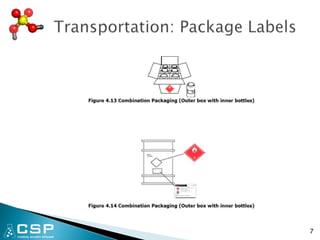
7
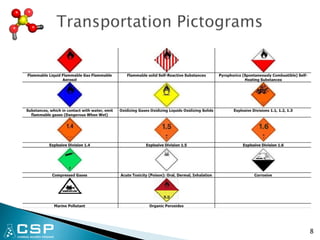
8
9
 Serve the same function as an MSDS does in
ISO, EU and ANSI requirements
 Most comprehensive source of information
• Hazards, including environmental hazards
• Advice and safety precautions
◦ Transportation, emergency responders, poison centers
 Product related and not specific to workplace
or task
• Written and supplied by manufacturer
 Only for pure substances and some mixtures
http://www.osha.gov/dsg/hazcom/ghs.html
10
1. Identification
2. Hazard(s) identification
3. Composition/information
on ingredients
4. First-aid measures
5. Fire-fighting measures
6. Accidental release
measures
7. Handling and Storage
8. Exposure controls/
personal protection
9. Physical and chemical
properties
10. Stability and reactivity
11. Toxicological information
12. Ecological information
13. Disposal considerations
14. Transport information
15. Regulatory information
16. Other information
16 Sections
Look at Sulfuric Acid SDS provided in Booklet, as we
describe some of the important sections
11
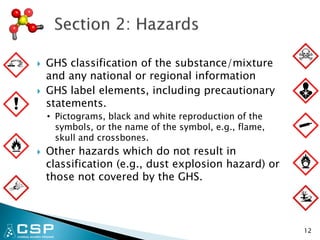
 GHS classification of the substance/mixture
and any national or regional information
 GHS label elements, including precautionary
statements.
• Pictograms, black and white reproduction of the
symbols, or the name of the symbol, e.g., flame,
skull and crossbones.
 Other hazards which do not result in
classification (e.g., dust explosion hazard) or
those not covered by the GHS.
12
 Description of necessary measures,
subdivided according to the different routes
of exposure, i.e., inhalation, skin and eye
contact, and ingestion.
 Most important symptoms/effects, acute and
delayed.
 Indication of immediate medical attention and
special treatment needed, if necessary.
13
Section 6: Handling and Storage
 Precautions for safe handling.
 Conditions for safe storage, including any
incompatibilities.
Section 7: Exposure controls/ personal protection
 Control parameters, e.g., occupational exposure
limit values or biological limit values.
 Appropriate engineering controls.
 Individual protection measures, such as personal
protective equipment (PPE).
14
 Reactivity
 Chemical stability
 Possibility of hazardous reactions
 Conditions to avoid (e.g., static discharge,
shock or vibration)
 Incompatible materials
 Hazardous decomposition products
15
Section 13: Disposal Considerations
 Description of waste residues and
information on their safe handling and
methods of disposal, including the disposal
of any contaminated packaging.
• May be region, country specific
Section 15: Regulatory Information
 Safety, health and environmental regulations
specific for the product in question.
• May be region, country specific
16
‣ Drawbacks
• Not always current
• Lack of toxicity information for most chemicals
• Industry focus, not specific to laboratory scale
• Sometimes inconsistent
‣ SDS contains comprehensive information for
chemical management in one place
‣ Keep SDS for each chemical in your inventory
17

3 ghs

  • 1.
    Sandia is amulti-program laboratory operated by Sandia Corporation, a Lockheed Martin Company, for the United States Department of Energy’s National Nuclear Security Administration under contract DE-AC04-94AL85000.
  • 3.
    3  A systemfor standardizing and harmonizing the classification and labeling of chemicals  Not a regulation or a standard. • establishes agreed hazard classification and communication provisions with explanatory information on how to apply the system  GHS Labels and Safety Data Sheets (SDS) http://www.osha.gov/dsg/hazcom/ghs.html
  • 4.
    4  Symbols (hazardpictograms)  Signal words • "Danger" for the more severe hazards, and • "Warning" for the less severe hazards  Hazard statement  Precautionary Statements and Pictograms • prevention, response in cases of accidental spillage or exposure, storage, and disposal  Product Identifier (ingredient disclosure)  Supplier identification  Supplemental information
  • 5.
    5 Symbols (Hazard Pictograms) SignalWord ("Danger" for the more severe hazards, and "Warning" for the less severe hazards) Hazard Statement Product Identifier and ingredient disclosure Precautionary Statement (prevention, response in cases of accidental spillage or exposure, storage, and disposal Supplemental Information Supplier Identification
  • 6.
    Corrosive Irritant HealthHazard Acute Toxicity Flammable Explosion Oxidizer Compressed Gas 6
  • 7.
  • 8.
  • 9.
  • 10.
     Serve thesame function as an MSDS does in ISO, EU and ANSI requirements  Most comprehensive source of information • Hazards, including environmental hazards • Advice and safety precautions ◦ Transportation, emergency responders, poison centers  Product related and not specific to workplace or task • Written and supplied by manufacturer  Only for pure substances and some mixtures http://www.osha.gov/dsg/hazcom/ghs.html 10
  • 11.
    1. Identification 2. Hazard(s)identification 3. Composition/information on ingredients 4. First-aid measures 5. Fire-fighting measures 6. Accidental release measures 7. Handling and Storage 8. Exposure controls/ personal protection 9. Physical and chemical properties 10. Stability and reactivity 11. Toxicological information 12. Ecological information 13. Disposal considerations 14. Transport information 15. Regulatory information 16. Other information 16 Sections Look at Sulfuric Acid SDS provided in Booklet, as we describe some of the important sections 11
  • 12.
     GHS classificationof the substance/mixture and any national or regional information  GHS label elements, including precautionary statements. • Pictograms, black and white reproduction of the symbols, or the name of the symbol, e.g., flame, skull and crossbones.  Other hazards which do not result in classification (e.g., dust explosion hazard) or those not covered by the GHS. 12
  • 13.
     Description ofnecessary measures, subdivided according to the different routes of exposure, i.e., inhalation, skin and eye contact, and ingestion.  Most important symptoms/effects, acute and delayed.  Indication of immediate medical attention and special treatment needed, if necessary. 13
  • 14.
    Section 6: Handlingand Storage  Precautions for safe handling.  Conditions for safe storage, including any incompatibilities. Section 7: Exposure controls/ personal protection  Control parameters, e.g., occupational exposure limit values or biological limit values.  Appropriate engineering controls.  Individual protection measures, such as personal protective equipment (PPE). 14
  • 15.
     Reactivity  Chemicalstability  Possibility of hazardous reactions  Conditions to avoid (e.g., static discharge, shock or vibration)  Incompatible materials  Hazardous decomposition products 15
  • 16.
    Section 13: DisposalConsiderations  Description of waste residues and information on their safe handling and methods of disposal, including the disposal of any contaminated packaging. • May be region, country specific Section 15: Regulatory Information  Safety, health and environmental regulations specific for the product in question. • May be region, country specific 16
  • 17.
    ‣ Drawbacks • Notalways current • Lack of toxicity information for most chemicals • Industry focus, not specific to laboratory scale • Sometimes inconsistent ‣ SDS contains comprehensive information for chemical management in one place ‣ Keep SDS for each chemical in your inventory 17

Editor's Notes

  • #6 Animation guides through: Symbols (hazard pictograms) Signal words "Danger" for the more severe hazards, and "Warning" for the less severe hazards Hazard statement Precautionary Statements and Pictograms prevention, response in cases of accidental spillage or exposure, storage, and disposal Product Identifier (ingredient disclosure) Supplier identification Supplemental information