Presented by : Ajay Kumar
Course : M.sc physics (sem. -3rd)
Registration no. : 16mscphy09
Email : invinciblelangeh9297@gmail.com
Seminar on
Polymer
Nanocomposites
Supervision by :
Dr. Kamesh Yadav
Assistant professor
Centre for physical sciences
1
CONTENT
 Introduction
 Advantage of Nanoscale filler over conventional filler
 Role of interface between reinforcement and matrix
 Surface modification of nanofiller & It’s role
 Polymer nanocomposites and it’s synthesis method
- melt compounding
- solvent processing
- in situ polymerisation
 Advantages of Polymer NC over conventional composites
Reference
2
‘Nanocomposites’ = Nano + Composites
‘Nano’ means very small ratio, billionth part of one
[ 1nano = 10−9
]
‘Composites’ are combinations of more than two,
difference phase materials
What are nanocomposites?
3
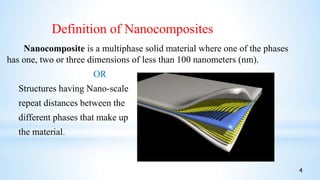
Nanocomposite is a multiphase solid material where one of the phases
has one, two or three dimensions of less than 100 nanometers (nm).
OR
Structures having Nano-scale
repeat distances between the
different phases that make up
the material.
Definition of Nanocomposites
4
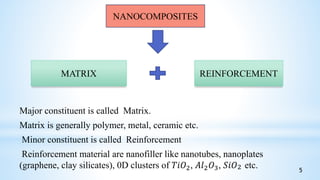
Major constituent is called Matrix.
Matrix is generally polymer, metal, ceramic etc.
Minor constituent is called Reinforcement
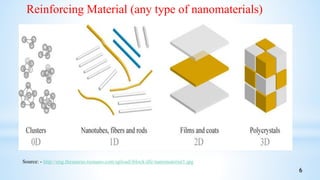
Reinforcement material are nanofiller like nanotubes, nanoplates
(graphene, clay silicates), 0D clusters of 𝑇𝑖𝑂2, 𝐴𝑙2 𝑂3, 𝑆𝑖𝑂2 etc.
NANOCOMPOSITES
MATRIX REINFORCEMENT
5
Reinforcing Material (any type of nanomaterials)
Source: - http://eng.thesaurus.rusnano.com/upload/iblock/dfc/nanomaterial1.jpg
6
Advantages of Nanoscale Filler over Conventional Filler
 Low-percolation threshold (~0.1–2 vol.%).
 Large number density of particles per particle volume
(106–108 particles/µm3
).
 Surface area per volume ratio
 Area of interface is higher as compared normal composites
 Short distances between particles (10–50nm at ~1–8 vol.%).
7
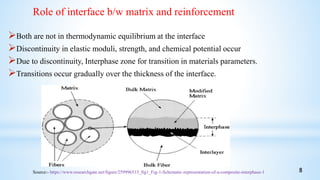
Both are not in thermodynamic equilibrium at the interface
Discontinuity in elastic moduli, strength, and chemical potential occur
Due to discontinuity, Interphase zone for transition in materials parameters.
Transitions occur gradually over the thickness of the interface.
Source:- https://www.researchgate.net/figure/259996513_fig1_Fig-1-Schematic-representation-of-a-composite-interphase-1
Role of interface b/w matrix and reinforcement
8
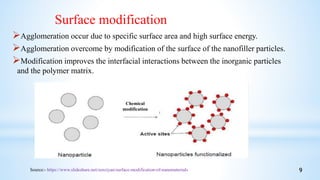
Agglomeration occur due to specific surface area and high surface energy.
Agglomeration overcome by modification of the surface of the nanofiller particles.
Modification improves the interfacial interactions between the inorganic particles
and the polymer matrix.
Chemical
modification
Source:- https://www.slideshare.net/zenziyan/surface-modification-of-nanomaterials
Surface modification
9
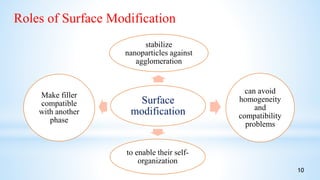
Surface
modification
Make filler
compatible
with another
phase
can avoid
homogeneity
and
compatibility
problems
to enable their self-
organization
stabilize
nanoparticles against
agglomeration
Roles of Surface Modification
10
Polymer Nanocomposites
Polymers = Poly + Mers
‘Poly’ means ‘many’ & ‘Mers’ means a ‘units’
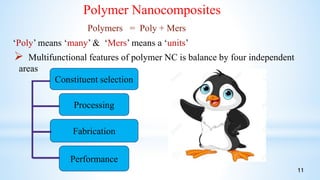
 Multifunctional features of polymer NC is balance by four independent
areas
Constituent selection
Processing
Fabrication
Performance
11
Challenges to prepare Nanocomposites
 Overcome the huge surface energy, a result of enormous surface
area or large surface to volume ratio
 desired size, uniform size distribution, morphology,
crystallinity, chemical composition and microstructure desired
physical properties.
 Prevent nanocomposites from agglomeration
 Morphology control
12
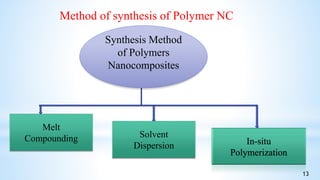
In-situ
Polymerization
Melt
Compounding Solvent
Dispersion
Synthesis Method
of Polymers
Nanocomposites
Method of synthesis of Polymer NC
13
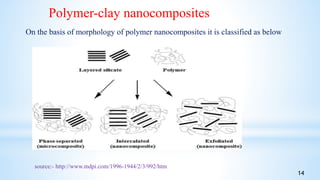
Polymer-clay nanocomposites
On the basis of morphology of polymer nanocomposites it is classified as below
source:- http://www.mdpi.com/1996-1944/2/3/992/htm
14
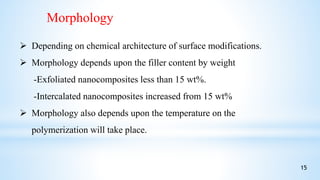
Morphology
 Depending on chemical architecture of surface modifications.
 Morphology depends upon the filler content by weight
-Exfoliated nanocomposites less than 15 wt%.
-Intercalated nanocomposites increased from 15 wt%
 Morphology also depends upon the temperature on the
polymerization will take place.
15
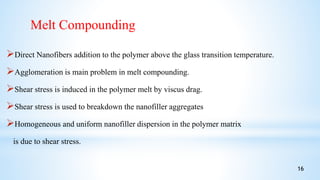
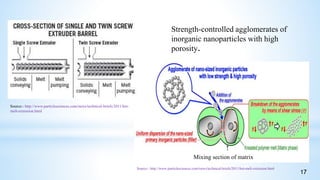
Direct Nanofibers addition to the polymer above the glass transition temperature.
Agglomeration is main problem in melt compounding.
Shear stress is induced in the polymer melt by viscus drag.
Shear stress is used to breakdown the nanofiller aggregates
Homogeneous and uniform nanofiller dispersion in the polymer matrix
is due to shear stress.
Melt Compounding
16
Mixing section of matrix
Strength-controlled agglomerates of
inorganic nanoparticles with high
porosity.
Source:- http://www.particlesciences.com/news/technical-briefs/2011/hot-
melt-extrusion.html
Source:- http://www.particlesciences.com/news/technical-briefs/2011/hot-melt-extrusion.html
17
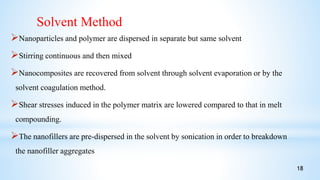
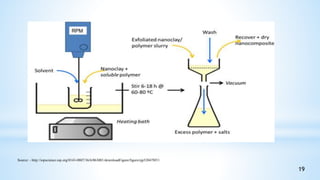
Nanoparticles and polymer are dispersed in separate but same solvent
Stirring continuous and then mixed
Nanocomposites are recovered from solvent through solvent evaporation or by the
solvent coagulation method.
Shear stresses induced in the polymer matrix are lowered compared to that in melt
compounding.
The nanofillers are pre-dispersed in the solvent by sonication in order to breakdown
the nanofiller aggregates
Solvent Method
18
Source: - http://iopscience.iop.org/0143-0807/36/6/063001/downloadFigure/figure/ejp520478f11
19
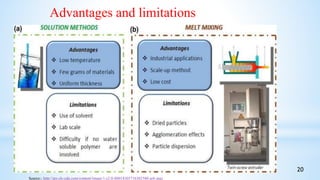
Advantages and limitations
Source:- http://ars.els-cdn.com/content/image/1-s2.0-S0014305716302580-gr6.jpgs
20
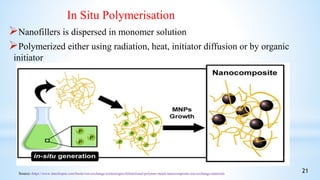
Nanofillers is dispersed in monomer solution
Polymerized either using radiation, heat, initiator diffusion or by organic
initiator
In Situ Polymerisation
Source:-https://www.intechopen.com/books/ion-exchange-technologies/bifunctional-polymer-metal-nanocomposite-ion-exchange-materials
21
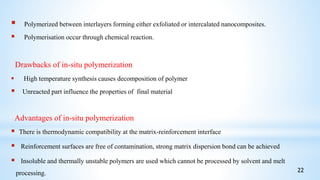
 Polymerized between interlayers forming either exfoliated or intercalated nanocomposites.
 Polymerisation occur through chemical reaction.
Drawbacks of in-situ polymerization
 High temperature synthesis causes decomposition of polymer
 Unreacted part influence the properties of final material
Advantages of in-situ polymerization
 There is thermodynamic compatibility at the matrix-reinforcement interface
 Reinforcement surfaces are free of contamination, strong matrix dispersion bond can be achieved
 Insoluble and thermally unstable polymers are used which cannot be processed by solvent and melt
processing. 22
Advantages of Polymer NC over conventional polymer composites
23
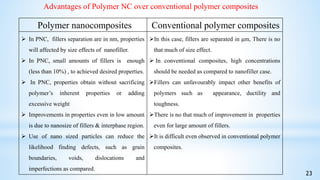
Polymer nanocomposites Conventional polymer composites
 In PNC, fillers separation are in nm, properties
will affected by size effects of nanofiller.
 In PNC, small amounts of fillers is enough
(less than 10%) , to achieved desired properties.
 In PNC, properties obtain without sacrificing
polymer’s inherent properties or adding
excessive weight
 Improvements in properties even in low amount
is due to nanosize of fillers & interphase region.
 Use of nano sized particles can reduce the
likelihood finding defects, such as grain
boundaries, voids, dislocations and
imperfections as compared.
In this case, fillers are separated in μm, There is no
that much of size effect.
 In conventional composites, high concentrations
should be needed as compared to nanofiller case.
Fillers can unfavourably impact other benefits of
polymers such as appearance, ductility and
toughness.
There is no that much of improvement in properties
even for large amount of fillers.
It is difficult even observed in conventional polymer
composites.
REFERENCES
• https://i1.wp.com/www.qats.com/cms/wpcontent/uploads/2015/02/Advanced_Packaging_Materials_
October_2014_Figure_2.png
• https://www.researchgate.net/figure/223258676_fig12_Fig-12-Schematic-representation-of-the-preparation-
of-the-nanocomposites-a-direct
• https://en.wikipedia.org/wiki/Metal_matrix_composite
• http://www.scielo.br/pdf/mr/v12n1/02.pdf
• https://www.researchgate.net/publication/312327309_PVA_PVA_Blends_and_Their_Nanocomposit
es_for_Biodegradable_Packaging_Application
• http://ncmn.unl.edu/Nanocomposite%20%282013%206%2021%29.pdf
http://ncmn.unl.edu/Nanocomposite%20%282013%206%2021%29.pdf
• http://www.onecentralpress.com/wp-content/uploads/2016/12/Chapter-4-TN-.pdf
• https://www.slideshare.net/AttittudeBlogger/amina-42914064
• http://www.sciencedirect.com/science/article/pii/S0032386108003157
• https://www.researchgate.net/publication/226269884_Ceramic_Matrix_Composites_Containing_Ca
rbon_Nanotubes
24
Thank you
24

Seminar on nanocomposites

  • 1.
    Presented by :Ajay Kumar Course : M.sc physics (sem. -3rd) Registration no. : 16mscphy09 Email : invinciblelangeh9297@gmail.com Seminar on Polymer Nanocomposites Supervision by : Dr. Kamesh Yadav Assistant professor Centre for physical sciences 1
  • 2.
    CONTENT  Introduction  Advantageof Nanoscale filler over conventional filler  Role of interface between reinforcement and matrix  Surface modification of nanofiller & It’s role  Polymer nanocomposites and it’s synthesis method - melt compounding - solvent processing - in situ polymerisation  Advantages of Polymer NC over conventional composites Reference 2
  • 3.
    ‘Nanocomposites’ = Nano+ Composites ‘Nano’ means very small ratio, billionth part of one [ 1nano = 10−9 ] ‘Composites’ are combinations of more than two, difference phase materials What are nanocomposites? 3
  • 4.
    Nanocomposite is amultiphase solid material where one of the phases has one, two or three dimensions of less than 100 nanometers (nm). OR Structures having Nano-scale repeat distances between the different phases that make up the material. Definition of Nanocomposites 4
  • 5.
    Major constituent iscalled Matrix. Matrix is generally polymer, metal, ceramic etc. Minor constituent is called Reinforcement Reinforcement material are nanofiller like nanotubes, nanoplates (graphene, clay silicates), 0D clusters of 𝑇𝑖𝑂2, 𝐴𝑙2 𝑂3, 𝑆𝑖𝑂2 etc. NANOCOMPOSITES MATRIX REINFORCEMENT 5
  • 6.
    Reinforcing Material (anytype of nanomaterials) Source: - http://eng.thesaurus.rusnano.com/upload/iblock/dfc/nanomaterial1.jpg 6
  • 7.
    Advantages of NanoscaleFiller over Conventional Filler  Low-percolation threshold (~0.1–2 vol.%).  Large number density of particles per particle volume (106–108 particles/µm3 ).  Surface area per volume ratio  Area of interface is higher as compared normal composites  Short distances between particles (10–50nm at ~1–8 vol.%). 7
  • 8.
    Both are notin thermodynamic equilibrium at the interface Discontinuity in elastic moduli, strength, and chemical potential occur Due to discontinuity, Interphase zone for transition in materials parameters. Transitions occur gradually over the thickness of the interface. Source:- https://www.researchgate.net/figure/259996513_fig1_Fig-1-Schematic-representation-of-a-composite-interphase-1 Role of interface b/w matrix and reinforcement 8
  • 9.
    Agglomeration occur dueto specific surface area and high surface energy. Agglomeration overcome by modification of the surface of the nanofiller particles. Modification improves the interfacial interactions between the inorganic particles and the polymer matrix. Chemical modification Source:- https://www.slideshare.net/zenziyan/surface-modification-of-nanomaterials Surface modification 9
  • 10.
    Surface modification Make filler compatible with another phase canavoid homogeneity and compatibility problems to enable their self- organization stabilize nanoparticles against agglomeration Roles of Surface Modification 10
  • 11.
    Polymer Nanocomposites Polymers =Poly + Mers ‘Poly’ means ‘many’ & ‘Mers’ means a ‘units’  Multifunctional features of polymer NC is balance by four independent areas Constituent selection Processing Fabrication Performance 11
  • 12.
    Challenges to prepareNanocomposites  Overcome the huge surface energy, a result of enormous surface area or large surface to volume ratio  desired size, uniform size distribution, morphology, crystallinity, chemical composition and microstructure desired physical properties.  Prevent nanocomposites from agglomeration  Morphology control 12
  • 13.
    In-situ Polymerization Melt Compounding Solvent Dispersion Synthesis Method ofPolymers Nanocomposites Method of synthesis of Polymer NC 13
  • 14.
    Polymer-clay nanocomposites On thebasis of morphology of polymer nanocomposites it is classified as below source:- http://www.mdpi.com/1996-1944/2/3/992/htm 14
  • 15.
    Morphology  Depending onchemical architecture of surface modifications.  Morphology depends upon the filler content by weight -Exfoliated nanocomposites less than 15 wt%. -Intercalated nanocomposites increased from 15 wt%  Morphology also depends upon the temperature on the polymerization will take place. 15
  • 16.
    Direct Nanofibers additionto the polymer above the glass transition temperature. Agglomeration is main problem in melt compounding. Shear stress is induced in the polymer melt by viscus drag. Shear stress is used to breakdown the nanofiller aggregates Homogeneous and uniform nanofiller dispersion in the polymer matrix is due to shear stress. Melt Compounding 16
  • 17.
    Mixing section ofmatrix Strength-controlled agglomerates of inorganic nanoparticles with high porosity. Source:- http://www.particlesciences.com/news/technical-briefs/2011/hot- melt-extrusion.html Source:- http://www.particlesciences.com/news/technical-briefs/2011/hot-melt-extrusion.html 17
  • 18.
    Nanoparticles and polymerare dispersed in separate but same solvent Stirring continuous and then mixed Nanocomposites are recovered from solvent through solvent evaporation or by the solvent coagulation method. Shear stresses induced in the polymer matrix are lowered compared to that in melt compounding. The nanofillers are pre-dispersed in the solvent by sonication in order to breakdown the nanofiller aggregates Solvent Method 18
  • 19.
  • 20.
    Advantages and limitations Source:-http://ars.els-cdn.com/content/image/1-s2.0-S0014305716302580-gr6.jpgs 20
  • 21.
    Nanofillers is dispersedin monomer solution Polymerized either using radiation, heat, initiator diffusion or by organic initiator In Situ Polymerisation Source:-https://www.intechopen.com/books/ion-exchange-technologies/bifunctional-polymer-metal-nanocomposite-ion-exchange-materials 21
  • 22.
     Polymerized betweeninterlayers forming either exfoliated or intercalated nanocomposites.  Polymerisation occur through chemical reaction. Drawbacks of in-situ polymerization  High temperature synthesis causes decomposition of polymer  Unreacted part influence the properties of final material Advantages of in-situ polymerization  There is thermodynamic compatibility at the matrix-reinforcement interface  Reinforcement surfaces are free of contamination, strong matrix dispersion bond can be achieved  Insoluble and thermally unstable polymers are used which cannot be processed by solvent and melt processing. 22
  • 23.
    Advantages of PolymerNC over conventional polymer composites 23 Polymer nanocomposites Conventional polymer composites  In PNC, fillers separation are in nm, properties will affected by size effects of nanofiller.  In PNC, small amounts of fillers is enough (less than 10%) , to achieved desired properties.  In PNC, properties obtain without sacrificing polymer’s inherent properties or adding excessive weight  Improvements in properties even in low amount is due to nanosize of fillers & interphase region.  Use of nano sized particles can reduce the likelihood finding defects, such as grain boundaries, voids, dislocations and imperfections as compared. In this case, fillers are separated in μm, There is no that much of size effect.  In conventional composites, high concentrations should be needed as compared to nanofiller case. Fillers can unfavourably impact other benefits of polymers such as appearance, ductility and toughness. There is no that much of improvement in properties even for large amount of fillers. It is difficult even observed in conventional polymer composites.
  • 24.
    REFERENCES • https://i1.wp.com/www.qats.com/cms/wpcontent/uploads/2015/02/Advanced_Packaging_Materials_ October_2014_Figure_2.png • https://www.researchgate.net/figure/223258676_fig12_Fig-12-Schematic-representation-of-the-preparation- of-the-nanocomposites-a-direct •https://en.wikipedia.org/wiki/Metal_matrix_composite • http://www.scielo.br/pdf/mr/v12n1/02.pdf • https://www.researchgate.net/publication/312327309_PVA_PVA_Blends_and_Their_Nanocomposit es_for_Biodegradable_Packaging_Application • http://ncmn.unl.edu/Nanocomposite%20%282013%206%2021%29.pdf http://ncmn.unl.edu/Nanocomposite%20%282013%206%2021%29.pdf • http://www.onecentralpress.com/wp-content/uploads/2016/12/Chapter-4-TN-.pdf • https://www.slideshare.net/AttittudeBlogger/amina-42914064 • http://www.sciencedirect.com/science/article/pii/S0032386108003157 • https://www.researchgate.net/publication/226269884_Ceramic_Matrix_Composites_Containing_Ca rbon_Nanotubes 24
  • 25.