-Presentation Made By Omkar Rane
Roll Number : SETB118
SEAT NUMBER: S177086
BATCH-1, BLOCK-1, CYCLE-2, SEM-3
Department Of Electronics And Telecommunication Engineering
Nano-Technology In Mobiles Phones
Nanotechnology ("nanotech") is manipulation of matter on an atomic, molecular,
and supramolecular scale. The earliest, widespread description of nanotechnology
referred to the particular technological goal of precisely manipulating atoms and
molecules for fabrication of macroscale products, also now referred to as molecular
nanotechnology. A more generalized description of nanotechnology was subsequently
established by the National Nanotechnology Initiative, which defines nanotechnology
as the manipulation of matter with at least one dimension sized from 1 to
100 nanometers.
Super Hydrophobic Coatings
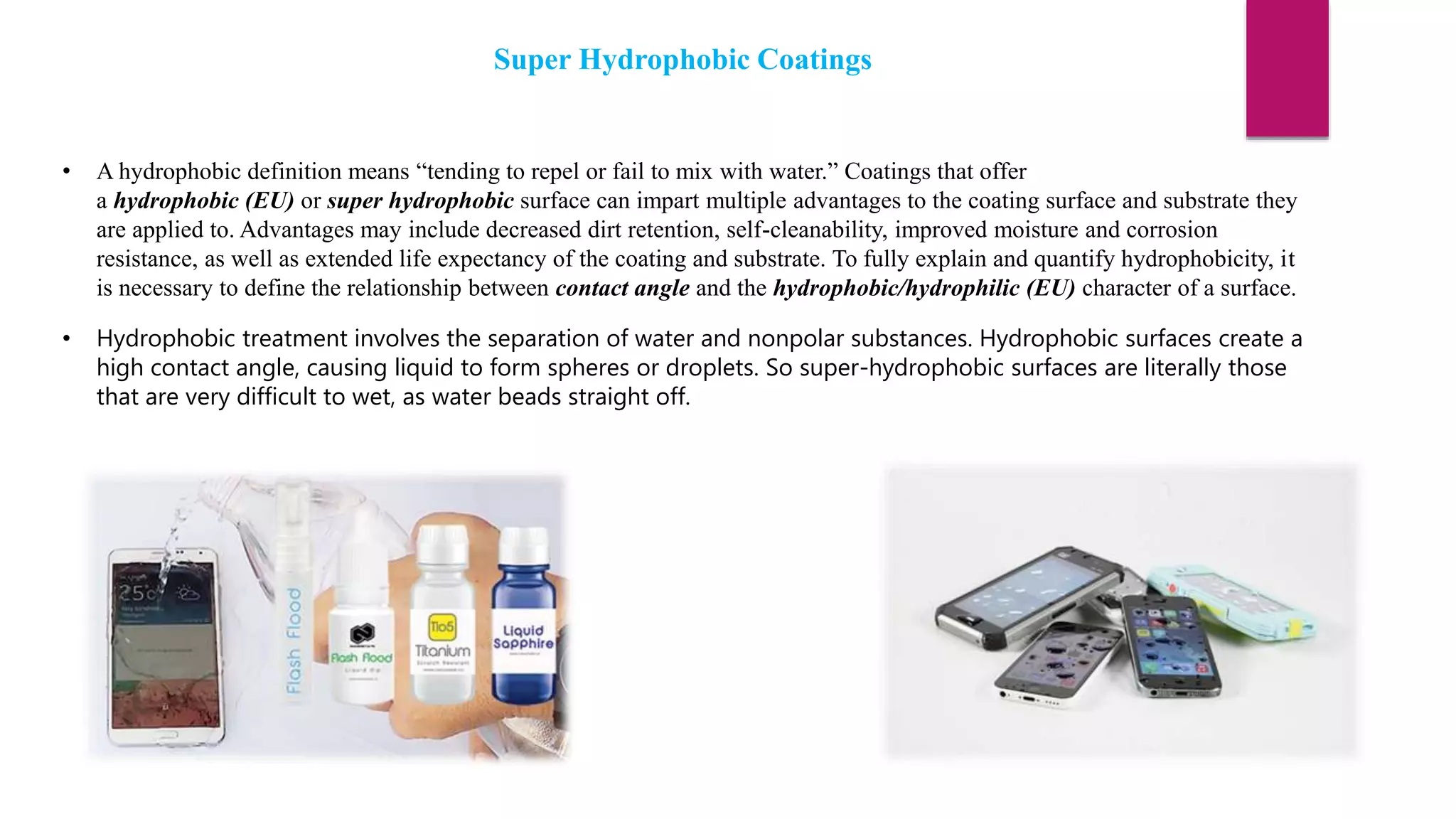
• A hydrophobic definition means “tending to repel or fail to mix with water.” Coatings that offer
a hydrophobic (EU) or super hydrophobic surface can impart multiple advantages to the coating surface and substrate they
are applied to. Advantages may include decreased dirt retention, self-cleanability, improved moisture and corrosion
resistance, as well as extended life expectancy of the coating and substrate. To fully explain and quantify hydrophobicity, it
is necessary to define the relationship between contact angle and the hydrophobic/hydrophilic (EU) character of a surface.
• Hydrophobic treatment involves the separation of water and nonpolar substances. Hydrophobic surfaces create a
high contact angle, causing liquid to form spheres or droplets. So super-hydrophobic surfaces are literally those
that are very difficult to wet, as water beads straight off.
Nanotechnology in Mobile Phone Displays
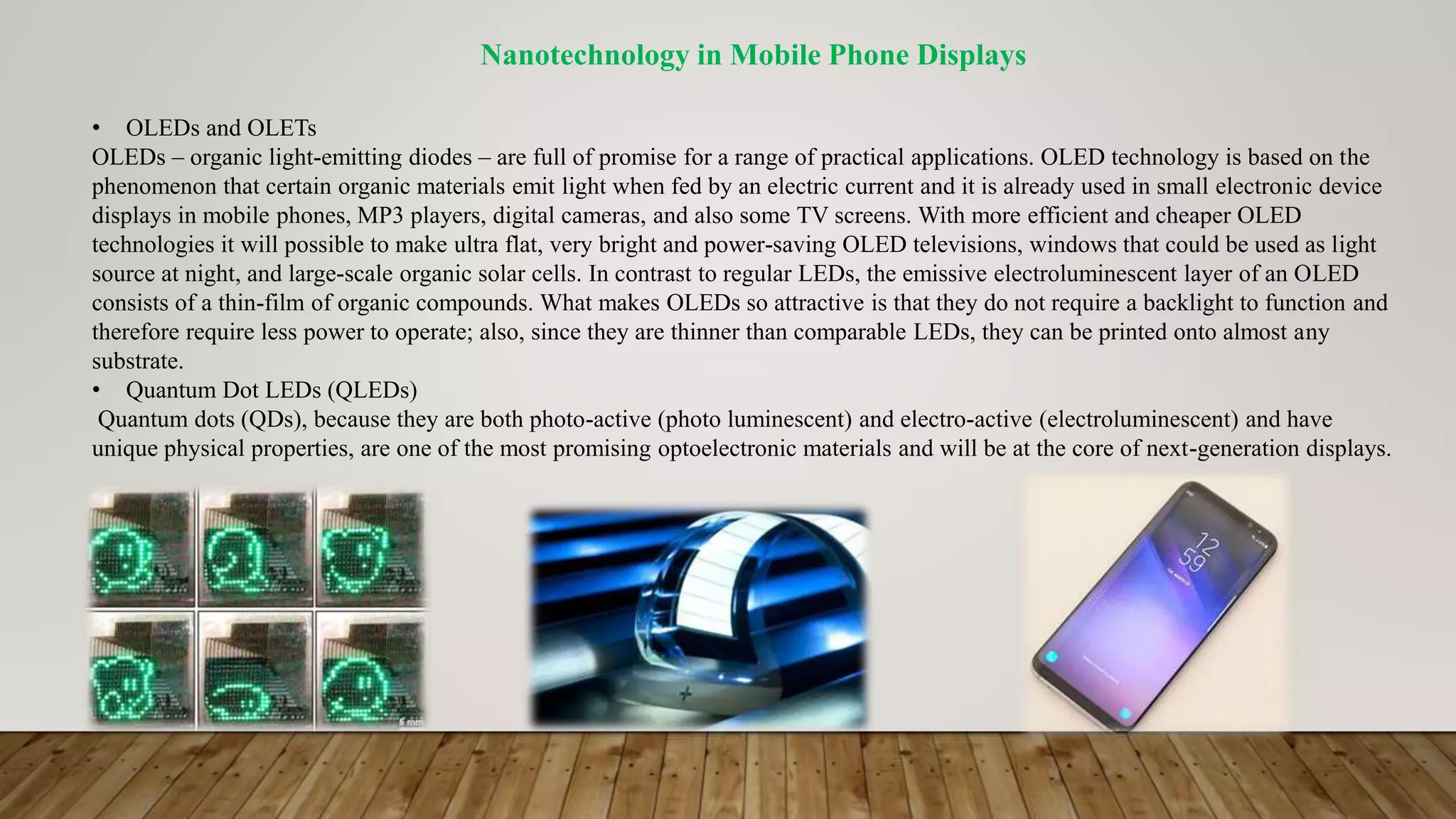
• OLEDs and OLETs
OLEDs – organic light-emitting diodes – are full of promise for a range of practical applications. OLED technology is based on the
phenomenon that certain organic materials emit light when fed by an electric current and it is already used in small electronic device
displays in mobile phones, MP3 players, digital cameras, and also some TV screens. With more efficient and cheaper OLED
technologies it will possible to make ultra flat, very bright and power-saving OLED televisions, windows that could be used as light
source at night, and large-scale organic solar cells. In contrast to regular LEDs, the emissive electroluminescent layer of an OLED
consists of a thin-film of organic compounds. What makes OLEDs so attractive is that they do not require a backlight to function and
therefore require less power to operate; also, since they are thinner than comparable LEDs, they can be printed onto almost any
substrate.
• Quantum Dot LEDs (QLEDs)
Quantum dots (QDs), because they are both photo-active (photo luminescent) and electro-active (electroluminescent) and have
unique physical properties, are one of the most promising optoelectronic materials and will be at the core of next-generation displays.
Nano technology in Lithium Ion Mobile batteries
• Researchers at North Carolina State University have demonstrated the use of silicon coated carbon nanotubes for in
anodes for Li-ion batteries. They are predicting that the use of silicon can increase the capacity of Li-ion batteries by up to 10
times. However silicon expands during a batteries discharge cycle, which can damage silicon based anodes. By depositing
silicon on nanotubes aligned parallel to each other the researchers hope to prevent damage to the anode when the silicon
expands.
• Researchers at Stanford University and SLAC are developing techniques to surround silicon nanoparticles with graphene
cages. The idea is that when the silicon expands and cracks form in the nanoparticles the silicon remains in the graphene cage
without degrading the anode.
• Researchers at Los Alamos National Laboratory have demonstrated a catalyst made from nitrogen-doped carbon-
nanotubes, instead of platinum. The researchers believe this type of catalyst could be used in Lithium-air batteries, which can
store up to 10 times as much energy as lithium-ion batteries.
• Researchers at USC are developing a lithium ion battery that can recharge within 10 minutes using silicon nanoparticles in
the anode of the battery. The use of silicon nanoparticles, rather than solid silicon, prevents the cracking of the electrode which
occurs in solid silicon electrodes.
Nano Technology In Processors And Memories
• All modern processor architecture like ARM, CORTEX they use Nano
technology for manufacturing of micro-chips.
• Semiconductor memories of large size unto 1 TB are available in small sizes
which reduces physical size of storage.
• Nano technology is widely used in manufacturing and fabrication of SMD(solid
state devices) electronics components which reduce the size on Printed Circuit
Boards (PCB).
THANK YOU !
-Presentation Made By Omkar Rane
Roll Number : SETB118
SEAT NUMBER: S!77086
BATCH-1, BLOCK-1, CYCLE-2, SEM-3

Nano technology In Mobiles

  • 1.
    -Presentation Made ByOmkar Rane Roll Number : SETB118 SEAT NUMBER: S177086 BATCH-1, BLOCK-1, CYCLE-2, SEM-3 Department Of Electronics And Telecommunication Engineering
  • 2.
    Nano-Technology In MobilesPhones Nanotechnology ("nanotech") is manipulation of matter on an atomic, molecular, and supramolecular scale. The earliest, widespread description of nanotechnology referred to the particular technological goal of precisely manipulating atoms and molecules for fabrication of macroscale products, also now referred to as molecular nanotechnology. A more generalized description of nanotechnology was subsequently established by the National Nanotechnology Initiative, which defines nanotechnology as the manipulation of matter with at least one dimension sized from 1 to 100 nanometers.
  • 3.
    Super Hydrophobic Coatings •A hydrophobic definition means “tending to repel or fail to mix with water.” Coatings that offer a hydrophobic (EU) or super hydrophobic surface can impart multiple advantages to the coating surface and substrate they are applied to. Advantages may include decreased dirt retention, self-cleanability, improved moisture and corrosion resistance, as well as extended life expectancy of the coating and substrate. To fully explain and quantify hydrophobicity, it is necessary to define the relationship between contact angle and the hydrophobic/hydrophilic (EU) character of a surface. • Hydrophobic treatment involves the separation of water and nonpolar substances. Hydrophobic surfaces create a high contact angle, causing liquid to form spheres or droplets. So super-hydrophobic surfaces are literally those that are very difficult to wet, as water beads straight off.
  • 4.
    Nanotechnology in MobilePhone Displays • OLEDs and OLETs OLEDs – organic light-emitting diodes – are full of promise for a range of practical applications. OLED technology is based on the phenomenon that certain organic materials emit light when fed by an electric current and it is already used in small electronic device displays in mobile phones, MP3 players, digital cameras, and also some TV screens. With more efficient and cheaper OLED technologies it will possible to make ultra flat, very bright and power-saving OLED televisions, windows that could be used as light source at night, and large-scale organic solar cells. In contrast to regular LEDs, the emissive electroluminescent layer of an OLED consists of a thin-film of organic compounds. What makes OLEDs so attractive is that they do not require a backlight to function and therefore require less power to operate; also, since they are thinner than comparable LEDs, they can be printed onto almost any substrate. • Quantum Dot LEDs (QLEDs) Quantum dots (QDs), because they are both photo-active (photo luminescent) and electro-active (electroluminescent) and have unique physical properties, are one of the most promising optoelectronic materials and will be at the core of next-generation displays.
  • 5.
    Nano technology inLithium Ion Mobile batteries • Researchers at North Carolina State University have demonstrated the use of silicon coated carbon nanotubes for in anodes for Li-ion batteries. They are predicting that the use of silicon can increase the capacity of Li-ion batteries by up to 10 times. However silicon expands during a batteries discharge cycle, which can damage silicon based anodes. By depositing silicon on nanotubes aligned parallel to each other the researchers hope to prevent damage to the anode when the silicon expands. • Researchers at Stanford University and SLAC are developing techniques to surround silicon nanoparticles with graphene cages. The idea is that when the silicon expands and cracks form in the nanoparticles the silicon remains in the graphene cage without degrading the anode. • Researchers at Los Alamos National Laboratory have demonstrated a catalyst made from nitrogen-doped carbon- nanotubes, instead of platinum. The researchers believe this type of catalyst could be used in Lithium-air batteries, which can store up to 10 times as much energy as lithium-ion batteries. • Researchers at USC are developing a lithium ion battery that can recharge within 10 minutes using silicon nanoparticles in the anode of the battery. The use of silicon nanoparticles, rather than solid silicon, prevents the cracking of the electrode which occurs in solid silicon electrodes.
  • 6.
    Nano Technology InProcessors And Memories • All modern processor architecture like ARM, CORTEX they use Nano technology for manufacturing of micro-chips. • Semiconductor memories of large size unto 1 TB are available in small sizes which reduces physical size of storage. • Nano technology is widely used in manufacturing and fabrication of SMD(solid state devices) electronics components which reduce the size on Printed Circuit Boards (PCB).
  • 7.
    THANK YOU ! -PresentationMade By Omkar Rane Roll Number : SETB118 SEAT NUMBER: S!77086 BATCH-1, BLOCK-1, CYCLE-2, SEM-3