CONTENTS:
Introduction
What is nanotechnology?
Approaches
Steps to produce nanomaterials
Applications
Advantages
Conclusion
Introduction:
It’s the development and practical applications on a
nanometric scale
Engineering of tiny machines
Greek prefix ”nano” means a billionth
100 nanometers is the limit to observe new
properties of matter
What Is Nanotechnology
Nanotechnology is the engineering of tiny machines—the
projected ability to make things from the bottom up, using
techniques and tools being developed today to place every
atom and molecule in a desired place. Shortly after this
envisioned molecular machinery is created, it will result in a
manufacturing revolution, probably causing severe
disruption. It also has serious economic, social,
environmental, and military implications.
The principles of physics do not limit our ability to manipulate
things atom by atom. It is not an attempt to violate any laws; it is
something, in principle, that can be done; but in practice, it has not
been done because we are too big.
--Richard Feynman
Approaches:
In building any nanomaterials; the available approaches i.e.
methods are

 Top-down

Bottom-up
Top-down
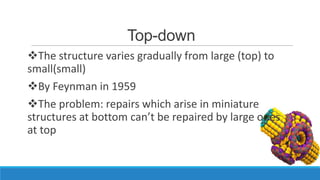
The structure varies gradually from large (top) to
small(small)
By Feynman in 1959
The problem: repairs which arise in miniature
structures at bottom can’t be repaired by large ones
at top
Bottom-up
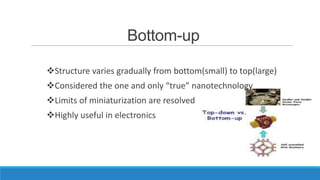
Structure varies gradually from bottom(small) to top(large)
Considered the one and only “true” nanotechnology
Limits of miniaturization are resolved
Highly useful in electronics
Steps to produce NANOMATERIALS
Three primary steps to produce nanomaterials
1. Ability to manipulate individual atoms
2. Development of nanoscopic
machines(assemblers)
3. Replicators are to be programmed
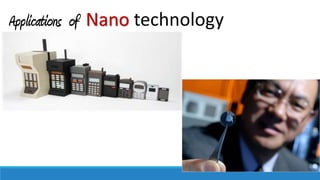
Applications of Nano technology
APPLICATIONS:
Strong fibers:
Basic item to produce is strong fibre
Later on replications can be made of diamonds,
water and even food
Famines can be then successfully eradicated
Atomic plants:
Hands” for handling radioactive substances
Various functions inside the inner parts of
reactors
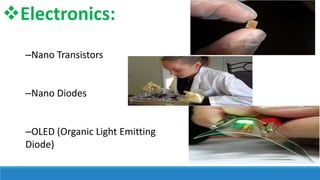
Electronics:
–Nano Transistors
–Nano Diodes
–OLED (Organic Light Emitting
Diode)
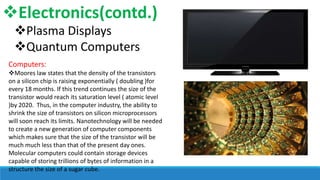
Electronics(contd.)
Plasma Displays
Quantum Computers
Computers:
Moores law states that the density of the transistors
on a silicon chip is raising exponentially ( doubling )for
every 18 months. If this trend continues the size of the
transistor would reach its saturation level ( atomic level
)by 2020. Thus, in the computer industry, the ability to
shrink the size of transistors on silicon microprocessors
will soon reach its limits. Nanotechnology will be needed
to create a new generation of computer components
which makes sure that the size of the transistor will be
much much less than that of the present day ones.
Molecular computers could contain storage devices
capable of storing trillions of bytes of information in a
structure the size of a sugar cube.
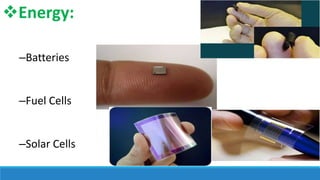
Energy:
–Batteries
–Fuel Cells
–Solar Cells
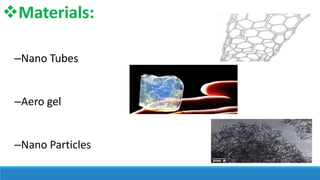
Materials:
–Nano Tubes
–Aero gel
–Nano Particles
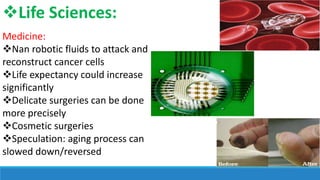
Life Sciences:
Medicine:
Nan robotic fluids to attack and
reconstruct cancer cells
Life expectancy could increase
significantly
Delicate surgeries can be done
more precisely
Cosmetic surgeries
Speculation: aging process can
slowed down/reversed
Space working:
Machines with very low mass, volume and power consumption
Reconfigurable, autonomous and “thinking” spacecrafts

Ultra new and ultra small constructions and probes
ADVANTAGES:
Size of substances can be substantially reduced
Efficiency can be greatly improved
Production will be easy and fast
Precise substances can be produced
Strength and density factors can be improved
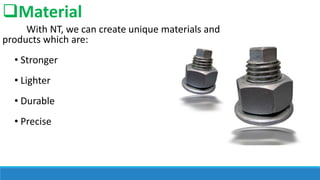
Material
With NT, we can create unique materials and
products which are:

• Stronger
• Lighter

• Durable
• Precise
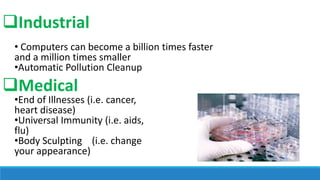
Industrial
• Computers can become a billion times faster
and a million times smaller
•Automatic Pollution Cleanup

Medical

•End of Illnesses (i.e. cancer,
heart disease)
•Universal Immunity (i.e. aids,
flu)
•Body Sculpting (i.e. change
your appearance)
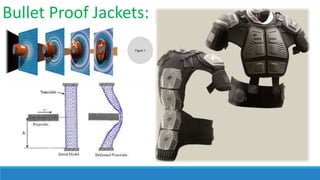
Bullet Proof Jackets:
Disadvantages :
•Loss

etc)

of jobs (in manufacturing, farming,

•Carbon

of lungs
•Atomic

Nanotubes could cause infection

weapons could be more
accessible and destructive
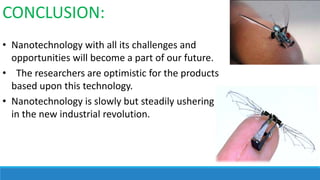
CONCLUSION:
• Nanotechnology with all its challenges and
opportunities will become a part of our future.
• The researchers are optimistic for the products
based upon this technology.
• Nanotechnology is slowly but steadily ushering
in the new industrial revolution.
Nano technology.

Nano technology.

  • 2.
    CONTENTS: Introduction What is nanotechnology? Approaches Stepsto produce nanomaterials Applications Advantages Conclusion
  • 3.
    Introduction: It’s the developmentand practical applications on a nanometric scale Engineering of tiny machines Greek prefix ”nano” means a billionth 100 nanometers is the limit to observe new properties of matter
  • 4.
    What Is Nanotechnology Nanotechnologyis the engineering of tiny machines—the projected ability to make things from the bottom up, using techniques and tools being developed today to place every atom and molecule in a desired place. Shortly after this envisioned molecular machinery is created, it will result in a manufacturing revolution, probably causing severe disruption. It also has serious economic, social, environmental, and military implications.
  • 5.
    The principles ofphysics do not limit our ability to manipulate things atom by atom. It is not an attempt to violate any laws; it is something, in principle, that can be done; but in practice, it has not been done because we are too big. --Richard Feynman
  • 6.
    Approaches: In building anynanomaterials; the available approaches i.e. methods are  Top-down Bottom-up
  • 7.
    Top-down The structure variesgradually from large (top) to small(small) By Feynman in 1959 The problem: repairs which arise in miniature structures at bottom can’t be repaired by large ones at top
  • 8.
    Bottom-up Structure varies graduallyfrom bottom(small) to top(large) Considered the one and only “true” nanotechnology Limits of miniaturization are resolved Highly useful in electronics
  • 9.
    Steps to produceNANOMATERIALS Three primary steps to produce nanomaterials 1. Ability to manipulate individual atoms 2. Development of nanoscopic machines(assemblers) 3. Replicators are to be programmed
  • 10.
  • 11.
    APPLICATIONS: Strong fibers: Basic itemto produce is strong fibre Later on replications can be made of diamonds, water and even food Famines can be then successfully eradicated Atomic plants: Hands” for handling radioactive substances Various functions inside the inner parts of reactors
  • 12.
  • 13.
    Electronics(contd.) Plasma Displays Quantum Computers Computers: Mooreslaw states that the density of the transistors on a silicon chip is raising exponentially ( doubling )for every 18 months. If this trend continues the size of the transistor would reach its saturation level ( atomic level )by 2020. Thus, in the computer industry, the ability to shrink the size of transistors on silicon microprocessors will soon reach its limits. Nanotechnology will be needed to create a new generation of computer components which makes sure that the size of the transistor will be much much less than that of the present day ones. Molecular computers could contain storage devices capable of storing trillions of bytes of information in a structure the size of a sugar cube.
  • 14.
  • 15.
  • 16.
    Life Sciences: Medicine: Nan roboticfluids to attack and reconstruct cancer cells Life expectancy could increase significantly Delicate surgeries can be done more precisely Cosmetic surgeries Speculation: aging process can slowed down/reversed
  • 17.
    Space working: Machines withvery low mass, volume and power consumption Reconfigurable, autonomous and “thinking” spacecrafts Ultra new and ultra small constructions and probes
  • 18.
    ADVANTAGES: Size of substancescan be substantially reduced Efficiency can be greatly improved Production will be easy and fast Precise substances can be produced Strength and density factors can be improved
  • 19.
    Material With NT, wecan create unique materials and products which are: • Stronger • Lighter • Durable • Precise
  • 20.
    Industrial • Computers canbecome a billion times faster and a million times smaller •Automatic Pollution Cleanup Medical •End of Illnesses (i.e. cancer, heart disease) •Universal Immunity (i.e. aids, flu) •Body Sculpting (i.e. change your appearance)
  • 21.
  • 22.
    Disadvantages : •Loss etc) of jobs(in manufacturing, farming, •Carbon of lungs •Atomic Nanotubes could cause infection weapons could be more accessible and destructive
  • 23.
    CONCLUSION: • Nanotechnology withall its challenges and opportunities will become a part of our future. • The researchers are optimistic for the products based upon this technology. • Nanotechnology is slowly but steadily ushering in the new industrial revolution.

Editor's Notes

  • #4 هو العالم الانكليزي وليم جلبرتفي عام 1600فارارداي 1821أديسون عام 1880
  • #7 Intel Core i7 mprocessor …..2.3 billion transistors64 Gb Flash memory…..16 billion transistorsFBGA ---Virtex-7 ---- 6,800,000,000[20] ----- 2011 ----- Xilinx --- 28 nmGPU ---- GK110 ---- 7,100,000,000[16] ----2012 ------ NVIDIA ---- 28 nm --- 521 mm²CPU8-Core Itanium Poulson ----- 3,100,000,000 --- 2012 Intel 32 nm -- 544 mm²62-Core Xeon Phi ------------ 5,000,000,000 --- 2012 Intel 22 nm