
WAN
technologies II.
Page 2
Instructor, PACE-IT Program – Edmonds Community College
Areas of expertise Industry Certifications
 PC Hardware
 Network Administration
 IT Project Management
 Network Design
 User Training
 IT Troubleshooting
Qualifications Summary
Education
 M.B.A., IT Management, Western Governor’s University
 B.S., IT Security, Western Governor’s University
Entrepreneur, executive leader, and proven manger
with 10+ years of experience turning complex issues
into efficient and effective solutions.
Strengths include developing and mentoring diverse
workforces, improving processes, analyzing
business needs and creating the solutions
required— with a focus on technology.
Page 3
PACE-IT.
– GSM/CDMA WAN connections.
– WiMAX WAN connections.
– Satellite WAN connections.
Page 4
WAN technologies II.
Page 5
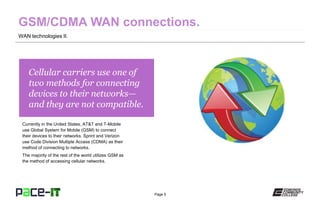
Cellular carriers use one of
two methods for connecting
devices to their networks—
and they are not compatible.
Currently in the United States, AT&T and T-Mobile
use Global System for Mobile (GSM) to connect
their devices to their networks. Sprint and Verizon
use Code Division Multiple Access (CDMA) as their
method of connecting to networks.
The majority of the rest of the world utilizes GSM as
the method of accessing cellular networks.
WAN technologies II.
Page 6
WAN technologies II.
– Cellular networking.
» Cellular networking involves using the cellular phone
system for more than just phone calls.
» 1G cellular was only capable of voice transmissions.
» 2G cellular added simple data transmission capability
(text).
• 2G EDGE offered some basic cellular networking
connectivity and was a stopgap between 2G and 3G.
» 3G cellular is the beginning of cellular WAN networking.
» 4G is still an emerging technology; it currently consists of
LTE and WiMAX.
» HSPA+ (Evolved High Speed Packet Access): a
stopgap between 3G and 4G.
• The current standards allows for up to a maximum data
rate of 84 Mbps.
» LTE (Long Term Evolution): uses an all-IP based core
with high data rates. It is compatible with 3G and WiMAX.
• The current standards allow for up to 300 Mbps in
download speed and up to 75 Mbps in upload speed.
Page 7
WAN technologies II.
Page 8
WAN technologies II.
– World Wide Interoperability for Microwave
Access (WiMAX) networking.
» WiMAX was originally developed as a last mile alternative for
use when DSL or cable was not available.
• Provides an alternative broadband connection to a fixed
location.
» It uses microwave transmissions as an over-the-air method to
transmit voice and data.
• Requires a line of sight between relay stations.
» WiMAX can be used to cover significant geographic distances.
• Many municipalities are exploring the use of WiMAX as a
means of providing reasonably priced broadband to their
citizens.
» It is often considered to be a type of 4G technology because it
is compatible with LTE networks.
• WiMAX is not compatible with 3G type networks.
Page 9
WAN technologies II.
Page 10
WAN technologies II.
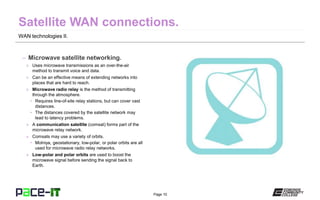
– Microwave satellite networking.
» Uses microwave transmissions as an over-the-air
method to transmit voice and data.
» Can be an effective means of extending networks into
places that are hard to reach.
» Microwave radio relay is the method of transmitting
through the atmosphere.
• Requires line-of-site relay stations, but can cover vast
distances.
• The distances covered by the satellite network may
lead to latency problems.
» A communication satellite (comsat) forms part of the
microwave relay network.
» Comsats may use a variety of orbits.
• Molniya, geostationary, low-polar, or polar orbits are all
used for microwave radio relay networks.
» Low-polar and polar orbits are used to boost the
microwave signal before sending the signal back to
Earth.
Page 11
WAN technologies II.
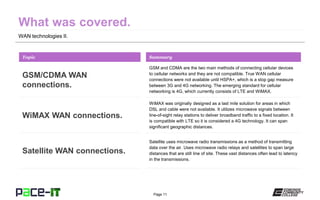
GSM and CDMA are the two main methods of connecting cellular devices
to cellular networks and they are not compatible. True WAN cellular
connections were not available until HSPA+, which is a stop gap measure
between 3G and 4G networking. The emerging standard for cellular
networking is 4G, which currently consists of LTE and WiMAX.
Topic
GSM/CDMA WAN
connections.
Summary
WiMAX was originally designed as a last mile solution for areas in which
DSL and cable were not available. It utilizes microwave signals between
line-of-sight relay stations to deliver broadband traffic to a fixed location. It
is compatible with LTE so it is considered a 4G technology. It can span
significant geographic distances.
WiMAX WAN connections.
Satellite uses microwave radio transmissions as a method of transmitting
data over the air. Uses microwave radio relays and satellites to span large
distances that are still line of site. These vast distances often lead to latency
in the transmissions.
Satellite WAN connections.
Page 12
THANK YOU!
This workforce solution was 100 percent funded by a $3 million grant awarded by the
U.S. Department of Labor's Employment and Training Administration. The solution was
created by the grantee and does not necessarily reflect the official position of the U.S.
Department of Labor. The Department of Labor makes no guarantees, warranties, or
assurances of any kind, express or implied, with respect to such information, including
any information on linked sites and including, but not limited to, accuracy of the
information or its completeness, timeliness, usefulness, adequacy, continued availability
or ownership. Funded by the Department of Labor, Employment and Training
Administration, Grant #TC-23745-12-60-A-53.
PACE-IT is an equal opportunity employer/program and auxiliary aids and services are
available upon request to individuals with disabilities. For those that are hearing
impaired, a video phone is available at the Services for Students with Disabilities (SSD)
office in Mountlake Terrace Hall 159. Check www.edcc.edu/ssd for office hours. Call
425.354.3113 on a video phone for more information about the PACE-IT program. For
any additional special accommodations needed, call the SSD office at 425.640.1814.
Edmonds Community College does not discriminate on the basis of race; color; religion;
national origin; sex; disability; sexual orientation; age; citizenship, marital, or veteran
status; or genetic information in its programs and activities.

PACE-IT: WAN Technologies (part 2) - N10 006

  • 1.
  • 2.
    Page 2 Instructor, PACE-ITProgram – Edmonds Community College Areas of expertise Industry Certifications  PC Hardware  Network Administration  IT Project Management  Network Design  User Training  IT Troubleshooting Qualifications Summary Education  M.B.A., IT Management, Western Governor’s University  B.S., IT Security, Western Governor’s University Entrepreneur, executive leader, and proven manger with 10+ years of experience turning complex issues into efficient and effective solutions. Strengths include developing and mentoring diverse workforces, improving processes, analyzing business needs and creating the solutions required— with a focus on technology.
  • 3.
    Page 3 PACE-IT. – GSM/CDMAWAN connections. – WiMAX WAN connections. – Satellite WAN connections.
  • 4.
  • 5.
    Page 5 Cellular carriersuse one of two methods for connecting devices to their networks— and they are not compatible. Currently in the United States, AT&T and T-Mobile use Global System for Mobile (GSM) to connect their devices to their networks. Sprint and Verizon use Code Division Multiple Access (CDMA) as their method of connecting to networks. The majority of the rest of the world utilizes GSM as the method of accessing cellular networks. WAN technologies II.
  • 6.
    Page 6 WAN technologiesII. – Cellular networking. » Cellular networking involves using the cellular phone system for more than just phone calls. » 1G cellular was only capable of voice transmissions. » 2G cellular added simple data transmission capability (text). • 2G EDGE offered some basic cellular networking connectivity and was a stopgap between 2G and 3G. » 3G cellular is the beginning of cellular WAN networking. » 4G is still an emerging technology; it currently consists of LTE and WiMAX. » HSPA+ (Evolved High Speed Packet Access): a stopgap between 3G and 4G. • The current standards allows for up to a maximum data rate of 84 Mbps. » LTE (Long Term Evolution): uses an all-IP based core with high data rates. It is compatible with 3G and WiMAX. • The current standards allow for up to 300 Mbps in download speed and up to 75 Mbps in upload speed.
  • 7.
  • 8.
    Page 8 WAN technologiesII. – World Wide Interoperability for Microwave Access (WiMAX) networking. » WiMAX was originally developed as a last mile alternative for use when DSL or cable was not available. • Provides an alternative broadband connection to a fixed location. » It uses microwave transmissions as an over-the-air method to transmit voice and data. • Requires a line of sight between relay stations. » WiMAX can be used to cover significant geographic distances. • Many municipalities are exploring the use of WiMAX as a means of providing reasonably priced broadband to their citizens. » It is often considered to be a type of 4G technology because it is compatible with LTE networks. • WiMAX is not compatible with 3G type networks.
  • 9.
  • 10.
    Page 10 WAN technologiesII. – Microwave satellite networking. » Uses microwave transmissions as an over-the-air method to transmit voice and data. » Can be an effective means of extending networks into places that are hard to reach. » Microwave radio relay is the method of transmitting through the atmosphere. • Requires line-of-site relay stations, but can cover vast distances. • The distances covered by the satellite network may lead to latency problems. » A communication satellite (comsat) forms part of the microwave relay network. » Comsats may use a variety of orbits. • Molniya, geostationary, low-polar, or polar orbits are all used for microwave radio relay networks. » Low-polar and polar orbits are used to boost the microwave signal before sending the signal back to Earth.
  • 11.
    Page 11 WAN technologiesII. GSM and CDMA are the two main methods of connecting cellular devices to cellular networks and they are not compatible. True WAN cellular connections were not available until HSPA+, which is a stop gap measure between 3G and 4G networking. The emerging standard for cellular networking is 4G, which currently consists of LTE and WiMAX. Topic GSM/CDMA WAN connections. Summary WiMAX was originally designed as a last mile solution for areas in which DSL and cable were not available. It utilizes microwave signals between line-of-sight relay stations to deliver broadband traffic to a fixed location. It is compatible with LTE so it is considered a 4G technology. It can span significant geographic distances. WiMAX WAN connections. Satellite uses microwave radio transmissions as a method of transmitting data over the air. Uses microwave radio relays and satellites to span large distances that are still line of site. These vast distances often lead to latency in the transmissions. Satellite WAN connections.
  • 12.
  • 13.
    This workforce solutionwas 100 percent funded by a $3 million grant awarded by the U.S. Department of Labor's Employment and Training Administration. The solution was created by the grantee and does not necessarily reflect the official position of the U.S. Department of Labor. The Department of Labor makes no guarantees, warranties, or assurances of any kind, express or implied, with respect to such information, including any information on linked sites and including, but not limited to, accuracy of the information or its completeness, timeliness, usefulness, adequacy, continued availability or ownership. Funded by the Department of Labor, Employment and Training Administration, Grant #TC-23745-12-60-A-53. PACE-IT is an equal opportunity employer/program and auxiliary aids and services are available upon request to individuals with disabilities. For those that are hearing impaired, a video phone is available at the Services for Students with Disabilities (SSD) office in Mountlake Terrace Hall 159. Check www.edcc.edu/ssd for office hours. Call 425.354.3113 on a video phone for more information about the PACE-IT program. For any additional special accommodations needed, call the SSD office at 425.640.1814. Edmonds Community College does not discriminate on the basis of race; color; religion; national origin; sex; disability; sexual orientation; age; citizenship, marital, or veteran status; or genetic information in its programs and activities.