HISTORYHISTORY
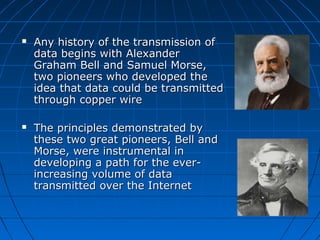
 Any history of the transmission ofAny history of the transmission of
data begins with Alexanderdata begins with Alexander
Graham Bell and Samuel Morse,Graham Bell and Samuel Morse,
two pioneers who developed thetwo pioneers who developed the
idea that data could be transmittedidea that data could be transmitted
through copper wirethrough copper wire
 The principles demonstrated byThe principles demonstrated by
these two great pioneers, Bell andthese two great pioneers, Bell and
Morse, were instrumental inMorse, were instrumental in
developing a path for the ever-developing a path for the ever-
increasing volume of dataincreasing volume of data
transmitted over the Internettransmitted over the Internet
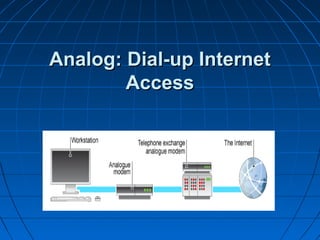
Analog: Dial-up InternetAnalog: Dial-up Internet
AccessAccess
 An analog Internet connection isAn analog Internet connection is
both economical and slowboth economical and slow
 The modem converts receivedThe modem converts received
analog data to digitalanalog data to digital
 Typical Dial-up connectionTypical Dial-up connection
speeds range from 2400 bps tospeeds range from 2400 bps to
56 Kbps56 Kbps
Analog to DigitalAnalog to Digital
 Dial-up speeds satisfied earlyDial-up speeds satisfied early
internet browsing functionsinternet browsing functions
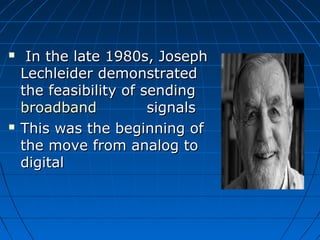
 In the late 1980s, JosephIn the late 1980s, Joseph
Lechleider demonstratedLechleider demonstrated
the feasibility of sendingthe feasibility of sending
broadbandbroadband signalssignals
 This was the beginning ofThis was the beginning of
the move from analog tothe move from analog to
digitaldigital
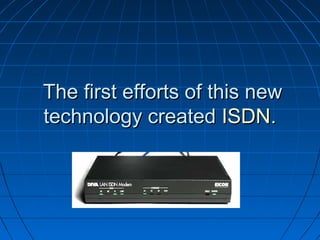
The first efforts of this newThe first efforts of this new
technology createdtechnology created ISDNISDN..
ISDN - Integrated ServicesISDN - Integrated Services
Digital NetworkDigital Network
 ISDN speeds range from 64 KbpsISDN speeds range from 64 Kbps
to 128 Kbpsto 128 Kbps
B-ISDN - Broadband ISDNB-ISDN - Broadband ISDN
 Similar in function to ISDNSimilar in function to ISDN
 Broadband ISDN has not beenBroadband ISDN has not been
widely implementedwidely implemented
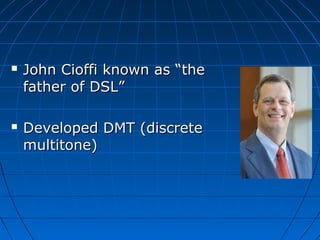
 John Cioffi known as “theJohn Cioffi known as “the
father of DSL”father of DSL”
 Developed DMT (discreteDeveloped DMT (discrete
multitone)multitone)
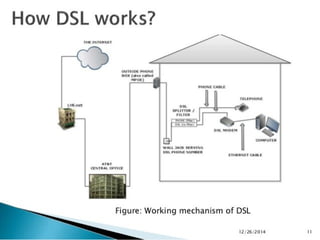
 DSL stands for DIGITAL SUBSCRIBERDSL stands for DIGITAL SUBSCRIBER
LINELINE
 Digital data does not require changingDigital data does not require changing
into analog form and back to digitalinto analog form and back to digital
formform
 Works by taking advantage of theWorks by taking advantage of the
unused (higher) frequencies ofunused (higher) frequencies of
your phone linesyour phone lines
Following are some of the keyFollowing are some of the key
features of DSL:features of DSL:
 Distance-sensitive technologyDistance-sensitive technology
 Internet connection is always ONInternet connection is always ON
 Simultaneous use of the phone lineSimultaneous use of the phone line
 For voice as well as data trafficFor voice as well as data traffic
 Internet Connections highly reliable andInternet Connections highly reliable and
securesecure
 High Speed (Mbps), via a regular modemHigh Speed (Mbps), via a regular modem
(56 Kbps max)(56 Kbps max)
DSL DEVICESDSL DEVICES
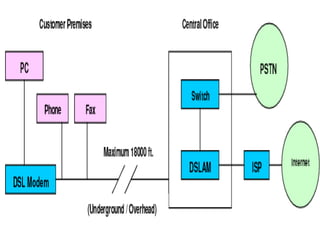
 DSL modems transmit data atDSL modems transmit data at
the rate of up to 160 Kbps overthe rate of up to 160 Kbps over
copper lines, up to 18000 feetcopper lines, up to 18000 feet
MODULATION TECHNOLOGIESMODULATION TECHNOLOGIES
 DSL uses the Quadrature AmplitudeDSL uses the Quadrature Amplitude
Modulation (QAM) technology toModulation (QAM) technology to
modify the carrier signalmodify the carrier signal
 DSL uses either CAP or DMTDSL uses either CAP or DMT
techniques, both of which are basedtechniques, both of which are based
on QAM, but vary in theiron QAM, but vary in their
implementationimplementation
CAPCAP
Carrier-less Amplitude PhaseCarrier-less Amplitude Phase
 Incoming data modules a singleIncoming data modules a single
carrier that is then transmitted downcarrier that is then transmitted down
a telephone linea telephone line
 The carrier itself is suppressedThe carrier itself is suppressed
before the transmissionbefore the transmission
 It is called “carrier-less”It is called “carrier-less”
Carrierless Amplitude PhaseCarrierless Amplitude Phase
 Carrierless Amplitude Phase (CAP) isCarrierless Amplitude Phase (CAP) is
an encoding method that divides thean encoding method that divides the
signals into two distinct bands:signals into two distinct bands:
1.1. The upstream data channelThe upstream data channel
1.1. The downstream data channelThe downstream data channel
DMTDMT
Discrete Multi ToneDiscrete Multi Tone
 This is a version of multi-carrierThis is a version of multi-carrier
modulationmodulation
 DMT separates the DSL signal intoDMT separates the DSL signal into
256 channels of 4.3125kHz each256 channels of 4.3125kHz each
 DMT has 224 downstream frequencyDMT has 224 downstream frequency
bins (or carriers) and 32 upstreambins (or carriers) and 32 upstream
frequency binsfrequency bins
 DMT constantly shifts signalsDMT constantly shifts signals
between different channelsbetween different channels
DSL ApplicationsDSL Applications
 Interactive Video –movies on demand,Interactive Video –movies on demand,
video on demand, video conferencingvideo on demand, video conferencing
 High-speed Data communication –InternetHigh-speed Data communication –Internet
access, Telecommuting, Remote LANaccess, Telecommuting, Remote LAN
access, specialized network accessaccess, specialized network access
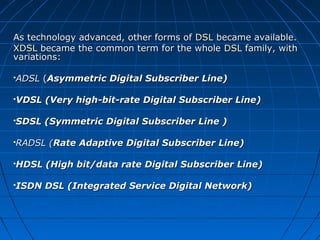
As technology advanced, other forms ofAs technology advanced, other forms of DSLDSL became available.became available.
XDSLXDSL became the common term for the wholebecame the common term for the whole DSLDSL family, withfamily, with
variations:variations:
ADSLADSL ((Asymmetric Digital Subscriber Line)Asymmetric Digital Subscriber Line)
VDSL (Very high-bit-rate Digital Subscriber Line)VDSL (Very high-bit-rate Digital Subscriber Line)
SDSL (Symmetric Digital Subscriber Line )SDSL (Symmetric Digital Subscriber Line )
RADSL (RADSL (Rate Adaptive Digital Subscriber Line)Rate Adaptive Digital Subscriber Line)
HDSL (High bit/data rate Digital Subscriber Line)HDSL (High bit/data rate Digital Subscriber Line)
ISDN DSL (Integrated Service Digital Network)ISDN DSL (Integrated Service Digital Network)
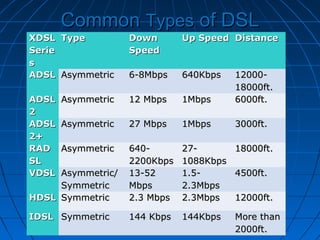
CommonCommon TypesTypes of DSLof DSL
XDSLXDSL
SerieSerie
ss
TypeType DownDown
SpeedSpeed
Up SpeedUp Speed DistanceDistance
ADSLADSL AsymmetricAsymmetric 6-8Mbps6-8Mbps 640Kbps640Kbps 12000-12000-
18000ft.18000ft.
ADSLADSL
22
AsymmetricAsymmetric 12 Mbps12 Mbps 1Mbps1Mbps 6000ft.6000ft.
ADSLADSL
2+2+
AsymmetricAsymmetric 27 Mbps27 Mbps 1Mbps1Mbps 3000ft.3000ft.
RADRAD
SLSL
AsymmetricAsymmetric 640-640-
2200Kbps2200Kbps
27-27-
1088Kbps1088Kbps
18000ft.18000ft.
VDSLVDSL Asymmetric/Asymmetric/
SymmetricSymmetric
13-5213-52
MbpsMbps
1.5-1.5-
2.3Mbps2.3Mbps
4500ft.4500ft.
HDSLHDSL SymmetricSymmetric 2.3 Mbps2.3 Mbps 2.3Mbps2.3Mbps 12000ft.12000ft.
IDSLIDSL SymmetricSymmetric 144 Kbps144 Kbps 144Kbps144Kbps More thanMore than
2000ft.2000ft.
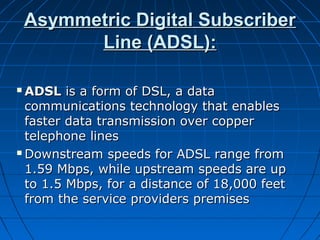
Asymmetric Digital SubscriberAsymmetric Digital Subscriber
Line (ADSL):Line (ADSL):
 ADSLADSL is a form of DSL, a datais a form of DSL, a data
communications technology that enablescommunications technology that enables
faster data transmission over copperfaster data transmission over copper
telephone linestelephone lines
 Downstream speeds for ADSL range fromDownstream speeds for ADSL range from
1.59 Mbps, while upstream speeds are up1.59 Mbps, while upstream speeds are up
to 1.5 Mbps, for a distance of 18,000 feetto 1.5 Mbps, for a distance of 18,000 feet
from the service providers premisesfrom the service providers premises
What does ADSL meanWhat does ADSL mean
 AAsymmetric - The data can flow faster in onesymmetric - The data can flow faster in one
direction than the otherdirection than the other
 DDigital - No type of communication is transferredigital - No type of communication is transferred
in an analog methodin an analog method
 SSubscriberubscriber LLine - The data is carried over a singleine - The data is carried over a single
twisted pair copper loop to the subscribertwisted pair copper loop to the subscriber
premisespremises
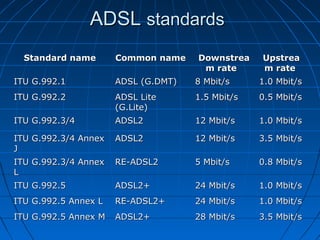
ADSLADSL standardsstandards
Standard nameStandard name Common nameCommon name DownstreaDownstrea
m ratem rate
UpstreaUpstrea
m ratem rate
ITU G.992.1ITU G.992.1 ADSL (G.DMT)ADSL (G.DMT) 8 Mbit/s8 Mbit/s 1.0 Mbit/s1.0 Mbit/s
ITU G.992.2ITU G.992.2 ADSL LiteADSL Lite
(G.Lite)(G.Lite)
1.5 Mbit/s1.5 Mbit/s 0.5 Mbit/s0.5 Mbit/s
ITU G.992.3/4ITU G.992.3/4 ADSL2ADSL2 12 Mbit/s12 Mbit/s 1.0 Mbit/s1.0 Mbit/s
ITU G.992.3/4 AnnexITU G.992.3/4 Annex
JJ
ADSL2ADSL2 12 Mbit/s12 Mbit/s 3.5 Mbit/s3.5 Mbit/s
ITU G.992.3/4 AnnexITU G.992.3/4 Annex
LL
RE-ADSL2RE-ADSL2 5 Mbit/s5 Mbit/s 0.8 Mbit/s0.8 Mbit/s
ITU G.992.5ITU G.992.5 ADSL2+ADSL2+ 24 Mbit/s24 Mbit/s 1.0 Mbit/s1.0 Mbit/s
ITU G.992.5 Annex LITU G.992.5 Annex L RE-ADSL2+RE-ADSL2+ 24 Mbit/s24 Mbit/s 1.0 Mbit/s1.0 Mbit/s
ITU G.992.5 Annex MITU G.992.5 Annex M ADSL2+ADSL2+ 28 Mbit/s28 Mbit/s 3.5 Mbit/s3.5 Mbit/s
ADSL RequirementsADSL Requirements
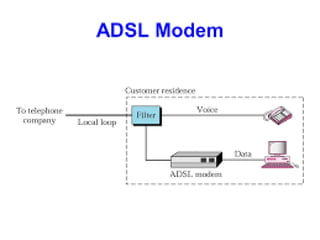
 Phone-line, activated by your phonePhone-line, activated by your phone
company for ADSLcompany for ADSL
 Filter to separate the phone signal fromFilter to separate the phone signal from
the Internet signalthe Internet signal
 ADSL modemADSL modem
 Subscription with an ISP supporting ADSLSubscription with an ISP supporting ADSL
 ADSL is more popular in NorthADSL is more popular in North
AmericaAmerica
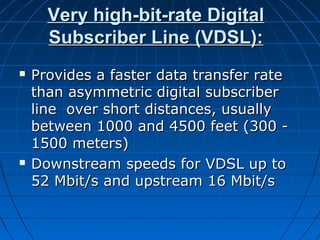
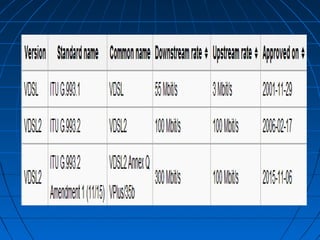
Very high-bit-rate DigitalVery high-bit-rate Digital
Subscriber Line (VDSL):Subscriber Line (VDSL):
 Provides a faster data transfer rateProvides a faster data transfer rate
than asymmetric digital subscriberthan asymmetric digital subscriber
line over short distances, usuallyline over short distances, usually
between 1000 and 4500 feet (300 -between 1000 and 4500 feet (300 -
1500 meters)1500 meters)
 Downstream speeds for VDSL up toDownstream speeds for VDSL up to
5252 Mbit/sMbit/s and upstream 16 Mbit/sand upstream 16 Mbit/s
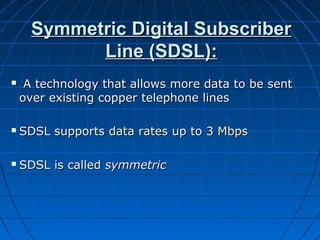
Symmetric Digital SubscriberSymmetric Digital Subscriber
Line (SDSL):Line (SDSL):
 A technology that allows more data to be sentA technology that allows more data to be sent
over existing copper telephone linesover existing copper telephone lines
 SDSL supportsSDSL supports data ratesdata rates up to 3up to 3 MbpsMbps
 SDSL is calledSDSL is called symmetricsymmetric
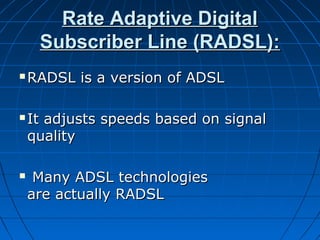
Rate Adaptive DigitalRate Adaptive Digital
Subscriber Line (RADSL):Subscriber Line (RADSL):
 RADSL is a version of ADSLRADSL is a version of ADSL
 It adjusts speeds based on signalIt adjusts speeds based on signal
qualityquality
 Many ADSL technologiesMany ADSL technologies
are actually RADSLare actually RADSL
Modulation TechniquesModulation Techniques
RADSL specifies two modulationRADSL specifies two modulation
schemesschemes
 QAMQAM
 CAPCAP
RADSL is not interoperable with DMTRADSL is not interoperable with DMT
modulationmodulation
High bit/data rate DigitalHigh bit/data rate Digital
Subscriber Line (HDSL):Subscriber Line (HDSL):
 HDSL requires two cable pairs up toHDSL requires two cable pairs up to
12,000 feet12,000 feet
 HDSL-2 requires only one cable pairHDSL-2 requires only one cable pair
and spans 18,000 feetand spans 18,000 feet
 HDSL is symmetricalHDSL is symmetrical
IDSLIDSL (ISDN DSL) (ISDN DSL)
 IDSL is a slightly faster basic BRI ISIDSL is a slightly faster basic BRI IS
DN service DN service 
   Unlike standard ISDN, IDSL does noUnlike standard ISDN, IDSL does no
t support analog phones, and signals t support analog phones, and signals 
are not    switched are not    switched 
through the telephone networkthrough the telephone network
   It uses the 16 Kbps "D" channel for It uses the 16 Kbps "D" channel for 
data rather than call data rather than call 
setup to achieve 144 Kbps instead ofsetup to achieve 144 Kbps instead of
 128 Kbps 128 Kbps
Symmetrical high-speed digital Symmetrical high-speed digital 
subscriber linesubscriber line ((SHDSLSHDSL))
 SHDSL technology supports a minimum of SHDSL technology supports a minimum of 
2Mbps, extending up to a maximum data 2Mbps, extending up to a maximum data 
rate 80Mbps/80Mbps  rate 80Mbps/80Mbps  
 SHDSL allows your business to get the SHDSL allows your business to get the 
best performance from applications such best performance from applications such 
as IP telephony,as IP telephony,
virtual private networks, video virtual private networks, video 
conferencing and much moreconferencing and much more
DSL VS. CABLEDSL VS. CABLE
 Both DSL and Cable Modem Both DSL and Cable Modem 
technologies offer high-speed technologies offer high-speed 
Internet accessInternet access
 The two technologies differ on some The two technologies differ on some 
fundamental aspects such as:fundamental aspects such as:
 SpeedSpeed
 BandwidthBandwidth
 SecuritySecurity
 ReliabilityReliability
Benefits of DSLBenefits of DSL
 Greater Bandwidth CapacityGreater Bandwidth Capacity
 Constant ConnectionConstant Connection
 SpeedSpeed
 Dedicated LineDedicated Line
 EfficiencyEfficiency
DisadvantagesDisadvantages  of DSLof DSL
 Your DSL connection works faster if you live Your DSL connection works faster if you live 
closer to the provider’s central office. The closer to the provider’s central office. The 
farther your home is from the ISP’s office the farther your home is from the ISP’s office the 
more your speed will reduce. more your speed will reduce. 
 Data being received is faster than data being Data being received is faster than data being 
sent over the Internet.sent over the Internet.
 DSL availability is limited to certain cities, not DSL availability is limited to certain cities, not 
everyone can get this serviceeveryone can get this service
DSL STANDARDSDSL STANDARDS
 International Telecommunication Union (ITU). International Telecommunication Union (ITU). 
G.992.1 (G.dmt), G.992.2 (G.lite) standards G.992.1 (G.dmt), G.992.2 (G.lite) standards 
information.    information.    http://www.itu.inthttp://www.itu.int
 American National Standards Institute American National Standards Institute 
(ANSI). ANSI TI.413-1998, ADSL Metallic (ANSI). ANSI TI.413-1998, ADSL Metallic 
Interface.      Interface.      http://www.ansi.orghttp://www.ansi.org
 Universal ADSL Working Group. G.lite Universal ADSL Working Group. G.lite 
standards information.   http://uawg.orgstandards information.   http://uawg.org
 Standards Committee T1-Telecommunications. Standards Committee T1-Telecommunications. 
XDSL standards and relevant documents from XDSL standards and relevant documents from 
T1E1.4 Working group.      T1E1.4 Working group.      http://www.t1.orghttp://www.t1.org
 European Telecommunications Standards European Telecommunications Standards 
Institute (ETSI). ADSL, VDSL and SDSL Institute (ETSI). ADSL, VDSL and SDSL 
standards.     standards.     http://www.etsi.orghttp://www.etsi.org
 Internet Engineering Task Force (IETF). ADSL Internet Engineering Task Force (IETF). ADSL 
MIB working group.                                       MIB working group.                                       
http://www.ietf.org, http://www.ietf.org/html-http://www.ietf.org, http://www.ietf.org/html-
charters/adslmib-charter.htmlcharters/adslmib-charter.html
The future of DSLThe future of DSL
 With so 'many applications for high-With so 'many applications for high-
speed speed DSLDSL Internet and the future looks  Internet and the future looks 
promising promising 
 Consumers around the world are equipped Consumers around the world are equipped 
with free high speed internet for shopping, with free high speed internet for shopping, 
online courses Gamming, chat, online courses Gamming, chat, 
downloading music and movies and home-downloading music and movies and home-
based businesses based businesses 
 With the ever increasing demand for With the ever increasing demand for 
Internet and services it provides, the Internet and services it provides, the 
future looks good for future looks good for DSLDSL    

DSL