

Introduction to
network devices I.
Page 2
Instructor, PACE-IT Program – Edmonds Community College
Areas of Expertise Industry Certifications
 PC Hardware
 Network Administration
 IT Project Management
 Network Design
 User Training
 IT Troubleshooting
Qualifications Summary
Education
 M.B.A., IT Management, Western Governor’s University
 B.S., IT Security, Western Governor’s University
Entrepreneur, executive leader, and proven manger
with 10+ years of experience turning complex issues
into efficient and effective solutions.
Strengths include developing and mentoring diverse
workforces, improving processes, analyzing
business needs and creating the solutions
required— with a focus on technology.
Page 3
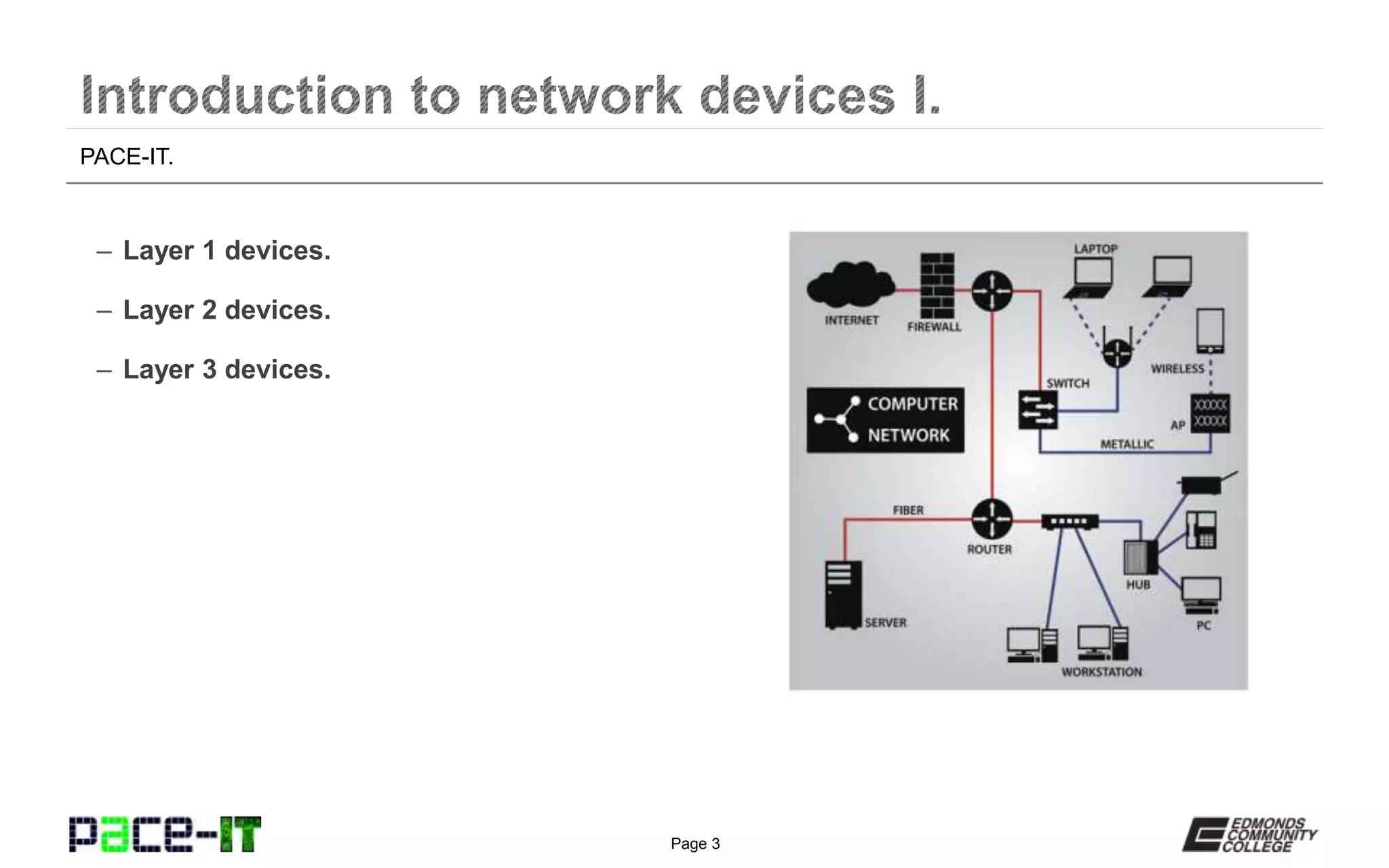
– Layer 1 devices.
– Layer 2 devices.
– Layer 3 devices.
PACE-IT.
Page 4
Introduction to network devices I.
Page 5
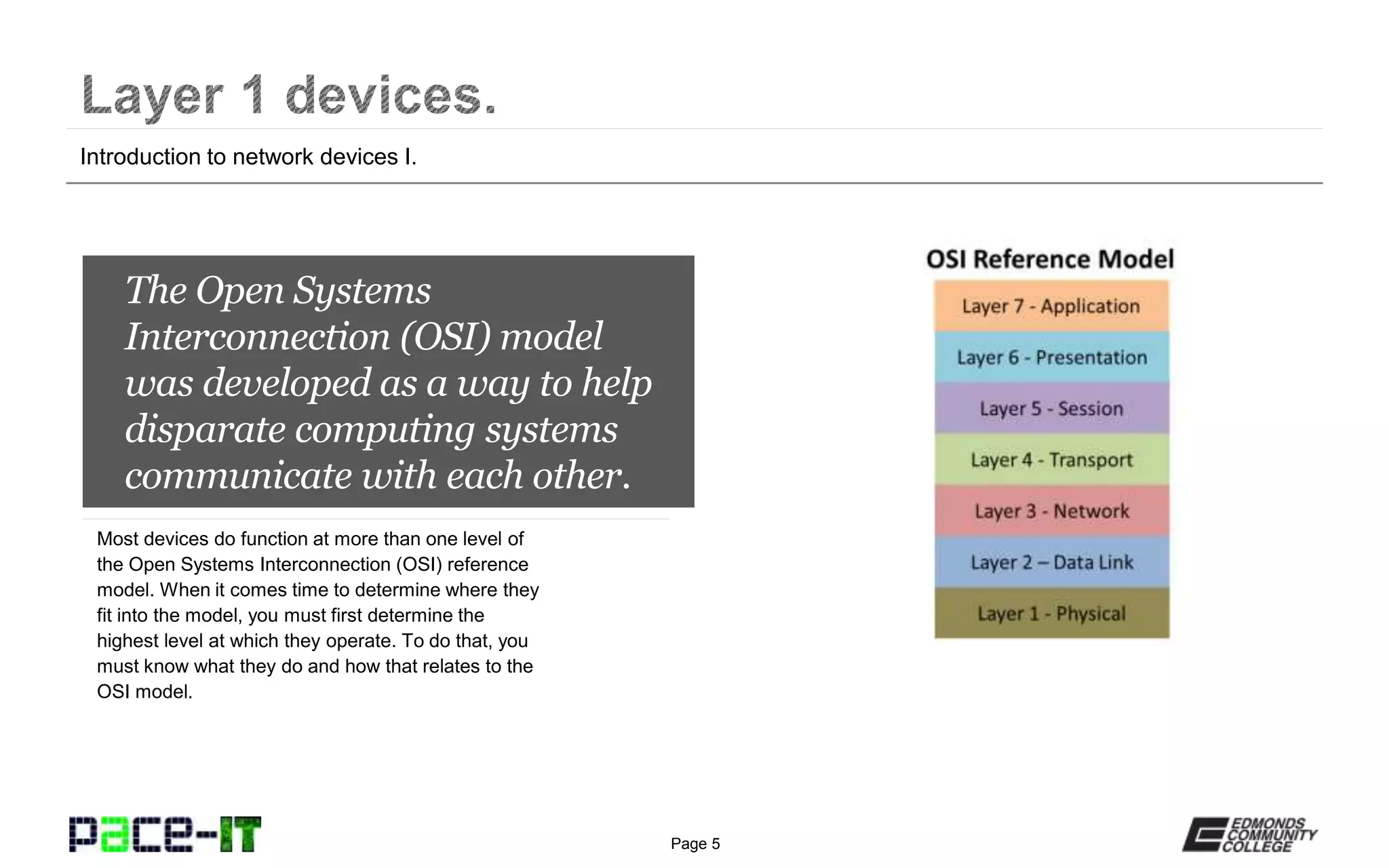
The Open Systems
Interconnection (OSI) model
was developed as a way to help
disparate computing systems
communicate with each other.
Most devices do function at more than one level of
the Open Systems Interconnection (OSI) reference
model. When it comes time to determine where they
fit into the model, you must first determine the
highest level at which they operate. To do that, you
must know what they do and how that relates to the
OSI model.
Introduction to network devices I.
Page 6
– Analog modem.
» The word modem is actually derived from a contraction of
modulator/demodulator.
• Modems were developed to take the digital signal coming from
a digital node and convert it to an analog signal (modulating the
signal) to be placed on the wire. In return, it would accept an
analog signal from the wire and convert it (demodulating the
signal) to a digital signal that the node could understand.
» They were developed to create connections between network
segments via the public switched telephone network (PSTN)
using the plain old telephone system (POTS).
• Modems provide for a single connection to a network.
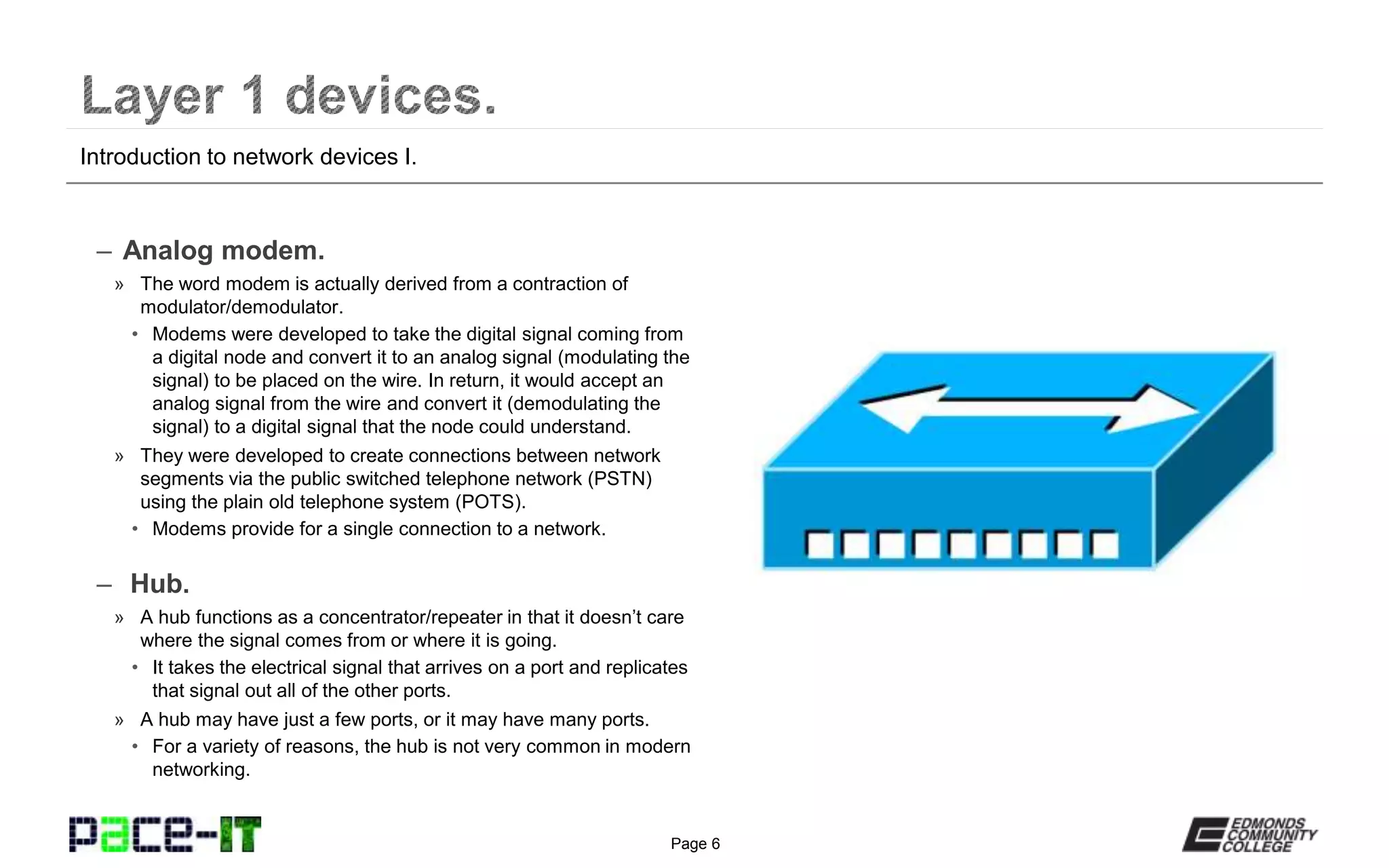
– Hub.
» A hub functions as a concentrator/repeater in that it doesn’t care
where the signal comes from or where it is going.
• It takes the electrical signal that arrives on a port and replicates
that signal out all of the other ports.
» A hub may have just a few ports, or it may have many ports.
• For a variety of reasons, the hub is not very common in modern
networking.
Introduction to network devices I.
Page 7
Introduction to network devices I.
Page 8
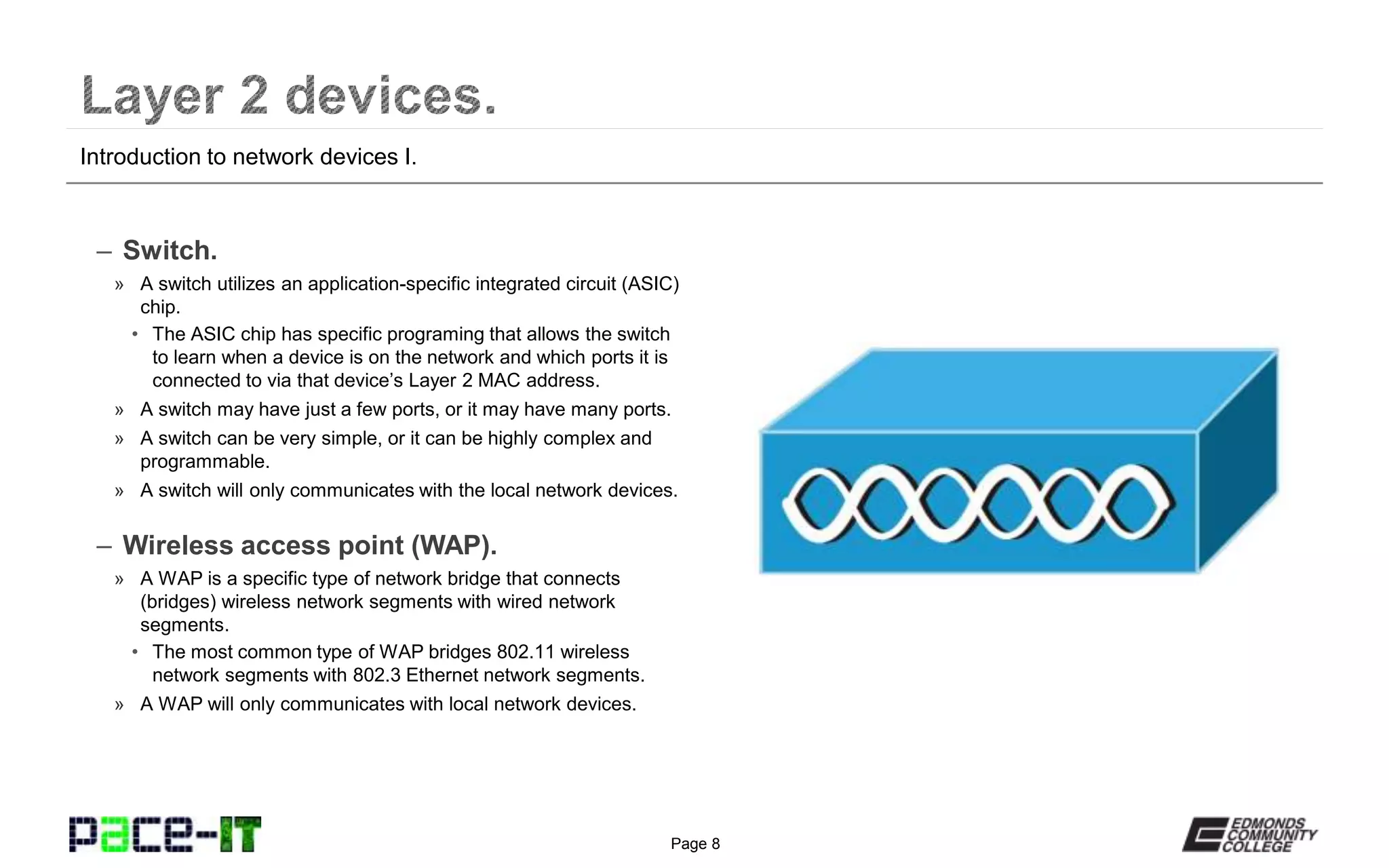
– Switch.
» A switch utilizes an application-specific integrated circuit (ASIC)
chip.
• The ASIC chip has specific programing that allows the switch
to learn when a device is on the network and which ports it is
connected to via that device’s Layer 2 MAC address.
» A switch may have just a few ports, or it may have many ports.
» A switch can be very simple, or it can be highly complex and
programmable.
» A switch will only communicates with the local network devices.
– Wireless access point (WAP).
» A WAP is a specific type of network bridge that connects
(bridges) wireless network segments with wired network
segments.
• The most common type of WAP bridges 802.11 wireless
network segments with 802.3 Ethernet network segments.
» A WAP will only communicates with local network devices.
Introduction to network devices I.
Page 9
Introduction to network devices I.
Page 10
– Multilayer switch (MLS).
» An MLS provides normal Layer 2 network switching services, but
it will also provide Layer 3 or higher OSI model services.
» The most common MLS is a Layer 3 switch.
• It not only utilizes an ASIC chip for switching, but that ASIC
chip is also programed to handle routing functions. This allows
the device to communicate and pass data to non-local network
devices.
» An MLS is a highly programmable and complex network device.
» An MLS may have just a few ports, or it may have many ports.
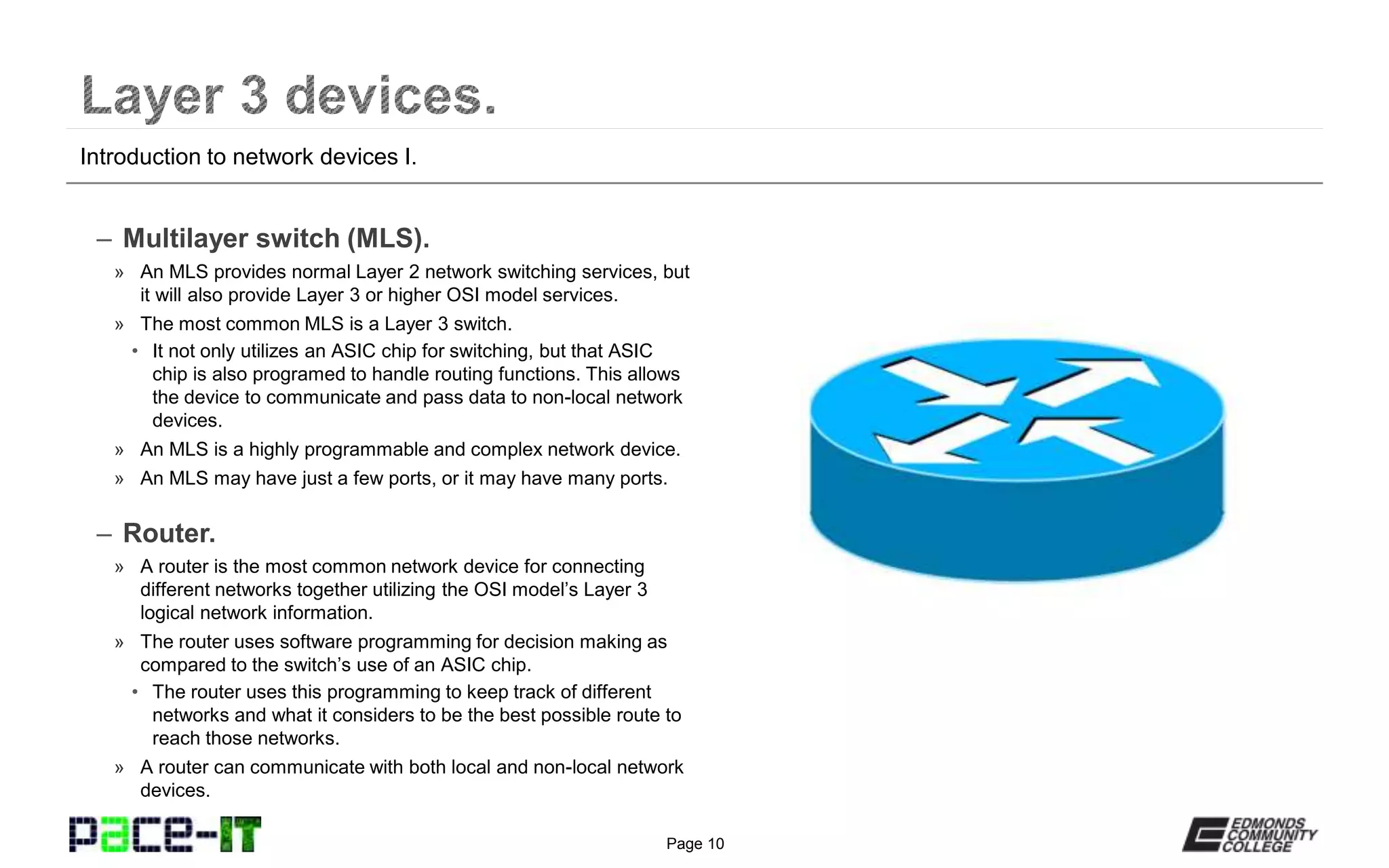
– Router.
» A router is the most common network device for connecting
different networks together utilizing the OSI model’s Layer 3
logical network information.
» The router uses software programming for decision making as
compared to the switch’s use of an ASIC chip.
• The router uses this programming to keep track of different
networks and what it considers to be the best possible route to
reach those networks.
» A router can communicate with both local and non-local network
devices.
Introduction to network devices I.
Page 11
Introduction to network devices I.
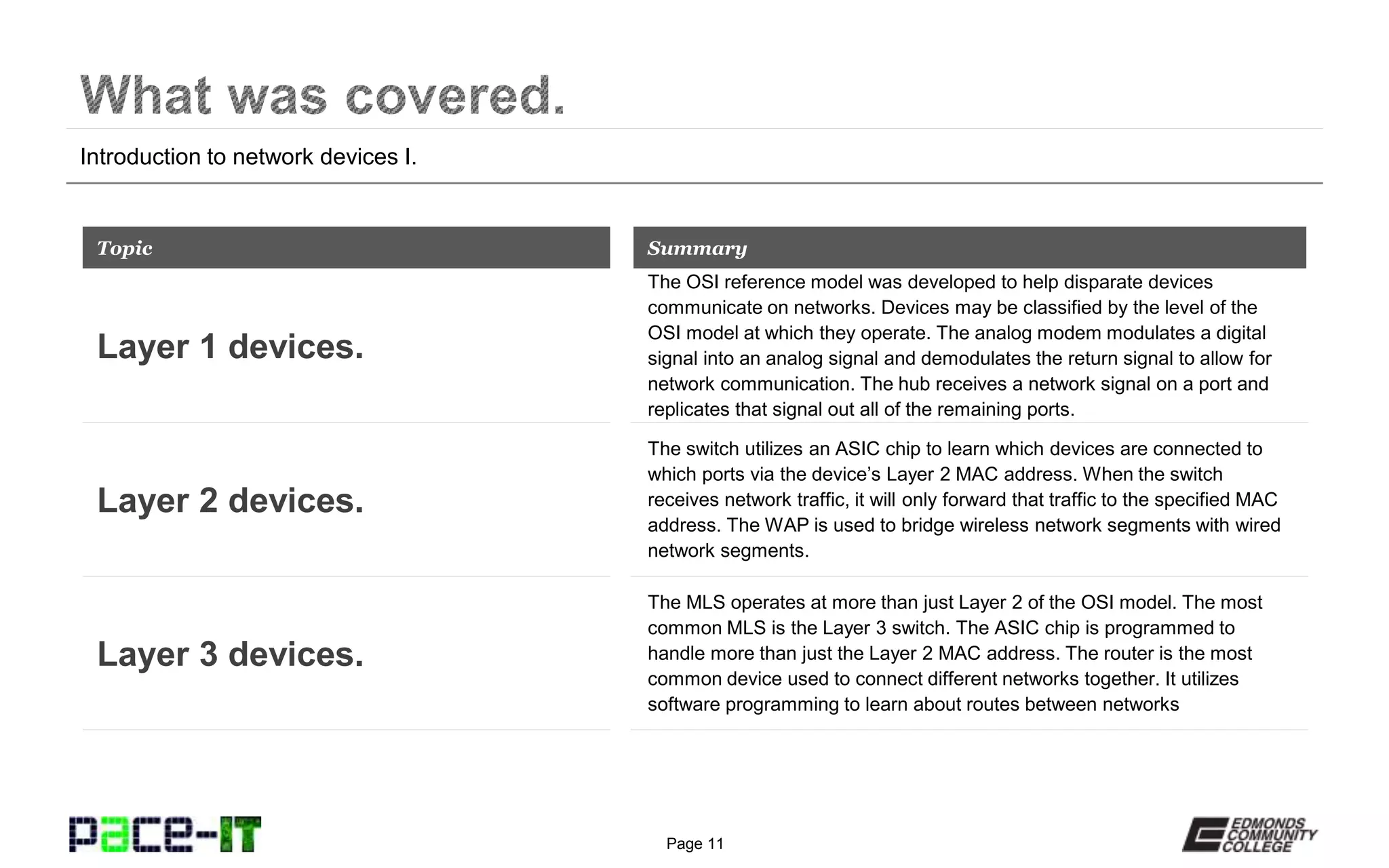
The OSI reference model was developed to help disparate devices
communicate on networks. Devices may be classified by the level of the
OSI model at which they operate. The analog modem modulates a digital
signal into an analog signal and demodulates the return signal to allow for
network communication. The hub receives a network signal on a port and
replicates that signal out all of the remaining ports.
Topic
Layer 1 devices.
Summary
The switch utilizes an ASIC chip to learn which devices are connected to
which ports via the device’s Layer 2 MAC address. When the switch
receives network traffic, it will only forward that traffic to the specified MAC
address. The WAP is used to bridge wireless network segments with wired
network segments.
Layer 2 devices.
The MLS operates at more than just Layer 2 of the OSI model. The most
common MLS is the Layer 3 switch. The ASIC chip is programmed to
handle more than just the Layer 2 MAC address. The router is the most
common device used to connect different networks together. It utilizes
software programming to learn about routes between networks
Layer 3 devices.
Page 12
THANK YOU!
This workforce solution was 100 percent funded by a $3 million grant awarded by the
U.S. Department of Labor's Employment and Training Administration. The solution was
created by the grantee and does not necessarily reflect the official position of the U.S.
Department of Labor. The Department of Labor makes no guarantees, warranties, or
assurances of any kind, express or implied, with respect to such information, including
any information on linked sites and including, but not limited to, accuracy of the
information or its completeness, timeliness, usefulness, adequacy, continued availability
or ownership. Funded by the Department of Labor, Employment and Training
Administration, Grant #TC-23745-12-60-A-53.
PACE-IT is an equal opportunity employer/program and auxiliary aids and services are
available upon request to individuals with disabilities. For those that are hearing
impaired, a video phone is available at the Services for Students with Disabilities (SSD)
office in Mountlake Terrace Hall 159. Check www.edcc.edu/ssd for office hours. Call
425.354.3113 on a video phone for more information about the PACE-IT program. For
any additional special accommodations needed, call the SSD office at 425.640.1814.
Edmonds Community College does not discriminate on the basis of race; color; religion;
national origin; sex; disability; sexual orientation; age; citizenship, marital, or veteran
status; or genetic information in its programs and activities.

PACE-IT: Introduction_to Network Devices (part 1) - N10 006

  • 1.
  • 2.
    Page 2 Instructor, PACE-ITProgram – Edmonds Community College Areas of Expertise Industry Certifications  PC Hardware  Network Administration  IT Project Management  Network Design  User Training  IT Troubleshooting Qualifications Summary Education  M.B.A., IT Management, Western Governor’s University  B.S., IT Security, Western Governor’s University Entrepreneur, executive leader, and proven manger with 10+ years of experience turning complex issues into efficient and effective solutions. Strengths include developing and mentoring diverse workforces, improving processes, analyzing business needs and creating the solutions required— with a focus on technology.
  • 3.
    Page 3 – Layer1 devices. – Layer 2 devices. – Layer 3 devices. PACE-IT.
  • 4.
    Page 4 Introduction tonetwork devices I.
  • 5.
    Page 5 The OpenSystems Interconnection (OSI) model was developed as a way to help disparate computing systems communicate with each other. Most devices do function at more than one level of the Open Systems Interconnection (OSI) reference model. When it comes time to determine where they fit into the model, you must first determine the highest level at which they operate. To do that, you must know what they do and how that relates to the OSI model. Introduction to network devices I.
  • 6.
    Page 6 – Analogmodem. » The word modem is actually derived from a contraction of modulator/demodulator. • Modems were developed to take the digital signal coming from a digital node and convert it to an analog signal (modulating the signal) to be placed on the wire. In return, it would accept an analog signal from the wire and convert it (demodulating the signal) to a digital signal that the node could understand. » They were developed to create connections between network segments via the public switched telephone network (PSTN) using the plain old telephone system (POTS). • Modems provide for a single connection to a network. – Hub. » A hub functions as a concentrator/repeater in that it doesn’t care where the signal comes from or where it is going. • It takes the electrical signal that arrives on a port and replicates that signal out all of the other ports. » A hub may have just a few ports, or it may have many ports. • For a variety of reasons, the hub is not very common in modern networking. Introduction to network devices I.
  • 7.
    Page 7 Introduction tonetwork devices I.
  • 8.
    Page 8 – Switch. »A switch utilizes an application-specific integrated circuit (ASIC) chip. • The ASIC chip has specific programing that allows the switch to learn when a device is on the network and which ports it is connected to via that device’s Layer 2 MAC address. » A switch may have just a few ports, or it may have many ports. » A switch can be very simple, or it can be highly complex and programmable. » A switch will only communicates with the local network devices. – Wireless access point (WAP). » A WAP is a specific type of network bridge that connects (bridges) wireless network segments with wired network segments. • The most common type of WAP bridges 802.11 wireless network segments with 802.3 Ethernet network segments. » A WAP will only communicates with local network devices. Introduction to network devices I.
  • 9.
    Page 9 Introduction tonetwork devices I.
  • 10.
    Page 10 – Multilayerswitch (MLS). » An MLS provides normal Layer 2 network switching services, but it will also provide Layer 3 or higher OSI model services. » The most common MLS is a Layer 3 switch. • It not only utilizes an ASIC chip for switching, but that ASIC chip is also programed to handle routing functions. This allows the device to communicate and pass data to non-local network devices. » An MLS is a highly programmable and complex network device. » An MLS may have just a few ports, or it may have many ports. – Router. » A router is the most common network device for connecting different networks together utilizing the OSI model’s Layer 3 logical network information. » The router uses software programming for decision making as compared to the switch’s use of an ASIC chip. • The router uses this programming to keep track of different networks and what it considers to be the best possible route to reach those networks. » A router can communicate with both local and non-local network devices. Introduction to network devices I.
  • 11.
    Page 11 Introduction tonetwork devices I. The OSI reference model was developed to help disparate devices communicate on networks. Devices may be classified by the level of the OSI model at which they operate. The analog modem modulates a digital signal into an analog signal and demodulates the return signal to allow for network communication. The hub receives a network signal on a port and replicates that signal out all of the remaining ports. Topic Layer 1 devices. Summary The switch utilizes an ASIC chip to learn which devices are connected to which ports via the device’s Layer 2 MAC address. When the switch receives network traffic, it will only forward that traffic to the specified MAC address. The WAP is used to bridge wireless network segments with wired network segments. Layer 2 devices. The MLS operates at more than just Layer 2 of the OSI model. The most common MLS is the Layer 3 switch. The ASIC chip is programmed to handle more than just the Layer 2 MAC address. The router is the most common device used to connect different networks together. It utilizes software programming to learn about routes between networks Layer 3 devices.
  • 12.
  • 13.
    This workforce solutionwas 100 percent funded by a $3 million grant awarded by the U.S. Department of Labor's Employment and Training Administration. The solution was created by the grantee and does not necessarily reflect the official position of the U.S. Department of Labor. The Department of Labor makes no guarantees, warranties, or assurances of any kind, express or implied, with respect to such information, including any information on linked sites and including, but not limited to, accuracy of the information or its completeness, timeliness, usefulness, adequacy, continued availability or ownership. Funded by the Department of Labor, Employment and Training Administration, Grant #TC-23745-12-60-A-53. PACE-IT is an equal opportunity employer/program and auxiliary aids and services are available upon request to individuals with disabilities. For those that are hearing impaired, a video phone is available at the Services for Students with Disabilities (SSD) office in Mountlake Terrace Hall 159. Check www.edcc.edu/ssd for office hours. Call 425.354.3113 on a video phone for more information about the PACE-IT program. For any additional special accommodations needed, call the SSD office at 425.640.1814. Edmonds Community College does not discriminate on the basis of race; color; religion; national origin; sex; disability; sexual orientation; age; citizenship, marital, or veteran status; or genetic information in its programs and activities.