LAN and WAN Technologies
Prepared By Adugna A.
Categorizing Network Technologies
• Transmission Medium
 Wired vs Wireless
• Link Configuration
Point-to-point vs Point-to-multipoint
• User Mobility
 Fixed vs mobile
• Types of Users
Access vs core (backbone)
• Coverage Area
Prepared By Adugna A.
Selecting the Transmission Medium
• Wired
o No interference from others ! high data rates, easy to
o upgrade capacity
o Small, predictable delay
o Expensive to install in hard to access locations
o Device locations are fixed
• Wireless
o No physical connection ! mobility, convenience
o Interference, varying channel conditions ! poor
o performance
o Licenses often required
o Hard to add more capacity
o Physical security is difficult
Prepared By Adugna A.
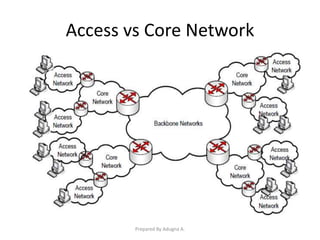
Access vs Core Network
Prepared By Adugna A.
Area Coverage
 In centimeters; people, objects
– Body Area Network
– Personal Area Network
– Infrared, Bluetooth, ZigBee, IEEE 802.15.4, . . .
 In meters; homes, offices, buildings
– Local Area Network
– Home Area Network
– Storage Area Network
– IEEE 802.3 (Ethernet), IEEE 802.11 (WiFi), Fibre
– Channel . . .
 In kilometers; cities, countries, between countries
– Metropolitan Area Network
– Wide Area Network
– PDH, SDH, ATM, Frame-Relay, WiMax, satellite, . . .
 In megamergers; globe, between planets
– Global Area Network
– The Internet, interplanetary networks
Prepared By Adugna A.
Topology Design Requirements
• Station should be able to communicate with any other
station
• Dedicated point-to-point links are better than shared
multipoint links
• Use as few links as possible
• Scales well: adding a new node requires little effort
• Fault-tolerant: failure of a link still allows other nodes
to communicate; failure of a device doesn't prevent
other nodes from communicating
• Fault-detection: a fault can be automatically detected
by network
Prepared By Adugna A.
Network Topologies Links
• Links: point-to-point, point-to-multipoint
– Mesh: every station has point-to-point link to
every other station
– Bus: every station connected via a multipoint link
– Ring: point-to-point links between pairs of
stations, or via special link, to form ring
– Star: every station has point-to-point link to
central device
– Hybrid: combination of 2 or more of above, e.g.
tree is combination of star and bus topologies
Prepared By Adugna A.
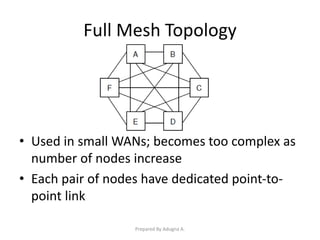
Full Mesh Topology
• Used in small WANs; becomes too complex as
number of nodes increase
• Each pair of nodes have dedicated point-to-
point link
Prepared By Adugna A.
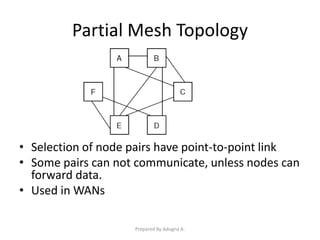
Partial Mesh Topology
• Selection of node pairs have point-to-point link
• Some pairs can not communicate, unless nodes can
forward data.
• Used in WANs
Prepared By Adugna A.
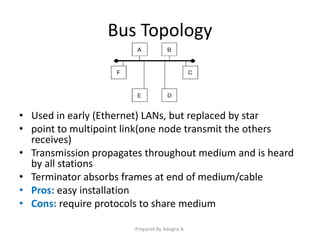
Bus Topology
• Used in early (Ethernet) LANs, but replaced by star
• point to multipoint link(one node transmit the others
receives)
• Transmission propagates throughout medium and is heard
by all stations
• Terminator absorbs frames at end of medium/cable
• Pros: easy installation
• Cons: require protocols to share medium
Prepared By Adugna A.
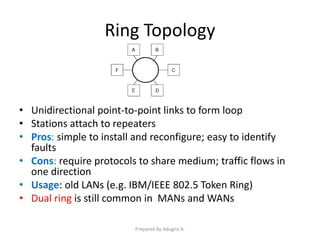
Ring Topology
• Unidirectional point-to-point links to form loop
• Stations attach to repeaters
• Pros: simple to install and reconfigure; easy to identify
faults
• Cons: require protocols to share medium; traffic flows in
one direction
• Usage: old LANs (e.g. IBM/IEEE 802.5 Token Ring)
• Dual ring is still common in MANs and WANs
Prepared By Adugna A.
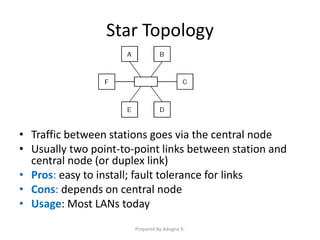
Star Topology
• Traffic between stations goes via the central node
• Usually two point-to-point links between station and
central node (or duplex link)
• Pros: easy to install; fault tolerance for links
• Cons: depends on central node
• Usage: Most LANs today
Prepared By Adugna A.
Point-to-Multipoint Links
• Multiple users share a point-to-multipoint link
• Typical for wireless systems (WiFi, mobile phone) and some wired LANs
• Use multiple access schemes to determine who transmits and when
– Fixed Assignment : e.g. FDMA(Frequency Division Multiple Access),
TDMA(Time Division Multiple Access)
• The sub channel assignments are fixed and the same.
• FDMA used in radio systems to share the radio spectrum.
• TDMA used in digital transmission technology
• This techniques is suitable for broadcast satellite communication
– Demand Assignment: Eg. Reservation, polling
• The sub channel allotment depends on user’s demand(use time to divide).
• Ignore idle nodes and consider only nodes that are ready to transmit
• This technique is suitable for point to point communication.
– Random Access : eg. CSMA
• unpredictable performance
– Demand Assignment and Random access called Medium Access Control (MAC)
Prepared By Adugna A.
Medium Access Control
• In a shared medium, if two (or more) stations transmit at the same
time, there is a chance the two transmissions will interfere with
each other
• Collision of frames: receiver receives two or more frames partially
overlapping in time; assume all frames are corrupted/lost
• Medium Access Control: allow one station to use the shared
medium at a time (avoiding collisions)
• MAC techniques must give stations opportunities to transmit: fair
and efficient
Demand Assignment reservation, polling, round-robin
– Stations are coordinated by a schedule
Random Access Aloha, CSMA
– Stations wait a random time and transmit if no-one else is currently
transmitting
Prepared By Adugna A.
WANs and LANs
• Wide Area Networks(WAN)
– Connect devices/networks over large geographical area
– Between campuses, offices buildings, cities, countries
– Owned and operated by organizations on behalf of
– users, e.g. TOT, CAT, TT&T
– Leased to users, e.g. unis, companies, smaller ISPs
• Local Area Networks(LAN)
– Connect end-user devices over small area
– Within campuses, buildings, homes
– Owned and operated by organization using the network
– Typically support higher data rates than WANs (internal
– communications, multiplexing)
Prepared By Adugna A.
Selecting the Link Configuration
• Point-to-point
– Dedicated link for users ! high, predictable
– Performance
– Need many links, planning of end-points (Topology)
– Wired links, wireless links with directional antennas
• Point-to-multipoint
– Cover multiple users with single link
– Requires sharing of medium: multiple access, Medium
– Access Control protocol
– Wireless links with omnidirectional antennas, shared
– wired links
Prepared By Adugna A.
Identifying a Network Type
• Communications medium
– Wire cable, fiber-optic cable, radio waves, microwaves
• Protocol
– How networked data is formatted into discrete units
– How each unit is transmitted and interpreted
• Topology
– Physical layout of cable and logical path
• Network type
– Private versus public
Prepared By Adugna A.
LAN/WAN Integration
• Becoming more advanced through networking
devices
– Bridges
– Routers
– Gateways
– Switches
Prepared By Adugna A.
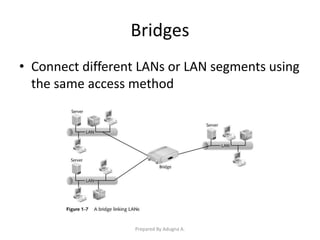
Bridges
• Connect different LANs or LAN segments using
the same access method
Prepared By Adugna A.
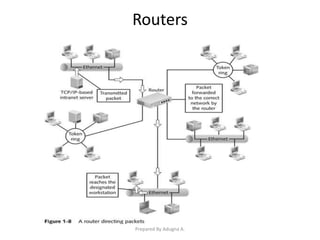
Routers
• Connect networks having the same or
different access methods and media
• Forward packets and frames to networks by
using a decision-making process based on:
– Routing table data
– Discovery of most efficient routes
– Preprogrammed information from network
administrator
Prepared By Adugna A.
Routers
Prepared By Adugna A.
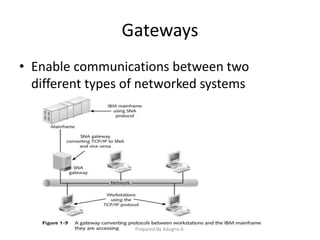
Gateways
• Enable communications between two
different types of networked systems
Prepared By Adugna A.
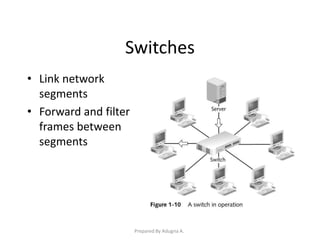
Switches
• Link network
segments
• Forward and filter
frames between
segments
Prepared By Adugna A.
Integrating Data Between LANs and
WANs
• Translation(Gateway)
• Encapsulation(Data PDU)
• LAN emulation (LANE): Local Area Network
Emulation (LANE) enables local area network
(LAN) data bridging and routing over an
Asynchronous Transfer Mode (ATM) network
and facilitates the exchange of Ethernet and
token ring network data.
Prepared By Adugna A.
Media Access
• Perhaps the most important part of data link
protocols. This part determines the way a
particular device gains the right to transmit
data on the medium
• There are two main standards that are
adhered to—contention and token passing.
Prepared By Adugna A.
Contention
• Each station has equal access to the medium.
– Each node monitors the medium to see if a
message is being transmitted.
– If no message is detected then any node can
transmit.
Prepared By Adugna A.
Collision
• One of the challenges with contention is the
possibility that two stations will transmit at
the same time.
Prepared By Adugna A.
CSMA/CD
• An alternative format to straight contention
• Known as a fair protocol
– All nodes listen to the medium to see whether a message
is being transmitted
– If medium is quiet, transmit message. If medium is busy,
wait for the signal to clear then transmit.
– If a collision occurs, wait for the signal to clear, then wait
for a random interval, and then retransmit
Prepared By Adugna A.
Token Passing Media Access Protocol
– Nodes wait to transmit token
– If transmit token is received and there is no message to
send, send the token to the next node.
– If token is received and there is a message to send, then:
• Transmit message
• Wait for acknowledgement
• When acknowledgement is received, pass the token to the next
mode.
Prepared By Adugna A.
Token Ring versus Ethernet (CSMA/CD)
• Token Ring networks are deterministic in nature -nodes may only transmit at certain well
defined times. Result is high bandwidth efficiency. Up to 90% in Token Ring, 40% in Ethernet.
• Guaranteed sequential access to network eliminates fluctuating response times experienced
on other network topologies.
• Token Ring performance does not deteriorate to the same extent as Ethernet when network
traffic increases. This means that at high loads, the presence of collisions of data frames on
Ethernet networks becomes a major problem and can seriously affect the throughput.
• By its nature Token Ring has a higher reliability, the ring can continue normal operation in
most cases despite any single fault.
• Ethernet has an advantage over Token Ring in that the cost of network equipment is lower
for Ethernet. Token Ring networks tend to be more expensive to set up and maintain than
Ethernet, although hardware costs for Token Ring are decreasing.
• Advances in Ethernet technology have tended to be much more rapid than Token Ring.
Gigabit Ethernet being an example of this. Token Ring technologies are being developed
however to allow data transfer rates of 100Mbps using technologies such as Token Ring
Switching.
Prepared By Adugna A.

Computer Networking: LAN and WAN Technologies

  • 1.
    LAN and WANTechnologies Prepared By Adugna A.
  • 2.
    Categorizing Network Technologies •Transmission Medium  Wired vs Wireless • Link Configuration Point-to-point vs Point-to-multipoint • User Mobility  Fixed vs mobile • Types of Users Access vs core (backbone) • Coverage Area Prepared By Adugna A.
  • 3.
    Selecting the TransmissionMedium • Wired o No interference from others ! high data rates, easy to o upgrade capacity o Small, predictable delay o Expensive to install in hard to access locations o Device locations are fixed • Wireless o No physical connection ! mobility, convenience o Interference, varying channel conditions ! poor o performance o Licenses often required o Hard to add more capacity o Physical security is difficult Prepared By Adugna A.
  • 4.
    Access vs CoreNetwork Prepared By Adugna A.
  • 5.
    Area Coverage  Incentimeters; people, objects – Body Area Network – Personal Area Network – Infrared, Bluetooth, ZigBee, IEEE 802.15.4, . . .  In meters; homes, offices, buildings – Local Area Network – Home Area Network – Storage Area Network – IEEE 802.3 (Ethernet), IEEE 802.11 (WiFi), Fibre – Channel . . .  In kilometers; cities, countries, between countries – Metropolitan Area Network – Wide Area Network – PDH, SDH, ATM, Frame-Relay, WiMax, satellite, . . .  In megamergers; globe, between planets – Global Area Network – The Internet, interplanetary networks Prepared By Adugna A.
  • 6.
    Topology Design Requirements •Station should be able to communicate with any other station • Dedicated point-to-point links are better than shared multipoint links • Use as few links as possible • Scales well: adding a new node requires little effort • Fault-tolerant: failure of a link still allows other nodes to communicate; failure of a device doesn't prevent other nodes from communicating • Fault-detection: a fault can be automatically detected by network Prepared By Adugna A.
  • 7.
    Network Topologies Links •Links: point-to-point, point-to-multipoint – Mesh: every station has point-to-point link to every other station – Bus: every station connected via a multipoint link – Ring: point-to-point links between pairs of stations, or via special link, to form ring – Star: every station has point-to-point link to central device – Hybrid: combination of 2 or more of above, e.g. tree is combination of star and bus topologies Prepared By Adugna A.
  • 8.
    Full Mesh Topology •Used in small WANs; becomes too complex as number of nodes increase • Each pair of nodes have dedicated point-to- point link Prepared By Adugna A.
  • 9.
    Partial Mesh Topology •Selection of node pairs have point-to-point link • Some pairs can not communicate, unless nodes can forward data. • Used in WANs Prepared By Adugna A.
  • 10.
    Bus Topology • Usedin early (Ethernet) LANs, but replaced by star • point to multipoint link(one node transmit the others receives) • Transmission propagates throughout medium and is heard by all stations • Terminator absorbs frames at end of medium/cable • Pros: easy installation • Cons: require protocols to share medium Prepared By Adugna A.
  • 11.
    Ring Topology • Unidirectionalpoint-to-point links to form loop • Stations attach to repeaters • Pros: simple to install and reconfigure; easy to identify faults • Cons: require protocols to share medium; traffic flows in one direction • Usage: old LANs (e.g. IBM/IEEE 802.5 Token Ring) • Dual ring is still common in MANs and WANs Prepared By Adugna A.
  • 12.
    Star Topology • Trafficbetween stations goes via the central node • Usually two point-to-point links between station and central node (or duplex link) • Pros: easy to install; fault tolerance for links • Cons: depends on central node • Usage: Most LANs today Prepared By Adugna A.
  • 13.
    Point-to-Multipoint Links • Multipleusers share a point-to-multipoint link • Typical for wireless systems (WiFi, mobile phone) and some wired LANs • Use multiple access schemes to determine who transmits and when – Fixed Assignment : e.g. FDMA(Frequency Division Multiple Access), TDMA(Time Division Multiple Access) • The sub channel assignments are fixed and the same. • FDMA used in radio systems to share the radio spectrum. • TDMA used in digital transmission technology • This techniques is suitable for broadcast satellite communication – Demand Assignment: Eg. Reservation, polling • The sub channel allotment depends on user’s demand(use time to divide). • Ignore idle nodes and consider only nodes that are ready to transmit • This technique is suitable for point to point communication. – Random Access : eg. CSMA • unpredictable performance – Demand Assignment and Random access called Medium Access Control (MAC) Prepared By Adugna A.
  • 14.
    Medium Access Control •In a shared medium, if two (or more) stations transmit at the same time, there is a chance the two transmissions will interfere with each other • Collision of frames: receiver receives two or more frames partially overlapping in time; assume all frames are corrupted/lost • Medium Access Control: allow one station to use the shared medium at a time (avoiding collisions) • MAC techniques must give stations opportunities to transmit: fair and efficient Demand Assignment reservation, polling, round-robin – Stations are coordinated by a schedule Random Access Aloha, CSMA – Stations wait a random time and transmit if no-one else is currently transmitting Prepared By Adugna A.
  • 15.
    WANs and LANs •Wide Area Networks(WAN) – Connect devices/networks over large geographical area – Between campuses, offices buildings, cities, countries – Owned and operated by organizations on behalf of – users, e.g. TOT, CAT, TT&T – Leased to users, e.g. unis, companies, smaller ISPs • Local Area Networks(LAN) – Connect end-user devices over small area – Within campuses, buildings, homes – Owned and operated by organization using the network – Typically support higher data rates than WANs (internal – communications, multiplexing) Prepared By Adugna A.
  • 16.
    Selecting the LinkConfiguration • Point-to-point – Dedicated link for users ! high, predictable – Performance – Need many links, planning of end-points (Topology) – Wired links, wireless links with directional antennas • Point-to-multipoint – Cover multiple users with single link – Requires sharing of medium: multiple access, Medium – Access Control protocol – Wireless links with omnidirectional antennas, shared – wired links Prepared By Adugna A.
  • 17.
    Identifying a NetworkType • Communications medium – Wire cable, fiber-optic cable, radio waves, microwaves • Protocol – How networked data is formatted into discrete units – How each unit is transmitted and interpreted • Topology – Physical layout of cable and logical path • Network type – Private versus public Prepared By Adugna A.
  • 18.
    LAN/WAN Integration • Becomingmore advanced through networking devices – Bridges – Routers – Gateways – Switches Prepared By Adugna A.
  • 19.
    Bridges • Connect differentLANs or LAN segments using the same access method Prepared By Adugna A.
  • 20.
    Routers • Connect networkshaving the same or different access methods and media • Forward packets and frames to networks by using a decision-making process based on: – Routing table data – Discovery of most efficient routes – Preprogrammed information from network administrator Prepared By Adugna A.
  • 21.
  • 22.
    Gateways • Enable communicationsbetween two different types of networked systems Prepared By Adugna A.
  • 23.
    Switches • Link network segments •Forward and filter frames between segments Prepared By Adugna A.
  • 24.
    Integrating Data BetweenLANs and WANs • Translation(Gateway) • Encapsulation(Data PDU) • LAN emulation (LANE): Local Area Network Emulation (LANE) enables local area network (LAN) data bridging and routing over an Asynchronous Transfer Mode (ATM) network and facilitates the exchange of Ethernet and token ring network data. Prepared By Adugna A.
  • 25.
    Media Access • Perhapsthe most important part of data link protocols. This part determines the way a particular device gains the right to transmit data on the medium • There are two main standards that are adhered to—contention and token passing. Prepared By Adugna A.
  • 26.
    Contention • Each stationhas equal access to the medium. – Each node monitors the medium to see if a message is being transmitted. – If no message is detected then any node can transmit. Prepared By Adugna A.
  • 27.
    Collision • One ofthe challenges with contention is the possibility that two stations will transmit at the same time. Prepared By Adugna A.
  • 28.
    CSMA/CD • An alternativeformat to straight contention • Known as a fair protocol – All nodes listen to the medium to see whether a message is being transmitted – If medium is quiet, transmit message. If medium is busy, wait for the signal to clear then transmit. – If a collision occurs, wait for the signal to clear, then wait for a random interval, and then retransmit Prepared By Adugna A.
  • 29.
    Token Passing MediaAccess Protocol – Nodes wait to transmit token – If transmit token is received and there is no message to send, send the token to the next node. – If token is received and there is a message to send, then: • Transmit message • Wait for acknowledgement • When acknowledgement is received, pass the token to the next mode. Prepared By Adugna A.
  • 30.
    Token Ring versusEthernet (CSMA/CD) • Token Ring networks are deterministic in nature -nodes may only transmit at certain well defined times. Result is high bandwidth efficiency. Up to 90% in Token Ring, 40% in Ethernet. • Guaranteed sequential access to network eliminates fluctuating response times experienced on other network topologies. • Token Ring performance does not deteriorate to the same extent as Ethernet when network traffic increases. This means that at high loads, the presence of collisions of data frames on Ethernet networks becomes a major problem and can seriously affect the throughput. • By its nature Token Ring has a higher reliability, the ring can continue normal operation in most cases despite any single fault. • Ethernet has an advantage over Token Ring in that the cost of network equipment is lower for Ethernet. Token Ring networks tend to be more expensive to set up and maintain than Ethernet, although hardware costs for Token Ring are decreasing. • Advances in Ethernet technology have tended to be much more rapid than Token Ring. Gigabit Ethernet being an example of this. Token Ring technologies are being developed however to allow data transfer rates of 100Mbps using technologies such as Token Ring Switching. Prepared By Adugna A.