By  Bhavin Chauhan (09BCE005) Arpan Chavda (09BCE006)
What is Ethernet? Most widely-installed local area network (LAN) technology IEEE 802.3 Uses coaxial cable or special grades of twisted pair wires Uses CSMA/CD  protocol & Manchester Encoding Advance Ethernet is advance version of Ethernet which is called as Ethernet 2.0
Types of Advance Ethernet Switched Ethernet Fast Ethernet Gigabit Ethernet
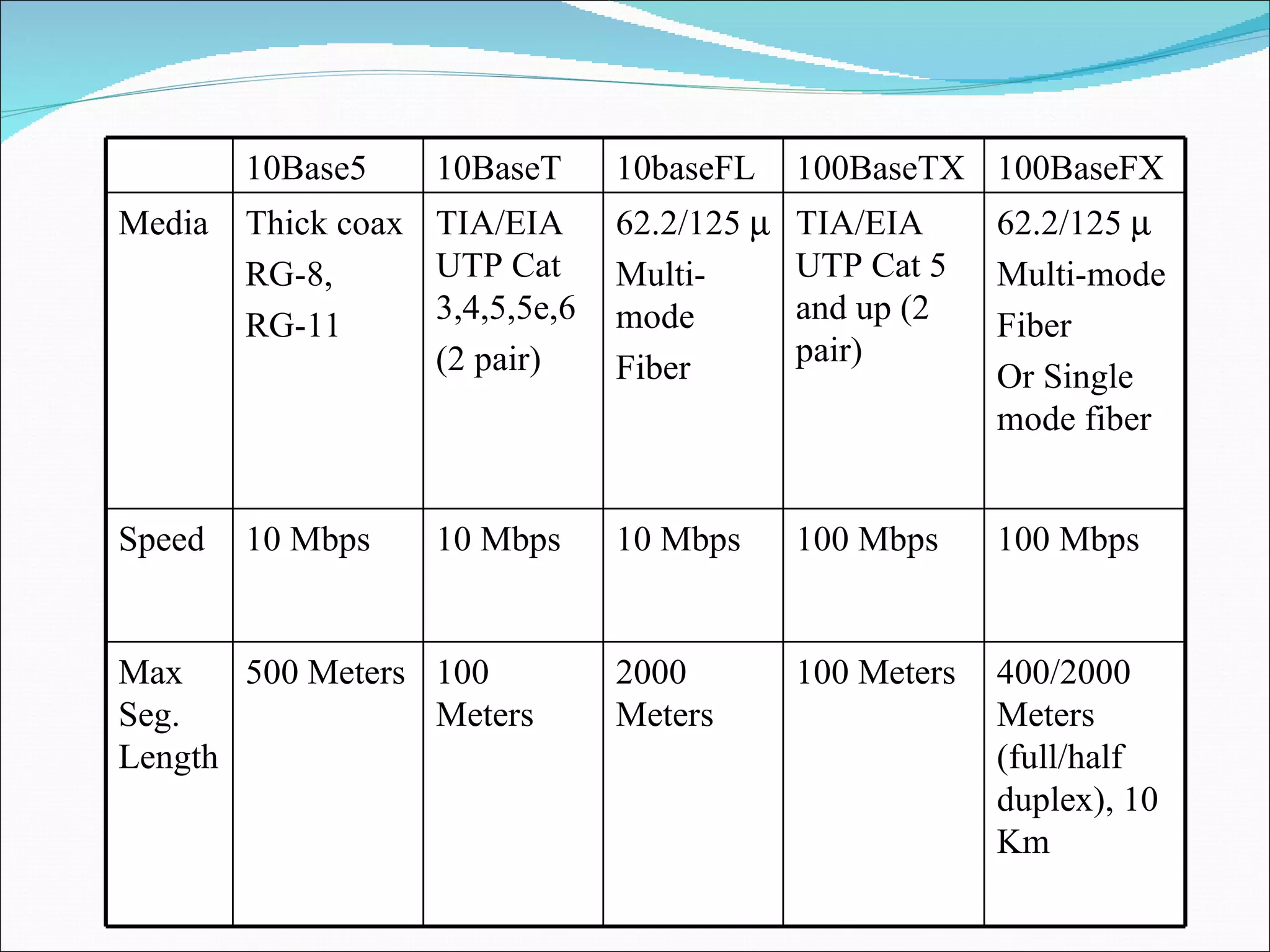
10Base5 10BaseT 10baseFL 100BaseTX 100BaseFX Media Thick coax RG-8,  RG-11 TIA/EIA UTP Cat 3,4,5,5e,6 (2 pair) 62.2/125   Multi-mode Fiber TIA/EIA UTP Cat 5 and up (2 pair) 62.2/125   Multi-mode Fiber Or Single mode fiber Speed 10 Mbps 10 Mbps 10 Mbps 100 Mbps 100 Mbps Max Seg. Length 500 Meters 100 Meters 2000 Meters 100 Meters 400/2000 Meters (full/half duplex), 10 Km
Switched Ethernet First Ethernet switch introduced by Networking Company ,Kalpana ,later acquired by Cisco. Operates at layer 2 of OSI model Switches forward and filter frames based on LAN addresses It’s not a bus or a router (although simple forwarding tables are maintained) Very scalable Full duplex operation (send/receive frames simultaneously) Connect two or more “segments” by copying data frames between them Switches only copy data when needed Higher link bandwidth Own collision domain Very less collision
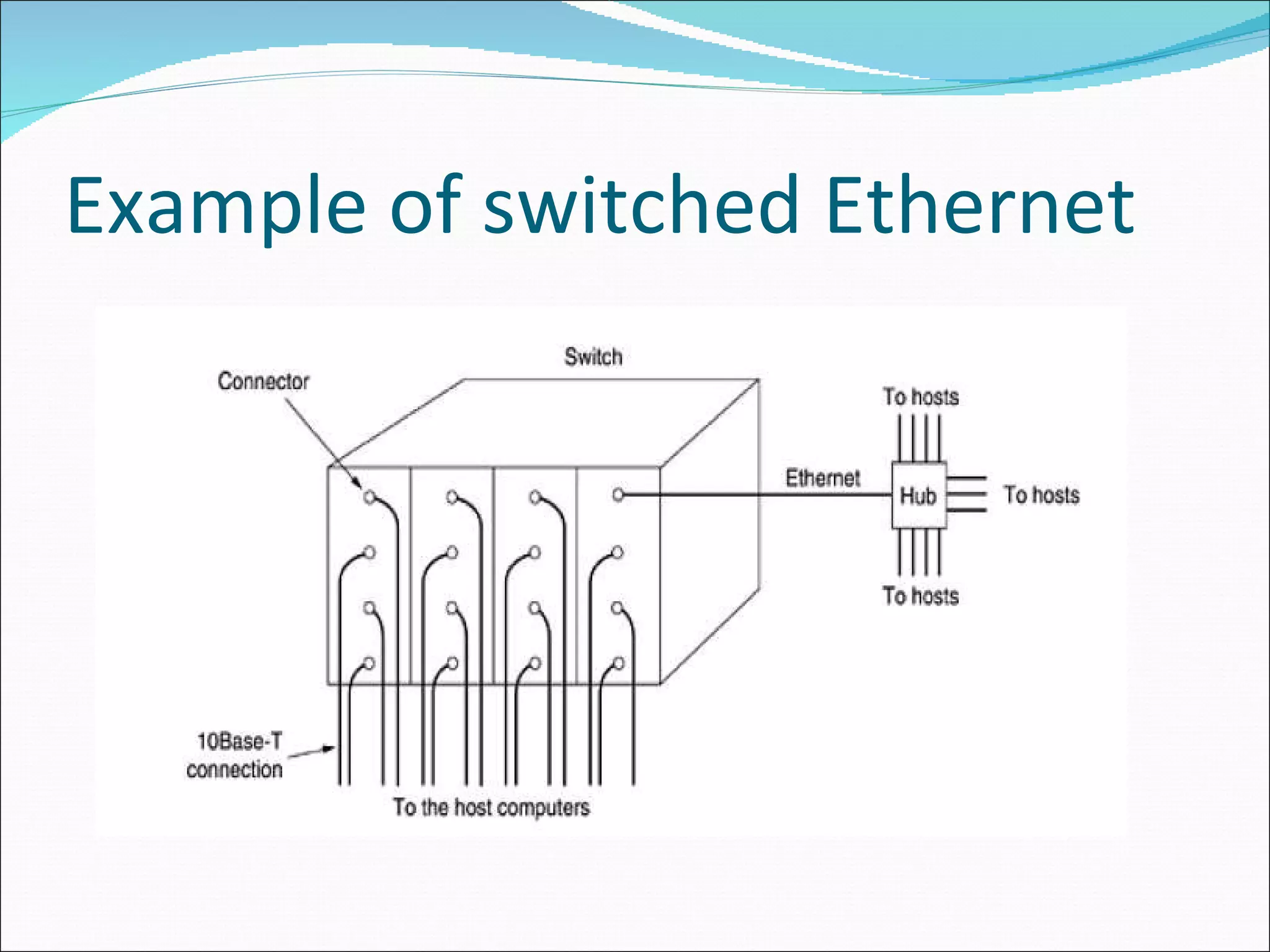
Example of switched Ethernet
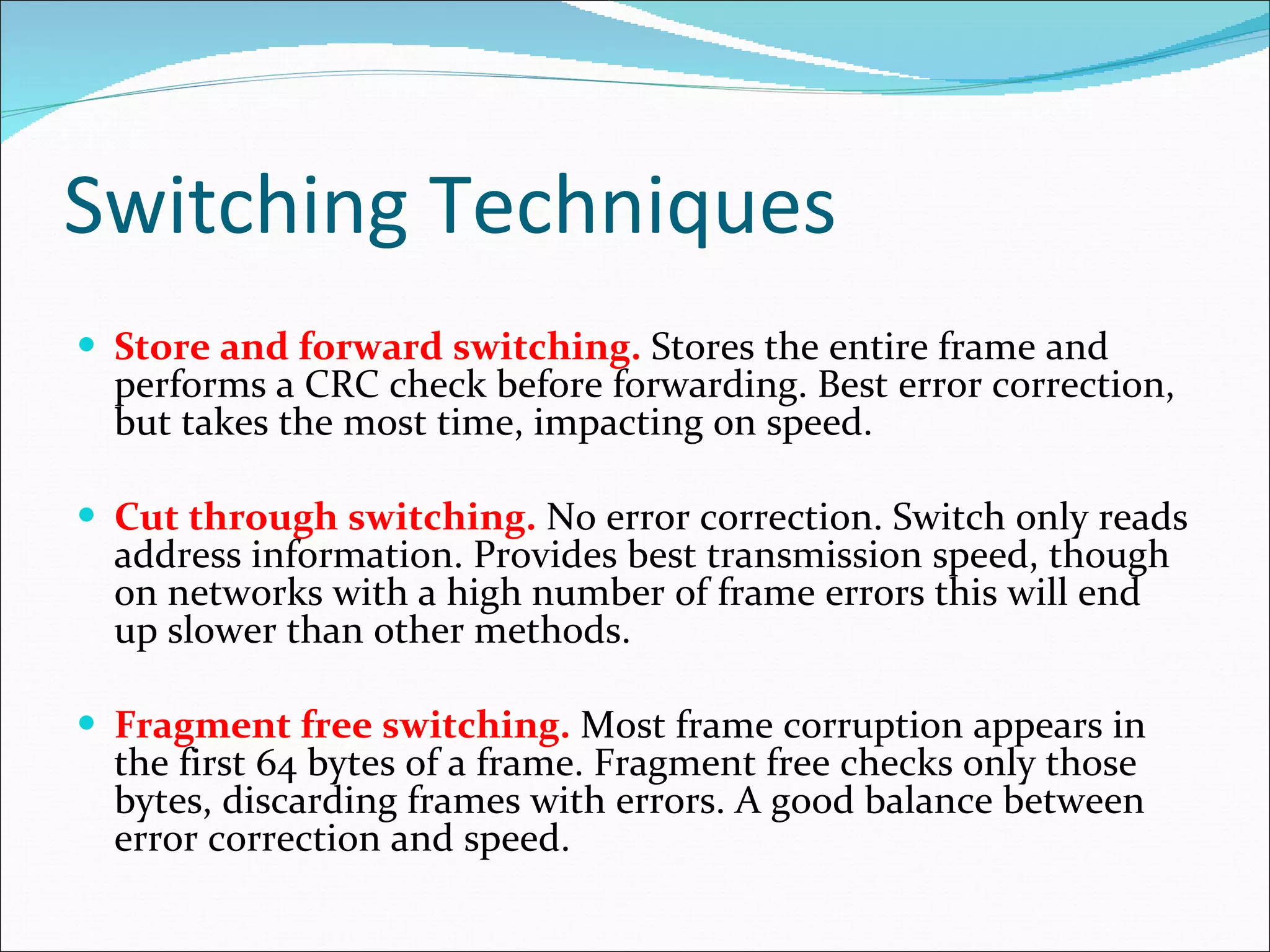
Switching Techniques  Store and forward switching.  Stores the entire frame and performs a CRC check before forwarding. Best error correction, but takes the most time, impacting on speed. Cut through switching.  No error correction. Switch only reads address information. Provides best transmission speed, though on networks with a high number of frame errors this will end up slower than other methods. Fragment free switching.  Most frame corruption appears in the first 64 bytes of a frame. Fragment free checks only those bytes, discarding frames with errors. A good balance between error correction and speed.
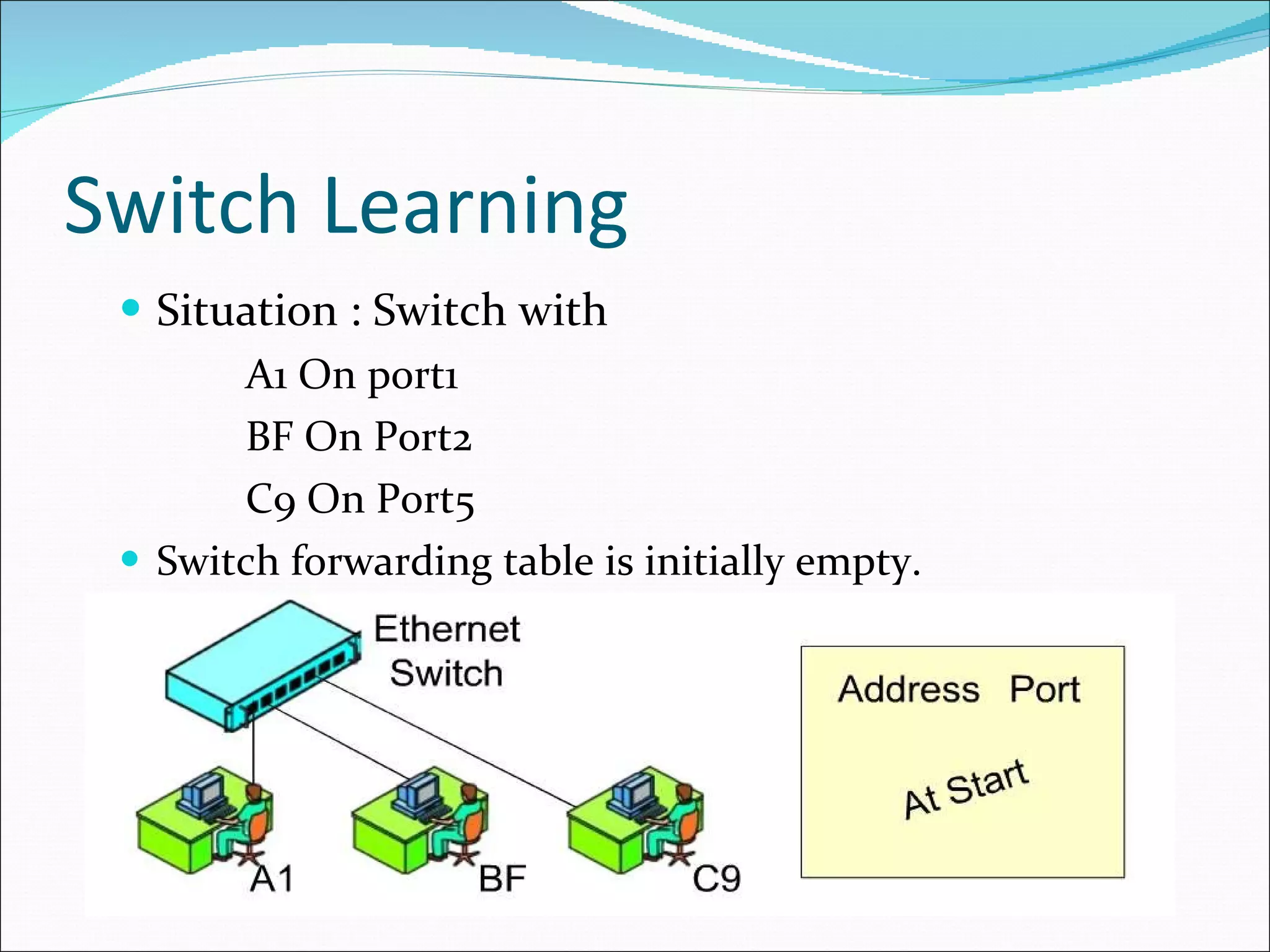
Switch Learning  Situation : Switch with A1 On port1 BF On Port2 C9 On Port5 Switch forwarding table is initially empty.
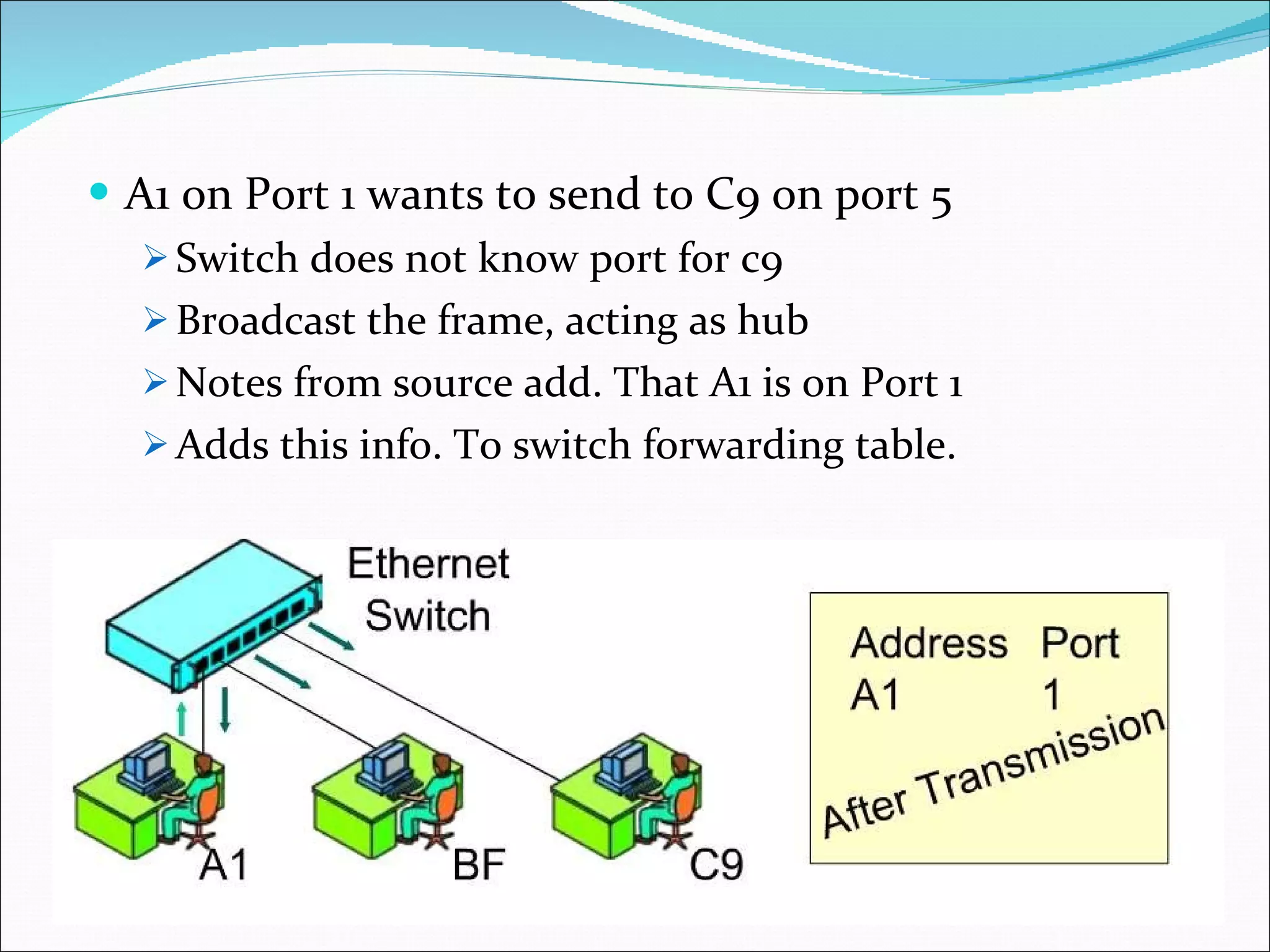
A1 on Port 1 wants to send to C9 on port 5 Switch does not know port for c9 Broadcast the frame, acting as hub Notes from source add. That A1 is on Port 1 Adds this info. To switch forwarding table.
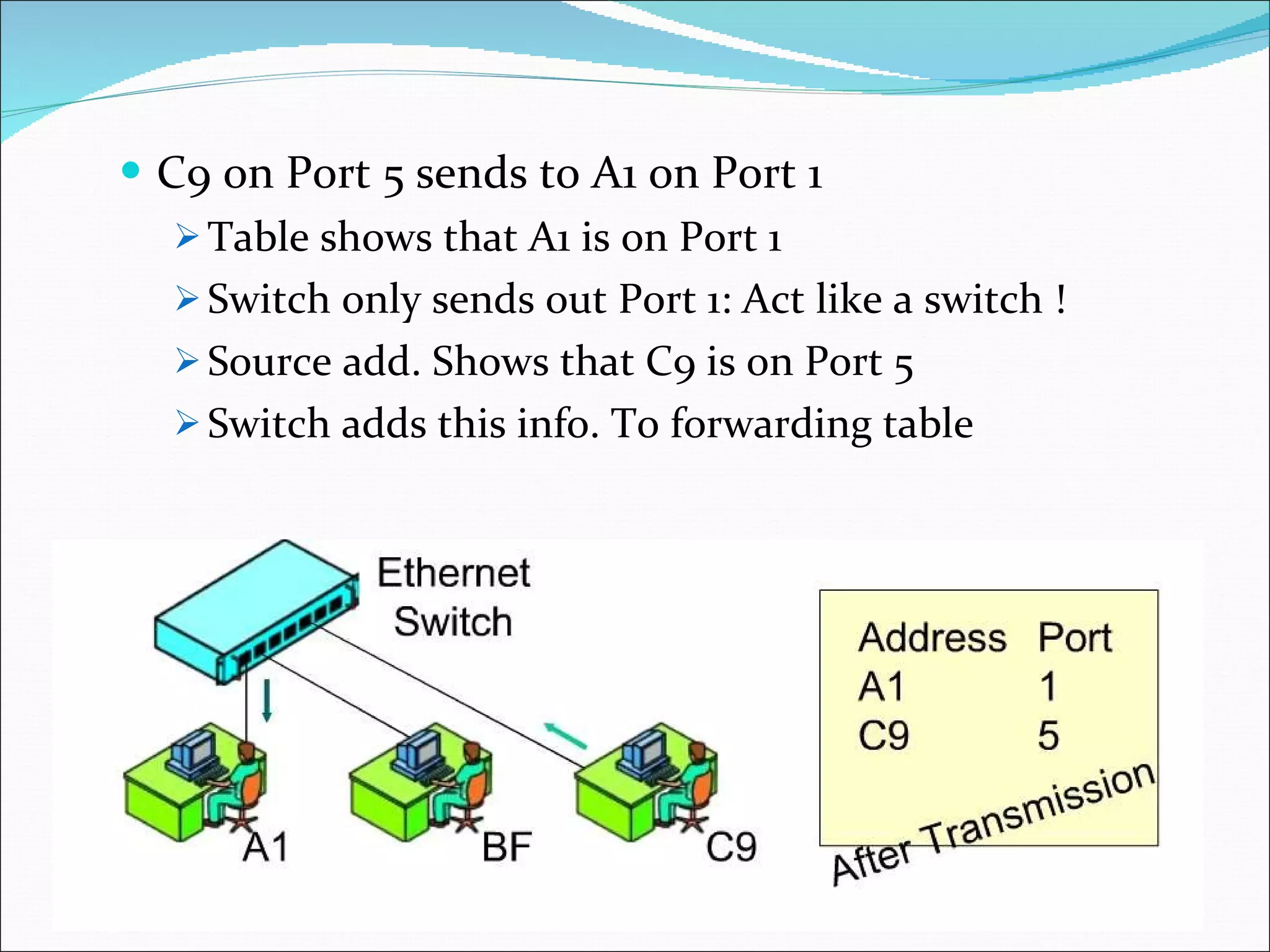
C9 on Port 5 sends to A1 on Port 1 Table shows that A1 is on Port 1 Switch only sends out Port 1: Act like a switch ! Source add. Shows that C9 is on Port 5 Switch adds this info. To forwarding table
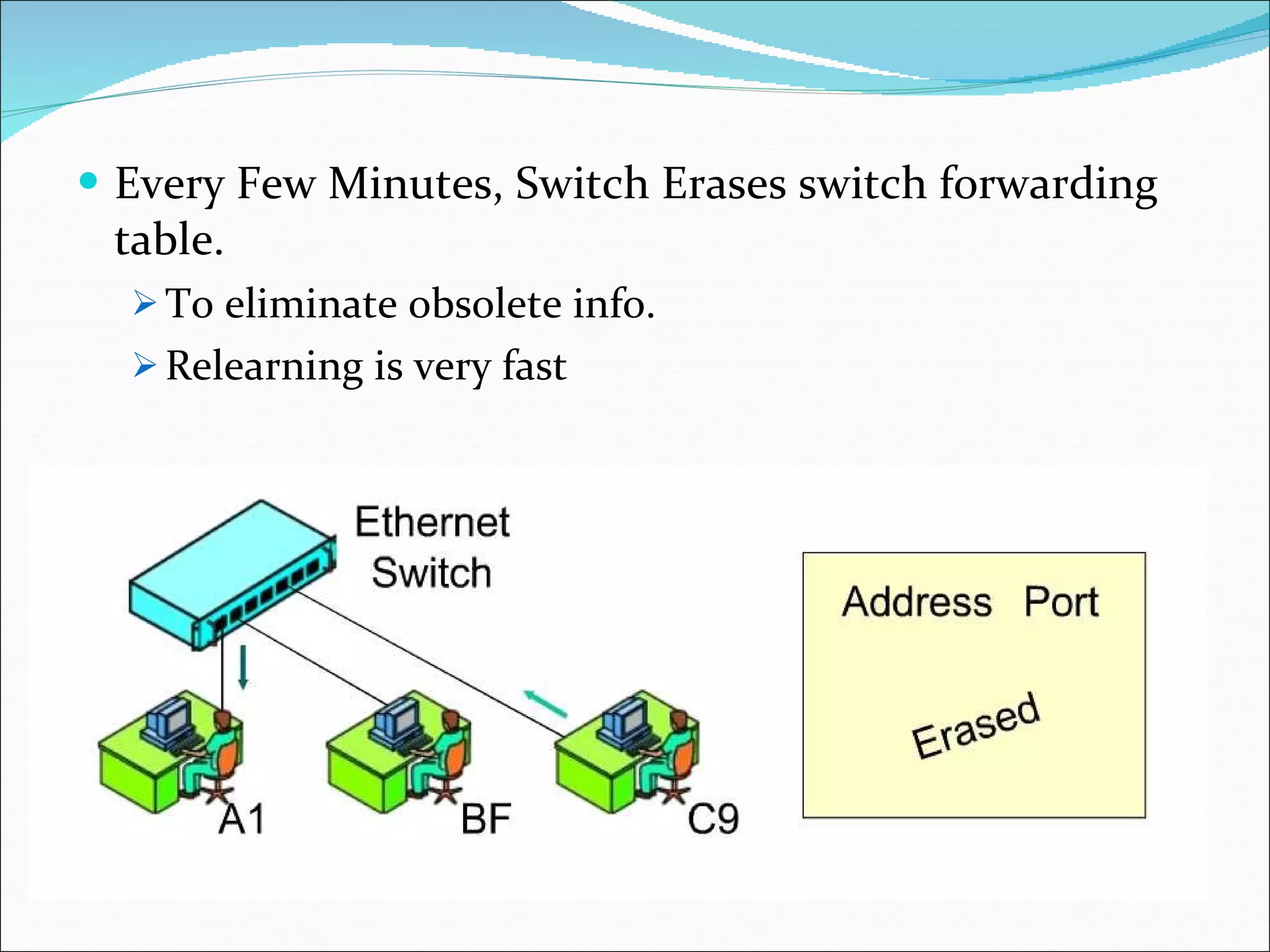
Every Few Minutes, Switch Erases switch forwarding table. To eliminate obsolete info. Relearning is very fast
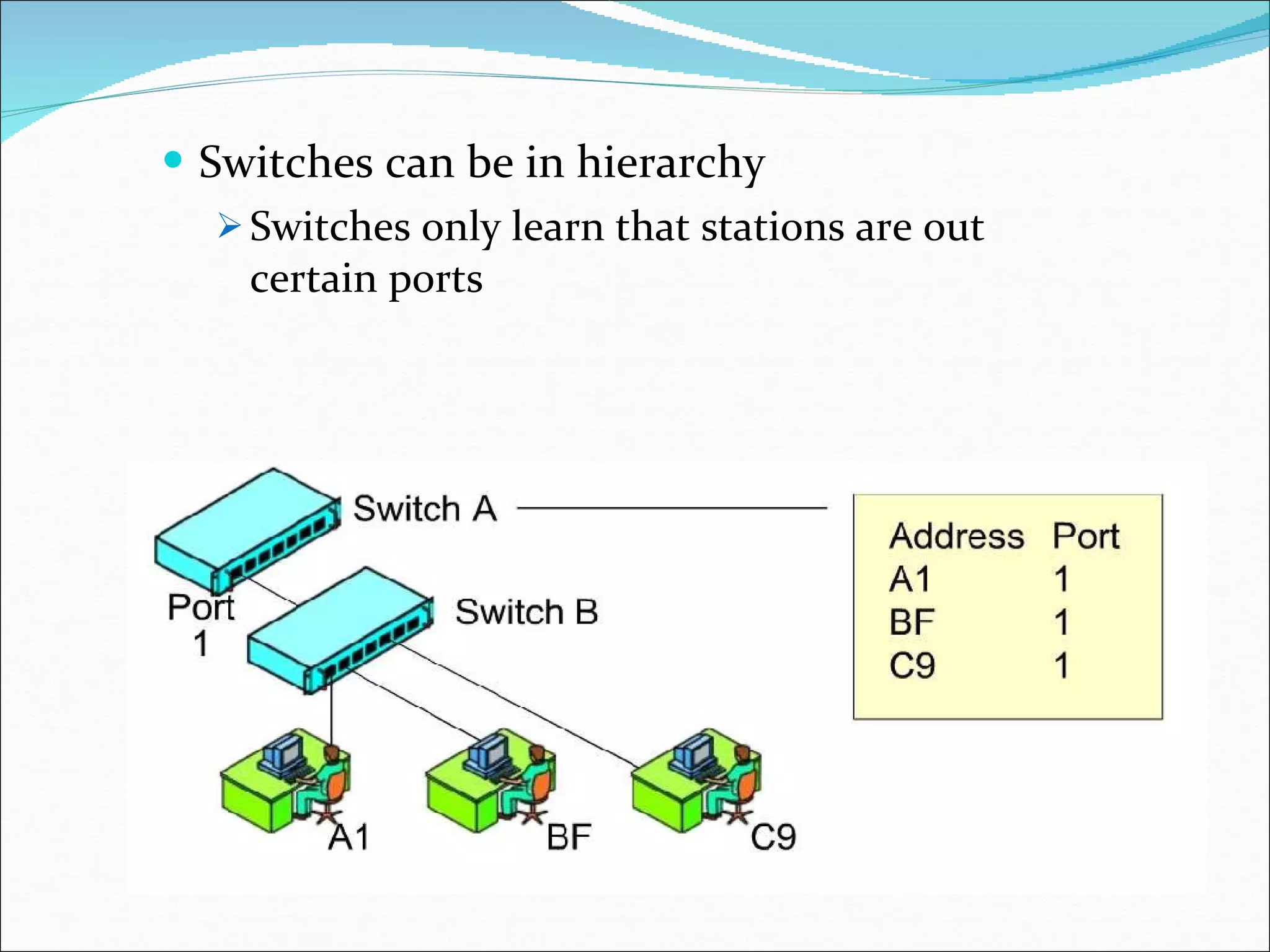
Switches can be in hierarchy Switches only learn that stations are out certain ports
Fast Ethernet “ 802.3u-1995  IEEE Standards for Local and Metropolitan Area Networks: Supplement to Carrier Sense Multiple Access with Collision Detection (CSMA/CD) Access Method and Physical Layer Specifications Media Access Control (MAC) Parameters, Physical Layer, Medium Attachment Units, and Repeater for 100 Mb/s Operation, Type 100BASE-T”
History In July 1993, a group of networking companies joined to form the Fast Ethernet Alliance.  The charter of the group was to draft the 802.3u 100BaseT specification of the IEEE and accelerate market acceptance of Fast Ethernet technology. Approved in 1995 Other goals of the committee were:  to maintain the Ethernet transmission protocol carrier sense multiple access collision detect (CSMA/CD); to support popular cabling schemes; and to ensure that Fast Ethernet technology will not require changes to the upper-layer protocols and software that run on LAN workstations.
Features of Fast Ethernet Fast Ethernet supports a maximum data rate of 100 Mbps Ability to coexist with existing network installations. ( These so-called "10/100" adapters can usually sense the speed of the line automatically and adjust accordingly.) Based on CSMA/CD Media Access Control (MAC) protocol Data can move from 10 Mbps to 100 Mbps without protocol translation or changes to application and networking software.
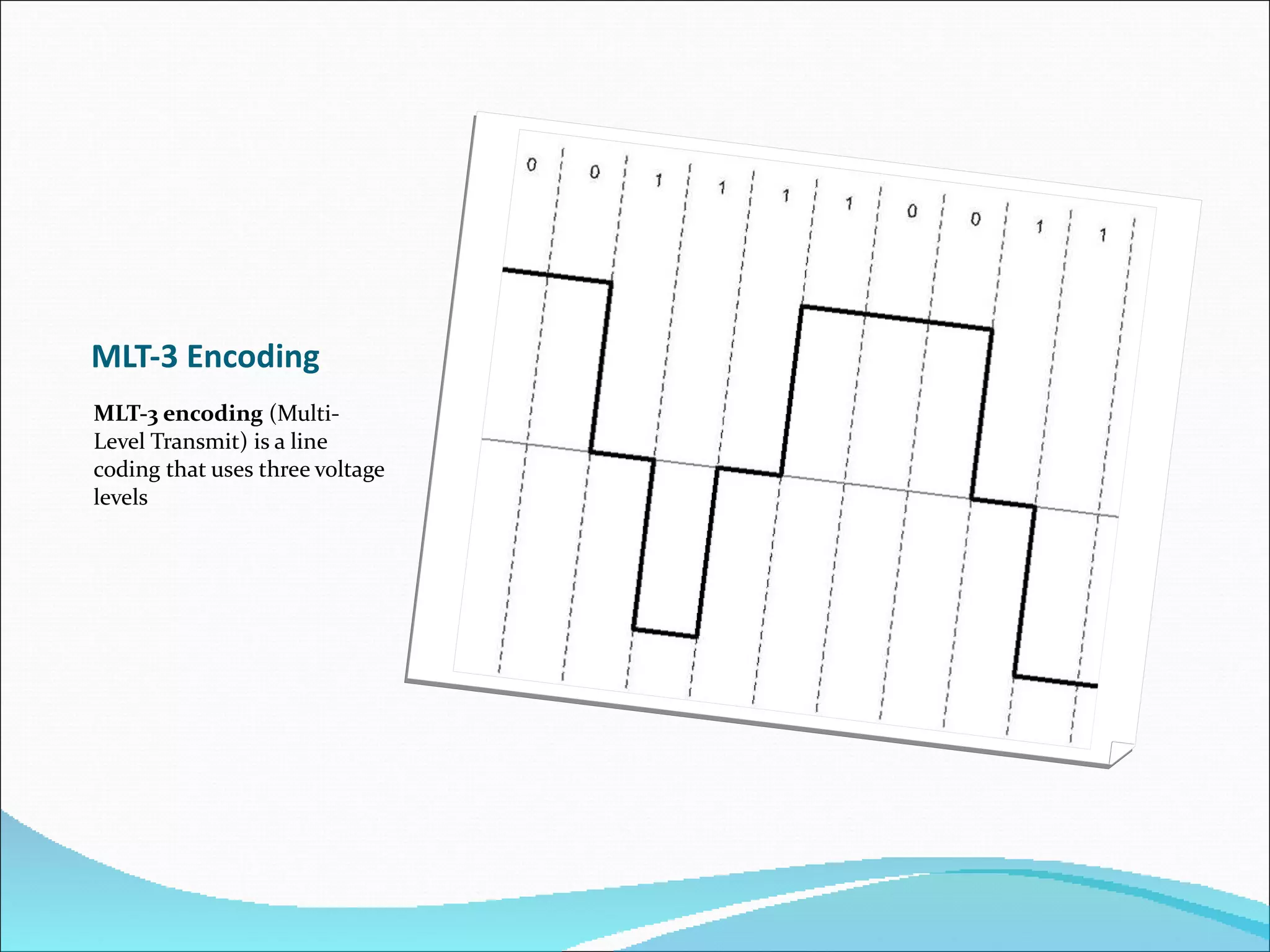
Fast Ethernet maintains CSMA/CD, the Ethernet transmission protocol. However, Fast Ethernet reduces the duration of time each bit is transmitted by a factor of 10, enabling the packet speed to increase tenfold from 10 Mbps to 100 Mbps.  ( 5.12 microseconds instead of 51.2 microseconds) Data can move between Ethernet and Fast Ethernet without requiring protocol translation, because Fast Ethernet also maintains the 10BaseT error control functions as well as the frame format and length. The encoding used is 4B/5B with MLT-3 wave shaping plus FSR.
MLT-3 Encoding MLT-3 encoding  (Multi-Level Transmit) is a line coding that uses three voltage levels
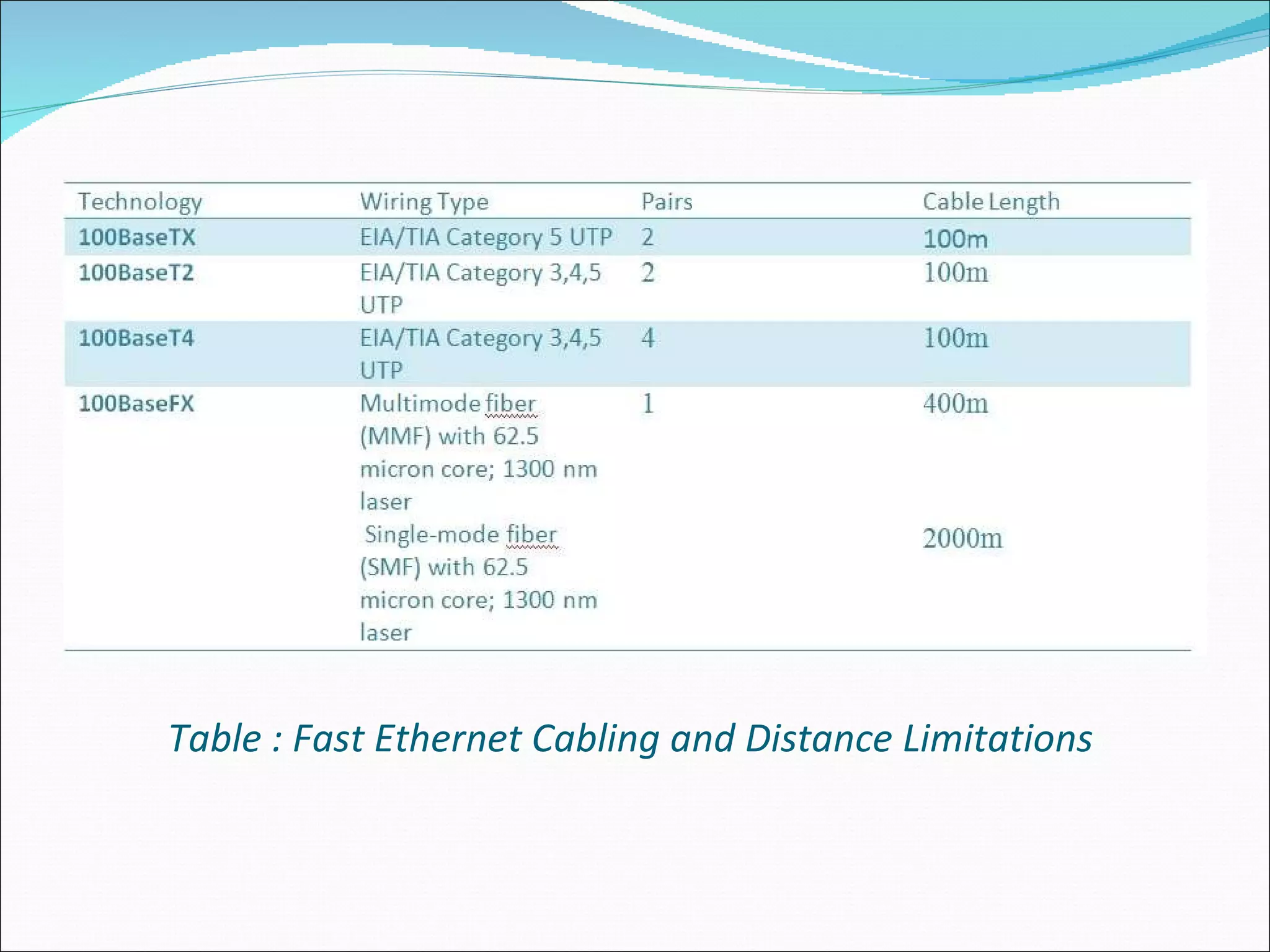
Table : Fast Ethernet Cabling and Distance Limitations
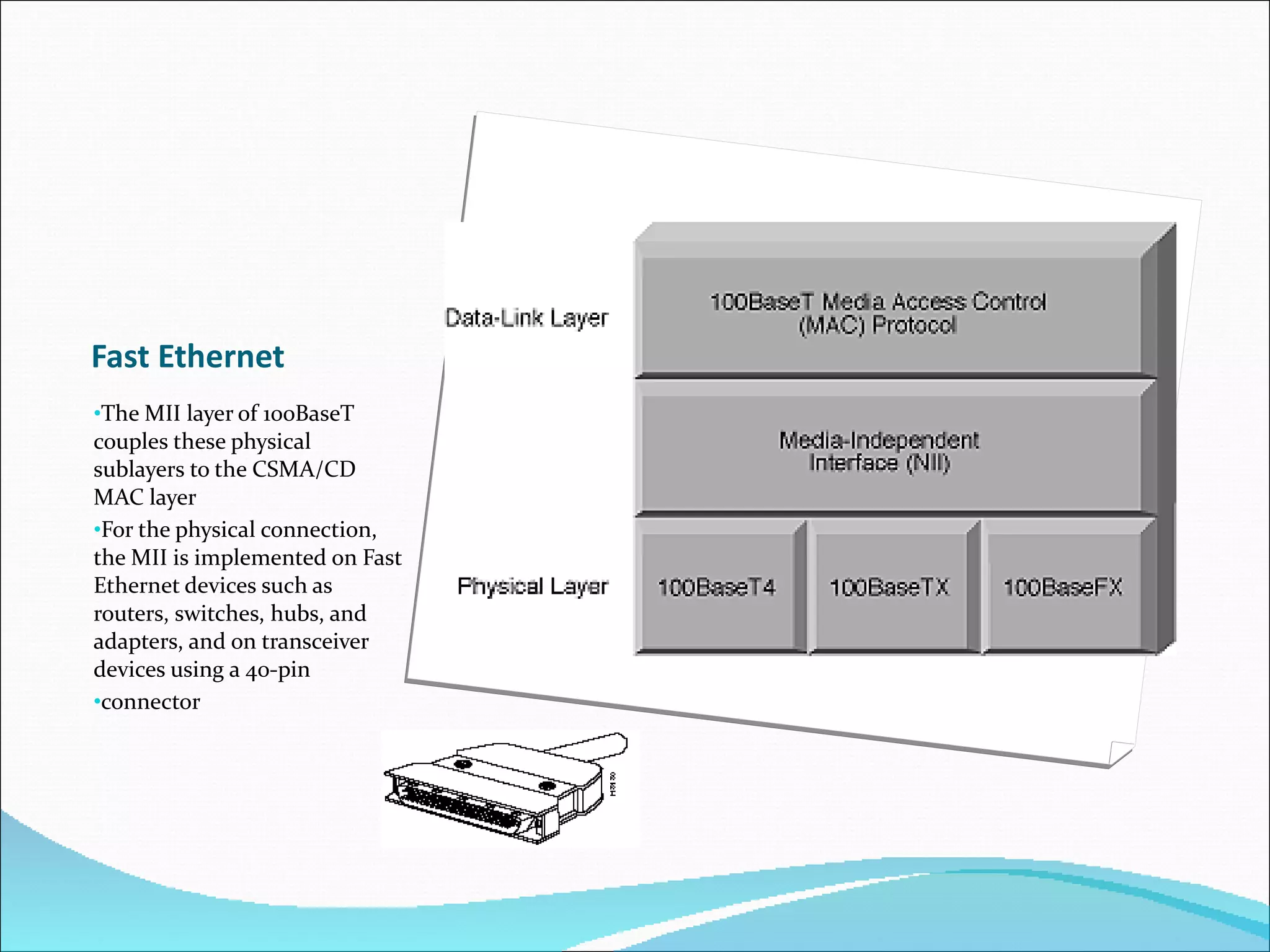
Fast Ethernet The MII layer of 100BaseT couples these physical sublayers to the CSMA/CD MAC layer  For the physical connection, the MII is implemented on Fast Ethernet devices such as routers, switches, hubs, and adapters, and on transceiver devices using a 40-pin connector
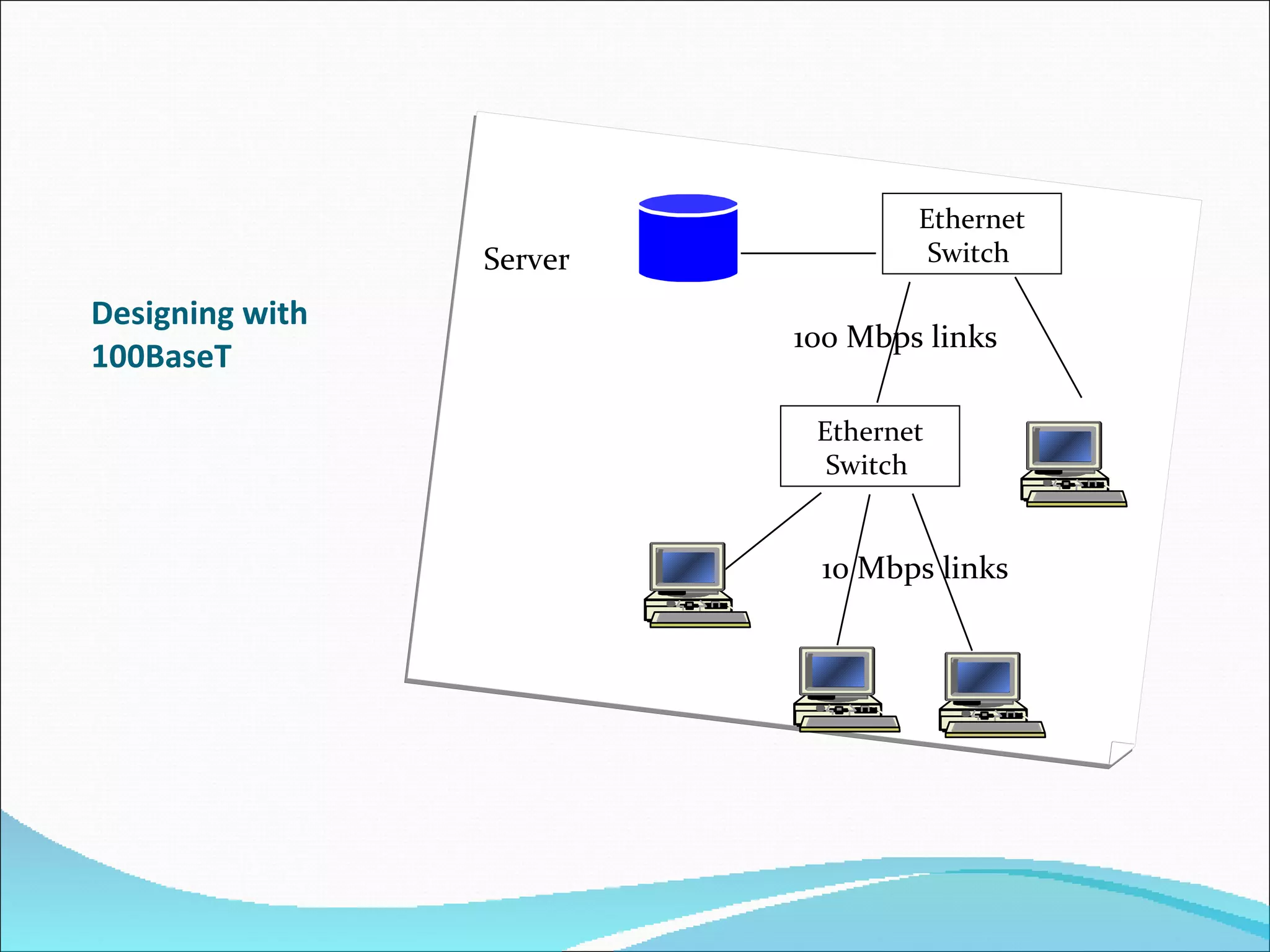
Designing with 100BaseT Ethernet Switch  Ethernet Switch  Server 100 Mbps links 10 Mbps links
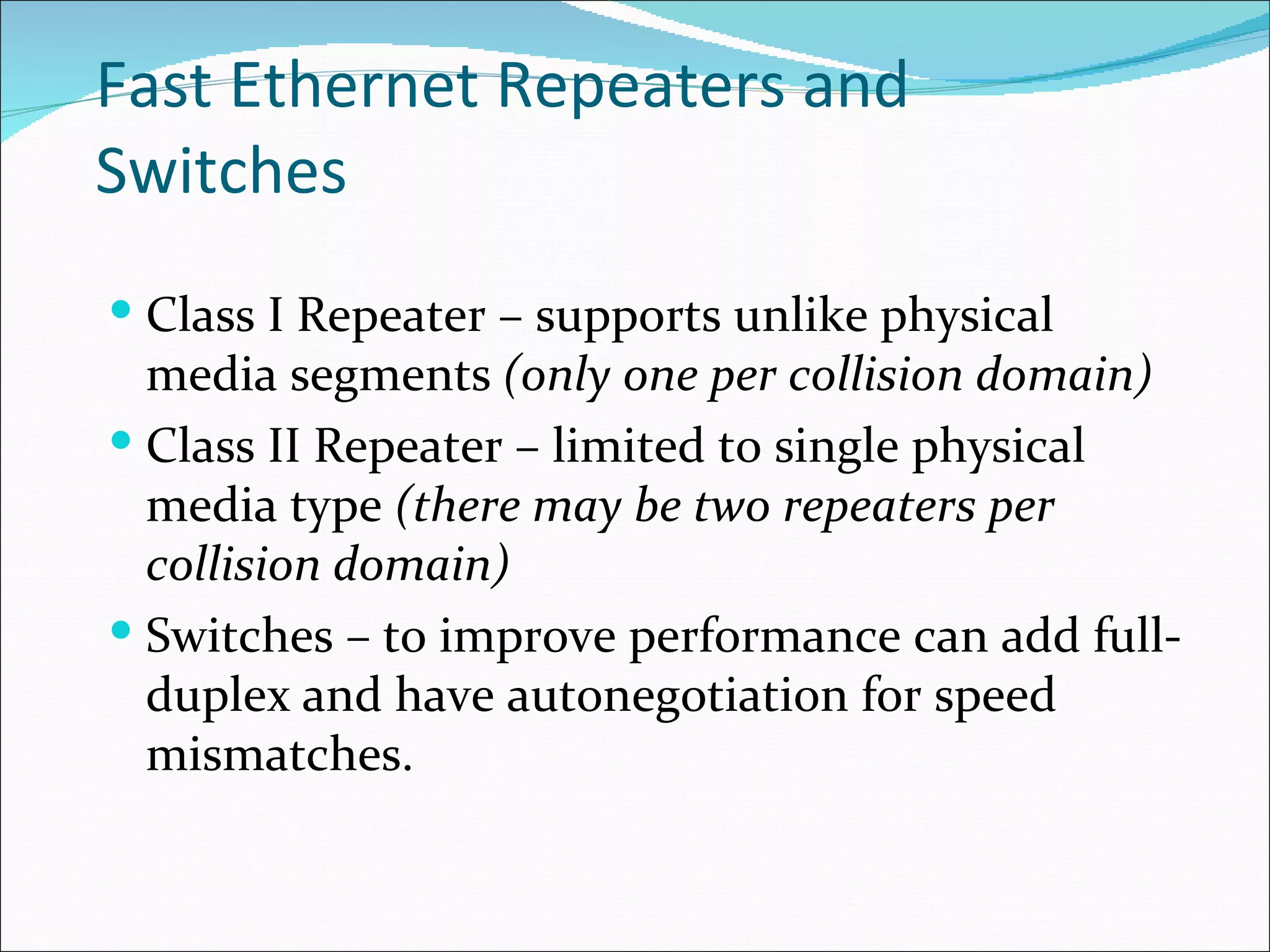
Fast Ethernet Repeaters and Switches Class I Repeater – supports unlike   physical media segments  (only one per collision domain) Class II Repeater – limited to single physical media type  (there may be two repeaters per collision domain) Switches – to improve performance can add full-duplex   and have autonegotiation for speed mismatches.
 
Autonegotiation The 100BaseT specification describes a negotiation process that allows devices at each end of a network link to automatically exchange information about their capabilities and perform the configuration necessary to operate together at their maximum common level.  For example, autonegotiation can determine whether a 100-Mbps hub is connected to a 10-Mbps or 100-Mbps adapter and then adjust its mode of operation accordingly. -Cisco
Gigabit Ethernet IEEE Std 802.3z- was formally approved by the IEEE Standards Board on June 25th, 1998.  “ IEEE Std 802.3z, extends the operating speed of the world's most popular local area network to 1 billion bits per second (1000 Mb/s) for interconnecting high-performance switches, routers, and servers in the backbone of local area networks. Maintaining backward compatibility with the over-100-million-node installed base of 10 Mb/s and 100 Mb/s was a key requirement”
(GMII)  is an interface between the Media Access Control (MAC) device and the physical layer (PHY).
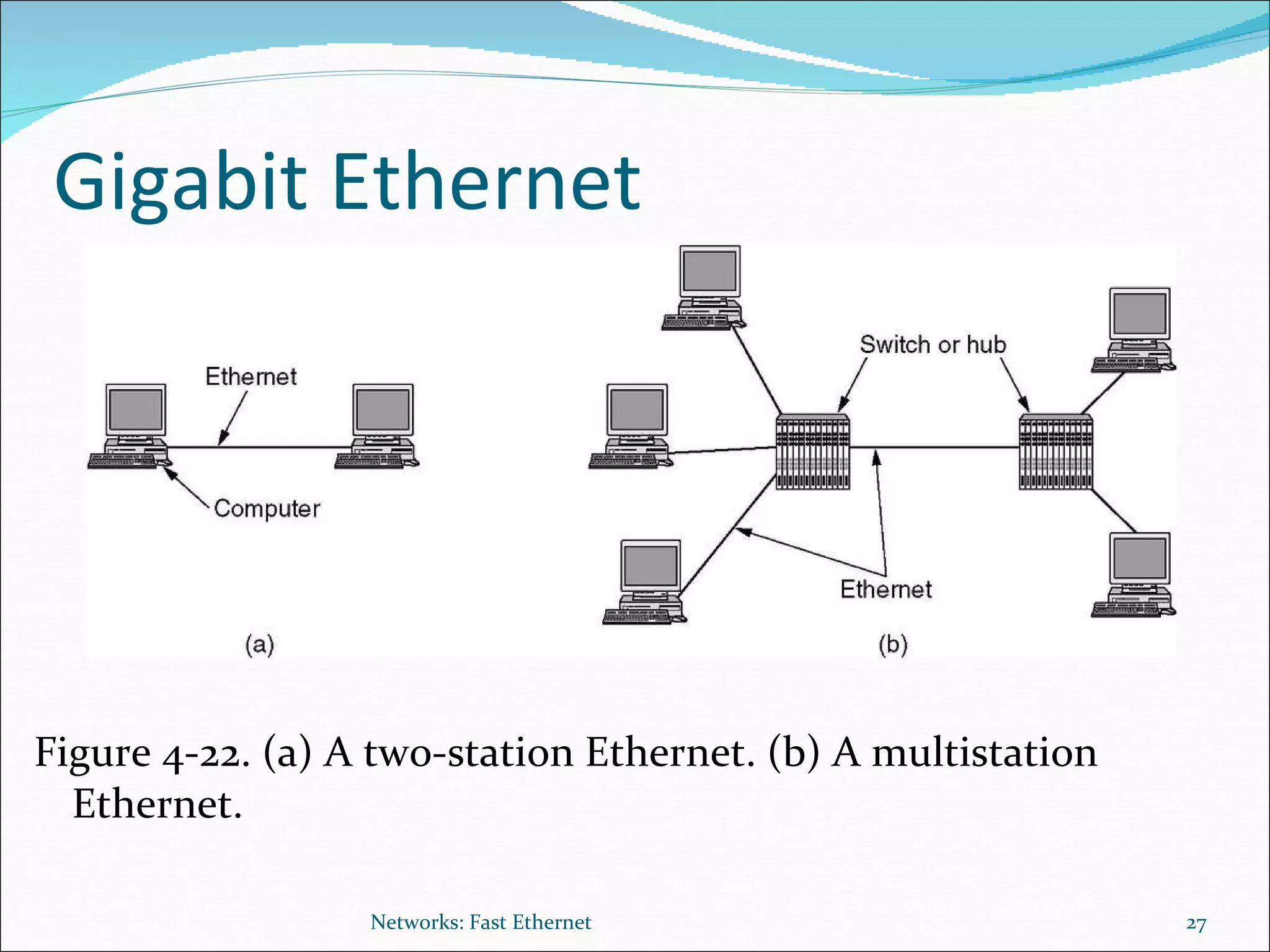
Features Provides speeds of 1000 Mbps for half-duplex and full-duplex operation. Uses Ethernet frame format and MAC technology CSMA/CD access method with support for  one repeater per collision domain. Backward compatible with 10 BASE-T and 100 BASE-T. Uses 802.3  full-duplex   Ethernet technology . All Gigabit Ethernet configurations are  point-to-point!
Figure 4-22. (a) A two-station Ethernet. (b) A multistation Ethernet. Gigabit Ethernet Networks: Fast Ethernet
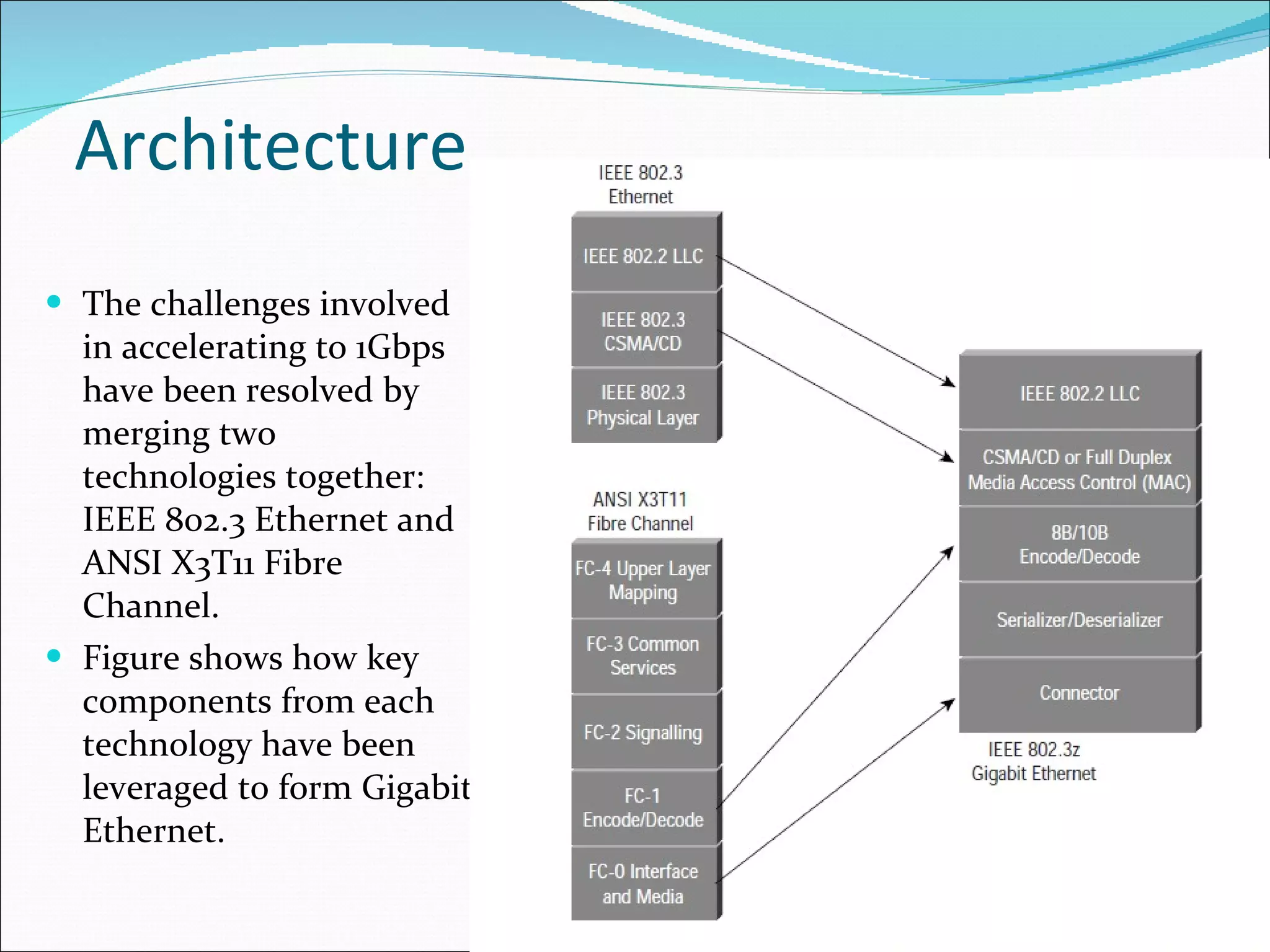
Architecture The challenges involved in accelerating to 1Gbps have been resolved by merging two technologies together: IEEE 802.3 Ethernet and ANSI X3T11 Fibre Channel.  Figure shows how key components from each technology have been leveraged to form Gigabit Ethernet.
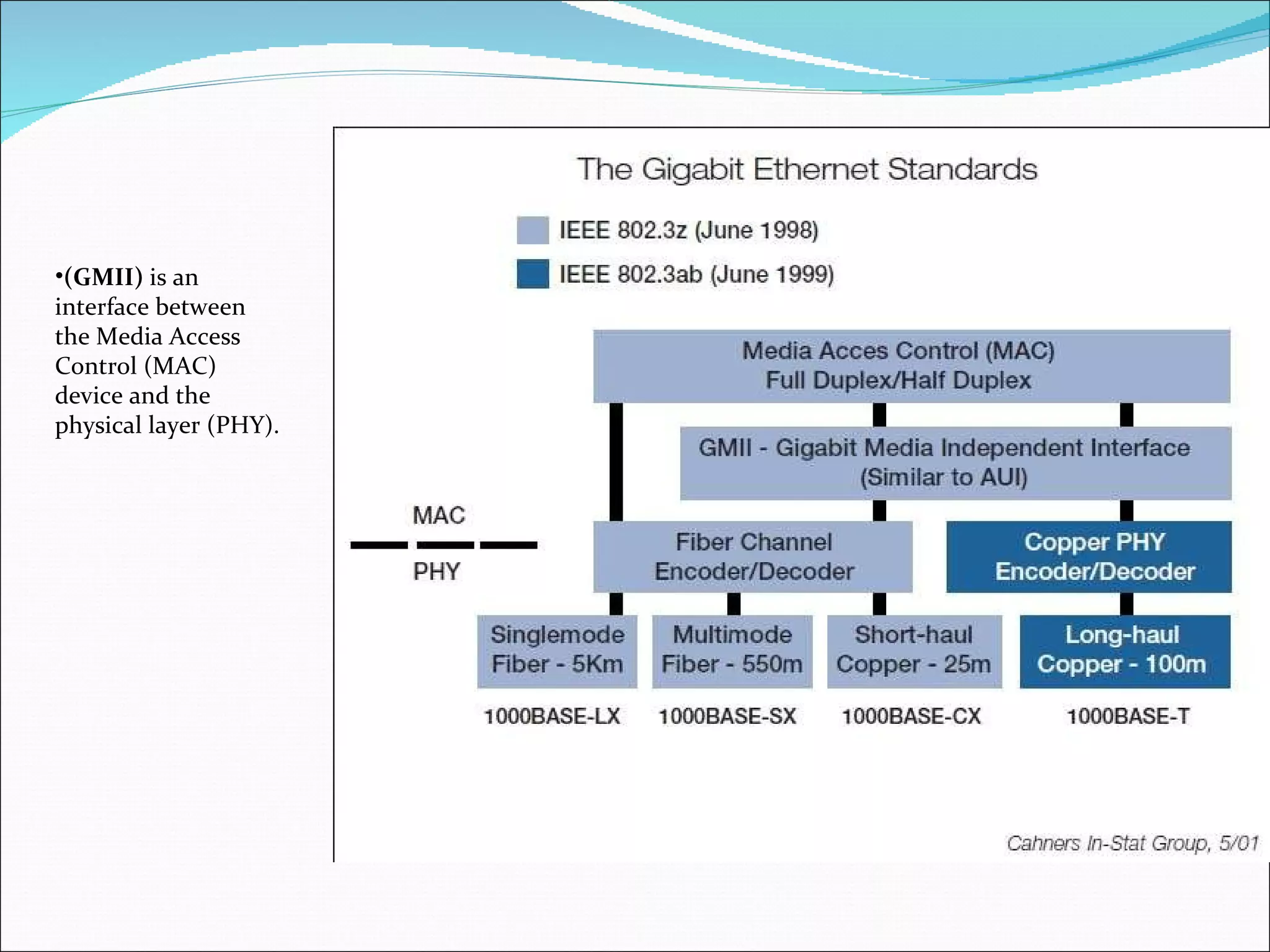
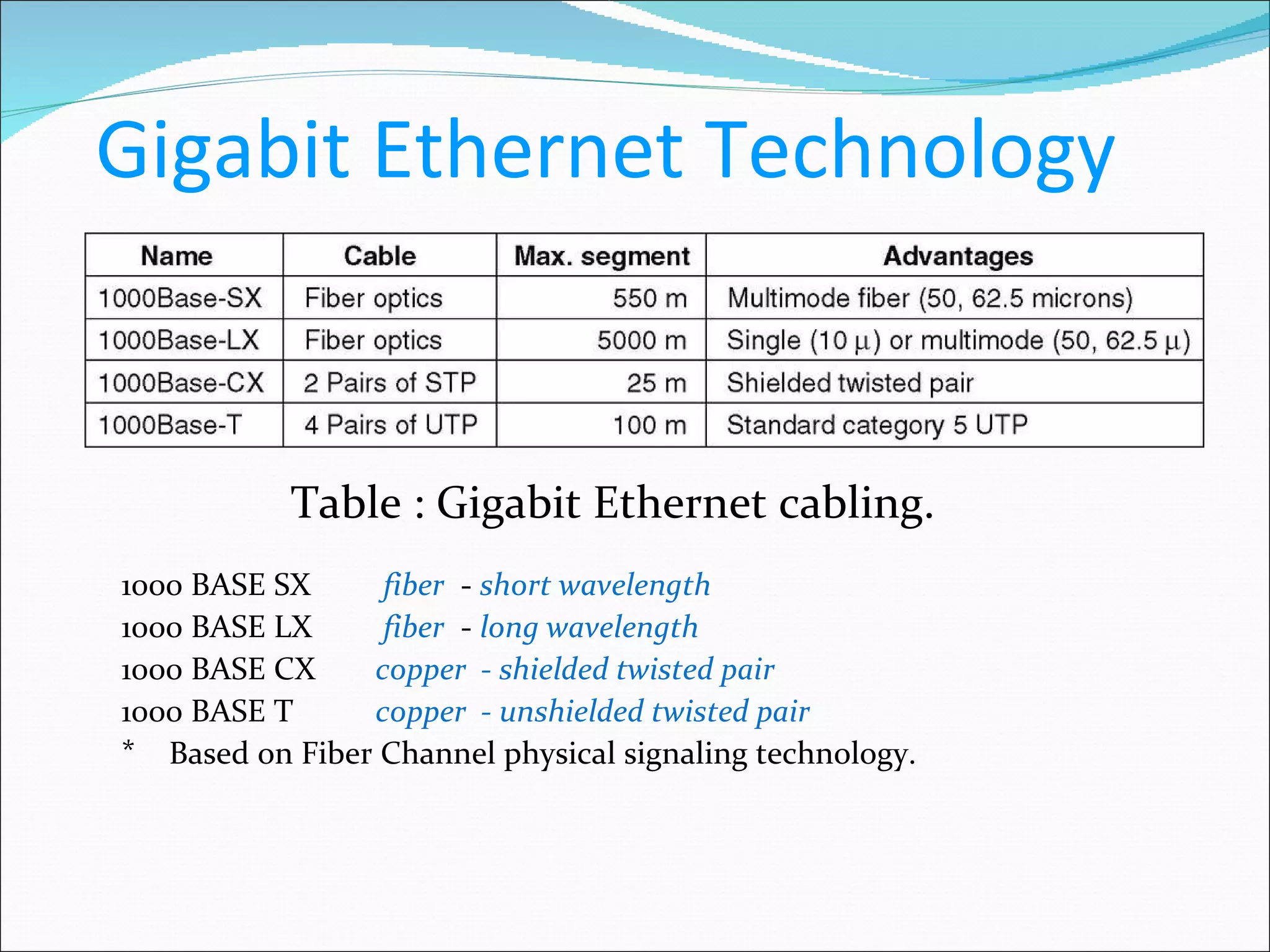
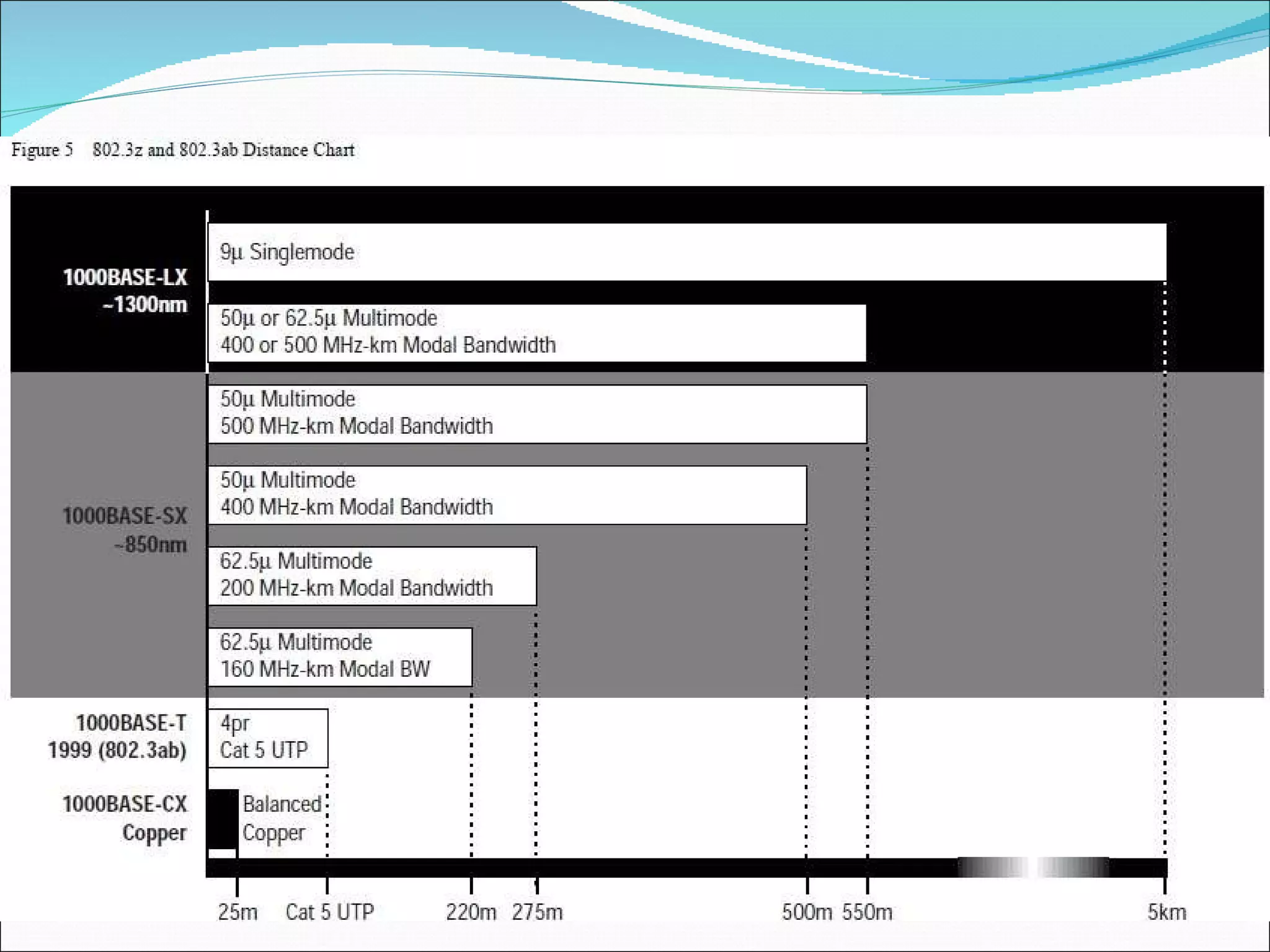
Gigabit Ethernet Technology   Table : Gigabit Ethernet cabling. 1000 BASE SX   fiber   -  short wavelength 1000 BASE LX   fiber   -  long wavelength 1000 BASE CX copper  - shielded twisted pair 1000 BASE T copper  - unshielded twisted pair Based on Fiber Channel physical signaling technology.
1000 Base SX Supports duplex links up to 275 meters. 770-860 nm range;  850 nm laser wavelength Fiber Channel   technology PCS  (Physical Code Sublayer)  includes  8B/10B encoding  with 1.25 Gbps line. Only  multimode fiber Cheaper than LX
1000 Base LX Supports duplex links up to 550 meters. 1270-1355 nm range;  1300 nm wavelength  using  lasers. Fiber Channel technology PCS (Physical Code Sublayer)  includes  8B/10B encoding  with 1.25 Gbps line. Either single mode or multimode fiber.
1000 Base CX Shielded twisted pair. 25 meters or less  typically within wiring closet. PCS (Physical Code Sublayer)   includes  8B/10B encoding  with 1.25 Gbps line. Each link is composed of a separate shielded twisted pair running in  each  direction.
1000 Base T Twisted Pair Cables Four pairs of Category 5 UTP. IEEE 802.3ab ratified in June 1999. Category 5, 6 and 7 copper up to 100 meters. This requires  extensive signal processing .
 
Carrier Extention RRRRRRRRRRRRR Frame 512 bytes For  10BaseT :  2.5 km max;   slot time = 64 bytes For  1000BaseT:  200 m max;  slot time = 512 bytes Carrier Extension :  continue transmitting control characters [R] to fill collision interval. This permits minimum 64-byte frame to be handled. Control characters discarded at destination.
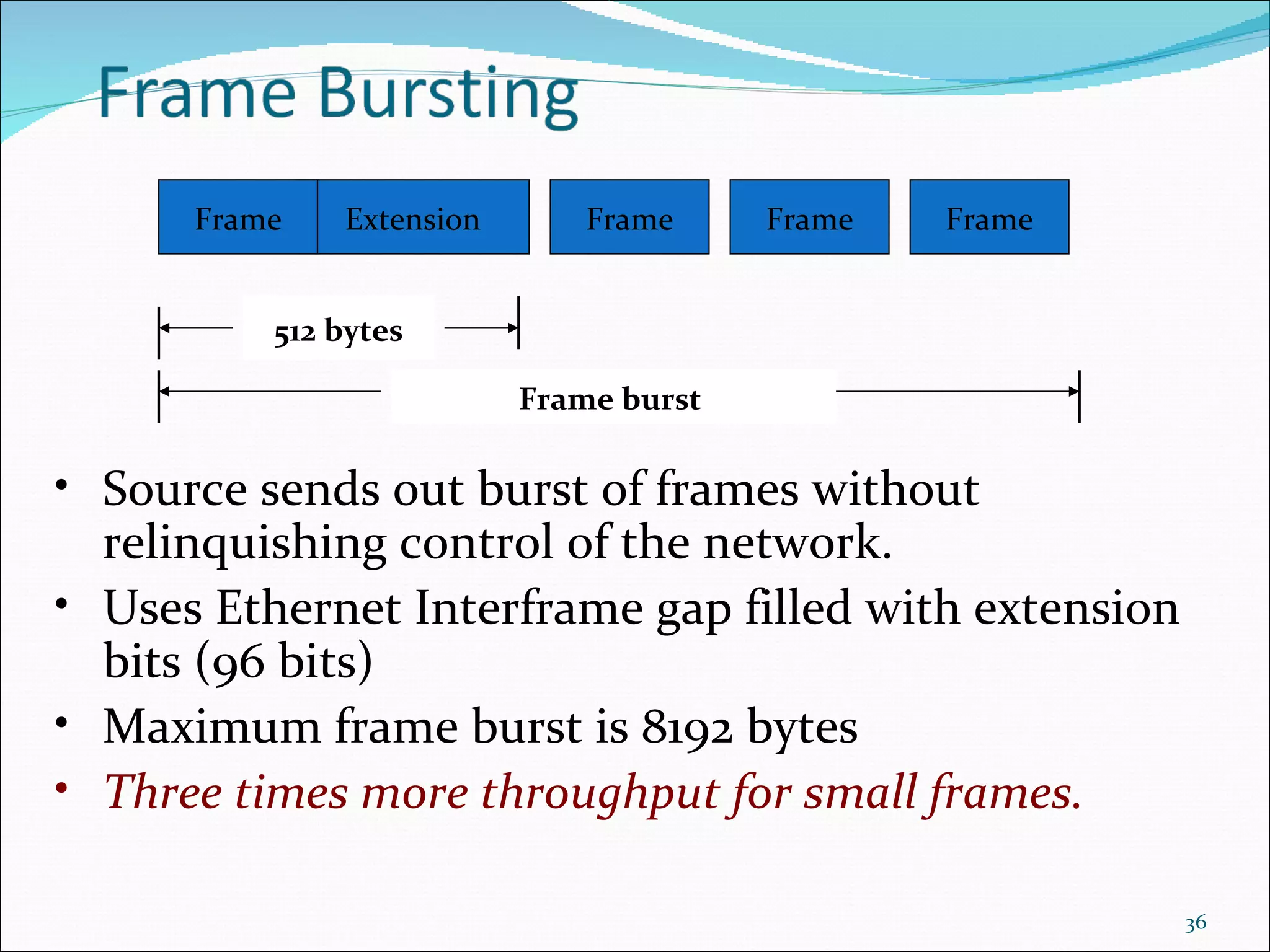
512 bytes Extension Frame Frame Frame Frame Frame burst  Source sends out burst of frames without relinquishing control of the network. Uses Ethernet Interframe gap filled with extension bits (96 bits) Maximum frame burst is 8192 bytes Three times more throughput for small frames.
References Computer Networks 4e by Andrew S. Tanenbaum www.cisco.com www.intel.com/network/ Standards.ieee.org/catalog grouper.ieee.org/groups/802/3 www.ethermanage.com Wikipedia.org compnetworking.about.com
-Bhavin Chauhan -Arpan Chavda Thank You

Advance ethernet

  • 1.
    By BhavinChauhan (09BCE005) Arpan Chavda (09BCE006)
  • 2.
    What is Ethernet?Most widely-installed local area network (LAN) technology IEEE 802.3 Uses coaxial cable or special grades of twisted pair wires Uses CSMA/CD protocol & Manchester Encoding Advance Ethernet is advance version of Ethernet which is called as Ethernet 2.0
  • 3.
    Types of AdvanceEthernet Switched Ethernet Fast Ethernet Gigabit Ethernet
  • 4.
    10Base5 10BaseT 10baseFL100BaseTX 100BaseFX Media Thick coax RG-8, RG-11 TIA/EIA UTP Cat 3,4,5,5e,6 (2 pair) 62.2/125  Multi-mode Fiber TIA/EIA UTP Cat 5 and up (2 pair) 62.2/125  Multi-mode Fiber Or Single mode fiber Speed 10 Mbps 10 Mbps 10 Mbps 100 Mbps 100 Mbps Max Seg. Length 500 Meters 100 Meters 2000 Meters 100 Meters 400/2000 Meters (full/half duplex), 10 Km
  • 5.
    Switched Ethernet FirstEthernet switch introduced by Networking Company ,Kalpana ,later acquired by Cisco. Operates at layer 2 of OSI model Switches forward and filter frames based on LAN addresses It’s not a bus or a router (although simple forwarding tables are maintained) Very scalable Full duplex operation (send/receive frames simultaneously) Connect two or more “segments” by copying data frames between them Switches only copy data when needed Higher link bandwidth Own collision domain Very less collision
  • 6.
  • 7.
    Switching Techniques Store and forward switching. Stores the entire frame and performs a CRC check before forwarding. Best error correction, but takes the most time, impacting on speed. Cut through switching. No error correction. Switch only reads address information. Provides best transmission speed, though on networks with a high number of frame errors this will end up slower than other methods. Fragment free switching. Most frame corruption appears in the first 64 bytes of a frame. Fragment free checks only those bytes, discarding frames with errors. A good balance between error correction and speed.
  • 8.
    Switch Learning Situation : Switch with A1 On port1 BF On Port2 C9 On Port5 Switch forwarding table is initially empty.
  • 9.
    A1 on Port1 wants to send to C9 on port 5 Switch does not know port for c9 Broadcast the frame, acting as hub Notes from source add. That A1 is on Port 1 Adds this info. To switch forwarding table.
  • 10.
    C9 on Port5 sends to A1 on Port 1 Table shows that A1 is on Port 1 Switch only sends out Port 1: Act like a switch ! Source add. Shows that C9 is on Port 5 Switch adds this info. To forwarding table
  • 11.
    Every Few Minutes,Switch Erases switch forwarding table. To eliminate obsolete info. Relearning is very fast
  • 12.
    Switches can bein hierarchy Switches only learn that stations are out certain ports
  • 13.
    Fast Ethernet “802.3u-1995 IEEE Standards for Local and Metropolitan Area Networks: Supplement to Carrier Sense Multiple Access with Collision Detection (CSMA/CD) Access Method and Physical Layer Specifications Media Access Control (MAC) Parameters, Physical Layer, Medium Attachment Units, and Repeater for 100 Mb/s Operation, Type 100BASE-T”
  • 14.
    History In July1993, a group of networking companies joined to form the Fast Ethernet Alliance. The charter of the group was to draft the 802.3u 100BaseT specification of the IEEE and accelerate market acceptance of Fast Ethernet technology. Approved in 1995 Other goals of the committee were: to maintain the Ethernet transmission protocol carrier sense multiple access collision detect (CSMA/CD); to support popular cabling schemes; and to ensure that Fast Ethernet technology will not require changes to the upper-layer protocols and software that run on LAN workstations.
  • 15.
    Features of FastEthernet Fast Ethernet supports a maximum data rate of 100 Mbps Ability to coexist with existing network installations. ( These so-called "10/100" adapters can usually sense the speed of the line automatically and adjust accordingly.) Based on CSMA/CD Media Access Control (MAC) protocol Data can move from 10 Mbps to 100 Mbps without protocol translation or changes to application and networking software.
  • 16.
    Fast Ethernet maintainsCSMA/CD, the Ethernet transmission protocol. However, Fast Ethernet reduces the duration of time each bit is transmitted by a factor of 10, enabling the packet speed to increase tenfold from 10 Mbps to 100 Mbps. ( 5.12 microseconds instead of 51.2 microseconds) Data can move between Ethernet and Fast Ethernet without requiring protocol translation, because Fast Ethernet also maintains the 10BaseT error control functions as well as the frame format and length. The encoding used is 4B/5B with MLT-3 wave shaping plus FSR.
  • 17.
    MLT-3 Encoding MLT-3encoding (Multi-Level Transmit) is a line coding that uses three voltage levels
  • 18.
    Table : FastEthernet Cabling and Distance Limitations
  • 19.
    Fast Ethernet TheMII layer of 100BaseT couples these physical sublayers to the CSMA/CD MAC layer For the physical connection, the MII is implemented on Fast Ethernet devices such as routers, switches, hubs, and adapters, and on transceiver devices using a 40-pin connector
  • 20.
    Designing with 100BaseTEthernet Switch Ethernet Switch Server 100 Mbps links 10 Mbps links
  • 21.
    Fast Ethernet Repeatersand Switches Class I Repeater – supports unlike physical media segments (only one per collision domain) Class II Repeater – limited to single physical media type (there may be two repeaters per collision domain) Switches – to improve performance can add full-duplex and have autonegotiation for speed mismatches.
  • 22.
  • 23.
    Autonegotiation The 100BaseTspecification describes a negotiation process that allows devices at each end of a network link to automatically exchange information about their capabilities and perform the configuration necessary to operate together at their maximum common level. For example, autonegotiation can determine whether a 100-Mbps hub is connected to a 10-Mbps or 100-Mbps adapter and then adjust its mode of operation accordingly. -Cisco
  • 24.
    Gigabit Ethernet IEEEStd 802.3z- was formally approved by the IEEE Standards Board on June 25th, 1998. “ IEEE Std 802.3z, extends the operating speed of the world's most popular local area network to 1 billion bits per second (1000 Mb/s) for interconnecting high-performance switches, routers, and servers in the backbone of local area networks. Maintaining backward compatibility with the over-100-million-node installed base of 10 Mb/s and 100 Mb/s was a key requirement”
  • 25.
    (GMII) isan interface between the Media Access Control (MAC) device and the physical layer (PHY).
  • 26.
    Features Provides speedsof 1000 Mbps for half-duplex and full-duplex operation. Uses Ethernet frame format and MAC technology CSMA/CD access method with support for one repeater per collision domain. Backward compatible with 10 BASE-T and 100 BASE-T. Uses 802.3 full-duplex Ethernet technology . All Gigabit Ethernet configurations are point-to-point!
  • 27.
    Figure 4-22. (a)A two-station Ethernet. (b) A multistation Ethernet. Gigabit Ethernet Networks: Fast Ethernet
  • 28.
    Architecture The challengesinvolved in accelerating to 1Gbps have been resolved by merging two technologies together: IEEE 802.3 Ethernet and ANSI X3T11 Fibre Channel. Figure shows how key components from each technology have been leveraged to form Gigabit Ethernet.
  • 29.
    Gigabit Ethernet Technology Table : Gigabit Ethernet cabling. 1000 BASE SX fiber - short wavelength 1000 BASE LX fiber - long wavelength 1000 BASE CX copper - shielded twisted pair 1000 BASE T copper - unshielded twisted pair Based on Fiber Channel physical signaling technology.
  • 30.
    1000 Base SXSupports duplex links up to 275 meters. 770-860 nm range; 850 nm laser wavelength Fiber Channel technology PCS (Physical Code Sublayer) includes 8B/10B encoding with 1.25 Gbps line. Only multimode fiber Cheaper than LX
  • 31.
    1000 Base LXSupports duplex links up to 550 meters. 1270-1355 nm range; 1300 nm wavelength using lasers. Fiber Channel technology PCS (Physical Code Sublayer) includes 8B/10B encoding with 1.25 Gbps line. Either single mode or multimode fiber.
  • 32.
    1000 Base CXShielded twisted pair. 25 meters or less typically within wiring closet. PCS (Physical Code Sublayer) includes 8B/10B encoding with 1.25 Gbps line. Each link is composed of a separate shielded twisted pair running in each direction.
  • 33.
    1000 Base TTwisted Pair Cables Four pairs of Category 5 UTP. IEEE 802.3ab ratified in June 1999. Category 5, 6 and 7 copper up to 100 meters. This requires extensive signal processing .
  • 34.
  • 35.
    Carrier Extention RRRRRRRRRRRRRFrame 512 bytes For 10BaseT : 2.5 km max; slot time = 64 bytes For 1000BaseT: 200 m max; slot time = 512 bytes Carrier Extension : continue transmitting control characters [R] to fill collision interval. This permits minimum 64-byte frame to be handled. Control characters discarded at destination.
  • 36.
    512 bytes ExtensionFrame Frame Frame Frame Frame burst Source sends out burst of frames without relinquishing control of the network. Uses Ethernet Interframe gap filled with extension bits (96 bits) Maximum frame burst is 8192 bytes Three times more throughput for small frames.
  • 37.
    References Computer Networks4e by Andrew S. Tanenbaum www.cisco.com www.intel.com/network/ Standards.ieee.org/catalog grouper.ieee.org/groups/802/3 www.ethermanage.com Wikipedia.org compnetworking.about.com
  • 38.
    -Bhavin Chauhan -ArpanChavda Thank You