Characteristics of Mutations
 Mutations are generally recessive.
 Mutations are generally harmful to the organism.
But a small proportion (0.1 per cent) of them are
beneficial.
 Mutations are random.
 Mutations are recurrent.
 Induced mutation commonly show pleiotropy.
Types of mutation
Gene or Point Mutation: By changes in the base
sequence of genes.
Chromosomal Mutation: By changes in
chromosome structure, or even in chromosome
number.
Cytoplasmic Mutation: Mutant character shows
cytoplasmic or extranuclear inheritance.
Bud or Somatic Mutation: Mutation occurring in
buds or somatic tissues which are used for
propagation.
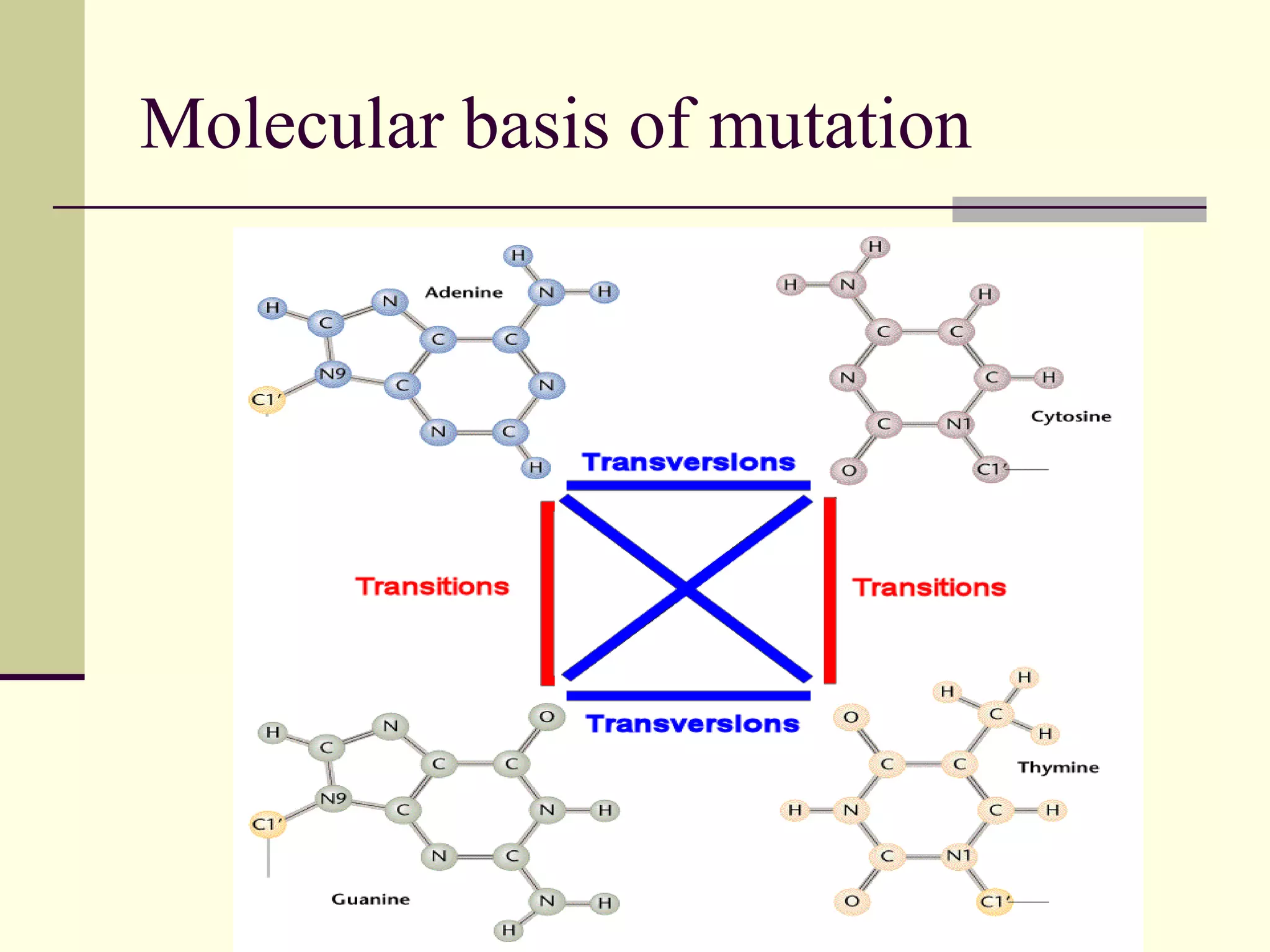
Molecular basis of mutation
Change in Chromosome
Structure
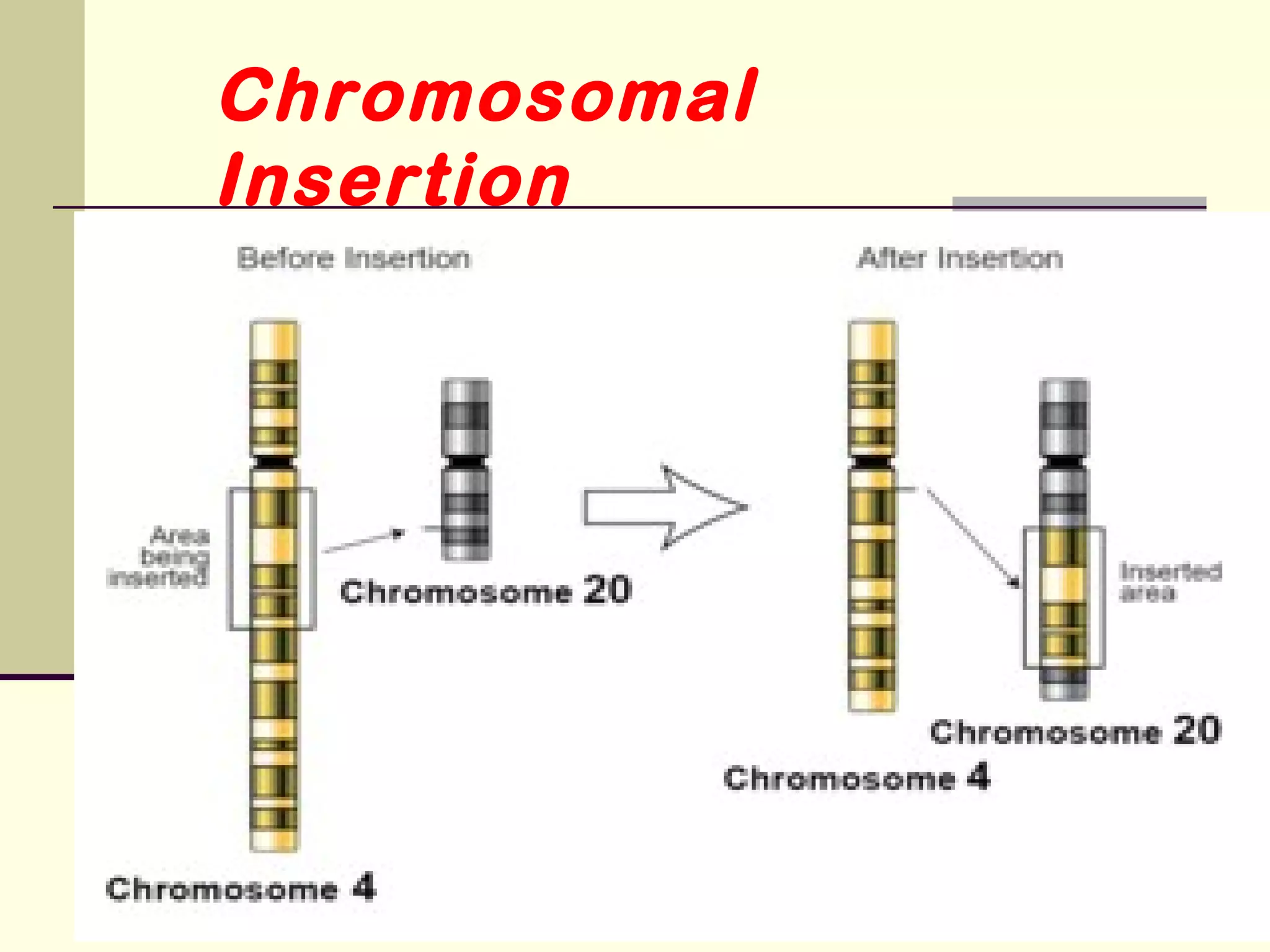
1. Mutations involving changes in chromosome
structure occur in four common types:
a. Deletions.
b. Duplications.
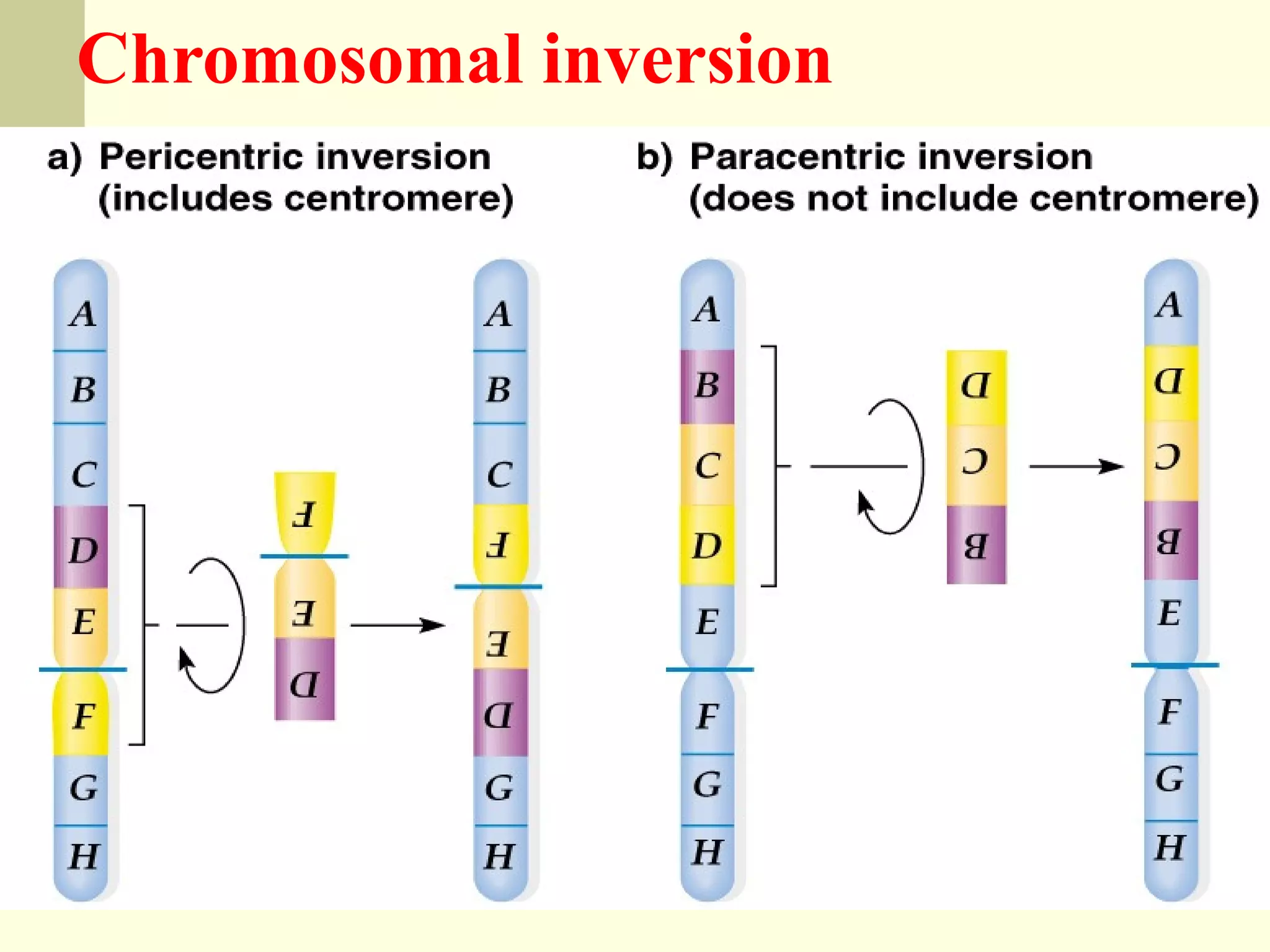
c. Inversions (changing orientation of a DNA
segment).
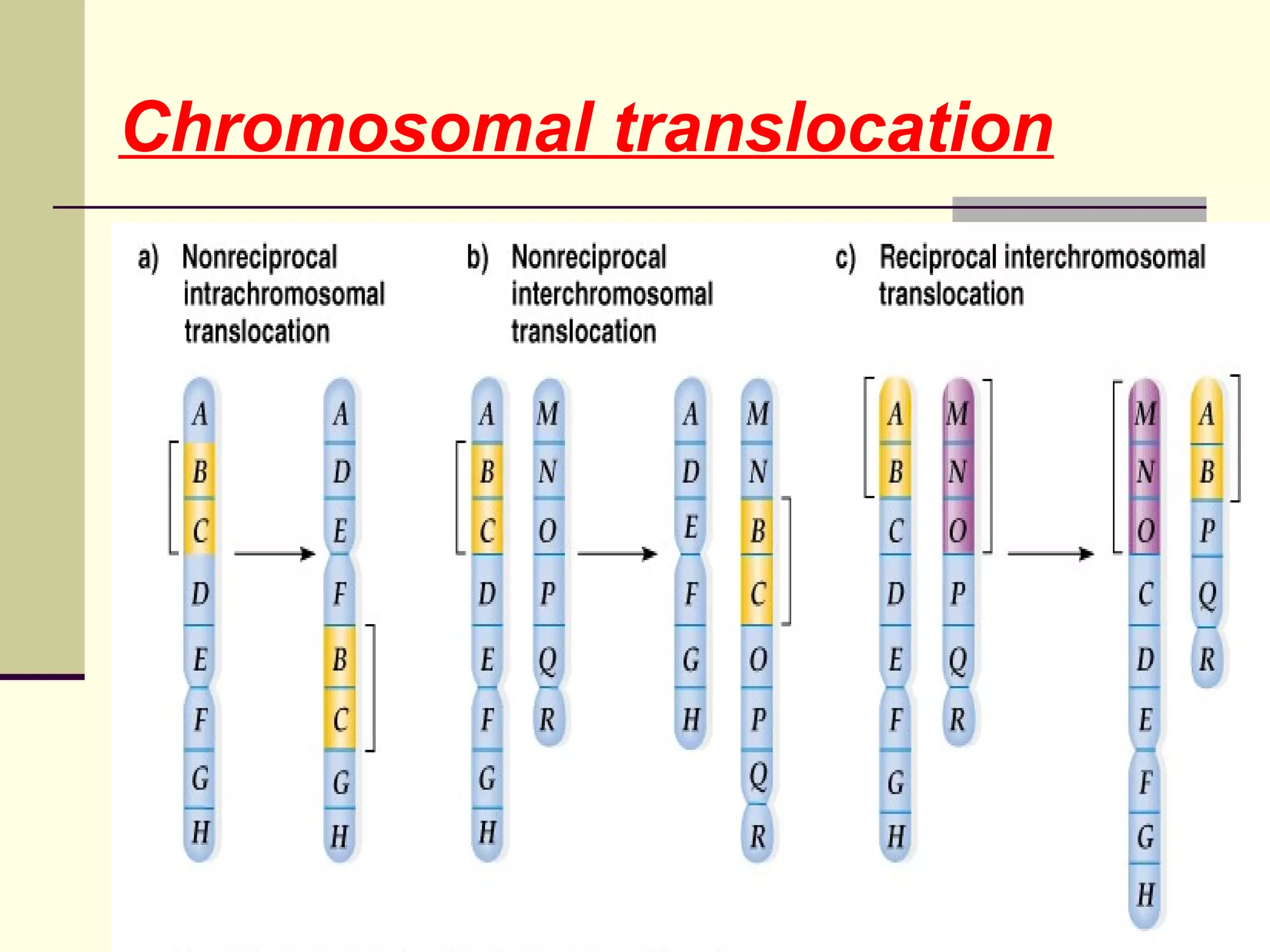
d. Translocations (moving a DNA segment).
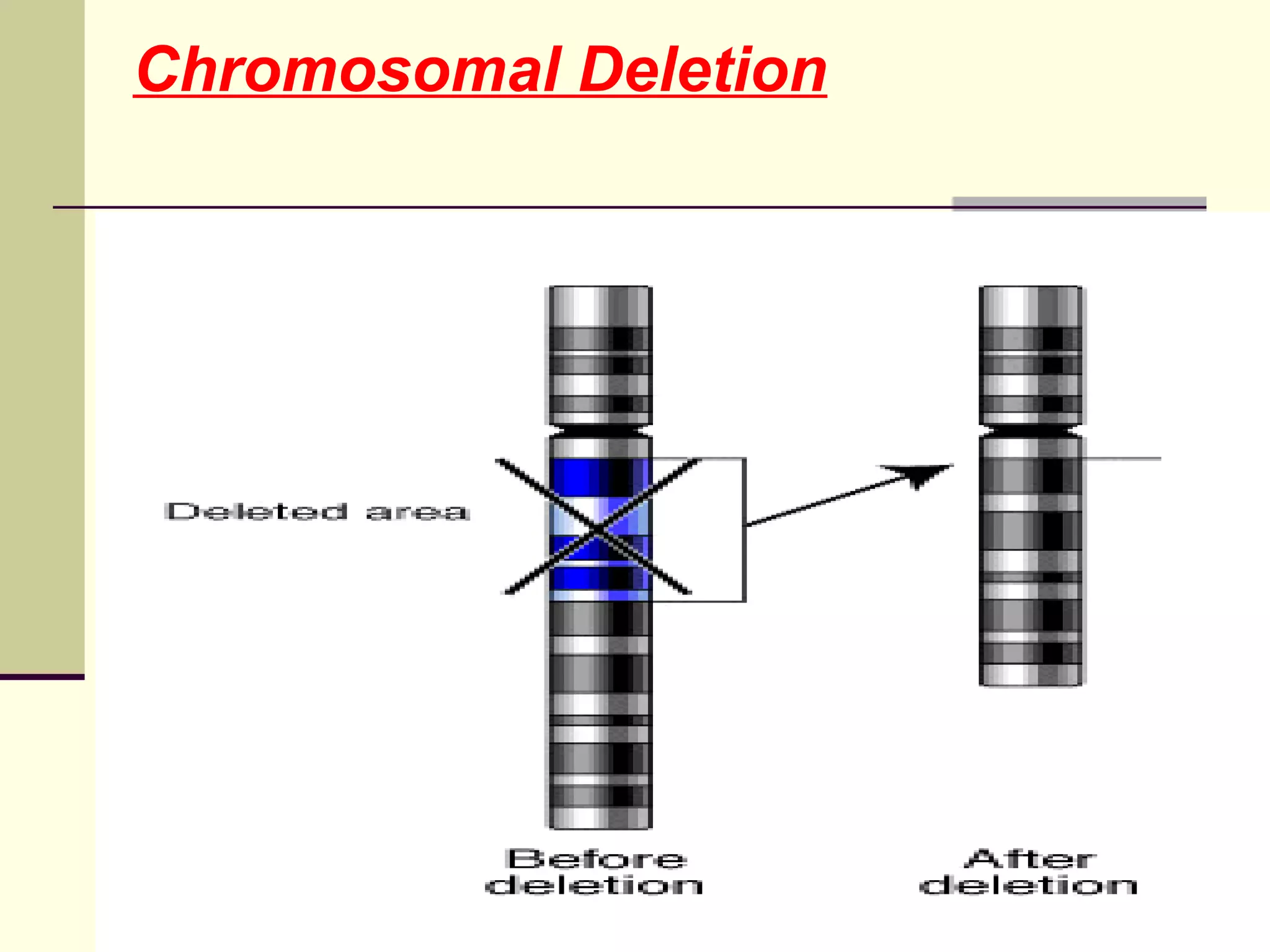
Chromosomal Deletion
Chromosomal
Insertion
Chromosomal inversion
Chromosomal translocation
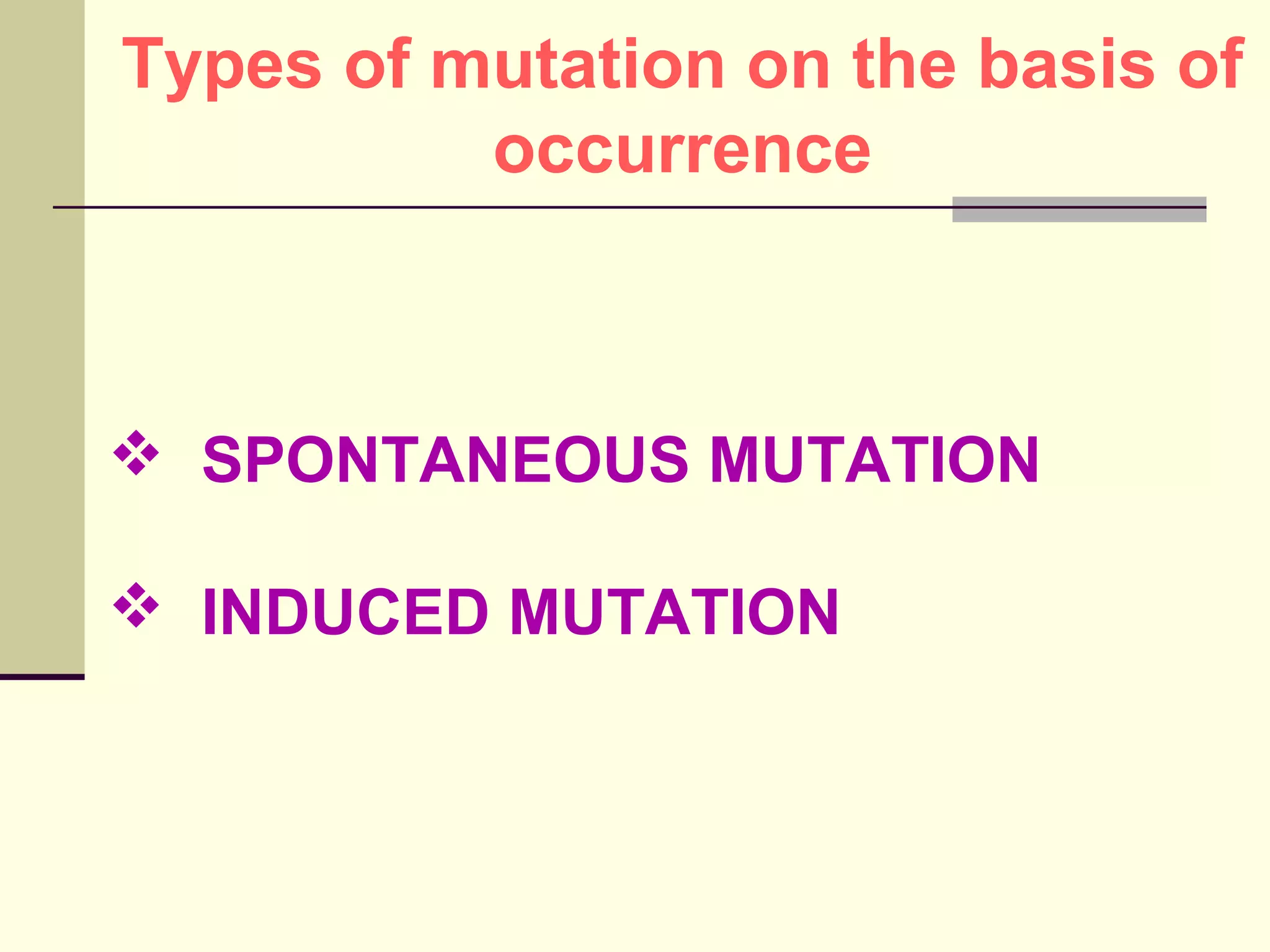
 SPONTANEOUS MUTATION
 INDUCED MUTATION
Types of mutation on the basis of
occurrence
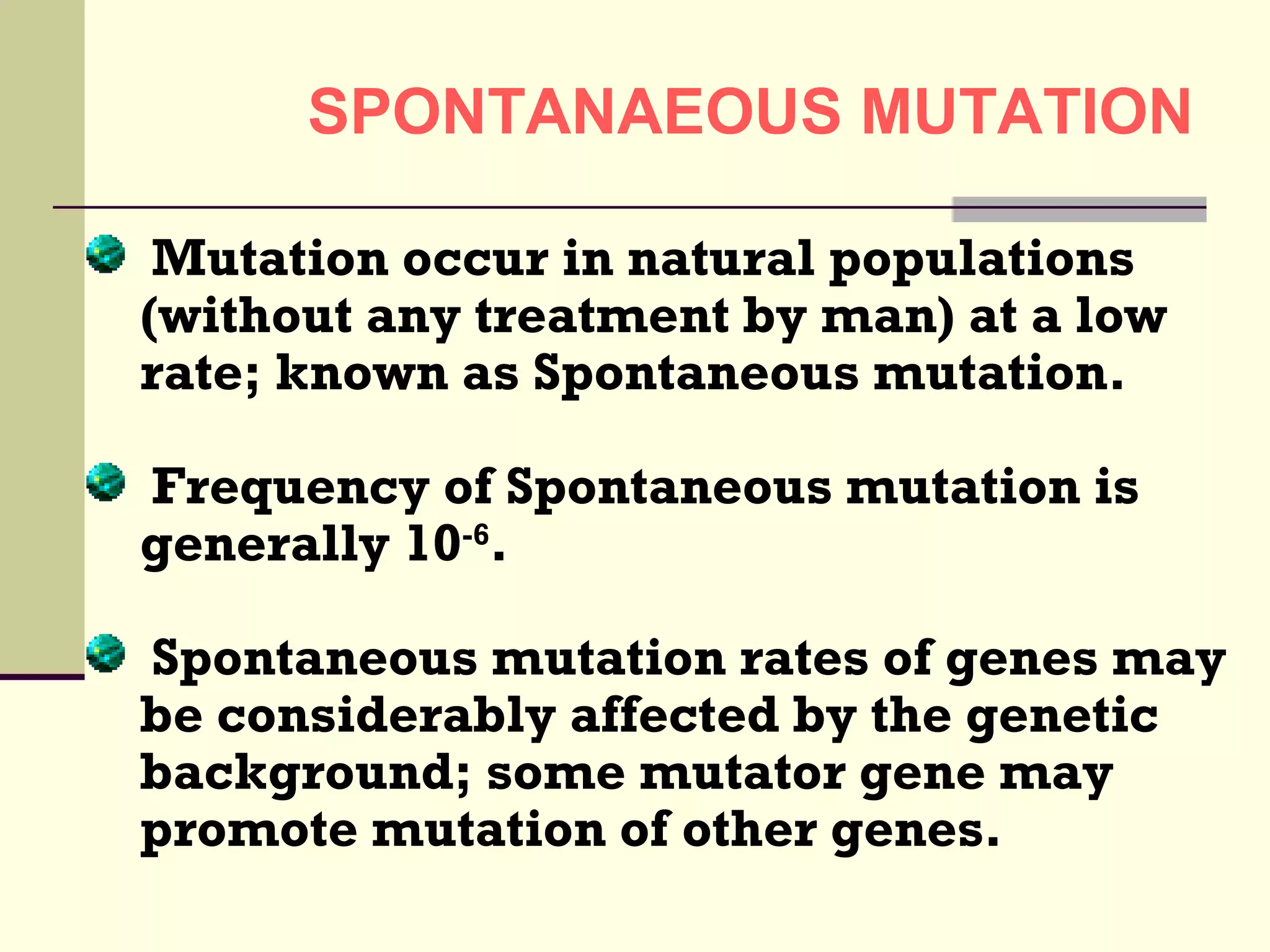
SPONTANAEOUS MUTATION
Mutation occur in natural populations
(without any treatment by man) at a low
rate; known as Spontaneous mutation.
Frequency of Spontaneous mutation is
generally 10-6
.
Spontaneous mutation rates of genes may
be considerably affected by the genetic
background; some mutator gene may
promote mutation of other genes.
INDUCED MUTATION
Mutation may be artificially induced by a
treatment with certain physical or chemical
agents known as Induced Mutation.
Agents used for producing them termed as
Mutagens.
The utilization of induced mutation for crop
improvement is known as Mutation
Breeding.
Induced mutation have a great advantage
over
the spontaneous ones; they occur at a
relatively higher frequency so that it is
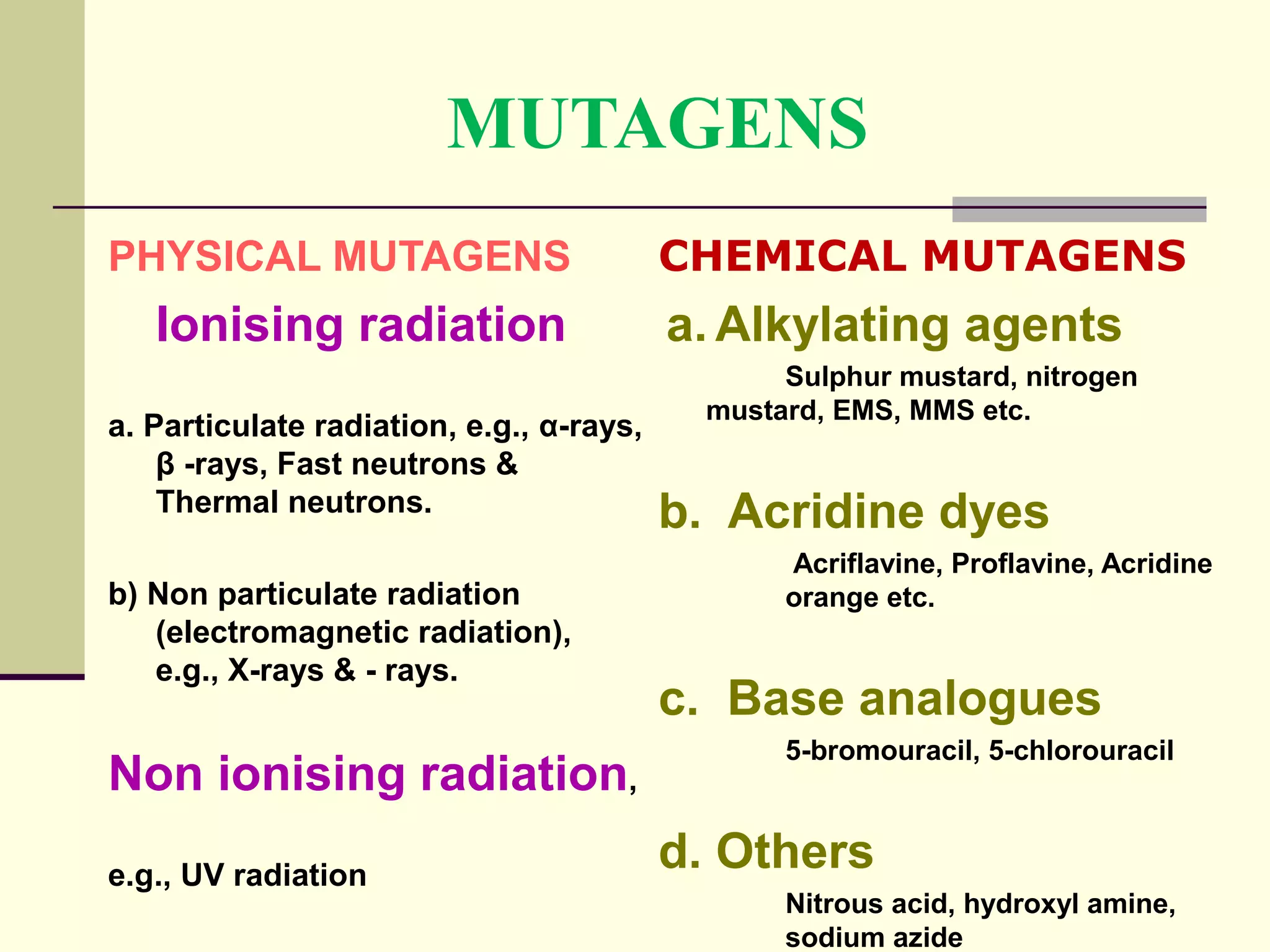
MUTAGENS
PHYSICAL MUTAGENS
Ionising radiation
a. Particulate radiation, e.g., α-rays,
β -rays, Fast neutrons &
Thermal neutrons.
b) Non particulate radiation
(electromagnetic radiation),
e.g., X-rays & - rays.
Non ionising radiation,
e.g., UV radiation
CHEMICAL MUTAGENS
a. Alkylating agents
Sulphur mustard, nitrogen
mustard, EMS, MMS etc.
b. Acridine dyes
Acriflavine, Proflavine, Acridine
orange etc.
c. Base analogues
5-bromouracil, 5-chlorouracil
d. Others
Nitrous acid, hydroxyl amine,
sodium azide
Effect of Mutation
Lethal : Kill each & every individual carrying them
Sublethal & Subvital : Sublethal kill more than
50% of the individuals, while subvitals kill much
less than 50%.

Vital : Do not reduce viability of the individual
carrying them.
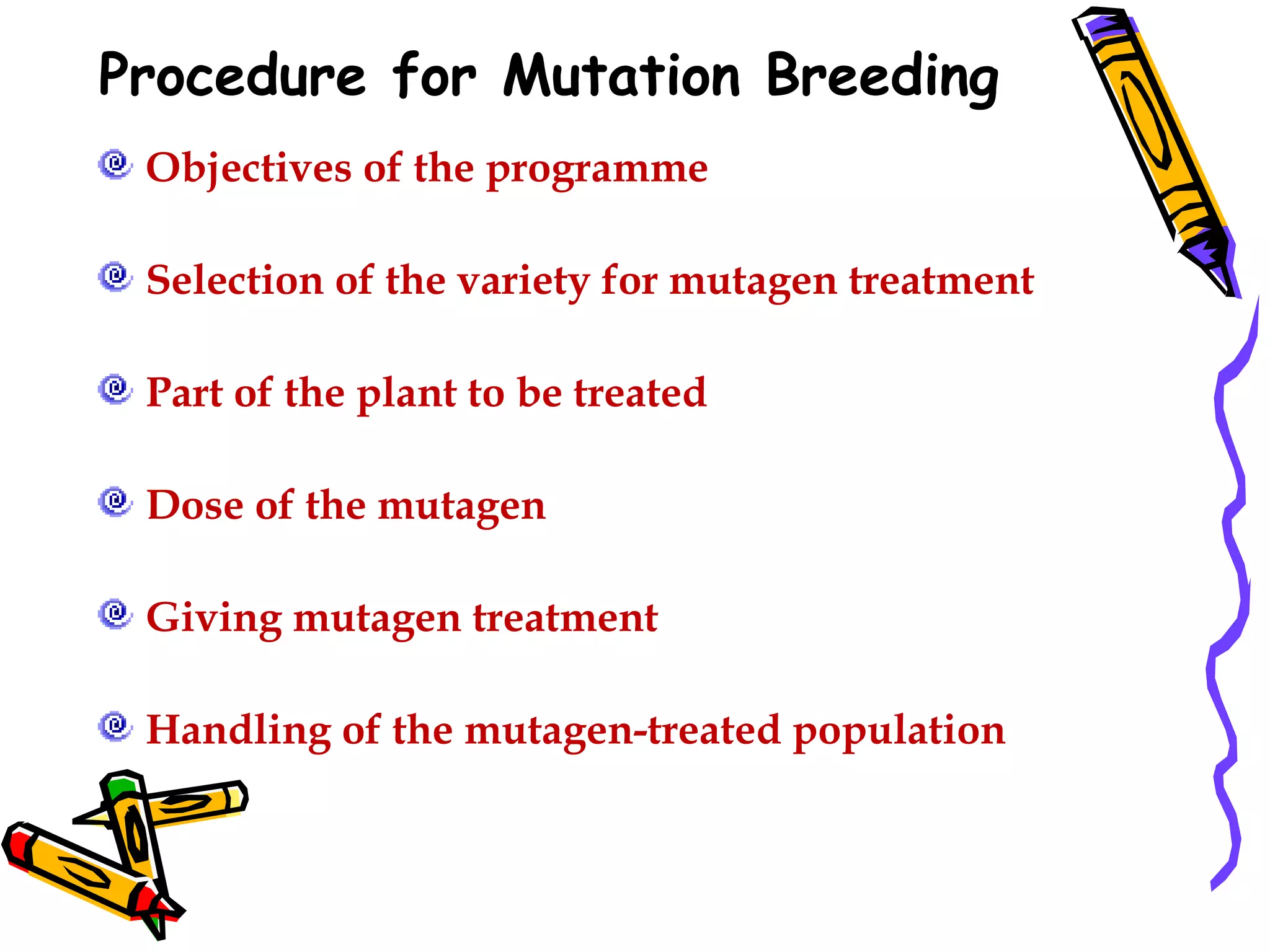
Procedure for Mutation Breeding
Objectives of the programme
Selection of the variety for mutagen treatment
Part of the plant to be treated
Dose of the mutagen
Giving mutagen treatment
Handling of the mutagen-treated population
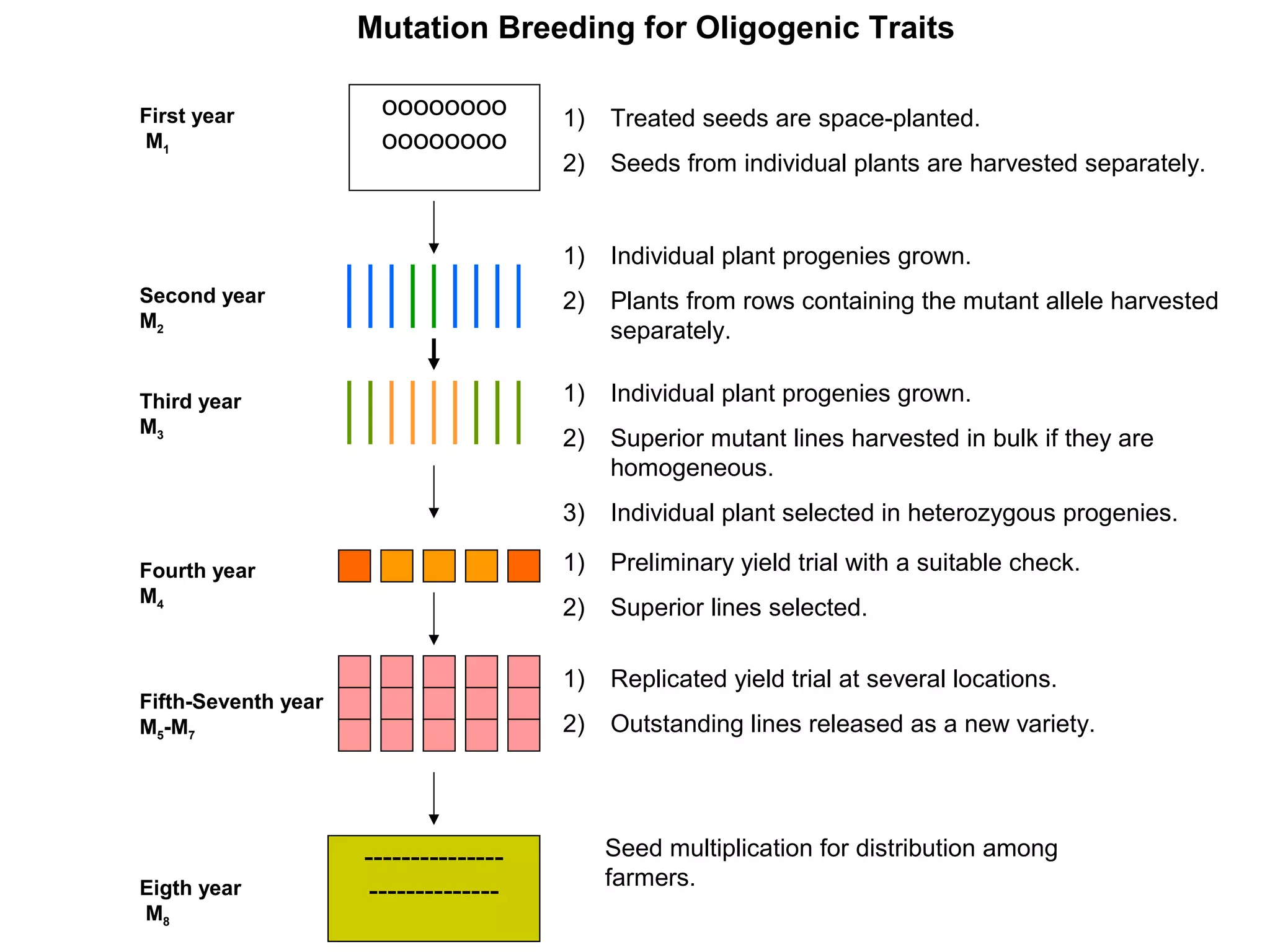
oooooooo
oooooooo
---------------
--------------
First year
M1
Second year
M2
Third year
M3
Fourth year
M4
Fifth-Seventh year
M5-M7
Eigth year
M8
1) Treated seeds are space-planted.
2) Seeds from individual plants are harvested separately.
1) Individual plant progenies grown.
2) Plants from rows containing the mutant allele harvested
separately.
1) Individual plant progenies grown.
2) Superior mutant lines harvested in bulk if they are
homogeneous.
3) Individual plant selected in heterozygous progenies.
1) Preliminary yield trial with a suitable check.
2) Superior lines selected.
1) Replicated yield trial at several locations.
2) Outstanding lines released as a new variety.
Seed multiplication for distribution among
farmers.
Mutation Breeding for Oligogenic Traits
oooooooo
oooooooo
---------------
--------------
First year
M1
Second year
M2
Third year
M3
Fourth year
M4
Sixth-Eighth year
M6-M8
Ninth year M9
1) Treated seeds are space-planted.
2) Seeds from individual plants are harvested separately.
1) Individual plant progenies grown.
2) Fertile, vigorous, normal looking plants harvested separately.
1) Individual plant progenies from the selected plants grown.
2) Superior mutant lines harvested in bulk if they are homogeneous.
3) Segregating lines usually rejected.
1) Preliminary yield trial with a suitable check.
2) Superior lines selected.
1) Replicated yield trial at several locations.
2) Outstanding lines released as a new variety.
Seed multiplication for distribution among farmers.
Mutation Breeding for Polygenic Traits
1) Individual plant progenies from selected plants grown.
2) Superior plants selected from superior progenies showing
segregation.
Fifth year
M5
Screening or Selection
Mainly three types of screening are used in M-2
and Subsequent generation
1. Visual
2. Mechanical or Physical
3. Chromatography or Electrophoresis
The primary research center and institute in India
that participated in the development and released
of various mutagen
1. IARI, New Delhi
2. BARC, Mumbai
3. NBRI, Lucknow
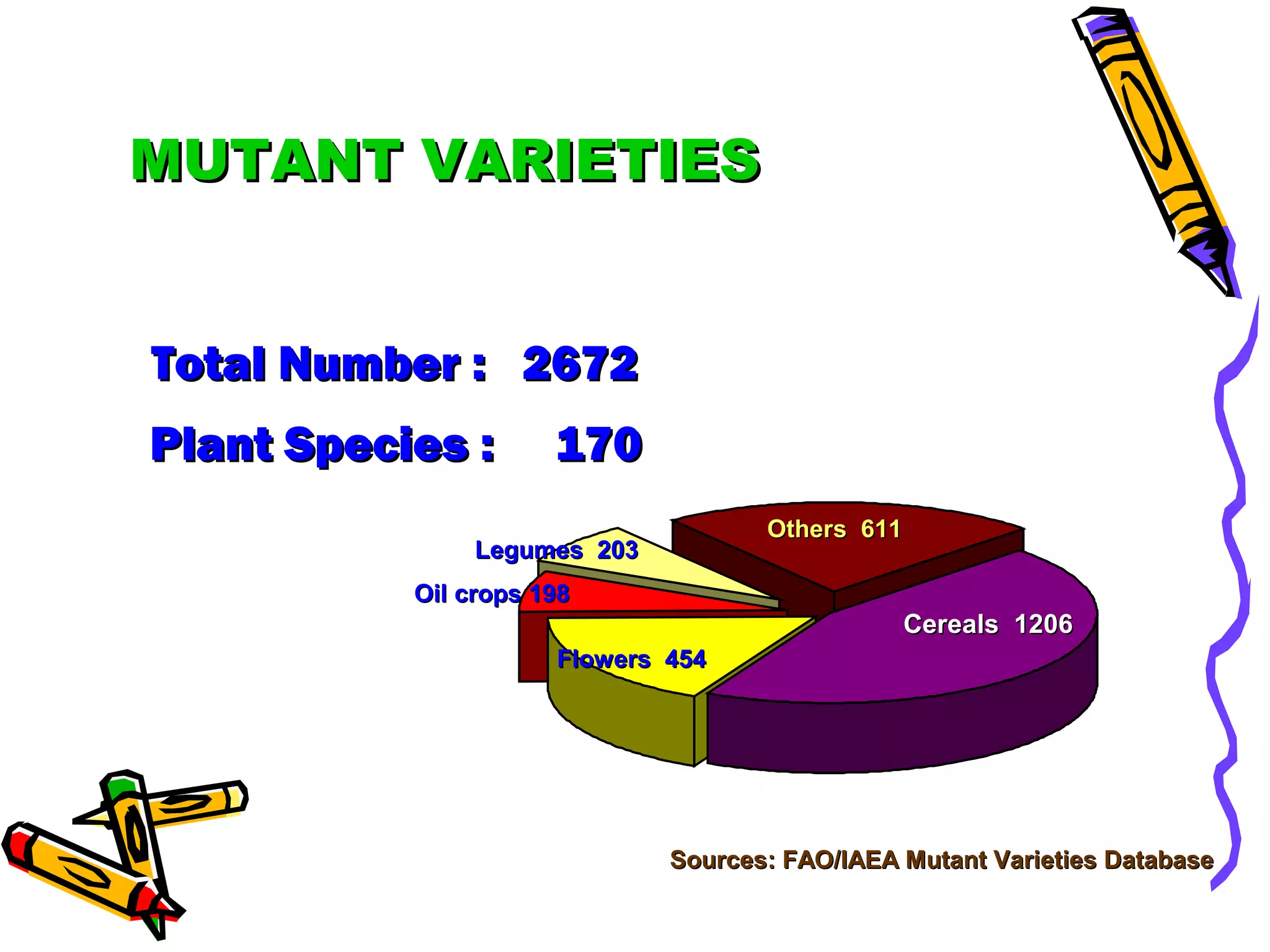
MUTANT VARIETIESMUTANT VARIETIES
Cereals 1206Cereals 1206
Flowers 454Flowers 454
Legumes 203Legumes 203
Oil crops 198Oil crops 198
Others 611Others 611
Total Number : 2672Total Number : 2672
Plant Species : 170Plant Species : 170
Sources: FAO/IAEA Mutant Varieties DatabaseSources: FAO/IAEA Mutant Varieties Database
Short stemmed & dwarf
mutants
SpeciesSpecies MutagensMutagens
Lycopersicon esculentumLycopersicon esculentum Gamma raysGamma rays
Gamma rays & neutronsGamma rays & neutrons
SpontaneousSpontaneous
Capsicum annuumCapsicum annuum X-raysX-rays
Pisum sativumPisum sativum Gamma raysGamma rays
X-rays & neutronsX-rays & neutrons
EMSEMS
Phaseolus vulgarisPhaseolus vulgaris X-raysX-rays
Gamma raysGamma rays
Vicia fabaVicia faba Gamma rays & EMSGamma rays & EMS
Cucumis meloCucumis melo spontaneousspontaneous
Early flowering & high
yielding mutants
CropsCrops Mutagenic agentsMutagenic agents RemarksRemarks
LycopersiconLycopersicon
esculentumesculentum
Gamma raysGamma rays
DESDES
Early & high yieldingEarly & high yielding
Early flowering mutantsEarly flowering mutants
High yieldHigh yield
Capsicum annuumCapsicum annuum Gamma raysGamma rays A productive mutantA productive mutant
Pisum sativumPisum sativum Gamma raysGamma rays
X-rays & neutronX-rays & neutron
DESDES
Super mutagenSuper mutagen
X-rays & neutronsX-rays & neutrons
10 days earlier10 days earlier
Early and lowEarly and low
yielderyielder
Very earlyVery early
5 early mutants5 early mutants
differentialdifferential
response toresponse to
environmentenvironment
Phaseolus vulgarisPhaseolus vulgaris
EMS & MMSEMS & MMS
X-rays & gamma raysX-rays & gamma rays
Early floweringEarly flowering
Early & high yieldingEarly & high yielding
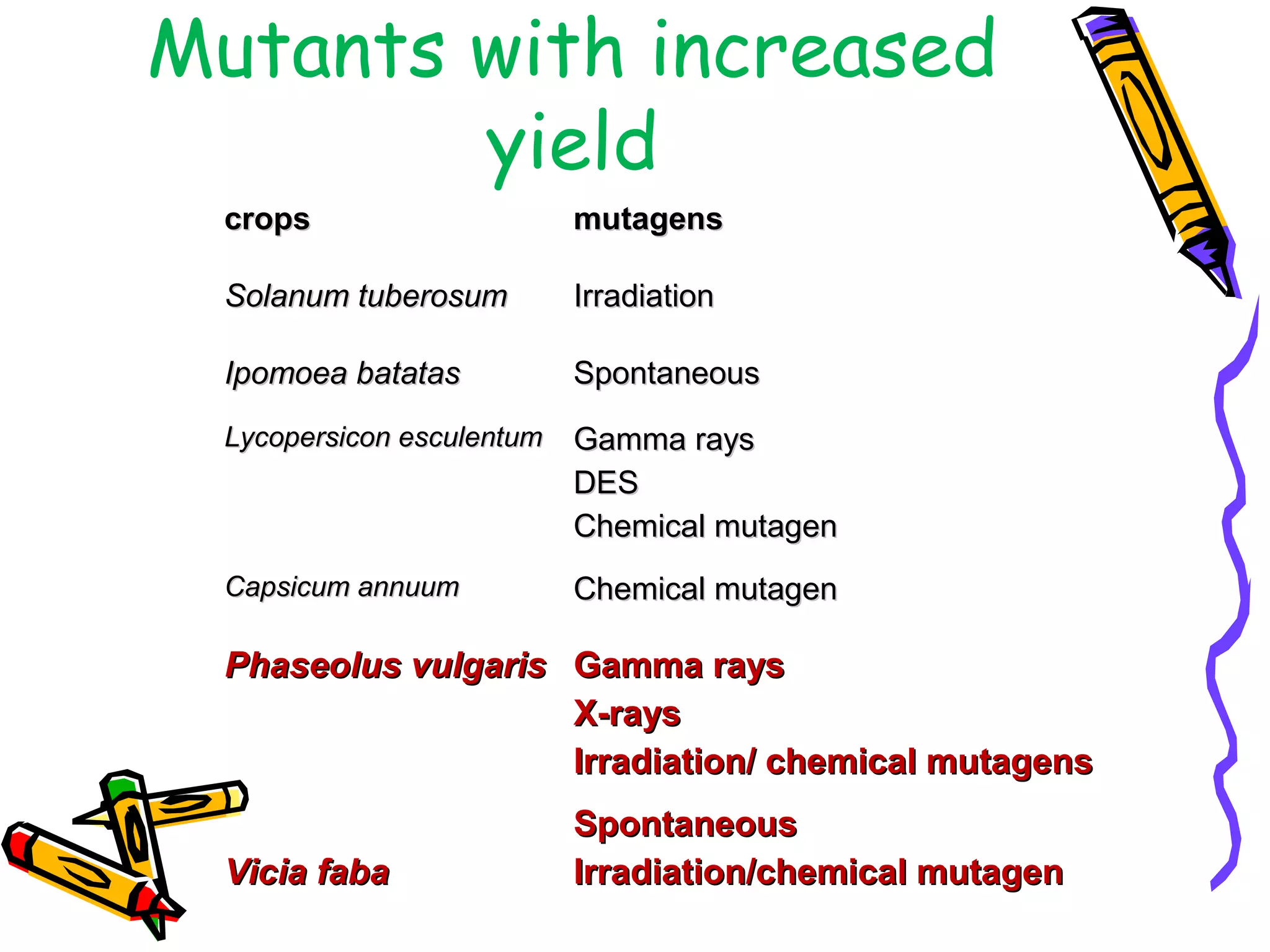
Mutants with increased
yield
cropscrops mutagensmutagens
Solanum tuberosumSolanum tuberosum IrradiationIrradiation
Ipomoea batatasIpomoea batatas SpontaneousSpontaneous
Lycopersicon esculentumLycopersicon esculentum Gamma raysGamma rays
DESDES
Chemical mutagenChemical mutagen
Capsicum annuumCapsicum annuum Chemical mutagenChemical mutagen
Phaseolus vulgarisPhaseolus vulgaris Gamma raysGamma rays
X-raysX-rays
Irradiation/ chemical mutagensIrradiation/ chemical mutagens
Vicia fabaVicia faba
SpontaneousSpontaneous
Irradiation/chemical mutagenIrradiation/chemical mutagen
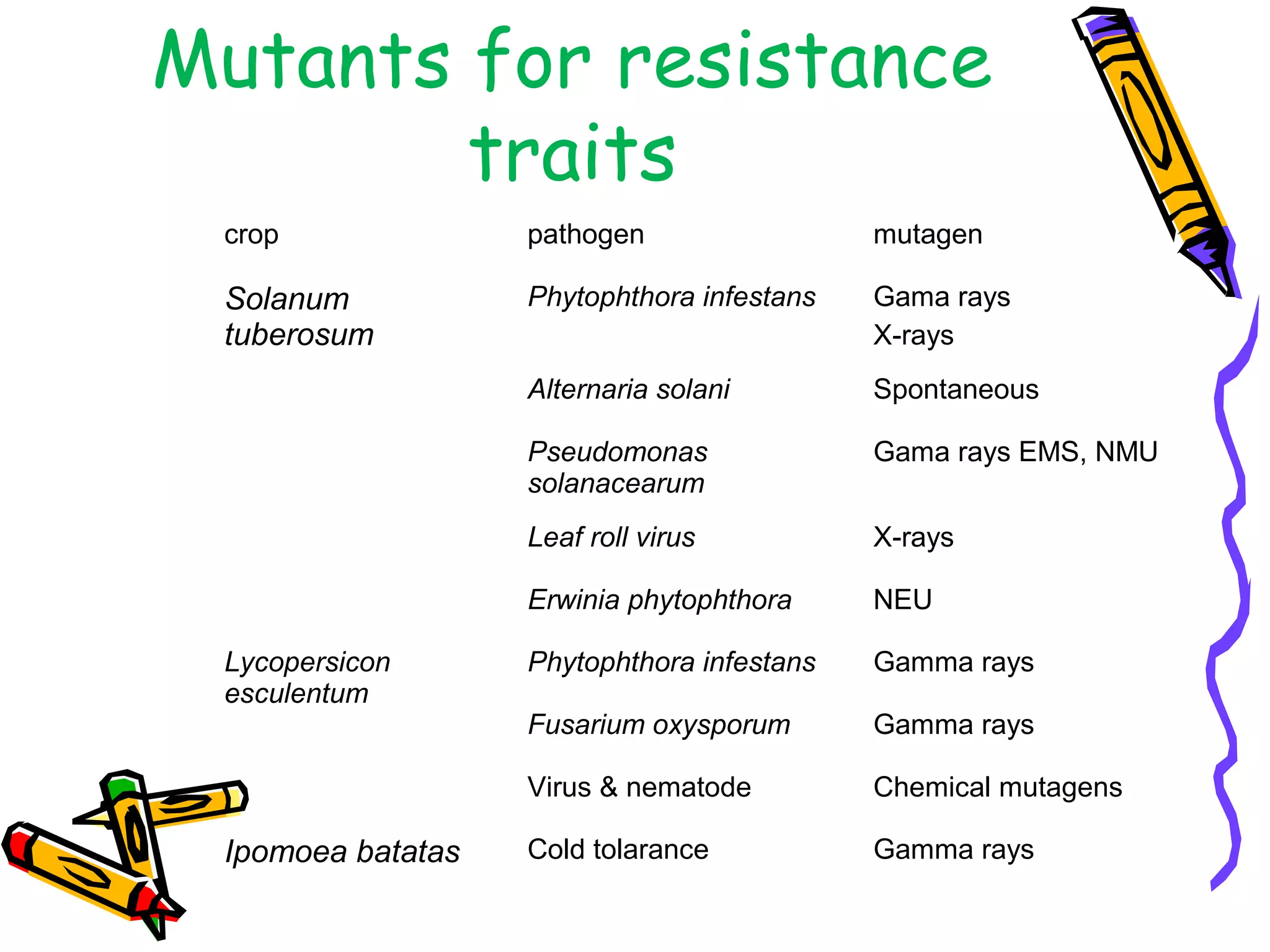
Mutants for resistance
traits
crop pathogen mutagen
Solanum
tuberosum
Phytophthora infestans Gama rays
X-rays
Alternaria solani Spontaneous
Pseudomonas
solanacearum
Gama rays EMS, NMU
Leaf roll virus X-rays
Erwinia phytophthora NEU
Lycopersicon
esculentum
Phytophthora infestans Gamma rays
Fusarium oxysporum Gamma rays
Virus & nematode Chemical mutagens
Ipomoea batatas Cold tolarance Gamma rays
crops pathogens mutagens
Solanum melongena Pseudomonas
solanacearum
irradiation
Pisum sativum Powdery mildew X-rays
Phaseolus vulgaris Bacterial disease Gamma rays
Golden mosaic virus EMS
Yellow mosaic virus Gamma rays and EMS
Uromyces phaseoli Gamma rays & EMS
Xanthomonas phaseoli Gamma rays
Cont…
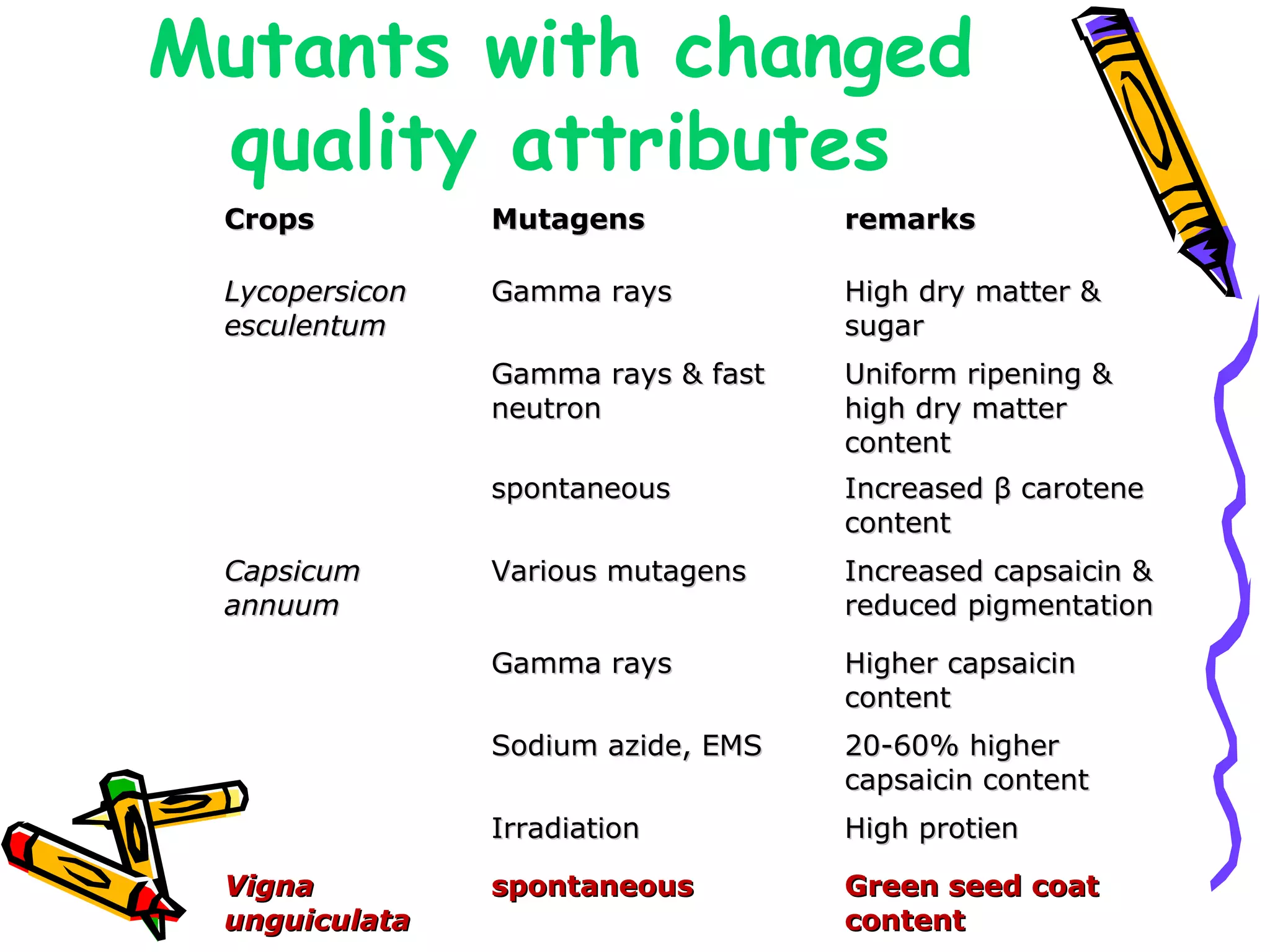
Mutants with changed
quality attributes
CropsCrops MutagensMutagens remarksremarks
LycopersiconLycopersicon
esculentumesculentum
Gamma raysGamma rays High dry matter &High dry matter &
sugarsugar
Gamma rays & fastGamma rays & fast
neutronneutron
Uniform ripening &Uniform ripening &
high dry matterhigh dry matter
contentcontent
spontaneousspontaneous IncreasedIncreased ββ carotenecarotene
contentcontent
CapsicumCapsicum
annuumannuum
Various mutagensVarious mutagens Increased capsaicin &Increased capsaicin &
reduced pigmentationreduced pigmentation
Gamma raysGamma rays Higher capsaicinHigher capsaicin
contentcontent
Sodium azide, EMSSodium azide, EMS 20-60% higher20-60% higher
capsaicin contentcapsaicin content
IrradiationIrradiation High protienHigh protien
VignaVigna
unguiculataunguiculata
spontaneousspontaneous Green seed coatGreen seed coat
contentcontent
Conti…
cropscrops mutagensmutagens remarksremarks
Vicia fabaVicia faba Irradiation, chemicalIrradiation, chemical
mutagensmutagens
Increased protein contentIncreased protein content
Phaseolus vulgarisPhaseolus vulgaris X-raysX-rays From yellow to green podedFrom yellow to green poded
EI, DMSEI, DMS Increased protein content &Increased protein content &
var Moskovsky released invar Moskovsky released in
U.S.S.R.U.S.S.R.
Trigonella foenumgraecumTrigonella foenumgraecum MMSMMS Increased crude oil contentIncreased crude oil content
B. oleracia var botrytisB. oleracia var botrytis spontaneousspontaneous Orange curd mutantOrange curd mutant
B. pekinensisB. pekinensis EI, DMSEI, DMS Increased ascorbic acidIncreased ascorbic acid
contentcontent
Solanum tuberosumSolanum tuberosum Gamma rays &Gamma rays &
radioisotopesradioisotopes
White skinned, fleet eyesWhite skinned, fleet eyes
from deep eyesfrom deep eyes
Ipomoea batatasIpomoea batatas Gamma raysGamma rays Change in tuber colourChange in tuber colour
Gamma rays, EIGamma rays, EI Variation in sugar contentVariation in sugar content
G. Kalloo 1988
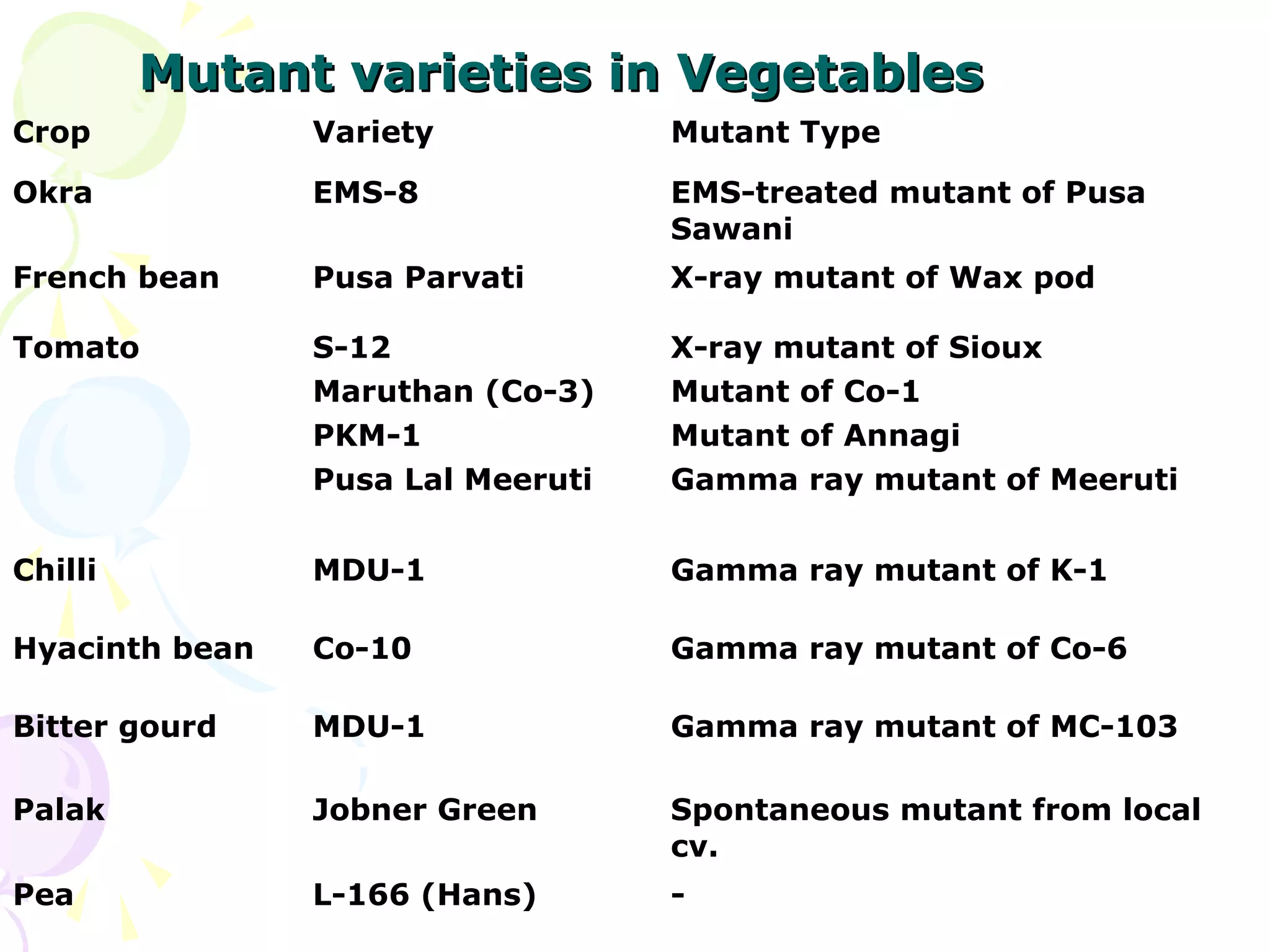
Mutant varieties in VegetablesMutant varieties in Vegetables
Crop Variety Mutant Type
Okra EMS-8 EMS-treated mutant of Pusa
Sawani
French bean Pusa Parvati X-ray mutant of Wax pod
Tomato S-12
Maruthan (Co-3)
PKM-1
Pusa Lal Meeruti
X-ray mutant of Sioux
Mutant of Co-1
Mutant of Annagi
Gamma ray mutant of Meeruti
Chilli MDU-1 Gamma ray mutant of K-1
Hyacinth bean Co-10 Gamma ray mutant of Co-6
Bitter gourd MDU-1 Gamma ray mutant of MC-103
Palak Jobner Green Spontaneous mutant from local
cv.
Pea L-166 (Hans) -
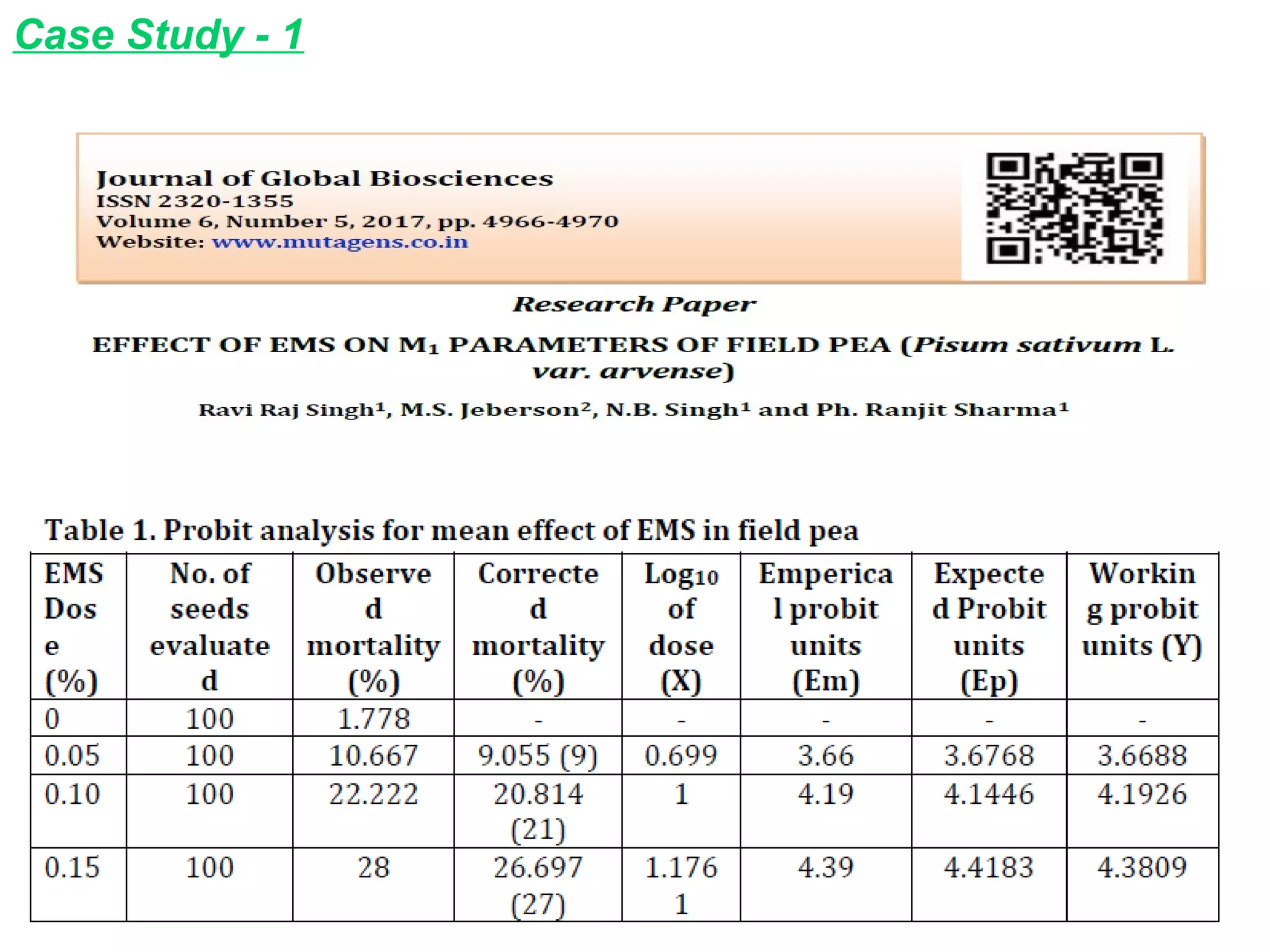
Case Study - 1
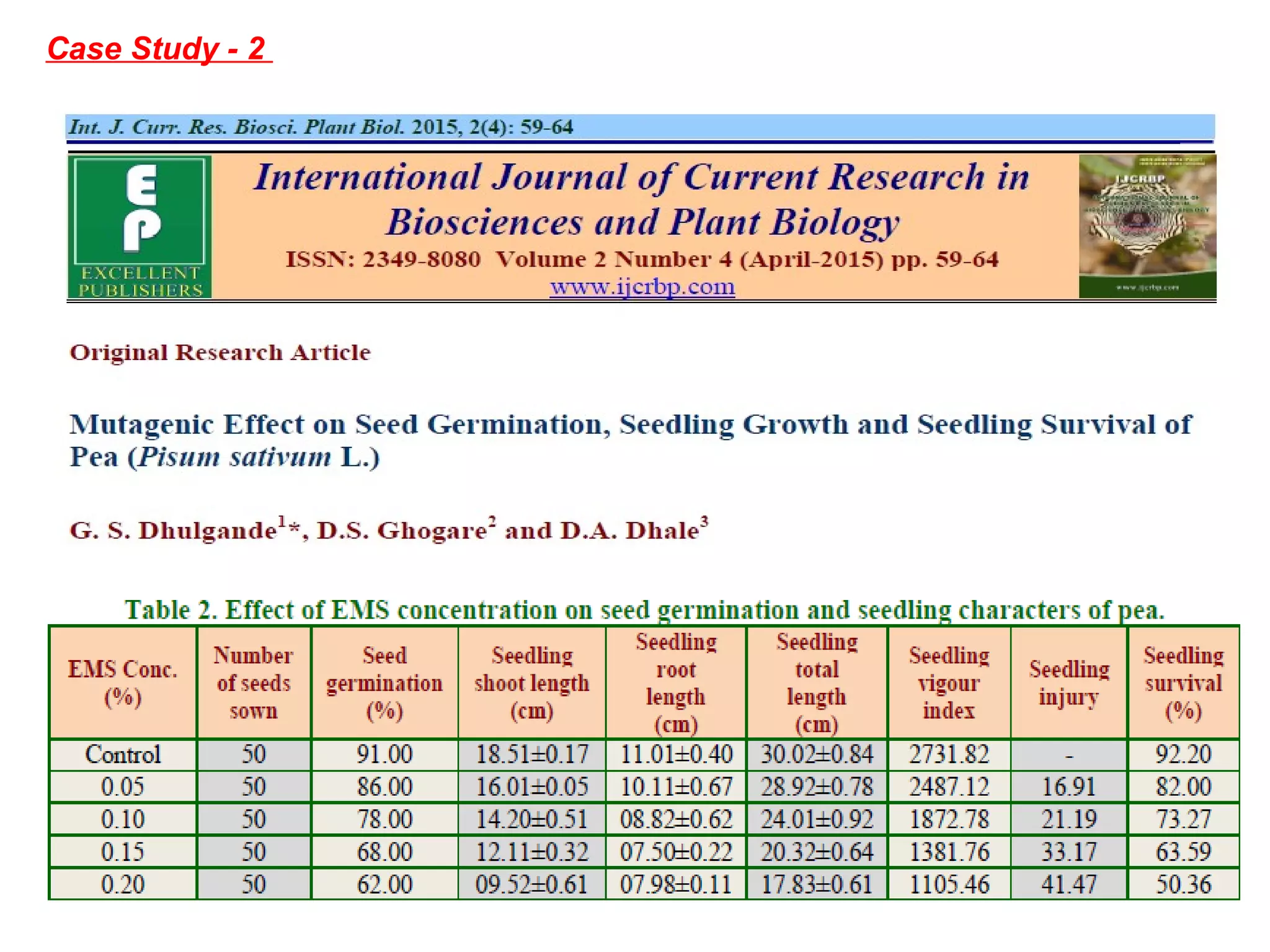
Case Study - 2
Case Study - 3
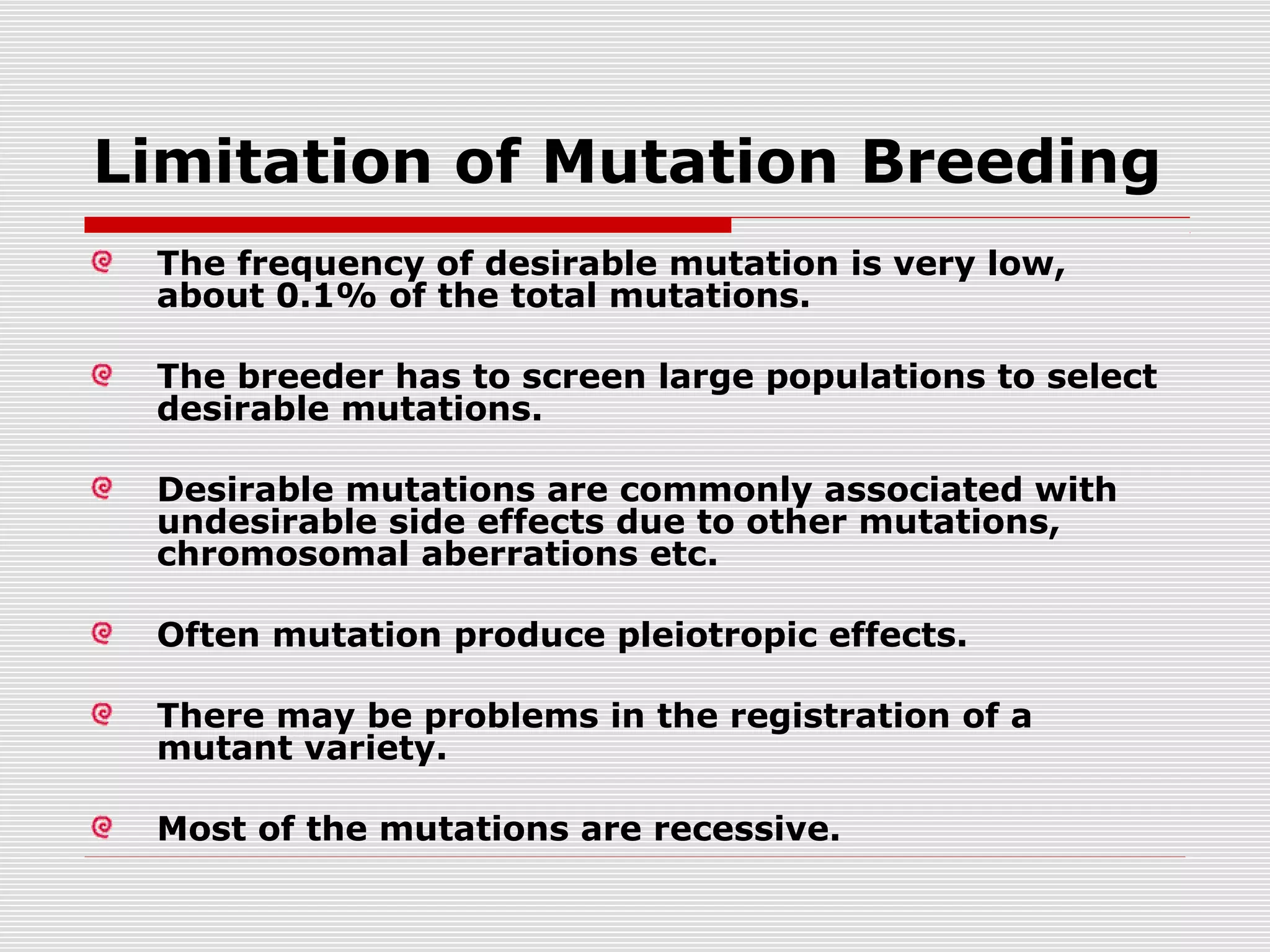
Limitation of Mutation Breeding
The frequency of desirable mutation is very low,
about 0.1% of the total mutations.
The breeder has to screen large populations to select
desirable mutations.
Desirable mutations are commonly associated with
undesirable side effects due to other mutations,
chromosomal aberrations etc.
Often mutation produce pleiotropic effects.
There may be problems in the registration of a
mutant variety.
Most of the mutations are recessive.
THANK
YOU

MUTATION BREEDING IN VEGETABLE CROPS

  • 4.
    Characteristics of Mutations Mutations are generally recessive.  Mutations are generally harmful to the organism. But a small proportion (0.1 per cent) of them are beneficial.  Mutations are random.  Mutations are recurrent.  Induced mutation commonly show pleiotropy.
  • 5.
    Types of mutation Geneor Point Mutation: By changes in the base sequence of genes. Chromosomal Mutation: By changes in chromosome structure, or even in chromosome number. Cytoplasmic Mutation: Mutant character shows cytoplasmic or extranuclear inheritance. Bud or Somatic Mutation: Mutation occurring in buds or somatic tissues which are used for propagation.
  • 6.
  • 7.
    Change in Chromosome Structure 1.Mutations involving changes in chromosome structure occur in four common types: a. Deletions. b. Duplications. c. Inversions (changing orientation of a DNA segment). d. Translocations (moving a DNA segment).
  • 8.
  • 9.
  • 10.
  • 11.
  • 12.
     SPONTANEOUS MUTATION INDUCED MUTATION Types of mutation on the basis of occurrence
  • 13.
    SPONTANAEOUS MUTATION Mutation occurin natural populations (without any treatment by man) at a low rate; known as Spontaneous mutation. Frequency of Spontaneous mutation is generally 10-6 . Spontaneous mutation rates of genes may be considerably affected by the genetic background; some mutator gene may promote mutation of other genes.
  • 14.
    INDUCED MUTATION Mutation maybe artificially induced by a treatment with certain physical or chemical agents known as Induced Mutation. Agents used for producing them termed as Mutagens. The utilization of induced mutation for crop improvement is known as Mutation Breeding. Induced mutation have a great advantage over the spontaneous ones; they occur at a relatively higher frequency so that it is
  • 15.
    MUTAGENS PHYSICAL MUTAGENS Ionising radiation a.Particulate radiation, e.g., α-rays, β -rays, Fast neutrons & Thermal neutrons. b) Non particulate radiation (electromagnetic radiation), e.g., X-rays & - rays. Non ionising radiation, e.g., UV radiation CHEMICAL MUTAGENS a. Alkylating agents Sulphur mustard, nitrogen mustard, EMS, MMS etc. b. Acridine dyes Acriflavine, Proflavine, Acridine orange etc. c. Base analogues 5-bromouracil, 5-chlorouracil d. Others Nitrous acid, hydroxyl amine, sodium azide
  • 16.
    Effect of Mutation Lethal: Kill each & every individual carrying them Sublethal & Subvital : Sublethal kill more than 50% of the individuals, while subvitals kill much less than 50%. Vital : Do not reduce viability of the individual carrying them.
  • 17.
    Procedure for MutationBreeding Objectives of the programme Selection of the variety for mutagen treatment Part of the plant to be treated Dose of the mutagen Giving mutagen treatment Handling of the mutagen-treated population
  • 18.
    oooooooo oooooooo --------------- -------------- First year M1 Second year M2 Thirdyear M3 Fourth year M4 Fifth-Seventh year M5-M7 Eigth year M8 1) Treated seeds are space-planted. 2) Seeds from individual plants are harvested separately. 1) Individual plant progenies grown. 2) Plants from rows containing the mutant allele harvested separately. 1) Individual plant progenies grown. 2) Superior mutant lines harvested in bulk if they are homogeneous. 3) Individual plant selected in heterozygous progenies. 1) Preliminary yield trial with a suitable check. 2) Superior lines selected. 1) Replicated yield trial at several locations. 2) Outstanding lines released as a new variety. Seed multiplication for distribution among farmers. Mutation Breeding for Oligogenic Traits
  • 19.
    oooooooo oooooooo --------------- -------------- First year M1 Second year M2 Thirdyear M3 Fourth year M4 Sixth-Eighth year M6-M8 Ninth year M9 1) Treated seeds are space-planted. 2) Seeds from individual plants are harvested separately. 1) Individual plant progenies grown. 2) Fertile, vigorous, normal looking plants harvested separately. 1) Individual plant progenies from the selected plants grown. 2) Superior mutant lines harvested in bulk if they are homogeneous. 3) Segregating lines usually rejected. 1) Preliminary yield trial with a suitable check. 2) Superior lines selected. 1) Replicated yield trial at several locations. 2) Outstanding lines released as a new variety. Seed multiplication for distribution among farmers. Mutation Breeding for Polygenic Traits 1) Individual plant progenies from selected plants grown. 2) Superior plants selected from superior progenies showing segregation. Fifth year M5
  • 20.
    Screening or Selection Mainlythree types of screening are used in M-2 and Subsequent generation 1. Visual 2. Mechanical or Physical 3. Chromatography or Electrophoresis
  • 21.
    The primary researchcenter and institute in India that participated in the development and released of various mutagen 1. IARI, New Delhi 2. BARC, Mumbai 3. NBRI, Lucknow
  • 22.
    MUTANT VARIETIESMUTANT VARIETIES Cereals1206Cereals 1206 Flowers 454Flowers 454 Legumes 203Legumes 203 Oil crops 198Oil crops 198 Others 611Others 611 Total Number : 2672Total Number : 2672 Plant Species : 170Plant Species : 170 Sources: FAO/IAEA Mutant Varieties DatabaseSources: FAO/IAEA Mutant Varieties Database
  • 24.
    Short stemmed &dwarf mutants SpeciesSpecies MutagensMutagens Lycopersicon esculentumLycopersicon esculentum Gamma raysGamma rays Gamma rays & neutronsGamma rays & neutrons SpontaneousSpontaneous Capsicum annuumCapsicum annuum X-raysX-rays Pisum sativumPisum sativum Gamma raysGamma rays X-rays & neutronsX-rays & neutrons EMSEMS Phaseolus vulgarisPhaseolus vulgaris X-raysX-rays Gamma raysGamma rays Vicia fabaVicia faba Gamma rays & EMSGamma rays & EMS Cucumis meloCucumis melo spontaneousspontaneous
  • 25.
    Early flowering &high yielding mutants CropsCrops Mutagenic agentsMutagenic agents RemarksRemarks LycopersiconLycopersicon esculentumesculentum Gamma raysGamma rays Gamma raysGamma rays DESDES Early & high yieldingEarly & high yielding Early flowering mutantsEarly flowering mutants High yieldHigh yield Capsicum annuumCapsicum annuum Gamma raysGamma rays A productive mutantA productive mutant Pisum sativumPisum sativum Gamma raysGamma rays X-rays & neutronX-rays & neutron DESDES Super mutagenSuper mutagen X-rays & neutronsX-rays & neutrons 10 days earlier10 days earlier Early and lowEarly and low yielderyielder Very earlyVery early 5 early mutants5 early mutants differentialdifferential response toresponse to environmentenvironment Phaseolus vulgarisPhaseolus vulgaris EMS & MMSEMS & MMS X-rays & gamma raysX-rays & gamma rays Early floweringEarly flowering Early & high yieldingEarly & high yielding
  • 26.
    Mutants with increased yield cropscropsmutagensmutagens Solanum tuberosumSolanum tuberosum IrradiationIrradiation Ipomoea batatasIpomoea batatas SpontaneousSpontaneous Lycopersicon esculentumLycopersicon esculentum Gamma raysGamma rays DESDES Chemical mutagenChemical mutagen Capsicum annuumCapsicum annuum Chemical mutagenChemical mutagen Phaseolus vulgarisPhaseolus vulgaris Gamma raysGamma rays X-raysX-rays Irradiation/ chemical mutagensIrradiation/ chemical mutagens Vicia fabaVicia faba SpontaneousSpontaneous Irradiation/chemical mutagenIrradiation/chemical mutagen
  • 27.
    Mutants for resistance traits croppathogen mutagen Solanum tuberosum Phytophthora infestans Gama rays X-rays Alternaria solani Spontaneous Pseudomonas solanacearum Gama rays EMS, NMU Leaf roll virus X-rays Erwinia phytophthora NEU Lycopersicon esculentum Phytophthora infestans Gamma rays Fusarium oxysporum Gamma rays Virus & nematode Chemical mutagens Ipomoea batatas Cold tolarance Gamma rays
  • 28.
    crops pathogens mutagens Solanummelongena Pseudomonas solanacearum irradiation Pisum sativum Powdery mildew X-rays Phaseolus vulgaris Bacterial disease Gamma rays Golden mosaic virus EMS Yellow mosaic virus Gamma rays and EMS Uromyces phaseoli Gamma rays & EMS Xanthomonas phaseoli Gamma rays Cont…
  • 29.
    Mutants with changed qualityattributes CropsCrops MutagensMutagens remarksremarks LycopersiconLycopersicon esculentumesculentum Gamma raysGamma rays High dry matter &High dry matter & sugarsugar Gamma rays & fastGamma rays & fast neutronneutron Uniform ripening &Uniform ripening & high dry matterhigh dry matter contentcontent spontaneousspontaneous IncreasedIncreased ββ carotenecarotene contentcontent CapsicumCapsicum annuumannuum Various mutagensVarious mutagens Increased capsaicin &Increased capsaicin & reduced pigmentationreduced pigmentation Gamma raysGamma rays Higher capsaicinHigher capsaicin contentcontent Sodium azide, EMSSodium azide, EMS 20-60% higher20-60% higher capsaicin contentcapsaicin content IrradiationIrradiation High protienHigh protien VignaVigna unguiculataunguiculata spontaneousspontaneous Green seed coatGreen seed coat contentcontent
  • 30.
    Conti… cropscrops mutagensmutagens remarksremarks ViciafabaVicia faba Irradiation, chemicalIrradiation, chemical mutagensmutagens Increased protein contentIncreased protein content Phaseolus vulgarisPhaseolus vulgaris X-raysX-rays From yellow to green podedFrom yellow to green poded EI, DMSEI, DMS Increased protein content &Increased protein content & var Moskovsky released invar Moskovsky released in U.S.S.R.U.S.S.R. Trigonella foenumgraecumTrigonella foenumgraecum MMSMMS Increased crude oil contentIncreased crude oil content B. oleracia var botrytisB. oleracia var botrytis spontaneousspontaneous Orange curd mutantOrange curd mutant B. pekinensisB. pekinensis EI, DMSEI, DMS Increased ascorbic acidIncreased ascorbic acid contentcontent Solanum tuberosumSolanum tuberosum Gamma rays &Gamma rays & radioisotopesradioisotopes White skinned, fleet eyesWhite skinned, fleet eyes from deep eyesfrom deep eyes Ipomoea batatasIpomoea batatas Gamma raysGamma rays Change in tuber colourChange in tuber colour Gamma rays, EIGamma rays, EI Variation in sugar contentVariation in sugar content G. Kalloo 1988
  • 31.
    Mutant varieties inVegetablesMutant varieties in Vegetables Crop Variety Mutant Type Okra EMS-8 EMS-treated mutant of Pusa Sawani French bean Pusa Parvati X-ray mutant of Wax pod Tomato S-12 Maruthan (Co-3) PKM-1 Pusa Lal Meeruti X-ray mutant of Sioux Mutant of Co-1 Mutant of Annagi Gamma ray mutant of Meeruti Chilli MDU-1 Gamma ray mutant of K-1 Hyacinth bean Co-10 Gamma ray mutant of Co-6 Bitter gourd MDU-1 Gamma ray mutant of MC-103 Palak Jobner Green Spontaneous mutant from local cv. Pea L-166 (Hans) -
  • 32.
  • 33.
  • 34.
  • 36.
    Limitation of MutationBreeding The frequency of desirable mutation is very low, about 0.1% of the total mutations. The breeder has to screen large populations to select desirable mutations. Desirable mutations are commonly associated with undesirable side effects due to other mutations, chromosomal aberrations etc. Often mutation produce pleiotropic effects. There may be problems in the registration of a mutant variety. Most of the mutations are recessive.
  • 38.