Dr. NAVEENKUMAR K.L
Assistant Professor
Dept. Of Genetics and Plant Breeding
UAHS Shivamogga
Backcross Breeding
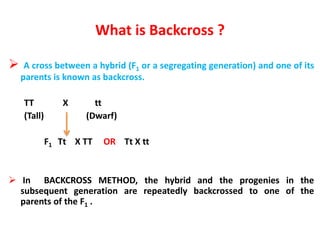
What is Backcross ?
 A cross between a hybrid (F1 or a segregating generation) and one of its
parents is known as backcross.
TT X tt
(Tall) (Dwarf)
F1 Tt X TT OR Tt X tt
 In BACKCROSS METHOD, the hybrid and the progenies in the
subsequent generation are repeatedly backcrossed to one of the
parents of the F1 .
Why backcross method is used?
1. To transfer a major gene
2. In disease/pest resistance breeding
3. To transfer alien cytoplasm or to transfer cytoplasmic
male sterility
4. To transfer a transgene from already developed
transgenic line
objective of backcross method
 The objective of backcross method is to improve one or two
specific defect of a high yielding variety, which is well adapted
to the area and has a other desirable characteristics.
Requirement for a Backcross Programme
1. A suitable recurrent parent, which lacks in one or two
characters.
2. A suitable Donor parent that has an intense form of character
which is deficient in recurrent parent.
3. The character to be transferred must have high heritability and
governed by one or few genes.
4. Sufficient number of backcrosses.
History of Backcrossing
 Harlan and Pope, 1922
 Smooth vs. rough awn barley
 Wanted the smooth awns from European barleys in
the domestic barleys
 Decided to backcross smooth awn
 After 1 BC, progeny resembled Manchuria and they
were able to recover high yielding smooth awn types
Terminology
 Recurrent parent (RP) - parent you are transferring trait
OR
In backcross breeding, the parent to which few or more genes are
transferred from the donor parent is called the Recurrent parent.
 Donor or non-recurrent parent (DP) - source of desirable trait
OR
In backcross breeding, the parent from which few or more genes
are transferred to the recurrent parent is called the Donor parent.
 Progeny test - when trait is recessive
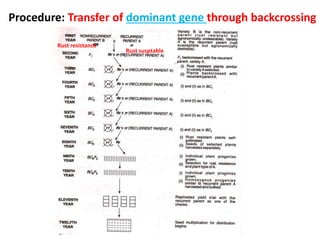
Procedure: Transfer of dominant gene through backcrossing
Rust resistance
Rust susptable
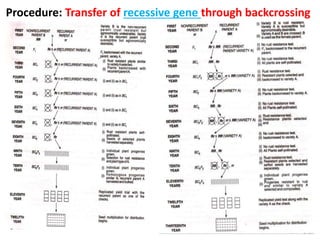
Procedure: Transfer of recessive gene through backcrossing
Average proportion (in %) of genes from the
recurrent parent
Percentage of homozygosity and
heterozygosity after selfing
The proportion of homozygotes for all the
gene in back cross=[(2m-1)/2m]n
m= no of back cross
n= no. of genes
Recovery of genes from RP
 Ave. recovery of RP = 1-(1/2)n+1, where n is the number
of backcrosses to RP
 The percentage recovery of RP varies among the
backcross progeny
 For example, in the BC3, if the DP and RP differ by 10
loci, 26% of the plants will be homozygous for the 10
alleles of the RP; remainder will vary.
Genetic consequences of backcross breeding
1. Reduction heterozygosis and increase in homozygosis
2. Increased similarity with the recurrent parent
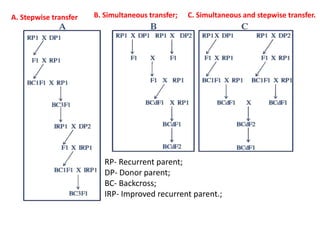
RP- Recurrent parent;
DP- Donor parent;
BC- Backcross;
IRP- Improved recurrent parent.;
A. Stepwise transfer B. Simultaneous transfer; C. Simultaneous and stepwise transfer.
Applications of backcross breeding
1. Intervarietal transfer of simply inherited traits: characters
governed by one or two major genes – E.g.disease resistance,
seed color, plant height etc.
2. Intervarietal transfer of quantitative traits Quantitative characters
with high heritability can be transferred.
E.g. Earlyness, Plant height seed size, seed shape.
3. Interspecific transfer of simply inherited traits: Mostly disease
resistance from related species into a cultivated species.
Eg.(i) Leaf and stem rust resistance from Triticum timopheevii
T. monococcum, Aegilops speltoides and rye (S. cereale) to T.
aestivum
(ii) Black arm resistance from several Gossypium species to G.
hirsutum.
4. Transfer of cytoplasm: B. C. method used to transfer cytoplasm from
one variety or species to another.
This is especial desirable in cases of Cytoplasmic or Cytoplasmic genetic
male sterility. E. g. Transfer of T. timopheevii cytoplasm to T.
aesticem.
5. Transgressive segregations:Back cross method may be modified to
obtain transgressive segregants.
6. Production of near isogenic lines:
 Isogenic lines are identical in their genotype, except for one gene.
 Such lines are useful in studying the effects of individual genes on
yield and other characteristics.
 Isogenic lines and easily produced using the back cross method.
7.Germplasm conversion: Conversion of photosensitive germplasm lines
(using as recurrent parent) to photo insensitive line (using a photo
insensitive line as a donor or non-recurrent parent.
Merits of Backcross method
1. The outcome of backcross programme is a well adopted variety
with superior traits, no need to conduct extensive yield tests.
2. Defects of well-adapted variety are removed without affecting its
adaptability and performance.
3. Much smaller population needed, when compared to pedigree
method.
4. Does not depend on environmental conditions, unless it is
required for selection of traits, hence 2-3 generation per year
can be grown.
Demerits
1. The performance of new variety is not significantly superior to
recurrent parent except for transferred trait
2. Problem of linkage drag – undesirable genes linked to gene being
transferred may also be transferred
3. Hybridization need to be carried out in each generation.
4. By the time new gene is being transferred to adopted variety, it
may be out of cultivation.
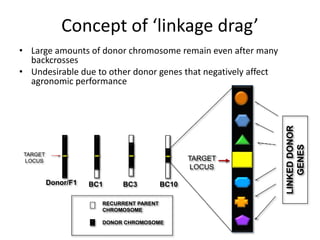
Concept of ‘linkage drag’
• Large amounts of donor chromosome remain even after many
backcrosses
• Undesirable due to other donor genes that negatively affect
agronomic performance
Donor/F1 BC1
c
BC3 BC10
TARGET
LOCUS
RECURRENT PARENT
CHROMOSOME
DONOR CHROMOSOME
TARGET
LOCUS
LINKED
DONOR
GENES
Marker-Assisted Backcrossing
May improve efficiency in three ways:
1) If phenotyping is difficult
2) Markers can be used to select against the donor parent in
the region outside the target
3) Markers can be used to select rare progeny that result from
recombination near the target gene
P1 x F1
P1 x P2
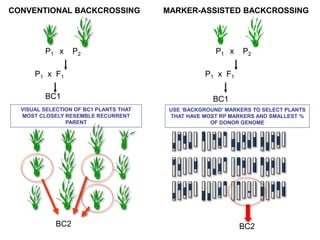
CONVENTIONAL BACKCROSSING
BC1
VISUAL SELECTION OF BC1 PLANTS THAT
MOST CLOSELY RESEMBLE RECURRENT
PARENT
BC2
MARKER-ASSISTED BACKCROSSING
P1 x F1
P1 x P2
BC1
USE ‘BACKGROUND’ MARKERS TO SELECT PLANTS
THAT HAVE MOST RP MARKERS AND SMALLEST %
OF DONOR GENOME
BC2
 Backcross Breeding Method

Backcross Breeding Method

  • 1.
    Dr. NAVEENKUMAR K.L AssistantProfessor Dept. Of Genetics and Plant Breeding UAHS Shivamogga Backcross Breeding
  • 2.
    What is Backcross?  A cross between a hybrid (F1 or a segregating generation) and one of its parents is known as backcross. TT X tt (Tall) (Dwarf) F1 Tt X TT OR Tt X tt  In BACKCROSS METHOD, the hybrid and the progenies in the subsequent generation are repeatedly backcrossed to one of the parents of the F1 .
  • 3.
    Why backcross methodis used? 1. To transfer a major gene 2. In disease/pest resistance breeding 3. To transfer alien cytoplasm or to transfer cytoplasmic male sterility 4. To transfer a transgene from already developed transgenic line
  • 4.
    objective of backcrossmethod  The objective of backcross method is to improve one or two specific defect of a high yielding variety, which is well adapted to the area and has a other desirable characteristics.
  • 5.
    Requirement for aBackcross Programme 1. A suitable recurrent parent, which lacks in one or two characters. 2. A suitable Donor parent that has an intense form of character which is deficient in recurrent parent. 3. The character to be transferred must have high heritability and governed by one or few genes. 4. Sufficient number of backcrosses.
  • 6.
    History of Backcrossing Harlan and Pope, 1922  Smooth vs. rough awn barley  Wanted the smooth awns from European barleys in the domestic barleys  Decided to backcross smooth awn  After 1 BC, progeny resembled Manchuria and they were able to recover high yielding smooth awn types
  • 7.
    Terminology  Recurrent parent(RP) - parent you are transferring trait OR In backcross breeding, the parent to which few or more genes are transferred from the donor parent is called the Recurrent parent.  Donor or non-recurrent parent (DP) - source of desirable trait OR In backcross breeding, the parent from which few or more genes are transferred to the recurrent parent is called the Donor parent.  Progeny test - when trait is recessive
  • 8.
    Procedure: Transfer ofdominant gene through backcrossing Rust resistance Rust susptable
  • 9.
    Procedure: Transfer ofrecessive gene through backcrossing
  • 10.
    Average proportion (in%) of genes from the recurrent parent Percentage of homozygosity and heterozygosity after selfing The proportion of homozygotes for all the gene in back cross=[(2m-1)/2m]n m= no of back cross n= no. of genes
  • 11.
    Recovery of genesfrom RP  Ave. recovery of RP = 1-(1/2)n+1, where n is the number of backcrosses to RP  The percentage recovery of RP varies among the backcross progeny  For example, in the BC3, if the DP and RP differ by 10 loci, 26% of the plants will be homozygous for the 10 alleles of the RP; remainder will vary.
  • 12.
    Genetic consequences ofbackcross breeding 1. Reduction heterozygosis and increase in homozygosis 2. Increased similarity with the recurrent parent
  • 13.
    RP- Recurrent parent; DP-Donor parent; BC- Backcross; IRP- Improved recurrent parent.; A. Stepwise transfer B. Simultaneous transfer; C. Simultaneous and stepwise transfer.
  • 14.
    Applications of backcrossbreeding 1. Intervarietal transfer of simply inherited traits: characters governed by one or two major genes – E.g.disease resistance, seed color, plant height etc. 2. Intervarietal transfer of quantitative traits Quantitative characters with high heritability can be transferred. E.g. Earlyness, Plant height seed size, seed shape. 3. Interspecific transfer of simply inherited traits: Mostly disease resistance from related species into a cultivated species. Eg.(i) Leaf and stem rust resistance from Triticum timopheevii T. monococcum, Aegilops speltoides and rye (S. cereale) to T. aestivum (ii) Black arm resistance from several Gossypium species to G. hirsutum.
  • 15.
    4. Transfer ofcytoplasm: B. C. method used to transfer cytoplasm from one variety or species to another. This is especial desirable in cases of Cytoplasmic or Cytoplasmic genetic male sterility. E. g. Transfer of T. timopheevii cytoplasm to T. aesticem. 5. Transgressive segregations:Back cross method may be modified to obtain transgressive segregants. 6. Production of near isogenic lines:  Isogenic lines are identical in their genotype, except for one gene.  Such lines are useful in studying the effects of individual genes on yield and other characteristics.  Isogenic lines and easily produced using the back cross method. 7.Germplasm conversion: Conversion of photosensitive germplasm lines (using as recurrent parent) to photo insensitive line (using a photo insensitive line as a donor or non-recurrent parent.
  • 16.
    Merits of Backcrossmethod 1. The outcome of backcross programme is a well adopted variety with superior traits, no need to conduct extensive yield tests. 2. Defects of well-adapted variety are removed without affecting its adaptability and performance. 3. Much smaller population needed, when compared to pedigree method. 4. Does not depend on environmental conditions, unless it is required for selection of traits, hence 2-3 generation per year can be grown.
  • 17.
    Demerits 1. The performanceof new variety is not significantly superior to recurrent parent except for transferred trait 2. Problem of linkage drag – undesirable genes linked to gene being transferred may also be transferred 3. Hybridization need to be carried out in each generation. 4. By the time new gene is being transferred to adopted variety, it may be out of cultivation.
  • 18.
    Concept of ‘linkagedrag’ • Large amounts of donor chromosome remain even after many backcrosses • Undesirable due to other donor genes that negatively affect agronomic performance Donor/F1 BC1 c BC3 BC10 TARGET LOCUS RECURRENT PARENT CHROMOSOME DONOR CHROMOSOME TARGET LOCUS LINKED DONOR GENES
  • 19.
    Marker-Assisted Backcrossing May improveefficiency in three ways: 1) If phenotyping is difficult 2) Markers can be used to select against the donor parent in the region outside the target 3) Markers can be used to select rare progeny that result from recombination near the target gene
  • 20.
    P1 x F1 P1x P2 CONVENTIONAL BACKCROSSING BC1 VISUAL SELECTION OF BC1 PLANTS THAT MOST CLOSELY RESEMBLE RECURRENT PARENT BC2 MARKER-ASSISTED BACKCROSSING P1 x F1 P1 x P2 BC1 USE ‘BACKGROUND’ MARKERS TO SELECT PLANTS THAT HAVE MOST RP MARKERS AND SMALLEST % OF DONOR GENOME BC2