Mutation Breeding –Problems and
achievements
Sukh Dev Singh
Ph.D. (Horti.)
College of Agriculture,
Swami Keshwanand Rajasthan Agricultural
University, Bikaner, Rajasthan, India-334 006
Introduction
Mutation-a sudden heritable change
“Any heritable change in the idiotypic constitution
of sporophytic or gametophytic plant tissue, not
caused by normal genetic recombination or
segregation” (Harten, 1998).
Genetic basis or raw material for evolution of
species in nature
No variation means no evolution and mutations
are the ultimate source of variation.
Artificial development new varieties with
desirable characters-mutation breeding
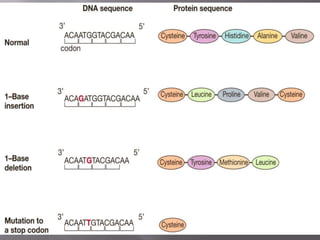
 DNA made up of sequence of nucleotides. Each
nucleotide includes a sugar, phosphate and one of four
possible nitrogenous bases
 Purines-adenine and guanine
 Pyrimidines-thymine and cytosine
 Sequence of bases in DNA codes for protein structure
as each three base sequence codes for one amino acid
in the protein chain.
4.2
 When DNA is synthesized an enzyme called
DNA polymerase reads one strand of DNA
molecule and constructs a complementary
strand.
 If DNA polymerase makes a mistake and it is
not repaired, a mutation has occurred.
How mutation takes place
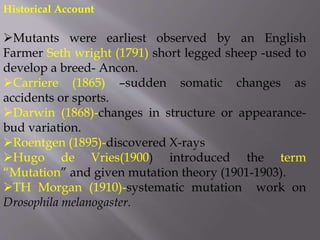
Historical Account
Mutants were earliest observed by an English
Farmer Seth wright (1791) short legged sheep -used to
develop a breed- Ancon.
Carriere (1865) –sudden somatic changes as
accidents or sports.
Darwin (1868)-changes in structure or appearance-
bud variation.
Roentgen (1895)-discovered X-rays
Hugo de Vries(1900) introduced the term
“Mutation” and given mutation theory (1901-1903).
TH Morgan (1910)-systematic mutation work on
Drosophila melanogaster.
Muller(1927) -discovered the action of X-rays on Drosophilla
Stadler (1927) -discovered the effect of X-rays in maize,
wheat and barley.
 Mutation Breeding Programme was started in Sweden,
USSR and Germany in 1927 after the discovery by Muller.
IAEA (1964)- Initiated coordinated programme on mutation
breeding in rice.
Becquerel (1996)- invented radioactivity.
Types of mutations/terminology :
Two type-
Spontaneous- Natural mutation
Induced mutations – Artificial mutation
Macro -Oligo mutations / Quality Mutations -
Phenotypic effect is quite clear
Micro mutations-polygenic mutations- quantitative
traits, are of economic importance.
Phenotypic effects are invisible, need large
populations to score mutations and special statistical
analysis is required to detect their effect (biometrical
techniques)
Origin of spontaneous mutation
Error during DNA replication
Base alteration or damage
Spontaneous base degradation
Free radicals of oxygen
Spontaneous frame shift mutation
Induced mutation
Physical
Chemical
Transposon
Deletions- removal of segments of DNA
Insertions- addition of segments of DNA
These segments can range from individual base pairs to
several thousand base pairs long.
Substitutions occur when a particular base is replaced
with one of the other three nucleotide bases.
 Three type –
• Transition
•Transversion
•Frame shift
Transition- replacement of one purine with another purine
or one pyrimidine with another pyrimidine.
Transversion mutation is the substitution of a purine by a
pyrimidine or vice versa.
Frame shift -change in the reading frame of the gene by
the addition or deletion of nitrogen bases.
Inversions are instances where a segment of chromosome is
rotated and replaced in the opposite direction that the
segment was facing.
Reciprocal translocation- This involves the excision of
segments from two nonhomologous chromosomes. These
excised portions are then inserted into the other chromosome.
Chromosome A will gain the segment from Chromosome B
and Chromosome B gains the segment from chromosome A.
Silent mutations-not cause a change in amino acid
coded for.
Replacement mutations-Mutations that do cause a
change in amino acid.
Point and Cytoplasmic Mutations :
Point -Alteration in the nuclear DNA
Cytoplasmic Mutations- Alteration in the cytoplasmic
DNA (CMS)
Mutagen- two type
1.Physical
I. Ionizing radiation- (Alpha rays, x-Rays, Gamma rays)
II. Non ionising radiation- UV rays
2. Chemical mutagen
i. Alkylating Agents -Mustard gas, EMS, MMS, Ethylene Imines
ii. Acradine dye- Acradine orange, proflavin
iii. Base analogous- 5-chloro urecil, 2-amino purine
Other chemicals like nitrous acid, hydroxylamine and sodium
azide are also efficient mutagens.
3. Transposable Elements
Transposable elements are a special class of mutagen. They
are self replicating segments of DNA that excise and/or insert
themselves within the genome. Also known as transposons,
these strange sequences were first proposed by the pioneering
Barbara McCLintock working on maize (McClintock, 1948).
Transposable elements, unlike other forms of mutagenesis,
do not act upon the genome in a completely random fashion.
Rather, they have certain “hotspots” where they are more
likely to insert or replicate themselves.
Transposable elements can cause gene disruptions, protein
product alterations, or largescale genome rearrangements. If
inserted into the intron of a gene, they can cause
transcriptional inefficiency (Hartwell et al., 2008).
PROCEDURE OF MUTATION BREEDING
It includes:
1. Selection of the material
2. Choice of the mutagen
3. Mutagen Treatment
4. Handling of the mutated populations in the case of seed
propagated species
5. Handling of mutated populations in the case of clonally
propagated species
1.Selection of the material-
Plant part used -Best variety should be used
Sexually propagated crops- seeds and pollengrains
Seeds- frequently used, can tolerate extreme
environments
Pollengrains- rarely used (difficulty in collection and
hand pollination , low survival)
Pollengrain are the only plant part which can be treated
with UV rays
 Vegetatively propagated crops- buds, cuttings, whole
plants, corms, bulbs etc.
In vitro- callus
2. Choice of the mutagen
Mutagenesis- treatments with chemicals
Irradiadition –exposing to radiation
(generally chemicals for seed and radiation for veg.
parts/pollens)
Dose and duration- type of mutagenic agent and
biological material to be treated (species/ploidy
/condition)
An optimum doses is one which produce
maximum frequency of mutation and minimum
damage/kiling.
LD 50 dose should be optimum
3. Mutagen Treatment
The plant part is exposed to the desired mutagen dose.
In irradiation the plant parts are immediately planted to
raise M1 plants from them.
In case of chemical mutagens seeds are usually pretreated
(soaked for few hours/chemicals) to initiate metabolic
activities.
Safety for radiation-distance from source, protected
environment.
4. Handling of the mutated populations in the case of seed
propagated species
M0- All seed sown
M1- Dominant/pseudo dominant selected, selfed, harvested
separately
M2- Oligogenic , superior, desirable selected
M3- Evaluated for breeding behaviour, true progeny seed
bulked, in case of polygenic traits inferior rejected
M4- Preliminary yield trials
M5- Co-ordinated yield trails
M8-M9- Most promising line are selected and released
5. Handling of mutated populations in the case of clonally
propagated species
VM0- Treated propagules
VM1- Chimera selected
VM2- Solid mutation identified and selected
VM3- Confirmation of mutation
VM4- Preliminary yield trials
VM5- Co-ordinated yield trails
VM 8-9- New variety released
The most common example is a "variegated" plant where
different regions of the leaf are yellow or white due to the lack
of chlorophyll synthesis, i.e. these are chlorophyll mutants.
However, there are many kinds of chimeras. Thornless
blackberries are chimeras where the L-I epidermis lacks the
ability to produce thorns.
Some fruits have sweet and sour regions of flesh, which may
be a chimera.
Variegated aloe and geranium
Chimera ?
Ploidy and how it affects mutation breeding
Mutagenesis of polyploid plant species is difficult.
Because most mutations are recessive, plants must
be homozygous to display the trait.
Polyploid conditions can further complicate the
process of reaching homozygosity for the mutation,
 So must be selfed for additional generations to
ensure presence of the mutation.
Effects Of Mutation :
1. Lethal :- They kill each & every individual that carry
them in appropriate genotype .
Dominant lethal : It can’t survive.
Recessive lethal : kill in homozygous state.
2. Sub Lethal & Sub Vital :- Both mutation reduce
viability but don’t kill all the individual carrying
them in appropriate genotype.
Sub Lethal : Kill more than 50%.
Sub Vital : Kill less than 50%.
Vital :-a) Don’t reduce the viability.
b) Crop improvement can utilize only such
mutations.
Lethal , Sub lethal mutations have no value in crop
improvement.
Mutation breeding application:
Generally used in S.P. and clonally propagated crops.
Ex.-Wheat, sugarcane, banana,
When…… ?:
Desired variability exhausts in cultivated species and
germplasm. When a desirable variety has an oligogenic genetic
defect.
There is tight linkage between desirable and undesirable
traits. Only one or two characters are to be improved in a fruit
crop without changing its taste.
Crop does not have sexuality, thus lacks variability.
The generation cycle is very long, such as plantation crops,
fruit trees….there mutation breeding is the shortcut way for
genetic improvement.
In ornamental plants Mutant Dog Rose Flower, Mutant
yellow Rose and Red Rose, chrysanthemum
Mutation breeding -
A particular reaction is to be blocked e.g., in opium the synthesis
of morphine takes place in stepwise manner.
If the reaction is stopped at bane level, it will block the synthesis
of morphine without affecting the conversion process of the bane
into useful pharmaceutical products.
Application of mutation breeding :
Application of mutation breeding Induction of desirable
mutant alleles which may not be present in the germplasm
available to the breeder.
In improving specific characteristics of well adapted high
yielding variety .
Mutagenesis has been successfully used to improve
various quantitative characters including yield.
Any mutational change in a character which can be
practical use
Improve nutrition value of crop product
Short stem
High lodging resistance
Disease resistance
Mutation breeding can be used
To develop improved crop varieties, with new traits
To induce male sterility,
For the production of haploids,
To create additional genetic variability, and
To improve the adaptability of crops.
Varieties developed in India through mutation breeding
Yusuff Oladosua,2016
Yusuff Oladosua, 2016
Application of induced mutagenesis for abiotic stress resistance
Application of induced mutagenesis for improvement of quality and
nutritional traits
Yusuff Oladosua, 2016
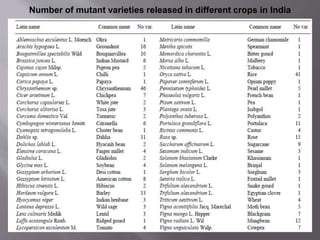
Number of mutant varieties released in different crops in India
Source: Chopra, 2005.
The Future of mutation breeding
Technologies such as high throughput sequencing has
allowed for the relatively cheap and fast genome
sequencing of plants.
Methods such as TILLING (Targeting Induced Local
Lesions in Genomes)
Zinc finger nuclease mediated mutagenesis, and the use
of meganucleases, has allowed us to produce targeted
mutations in crop plants to delineate gene function as
well as improve cultivars.
These new and more specific methods are very
promising.
TILLING relies on high throughput sequencing to assemble an
array of mutants for a particular target sequence. (McCallum et
al., 2000).
Although the mutations are induced randomly across the plant
genome, they are detected only in the gene of interest. This
allows the researcher to keep only those plants with mutations in
the desired region.
A similar process, EcoTILLING, screens for the spontaneous
mutations present due to natural variation within a population.
The main advantage of TILLING as a reverse genetics strategy
is that it can be applied to any species, regardless of its genome
size and ploidy level.
The TILLING protocol provides a high frequency of point
mutations distributed randomly in the genome.
Source: Dayton Wilde et al., 2012.
Limitations of mutation breeding
 The frequency of desirable mutations is very low (0.1 %)
Therefore, large M2 and subsequent populations -requires time,
labour and other resources.
Mutation breeding is more easily applied to such characters where
quick screening techniques are available, e.g., disease resistance. non
bolting
But in the case of characters where elaborate tests are required, e.g.,
quality characteristics, mutation breeding is virtually impractical.
For this reason, mutation breeding has been more successful when
mutant phenotype is distinct and easily detectable.
Desirable mutations are commonly associated with undesirable side
effects due to other mutations, chromosomal aberrations, etc.
Removed by- backcrossed to the respective parent
Again -labour, time and expenditure.
 Often mutations produce pleiotropic effects.
-Eliminating by pleiotropic by hybridizing with different genetic
backgrounds or Alternatively, when the pleiotropic {effect is on a
specific trait, e.g., delayed flowering,, e.g., genes for early flowering, can
be introgressed into the mutant strain.
Mutations in quantitative traits are usually in the direction away from
the selection history of the parent variety; e.g.,yield.
There may be problems in the registration of a mutant
-The PBR laws, where they exist, require a new variety to be distinct,
uniform and stable (the DUS requirement).
Most of the mutations are recessive; detection of recessive mutations
is almost impossible in clonal crops and is difficult in polyploidy
species.
- Consequently, in polyploidy species, larger population have to be
grown and larger doses of mutagens have to be applied.
Mutagenesis has been most commonly applied to diploid species that
reproduce sexually, more particularly to self pollinated species.
Mutation breeding

Mutation breeding

  • 1.
    Mutation Breeding –Problemsand achievements Sukh Dev Singh Ph.D. (Horti.) College of Agriculture, Swami Keshwanand Rajasthan Agricultural University, Bikaner, Rajasthan, India-334 006
  • 2.
    Introduction Mutation-a sudden heritablechange “Any heritable change in the idiotypic constitution of sporophytic or gametophytic plant tissue, not caused by normal genetic recombination or segregation” (Harten, 1998). Genetic basis or raw material for evolution of species in nature No variation means no evolution and mutations are the ultimate source of variation. Artificial development new varieties with desirable characters-mutation breeding
  • 3.
     DNA madeup of sequence of nucleotides. Each nucleotide includes a sugar, phosphate and one of four possible nitrogenous bases  Purines-adenine and guanine  Pyrimidines-thymine and cytosine  Sequence of bases in DNA codes for protein structure as each three base sequence codes for one amino acid in the protein chain.
  • 4.
  • 6.
     When DNAis synthesized an enzyme called DNA polymerase reads one strand of DNA molecule and constructs a complementary strand.  If DNA polymerase makes a mistake and it is not repaired, a mutation has occurred. How mutation takes place
  • 7.
    Historical Account Mutants wereearliest observed by an English Farmer Seth wright (1791) short legged sheep -used to develop a breed- Ancon. Carriere (1865) –sudden somatic changes as accidents or sports. Darwin (1868)-changes in structure or appearance- bud variation. Roentgen (1895)-discovered X-rays Hugo de Vries(1900) introduced the term “Mutation” and given mutation theory (1901-1903). TH Morgan (1910)-systematic mutation work on Drosophila melanogaster.
  • 8.
    Muller(1927) -discovered theaction of X-rays on Drosophilla Stadler (1927) -discovered the effect of X-rays in maize, wheat and barley.  Mutation Breeding Programme was started in Sweden, USSR and Germany in 1927 after the discovery by Muller. IAEA (1964)- Initiated coordinated programme on mutation breeding in rice. Becquerel (1996)- invented radioactivity.
  • 9.
    Types of mutations/terminology: Two type- Spontaneous- Natural mutation Induced mutations – Artificial mutation Macro -Oligo mutations / Quality Mutations - Phenotypic effect is quite clear Micro mutations-polygenic mutations- quantitative traits, are of economic importance. Phenotypic effects are invisible, need large populations to score mutations and special statistical analysis is required to detect their effect (biometrical techniques)
  • 10.
    Origin of spontaneousmutation Error during DNA replication Base alteration or damage Spontaneous base degradation Free radicals of oxygen Spontaneous frame shift mutation Induced mutation Physical Chemical Transposon
  • 11.
    Deletions- removal ofsegments of DNA Insertions- addition of segments of DNA These segments can range from individual base pairs to several thousand base pairs long. Substitutions occur when a particular base is replaced with one of the other three nucleotide bases.  Three type – • Transition •Transversion •Frame shift
  • 12.
    Transition- replacement ofone purine with another purine or one pyrimidine with another pyrimidine. Transversion mutation is the substitution of a purine by a pyrimidine or vice versa. Frame shift -change in the reading frame of the gene by the addition or deletion of nitrogen bases.
  • 13.
    Inversions are instanceswhere a segment of chromosome is rotated and replaced in the opposite direction that the segment was facing. Reciprocal translocation- This involves the excision of segments from two nonhomologous chromosomes. These excised portions are then inserted into the other chromosome. Chromosome A will gain the segment from Chromosome B and Chromosome B gains the segment from chromosome A.
  • 14.
    Silent mutations-not causea change in amino acid coded for. Replacement mutations-Mutations that do cause a change in amino acid. Point and Cytoplasmic Mutations : Point -Alteration in the nuclear DNA Cytoplasmic Mutations- Alteration in the cytoplasmic DNA (CMS)
  • 15.
    Mutagen- two type 1.Physical I.Ionizing radiation- (Alpha rays, x-Rays, Gamma rays) II. Non ionising radiation- UV rays 2. Chemical mutagen i. Alkylating Agents -Mustard gas, EMS, MMS, Ethylene Imines ii. Acradine dye- Acradine orange, proflavin iii. Base analogous- 5-chloro urecil, 2-amino purine Other chemicals like nitrous acid, hydroxylamine and sodium azide are also efficient mutagens.
  • 16.
    3. Transposable Elements Transposableelements are a special class of mutagen. They are self replicating segments of DNA that excise and/or insert themselves within the genome. Also known as transposons, these strange sequences were first proposed by the pioneering Barbara McCLintock working on maize (McClintock, 1948). Transposable elements, unlike other forms of mutagenesis, do not act upon the genome in a completely random fashion. Rather, they have certain “hotspots” where they are more likely to insert or replicate themselves. Transposable elements can cause gene disruptions, protein product alterations, or largescale genome rearrangements. If inserted into the intron of a gene, they can cause transcriptional inefficiency (Hartwell et al., 2008).
  • 17.
    PROCEDURE OF MUTATIONBREEDING It includes: 1. Selection of the material 2. Choice of the mutagen 3. Mutagen Treatment 4. Handling of the mutated populations in the case of seed propagated species 5. Handling of mutated populations in the case of clonally propagated species
  • 18.
    1.Selection of thematerial- Plant part used -Best variety should be used Sexually propagated crops- seeds and pollengrains Seeds- frequently used, can tolerate extreme environments Pollengrains- rarely used (difficulty in collection and hand pollination , low survival) Pollengrain are the only plant part which can be treated with UV rays  Vegetatively propagated crops- buds, cuttings, whole plants, corms, bulbs etc. In vitro- callus
  • 19.
    2. Choice ofthe mutagen Mutagenesis- treatments with chemicals Irradiadition –exposing to radiation (generally chemicals for seed and radiation for veg. parts/pollens) Dose and duration- type of mutagenic agent and biological material to be treated (species/ploidy /condition) An optimum doses is one which produce maximum frequency of mutation and minimum damage/kiling. LD 50 dose should be optimum
  • 20.
    3. Mutagen Treatment Theplant part is exposed to the desired mutagen dose. In irradiation the plant parts are immediately planted to raise M1 plants from them. In case of chemical mutagens seeds are usually pretreated (soaked for few hours/chemicals) to initiate metabolic activities. Safety for radiation-distance from source, protected environment.
  • 21.
    4. Handling ofthe mutated populations in the case of seed propagated species M0- All seed sown M1- Dominant/pseudo dominant selected, selfed, harvested separately M2- Oligogenic , superior, desirable selected M3- Evaluated for breeding behaviour, true progeny seed bulked, in case of polygenic traits inferior rejected M4- Preliminary yield trials M5- Co-ordinated yield trails M8-M9- Most promising line are selected and released
  • 22.
    5. Handling ofmutated populations in the case of clonally propagated species VM0- Treated propagules VM1- Chimera selected VM2- Solid mutation identified and selected VM3- Confirmation of mutation VM4- Preliminary yield trials VM5- Co-ordinated yield trails VM 8-9- New variety released
  • 23.
    The most commonexample is a "variegated" plant where different regions of the leaf are yellow or white due to the lack of chlorophyll synthesis, i.e. these are chlorophyll mutants. However, there are many kinds of chimeras. Thornless blackberries are chimeras where the L-I epidermis lacks the ability to produce thorns. Some fruits have sweet and sour regions of flesh, which may be a chimera.
  • 24.
  • 26.
  • 29.
    Ploidy and howit affects mutation breeding Mutagenesis of polyploid plant species is difficult. Because most mutations are recessive, plants must be homozygous to display the trait. Polyploid conditions can further complicate the process of reaching homozygosity for the mutation,  So must be selfed for additional generations to ensure presence of the mutation.
  • 30.
    Effects Of Mutation: 1. Lethal :- They kill each & every individual that carry them in appropriate genotype . Dominant lethal : It can’t survive. Recessive lethal : kill in homozygous state. 2. Sub Lethal & Sub Vital :- Both mutation reduce viability but don’t kill all the individual carrying them in appropriate genotype. Sub Lethal : Kill more than 50%. Sub Vital : Kill less than 50%. Vital :-a) Don’t reduce the viability. b) Crop improvement can utilize only such mutations. Lethal , Sub lethal mutations have no value in crop improvement.
  • 31.
    Mutation breeding application: Generallyused in S.P. and clonally propagated crops. Ex.-Wheat, sugarcane, banana, When…… ?: Desired variability exhausts in cultivated species and germplasm. When a desirable variety has an oligogenic genetic defect. There is tight linkage between desirable and undesirable traits. Only one or two characters are to be improved in a fruit crop without changing its taste. Crop does not have sexuality, thus lacks variability. The generation cycle is very long, such as plantation crops, fruit trees….there mutation breeding is the shortcut way for genetic improvement. In ornamental plants Mutant Dog Rose Flower, Mutant yellow Rose and Red Rose, chrysanthemum
  • 32.
    Mutation breeding - Aparticular reaction is to be blocked e.g., in opium the synthesis of morphine takes place in stepwise manner. If the reaction is stopped at bane level, it will block the synthesis of morphine without affecting the conversion process of the bane into useful pharmaceutical products.
  • 33.
    Application of mutationbreeding : Application of mutation breeding Induction of desirable mutant alleles which may not be present in the germplasm available to the breeder. In improving specific characteristics of well adapted high yielding variety . Mutagenesis has been successfully used to improve various quantitative characters including yield. Any mutational change in a character which can be practical use Improve nutrition value of crop product Short stem High lodging resistance Disease resistance
  • 34.
    Mutation breeding canbe used To develop improved crop varieties, with new traits To induce male sterility, For the production of haploids, To create additional genetic variability, and To improve the adaptability of crops.
  • 35.
    Varieties developed inIndia through mutation breeding
  • 38.
  • 39.
    Yusuff Oladosua, 2016 Applicationof induced mutagenesis for abiotic stress resistance
  • 40.
    Application of inducedmutagenesis for improvement of quality and nutritional traits Yusuff Oladosua, 2016
  • 41.
    Number of mutantvarieties released in different crops in India
  • 42.
  • 43.
    The Future ofmutation breeding Technologies such as high throughput sequencing has allowed for the relatively cheap and fast genome sequencing of plants. Methods such as TILLING (Targeting Induced Local Lesions in Genomes) Zinc finger nuclease mediated mutagenesis, and the use of meganucleases, has allowed us to produce targeted mutations in crop plants to delineate gene function as well as improve cultivars. These new and more specific methods are very promising.
  • 44.
    TILLING relies onhigh throughput sequencing to assemble an array of mutants for a particular target sequence. (McCallum et al., 2000). Although the mutations are induced randomly across the plant genome, they are detected only in the gene of interest. This allows the researcher to keep only those plants with mutations in the desired region. A similar process, EcoTILLING, screens for the spontaneous mutations present due to natural variation within a population. The main advantage of TILLING as a reverse genetics strategy is that it can be applied to any species, regardless of its genome size and ploidy level. The TILLING protocol provides a high frequency of point mutations distributed randomly in the genome.
  • 46.
    Source: Dayton Wildeet al., 2012.
  • 47.
    Limitations of mutationbreeding  The frequency of desirable mutations is very low (0.1 %) Therefore, large M2 and subsequent populations -requires time, labour and other resources. Mutation breeding is more easily applied to such characters where quick screening techniques are available, e.g., disease resistance. non bolting But in the case of characters where elaborate tests are required, e.g., quality characteristics, mutation breeding is virtually impractical. For this reason, mutation breeding has been more successful when mutant phenotype is distinct and easily detectable. Desirable mutations are commonly associated with undesirable side effects due to other mutations, chromosomal aberrations, etc. Removed by- backcrossed to the respective parent Again -labour, time and expenditure.
  • 48.
     Often mutationsproduce pleiotropic effects. -Eliminating by pleiotropic by hybridizing with different genetic backgrounds or Alternatively, when the pleiotropic {effect is on a specific trait, e.g., delayed flowering,, e.g., genes for early flowering, can be introgressed into the mutant strain. Mutations in quantitative traits are usually in the direction away from the selection history of the parent variety; e.g.,yield. There may be problems in the registration of a mutant -The PBR laws, where they exist, require a new variety to be distinct, uniform and stable (the DUS requirement). Most of the mutations are recessive; detection of recessive mutations is almost impossible in clonal crops and is difficult in polyploidy species. - Consequently, in polyploidy species, larger population have to be grown and larger doses of mutagens have to be applied. Mutagenesis has been most commonly applied to diploid species that reproduce sexually, more particularly to self pollinated species.

Editor's Notes

  • #16 Ionizing radiations-high energy level are capable of causing both excitation and ionization at the level of nitrogen bases. Radiations with lower energy levels are capable of causing excitations at the level of nitrogen bases of the genetic material and they are called non-ionizing radiations.