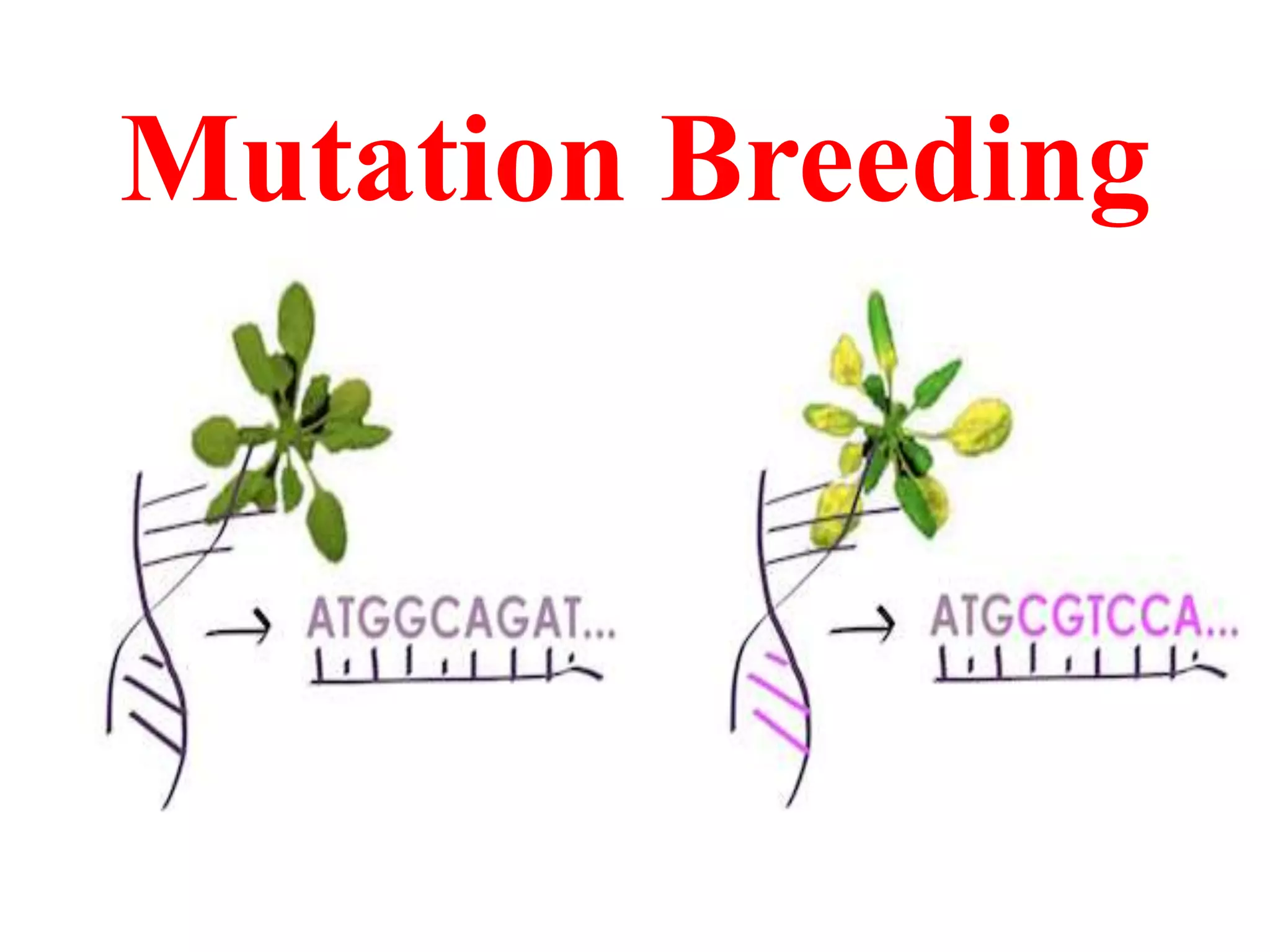
Mutation Breeding
Introduction
• The word mutation is derived from Latin word
“mutatus” meaning “changed”
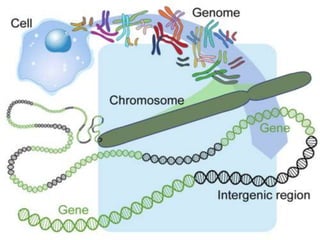
• In biology, a mutation is the permanent alteration of
the nucleotide sequence of the genome of an
organism, virus or extra-chromosomal DNA or other
genetic element.
• Refers to sudden heritable change in the phenotype of
an individual.
• Mutation breeding: Referred to as variation breeding
is the process of exposing plants or seeds to chemical
or radiation in order to generate mutants with
desirable traits to be breed with other cultivars (plant
varieties)
• Plants/seeds created using mutagenesis are called
mutagenic plants or mutagenic seeds.
• Mutant: A mutant is an organism or a new genetic
characters arising or resulting from mutation which
is an alteration of the DNA sequence of a gene or
chromosome of an organism.
• From 1930 to 2014 more than 3200 mutagenic
plant varieties were released & still counting.
• From direct mutation 70% and from their progeny
30%
• Natural occurrence of genetic mutation is integral
to the process of evolution
• Mutation occurs in two ways :
(1) By alteration in nuclear DNA (point mutations)
(2) By change in cytoplasmic DNA (cytoplasmic
mutation)
History
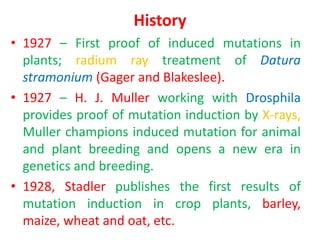
• 1927 – First proof of induced mutations in
plants; radium ray treatment of Datura
stramonium (Gager and Blakeslee).
• 1927 – H. J. Muller working with Drosphila
provides proof of mutation induction by X-rays,
Muller champions induced mutation for animal
and plant breeding and opens a new era in
genetics and breeding.
• 1928, Stadler publishes the first results of
mutation induction in crop plants, barley,
maize, wheat and oat, etc.
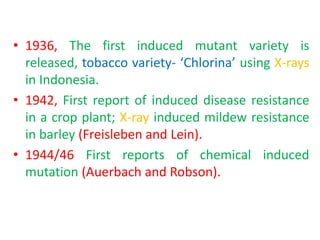
• 1936, The first induced mutant variety is
released, tobacco variety- ‘Chlorina’ using X-rays
in Indonesia.
• 1942, First report of induced disease resistance
in a crop plant; X-ray induced mildew resistance
in barley (Freisleben and Lein).
• 1944/46 First reports of chemical induced
mutation (Auerbach and Robson).
TYPES OF MUTATION
TYPES OF MUTATION
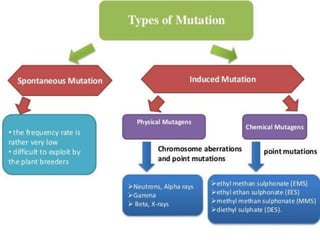
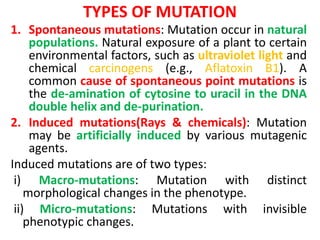
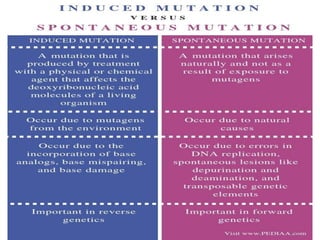
1. Spontaneous mutations: Mutation occur in natural
populations. Natural exposure of a plant to certain
environmental factors, such as ultraviolet light and
chemical carcinogens (e.g., Aflatoxin B1). A
common cause of spontaneous point mutations is
the de-amination of cytosine to uracil in the DNA
double helix and de-purination.
2. Induced mutations(Rays & chemicals): Mutation
may be artificially induced by various mutagenic
agents.
Induced mutations are of two types:
i) Macro-mutations: Mutation with distinct
morphological changes in the phenotype.
ii) Micro-mutations: Mutations with invisible
phenotypic changes.
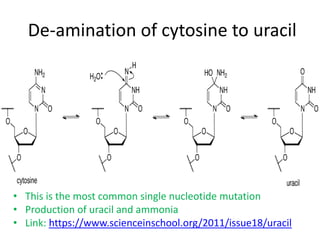
De-amination of cytosine to uracil
• This is the most common single nucleotide mutation
• Production of uracil and ammonia
• Link: https://www.scienceinschool.org/2011/issue18/uracil
MUTATION BREEDING
• Inducing desirable mutations and exploiting them for crop
improvement.
• It is commonly used in self pollinated crops and used to
produce traits in crops such as larger seeds, new colour,
greater yields, etc.
Important steps to know before mutation breeding are:
1.Selection of variety for mutation breeding, It should be
the best variety available in crop and Seed should be pure
2.Part of the plant to be treated
3.Dose of the mutagen (LD50): Mutagens generally induce a
high
frequency of chromosomal changes and meiotic and mitotic
irregularities, Optimum mutagen dose is one, which
produces maximum frequency of mutations and causes the
minimum killing.
MUTAGENS
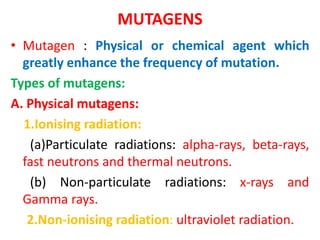
• Mutagen : Physical or chemical agent which
greatly enhance the frequency of mutation.
Types of mutagens:
A. Physical mutagens:
1.Ionising radiation:
(a)Particulate radiations: alpha-rays, beta-rays,
fast neutrons and thermal neutrons.
(b) Non-particulate radiations: x-rays and
Gamma rays.
2.Non-ionising radiation: ultraviolet radiation.
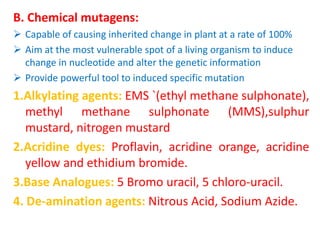
B. Chemical mutagens:
 Capable of causing inherited change in plant at a rate of 100%
 Aim at the most vulnerable spot of a living organism to induce
change in nucleotide and alter the genetic information
 Provide powerful tool to induced specific mutation
1.Alkylating agents: EMS `(ethyl methane sulphonate),
methyl methane sulphonate (MMS),sulphur
mustard, nitrogen mustard
2.Acridine dyes: Proflavin, acridine orange, acridine
yellow and ethidium bromide.
3.Base Analogues: 5 Bromo uracil, 5 chloro-uracil.
4. De-amination agents: Nitrous Acid, Sodium Azide.
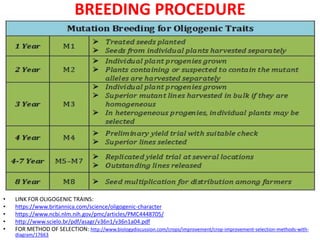
BREEDING PROCEDURE
• LINK FOR OLIGOGENIC TRAINS:
• https://www.britannica.com/science/oligogenic-character
• https://www.ncbi.nlm.nih.gov/pmc/articles/PMC4448705/
• http://www.scielo.br/pdf/asagr/v36n1/v36n1a04.pdf
• FOR METHOD OF SELECTION: http://www.biologydiscussion.com/crops/improvement/crop-improvement-selection-methods-with-
diagram/17663
Screening/selection
• Mainly three types of screening/selection
techniques are used in M2 and subsequent
generation.
1. Visual: most effective and efficient method for
identifying mutant phenotypes.
2. Mechanical/Physical: Very efficient for seed size,
shape, weight, density, etc., using appropriate
sieving machinery.
3. Other methods: Low alkaloid content mutants can
be selected using colorimetric tests (method of
determining the concentration of a chemical
element or chemical compound in a solution with
the aid of a colour reagent), chromatographic or
electrophoresis techniques may be used to select
isolate protein variants
Advantages of mutation breeding
• Mutation breeding is a cheap and rapid method of developing new
varieties.
• For the production of novel traits.
• Production of new species
• Can provide solution for some specific plant breeding problems
• Induced mutagens are used for the induction of CMS (Cytoplasmic male
sterility). Ethidium bromide (EB) has been used for induction of CMS in
barley.(observed in over 150 plant species)
• Mutation breeding is more effective for the improvement of oligogenic
characters (a trait that is influenced by more than one gene).
• Evolution of new and better food plants having good desirable
characters such as high yielding and greater resistance(crop
improvement)
• Mutation breeding is the simple, quick and the best way when a new
character is to be induced.
• Link: https://www.biotecharticles.com/Genetics-Article/Significance-of-
Mutation-in-Plant-Breeding-and-its-role-in-Evolution-3687.html
• http://plantbreeding.coe.uga.edu/index.php?title=20._Mutagenesis
Disadvantages
• The process is generally random and unpredictable.
• Useful mutants are rare and predominantly
recessive.
• Mutants can have strong negative pleiotropic effects
on other traits.
• Health risks: handling, chemical mutagens;
radiations, fast neutrons treatments.
• Most mutants are of no use to breeding even if a
large number of mutants can be produced.
• Field trialling and germplasm storage can be
expensive and require a lot of space and careful
management if large mutant populations are
handled.
The primary research centres and institutes in
India that participated in the development and
release of various mutants
Indian Agricultural Research Institute (IARI)--
New Delhi
Bhabha Atomic Research Centre--Mumbai
Tamil Nadu Agricultural University--TN and
National Botanical Research Institute--Lucknow,
UP
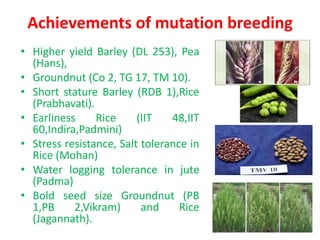
Achievements of mutation breeding
• Higher yield Barley (DL 253), Pea
(Hans),
• Groundnut (Co 2, TG 17, TM 10).
• Short stature Barley (RDB 1),Rice
(Prabhavati).
• Earliness Rice (IIT 48,IIT
60,Indira,Padmini)
• Stress resistance, Salt tolerance in
Rice (Mohan)
• Water logging tolerance in jute
(Padma)
• Bold seed size Groundnut (PB
1,PB 2,Vikram) and Rice
(Jagannath).
THANK YOU

Mutation breeding

  • 1.
  • 2.
    Introduction • The wordmutation is derived from Latin word “mutatus” meaning “changed” • In biology, a mutation is the permanent alteration of the nucleotide sequence of the genome of an organism, virus or extra-chromosomal DNA or other genetic element. • Refers to sudden heritable change in the phenotype of an individual. • Mutation breeding: Referred to as variation breeding is the process of exposing plants or seeds to chemical or radiation in order to generate mutants with desirable traits to be breed with other cultivars (plant varieties) • Plants/seeds created using mutagenesis are called mutagenic plants or mutagenic seeds.
  • 5.
    • Mutant: Amutant is an organism or a new genetic characters arising or resulting from mutation which is an alteration of the DNA sequence of a gene or chromosome of an organism. • From 1930 to 2014 more than 3200 mutagenic plant varieties were released & still counting. • From direct mutation 70% and from their progeny 30% • Natural occurrence of genetic mutation is integral to the process of evolution • Mutation occurs in two ways : (1) By alteration in nuclear DNA (point mutations) (2) By change in cytoplasmic DNA (cytoplasmic mutation)
  • 8.
    History • 1927 –First proof of induced mutations in plants; radium ray treatment of Datura stramonium (Gager and Blakeslee). • 1927 – H. J. Muller working with Drosphila provides proof of mutation induction by X-rays, Muller champions induced mutation for animal and plant breeding and opens a new era in genetics and breeding. • 1928, Stadler publishes the first results of mutation induction in crop plants, barley, maize, wheat and oat, etc.
  • 9.
    • 1936, Thefirst induced mutant variety is released, tobacco variety- ‘Chlorina’ using X-rays in Indonesia. • 1942, First report of induced disease resistance in a crop plant; X-ray induced mildew resistance in barley (Freisleben and Lein). • 1944/46 First reports of chemical induced mutation (Auerbach and Robson).
  • 10.
  • 11.
    TYPES OF MUTATION 1.Spontaneous mutations: Mutation occur in natural populations. Natural exposure of a plant to certain environmental factors, such as ultraviolet light and chemical carcinogens (e.g., Aflatoxin B1). A common cause of spontaneous point mutations is the de-amination of cytosine to uracil in the DNA double helix and de-purination. 2. Induced mutations(Rays & chemicals): Mutation may be artificially induced by various mutagenic agents. Induced mutations are of two types: i) Macro-mutations: Mutation with distinct morphological changes in the phenotype. ii) Micro-mutations: Mutations with invisible phenotypic changes.
  • 13.
    De-amination of cytosineto uracil • This is the most common single nucleotide mutation • Production of uracil and ammonia • Link: https://www.scienceinschool.org/2011/issue18/uracil
  • 15.
    MUTATION BREEDING • Inducingdesirable mutations and exploiting them for crop improvement. • It is commonly used in self pollinated crops and used to produce traits in crops such as larger seeds, new colour, greater yields, etc. Important steps to know before mutation breeding are: 1.Selection of variety for mutation breeding, It should be the best variety available in crop and Seed should be pure 2.Part of the plant to be treated 3.Dose of the mutagen (LD50): Mutagens generally induce a high frequency of chromosomal changes and meiotic and mitotic irregularities, Optimum mutagen dose is one, which produces maximum frequency of mutations and causes the minimum killing.
  • 16.
    MUTAGENS • Mutagen :Physical or chemical agent which greatly enhance the frequency of mutation. Types of mutagens: A. Physical mutagens: 1.Ionising radiation: (a)Particulate radiations: alpha-rays, beta-rays, fast neutrons and thermal neutrons. (b) Non-particulate radiations: x-rays and Gamma rays. 2.Non-ionising radiation: ultraviolet radiation.
  • 18.
    B. Chemical mutagens: Capable of causing inherited change in plant at a rate of 100%  Aim at the most vulnerable spot of a living organism to induce change in nucleotide and alter the genetic information  Provide powerful tool to induced specific mutation 1.Alkylating agents: EMS `(ethyl methane sulphonate), methyl methane sulphonate (MMS),sulphur mustard, nitrogen mustard 2.Acridine dyes: Proflavin, acridine orange, acridine yellow and ethidium bromide. 3.Base Analogues: 5 Bromo uracil, 5 chloro-uracil. 4. De-amination agents: Nitrous Acid, Sodium Azide.
  • 19.
    BREEDING PROCEDURE • LINKFOR OLIGOGENIC TRAINS: • https://www.britannica.com/science/oligogenic-character • https://www.ncbi.nlm.nih.gov/pmc/articles/PMC4448705/ • http://www.scielo.br/pdf/asagr/v36n1/v36n1a04.pdf • FOR METHOD OF SELECTION: http://www.biologydiscussion.com/crops/improvement/crop-improvement-selection-methods-with- diagram/17663
  • 20.
    Screening/selection • Mainly threetypes of screening/selection techniques are used in M2 and subsequent generation. 1. Visual: most effective and efficient method for identifying mutant phenotypes. 2. Mechanical/Physical: Very efficient for seed size, shape, weight, density, etc., using appropriate sieving machinery. 3. Other methods: Low alkaloid content mutants can be selected using colorimetric tests (method of determining the concentration of a chemical element or chemical compound in a solution with the aid of a colour reagent), chromatographic or electrophoresis techniques may be used to select isolate protein variants
  • 21.
    Advantages of mutationbreeding • Mutation breeding is a cheap and rapid method of developing new varieties. • For the production of novel traits. • Production of new species • Can provide solution for some specific plant breeding problems • Induced mutagens are used for the induction of CMS (Cytoplasmic male sterility). Ethidium bromide (EB) has been used for induction of CMS in barley.(observed in over 150 plant species) • Mutation breeding is more effective for the improvement of oligogenic characters (a trait that is influenced by more than one gene). • Evolution of new and better food plants having good desirable characters such as high yielding and greater resistance(crop improvement) • Mutation breeding is the simple, quick and the best way when a new character is to be induced. • Link: https://www.biotecharticles.com/Genetics-Article/Significance-of- Mutation-in-Plant-Breeding-and-its-role-in-Evolution-3687.html • http://plantbreeding.coe.uga.edu/index.php?title=20._Mutagenesis
  • 22.
    Disadvantages • The processis generally random and unpredictable. • Useful mutants are rare and predominantly recessive. • Mutants can have strong negative pleiotropic effects on other traits. • Health risks: handling, chemical mutagens; radiations, fast neutrons treatments. • Most mutants are of no use to breeding even if a large number of mutants can be produced. • Field trialling and germplasm storage can be expensive and require a lot of space and careful management if large mutant populations are handled.
  • 23.
    The primary researchcentres and institutes in India that participated in the development and release of various mutants Indian Agricultural Research Institute (IARI)-- New Delhi Bhabha Atomic Research Centre--Mumbai Tamil Nadu Agricultural University--TN and National Botanical Research Institute--Lucknow, UP
  • 24.
    Achievements of mutationbreeding • Higher yield Barley (DL 253), Pea (Hans), • Groundnut (Co 2, TG 17, TM 10). • Short stature Barley (RDB 1),Rice (Prabhavati). • Earliness Rice (IIT 48,IIT 60,Indira,Padmini) • Stress resistance, Salt tolerance in Rice (Mohan) • Water logging tolerance in jute (Padma) • Bold seed size Groundnut (PB 1,PB 2,Vikram) and Rice (Jagannath).
  • 25.