Mutation breeding
Sakshi More
AO17
Content
• Introduction
• History
• Types of mutation breeding
• Techniques for inducing mutagens
• Use of mutation in reproduction of crops
• Mutation detection
• Trend in plant breeding based on mutation
• Success of mutation breeding
• Advantages and Disadvantages
2 11/25/2022 Add a footer
Introduction
3 11/25/2022 Add a footer
Introduction
What exactly is mutation ?
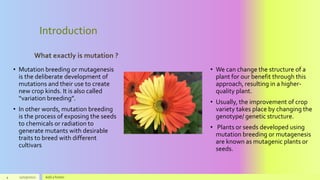
• Mutation breeding or mutagenesis
is the deliberate development of
mutations and their use to create
new crop kinds. It is also called
“variation breeding”.
• In other words, mutation breeding
is the process of exposing the seeds
to chemicals or radiation to
generate mutants with desirable
traits to breed with different
cultivars
• We can change the structure of a
plant for our benefit through this
approach, resulting in a higher-
quality plant.
• Usually, the improvement of crop
variety takes place by changing the
genotype/ genetic structure.
• Plants or seeds developed using
mutation breeding or mutagenesis
are known as mutagenic plants or
seeds.
4 11/25/2022 Add a footer
History
When and how it began?
• Mutation breeding dates back to 300BC. The ancient Chinese book “lulan”
provides the first documentation of mutant selection in plant breeding.
• In the year 1590, the first verifiable plant mutant was described. It was a
mutant of greater celandine( Chelidonium majus).
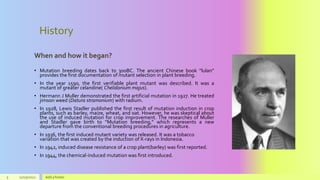
• Hermann J Muller demonstrated the first artificial mutation in 1927. He treated
jimson weed (Datura stramonium) with radium.
• In 1928, Lewis Stadler published the first result of mutation induction in crop
plants, such as barley, maize, wheat, and oat. However, he was skeptical about
the use of induced mutation for crop improvement. The researches of Muller
and Stadler gave birth to “Mutation breeding,” which represents a new
departure from the conventional breeding procedures in agriculture.
• In 1936, the first induced mutant variety was released. It was a tobacco
variation that was created by the induction of X-rays in Indonesia.
• In 1942, induced disease resistance of a crop plant(barley) was first reported.
• In 1944, the chemical-induced mutation was first introduced.
5 11/25/2022 Add a footer
History
When and how it began?
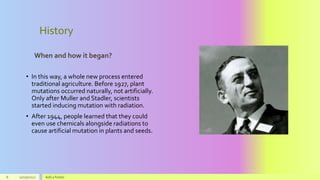
• In this way, a whole new process entered
traditional agriculture. Before 1927, plant
mutations occurred naturally, not artificially.
Only after Muller and Stadler, scientists
started inducing mutation with radiation.
• After 1944, people learned that they could
even use chemicals alongside radiations to
cause artificial mutation in plants and seeds.
6 11/25/2022 Add a footer
Types of Mutation Breeding
1. Spontaneous Mutation
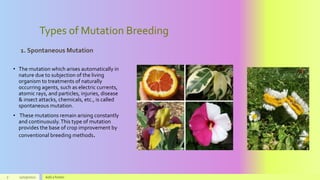
• The mutation which arises automatically in
nature due to subjection of the living
organism to treatments of naturally
occurring agents, such as electric currents,
atomic rays, and particles, injuries, disease
& insect attacks, chemicals, etc., is called
spontaneous mutation.
• These mutations remain arising constantly
and continuously.This type of mutation
provides the base of crop improvement by
conventional breeding methods.
7 11/25/2022 Add a footer
Types of Mutation Breeding
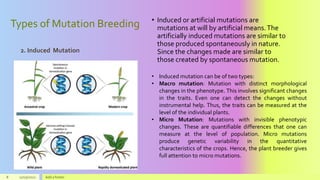
2. Induced Mutation
• Induced or artificial mutations are
mutations at will by artificial means.The
artificially induced mutations are similar to
those produced spontaneously in nature.
Since the changes made are similar to
those created by spontaneous mutation.
8 11/25/2022 Add a footer
• Induced mutation can be of two types:
• Macro mutation: Mutation with distinct morphological
changes in the phenotype. This involves significant changes
in the traits. Even one can detect the changes without
instrumental help. Thus, the traits can be measured at the
level of the individual plants.
• Micro Mutation: Mutations with invisible phenotypic
changes. These are quantifiable differences that one can
measure at the level of population. Micro mutations
produce genetic variability in the quantitative
characteristics of the crops. Hence, the plant breeder gives
full attention to micro mutations.
Techniques for artificially inducing mutagens
Physical mutagens
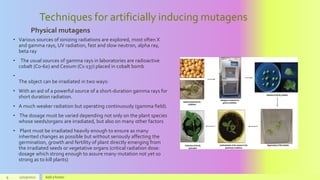
• Various sources of ionizing radiations are explored, most often X
and gamma rays, UV radiation, fast and slow neutron, alpha ray,
beta ray
• The usual sources of gamma rays in laboratories are radioactive
cobalt (Co-60) and Cesium (Cs-137) placed in cobalt bomb
•
The object can be irradiated in two ways:
• With an aid of a powerful source of a short-duration gamma rays for
short duration radiation.
• A much weaker radiation but operating continuously (gamma field).
• The dosage must be varied depending not only on the plant species
whose seeds/organs are irradiated, but also on many other factors
• Plant must be irradiated heavily enough to ensure as many
inherited changes as possible but without seriously affecting the
germination, growth and fertility of plant directly emerging from
the irradiated seeds or vegetative organs (critical radiation dose:
dosage which strong enough to assure many mutation not yet so
strong as to kill plants)
9 11/25/2022 Add a footer
Techniques for artificially inducing mutagens
Chemical mutagens
• Mutagenic substances belonging to different classes of chemical compounds, such
as ethylene imine, diethyl sulfate, dimethyl sulfate, N-nitrosoethyl urea, N-
nitrosomethyl urea, methal sulfonate, diepoxy butane, ethyleneoxide
• Most are highly toxic, usually result in point mutations
• Use in solution in the concentration ranging from tenth – hundredths even
thousandths of percent
• Many chemical mutagens are much more effective than physical one. If irradiation
of crops produces 10 – 15% of viable inherited changes, chemical mutants do the
same at a rate of 30 to 60%
• They often exert more specific and finely tuned action on the cell
• Chemical mutagens
• Some substances (supermutagen) are capable of causing inherited changes in
plants at a rate up 100%
• Chemical mutagens aim at the most vulnerable spot of a living organism (DNA) to
induce changes in nucleotides and alter the genetic information (Sometimes
causes specific mutation)
• It provides a powerful tool to induce desire changes in a trait
10 11/25/2022 Add a footer
Use of mutations in reproduction of crops
• Use of mutations in sexually reproduced crops
• More valuable in self than cross pollinated. The probability of producing
desirable mutations and genetic variability is theoretically higher
• Use of mutations in asexually produced crops
• It has been much easier and quicker to obtain variant plant types
• Specific location of the mutation event (segmental chimera) becomes
important.
• The mutant must be in meristematic tissue that will produce faithfully
through cutting or other vegetative means
• Bud •Tuber • bulbs
11 11/25/2022 Add a footer
Mutation detection
• Detection, isolation and testing mutants are extremely difficult
• Due to the sporadic nature of viable useful mutations, it is advisable to have larger
plant population
• When mutagens are used in breeding, the biological nature of the trait (dominance or
recession of the mutation) and crops must be taken into account
12 11/25/2022 Add a footer
Trend in plant breeding based on mutation.
• Mutagens are used to induce mutations within a broad range and at a high frequency to obtain ample source
of material for selection
• Mutant with a specific changes in certain characters are created in order to correct some defects in crop
varieties. It is important that the other economic characters remain unaltered
• Mutagens can be used to solve special problems in plant breeding for instance by increasing the number of
genetic recombination's and breaks of undesirable linkages, transferring chromosomal fragment from one
plant species into chromosomes of another during hybridization, obtaining homozygous mutant through
irradiation of haploids with subsequent doubling of chromosome number
• Mutation useful for crop improvement
• Useful mutation Any mutational change in a character which can be put to practical use
• Improve nutrition value of crop product • Short stem • High lodging resistance • Disease resistance
13 11/25/2022 Add a footer
Success of mutation breeding.
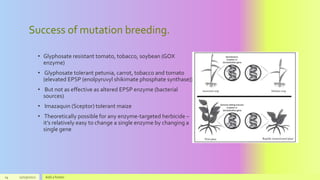
• Glyphosate resistant tomato, tobacco, soybean (GOX
enzyme)
• Glyphosate tolerant petunia, carrot, tobacco and tomato
(elevated EPSP (enolpyruvyl shikimate phosphate synthase))
• But not as effective as altered EPSP enzyme (bacterial
sources)
• Imazaquin (Sceptor) tolerant maize
• Theoretically possible for any enzyme-targeted herbicide –
it’s relatively easy to change a single enzyme by changing a
single gene
14 11/25/2022 Add a footer
Advantages
• Mutation breeding can be used for both oligogenic and polygenic
traits in plants.
• It improves the morphological and physiological characters of
collected crops.
• Mutation breeding can improve the disease resistance of crop
plants.
• Induced mutations can induce desirable mutant alleles in crop
plants.
• Mutation breeding can be used to improve the specific characters
of the well-adapted high-yielding variety.
• Quantitative characteristics of crop plants including yield can be
improved by induced mutations.
• The F1 hybrids obtained from inter varietal cross are treated with
mutagens to increase variability.
• Mutation breeding can effectively disseminate an undesirable
character from a crop variety.
• Mutation breeding is the simplest, quickest, and best way when a
new character is to be induced.
• The frequency of desirable mutation will be very low. (0.1% of
total mutations)
• The breeder has to screen a large population to select a desirable
mutation.
• Desirable mutations are commonly associated with undesirable
side effects.
• Mutation in quantitative traits is usually in a direction away from
the selection history of the parent variety.
• There may be problems in the registration of mutant varieties in
many parts.
• Mutation breeding, in absence of full information about the
genotype of material, proper mutagen, and its efficiency,
frequency of different kinds of mutations, and other relative
phenomena and factors, is not a good device for crop
improvement.
• Mutation breeding work is confined to a few institutions where
irradiation facilities and trained personnel are available.
Government too can afford to grant such facilities only to a few
institutions.
• There are health risks in handling chemical mutagens, radiations,
fast neutron treatments.
15 11/25/2022 Add a footer
Disadvantages
Sources
• Wikipedia
• ResearchGate
• Planet net
• Slide serve
• Pinterest
• Current protocols
• Chegg.com
16 11/25/2022 Add a footer
THANKYOU
17 11/25/2022 Add a footer

Mutation breeding.pptx

  • 1.
  • 2.
    Content • Introduction • History •Types of mutation breeding • Techniques for inducing mutagens • Use of mutation in reproduction of crops • Mutation detection • Trend in plant breeding based on mutation • Success of mutation breeding • Advantages and Disadvantages 2 11/25/2022 Add a footer
  • 3.
  • 4.
    Introduction What exactly ismutation ? • Mutation breeding or mutagenesis is the deliberate development of mutations and their use to create new crop kinds. It is also called “variation breeding”. • In other words, mutation breeding is the process of exposing the seeds to chemicals or radiation to generate mutants with desirable traits to breed with different cultivars • We can change the structure of a plant for our benefit through this approach, resulting in a higher- quality plant. • Usually, the improvement of crop variety takes place by changing the genotype/ genetic structure. • Plants or seeds developed using mutation breeding or mutagenesis are known as mutagenic plants or seeds. 4 11/25/2022 Add a footer
  • 5.
    History When and howit began? • Mutation breeding dates back to 300BC. The ancient Chinese book “lulan” provides the first documentation of mutant selection in plant breeding. • In the year 1590, the first verifiable plant mutant was described. It was a mutant of greater celandine( Chelidonium majus). • Hermann J Muller demonstrated the first artificial mutation in 1927. He treated jimson weed (Datura stramonium) with radium. • In 1928, Lewis Stadler published the first result of mutation induction in crop plants, such as barley, maize, wheat, and oat. However, he was skeptical about the use of induced mutation for crop improvement. The researches of Muller and Stadler gave birth to “Mutation breeding,” which represents a new departure from the conventional breeding procedures in agriculture. • In 1936, the first induced mutant variety was released. It was a tobacco variation that was created by the induction of X-rays in Indonesia. • In 1942, induced disease resistance of a crop plant(barley) was first reported. • In 1944, the chemical-induced mutation was first introduced. 5 11/25/2022 Add a footer
  • 6.
    History When and howit began? • In this way, a whole new process entered traditional agriculture. Before 1927, plant mutations occurred naturally, not artificially. Only after Muller and Stadler, scientists started inducing mutation with radiation. • After 1944, people learned that they could even use chemicals alongside radiations to cause artificial mutation in plants and seeds. 6 11/25/2022 Add a footer
  • 7.
    Types of MutationBreeding 1. Spontaneous Mutation • The mutation which arises automatically in nature due to subjection of the living organism to treatments of naturally occurring agents, such as electric currents, atomic rays, and particles, injuries, disease & insect attacks, chemicals, etc., is called spontaneous mutation. • These mutations remain arising constantly and continuously.This type of mutation provides the base of crop improvement by conventional breeding methods. 7 11/25/2022 Add a footer
  • 8.
    Types of MutationBreeding 2. Induced Mutation • Induced or artificial mutations are mutations at will by artificial means.The artificially induced mutations are similar to those produced spontaneously in nature. Since the changes made are similar to those created by spontaneous mutation. 8 11/25/2022 Add a footer • Induced mutation can be of two types: • Macro mutation: Mutation with distinct morphological changes in the phenotype. This involves significant changes in the traits. Even one can detect the changes without instrumental help. Thus, the traits can be measured at the level of the individual plants. • Micro Mutation: Mutations with invisible phenotypic changes. These are quantifiable differences that one can measure at the level of population. Micro mutations produce genetic variability in the quantitative characteristics of the crops. Hence, the plant breeder gives full attention to micro mutations.
  • 9.
    Techniques for artificiallyinducing mutagens Physical mutagens • Various sources of ionizing radiations are explored, most often X and gamma rays, UV radiation, fast and slow neutron, alpha ray, beta ray • The usual sources of gamma rays in laboratories are radioactive cobalt (Co-60) and Cesium (Cs-137) placed in cobalt bomb • The object can be irradiated in two ways: • With an aid of a powerful source of a short-duration gamma rays for short duration radiation. • A much weaker radiation but operating continuously (gamma field). • The dosage must be varied depending not only on the plant species whose seeds/organs are irradiated, but also on many other factors • Plant must be irradiated heavily enough to ensure as many inherited changes as possible but without seriously affecting the germination, growth and fertility of plant directly emerging from the irradiated seeds or vegetative organs (critical radiation dose: dosage which strong enough to assure many mutation not yet so strong as to kill plants) 9 11/25/2022 Add a footer
  • 10.
    Techniques for artificiallyinducing mutagens Chemical mutagens • Mutagenic substances belonging to different classes of chemical compounds, such as ethylene imine, diethyl sulfate, dimethyl sulfate, N-nitrosoethyl urea, N- nitrosomethyl urea, methal sulfonate, diepoxy butane, ethyleneoxide • Most are highly toxic, usually result in point mutations • Use in solution in the concentration ranging from tenth – hundredths even thousandths of percent • Many chemical mutagens are much more effective than physical one. If irradiation of crops produces 10 – 15% of viable inherited changes, chemical mutants do the same at a rate of 30 to 60% • They often exert more specific and finely tuned action on the cell • Chemical mutagens • Some substances (supermutagen) are capable of causing inherited changes in plants at a rate up 100% • Chemical mutagens aim at the most vulnerable spot of a living organism (DNA) to induce changes in nucleotides and alter the genetic information (Sometimes causes specific mutation) • It provides a powerful tool to induce desire changes in a trait 10 11/25/2022 Add a footer
  • 11.
    Use of mutationsin reproduction of crops • Use of mutations in sexually reproduced crops • More valuable in self than cross pollinated. The probability of producing desirable mutations and genetic variability is theoretically higher • Use of mutations in asexually produced crops • It has been much easier and quicker to obtain variant plant types • Specific location of the mutation event (segmental chimera) becomes important. • The mutant must be in meristematic tissue that will produce faithfully through cutting or other vegetative means • Bud •Tuber • bulbs 11 11/25/2022 Add a footer
  • 12.
    Mutation detection • Detection,isolation and testing mutants are extremely difficult • Due to the sporadic nature of viable useful mutations, it is advisable to have larger plant population • When mutagens are used in breeding, the biological nature of the trait (dominance or recession of the mutation) and crops must be taken into account 12 11/25/2022 Add a footer
  • 13.
    Trend in plantbreeding based on mutation. • Mutagens are used to induce mutations within a broad range and at a high frequency to obtain ample source of material for selection • Mutant with a specific changes in certain characters are created in order to correct some defects in crop varieties. It is important that the other economic characters remain unaltered • Mutagens can be used to solve special problems in plant breeding for instance by increasing the number of genetic recombination's and breaks of undesirable linkages, transferring chromosomal fragment from one plant species into chromosomes of another during hybridization, obtaining homozygous mutant through irradiation of haploids with subsequent doubling of chromosome number • Mutation useful for crop improvement • Useful mutation Any mutational change in a character which can be put to practical use • Improve nutrition value of crop product • Short stem • High lodging resistance • Disease resistance 13 11/25/2022 Add a footer
  • 14.
    Success of mutationbreeding. • Glyphosate resistant tomato, tobacco, soybean (GOX enzyme) • Glyphosate tolerant petunia, carrot, tobacco and tomato (elevated EPSP (enolpyruvyl shikimate phosphate synthase)) • But not as effective as altered EPSP enzyme (bacterial sources) • Imazaquin (Sceptor) tolerant maize • Theoretically possible for any enzyme-targeted herbicide – it’s relatively easy to change a single enzyme by changing a single gene 14 11/25/2022 Add a footer
  • 15.
    Advantages • Mutation breedingcan be used for both oligogenic and polygenic traits in plants. • It improves the morphological and physiological characters of collected crops. • Mutation breeding can improve the disease resistance of crop plants. • Induced mutations can induce desirable mutant alleles in crop plants. • Mutation breeding can be used to improve the specific characters of the well-adapted high-yielding variety. • Quantitative characteristics of crop plants including yield can be improved by induced mutations. • The F1 hybrids obtained from inter varietal cross are treated with mutagens to increase variability. • Mutation breeding can effectively disseminate an undesirable character from a crop variety. • Mutation breeding is the simplest, quickest, and best way when a new character is to be induced. • The frequency of desirable mutation will be very low. (0.1% of total mutations) • The breeder has to screen a large population to select a desirable mutation. • Desirable mutations are commonly associated with undesirable side effects. • Mutation in quantitative traits is usually in a direction away from the selection history of the parent variety. • There may be problems in the registration of mutant varieties in many parts. • Mutation breeding, in absence of full information about the genotype of material, proper mutagen, and its efficiency, frequency of different kinds of mutations, and other relative phenomena and factors, is not a good device for crop improvement. • Mutation breeding work is confined to a few institutions where irradiation facilities and trained personnel are available. Government too can afford to grant such facilities only to a few institutions. • There are health risks in handling chemical mutagens, radiations, fast neutron treatments. 15 11/25/2022 Add a footer Disadvantages
  • 16.
    Sources • Wikipedia • ResearchGate •Planet net • Slide serve • Pinterest • Current protocols • Chegg.com 16 11/25/2022 Add a footer
  • 17.