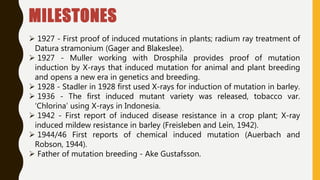
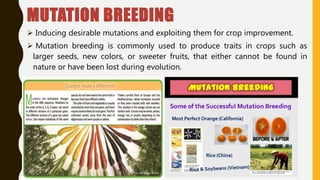
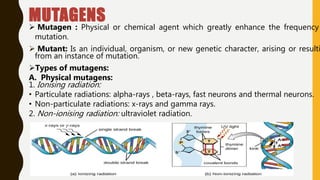
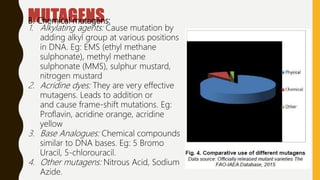
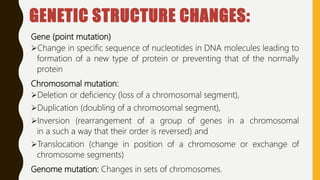
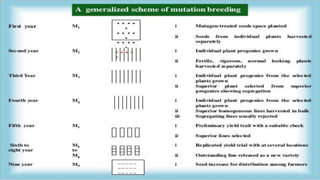
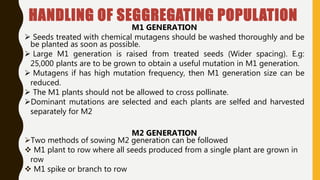
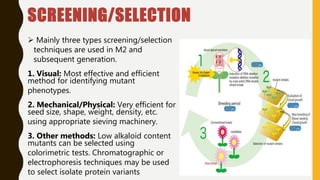
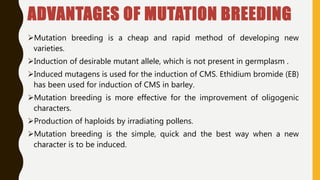
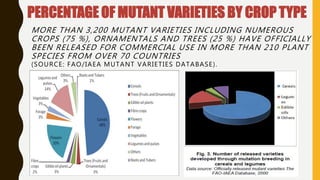
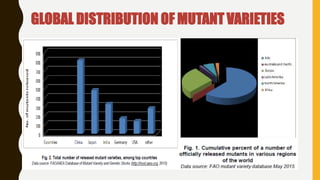
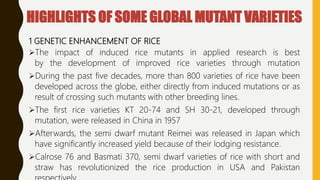
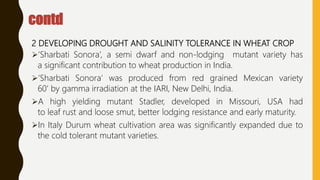
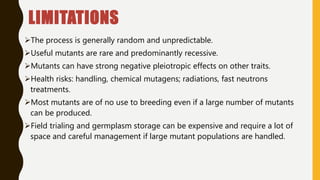
Mutation breeding is a tool for crop improvement that induces mutations using physical or chemical mutagens. Over 3,200 mutant varieties have been released globally in over 70 plant species. Key milestones included the first induced mutations in plants in 1927 and development of the first induced mutant variety in 1936. Procedures involve choosing plant material, applying mutagens like radiation or chemicals, handling mutated plants, and screening generations to select desirable traits. Successful examples include developing semi-dwarf, disease resistant, early maturing, and stress tolerant rice, wheat, barley, peanut, and chickpea varieties. Mutation breeding has made major contributions to global food production.



![contd
3 Enhancing lodging resistance in Barley crop
Mutation breeding has been very successfully used in breeding barley, the
introduction of ‘Diamant’ and ‘Golden Promise’ a gamma-ray induced semi-
dwarf mutant revolutionized brewing industry in Europe.
‘Luther’, gamma ray induced mutant had 20% increased yield, higher
and lodging resistance and ‘Pennrad’, had winter hardiness, better lodging
resistance and early ripening [46].
4 Developing early maturing varieties of Peanut
5 High yielding and wilt disease resistant chickpea mutants
6 Improvement in Ornamental plants
7 Major economic successes in USA (rice, barley, sunflower, grape fruit),
Pakistan (cotton), India (blackgram), Australia & Canada (linseed), Japan](https://image.slidesharecdn.com/mutationbreeding-180225035516/85/Mutation-breeding-in-Plants-19-320.jpg)



![Polymer [ बहुलक ] Chemistry Notes PDF - Irfanullah Mehar - JJ Sir Chemistry.pdf](https://cdn.slidesharecdn.com/ss_thumbnails/polymerchemistrynotespdf-irfanullahmehar-jjsirchemistry-260210172118-3f9b37f7-thumbnail.jpg?width=640&height=640&fit=bounds)


