HYBRIDOMA TECHNOLOGY
Sijo.A
B.sc. Botany & Biotechnology
Mar ivanios College
Tvm,Kerala
HYBRIDOMA TECHNOLOGY
• Hybridoma technology is a method for producing
large number of identical antibodies called
monoclonal antibodies.
• It was discovered by G.kohler and C.milstein in
1975. they were awarded nobel prize for physiology
and medicine in 1975.
• The hybrid cells are produced by fusing B-
lumphocyte with myeloma cells or tumour cells.
• The B-lymphocyte have the ability to produce large
number of antibodies and tumour cells have
indefinite growth.
• This is why two cells are used for the production of
hybrid cell.
Procedure
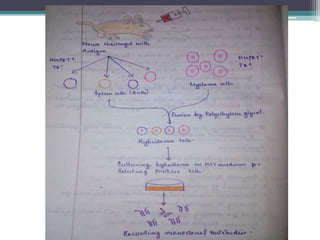
1. The mouse is immunised by specific antigen
injection against which monoclonal antibodies
have to be produced.
2. After 72 hrs of immunisation spleen is
collected from mouse.(antibody prodcing B
cells).
3. The B cells are fused with immortalised
myeloma cells by polyethylene glycol or
sendai virus.
4. The B cells are fused with immortalised
myeloma cells.
5. The fused cells are incubated in the HAT
medium.
HAT medium
• The hybridoma cells or fused cells are selected
using selective media are called HAT medium.
• It contains Hypoxanthine, Aminopterin &
Thymidine.
• The unfused B cells will die due to their short life
span.
• The myeloma cells can synthesise DNA
nucleotides using two pathway : Denovo pathway
and Salvage pathway.
• In HAT medium, the myeloma cells are unable to
replicate because the denovo pathway is blocked by
Aminopterin in the medium.
• When denovo pathway is blocked, the cell will
utilise salvage as an alternative pathway. But it
cannot takesplace due to the lack of HGPRT
(Hypoxanthine-guanine phosphoribosyl
transferase).
• so it is contributed by B cell and is rich in
HGPRT+.
• The salvage pathway is also inhibited due to the
mutation of Thymidine kinase(TK), an enzyme that
catalyses the phosphorylation reaction.
• The resulting clones of hybridoma cells secrets
large quantities of monoclonal antibodies.
Applications
• It is used for the early detection of pregnancy.
• Detection and treatment of cancer.
• Diagnosis of leprosy.
• Treatment of autoimmune diseases.
• Radiolabelled monoclonal antibodies are used in
vivo for detecting or locating tumour antigen.
• Used for making immunotoxins that inhibit
protein synthesis.
• Eg: ricin, shigella toxin & diphteria toxin.

Hybridoma technology

  • 1.
    HYBRIDOMA TECHNOLOGY Sijo.A B.sc. Botany& Biotechnology Mar ivanios College Tvm,Kerala
  • 2.
    HYBRIDOMA TECHNOLOGY • Hybridomatechnology is a method for producing large number of identical antibodies called monoclonal antibodies. • It was discovered by G.kohler and C.milstein in 1975. they were awarded nobel prize for physiology and medicine in 1975. • The hybrid cells are produced by fusing B- lumphocyte with myeloma cells or tumour cells. • The B-lymphocyte have the ability to produce large number of antibodies and tumour cells have indefinite growth. • This is why two cells are used for the production of hybrid cell.
  • 3.
    Procedure 1. The mouseis immunised by specific antigen injection against which monoclonal antibodies have to be produced. 2. After 72 hrs of immunisation spleen is collected from mouse.(antibody prodcing B cells). 3. The B cells are fused with immortalised myeloma cells by polyethylene glycol or sendai virus. 4. The B cells are fused with immortalised myeloma cells. 5. The fused cells are incubated in the HAT medium.
  • 4.
    HAT medium • Thehybridoma cells or fused cells are selected using selective media are called HAT medium. • It contains Hypoxanthine, Aminopterin & Thymidine. • The unfused B cells will die due to their short life span. • The myeloma cells can synthesise DNA nucleotides using two pathway : Denovo pathway and Salvage pathway.
  • 5.
    • In HATmedium, the myeloma cells are unable to replicate because the denovo pathway is blocked by Aminopterin in the medium. • When denovo pathway is blocked, the cell will utilise salvage as an alternative pathway. But it cannot takesplace due to the lack of HGPRT (Hypoxanthine-guanine phosphoribosyl transferase). • so it is contributed by B cell and is rich in HGPRT+. • The salvage pathway is also inhibited due to the mutation of Thymidine kinase(TK), an enzyme that catalyses the phosphorylation reaction. • The resulting clones of hybridoma cells secrets large quantities of monoclonal antibodies.
  • 7.
    Applications • It isused for the early detection of pregnancy. • Detection and treatment of cancer. • Diagnosis of leprosy. • Treatment of autoimmune diseases. • Radiolabelled monoclonal antibodies are used in vivo for detecting or locating tumour antigen. • Used for making immunotoxins that inhibit protein synthesis. • Eg: ricin, shigella toxin & diphteria toxin.