MUTATIONS,NATURAL SELECTION
AND SPECIATIONSUBMITTED TO – EKTA GULERIA
SUBMITTED BY – SHABNAM (CUHP18ZOO22)
MUTATIONS
 Sudden, stable, inheritable, discontinuous variations which lead to change in the
genetic material or character of an organism is known as MUTATIONS or SPORTS or
SALTATIONS.
 Individuals showing these changes are known as mutants.
 An individual showing an altered phenotype due to mutation are known as variant.
 Factor or agents causing mutation are known as mutagens.
 Mutations which causes changes in base sequence of a gene are known as
gene mutations or point mutations.
 In gene mutations, the DNA code will have a base (or more) missing, added, or
exchanged in a codon.
HISTORY
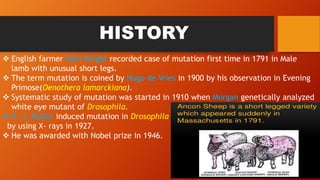
 English farmer Seth Wright recorded case of mutation first time in 1791 in Male
lamb with unusual short legs.
 The term mutation is coined by Hugo de Vries in 1900 by his observation in Evening
Primose(Oenothera lamarckiana).
 Systematic study of mutation was started in 1910 when Morgan genetically analyzed
white eye mutant of Drosophila.
 H. J. Muller induced mutation in Drosophila
by using X- rays in 1927.
 He was awarded with Nobel prize in 1946.
Characteristics of Mutation
Generally mutant alleles are recessive to their wild type or normal alleles.
• Most mutations have harmful effect, but some mutations are beneficial
• Spontaneous mutations occurs at very low rate.
• Some genes shows high rate of mutation such genes are called as mutable gene.
• Highly mutable sites within a gene are known as hot spots.
• Mutation can occur in any tissue/cell (somatic or germinal) of an organism.
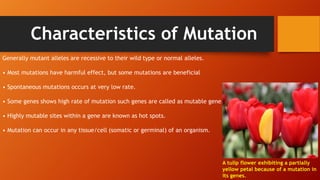
A tulip flower exhibiting a partially
yellow petal because of a mutation in
its genes.
Classification of mutation
Based on the survival of an individual
1. Lethal mutation – when mutation causes death of all individuals undergoing mutation are known as lethal.
2. Sub-lethal mutation - causes death of 90% individuals.
3. Sub-vital mutation– such mutation kills less than 90% individuals.
4. Vital mutation -when mutation doesn’t affect the survival of an individual are known as vital.
5. Supervital mutation – This kind of mutation enhances the survival of individual.
Based on causes of mutation
1. Spontaneous mutation-
Spontaneous mutation occurs naturally without any cause. The rate of spontaneous mutation is very
slow. eg- Methylation followed by deamination of cytosine.
Rate of spontaneous mutation is higher in eukaryotes than prokaryotes.
Eg. UV light of sunlight causing mutation in bacteria
2. Induced Mutation-
Mutations produced due to treatment with either a chemical or physical
agent are called induced mutation .
The agents capable of inducing such mutations are known as mutagen.
use of induced mutation for crop improvement program is known as mutation breeding.
Eg. X- rays causing mutation in cereals
Based on tissue of origin
1. Somatic mutation-
A mutation occurring in somatic cell is called somatic mutation.
In asexually reproducing species somatic mutations transmits from one progeny to the next progeny.
2. Germinal Mutation-
When mutation occur in gametic cells or reproductive cells are known as germinal mutation.
In sexually reproductive species only germinal mutation are transmitted to the next generation.
 Based on direction of mutation
1. Forward mutation- When mutation occurs from the normal/wild type allele to mutant allele
are known as forward mutation.
2. Reverse mutation- When mutation occurs in reverse direction that is, from mutant allele to
the normal/wild type allele are known as reverse mutation.
 Type of trait affected
1. Visible mutation- Those mutation which affects on phenotypic character and can be detected by
normal observation are known as visible mutation.
2. Biochemical mutation- mutation which affect the production of biochemicals and which does
not not show any phenotypic character are known as biochemical mutation.
Causes of mutations
•Natural Cause
• DNA fails to copy accurately –when a cell divides, it makes a copy of its DNA and sometimes
the copy is not quite perfect.
•External Influences/Mutagens
In genetics, a mutagen is a physical or chemical agent that changes the genetic material,
usually DNA, of an organism and thus increases the frequency of mutations above the natural
background level. Mutagens effects-
It can affect the transcription and replication of the DNA,
Produces mutations that can result in aberrant, impaired or loss of function for a particular
gene,
Accumulation of mutations may lead to cancer,
Can lead to cell death.
Physical and chemical mutagens
• Ionizing radiations such as X-rays, gamma rays and alpha particles-may cause DNA breakage
and other damages. The most common sources include cobalt-60 and cesium-137.
• Radioactive decay
• Ultraviolet radiations with wavelength above 260 nm– are absorbed strongly by bases,
producing pyrimidine dimers, which can cause error in replication if left uncorrected.
• DNA reactive chemicals– A large number of chemicals may interact directly with DNA.
However, many are not necessarily mutagenic by themselves, but through metabolic processes
in cells they produce mutagenic compounds.
• Reactive oxygen species (ROS)– These ROS may result in the production of many base
adducts, as well as DNA strand breaks and crosslinks.
• Deaminating agents – for example nitrous acid which can cause transition mutations by
converting cytosine to uracil.
• Aromatic amines and amides – have been associated with carcinogenesis, may cause cancer
of the bladder, liver, ear, intestine, thyroid and breast
Biological Agents
• Virus– Virus DNA may be inserted into the genome and disrupts genetic function. Infectious
agents have been suggested to cause cancer.
• Bacteria– some bacteria such as Helicobacter pylori cause inflammation during which
oxidative species are produced, causing DNA damage and reducing efficiency of DNA repair
systems, thereby increasing mutation.
 PROTECTION AGAINST MUTATIONS-
Fruits and vegetables that are rich in antioxidants– Antioxidants are an important group of
anticarcinogenic compounds that may help remove ROS or potentially harmful chemicals.
An effective precautionary measure an individual can undertake to protect themselves is
by limiting exposure to mutagens such as UV radiations and tobacco smoke.
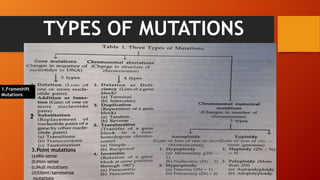
TYPES OF MUTATIONS
3.Point mutations
(a)Mis-sense
(b)Non-sense
(c)Null mutations
(d)Silent/samesense
mutations
1.Frameshift
Mutations
2.
A. GENE MUTATIONS
These are invisible changes in a chemical nature(DNA) of a gene and involve the change in one
or more nucleotide pairs of a gene.
Most of the gene mutations involve a change in only a single nucleotide or nitrogenous base of
of the cistron or DNA segment representing a single gene. Therefore, gene mutations are also
called POINT MUTATIONS.
Each human gene has the mutation chances of 10-6 per locus. Mutations are generally rare and
harmful. Many times a gene mutation does not produce any detectable phenotypic effect as
most of the gene mutations are recessive and remain masked by dominant and normal alleles.
But the dominant gene mutations in homozygous condition may produce a different kind of
polypeptide chain so producing the phenotypic change.
The gene mutations are of three types:-
1.Frame-shift Mutations
2.Substitutions(Replacement)
3.Point mutations
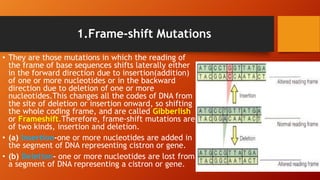
1.Frame-shift Mutations
• They are those mutations in which the reading of
the frame of base sequences shifts laterally either
in the forward direction due to insertion(addition)
of one or more nucleotides or in the backward
direction due to deletion of one or more
nucleotides.This changes all the codes of DNA from
the site of deletion or insertion onward, so shifting
the whole coding frame, and are called Gibberlish
or Frameshift.Therefore, frame-shift mutations are
of two kinds, insertion and deletion.
• (a) Insertion-one or more nucleotides are added in
the segment of DNA representing cistron or gene.
• (b) Deletion- one or more nucleotides are lost from
a segment of DNA representing a cistron or gene.
2.Substitutions
• In a substitution, a nitrogenous base is changed with another. E.g. in SICKLE-CELL ANAEMIA,
glutamic acid of Beta-chain of Hb-A is replaced by valine amino acid to form defective Hb-S
DUE to substitution of T=A pair of gene by A=T pair.
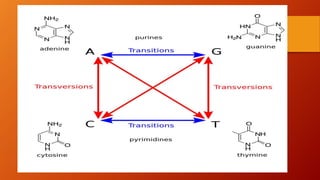
• (1) In Transition, a purine(adenine or guanine) or a pyrimidine (cytosine or thymine or
uracil)in triplet code of DNA or mRNA is replaced by its type i.e. a purine replaces purine and
pyrimidine replaces pyrimidine.
• (2) Transversions are substitution gene mutations in which a purine ( A OR G) is replaced by
pyrimidine (T or C) or vice-versa.
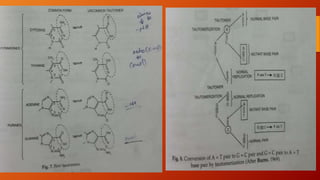
• (3) Tautomerism- The changed pairing qualities of the bases (pairing of purine with purine
and pyrimidine with pyrimidine) are due to phenomenon called tautomerism.
• TAUTOMERS are the alternate form of bases and are produced by rearrangements of electrons and
protons in the molecules. Due to tautomerisation the amino (-NH2) group of cytosine and adenine is
converted into (-NH) group and likewise keto (C=O) of thymine and guanine is converted to enol
group(-OH). Tautomeric thymine pairs with normal guanine and cytosine with adenine. Such pairs of
nitrogen bases are known as forbidden base pairs or unusual base pairs.
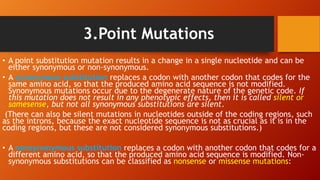
3.Point Mutations
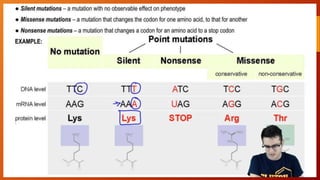
• A point substitution mutation results in a change in a single nucleotide and can be
either synonymous or non-synonymous.
• A synonymous substitution replaces a codon with another codon that codes for the
same amino acid, so that the produced amino acid sequence is not modified.
Synonymous mutations occur due to the degenerate nature of the genetic code. If
this mutation does not result in any phenotypic effects, then it is called silent or
samesense, but not all synonymous substitutions are silent.
(There can also be silent mutations in nucleotides outside of the coding regions, such
as the introns, because the exact nucleotide sequence is not as crucial as it is in the
coding regions, but these are not considered synonymous substitutions.)
• A nonsynonymous substitution replaces a codon with another codon that codes for a
different amino acid, so that the produced amino acid sequence is modified. Non-
synonymous substitutions can be classified as nonsense or missense mutations:
1. A missense mutation changes a nucleotide to cause substitution of a different amino
acid. This in turn can render the resulting protein nonfunctional. Such mutations are
responsible for diseases such as Epidermolysis bullosa, sickle-cell disease, and SOD1-
mediated ALS.
On the other hand, if a missense mutation occurs in an amino acid codon that results
in the use of a different, but chemically similar, amino acid, then sometimes little or
no change is rendered in the protein. For example, a change from AAA to AGA will
encode arginine, a chemically similar molecule to the intended lysine. In this latter
case the mutation will have little or no effect on phenotype and therefore be neutral.
2. A nonsense mutation is a point mutation in a sequence of DNA that results in a
premature stop codon, or a nonsense codon in the transcribed mRNA, and possibly a
truncated, and often nonfunctional protein product. This sort of mutation has been
linked to different mutations, such as congenital adrenal hyperplasia.
NULL MUTATION- A Mutation that eliminates gene function because of deletion is
called Null mutation. NULL mutation is lethal if the gene has a vital function.
B. Chromosomal Mutations
Structural changes in chromosomes or chromosome aberrations or chromosomal
mutations occur in number and sequence of genes in the chromosomes without
altering their ploidy. Chormosomal mutations leads to change of morphology and
architecture of chromosome.
Five types of chromosomal mutations exists:
–Deletion
–Inversion
–Translocation
–Nondisjunction
–Duplication
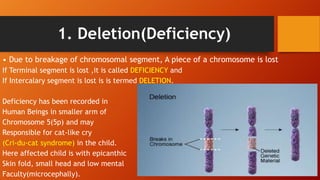
1. Deletion(Deficiency)
• Due to breakage of chromosomal segment, A piece of a chromosome is lost
If Terminal segment is lost ,it is called DEFICIENCY and
If Intercalary segment is lost is is termed DELETION.
Deficiency has been recorded in
Human Beings in smaller arm of
Chromosome 5(5p) and may
Responsible for cat-like cry
(Cri-du-cat syndrome) in the child.
Here affected child is with epicanthic
Skin fold, small head and low mental
Faculty(microcephally).
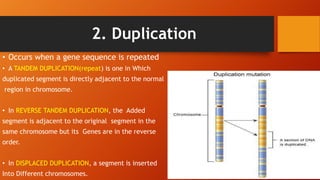
2. Duplication
• Occurs when a gene sequence is repeated
• A TANDEM DUPLICATION(repeat) is one in Which
duplicated segment is directly adjacent to the normal
region in chromosome.
• In REVERSE TANDEM DUPLICATION, the Added
segment is adjacent to the original segment in the
same chromosome but its Genes are in the reverse
order.
• In DISPLACED DUPLICATION, a segment is inserted
Into Different chromosomes.
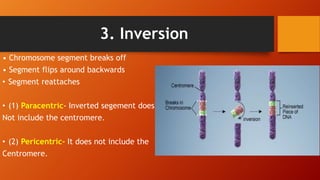
3. Inversion
• Chromosome segment breaks off
• Segment flips around backwards
• Segment reattaches
• (1) Paracentric- Inverted segement does
Not include the centromere.
• (2) Pericentric- It does not include the
Centromere.
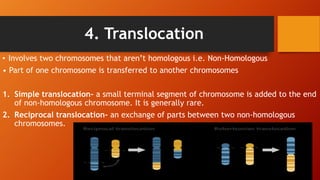
4. Translocation
• Involves two chromosomes that aren’t homologous i.e. Non-Homologous
• Part of one chromosome is transferred to another chromosomes
1. Simple translocation- a small terminal segment of chromosome is added to the end
of non-homologous chromosome. It is generally rare.
2. Reciprocal translocation- an exchange of parts between two non-homologous
chromosomes.
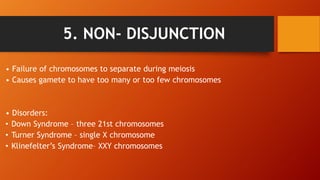
5. NON- DISJUNCTION
• Failure of chromosomes to separate during meiosis
• Causes gamete to have too many or too few chromosomes
• Disorders:
• Down Syndrome – three 21st chromosomes
• Turner Syndrome – single X chromosome
• Klinefelter’s Syndrome– XXY chromosomes
C. Chromosomal Numerical Mutations
• (1) Aneuploidy -the abnormal condition where one or more chromosomes of a
normal set of chromosomes are missing or present in more than their usual number
of copies.
• It is of two types- HYPOPLOIDY and HYPERPLOIDY
• HYPOPLOIDY- loss of one or more chromosomes
• HYPERPLOIDY- addition of one or more chromosomes
• MONOSOMY and NULLISOMY are examples of Hypoploidy.
• TRISOMY and TETRASOMY are examples of Hyperploidy.
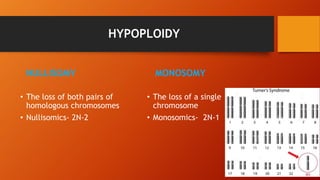
HYPOPLOIDY
NULLISOMY
• The loss of both pairs of
homologous chromosomes
• Nullisomics- 2N-2
MONOSOMY
• The loss of a single
chromosome
• Monosomics- 2N-1
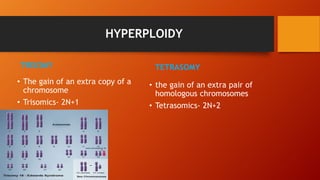
HYPERPLOIDY
TRISOMY
• The gain of an extra copy of a
chromosome
• Trisomics- 2N+1
TETRASOMY
• the gain of an extra pair of
homologous chromosomes
• Tetrasomics- 2N+2
(2) EUPLOIDY- It is a condition in which the chromosome is an exact
multiple of genome or basic haploid number.
It is of two types-
1. MONOPLOIDY or HAPLOIDY – Single basic set of chromosomes
2. POLYPLOIDY-Having more than two haploid sets of chromosomes.
Polyploids are of two types-
I. Autopolyploids- Those poyploids, which have the same basic set of
chromosomes multiplied. E.g. AA or AAA or AAAA e.g.
potato(48),coffee(44).
II. Allopolyploids-They develop due to hybridization between two sp.
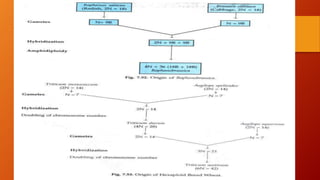
Followed by doubling of chromosomes. Allotetraploid(AABB) is the
common example.e.g. origin of BREAD WHEAT(AABBDD; 6N=42)
Harmful mutations
• If there is a mutation in a DNA repair gene within a germ cell, humans carrying such germline
mutations may have an increased risk of cancer. A list of 34 such germline mutations is given
in the article DNA repair-deficiency disorder.
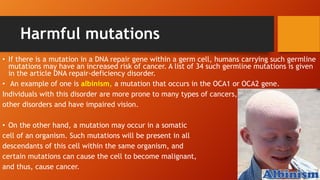
• An example of one is albinism, a mutation that occurs in the OCA1 or OCA2 gene.
Individuals with this disorder are more prone to many types of cancers,
other disorders and have impaired vision.
• On the other hand, a mutation may occur in a somatic
cell of an organism. Such mutations will be present in all
descendants of this cell within the same organism, and
certain mutations can cause the cell to become malignant,
and thus, cause cancer.
Beneficial mutations
• In these cases a mutation will tend to become more common in a population through
natural selection. Examples include the following:
HIV resistance: a specific 32 base pair deletion in human CCR5 (CCR5-Δ32) confers HIV resistance to
homozygotes and delays AIDS onset in heterozygotes. One possible explanation of the etiology of the relatively high
frequency of CCR5-Δ32 in the European population is that it conferred resistance to the bubonic plague in mid-14th
century Europe. People with this mutation were more likely to survive infection; thus its frequency in the
population increased. This theory could explain why this mutation is not found in Southern Africa, which remained
untouched by bubonic plague. A newer theory suggests that the selective pressure on the CCR5 Delta 32 mutation
was caused by smallpox instead of the bubonic plague.
Antibiotic resistance: Practically all bacteria develop antibiotic resistance when exposed to
antibiotics. In fact, bacterial populations already have such mutations that get selected under antibiotic selection.
Obviously, such mutations are only beneficial for the bacteria but not for those infected.
Malaria resistance: An example of a harmful mutation is sickle-cell disease, a blood disorder
in which the body produces an abnormal type of the oxygen-carrying substance hemoglobin in the red
blood cells. One-third of all indigenous inhabitants of Sub-Saharan Africa carry the allele, because, in
areas where malaria is common, there is a survival value in carrying only a single sickle-cell allele (sickle
cell trait).Those with only one of the two alleles of the sickle-cell disease are more resistant to malaria,
since the infestation of the malaria Plasmodium is halted by the sickling of the cells that it infests.
Lactase persistence is the continued activity of the lactase enzyme in adulthood. Since lactase's only
function is the digestion of lactose in milk, in most mammal species, the activity of the enzyme is dramatically
reduced after weaning. In some human populations, though, lactase persistence has recently evolved as an
adaptation to the consumption of non-human milk and dairy products beyond infancy. The majority of people
around the world remain lactase nonpersistent, and consequently are affected by varying degrees of lactose
intolerance as adults.
Lactase persistence: A mutation allowed humans to express the enzyme lactase after they
are naturally weaned from breast milk, allowing adults to digest lactose, which is probably one of the
most beneficial mutations in recent human evolution.
NATURAL SELECTION
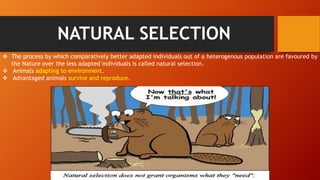
 The process by which comparatively better adapted individuals out of a heterogenous population are favoured by
the Nature over the less adapted individuals is called natural selection.
 Animals adapting to environment.
 Advantaged animals survive and reproduce.
MECHANISM
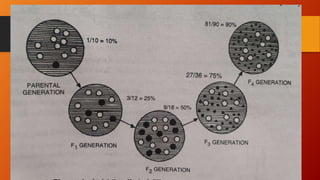
• The process of Natural selection operates through DIFFERENTIAL REPRODUCTION. It
means that those individuals, which are best adapted to the environment, survive
longer and reproduce at a higher rate and produce more offsprings than those which
are less adapted.
• If differential reproduction continues for a number of generations, then the genes of
those individuals which produce more offsprings will become predominant in the
gene pool of the population.
• Thus, there occurs free flow of genes in most of the members of a species due to
sexual communication.
• So, natural selection causes progressive changes in gene frequencies, i.e. the
frequency of adaptive genes increases while the fq. Of less adaptive genes decreases
• So natural selection of NEO-DARWINISM acts as a creative force operates through
comparative reproductive success.
• Accumulation of such variations leads to the Origin Of A New Species.
TYPES OF NATURAL SELECTION
•The three different types of natural selections
observed are-
1) Stabilizing or Balancing or Normalizing Selection
2) Directional or Progressive Selection
3) Disruptive or Diversifying Selection
Stabilizing Selection
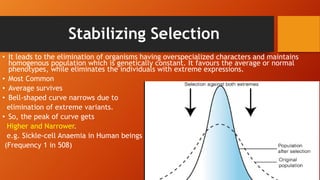
• It leads to the elimination of organisms having overspecialized characters and maintains
homogenous population which is genetically constant. It favours the average or normal
phenotypes, while eliminates the individuals with extreme expressions.
• Most Common
• Average survives
• Bell-shaped curve narrows due to
elimination of extreme variants.
• So, the peak of curve gets
Higher and Narrower.
e.g. Sickle-cell Anaemia in Human beings
(Frequency 1 in 508)
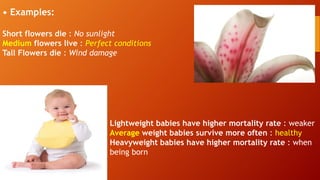
• Examples:
Short flowers die : No sunlight
Medium flowers live : Perfect conditions
Tall Flowers die : Wind damage
Lightweight babies have higher mortality rate : weaker
Average weight babies survive more often : healthy
Heavyweight babies have higher mortality rate : when
being born
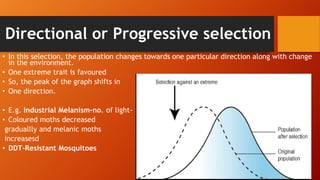
Directional or Progressive selection
• In this selection, the population changes towards one particular direction along with change
in the environment.
• One extreme trait is favoured
• So, the peak of the graph shifts in
• One direction.
• E.g. Industrial Melanism-no. of light-
• Coloured moths decreased
graduallly and melanic moths
increasesd
• DDT-Resistant Mosquitoes
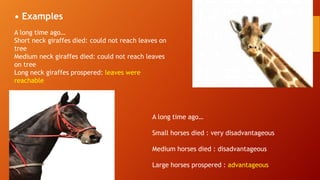
• Examples
A long time ago…
Short neck giraffes died: could not reach leaves on
tree
Medium neck giraffes died: could not reach leaves
on tree
Long neck giraffes prospered: leaves were
reachable
A long time ago…
Small horses died : very disadvantageous
Medium horses died : disadvantageous
Large horses prospered : advantageous
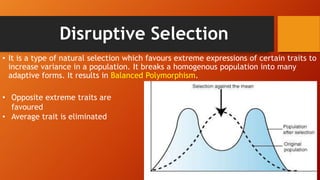
Disruptive Selection
• It is a type of natural selection which favours extreme expressions of certain traits to
increase variance in a population. It breaks a homogenous population into many
adaptive forms. It results in Balanced Polymorphism.
• Opposite extreme traits are
favoured
• Average trait is eliminated
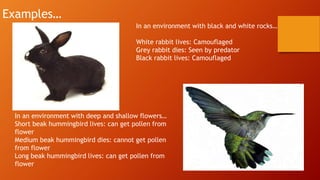
Examples…
In an environment with black and white rocks…
White rabbit lives: Camouflaged
Grey rabbit dies: Seen by predator
Black rabbit lives: Camouflaged
In an environment with deep and shallow flowers…
Short beak hummingbird lives: can get pollen from
flower
Medium beak hummingbird dies: cannot get pollen
from flower
Long beak hummingbird lives: can get pollen from
flower
SPECIATION
o Speciation refers to the origin of new species from pre-existing ones. It forms the
basis of entire course of evolution.
• Mechanism of Speciation:
Speciation occurs when the gene pool of a population is somehow reproductively
isolated from other populations of the parent species and no longer gene flow occurs
between them.
On the basis of period taken in speciation, there are two types of mechanisms of
speciation:
A. Gradual speciation B. Instantaneous or abrupt speciation
Gradual speciation
It is the gradual divergence of populations due to the accumulation of variations over a long period of
time.
Gradual speciation occurs by different ways:
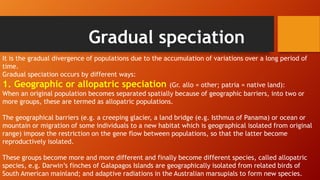
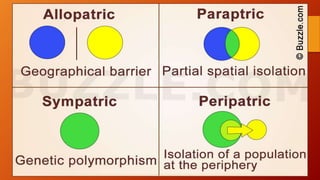
1. Geographic or allopatric speciation (Gr. allo = other; patria = native land):
When an original population becomes separated spatially because of geographic barriers, into two or
more groups, these are termed as allopatric populations.
The geographical barriers (e.g. a creeping glacier, a land bridge (e.g. Isthmus of Panama) or ocean or
mountain or migration of some individuals to a new habitat which is geographical isolated from original
range) impose the restriction on the gene flow between populations, so that the latter become
reproductively isolated.
These groups become more and more different and finally become different species, called allopatric
species, e.g. Darwin’s finches of Galapagos Islands are geographically isolated from related birds of
South American mainland; and adaptive radiations in the Australian marsupials to form new species.
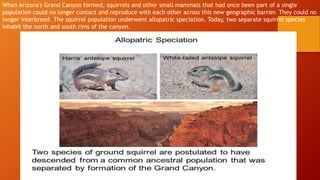
When Arizona's Grand Canyon formed, squirrels and other small mammals that had once been part of a single
population could no longer contact and reproduce with each other across this new geographic barrier. They could no
longer interbreed. The squirrel population underwent allopatric speciation. Today, two separate squirrel species
inhabit the north and south rims of the canyon.
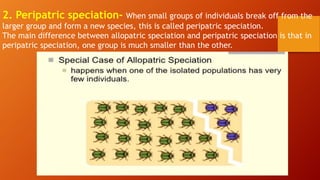
2. Peripatric speciation- When small groups of individuals break off from the
larger group and form a new species, this is called peripatric speciation.
The main difference between allopatric speciation and peripatric speciation is that in
peripatric speciation, one group is much smaller than the other.
3.Sympatric speciation (Gr. sym = together; patria =native
land):Gr. sym = together; patria = native land)
It occurs within a same geographical area and within original
population but two elementary species occupy different ethological or
ecological nittches and are reproductively isolated by the development
of biological isolating barriers.
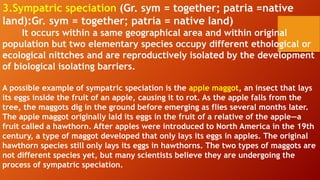
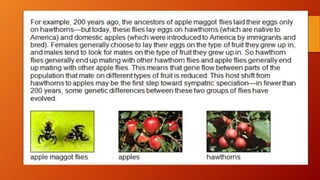
A possible example of sympatric speciation is the apple maggot, an insect that lays
its eggs inside the fruit of an apple, causing it to rot. As the apple falls from the
tree, the maggots dig in the ground before emerging as flies several months later.
The apple maggot originally laid its eggs in the fruit of a relative of the apple—a
fruit called a hawthorn. After apples were introduced to North America in the 19th
century, a type of maggot developed that only lays its eggs in apples. The original
hawthorn species still only lays its eggs in hawthorns. The two types of maggots are
not different species yet, but many scientists believe they are undergoing the
process of sympatric speciation.
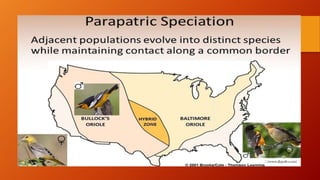
4. Parapatric speciation –
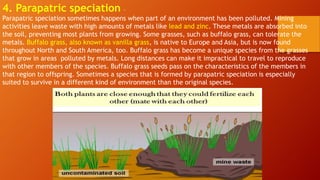
Parapatric speciation sometimes happens when part of an environment has been polluted. Mining
activities leave waste with high amounts of metals like lead and zinc. These metals are absorbed into
the soil, preventing most plants from growing. Some grasses, such as buffalo grass, can tolerate the
metals. Buffalo grass, also known as vanilla grass, is native to Europe and Asia, but is now found
throughout North and South America, too. Buffalo grass has become a unique species from the grasses
that grow in areas polluted by metals. Long distances can make it impractical to travel to reproduce
with other members of the species. Buffalo grass seeds pass on the characteristics of the members in
that region to offspring. Sometimes a species that is formed by parapatric speciation is especially
suited to survive in a different kind of environment than the original species.
Abrupt or instantaneous speciation
It is defined as the sudden development of new species which is reproductively and
ecologically isolated from the parental species. This mechanism operates through
individuals and thus, not a population phenomenon.
It may occur by:
1. Mutations:
Mutations are large, sudden and inheritable changes while individuals with mutations are called
mutants. Mutations are called fountain head of variations as these form the main types of sources of
variations.
Significance:
Such mutations can produce sibling species which are morphologically similar but ecologically and
reproductively isolated. For example, the production of two sibling species of Drosophila pseudo-
obscura and D. persimilis.
2. Hybridization and Polyploidy:
Hybridization involves the interbreeding of two genetically different – individuals of two same or
different species to produce hybrids while polyploidy means presence of more than two sets of
chromosomes.
Occasionally, the interspecific hybrids are produced naturally or artificially. Such hybrids are, however,
sterile due to incompatibility between the chromosomes of two different species and their failure to
pair in meiosis.
But the doubling of chromosomes may produce fertile offsprings. Doubling of chromosome number
allows normal meiosis and formation of normal but diploid gametes so hybridization followed by
polyploidy can lead to the formation of new species very rapidly. This results in the production of new
species.
Some examples are the production of Raphanobrassica [An intergeneric hybrid with 2N=36 produced by
crossing Raphanus – radish (2N=18) and Brassica-cabbage (2N = 18) by Karpechenko. It was produced by
hybridization followed by polyploidy], Triticale [An intergeneric hybrid between Triticum (wheat) and
Secale (rye). It is a man-made cereal] and Triticum aestivum (Hexaploid bread wheat).
Thank You!
thakurshabnam003@gmail.com

Mutations,natural selection and speciation

  • 1.
    MUTATIONS,NATURAL SELECTION AND SPECIATIONSUBMITTEDTO – EKTA GULERIA SUBMITTED BY – SHABNAM (CUHP18ZOO22)
  • 2.
    MUTATIONS  Sudden, stable,inheritable, discontinuous variations which lead to change in the genetic material or character of an organism is known as MUTATIONS or SPORTS or SALTATIONS.  Individuals showing these changes are known as mutants.  An individual showing an altered phenotype due to mutation are known as variant.  Factor or agents causing mutation are known as mutagens.  Mutations which causes changes in base sequence of a gene are known as gene mutations or point mutations.  In gene mutations, the DNA code will have a base (or more) missing, added, or exchanged in a codon.
  • 3.
    HISTORY  English farmerSeth Wright recorded case of mutation first time in 1791 in Male lamb with unusual short legs.  The term mutation is coined by Hugo de Vries in 1900 by his observation in Evening Primose(Oenothera lamarckiana).  Systematic study of mutation was started in 1910 when Morgan genetically analyzed white eye mutant of Drosophila.  H. J. Muller induced mutation in Drosophila by using X- rays in 1927.  He was awarded with Nobel prize in 1946.
  • 4.
    Characteristics of Mutation Generallymutant alleles are recessive to their wild type or normal alleles. • Most mutations have harmful effect, but some mutations are beneficial • Spontaneous mutations occurs at very low rate. • Some genes shows high rate of mutation such genes are called as mutable gene. • Highly mutable sites within a gene are known as hot spots. • Mutation can occur in any tissue/cell (somatic or germinal) of an organism. A tulip flower exhibiting a partially yellow petal because of a mutation in its genes.
  • 5.
    Classification of mutation Basedon the survival of an individual 1. Lethal mutation – when mutation causes death of all individuals undergoing mutation are known as lethal. 2. Sub-lethal mutation - causes death of 90% individuals. 3. Sub-vital mutation– such mutation kills less than 90% individuals. 4. Vital mutation -when mutation doesn’t affect the survival of an individual are known as vital. 5. Supervital mutation – This kind of mutation enhances the survival of individual.
  • 6.
    Based on causesof mutation 1. Spontaneous mutation- Spontaneous mutation occurs naturally without any cause. The rate of spontaneous mutation is very slow. eg- Methylation followed by deamination of cytosine. Rate of spontaneous mutation is higher in eukaryotes than prokaryotes. Eg. UV light of sunlight causing mutation in bacteria 2. Induced Mutation- Mutations produced due to treatment with either a chemical or physical agent are called induced mutation . The agents capable of inducing such mutations are known as mutagen. use of induced mutation for crop improvement program is known as mutation breeding. Eg. X- rays causing mutation in cereals
  • 7.
    Based on tissueof origin 1. Somatic mutation- A mutation occurring in somatic cell is called somatic mutation. In asexually reproducing species somatic mutations transmits from one progeny to the next progeny. 2. Germinal Mutation- When mutation occur in gametic cells or reproductive cells are known as germinal mutation. In sexually reproductive species only germinal mutation are transmitted to the next generation.
  • 8.
     Based ondirection of mutation 1. Forward mutation- When mutation occurs from the normal/wild type allele to mutant allele are known as forward mutation. 2. Reverse mutation- When mutation occurs in reverse direction that is, from mutant allele to the normal/wild type allele are known as reverse mutation.
  • 9.
     Type oftrait affected 1. Visible mutation- Those mutation which affects on phenotypic character and can be detected by normal observation are known as visible mutation. 2. Biochemical mutation- mutation which affect the production of biochemicals and which does not not show any phenotypic character are known as biochemical mutation.
  • 10.
    Causes of mutations •NaturalCause • DNA fails to copy accurately –when a cell divides, it makes a copy of its DNA and sometimes the copy is not quite perfect. •External Influences/Mutagens In genetics, a mutagen is a physical or chemical agent that changes the genetic material, usually DNA, of an organism and thus increases the frequency of mutations above the natural background level. Mutagens effects- It can affect the transcription and replication of the DNA, Produces mutations that can result in aberrant, impaired or loss of function for a particular gene, Accumulation of mutations may lead to cancer, Can lead to cell death.
  • 11.
    Physical and chemicalmutagens • Ionizing radiations such as X-rays, gamma rays and alpha particles-may cause DNA breakage and other damages. The most common sources include cobalt-60 and cesium-137. • Radioactive decay • Ultraviolet radiations with wavelength above 260 nm– are absorbed strongly by bases, producing pyrimidine dimers, which can cause error in replication if left uncorrected. • DNA reactive chemicals– A large number of chemicals may interact directly with DNA. However, many are not necessarily mutagenic by themselves, but through metabolic processes in cells they produce mutagenic compounds. • Reactive oxygen species (ROS)– These ROS may result in the production of many base adducts, as well as DNA strand breaks and crosslinks. • Deaminating agents – for example nitrous acid which can cause transition mutations by converting cytosine to uracil. • Aromatic amines and amides – have been associated with carcinogenesis, may cause cancer of the bladder, liver, ear, intestine, thyroid and breast
  • 12.
    Biological Agents • Virus–Virus DNA may be inserted into the genome and disrupts genetic function. Infectious agents have been suggested to cause cancer. • Bacteria– some bacteria such as Helicobacter pylori cause inflammation during which oxidative species are produced, causing DNA damage and reducing efficiency of DNA repair systems, thereby increasing mutation.  PROTECTION AGAINST MUTATIONS- Fruits and vegetables that are rich in antioxidants– Antioxidants are an important group of anticarcinogenic compounds that may help remove ROS or potentially harmful chemicals. An effective precautionary measure an individual can undertake to protect themselves is by limiting exposure to mutagens such as UV radiations and tobacco smoke.
  • 13.
    TYPES OF MUTATIONS 3.Pointmutations (a)Mis-sense (b)Non-sense (c)Null mutations (d)Silent/samesense mutations 1.Frameshift Mutations 2.
  • 14.
    A. GENE MUTATIONS Theseare invisible changes in a chemical nature(DNA) of a gene and involve the change in one or more nucleotide pairs of a gene. Most of the gene mutations involve a change in only a single nucleotide or nitrogenous base of of the cistron or DNA segment representing a single gene. Therefore, gene mutations are also called POINT MUTATIONS. Each human gene has the mutation chances of 10-6 per locus. Mutations are generally rare and harmful. Many times a gene mutation does not produce any detectable phenotypic effect as most of the gene mutations are recessive and remain masked by dominant and normal alleles. But the dominant gene mutations in homozygous condition may produce a different kind of polypeptide chain so producing the phenotypic change. The gene mutations are of three types:- 1.Frame-shift Mutations 2.Substitutions(Replacement) 3.Point mutations
  • 15.
    1.Frame-shift Mutations • Theyare those mutations in which the reading of the frame of base sequences shifts laterally either in the forward direction due to insertion(addition) of one or more nucleotides or in the backward direction due to deletion of one or more nucleotides.This changes all the codes of DNA from the site of deletion or insertion onward, so shifting the whole coding frame, and are called Gibberlish or Frameshift.Therefore, frame-shift mutations are of two kinds, insertion and deletion. • (a) Insertion-one or more nucleotides are added in the segment of DNA representing cistron or gene. • (b) Deletion- one or more nucleotides are lost from a segment of DNA representing a cistron or gene.
  • 16.
    2.Substitutions • In asubstitution, a nitrogenous base is changed with another. E.g. in SICKLE-CELL ANAEMIA, glutamic acid of Beta-chain of Hb-A is replaced by valine amino acid to form defective Hb-S DUE to substitution of T=A pair of gene by A=T pair. • (1) In Transition, a purine(adenine or guanine) or a pyrimidine (cytosine or thymine or uracil)in triplet code of DNA or mRNA is replaced by its type i.e. a purine replaces purine and pyrimidine replaces pyrimidine. • (2) Transversions are substitution gene mutations in which a purine ( A OR G) is replaced by pyrimidine (T or C) or vice-versa. • (3) Tautomerism- The changed pairing qualities of the bases (pairing of purine with purine and pyrimidine with pyrimidine) are due to phenomenon called tautomerism. • TAUTOMERS are the alternate form of bases and are produced by rearrangements of electrons and protons in the molecules. Due to tautomerisation the amino (-NH2) group of cytosine and adenine is converted into (-NH) group and likewise keto (C=O) of thymine and guanine is converted to enol group(-OH). Tautomeric thymine pairs with normal guanine and cytosine with adenine. Such pairs of nitrogen bases are known as forbidden base pairs or unusual base pairs.
  • 19.
    3.Point Mutations • Apoint substitution mutation results in a change in a single nucleotide and can be either synonymous or non-synonymous. • A synonymous substitution replaces a codon with another codon that codes for the same amino acid, so that the produced amino acid sequence is not modified. Synonymous mutations occur due to the degenerate nature of the genetic code. If this mutation does not result in any phenotypic effects, then it is called silent or samesense, but not all synonymous substitutions are silent. (There can also be silent mutations in nucleotides outside of the coding regions, such as the introns, because the exact nucleotide sequence is not as crucial as it is in the coding regions, but these are not considered synonymous substitutions.) • A nonsynonymous substitution replaces a codon with another codon that codes for a different amino acid, so that the produced amino acid sequence is modified. Non- synonymous substitutions can be classified as nonsense or missense mutations:
  • 21.
    1. A missensemutation changes a nucleotide to cause substitution of a different amino acid. This in turn can render the resulting protein nonfunctional. Such mutations are responsible for diseases such as Epidermolysis bullosa, sickle-cell disease, and SOD1- mediated ALS. On the other hand, if a missense mutation occurs in an amino acid codon that results in the use of a different, but chemically similar, amino acid, then sometimes little or no change is rendered in the protein. For example, a change from AAA to AGA will encode arginine, a chemically similar molecule to the intended lysine. In this latter case the mutation will have little or no effect on phenotype and therefore be neutral. 2. A nonsense mutation is a point mutation in a sequence of DNA that results in a premature stop codon, or a nonsense codon in the transcribed mRNA, and possibly a truncated, and often nonfunctional protein product. This sort of mutation has been linked to different mutations, such as congenital adrenal hyperplasia. NULL MUTATION- A Mutation that eliminates gene function because of deletion is called Null mutation. NULL mutation is lethal if the gene has a vital function.
  • 22.
    B. Chromosomal Mutations Structuralchanges in chromosomes or chromosome aberrations or chromosomal mutations occur in number and sequence of genes in the chromosomes without altering their ploidy. Chormosomal mutations leads to change of morphology and architecture of chromosome. Five types of chromosomal mutations exists: –Deletion –Inversion –Translocation –Nondisjunction –Duplication
  • 23.
    1. Deletion(Deficiency) • Dueto breakage of chromosomal segment, A piece of a chromosome is lost If Terminal segment is lost ,it is called DEFICIENCY and If Intercalary segment is lost is is termed DELETION. Deficiency has been recorded in Human Beings in smaller arm of Chromosome 5(5p) and may Responsible for cat-like cry (Cri-du-cat syndrome) in the child. Here affected child is with epicanthic Skin fold, small head and low mental Faculty(microcephally).
  • 24.
    2. Duplication • Occurswhen a gene sequence is repeated • A TANDEM DUPLICATION(repeat) is one in Which duplicated segment is directly adjacent to the normal region in chromosome. • In REVERSE TANDEM DUPLICATION, the Added segment is adjacent to the original segment in the same chromosome but its Genes are in the reverse order. • In DISPLACED DUPLICATION, a segment is inserted Into Different chromosomes.
  • 25.
    3. Inversion • Chromosomesegment breaks off • Segment flips around backwards • Segment reattaches • (1) Paracentric- Inverted segement does Not include the centromere. • (2) Pericentric- It does not include the Centromere.
  • 26.
    4. Translocation • Involvestwo chromosomes that aren’t homologous i.e. Non-Homologous • Part of one chromosome is transferred to another chromosomes 1. Simple translocation- a small terminal segment of chromosome is added to the end of non-homologous chromosome. It is generally rare. 2. Reciprocal translocation- an exchange of parts between two non-homologous chromosomes.
  • 27.
    5. NON- DISJUNCTION •Failure of chromosomes to separate during meiosis • Causes gamete to have too many or too few chromosomes • Disorders: • Down Syndrome – three 21st chromosomes • Turner Syndrome – single X chromosome • Klinefelter’s Syndrome– XXY chromosomes
  • 28.
    C. Chromosomal NumericalMutations • (1) Aneuploidy -the abnormal condition where one or more chromosomes of a normal set of chromosomes are missing or present in more than their usual number of copies. • It is of two types- HYPOPLOIDY and HYPERPLOIDY • HYPOPLOIDY- loss of one or more chromosomes • HYPERPLOIDY- addition of one or more chromosomes • MONOSOMY and NULLISOMY are examples of Hypoploidy. • TRISOMY and TETRASOMY are examples of Hyperploidy.
  • 29.
    HYPOPLOIDY NULLISOMY • The lossof both pairs of homologous chromosomes • Nullisomics- 2N-2 MONOSOMY • The loss of a single chromosome • Monosomics- 2N-1
  • 30.
    HYPERPLOIDY TRISOMY • The gainof an extra copy of a chromosome • Trisomics- 2N+1 TETRASOMY • the gain of an extra pair of homologous chromosomes • Tetrasomics- 2N+2
  • 31.
    (2) EUPLOIDY- Itis a condition in which the chromosome is an exact multiple of genome or basic haploid number. It is of two types- 1. MONOPLOIDY or HAPLOIDY – Single basic set of chromosomes 2. POLYPLOIDY-Having more than two haploid sets of chromosomes. Polyploids are of two types- I. Autopolyploids- Those poyploids, which have the same basic set of chromosomes multiplied. E.g. AA or AAA or AAAA e.g. potato(48),coffee(44). II. Allopolyploids-They develop due to hybridization between two sp. Followed by doubling of chromosomes. Allotetraploid(AABB) is the common example.e.g. origin of BREAD WHEAT(AABBDD; 6N=42)
  • 32.
    Harmful mutations • Ifthere is a mutation in a DNA repair gene within a germ cell, humans carrying such germline mutations may have an increased risk of cancer. A list of 34 such germline mutations is given in the article DNA repair-deficiency disorder. • An example of one is albinism, a mutation that occurs in the OCA1 or OCA2 gene. Individuals with this disorder are more prone to many types of cancers, other disorders and have impaired vision. • On the other hand, a mutation may occur in a somatic cell of an organism. Such mutations will be present in all descendants of this cell within the same organism, and certain mutations can cause the cell to become malignant, and thus, cause cancer.
  • 33.
    Beneficial mutations • Inthese cases a mutation will tend to become more common in a population through natural selection. Examples include the following: HIV resistance: a specific 32 base pair deletion in human CCR5 (CCR5-Δ32) confers HIV resistance to homozygotes and delays AIDS onset in heterozygotes. One possible explanation of the etiology of the relatively high frequency of CCR5-Δ32 in the European population is that it conferred resistance to the bubonic plague in mid-14th century Europe. People with this mutation were more likely to survive infection; thus its frequency in the population increased. This theory could explain why this mutation is not found in Southern Africa, which remained untouched by bubonic plague. A newer theory suggests that the selective pressure on the CCR5 Delta 32 mutation was caused by smallpox instead of the bubonic plague. Antibiotic resistance: Practically all bacteria develop antibiotic resistance when exposed to antibiotics. In fact, bacterial populations already have such mutations that get selected under antibiotic selection. Obviously, such mutations are only beneficial for the bacteria but not for those infected.
  • 34.
    Malaria resistance: Anexample of a harmful mutation is sickle-cell disease, a blood disorder in which the body produces an abnormal type of the oxygen-carrying substance hemoglobin in the red blood cells. One-third of all indigenous inhabitants of Sub-Saharan Africa carry the allele, because, in areas where malaria is common, there is a survival value in carrying only a single sickle-cell allele (sickle cell trait).Those with only one of the two alleles of the sickle-cell disease are more resistant to malaria, since the infestation of the malaria Plasmodium is halted by the sickling of the cells that it infests. Lactase persistence is the continued activity of the lactase enzyme in adulthood. Since lactase's only function is the digestion of lactose in milk, in most mammal species, the activity of the enzyme is dramatically reduced after weaning. In some human populations, though, lactase persistence has recently evolved as an adaptation to the consumption of non-human milk and dairy products beyond infancy. The majority of people around the world remain lactase nonpersistent, and consequently are affected by varying degrees of lactose intolerance as adults. Lactase persistence: A mutation allowed humans to express the enzyme lactase after they are naturally weaned from breast milk, allowing adults to digest lactose, which is probably one of the most beneficial mutations in recent human evolution.
  • 35.
    NATURAL SELECTION  Theprocess by which comparatively better adapted individuals out of a heterogenous population are favoured by the Nature over the less adapted individuals is called natural selection.  Animals adapting to environment.  Advantaged animals survive and reproduce.
  • 36.
    MECHANISM • The processof Natural selection operates through DIFFERENTIAL REPRODUCTION. It means that those individuals, which are best adapted to the environment, survive longer and reproduce at a higher rate and produce more offsprings than those which are less adapted. • If differential reproduction continues for a number of generations, then the genes of those individuals which produce more offsprings will become predominant in the gene pool of the population. • Thus, there occurs free flow of genes in most of the members of a species due to sexual communication. • So, natural selection causes progressive changes in gene frequencies, i.e. the frequency of adaptive genes increases while the fq. Of less adaptive genes decreases • So natural selection of NEO-DARWINISM acts as a creative force operates through comparative reproductive success. • Accumulation of such variations leads to the Origin Of A New Species.
  • 38.
    TYPES OF NATURALSELECTION •The three different types of natural selections observed are- 1) Stabilizing or Balancing or Normalizing Selection 2) Directional or Progressive Selection 3) Disruptive or Diversifying Selection
  • 39.
    Stabilizing Selection • Itleads to the elimination of organisms having overspecialized characters and maintains homogenous population which is genetically constant. It favours the average or normal phenotypes, while eliminates the individuals with extreme expressions. • Most Common • Average survives • Bell-shaped curve narrows due to elimination of extreme variants. • So, the peak of curve gets Higher and Narrower. e.g. Sickle-cell Anaemia in Human beings (Frequency 1 in 508)
  • 40.
    • Examples: Short flowersdie : No sunlight Medium flowers live : Perfect conditions Tall Flowers die : Wind damage Lightweight babies have higher mortality rate : weaker Average weight babies survive more often : healthy Heavyweight babies have higher mortality rate : when being born
  • 41.
    Directional or Progressiveselection • In this selection, the population changes towards one particular direction along with change in the environment. • One extreme trait is favoured • So, the peak of the graph shifts in • One direction. • E.g. Industrial Melanism-no. of light- • Coloured moths decreased graduallly and melanic moths increasesd • DDT-Resistant Mosquitoes
  • 42.
    • Examples A longtime ago… Short neck giraffes died: could not reach leaves on tree Medium neck giraffes died: could not reach leaves on tree Long neck giraffes prospered: leaves were reachable A long time ago… Small horses died : very disadvantageous Medium horses died : disadvantageous Large horses prospered : advantageous
  • 43.
    Disruptive Selection • Itis a type of natural selection which favours extreme expressions of certain traits to increase variance in a population. It breaks a homogenous population into many adaptive forms. It results in Balanced Polymorphism. • Opposite extreme traits are favoured • Average trait is eliminated
  • 44.
    Examples… In an environmentwith black and white rocks… White rabbit lives: Camouflaged Grey rabbit dies: Seen by predator Black rabbit lives: Camouflaged In an environment with deep and shallow flowers… Short beak hummingbird lives: can get pollen from flower Medium beak hummingbird dies: cannot get pollen from flower Long beak hummingbird lives: can get pollen from flower
  • 45.
    SPECIATION o Speciation refersto the origin of new species from pre-existing ones. It forms the basis of entire course of evolution. • Mechanism of Speciation: Speciation occurs when the gene pool of a population is somehow reproductively isolated from other populations of the parent species and no longer gene flow occurs between them. On the basis of period taken in speciation, there are two types of mechanisms of speciation: A. Gradual speciation B. Instantaneous or abrupt speciation
  • 46.
    Gradual speciation It isthe gradual divergence of populations due to the accumulation of variations over a long period of time. Gradual speciation occurs by different ways: 1. Geographic or allopatric speciation (Gr. allo = other; patria = native land): When an original population becomes separated spatially because of geographic barriers, into two or more groups, these are termed as allopatric populations. The geographical barriers (e.g. a creeping glacier, a land bridge (e.g. Isthmus of Panama) or ocean or mountain or migration of some individuals to a new habitat which is geographical isolated from original range) impose the restriction on the gene flow between populations, so that the latter become reproductively isolated. These groups become more and more different and finally become different species, called allopatric species, e.g. Darwin’s finches of Galapagos Islands are geographically isolated from related birds of South American mainland; and adaptive radiations in the Australian marsupials to form new species.
  • 47.
    When Arizona's GrandCanyon formed, squirrels and other small mammals that had once been part of a single population could no longer contact and reproduce with each other across this new geographic barrier. They could no longer interbreed. The squirrel population underwent allopatric speciation. Today, two separate squirrel species inhabit the north and south rims of the canyon.
  • 48.
    2. Peripatric speciation-When small groups of individuals break off from the larger group and form a new species, this is called peripatric speciation. The main difference between allopatric speciation and peripatric speciation is that in peripatric speciation, one group is much smaller than the other.
  • 49.
    3.Sympatric speciation (Gr.sym = together; patria =native land):Gr. sym = together; patria = native land) It occurs within a same geographical area and within original population but two elementary species occupy different ethological or ecological nittches and are reproductively isolated by the development of biological isolating barriers. A possible example of sympatric speciation is the apple maggot, an insect that lays its eggs inside the fruit of an apple, causing it to rot. As the apple falls from the tree, the maggots dig in the ground before emerging as flies several months later. The apple maggot originally laid its eggs in the fruit of a relative of the apple—a fruit called a hawthorn. After apples were introduced to North America in the 19th century, a type of maggot developed that only lays its eggs in apples. The original hawthorn species still only lays its eggs in hawthorns. The two types of maggots are not different species yet, but many scientists believe they are undergoing the process of sympatric speciation.
  • 51.
    4. Parapatric speciation– Parapatric speciation sometimes happens when part of an environment has been polluted. Mining activities leave waste with high amounts of metals like lead and zinc. These metals are absorbed into the soil, preventing most plants from growing. Some grasses, such as buffalo grass, can tolerate the metals. Buffalo grass, also known as vanilla grass, is native to Europe and Asia, but is now found throughout North and South America, too. Buffalo grass has become a unique species from the grasses that grow in areas polluted by metals. Long distances can make it impractical to travel to reproduce with other members of the species. Buffalo grass seeds pass on the characteristics of the members in that region to offspring. Sometimes a species that is formed by parapatric speciation is especially suited to survive in a different kind of environment than the original species.
  • 54.
    Abrupt or instantaneousspeciation It is defined as the sudden development of new species which is reproductively and ecologically isolated from the parental species. This mechanism operates through individuals and thus, not a population phenomenon. It may occur by: 1. Mutations: Mutations are large, sudden and inheritable changes while individuals with mutations are called mutants. Mutations are called fountain head of variations as these form the main types of sources of variations. Significance: Such mutations can produce sibling species which are morphologically similar but ecologically and reproductively isolated. For example, the production of two sibling species of Drosophila pseudo- obscura and D. persimilis.
  • 55.
    2. Hybridization andPolyploidy: Hybridization involves the interbreeding of two genetically different – individuals of two same or different species to produce hybrids while polyploidy means presence of more than two sets of chromosomes. Occasionally, the interspecific hybrids are produced naturally or artificially. Such hybrids are, however, sterile due to incompatibility between the chromosomes of two different species and their failure to pair in meiosis. But the doubling of chromosomes may produce fertile offsprings. Doubling of chromosome number allows normal meiosis and formation of normal but diploid gametes so hybridization followed by polyploidy can lead to the formation of new species very rapidly. This results in the production of new species. Some examples are the production of Raphanobrassica [An intergeneric hybrid with 2N=36 produced by crossing Raphanus – radish (2N=18) and Brassica-cabbage (2N = 18) by Karpechenko. It was produced by hybridization followed by polyploidy], Triticale [An intergeneric hybrid between Triticum (wheat) and Secale (rye). It is a man-made cereal] and Triticum aestivum (Hexaploid bread wheat).
  • 57.