Hemorrhage
Ikram Ullah
M.Phil MLSc
Hemorrhage
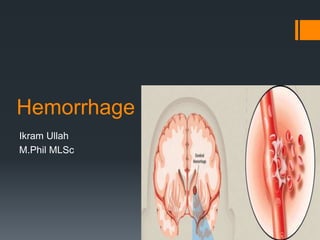
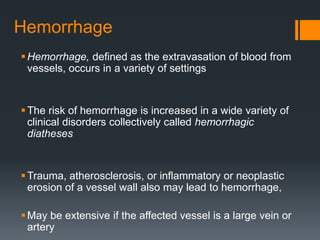
ļ‚§Hemorrhage, defined as the extravasation of blood from
vessels, occurs in a variety of settings
ļ‚§The risk of hemorrhage is increased in a wide variety of
clinical disorders collectively called hemorrhagic
diatheses
ļ‚§Trauma, atherosclerosis, or inflammatory or neoplastic
erosion of a vessel wall also may lead to hemorrhage,
ļ‚§May be extensive if the affected vessel is a large vein or
artery
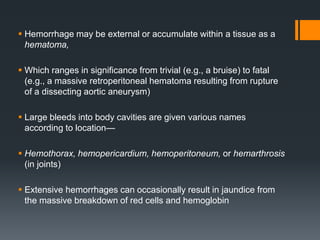
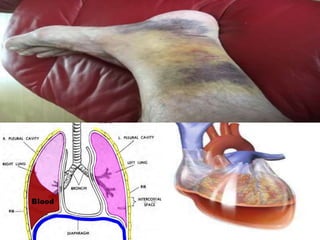
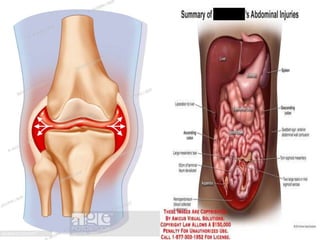
ļ‚§ Hemorrhage may be external or accumulate within a tissue as a
hematoma,
ļ‚§ Which ranges in significance from trivial (e.g., a bruise) to fatal
(e.g., a massive retroperitoneal hematoma resulting from rupture
of a dissecting aortic aneurysm)
ļ‚§ Large bleeds into body cavities are given various names
according to location—
ļ‚§ Hemothorax, hemopericardium, hemoperitoneum, or hemarthrosis
(in joints)
ļ‚§ Extensive hemorrhages can occasionally result in jaundice from
the massive breakdown of red cells and hemoglobin
Petechiae
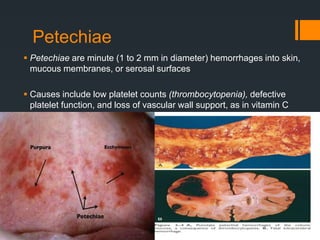
ļ‚§ Petechiae are minute (1 to 2 mm in diameter) hemorrhages into skin,
mucous membranes, or serosal surfaces
ļ‚§ Causes include low platelet counts (thrombocytopenia), defective
platelet function, and loss of vascular wall support, as in vitamin C
deficiency
Purpura
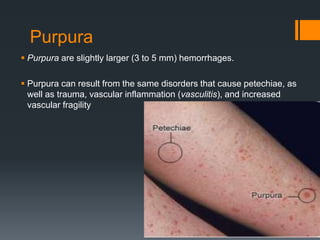
ļ‚§ Purpura are slightly larger (3 to 5 mm) hemorrhages.
ļ‚§ Purpura can result from the same disorders that cause petechiae, as
well as trauma, vascular inflammation (vasculitis), and increased
vascular fragility
Ecchymoses
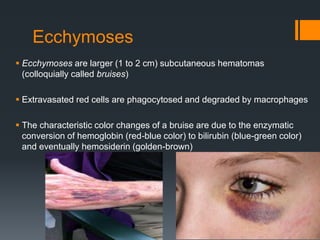
ļ‚§ Ecchymoses are larger (1 to 2 cm) subcutaneous hematomas
(colloquially called bruises)
ļ‚§ Extravasated red cells are phagocytosed and degraded by macrophages
ļ‚§ The characteristic color changes of a bruise are due to the enzymatic
conversion of hemoglobin (red-blue color) to bilirubin (blue-green color)
and eventually hemosiderin (golden-brown)
ļ‚§ The clinical significance of any particular hemorrhage depends
on the volume of blood lost and the rate of bleeding
ļ‚§ Rapid loss of up to 20% of the blood volume, or slow losses of
even larger amounts, may have little impact in healthy adults;
greater losses, however, can cause hemorrhagic (hypovolemic)
shock
ļ‚§ Chronic or recurrent external blood loss (e.g., due to peptic ulcer
or menstrual bleeding) frequently culminates in iron deficiency
anemia
ļ‚§ By contrast, iron is efficiently recycled from phagocytosed red
cells, so internal bleeding (e.g., a hematoma) does not lead to
iron deficiency

Hemorrhage

  • 1.
  • 2.
    Hemorrhage ļ‚§Hemorrhage, defined asthe extravasation of blood from vessels, occurs in a variety of settings ļ‚§The risk of hemorrhage is increased in a wide variety of clinical disorders collectively called hemorrhagic diatheses ļ‚§Trauma, atherosclerosis, or inflammatory or neoplastic erosion of a vessel wall also may lead to hemorrhage, ļ‚§May be extensive if the affected vessel is a large vein or artery
  • 3.
    ļ‚§ Hemorrhage maybe external or accumulate within a tissue as a hematoma, ļ‚§ Which ranges in significance from trivial (e.g., a bruise) to fatal (e.g., a massive retroperitoneal hematoma resulting from rupture of a dissecting aortic aneurysm) ļ‚§ Large bleeds into body cavities are given various names according to location— ļ‚§ Hemothorax, hemopericardium, hemoperitoneum, or hemarthrosis (in joints) ļ‚§ Extensive hemorrhages can occasionally result in jaundice from the massive breakdown of red cells and hemoglobin
  • 6.
    Petechiae ļ‚§ Petechiae areminute (1 to 2 mm in diameter) hemorrhages into skin, mucous membranes, or serosal surfaces ļ‚§ Causes include low platelet counts (thrombocytopenia), defective platelet function, and loss of vascular wall support, as in vitamin C deficiency
  • 7.
    Purpura ļ‚§ Purpura areslightly larger (3 to 5 mm) hemorrhages. ļ‚§ Purpura can result from the same disorders that cause petechiae, as well as trauma, vascular inflammation (vasculitis), and increased vascular fragility
  • 8.
    Ecchymoses ļ‚§ Ecchymoses arelarger (1 to 2 cm) subcutaneous hematomas (colloquially called bruises) ļ‚§ Extravasated red cells are phagocytosed and degraded by macrophages ļ‚§ The characteristic color changes of a bruise are due to the enzymatic conversion of hemoglobin (red-blue color) to bilirubin (blue-green color) and eventually hemosiderin (golden-brown)
  • 9.
    ļ‚§ The clinicalsignificance of any particular hemorrhage depends on the volume of blood lost and the rate of bleeding ļ‚§ Rapid loss of up to 20% of the blood volume, or slow losses of even larger amounts, may have little impact in healthy adults; greater losses, however, can cause hemorrhagic (hypovolemic) shock ļ‚§ Chronic or recurrent external blood loss (e.g., due to peptic ulcer or menstrual bleeding) frequently culminates in iron deficiency anemia ļ‚§ By contrast, iron is efficiently recycled from phagocytosed red cells, so internal bleeding (e.g., a hematoma) does not lead to iron deficiency