Gene transfer techniques
By,
Abhinava J V
BIRAC Innovation Fellow
University of Agricultural Sciences, Dharwad
Direct DNA transfer
• vector less
Indirect DNA transfer
• Vector-mediated
Direct DNA transfer
Physical gene transfer methods
Chemical gene transfer methods
Physical gene transfer methods
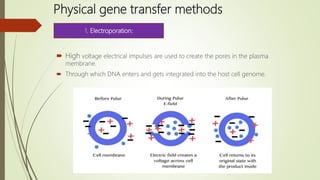
 High voltage electrical impulses are used to create the pores in the plasma
membrane.
 Through which DNA enters and gets integrated into the host cell genome.
1. Electroporation:
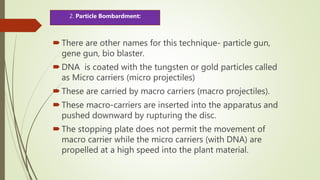
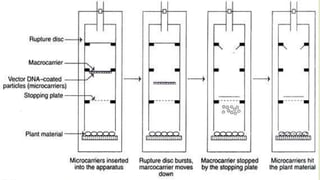
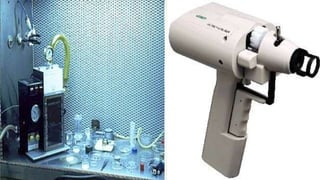
There are other names for this technique- particle gun,
gene gun, bio blaster.
DNA is coated with the tungsten or gold particles called
as Micro carriers (micro projectiles)
These are carried by macro carriers (macro projectiles).
These macro-carriers are inserted into the apparatus and
pushed downward by rupturing the disc.
The stopping plate does not permit the movement of
macro carrier while the micro carriers (with DNA) are
propelled at a high speed into the plant material.
2. Particle Bombardment:
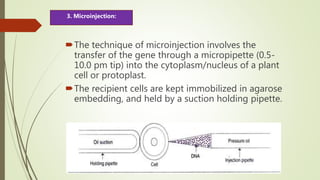
The technique of microinjection involves the
transfer of the gene through a micropipette (0.5-
10.0 pm tip) into the cytoplasm/nucleus of a plant
cell or protoplast.
The recipient cells are kept immobilized in agarose
embedding, and held by a suction holding pipette.
3. Microinjection:
Chemical Gene Transfer Methods:
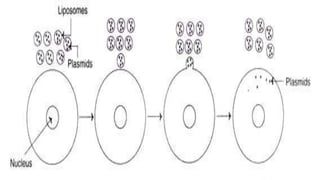
Liposomes are artificially created lipid vesicles
containing a phospholipid membrane.
They are successfully used in mammalian cells for the
delivery of proteins, drugs etc.
Liposomes carrying genes can be employed to fuse
protoplasts and transfer the genes.
The efficiency of transformation increases when the
process is carried out in conjunction with polyethylene
glycol (PEG).
 1. Liposome-Mediated Transformation:
 The desirable DNA can be complexed with a high molecular
weight polymer diethyl amino ethyl (DEAE) dextran and
transferred.
 2. DEAE Dextran-Mediated transfer:
 3. Calcium Phosphate Co- Precipitation-Mediated Transfer:
 The DNA is allowed to mix with calcium chloride solution and
isotonic phosphate buffer to form DNA-calcium phosphate
precipitate.
 When the actively dividing cells in culture are exposed to this
precipitate for several hours, the cells get transformed.
Indirect DNA transfer
Agrobacterium-Mediated Gene Transfer
Viruses-Mediated Gene Transfer
Agrobacterium-Mediated Gene Transfer
 Agrobacterium tumefaciens is a soil-borne, Gram-negative
bacterium.
 It is rod shaped and motile, and belongs to the bacterial family of
Rhizobiaceae.
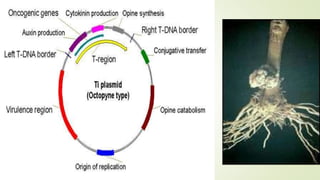
 A. tumefaciens contain a 200-kb tumor inducing (Ti) plasmid
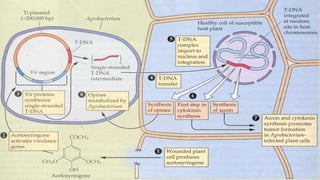
 Bacteria was capable to transfer a portion of the plasmid DNA into
the plant host (T-DNA).
 Infects plants through breaks or wounds.
 Expression of genes in wild-type T-DNA results in dramatic
physiological changes to the plant cell.
 T-DNA Synthesis the of plant growth hormones (auxins and
cytokinins) which cause to neoplastic growth (tumor formation)
Agrobacterium tumefaciens chromosomal genes:
chvA, chvB, pscA required for initial binding of the
bacterium to the plant cell and code for
polysaccharide on bacterial cell surface.
Virulence region (vir) carried on pTi, but not in the
transferred region (T-DNA). Genes code for proteins
that prepare the T-DNA and the bacterium for
transfer.
At least nine vir-gene operons have been identified.
These include vir A, vir G, vir B1, vir C1, vir D1, D2 and
D4, and vir E1, and E2.
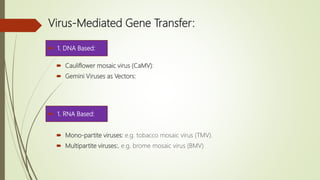
Virus-Mediated Gene Transfer:
 Mono-partite viruses: e.g. tobacco mosaic virus (TMV).
 Multipartite viruses:, e.g. brome mosaic virus (BMV)
 1. DNA Based:
 Cauliflower mosaic virus (CaMV):
 Gemini Viruses as Vectors:
 1. RNA Based:
Thank You

Gene transfer methods

  • 1.
    Gene transfer techniques By, AbhinavaJ V BIRAC Innovation Fellow University of Agricultural Sciences, Dharwad
  • 2.
    Direct DNA transfer •vector less Indirect DNA transfer • Vector-mediated
  • 3.
    Direct DNA transfer Physicalgene transfer methods Chemical gene transfer methods
  • 4.
    Physical gene transfermethods  High voltage electrical impulses are used to create the pores in the plasma membrane.  Through which DNA enters and gets integrated into the host cell genome. 1. Electroporation:
  • 5.
    There are othernames for this technique- particle gun, gene gun, bio blaster. DNA is coated with the tungsten or gold particles called as Micro carriers (micro projectiles) These are carried by macro carriers (macro projectiles). These macro-carriers are inserted into the apparatus and pushed downward by rupturing the disc. The stopping plate does not permit the movement of macro carrier while the micro carriers (with DNA) are propelled at a high speed into the plant material. 2. Particle Bombardment:
  • 8.
    The technique ofmicroinjection involves the transfer of the gene through a micropipette (0.5- 10.0 pm tip) into the cytoplasm/nucleus of a plant cell or protoplast. The recipient cells are kept immobilized in agarose embedding, and held by a suction holding pipette. 3. Microinjection:
  • 10.
    Chemical Gene TransferMethods: Liposomes are artificially created lipid vesicles containing a phospholipid membrane. They are successfully used in mammalian cells for the delivery of proteins, drugs etc. Liposomes carrying genes can be employed to fuse protoplasts and transfer the genes. The efficiency of transformation increases when the process is carried out in conjunction with polyethylene glycol (PEG).  1. Liposome-Mediated Transformation:
  • 12.
     The desirableDNA can be complexed with a high molecular weight polymer diethyl amino ethyl (DEAE) dextran and transferred.  2. DEAE Dextran-Mediated transfer:  3. Calcium Phosphate Co- Precipitation-Mediated Transfer:  The DNA is allowed to mix with calcium chloride solution and isotonic phosphate buffer to form DNA-calcium phosphate precipitate.  When the actively dividing cells in culture are exposed to this precipitate for several hours, the cells get transformed.
  • 13.
    Indirect DNA transfer Agrobacterium-MediatedGene Transfer Viruses-Mediated Gene Transfer
  • 14.
    Agrobacterium-Mediated Gene Transfer Agrobacterium tumefaciens is a soil-borne, Gram-negative bacterium.  It is rod shaped and motile, and belongs to the bacterial family of Rhizobiaceae.  A. tumefaciens contain a 200-kb tumor inducing (Ti) plasmid  Bacteria was capable to transfer a portion of the plasmid DNA into the plant host (T-DNA).  Infects plants through breaks or wounds.  Expression of genes in wild-type T-DNA results in dramatic physiological changes to the plant cell.  T-DNA Synthesis the of plant growth hormones (auxins and cytokinins) which cause to neoplastic growth (tumor formation)
  • 16.
    Agrobacterium tumefaciens chromosomalgenes: chvA, chvB, pscA required for initial binding of the bacterium to the plant cell and code for polysaccharide on bacterial cell surface. Virulence region (vir) carried on pTi, but not in the transferred region (T-DNA). Genes code for proteins that prepare the T-DNA and the bacterium for transfer. At least nine vir-gene operons have been identified. These include vir A, vir G, vir B1, vir C1, vir D1, D2 and D4, and vir E1, and E2.
  • 18.
    Virus-Mediated Gene Transfer: Mono-partite viruses: e.g. tobacco mosaic virus (TMV).  Multipartite viruses:, e.g. brome mosaic virus (BMV)  1. DNA Based:  Cauliflower mosaic virus (CaMV):  Gemini Viruses as Vectors:  1. RNA Based:
  • 19.