Ikram Ullah
M.Phil MLSc
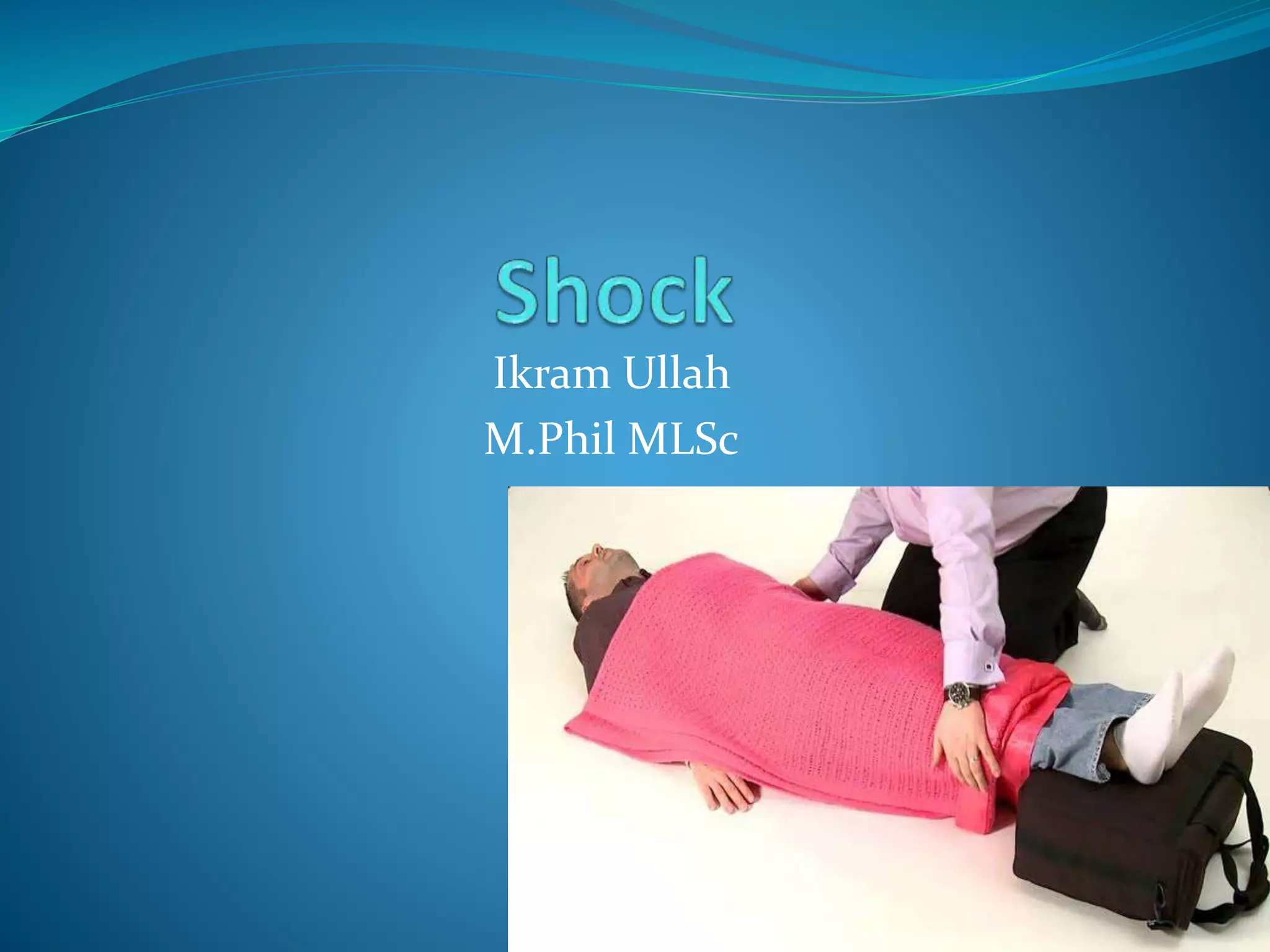
Shock
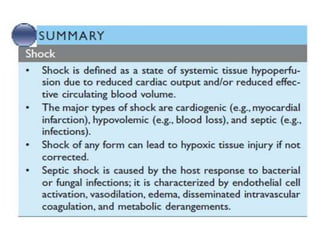
 Shock is characterized by systemic hypoperfusion of
tissues; it can be caused by diminished cardiac output or
by reduced effective circulating blood volume
 The consequences are impaired tissue perfusion and
cellular hypoxia
 Although shock initially is reversible, prolonged shock
eventually leads to irreversible tissue injury that often
proves fatal
 Shock is the final common pathway for several
potentially lethal events, including exsanguination,
extensive trauma or burns, myocardial infarction,
pulmonary embolism, and sepsis
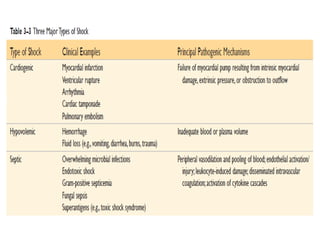
Types
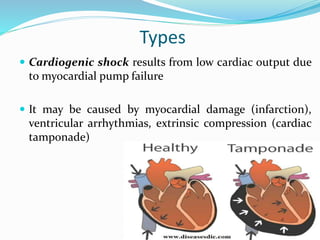
 Cardiogenic shock results from low cardiac output due
to myocardial pump failure
 It may be caused by myocardial damage (infarction),
ventricular arrhythmias, extrinsic compression (cardiac
tamponade)
 Hypovolemic shock results from low cardiac output
due to loss of blood or plasma volume
 e.g., due to hemorrhage or fluid loss from severe burns
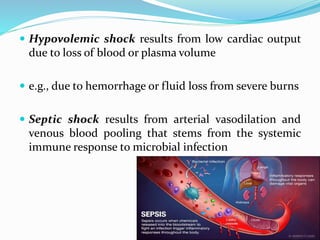
 Septic shock results from arterial vasodilation and
venous blood pooling that stems from the systemic
immune response to microbial infection
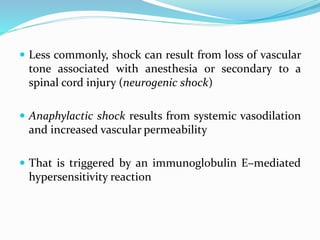
 Less commonly, shock can result from loss of vascular
tone associated with anesthesia or secondary to a
spinal cord injury (neurogenic shock)
 Anaphylactic shock results from systemic vasodilation
and increased vascular permeability
 That is triggered by an immunoglobulin E–mediated
hypersensitivity reaction
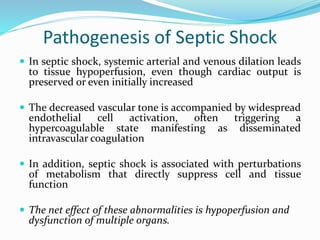
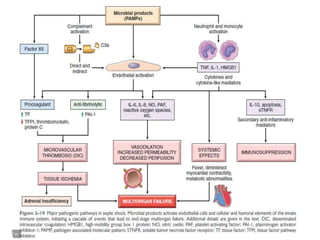
Pathogenesis of Septic Shock
 In septic shock, systemic arterial and venous dilation leads
to tissue hypoperfusion, even though cardiac output is
preserved or even initially increased
 The decreased vascular tone is accompanied by widespread
endothelial cell activation, often triggering a
hypercoagulable state manifesting as disseminated
intravascular coagulation
 In addition, septic shock is associated with perturbations
of metabolism that directly suppress cell and tissue
function
 The net effect of these abnormalities is hypoperfusion and
dysfunction of multiple organs.
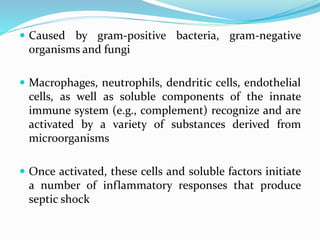
 Caused by gram-positive bacteria, gram-negative
organisms and fungi
 Macrophages, neutrophils, dendritic cells, endothelial
cells, as well as soluble components of the innate
immune system (e.g., complement) recognize and are
activated by a variety of substances derived from
microorganisms
 Once activated, these cells and soluble factors initiate
a number of inflammatory responses that produce
septic shock
Factors contributing to the pathophysiology of
septic shock
 Inflammatory mediators: Cells of the innate
immune system express receptors (e.g., Toll-like
receptors [TLRs]
 That recognize a host of microbe-derived substances
containing so-called pathogen-associated molecular
patterns (PAMPs)
 Activation of pathogen recognition receptors by PAMPs
triggers the innate immune responses that drive sepsis.
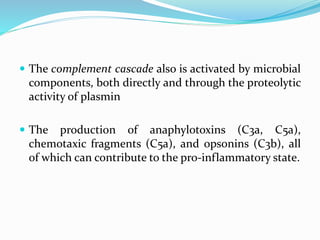
 The complement cascade also is activated by microbial
components, both directly and through the proteolytic
activity of plasmin
 The production of anaphylotoxins (C3a, C5a),
chemotaxic fragments (C5a), and opsonins (C3b), all
of which can contribute to the pro-inflammatory state.
 Endothelial cell activation and injury: Endothelial
activation by microbial constituents or inflammatory
cell mediators has three major sequelae:
 (1) thrombosis;
 (2) increased vascular permeability; and
 (3) vasodilation.
 Sepsis alters the expression of many factors ultimately
favoring coagulation
 Pro-inflammatory cytokines result in increased tissue
factor production
 While at the same time dampening fibrinolysis by
increasing PAI expression
 The production of other endothelial anticoagulant
factors, such as tissue factor pathway inhibitor,
thrombomodulin, and protein C, is also diminished
 The procoagulant tendency is further enhanced by
decreased blood flow within small vessels
 Which produces stasis and diminishes the washout of
activated coagulation factors
 These effects promote the systemic deposition of
fibrin-rich thrombi in small vessels, thus exacerbating
tissue hypoperfusion
 In full blown disseminated intravascular coagulation,
there is also consumption of clotting factors and
platelets, leading to concomitant bleeding and
hemorrhage
 The pro-inflammatory state widespread vascular
leakage and tissue edema, with deleterious effects on
both nutrient delivery and waste removal
 Expression of vasoactive inflammatory mediators (e.g.,
C3a, C5a, PAF, NO) leads to systemic relaxation of
vascular smooth muscle, producing hypotension and
further reductions in tissue perfusion
Metabolic abnormalities
 Septic patients exhibit insulin resistance and
hyperglycemia
 Cytokines such as TNF and IL-1, stress-induced hormones
(such as glucagon, growth hormone, and glucocorticoid),
and catecholamines all drive gluconeogenesis
 The pro-inflammatory cytokines suppress insulin release
while simultaneously promoting insulin resistance in
skeletal muscle and other tissues
 Hyperglycemia suppresses neutrophil function—thereby
decreasing bactericidal activity
Immune suppression.
 The hyperinflammatory state initiated by sepsis can
paradoxically lead to a state of immunosuppression
 Proposed mechanisms include production of anti-
inflammatory mediators
Organ dysfunction.
 All of the following conditions decrease the delivery of
oxygen and nutrients to the tissues and contribute to
organ dysfunction.
 Systemic hypotension, increased vascular
permeability, tissue edema, and small vessel
thrombosis
 An additional group of secreted bacterial proteins
called superantigens also cause a syndrome similar to
septic shock (e.g., toxic shock syndrome)
 Superantigens are polyclonal T-lymphocyte activators
that induce T cells to release high levels of cytokines
 Which in turn results in a variety of clinical
manifestations, ranging from a diffuse rash to
vasodilation, hypotension, and death
Stages of Shock
 Shock is a progressive disorder that leads to death if
the underlying problems are not corrected.
 For hypovolemic and cardiogenic shock, the pathways
leading to a patient’s demise are reasonably well
understood
Stages of Shock
 An initial nonprogressive stage, during which reflex
compensatory mechanisms are activated and vital
organ perfusion is maintained
 A progressive stage, characterized by tissue
hypoperfusion and onset of worsening circulatory and
metabolic derangement, including acidosis
 An irreversible stage, in which cellular and tissue
injury is so severe that even if the hemodynamic
defects are corrected, survival is not possible
Compensatory Mechanism
 In the early nonprogressive phase of shock, various
neurohumoral mechanisms help maintain cardiac
output and blood pressure
 These mechanisms include
 Baroreceptor reflexes
 Release of catecholamines
 Antidiuretic hormone
 Activation of the renin-angiotensin-aldersterone axis
 And generalized sympathetic stimulation
 The net effect is tachycardia, peripheral vasoconstriction,
and renal fluid conservation
 Cutaneous vasoconstriction causes the characteristic
“shocky” skin coolness and pallor
 Septic shock can initially cause cutaneous vasodilation, so
the patient may present with warm, flushed skin)
 Coronary and cerebral vessels are less sensitive to
sympathetic signals and maintain relatively normal caliber,
blood flow, and oxygen delivery
 Thus, blood is shunted away from the skin to the vital
organs such as the heart and the brain
 If the underlying causes are not corrected, shock passes
imperceptibly to the progressive phase, which as noted is
characterized by widespread tissue hypoxia
 In the setting of persistent oxygen deficit, intracellular
aerobic respiration is replaced by anaerobic glycolysis with
excessive production of lactic acid
 Metabolic lactic acidosis lowers the tissue pH, which blunts
the vasomotor response; arterioles dilate, and blood begins
to pool in the microcirculation
 Peripheral pooling not only worsens the cardiac output but
also puts endothelial cells at risk for the development of
anoxic injury with subsequent DIC
`

Shock

  • 1.
  • 2.
    Shock  Shock ischaracterized by systemic hypoperfusion of tissues; it can be caused by diminished cardiac output or by reduced effective circulating blood volume  The consequences are impaired tissue perfusion and cellular hypoxia  Although shock initially is reversible, prolonged shock eventually leads to irreversible tissue injury that often proves fatal  Shock is the final common pathway for several potentially lethal events, including exsanguination, extensive trauma or burns, myocardial infarction, pulmonary embolism, and sepsis
  • 3.
    Types  Cardiogenic shockresults from low cardiac output due to myocardial pump failure  It may be caused by myocardial damage (infarction), ventricular arrhythmias, extrinsic compression (cardiac tamponade)
  • 4.
     Hypovolemic shockresults from low cardiac output due to loss of blood or plasma volume  e.g., due to hemorrhage or fluid loss from severe burns  Septic shock results from arterial vasodilation and venous blood pooling that stems from the systemic immune response to microbial infection
  • 6.
     Less commonly,shock can result from loss of vascular tone associated with anesthesia or secondary to a spinal cord injury (neurogenic shock)  Anaphylactic shock results from systemic vasodilation and increased vascular permeability  That is triggered by an immunoglobulin E–mediated hypersensitivity reaction
  • 7.
    Pathogenesis of SepticShock  In septic shock, systemic arterial and venous dilation leads to tissue hypoperfusion, even though cardiac output is preserved or even initially increased  The decreased vascular tone is accompanied by widespread endothelial cell activation, often triggering a hypercoagulable state manifesting as disseminated intravascular coagulation  In addition, septic shock is associated with perturbations of metabolism that directly suppress cell and tissue function  The net effect of these abnormalities is hypoperfusion and dysfunction of multiple organs.
  • 8.
     Caused bygram-positive bacteria, gram-negative organisms and fungi  Macrophages, neutrophils, dendritic cells, endothelial cells, as well as soluble components of the innate immune system (e.g., complement) recognize and are activated by a variety of substances derived from microorganisms  Once activated, these cells and soluble factors initiate a number of inflammatory responses that produce septic shock
  • 10.
    Factors contributing tothe pathophysiology of septic shock  Inflammatory mediators: Cells of the innate immune system express receptors (e.g., Toll-like receptors [TLRs]  That recognize a host of microbe-derived substances containing so-called pathogen-associated molecular patterns (PAMPs)  Activation of pathogen recognition receptors by PAMPs triggers the innate immune responses that drive sepsis.
  • 11.
     The complementcascade also is activated by microbial components, both directly and through the proteolytic activity of plasmin  The production of anaphylotoxins (C3a, C5a), chemotaxic fragments (C5a), and opsonins (C3b), all of which can contribute to the pro-inflammatory state.
  • 12.
     Endothelial cellactivation and injury: Endothelial activation by microbial constituents or inflammatory cell mediators has three major sequelae:  (1) thrombosis;  (2) increased vascular permeability; and  (3) vasodilation.
  • 13.
     Sepsis altersthe expression of many factors ultimately favoring coagulation  Pro-inflammatory cytokines result in increased tissue factor production  While at the same time dampening fibrinolysis by increasing PAI expression  The production of other endothelial anticoagulant factors, such as tissue factor pathway inhibitor, thrombomodulin, and protein C, is also diminished
  • 14.
     The procoagulanttendency is further enhanced by decreased blood flow within small vessels  Which produces stasis and diminishes the washout of activated coagulation factors  These effects promote the systemic deposition of fibrin-rich thrombi in small vessels, thus exacerbating tissue hypoperfusion  In full blown disseminated intravascular coagulation, there is also consumption of clotting factors and platelets, leading to concomitant bleeding and hemorrhage
  • 15.
     The pro-inflammatorystate widespread vascular leakage and tissue edema, with deleterious effects on both nutrient delivery and waste removal  Expression of vasoactive inflammatory mediators (e.g., C3a, C5a, PAF, NO) leads to systemic relaxation of vascular smooth muscle, producing hypotension and further reductions in tissue perfusion
  • 16.
    Metabolic abnormalities  Septicpatients exhibit insulin resistance and hyperglycemia  Cytokines such as TNF and IL-1, stress-induced hormones (such as glucagon, growth hormone, and glucocorticoid), and catecholamines all drive gluconeogenesis  The pro-inflammatory cytokines suppress insulin release while simultaneously promoting insulin resistance in skeletal muscle and other tissues  Hyperglycemia suppresses neutrophil function—thereby decreasing bactericidal activity
  • 17.
    Immune suppression.  Thehyperinflammatory state initiated by sepsis can paradoxically lead to a state of immunosuppression  Proposed mechanisms include production of anti- inflammatory mediators
  • 18.
    Organ dysfunction.  Allof the following conditions decrease the delivery of oxygen and nutrients to the tissues and contribute to organ dysfunction.  Systemic hypotension, increased vascular permeability, tissue edema, and small vessel thrombosis
  • 19.
     An additionalgroup of secreted bacterial proteins called superantigens also cause a syndrome similar to septic shock (e.g., toxic shock syndrome)  Superantigens are polyclonal T-lymphocyte activators that induce T cells to release high levels of cytokines  Which in turn results in a variety of clinical manifestations, ranging from a diffuse rash to vasodilation, hypotension, and death
  • 20.
    Stages of Shock Shock is a progressive disorder that leads to death if the underlying problems are not corrected.  For hypovolemic and cardiogenic shock, the pathways leading to a patient’s demise are reasonably well understood
  • 21.
    Stages of Shock An initial nonprogressive stage, during which reflex compensatory mechanisms are activated and vital organ perfusion is maintained  A progressive stage, characterized by tissue hypoperfusion and onset of worsening circulatory and metabolic derangement, including acidosis  An irreversible stage, in which cellular and tissue injury is so severe that even if the hemodynamic defects are corrected, survival is not possible
  • 22.
    Compensatory Mechanism  Inthe early nonprogressive phase of shock, various neurohumoral mechanisms help maintain cardiac output and blood pressure  These mechanisms include  Baroreceptor reflexes  Release of catecholamines  Antidiuretic hormone  Activation of the renin-angiotensin-aldersterone axis  And generalized sympathetic stimulation
  • 23.
     The neteffect is tachycardia, peripheral vasoconstriction, and renal fluid conservation  Cutaneous vasoconstriction causes the characteristic “shocky” skin coolness and pallor  Septic shock can initially cause cutaneous vasodilation, so the patient may present with warm, flushed skin)  Coronary and cerebral vessels are less sensitive to sympathetic signals and maintain relatively normal caliber, blood flow, and oxygen delivery  Thus, blood is shunted away from the skin to the vital organs such as the heart and the brain
  • 24.
     If theunderlying causes are not corrected, shock passes imperceptibly to the progressive phase, which as noted is characterized by widespread tissue hypoxia  In the setting of persistent oxygen deficit, intracellular aerobic respiration is replaced by anaerobic glycolysis with excessive production of lactic acid  Metabolic lactic acidosis lowers the tissue pH, which blunts the vasomotor response; arterioles dilate, and blood begins to pool in the microcirculation  Peripheral pooling not only worsens the cardiac output but also puts endothelial cells at risk for the development of anoxic injury with subsequent DIC
  • 25.