NEURO-MUSCULAR
JUNCTIONS
First year MBBS,
THOOTHUKUDI MEDICAL
COLLEGE,
THOOTHUKUDI
OBJECTIVES
 Structure of Neuromuscular junction
 Events occurring at Neuromuscular
junction
 Drugs acting on Neuromuscular
junction and their mechanism of action
 Clinical Aspects
1)Myasthenia Gravis
2)Lambert-Eaton Syndrome
First of all….What is a
neuromuscular junction??
 Neuromuscular junction refers to the
intimate contact of nerve endings with
the muscle fiber to which they innervate
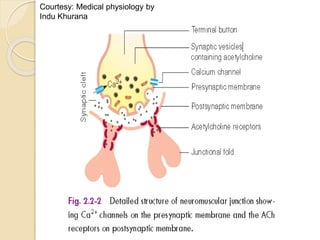
 The following structures are included in a
typical neuromuscular junction
* Terminal button
* Presynaptic membrane
* Synaptic cleft
* Postsynaptic membrane
1) Terminal Button
 The axon of a neuron supplying a
skeletal muscle loses its myelin sheath
and divides into a number of fine
branches which end in small knobs
called terminal buttons or end feet which
forms a neuromuscular junction, at the
centre of muscle fibre .
 Synaptic knob contain about three lakh
vesicles containing acetylcholine and
mitochondria.
 The acetylcholine is synthesized by the
mitochondria and is stored in the
vesicles
Pre synaptic membrane
This refers to the axonal membrane
lining the terminal buttons of the nerve
endings.
Synaptic cleft
 It is the space between the
presynaptic and the postsynaptic
membrane
 It is about 50-100nm
 It is filled with ECF with reticular fibers
forming the matrix
Post synaptic membrane
 It refers to the sacrolemma of the
muscle fiber which is present in the
neuromuscular junction
 The sacrolemma is thickened and
depressed to form the synaptic trough
where the terminal button fits
 This thickened portion is called the
motor end plate
Contd…
 The postsynaptic membrane contains
receptor sites for ACETYLCHOLINE
called as the NICOTINIC
RECEPTORS
 The matrix of cleft contains the
enzyme CHOLINESTERASE which
hydrolyzes the acetylcholine
Courtesy: Medical
physiology by Indu Khurana
Courtesy: Medical physiology by
Indu Khurana
Synthesis of
ACETYLCHOLINE
Raw materials :
The mitochondria requires
 Choline
 Acetyl Co Enzyme-A
 ATP
 Glucose
 Enzyme---} Choline acetylase (or)
Choline transferase
Storage :
Acetylcholine once synthesized is
stored temporarily in the vesicles in
small packets called quanta which
consists of about 10^4 molecules of
acetylcholine
Sequence of events:
 Release of acetylcholine by the nerve
terminals
 Effect of acetylcholine on the
postsynaptic membrane
 Development of end plate potential
 Miniature end plate potential
 Removal of acetylcholine by
cholinesterase
 Initiation of action potential in the muscle
fiber
Release of acetylcholine by the
nerve terminals
 When the nerve impulse travelling in the
nerve fibre (axon) reaches the terminal
buttons, the voltage gated Ca2+
channels present on the presynaptic
membrane open up, increasing its
permeability to Ca2+ ions.
 Consequently, the Ca2+ ions present in
the ECF of the synaptic cleft enter the
cytosol of the terminal buttons which
inturn trigger a marked increase in
exocytosis of vesicles releasing
Effect of acetylcholine of the
postsynaptic membrane
The acetylcholine so released diffuses
in the synaptic cleft and binds to the
nicotinic–acetylcholine receptors
located mainly on the junctional folds
of the motor end plate (postsynaptic
membrane) leading to opening up of
the tubular channels.
Development of end plate
potential
Due to opening of the acetylcholine-
gated channels in the end plate
membrane, a large number of Na+
ions from the ECF enter inside the
muscle fibre causing a local positive
potential change inside the muscle
fibre membrane called the end plate
potential.
Contd…
 The end plate potential is non-
propagative but when a critical level of
−60 mV is reached, it triggers the
development of action potential in the
muscle fibre
 The action potentials are generated on
either side of the end plate and
conducted away from the end plate in
both the directions along the muscle
fibres thus causing muscle contraction
Courtesy: Medical physiology
by Indu Khurana
Miniature end plate potential
 Even at rest, small quanta of
acetylcholine are released randomly
from the nerve terminal because of
random Brownian movement of
axoplasm.
 Each quantum of acetylcholine
produces a weak end plate potential
about 0.5 mV in magnitude. This is
called miniature end plate potential.
Giant end plate potential
 Due to increased releasing of
Acetylcholine the end plate potential
rises to 12mV.
 This is known as giant end plate
potential
 This is not sufficient to generate
action potential
Removal of acetylcholine
 The acetylcholine released in the
synaptic cleft stays for a short time
and is removed within 1 ms by the
enzyme acetylcholinesterase present
in the matrix of synaptic cleft.
 A small amount of ACh diffuses back
into nerve terminals from the synaptic
cleft.
 The rapid removal prevents repeated
excitation of the muscle fibre
Drugs affecting neuromuscular
juncton
These drugs are classified as :
*Drugs which block transmission,
known as NEUROMUSCULAR
BLOCKERS
*Drugs that stimulate transmission,
the NEUROMUSCULAR
STIMULATORS
NEUROMUSCULAR
BLOCKERS
 CURAE
 BUNGAROTOXIN
 SUCCINYLCHOLINE
 CARBAMYLCHOLINE
 BOTULINUM TOXIN
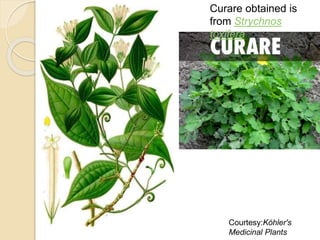
Curare
 Curare combines with the
aceytlcholine receptors
 Thus there will be no sites for the
acetylcholine to combine and hence
end plate potential will not develop
 This is the active principle of
D-tubocurarine
Curare obtained is
from Strychnos
toxifera
Courtesy:Köhler's
Medicinal Plants
Bungarotoxin
 This is obtained from venom of deadly
snakes
 This also binds with the Acetylcholine
receptors and block the transmission
Obtained from a krait (snake)
Bungarus multicinctus
Courtesy: PubChem and
Thomas Brown
Succinylcholine &
carbamylcholine
 Succinylcholine and carbamylcholine
act like acetylcholine and cause
depolarization of the postsynaptic
membrane.
 But, these are not destroyed by
cholinesterase and so the muscle
remains in a depolarized state for a
long time.
 Thus, these drugs block the
myoneural junction by keeping the
Succinylcholine
Courtesy: pharmacopeia.cn
Carmabylcholine (carbachol)
Courtesy:
Chembase
Botulinum toxin
 It is obtained from Clostridium
botulinum
 It prevents the release of acetylcholine
from the terminal branches of the
nerve endings
Courtesy: Centre for Food safety, Hong Kong
Neuromuscular stimulators
• Methacholine
• Carbachol
• NicotineDrugs acting
like Ach
• Neostigmine
• Physostigmine
• Diisopropyl
flurophosphate(DFP)
Drugs that
inactivate
cholinesterase
Drugs acting like Ach
 These act like acetylcholine and
produce end plate potential exciting
the muscle fibre.
 However, these drugs are either not
destroyed or are destroyed very slowly
by the enzyme acetylcholinesterase.
 So they cause repeated stimulation
and continuous action of muscle,
thereby causing a state of muscle
spasm.
Drugs that inactivates the
enzyme cholinesterase:
 These stimulate the neuromuscular
junction by inactivating this enzyme due
to which the acetylcholine released at
the nerve terminal cannot be hydrolysed,
this leads to repeated stimulation and
continuous action of muscle.
 The effect of neostigmine and
physostigmine lasts for several hours
while that of DFP lasts for several
weeks.
 The DFP is thus a lethal poison which
can cause death due to laryngeal spasm.
Clinical aspects :
•Myasthenia
gravis
•Lambert-Eaton
syndrome
AntibodiesattacktheseACHreceptors
Lambert-Eaton syndrome
 Here, antibodies are produced against
the calcium channels present on the
presynaptic membrane which destroy the
channels.
 Consequently, Ca2+ influx into the nerve
terminal is markedly decreased and
thereby release of acetylcholine is also
reduced.
 Scanty amount of acetylcholine is not
able to produce adequate end plate
potential to excite the muscle fibres
producing muscular weakness.
Symptoms
 Weak muscles – weakness is often
relieved temporarily after exercise or
exertion
 Trouble walking
 Tingling sensation in the hands or feet
 Eyelid drooping
 Fatigue
 Dry mouth
 Trouble speaking and swallowing
 Trouble breathing
 Bladder and bowel changes
 Erectile dysfunction
References:
 Medical physiology for Undergraduate
students by Indu Khurana 1st Edition
 Textbook of Medical physiology by
Guyton and Hall , 2nd South Asia
Edition
 Johns Hopkins Medical library(online)
First year MBBS
THOOTHUKUDI MEDICAL COLLEGE, THOOTHUKUDI

Neuromuscular junction

  • 1.
  • 2.
    OBJECTIVES  Structure ofNeuromuscular junction  Events occurring at Neuromuscular junction  Drugs acting on Neuromuscular junction and their mechanism of action  Clinical Aspects 1)Myasthenia Gravis 2)Lambert-Eaton Syndrome
  • 3.
    First of all….Whatis a neuromuscular junction??  Neuromuscular junction refers to the intimate contact of nerve endings with the muscle fiber to which they innervate  The following structures are included in a typical neuromuscular junction * Terminal button * Presynaptic membrane * Synaptic cleft * Postsynaptic membrane
  • 4.
    1) Terminal Button The axon of a neuron supplying a skeletal muscle loses its myelin sheath and divides into a number of fine branches which end in small knobs called terminal buttons or end feet which forms a neuromuscular junction, at the centre of muscle fibre .  Synaptic knob contain about three lakh vesicles containing acetylcholine and mitochondria.  The acetylcholine is synthesized by the mitochondria and is stored in the vesicles
  • 5.
    Pre synaptic membrane Thisrefers to the axonal membrane lining the terminal buttons of the nerve endings.
  • 6.
    Synaptic cleft  Itis the space between the presynaptic and the postsynaptic membrane  It is about 50-100nm  It is filled with ECF with reticular fibers forming the matrix
  • 7.
    Post synaptic membrane It refers to the sacrolemma of the muscle fiber which is present in the neuromuscular junction  The sacrolemma is thickened and depressed to form the synaptic trough where the terminal button fits  This thickened portion is called the motor end plate
  • 8.
    Contd…  The postsynapticmembrane contains receptor sites for ACETYLCHOLINE called as the NICOTINIC RECEPTORS  The matrix of cleft contains the enzyme CHOLINESTERASE which hydrolyzes the acetylcholine
  • 9.
  • 10.
  • 11.
    Synthesis of ACETYLCHOLINE Raw materials: The mitochondria requires  Choline  Acetyl Co Enzyme-A  ATP  Glucose  Enzyme---} Choline acetylase (or) Choline transferase
  • 12.
    Storage : Acetylcholine oncesynthesized is stored temporarily in the vesicles in small packets called quanta which consists of about 10^4 molecules of acetylcholine
  • 13.
    Sequence of events: Release of acetylcholine by the nerve terminals  Effect of acetylcholine on the postsynaptic membrane  Development of end plate potential  Miniature end plate potential  Removal of acetylcholine by cholinesterase  Initiation of action potential in the muscle fiber
  • 14.
    Release of acetylcholineby the nerve terminals  When the nerve impulse travelling in the nerve fibre (axon) reaches the terminal buttons, the voltage gated Ca2+ channels present on the presynaptic membrane open up, increasing its permeability to Ca2+ ions.  Consequently, the Ca2+ ions present in the ECF of the synaptic cleft enter the cytosol of the terminal buttons which inturn trigger a marked increase in exocytosis of vesicles releasing
  • 15.
    Effect of acetylcholineof the postsynaptic membrane The acetylcholine so released diffuses in the synaptic cleft and binds to the nicotinic–acetylcholine receptors located mainly on the junctional folds of the motor end plate (postsynaptic membrane) leading to opening up of the tubular channels.
  • 16.
    Development of endplate potential Due to opening of the acetylcholine- gated channels in the end plate membrane, a large number of Na+ ions from the ECF enter inside the muscle fibre causing a local positive potential change inside the muscle fibre membrane called the end plate potential.
  • 17.
    Contd…  The endplate potential is non- propagative but when a critical level of −60 mV is reached, it triggers the development of action potential in the muscle fibre  The action potentials are generated on either side of the end plate and conducted away from the end plate in both the directions along the muscle fibres thus causing muscle contraction
  • 18.
  • 19.
    Miniature end platepotential  Even at rest, small quanta of acetylcholine are released randomly from the nerve terminal because of random Brownian movement of axoplasm.  Each quantum of acetylcholine produces a weak end plate potential about 0.5 mV in magnitude. This is called miniature end plate potential.
  • 20.
    Giant end platepotential  Due to increased releasing of Acetylcholine the end plate potential rises to 12mV.  This is known as giant end plate potential  This is not sufficient to generate action potential
  • 21.
    Removal of acetylcholine The acetylcholine released in the synaptic cleft stays for a short time and is removed within 1 ms by the enzyme acetylcholinesterase present in the matrix of synaptic cleft.  A small amount of ACh diffuses back into nerve terminals from the synaptic cleft.  The rapid removal prevents repeated excitation of the muscle fibre
  • 22.
    Drugs affecting neuromuscular juncton Thesedrugs are classified as : *Drugs which block transmission, known as NEUROMUSCULAR BLOCKERS *Drugs that stimulate transmission, the NEUROMUSCULAR STIMULATORS
  • 23.
    NEUROMUSCULAR BLOCKERS  CURAE  BUNGAROTOXIN SUCCINYLCHOLINE  CARBAMYLCHOLINE  BOTULINUM TOXIN
  • 24.
    Curare  Curare combineswith the aceytlcholine receptors  Thus there will be no sites for the acetylcholine to combine and hence end plate potential will not develop  This is the active principle of D-tubocurarine
  • 25.
    Curare obtained is fromStrychnos toxifera Courtesy:Köhler's Medicinal Plants
  • 26.
    Bungarotoxin  This isobtained from venom of deadly snakes  This also binds with the Acetylcholine receptors and block the transmission
  • 27.
    Obtained from akrait (snake) Bungarus multicinctus Courtesy: PubChem and Thomas Brown
  • 28.
    Succinylcholine & carbamylcholine  Succinylcholineand carbamylcholine act like acetylcholine and cause depolarization of the postsynaptic membrane.  But, these are not destroyed by cholinesterase and so the muscle remains in a depolarized state for a long time.  Thus, these drugs block the myoneural junction by keeping the
  • 29.
  • 30.
  • 31.
    Botulinum toxin  Itis obtained from Clostridium botulinum  It prevents the release of acetylcholine from the terminal branches of the nerve endings
  • 32.
    Courtesy: Centre forFood safety, Hong Kong
  • 33.
    Neuromuscular stimulators • Methacholine •Carbachol • NicotineDrugs acting like Ach • Neostigmine • Physostigmine • Diisopropyl flurophosphate(DFP) Drugs that inactivate cholinesterase
  • 34.
    Drugs acting likeAch  These act like acetylcholine and produce end plate potential exciting the muscle fibre.  However, these drugs are either not destroyed or are destroyed very slowly by the enzyme acetylcholinesterase.  So they cause repeated stimulation and continuous action of muscle, thereby causing a state of muscle spasm.
  • 35.
    Drugs that inactivatesthe enzyme cholinesterase:  These stimulate the neuromuscular junction by inactivating this enzyme due to which the acetylcholine released at the nerve terminal cannot be hydrolysed, this leads to repeated stimulation and continuous action of muscle.  The effect of neostigmine and physostigmine lasts for several hours while that of DFP lasts for several weeks.  The DFP is thus a lethal poison which can cause death due to laryngeal spasm.
  • 36.
  • 38.
  • 39.
    Lambert-Eaton syndrome  Here,antibodies are produced against the calcium channels present on the presynaptic membrane which destroy the channels.  Consequently, Ca2+ influx into the nerve terminal is markedly decreased and thereby release of acetylcholine is also reduced.  Scanty amount of acetylcholine is not able to produce adequate end plate potential to excite the muscle fibres producing muscular weakness.
  • 40.
    Symptoms  Weak muscles– weakness is often relieved temporarily after exercise or exertion  Trouble walking  Tingling sensation in the hands or feet  Eyelid drooping  Fatigue  Dry mouth  Trouble speaking and swallowing  Trouble breathing  Bladder and bowel changes  Erectile dysfunction
  • 41.
    References:  Medical physiologyfor Undergraduate students by Indu Khurana 1st Edition  Textbook of Medical physiology by Guyton and Hall , 2nd South Asia Edition  Johns Hopkins Medical library(online)
  • 42.
    First year MBBS THOOTHUKUDIMEDICAL COLLEGE, THOOTHUKUDI