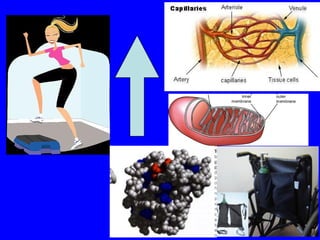
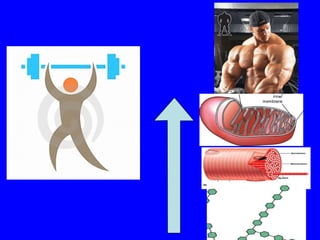
Why do I care? You like to move
Muscle Similarities Skeletal and smooth muscle cells are elongated and are called muscle fibers Muscle contraction depends on two kinds of myofilaments – actin and myosin Muscle terminology is similar Sarcolemma – muscle plasma membrane Sarcoplasm – cytoplasm of a muscle cell myo, mys, and sarco all refer to muscle
Skeletal Muscle Tissue Attach to the skeleton Striations Voluntary Contracts rapidly, tires easily Is responsible for movement Is extremely adaptable and can exert a wide range of forces
Cardiac Muscle Tissue In the heart  Striated  Involuntary Contracts at a steady rate set by the pacemaker Neural controls allow the heart to respond to changes in bodily needs
Smooth Muscle Tissue Found in the walls of hollow organs, such as the stomach, urinary bladder, and respiratory passages Forces food and other substances through internal body channels It is not striated and is involuntary
muscle cells are referred to as? muscle fibers What prefixes mean muscle? mys, myo, sarco What type of muscle is subject to conscious control? Skeletal What muscle types appear striated? skeletal and cardiac
Functional Characteristics of Muscle Tissue Excitability– the ability to receive and respond to stimuli Contractility – the ability to shorten Extensibility – the ability to be stretched Elasticity – the ability to recoil
Identify four important functions of muscle tissue
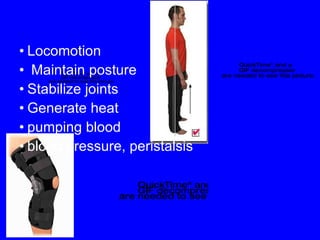
Locomotion Maintain posture  Stabilize joints Generate heat pumping blood blood pressure, peristalsis
Describe the structure and function of the gross and microscopic structures of skeletal muscle
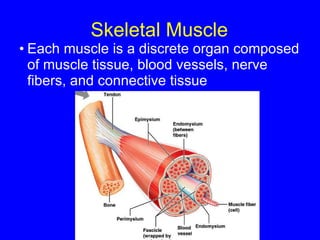
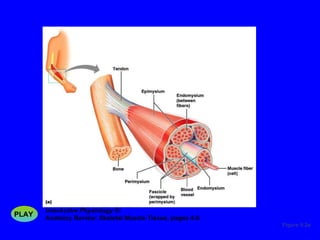
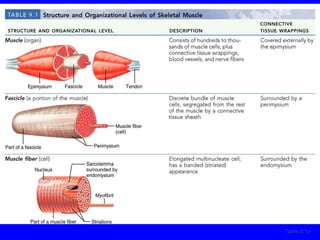
Skeletal Muscle Each muscle is a discrete organ composed of muscle tissue, blood vessels, nerve fibers, and connective tissue
Figure 9.2a InterActive Physiology ÂŽ:   Anatomy Review: Skeletal Muscle Tissue, pages 4-6 PLAY
Table 9.1a
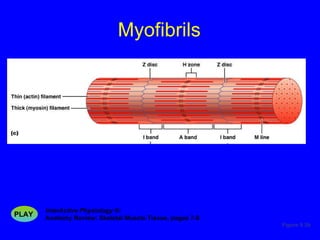
Myofibrils Figure 9.3b InterActive Physiology ÂŽ:   Anatomy Review: Skeletal Muscle Tissue, pages 7-8 PLAY
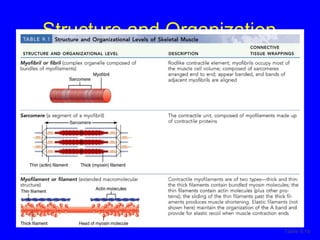
Structure and Organization Table 9.1b
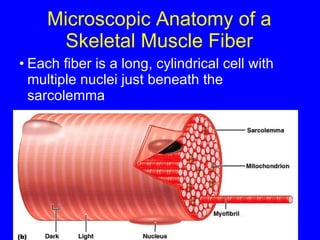
Microscopic Anatomy of a Skeletal Muscle Fiber Each fiber is a long, cylindrical cell with multiple nuclei just beneath the sarcolemma
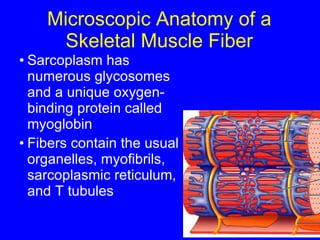
Microscopic Anatomy of a Skeletal Muscle Fiber Sarcoplasm has numerous glycosomes and a unique oxygen-binding protein called myoglobin Fibers contain the usual organelles, myofibrils, sarcoplasmic reticulum, and T tubules
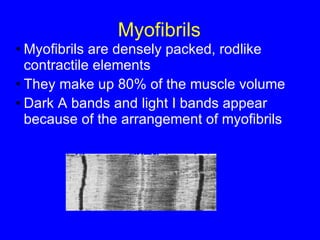
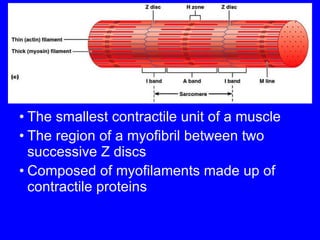
Myofibrils Myofibrils are densely packed, rodlike contractile elements  They make up 80% of the muscle volume  Dark A bands and light I bands appear because of the arrangement of myofibrils
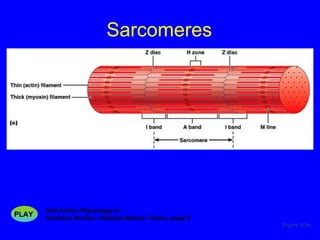
Sarcomeres Figure 9.3c InterActive Physiology ÂŽ:   Anatomy Review: Skeletal Muscle Tissue, page 9 PLAY
The smallest contractile unit of a muscle The region of a myofibril between two successive Z discs Composed of myofilaments made up of contractile proteins
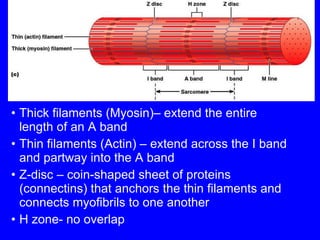
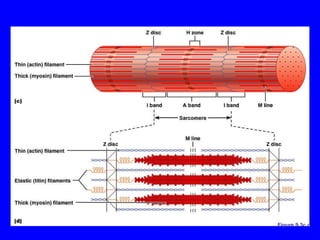
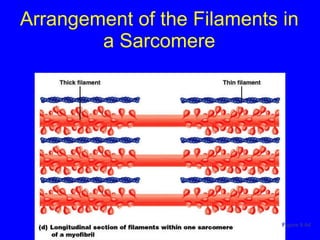
Thick filaments (Myosin)– extend the entire length of an A band Thin filaments (Actin) – extend across the I band and partway into the A band Z-disc – coin-shaped sheet of proteins (connectins) that anchors the thin filaments and connects myofibrils to one another H zone- no overlap
Figure 9.3c,d
1. What is the smallest functional unit of skeletal muscle? 2. Give 4 functions of skeletal muscle.
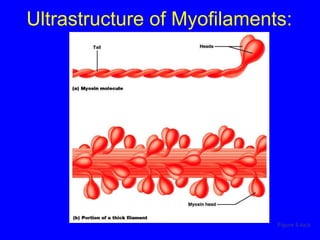
Ultrastructure of Myofilaments: Thick Filaments Figure 9.4a,b
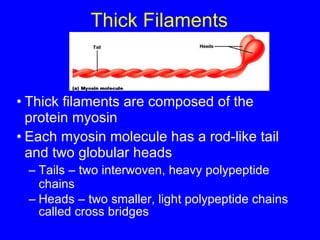
Thick Filaments Thick filaments are composed of the protein myosin Each myosin molecule has a rod-like tail and two globular heads Tails – two interwoven, heavy polypeptide chains Heads – two smaller, light polypeptide chains called cross bridges
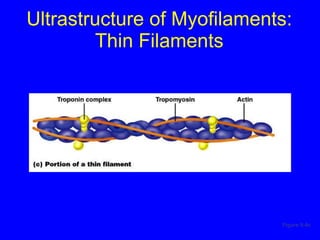
Ultrastructure of Myofilaments: Thin Filaments Figure 9.4c
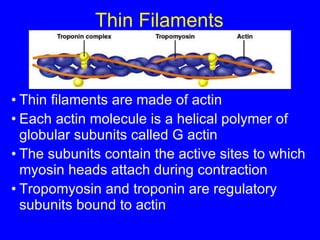
Thin Filaments Thin filaments are made of actin Each actin molecule is a helical polymer of globular subunits called G actin The subunits contain the active sites to which myosin heads attach during contraction Tropomyosin and troponin are regulatory subunits bound to actin
Arrangement of the Filaments in a Sarcomere Figure 9.4d
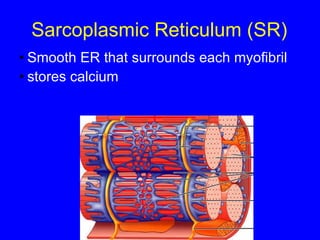
Sarcoplasmic Reticulum (SR) Smooth ER that surrounds each myofibril stores calcium
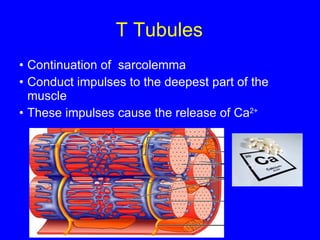
T Tubules Continuation of  sarcolemma Conduct impulses to the deepest part of the muscle These impulses cause the release of Ca 2+
Which of the following components accounts for the bulk muscle fiber volume (up to 80%)? a.  glycosomes b.  mitochondria c.  myofibrils d.  sarcoplasm
The functional unit of a muscle fiber is the __________.
The thin filaments are  not  comprised of which of the following components? a.  actin b.  titin c.  troponin d.  tropomyosin
What is the major function of the sarcoplasmic reticulum? a.  store sodium ions b.  store potassium ions c.  expel calcium ions from the cell d.  store calcium ions
 
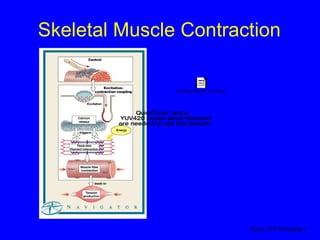
Important steps  Action potential comes from nerve Acetylcholine is released  Action potential is generated in the muscle Action potential travels down the T-tubules Calcium is released
Skeletal Muscle Contraction Figure 10–9 (Navigator)
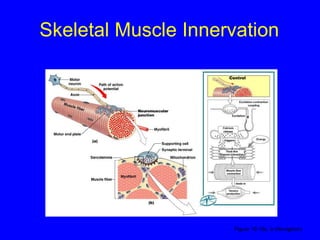
Skeletal Muscle Innervation Figure 10–10a, b (Navigator)
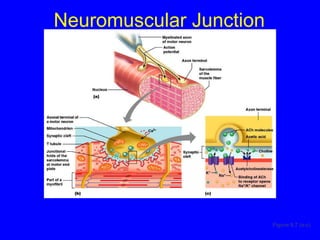
Neuromuscular Junction Figure 9.7 (a-c)
Neuromuscular Junction When a nerve impulse reaches the neuromuscular junction Acetylcholine (Ach) is released InterActive Physiology ÂŽ:   The Neuromuscular Junction, pages 3-5 PLAY
Destruction of Acetylcholine ACh destroyed by the enzyme acetylcholinesterase  This prevents continuous contraction InterActive Physiology ÂŽ:   The Neuromuscular Junction, pages 6-10 PLAY
Ion Channels protein channels in the cell membrane that can be opened by chemicals or electrically
Action Potential An electrical signal that is spread by the difference in charge across a membrane
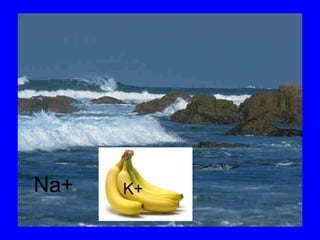
Na+ K+
Action potential At rest, cell has negative charge
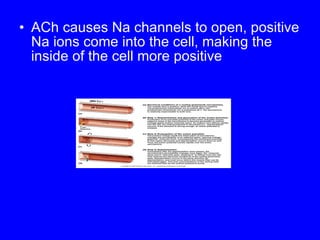
ACh causes Na channels to open, positive Na ions come into the cell, making the inside of the cell more positive
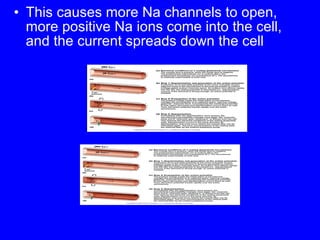
This causes more Na channels to open, more positive Na ions come into the cell, and the current spreads down the cell
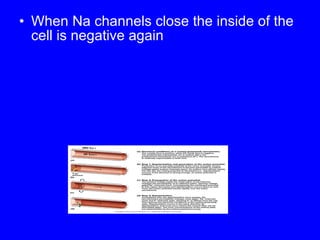
When Na channels close the inside of the cell is negative again
Action potential review At rest, the inside of the cell has negative charge  ACh causes Na channels to open, positive Na ions come into the cell, making the inside of the cell more positive This causes more Na channels to open, more positive Na ions come into the cell, and the current spreads down the cell When Na channels close the inside of the cell becomes negative again
Excitation-Contraction Coupling Once generated, the action potential: Travels along the sarcolemma, down the T tubules Triggers Ca 2+  release Ca 2+  binds to troponin and causes Actin binding sites to be exposed
Excitation-Contraction Coupling Myosin cross bridges alternately attach and detach Thin filaments move toward the center of the sarcomere Hydrolysis of ATP powers this cycling process Ca 2+  is removed into the SR, tropomyosin blockage is restored, and the muscle fiber relaxes
Role of (Ca 2+ )  At low  [Ca 2+ ] Tropomyosin blocks the binding sites on actin Myosin cross bridges cannot attach  Figure 9.11a
At high [Ca 2+  ] Calcium binds to troponin Troponin changes shape tropomyosin moves away from actin’s binding sites Figure 9.11b
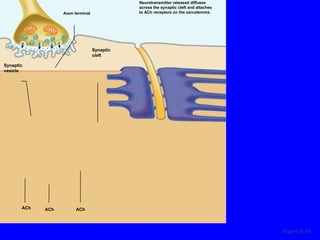
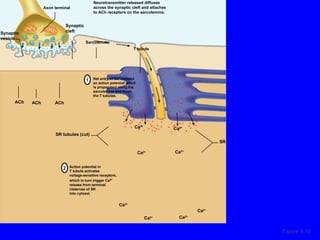
Figure 9.10 Synaptic cleft Synaptic vesicle Axon terminal ACh ACh ACh Neurotransmitter released diffuses across the synaptic cleft and attaches to ACh receptors on the sarcolemma.
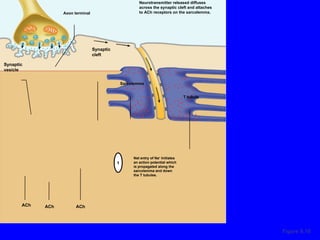
Figure 9.10 Net entry of Na +  Initiates an action potential which is propagated along the sarcolemma and down the T tubules. T tubule Sarcolemma Synaptic cleft Synaptic vesicle Axon terminal ACh ACh ACh Neurotransmitter released diffuses across the synaptic cleft and attaches to ACh receptors on the sarcolemma. 1
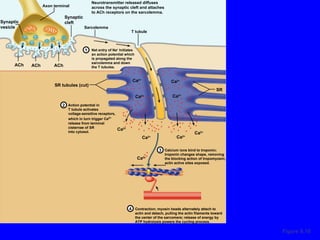
Figure 9.10 Net entry of Na +  Initiates an action potential which is propagated along the sarcolemma and down the T tubules. T tubule Sarcolemma SR tubules (cut) Synaptic cleft Synaptic vesicle Axon terminal ACh ACh ACh Neurotransmitter released diffuses across the synaptic cleft and attaches to ACh receptors on the sarcolemma. Action potential in T tubule activates voltage-sensitive receptors, which in turn trigger Ca 2+ release from terminal cisternae of SR into cytosol.  SR Ca 2+ Ca 2+ Ca 2+ Ca 2+ Ca 2+ Ca 2+ Ca 2+ Ca 2+ 1 2
Figure 9.10 Net entry of Na +  Initiates an action potential which is propagated along the sarcolemma and down the T tubules. T tubule Sarcolemma SR tubules (cut) Synaptic cleft Synaptic vesicle Axon terminal ACh ACh ACh Neurotransmitter released diffuses across the synaptic cleft and attaches to ACh receptors on the sarcolemma. Action potential in T tubule activates voltage-sensitive receptors, which in turn trigger Ca 2+ release from terminal cisternae of SR into cytosol.  Calcium ions bind to troponin; troponin changes shape, removing the blocking action of tropomyosin; actin active sites exposed. SR Ca 2+ Ca 2+ Ca 2+ Ca 2+ Ca 2+ Ca 2+ Ca 2+ Ca 2+ Ca 2+ 1 2 3
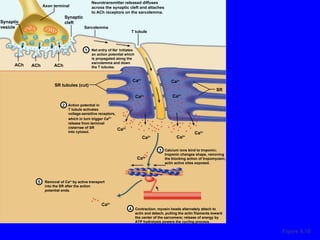
Figure 9.10 Net entry of Na +  Initiates an action potential which is propagated along the sarcolemma and down the T tubules. T tubule Sarcolemma SR tubules (cut) Synaptic cleft Synaptic vesicle Axon terminal ACh ACh ACh Neurotransmitter released diffuses across the synaptic cleft and attaches to ACh receptors on the sarcolemma. Action potential in T tubule activates voltage-sensitive receptors, which in turn trigger Ca 2+ release from terminal cisternae of SR into cytosol.  Calcium ions bind to troponin; troponin changes shape, removing the blocking action of tropomyosin; actin active sites exposed. Contraction; myosin heads alternately attach to actin and detach, pulling the actin filaments toward the center of the sarcomere; release of energy by ATP hydrolysis powers the cycling process. SR Ca 2+ Ca 2+ Ca 2+ Ca 2+ Ca 2+ Ca 2+ Ca 2+ Ca 2+ Ca 2+ 1 2 3 4
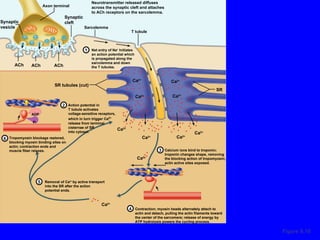
Figure 9.10 Net entry of Na +  Initiates an action potential which is propagated along the sarcolemma and down the T tubules. T tubule Sarcolemma SR tubules (cut) Synaptic cleft Synaptic vesicle Axon terminal ACh ACh ACh Neurotransmitter released diffuses across the synaptic cleft and attaches to ACh receptors on the sarcolemma. Action potential in T tubule activates voltage-sensitive receptors, which in turn trigger Ca 2+ release from terminal cisternae of SR into cytosol.  Calcium ions bind to troponin; troponin changes shape, removing the blocking action of tropomyosin; actin active sites exposed. Contraction; myosin heads alternately attach to actin and detach, pulling the actin filaments toward the center of the sarcomere; release of energy by ATP hydrolysis powers the cycling process. Removal of Ca 2+  by active transport into the SR after the action potential ends. SR Ca 2+ Ca 2+ Ca 2+ Ca 2+ Ca 2+ Ca 2+ Ca 2+ Ca 2+ Ca 2+ Ca 2+ 1 2 3 4 5
Figure 9.10 ADP P i Net entry of Na +  Initiates an action potential which is propagated along the sarcolemma and down the T tubules. T tubule Sarcolemma SR tubules (cut) Synaptic cleft Synaptic vesicle Axon terminal ACh ACh ACh Neurotransmitter released diffuses across the synaptic cleft and attaches to ACh receptors on the sarcolemma. Action potential in T tubule activates voltage-sensitive receptors, which in turn trigger Ca 2+ release from terminal cisternae of SR into cytosol.  Calcium ions bind to troponin; troponin changes shape, removing the blocking action of tropomyosin; actin active sites exposed. Contraction; myosin heads alternately attach to actin and detach, pulling the actin filaments toward the center of the sarcomere; release of energy by ATP hydrolysis powers the cycling process. Removal of Ca 2+  by active transport into the SR after the action potential ends. SR Tropomyosin blockage restored, blocking myosin binding sites on actin; contraction ends and muscle fiber relaxes. Ca 2+ Ca 2+ Ca 2+ Ca 2+ Ca 2+ Ca 2+ Ca 2+ Ca 2+ Ca 2+ Ca 2+ 1 2 3 4 5 6
NMJ 14
EC coupling review Action potential comes from nerve Acetylcholine is released  Action potential is generated in the muscle Action potential travels down the T-tubules Calcium is released
Action potential review
Describe the sliding filament model of muscle contraction
SF19-28
5 Steps of the Contraction Cycle  Exposure of active sites Formation of cross-bridges Pivoting of myosin heads (power stroke) Detachment of cross-bridges Reactivation of myosin
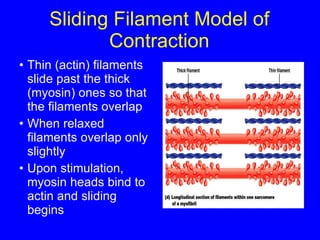
Sliding Filament Model of Contraction Thin (actin) filaments slide past the thick (myosin) ones so that the filaments overlap  When relaxed filaments overlap only slightly Upon stimulation, myosin heads bind to actin and sliding begins
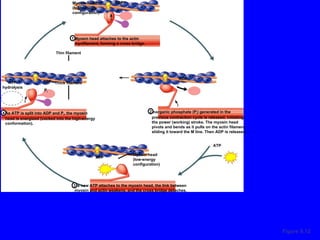
Figure 9.12 ATP ADP ADP ATP hydrolysis ADP ATP P i P i Myosin head (high-energy configuration) Myosin head attaches to the actin myofilament, forming a cross bridge. Thin filament As ATP is split into ADP and P i , the myosin head is energized (cocked into the high-energy conformation). Inorganic phosphate (P i ) generated in the previous contraction cycle is released, initiating the power (working) stroke. The myosin head pivots and bends as it pulls on the actin filament, sliding it toward the M line. Then ADP is released. Myosin head (low-energy configuration) As new ATP attaches to the myosin head, the link between myosin and actin weakens, and the cross bridge detaches. Thick filament 1 4 2 3
5 Steps of the Contraction Cycle  Exposure of active sites Formation of cross-bridges Pivoting of myosin heads Detachment of cross-bridges Reactivation of myosin
Contraction Refers to the activation of myosin’s cross bridges. Shortening occurs when the tension produced is greater than load  Ends when cross bridges become inactive
describe the different types of muscle contraction
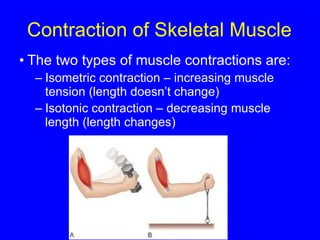
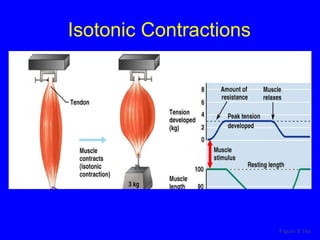
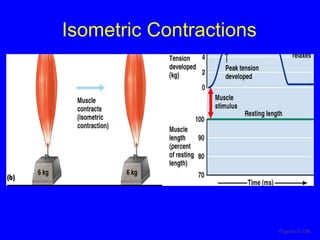
Contraction of Skeletal Muscle The two types of muscle contractions are: Isometric contraction – increasing muscle tension (length doesn’t change) Isotonic contraction – decreasing muscle length (length changes)
Isotonic Contractions Figure 9.19a
Isometric Contractions Figure 9.19b
Describe muscle twitch, tetanus and motor unit
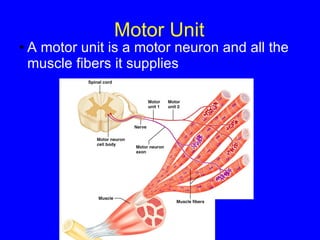
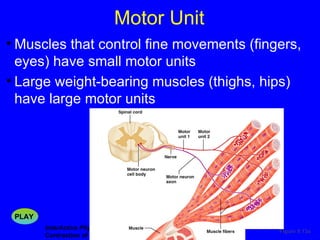
Motor Unit A motor unit is a motor neuron and all the muscle fibers it supplies
Motor Unit InterActive Physiology ÂŽ:   Contraction of Motor Units, pages 3-9 Figure 9.13a Muscles that control fine movements (fingers, eyes) have small motor units Large weight-bearing muscles (thighs, hips) have large motor units PLAY
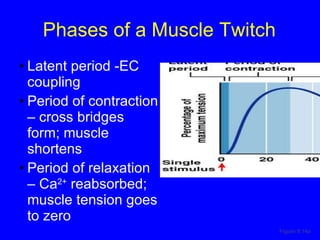
Muscle Twitch A muscle twitch is the response of a muscle to a single stimulus There are three phases to a muscle twitch Latent period Period of contraction Period of relaxation
Phases of a Muscle Twitch Latent period -EC coupling Period of contraction – cross bridges form; muscle shortens Period of relaxation – Ca 2+  reabsorbed; muscle tension goes to zero Figure 9.14a
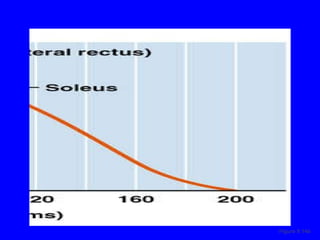
Figure 9.14b
Graded Muscle Responses Graded muscle responses are: Variations in the degree of muscle contraction Required for proper control of skeletal movement Responses are graded by Changing the frequency or strength of stimulation
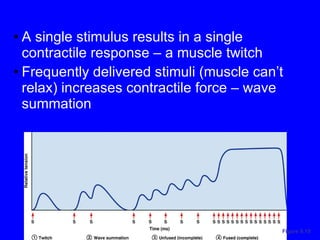
A single stimulus results in a single contractile response – a muscle twitch Frequently delivered stimuli (muscle can’t relax) increases contractile force – wave summation Figure 9.15
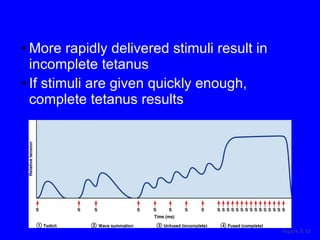
More rapidly delivered stimuli result in incomplete tetanus If stimuli are given quickly enough, complete tetanus results Figure 9.15
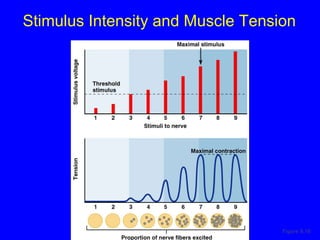
Stimulus Intensity and Muscle Tension Figure 9.16
Threshold stimulus – the minimum stimulus for  contraction to occur Muscle contracts more vigorously as stimulus strength is increased Force of contraction is controlled by the number of motor units recruited (activated) Recruitment activates more and more muscle fibers
Force of Muscle Contraction The force of contraction is affected by: The number of muscle fibers contracting  The relative size of the muscle  Degree of muscle stretch
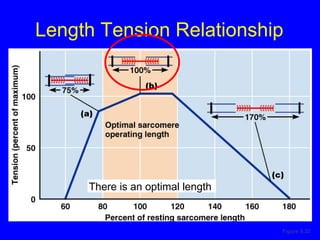
Length Tension Relationship Figure 9.22 There is an optimal length
 
describe the types of skeletal muscle fibers (fast-twitch, slow-twitch)
mm25
Muscle Fiber Type: Functional Characteristics Speed of contraction –  slow and fast fibers ATP-forming pathways Oxidative fibers (red) Glycolytic fibers (white) We have 3 types of fibers- slow oxidative, fast oxidative, and fast glycolytic InterActive Physiology ®:   Muscle Metabolism, pages 25-27 PLAY


Describe the methods that are used to produce ATP for muscle contraction
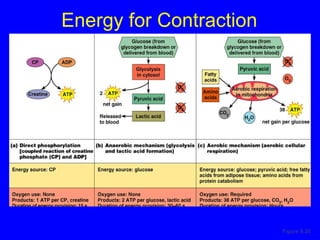
Muscle Metabolism ATP is the energy source for contractile activity As soon as available stores of ATP are used (4-6 seconds), they are regenerated by: Creatine phosphate (CP)  Anaerobic glycolysis  Aerobic respiration InterActive Physiology ÂŽ:   Muscle Metabolism, pages 15
Energy for Contraction Figure 9.20
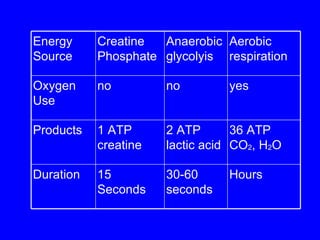
Energy Source Creatine Phosphate Anaerobic glycolyis Aerobic respiration Oxygen Use no no yes Products 1 ATP creatine 2 ATP lactic acid 36 ATP CO 2 , H 2 O Duration 15 Seconds 30-60 seconds Hours
compare the gross, microscopic anatomy, and contractile mechanisms of smooth muscle and cardiac muscle to skeletal muscle
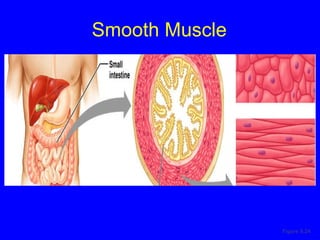
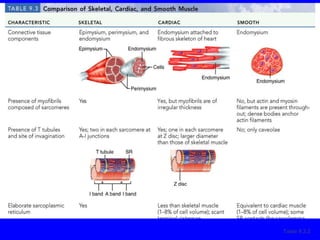
Smooth Muscle spindle-shaped fibers  have fine endomysium Organized into two layers (longitudinal and circular) Found in walls of hollow organs  Have essentially the same contractile mechanisms as skeletal muscle
Smooth Muscle Figure 9.24
Peristalsis Peristalsis – alternating contractions and relaxations of smooth muscles that mix and squeeze substances through the lumen of hollow organs
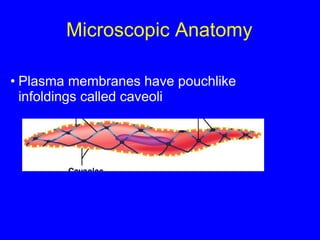
Microscopic Anatomy Plasma membranes have pouchlike infoldings called caveoli
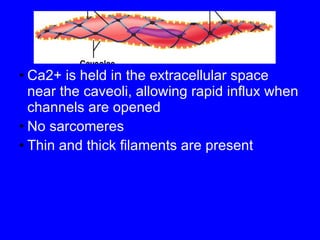
Ca2+ is held in the extracellular space near the caveoli, allowing rapid influx when channels are opened No sarcomeres Thin and thick filaments are present
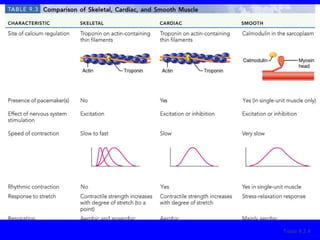
Myofilaments in Smooth Muscle Ratio of thick to thin filaments is lower than in skeletal muscle Thick filaments have heads along their entire length No troponin
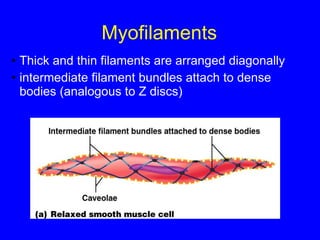
Myofilaments Thick and thin filaments are arranged diagonally intermediate filament bundles attach to dense bodies (analogous to Z discs)
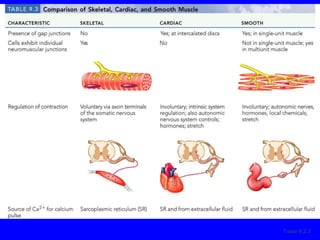
Contraction of Smooth Muscle Whole sheets of smooth muscle exhibit slow, synchronized contraction They are electrically coupled with gap junctions Some cells are self-excitatory and act as pacemakers
Ca 2+  binds to calmodulin and activates it Calmodulin activates the kinase enzyme Kinase transfers phosphate from ATP to myosin cross bridges Phosphorylated cross bridges interact with actin to produce shortening Smooth muscle relaxes when intracellular Ca 2+  levels drop Contraction of Smooth Muscle
Smooth Muscle  Unique characteristics of smooth muscle include: Smooth muscle tone Slow, prolonged contractile activity Low energy requirements Response to stretch
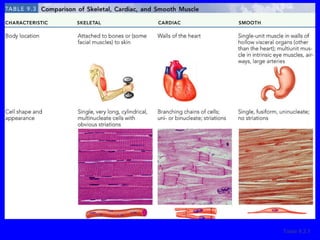
Table 9.3.1
Table 9.3.2
Table 9.3.3
Table 9.3.4
 
 
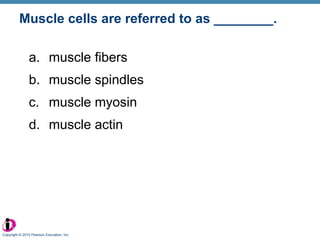
Muscle cells are referred to as ________. muscle fibers muscle spindles muscle myosin muscle actin Copyright Š 2010 Pearson Education, Inc.
Which of the following is not a prefix used to refer to muscle? Mys Myo Sarco Lemma Copyright Š 2010 Pearson Education, Inc.
Of the following muscle types, which is the only one subject to conscious control? Smooth Skeletal Cardiac All of these muscle types are subject to conscious control. Copyright Š 2010 Pearson Education, Inc.
Which two types of muscle appear striated when examined under a microscope? Smooth and skeletal Smooth and cardiac Cardiac and skeletal Skeletal muscle is the only striated muscle type. Copyright Š 2010 Pearson Education, Inc.
Which of the following muscular functions serves a metabolic function? Movement Posture maintenance Joint stabilization Heat generation Copyright Š 2010 Pearson Education, Inc.
In order to receive a signal to contract, each skeletal muscle must be served by a(n) ________. artery nerve vein ligament Copyright Š 2010 Pearson Education, Inc.
Which of the following components accounts for the bulk of muscle fiber volume (up to 80%)? Glycosomes Mitochondria Myofibrils Sarcoplasm Copyright Š 2010 Pearson Education, Inc.
The functional unit of a muscle fiber is the __________. sarcomere myofibril fascicle myofilament Copyright Š 2010 Pearson Education, Inc.
The thin filaments are not comprised of which of the following components? Actin Titin Troponin Tropomyosin Copyright Š 2010 Pearson Education, Inc.
What is the major function of the sarcoplasmic reticulum? Store sodium ions Expel sodium ions from the cell Expel calcium ions from the cell Store calcium ions Copyright Š 2010 Pearson Education, Inc.
During a muscle contraction, the sliding filament theory would be apparent in a sarcomere because __________. the I bands get longer the A bands get shorter the H zone becomes less obvious and the Z discs move closer together the Z discs get pulled closer to the I bands and the H zone becomes more obvious Copyright Š 2010 Pearson Education, Inc.
At the neuromuscular junction, the muscle contraction initiation event is ______. a release of calcium ions from the sarcoplasmic reticulum conduction of an electrical impulse down the T tubules binding of acetylcholine to membrane receptors on the sarcolemma sliding of actin and myosin filaments past each other Copyright Š 2010 Pearson Education, Inc.
In a muscle fiber, the key intracellular event that stimulates muscle contraction is known as ________. polarization depolarization repolarization potential  Copyright Š 2010 Pearson Education, Inc.
During depolarization, the sarcolemma is most permeable to _______. sodium ions potassium ions calcium ions chloride ions Copyright Š 2010 Pearson Education, Inc.
The time period between action potential initiation and mechanical activity of a muscle fiber is called the _________. latent period refractory period action potential excitation period Copyright Š 2010 Pearson Education, Inc.
What is calcium’s function during muscle contraction? Calcium binds to troponin, changing its shape and removing the blocking action of tropomyosin. Calcium binds to troponin to prevent myosin from attaching to actin. Calcium depolarizes the muscle fiber. Calcium flows down the T tubules to stimulate the influx of sodium from the sarcoplasmic reticulum. Copyright © 2010 Pearson Education, Inc.
Corpses usually exhibit rigor mortis because __________. ATP hydrolysis is stimulating myosin head attachment to actin a lack of ATP hydrolysis prevents myosin head detachment from actin calcium stores become deficient sodium stores become deficient Copyright Š 2010 Pearson Education, Inc.
Small precise movements are controlled by ______ motor units. small large many few Copyright Š 2010 Pearson Education, Inc.
A muscle contraction increases in strength up to a point because ________. stronger stimuli inhibit motor unit activation recruitment occurs and more motor units respond to stronger stimuli more calcium is available in the sarcoplasm additional neurons begin stimulating each muscle fiber Copyright Š 2010 Pearson Education, Inc.
Isometric contractions come into play when an individual is ________. jumping walking uphill lifting a heavy object maintaining an upright posture Copyright Š 2010 Pearson Education, Inc.
A sprinter is more likely to depend on _______ respiration to generate ATP, whereas a Tour de France cyclist is more likely to rely on __________ respiration. anaerobic; aerobic aerobic; anaerobic aerobic; aerobic anaerobic; anaerobic Copyright Š 2010 Pearson Education, Inc.
Sprinters typically possess more ________ muscle fibers. slow glycolytic fast glycolytic slow oxidative fast oxidative Copyright Š 2010 Pearson Education, Inc.
A major difference between smooth muscle fibers and skeletal muscle fibers in terms of calcium influx is that ______. smooth muscle fibers have a sarcoplasmic reticulum calcium ions are stored in the sarcoplasm of smooth muscle calcium ion influx occurs mostly from the extracellular fluid in smooth muscle smooth muscle contraction does not involve calcium Copyright Š 2010 Pearson Education, Inc.
A major cellular feature in smooth muscle that contributes to its rhythmicity and ability to participate in peristalsis is the presence of _________. troponin complex gap junctions varicosities caveolae Copyright Š 2010 Pearson Education, Inc.

Muscle

  • 1.
    Why do Icare? You like to move
  • 2.
    Muscle Similarities Skeletaland smooth muscle cells are elongated and are called muscle fibers Muscle contraction depends on two kinds of myofilaments – actin and myosin Muscle terminology is similar Sarcolemma – muscle plasma membrane Sarcoplasm – cytoplasm of a muscle cell myo, mys, and sarco all refer to muscle
  • 3.
    Skeletal Muscle TissueAttach to the skeleton Striations Voluntary Contracts rapidly, tires easily Is responsible for movement Is extremely adaptable and can exert a wide range of forces
  • 4.
    Cardiac Muscle TissueIn the heart Striated Involuntary Contracts at a steady rate set by the pacemaker Neural controls allow the heart to respond to changes in bodily needs
  • 5.
    Smooth Muscle TissueFound in the walls of hollow organs, such as the stomach, urinary bladder, and respiratory passages Forces food and other substances through internal body channels It is not striated and is involuntary
  • 6.
    muscle cells arereferred to as? muscle fibers What prefixes mean muscle? mys, myo, sarco What type of muscle is subject to conscious control? Skeletal What muscle types appear striated? skeletal and cardiac
  • 7.
    Functional Characteristics ofMuscle Tissue Excitability– the ability to receive and respond to stimuli Contractility – the ability to shorten Extensibility – the ability to be stretched Elasticity – the ability to recoil
  • 8.
    Identify four importantfunctions of muscle tissue
  • 9.
    Locomotion Maintain posture Stabilize joints Generate heat pumping blood blood pressure, peristalsis
  • 10.
    Describe the structureand function of the gross and microscopic structures of skeletal muscle
  • 11.
    Skeletal Muscle Eachmuscle is a discrete organ composed of muscle tissue, blood vessels, nerve fibers, and connective tissue
  • 12.
    Figure 9.2a InterActivePhysiology ÂŽ: Anatomy Review: Skeletal Muscle Tissue, pages 4-6 PLAY
  • 13.
  • 14.
    Myofibrils Figure 9.3bInterActive Physiology ÂŽ: Anatomy Review: Skeletal Muscle Tissue, pages 7-8 PLAY
  • 15.
  • 16.
    Microscopic Anatomy ofa Skeletal Muscle Fiber Each fiber is a long, cylindrical cell with multiple nuclei just beneath the sarcolemma
  • 17.
    Microscopic Anatomy ofa Skeletal Muscle Fiber Sarcoplasm has numerous glycosomes and a unique oxygen-binding protein called myoglobin Fibers contain the usual organelles, myofibrils, sarcoplasmic reticulum, and T tubules
  • 18.
    Myofibrils Myofibrils aredensely packed, rodlike contractile elements They make up 80% of the muscle volume Dark A bands and light I bands appear because of the arrangement of myofibrils
  • 19.
    Sarcomeres Figure 9.3cInterActive Physiology ÂŽ: Anatomy Review: Skeletal Muscle Tissue, page 9 PLAY
  • 20.
    The smallest contractileunit of a muscle The region of a myofibril between two successive Z discs Composed of myofilaments made up of contractile proteins
  • 21.
    Thick filaments (Myosin)–extend the entire length of an A band Thin filaments (Actin) – extend across the I band and partway into the A band Z-disc – coin-shaped sheet of proteins (connectins) that anchors the thin filaments and connects myofibrils to one another H zone- no overlap
  • 22.
  • 23.
    1. What isthe smallest functional unit of skeletal muscle? 2. Give 4 functions of skeletal muscle.
  • 24.
    Ultrastructure of Myofilaments:Thick Filaments Figure 9.4a,b
  • 25.
    Thick Filaments Thickfilaments are composed of the protein myosin Each myosin molecule has a rod-like tail and two globular heads Tails – two interwoven, heavy polypeptide chains Heads – two smaller, light polypeptide chains called cross bridges
  • 26.
    Ultrastructure of Myofilaments:Thin Filaments Figure 9.4c
  • 27.
    Thin Filaments Thinfilaments are made of actin Each actin molecule is a helical polymer of globular subunits called G actin The subunits contain the active sites to which myosin heads attach during contraction Tropomyosin and troponin are regulatory subunits bound to actin
  • 28.
    Arrangement of theFilaments in a Sarcomere Figure 9.4d
  • 29.
    Sarcoplasmic Reticulum (SR)Smooth ER that surrounds each myofibril stores calcium
  • 30.
    T Tubules Continuationof sarcolemma Conduct impulses to the deepest part of the muscle These impulses cause the release of Ca 2+
  • 31.
    Which of thefollowing components accounts for the bulk muscle fiber volume (up to 80%)? a. glycosomes b. mitochondria c. myofibrils d. sarcoplasm
  • 32.
    The functional unitof a muscle fiber is the __________.
  • 33.
    The thin filamentsare not comprised of which of the following components? a. actin b. titin c. troponin d. tropomyosin
  • 34.
    What is themajor function of the sarcoplasmic reticulum? a. store sodium ions b. store potassium ions c. expel calcium ions from the cell d. store calcium ions
  • 35.
  • 36.
    Important steps Action potential comes from nerve Acetylcholine is released Action potential is generated in the muscle Action potential travels down the T-tubules Calcium is released
  • 37.
    Skeletal Muscle ContractionFigure 10–9 (Navigator)
  • 38.
    Skeletal Muscle InnervationFigure 10–10a, b (Navigator)
  • 39.
  • 40.
    Neuromuscular Junction Whena nerve impulse reaches the neuromuscular junction Acetylcholine (Ach) is released InterActive Physiology ÂŽ: The Neuromuscular Junction, pages 3-5 PLAY
  • 41.
    Destruction of AcetylcholineACh destroyed by the enzyme acetylcholinesterase This prevents continuous contraction InterActive Physiology ÂŽ: The Neuromuscular Junction, pages 6-10 PLAY
  • 42.
    Ion Channels proteinchannels in the cell membrane that can be opened by chemicals or electrically
  • 43.
    Action Potential Anelectrical signal that is spread by the difference in charge across a membrane
  • 44.
  • 45.
    Action potential Atrest, cell has negative charge
  • 46.
    ACh causes Nachannels to open, positive Na ions come into the cell, making the inside of the cell more positive
  • 47.
    This causes moreNa channels to open, more positive Na ions come into the cell, and the current spreads down the cell
  • 48.
    When Na channelsclose the inside of the cell is negative again
  • 49.
    Action potential reviewAt rest, the inside of the cell has negative charge ACh causes Na channels to open, positive Na ions come into the cell, making the inside of the cell more positive This causes more Na channels to open, more positive Na ions come into the cell, and the current spreads down the cell When Na channels close the inside of the cell becomes negative again
  • 50.
    Excitation-Contraction Coupling Oncegenerated, the action potential: Travels along the sarcolemma, down the T tubules Triggers Ca 2+ release Ca 2+ binds to troponin and causes Actin binding sites to be exposed
  • 51.
    Excitation-Contraction Coupling Myosincross bridges alternately attach and detach Thin filaments move toward the center of the sarcomere Hydrolysis of ATP powers this cycling process Ca 2+ is removed into the SR, tropomyosin blockage is restored, and the muscle fiber relaxes
  • 52.
    Role of (Ca2+ ) At low [Ca 2+ ] Tropomyosin blocks the binding sites on actin Myosin cross bridges cannot attach Figure 9.11a
  • 53.
    At high [Ca2+ ] Calcium binds to troponin Troponin changes shape tropomyosin moves away from actin’s binding sites Figure 9.11b
  • 54.
    Figure 9.10 Synapticcleft Synaptic vesicle Axon terminal ACh ACh ACh Neurotransmitter released diffuses across the synaptic cleft and attaches to ACh receptors on the sarcolemma.
  • 55.
    Figure 9.10 Netentry of Na + Initiates an action potential which is propagated along the sarcolemma and down the T tubules. T tubule Sarcolemma Synaptic cleft Synaptic vesicle Axon terminal ACh ACh ACh Neurotransmitter released diffuses across the synaptic cleft and attaches to ACh receptors on the sarcolemma. 1
  • 56.
    Figure 9.10 Netentry of Na + Initiates an action potential which is propagated along the sarcolemma and down the T tubules. T tubule Sarcolemma SR tubules (cut) Synaptic cleft Synaptic vesicle Axon terminal ACh ACh ACh Neurotransmitter released diffuses across the synaptic cleft and attaches to ACh receptors on the sarcolemma. Action potential in T tubule activates voltage-sensitive receptors, which in turn trigger Ca 2+ release from terminal cisternae of SR into cytosol. SR Ca 2+ Ca 2+ Ca 2+ Ca 2+ Ca 2+ Ca 2+ Ca 2+ Ca 2+ 1 2
  • 57.
    Figure 9.10 Netentry of Na + Initiates an action potential which is propagated along the sarcolemma and down the T tubules. T tubule Sarcolemma SR tubules (cut) Synaptic cleft Synaptic vesicle Axon terminal ACh ACh ACh Neurotransmitter released diffuses across the synaptic cleft and attaches to ACh receptors on the sarcolemma. Action potential in T tubule activates voltage-sensitive receptors, which in turn trigger Ca 2+ release from terminal cisternae of SR into cytosol. Calcium ions bind to troponin; troponin changes shape, removing the blocking action of tropomyosin; actin active sites exposed. SR Ca 2+ Ca 2+ Ca 2+ Ca 2+ Ca 2+ Ca 2+ Ca 2+ Ca 2+ Ca 2+ 1 2 3
  • 58.
    Figure 9.10 Netentry of Na + Initiates an action potential which is propagated along the sarcolemma and down the T tubules. T tubule Sarcolemma SR tubules (cut) Synaptic cleft Synaptic vesicle Axon terminal ACh ACh ACh Neurotransmitter released diffuses across the synaptic cleft and attaches to ACh receptors on the sarcolemma. Action potential in T tubule activates voltage-sensitive receptors, which in turn trigger Ca 2+ release from terminal cisternae of SR into cytosol. Calcium ions bind to troponin; troponin changes shape, removing the blocking action of tropomyosin; actin active sites exposed. Contraction; myosin heads alternately attach to actin and detach, pulling the actin filaments toward the center of the sarcomere; release of energy by ATP hydrolysis powers the cycling process. SR Ca 2+ Ca 2+ Ca 2+ Ca 2+ Ca 2+ Ca 2+ Ca 2+ Ca 2+ Ca 2+ 1 2 3 4
  • 59.
    Figure 9.10 Netentry of Na + Initiates an action potential which is propagated along the sarcolemma and down the T tubules. T tubule Sarcolemma SR tubules (cut) Synaptic cleft Synaptic vesicle Axon terminal ACh ACh ACh Neurotransmitter released diffuses across the synaptic cleft and attaches to ACh receptors on the sarcolemma. Action potential in T tubule activates voltage-sensitive receptors, which in turn trigger Ca 2+ release from terminal cisternae of SR into cytosol. Calcium ions bind to troponin; troponin changes shape, removing the blocking action of tropomyosin; actin active sites exposed. Contraction; myosin heads alternately attach to actin and detach, pulling the actin filaments toward the center of the sarcomere; release of energy by ATP hydrolysis powers the cycling process. Removal of Ca 2+ by active transport into the SR after the action potential ends. SR Ca 2+ Ca 2+ Ca 2+ Ca 2+ Ca 2+ Ca 2+ Ca 2+ Ca 2+ Ca 2+ Ca 2+ 1 2 3 4 5
  • 60.
    Figure 9.10 ADPP i Net entry of Na + Initiates an action potential which is propagated along the sarcolemma and down the T tubules. T tubule Sarcolemma SR tubules (cut) Synaptic cleft Synaptic vesicle Axon terminal ACh ACh ACh Neurotransmitter released diffuses across the synaptic cleft and attaches to ACh receptors on the sarcolemma. Action potential in T tubule activates voltage-sensitive receptors, which in turn trigger Ca 2+ release from terminal cisternae of SR into cytosol. Calcium ions bind to troponin; troponin changes shape, removing the blocking action of tropomyosin; actin active sites exposed. Contraction; myosin heads alternately attach to actin and detach, pulling the actin filaments toward the center of the sarcomere; release of energy by ATP hydrolysis powers the cycling process. Removal of Ca 2+ by active transport into the SR after the action potential ends. SR Tropomyosin blockage restored, blocking myosin binding sites on actin; contraction ends and muscle fiber relaxes. Ca 2+ Ca 2+ Ca 2+ Ca 2+ Ca 2+ Ca 2+ Ca 2+ Ca 2+ Ca 2+ Ca 2+ 1 2 3 4 5 6
  • 61.
  • 62.
    EC coupling reviewAction potential comes from nerve Acetylcholine is released Action potential is generated in the muscle Action potential travels down the T-tubules Calcium is released
  • 63.
  • 64.
    Describe the slidingfilament model of muscle contraction
  • 65.
  • 66.
    5 Steps ofthe Contraction Cycle Exposure of active sites Formation of cross-bridges Pivoting of myosin heads (power stroke) Detachment of cross-bridges Reactivation of myosin
  • 67.
    Sliding Filament Modelof Contraction Thin (actin) filaments slide past the thick (myosin) ones so that the filaments overlap When relaxed filaments overlap only slightly Upon stimulation, myosin heads bind to actin and sliding begins
  • 68.
    Figure 9.12 ATPADP ADP ATP hydrolysis ADP ATP P i P i Myosin head (high-energy configuration) Myosin head attaches to the actin myofilament, forming a cross bridge. Thin filament As ATP is split into ADP and P i , the myosin head is energized (cocked into the high-energy conformation). Inorganic phosphate (P i ) generated in the previous contraction cycle is released, initiating the power (working) stroke. The myosin head pivots and bends as it pulls on the actin filament, sliding it toward the M line. Then ADP is released. Myosin head (low-energy configuration) As new ATP attaches to the myosin head, the link between myosin and actin weakens, and the cross bridge detaches. Thick filament 1 4 2 3
  • 69.
    5 Steps ofthe Contraction Cycle Exposure of active sites Formation of cross-bridges Pivoting of myosin heads Detachment of cross-bridges Reactivation of myosin
  • 70.
    Contraction Refers tothe activation of myosin’s cross bridges. Shortening occurs when the tension produced is greater than load Ends when cross bridges become inactive
  • 71.
    describe the differenttypes of muscle contraction
  • 72.
    Contraction of SkeletalMuscle The two types of muscle contractions are: Isometric contraction – increasing muscle tension (length doesn’t change) Isotonic contraction – decreasing muscle length (length changes)
  • 73.
  • 74.
  • 75.
    Describe muscle twitch,tetanus and motor unit
  • 76.
    Motor Unit Amotor unit is a motor neuron and all the muscle fibers it supplies
  • 77.
    Motor Unit InterActivePhysiology ÂŽ: Contraction of Motor Units, pages 3-9 Figure 9.13a Muscles that control fine movements (fingers, eyes) have small motor units Large weight-bearing muscles (thighs, hips) have large motor units PLAY
  • 78.
    Muscle Twitch Amuscle twitch is the response of a muscle to a single stimulus There are three phases to a muscle twitch Latent period Period of contraction Period of relaxation
  • 79.
    Phases of aMuscle Twitch Latent period -EC coupling Period of contraction – cross bridges form; muscle shortens Period of relaxation – Ca 2+ reabsorbed; muscle tension goes to zero Figure 9.14a
  • 80.
  • 81.
    Graded Muscle ResponsesGraded muscle responses are: Variations in the degree of muscle contraction Required for proper control of skeletal movement Responses are graded by Changing the frequency or strength of stimulation
  • 82.
    A single stimulusresults in a single contractile response – a muscle twitch Frequently delivered stimuli (muscle can’t relax) increases contractile force – wave summation Figure 9.15
  • 83.
    More rapidly deliveredstimuli result in incomplete tetanus If stimuli are given quickly enough, complete tetanus results Figure 9.15
  • 84.
    Stimulus Intensity andMuscle Tension Figure 9.16
  • 85.
    Threshold stimulus –the minimum stimulus for contraction to occur Muscle contracts more vigorously as stimulus strength is increased Force of contraction is controlled by the number of motor units recruited (activated) Recruitment activates more and more muscle fibers
  • 86.
    Force of MuscleContraction The force of contraction is affected by: The number of muscle fibers contracting The relative size of the muscle Degree of muscle stretch
  • 87.
    Length Tension RelationshipFigure 9.22 There is an optimal length
  • 88.
  • 89.
    describe the typesof skeletal muscle fibers (fast-twitch, slow-twitch)
  • 90.
  • 91.
    Muscle Fiber Type:Functional Characteristics Speed of contraction – slow and fast fibers ATP-forming pathways Oxidative fibers (red) Glycolytic fibers (white) We have 3 types of fibers- slow oxidative, fast oxidative, and fast glycolytic InterActive Physiology ®: Muscle Metabolism, pages 25-27 PLAY
  • 92.
  • 93.
  • 94.
  • 95.
  • 96.
  • 97.
    Describe the methodsthat are used to produce ATP for muscle contraction
  • 98.
    Muscle Metabolism ATPis the energy source for contractile activity As soon as available stores of ATP are used (4-6 seconds), they are regenerated by: Creatine phosphate (CP) Anaerobic glycolysis Aerobic respiration InterActive Physiology ÂŽ: Muscle Metabolism, pages 15
  • 99.
  • 100.
    Energy Source CreatinePhosphate Anaerobic glycolyis Aerobic respiration Oxygen Use no no yes Products 1 ATP creatine 2 ATP lactic acid 36 ATP CO 2 , H 2 O Duration 15 Seconds 30-60 seconds Hours
  • 101.
    compare the gross,microscopic anatomy, and contractile mechanisms of smooth muscle and cardiac muscle to skeletal muscle
  • 102.
    Smooth Muscle spindle-shapedfibers have fine endomysium Organized into two layers (longitudinal and circular) Found in walls of hollow organs Have essentially the same contractile mechanisms as skeletal muscle
  • 103.
  • 104.
    Peristalsis Peristalsis –alternating contractions and relaxations of smooth muscles that mix and squeeze substances through the lumen of hollow organs
  • 105.
    Microscopic Anatomy Plasmamembranes have pouchlike infoldings called caveoli
  • 106.
    Ca2+ is heldin the extracellular space near the caveoli, allowing rapid influx when channels are opened No sarcomeres Thin and thick filaments are present
  • 107.
    Myofilaments in SmoothMuscle Ratio of thick to thin filaments is lower than in skeletal muscle Thick filaments have heads along their entire length No troponin
  • 108.
    Myofilaments Thick andthin filaments are arranged diagonally intermediate filament bundles attach to dense bodies (analogous to Z discs)
  • 109.
    Contraction of SmoothMuscle Whole sheets of smooth muscle exhibit slow, synchronized contraction They are electrically coupled with gap junctions Some cells are self-excitatory and act as pacemakers
  • 110.
    Ca 2+ binds to calmodulin and activates it Calmodulin activates the kinase enzyme Kinase transfers phosphate from ATP to myosin cross bridges Phosphorylated cross bridges interact with actin to produce shortening Smooth muscle relaxes when intracellular Ca 2+ levels drop Contraction of Smooth Muscle
  • 111.
    Smooth Muscle Unique characteristics of smooth muscle include: Smooth muscle tone Slow, prolonged contractile activity Low energy requirements Response to stretch
  • 112.
  • 113.
  • 114.
  • 115.
  • 116.
  • 117.
  • 118.
    Muscle cells arereferred to as ________. muscle fibers muscle spindles muscle myosin muscle actin Copyright Š 2010 Pearson Education, Inc.
  • 119.
    Which of thefollowing is not a prefix used to refer to muscle? Mys Myo Sarco Lemma Copyright Š 2010 Pearson Education, Inc.
  • 120.
    Of the followingmuscle types, which is the only one subject to conscious control? Smooth Skeletal Cardiac All of these muscle types are subject to conscious control. Copyright Š 2010 Pearson Education, Inc.
  • 121.
    Which two typesof muscle appear striated when examined under a microscope? Smooth and skeletal Smooth and cardiac Cardiac and skeletal Skeletal muscle is the only striated muscle type. Copyright Š 2010 Pearson Education, Inc.
  • 122.
    Which of thefollowing muscular functions serves a metabolic function? Movement Posture maintenance Joint stabilization Heat generation Copyright Š 2010 Pearson Education, Inc.
  • 123.
    In order toreceive a signal to contract, each skeletal muscle must be served by a(n) ________. artery nerve vein ligament Copyright Š 2010 Pearson Education, Inc.
  • 124.
    Which of thefollowing components accounts for the bulk of muscle fiber volume (up to 80%)? Glycosomes Mitochondria Myofibrils Sarcoplasm Copyright Š 2010 Pearson Education, Inc.
  • 125.
    The functional unitof a muscle fiber is the __________. sarcomere myofibril fascicle myofilament Copyright Š 2010 Pearson Education, Inc.
  • 126.
    The thin filamentsare not comprised of which of the following components? Actin Titin Troponin Tropomyosin Copyright Š 2010 Pearson Education, Inc.
  • 127.
    What is themajor function of the sarcoplasmic reticulum? Store sodium ions Expel sodium ions from the cell Expel calcium ions from the cell Store calcium ions Copyright Š 2010 Pearson Education, Inc.
  • 128.
    During a musclecontraction, the sliding filament theory would be apparent in a sarcomere because __________. the I bands get longer the A bands get shorter the H zone becomes less obvious and the Z discs move closer together the Z discs get pulled closer to the I bands and the H zone becomes more obvious Copyright Š 2010 Pearson Education, Inc.
  • 129.
    At the neuromuscularjunction, the muscle contraction initiation event is ______. a release of calcium ions from the sarcoplasmic reticulum conduction of an electrical impulse down the T tubules binding of acetylcholine to membrane receptors on the sarcolemma sliding of actin and myosin filaments past each other Copyright Š 2010 Pearson Education, Inc.
  • 130.
    In a musclefiber, the key intracellular event that stimulates muscle contraction is known as ________. polarization depolarization repolarization potential Copyright Š 2010 Pearson Education, Inc.
  • 131.
    During depolarization, thesarcolemma is most permeable to _______. sodium ions potassium ions calcium ions chloride ions Copyright Š 2010 Pearson Education, Inc.
  • 132.
    The time periodbetween action potential initiation and mechanical activity of a muscle fiber is called the _________. latent period refractory period action potential excitation period Copyright Š 2010 Pearson Education, Inc.
  • 133.
    What is calcium’sfunction during muscle contraction? Calcium binds to troponin, changing its shape and removing the blocking action of tropomyosin. Calcium binds to troponin to prevent myosin from attaching to actin. Calcium depolarizes the muscle fiber. Calcium flows down the T tubules to stimulate the influx of sodium from the sarcoplasmic reticulum. Copyright © 2010 Pearson Education, Inc.
  • 134.
    Corpses usually exhibitrigor mortis because __________. ATP hydrolysis is stimulating myosin head attachment to actin a lack of ATP hydrolysis prevents myosin head detachment from actin calcium stores become deficient sodium stores become deficient Copyright Š 2010 Pearson Education, Inc.
  • 135.
    Small precise movementsare controlled by ______ motor units. small large many few Copyright Š 2010 Pearson Education, Inc.
  • 136.
    A muscle contractionincreases in strength up to a point because ________. stronger stimuli inhibit motor unit activation recruitment occurs and more motor units respond to stronger stimuli more calcium is available in the sarcoplasm additional neurons begin stimulating each muscle fiber Copyright Š 2010 Pearson Education, Inc.
  • 137.
    Isometric contractions comeinto play when an individual is ________. jumping walking uphill lifting a heavy object maintaining an upright posture Copyright Š 2010 Pearson Education, Inc.
  • 138.
    A sprinter ismore likely to depend on _______ respiration to generate ATP, whereas a Tour de France cyclist is more likely to rely on __________ respiration. anaerobic; aerobic aerobic; anaerobic aerobic; aerobic anaerobic; anaerobic Copyright Š 2010 Pearson Education, Inc.
  • 139.
    Sprinters typically possessmore ________ muscle fibers. slow glycolytic fast glycolytic slow oxidative fast oxidative Copyright Š 2010 Pearson Education, Inc.
  • 140.
    A major differencebetween smooth muscle fibers and skeletal muscle fibers in terms of calcium influx is that ______. smooth muscle fibers have a sarcoplasmic reticulum calcium ions are stored in the sarcoplasm of smooth muscle calcium ion influx occurs mostly from the extracellular fluid in smooth muscle smooth muscle contraction does not involve calcium Copyright Š 2010 Pearson Education, Inc.
  • 141.
    A major cellularfeature in smooth muscle that contributes to its rhythmicity and ability to participate in peristalsis is the presence of _________. troponin complex gap junctions varicosities caveolae Copyright Š 2010 Pearson Education, Inc.

Editor's Notes

  • #32 Answer: c. myofibrils
  • #33 Answer: a. sarcomere
  • #34 Answer: b. titin
  • #35 Answer: d. store calcium ions
  • #119 Answer: a. muscle fibers
  • #120 Answer: d. Lemma
  • #121 Answer: b. Skeletal
  • #122 Answer: c. Cardiac and skeletal
  • #123 Answer: d. Heat generation
  • #124 Answer: b. nerve
  • #125 Answer: c. Myofibrils
  • #126 Answer: a. sarcomere
  • #127 Answer: b. Titin
  • #128 Answer: d. Store calcium ions
  • #129 Answer: c. the H zone becomes less obvious and the Z-discs move closer together
  • #130 Answer: c. binding of acetylcholine to membrane receptors on the sarcolemma
  • #131 Answer: b. depolarization
  • #132 Answer: a. sodium ions
  • #133 Answer: a. latent period
  • #134 Answer: a. Calcium binds to troponin, changing its shape and removing the blocking action of tropomyosin.
  • #135 Answer: b. ATP hydrolysis promotes myosin head detachment from actin
  • #136 Answer: a. small
  • #137 Answer: b. recruitment occurs and more motor units respond to stronger stimuli
  • #138 Answer: d. maintaining an upright posture
  • #139 Answer: a. anaerobic; aerobic
  • #140 Answer: d. fast oxidative
  • #141 Answer: c. calcium ion influx occurs mostly from the extra cellular fluid in smooth muscle
  • #142 Answer: b. gap junctions