Dr.Praveen Nagula ,1st Year PG
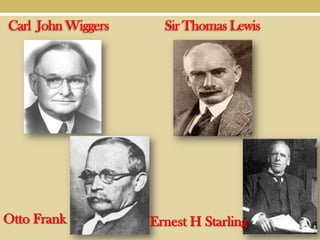
Carl John Wiggers

Otto Frank

Sir Thomas Lewis

Ernest H Starling
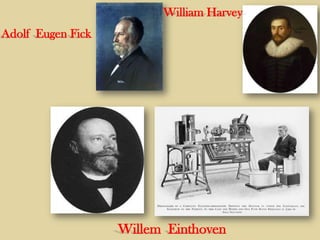
William Harvey
Adolf Eugen Fick

Willem Einthoven
Introduction
Principal function of cardiovascular system is to deliver oxygen

and nutrients to and remove carbon dioxide and wastes from
metabolizing tissues.
It is by two specialized circulations in series
1.a low resistance pulmonary driven by right heart
2.a high resistance systemic driven by left heart
Systolic pressure in the vascular system refers to the
peak pressure reached during the systole,not the mean
pressure.
The diastolic pressure refers to the lowest pressure during
diastole.
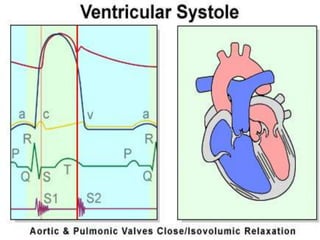
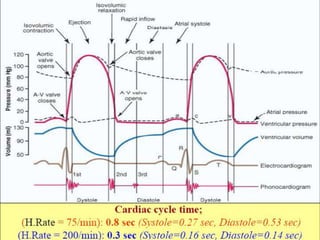
WIGGERS DIAGRAM
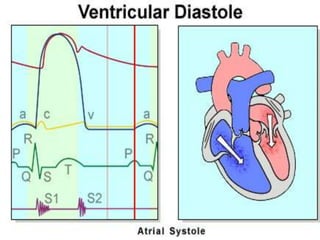
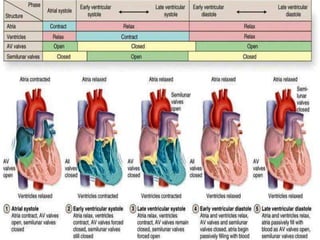
EVENTS IN CARDIAC CYCLE
DETERMINANTS OF MYOCARDIAL PERFORMANCE
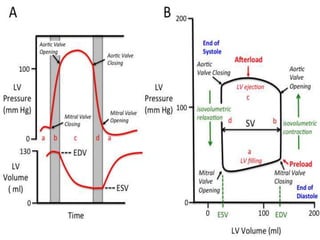
PRESSURE VOLUME LOOP
PHYSIOLOGICAL VS PATHOLOGICAL HYPERTROPHY
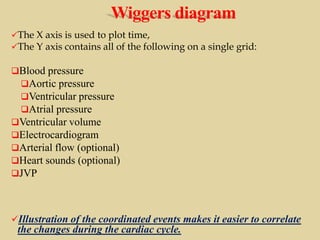
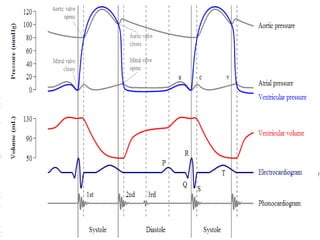
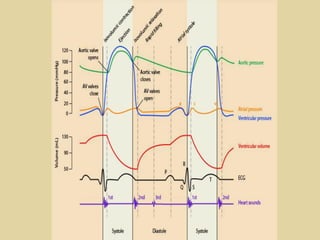
Wiggers diagram
The X axis is used to plot time,
The Y axis contains all of the following on a single grid:

Blood pressure
Aortic pressure
Ventricular pressure
Atrial pressure
Ventricular volume
Electrocardiogram
Arterial flow (optional)
Heart sounds (optional)
JVP

Illustration of the coordinated events makes it easier to correlate

the changes during the cardiac cycle.
WIGGERS DIAGRAM
EVENTS IN CARDIAC CYCLE
DETERMINANTS OF MYOCARDIAL PERFORMANCE
PRESSURE VOLUME LOOP
PHYSIOLOGICAL VS PATHOLOGICAL HYPERTROPHY
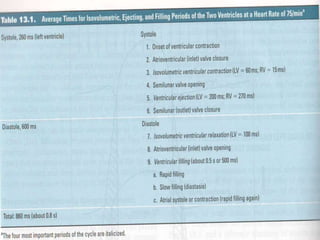
Cardiac cycle
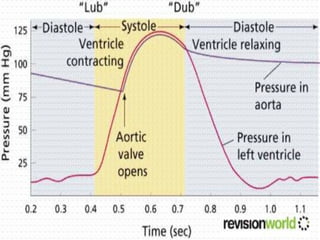
• The cardiac cycle describes pressure,volume and flow

phenomena in the ventricles as a function of time.
• Similar for both LV and RV except for the timing,levels of
pressure.
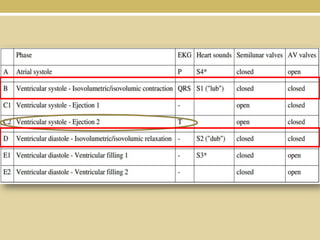
Mechanical events in Cardiac cycle
• Systole
• Isovolumic contraction
• Maximal ejection
• Reduced ejection
• Diastole
• Isovolumic relaxation
• Rapid filling phase
• Slow filling phase /diastasis
• Atrial systole
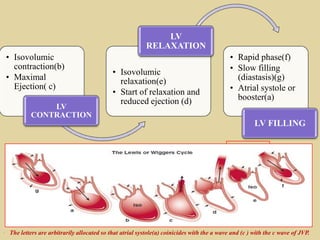
LV
RELAXATION
• Isovolumic
contraction(b)
• Maximal
Ejection( c)
LV
CONTRACTION

• Isovolumic
relaxation(e)
• Start of relaxation and
reduced ejection (d)

• Rapid phase(f)
• Slow filling
(diastasis)(g)
• Atrial systole or
booster(a)
LV FILLING

• The letters are arbitrarily allocated so that atrial systole(a) coinicides with the a wave and (c ) with the c wave of JVP.
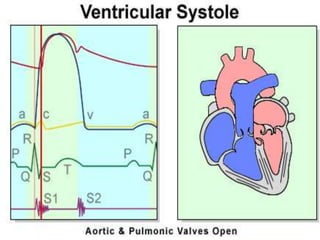
LV contraction
• Actin myosin contraction triggered by arrival of Calcium ions at
•
•
•
•
•
•
•

contractile proteins.
ECG – peak of R wave
LV pressure >LA pressure (10-15mm Hg)
Followed approx. 50msec by M1.
Delay of M1 – inertia of the blood flow – valve is kept open.
Isovolumic contraction as volume is fixed.
Increased pressure as more fibers enter contractile state.
LV pressure >Aorta – Aortic valve opens – silent event
clinically.
• Phase of rapid ejection:
• Pressure gradient across the aortic valve
• Elastic properties of aorta,arterial tree (systolic expansion)
• LV pressure rises to peak and then falls.
LV relaxation
• Activated phospholamban causes calcium transfer into SR.
• Decreases contractile apparatus function – phase of reduced ejection –

blood flow from LV to aorta decreases but maintained by aortic recoil
– WINDKESSEL EFFECT*.
• Aortic valve closes as LV pressure drops
• Isovolumic relaxation
• Mitral valve opens – clinically silent event.

† Giovanni Borelli,Stephen Hales,Fick(mathematical foundation).
†WINDKESSEL in german AIRCHAMBER or elastic resorvoir.
LV filling
• Rapid filling phase – active diastolic relaxation of LV.
• LA- LV pressures equalize - diastasis.
• LA booster atrial systole – important in exercise and LVH.
• First phase of diastole –isovolumic phase – no ventricular
•
•
•
•
•

filling.
Most of ventricular filling –rapid filling phase.
Diastasis -5%
Final atrial booster phase -15%.
The sucking effect of ventricle – myosin is pulled into the
space between the two anchoring segments of titin.
Dominant backward pressure wave –diastolic coronary
filling.
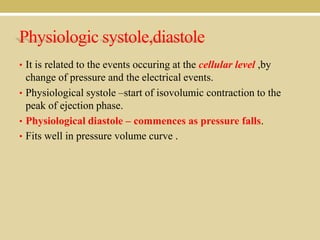
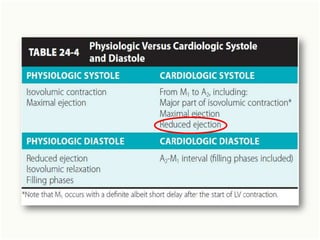
Physiologic systole,diastole
• It is related to the events occuring at the cellular level ,by

change of pressure and the electrical events.
• Physiological systole –start of isovolumic contraction to the
peak of ejection phase.
• Physiological diastole – commences as pressure falls.
• Fits well in pressure volume curve .
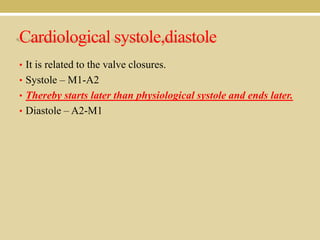
Cardiological systole,diastole
• It is related to the valve closures.
• Systole – M1-A2
• Thereby starts later than physiological systole and ends later.
• Diastole – A2-M1
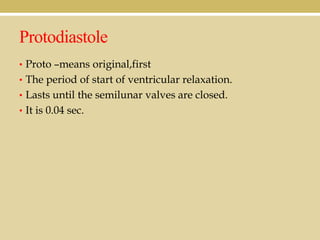
Protodiastole
• Proto –means original,first
• The period of start of ventricular relaxation.
• Lasts until the semilunar valves are closed.
• It is 0.04 sec.
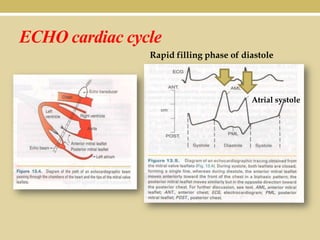
ECHO cardiac cycle
Rapid filling phase of diastole

Atrial systole
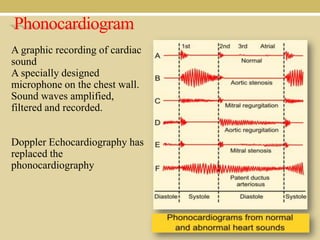
Phonocardiogram
A graphic recording of cardiac
sound
A specially designed
microphone on the chest wall.
Sound waves amplified,
filtered and recorded.
Doppler Echocardiography has
replaced the
phonocardiography
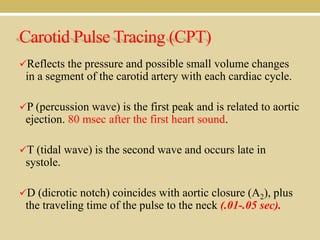
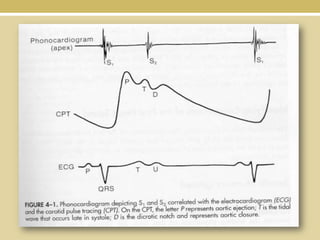
Carotid Pulse Tracing (CPT)
Reflects the pressure and possible small volume changes

in a segment of the carotid artery with each cardiac cycle.
P (percussion wave) is the first peak and is related to aortic

ejection. 80 msec after the first heart sound.
T (tidal wave) is the second wave and occurs late in

systole.
D (dicrotic notch) coincides with aortic closure (A2), plus

the traveling time of the pulse to the neck (.01-.05 sec).
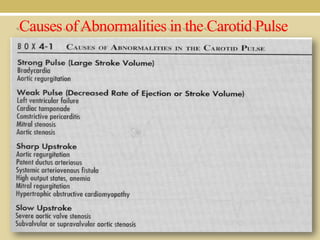
Causes of Abnormalities in the Carotid Pulse
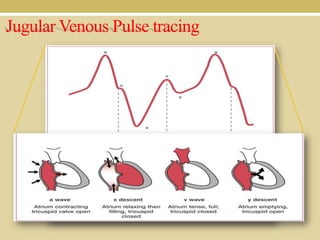
Jugular Venous Pulse tracing
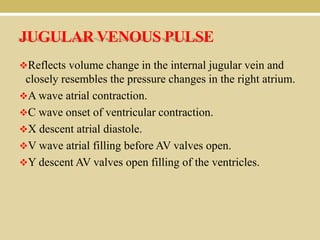
JUGULAR VENOUS PULSE
Reflects volume change in the internal jugular vein and

closely resembles the pressure changes in the right atrium.
A wave atrial contraction.
C wave onset of ventricular contraction.
X descent atrial diastole.
V wave atrial filling before AV valves open.
Y descent AV valves open filling of the ventricles.
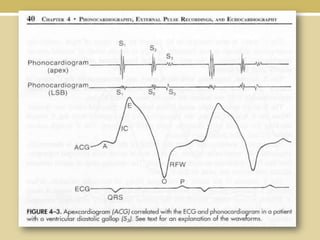
Apex cardiogram
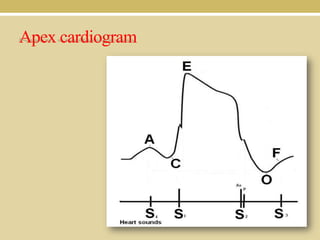
Apex cardiogram
Records low-frequency vibrations over the apical impulse.
Deflections not delayed.
A –atrial contraction.
C –onset of LV contraction.
E – peak of the ascent (initial ejection from LV to aorta)

O – opening of the mitral valve.
RF –rapid filling wave
SF – slow filling wave.
WIGGERS DIAGRAM
EVENTS IN CARDIAC CYCLE
DETERMINANTS OF MYOCARDIAL PERFORMANCE
PRESSURE VOLUME LOOP
PHYSIOLOGICAL VS PATHOLOGICAL HYPERTROPHY
Determinants of myocardial mechanical
performance
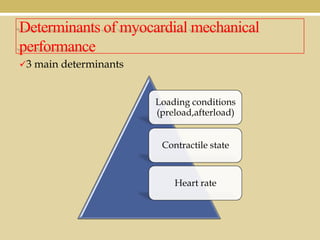
3 main determinants

Loading conditions
(preload,afterload)

Contractile state

Heart rate
Preload
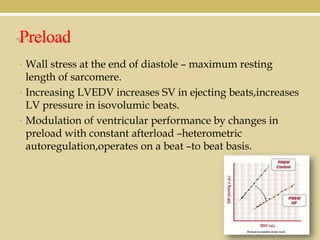
• Wall stress at the end of diastole – maximum resting

length of sarcomere.
• Increasing LVEDV increases SV in ejecting beats,increases
LV pressure in isovolumic beats.
• Modulation of ventricular performance by changes in
preload with constant afterload –heterometric
autoregulation,operates on a beat –to beat basis.
Frank Starling mechanism
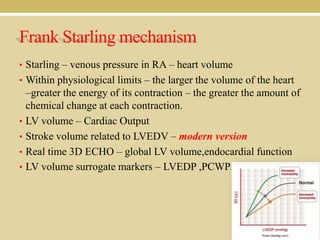
• Starling – venous pressure in RA – heart volume
• Within physiological limits – the larger the volume of the heart

•
•
•
•

–greater the energy of its contraction – the greater the amount of
chemical change at each contraction.
LV volume – Cardiac Output
Stroke volume related to LVEDV – modern version
Real time 3D ECHO – global LV volume,endocardial function
LV volume surrogate markers – LVEDP ,PCWP.
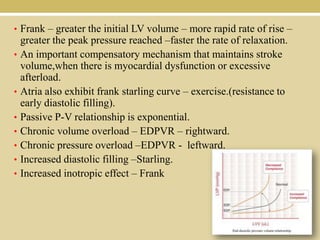
• Frank – greater the initial LV volume – more rapid rate of rise –
•

•
•
•
•
•
•

greater the peak pressure reached –faster the rate of relaxation.
An important compensatory mechanism that maintains stroke
volume,when there is myocardial dysfunction or excessive
afterload.
Atria also exhibit frank starling curve – exercise.(resistance to
early diastolic filling).
Passive P-V relationship is exponential.
Chronic volume overload – EDPVR – rightward.
Chronic pressure overload –EDPVR - leftward.
Increased diastolic filling –Starling.
Increased inotropic effect – Frank
Afterload
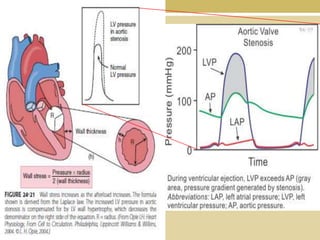
Exact definition – wall stress during LV ejection.
Tension in the LV wall that resists ventricular ejection or as the

arterial input impedance.
In clinical practice the arterial blood pressure is often taken as
synonymous with afterload while ignoring aortic compliance
(increase in stiff aorta).
Anrep effect
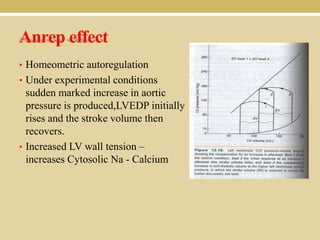
• Homeometric autoregulation
• Under experimental conditions

sudden marked increase in aortic
pressure is produced,LVEDP initially
rises and the stroke volume then
recovers.
• Increased LV wall tension –
increases Cytosolic Na - Calcium
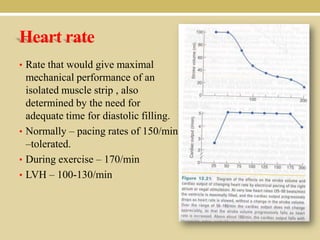
Heart rate
• Rate that would give maximal

mechanical performance of an
isolated muscle strip , also
determined by the need for
adequate time for diastolic filling.
• Normally – pacing rates of 150/min
–tolerated.
• During exercise – 170/min
• LVH – 100-130/min
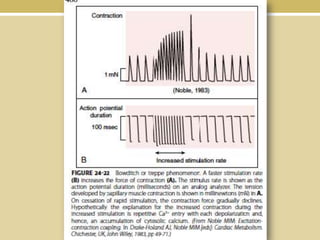
Bowditch phenomenon
Treppe effect
Positive inotropic effect of activation
Force freqeuncy relation
• “increased heart rate – increases force of ventricular contraction”

HR – negative staircase effect
• More rapid stimulation – more sodium and calcium ions enter the
myocardial cell that can be handled by sodium pump and the
mechanisms for calcium exit - decreased force.
 Clinical implications
AF with varying interval.
In HF – phenomenon is muted or lost.
Post extrasystolic potentiation ,inotropic effect of paired pacing –
increased contractile state.
•
Contractility
• It is the inherent capacity of the myocardium to contract

independently of changes in the preload and afterload.
• An increased contractile function –assosciated with
greater degree of relaxation – LUSITROPIC effect
• Important regulator of My02 uptake
• Increased contractile function – exercise,adrenergic
stimulation,digitalis,other inotropic agents.
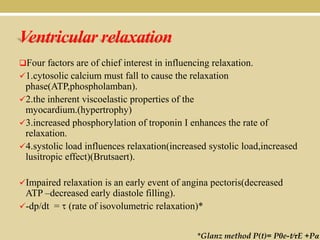
Ventricular relaxation
Four factors are of chief interest in influencing relaxation.
1.cytosolic calcium must fall to cause the relaxation

phase(ATP,phospholamban).
2.the inherent viscoelastic properties of the
myocardium.(hypertrophy)
3.increased phosphorylation of troponin I enhances the rate of
relaxation.
4.systolic load influences relaxation(increased systolic load,increased
lusitropic effect)(Brutsaert).
Impaired relaxation is an early event of angina pectoris(decreased

ATP –decreased early diastole filling).
-dp/dt = (rate of isovolumetric relaxation)*

*Glanz method P(t)= P0e-t⁄τE +Pα
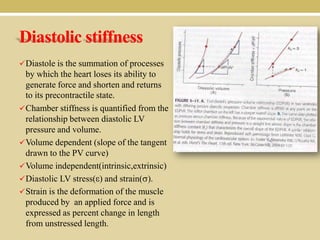
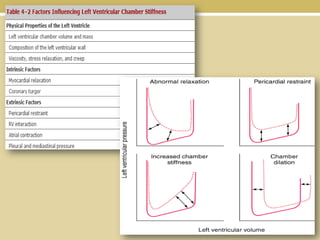
Diastolic stiffness
 Diastole is the summation of processes

by which the heart loses its ability to
generate force and shorten and returns
to its precontractile state.
 Chamber stiffness is quantified from the
relationship between diastolic LV
pressure and volume.
 Volume dependent (slope of the tangent
drawn to the PV curve)
 Volume independent(intrinsic,extrinsic)
 Diastolic LV stress( ) and strain( ).
 Strain is the deformation of the muscle
produced by an applied force and is
expressed as percent change in length
from unstressed length.
Time varying elastance concept
Ventricular volume and loading are altered under conditions of

unvarying contractility.(frank starling preparations are load
independent).
At any time t,following the onset of contraction,the P-V relation
is linear
P(t) = E(t)-{V(t)-Vo},E –time varying elastance,Vo is volume at
zero pressure or dead volume.
Ventricle behaves like a spring with a stiffness(elastance) that
increases during contraction,decreases during relaxation.
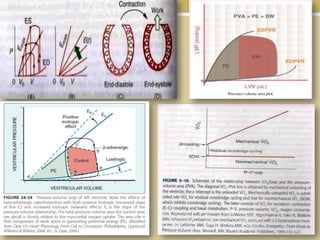
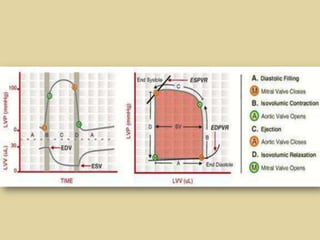
PVA area bounded by the LV P-V loop is a measure of the total
mechanical energy of LV contraction.
Formulae
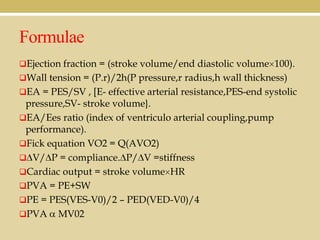
Ejection fraction = (stroke volume/end diastolic volume 100).
Wall tension = (P.r)/2h(P pressure,r radius,h wall thickness)
EA = PES/SV , [E- effective arterial resistance,PES-end systolic

pressure,SV- stroke volume}.
EA/Ees ratio (index of ventriculo arterial coupling,pump
performance).
Fick equation VO2 = Q(AVO2)
 V/ P = compliance. P/ V =stiffness
Cardiac output = stroke volume HR
PVA = PE+SW
PE = PES(VES-V0)/2 – PED(VED-V0)/4
PVA MV02
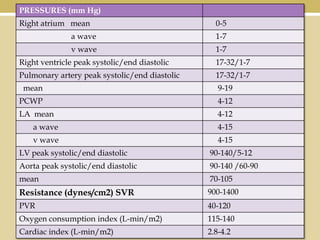
PRESSURES (mm Hg)
Right atrium mean

0-5

wave
Normalavalues

1-7

Right ventricle peak systolic/end diastolic

17-32/1-7

Pulmonary artery peak systolic/end diastolic

17-32/1-7

v wave

1-7

mean

9-19

PCWP

4-12

LA mean

4-12

a wave

4-15

v wave

4-15

LV peak systolic/end diastolic

90-140/5-12

Aorta peak systolic/end diastolic

90-140 /60-90

mean

70-105

Resistance (dynes/cm2) SVR

900-1400

PVR

40-120

Oxygen consumption index (L-min/m2)

115-140

Cardiac index (L-min/m2)

2.8-4.2
WIGGERS DIAGRAM
EVENTS IN CARDIAC CYCLE
DETERMINANTS OF MYOCARDIAL PERFORMANCE
PRESSURE VOLUME LOOP
PHYSIOLOGICAL VS PATHOLOGICAL HYPERTROPHY
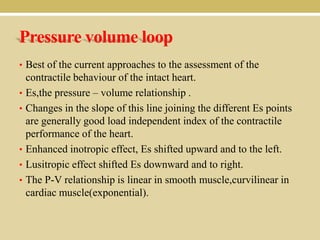
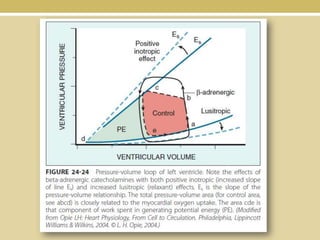
Pressure volume loop
• Best of the current approaches to the assessment of the
•
•

•
•
•

contractile behaviour of the intact heart.
Es,the pressure – volume relationship .
Changes in the slope of this line joining the different Es points
are generally good load independent index of the contractile
performance of the heart.
Enhanced inotropic effect, Es shifted upward and to the left.
Lusitropic effect shifted Es downward and to right.
The P-V relationship is linear in smooth muscle,curvilinear in
cardiac muscle(exponential).
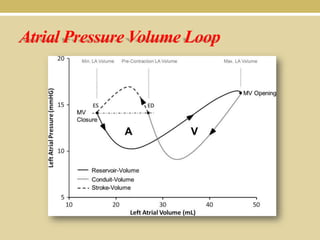
Atrial Pressure Volume Loop
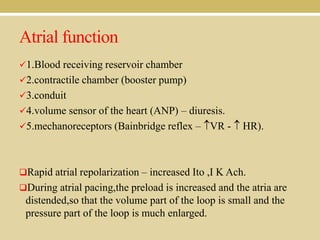
Atrial function
1.Blood receiving reservoir chamber
2.contractile chamber (booster pump)
3.conduit
4.volume sensor of the heart (ANP) – diuresis.
5.mechanoreceptors (Bainbridge reflex –

VR -

HR).

Rapid atrial repolarization – increased Ito ,I K Ach.
During atrial pacing,the preload is increased and the atria are

distended,so that the volume part of the loop is small and the
pressure part of the loop is much enlarged.
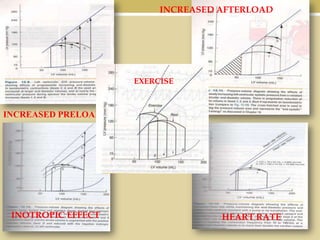
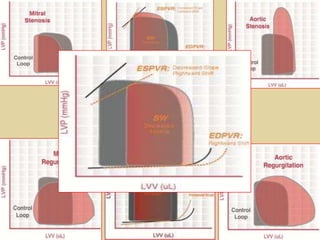
Pressure volume loop diagram
in various pathological
scenarios
INCREASED AFTERLOAD

EXERCISE

INCREASED PRELOAD

INOTROPIC EFFECT

HEART RATE
WIGGERS DIAGRAM
EVENTS IN CARDIAC CYCLE
DETERMINANTS OF MYOCARDIAL PERFORMANCE
PRESSURE VOLUME LOOP
PHYSIOLOGICAL VS PATHOLOGICAL HYPERTROPHY
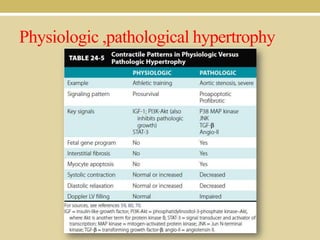
Physiologic ,pathological hypertrophy
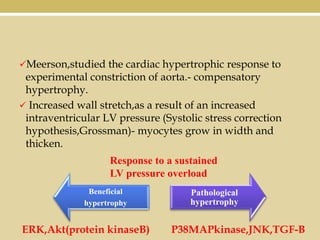
Meerson,studied the cardiac hypertrophic response to

experimental constriction of aorta.- compensatory
hypertrophy.
 Increased wall stretch,as a result of an increased
intraventricular LV pressure (Systolic stress correction
hypothesis,Grossman)- myocytes grow in width and
thicken.
Response to a sustained
LV pressure overload
Beneficial
hypertrophy

ERK,Akt(protein kinaseB)

Pathological
hypertrophy

P38MAPkinase,JNK,TGF-B
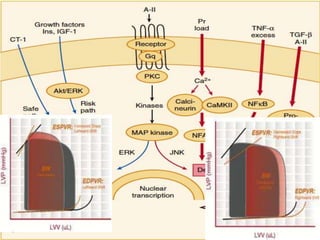
Chronic elevation of the preload was associated with Akt

activation without fibrosis,little apoptosis,better function,and
lower mortality.
Chronic elevation of afterload (AS) caused maladaptive
hypertrophy,increased fibrosis,rapid failure,increased mortality.
Increased release of angiotensin II from myocardium.
TGF B maldaptive hypertrophy in AS (diastolic dysfunction)
Cardiac steatosis in insulin resistance – increased TG
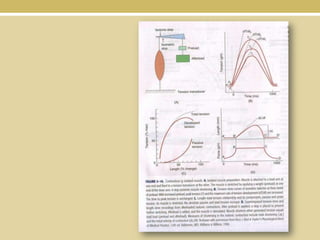
Isometric versus isotonic contraction
An isometric exercise is a form of exercise involving the static

contraction of a muscle without any visible movement in the
angle of the joint.
The term "isometric" combines the Greek words "isos" ("equal"
or "same") and "metron" ("distance" or "measure"), meaning
that in these exercises the length of the muscle and the angle of
the joint do not change, though contraction strength may be
varied.
 This is in contrast to isotonic contractions, in which the
contraction strength does not change, though the muscle length
and joint angle do.
WIGGERS DIAGRAM
EVENTS IN CARDIAC CYCLE
DETERMINANTS OF MYOCARDIAL PERFORMANCE
PRESSURE VOLUME LOOP
PHYSIOLOGICAL VS PATHOLOGICAL HYPERTROPHY

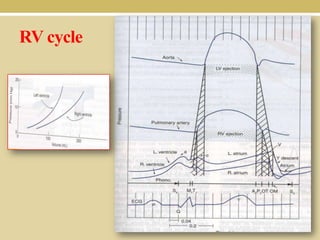
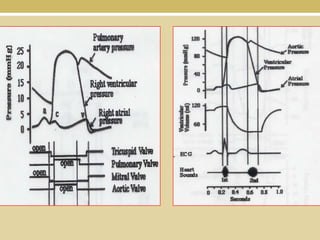
RV CARDIAC CYCLE
RV cycle
References
1.Ganong’s Review of Medical Physiology,24th Edition.
2.Guyton and Hall,Textbook of Medical Physiology.
3.Best and Taylor’s Physiological Basis of Medical

Practice,13th edition.
4.HURST’S,THE HEART ,13th edition
5.Braunwald’s Heart Disease,9th edition
6.Circulation Journal.
7.European Heart Journal.
THE WONDERFUL DAY

11-12-13

cardiac cycle

  • 1.
  • 2.
    Carl John Wiggers OttoFrank Sir Thomas Lewis Ernest H Starling
  • 3.
    William Harvey Adolf EugenFick Willem Einthoven
  • 4.
    Introduction Principal function ofcardiovascular system is to deliver oxygen and nutrients to and remove carbon dioxide and wastes from metabolizing tissues. It is by two specialized circulations in series 1.a low resistance pulmonary driven by right heart 2.a high resistance systemic driven by left heart Systolic pressure in the vascular system refers to the peak pressure reached during the systole,not the mean pressure. The diastolic pressure refers to the lowest pressure during diastole.
  • 5.
    WIGGERS DIAGRAM EVENTS INCARDIAC CYCLE DETERMINANTS OF MYOCARDIAL PERFORMANCE PRESSURE VOLUME LOOP PHYSIOLOGICAL VS PATHOLOGICAL HYPERTROPHY
  • 6.
    Wiggers diagram The Xaxis is used to plot time, The Y axis contains all of the following on a single grid: Blood pressure Aortic pressure Ventricular pressure Atrial pressure Ventricular volume Electrocardiogram Arterial flow (optional) Heart sounds (optional) JVP Illustration of the coordinated events makes it easier to correlate the changes during the cardiac cycle.
  • 10.
    WIGGERS DIAGRAM EVENTS INCARDIAC CYCLE DETERMINANTS OF MYOCARDIAL PERFORMANCE PRESSURE VOLUME LOOP PHYSIOLOGICAL VS PATHOLOGICAL HYPERTROPHY
  • 12.
    Cardiac cycle • Thecardiac cycle describes pressure,volume and flow phenomena in the ventricles as a function of time. • Similar for both LV and RV except for the timing,levels of pressure.
  • 13.
    Mechanical events inCardiac cycle • Systole • Isovolumic contraction • Maximal ejection • Reduced ejection • Diastole • Isovolumic relaxation • Rapid filling phase • Slow filling phase /diastasis • Atrial systole
  • 14.
    LV RELAXATION • Isovolumic contraction(b) • Maximal Ejection(c) LV CONTRACTION • Isovolumic relaxation(e) • Start of relaxation and reduced ejection (d) • Rapid phase(f) • Slow filling (diastasis)(g) • Atrial systole or booster(a) LV FILLING • The letters are arbitrarily allocated so that atrial systole(a) coinicides with the a wave and (c ) with the c wave of JVP.
  • 15.
    LV contraction • Actinmyosin contraction triggered by arrival of Calcium ions at • • • • • • • contractile proteins. ECG – peak of R wave LV pressure >LA pressure (10-15mm Hg) Followed approx. 50msec by M1. Delay of M1 – inertia of the blood flow – valve is kept open. Isovolumic contraction as volume is fixed. Increased pressure as more fibers enter contractile state. LV pressure >Aorta – Aortic valve opens – silent event clinically.
  • 17.
    • Phase ofrapid ejection: • Pressure gradient across the aortic valve • Elastic properties of aorta,arterial tree (systolic expansion) • LV pressure rises to peak and then falls.
  • 19.
    LV relaxation • Activatedphospholamban causes calcium transfer into SR. • Decreases contractile apparatus function – phase of reduced ejection – blood flow from LV to aorta decreases but maintained by aortic recoil – WINDKESSEL EFFECT*. • Aortic valve closes as LV pressure drops • Isovolumic relaxation • Mitral valve opens – clinically silent event. † Giovanni Borelli,Stephen Hales,Fick(mathematical foundation). †WINDKESSEL in german AIRCHAMBER or elastic resorvoir.
  • 20.
    LV filling • Rapidfilling phase – active diastolic relaxation of LV. • LA- LV pressures equalize - diastasis. • LA booster atrial systole – important in exercise and LVH. • First phase of diastole –isovolumic phase – no ventricular • • • • • filling. Most of ventricular filling –rapid filling phase. Diastasis -5% Final atrial booster phase -15%. The sucking effect of ventricle – myosin is pulled into the space between the two anchoring segments of titin. Dominant backward pressure wave –diastolic coronary filling.
  • 23.
    Physiologic systole,diastole • Itis related to the events occuring at the cellular level ,by change of pressure and the electrical events. • Physiological systole –start of isovolumic contraction to the peak of ejection phase. • Physiological diastole – commences as pressure falls. • Fits well in pressure volume curve .
  • 24.
    Cardiological systole,diastole • Itis related to the valve closures. • Systole – M1-A2 • Thereby starts later than physiological systole and ends later. • Diastole – A2-M1
  • 26.
    Protodiastole • Proto –meansoriginal,first • The period of start of ventricular relaxation. • Lasts until the semilunar valves are closed. • It is 0.04 sec.
  • 28.
    ECHO cardiac cycle Rapidfilling phase of diastole Atrial systole
  • 30.
    Phonocardiogram A graphic recordingof cardiac sound A specially designed microphone on the chest wall. Sound waves amplified, filtered and recorded. Doppler Echocardiography has replaced the phonocardiography
  • 31.
    Carotid Pulse Tracing(CPT) Reflects the pressure and possible small volume changes in a segment of the carotid artery with each cardiac cycle. P (percussion wave) is the first peak and is related to aortic ejection. 80 msec after the first heart sound. T (tidal wave) is the second wave and occurs late in systole. D (dicrotic notch) coincides with aortic closure (A2), plus the traveling time of the pulse to the neck (.01-.05 sec).
  • 33.
    Causes of Abnormalitiesin the Carotid Pulse
  • 34.
  • 35.
    JUGULAR VENOUS PULSE Reflectsvolume change in the internal jugular vein and closely resembles the pressure changes in the right atrium. A wave atrial contraction. C wave onset of ventricular contraction. X descent atrial diastole. V wave atrial filling before AV valves open. Y descent AV valves open filling of the ventricles.
  • 36.
  • 37.
    Apex cardiogram Records low-frequencyvibrations over the apical impulse. Deflections not delayed. A –atrial contraction. C –onset of LV contraction. E – peak of the ascent (initial ejection from LV to aorta) O – opening of the mitral valve. RF –rapid filling wave SF – slow filling wave.
  • 39.
    WIGGERS DIAGRAM EVENTS INCARDIAC CYCLE DETERMINANTS OF MYOCARDIAL PERFORMANCE PRESSURE VOLUME LOOP PHYSIOLOGICAL VS PATHOLOGICAL HYPERTROPHY
  • 40.
    Determinants of myocardialmechanical performance 3 main determinants Loading conditions (preload,afterload) Contractile state Heart rate
  • 41.
    Preload • Wall stressat the end of diastole – maximum resting length of sarcomere. • Increasing LVEDV increases SV in ejecting beats,increases LV pressure in isovolumic beats. • Modulation of ventricular performance by changes in preload with constant afterload –heterometric autoregulation,operates on a beat –to beat basis.
  • 42.
    Frank Starling mechanism •Starling – venous pressure in RA – heart volume • Within physiological limits – the larger the volume of the heart • • • • –greater the energy of its contraction – the greater the amount of chemical change at each contraction. LV volume – Cardiac Output Stroke volume related to LVEDV – modern version Real time 3D ECHO – global LV volume,endocardial function LV volume surrogate markers – LVEDP ,PCWP.
  • 43.
    • Frank –greater the initial LV volume – more rapid rate of rise – • • • • • • • greater the peak pressure reached –faster the rate of relaxation. An important compensatory mechanism that maintains stroke volume,when there is myocardial dysfunction or excessive afterload. Atria also exhibit frank starling curve – exercise.(resistance to early diastolic filling). Passive P-V relationship is exponential. Chronic volume overload – EDPVR – rightward. Chronic pressure overload –EDPVR - leftward. Increased diastolic filling –Starling. Increased inotropic effect – Frank
  • 44.
    Afterload Exact definition –wall stress during LV ejection. Tension in the LV wall that resists ventricular ejection or as the arterial input impedance. In clinical practice the arterial blood pressure is often taken as synonymous with afterload while ignoring aortic compliance (increase in stiff aorta).
  • 45.
    Anrep effect • Homeometricautoregulation • Under experimental conditions sudden marked increase in aortic pressure is produced,LVEDP initially rises and the stroke volume then recovers. • Increased LV wall tension – increases Cytosolic Na - Calcium
  • 47.
    Heart rate • Ratethat would give maximal mechanical performance of an isolated muscle strip , also determined by the need for adequate time for diastolic filling. • Normally – pacing rates of 150/min –tolerated. • During exercise – 170/min • LVH – 100-130/min
  • 49.
    Bowditch phenomenon Treppe effect Positiveinotropic effect of activation Force freqeuncy relation • “increased heart rate – increases force of ventricular contraction” HR – negative staircase effect • More rapid stimulation – more sodium and calcium ions enter the myocardial cell that can be handled by sodium pump and the mechanisms for calcium exit - decreased force.  Clinical implications AF with varying interval. In HF – phenomenon is muted or lost. Post extrasystolic potentiation ,inotropic effect of paired pacing – increased contractile state. •
  • 51.
    Contractility • It isthe inherent capacity of the myocardium to contract independently of changes in the preload and afterload. • An increased contractile function –assosciated with greater degree of relaxation – LUSITROPIC effect • Important regulator of My02 uptake • Increased contractile function – exercise,adrenergic stimulation,digitalis,other inotropic agents.
  • 52.
    Ventricular relaxation Four factorsare of chief interest in influencing relaxation. 1.cytosolic calcium must fall to cause the relaxation phase(ATP,phospholamban). 2.the inherent viscoelastic properties of the myocardium.(hypertrophy) 3.increased phosphorylation of troponin I enhances the rate of relaxation. 4.systolic load influences relaxation(increased systolic load,increased lusitropic effect)(Brutsaert). Impaired relaxation is an early event of angina pectoris(decreased ATP –decreased early diastole filling). -dp/dt = (rate of isovolumetric relaxation)* *Glanz method P(t)= P0e-t⁄τE +Pα
  • 53.
    Diastolic stiffness  Diastoleis the summation of processes by which the heart loses its ability to generate force and shorten and returns to its precontractile state.  Chamber stiffness is quantified from the relationship between diastolic LV pressure and volume.  Volume dependent (slope of the tangent drawn to the PV curve)  Volume independent(intrinsic,extrinsic)  Diastolic LV stress( ) and strain( ).  Strain is the deformation of the muscle produced by an applied force and is expressed as percent change in length from unstressed length.
  • 55.
    Time varying elastanceconcept Ventricular volume and loading are altered under conditions of unvarying contractility.(frank starling preparations are load independent). At any time t,following the onset of contraction,the P-V relation is linear P(t) = E(t)-{V(t)-Vo},E –time varying elastance,Vo is volume at zero pressure or dead volume. Ventricle behaves like a spring with a stiffness(elastance) that increases during contraction,decreases during relaxation. PVA area bounded by the LV P-V loop is a measure of the total mechanical energy of LV contraction.
  • 57.
    Formulae Ejection fraction =(stroke volume/end diastolic volume 100). Wall tension = (P.r)/2h(P pressure,r radius,h wall thickness) EA = PES/SV , [E- effective arterial resistance,PES-end systolic pressure,SV- stroke volume}. EA/Ees ratio (index of ventriculo arterial coupling,pump performance). Fick equation VO2 = Q(AVO2)  V/ P = compliance. P/ V =stiffness Cardiac output = stroke volume HR PVA = PE+SW PE = PES(VES-V0)/2 – PED(VED-V0)/4 PVA MV02
  • 58.
    PRESSURES (mm Hg) Rightatrium mean 0-5 wave Normalavalues 1-7 Right ventricle peak systolic/end diastolic 17-32/1-7 Pulmonary artery peak systolic/end diastolic 17-32/1-7 v wave 1-7 mean 9-19 PCWP 4-12 LA mean 4-12 a wave 4-15 v wave 4-15 LV peak systolic/end diastolic 90-140/5-12 Aorta peak systolic/end diastolic 90-140 /60-90 mean 70-105 Resistance (dynes/cm2) SVR 900-1400 PVR 40-120 Oxygen consumption index (L-min/m2) 115-140 Cardiac index (L-min/m2) 2.8-4.2
  • 59.
    WIGGERS DIAGRAM EVENTS INCARDIAC CYCLE DETERMINANTS OF MYOCARDIAL PERFORMANCE PRESSURE VOLUME LOOP PHYSIOLOGICAL VS PATHOLOGICAL HYPERTROPHY
  • 60.
    Pressure volume loop •Best of the current approaches to the assessment of the • • • • • contractile behaviour of the intact heart. Es,the pressure – volume relationship . Changes in the slope of this line joining the different Es points are generally good load independent index of the contractile performance of the heart. Enhanced inotropic effect, Es shifted upward and to the left. Lusitropic effect shifted Es downward and to right. The P-V relationship is linear in smooth muscle,curvilinear in cardiac muscle(exponential).
  • 64.
  • 65.
    Atrial function 1.Blood receivingreservoir chamber 2.contractile chamber (booster pump) 3.conduit 4.volume sensor of the heart (ANP) – diuresis. 5.mechanoreceptors (Bainbridge reflex – VR - HR). Rapid atrial repolarization – increased Ito ,I K Ach. During atrial pacing,the preload is increased and the atria are distended,so that the volume part of the loop is small and the pressure part of the loop is much enlarged.
  • 66.
    Pressure volume loopdiagram in various pathological scenarios
  • 67.
  • 69.
    WIGGERS DIAGRAM EVENTS INCARDIAC CYCLE DETERMINANTS OF MYOCARDIAL PERFORMANCE PRESSURE VOLUME LOOP PHYSIOLOGICAL VS PATHOLOGICAL HYPERTROPHY
  • 70.
  • 71.
    Meerson,studied the cardiachypertrophic response to experimental constriction of aorta.- compensatory hypertrophy.  Increased wall stretch,as a result of an increased intraventricular LV pressure (Systolic stress correction hypothesis,Grossman)- myocytes grow in width and thicken. Response to a sustained LV pressure overload Beneficial hypertrophy ERK,Akt(protein kinaseB) Pathological hypertrophy P38MAPkinase,JNK,TGF-B
  • 72.
    Chronic elevation ofthe preload was associated with Akt activation without fibrosis,little apoptosis,better function,and lower mortality. Chronic elevation of afterload (AS) caused maladaptive hypertrophy,increased fibrosis,rapid failure,increased mortality. Increased release of angiotensin II from myocardium. TGF B maldaptive hypertrophy in AS (diastolic dysfunction) Cardiac steatosis in insulin resistance – increased TG
  • 74.
    Isometric versus isotoniccontraction An isometric exercise is a form of exercise involving the static contraction of a muscle without any visible movement in the angle of the joint. The term "isometric" combines the Greek words "isos" ("equal" or "same") and "metron" ("distance" or "measure"), meaning that in these exercises the length of the muscle and the angle of the joint do not change, though contraction strength may be varied.  This is in contrast to isotonic contractions, in which the contraction strength does not change, though the muscle length and joint angle do.
  • 76.
    WIGGERS DIAGRAM EVENTS INCARDIAC CYCLE DETERMINANTS OF MYOCARDIAL PERFORMANCE PRESSURE VOLUME LOOP PHYSIOLOGICAL VS PATHOLOGICAL HYPERTROPHY RV CARDIAC CYCLE
  • 77.
  • 79.
    References 1.Ganong’s Review ofMedical Physiology,24th Edition. 2.Guyton and Hall,Textbook of Medical Physiology. 3.Best and Taylor’s Physiological Basis of Medical Practice,13th edition. 4.HURST’S,THE HEART ,13th edition 5.Braunwald’s Heart Disease,9th edition 6.Circulation Journal. 7.European Heart Journal.
  • 80.