Skeletal tissue and system
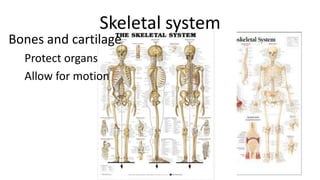
Skeletal system

Bones and cartilage
Protect organs
Allow for motion
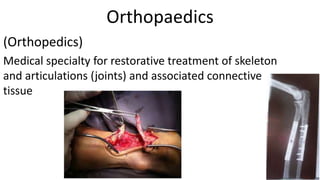
Orthopaedics
(Orthopedics)
Medical specialty for restorative treatment of skeleton
and articulations (joints) and associated connective
tissue
Skeletal system tissue
Cartilage
Bone
Dense connective
Skeletal system functions
Support
Protection
Movement (along with attached muscle)
Mineral Storage (calcium)
Storage and production of blood cell – red marrow
(hematopoiesis)
Energy storage -yellow marrow
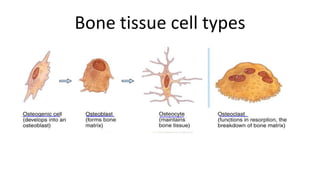
Bone tissue cell types
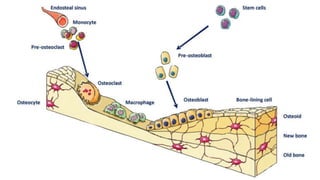
Osteogenic (osteoprogenitor) cells
From mesenchyme
Can proliferate (mitosis)
Can differentiate
In periosteum, endosteum and canalicula
Osteoblasts
Form bone
Produce & secrete organic (collagenous)
components
Produce & secrete mineral salts (hydroxyapatite;
calcium phosphate, calcium carbonate)
Can no longer divide
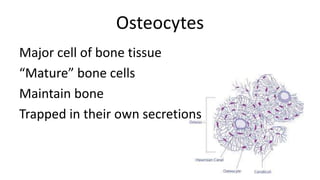
Osteocytes
Major cell of bone tissue
“Mature” bone cells
Maintain bone
Trapped in their own secretions
Osteoclasts
Reabsorb bone (degrade bone)
Critical for remodeling and development and
repair
Located on bone surface
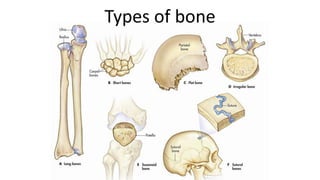
Types of bone
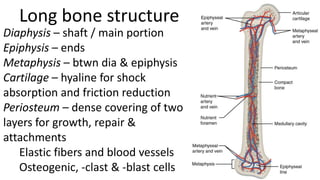
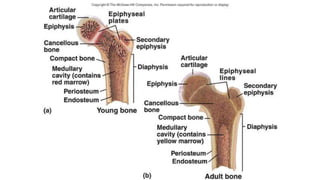
Long bone structure
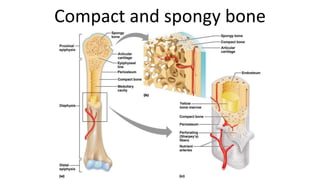
Diaphysis – shaft / main portion
Epiphysis – ends
Metaphysis – btwn dia & epiphysis
Cartilage – hyaline for shock
absorption and friction reduction
Periosteum – dense covering of two
layers for growth, repair &
attachments
Elastic fibers and blood vessels
Osteogenic, -clast & -blast cells
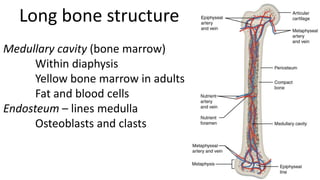
Long bone structure
Medullary cavity (bone marrow)
Within diaphysis
Yellow bone marrow in adults
Fat and blood cells
Endosteum – lines medulla
Osteoblasts and clasts
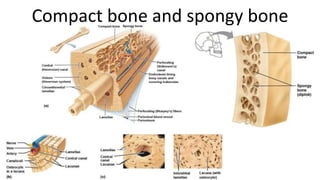
Compact bone and spongy bone
Compact and spongy bone
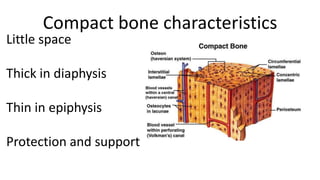
Compact bone characteristics

Little space

Thick in diaphysis
Thin in epiphysis
Protection and support
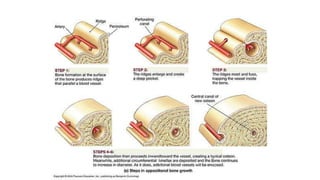
Compact bone structure
Rings of bone material - Osteons
– Contain osteocytes
– Lacunae – space in which osteocytes are trapped
– Canaliculi – connect to lacunae, “little canals” for
nutrient and waste distribution
– Central canals – lead to perforating canals
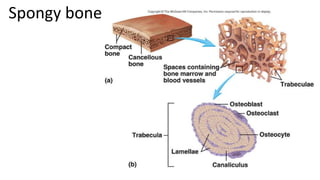
Spongy bone
Spongy bone
No true osteons
Trabeculae – irregular thin bone plates
Red marrow between trabeculae
Produces blood cells

Osteocyte containing lacunae within trabeculae
Bone Formation
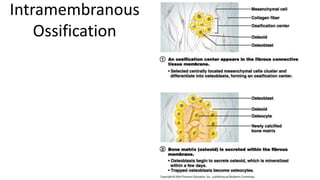
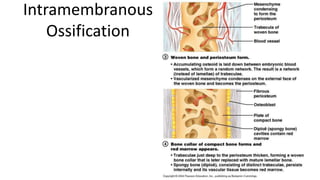
Intramembranous Ossification
Formation of bone within fibrous membranes
Forms flat bones of skull

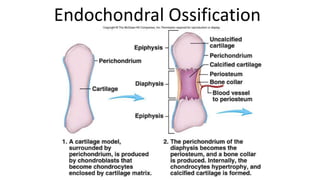
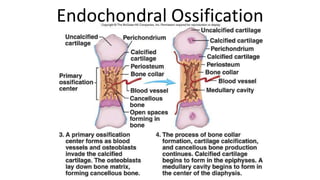
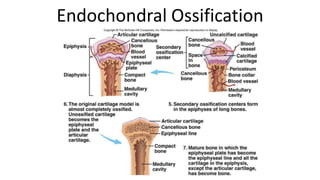
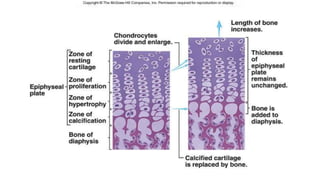
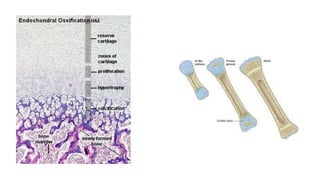
Endochondral ossification
Most common type of bone formation
Bone forms from cartilage
Intramembranous
Ossification
Intramembranous
Ossification
Endochondral Ossification
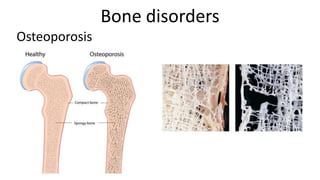
Bone disorders
Osteoporosis
Bone disorders
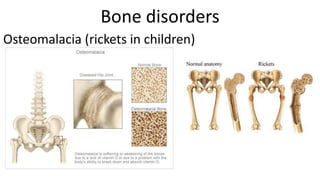
Osteomalacia (rickets in children)
Bone disorders
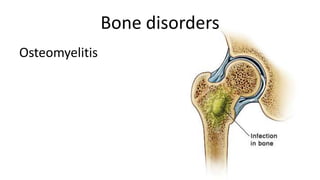
Osteomyelitis
Bone disorders
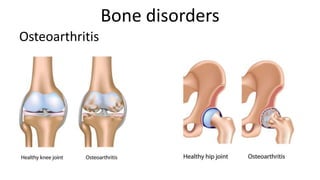
Osteoarthritis
Bone disorders
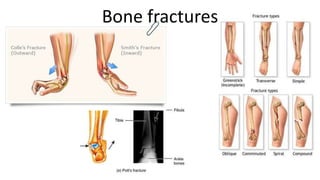
Bone fractures
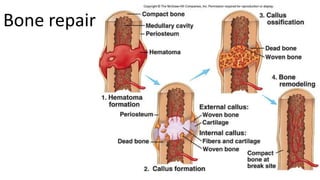
Bone repair
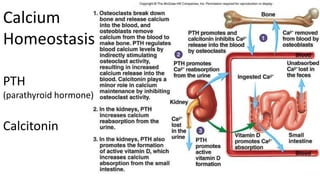
Calcium
Homeostasis
PTH
(parathyroid hormone)

Calcitonin

Skeletal tissue