OTIC GANGLIA
Rana Usama Amjad
MBBS-II
Rai Medical College Sargodha
OTIC GANGLIA
.Parasympathetic Ganglia
.Topographically:
Mandibular Nerve
.Functionally:
Glossopharyngeal Nerve
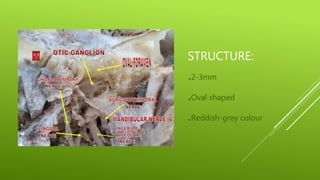
STRUCTURE:
.2-3mm
.Oval shaped
.Reddish-grey colour
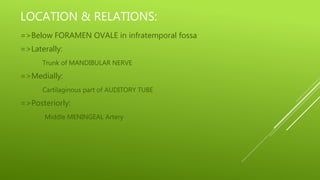
LOCATION & RELATIONS:
=>Below FORAMEN OVALE in infratemporal fossa
=>Laterally:
Trunk of MANDIBULAR NERVE
=>Medially:
Cartilaginous part of AUDITORY TUBE
=>Posteriorly:
Middle MENINGEAL Artery
CONNECTIONS:
3 types of connections…
.Parasympathetic
.Sympathetic
.Sensory & Motor
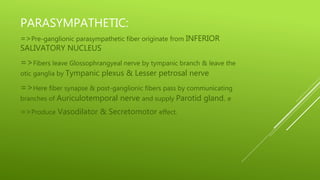
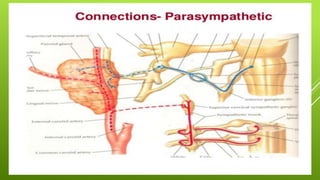
PARASYMPATHETIC:
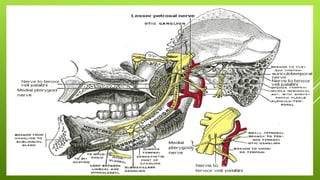
=>Pre-ganglionic parasympathetic fiber originate from INFERIOR
SALIVATORY NUCLEUS
=>Fibers leave Glossophrangyeal nerve by tympanic branch & leave the
otic ganglia by Tympanic plexus & Lesser petrosal nerve
=>Here fiber synapse & post-ganglionic fibers pass by communicating
branches of Auriculotemporal nerve and supply Parotid gland. e
=>Produce Vasodilator & Secretomotor effect.
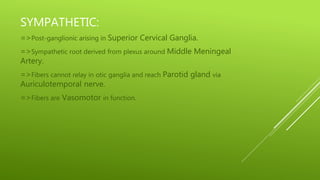
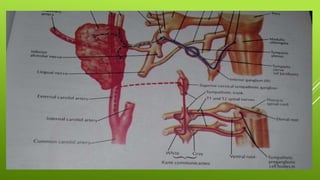
SYMPATHETIC:
=>Post-ganglionic arising in Superior Cervical Ganglia.
=>Sympathetic root derived from plexus around Middle Meningeal
Artery.
=>Fibers cannot relay in otic ganglia and reach Parotid gland via
Auriculotemporal nerve.
=>Fibers are Vasomotor in function.
SENSORY & MOTOR:
=>Sensory root comes from Auriculotemporal nerve and is sensory
to Parotid Gland.
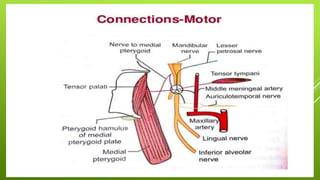
=>Motor fibers pass through otic ganglia without relay and supply
following Muscles…
i)Medial pterygoid
ii)Tensor Platini
iii)Tensor Tympani
=>Due to connection with Chorda Tympani the pathway provide an
alternate pathway for Taste Sensation.
CLINICAL SIGNIFICANCE:
Frey's Syndrome:
=>Due to damage of Auriculotemporal nerve
=>Salivation induce perspiration(sweating)
=>accompanied with ERYTHEMA(reddening of skin)
Otic Ganglia

Otic Ganglia