Cardiac Cycle
By
Mubin Mustafa Kiyani
Cardiac cycle
The Conducting System
• Heartbeat
– A single contraction of the heart
– The entire heart contracts in series
• First the atria
• Then the ventricles
The Conducting System
• Structures of the Conducting System
– Sinoatrial (SA) node - wall of right atrium
– Atrioventricular (AV) node - junction between
atria and ventricles
– Conducting cells - throughout myocardium
The Conducting System
• Conducting Cells
– Interconnect SA and AV nodes
– Distribute stimulus through myocardium
– In the atrium
• Internodal pathways

– In the ventricles
• AV bundle and the bundle branches
The Conducting System

Figure : The Conducting System of the Heart
The Conducting System
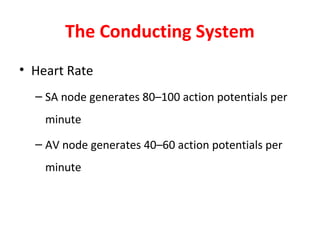
• Heart Rate
– SA node generates 80–100 action potentials per
minute
– AV node generates 40–60 action potentials per
minute
The Conducting System
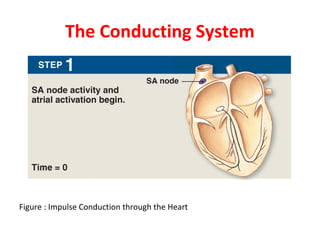
• The Sinoatrial (SA) Node
– In posterior wall of right atrium
– Contains pacemaker cells
– Connected to AV node by internodal pathways
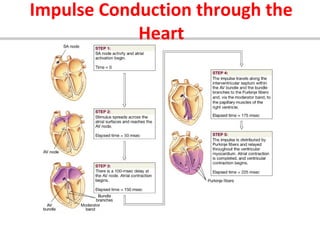
– Begins atrial activation (Step 1)
The Conducting System

Figure : Impulse Conduction through the Heart
The Conducting System
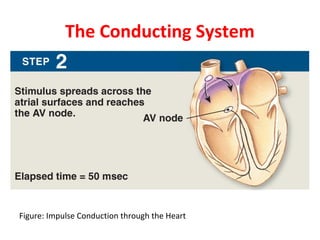
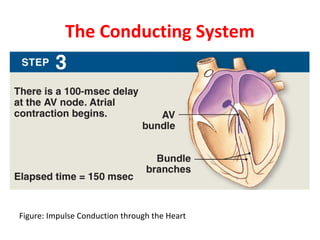
• The Atrioventricular (AV) Node
– In floor of right atrium
– Receives impulse from SA node (Step 2)
– Delays impulse (Step 3)
– Atrial contraction begins
The Conducting System

Figure: Impulse Conduction through the Heart
The Conducting System

Figure: Impulse Conduction through the Heart
The Conducting System
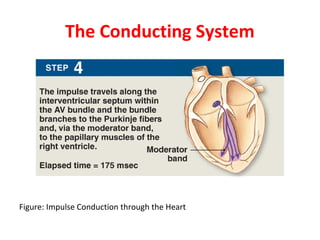
• The AV Bundle
– In the septum
– Carries impulse to left and right bundle branches
• Which conduct to Purkinje fibers (Step 4)

– And to the moderator band
• Which conducts to papillary muscles
The Conducting System

Figure: Impulse Conduction through the Heart
The Conducting System
• Purkinje Fibers
– Distribute impulse through ventricles (Step 5)
– Atrial contraction is completed
– Ventricular contraction begins
The Conducting System

Figure: Impulse Conduction through the Heart
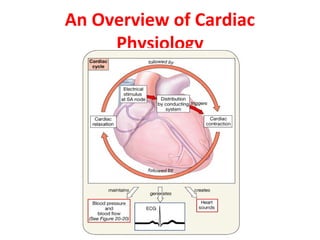
An Overview of Cardiac
Physiology
Cardiac Cycle
The cardiac events that occur from the
beginning of one heartbeat to the beginning
of the next are called the cardiac cycle.
• The cardiac cycle consists:
– Period of relaxation - diastole,
• during which the heart fills with blood,
– Followed by a period of contraction called systole.
• during which heart ejects blood
Cardiac Cycle
• During systole there is contraction of the cardiac
muscle and pumping of blood from the heart
through arteries.
• During diastole, there is relaxation of cardiac muscle
and filling of blood.
• Various changes occur in different chambers of heart
during each heartbeat. These changes are repeated
during every heartbeat in a cyclic manner.
• Each cycle is initiated by spontaneous generation of
action potential in the S.A node.
Divisions of cardiac cycle
• The cardiac cycle consists of a period of relaxation
called diastole, during which the heart fills with blood
this period is followed by a period of contraction called
systole.
• The contraction and relaxation of atria are called atrial
systole and atrial diastole respectively.
• The contraction and relaxation of ventricles are called
ventricular systole and ventricular diastole
respectively.
Requirements for Efficient Cardiac
Contraction
1. Atrial excitation and contraction need to be
complete before ventricular contraction
occurs.
2. Excitation of cardiac muscle fibers should be
coordinated so that each chamber contracts
as a unit.
3. Pair of atria and pair of ventricles should be
coordinated so that both members of the
pair contract simultaneously.
Cardiac cycle
• First assembled by Lewis in 1920 but first conceived by Wiggers in
1915
• It is named after Dr. Carl J. Wiggers, M.D.
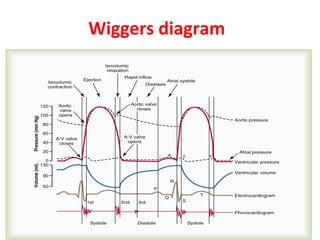
• A Wiggers diagram is a standard diagram used in cardiac physiology
• The X axis is used to plot time, while the Y axis contains all of the
following on a single grid:
• Blood pressure
Aortic pressure
Ventricular pressure
Atrial pressure
• Ventricular volume
• Electrocardiogram
• Arterial flow (optional)
• Heart sounds (optional)
Wiggers diagram
Phases of Cardiac cycle
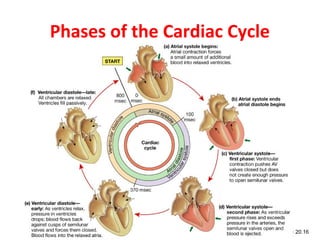
1. Atrial systole
2. Isovolumic contraction
3. Ejection
4. Isovolumic relaxation
5. Rapid inflow
6. Diastasis
Phases of the Cardiac Cycle

Figure 20.16
The Cardiac Cycle
• Cardiac Cycle and Heart Rate
– At 75 beats per minute
• Cardiac cycle lasts about 800 msecs

– When heart rate increases
• All phases of cardiac cycle shorten, particularly diastole
The Cardiac Cycle

Figure 20–17 Pressure and Volume Relationships in the Cardiac Cycle
Copyright © 2009 Pearson
Education, Inc., publishing as
Pearson Benjamin Cummings
The Cardiac Cycle
Eight Steps in the Cardiac Cycle
1. Atrial systole
•

Atrial contraction begins

•

Right and left AV valves are open

1. Atria eject blood into ventricles
•

Filling ventricles

3. Atrial systole ends
•

AV valves close

•

Ventricles contain maximum blood volume

•

Known as end-diastolic volume (EDV)
The Cardiac Cycle
Eight Steps in the Cardiac Cycle
4. Ventricular systole
•

Isovolumetric ventricular contraction

•

Pressure in ventricles rises

•

AV valves shut

5. Ventricular ejection
•

Semilunar valves open

•

Blood flows into pulmonary and aortic trunks

•

Stroke volume (SV) = 60% of end-diastolic volume
The Cardiac Cycle
Eight Steps in the Cardiac Cycle
6. Ventricular pressure falls
•

Semilunar valves close

•

Ventricles contain end-systolic volume (ESV), about 40% of enddiastolic volume

7. Ventricular diastole
•

Ventricular pressure is higher than atrial pressure

•

All heart valves are closed

•

Ventricles relax (isovolumetric relaxation)
The Cardiac Cycle
Eight Steps in the Cardiac Cycle
8. Atrial pressure is higher than ventricular
pressure
•

AV valves open

•

Passive atrial filling

•

Passive ventricular filling

•

Cardiac cycle ends
Pressure changes in the atria
•

a, c and v atrial pressure waves are noted in atria

•

The ‘a’ wave is caused by the atrial contraction, during right atrial
contraction pressure increases 4-6 mm of Hg, while in left atrium it is 7-8
mm of Hg.

•

The ‘c’ wave occur when the ventricles begin to contract, it is caused
partially by slight back flow of blood when there is ventricular
contraction, but mainly by bulging the A-V valves backward toward the
atria because of increasing pressure in ventricles

•

The ‘v’ wave occur toward the end of ventricular contraction, this is
caused by the slow flow of blood from great veins while the A-V valves
are closed, when A-V valves opens allowing the store blood into
ventricle this ‘v’ wave disappear.
Wiggers diagram
Summary: Pathway of Heartbeat
• Begins in the sinoatrial (S-A)
node
• Internodal pathway to
atrioventricular (A-V) node
• Impulse delayed in A-V node
(allows atria to contract before
ventricles)
• A-V bundle takes impulse into
ventricles
• Left and right bundles of
Purkinje fibers take
impulses to all parts of
ventricles

KEY

Red = specialized cells;
all else = contractile cells
Impulse Conduction through the
Heart
Time Intervals
Total ventricular systole
0.3 sec
• Isovolumic contraction (b) 0.05 sec (0.015sec for RV)
• Maximal ejection (c)
0.1 sec
• Reduced ejection (d)
0.15 sec
Total ventricular diastole
0.5 sec
• Isovolumic relaxation (e) 0.1 sec
• Rapid filling phase (f)
0.1 sec
• Slow filling (diastasis) (g) 0.2 sec
• Atrial systole or booster (a) 0.1 sec
GRAND TOTAL (Syst+Diast) = 0.8 sec
Cardiac cycle

Cardiac cycle physiology_4_dpt

  • 1.
  • 2.
  • 3.
    The Conducting System •Heartbeat – A single contraction of the heart – The entire heart contracts in series • First the atria • Then the ventricles
  • 4.
    The Conducting System •Structures of the Conducting System – Sinoatrial (SA) node - wall of right atrium – Atrioventricular (AV) node - junction between atria and ventricles – Conducting cells - throughout myocardium
  • 5.
    The Conducting System •Conducting Cells – Interconnect SA and AV nodes – Distribute stimulus through myocardium – In the atrium • Internodal pathways – In the ventricles • AV bundle and the bundle branches
  • 6.
    The Conducting System Figure: The Conducting System of the Heart
  • 7.
    The Conducting System •Heart Rate – SA node generates 80–100 action potentials per minute – AV node generates 40–60 action potentials per minute
  • 8.
    The Conducting System •The Sinoatrial (SA) Node – In posterior wall of right atrium – Contains pacemaker cells – Connected to AV node by internodal pathways – Begins atrial activation (Step 1)
  • 9.
    The Conducting System Figure: Impulse Conduction through the Heart
  • 10.
    The Conducting System •The Atrioventricular (AV) Node – In floor of right atrium – Receives impulse from SA node (Step 2) – Delays impulse (Step 3) – Atrial contraction begins
  • 11.
    The Conducting System Figure:Impulse Conduction through the Heart
  • 12.
    The Conducting System Figure:Impulse Conduction through the Heart
  • 13.
    The Conducting System •The AV Bundle – In the septum – Carries impulse to left and right bundle branches • Which conduct to Purkinje fibers (Step 4) – And to the moderator band • Which conducts to papillary muscles
  • 14.
    The Conducting System Figure:Impulse Conduction through the Heart
  • 15.
    The Conducting System •Purkinje Fibers – Distribute impulse through ventricles (Step 5) – Atrial contraction is completed – Ventricular contraction begins
  • 16.
    The Conducting System Figure:Impulse Conduction through the Heart
  • 17.
    An Overview ofCardiac Physiology
  • 18.
    Cardiac Cycle The cardiacevents that occur from the beginning of one heartbeat to the beginning of the next are called the cardiac cycle.
  • 19.
    • The cardiaccycle consists: – Period of relaxation - diastole, • during which the heart fills with blood, – Followed by a period of contraction called systole. • during which heart ejects blood
  • 20.
    Cardiac Cycle • Duringsystole there is contraction of the cardiac muscle and pumping of blood from the heart through arteries. • During diastole, there is relaxation of cardiac muscle and filling of blood. • Various changes occur in different chambers of heart during each heartbeat. These changes are repeated during every heartbeat in a cyclic manner. • Each cycle is initiated by spontaneous generation of action potential in the S.A node.
  • 21.
    Divisions of cardiaccycle • The cardiac cycle consists of a period of relaxation called diastole, during which the heart fills with blood this period is followed by a period of contraction called systole. • The contraction and relaxation of atria are called atrial systole and atrial diastole respectively. • The contraction and relaxation of ventricles are called ventricular systole and ventricular diastole respectively.
  • 23.
    Requirements for EfficientCardiac Contraction 1. Atrial excitation and contraction need to be complete before ventricular contraction occurs. 2. Excitation of cardiac muscle fibers should be coordinated so that each chamber contracts as a unit. 3. Pair of atria and pair of ventricles should be coordinated so that both members of the pair contract simultaneously.
  • 24.
    Cardiac cycle • Firstassembled by Lewis in 1920 but first conceived by Wiggers in 1915 • It is named after Dr. Carl J. Wiggers, M.D. • A Wiggers diagram is a standard diagram used in cardiac physiology • The X axis is used to plot time, while the Y axis contains all of the following on a single grid: • Blood pressure Aortic pressure Ventricular pressure Atrial pressure • Ventricular volume • Electrocardiogram • Arterial flow (optional) • Heart sounds (optional)
  • 25.
  • 26.
    Phases of Cardiaccycle 1. Atrial systole 2. Isovolumic contraction 3. Ejection 4. Isovolumic relaxation 5. Rapid inflow 6. Diastasis
  • 27.
    Phases of theCardiac Cycle Figure 20.16
  • 28.
    The Cardiac Cycle •Cardiac Cycle and Heart Rate – At 75 beats per minute • Cardiac cycle lasts about 800 msecs – When heart rate increases • All phases of cardiac cycle shorten, particularly diastole
  • 29.
    The Cardiac Cycle Figure20–17 Pressure and Volume Relationships in the Cardiac Cycle Copyright © 2009 Pearson Education, Inc., publishing as Pearson Benjamin Cummings
  • 30.
    The Cardiac Cycle EightSteps in the Cardiac Cycle 1. Atrial systole • Atrial contraction begins • Right and left AV valves are open 1. Atria eject blood into ventricles • Filling ventricles 3. Atrial systole ends • AV valves close • Ventricles contain maximum blood volume • Known as end-diastolic volume (EDV)
  • 31.
    The Cardiac Cycle EightSteps in the Cardiac Cycle 4. Ventricular systole • Isovolumetric ventricular contraction • Pressure in ventricles rises • AV valves shut 5. Ventricular ejection • Semilunar valves open • Blood flows into pulmonary and aortic trunks • Stroke volume (SV) = 60% of end-diastolic volume
  • 32.
    The Cardiac Cycle EightSteps in the Cardiac Cycle 6. Ventricular pressure falls • Semilunar valves close • Ventricles contain end-systolic volume (ESV), about 40% of enddiastolic volume 7. Ventricular diastole • Ventricular pressure is higher than atrial pressure • All heart valves are closed • Ventricles relax (isovolumetric relaxation)
  • 33.
    The Cardiac Cycle EightSteps in the Cardiac Cycle 8. Atrial pressure is higher than ventricular pressure • AV valves open • Passive atrial filling • Passive ventricular filling • Cardiac cycle ends
  • 34.
    Pressure changes inthe atria • a, c and v atrial pressure waves are noted in atria • The ‘a’ wave is caused by the atrial contraction, during right atrial contraction pressure increases 4-6 mm of Hg, while in left atrium it is 7-8 mm of Hg. • The ‘c’ wave occur when the ventricles begin to contract, it is caused partially by slight back flow of blood when there is ventricular contraction, but mainly by bulging the A-V valves backward toward the atria because of increasing pressure in ventricles • The ‘v’ wave occur toward the end of ventricular contraction, this is caused by the slow flow of blood from great veins while the A-V valves are closed, when A-V valves opens allowing the store blood into ventricle this ‘v’ wave disappear.
  • 35.
  • 36.
    Summary: Pathway ofHeartbeat • Begins in the sinoatrial (S-A) node • Internodal pathway to atrioventricular (A-V) node • Impulse delayed in A-V node (allows atria to contract before ventricles) • A-V bundle takes impulse into ventricles • Left and right bundles of Purkinje fibers take impulses to all parts of ventricles KEY Red = specialized cells; all else = contractile cells
  • 37.
  • 38.
    Time Intervals Total ventricularsystole 0.3 sec • Isovolumic contraction (b) 0.05 sec (0.015sec for RV) • Maximal ejection (c) 0.1 sec • Reduced ejection (d) 0.15 sec Total ventricular diastole 0.5 sec • Isovolumic relaxation (e) 0.1 sec • Rapid filling phase (f) 0.1 sec • Slow filling (diastasis) (g) 0.2 sec • Atrial systole or booster (a) 0.1 sec GRAND TOTAL (Syst+Diast) = 0.8 sec
  • 39.

Editor's Notes

  • #24 2. Need functional syncitium so all contracting at same time